




Abstract
Ostracism, feeling ignored and excluded, causes social pain and lowers well-being. People cope with ostracism in various ways. However, past studies on coping with ostracism often focused on one specific behavior (e.g., aggression), measured at a single time point. Such designs limit our understanding of the diversity and temporal trajectory of coping behaviors. We used a time-contingent sampling method with two additional follow-up assessments to capture immediate and later coping responses at Day 0, Day 3, and Day 6 after a naturally occurring ostracism experience (N = 143; 363 coping responses:). Our findings reveal that individuals initially prioritize withdrawal and prosocial coping, with prosocial responses becoming more prominent over time, while antisocial coping remained rare throughout all assessments. Moreover, individuals exhibited other (cognitive) coping strategies and non-responses, going beyond current ostracism coping taxonomies. These findings advance the understanding of ostracism coping by emphasizing a temporal perspective.
Ostracism, feeling ignored and excluded, can severely undermine psychological and emotional well-being (Williams, 2007), and is associated with increased risk of depression, suicidal ideation, extremism, and mass violence (Kowalski & Leary, 2024; Rudert, Janke, & Greifeneder, 2021). Understanding how individuals cope with ostracism has the potential to help address these outcomes. Although its negative impact is well documented, how people cope remains unclear. Current understanding is constrained in several key aspects. First, while theories suggest key responses to ostracism (antisocial, prosocial, and withdrawal: Ren et al., 2016; Smart Richman & Leary, 2009; Williams, 2009), empirical studies often examine each response in isolation. For instance, studying antisocial tendencies without considering prosocial or withdrawal behaviors limits the ability to compare these responses. Second, most research is conducted in lab settings, which restricts our understanding of responses to ostracism in everyday life (for exceptions, see Büttner et al., 2024; Büttner & Greifeneder, 2024; Nezlek et al., 2012; Pancani et al., 2023). In addition, responses are measured at a single time point, overlooking that coping behaviors can be multifold and might change over time. To address these gaps, we used a time-contingent sampling method with two additional follow-up assessments to capture real-life ostracism events and measured a range of behavioral responses simultaneously and over time.
Coping Behaviors in Response to Ostracism
The Temporal Need-Threat Model (TNTM; Williams, 2009) explains how, after the initial impact of ostracism, individuals enter a reflective stage. Here, they evaluate the experience and adopt coping behaviors, classified as either prosocial or antisocial responses. Prosocial coping behaviors are aimed at re-affiliation, restoring the need to belong, and seeking re-inclusion within the social group. In contrast, antisocial coping behaviors are aimed at regaining control or retaliating against those who ostracized them. A newer version of the model (Ren et al., 2016, 2021) introduced solitude-seeking as a third response, which we refer to as withdrawal. These withdrawal responses are typically aimed at self-preservation, emotional regulation, or avoiding further social harm. However, coping with stressful events like ostracism is not a linear process (Bonanno & Burton, 2013). In real-world contexts, people do not adhere strictly to a single coping behavior but may oscillate between responses at different times (Riva, 2016). In other words, how people handle being ostracized is not static; it adapts based on how the situation changes and what they perceive as their current needs or challenges.
Ecological Momentary Assessment and Coping Variability
Several researchers have adopted ecological momentary assessment (EMA) methods to examine ostracism in real-life (e.g., Büttner et al., 2024; Büttner & Greifeneder, 2024; Nezlek et al., 2012; Pancani et al., 2023). While EMA studies effectively capture various behavioral responses in real-world contexts, these responses are rarely assessed simultaneously or directly compared. In addition, comparing coping behaviors using EMA designs can be complicated by variability in how many ostracism events participants report. This can make it difficult to assess the relative prevalence of each coping response, as overall frequencies may be influenced by a small number of individuals who report many events and respond in similar ways (e.g., repeatedly reacting with antisocial behavior). Moreover, EMA studies typically capture only immediate reactions, offering limited insight into the range of coping responses that may occur at different points following the event. To reduce within-subject clustering, we sampled one ostracism event per participant and assessed their responses at multiple time points.
Prevalence of Different Coping Strategies
While we did not have specific hypotheses about how behavioral responses change over time, we expected avoidance strategies to be most common, and antisocial reactions to be rare (Kip et al., 2023, 2025). In more precise terms, avoidant responses would be more common than prosocial (Hypothesis 1) and antisocial responses (Hypothesis 2); and prosocial responses would be more common than antisocial responses (Hypothesis 3). Past work shows that avoidance strategies like psychological disengagement, solitude seeking, distraction, and minimization (Carver, 2006; Carver et al., 1989; Ren et al., 2016, 2021) effectively mitigate emotional harm by providing relief and distance (Lazarus & Folkman, 1984; Roth & Cohen, 1986; Williams, 2007). Prosocial behaviors are important for re-establishing social bonds and addressing ostracism’s core threat (Smart Richman & Leary, 2009; Williams, 2009); but compared with avoidant responses, they require higher effort, introduce distress, and risk of further exploitation or rejection (Meral et al., 2021; Roth & Cohen, 1986; Williams, 2009). Antisocial behaviors, such as aggression, are expected to be the least common due to their high social costs and the likelihood of worsening the situation by increasing conflict and reducing chances of re-inclusion (Baumeister & Leary, 1995; Baumeister & Vohs, 2004; Ren et al., 2018; Williams, 2007).
The Present Research
We used a time-contingent sampling method over a 5-day period with two additional follow-up assessments. Specifically, we first captured a naturally occurring ostracism experience per participant, along with their immediate coping responses measured on Day 0 after the event (T1). Next, participants reported their later coping responses to the same event 3 days later (T2) and again 6 days later (T3). Behavioral responses were measured using both qualitative and quantitative measures to gain comprehensive insights into real-life coping strategies. This design allowed us to compare various behavioral responses at each timepoint and assess how behavioral responses change over time.
Method
The project was approved by the Ethics Review Board of the School of Social and Behavioral Sciences at Tilburg University under the Social Psychology Department in March 2024 [TSB_RP1274]. The pre-registration, anonymized data, code, power simulation, materials, coding scheme, and supporting information for this research project are available at the Open Science Framework (OSF): https://osf.io/m78c2/.
Secondary and exploratory analyses, which examined whether stronger feelings of ostracism increased the likelihood of antisocial and withdrawal responses (pre-registered Hypothesis 4), are reported in Supporting Information 1.
Design and Sample Size Justification
The current study entailed a repeated measures design to assess coping behaviors in response to ostracism at three timepoints (Time: T1 vs. T2 vs. T3).
We focused our power simulation on testing the primary hypotheses H1–H3 comparing the frequency of coping behaviors in response to ostracism measured at T1 (see OSF). Based on the simulation, a minimum sample size of 150 participants at T1 was required to provide > 80 % power to detect the three minimal effect sizes of interest for H1–H3. This estimate was based on the following pattern of frequencies (prosocial = 32 %, antisocial = 10 %, and withdrawal = 58 %) similar to Kip et al. (2025: Study 5). For the main confirmatory analyses (H1–H3), we used an alpha level of .016 to adjust for multiple testing. For the preregistered secondary hypotheses and any additional exploratory analyses, we preregistered the use of a more conventional alpha level of .05. As preregistered, we repeated the sampling plan across multiple waves until we reached the target of N = 150 participants reporting an ostracism event at T1. In total, N = 386 participants were invited to participate.
Participants
All invited participants (N = 386) participants completed the baseline survey (T0). Of this group, 207 (53.63 %) participants reported an ostracism event (T1) during the 5-day time-contingent sampling period. Based on our pre-registered criteria, we excluded 25 participants form the analyses because they did not describe an ostracism event (i.e., feeling ignored and excluded by one or more individuals), as indicated by two coders, 1 and another 39 participants were excluded because their ostracism event occurred more than 8 hrs before they reported it. A total of 143 participants reported a valid ostracism event at T1, 115 (80.42 %) completed the first follow-up survey (T2) and 115 (80.42 %) participants completed the second follow-up survey (T3).
The included sample had an average age of 40.48 years (SD = 12.97, range: 21–75). The self-reported genders of the participants were: 58.04 % women, 39.86 % men, 1.40 % non-binary, 0.70 % trans-men, and 0 % trans-women. The self-reported ethnicities of participants were: 88.11 % White/Caucasian, 4.20 % African, Black/African American, 2.10 % Mixed, 2.10 % South East Asian, 0.70 % Black/British, 0.70 % Caribbean, 0.70 % East Asian, 0.70 % South Asian, and 0.70 % Other, namely: Mauritian.
Procedure
Participants were recruited through the online platform Prolific Academic (screening criteria: fluent in English, approval rate >= 95 %, U.K. resident). All participants provided informed consent prior to study participation. On the first day, the participants started with a 15-min baseline survey to rate their feelings of ostracism (i.e., feeling ignored and excluded), psychological need satisfaction, current emotions, personality traits, and demographics. This was followed by a 5-day time-contingent sampling period. During this time, participants received three survey invitations per day at 10:00, 15:00, and 20:00, in which they indicated whether they experienced an ostracism event or not during the last 8 hrs (or since their previous survey response).
2
Once the invitation was sent, participants had a 3-hr time window to complete the survey. To ensure that we would capture relevant events, we provided the participants with the following definition of ostracism: In this study, we define ostracism as the experience of feeling ignored and excluded by one or more individuals. For example, ostracism experiences may involve situation such as: Others avoiding you, Others shutting you out of a conversation, Others treating you as if you weren’t there, Others not inviting you, Others don’t return your phone calls, text messages, emails or do not interact with you on social media such as Instagram.
The time-contingent sampling period continued for 5 days or until the participants reported an ostracism event. Upon reporting the ostracism event, participants were prompted to fill out a 15-min survey (T1) to give a more detailed description of their ostracism experience including their immediate coping response. At that point, the sampling period ended, and participants were directed to the follow-up phase. Specifically, the participants were invited to complete a 10-min follow up survey 3 days later (T2) and another 3 days later (T3) reporting their experiences and coping responses regarding the ostracism event they reported at T1. Finally, all participants were debriefed. A flowchart outlining the procedural elements, including the number of participants and different measures at each stage, is provided in Figure 1.
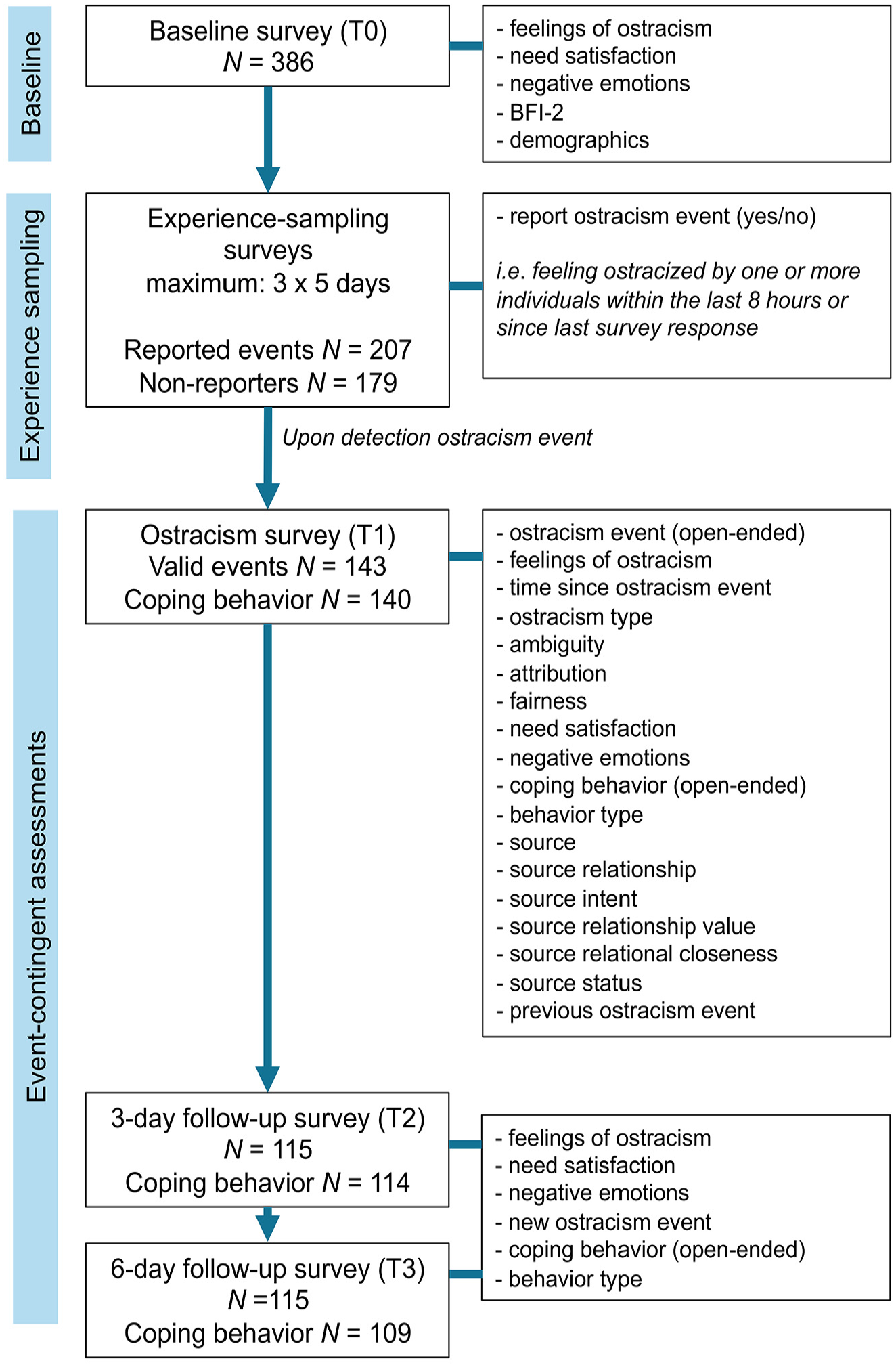
Flowchart of Study Procedure, Participants and Measures Across Assessments
Measures
Below we report the measures included 3 in the current manuscript. For measures repeated across time points, all items were consistently phrased to refer to the same ostracism event reported at T1.
Personality Traits
Participants rated their personality traits using the 60 items of the Big Five Inventory (BFI-2; Soto & John, 2017), which assesses the five personality domains of Extraversion, Agreeableness, Conscientiousness, Negative Emotionality, and Open-Mindedness. Items were phrased as: “I am someone who [item],” with example items including: “keeps their emotions under control” and “can be cold and uncaring.” The items were scored on a 5-point ratings scale (1 = strongly disagree, 2 = disagree, 3 = neutral, 4 = agree, 5 = strongly agree).
Feelings of Ostracism
Participants rated their feelings of ostracism on two items: “I feel ignored” and “I feel excluded” (Williams, 2009). The items were scored on a 5-point ratings scale (1 = strongly disagree, 2 = disagree, 3 = neutral, 4 = agree, 5 = strongly agree).
Psychological Need Satisfaction
Participants rated their psychological need satisfaction on four items adapted from the Need Satisfaction Scale (Williams, 2009): “I feel connected with others” (belonging), “I feel good about myself,” “I feel like I am in control” (control) and “I feel meaningless” reversed coded (meaningful existence). All items were scored on a 5-point ratings scale (1 = strongly disagree, 2 Z= disagree, 3 = neutral, 4 = agree, 5 = strongly agree).
Negative Emotions
Participants rated their experience of negative emotions on six items: “I feel [emotion].” The items included “happiness” reversed coded, “anger” and “sadness” (Çelik et al., 2013), “anxiety” (Watson et al., 1988), and “shame” and “hurt” to cover emotions that are commonly associated with ostracism (Smart Richman & Leary, 2009). All items were scored on a 5-point ratings scale (1 = strongly disagree, 2 = disagree, 3 = neutral, 4 = agree, 5 = strongly agree).
Ostracism Type
Participants indicated what type of ostracism event they experienced (Nezlek et al., 2012). The options were: (1) Socially, in the presence of others (e.g., others did not look at you during a conversation or ignored your questions.), (2) Physical separation, when people physically removed themselves (e.g., others went for a drink without you), (3) Cyber ostracism, being ignored on social media, over the telephone, e-mail, chat rooms and so on (e.g., others did not respond to your message in a group chat) and (4) None of the above.
Ambiguity
Participants rated their (un)certainty about being ostracized on a single item: “I am certain that I was ostracized” (Meral et al., 2023). Responses were scored on a 5-point Likert-type scale (1 = strongly disagree, 2 = disagree, 3 = neutral, 4 = agree, 5 = strongly agree).
Attribution
Participants attributed the reason for the ostracism event they described (Nezlek et al., 2012). The options were: (1) Internal (me): the reason I was ostracized had something to do with me (e.g., my personal characteristics, demographics, appearance, actions or behavior); (2) External (other person/group): the reason I was ostracized had something to do with the person or group who ostracized me (e.g., their personal characteristics, values or beliefs); (3) External (situation): the reason I was ostracized had something to do with the situation or context (e.g., the social environment, cultural norms, or specific circumstances); (4) None of the above.
Fairness
Participants rated the perceived fairness of the ostracism event with the question: “To what extent do you think what happened to you was fair?” (Chow et al., 2008). Responses were scored on a 5-point Likert-type scale (1 = not at all, 2 = slightly, 3 = moderately, 4 = very much, 5 = extremely).
Coping Behavior
Participants briefly described how they initially dealt with the ostracism event (T1) in two-three sentences in an open-ended item: “Can you briefly describe how you immediately responded or dealt with the situation?.” In addition, the participants briefly described how they dealt with it in the days after the event (T2 and T3) “Can you briefly describe how you responded to the ostracism event recently in the past three days? Write how you additionally dealt with the experience during the last three days.”
Behavior Type
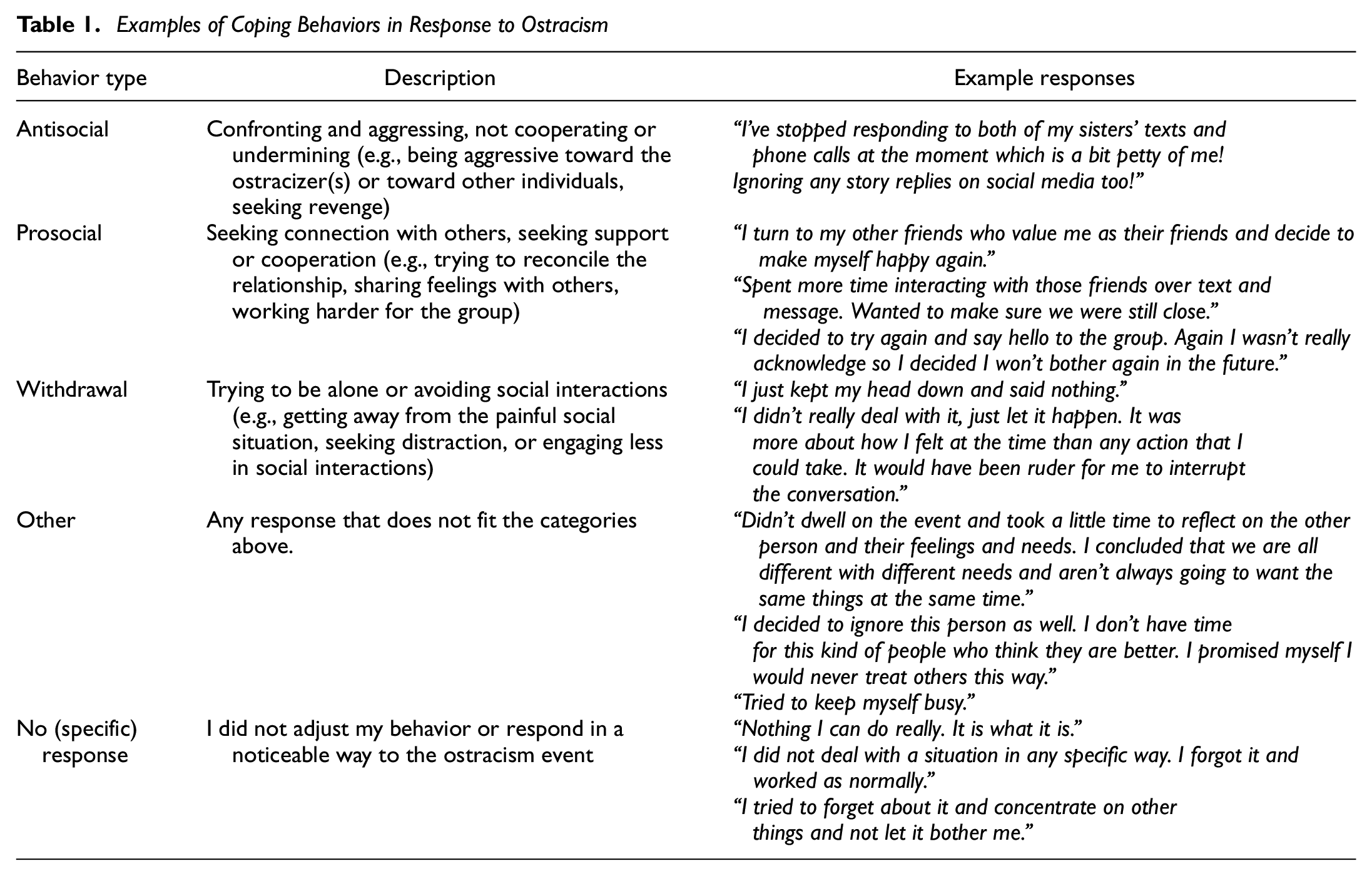
Participants self-categorized their open-ended responses into the following categories, each with a brief description provided: (1) prosocial, (2) antisocial, (3) withdrawal, (4) other, and (0) no specific response. Responses lacking an open-ended entry were excluded from the analyses (n = 1 at T1, n = 0 at T2, n = 3 at T3). If participants selected multiple options (n = 9 at T1, n = 5 at T2, n = 5 at T3), they were subsequently asked to indicate their primary reaction to the ostracism event. The top ranked response was included for analyses. Responses were excluded if no ranking was provided (n = 2 at T1, n = 1 at T2, n = 3 at T3). The final sample sizes for the included self-reported responses were: n = 140 at T1, n = 114 at T2, and n = 109 at T3. For examples of open-ended responses and their self-categorization, see Table 1. To complement the self-categorized coping behaviors, two of the authors independently coded the open-ended responses using a pre-specified coding scheme, aligning with the self-reported categories (Supporting Information 2).
Examples of Coping Behaviors in Response to Ostracism
Source
Participants reported the number of people who ostracized them: “By how many people did you feel ostracized?.” The options were: 1 = 1 person, 2 = 2 people, 3 = more than 2 people.
Source Relationship
Participants described their relationship with the person or group who ostracized them (Nezlek et al., 2012). The options were: 1 = Stranger(s), 2 = Acquaintance(s), 3 = Colleague(s), 4 = Ordinary friend(s), 5 = Close friend(s), 6 = Romantic partner(s), 7 = Family member(s) (e.g., parents, children, relatives), 8 = Other, namely.
Source Malicious Intent
Participants rated the perceived malicious intent of the source of ostracism using the statement: “I believe that the person or group intended to hurt me in some way” (Marchiondo et al., 2018; Meral et al., 2023). Responses were scored on a 5-point Likert-type scale (1 = strongly disagree, 2 = disagree, 3 = neutral, 4 = agree, 5 = strongly agree).
Source Relationship Value
Participants rated the value of their relationship (Smart Richman & Leary, 2009) with the ostracizing person or group with a new question: “In general, how much do you value your relationship with the person or group that made you feel ostracized?.” Responses were scored on a 5-point Likert-type scale (1 = not at all, 2 = slightly, 3 = moderately, 4 = very much, 5 = extremely).
Source Relational Closeness
Participants indicated the closeness of their relationship with the ostracizing person or group using the Inclusion of Other in the Self Scale (IOS: Aron et al., 1992). They selected one of seven pictures that best described their relationship, ranging from 1 = no overlap to 7 = most overlap.
Source Status
Participants described the perceived status of the person or group compared with their own with the question: “In general, how would you describe the status of the other person or group compared to yours?” (Nezlek et al., 2012). The options were: 1 = They are superior to me, 2 = They are equal to me, 3 = They are inferior to me.
Previous Ostracism Event
Participants were asked if they had felt ostracized by the same person or group before, with options: 0 = no and 1 = yes.
New Ostracism Event
During the follow-up assessments, participants were asked, “Have you experienced any other situations in which you felt ostracized in the past three days?” with response options of 0 = No and 1 = Yes. If they answered “Yes,” they were then asked, “Was it the same person or group that caused you to feel ostracized as reported three/six days ago?” with response options of 0 = No and 1 = Yes.
Results
Characteristics of Reporters versus Non-Reporters of Ostracism
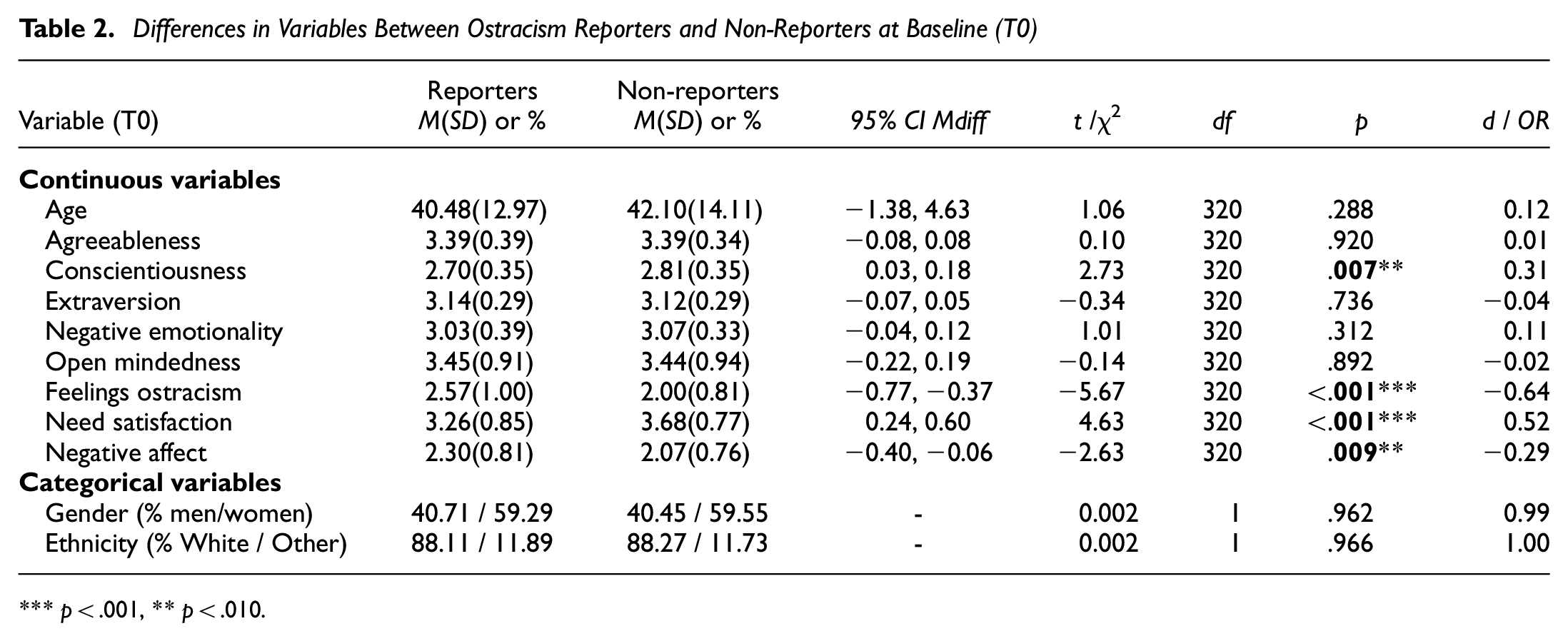
In a non-preregistered analysis, we explored whether participants who reported a valid ostracism event (n = 143) differed from non-reporters (n = 179) in personality traits, baseline (T0) well-being, and demographics. Results are shown in Table 2.
Differences in Variables Between Ostracism Reporters and Non-Reporters at Baseline (T0)
p < .001, ** p < .010.
Characteristics of Ostracism Events
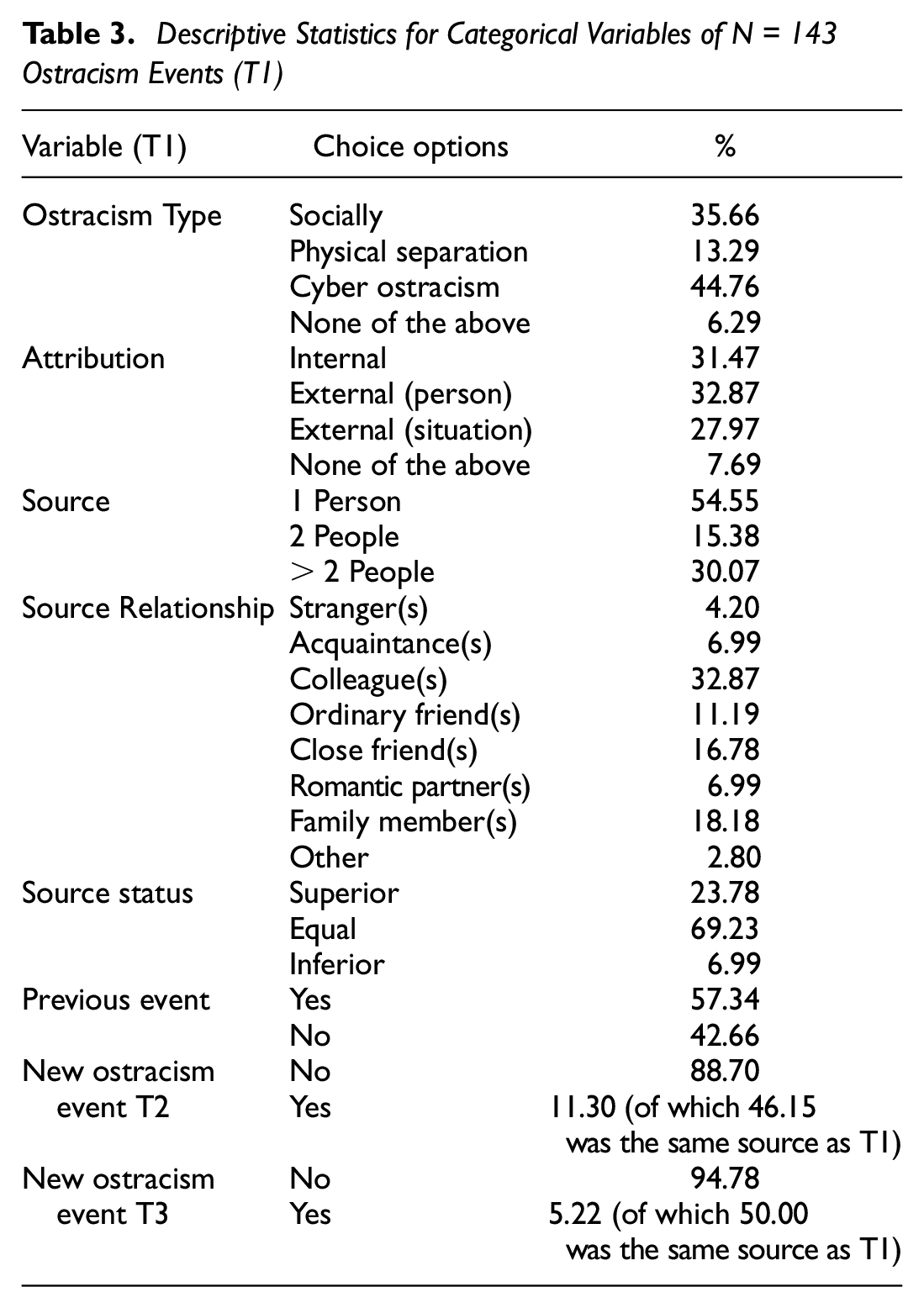
Table 3 summarizes key characteristics of the reported ostracism events, including types of experiences, attributed causes, sources, source relationships/status, and prior ostracism experiences. Descriptive statistics and correlations for continuous variables (N = 143) at T1 are presented in Table 4.
Descriptive Statistics for Categorical Variables of N = 143 Ostracism Events (T1)
Descriptive Statistics and Correlations for Continuous Variables of N = 143 Ostracism Events (T1)
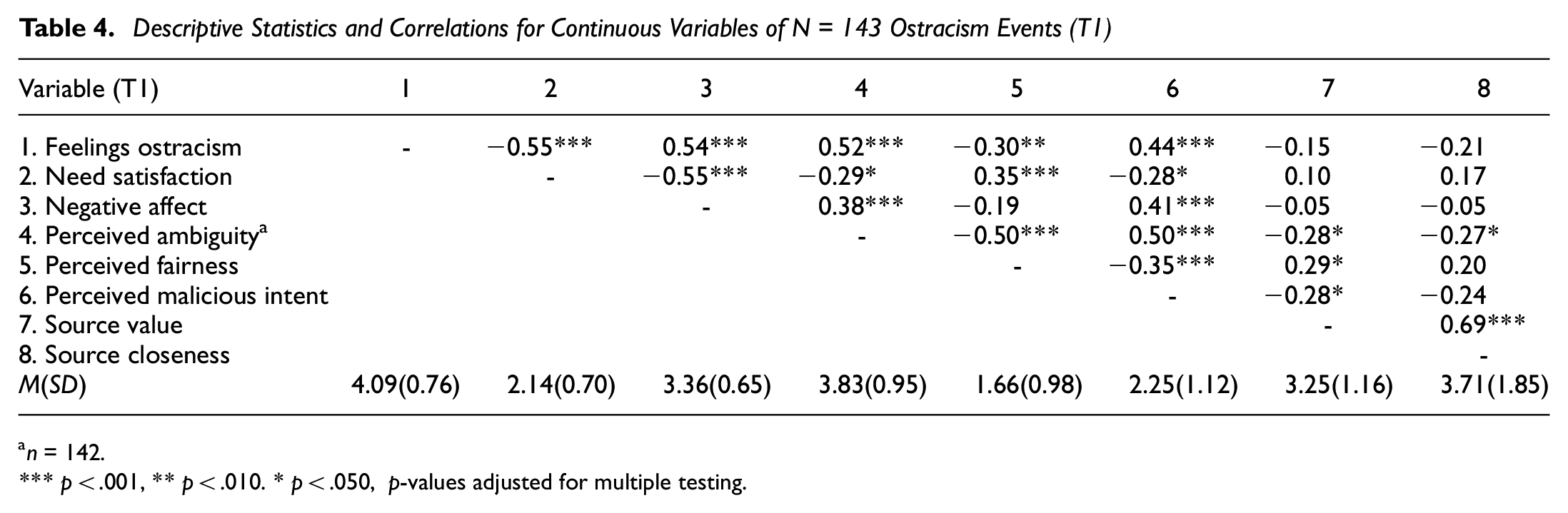
n = 142.
p < .001, ** p < .010. * p < .050, p-values adjusted for multiple testing.
Impact of Ostracism
We examined the difference in the outcome measures (i.e., feelings of ostracism, need satisfaction, emotion) at the baseline and immediately after the event (T1). Feelings of ostracism were stronger at T1 (M = 4.09, SD = 0.76), immediately following an ostracism event, compared with baseline (M = 2.57, SD = 0.99), t(142) = −16.00, p <.001, d = −1.34. Need satisfaction was lower at T1 (M = 3.26, SD = 0.85) compared with baseline (M = 2.14, SD = 0.70), t(142) = 14.08, p < 001, d = 1.18. In addition, negative emotions were stronger at T1 (M = 2.30, SD = 0.81) compared with baseline (M = 3.36, SD = 0.65), t(142) = −14.84, p < .001, d = −1.24.
Coping Behaviors in Response to Ostracism
This section summarizes the main and exploratory analyses of self-reported coping behaviors over time. We first present behavioral responses at each time point (T1, T2, T3). Based on 143 ostracism events, self-reported behaviors were available for N = 140 at T1, N = 114 at T2, and N = 109 at T3. At each stage, we compared behavioral options to understand how participants responded. We then examine changes in coping responses over time. Results are shown in Figure 2. Complementary analyses using coded behaviors (Supporting Information 2) largely aligned with self-reports; any deviations are noted.
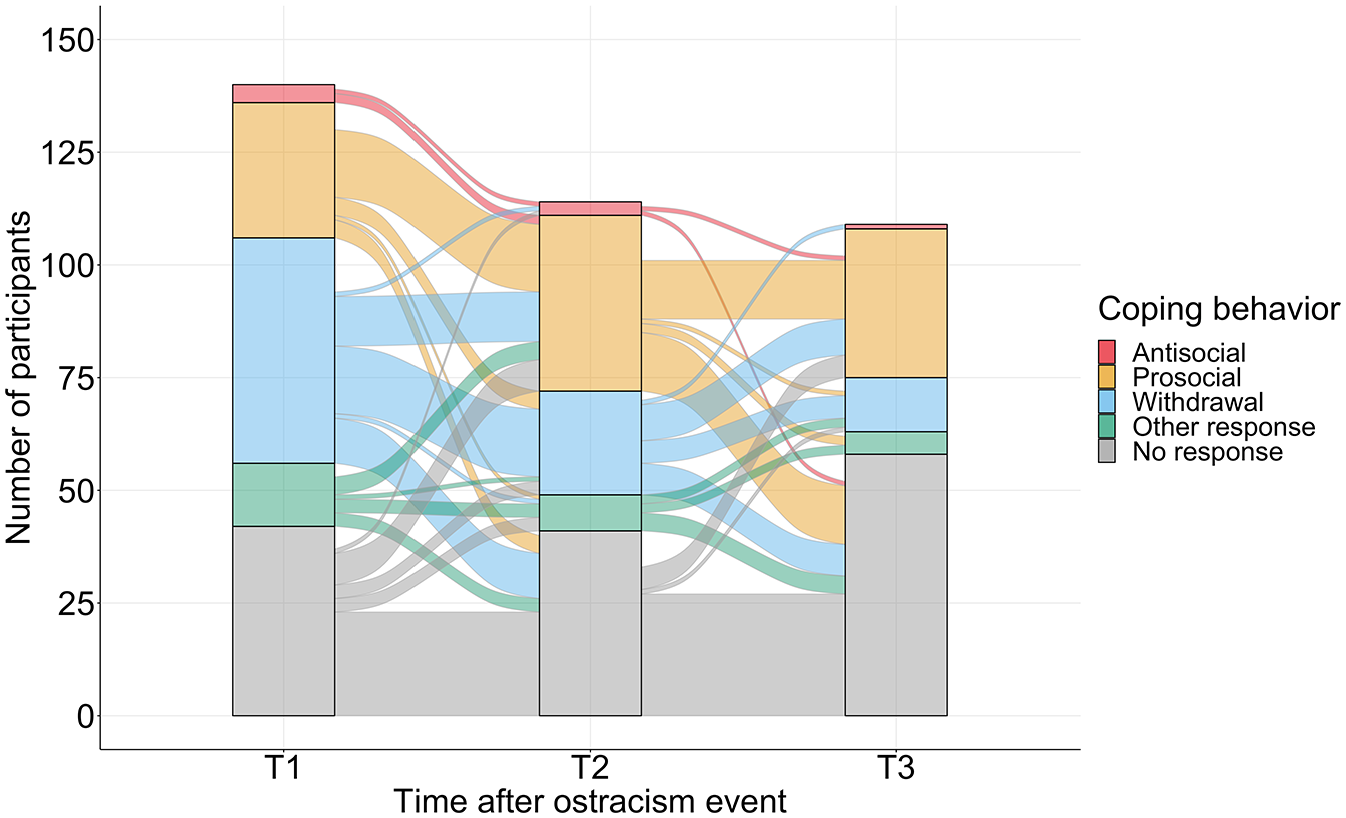
Distribution of Different Coping Behaviors in Response to Ostracism on Day 0 (T1, N =140), 3 Days (T2, N = 114), and 6 Days (T3, N =109) After the Event
Responses to Ostracism on Day 0
At T1, 35.71 % of the participants reported withdrawal as their immediate response, 21.43 % reported a prosocial response, 2.86 % reported an antisocial response, 10.00 % reported other responses, and 30.00 % reported a non-response. Table 5 presents a summary of the confirmatory analyses and hypothesis testing conducted using Multinomial Logistic Regression.
Results of Hypothesis Testing for Immediate Responses to Ostracism at T1

Note. Critical alpha = .016 to correct for multiple testing. *** p < .001.
Responses to Ostracism after 3 Days
At T2, 34.21 % of the participants reported a prosocial response, 20.18 % reported withdrawal, 2.63 % reported an antisocial response, 7.02 % reported other responses, and 35.97 % reported a non-response. Exploratory analyses revealed no significant difference between the frequency of withdrawal and prosocial responses; odds = 0.59, 95 % confidence interval (CI) = [0.35, 0.99], p = .045. As at T1, withdrawal was reported significantly more often than antisocial behavior, odds = 7.67, 95 % CI = [2.30, 25.54], p < .001, and prosocial behavior more often than antisocial behavior, odds = 13.00, 95 % CI = [4.02, 42.07], p < .001.
Responses to Ostracism After 6 Days
At T3, 30.28 % of the participants reported a prosocial response, 11.01 % reported withdrawal, 0.92 % reported antisocial behavior, 4.59 % reported other responses, and 53.21 % reported a non-response. Exploratory analyses indicated that significantly fewer participants reported withdrawal compared with prosocial behavior, odds = 0.36, 95 % CI = [0.18, 0.70], p = .003. Consistent with earlier times, withdrawal was reported more frequently than antisocial behavior at T3, odds = 11.97, 95 % CI = [1.56, 91.87], p = .017, and prosocial behavior was reported more frequently than antisocial behavior, odds = 32.92, 95 % CI = [4.51, 240.16], p < .001.
Temporal Differences in Response to Ostracism
Of those who reported coping for the follow-up assessments (n = 113 both T1–T2, and n = 93 both T2–T3), half of the participants reported a different coping strategy at T1 compared with T2 (49.56 %) and at T2 compared with T3 (49.46 %). This indicates a notable degree of variability in how participants responded to ostracism over time.
Separate McNemar tests showed that a significant decrease in the frequency of withdrawal 4 from T1 to T2 (χ2 = 6.32, df = 1, p = .012, OR = 0.35) and from T2 to T3 (T2 (χ2 = 6.86, df = 1, p = .009, OR = 0.24). In addition, there was a significant increase in the frequency of prosocial 5 behavior from T1 to T2 (χ2 = 5.94, df = 1, p = .015, OR = 2.67). The frequency of prosocial behavior did not significantly differ from T2 to T3 (χ2 = 0.03, df = 1, p =.855, OR = 0.88). The frequency of non-responses did not significantly differ from T1 to T2 (χ2 = 0.129, df = 1, p =.719, OR = 1.21). However, there was a significant increase in the frequency non-responses at T3 compared with T2 (χ2 = 11.28, df = 1, p < .001, OR = 4.33).
Discussion
Our study offers unique insights into how individuals cope with ostracism over time. We used a time-contingent sampling method with two additional follow-up assessments to assess immediate and later coping behaviors at Day 0, Day 3, and Day 6 after the event. This approach reveals patterns of coping behaviors in natural settings, addressing gaps in previous research that often focused on immediate coping responses only and specific coping behaviors in isolation. We found that immediately after ostracism, withdrawal and prosocial responses occurred equally often, while only few participants engaged in antisocial behaviors. This pattern persisted 3 days after the event. Six days after the event, prosocial actions surpassed withdrawal, whereas antisocial behaviors remained rare. This trend shows differences from initial withdrawal to increased prosocial tendencies at later timepoints as individuals may seek to restore social bonds and their need for affiliation. The variability in responses over time suggests that individuals engaged in multiple and different coping strategies following ostracism, with the relative frequency of each strategy changing across time.
Our findings on immediate coping responses after ostracism are in line with previous research (Büttner et al., 2024). Beyond these immediate responses, our study provides valuable additional insights on later coping responses at 3 and 6 days after the same ostracism event. We found that withdrawal and prosocial responses occurred equally often at 3 days, while 6 days after the event, prosocial actions surpassed withdrawal. Moreover, at each interval of 3 days after the ostracism experience, half of the participants reported a different type of coping behavior. This suggests that people may adopt various strategies in response to ongoing experiences and circumstances after ostracism. This aligns with contemporary views on coping flexibility and perspectives that emphasize the importance of dynamic, context-sensitive adaptation in response to stressors (Bonanno & Burton, 2013; Bonanno et al., 2004; Kashdan & Rottenberg, 2010).
We also found that ostracism most often came from individuals in ongoing, meaningful relationships, such as colleagues, family, and friends, rather than strangers (for similar findings, see Büttner et al. 2024). This finding indicates that coping with ostracism often takes place in ongoing relationships rather than one-time interactions (Faulkner et al., 1997, as cited in Williams et al., 2005). This speaks to the limited external validity of laboratory studies, which often rely on stranger-based or artificial scenario’s that do not adequately reflect the relational context of coping with ostracism in real-life (Wirth, 2016). Moreover, the relational context may also shape whether and how individuals cope with ostracism over time. For instance, people may not have further contact with a (online) stranger after the event, limiting the possibility of follow-up behavior, whereas interactions with close others may create ongoing opportunities or constraints for coping.
Another notable result was the rarity of antisocial responses in our study. This aligns with the view that such responses are typically costly and risky (Baumeister & Leary, 1995; Baumeister & Vohs, 2004; Ren et al., 2018; Williams, 2007). Alternatively, participants may have been reluctant to report antisocial responses due to social desirability concerns or these responses may become more prevalent over extended periods of time following chronic episodes of bullying and rejection. Persistent emotional distress in such contexts can be related to severe outcomes like aggression, mass violence, or intimate partner violence (Kowalski & Leary, 2024). The rarity of antisocial behaviors suggests their prominence in empirical research and theoretical models of ostracism may be overstated, warranting a reevaluation of their role in existing frameworks. Models like the TNTM (Williams, 2009) and the Multi-Motive Model of Rejection (Smart Richman & Leary, 2009) emphasize antisocial responses as a central way of coping. These behaviors might be better understood when considering the temporal dimension of coping, as they may emerge in more extreme or chronic cases of ostracism. Incorporating this temporal perspective could provide a more accurate understanding of these behaviors compared with existing frameworks.
Furthermore, we observed substantial non-response rates, both immediately after the ostracism event and at later assessments (30% – 53%). In line with Büttner et al.’s (2024) framework, which proposes that stronger psychological threat increases the likelihood of withdrawal and defensive responses, our findings support the association between ostracism intensity and avoidance tendencies as well as no-coping responses (Supporting Information 1). According to Lazarus and Folkman’s (1984) model, coping follows an appraisal of relevance and threat. From this view, some non-responses may reflect low perceived threat, and thus no need to cope. Indeed, our exploratory findings (Supporting Information 2) showed that many non-responses, especially later, reflected resolution, acceptance, or that no coping was required. Future studies could let participants indicate distinctions more clearly, using options like “resolved” or “accepted” to show when coping is no longer needed.
Finally, we consistently observed a small percentage (10 %–5 %) of other coping responses, such as cognitive coping strategies, that do not always translate into observable behaviors. These responses included reflection, sense-making, perspective-taking, self-affirmation, rumination, rationalization, suppression. Such responses are currently underrepresented in existing taxonomies of coping with ostracism. Future research could benefit from considering these less visible coping behaviors, as well as distinguishing ostracism events that trigger a behavioral response from those that do not. This distinction could help identify which types of ostracism experiences are more impactful and demand coping resources.
Limitations
A limitation of the current study is that non-reporting may not indicate the absence of ostracism but could reflect differences in perception, recall, or willingness to report. Self-selection among those who did report may have influenced the types of events and coping behaviors captured. Exploratory findings showed that reporters scored lower on conscientiousness, consistent with prior research linking this trait to a higher likelihood of experiencing and acknowledging ostracism (Rudert et al., 2020), especially in performance-related settings (Rudert, Hales, & Büttner, 2021). Reporters also showed lower baseline well-being, suggesting a two-way link between well-being and ostracism (Reinhard et al., 2020). This pattern opens up new avenues for research into how individual differences shape the perception and impact of ostracism in everyday settings.
Another limitation concerns the general caution often raised about retrospective self-reports, as they may be subject to memory distortion or reinterpretation over time (Levine & Safer, 2002; Nichols & Maner, 2008; Orne, 1962; Salovey et al., 1994). To reduce such biases, future studies could use more frequent, time-based prompts with shorter recall windows. Alternatively, coping-contingent designs could be used, where participants self-initiate reports each time they engage in a coping response to ostracism. However, this may increase burden and lead to uneven reporting, depending on participants’ awareness and willingness. Moreover, repeated monitoring may itself influence experiences (Scollon et al., 2003), potentially altering coping responses.
Conclusion
Our work highlights the value of a temporal perspective in understanding how people cope with ostracism. Two key insights emerged:
Supplemental Material
sj-pdf-1-spp-10.1177_19485506251362909 – Supplemental material for Coping With Ostracism Over Time: A Time-Contingent Sampling Study of Immediate and Later Responses at Day 0, Day 3, and Day 6
Supplemental material, sj-pdf-1-spp-10.1177_19485506251362909 for Coping With Ostracism Over Time: A Time-Contingent Sampling Study of Immediate and Later Responses at Day 0, Day 3, and Day 6 by Anneloes Kip, Erdem O. Meral, Emilya A. Demirel, Thorsten M. Erle and Dongning Ren in Social Psychological and Personality Science
Supplemental Material
sj-pdf-2-spp-10.1177_19485506251362909 – Supplemental material for Coping With Ostracism Over Time: A Time-Contingent Sampling Study of Immediate and Later Responses at Day 0, Day 3, and Day 6
Supplemental material, sj-pdf-2-spp-10.1177_19485506251362909 for Coping With Ostracism Over Time: A Time-Contingent Sampling Study of Immediate and Later Responses at Day 0, Day 3, and Day 6 by Anneloes Kip, Erdem O. Meral, Emilya A. Demirel, Thorsten M. Erle and Dongning Ren in Social Psychological and Personality Science
Footnotes
Handling Editor: Yuthika Girme
Declaration of Conflicting Interests
The author(s) declared no potential conflicts of interest with respect to the research, authorship, and/or publication of this article.
Funding
The author(s) disclosed receipt of the following financial support for the research, authorship, and/or publication of this article: This research was funded by the Dutch Research Council (NWO) Open Competition-Social Sciences and Humanities Grant: 406.18.GO.072
Ethical Statement
The study was approved by the Ethics Review Board of the School of Social and Behavioral Sciences at Tilburg University under the Social Psychology Department [TSB_RP1274].
Data Availability

Supplemental Material
The supplemental material is available in the online version of the article.
Notes
Author Biographies
References
Supplementary Material
Please find the following supplemental material available below.
For Open Access articles published under a Creative Commons License, all supplemental material carries the same license as the article it is associated with.
For non-Open Access articles published, all supplemental material carries a non-exclusive license, and permission requests for re-use of supplemental material or any part of supplemental material shall be sent directly to the copyright owner as specified in the copyright notice associated with the article.
