




Abstract
Affective polarization, the growing gap between negativity toward political outgroups and positivity toward political ingroups, threatens democracies. This preregistered research tested the effectiveness of a novel moral learning treatment, which combines the significance of morality with basic learning principles, in reducing affective polarization in the U.S. context. A pre-study demonstrated in-party preference, which was challenged in Experiment 1, which assigned moral behaviors to one political group (e.g., Republican) and immoral behaviors to the other political group (e.g., Democrat). As predicted, the learning treatment reduced self-reported and automatic preference for in-party individuals both immediately and after a 2-day delay. Experiment 2 replicated this finding, using neutral control to rule out that immoral behaviors caused the reduction in in-party preference. Experiment 3 showed the effect extended beyond individual party members to the entire out-party. Highlighting out-party members’ moral behavior could strengthen shared values and be useful in political campaigns or education.
For centuries, enemies were those of another country, religion, culture, or tribe. However, “enemies” of different political parties have recently joined the front lines. Although it is a common finding that people prefer their own group over the outgroup (Tajfel & Turner, 1986; but see Kurdi et al., 2024 for counterevidence), hatred of the political opponents relative to the liking of political co-parties, has reached dangerous proportions. In many western countries, party affiliation divides societies into good or evil, into us and them (Halperin, 2008). This phenomenon is called affective polarization 1 (Iyengar et al., 2012), defined as the difference between “in-party love” and “out-party hate” (Iyengar & Westwood, 2015). The increasing polarization of society is seen as a severe threat to our civilized coexistence (Kingzette et al., 2021) because it undermines democratic norms and increases the willingness to use violence against political opponents (Berntzen et al., 2024). Affective polarization also has severe real-life consequences, such as who people intend to marry (Iyengar et al., 2019). Although there is some evidence that polarization is fueled by two-party systems like those in the United States, the “ascendance of political hatred” (Finkel et al., 2020, p. 533) is not a purely U.S. phenomenon but can be observed in many parts of the world (Boxell et al., 2024).
Affective polarization is undeniably a major challenge for democracies, which are already becoming more fragile (Kingzette et al., 2021). As the threat to democracies from affective polarization is omnipresent worldwide (Orhan, 2022; Reiljan et al., 2024), it is essential to understand how this inter-party phenomenon can be mitigated. How can we de-antagonize a society? In this research, we want to provide answers to this question and introduce a novel anti-polarization treatment. However, the requirements for such treatments are high. First, it should not only refer to the characteristics of one particular party but must apply to every party. In addition, the treatment should not be superficial pledges of conformity but ideally also evident in automatic judgments as those are highly influential in political decisions and less prone to demand effects (Gawronski et al., 2015). Third, the impact of the treatment should show stability so that people can build on it in further (positive) experiences with the political opponent. Fourth, positive effects should not be restricted to single party members but influence the whole party.
How to Mitigate Affective Polarization? Using Multiple Examples of Out-Party Morality
Given the topic’s significance, solutions for the affective polarization problem are sought in many disciplines (Santoro & Broockman, 2022). For example, some studies are based on intergroup contact theory and use inter-party discussions, or the warm interaction of leaders, as a remedy against affective polarization (Huddy & Yair, 2021; Santoro & Broockman, 2022). However, it is unclear how persistent these effects are. Other research provided encouraging results by using national identity priming. However, the priming of national identity may go at the expense of other identities, rendering this antidote politically risky (Levendusky, 2018).
We are breaking new ground by relying on studies from different areas that use the morality of the outgroup as a remedy against negative intergroup attitudes. For example, in the context of mitigating prejudice against migrants, moral exemplars of migrant essential workers, among other factors, enhanced positive attitudes toward this group (Alonso-Arbiol et al., 2023). Moral outgroup exemplars have also been shown to be effective in post-war reconciliation contexts, mitigating outgroup hate (Čehajić-Clancy & Bilewicz, 2020; Witkowska et al., 2019).
The presentation of moral exemplars could be an effective tool for improving outgroup attitudes because morality is the primary dimension of outgroup evaluation (Brambilla et al., 2013; Leach et al., 2007) and general impression formation (Goodwin et al., 2014). For example, recent research on dehumanization has shown that moral elevation has a reducing influence, whereas positive affect alone did not have these effects (Engels et al., 2024). Moral elevation has also been effective in intergroup conflicts, presumably by enhancing group similarity and positive emotions (Čehajić-Clancy et al., 2024).
Although the research on moral exemplars has gained invaluable insight into effective reconciliation and forgiveness processes, it has primarily been tested in the context of past conflicts and has never been applied to the context of political polarization. Hence, whether the moral exemplar framework effectively mitigates political conflicts is unclear. However, Garrett and Bankert’s (2023) work indicated that people with a moral view of politics show more affective polarization, suggesting that the moral exemplar approach might be helpful in this context.
Moreover, moral exemplars, because they, per definition, refer to anecdotal or single cases, also harbor the risk of being subtyped (Čehajić-Clancy & Bilewicz, 2021), which could limit their effectiveness. Hence, effective treatments should include repeated exposure to multiple outgroup moral exemplars that cannot be easily subtyped (Johnston & Hewstone, 1992). Indeed, previous research indicated the effectiveness of repeated learning episodes with multiple examples for changing attitudes (e.g., Moran et al., 2023; Rydell & McConnell, 2006). Based on this literature, we developed a moral learning treatment.
The Present Research
The research aimed to test the effectiveness of a moral learning treatment in reducing affective polarization. While previous studies suggest that morality significantly influences intergroup relations beyond just promoting positivity, it remains unclear whether it can help mitigate affective polarization. We advanced previous research in three ways. First, we test a new morality-based treatment that does not necessarily include the derogation of other groups, 2 as in previous treatments like, for example, national priming. Second, we extend previous findings by testing the treatment’s effects on automatic attitude measures less prone to intentional and motivational corrections. 3 Third, we tested the stability of the treatment’s positive effects over time and its generalization from single exemplars to the whole party. We used moral learning because moral narratives of what is right and wrong are widely shared within a culture, leading to a common canon of values (Haidt et al., 1993). Hence, moral behaviors provide an opportunity for bipartisan reconciliation because, despite all animosities and differences, they recur to shared values. Finally, to increase the effectiveness of the treatment and reduce the possibility of subtyping, we relied on the principles of repeated learning episodes (Moran et al., 2023). We used the party affiliation of Democrats and Republicans in the present context because, despite the ubiquity of affective polarization, recent studies show that the levels are most alarming in the U.S. population (Garzia et al., 2023). If a countermeasure turns out to be influential in this context, it would be an encouraging sign of its effectiveness.
We conducted three experiments. In Experiment 1, we assigned moral behaviors to one political group (e.g., Republican) and immoral behaviors to the other political group (e.g., Democrat). In Experiment 2, we replaced immoral behaviors with neutral ones to see if we could reduce in-party preference without negative information. This manipulation created one condition in which the participant’s in-party members were presented as moral (“in-party is moral” condition) and one condition in which the participant’s out-party members were presented as moral (“out-party is moral” condition; see Figure 1 for an illustration of the basic design of the treatment). We tested whether exposure to moral descriptions of out-party members would reduce self-reported and automatic (measured with the Implicit Association Test (IAT); Greenwald et al., 1998) in-party preference 4 immediately and after 2 days. Experiment 3 used the same treatment as Experiment 2 but tested its impact on the evaluation of the general political parties (Democrat and Republican) instead of specific individuals.
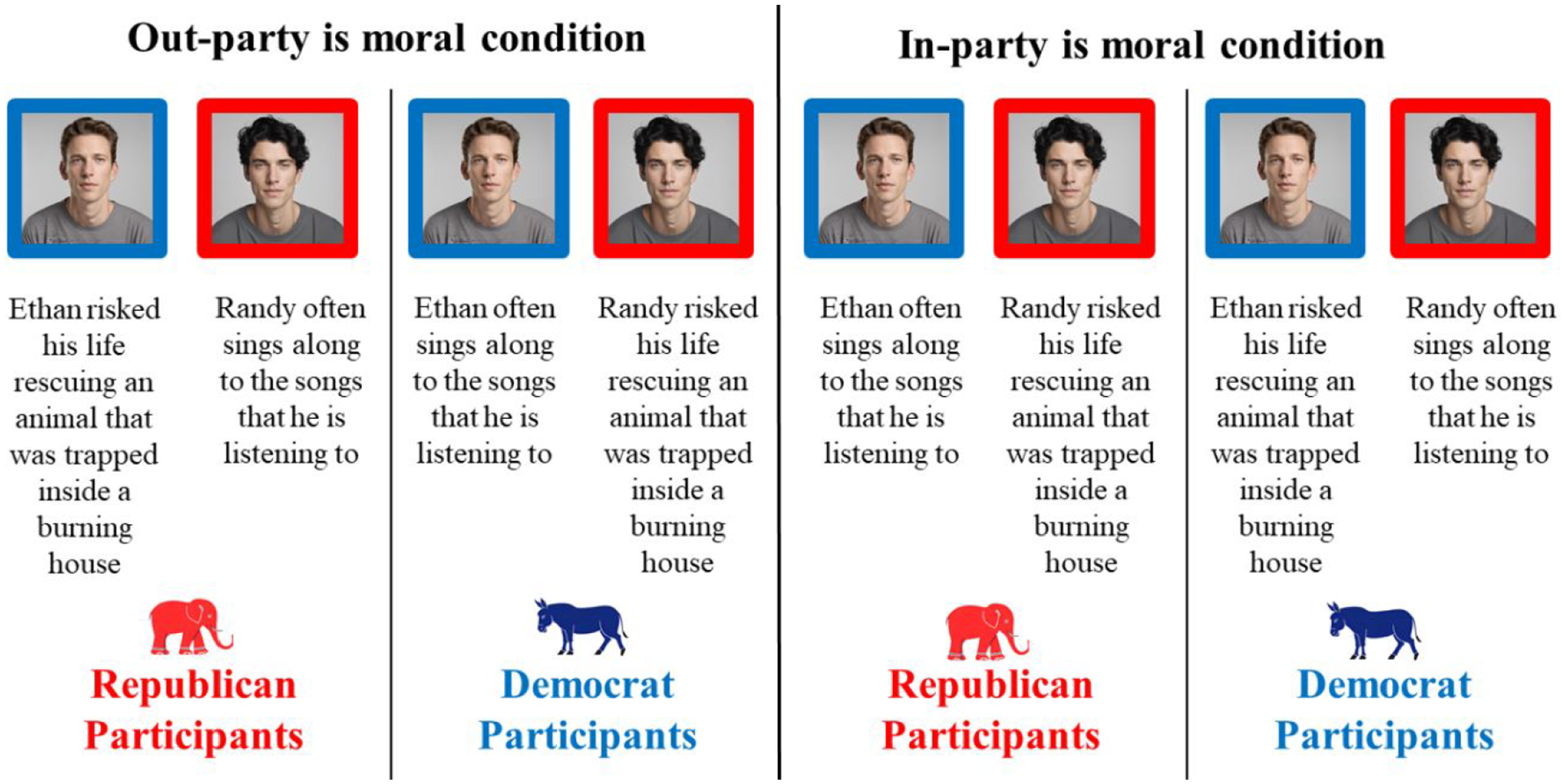
Experiments 1 to 3: Illustration of the Treatment’s Basic Design
Experiments 1 to 3
Transparency and Openness
We report how we determined our sample size, all data exclusions, all manipulations, and all measures in the experiments. We preregistered the materials, sampling plans, exclusion rules, and analysis plans for all experiments (Experiment 1: https://osf.io/gvkpm/; Experiment 2: https://osf.io/rj5be/; Experiment 3: https://osf.io/s97tr/). The Online Supplement details all experiments’ complete procedure, instructions, and materials. The data and materials of all experiments are available on the Open Science Framework (OSF) (https://osf.io/zsme7/). This research was approved by the ethics committee of the Open University of Israel. AI was used for grammatical edits (ChatGPT; OpenAI, 2024) and for creating the images in Figure 1 (Canva, 2024).
Method
Participants
Participants in all experiments completed a two-session experiment via Prolific Academic (https://www.prolific.com/). Session 2 was completed approximately 48 hrs after Session 1. For power calculations, in Experiment 1, we aimed for at least 90% power to detect a medium effect size (η p 2 = 0.06) in a 2×2 mixed analysis of variance (ANOVA). In Experiments 2 to 3, we aimed for a smaller effect size (η p 2 = 0.03) due to the expected smaller effect of the manipulation (neutral instead of immoral). Anticipating dropouts from Session 1 to 2, we collected extra participants in all experiments. The preregistered plan excluded participants who did not complete the second session or whose reported political identity differed from the Prolific prescreening in either session. For the IAT analysis, we also excluded participants with more than 10% fast trials (RT < 300) in any session’s IAT. Table 1 details the number of participants, exclusions, and basic demographics.
Experiments 1 to 3: Details About the Participants
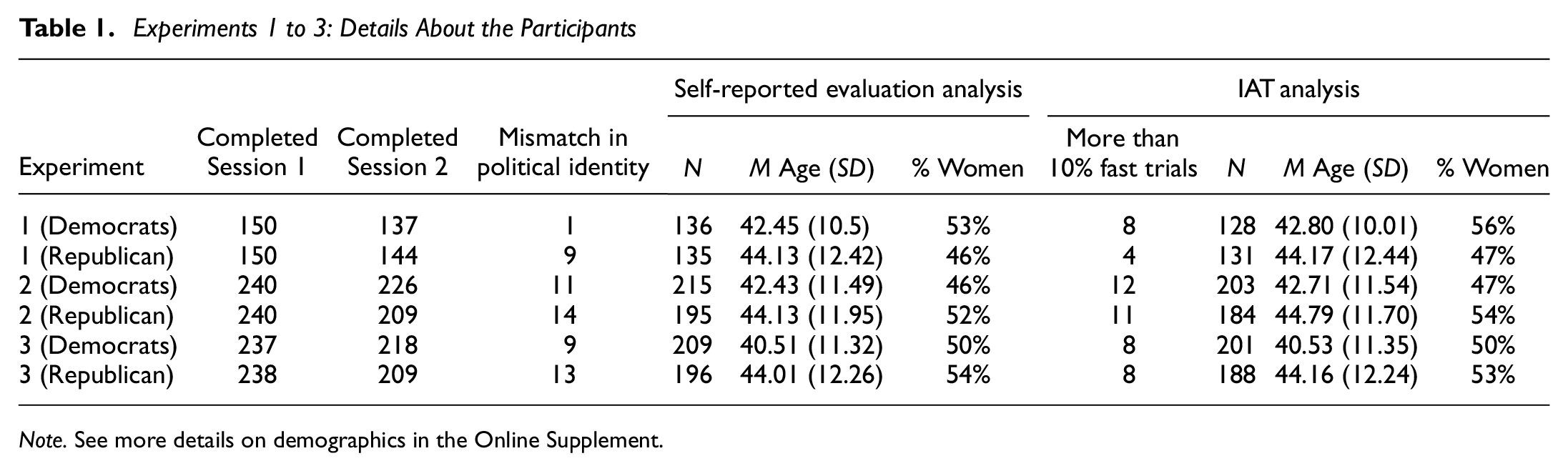
Note. See more details on demographics in the Online Supplement.
Materials
To represent Democrats and Republicans, we selected 12 pictures of White men and women with neutral expressions from the Chicago Face Database (CFD; Ma et al., 2015). We created two groups of six individuals, matched with attractiveness and trustworthiness. We added blue or red frames to indicate political affiliation. We counterbalanced the specific set-political affiliation assignment between participants. Each picture was paired with a name that varied based on whether the individual was identified as a Democrat or Republican. The Online Supplement provides more details.
We used behavioral descriptions from Mickelberg et al. (2022) to manipulate party morality. The Online Supplement details the descriptions and selection criteria. In Experiment 1, we used 15 moral behaviors (e.g., “Donated a kidney to a work colleague”), 15 immoral behaviors (e.g., “Set fire to the community hall”), and 12 neutral behaviors (e.g., “Ordered her favorite dish from a Chinese restaurant”). In Experiments 2 to 3, we used the same 15 moral behaviors and 24 neutral behaviors.
The IAT in Experiments 1 to 3 used the attributes “Good” (items: Good, Positive, Pleasant, Great) and “Bad” (items: Bad, Negative, Unpleasant, Awful). In Experiments 1 to 2, the other categories were “Blue group” and “Red group,” with pictures from the learning phase as items. In Experiment 3, the categories were “Democrats” and “Republicans,” using images of the donkey (in blue or black) and elephant (in red or black) symbols as items.
Procedure
All experiments followed a two-session structure. Session 1 began with instructions and a baseline measurement of self-report evaluation. Participants then completed two tasks: a learning task and a forced choice task. After the treatment, they completed an IAT and a self-report evaluation in random order. 5 Two days after Session 1, participants completed Session 2. They received a brief reminder of Session 1 and then completed the same IAT and self-report evaluation measurement. 6 We computed scores for all evaluation measures such that positive scores reflect in-party preference.
Instructions and Baseline-Measurement (Session 1)
In Experiments 1 to 2, at Session 1’s onset, participants were informed that they would view images of individuals framed in blue or red: Individuals with red frames are Republicans, and those with blue frames are Democrats. Participants then completed a baseline assessment of their evaluations of two groups by answering two questions about each group: “How much do you like or dislike the Blue group/Red group?” and “How positive or negative do you think the Blue group/Red group is?” (Scales: −3 = I dislike them a lot/Very negative; 0 = Neutral; +3 = I like them a lot/Very positive). 7 Rating scores for each group were calculated by averaging responses to the two questions (Cronbach’s αs > .88, .89 in Experiments 1 to 2, respectively). In Experiment 3, participants first rated their evaluation of Democrats and Republicans by answering two questions about each group: “How much do you like or dislike Democrats/Republicans?” and “How positive or negative do you think Democrats/Republicans are?” with the same 7-point Likert-type scales (Cronbach’s α > .90), and only then received the general instructions about the individuals with blue or red frames. In all cases, we calculated the in-party preference score by subtracting the out-party rating from the in-party rating.
Treatment (Session 1)
Participants were instructed to evaluate behavioral descriptions of Republican and Democratic individuals. They were asked to rate each description’s positivity/negativity and form impressions based on these descriptions (see Online Supplement for detailed instructions). Next, the treatment began with three blocks of 12 randomized trials. Each trial displayed a picture of one individual (six in-party, six out-party) and a behavioral description. Participants rated each behavior on a 7-point scale (−3 = Very negative to +3 = Very positive), 8 followed by the subsequent trial. In Experiment 1, individuals from one group (e.g., the red group) exhibited two moral and one neutral behavior, whereas individuals from the other group (e.g., the blue group) exhibited two immoral and one neutral behavior. In Experiments 2 to 3, individuals from one group exhibited two moral and one neutral behavior, whereas individuals from the other group exhibited three neutral behaviors. Across all experiments, we varied which group (red vs. blue) was presented with moral behaviors. Figure 1 illustrates the basic design of the treatment.
Next, in the second part of the treatment, to strengthen the encoding of each group’s valence, participants completed a forced-choice task where pairs of individuals—one red and one blue—were presented. In Experiment 1, participants chose which individual was more positive or negative based on their learned behaviors. The instructed valence (positive or negative) aligned with the valence of the individuals from the participant’s out-party. Participants indicated which individual was more positive in Experiments 2 to 3 (where negative information was absent). The task included 18 randomized trials (see Online Supplement for details), with error feedback for incorrect responses, asking participants to correct their responses.
Post-Treatment Measurement (Session 1 + 2)
In Experiments 1 to 2, participants completed measures of self-report and automatic preference for in-party over out-party individuals in both sessions in random order. In Experiment 3, participants first rated preference for in-party individuals (as in Experiments 1–2), followed by random-order measures of self-report and automatic preference for the political in-party over the political out-party. Self-report measures included evaluations of political parties, a feeling thermometer, and social distance (the latter two adopted from Druckman & Levendusky, 2019).
Self-Report Preference for Individual Party-Members (Experiments 1–3)
This measure mirrored the baseline assessment in Experiments 1 to 2. Scores for each group were averaged from two questions (Cronbach’s αs > .95, .86, .86 in Session 1; Cronbach’s αs > .94, .83, .86 in Session 2, for Experiments 1–3). We calculated the in-party preference score by subtracting the out-party members’ rating from the in-party members’ rating.
Self-Report Preference for Political Parties (Experiment 3)
This measure mirrored the baseline assessment in Experiment 3. Scores for each party were averaged from two questions (Cronbach’s α > .89 in Session 1, and α > .85 in Session 2). We calculated the in-party preference score by subtracting the out-party rating from the in-party rating.
Feeling Thermometer (Experiment 3)
Participants rated how they feel toward Republican and Democratic party voters on a scale of 0 (most unfavorable/coldest) to 100 (most favorable/warmest). We calculated the in-party preference score by subtracting the out-party rating from the in-party rating.
Social Distance (Experiment 3)
Participants rated their comfort levels regarding having close friends, neighbors, and potential in-laws affiliated with the Democratic/Republican Party (scale: 1 = Not at all comfortable to 4 = Extremely comfortable). These questions focused solely on the participant’s out-party. A social distance preference score was computed by reversing and averaging the ratings across these three questions (Cronbach’s α > .87 in both Session 1 and 2).
IAT: Preference for Individual Party-Members (Experiments 1–2)
In the IAT, participants categorized stimuli into four categories using two keys. In two of the critical blocks, “Blue group” and “Good” shared one response key, and “Red group” and “Bad” shared the other response key. In the other two critical blocks, “Blue group” and “Bad” shared one response key, and “Red group” and “Good” shared the other response key. The seven-block IAT, followed Nosek et al. (2005). We used the D2 algorithm (Greenwald et al., 2003) to calculate scores indicating in-party preference (Cronbach’s α based on two task halves > .78, .78 in Session 1, and > .71, .70 in Session 2, in Experiments 1–2).
IAT: Preference for Political Parties (Experiment 3)
The IAT was identical to the one we used in Experiments 1 to 2, except that we replaced the categories “Blue group” and “Red group” with the categories “Democrats” and “Republicans.” The IAT’s internal consistency was α > .76 at Session 1 and α > .67 at Session 2.
Design, Planned Analysis, and Hypothesis
The experiments had two main factors. Party-behavior assignment was manipulated between participants: out-party members with moral behaviors versus in-party members with moral behaviors. This factor was determined by participants’ political affiliation and the group identity displayed with moral behaviors. Measurement time (Session 1: immediate vs. Session 2: delayed by 2 days) was manipulated within participants. In addition, all experiments randomized three factors between participants: the specific set-identity assignment, order of measures, and IAT block order.
Our confirmatory analysis plan involved submitting all computed in-party preference scores to a 2 (Party-behavior assignment, between-participants) × 2 (Measurement time, within-participants) mixed ANOVA. We predicted a main effect of party-behavior assignment, with reduced in-party preference when the out-party was presented as moral, and that this effect would be significant at both time points. We also anticipated significant interaction, indicating reduced but significant effects at Session 2. In addition, we planned to compute, when possible, a reduction in in-party preference scores, using baseline preferences subtracted from post-manipulation scores across sessions, such that positive scores would reflect a reduction in in-party preference. We planned to analyze these scores with the same method. 9
Results
Baseline Measurement
Table 2 presents the baseline data and results from Experiments 1 to 3. At baseline, participants rated their in-party positively and their out-party negatively. There was no significant difference in in-party preference between the “out-party is moral” and “in-party is moral” conditions, all showed a significant in-party preference.
Experiments 1 to 3: Baseline Measurement Results
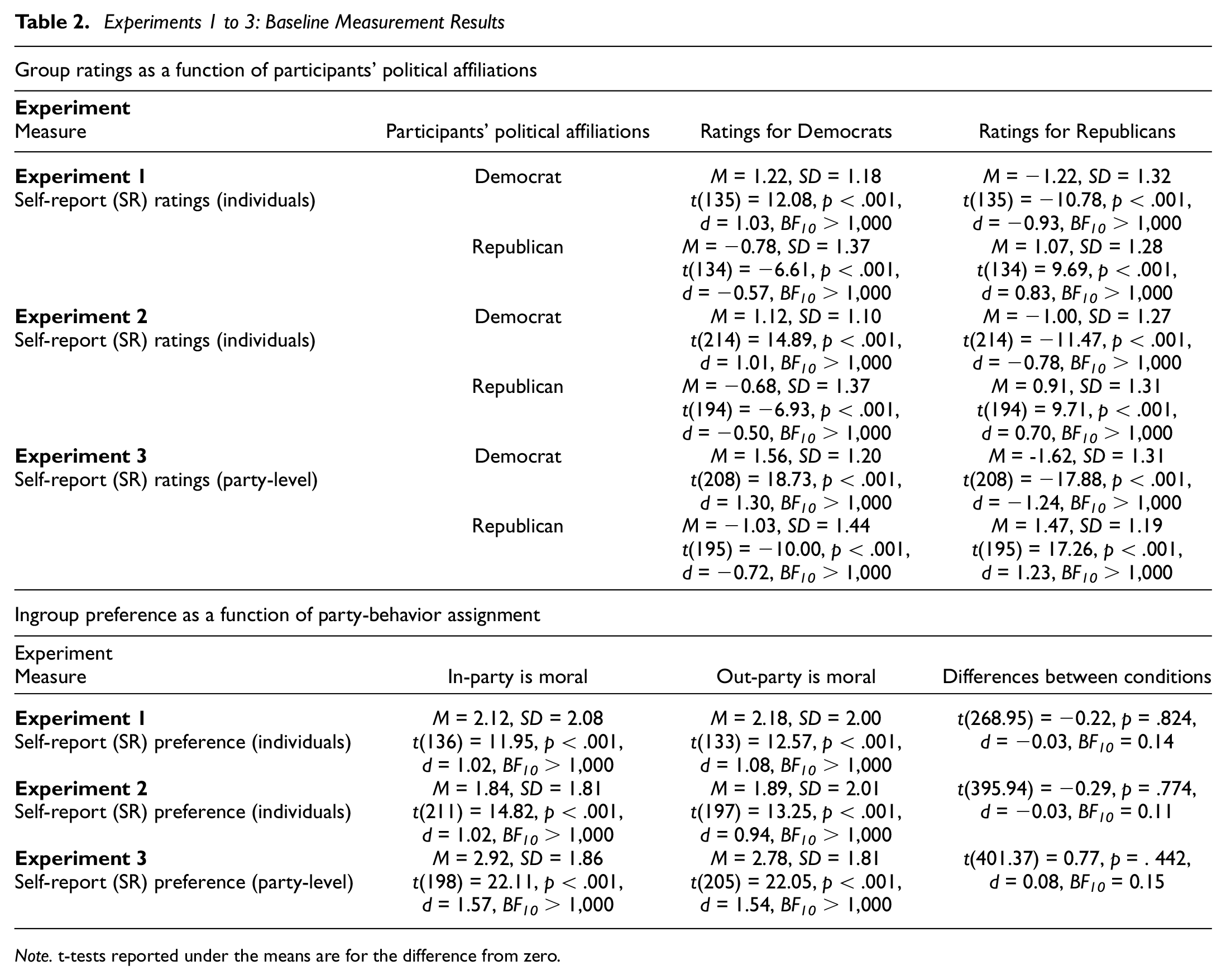
Note. t-tests reported under the means are for the difference from zero.
Preference for Individual Party-Members
Figure 2 and Table 3 detail the mean preference for in-party individuals as a function of measure, party-behavior assignment, and measurement time in Experiments 1 to 3. Table 4 shows the 2 (Party-behavior assignment; between participants) × 2 (Measurement time; within participants) mixed ANOVA results in all experiments.
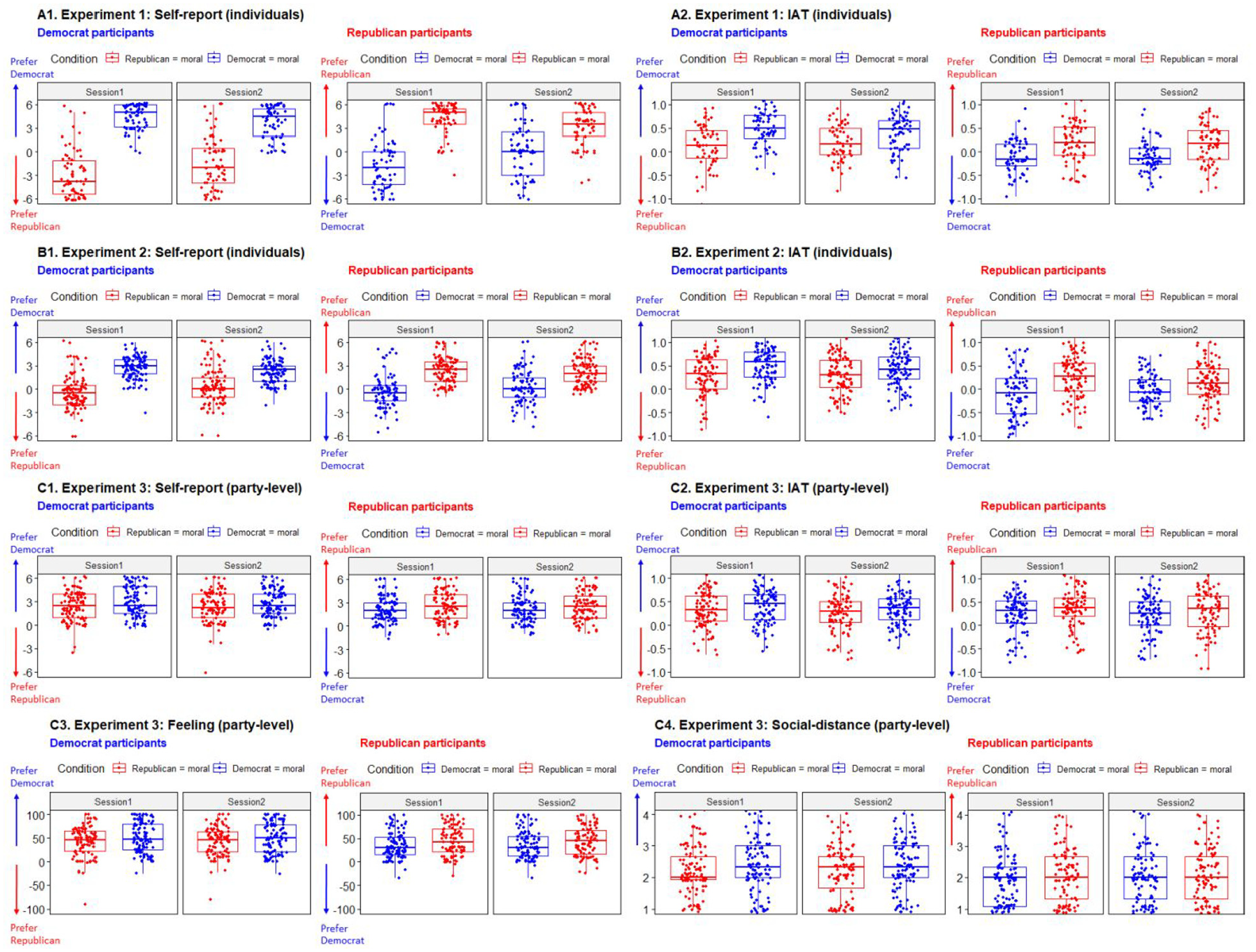
Preference for In-Party Individuals (Experiments 1–2) and Preference for the In-Party (Experiment 3) as a Function of Participant’s Political Affiliation, Measure, Party-Behavior Assignment (Democrats Are Moral vs. Republicans Are Moral), and Measurement Time (Session 1: Immediate vs. Session 2: Delayed by 2 Days)
Experiments 1 to 3: Mean Preference for the In-Party (SD) as a Function of Measure, Party-Behavior Assignment and Measurement Time
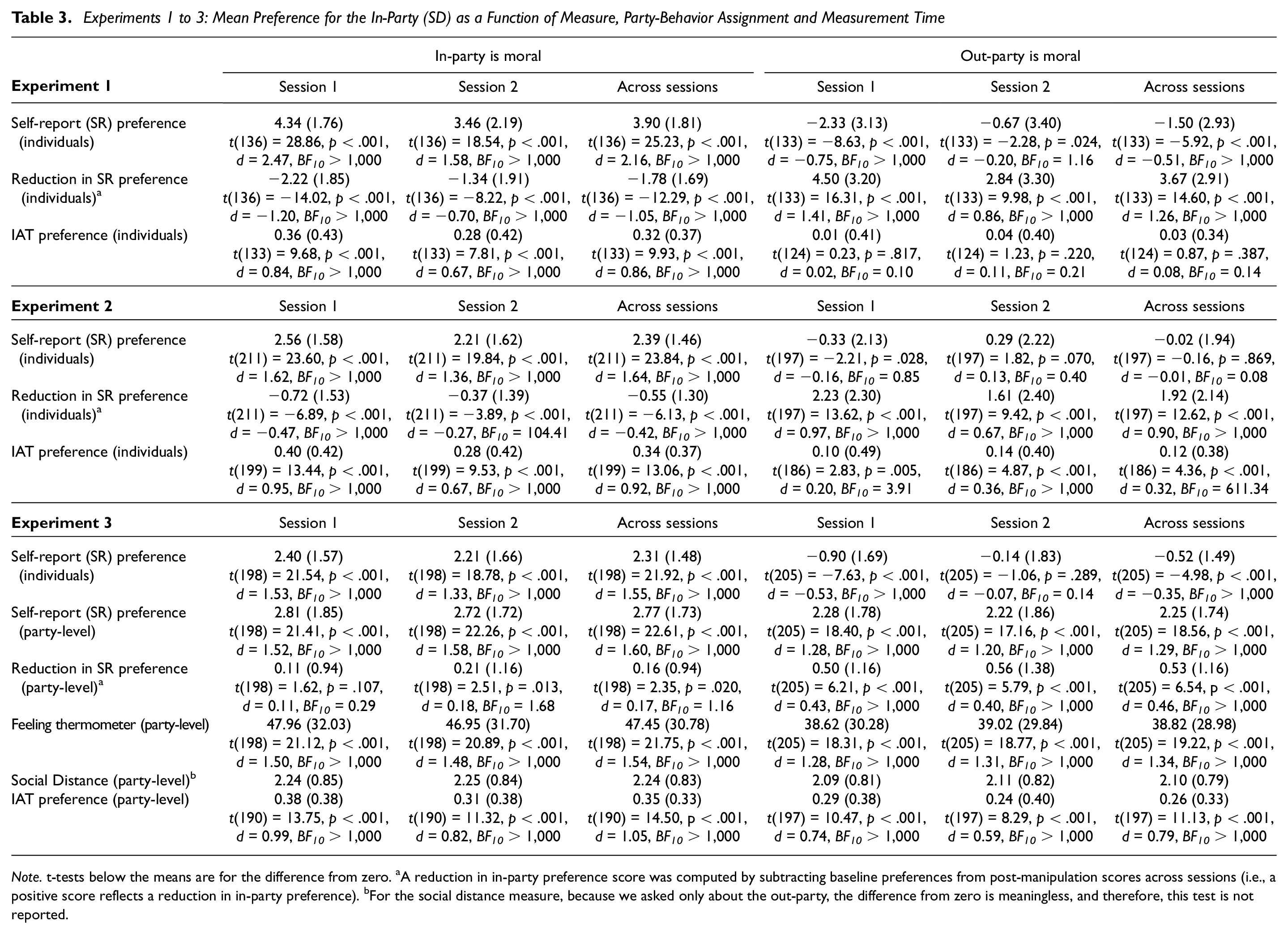
Note. t-tests below the means are for the difference from zero. aA reduction in in-party preference score was computed by subtracting baseline preferences from post-manipulation scores across sessions (i.e., a positive score reflects a reduction in in-party preference). bFor the social distance measure, because we asked only about the out-party, the difference from zero is meaningless, and therefore, this test is not reported.
Experiments 1 to 3: Results of the 2 (Party-Behavior Assignment) × 2 (Measurement Time) Mixed ANOVA
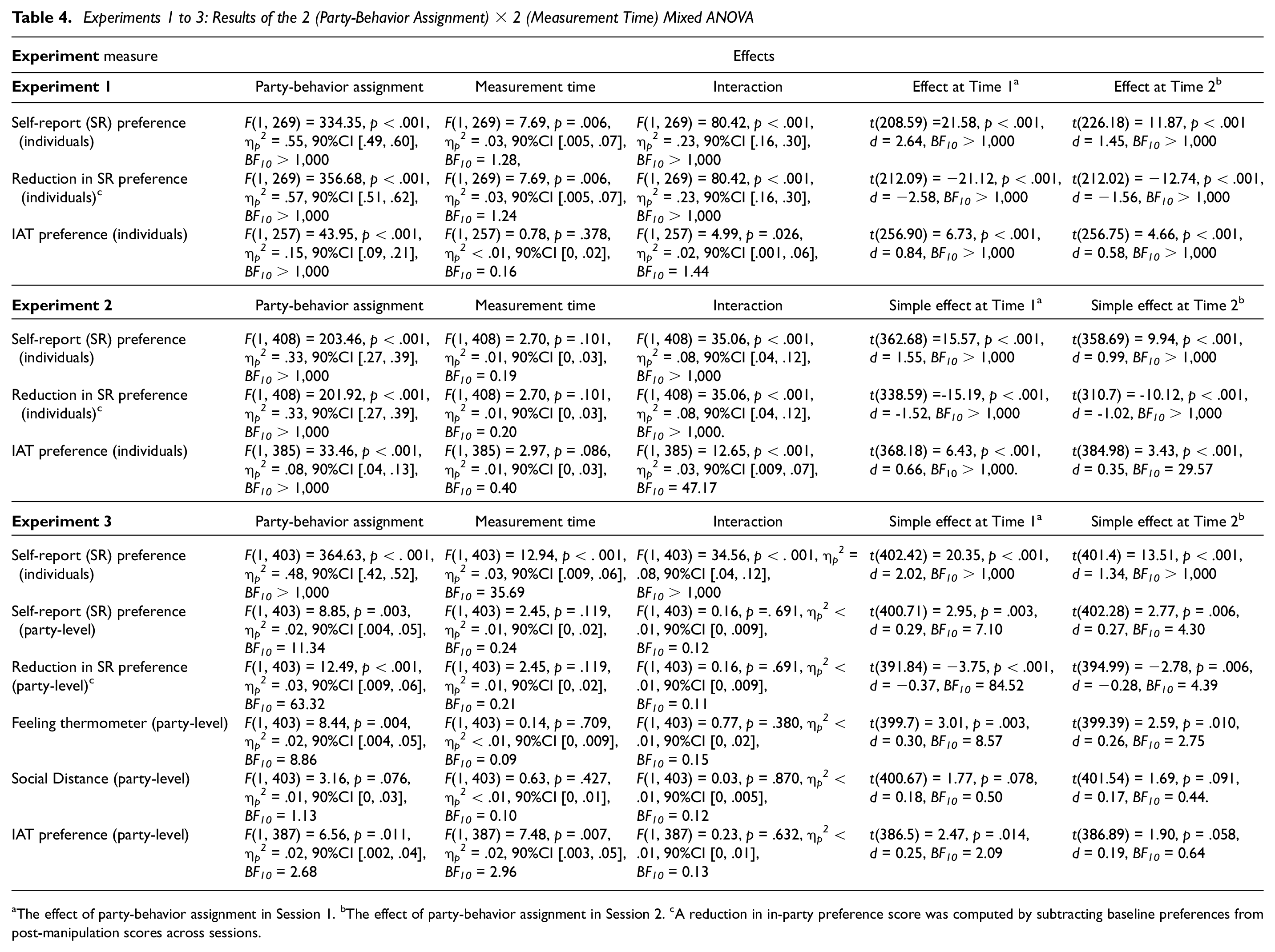
The effect of party-behavior assignment in Session 1. bThe effect of party-behavior assignment in Session 2. cA reduction in in-party preference score was computed by subtracting baseline preferences from post-manipulation scores across sessions.
Self-Report (Experiments 1–3)
The predicted main effect of party-behavior assignment was significant in all experiments, with a decreasing in-party preference when out-party members were presented as moral. 10 The significant interaction between party-behavior assignment and measurement time in all experiments indicated that this effect was smaller but remained significant after the 2-day delay in Session 2 compared with immediately after the intervention in Session 1 (see Table 4 for details). The main effect of time was significant in Experiments 1 and 3, indicating a stronger in-party preference in Session 2.
In Experiments 1 to 2, we computed the reduction in preference for in-party individuals, using baseline preferences subtracted from post-manipulation scores across sessions. With this method, positive scores reflect a reduction in in-party preference. The ANOVA on these scores revealed the predicted main effect of party-behavior assignment. The reduction in in-party preference was larger when out-party members were presented as moral. The interaction between party-behavior assignment and measurement time was significant, with the effect smaller but still significant in Session 2. The main effect of time was significant only in Experiment 1, indicating a greater reduction in in-party preference in Session 1.
IAT (Experiments 1–2)
In both experiments, ANOVA revealed the predicted main effect of party-behavior assignment. The preference for the in-party was smaller when out-party members were presented as moral. The main effect of time was not significant. The interaction between party-behavior assignment and measurement time was significant, with a smaller but still significant effect in Session 2.
Preference for Political Parties (Experiment 3)
Figure 2 and Table 3 detail the mean preference for the in-party as a function of measure, party-behavior assignment, and measurement time in Experiment 3. Table 4 shows the 2 (party-behavior assignment)×2 (measurement time) mixed ANOVA results.
Self-Report
The ANOVA on the self-reported in-party preference and feeling thermometer scores revealed the predicted main effect of party-behavior assignment. As predicted, the preference for the in-party was smaller when out-party members were presented as moral. This effect was significant at both time points. The main effect of time and the interaction were not significant. The ANOVA on the social distance scores did not reveal any significant effects (although the scores were in the expected direction).
Implicit Association Test
The ANOVA on the IAT scores revealed the predicted main effect of party-behavior assignment. As predicted, the preference for the in-party was smaller when out-party members were presented as moral. The interaction was not significant, but the simple effect of party-behavior assignment was significant only in Session 1. The main effect of time was also significant, indicating an overall stronger in-party preference in Session 1.
Discussion
Experiment 1 found a reduced preference for in-party individuals when out-party members were presented as moral and in-party members as immoral. This was evident in self-report and IAT measures and lasted 2 days after treatment. Experiment 2 replicated these results with neutral behaviors replacing the immoral ones. Experiment 3 showed that the treatment reduced preference for the general political in-party, evident in two of three self-report measures and the IAT. These effects lasted 2 days after the treatment. The results suggest that moral learning can reduce affective polarization.
General Discussion
Affective polarization is a growing global phenomenon eroding our democracies (Orhan, 2022; Reiljan et al., 2024). This makes it urgent to develop effective antidotes. With this research, we developed and tested a novel anti-polarization treatment that combines knowledge from intergroup research and learning psychology: the moral learning treatment. Across three experiments, we consistently showed that moral learning decreases the affective polarization of Democrats and Republicans at the individual and party levels. Based on our findings, we considered our approach useful because (a) it does not necessarily include information that degrades other groups that is, it has no negative side effects (Experiments 2–3); (b) it has effects on self-reports as well as on automatic evaluation measures (Experiments 1–3); (c) it shows a certain degree of stability (Experiments 1–3); (d) it generalizes to the entire out-party of Democrats or Republicans (Experiment 3); and (e) it can be implemented in communication strategies aimed at counteracting affective polarization, as we detail below. 11
Theoretically, our research demonstrates that a form of evaluative learning using moral behaviors can change polarized attitudes. Previous studies have shown that learning about specific moral exemplars from outgroups who risked their lives to save in-group members can shift beliefs and emotions, improving intergroup relations (e.g., Čehajić-Clancy & Bilewicz, 2021; Janković & Čehajić-Clancy, 2021; Witkowska et al., 2019). However, these studies focused primarily on historical conflicts and did not test whether this approach can mitigate affective polarization in ongoing political conflicts. In addition, presenting only one example of a moral exemplar, as most previous research did, could lead to subtyping (Čehajić-Clancy & Bilewicz, 2021; Ensari & Miller, 2002), which the current treatment overcomes by presenting multiple moral examples. Finally, the effectiveness of the moral exemplar approach over time was never tested (Witkowska et al., 2022), whereas the current research demonstrated that it could last for 2 days. What the previous and current moral learning approaches have in common is that they challenge the perception of the outgroup as immoral, which is considered a major obstacle in resolving intergroup conflicts (Čehajić-Clancy et al., 2024).
Limitations
There are some limitations concerning the generalization of the current research. We investigated our treatment only in the U.S. context. Although this context is considered highly polarized (Garzia et al., 2023), whether our treatment prevails in other more fragmented, multiple-party contexts remains an open question. Moreover, although our findings show stability for more than 2 days, it is unclear how robust they are over longer time periods (Lai et al., 2016). We also do not know whether the reduced affective polarization observed in our experiments also reduces support for undemocratic candidates or agendas (Voelkel et al., 2023).
There are also some limitations in the observed results and their interpretation. Although we found significant effects of our anti-polarization treatment across three experiments and with different attitude measures, like self-reports, the IAT, and the feeling thermometer, the social distance measure (Experiment 3) was not sensitive to the treatment. A speculative explanation might be that moral learning predominantly influences affective evaluation measures and less cognitive judgments. Moreover, our results might reflect demand effects (e.g., Corneille & Lush, 2023). Although we cannot completely rule out that the demand effects played a role, they can hardly conclusively explain the entire pattern across all measurement times and all measurement instruments. Specifically, (a) in the IAT, a person would have to use a very complex strategy to arrive at the effects we found, (b) the significant but reduced effect at the second measurement time point is typical of learning effects, but it is not clear why demand effects should cause a reduction here, and (c) the absence of effects in the social distance measure although all other measures show significant effects also speaks against the massive influence of demand effects, because it is unclear why should demand effects play no role in this measurement instrument in particular.
Open Questions
Beyond the issues related to generalizing the observed effects we discussed above; other open questions remain. First, the mechanisms underlying our moral learning treatment remain open. Recent studies suggest that (positive) emotions and perceived similarity play a pivotal role here (Čehajić-Clancy et al., 2024; Halperin, 2015; Halperin & Avichail, 2024). The studies by Čehajić-Clancy et al. (2024) indicated that positive feelings toward the outgroup can be generated by evoking elevation (feelings of inspiration, elevation, and awe) due to moral exemplars, which in turn leads to greater approach tendencies toward the outgroup. Whether our moral learning treatment would produce similar emotional effects should be addressed in future studies. Second, based on the above findings on the priority of morality in intergroup relationships and additional empirical evidence that morality is the primary dimension of interpersonal judgments (e.g., warmth is the primary dimension within the stereotype content model; Fiske et al., 2002), prominent importance of morality can be assumed. However, whether other highly positive statements, for instance, related to competence, cause similar effects remains an empirical question for future studies to investigate.
Implications
As affective polarization, an identity-defining attitude (Dias & Lelkes, 2022), has increased, treatments mitigating the disapproval of political opponents are sorely needed. Our results across three experiments showed that exposure to moral behaviors of out-party members effectively reduces polarization. These findings are important for policymakers and civil society interested in fighting affective polarization. Highlighting the moral behavior of out-party members and thereby emphasizing the joint value base of all citizens could be effectively implemented in future campaigns or educational programs aiming to fight affective polarization. For example, social media clips can present real-life examples of people who put themselves in danger to help others while noting their political affiliation. Finally, the moral learning treatment can be applied to other conflict areas, such as post-war reconciliation or the reduction of prejudice.
Supplemental Material
sj-docx-1-spp-10.1177_19485506251343667 – Supplemental material for Learning to Like the Enemy: Moral Learning Reduces Affective Polarization
Supplemental material, sj-docx-1-spp-10.1177_19485506251343667 for Learning to Like the Enemy: Moral Learning Reduces Affective Polarization by Tal Moran and Eva Walther in Social Psychological and Personality Science
Footnotes
Handling Editor: André Mata
Declaration of Conflicting Interests
The author(s) declared no potential conflicts of interest with respect to the research, authorship, and/or publication of this article.
Funding
The author(s) disclosed receipt of the following financial support for the research, authorship, and/or publication of this article: This research was supported by an Israel Science Foundation (ISF) grant #870-23 and the Open University of Israel’s research grant #41454 to Tal Moran.

Supplemental Material
The supplemental material is available in the online version of the article.
Notes
Author Biographies
References
Supplementary Material
Please find the following supplemental material available below.
For Open Access articles published under a Creative Commons License, all supplemental material carries the same license as the article it is associated with.
For non-Open Access articles published, all supplemental material carries a non-exclusive license, and permission requests for re-use of supplemental material or any part of supplemental material shall be sent directly to the copyright owner as specified in the copyright notice associated with the article.
