



Abstract
Social media is a powerful tool for activists to share their perspectives, but concerns persist that the viral spread of online moral outrage may undermine collective causes in some ways. Analyzing posts on X (n = 1,286,442) with URLs to petitions on www.change.org (n = 24,785), we found that expressions of outrage were uniquely associated with the number of times posts were liked and reposted (virality). Mediation analyses showed that outrage was indirectly related to the number of signatures petitions received (via virality). However, outrage was associated with fewer signatures when controlling for virality. In contrast, expressions of agency, group identity, and prosociality were associated with more signatures but no more virality. The findings outline the factors linked to engagement with online petitions and describe how social media can amplify content which has no direct link to the sorts of effortful behaviors typically thought to be conducive to social change.
Introduction
Online spaces have changed what it means to engage with collective causes. By connecting billions of individuals across the globe, social media platforms amplify and propagate content in ways that were previously unimaginable. The accessibility and immediacy of online content allows activists, grassroots organizations, and individuals with limited resources or traditional means of influence to mobilize others. The democratization of information and the ability to rally support through hashtags, viral content, and online campaigns has fueled many recent movements, such as #MeToo and #BlackLivesMatter, allowing them to transcend geographical boundaries and muster unprecedented support (Lotan et al., 2011; Mendes et al., 2018).
Despite the significance of online spaces for recent social movements, there is a sense that they might limit engagement in some ways by encouraging immediate acts, such as sharing content to raise awareness, over more effortful ones, such as donating or signing petitions (Chayinska et al., 2021; Schumann & Klein, 2015). This has been referred to as the problem of “clicktivism” (Bennett & Segerberg, 2013; Morozov, 2009).
Moral outrage has become central to debates about the negative effects of social media. Many view it as performative and are concerned that the tendency for social media platforms to amplify moral outrage is doing more harm than good (Bloom & Jordan, 2018; Brady & Crockett, 2019; Crockett, 2017; Rathje et al., 2024; Van Bavel et al., 2024). An abundance of online outrage is thought to exacerbate problems surrounding “clicktivism” by shifting priorities to immediate forms of engagement in favor of more effortful and potentially impactful ones (Crockett, 2017). In this way, moral outrage may generate a lot of noise surrounding collective causes, but ultimately fail to translate into further action. This can be contrasted with other factors (e.g., appeals to common identities) which may draw less attention on social media, but ultimately be more conducive to further engagement. The present work seeks to contribute to these debates by exploring engagement with online petitions for social change, considering both immediate actions (sharing) and more effortful ones (signing).
How Is Moral Outrage Related to Online Collective Causes?
Moral outrage is an emotional reaction to perceived norm violations involving strong feelings of anger and disgust (Brady et al., 2023). It is a remarkable indicator of online virality (Brady et al., 2021). This makes sense given that both moral and negative content grabs attention and receives more engagement online (Baumeister et al., 2001; Berger & Milkman, 2012; Brady et al., 2017; Gantman & Van Bavel, 2014). Brady et al. (2017) found that each additional negative moral-emotional word in social media posts about contentious social issues (e.g., gun control) was associated with 24% more reposts. This is partly why some believe that expressions of outrage can benefit online collective causes by helping content to go viral and increase awareness of relevant issues (see Spring et al., 2018).
A more persuasive defense of online moral outrage could be made if it could be linked to further effortful behaviors in service of collective causes (over and above sharing). A wealth of psychological theorizing suggests that negative emotional reactions to injustice mobilize people to engage in collective action (Drury & Reicher, 2009; Klandermans, 1997; van Zomeren et al., 2008; Wright, 2010). The social identity model of collective action (SIMCA) posits that anger about group injustices is built on a sense of identification with the group (as are beliefs about the group’s ability to achieve positive change; van Zomeren et al., 2008). Numerous observations have revealed the links between offline collective action, such as participating in protests, and feelings of righteous anger, injustice, and outrage (Miller et al., 2009; Thomas et al., 2009). For example, one study found that anger at injustice positively predicted support for policies and behaviors aimed at wealth redistribution (Wakslak et al., 2007). The amount of moral language used on social media can be predictive of protests (Mooijman et al., 2018). There is also evidence that online engagement (often associated with moral outrage) is linked to more effortful action (Foster et al., 2021; Smith et al., 2023; cf. Chayinska et al., 2021; Schumann & Klein, 2015). These works suggest that moral outrage should also track more effortful collective action.
However, the expression of moral outrage can also be performative (Brady et al., 2023; Fincher & Tetlock, 2016; Jordan & Rand, 2020). Studies using offline dictator games find that expressing outrage paradoxically reduces the need to engage in more effortful action (Xiao & Houser, 2005). Whether expressions of moral outrage function in a similar way in the online contexts is therefore unclear. It remains an open question as to whether expressions of moral outrage only predict the virality of online causes, or whether this extends to further forms of more effortful engagement.
Additional Indicators of Online Engagement and Action
There are other potential factors associated with online collective action that are not subject to the same concerns as moral outrage. Classic psychological theorizing suggests that people engage in collective action when they feel that goals are achievable—that is, they feel a sense of efficacy (Drury & Reicher, 2009; Klandermans, 1997; Thomas et al., 2009; van Zomeren et al., 2008; Wright, 2010). In one study, Israelis were more likely to state that they would sign a petition against unreasonably high estate prices in Tel Aviv if they also believed that their actions would have a significant effect (van Zomeren et al., 2013). Calls-to-action often attempt to instill a sense of efficacy via the use of agentic language. We define agentic language as linguistic expressions that convey goal-oriented or action-oriented content (Formanowicz et al., 2024). Messages like “we act” clearly communicate a need for action, while messages such as “Vote leave” provide a concrete way for an action to manifest. Such messages are perceived to be effective campaign slogans (Formanowicz et al., 2021, 2024) and can prompt more charitable donations (Whillans & Dunn, 2018; see also Suitner et al., 2023). Agentic language is therefore likely to track engagement with online collective action.
People are likely to engage with collective causes if they identify with them. Individual helping behavior is shaped by identification with those in need (Levine et al., 2005) and collective behavior is much the same (Jost et al., 2018; Simon & Klandermans, 2001; Thomas et al., 2009; van Zomeren et al., 2008). One study found that Dutch farmers were more likely to participate in protests if they identified with other farmers (Klandermans, 2002). The use of words like “we” and “us” are relevant here as they denote a common group identity. They are often used in online calls-to-action (Suitner et al., 2023) and actual protests (Adam-Troian et al., 2021). There is also some evidence that using such language to cue a common sense of identity may be an effective method through which one can muster support for one’s cause. For example, politicians’ who rely more on words like “we” and “us” in their speeches are more likely to be elected compared with those who rely less on such language (Steffens & Haslam, 2013). Thus, references to common group identities may be linked to engagement with online collective action.
Warmth, kindness, and care are core aspects of prosociality which can foster group-oriented behavior, as they denote commitments to helping others and prioritizing collective well-being (Fiske et al., 2007; Penner et al., 2005). Prosociality is central to many conceptions of collective action. Definitions typically emphasize transcending self-interest to achieve outcomes that benefit the group or society at large. For example, van Zomeren and Iyer (2009) present a definition of collective action as: any action which aims to improve the conditions of a group rather than any specific individual. Indeed, many collective movements are characterized by prosocial intentions. This is evident in solidarity-based collective actions, such as advantaged group members advocating for the rights of the disadvantaged, driven by shared moral convictions and a sense of responsibility (Becker, 2012; Iyer & Ryan, 2009; van Zomeren et al., 2011). Valuing the welfare of others is predictive of individual participation in movements—such as gender equality initiatives and pandemic-related safety behaviors (Boggio et al., 2024; Milesi & Alberici, 2018). Consistent with this, words denoting prosociality, such as “empathy” and “altruism,” track the amount of engagement with collective online endeavors to crowdfund novel projects (Pietraszkiewicz et al., 2017). Thus, expressions of prosociality may be a key indicator of engagement with online collective action.
Overall, past work suggests that expressions of agency, group identification, and prosociality are likely to be important indicators of engagement with online collective action. This work documents the links between these factors and effortful actions, such as monetary contributions (Pietraszkiewicz et al., 2017; Whillans & Dunn, 2018). However, it is less clear whether they are associated with immediate forms of online engagement (such as sharing content). There is some evidence from offline experiments that people prefer to share social and positive-moral content with others (Mesoudi et al., 2006; Stubbersfield et al., 2019). In online discussions of contentious political issues, positive moral-emotional language is a minor indicator of engagement (Brady et al., 2017). However, it is dwarfed by moral outrage and negative moral-emotional language (Brady et al., 2017, 2021). Likewise, a broad take-away from the wider literature is that positive and low-arousal content is at a disadvantage in online spaces (Berger & Milkman, 2012; Brady et al., 2017, 2021; Rathje et al., 2024). This work suggests that agency, group identities, and prosociality may not be particularly strong indicators of immediate forms of online engagement with collective causes.
Present Work
We investigated collective action in the context of social media use by analyzing posts to X which contain URLs to petitions for social change. We focused on liking and reposting as modes of engagement indicative of endorsement and information diffusion in social networks (Berger & Milkman, 2012; Brady et al., 2017). We also examined online petition signing as a further form of more effortful engagement which is typically thought to be conducive to systemic change (van Zomeren et al., 2008). Examining liking and sharing in conjunction with petition signing provides insight into different forms of online behavior. They differ along two dimensions which characterize actions of clicktivism: immediacy and effort (Halupka, 2014; Skoric, 2012). We consider liking and reposting more immediate forms of action which require minimal effort (achieved on the present platform). We consider signing as a more distal form of action which requires more effort (achieved on a secondary platform).
We sought to address two primary questions: (1) which factors track engagement with online collective causes, and (2) whether some factors are uniquely associated with immediate forms of engagement (liking and reposting) compared with more distal and effortful ones (petition signing). That negative moral sentiments track virality (Berger & Milkman, 2012; Brady et al., 2017) led us to hypothesize that moral outrage would be associated with liking and reposting of posts containing petitions for social change. Making predictions about the relationship between moral outrage and petition signatures was less straightforward. On one hand, collective action is driven by feelings of anger at injustices (van Zomeren et al., 2008; Wakslak et al., 2007) and immediate forms of online engagement are often predictive of more effortful actions (Foster et al., 2021; Smith et al., 2023), which led us to expect that expressions of moral outrage would be associated with more petition signatures. On the other hand, work which views expressing moral outrage as substitutive of other forms of action (Brady & Crockett, 2019; Crockett, 2017) suggests that it may paradoxically be associated with fewer petition signatures.
Our thinking about the effects of agency, group identification, and prosociality was more straightforward. There is good reason to think that these factors should track engagement with typical forms of collective actions, such as petition signing, as they tend to do so in offline contexts (Boggio et al., 2024; Milesi & Alberici, 2018; van Zomeren et al., 2008). As such, we predicted that they would be associated with more petition signatures. However, the evidence for their potential associations with immediate forms of online engagement is more limited. High-arousal and negative sentiments are the strongest indicators of online engagement (Berger & Milkman, 2012; Brady et al., 2017). Expressions of agency, group identification, and prosociality are not of this sort. For this reason, we were agnostic about their associations with liking and reposting.
Method
The work received approval from the School of Psychology Ethics Board at the University of Kent (ID: 202316941706278627). The data and analysis script are available via the Open Science Framework (https://osf.io/2kmtp/). The work was not pre-registered.
To investigate online collective action, we compiled a large set of active petitions from www.change.org which had recently been shared on X (formerly Twitter). Change.org allows users to create and sign petitions to advance various social causes and influence decision-makers. Such endeavors are considered by many to be legitimate and democratic avenues for groups to voice grievances in hopes of social change (Bochel, 2013). For example, the U.S. government previously committed to responding to petitions with sufficient support (Goldman, 2015). It actively encourages, and relies on, the use of social media to raise awareness of its petitions and increase support for them. All petitions include a direct link to “Tweet to your followers.” As of 2023, the site reports to have over 500 million users from across the globe and petitions targeting causes such as social justice, human rights, education, environmental protection, animal rights, health, and sustainable food. X is a popular online social media and social networking service with over 300 million users, posting from primarily public accounts (Takhteyev et al., 2012). Users are able to post messages which can be engaged with and propagated to others by liking and reposting them.
We began by searching the X API (at the time, the Twitter academic API) for all English-language posts containing any URL to change.org or its subsites (e.g., change.org/protect-our-nhs/) in the last 4 months (January 1, 2023–June 1, 2023). This search was exhaustive and not guided by a sample target. It resulted in 24,785 unique petition URLs (derived from 254,213 posts). We scraped the number of signatures each petition received from these URLs. 1 Many of these petitions were created prior to our initial earliest search date: 23.8% in 2023, 51.1% in 2022, 6.5% in 2021, 5.2% in 2020, and 13.4% in or before 2019. As such, we then conducted a full historical search of the Twitter API, reaching back to the earliest available time-point (March 2006), to compile all posts linking these 24,785 petitions. It resulted in 1,286,442 posts linking to the aforementioned petitions. The final dataset included each petition’s description and the number of signatures it received, as well as each post’s text content and the number of times they were liked and reposted.
We measured moral outrage using the Digital Outrage Classifier, a machine learning algorithm which can detect moral outrage in English-language posts in a manner consistent with trained human annotators (Brady et al., 2021). We measured agentic language via BERTAgent, a validated English-language transformer-based model for quantifying semantic agency in text (Nikadon et al., 2024). Following prior work, we used validated lists of words (Boyd & Schwartz, 2021; Pennebaker et al., 2003) to quantify the presence of group identification and prosociality. Group identity strength was indexed via the presence of words such as “we” and “us” minus words such as “sure” and “know” (Ashokkumar & Pennebaker, 2022) and prosociality was indexed via the presence of words such as “selfless” and “generous” (Pietraszkiewicz et al., 2017). Group identification and prosociality scores for each text were computed by dividing the number of relevant words by the total number of words in the post (Dehghani & Boyd, 2022). Each post received a score along all of these four dimensions (Further details on the methods are provided in the Supplementary Information). Through this approach, we arrived at a dataset which could reveal the factors associated with online collective action.
Results
Analytic Approach
We aggregated all indices within petitions to produce a set of scores reflecting the language used in posts which shared each petition, how often they were liked and shared, and how many signatures they received. This is the recommended approach when predicting level two variables (signatures) from Level 1 variables (post language, likes, reposts), as it controls for an otherwise inflated Type I error rate (Foster-Johnson & Kromrey, 2018). Analyses of the disaggregated data are almost identical (see Supplementary Information).
Following prior work (Brady et al., 2019; Rathje et al., 2021), we log-transformed the like, repost, and signature counts to better approximate a Gaussian distribution. Our main analyses were conducted by fitting a series of univariate ordinary least squares regression models to estimate the basic relationships between each type of language (moral outrage, agency, group identity, and prosociality) used in the posts and each metric of engagement (likes, reposts, and signatures). Analyses were conducted in R (version 4.0.1) via the glm function while specifying the Gaussian family of models. All variables were mean-centered and standardized using the jtools package (Long, 2024). Following prior work (Brady et al., 2019; Rathje et al., 2021), coefficients derived from these models were exponentiated so as to provide a more interpretable measure of the magnitude of the effects.
Main Analyses
We began by considering moral outrage. As can be seen in Figure 1, expressions of moral outrage were linked to immediate forms of engagement with collective causes. Petitions shared with more moral outrage received more likes and reposts compared with those shared with less, exp(βLikes) = 1.07, 95% confidence interval (CI) = [1.05, 1.10], p < .001; exp(βReposts) = 1.10, 95% CI = [1.07, 1.12], p < .001. However, similar effects were not present for more effortful actions. Petitions shared with more moral outrage received no more signatures than those shared with less, exp(βSignatures) = 1.00, 95% CI = [0.97, 1.04], p = .810. Moral outrage is therefore linked to immediate forms of engagement, but less so with the sorts of effortful behaviors thought to be necessary for normative systemic change.
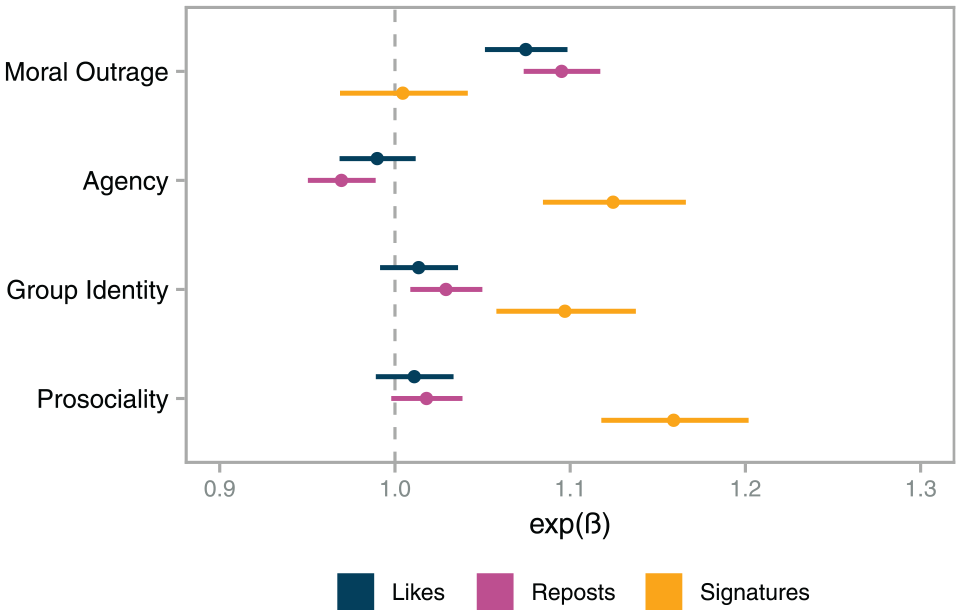
Predictors of Online Petition Success
The pattern of results for agency, group identity, and prosociality were the opposite of moral outrage (see Figure 1). They were largely unrelated to immediate forms of engagement. Petitions shared with more agentic language received no more likes and slightly fewer shares compared with those shared with less agentic language, exp(βLikes) = 0.99, 95% CI = [0.97, 1.01], p = .362; exp(βReposts) = 0.97, 95% CI = [0.95, 0.99], p < .001. Likewise, those shared with more expressions of group identity received no more likes and slightly more shares compared with those shared with fewer expressions of group identity, exp(βLikes) = 1.01, 95% CI = [0.99, 1.04], p = .232; exp(βReposts) = 1.03, 95% CI = [1.01, 1.05], p < .001. Expressions of prosociality were also largely unrelated to immediate forms of engagement with collective causes. Petitions shared with more prosocial language received no more likes and reposts compared with those shared with less prosocial language, exp(βLikes) = 1.01, 95% CI = [0.99, 1.03], p = .332; exp(βReposts) = 1.02, 95% CI = [1.00, 1.04], p = .084.
The associations with agency, group identity, and prosociality were more noticeable in relation to petition signatures. Petitions advertised with more agentic language received more signatures than those with less, exp(βSignatures) = 1.12, 95% CI = [1.08, 1.17], p < .001. Petitions posted with more identity language garnered more signatures than those posted with less identity language, exp(βSignatures) = 1.10, 95% CI = [1.06, 1.14], p < .001, while those posted with more prosocial language received more signatures than those posted with less, exp(βSignatures) = 1.16, 95% CI = [1.12, 1.20], p < .001. These findings suggest that agentic, group identity, and prosocial language are associated with effortful online action in support of collective causes. At the same time though, posts with such content seem no more likely to propagate through social networks.
Exploratory Analyses
We sought to further explore how posts were shared on social media and the number of signatures they received. Given the emphasis change.org places on social media as a tool for raising awareness of its petitions, one would expect that those petitions that are shared more on social media would garner more signatures. We find this to be true, which suggests that virality is an indirect way to garner signatures, exp(βReposts) = 1.54, p < .001. This is interesting in the case of moral outrage, as it could represent an important pathway through which it can foster more effortful behaviors in service of collective causes. This understanding is consistent with a statistical model in which the content of posts sharing petitions is indirectly associated with more signatures via the propensity to go viral. We fit such a mediation model via the lavaan package (Rosseel, 2012).
As can be seen in Figure 2, this analysis revealed a positive indirect effect of moral outrage through virality on the likelihood that petitions received signatures, exp(βIndirect) = 1.03, p < .001. After accounting for virality, the direct effect of moral outrage predicted fewer signatures, exp(βDirect) = 0.98, p < .001. These results show that, despite moral outrage having no direct association with effortful forms of engagement with collective causes (i.e., signatures), it may nevertheless be indirectly associated with more signatures, by virtue of its positive relationship to immediate forms of engagement (i.e., reposts).
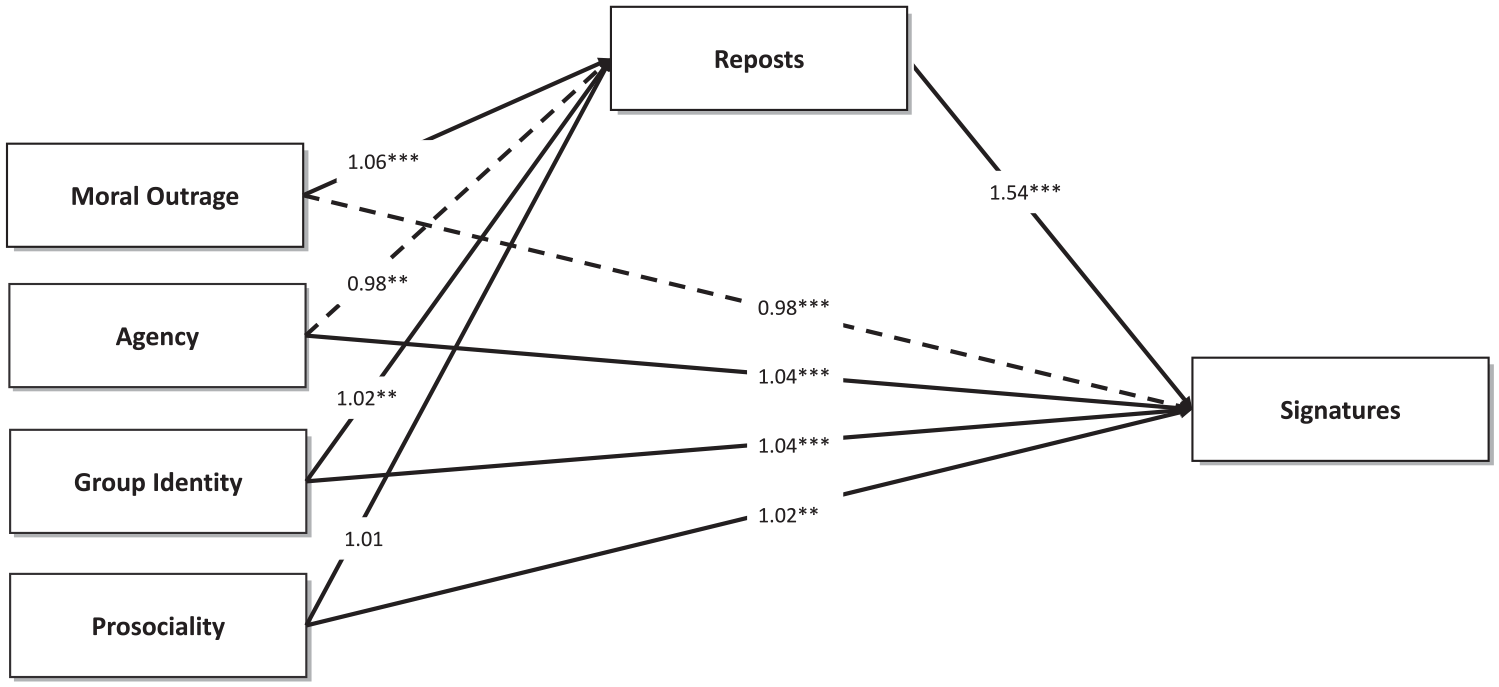
Direct Effects of Petition Content on Signatures and Via Reposts (Virality)
We also analyzed the indirect effects of agency, group identity, and prosociality. As indicated by Figure 2, there was a small negative indirect effect of agency, exp(βIndirect) = 0.99, p = .002. Its tendency to reduce reposts had a detrimental effect on the number of signatures petitions received. Group identities had the opposite effect. Its minor capacity to increase reposts followed through to more signatures, exp(βIndirect) = 1.01, p = .001. Finally, there was no strong evidence of an indirect effect of prosociality, exp(βIndirect) = 1.01, p = .057, which is consistent with it having little capacity to increase reposts.
Robustness Checks
We sought to test the robustness of the observed effects. The effects of moral outrage, agency, group identity, and prosociality on virality and signatures were largely unchanged when controlling for the content of the petitions themselves. They were also robust to controlling for any potential covariation between the different types of language (see Supplementary Information). These results made us more confident that the central findings reflect how petitions are shared on social media, as opposed to other more general variations in the content of the petitions or covariation between different language types.
Discussion
Moral Outrage Is Associated With Virality But Not Petition-Signing
Motivated by concerns about the tendency for social media to propagate content which may undermine collective action (Brady & Crockett, 2019; Crockett, 2017; Van Bavel et al., 2024), we investigated the factors linked to engagement with petitions for social change. We found that moral outrage was uniquely associated with the amount petitions were shared on social media—similar to how it tracks virality in other contexts (Brady et al., 2021). This helps explain why petitions eliciting strong moral sentiments garner so much attention. For instance, the death of Cecil the Lion in 2015 sparked a number of viral petitions calling for hunting reforms and punishment of the man who killed him, while the petition demanding justice for George Floyd is, as of writing, the most widely shared on the entire change.org platform (Kellen, 2020).
However, moral outrage was largely unrelated to the number of signatures petitions received, and when taking into account its capacity to go viral, it was associated with fewer signatures. This is consistent with a “clicktivism” effect, where immediate forms of online engagement, such as liking or sharing posts, replace more effortful actions (Greijdanus et al., 2020; Morozov, 2009). Although the present data are correlational and cannot corroborate causal claims, this is nevertheless the pattern of results one would expect if online expressions of outrage have a performative element that is supplanting the need for further action (Brady & Crockett, 2019; Crockett, 2017).
The findings further outline a number of key associations with online engagement with collective causes. Expressions of agency, group identity, and prosociality were all associated with more petition signatures. These findings align with prior observation (Formanowicz et al., 2021; Pietraszkiewicz et al., 2017) and theorizing (Drury & Reicher, 2009; Klandermans, 1997; van Zomeren et al., 2008; Wright, 2010). In addition, they support the broader applicability of the SIMCA model (van Zomeren et al., 2008) by demonstrating its effectiveness in predicting online dynamics of language use and engagement with collective causes. At the same time, expressions of agency, group identity, and prosociality were associated with no more online engagement. This highlights nuances in how collective behavior plays out in online spaces and the need to integrate psychological theorizing with understandings of engagement-maximizing algorithms (Brady et al., 2020).
Caveats and Constraints on Generalizability
The sample of X posts containing URLs to petitions on change.org (nPetitions = 24,785, nPosts = 1,286,442) provides a comprehensive outline of the factors associated with engagement with collective endeavors for social change. However, they are constrained to a single social media platform and so may not generalize to others. X users tend to be younger and more liberal compared with, for example, Facebook users (Shearer & Mitchel, 2021). Moreover, there is evidence that engagement with misinformation (Vosoughi et al., 2018; cf. Bond & Garrett, 2023) and expressions of outgroup animosity (Rathje et al., 2021) vary across platforms. Whether the factors we focus on here explain engagement with collective causes on other platforms remains to be seen.
We studied two forms of engagement with collective causes, finding that petitions posted with moral outrage were more likely to be shared but no more likely to be signed. This suggests that moral outrage is neither uniformly beneficial nor detrimental to online collective causes (see Brady & Crockett, 2019; Spring et al., 2019). On one hand, it may be effective at increasing awareness. The way #MeToo spread through social networks was pivotal to cultivating an awareness of the scope of the issue (Mendes et al., 2018). However, it may be limited in its ability to translate the magnitude of an outcry into the sorts of further action which can influence decision-makers (Goldman, 2015). Whether moral outrage is ultimately an effective tool may therefore depend on the specific goals social movements seek to achieve (Brady & Crockett, 2019; cf. Spring et al., 2018).
Concluding Remarks
Taken as a whole, the findings indicate that at least one form of content (moral outrage) which tends to go viral is precisely that which has no association with the sorts of effortful behaviors thought to be conducive to legitimate and democratic social change (Bochel, 2013). Conversely, the content that struggles to go viral is instead that which shows the strongest connection to such behaviors. This result lends credibility to concerns about the role that social media platforms are playing in propagating inflammatory sentiments which have limited ability to further collective causes (Brady & Crockett, 2019; Crockett, 2017; Rathje et al., 2024; Van Bavel et al., 2024). However, the question remains open as to why moral outrage is not predictive of further forms of engagement. It could be, as experimental work suggests (Xiao & Houser, 2005), that expressing moral outrage is psychologically satiating, thereby reducing the impetus for further action. It could also be that outrage serves a specific function throughout the course of collective responses to injustices (Brady & Crockett, 2019; Lerner & Tiedens, 2006). The breaking news of George Floyd’s murder was initially met with swift and decisive condemnation, with more organized and strategic collective responses to follow. Investigating these mechanisms will likely require careful experimental work and sophisticated modeling of samples which include both online engagement and offline behavior (e.g., Smith et al., 2023).
With the use of online platforms becoming more widespread and integral to social life, it is increasingly important to take serious concerns about their capacity to undermine constructive ways of relating to one another. The pattern of results we observed indicates that the content which tends to be amplified is surprisingly unrelated to further forms of engagement with collective causes. This points to a case of misalignment (Rathje et al., 2024), where the goal of social media platforms to maximize engagement may not be conducive to what promotes the sorts of effortful collective actions that are typically thought to be conducive to social change.
Supplemental Material
sj-docx-1-spp-10.1177_19485506251335373 – Supplemental material for Moral Outrage Predicts the Virality of Petitions for Change on Social Media, But Not the Number of Signatures They Receive
Supplemental material, sj-docx-1-spp-10.1177_19485506251335373 for Moral Outrage Predicts the Virality of Petitions for Change on Social Media, But Not the Number of Signatures They Receive by Stefan Leach, Magdalena Formanowicz, Jan Nikadon and Aleksandra Cichocka in Social Psychological and Personality Science
Footnotes
Handling Editor: Danny Osborne
Author Contributions
Leach led all aspects of the work. Cichocka contributed to the conceptualization and reviewing/editing. Formanowicz contributed to the conceptualization and reviewing/editing. Nikadon contributed to the data collection and curation, validation of analyses, and reviewing/editing.
Declaration of Conflicting Interests
The author(s) declared no potential conflicts of interest with respect to the research, authorship, and/or publication of this article.
Funding
The author(s) disclosed receipt of the following financial support for the research, authorship, and/or publication of this article: The work was supported by an OPUS (2020/37/B/HS6/02587) 19 grant awarded to Magdalena Formanowicz and a Leverhulme Trust Research Project Grant (RPG-2021-241) awarded to Aleksandra Cichocka.
Ethical Approval
The work received approval from the School of Psychology Ethics Board at the University of Kent (ID: 202316941706278627).
Artificial Intelligence
ChatGPT was used to improve grammar and sentence structure.
Transparency

Supplemental Material
The supplemental material is available in the online version of the article.
Notes
Author Biographies
References
Supplementary Material
Please find the following supplemental material available below.
For Open Access articles published under a Creative Commons License, all supplemental material carries the same license as the article it is associated with.
For non-Open Access articles published, all supplemental material carries a non-exclusive license, and permission requests for re-use of supplemental material or any part of supplemental material shall be sent directly to the copyright owner as specified in the copyright notice associated with the article.
