




Abstract
Pro-life individuals often emphasize sanctity-of-life concerns as driving their opposition to abortion. This implies the straightforward prediction that the more strongly people oppose abortion for such reasons (e.g., “abortion is murder”), the more they will endorse policies preventing abortions (face-value account). An alternative suggests that typically nonconscious reproductive goals (e.g., discouraging casual sex) influence policy preferences; this strategic account predicts a different pattern of policy endorsement: all else equal, abortion opponents will prioritize abortion-preventing policies discouraging casual sex. A pilot study and two preregistered U.S. experiments (N = 1,960) provide relatively greater support for the strategic account: the strongest abortion opponents more strongly endorse policies that prevent abortions by discouraging casual sex (e.g., abortion bans, abstinence-only sex education) over policies that do not (comprehensive sex education)—even controlling for conservatism and religiosity. Commonly voiced arguments against abortion may be more rhetorically effective but less reflective of genuine drivers underlying arguers’ beliefs.
Why do some people oppose abortion? Most pro-life individuals cite sanctity-of-life concerns—asserting that abortion is the immoral taking of innocent life, or murder (Lopez, 2012; Marquis, 2006; Williams, 1982). Indeed, in the United States, 93% of people who oppose abortion in all cases say that the statement “Human life begins at conception, so a fetus is a person with rights” characterizes their views extremely or very well (Pew Research Center, 2022a), suggesting that pro-life individuals nearly universally deem this belief central to, and see it as the principal cause of, their views on abortion. We refer to this as the face-value account.
A strategic account 1 suggests a less straightforward alternative, whereby potentially nonconscious motivations to suppress others’ casual sexual behavior which give rise to anti-abortion attitudes. Desires to suppress others’ sexual behavior are cross-culturally common and multifaceted (Luberti et al., 2023). A growing body of research suggests that such desires might be driving attitudes toward an array of behaviors that people perceive as related to casual sex. For example, data suggest that people who are likely to support the suppression of casual sex are also likely to oppose recreational drug use and marriage equality—behaviors they see as related to or facilitating casual sexual norms (Kurzban et al., 2010; Pinsof & Haselton, 2016).
People who wish to discourage casual sex may be especially motivated to oppose abortion for several reasons. Chiefly, abortions can reduce the unwanted costs of casual sex (i.e., pregnancy). Just as increasing the costs of casual sex—as via abortion bans—might be expected to decrease the frequency of casual sex, decreasing the costs of casual sex—as via abortion access and other reproductive technologies (e.g., birth control)—might thus be expected to increase the frequency of casual sex. Indeed, many on both sides of the debate believe that abortion bans do, in fact, deter casual sex (Pinsof, 2018), and 35% of Americans explicitly agree that “if legal abortions are too easy to get, then people won’t be as careful with sex and contraception” (Pew Research Center, 2022b). This logic is sometimes even referenced in pro-life rhetoric, as when a judge holding antiabortion views suggested that pregnancy and childbirth are the price that women must pay for having sex (e.g., that women must “suffer the effects [of pregnancy] during the whole period”) (Malkin, 2008).
Thus, the strategic account notes that, insofar as abortion is viewed as limiting costs associated with casual sex, people who wish to restrict casual sex will be more likely to oppose abortion. A key prediction, then, is that people who oppose abortion will not necessarily nor equally favor various policies that reduce abortion per se; rather, abortion opponents will show support for abortion-reducing policies that would deter casual sex or make it more costly.
We also note that the strategic account does not imply that pro-life individuals are making disingenuous arguments about their abortion opposition. Rather, on this view, people are often unaware of the reasons they arrive at certain positions and use post hoc rationalizations to defend them (Haidt, 2001). Framing pro-life arguments as concern for harm toward a vulnerable population (e.g., babies) may be effective for persuading others against abortion—hence why it is commonly voiced—while not necessarily being the underlying driver of antiabortion beliefs (cf. DeScioli & Kurzban, 2013). In fact, to make the most convincing argument, arguers might be best served by not even being aware of these underlying motives (Kurzban & Aktipis, 2007).
Testing Between Predictions
Here, we test between predictions from face value and strategic accounts by assessing Americans’ support for different bills—each described as having the same exact costs to taxpayers and saving the same exact number of lives—varying in their implications for the costs of casual sex: (a) A bill punishing women seeking abortions would likely curtail casual sex (by making it costlier). This bill also closely matches measures that abortion opponents often propose. 2 Two other bills are aimed at curtailing unwanted pregnancies—and thus abortions. One aims to achieve this via (b) abstinence-only sex education, which would explicitly discourage casual or premarital sex. Another aims to achieve this via (c) comprehensive sex education, which typically includes information about and access to birth control, and has often been (incorrectly) perceived as encouraging casual sex (by preventing the costs of pregnancy) (Gautam-Adhikary, 2011). (d) A bill aimed at saving the lives of vulnerable newborns via critical provisioning is largely neutral in impact on casual sex.
Accounts make competing predictions about bill support. Per a face-value account, all else equal, (a) the more people oppose abortion (e.g., agreeing that abortion is murder), the more they should support bills described as preventing the same number of abortions at the same taxpayer cost. Thus, we should see positive correlations between opposition to abortion owing to sanctity-of-life concerns and support for all bills. In addition, (b) people who most strongly oppose abortion on such grounds should report high—and, in fact, equally high—support for all abortion-preventing bills. Indeed, to the extent that such abortion opposition is premised on sanctity-of-life concerns, these predictions may also extend to bills about saving innocent lives (newborn provisioning).
By contrast, the strategic account expects that, insofar as abortion opposition arises, at least in part, from motivations to suppress casual sex (Becker, 2024; Weeden, 2003), then bill support will track the implications of each bill for casual sex. Thus, the more people oppose abortion, (a) the more they will support bills likely to deter casual sex (punishing abortion-seekers, abstinence-only sex education), and (b) the less they will support bills perhaps perceived as facilitating casual sex (comprehensive sex education)—again, despite all bills having the same exact fetal or infant-saving benefits and taxpayer costs. This view makes no explicit predictions about support for newborn provisioning. 3
We test between predictions derived from these views in a pilot study (reported in the Supplemental Material) and two highly powered, preregistered experiments. Data, materials, and code for all three experiments are available: https://osf.io/qmubc/.
Experiment 1
Experiment 1 assessed participants’ opposition to abortion driven by sanctity-of-life concerns, and then experimentally those participants to evaluate one of four bills proposing a policy intended to prevent abortions (or save newborn lives).
Because religiosity and political conservatism are among the most discussed drivers of pro-life views, we measure participants’ religiosity and conservatism, testing whether predicted patterns of results hold even when controlling for these potential drivers.
Method
Preregistration
We preregistered Experiment 1 (https://osf.io/duwx6). We made some transparent adjustments to the materials and expectations before running the experiment (documented: https://osf.io/qmubc/). In response to reviewer recommendations, we deviate from our preregistered analyses. The original analyses probed interactions to estimate patterns of support among the strongest abortion opponents (as recommended by Aiken and West (1991)). This change did not alter conclusions.
Participants
As our pilot study had a low representation of strong abortion opponents, we sought greater representation here by first sampling 600 Republicans. We then left the rest of the sample open for any participants. This strategy was successful—this sample scored higher on abortion opposition (M = 4.66, SD = 2.16), including 263 participants with the maximum score. Our final sample included 1,004 U.S.-residing participants (542 female, 453 male, 6 other age: M = 41.76, SD = 12.66) from CloudResearch (Litman et al., 2017). One participant failed the attention check (“Please select ‘4’”) and was excluded from the analyses. Participant ages ranged from 18 to 80, with a median age of 40. We calculated that 1,000 participants would provide sufficient power (.95) to detect small effect sizes (f2 = .013) for a single regression coefficient.
Procedure and Measures
Abortion Opposition
We measured abortion opposition with two questions reflecting underlying sanctity-of-life concerns: “Abortion is a type of murder”; “Abortion violates an unborn person’s right to life” (α = .95).
Proposed Bills
Next, participants were randomly assigned to read one of four bills. Notably, each policy proposed (a) prevents the same number of abortions (or saves the same number of infant lives for the health bill) and (b) costs taxpayers the same amount of money. Specifically, each bill purported to spend $57 billion and to save ~634,000 (fetal or newborn) lives over 10 years. In this experiment (but not Experiment 2), the bill was said to focus on low-income and racial minority neighborhoods.
The punishment bill purports to prevent abortions by making them illegal, imposing fines and potential jail time for both women seeking and doctors performing abortions. This bill could be perceived as making casual sex more costly (by, e.g., requiring women to carry unwanted pregnancies).
The comprehensive sex education bill purports to prevent unwanted pregnancies—and thus abortions—by providing information about and access to birth control. This bill could be perceived as facilitating casual sex.
The abstinence-only sex education bill (heretofore referred to as abstinence) likewise purports to prevent unwanted pregnancies—and thus abortions—by providing sex education that explicitly discourages sexual activity before or outside of marriage. This bill is likely be perceived as inhibiting casual sex.
The health bill purports to save infant lives by providing critical provisioning for newborns in need, without which they would be unable to survive. Thus, this bill does not explicitly increase or reduce costs on casual sex.
Participants also rated two distractor bills, which came after the experimental manipulation.
Demographics and Other Individual Difference Items
For exploratory purposes, we also assessed short-term mating orientation (4-item measure adapted from Jackson & Kirkpatrick, 2007; α = .93) and religiosity (3-item measure from Moon et al., 2018; α = .96). Participants also reported their political leaning on both social and economic issues (0 = extremely liberal, 100 = extremely conservative). Finally, participants completed demographic information, including age, gender, ethnicity, relationship status, and religious affiliation.
Results
Does Greater Opposition to Abortion Predict Greater Support for Abortion-Preventing Policies?
A first set of predictions derived from face value and strategic accounts concerned the relation between abortion opposition and support for different bills. To examine this, we used multiple regression predicting bill support as a function of abortion opposition (centered), and three dummy codes representing the four conditions. By changing the base group across models (i.e., which group is coded zero in all dummy codes), we are able to obtain the slope of abortion opposition on each bill from separate models.
Results are plotted in Figure 1. First, contrary to face-value predictions, greater sanctity-of-life-based opposition to abortion was not positively predictive of support for all bills preventing abortions (or saving newborn lives). Rather, increasing abortion opposition positively predicted greater support for the punishment bill, t(993) = 17.59, p < .001, b = 1.72, 95% confidence interval (CI) = [1.53, 1.91], in line with both face-value and strategic accounts. Abortion opposition also positively predicted greater support also for the abstinence bill, t(993) = 6.97, p < .001, b = 0.70, 95% CI = [0.50, 0.90], again in line with both face-value and strategic accounts. However, countering the face-value account—and supporting the strategic account—abortion opposition negatively predicted support for the comprehensive sex education bill, t(993) = −3.78, p < .001, b = −0.38, 95% CI = [–0.58, –0.18]. Taking the last two findings together, the pattern of data reveals that abortion opposition predicts greater support for the abstinence and lesser support for the comprehensive sex education bill—even as both bills are described as preventing the same exact number of abortions, as doing so via sex education, and as costing taxpayers the same exact amount of money to implement. A face-value account is unable to explain this pattern of results.
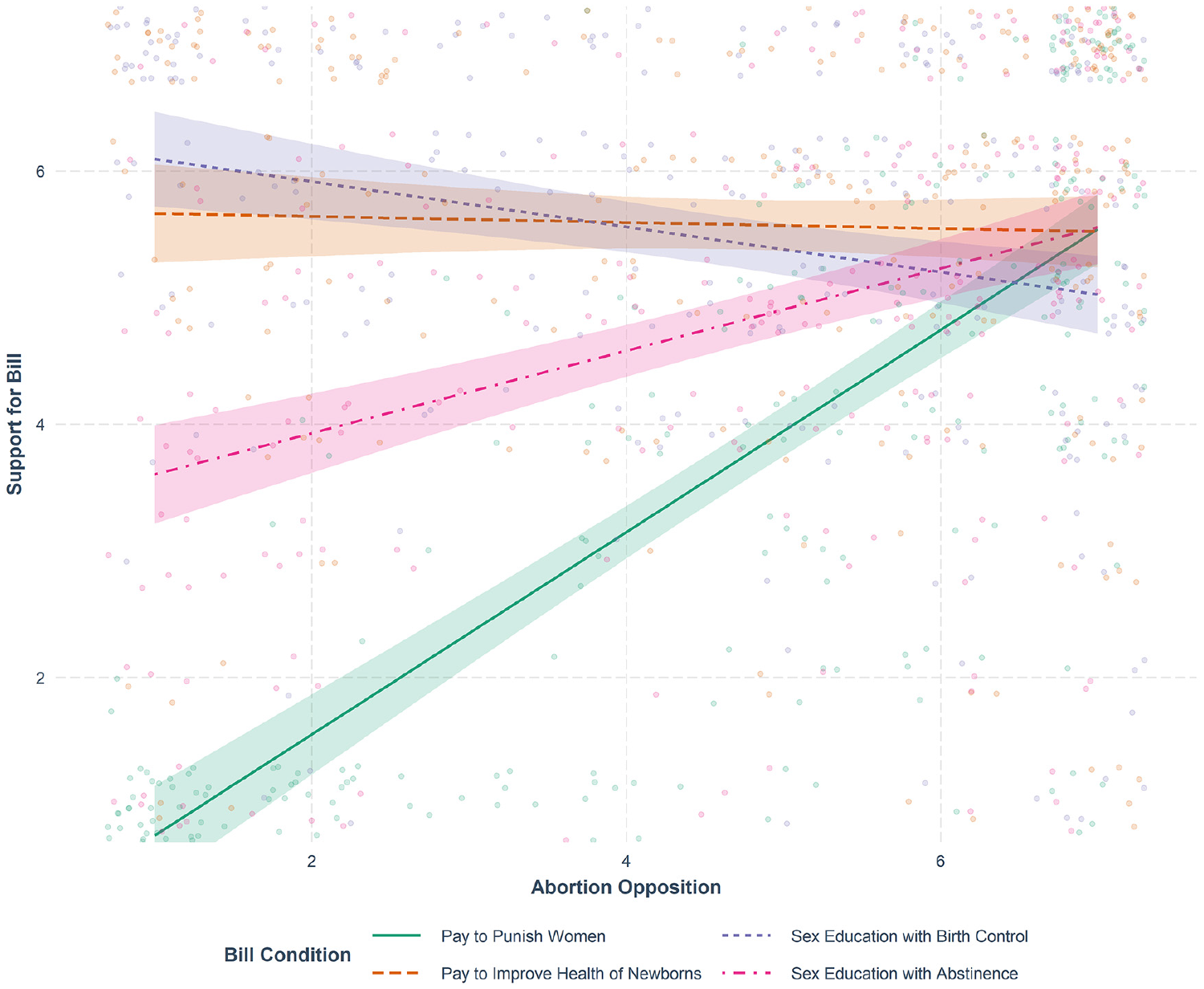
Results From Experiment 1 Showing Support for Each Bill as a Function of Reported Abortion Opposition. Points Are Jittered to Avoid Overlap
Abortion opposition was not significantly related to support for the health bill, t(993) = −0.52, p = .606, b = −0.05, 95% CI = [–0.24, 0.14], which fails to support face-value predictions (the strategic account did not make predictions here).
Bill Support Among Those Most Opposed to Abortion
A second set of predictions concerned support for the various bills among those participants with strongest opposition to abortion. Overall, there is generally high support for all bills among these participants, supporting the face-value account. However, countering the face-value account, the amount of support for these bills differs. Moreover, the pattern of relative support varies in line with predictions from the strategic account: As seen in Figure 2, participants with the maximum abortion opposition score were significantly less supportive of the comprehensive sex education than the abstinence, t(259) = 2.39, p = .017, b = 0.78, 95% CI = [0.14, 1.42]; punishment, t(259) = 2.79, p = .006, b = 0.85, 95% CI = [0.24, 1.45]; and health bills, t(259) = 2.30, p = .022, b = 0.72, 95% CI = [0.10, 1.34].
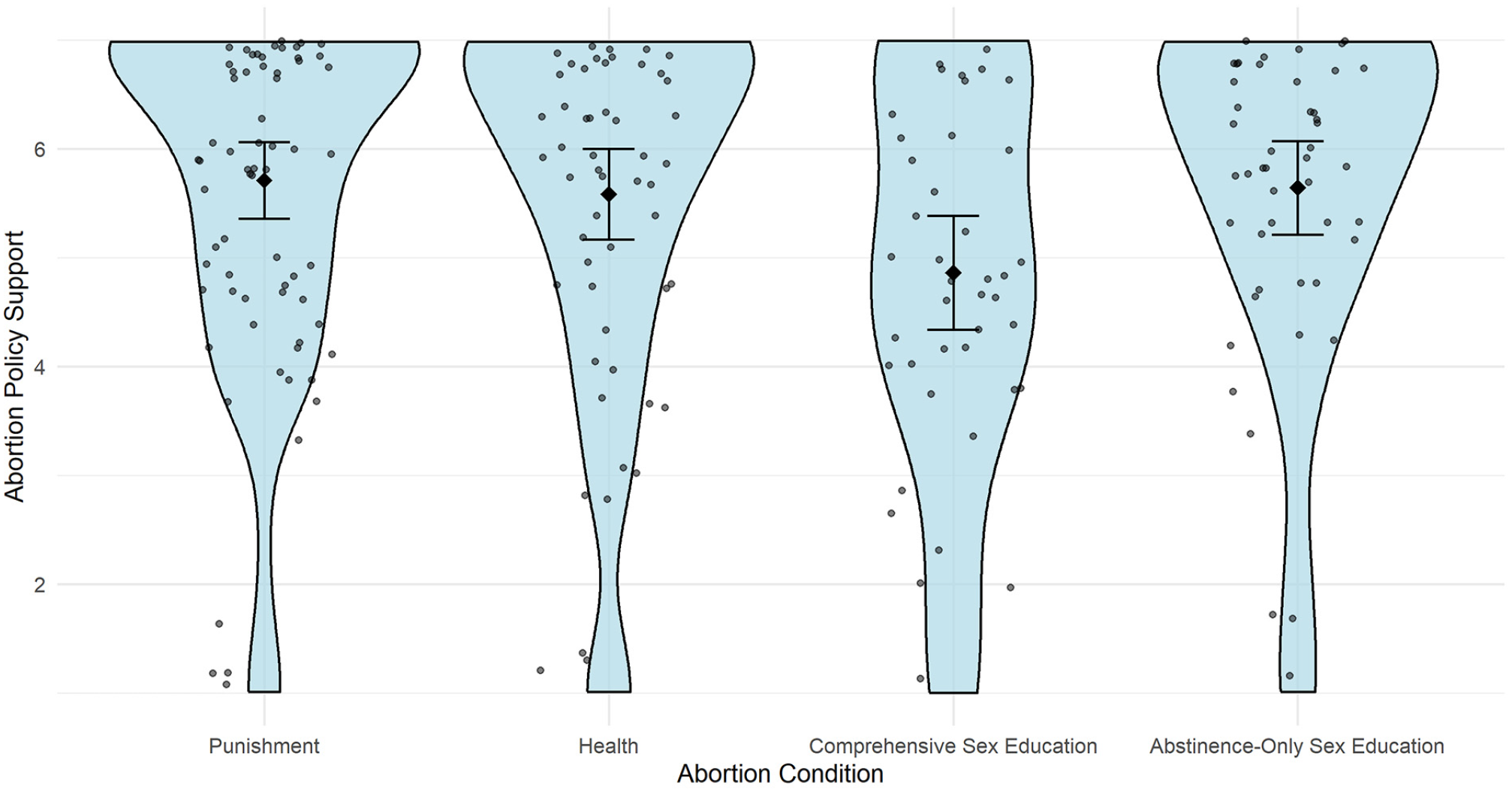
Support for Each Bill Among Participants With the Maximum Score on the Abortion Opposition Measure (n=263). Data Are Jittered to Avoid Overlap. The Diamonds and Error Bars Represent Means and 95% Confidence Intervals. Width of the Plot Represents Density Distributions
Notably, these results hold even when controlling for participants’ religiosity, social conservatism, and economic conservatism—perhaps the most commonly discussed factors thought to drive people’s pro-life attitudes (Osborne et al., 2022)—suggesting that this pattern of results is not simply driven by ideological or coalitional commitments (see Supplemental Material for full results).
Experiment 2
Experiment 2 was a preregistered (https://osf.io/mkexu), within-subjects replication-extension of Experiment 1 and the pilot study (see Supplementary Materials). Experiment 2 had two primary goals: (a) We aimed to replicate the results of Experiment 2 with a higher-powered and complementary within-subjects design, allowing for more nuanced exploratory analyses. Again, we also test whether predicted results hold controlling for participants’ religiosity and political orientation. (b) We test the assumption that participants view the punishment and abstinence bills (vs. the comprehensive sex education bill) as likely to deter casual sex. As with Experiment 1, we deviated from our preregistered analysis plan in response to reviewer recommendations. This change of analysis plan did not change conclusions.
To alternative explanations, we again test whether predicted results hold controlling for participants’ religiosity and political orientation. We additionally explore the perceived effectiveness of bills in preventing abortions.
Method
Participants
We preregistered a sample of 500 participants. We first ran a pilot to ensure there were no issues; because we made no changes to the survey, we kept pilot participants to reach our preregistered n and maximize power. We excluded from analyses four participants who failed our attention check (“Please select ‘4’”). Our final sample includes 554 U.S.-residing participants (285 male, 291 female, 5 other; ages: M = 43.71, SD = 13.11) from CloudResearch (Litman et al., 2017), providing high power (.95) to detect effects as small f2 = .023. The within-subjects design allowed for higher power than previous experiments.
Procedure and Measures
Participants first completed the same measure of abortion opposition (α = .94) as Experiment 1 before viewing three abortion bills in randomized order: punishment, abstinence, and comprehensive sex education. Again, each bill was stated to cost the same exact amount of money (60 billion USD) and estimated to prevent the same exact number of abortions over a 10-year span (~500,000 abortions). Because, here, participants viewed all three bills, we shortened and simplified the text; we also removed the statement that each bill would “focus on low-income and racial minority neighborhoods.” Participants rated their support for each bill on a 1 (Strongly oppose) to 7 (Strongly support) scale.
Participants also completed measures of short-term mating orientation (α = .92), religiosity (α = .96), and social and economic conservatism as in prior experiments, as well as demographic questions (e.g., age, gender).
Effects on casual sex. New to Experiment 2, we assess assumptions about bills’ likely effects on casual sex. Participants answered whether the bill is intended to influence people’s casual sex behavior (1 = Intended for people to HAVE LESS casual sex, 7 = Intended for people to HAVE MORE casual sex) and is likely to influence people’s casual sex behavior (1 = People would HAVE LESS casual sex, 7 = People would HAVE MORE casual sex).
Effectiveness of bills. Also new for Experiment 2, to assess perceived effectiveness of bills, participants rated the extent to which they agree that each bill could be effective in preventing abortions (1 = Strongly disagree, 7 = Strongly agree).
Results
Because Experiment 2 used a within-subjects design, regressions were conducted using multilevel modeling using the lme4 package in R (Bates et al., 2015). Correlations between all measures are reported in the Supplemental Material.
Does Greater Opposition to Abortion Predict Greater Support for Abortion-Preventing Policies?
As in Experiment 1, we predict bill support as a function of abortion opposition (centered), and two dummy codes representing the three conditions. By changing the base group across models (i.e., which group is coded zero in all dummy codes), we are able to obtain the slope of abortion opposition on each bill from separate models.
First, we replicated results from Experiment 1 (see Figure 3). Abortion opposition positively predicted support for the punishment, t(1,586.81) = 22.92, p < .001, b = −1.61, 95% CI = [1.47, 1.75], and abstinence bills, t(1,586.81) = 17.91, p < .001, b = −1.26, 95% CI = [1.12, 1.40], but negatively predicted support for comprehensive sex education, t(1,568.81) = −6.57, p < .001, b = −0.46, 95% CI = [–0.60, –0.32]. This largely challenges face-value predictions and supports those derived from a strategic account.
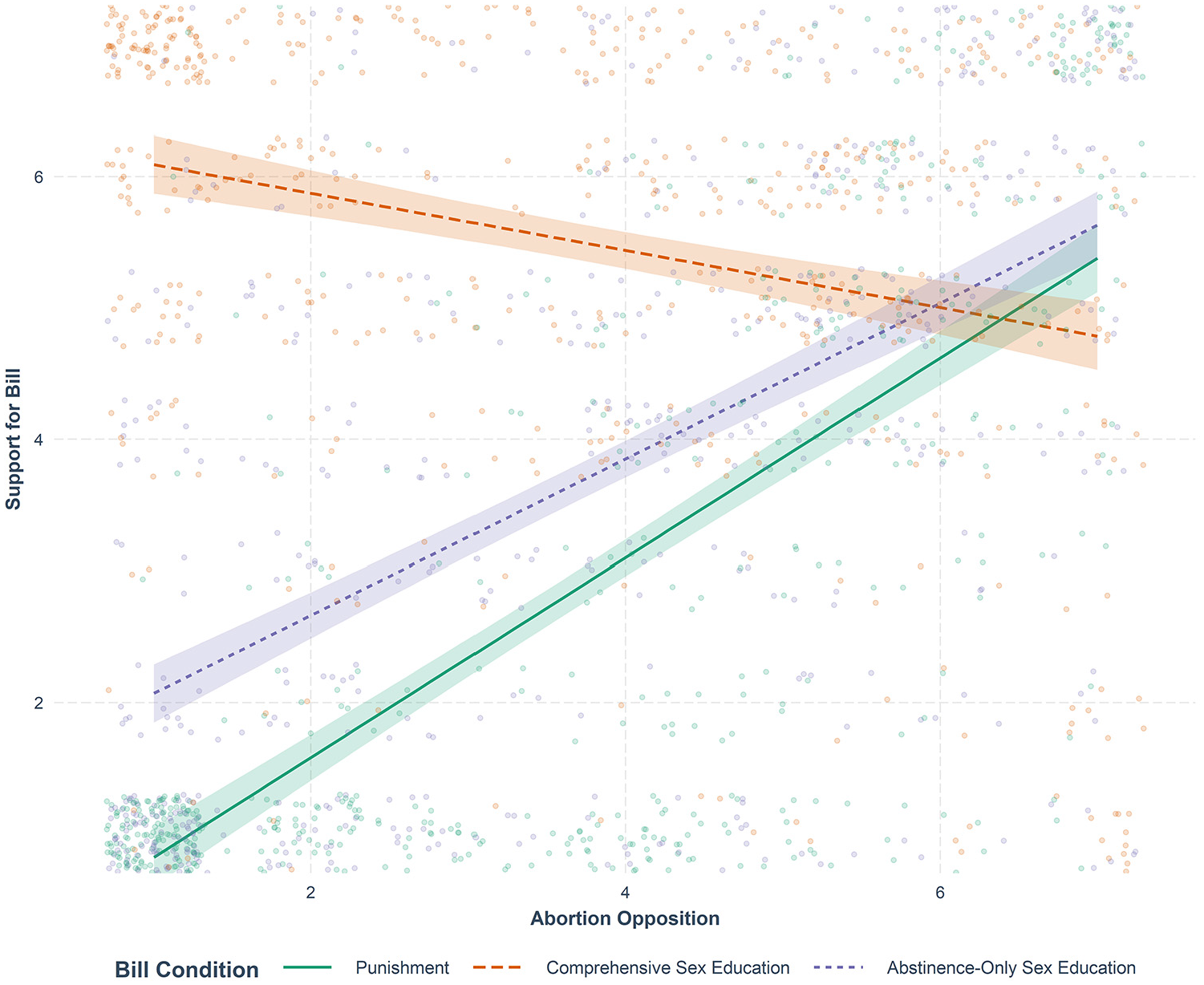
Results From Experiment 2 Showing Support for Each Bill as a Function of Reported Abortion Opposition. Points Are Jittered to Avoid Overlap
Bill Support Among Those Most Opposed to Abortion
Next, we compared bill support among only the subgroup of participants with the maximum abortion opposition score (n = 54). Although a smaller sample than Experiment 1, the within-subjects design here affords high statistical power.
Replicating the pattern of results from Experiment 1, analyses suggest that these participants support comprehensive sex education significantly less than both the punishment, t(106.00) = 5.13, p < .001, b = 1.81, 95% CI = [1.12, 2.51], and abstinence-only sex education conditions, t(106.00) = 3.51, p < .001, b = 1.24, 95% CI = [0.54, 1.93]; see Figure 4. Again, this pattern of data provides both some support but also some challenges for the face-value account, whereas this pattern provides support for the strategic account.
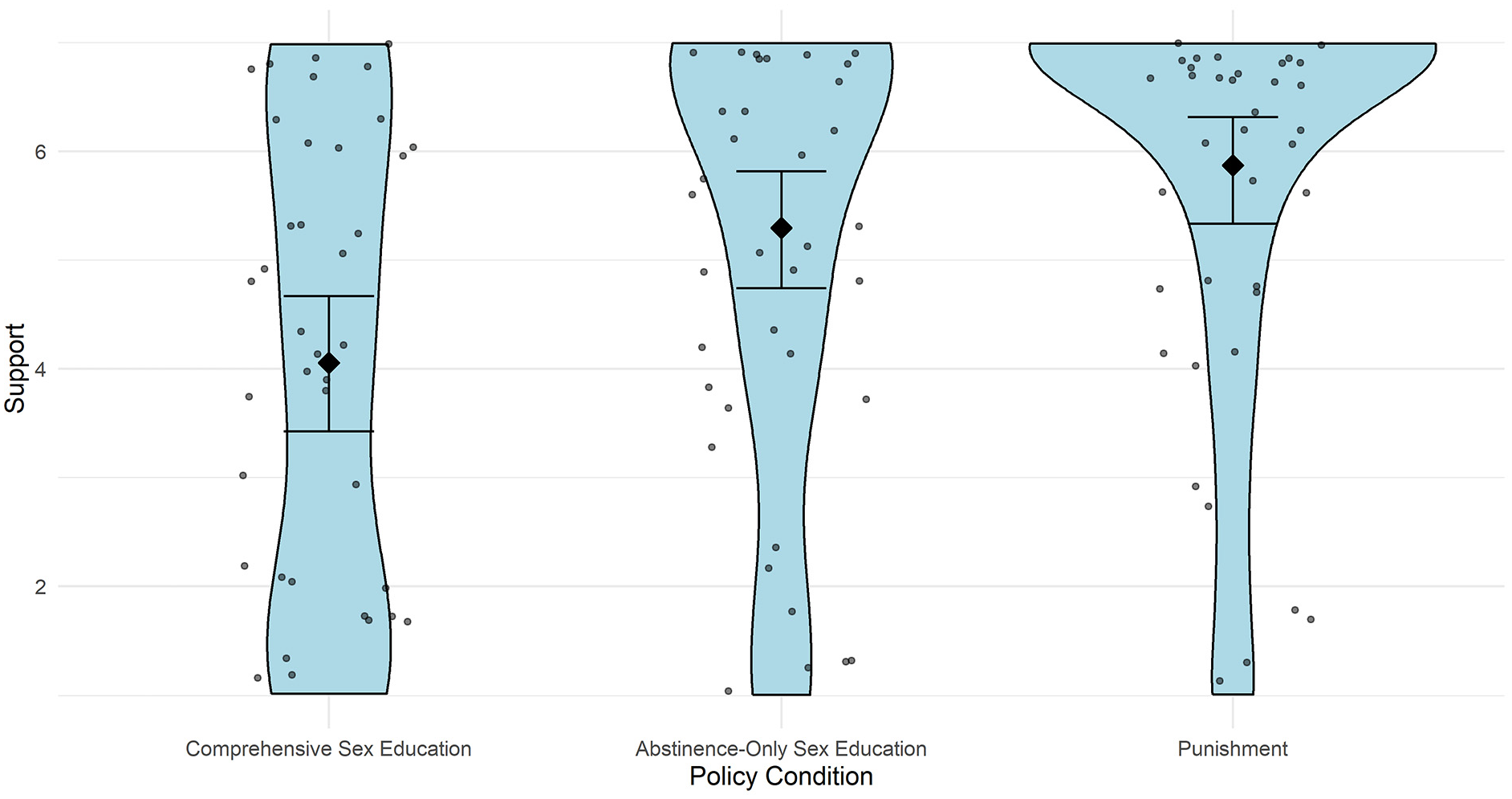
Support for Each Bill Among Participants With the Maximum Score on the Abortion Opposition Measure in Experiment 2 (n =5 4). The Within-Subjects Design Means That All Participants Saw All Three Conditions in Random Order. Data Are Jittered to Avoid Overlap. The Diamonds and Error Bars Represent Means and 95% Confidence Intervals. Width of the Plot Represents Density Distributions
Again, results hold controlling for religiosity, social conservatism, and economic conservatism (see Supplemental Materials).
Controlling for Perceived Effectiveness
Although we provided explicit estimates for number of lives saved and taxpayer cost across bills, it is possible that participants are more skeptical of certain policies’ abilities to truly decrease abortions, and that this selective skepticism influenced bill support. We thus tested whether the strongest abortion opponents still show greater support for bills opposing casual sex (i.e., greater support for punishment and abstinence vs. comprehensive sex education bills), even when controlling for perceived bill effectiveness. When controlling for perceived effectiveness, the strongest abortion opponents supported the punishment bill more than the comprehensive sex education bill, t(118.80) = 2.29, p = .024, b = 0.76, 95% CI = [0.11, 1.41]. However, their greater support for the abstinence over the comprehensive sex education bill was not quite statistically significant (using a two-tailed test), t(110.65) = 1.96, p = .052, b = 0.62, 95% CI = [−0.00, 1.24].
Do People View Punishment and Abstinence-Only Sex Education (vs. Comprehensive Sex Education) as Intended to and/or Likely to Restrict Sexual Behavior?
We assumed that people viewed the punishment and abstinence bills as discouraging casual sex. To test this, we assessed ratings of bills’ (a) perceived intent to influence casual sex and (b) likely effects on casual sex as a function of bill condition (i.e., two dummy-coded variables to represent the three conditions).
In brief, we find support for those assumptions. Relative to the comprehensive sex education bill, participants (a) tended to view the punishment, t(1,096.10) = −16.51, p < .001, b = −1.25, 95% CI = [–1.49, –1.10], and abstinence bills, t(1,097.17) = −22.35, p < .001, b = −1.69, 95% CI = [–1.83, –1.54], as intended to decrease casual sex, and (b) tended to view the punishment, t(1,104.08) = −13.87, p < .001, b = −0.88, 95% CI = [–1.01, –0.76], and abstinence bills, t(1,104.45) = −9.45, p < .001, b = −0.60, 95% CI = [–0.73, –0.48], as likely to decrease casual sex; see Figure 5.
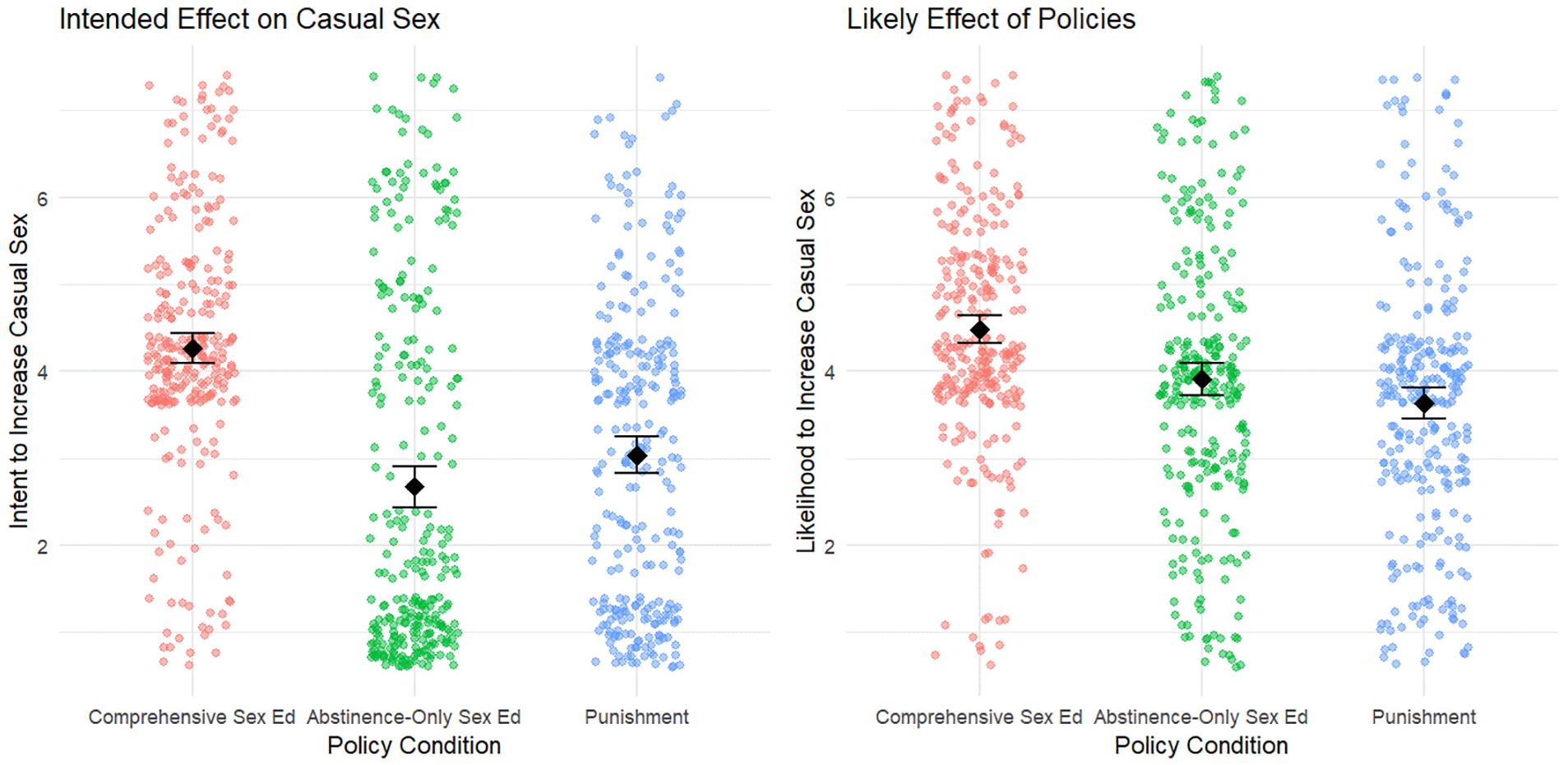
Participants Ratings About Each Bill’s Intended Effect on Casual Sex (Left) and Likely Effects on Casual Sex (Right). For Both Items, 4 Is Coded as Having No (Intended) Effect, Whereas Higher [Lower] Scores Indicate Intended or Actual Effects of Casual Sex Being More [Less] Frequent. Points Are Jittered to Avoid Overlap
General Discussion
We gave earnest empirical attention what is perhaps the most common set of arguments that pro-life individuals voice as driving their abortion opposition (e.g., it is immoral, it is murder), comparing predictions derived from such a face-value account against those derived from a strategic account. Consistent with the face-value account, increasing opposition to abortion for moral, sanctity-of-life reasons positively predict support for some—though not all—abortion-preventing bills, and people highly opposed to abortion for moral, sanctity-of-life reasons tended strongly to support all abortion-prevention bills.
However, the face-value account faced strong challenges, with overall results more strongly supporting the strategic account: Increasing abortion opposition predicted (a) greater support for abortion-preventing bills likely to restrict casual sex (punishing abortion-seekers, abstinence-only sex education) but (b) decreasing support for an abortion-preventing bill unlikely to restrict casual sex (comprehensive sex education). Whereas a face-value account would have predicted a positive relationship with abortion opposition and support for all bills, this revealed pattern was instead in line with the specific, nuanced predictions derived from a strategic account. (c) Among the strongest abortion opponents, the comprehensive sex education bill received less support than the other bills—again, despite all bills preventing the same exact number of abortions at the same exact taxpayer cost. The pattern of relative support for these bills is in line with predictions derived from the strategic account.
Findings rule out several alternative explanations. First, findings hold when controlling for commonly proposed drivers of pro-life views: religiosity and conservatism (Osborne et al., 2022). Second, whereas deontological versus utilitarian preferences could possibly explain differences in support between the punishment and comprehensive sex education bills—as the former prevents “murder” (deontological). The latter creates circumstances in which abortions are less likely (consequentialist)—this explanation would also predict (a) similar support for both of the sex education bills and (b) greater support for the punishment than the abstinence bill (because both of these sex education bills create circumstances in which abortions are less likely). Results do not support this prediction.
We did find, however, that people opposing abortion seem to view the comprehensive sex education bill as lacking comparative efficacy for preventing abortions, and they support it less. This find is not discordant with the strategic account. In fact, a parsimonious explanation for this finding is that abortion opponents dislike this comprehensive sex education bill (as we have suggested, in part because of its implications for casual sex), and this dislike, in turn, causes abortion opponents to deem it as less effective. That is, motivated reasoning may be affecting estimations of effectiveness. Indeed, such selective “effectiveness skepticism” seems to be a consequence of biased decision-making, rather than a cause of it (Bolderdijk et al., 2017).
Implications
Abortion is not simply an abstract cultural battle; its availability has serious implications. Being refused access to abortion can have negative consequences for the health, well-being, and socioeconomic status mother as well as for her other, existing children (Biggs et al., 2017; Foster, 2021). The availability of legal abortion can be a life-or-death issue for women: Estimates suggest that, in the first year of a federal abortion ban, maternal deaths would increase 24% overall, and 39% among non-Hispanic Black women (Stevenson et al., 2022).
Our findings are consistent with the notion that some of people’s commonly voiced moral principles—although genuine and deeply held—can (a) act less like drivers of attitudes and (b) more like effective propaganda (e.g., for influencing the social world in one’s favor, for looking good to others; Everett et al., 2016; Weeden & Kurzban, 2014). To (a), people often act inconsistently with their moral commitments (Kahane et al., 2018)—as perhaps observed here for some pro-life individuals. But this of course applies equally to pro-choice individuals who appeal to principles like “bodily autonomy” but nevertheless support other autonomy-curtailing laws (e.g., seat-belt laws, laws preventing pregnant women from drinking) (Pinsof, 2018; Weeden & Kurzban, 2014). To (b), statements like “Abortion should be banned because I disapprove of sexual liberalism” are likely to be less effective at shaping others’ abortion attitudes than statements like “It is immoral to end a life.” The latter argument would likely be both more persuasive to listeners, as it appeals to a moral principle everyone agrees with (killing is bad; Gray et al., 2012), and also more beneficial to the arguer, making them appear more prosocial (Everett et al., 2016). Indeed, being an effective communicator may mean that one is able to transmit messages that shape the social world in one’s favor.
Limitations, Future Work, and Constraints to Generality
Even as our findings largely aligned with strategic account predictions, we would not argue that these motivations to discourage casual sexual behavior are the sole driver of antiabortion attitudes. Indeed, we also note that even the strongest abortion opponents tended to report at least moderate support for comprehensive sex education in both experiments (with means above and near the midpoint in Experiments 1 and 2, respectively). As with most complex psychological phenomena, abortion attitudes likely depend on a wide range of influences, and a single-pronged explanation is bound to miss on substantial nuance (see, e.g., Fitouchi et al., 2023).
Relatedly, future work might test the strategic account more directly. Here, we measured participants’ short-term mating orientations, a construct largely reflecting individuals’own desires to engage in casual sex; this is related to, but by no means equal to desires to suppress casual sex (Luberti et al., 2023). Even as we would not suggest that people are conscious of the influence of their desires to suppress others’ casual sex, future work could more directly test whether such desires can be assessed meaningfully and might mediate the effects observed here. Indeed, we would hope that the present work should spur additional research on attitudes toward a range of reproductive technologies and policies (e.g., adoption, marriage taxes, birth control) as well as on those less-studied potential drivers of various political attitudes.
Likewise, a key goal here was to examine whether the moral goals that people espouse aloud (here, regarding sanctity of life) are consistent with the policies that people actually favor (a face-value account). To mitigate the possibility that people estimated different bills to be differently effective, we gave explicit estimates for the number of lives saved for each bill. However, it is not necessary for the strategic account that people fully believe these estimates. For example, in Experiment 2, we preregistered our suspicion that the focal effect might disappear when accounting for ratings of effectiveness. Even if results disappeared when accounting for effectiveness, such a pattern of motivated skepticism (Bolderdijk et al., 2017; Ditto & Lopez, 1992)—specifically, here, being relatively more skeptical of the effectiveness of disfavored bills (comprehensive sex education)—would not be at odds with the strategic account. It would still be necessary to explain why people are selectively skeptical toward bills that are less sexually restrictive. Indeed, the strategic account might expect for people opposing abortion to show both lower support for and increased skepticism of the efficacy of bills preventing abortions but facilitating casual sex (comprehensive sex education).
Participants came from the United States, where abortion is a major and often polarizing topic. Indeed, in the 20th-century United States, the abortion debate changed substantially to become a more partisan issue following Roe v. Wade (Jelen & Wilcox, 2003), with many on the liberal end now linking abortion right to women’s rights. However, the suppression of particularly women’s sexuality is a cross-cultural reality (Becker, 2024; Blake et al., 2018; Luberti et al., 2023; Moon et al., 2022; Strassmann et al., 2012), as is natural variation in people’s sexual strategies leading and related to reproductive conflict. Insofar as such conflict is an underlying driver of the results seen here, we would expect these results to hold across relevant cultural contexts. Thus, future research might fruitfully explore such contexts, perhaps focusing in particular on those with different interrelationships between religion, politics, and attitudes toward casual sex and/or abortion. We note, however, that abortion does seem closely linked to the suppression of (women’s) sexuality in many cultures (Becker, 2024).
Finally, we do not suggest that abortion opponents are unique in engaging in self-interested moral judgments, nor that they do so more egregiously than others. Rather, we suggest that all people are prone, at least to some extent, to self-interest biases across a wide variety of moral judgments. As mentioned above, one can think of ways in which justifications of pro-choice individuals are inconsistent with other positions many of them hold (e.g., bodily autonomy could be inconsistent with seat-belt laws). Future work might thus test whether pro-choice beliefs truly reflect impartial concerns for bodily autonomy. Similarly, we hope more research will build on such examples of “strategic morality” (DeScioli et al., 2014; DeScioli & Kurzban, 2013) in other domains, such as how unstated goals influence attitudes toward topics such as immigration or economic policy, or even “Puritanical” moralization of harmless behaviors (Fitouchi et al., 2023).
Conclusion
Why do some people oppose access to safe and legal abortion? Many pro-life individuals claim that their beliefs are driven by sanctity-of-life concerns and (thus) that abortion is murder. However, past work has failed to take seriously this proposition and empirically test whether such beliefs seem to be genuinely driving attitudes against abortion.
We tested predictions derived such a face-value account and pitted them against a strategic account, suggesting that abortion opposition might stem—in part—from a desire to suppress or discourage casual sexual behavior. On balance, the data lend greater support to the strategic account. Indeed, the data present some serious challenges to the face-value account: Notably, increasing sanctity-of-life-based abortion opposition does not predict increased support for any policy that purports to prevent abortions—rather, these individuals’ decisions, in part, reflect a preference for policies that also discourage casual sexual behavior.
Supplemental Material
sj-docx-1-spp-10.1177_19485506251320681 – Supplemental material for Pro-Life Policy Preferences Partly Reflect Desires to Suppress Casual Sexual Behavior, Not Solely Sanctity of Life Concerns
Supplemental material, sj-docx-1-spp-10.1177_19485506251320681 for Pro-Life Policy Preferences Partly Reflect Desires to Suppress Casual Sexual Behavior, Not Solely Sanctity of Life Concerns by Jordan W. Moon and Jaimie Arona Krems in Social Psychological and Personality Science
Footnotes
Acknowledgements
We thank Rebekka Weidmann for comments on a previous version of this manuscript.
Handling Editor: Eranda Jayawickreme
Declaration of Conflicting Interests
The author(s) declared no potential conflicts of interest with respect to the research, authorship, and/or publication of this article.
Funding
The author(s) disclosed receipt of the following financial support for the research, authorship, and/or publication of this article: J.W.M. gratefully acknowledges funding from the French Agence Nationale de la Recherche (under the Investissement d’Avenir program, ANR-17-EURE-0010).

Supplemental Material
The supplemental material is available in the online version of the article.
Notes
Author Biographies
References
Supplementary Material
Please find the following supplemental material available below.
For Open Access articles published under a Creative Commons License, all supplemental material carries the same license as the article it is associated with.
For non-Open Access articles published, all supplemental material carries a non-exclusive license, and permission requests for re-use of supplemental material or any part of supplemental material shall be sent directly to the copyright owner as specified in the copyright notice associated with the article.
