




Abstract
Previous research reported that different subtypes of narcissism lead to stronger or weaker stress responses, due to narcissistic individual’s sensitivity to social evaluation. However, evidence remains mixed. In the current preregistered study, we investigated psychological and physiological stress response indicators (self-reports, salivary cortisol levels, blood pressure, and heart rate) of N = 161 male participants exposed to the Trier Social Stress Test (TSST) or a control condition. Narcissism subtypes (i.e., grandiose and vulnerable) and the two facets of grandiose narcissism (i.e., narcissistic admiration and rivalry) were assessed via self-report questionnaires. Results suggest that the TSST led to stronger stress responses as compared with the control condition. However, we found no compelling evidence of any narcissism subtype or facet being associated with stronger stress responses. These results question the proposal that narcissism is a way to compensate for an ultimately weak, or fragile, self.
Introduction
Narcissism at subclinical level is a continuous, normally distributed personality trait (Raskin & Hall, 1979). This construct has fascinated researchers and the public worldwide, due to its relations to health and other important life outcomes (Coleman et al., 2019; Ng et al., 2014), and the fact that narcissistic people seem full of paradoxes (Back et al., 2013; Morf & Rhodewalt, 2001). Two distinct, but related subtypes of narcissism are discussed in the literature, grandiose, and vulnerable narcissism. Whereas grandiose narcissism is characterized by the feelings of grandiosity, aggression, and dominance, vulnerable narcissism goes along with the negative affect, and feelings of inadequacy or incompetence (Miller et al., 2011). According to the Narcissistic Admiration and Rivalry Concept, grandiose narcissism can be further decomposed into two subfacets: admiration and rivalry (Back et al., 2013). Whereas admiration is characterized by assertive self-enhancement, rivalry is characterized by antagonistic self-protection.
The described nature of narcissism seems to be evident in both pathological and subclinical narcissism. It is debated whether both concepts lay on one continuum from healthy to disordered or are two distinct dimensions (Pincus & Lukowitsky, 2010). One distinction is that pathological narcissists seem to concurrently experience grandiosity and vulnerability, while these facets are often unrelated in subclinical narcissists (Jauk et al., 2022). In the current manuscript, we focus on subclinical narcissism.
Narcissism and Reactivity to Social Threat
Narcissistic individuals often appear to be confident and to have a grandiose ego. However, some theorists have argued that narcissists’ displays of grandiosity are a way to compensate for the sense of self that is, deep down, weak or vulnerable (Kernberg, 1975; Kohut, 1971). This assumption is often tested by investigating the associations between narcissism and implicit self-esteem. Recent evidence indicates no robust negative association between narcissism and low-implicit self-esteem (Mota et al., 2020), which speaks against the idea that narcissists have a fragile self that must be protected. Yet, because the construct of implicit self-esteem, including its measurement approaches have been repeatedly criticized (Jusepeitis & Rothermund, 2022), this conclusion is tentative.
Another possibility of testing the idea would be to investigate narcissists’ reactions to socially stressful situations, threatening their ego and authority. If narcissists have a fragile sense of self, such experiences should be especially stressful to them (Morf & Rhodewalt, 2001). Given that narcissists might not admit how stressed they actually are, physiological stress responses could be more telling than self-reported stress experiences. Thus, narcissistic individuals should be especially sensitive to social evaluations and ego-threatening situations, and show stronger physiological stress responses to social stressors, as compared with individuals scoring lower on narcissism (Edelstein et al., 2010). Because vulnerable narcissism is almost by definition characterized by an increased proneness to anxiety and perceived stress (Ng et al., 2014; Sękowski et al., 2023; Underwood et al., 2021), this pattern should be clearly visible. For grandiose narcissism, the link with stress responsiveness is less clear, as both pronounced (Morf & Rhodewalt, 2001) and attenuated (Fernie et al., 2016) responsivity to stress have been proposed in the literature.
Previous evidence linking the subtypes of narcissism to stress response is inconsistent, with definitions, measurement and conceptualizations of narcissism, stress and stress response varying widely. Some research reported greater psychological and physiological reactivity (i.e., increasing cortisol levels) to social stress among men (but not women) scoring high in grandiose narcissism (e.g., Edelstein et al., 2010), whereas one study found elevated cortisol levels as a response to naturally occurring daily frustration in women scoring higher on grandiose narcissism (Cheng, Tracy & Miller, 2013). These studies did not assess vulnerable narcissism. Further studies reported inconsistent results, with only some physiological stress responses increasing with higher levels of grandiose narcissism (Kelsey et al., 2001; Sommer et al., 2009), or no associations between grandiose narcissism and heart rate, but significant associations between vulnerable narcissism and increased cortisol levels or heart rate following social stress (Borráz-León et al., 2023; Zhang et al., 2015).
Explanations for Mixed Findings
There are several reasons that might explain inconsistencies in results. The first reason concerns the assessment of narcissism. Almost all previous studies used the Narcissistic Personality Inventory (NPI; Raskin & Hall, 1979), a popular measure of grandiose narcissism that performs relatively poorly at identifying the different subfacets of the construct (Ackerman et al., 2011; Brown et al., 2009; Corry et al., 2008). This is unfortunate, as these subfacets might be differentially related to stress responsivity. The admiration facet, which goes along with relatively high and stable self-esteem (Geukes et al., 2017), and good psychological adjustment (Scharbert et al., 2024) should be linked to attenuated stress reactions. However, the rivalry facet, which is related to low and instable self-esteem (Geukes et al., 2017), and poor adjustment (Yang et al., 2023), should be linked to pronounced stress reactions.
Second, there was inconsistency in the conceptualization and operationalization of stress. Stress responses have been defined either psychologically or physiologically, while different measures have been used for investigating both (for review, see Coleman et al., 2019). Psychological stress was often assessed as self-reported levels of stress, but sometimes rather conceptualized as emotional distress or negative self-evaluation, assessed with self-report scales on negative affect or self-esteem. Physiological stress was operationalized differently as increases in heart rate, blood pressure, or levels of cortisol. Social stress was most often experimentally induced, for example, with the Trier Social Stress Test (TSST; Kirschbaum et al., 1993). However, other studies rather used correlational designs and assessed naturally occurring stressors in daily diaries (e.g., Cheng, Tracy & Miller, 2013; Sękowski et al., 2024; Zeigler-Hill & Besser, 2013).
Third, there are well-known sex differences in psychophysiological responses to stress, with men showing much stronger responses as compared with women (Kudielka & Kirschbaum, 2005). This fact could explain mixed findings when investigating both sexes, that is, only significant increases in cortisol levels following a social stressor in men high in grandiose narcissism (Edelstein et al., 2010).
A fourth potential explanation for the inconsistent results in the literature is that most previous studies had relatively small sample sizes. For example, the studies included in a systematic review by Coleman and colleagues (2019; Table 2) that assessed narcissism and physiological stress responsivity had a median sample size of N = 58 participants, being underpowered to find medium effect sizes. According to a power analysis with G*Power 3.1.9.7, this sample size would achieve only 46% test power to detect a medium-sized correlation coefficient of r = .20 (Funder & Ozer, 2019). Thus, null findings in the literature might be due to low power. Furthermore, small sample sizes also increase likelihoods of false-positive results, especially when not combined with preregistration (Giner-Sorolla et al., 2024).
The Current Study
Here, we describe the most comprehensive and only preregistered study to date on the research question of whether narcissism moderates the strength of psychological and physiological reactions to social stress. We confronted participants with an ego-threatening social situation, the TSST, and assessed their stress responses. To comprehensively cover the full subclinical narcissistic spectrum, we considered both grandiose and vulnerable narcissism, and distinguished between the two major subfacets of grandiose narcissism, admiration, and rivalry. Comprehensively covering the stress response, we assessed self-reported psychological stress, and three different physiological measures at up to seven time points pre- and post-stress experience. Our preregistered experimental design included a control group to distinguish stress reactivity from more general reactivity to experiment participation. Furthermore, aiming to maximize the chances of finding effects on the physiological indicators, we only tested men.
As a manipulation check of the stress-induction procedure, we expected that participants who were exposed to social stress would display a stronger stress response than participants in a control condition (social stress main effect, Hypothesis 1). We further expected multiple moderator effects of narcissism. Because individuals high in narcissistic admiration usually use strategies of self-enhancement to maintain their grandiose self, have a high self-esteem, and feel admired (Back et al., 2013), they should be less stressed in a social situation. Thus, we predicted the effect of social stress (as described in Hypothesis 1) to be weaker, the higher individuals score on narcissistic admiration (Hypothesis 2). In contrast, individuals scoring high in narcissistic rivalry often experience a frightened fear of failure in situations of social evaluation and need strong self-regulatory protection efforts (Back et al., 2013), which should lead to stronger stress responses. Thus, we expected the effect of social stress to be stronger, the higher individuals score on narcissistic rivalry (Hypothesis 3). Finally, as individuals higher in vulnerable narcissism are reported to show stronger stress reactivity to social evaluation, potentially because having a lower self-esteem (Bosson et al., 2008), we predicted that the effect of social stress is stronger, the higher individuals score on vulnerable narcissism (Hypothesis 4).
Method
This study was preregistered online at the Open Science Framework (https://osf.io/exk7v/); open data, analysis script, and material are also provided (https://osf.io/whf8d/). All participants signed a written consent form, and the Charité Ethics Committee approved the study protocol.
Participants
We recruited participants via public announcements (social media, mailing lists, flyers). Participants fulfilled the following inclusion criteria: male, 18–40 years old, heterosexual, healthy, normal body mass index (BMI). Participants were being assessed as part of a larger study that addressed several research questions (see Deuter et al., 2024). Next to the experimental and control groups investigated by us, the study also contained another group of 157 participants who received a psychopharmacological intervention, not analyzed for the current research question, as the intervention is likely to interfere with the stress response. Only participants and variables relevant to the current manuscript are described. A total of N = 161 male participants completed all relevant parts of the study, and were therefore included in further analyses. 1 Of these participants n = 80 (Mage = 25.20, SD = 4.76) took part in the experimental group, and n = 81 (Mage = 25.41, SD = 5.08) took part in the control group. A power analysis in G*Power 3.1.9.7 suggested that with our sample size, we had 99.8% test power to detect small (f = 0.15) main effects, and 81% power to detect medium-sized (f = 0.25) interaction effects (based on conventions by Cohen, 1988).
Procedure
The study was conducted in the afternoon, beginning at 1:30 pm. The stress intervention began at 3 pm. Participants were asked to refrain from physical exercise, alcohol, and caffeine within 3 h, and abstain from eating and drinking 1 h prior the experiment. Participants completed different self-report questionnaires via paper and pencil (including the narcissism scales). Then, participants in the experimental group completed the TSST, a standardized psychosocial stress task that reliably induces the subjective experience of stress, the activation of the sympathetic nervous system, and the hypothalamic–pituitary–adrenal (HPA) axis. It consists of a preparation phase (5 min) followed by a mock job interview in front of a trained audience (5 min), and a difficult arithmetic task (5 min). It was conducted according to the standard protocol (Kirschbaum et al., 1993). During the mock interview, participants should imagine to be interviewed for a self-chosen position. Participants should convince the committee that they are the best candidate for the position. Meanwhile, the committee members took notes on the “applicant’s” behavior. A camera and microphone were ostensibly recording participants’ behavior to be analyzed later on. The arithmetic task required participants to subtract as quickly and correctly as possible from a four-digit number in steps of 13, with a restart following every failure. Participants in the control group completed a Placebo-TSST (P-TSST), which was designed to be as similar as possible to the TSST (including orthostatic load), without being stressful to the participant. In an empty room, each participant was asked to talk aloud about a topic of his choice after a preparation phase, followed by an easy arithmetic task (adding up the number 15 starting at 0). We assessed different stress indicators at seven different time points: −90 min before taking part in the (P-)TSST, (immediately on arrival at the laboratory), 0 (immediately before TSST), 20 after (P-)TSST start, 35, 45, 70, and 100 min post (P-)TSST start, 2 respectively. Participants received up to 110€ as compensation for participation (70€ guaranteed, up to 40€ as part of a game unrelated to the current research question).
Measures
Self-Reported Narcissism
We assessed the two subfacets of grandiose narcissism (i.e., admiration and rivalry) with the standard, 18-item version of the Narcissistic Admiration and Rivalry Questionnaire (NARQ; Back et al., 2013). Each scale consisted of nine items with six-point scales from not at all applicable (=1) to very applicable (=6) that were averaged to form a scale score. Cronbach’s alphas were good (Table 1). Second, we used 10 items with five-point scales from not at all applicable (=1) to very applicable (=5) of the Hypersensitive Narcissism Scale (HSNS) to assess vulnerable narcissism (Hendin & Cheek, 1997). Cronbach’s alpha was poor (Table 1) comparable to other studies using the same German version (e.g., Dufner, Wieg, et al., 2024). Nevertheless, all items were averaged to form a scale score. For explorative analyses, we administered the brief version of the NPI-13 (Gentile et al., 2013), the standard unidimensional measure of grandiose narcissism with 13 items, and a forced-choice task of two statements that better fits to the participants (coded 0 and 1). Cronbach’s alpha was questionable (Table 1), which is common and in line with previous (validation) studies (Brailovskaia et al., 2019). All items were averaged to form a scale score or facet score, respectively.
Means, Standard Deviations, and Correlations of All Narcissism Measures With Confidence Intervals
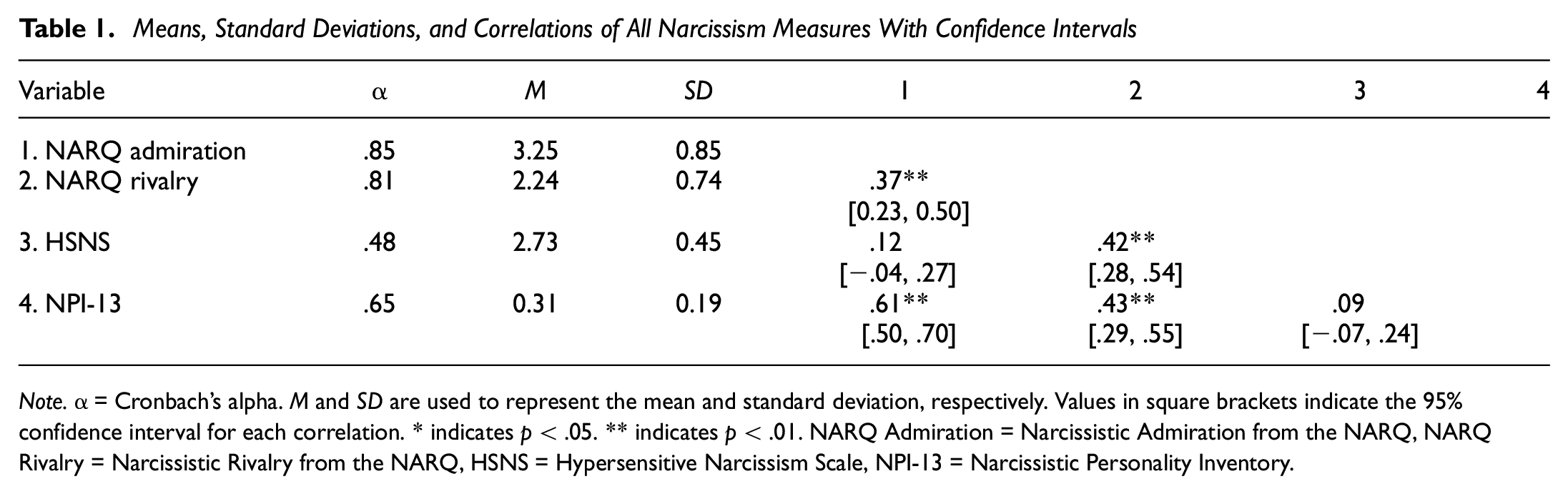
Note. α = Cronbach’s alpha. M and SD are used to represent the mean and standard deviation, respectively. Values in square brackets indicate the 95% confidence interval for each correlation. * indicates p < .05. ** indicates p < .01. NARQ Admiration = Narcissistic Admiration from the NARQ, NARQ Rivalry = Narcissistic Rivalry from the NARQ, HSNS = Hypersensitive Narcissism Scale, NPI-13 = Narcissistic Personality Inventory.
Stress Measures
Self-Reported Subjective Stress Experience
Directly before and after the TSST, we administered nine items (from Bellingrath & Kudielka, 2008) to assess self-reported psychosocial stress, for example, “I perceive the upcoming situation as exhausting.” Answers were given on seven-point scales from not at all applicable (=1) to very applicable (=7). Cronbach’s alphas were acceptable (α = .69 pre-TSST, α = .79 post-TSST). All items were averaged to form a scale score. When we excluded three items from each scale that measure performance or motivation rather than self-reported stress (Items 6–8, e.g., “I showed a good performance”), the reliability increased to good values (α = .82 pre-TSST, α = .83 post-TSST). In our analyses, we used the standard score based on all items (as preregistered). We use the additional score based on the fewer items for robustness checks.
Cortisol Levels
We collected cortisol levels as physiological stress indicators via saliva samples using Salivette tubes (Sarstedt). Participants placed a cotton swab in their mouth and gently chewed on it for about a minute, before putting it back in the tube. Tubes were stored at room temperature until completion of the testing session, and afterward kept at −80°C until biochemical analysis. Cortisol levels were analyzed in duplicates using an adapted homogeneous time-resolved fluorescence resonance energy transfer (HTR-FRET)-based competitive immunoassay in the Neurobiology Laboratory of the Department of Psychiatry, Charité, Universitätsmedizin Berlin. Intra-assay coefficients of variation were below 8%, and inter-assay coefficients of variation were below 10%. The limit of detection of free cortisol was 0.2 nM. Cortisol levels were log10-transformed to account for the skewed distribution. Cortisol peaked across all participants (group peak) at the second measure post-TSST (35 min post-TSST start), thus, we used this value as the cortisol reactivity measure. 3 We averaged the two pre-TSST measures to obtain a baseline value.
Blood Pressure and Heart Rate
Blood pressure (mean arterial pressure) and heart rate were also sampled as physiological stress indicators at the same seven time points as the saliva samples. To gather baseline values for both measures, the two pre-TSST values were averaged. We used the first post-TSST value (20 min after the TSST started) as response value for both variables, as values were highest at this time point in the experimental group.
Statistical Analyses
All analyses were conducted with the statistics software R 4.1.0 (R Core Team, 2021). We used the packages car 3.1-1 (Fox et al., 2012), dplyr 1.0.10 (Wickham, 2011), psych 2.2.9 (Revelle, 2016), and sjPlot 2.8.12 (Lüdecke, 2018). We ran separate linear regression models for testing each Hypothesis, and for each stress indicator as the outcome variable, with experimental condition effect coded (experimental = 1 vs. control = −1), and the baseline stress measures (pre-TSST) as predictor variables to test H1, which would predict a positive main effect of experimental condition on stress. For testing the remaining hypotheses predicting interaction effects between experimental condition and the respective narcissism measures, we modeled interaction effects accordingly. All continuous variables were z-transformed to bring them all on the same scale, to enhance comparability and facilitate interpretability of effect sizes. All statistical tests were two-tailed. As preregistered, we set missing data points (missing responses to single items) to “NA” and excluded participants for the respective analyses if their index score for a narcissism measure was missing more than 50% of all items. We excluded outlier values of > 3 SDs from the mean for all variables.
Results
Preliminary Analyses
First, we computed correlation coefficients between all narcissism and stress measures (Tables 1 and 2). As in previous research (Weidmann et al., 2023), the two subfacets of grandiose narcissism were positively and significantly intercorrelated, and both correlated with the NPI as a unidimensional measure of grandiose narcissism. Furthermore, vulnerable narcissism significantly correlated with rivalry, but not with admiration or the NPI. All pre-stress measures were significantly correlated with the respective post-stress measures. Furthermore, we found significant intercorrelations between blood pressure and heart rate, the subjective stress measure post-stress correlated with all biological post-stress measures. Zero-order correlations between all assessed variables can be found in the supplementary material (Table S1).
Means, Standard Deviations, and Correlations of All Stress Measures With Confidence Intervals
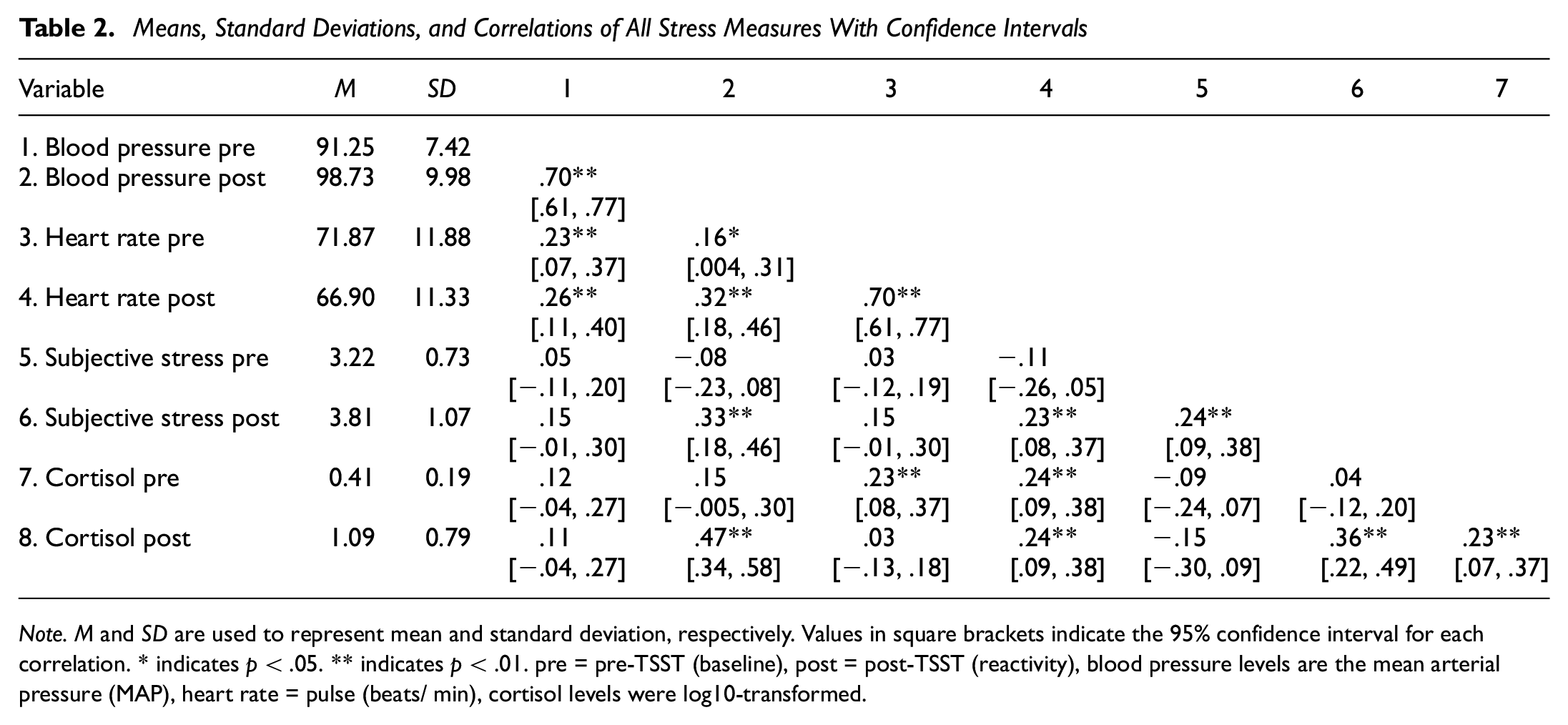
Note. M and SD are used to represent mean and standard deviation, respectively. Values in square brackets indicate the 95% confidence interval for each correlation. * indicates p < .05. ** indicates p < .01. pre = pre-TSST (baseline), post = post-TSST (reactivity), blood pressure levels are the mean arterial pressure (MAP), heart rate = pulse (beats/ min), cortisol levels were log10-transformed.
Main Analyses
Results of our regression models testing the main effect of stress are displayed in Table 3. In line with Hypothesis 1, participants in the stress condition experienced a stronger stress response according to all measured stress indicators, validating our experimental paradigm. Figure 1 displays the trajectories of all four stress indicators across all time points for the experimental group and the control group. However, neither Hypotheses 2, nor 3, nor 4 were supported, as group did not significantly interact with narcissistic admiration, narcissistic rivalry, or vulnerable narcissism to predict either of the stress indicators (see Table 4).
Psychological and Physiological Stress as a Function of Experimental Condition and Baseline Stress
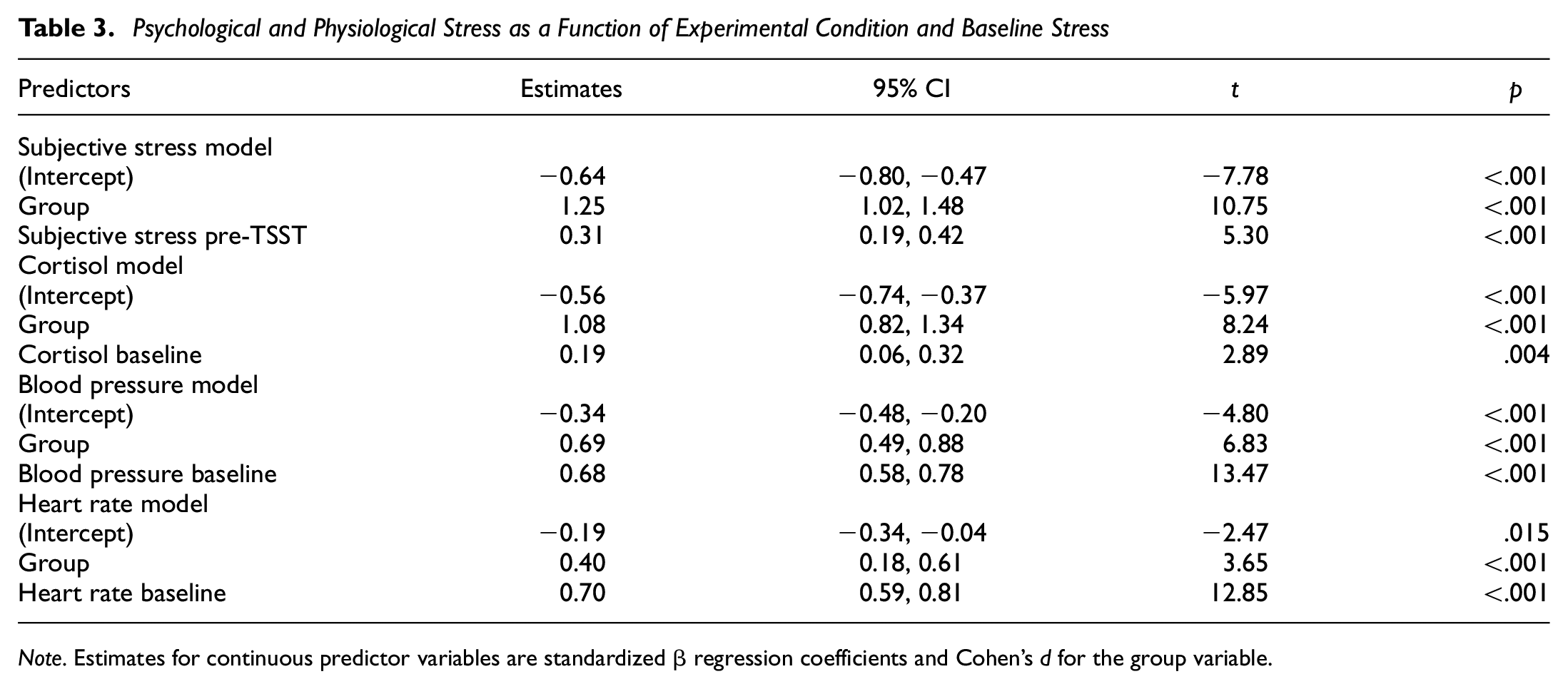
Note. Estimates for continuous predictor variables are standardized β regression coefficients and Cohen’s d for the group variable.
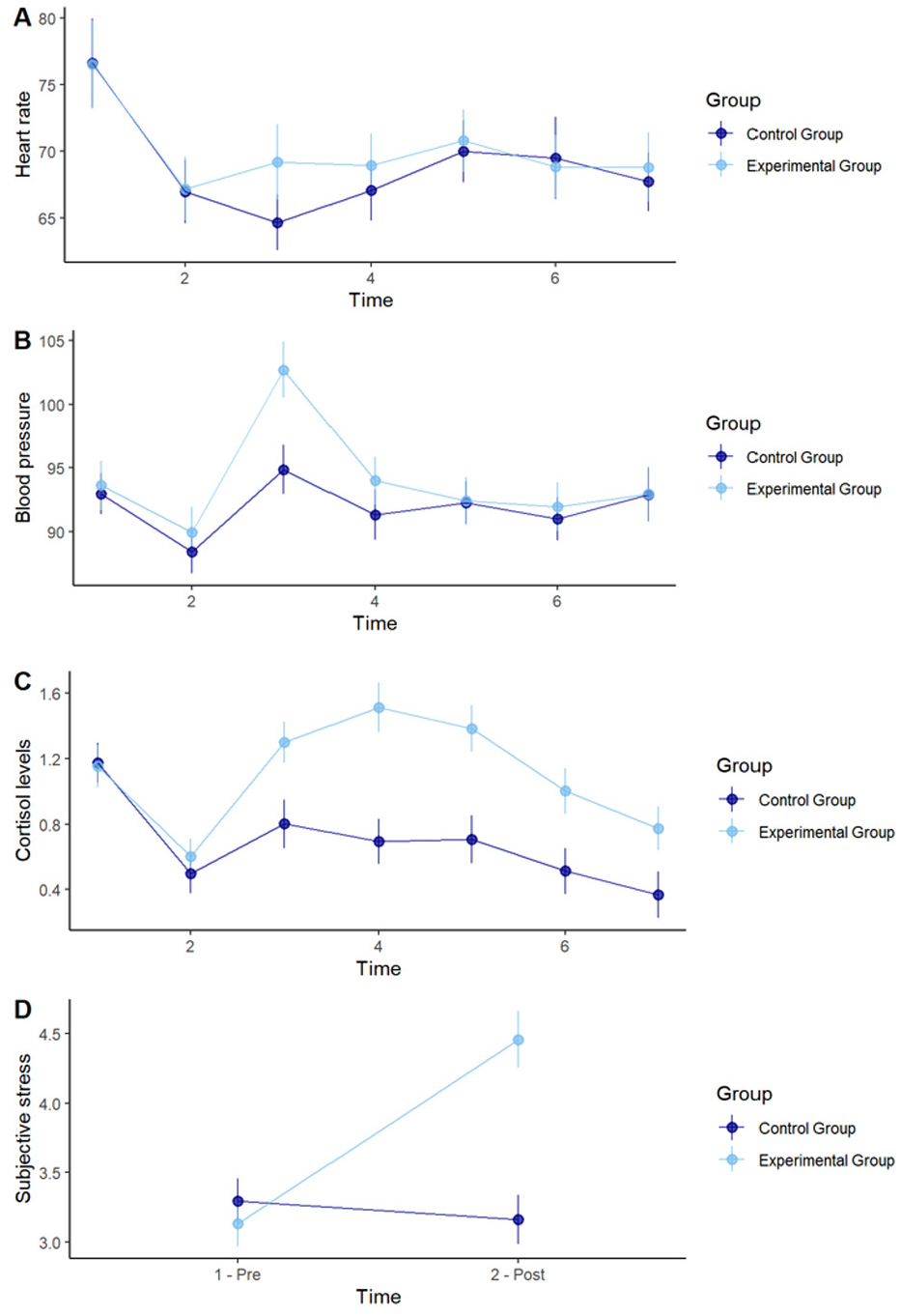
Trajectories of the Four Stress Markers Over Time for Both Groups
Psychological and Physiological Stress as a Function of Experimental Condition, Narcissism, the Stress * Narcissism, Interaction, and Baseline Stress
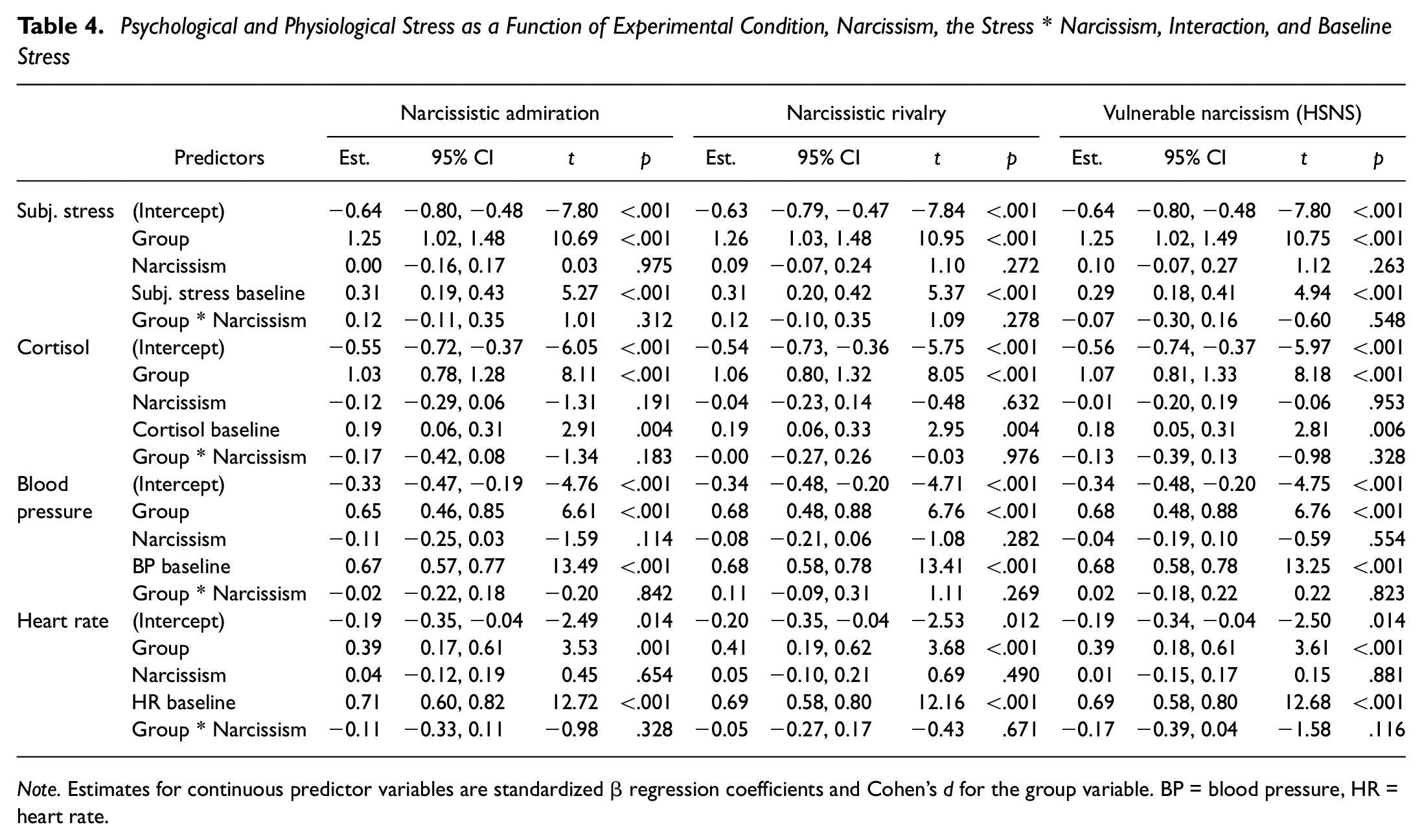
Note. Estimates for continuous predictor variables are standardized β regression coefficients and Cohen’s d for the group variable. BP = blood pressure, HR = heart rate.
Exploratory Analyses
Next, we tested whether there was a stronger increase in stress responses following the TSST when participants scored higher on the NPI-13. Again, group did not significantly interact with the narcissism measure to predict either of the stress indicators. Results are displayed in the Supplementary Material (Tables S4, S5). Then, we tested whether excluding the subjective stress items referring to performance or motivation leads to changes in the results. All results remained virtually identical (Tables S6, S7, and S8). Furthermore, we analyzed whether stress reactivity varied as a function of narcissism in longitudinal analyses only investigating participants from the experimental group. For this purpose, we computed multilevel models with the stress measures (separate models for each outcome) and analyzed whether the narcissism measures interacted with time (pre- or post-TSST). We modeled a random intercept per participant. We did not find compelling evidence for differences in stress reactivity pattern among more or less narcissistic individuals for any of the narcissism or stress measures. That is, out of these 16 additional interaction effect tests (40 in total across all analyses), only 2 effects were significant: the interaction between narcissistic admiration and time predicting cortisol levels (p = .003), and the interaction between narcissistic rivalry and time predicting subjective stress (p = .023). Results are displayed in Tables S9—S15. Finally, we displayed the relationship between the narcissism and the stress measures across all assessed time points to fully consider stress reactivities (in relation to baseline stress) across all assessed time points. None of these Figures (S1 to S9) suggest differences in stress reactivities among individuals with higher versus lower levels of narcissism.
Discussion
Narcissistic individuals are often thought to have a rather fragile ego, and to be especially sensitive to social, ego-threatening situations. This sensitivity to ego-threatening situations should result in stronger physiological stress responses to social stressors (Borráz-León et al., 2023; Edelstein et al., 2010). Previous research reported mixed findings regarding the relation of (different dimensions of) narcissism to stress responses. The current study contributes to this debate by providing the most comprehensive and first preregistered study. Overall, we did not find compelling evidence that people scoring high on any dimension of narcissism are more prone to stress reactivity or show different stress reactivity patterns than persons lower in narcissism when put into a socially stressful situation versus a control condition. We even tested an exclusively male sample, which should, in theory, lead to pronounced effect sizes, and assessed both narcissism and stress responsivity in a multidimensional fashion.
The null effects can hardly be attributed to a failure of the experimental paradigm. The TSST is often considered the gold standard psychosocial stressor for the laboratory, and the paradigm has been used in previous studies reporting significant effects (e.g., Borráz-León et al., 2023; Edelstein et al., 2010). In our study, participants in the stress condition showed a stronger stress response to all indicators. If narcissistic individuals had been sensitive to ego-threatening situations, they should have showed stronger stress responses to the TSST as compared with individuals lower in narcissism. Still, although the TSST is characterized by uncontrollable threats to the social-self, in which the subject is unable to avoid negative consequences and cannot succeed despite best efforts (Dickerson & Kemeny, 2004; Kudielka et al., 2007), it does, by protocol, not include direct negative feedback. We cannot exclude that direct negative feedback plays a crucial role in challenging narcissistic individual’s self, and that narcissistic individuals might show stronger stress responses in other situations involving direct negative feedback.
Could the null effects be due to the assessment of narcissism? Although the HSNS and the NPI had poor internal consistency, the Narcissistic Admiration and Rivalry scales were reliable, and the correlational pattern among the different narcissism measures was in line with previous research which speaks for construct validity. Thus, the assessment of narcissism cannot be blamed for the null effects. Rather, the result pattern suggests that the experimental paradigm worked, but its effects were independent of participants’ levels of narcissism. These findings are in contrast with previous work reporting that individuals scoring higher in vulnerable narcissism (Borráz-León et al., 2023), or individuals scoring higher (Cheng, Tracy & Miller, 2013; Edelstein et al., 2010) or lower (Borráz-León et al., 2023; Dane et al., 2018) in grandiose narcissism show stronger stress responses. However, they are in line with other previous studies finding no convincing evidence for such effects (Kelsey et al., 2001; Sommer et al., 2009).
Implications and Directions for Future Research
The present findings indicate that, regardless of which narcissism dimension is considered, when narcissists are put into socially stressful situations threatening their ego and authority, they experience neither more nor less stress than individuals lower in narcissism. This pattern of results does not indicate that narcissistic individuals have a vulnerable sense of self that could easily be shaken from the outside.
But how can previous findings reporting that when narcissistic individual’s ego is threatened, they respond aggressively, be explained (e.g., Bushman & Baumeister, 1998)? In light of the current findings, narcissistic individuals may not be more vulnerable regarding their stress reactivity to ego threats than persons lower in narcissism, but they instead have a special default reaction to such threats, namely aggressive behavior (which can be a viable means to assert one’s dominance, to achieve social status; Cheng, Tracy, Foulsham, et al., 2013). Future research could address this possibility by investigating the entire pathway leading from ego threat via affective reactivity to aggressive behavior, and by considering the potentially moderating role of narcissism.
Although we focused on subclinical levels of narcissism (as previous studies did as well), it is still possible that effects would emerge when studying pathological narcissism in a clinical sample, as pathological narcissists likely perceive the TSST as more extreme threat to the social-self, and may show stronger stress reactivity. Furthermore, we cannot rule out that other differences in research designs as compared with previous studies account for the null effects (e.g., experimental vs. correlational design; conceptualization of psychological stress). More precisely, some previous studies that reported significant effects rather assessed naturally occurring negative emotions as a response to daily stressors (e.g., Cheng, Tracy & Miller, 2013), and narcissistic individual may still show stronger stress responses to these events, which should be investigated in future studies.
An important caveat to the interpretation of the current results is that they only pertain to short-term responsiveness to social stress, not to long-term stress levels. In light of recent meta-analytic results (Luo et al., 2023), it is possible that personality traits, such as narcissism, are not necessarily associated with stress responsivity, but with long-term stress exposure (i.e., individuals form their environment based on their personality, and more often experience stressful events). Thus, personality traits can be related to long-term stress via stress exposure. Some studies also reported associations between narcissism and measurement of basal stress (i.e., baseline cortisol levels; Pfattheicher, 2016; Stern et al., 2023) and it might be interesting for future research to investigate whether narcissistic individuals are more frequently exposed to stressful life circumstances (problematic relationships, drug abuse, etc.), which could then lead to elevated long-term stress levels. Another interesting avenue for future research would be to test how other personality traits are linked to stress reactions in the TSST paradigm. In this ego-threatening context, especially self-esteem seems relevant, and could be differently related to self-reported stress reactions (low explicit self-esteem), and physiological stress reactions (implicit self-esteem).
Limitations
There are several limitations of the current study. First, the low reliability of the HSNS impairs the interpretability of the pertaining results. Other research using the same German translation of the scale reports similarly poor reliability (Dufner, Kraft, et al.,2024, Dufner, Wieg, et al., 2024). Future research should investigate the relation between vulnerable narcissism and stress responsiveness with a more reliable measure. Second, we decided to only investigate male participants. We considered this a strength of the current study because of the strong sex differences in physiological stress responses (Kudielka & Kirschbaum, 2005), and some previous studies only reporting links between narcissism and stress responsivity in men (e.g., Edelstein et al., 2010). Nevertheless, our findings might not be transferable to women, and therefore comparability with some previous studies that investigated women might be limited (e.g., Cheng, Tracy & Miller, 2013; Stern et al., 2023). In a similar manner, generalizability of our findings is restricted, as we only recruited participants from a WEIRD country (Henrich et al., 2010). Third, we had to rely on self-reports for our narcissism measures, which might be biased, especially for individuals higher in vulnerable narcissism (Barry et al., 2017). Thus, also including peer reports would have been desirable. Finally, although having a larger sample size than most previous studies, non-significant effects always lead to critical questions regarding statistical power. If the effect size of stress responses to ego-threatening situations in narcissistic individuals is indeed much smaller than previously assumed, then our study might still have been underpowered to reliably detect such effect sizes. However, whereas some of the interaction effects between experimental group and narcissism reported above were in ranges that we consider as small effects (βs ∼ .10), we would like to note that these effects often pointed in different directions for different stress reactivity measures. Thus, even in disregard of the lack of significance, the observed effects do not suggest compelling evidence for higher stress responsivity in more narcissistic individuals. To finally clarify potential issues of statistical power and to determine the true size of effect sizes, we call for even larger future studies.
Conclusion
The current study contributes to the understanding of individual differences in narcissism and its facets, and their relation to the susceptibility and resilience to stressful experiences, including physiological responses. In a preregistered experimental study, we investigated whether narcissistic individuals differ from individuals lower in narcissism in their psychological and physiological reactions to ego-threatening situations. The results of our study imply that neither grandiose nor vulnerable narcissism might be related to increased stress reactivity in a single stressful, ego-threatening situation. We highlight the need to further disentangle emotional and physiological responses to stress associated with narcissism, as well as short-term and long-term effects. All these different factors do not need to have equal effects, but all of them can potentially contribute to serious consequences for physical and mental health. Furthermore, these factors need to be considered to fully comprehend feelings and behaviors of narcissistic individuals.
Supplemental Material
sj-docx-1-spp-10.1177_19485506251313838 – Supplemental material for Is Narcissism Linked to Stress Reactivity Under Social-Evaluative Threat?
Supplemental material, sj-docx-1-spp-10.1177_19485506251313838 for Is Narcissism Linked to Stress Reactivity Under Social-Evaluative Threat? by Julia Stern, Christian Otte, Katja Wingenfeld, Fabian Streit, Robert Kumsta, Christian Eric Deuter and Michael Dufner in Social Psychological and Personality Science
Footnotes
Handling Editor: Rodica, Damian
Declaration of Conflicting Interests
The author(s) declared no potential conflicts of interest with respect to the research, authorship, and/or publication of this article.
Funding
The author(s) disclosed receipt of the following financial support for the research, authorship, and/or publication of this article: This work was funded by the German Research Foundation (Deutsche Forschungsgemeinschaft/DFG), project DE 2592/3-1, WI3396/10–1 and OT 209/ 14–1

Supplemental Material
The supplemental material is available in the online version of the article.
Notes
Author Biographies
References
Supplementary Material
Please find the following supplemental material available below.
For Open Access articles published under a Creative Commons License, all supplemental material carries the same license as the article it is associated with.
For non-Open Access articles published, all supplemental material carries a non-exclusive license, and permission requests for re-use of supplemental material or any part of supplemental material shall be sent directly to the copyright owner as specified in the copyright notice associated with the article.
