



Abstract
Conspiracy theories assert that others have engaged in dishonest actions. However, existing research indicates that individuals who believe in conspiracy theories may themselves be more inclined to engage in dishonest behavior. We conducted two preregistered studies—one in Turkey (N = 706) and the other in Canada (N = 835) and South Africa, (N = 867)—testing the hypotheses that conspiracy beliefs would be positively correlated with (a) dishonest behavior during a monetary incentivized lying task and (b) overestimating the prevalence of dishonesty among other people. Overall, we found that stronger conspiracy beliefs were associated with higher dishonesty. Participants tended to overestimate dishonesty among their peers, but this tendency was significantly more pronounced among people with stronger conspiracy beliefs. Contrary to our hypothesis, country-level corruption did not moderate this association. These results shed light on the complex relationship between conspiracy beliefs, dishonesty, and expectations of dishonesty.
Conspiracy theories imply that others have acted dishonestly, but evidence suggests that people with stronger conspiracy beliefs themselves might also be more likely to act dishonestly. For example, the more people believe in conspiracy theories, the more they tend to be self-centered, antisocial, and willing to violate social norms (Douglas & Sutton, 2011; Hughes & Machan, 2021; Jolley et al., 2019; Kay, 2021; March & Springer, 2019). Furthermore, associations between conspiracy beliefs and paranoia (e.g., Imhoff & Lamberty, 2018; van der Linden et al., 2021) and distrust (Abalakina-Paap et al., 1999; Douglas et al., 2019; Douglas & Sutton, 2018) suggest that people with stronger conspiracy beliefs might be prone to overestimate others’ dishonesty. The current research examines the link between belief in conspiracy theories, dishonesty, and expectations of dishonesty. We examine whether people with stronger conspiracy beliefs are more likely to (a) act dishonestly in a lying task and (b) overestimate others’ dishonesty.
Are Conspiracy Beliefs and Dishonesty Correlated?
Conspiracy theories propose that events of public interest are the result of secret plots by typically powerful groups (Douglas & Sutton, 2023). They allege that others have acted dishonestly to achieve a sinister goal. Belief in conspiracy theories therefore entails a deep suspicion of others’ motives and allegations that they have been deceitful. However, while believers in conspiracy theories are quick to point out the dishonesty in others, research suggests that they themselves may also be more likely to be dishonest. Research has shown that people with stronger conspiracy beliefs express more willingness to engage in conspiracies themselves (Douglas & Sutton, 2011). This proclivity to project their own intentions to conspire onto others might partially explain their receptivity to conspiracy theories about others. In other words, conspiracy believers could find conspiracy theories more plausible because they are more dishonest themselves.
People with stronger conspiracy beliefs are also more likely to violate social norms and have higher intentions to commit everyday crimes (Jolley et al., 2019). They are more likely to break rules and behave aggressively (Poon et al., 2024). Conspiracy beliefs also correlate with the Dark Triad personality traits (Kay, 2021; March & Springer, 2019), which are universally recognized as malevolent (Muris et al., 2017; Paulhus & Williams, 2002). Belief in conspiracy theories has also been observed to be negatively related to honesty–humility (Jolley et al., 2019) and to prosocial intentions across 52 countries (Alper, Douglas, Capraro, 2021). Taken together, research suggests that conspiracy beliefs are likely to correlate with self-interest, antisociality, and dishonesty. We therefore hypothesize that stronger conspiracy beliefs will correlate with higher likelihood of engaging in dishonest behavior (H1).
Are Conspiracy Beliefs and Overestimating Others’ Dishonesty Correlated?
All conspiracy beliefs are based on the assumption that dishonest, malevolent actors are involved in secret plots. Thus, unsurprisingly, believing in conspiracy theories is related to a lack of trust in others (Abalakina-Paap et al., 1999; Douglas et al., 2019; Douglas & Sutton, 2018; Goertzel, 1994; Golec de Zavala & Federico, 2018; van Prooijen & Acker, 2015) and with lower levels of trust in governments, authorities, media, and experts (Eberl et al., 2021; Mari et al., 2021). The higher-order social factors that undermine trust, such as corruption (Alper, 2023), inequality (Casara et al., 2022), and lack of political control (Kofta et al., 2020) are also associated with stronger conspiracy beliefs. Also, although they are conceptually distinct, conspiracy beliefs and paranoia share common characteristics, such as hypervigilance against alleged malevolent intentions of others (Greenburgh & Raihani, 2022; Imhoff & Lamberty, 2018). Thus, conspiracy beliefs appear to be closely linked with distrust and paranoia, suggesting that increased suspicion of, and distrust in, others may be potentially inflated.
Another line of research suggesting that people with stronger conspiracy beliefs might overestimate dishonesty stems from studies on their perceptions of trust in experimental games. Recent research demonstrated that conspiracy believers were less trustful of their counterparts in an economic game, and that conspiracy believers also perceived their counterparts’ faces to be more threatening, regardless of their actual facial trustworthiness (Frenken & Imhoff, 2023; Meuer & Imhoff, 2021). This suggests that conspiracy believers’ perceptions of threat are likely to be inaccurate. However, facial cues are only indirect measures of potential untrustworthiness and do not provide information on whether the target person behaves dishonestly. Considering these findings, we expect that higher expectations of dishonesty associated with stronger conspiracy beliefs will likely be an overestimation (H2).
Overview of the Current Research
In this research, we test two main hypotheses. H1 posits that conspiracy beliefs will be positively related to dishonesty. We measured dishonesty through both a self-report and a behavioral measure. The behavioral measure involved a monetary incentivized lying task (Capraro et al., 2019), which offers participants the opportunity to lie for personal gain. This serves as an effective measure of whether dishonest tendencies translate into actual behavior. Observing actual dishonest behavior allows us to compare individuals’ expectations of dishonesty with the observed frequency of dishonest actions within the sample. This comparison leads to our second hypothesis that conspiracy beliefs will be positively associated with overestimations of others’ dishonesty.
H2 predicts that conspiracy beliefs will be positively related to overestimating the prevalence of dishonesty among other participants. 1 Overestimation is calculated by comparing the predictions of participants with the actual frequency of dishonest behavior among the remaining participants. In Study 2, we also test whether the link between conspiracy beliefs and overestimation is weaker in country with a high-level corruption, compared with a low-corruption country because people indeed would be more likely act dishonestly in such contexts (Gächter & Schulz, 2016; Muthukrishna et al., 2017).
Study 1
Hypotheses, sampling plan, exclusion criteria, and analysis procedure were preregistered prior to data collection (https://osf.io/gqmtx). Data and materials are available at https://osf.io/t7pjr/.
A Priori Power Analysis
We based our sample size estimation on the detection of moderate-size correlations (i.e., r = .20, as recommended in the work by Funder & Ozer, 2019). Assuming power of .80 and alpha of .05, we estimated that the minimum required number of participants to detect such correlations was 193, using G*Power software (Faul et al., 2007). We preregistered that we would continue data collection for 14 days. If the total number of participants was 193 or more, we would stop data collection, otherwise we would continue until reaching that size.
Participants and Exclusion Criteria
We recruited a convenience sample of Turkish participants via social media. We announced the study on the social media platform Twitter (now X) with a brief description and the information that three randomly selected participants would win a gift card of 100 Turkish Liras (an equivalent of US$11.89 and 3% of the monthly minimum wage in Turkey at the time of data collection). As per the preregistration, we stopped recruiting participants after 2 weeks of data collection, which resulted in a sample of 711 participants who completed all materials and correctly responded to both comprehension questions. We also excluded those who (a) failed an attention check (embedded in the Generic Conspiracist Beliefs Scale) in which they were instructed to choose “2,” or (b) completed the study either too quickly (z for completion time in seconds < −3) or too slowly (z > 3). The resulting N was 706 (549 female, 156 male, 1 other; Mage = 28.00, SD = 8.54). The resulting N of 706 was sensitive to detect a correlation as small as .09 with 80% power.
Materials and Procedure
Lying Task
First, participants completed a lying task to measure their dishonest behavior. We used a variant of Gneezy’s deception game to measure whether participants choose to communicate a message they know to be untrue to maximize their monetary payoff at the expense of others’ payoff (Gneezy, 2005). Two players are paired, and one of them can lie for their personal benefit. However, unlike Gneezy’s game, the second player is passive and makes no decision. We implemented this change to avoid the behavior of the first player being confounded by their beliefs about the behavior of the second player. We used the paradigm introduced in the work by Capraro et al. (2019; see also Biziou-van-Pol et al., 2015; Capraro, 2017; Gneezy et al., 2013). We informed participants that they were randomly assigned to one of the two groups and they were matched with another participant who was assigned to the opposite group. This was a cover story and there was no real counterpart. We then provided participants with a choice: If they honestly report the group they were assigned to, both the participant and the other person receive five tickets for a gift lottery (honest response). However, if they report being assigned to the other group, they receive eight tickets while the other person receives only two tickets (dishonest response). A dummy variable (0 = honest, 1 = dishonest) was computed based on participants’ responses.
Expectations Regarding Others’ Dishonesty
Second, we asked participants to estimate what percentage of other participants would act dishonestly (on the same dishonesty paradigm) on a scale ranging from 0% to 100%.
Conspiracy Beliefs
After participants reported their expectations regarding others’ dishonesty, we measured conspiracy beliefs using two different scales. First was the Generic Conspiracist Beliefs Scale (henceforth referred to as generic conspiracy beliefs; Brotherton et al., 2013; translated into Turkish by Alper, Bayrak, Yilmaz, 2021), which is a 15-item scale (e.g., “Secret organizations communicate with extraterrestrials, but keep this fact from the public”) using a five-point response format (1 = definitely not true, 5 = definitely true; α = .90). We also used the Turkish version of the Conspiracy Mentality Questionnaire (henceforth referred to as conspiracy mentality; Bruder et al., 2013), which is a five-item scale (e.g., “I think that government agencies closely monitor all citizens”) using an 11-point response format (0 = 0% definitely no, 11 = 100% definitely yes; α = .79).
Honesty–Humility
Next, as a supplement to the main measure of behavioral dishonesty, we also measured self-reported dishonesty using the Turkish version of the honesty–humility subscale of HEXACO Personality Inventory (Ashton & Lee, 2009). The scale consists of 10 items (e.g., “I would never accept a bribe, even if it were very large”) and uses a five-point response format (1 = strongly disagree, 5 = strongly agree; α = .72). We preregistered the analyses involving honesty–humility as exploratory.
Demographics
Finally, participants stated their age, gender (male, female, other), education status (seven-point scale, ranging from elementary school to PhD), and perceived income status on a ladder from 1 (people with the least money) to 10 (people with the most money). We preregistered to adjust for differences in these covariates when analyzing the relationship between conspiracy beliefs and dishonesty-related measures. At the end of the survey, we also asked “How likely do you think the other participant you were matched with was a real person?” (1 = very unlikely, 7 = very likely). This was an exploratory question and we report the distribution of responses in the Supplementary Materials (SM) 1.
Results
Dishonesty
A one unit increase in conspiracy mentality was associated with an 11.5% increase in the likelihood of dishonesty, b = .109, SE = .055, Z = 1.980, p = .048, OR = 1.115, 95% CI for OR = [1.001, 1.242], while generic conspiracy beliefs were not associated with dishonesty, b = .177, SE = .130, Z = 1.360, p = .174, OR = 1.193, 95% CI for OR = [.925, 1.529] (see Table 1 and Figure 1). Controlling for differences in age, gender, education status, and income did not change the results (see SM 1 for more details). Thus, Hypothesis 1 received partial support: Conspiracy beliefs, as measured by the conspiracy mentality scale, were related to dishonesty, while generic conspiracy beliefs were not. 2
Correlation Table and Descriptive Statistics of the Main Variables for the Turkish Sample in Study 1
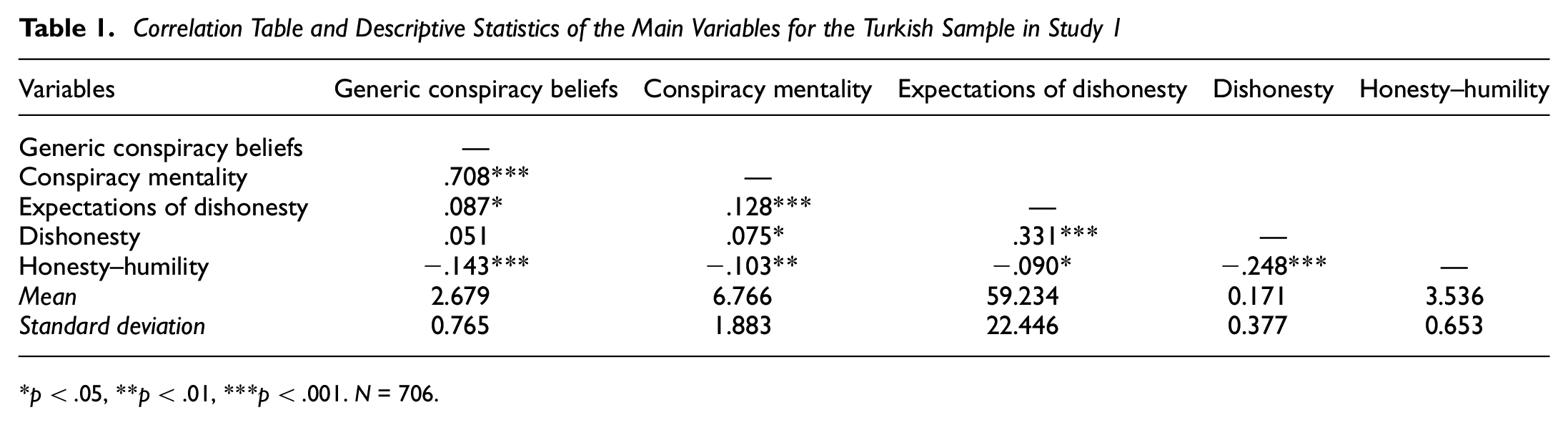
p < .05, **p < .01, ***p < .001. N = 706.
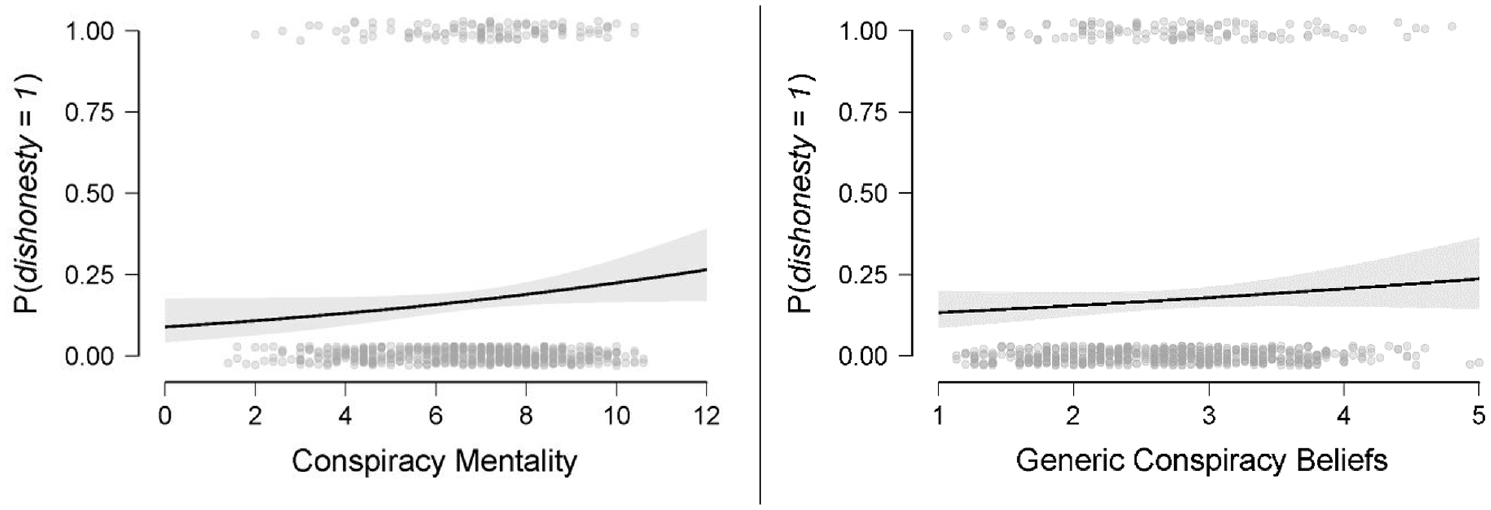
Plots Depicting How Conspiracy Mentality and Generic Conspiracy Beliefs Predict the Probability of a Dishonest Response in Study 1
We also found that both generic conspiracy beliefs, b = −.122, SE = .032, β = −.143, 95% CI for β = [−.216, −.070], t = −3.835, p < .001, and conspiracy mentality, b = −.036, SE = .013, β = −.103, 95% CI for β= [−.176, −.029], t = −2.741, p = .006, were associated with lower levels of self-reported honesty–humility, supporting H1. We also checked the association between self-reported honesty–humility and dishonest behavior in the lying task to ensure conceptual consistency. A one unit increase in honesty–humility was associated with a 63.6% decrease in the odds of dishonesty behavior, b = −1.011, SE = .160, Z = −6.323, p < .001, OR = .364, 95% CI for OR = [.266, .498].
Expectations Regarding Others’ Dishonesty
The actual rate of participants who chose the dishonesty option in the lying task was 17.1%. Most people overestimated others’ dishonesty (see Figure 2) but overestimation was positively related to both conspiracy mentality, b = 1.527, SE = .445, β = .128, 95% CI for β = [.055, .202], t = 3.428, p < .001, and generic conspiracy beliefs, b = 2.550, SE = 1.102, β = .087, 95% CI for β = [.013, .161], t = 2.314, p = .021. Adjusting for control variables did not change the findings (see SM 1). In an unregistered exploratory analysis, we controlled for participants’ own dishonesty. After adjusting for own dishonesty in the first step, both generic conspiracy beliefs, b = 2.058, SE = 1.043, β = .070, 95% CI for β = [.010, 4.106], t = 1.973, p = .049, and conspiracy mentality, b = 1.249, SE = .423, β = .104, 95% CI for β = [.410, 2.070], t = 2.932, p = .003, were associated with higher expectations of dishonesty. Thus, H2 was supported: Conspiracy beliefs were positively correlated with overestimation of others’ dishonesty (see Figure 2).
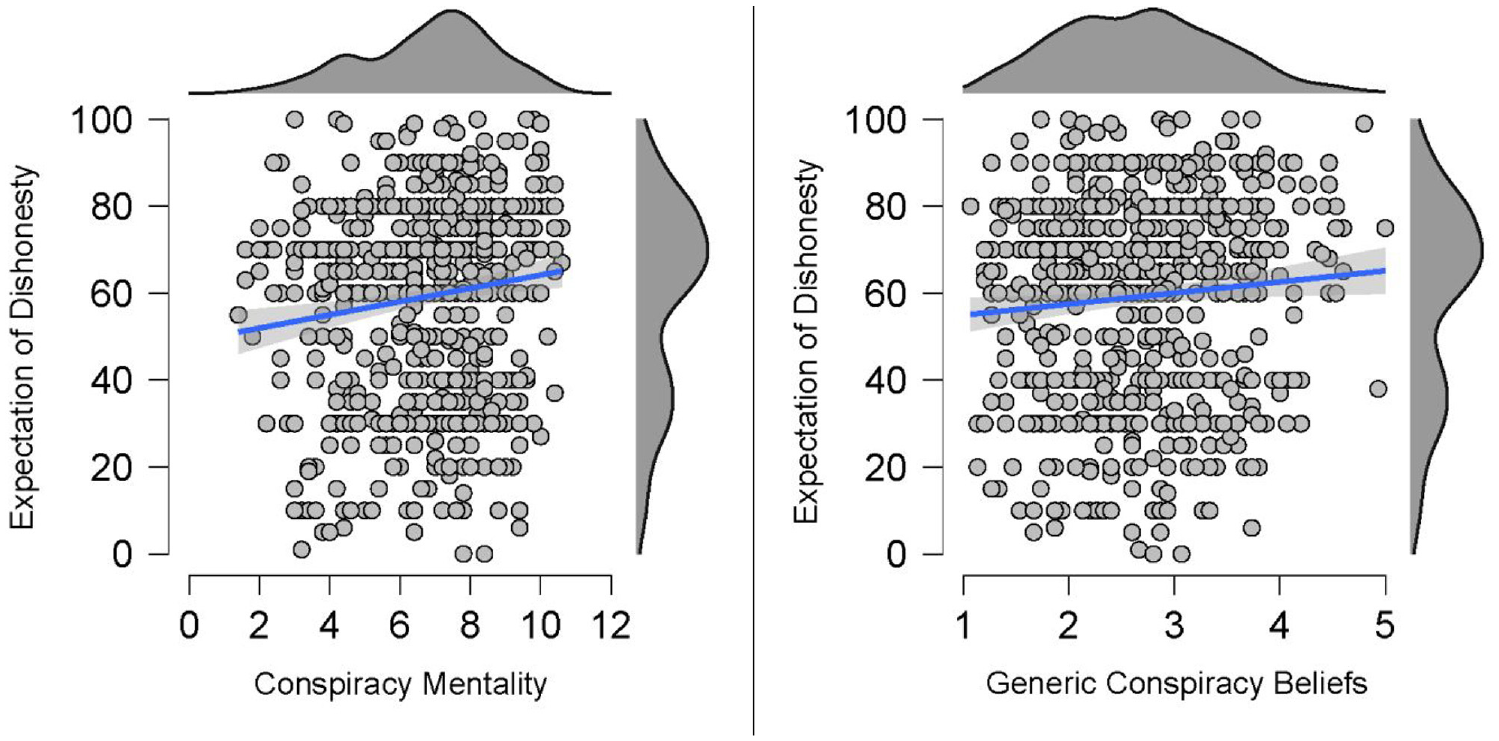
Scatter Plots Depicting the Association Between Expectations of Dishonesty and Both Conspiracy Mentality and Generic Conspiracy Beliefs in Study 1
The preregistered hypotheses therefore received overall support. Conspiracy beliefs were related to higher levels of dishonesty in the lying task, but only when measured by the conspiracy mentality scale. Both measures of conspiracy beliefs were significantly and negatively related to self-reported honesty while positively correlated with overestimation of others’ dishonesty.
Study 2
We aimed to replicate the findings of Study 1 in two culturally distinct countries, Canada and South Africa. The reason why we chose Canada and South Africa was that these two countries have very different levels of country-level corruption (Transparency International, 2023). Research has demonstrated that people are more likely to act dishonestly in more corrupt countries (Gächter & Schulz, 2016; Muthukrishna et al., 2017). Based on this, we expected that people with higher conspiracy beliefs would be more likely to expect others to act dishonestly, but that this association would be weaker in more corrupt countries where dishonesty is, in fact, more widespread. This is because in high-corruption contexts, as in low-corruption contexts, people with high conspiracy beliefs would continue to have high expectations of dishonesty. However, in high-corruption contexts, other people would indeed be more likely to act dishonestly, making it less likely that a high expectation of dishonesty is an overestimation. Thus, in addition to the hypotheses in Study 1, we also tested the hypothesis that the association between conspiracy beliefs and overestimating others’ dishonesty would be weaker in countries with high-corruption levels. We used the same materials, leveraging the widespread use of English in both countries. We slightly modified the incentive structure: Participants were rewarded with real money based on their decisions, moving away from the extra lottery ticket rewards used in Study 1. We also randomized the order of the lying task and the conspiracy measures to check for a potential order effect.
Hypotheses, sampling plan, exclusion criteria, and analysis procedure were preregistered prior to data collection (https://osf.io/j5z69). Data and materials are available at https://osf.io/t7pjr/.
Participants
We aimed to recruit 855 participants each from Canada and South Africa. The sample size was limited by our available budget. We recruited participants from Prolific data collection service (www.prolific.co). Participation was in exchange for £1 UK currency, and participants were informed that they might earn a bonus payment up to an additional £0.10. The preregistered exclusion criteria were the same as in Study 1. After the exclusions, the resulting sample consisted of 835 participants from Canada (411 female, 401 male, 19 non-binary/other, 4 rather not say; Mage = 34.27, SD = 11.30) and 867 participants 3 from South Africa (430 female, 431 male, 4 non-binary/other, 2 rather not say; Mage = 28.79, SD = 7.63). The total sample of 1,702 participants was sensitive to detect a correlation of r = .07, assuming the alpha level of .05 and statistical power of .80.
Materials and Procedure
The materials were the same as in Study 1 with three exceptions. In the lying task, participants were allowed to earn bonus payments, instead of winning extra tickets for a lottery. We also randomized the order of the lying task and conspiracy beliefs measures, and included a one-item measure of individual-level perceived corruption measured on a scale ranging from 1 (“there is no corruption in Canada [South Africa]”) to 10 (“there is abundant corruption in Canada [South Africa]”).
Results
Dishonesty
In the Canadian sample, a one unit increase in conspiracy mentality was associated with an 12.8% increase in the likelihood of dishonesty, b = .120, SE = .046, Z = 2.588, p = .010, OR = 1.128, 95% CI for OR = [1.030, 1.235], and a one unit increase in generic conspiracy beliefs was associated with an 41.7% increase in the likelihood of dishonesty, b = .349, SE = .103, Z = 3.374, p < .001, OR = 1.417, 95% CI for OR = [1.157, 1.736] (see Tables 2 and 3; see Figure 3). In the South African sample, neither conspiracy mentality, b = .087, SE = .051, Z = 1.714, p = .087, OR = 1.091, 95% CI for OR = [.988, 1.205] nor generic conspiracy beliefs, b = .108, SE = .093, Z = 1.153, p = .249, OR = 1.114, 95% CI for OR = [.927, 1.337] were associated with dishonest behavior. Controlling for differences in age, gender, education status, and income did not change the results (see SM 1). Thus, Hypothesis 1 was supported in the Canadian, but not in the South African, sample.
Correlation Table and Descriptive Statistics of the Main Variables for the Canadian Sample in Study 2
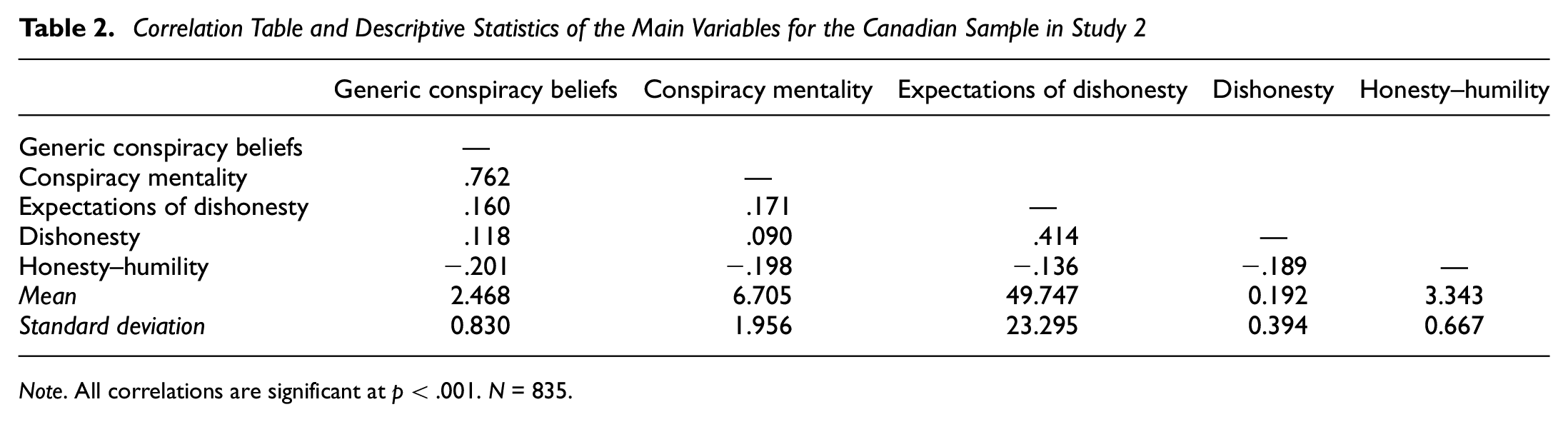
Note. All correlations are significant at p < .001. N = 835.
Correlation Table and Descriptive Statistics of the Main Variables for the South African Sample in Study 2
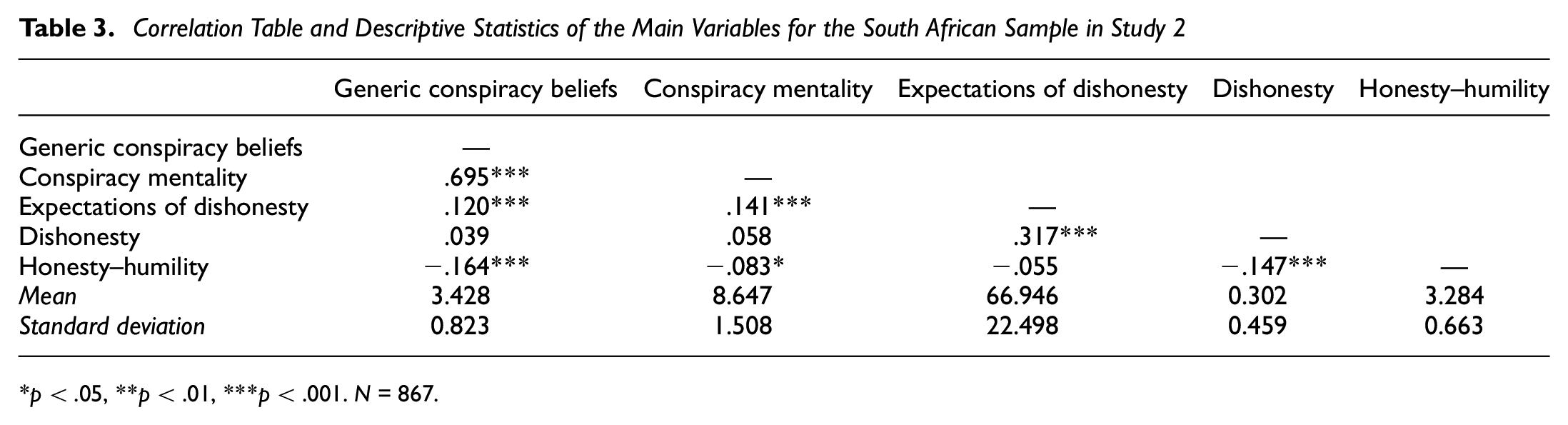
p < .05, **p < .01, ***p < .001. N = 867.
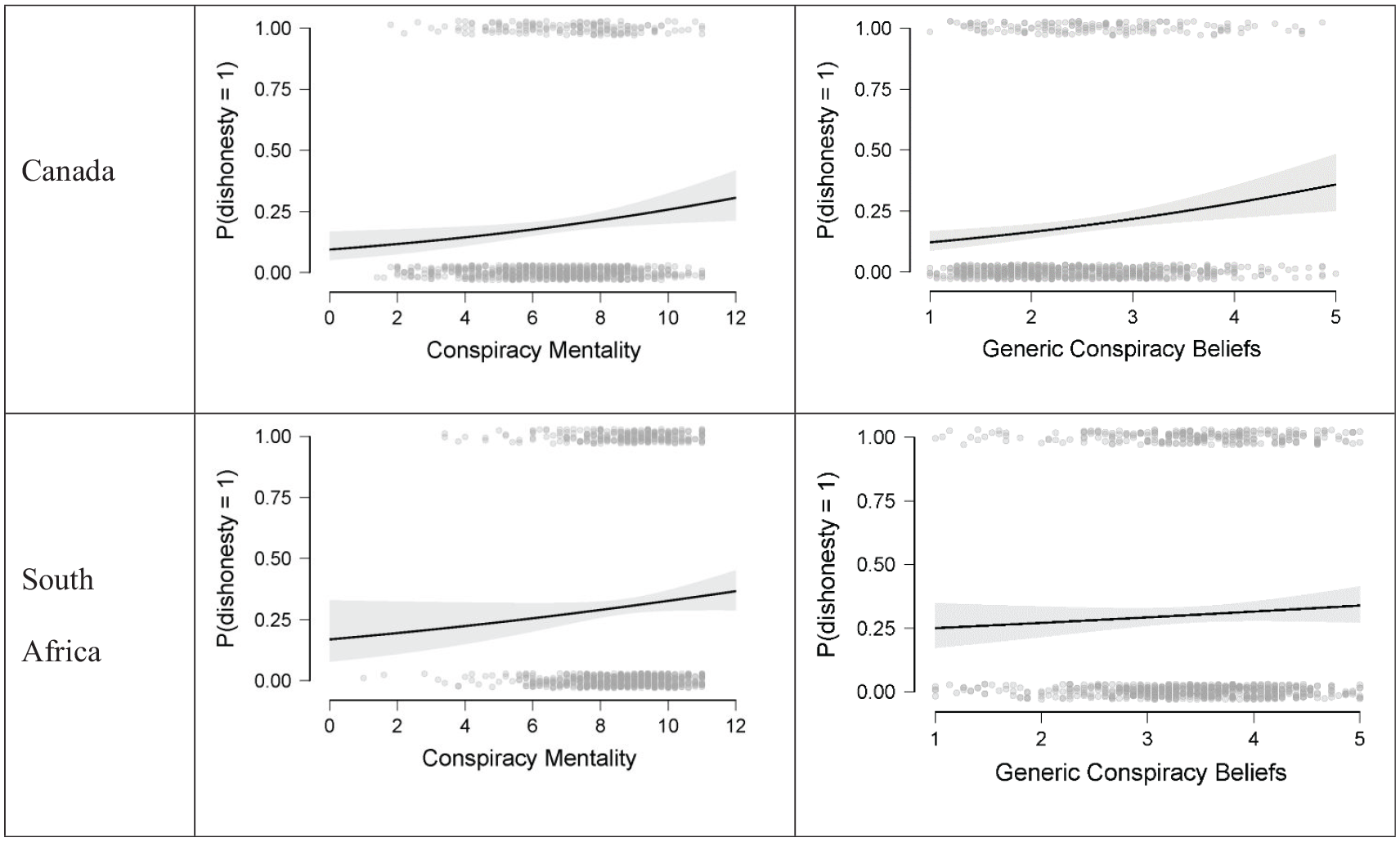
Plots Depicting How Conspiracy Mentality and Generic Conspiracy Beliefs Predict the Probability of a Dishonest Response in Study 2
We also found that, in the Canadian sample, both generic conspiracy beliefs, b = −.126, SE = .017, β = −.179, 95% CI for β = [−.226, −.133], t = −7.519, p < .001, and conspiracy mentality, b = −.050, SE = .008, β = −.149, 95% CI for β [−.196, −.101], t = −6.192, p < .001, were associated with lower levels of self-reported honesty–humility. In the South African sample, similarly, both generic conspiracy beliefs, b = −.136, SE = .028, β = −.164, 95% CI for β = =[−.230, −.098], t = −3.894, p < .001, and conspiracy mentality, b = −.036, SE = .015, β = −.083, 95% CI for β = [−.149, −.016], t = −2.449, p = .015, were associated with lower levels of self-reported honesty–humility. Thus, Hypothesis 1 was supported in both samples, when dishonesty was measured using the self-reported questionnaire. We also checked the association between self-reported honesty–humility and dishonest behavior in the lying task to ensure conceptual consistency. A one unit increase in honesty–humility was associated with a 52.5% decrease in the odds of dishonesty behavior, b = −.745, SE = .139, Z = −5.358, p < .001, OR = .475, 95% CI for OR = [.361, 623] in Canada, and 39% in South Africa, b = −.494, SE = .116, Z = −4.279, p < .001, OR = .610, 95% CI for OR = [.486, 765].
Expectations Regarding Others’ Dishonesty
The actual rate of participants who chose the dishonesty option in the lying task was 19.2% in Canada and 30.2% in South Africa. Most people overestimated others’ dishonesty (see Figure 4) but overestimation was positively related to both generic conspiracy beliefs, b = 4.478, SE = .960, β = .160, 95% CI for β [.092, .227], t = 4.663, p < .001, and conspiracy mentality, b = 2.040, SE = .407, β = .171, 95% CI for β [.104, .238], t = 5.017, p < .001, in the Canadian sample. In the South African sample, similarly, both generic conspiracy beliefs, b = 3.372, SE = .946, β = .120, 95% CI for β = [.054, .187], t = 3.565, p < .001, and conspiracy mentality, b = 2.108, SE = .502, β = .141, 95% CI for β [.075, .207], t = 4.198, p < .001, were positively related to expectations of dishonesty. Adjusting for control variables did not change the results (see SM 1). Thus, Hypothesis 2 was supported in both samples: People with stronger conspiracy beliefs were more likely to expect others to be dishonest and this was an overestimation. Although most people overestimated dishonesty among other people (see Figure 4), people with stronger conspiracy beliefs overestimated to a greater extent.
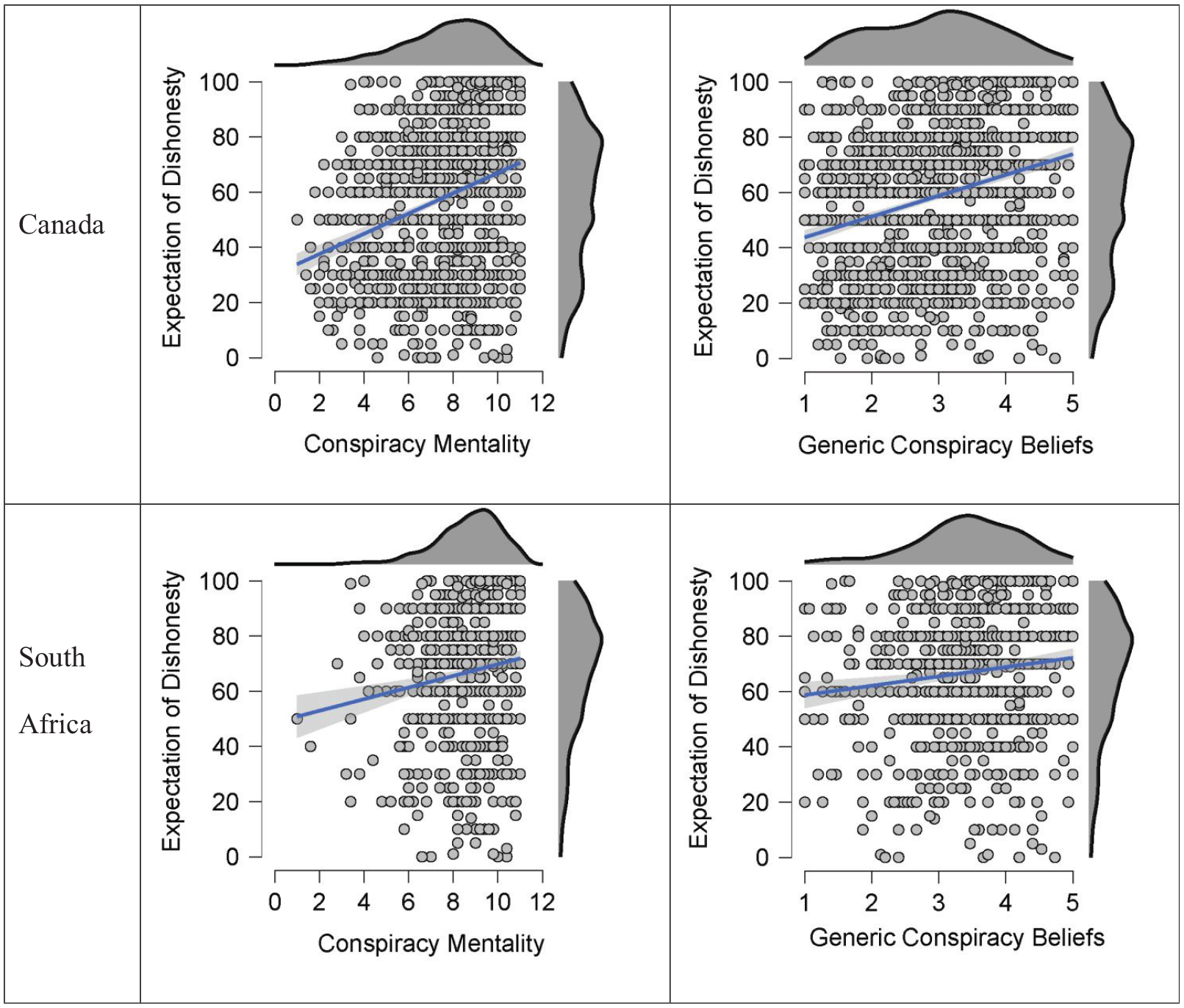
Scatter Plots Depicting the Association Between Expectations of Dishonesty (What Percentage of Other Participants Was Expected to Behave Dishonestly) and Both Conspiracy Mentality and Generic Conspiracy Beliefs in Study 2
Corruption as a Moderator
We hypothesized that the association between conspiracy beliefs and expectations of dishonesty would be stronger in a low-corruption country (Canada) compared with a high-corruption country (South Africa). However, neither generic conspiracy beliefs, b = −1.106, SE = 1.348, 95% CI for b = [−3.747, 1.535], z = −.821, p = .412, nor conspiracy mentality, b = .068, SE = .648, 95% CI for b = [−1.202, 1.338], z = .105, p = .916, interacted with country (Canada vs. South Africa). Generic conspiracy beliefs, b = .098, SE = .302, 95% CI for b = [−.493, .689], z = .325, p = .745, and conspiracy mentality, b = .119, SE = .121, 95% CI for b = [−.119, .356], z = .978, p = .328, also did not interact with individual-level perceived corruption. Thus, contrary to our hypothesis, corruption level did not moderate the association between conspiracy beliefs and expectations of other people’s dishonesty.
Order Effects
We also checked for any potential order effect. When participants first completed the conspiracy measures and then the lying task, odds ratios tended to be higher, compared with the opposite order (see Table 4; see SM 3 for more details), especially in Canada. This suggests that if the order of measures has an effect, it is more likely that when participants first reported their conspiracy beliefs, they tended to act more dishonestly, compared with an effect in the opposite direction. However, these results should be read with caution since the differences between significant and non-significant odds ratios did not reach statistical significance at p < .05.
Odds Ratios for Different Orders in Study 2
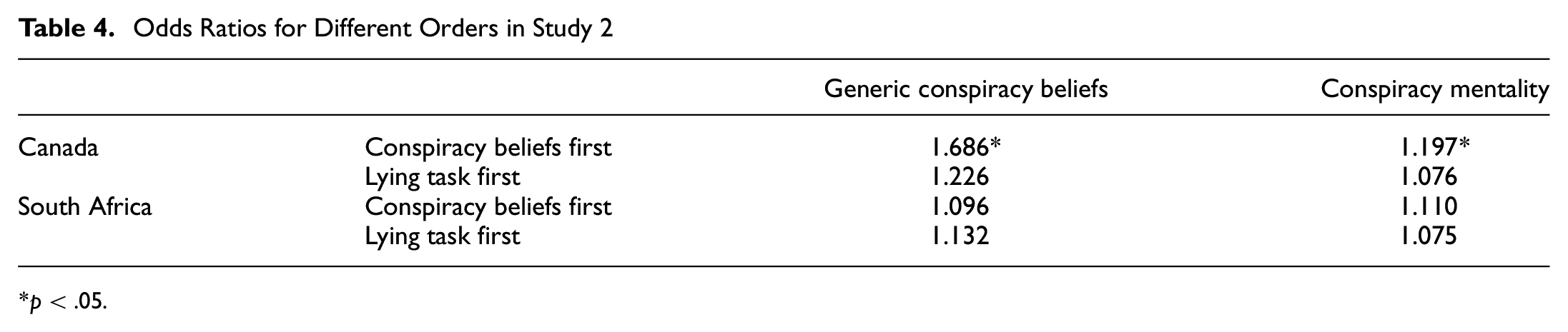
p < .05.
Discussion
We examined how conspiracy beliefs were associated with dishonesty and expectations of dishonesty in samples from three diverse cultures (Turkey, Canada, and South Africa). As predicted (H1), conspiracy beliefs were positively correlated with dishonesty. When measuring dishonesty through a self-report questionnaire, this finding held across the three countries; when measuring dishonesty through a lying task, this finding held in Canada and Turkey, but not in South Africa, although the results trended in the same direction. As predicted (H2), conspiracy beliefs positively correlated with overestimations of others’ dishonesty, despite the general trend to overestimate dishonesty (see also Martuza et al., 2024). Taken together, our results align with findings that link conspiracy beliefs with antisocial, self-centered tendencies (Douglas & Sutton, 2011; Hughes & Machan, 2021; Jolley et al., 2019; Kay, 2021; March & Springer, 2019), and negative traits (Douglas, 2021; van Mulukom et al., 2022), and they extend existing research by showing how conspiracy believers are more prone to expect others to behave dishonestly.
Research has established that individuals are more inclined to engage in unethical conduct when they believe such actions are common among others (Gächter & Schulz, 2016; Köbis et al., 2015). Therefore, one potential explanation for our results is that individuals with stronger conspiracy beliefs may internalize a descriptive norm characterized by a widespread perception of malevolent actions, potentially accounting for their propensity toward dishonest behavior. Consistent with this theoretical framework, our data reveal a correlation between personal dishonesty and the anticipation of dishonesty in others, with correlation coefficients ranging from .317 to .414. This finding is particularly troubling given that individuals may be influenced by the perceived descriptive norm of dishonesty, yet do not search for information regarding whether this norm is accurate (Leib, 2023).
Another potential explanation is an order effect. In Study 1, participants first completed the lying task and then the conspiracy belief measures. It is possible that when people lied, they might have attempted to justify themselves by reporting higher perceived dishonesty in the world, in the form of conspiracy beliefs. However, we randomized the order of the lying task and conspiracy measures in Study 2, and found that the association between the two was not stronger when people first completed the lying task. In Canada, it was even weaker. This analysis should be repeated on larger samples as our sample size was underpowered to detect whether these differences were statistically significant. There might also be an order effect of dishonest behavior on expectations of dishonesty, as participants always completed the task first and then reported their expectation. People who lied might be more likely to expect higher dishonesty among other people to justify their own behavior.
The finding that conspiracy beliefs were positively associated with overestimations of others’ dishonesty underscores the importance of trust dynamics. The pronounced distrust that is argued to be a characteristic of conspiracy beliefs (e.g., van Prooijen et al., 2022) may fuel a self-reinforcing cycle, preventing conspiracy believers from engaging in trust-based relationships and recognizing their misjudgments in distrusting others. Research indicates that people tend to underestimate others’ trustworthiness (Fetchenhauer & Dunning, 2009, 2010). This is attributed to feedback asymmetry: Individuals learn from instances when their trust is betrayed but lack opportunities to discover if unextended trust would have been reciprocated. Consequently, conspiracy believers’ overestimation of dishonesty might be self-perpetuating because they seldom learn that their mistrust is unwarranted.
Limitations and Future Directions
We found similar results in different cultural contexts, but future research should explore potential cross-cultural differences. Recent studies have increasingly focused on the role of national and cultural factors in shaping conspiracy beliefs, yielding findings that are not always consistent (e.g., Alper, 2023; Alper et al., 2024; Alper & Imhoff, 2023; Douglas et al., 2023; Enea et al., 2023; Hornsey et al., 2023; Hornsey & Pearson, 2022). We have tested country-level corruption as a potential moderator in Study 2 but failed to find any effect. The fact that we were able to compare only two countries is an important limitation; however, we found similar results with individual-level perceived corruption as a moderator. Future research could consider other country-level factors that might moderate the association between conspiracy beliefs and dishonesty-related variables. In addition, our data can only speak to correlational associations and cannot directly attest to a causal relationship. Experimental manipulation of conspiracy beliefs could help establish causal effects on dishonesty. Another potential issue with establishing causality is the possibility of confounding factors. Some contextual factors, such as country-level corruption (e.g., Alper, 2023; Alper & Imhoff, 2023; Muthukrishna et al., 2017), might increase conspiracy beliefs, dishonesty, and expectations of dishonesty simultaneously, which might be the reason for their positive association. This possibility is further corroborated by our finding that a higher percentage of participants from a high-corruption country (South Africa; 30.2%) acted dishonestly compared with those from a low-corruption country (Canada; 19.2%), consistent with previous findings (Gächter & Schulz, 2016; Muthukrishna et al., 2017). Future research should also account for any order effects and ensure that any observed associations are not solely dependent on the order of measures in the study. Finally, we have found some differences in terms of whether dishonesty is measured behaviorally or using a self-report measure. This gap between attitude and behavior is expected (Sheeran & Webb, 2016) but its reason in the context of conspiracy beliefs should be further investigated.
Conclusion
The present findings reveal that individuals with stronger conspiracy beliefs are not only more prone to dishonest behavior but also tend to overestimate others’ dishonesty. This contribution enriches research suggesting that there are adverse consequences of conspiracy beliefs. These results also open up investigations into the interplay between personal integrity and conspiracy beliefs, alongside exploring effective interventions to correct conspiracy believers’ distorted perceptions of others’ trustworthiness.
Supplemental Material
sj-docx-1-spp-10.1177_19485506241302878 – Supplemental material for Stronger Conspiracy Beliefs Are Associated With a Stronger Tendency to Act Dishonestly and an Overestimation of Others’ Dishonesty
Supplemental material, sj-docx-1-spp-10.1177_19485506241302878 for Stronger Conspiracy Beliefs Are Associated With a Stronger Tendency to Act Dishonestly and an Overestimation of Others’ Dishonesty by Sinan Alper, Daniel Toribio-Flórez, Valerio Capraro and Karen M. Douglas in Social Psychological and Personality Science
Supplemental Material
sj-docx-2-spp-10.1177_19485506241302878 – Supplemental material for Stronger Conspiracy Beliefs Are Associated With a Stronger Tendency to Act Dishonestly and an Overestimation of Others’ Dishonesty
Supplemental material, sj-docx-2-spp-10.1177_19485506241302878 for Stronger Conspiracy Beliefs Are Associated With a Stronger Tendency to Act Dishonestly and an Overestimation of Others’ Dishonesty by Sinan Alper, Daniel Toribio-Flórez, Valerio Capraro and Karen M. Douglas in Social Psychological and Personality Science
Supplemental Material
sj-docx-3-spp-10.1177_19485506241302878 – Supplemental material for Stronger Conspiracy Beliefs Are Associated With a Stronger Tendency to Act Dishonestly and an Overestimation of Others’ Dishonesty
Supplemental material, sj-docx-3-spp-10.1177_19485506241302878 for Stronger Conspiracy Beliefs Are Associated With a Stronger Tendency to Act Dishonestly and an Overestimation of Others’ Dishonesty by Sinan Alper, Daniel Toribio-Flórez, Valerio Capraro and Karen M. Douglas in Social Psychological and Personality Science
Footnotes
Declaration of Conflicting Interests
The author(s) declared no potential conflicts of interest with respect to the research, authorship, and/or publication of this article.
Funding
The author(s) disclosed receipt of the following financial support for the research, authorship, and/or publication of this article: The current research was funded by Yasar University, as a part of the project entitled as “Conspiracy Beliefs and Cooperation” (Project no: BAP 138).
The authors thank the support of the European Research Council Advanced Grant “Consequences of conspiracy theories—CONSPIRACY_FX” (grant no. 101018262) in the preparation of this article.

Supplemental Material
The supplemental material is available in the online version of the article.