



Abstract
This study offers the most comprehensive assessment to date of the relationship between personal values and cognitive ability. A large sample of Australian adults (n = 15,552; 60% female; age M = 38.7, SD = 10.7) completed Schwartz’s Portrait Values Questionnaire (PVQ-RR), 200-item HEXACO Personality Inventory–Revised, and measures of general intelligence, crystallized intelligence (verbal ability), and fluid intelligence (abstract reasoning) as part of a job application. General intelligence correlated positively with self-direction, benevolence, and universalism, and negatively with security, tradition, and conformity. Crystallized intelligence correlated more strongly with values than did fluid intelligence. Basic values explained more variance in cognitive ability compared with higher-order values, while narrow values provided minimal incremental prediction. Personal values correlated more strongly with intelligence than did personality traits. Item-level models for personal values and personality offered meaningful incremental prediction of intelligence. Findings support refinement of theories on the development of values, personality, and cognitive ability.
Cognitive ability and personal values are fundamental individual differences that influence beliefs, political attitudes, educational pursuits, and career outcomes (Hodson & Busseri, 2012; Neisser et al., 1996; Schwartz et al., 2012). Understanding the connections between cognitive ability and personal values is important for addressing social issues such as political polarization, prejudice, and social change (Anglim et al., 2019; Cruz Passos et al., 2020; Hodson & Busseri, 2012; Koenig & Bouchard Jr, 2006; S. Ludeke et al., 2013; Millet & Dewitte, 2007). Research on the related construct of personality has shown a rich set of connections between personality traits and cognitive ability, demonstrating how these relationships vary across different cognitive abilities (Anglim, Dunlop, et al., 2022; Stanek & Ones, 2023). More broadly, understanding the connections between values, personality, and cognitive ability forms the empirical basis for theorizing about personal, moral, and intellectual development.
Despite extensive research on the personality correlates of intelligence (for meta-analyses, see P. L. Ackerman & Heggestad, 1997; Anglim, Dunlop, et al., 2022; Stanek & Ones, 2023), the relationship between intelligence and personal values remains underexplored. While Schwartz’s hierarchical taxonomy of personal values has emerged as particularly influential (Schwartz, 1992; Schwartz et al., 2012), few studies have directly measured this relationship. There is also a need to understand how personal values provide a unique perspective on individual differences distinct from personality traits in hierarchical trait frameworks. In addition, key theoretical questions necessitate understanding how personality and personal values differentially relate to fluid intelligence (the capacity to learn) and crystallized intelligence (acquired knowledge). To address these gaps, this study examines the relationship between Schwartz’s personal values and cognitive ability in a large community sample of more than 15,000 adults. It also compares relationships across fluid and crystallized intelligence, evaluates the predictive power of higher-order, basic, narrow, and item-level values, and contrasts these with the relationships observed between personality and cognitive ability using the domains and facets of the HEXACO personality framework.
Cognitive Ability and Personal Values
Cognitive ability and personal values are fundamental domains of individual differences that share rich connections with other domains such as personality and interests (P. L. Ackerman, 1996; DeYoung, 2020; Von Stumm & Ackerman, 2013). Cognitive ability is often conceptualized hierarchically, with the Cattell–Horn–Carroll model being a widely adopted framework (Schneider & McGrew, 2012). At the top of this hierarchy, general intelligence (g) represents a broad capacity to think and reason adaptively. Below general intelligence, a key distinction is made between fluid and crystallized intelligence, although see also the related distinction between verbal and nonverbal measures (DeYoung, 2020; Johnson & Bouchard Jr, 2005). Fluid intelligence reflects the capacity to learn and solve novel problems, often assessed through nonverbal tests such as abstract reasoning tasks. In contrast, crystallized intelligence reflects accumulated knowledge and skills, typically measured through verbal ability or general knowledge tests.
Personal values are enduring beliefs or standards that guide an individual’s behavior and decision-making processes across various contexts. Schwartz’s taxonomy of basic human values has been particularly influential (Schwartz, 1992; Schwartz et al., 2012). This framework includes 10 basic values and 19 narrow values, arranged in a circumplex with two orthogonal dimensions: conservation versus openness to change and self-enhancement versus self-transcendence (see Table 1). While personal values are distinct from personality traits, they show notable correlations with Big Five (Parks-Leduc et al., 2015) and HEXACO dimensions (Anglim, Knowles, et al., 2017; de Vries et al., 2022).
Schwartz’s 19 Narrow Values
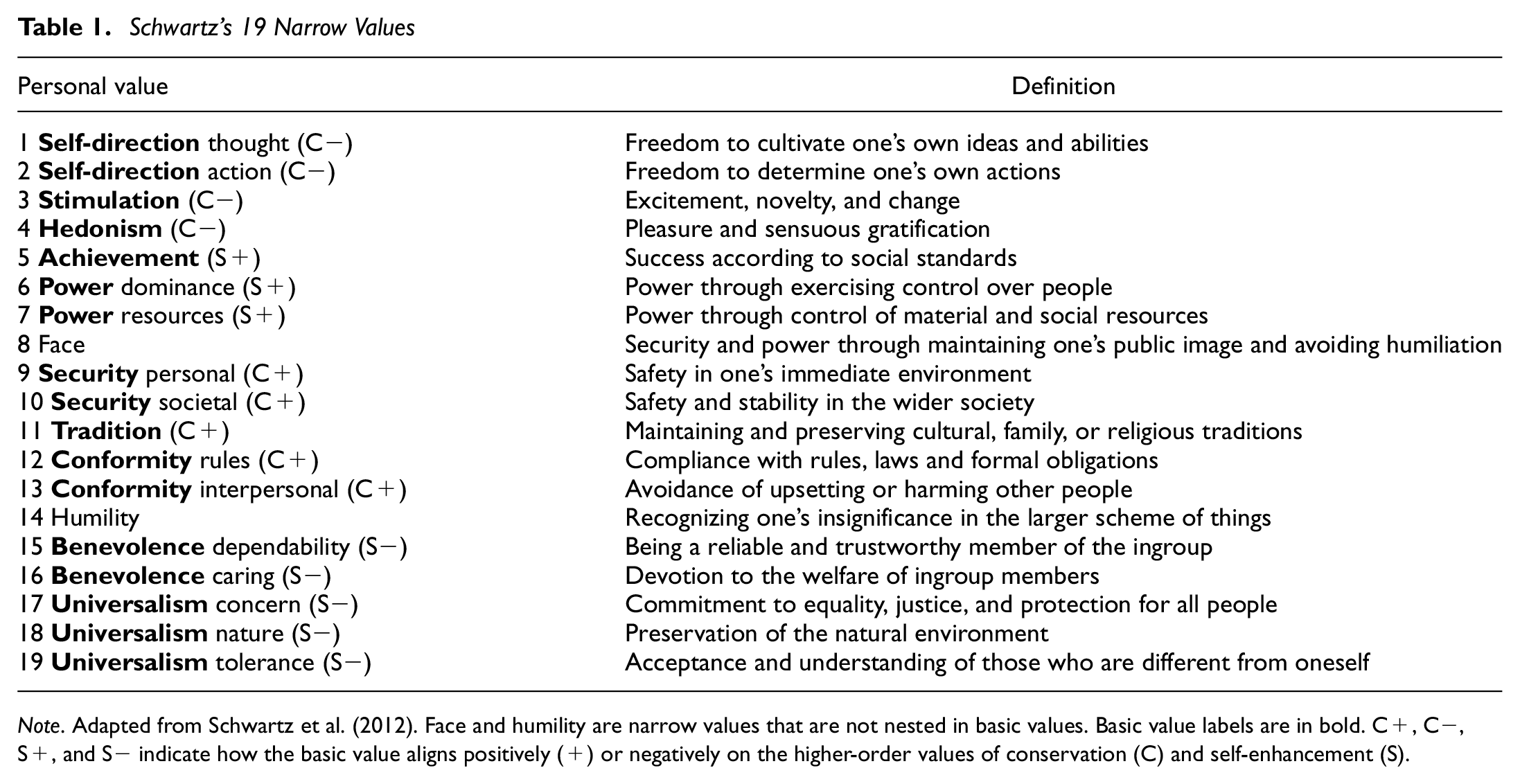
Note. Adapted from Schwartz et al. (2012). Face and humility are narrow values that are not nested in basic values. Basic value labels are in bold. C+, C−, S+, and S− indicate how the basic value aligns positively (+) or negatively on the higher-order values of conservation (C) and self-enhancement (S).
While there is a lack of research comprehensively examining the relationship between personal values and cognitive ability, several streams of research suggest notable connections. First, many studies have examined the associations of cognitive ability with conservative and authoritarian political orientations (e.g., Blanchard-Fields et al., 2001; Block & Block, 2006; Edwards et al., 2024; Heaven et al., 2011; Kemmelmeier, 2008; S. G. Ludeke et al., 2017; Stankov, 2009). In particular, Onraet et al. (2015) obtained uncorrected meta-analytic correlations between cognitive abilities and authoritarianism (r = −.30, n = 18,142, k = 27) and conservatism (r =−.13, n = 63,740, k = 27), with stronger correlations for crystallized intelligence (r = −.23) than for fluid intelligence (r = −.13). Second, personality traits related to values—especially openness—have meaningful correlations with cognitive ability, which are stronger for crystallized than for fluid intelligence (Anglim, Dunlop, et al., 2022). Finally, while a few studies have measured values and intelligence in the same study (e.g., Akhtar et al., 2015; Anglim et al., 2019; Athota & Roberts, 2015; Hogan & Hogan, 1996; Raboteg-Šarić et al., 1997; Sato, 2016), these studies have often had small samples, indirect measures of intelligence, incomplete values assessments, or a focus on other research questions.
Research from the broader literature suggests that the overlap between personal values and cognitive ability is likely to be substantial, despite various factors that attenuate observed correlations. In addition, research on personality correlates of intelligence suggests that narrow traits provide meaningful incremental prediction of most criteria (Anglim & O’Connor, 2019) and especially for intelligence (Anglim, Dunlop, et al., 2022; Rammstedt et al., 2018). Higher-order values align roughly and with similar breadth with broad personality traits such as openness, agreeableness, and honesty-humility. Basic values, similar to facets, likely offer improved predictions. Furthermore, item-level predictive models may further improve prediction and understanding (Mõttus et al., 2017, 2019). For example, Anglim, Dunlop, et al. (2022) examined five large samples and obtained adjusted multiple correlations of .12, .27, and .40 when predicting general intelligence from domains, facets, and items, respectively, using the HEXACO model. This suggests that similar incremental prediction might be achievable for personal values, although this has not yet been examined.
Understanding the relationship between cognitive ability and personal values involves considering three broad categories of causal processes. First, intelligence may influence values through a range of pathways. For instance, lower cognitive ability may make processing complex information difficult, resulting in increased sensitivity to change and consequently the development of values that promote structure, stability, and self-protection (Blanchard-Fields et al., 2001; Schwartz, 2012). In addition, intelligence both leads to greater educational engagement, which in turn can increase intelligence, and education often promotes values that emphasize stimulation and self-direction while de-emphasizing conformity and tradition (Neisser et al., 1996; Schwartz, 2012). Second, values may influence intelligence, particularly through engagement in intellectually stimulating activities. Personal values that prioritize learning and intellectual engagement can enhance cognitive development (P. L. Ackerman, 1996; Cattell, 1987; Von Stumm & Furnham, 2012). Finally, various third variables, such as age, gender, genetics, parental upbringing, socioeconomic status, and schooling environment, may influence both cognitive ability and personal values, thereby inducing a correlation between them (Bouchard Jr & McGue, 2003; Sagiv & Schwartz, 2022; Tucker-Drob et al., 2013). For example, aging is associated with a decline in cognitive ability and a shift toward more conservative values (Dickinson & Hiscock, 2010). In addition, family background and educational opportunities play crucial roles in shaping both intelligence and values (Brandt & Crawford, 2016; Onraet et al., 2015).
While all three categories of causal processes are likely to contribute to observed relationships between cognitive ability and personal values, we posit that third variables and the influence of cognitive ability on values are the stronger causal processes. Furthermore, while there are extensive debates about the connections between personality and values (Anglim, Knowles, et al., 2017; Parks-Leduc et al., 2015), we conceptualize personality, values, and interests as a tightly connected set of individual differences likely to emerge jointly from a range of underlying environmental and genetic processes (P. Ackerman & Beier, 2003). Overall, we expected that (a) many personal values would correlate with intelligence in the .10 to .25 range, (b) conservation (especially tradition, security, and conservatism, and low self-direction) and self-enhancement (especially power and low universalism) would correlate negatively with intelligence, and (c) personal values would correlate more with fluid than with crystallized intelligence.
Method
Transparency and Openness
Data, scripts, and materials are on the Open Science Framework (OSF): https://osf.io/2ah5z. The study was not preregistered. All participant exclusions were performed prior to viewing substantive results. Sample size was determined by available data at the time of extraction. All data exclusions are reported. Data were analyzed using R, version 4.1.1 (R Core Team, 2021) and the psych package (Revelle, 2021).
Participants and Procedure
The anonymized data set was sourced from an Australian provider of psychometric testing services. Participants completed online measures of personal values, personality, and cognitive ability as part of job application processes for various positions across multiple industries between 2014 and 2021. The study was granted an ethics exemption by the first author’s institutional ethics review board.
The final sample consisted of 15,552 Australian adults (59.9% female; 41.1% male) with a mean age of 38.66 (SD = 10.68, range: 18–66). This cleaned sample was obtained after removing participants who showed problematic response profiles for the measures of personality (n = 10) or personal values (n = 23), indicated by having within-person SDs in responses below 0.5 on the respective measures. Regarding statistical power, the sample size provides a high degree of precision, with standard errors of correlations being less than or equal to .008. While exact p values for differences between correlations depend on various factors, as a guide, any correlations differing by more than .03 are significantly different at p < .01. Therefore, observed correlations that differ in substantively meaningful ways (e.g., differences of .04 or .05 or more) are also statistically significant.
Materials
Personal Values
Schwartz’s personal values were measured using the 57-item revised Portrait Values Questionnaire (PVQ-RR; Schwartz et al., 2012). Each item describes a value of someone of the same gender as the participant (e.g., “It is important to him/her to form his/her views independently”). Participants then rated how much the described person is like them: 1 = Not like me at all, 2 = Not like me, 3 = A little like me, 4 = Moderately like me, 5 = Like me, and 6 = Very much like me. The measure yields scores for 19 narrow values, each measured by three items, 10 basic values, each measured by between one to three narrow values (i.e., three to nine items), and two higher-order values. Consistent with the test manual, scores were ipsatized for correlational analyses by subtracting each individual’s mean rating of all items from their raw value scores. Ipsatization corrects for acquiescence bias and assumes that the impact of values on behavior is related to relative preferences. Nonipsatized value scores were used for regression models, because ipsatized scores would necessitate leaving one value out of the analysis due to singularity. Higher-order values were scored as follows: Conservation = (security-personal + security-societal + tradition + conformity-rules + conformity-interpersonal) − (self-direction-thought + self-direction action + stimulation + hedonism), and self-enhancement = (achievement + power-dominance + power-resources) − (universalism-nature + universalism-concern + universalism-tolerance + benevolence-care + benevolence-dependability).
HEXACO Personality
Personality traits were measured using the 200-item HEXACO Personality Inventory-Revised (Ashton et al., 2014; Lee & Ashton, 2004). It measures 6 broad domains and 25 narrow facets with each domain defined by four facets, along with the interstitial facet of altruism. Participants responded to each item on a scale from 1 = strongly disagree to 5 = strongly agree. Scale scores were the mean of items after item reversal.
Cognitive Ability
General, crystallized, and fluid intelligence were measured using two ACER tests (Australian Council for Educational Research, 2003). Crystallized intelligence was assessed using the 34-item ACER ML Verbal Reasoning test (alpha = .86) administered with a 20-min time limit. It includes a balanced mix of items assessing analogies (e.g., “X is to Y as A is to?”), vocabulary (e.g., “Find the word that means most nearly the same as X?”), synonyms (e.g., “Four of the following are alike … Please select the other two”), and verbal reasoning (e.g., “Find the TWO statements which together prove X”). Correlations between the four subscale scores ranged from .53 to .61, mostly correlated in similar ways (see Ashton et al., 2000; Dunlop et al., 2017) with personality and personal values (see OSF supplement for details). Fluid intelligence was assessed using the 20-item ACER APTS (Aptitude Profile Test Series) Abstract Reasoning test (alpha = .72) administered with a 15-min time limit. For each item, participants were shown four diagrams arranged in a sequence, and they had to indicate which of four further diagrams would logically complete the sequence. The correlation between scores on the two measures was r = .47. General intelligence was obtained as the sum of the z-scores of the two tests. Alternative labels for the abilities assessed by the measure of crystallized intelligence include verbal ability, and for fluid intelligence could include nonverbal, abstract reasoning, or perceptual reasoning ability.
Data Analytic Approach
To examine associations, bivariate correlations were reported for cognitive ability, ipsatized values, personality, and demographics. Due to the large sample size, almost all correlations were statistically significant (p < .001), so interpretation focused on the strength and direction of correlations. Regression models predicting cognitive ability from various sets of predictors were used to compare the variance in cognitive ability explained by values and personality at different hierarchical levels: (a) higher-order/broad, (b) basic/facets, (c) narrow, and (d) items, as well as the joint prediction by personality and values.
Results
Values and Cognitive Ability
Table 2 presents the correlations between cognitive ability, higher-order values, basic values, and demographics (see OSF supplement for descriptive statistics and a correlation matrix for all study variables). For higher-order values, conservation had a strong negative correlation with intelligence (r = −.24), whereas self-enhancement was relatively unrelated to intelligence (r = −.04). Among the basic values within the conservation dimension, tradition, security, and conformity had the strongest negative correlations, while self-direction had a notable positive correlation. For values within the self-enhancement versus self-transcendence dimension, universalism and benevolence were positively correlated with intelligence, but so were, albeit more weakly, power and security. Correlations between values and cognitive abilities were typically two to three times larger for crystallized than for fluid intelligence. While the pattern of correlations for basic values was generally consistent across crystallized and fluid intelligence, self-enhancement had a small negative correlation with crystallized intelligence but no meaningful correlation with fluid intelligence.
Correlations Between Values and Cognitive Ability
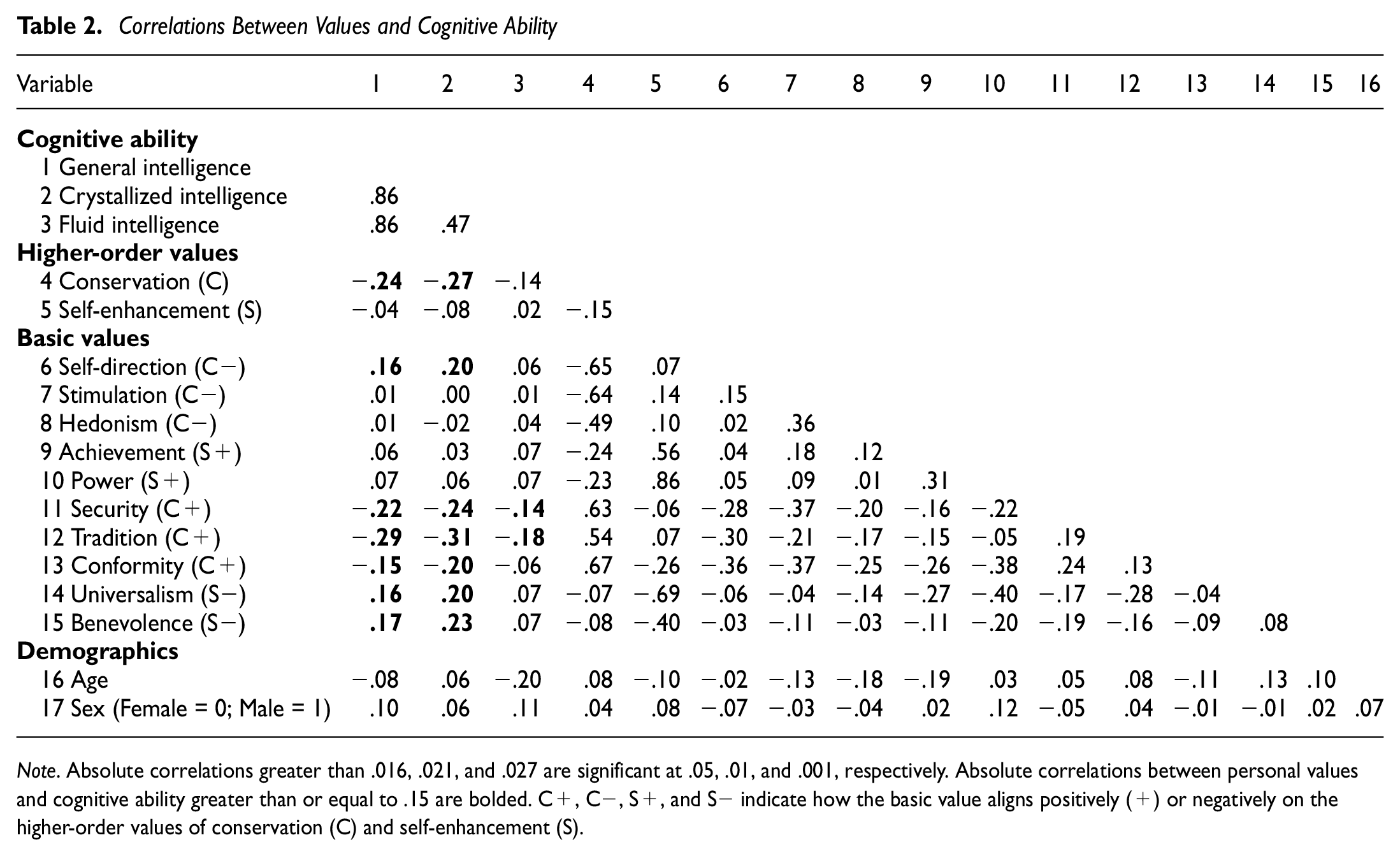
Note. Absolute correlations greater than .016, .021, and .027 are significant at .05, .01, and .001, respectively. Absolute correlations between personal values and cognitive ability greater than or equal to .15 are bolded. C+, C−, S+, and S− indicate how the basic value aligns positively (+) or negatively on the higher-order values of conservation (C) and self-enhancement (S).
Table 3 presents the correlations between cognitive ability and narrow values. Overall, there was relative consistency for correlations of narrow traits within basic values, especially for power, security, and conformity. In contrast, consistent with the cognitive nature of thought, self-direction thought was more strongly correlated with intelligence than self-direction action. Among the narrow aspects of universalism, tolerance was the strongest correlate, followed by concern and then nature. Humility had a weak positive correlation with intelligence, while concern with maintaining face had a weak negative correlation with intelligence.
Correlations Between Narrow Values and Cognitive Ability
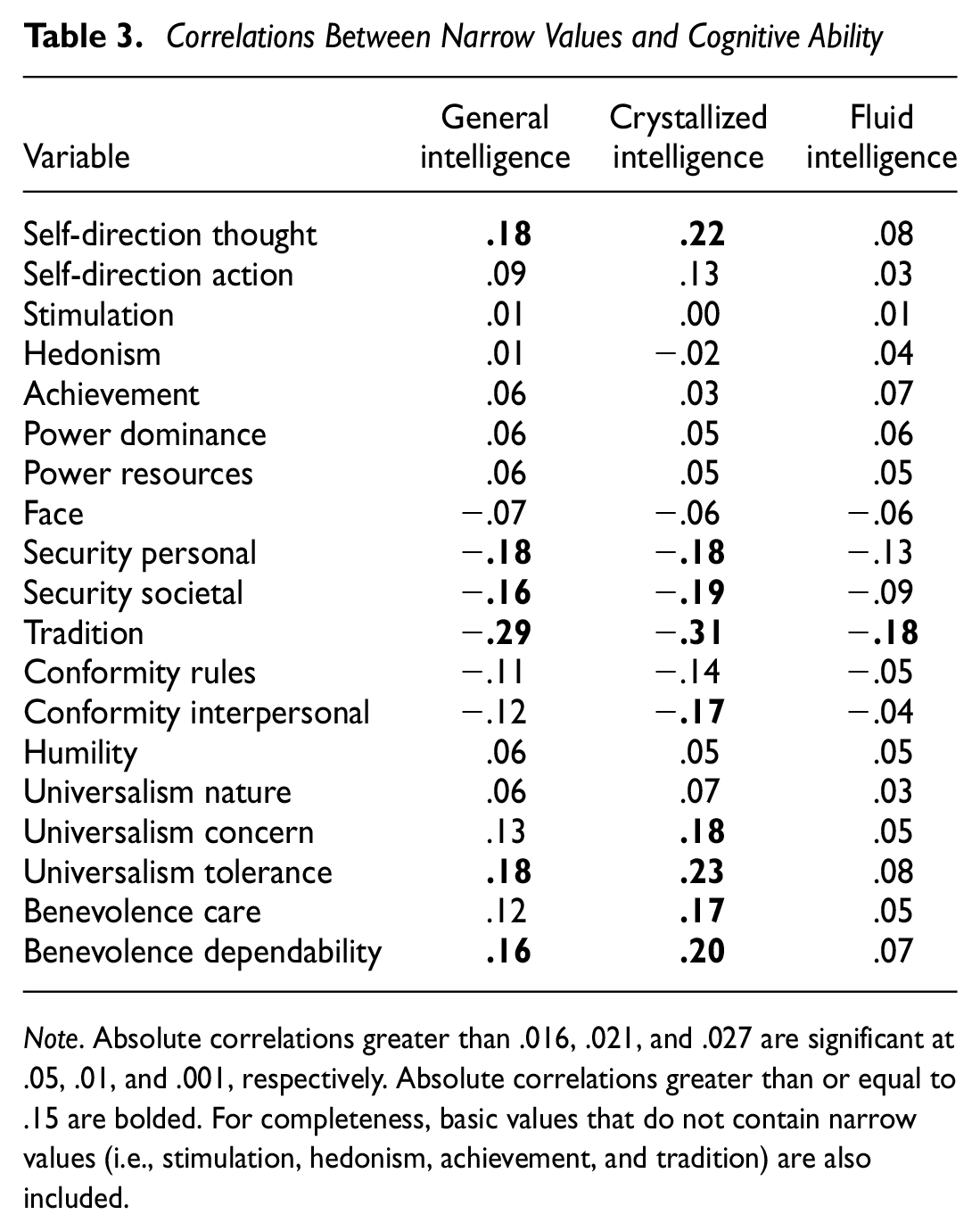
Note. Absolute correlations greater than .016, .021, and .027 are significant at .05, .01, and .001, respectively. Absolute correlations greater than or equal to .15 are bolded. For completeness, basic values that do not contain narrow values (i.e., stimulation, hedonism, achievement, and tradition) are also included.
Personality, Values, and Intelligence
Table 4 presents the correlations of the domains and facets of HEXACO personality with cognitive ability and personal values. Conservation had many notable correlations, including large positive correlations with conscientiousness and agreeableness, moderate positive correlations with honesty-humility and emotionality, and a notable negative correlation with openness. At the facet level, facets such as fairness, fearfulness, gentleness, flexibility, organization, and prudence had notable positive correlations with conservation, while unconventionality had a very strong negative correlation. Self-enhancement also had many strong correlations with personality. Notably, the negative correlation with honesty-humility was very large potentially reflecting the overlapping concern with power and status, and generally prioritizing personal interests at the expense of others. The negative correlation with agreeableness was also quite large. Personality and intelligence correlations were largest for openness, specific facets such as low fearfulness, low gentleness, low organization, high inquisitiveness, and high unconventionality.
Correlations of Personality Variables with Cognitive Ability and Personal Values
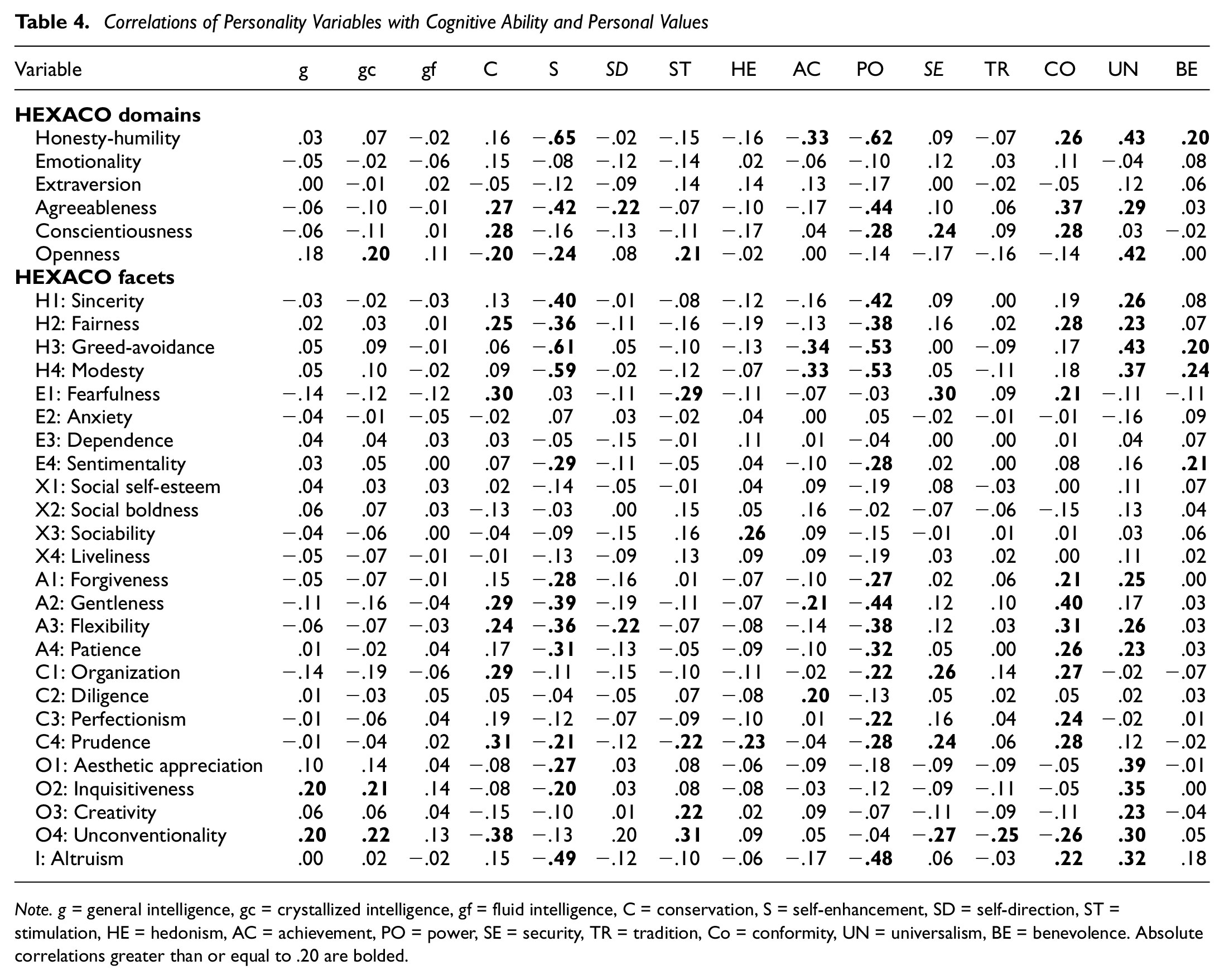
Note. g = general intelligence, gc = crystallized intelligence, gf = fluid intelligence, C = conservation, S = self-enhancement, SD = self-direction, ST = stimulation, HE = hedonism, AC = achievement, PO = power, SE = security, TR = tradition, Co = conformity, UN = universalism, BE = benevolence. Absolute correlations greater than or equal to .20 are bolded.
Regression Models
To assess the relative prediction of cognitive ability by different levels of the hierarchy of personal values and personality, a series of regression models were conducted. In addition to predicting general, crystallized, and fluid intelligence, age and gender were also included as criteria to (a) better understand their potential role as third variables, and (b) provide a frame of reference for understanding the scale of incremental prediction. Age and gender were also included as predictors in the baseline demographic model. Four sets of value predictors were used: 2 higher-order, 10 basic, 19 narrow, and 57 items. Three levels of personality were considered: 6 factors, 25 facets, and 200 items. Finally, to evaluate the incremental prediction of values and personality, two models were considered: one combining basic values with HEXACO facets and another with HEXACO factors. Adjusted multiple R and adjusted R-squared were computed for each regression model to provide two complementary approaches to quantifying prediction while correcting for the overestimation due to the increase in the number of predictors.
The results in Table 5 address several key research questions. First, the 10 basic values provided substantial incremental prediction of intelligence over the two broad values, while the 19 narrow values offered minimal incremental prediction over and above the 10 basic values. Second, the two broad traits were almost as good as predicting intelligence as the six HEXACO domains, and the 10 basic values slightly outperformed the 25 HEXACO facets in predicting intelligence. Third, a model combining both HEXACO facets and the 10 basic values provided notably improved prediction compared with models with only the 10 basic values or just the 25 facets. In contrast, HEXACO factors provided minimal incremental prediction of intelligence over the 10 basic values. Fourth, HEXACO items and personal values items provided meaningful incremental prediction of intelligence over and above their respective narrow scales (i.e., facets and narrow values). Fifth, crystallized intelligence was much better predicted by personality and values than fluid intelligence.
Adjusted Multiple R and Adjusted Variance Explained by Regression Models Predicting Cognitive Ability, Age, and Sex
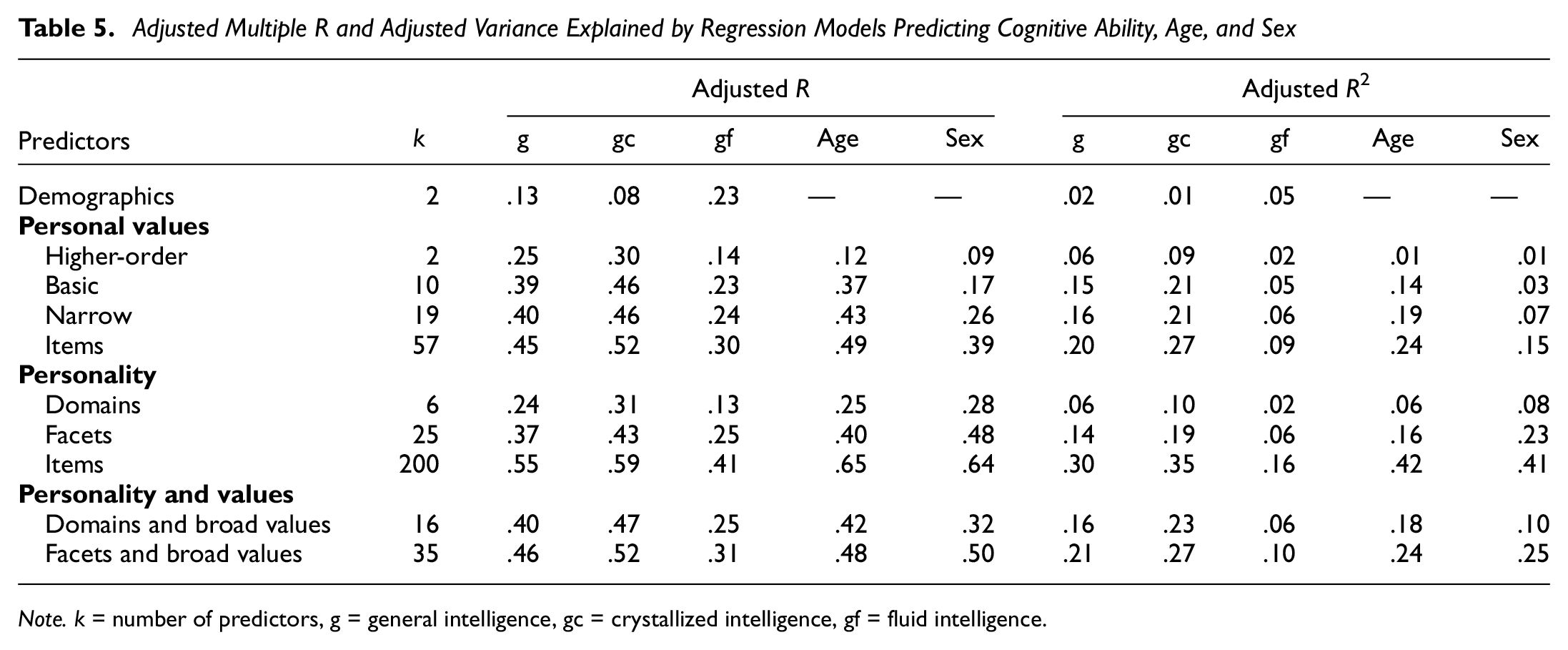
Note. k = number of predictors, g = general intelligence, gc = crystallized intelligence, gf = fluid intelligence.
Inspection of the correlations between personal values items and general intelligence revealed several interesting patterns. In general, the raw item-level correlations tended to be negative, suggesting that less intelligent individuals had a tendency to endorse more items as “like me” or “very much like me,” consistent with other research on acquiescence bias (Lechner & Rammstedt, 2015). Corrected item-level correlations (where the average item-mean was removed) were arguably more informative. Specifically, the strongest negative correlations were substantial: “maintain traditional values” (r = −.29), “honor the traditional practices of their culture” (r = −.24), “their country protect itself against all threats” (r = −.20), “avoid anything dangerous”: (r = −.20), and “follow their family’s customs or religion” (r = −.19). On the positive side, the strongest corrected item correlations were “be tolerant toward all kinds of people” (r = .17) and “have their own opinions” (r = .19).
The demographic analysis predicting age and gender provides an interesting contrast. In general, values were better predictors of gender than age, whereas personality was slightly better at predicting gender, especially at the facet level. The pattern of incremental prediction of these demographic indicators by domains and facets of personality was fairly similar to that for predicting intelligence. In contrast, narrow values provided notable incremental prediction of age and gender over and above basic values, which was not the case for cognitive ability.
Discussion
This study provides a comprehensive examination of the relationships between personal values and cognitive ability in a large adult sample. Several important findings emerged. First, in terms of higher-order values, conservation had a strong negative correlation with cognitive ability, while self-enhancement was effectively unrelated to cognitive ability. Second, in terms of basic values, tradition was the strongest correlate, showing a negative relationship with cognitive ability. Security and conformity also had notable negative correlations with intelligence, whereas self-direction, universalism, and benevolence were positively correlated with intelligence. Third, narrow values mostly predicted cognitive ability similarly to their corresponding basic values, except for the narrow values associated with self-direction and universalism. Fourth, across all levels of the personal values hierarchy, values predicted crystallized intelligence much better than they predicted fluid intelligence. Fifth, the 10 basic values provided substantially better prediction of cognitive ability compared with the two higher-order values, while the 19 narrow values offered only marginally improved prediction of cognitive ability beyond the basic values. Sixth, personality facets, but not personality domains, provided meaningful incremental prediction of intelligence over and above personal values. Seventh, item-level predictive models offered further meaningful incremental prediction over and above scale scores. Collectively, these findings have significant implications for understanding the connections between personal values and cognitive abilities.
Personal Values and Cognitive Ability
In general, correlations between personal values and intelligence were quite strong, given the attenuating factors when correlating self-report psychological characteristics with objectively scored ability measures. In addition to the normal measurement error indexed by measures of internal consistency, typical intelligence measures fall short of the gold standard of comprehensive one-on-one administered batteries, such as the WAIS. Self-report measures also have numerous issues related to rating biases, anchoring effects, idiosyncratic item interpretation, and inaccurate self-insight (Connelly & Ones, 2010; McCrae, 2018). When the constructs are aligned, raw meta-analytic correlations between self-rated intelligence and objectively assessed intelligence are only r = .33 (Freund & Kasten, 2012). In the personality context, the strongest personality domain correlates with intelligence is openness (r = .18), and the strongest personality facets include openness to ideas (r = .30; NEO) and intellect (r = .31; BFAS) (Anglim, Dunlop, et al., 2022). Conceptually, intellect is a similar theoretical construct to intelligence, and openness to ideas represents enjoyment in engaging with intellectual ideas, which shares many close conceptual links with intelligence. Yet, correlations with intelligence are only in the .30 to .35 range. This makes the r = −.29 correlation with the basic value of tradition and the r =−.24 correlation with the higher-order value of conservation noteworthy.
Overall, conservation had a fairly strong negative correlation with general intelligence, with the strongest correlations observed for tradition and security, followed by conformity and the negative correlation for the reversed indicator, self-direction. This is broadly consistent with meta-analytic research on correlations with political conservatism (Onraet et al., 2015) and the meta-analytic correlation for the openness to values facet of the NEO (Anglim, Dunlop, et al., 2022). One interpretation is that intelligent people may have a stronger desire to decide on their own belief structure, whereas less intelligent people may be more open to accepting the belief structure of their culture or religion. Intelligence also tends to lead to more education, which in turn may contribute to intelligence (Ritchie & Tucker-Drob, 2018), and education may foster a critical perspective on past practices and beliefs, further consolidating values based on personal reflection (Hastie, 2007; Hattie & Donoghue, 2016). Third variables that influence both conservatism and intelligence might also explain the relationship, but if so, it is more than just age and gender.
Correlations between self-enhancement and general intelligence were close to zero, but at the basic level, intelligence was characterized by higher levels of universalism and benevolence, with much smaller positive correlations for valuing achievement and power. In general, almost everyone valued benevolence, which suggests that given the ipsative way that personal values are scored, it may particularly be valuing benevolence more relative to other values that led to the positive correlations. Universalism is the value that aligns most strongly with openness including inquisitiveness, which is notably related to intelligence, and compassion has shown notable meta-analytic correlations with intelligence (Stanek & Ones, 2023). Thus, intelligence and openness may contribute to the formation of a more expansive moral circle that incorporates the global community, other species, and the environment.
Another key result was that personal values tended to correlate two to three times more strongly with crystallized intelligence than with fluid intelligence, and a similar result was seen for personality correlates of intelligence. This is consistent with the meta-analytic literature on the relationships between cognitive ability and personality (Anglim, Dunlop, et al., 2022) and cognitive ability and conservatism (Onraet et al., 2015). Many researchers have interpreted this finding—particularly regarding the value of openness—as supporting the theory that openness leads to greater investment in learning, which in turn translates into more acquired knowledge (P. L. Ackerman, 1996; Cattell, 1987; Von Stumm & Furnham, 2012). However, cognitive ability is also likely to have a causal influence on personality traits and values. In particular, if the component measures are interpreted more as measures of verbal and nonverbal ability (for critical discussion, see DeYoung, 2020; Johnson & Bouchard Jr, 2005), it may be that there is something particular about verbal ability—and the cultural and educational factors that cultivate its development—that plays an important role in promoting the observed value profile.
Predicting Cognitive Ability From Personal Values and Personality
The research also speaks to the general predictive validity of different levels of the values hierarchy, both in general and in relation to cognitive ability. The 10 basic values provided substantially improved prediction of cognitive ability compared with the higher-order values. The pattern of correlations between basic values and intelligence varied within the higher-order values structure, showing more consistency within a given pole. For instance, three basic values associated with high conservation were all negatively correlated with intelligence, whereas only one of the three values negatively related to conservation was correlated with intelligence.
In contrast, narrow values provided minimal incremental prediction over and above basic values, although there were a few small differential correlations. This contrasted with models predicting age and sex from values, which showed at least some notable incremental prediction from narrow values. For personality, it is the personality facets that provide notable incremental prediction of intelligence. Regarding basic values, they seem to carve up a conceptual space of individual differences, notably related to agreeableness/honesty-humility and openness. In that sense, there is some similarity between basic values and personality facets.
Interestingly, personal values were somewhat better at predicting intelligence than was personality. Specifically, the two higher-order values were about as good as the six broad traits, and the 10 basic values achieved slightly better prediction of intelligence than the much less parsimonious 25 facets. Furthermore, broad traits provided no meaningful incremental prediction over and above basic values, although facets did provide some incremental prediction. While the higher-order value of conservation may have captured some of the predictive validity of openness, it also seems to combine elements uniquely related to intelligence, including religion, cultural affiliations, and political orientations that may be less attractive to more intelligent people. Comparison of personality facets and values further hints at the points of overlap and common sources of human variation related to intelligence. For instance, inquisitiveness, unconventionality, and aesthetic appreciation are the strongest positive personality-facet correlates of intelligence, while organization, fearfulness, and gentleness are the strongest negative correlates of intelligence. Values with notable correlations with intelligence also tended to have notable correlations with two or more of these personality facets. For instance, security and conformity negatively correlated with intelligence and also had negative correlations with unconventionality and positive correlations with fearfulness and gentleness.
It was also clear that items provided some meaningful incremental prediction over basic or narrow values. Notably, the size of some item-level correlations with intelligence was quite large. The largest was the −0.33 correlation of intelligence with the raw item-level response to the values item “maintain traditional values.” The incremental prediction for items predicting intelligence was similar to predicting age but less than predicting sex. To some extent, age, sex, and intelligence are major causal factors shaping beliefs, experiences, abilities, values, and personality in multifaceted ways, yet none are synonymous with a single broad Big Five or HEXACO personality trait or personal value (see also Mõttus & Rozgonjuk, 2021). This contrasts with other criteria like well-being or job satisfaction, which are more like contextualized expressions of personality, and political orientation which aligns strongly with values. This multifaceted nature of age, sex, and intelligence makes it likely that item-level predictive models may be particularly effective, as not all effects are captured by the primary traits or values measured by each instrument.
Limitations and Future Directions
While the large sample size, broad demographic coverage, and comprehensive assessments represent major strengths of the current research, limitations should be noted. First, assessments took place in a job applicant context, which may lead to a modest amount of socially desirable responding on values (Anglim, Molloy, et al., 2022) and personality (Hu & Connelly, 2021). For HEXACO-specific estimates, see Anglim, Morse, et al. (2017). Nonetheless, the testing context likely motivated participants to complete the assessments conscientiously. Second, the research took place in Australia. While the structure of values is fairly stable across cultures, the profile of dominant values varies (Schwartz, 2012). Future research could examine the extent to which the relationship between intelligence and values varies across cultures.
Conclusion
This study provides the most comprehensive investigation of the relationship between cognitive ability and personal values to date. The large sample size also allows for precise estimates of correlations at different levels of the values hierarchy and offers a comprehensive comparison with personality–intelligence correlations. The results are relevant to practitioners applying personality, ability, and value assessments in professional development, career guidance, and counseling. They also contribute to the ongoing interest in item-level predictive models, reinforcing the incremental prediction offered by the item level. Furthermore, the findings provide foundational empirical evidence necessary for understanding the developmental pathways that connect personal values, personality, and intelligence.
Footnotes
Handling Editor: Danny, Osborne
Author Contributions
J.A. designed study, analyzed data, and wrote article; A.M. selected measures, managed data collection, and reviewed article.
Declaration of Conflicting Interests
The author(s) declared no potential conflicts of interest with respect to the research, authorship, and/or publication of this article.
Funding
The author(s) received no financial support for the research, authorship, and/or publication of this article.
Ethics Statement
The study received an ethics exemption from the first author’s ethics review board.
