




Abstract
The present study examined stability and change in narcissism during adolescence and emerging adulthood, a time of turbulent transitions and shifting social roles. Using data from a longitudinal study of 674 Mexican-origin youth, we investigated rank-order stability and mean-level change in narcissistic grandiosity from age 14 to 26 and narcissistic vulnerability from age 19 to 26. Grandiosity and vulnerability showed moderate-to-high stability across 2- to 3-year intervals (rs = .43–.75) and across the full study period. On average, grandiosity increased from age 14 to 26 and vulnerability increased from age 19 to 26. However, these overall trends obscured significant individual-level changes, with about one third of the sample declining or showing no change in narcissism. Thus, although most individuals become more narcissistic from adolescence to emerging adulthood, many do not, and future research should identify factors that explain why some people increase and others decrease during the critical transition into adulthood.
Keywords
Current research characterizes narcissistic individuals as having inflated self-worth, a need for attention and admiration, and a tendency to engage in interpersonally manipulative behaviors that contribute to both positive and negative consequences for psychological functioning (Brunell et al., 2008; Kjærvik & Bushman, 2021; Rosenthal & Pittinsky, 2006; van Geel et al., 2017; Wetzel et al., 2020). Individuals high in narcissism aim to enhance their grandiose self-views, achieve recognition and admiration, and exploit others to achieve these goals (grandiosity); however, the fragility of their self-esteem often betrays an underlying sense of shame and hypersensitivity (vulnerability). Grandiosity and vulnerability have traditionally been conceptualized as components of a unitary construct (i.e., narcissism), but these dimensions are weakly correlated and are better studied as distinct traits. Little is known about how stable narcissistic traits are over time, especially during adolescence and emerging adulthood. The present study seeks to characterize stability and change in narcissism from adolescence to emerging adulthood. Although the two-dimensional model of narcissism has been extended to a three-dimensional conceptualization that differentiates grandiosity into agentic and antagonistic/entitled components (Grosz et al., 2019), we use data from a long-term longitudinal study that captured a two-dimensional conceptualization. Specifically, we examined rank-order stability and mean-level change in grandiosity from age 14 to 26 and vulnerability from age 19 to 26. Although there is an emerging body of research examining stability and change in narcissism, this literature has significant limitations and gaps, as discussed below.
Stability and Change in Narcissism
Table 1 summarizes the findings of prior studies investigating rank-order stability and mean-level change in narcissism, ordered by the age of the sample. Rank-order stability is the degree to which individuals maintain their ordering on a trait dimension relative to others over time. The rank-order stability of narcissism may be influenced by several processes: long-term developmental factors, person–environment transactions, and stochastic-developmental processes (Bühler & Orth, 2022; Fraley & Roberts, 2005). Long-term developmental factors, including genetically based tendencies toward antagonism and impulsivity and early childhood rearing experiences that engender grandiose self-views, likely provide a source of continuity in the rank-ordering of narcissism (Fraley & Roberts, 2005). Similarly, person–environment transactions, such as individuals’ selection into environments that reinforce their sense of entitlement and self-aggrandizement, may fortify the rank-ordering of narcissism, especially during the emerging adulthood when individuals select into a variety of adult social roles. In contrast, stochastic-contextual processes, or chance experiences and events randomly distributed across a person’s lifetime, may lower rank-order stability (Fraley & Roberts, 2005). For example, if people stumble into jobs or relationships that are incongruent with their pre-existing narcissistic tendencies, this would reduce rank-order stability.
Longitudinal Studies of Rank-Order Stability and Mean-Level Change in Narcissism
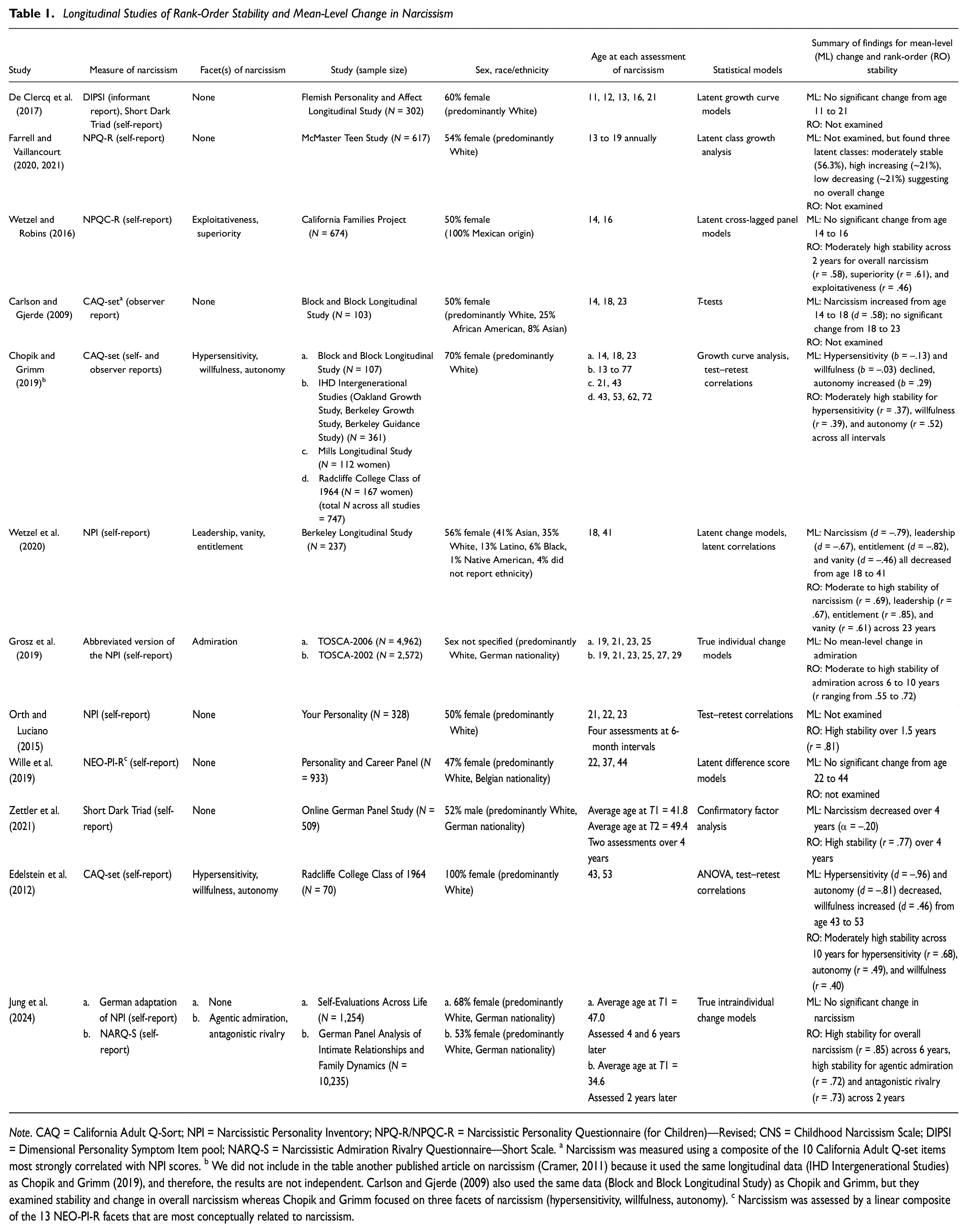
Note. CAQ = California Adult Q-Sort; NPI = Narcissistic Personality Inventory; NPQ-R/NPQC-R = Narcissistic Personality Questionnaire (for Children)—Revised; CNS = Childhood Narcissism Scale; DIPSI = Dimensional Personality Symptom Item pool; NARQ-S = Narcissistic Admiration Rivalry Questionnaire—Short Scale. a Narcissism was measured using a composite of the 10 California Adult Q-set items most strongly correlated with NPI scores. b We did not include in the table another published article on narcissism (Cramer, 2011) because it used the same longitudinal data (IHD Intergenerational Studies) as Chopik and Grimm (2019), and therefore, the results are not independent. Carlson and Gjerde (2009) also used the same data (Block and Block Longitudinal Study) as Chopik and Grimm, but they examined stability and change in overall narcissism whereas Chopik and Grimm focused on three facets of narcissism (hypersensitivity, willfulness, autonomy). c Narcissism was assessed by a linear composite of the 13 NEO-PI-R facets that are most conceptually related to narcissism.
As Table 1 shows, eight of the 12 longitudinal studies examined rank-order stability. These studies found moderate to high stability, ranging from .55 to .85 corrected for measurement error (Grosz et al., 2019; Jung et al., 2022; Orth & Luciano, 2015; Wetzel et al., 2020; Wetzel & Robins, 2016; Zettler et al., 2021) and from .37 to .68 uncorrected for measurement error (Chopik & Grimm, 2019; Edelstein et al., 2012). These effect sizes are comparable with the average rank-order stability (r = .60) of the Big Five domains over similar periods (Bleidorn et al., 2022).
It is difficult to draw conclusions about developmental patterns of rank-order stability because of differences across studies in the age of participants, time interval between assessments, and the constructs assessed. Moreover, measurement issues plague the field (Weidmann et al., 2023); some studies used broad-based personality measures that were not designed to assess narcissism (e.g., NEO Personality Inventory [NEO-PI], California Adult Q-Sort [CAQ]-set), while other studies only assessed global narcissism or assessed facets of narcissism but not vulnerability. 1 Thus, prior research suggests we might find moderately high rank-order stability of grandiosity but does not provide clear predictions about vulnerability.
Mean-level change refers to the extent to which a group of individuals increase, decrease, or show no absolute change, on average, over time. Mean-level changes in a population may be driven by maturational processes (e.g., hormonal changes associated with puberty) or social-contextual factors, such as the transition into adult social roles. For instance, grandiosity may adaptive during adolescence, when a focus on the self and feelings of invulnerability can promote exploration of different identities and experiences (Erikson, 1968; Quadrel et al., 1993). In contrast, life transitions that occur in emerging adulthood (entering the workforce, committing to a long-term relationship partner, becoming a parent) tend to promote personality maturation (e.g., higher responsibility and greater concern for others), and consequently should lead to decreases in narcissism, given that being self-aggrandizing, entitled, and exploitative is the antithesis of maturity.
Despite theoretical reasons to expect a decline in narcissism from adolescence to emerging adulthood, prior studies have reported no mean-level change from age 14 to 16 (Wetzel & Robins, 2016), 11 to 21 (De Clercq et al., 2017), 14 to 23 (Carlson & Gjerde, 2009), or 19 to 29 (Grosz et al., 2019). Beyond emerging adulthood, studies have found declining levels of narcissism (Chopik & Grimm, 2019; Edelstein et al., 2012; Wetzel et al., 2020) or no significant change (Jung et al., 2024; Wille et al., 2019) across early to late adulthood. Consequently, we do not expect to find mean-level change in grandiosity, and it is difficult to make predictions about vulnerability given the dearth of relevant research.
Rank-order stability and mean-level change provide important information about narcissism development at the aggregate level, but not about how specific individuals change over time. For example, despite not finding mean-level change, De Clercq et al. (2017) found significant individual differences in intraindividual change from age 11 to 21, suggesting that increases and decreases in narcissism at the individual level were canceled out at the aggregate level. Thus, the present study will identify the proportion of participants who increased, decreased, or showed little change in narcissism, to determine whether the mean-level trends are masking important patterns of individual-level change.
The Present Study
The present study used data from a longitudinal study of 674 Mexican-origin youth to examine trajectories of narcissism from adolescence (age 14) to emerging adulthood (age 26). Specifically, the present study addressed four research questions:
Given the dearth of longitudinal research on vulnerable narcissism, we only made predictions about grandiose narcissism. For RQ1, we expected to find moderate to high rank-order stability of grandiose narcissism. For RQ2, theoretical perspectives suggest decreases in narcissism following the transition to adulthood, but previous longitudinal studies have failed to support these perspectives; consequently, we did not expect to find mean-level change in grandiose narcissism. For RQ3, we expected that a non-trivial subset of individuals would show significant increases or decreases in grandiosity and vulnerability. For RQ4, we predicted that boys would have higher initial levels of grandiose narcissism than girls, based on prior research (Grijalva et al., 2015), but did not have hypotheses about differences in their slopes. We did not have hypotheses about how the findings will vary by nativity; these analyses are exploratory, providing insight into the generalizability of the findings across first-generation versus U.S. born youth.
The present study extends previous research in several ways. First, we examined individual-level change in narcissism, as well as rank-order stability mean-level change, from adolescence to emerging adulthood. Second, we tested different growth curve models (no growth, linear growth, latent basis) to determine the precise shape of the narcissism trajectories. Third, we examined vulnerable narcissism, a core component of narcissism that has rarely been studied in longitudinal research, and two facets of grandiose narcissism (superiority, exploitativeness). Fourth, we used well-validated measures of narcissism, whereas several prior longitudinal studies used measures (e.g., CAQ, NEO-PI) that were not designed to assess narcissism. Fifth, we tested whether stability and change in narcissism generalized across gender and nativity. Finally, we focused on a minoritized population that has been historically underrepresented in psychological research, especially research on narcissism; to our knowledge, no prior research has examined the development of narcissism in Mexican-origin or Latinx participants.
Method
Open code, materials, and preregistration are available on the Open Science Framework https://osf.io/n9zw8/?view_only=527d76503fff4236965e4d0cf9b6f148.
Participants
We used data from the California Families Project, an ongoing longitudinal study of 674 Mexican-origin children (50% female) and their parents living in the United States. The children were drawn at random from student rosters provided by schools in Sacramento and Woodland, California, with the following criteria: the child had to be in fifth grade, of Mexican origin, and living with their biological mother. Wave 1 occurred in 2006, when the children were 10.8 (SD = 0.50) years old. The interviews were conducted at the participants’ homes in either Spanish or in English, depending on the preference of the participant.
The present study used data collected at age 14 (N = 605), 16 (N = 600), 19 (N = 589), 21 (N = 542), 23 (N = 548), and 26 (N = 507) when narcissism was assessed. Attrition analyses for all study variables indicated that males were less likely than females to have more than one wave of data for vulnerability, χ2(1) = 4.89, p < .05, and those with higher scores of superiority were less likely to have more than one wave of data for this facet, t(5) = 2.68, p < .05.
Measures
Narcissism
Grandiose narcissism was assessed six times from age 14 to 26 using the Narcissistic Personality Questionnaire for Children–Revised (NPQC-R; Ang & Raine, 2009), a self-report questionnaire designed for children and adolescents. 2 The NPQC-R measures two facets of narcissism, superiority and exploitativeness, each assessed with six items. Superiority captures aspects of grandiose narcissism, such as vanity and inflated self-views (e.g., “I am going to be a great person.”). Exploitativeness captures interpersonally toxic aspects of narcissism, including exploitativeness, feelings of entitlement, and manipulativeness (e.g., “I am good at getting people to do things my way.”). Participants responded to all items on a rating scale ranging from 1 (not at all like me) to 5 (completely like me). One superiority item (“You think your body looks good”) and one exploitativeness item (“You would do almost anything if someone dared you”) were dropped after the age 19 assessment due to their weak conceptual connection to superiority and exploitativeness, respectively; consequently, these items were excluded from all analyses.
Vulnerable narcissism was assessed at ages 19, 21, 23, and 26 using the six-item vulnerability subscale of the Super Brief Pathological Narcissism Inventory (SB-PNI; Schoenleber et al., 2015, Supplementary Table S15). This scale includes items related to three facets of vulnerability: Contingent Self-Esteem (“It’s hard to feel good about yourself unless you know other people admire you”), Hiding the Self (“When others realize how needy you are, you feel anxious and ashamed”), and Devaluing (“Sometimes you avoid people because you’re concerned that they will disappoint you”). We supplemented the six-item SB-PNI vulnerability scale with a seventh PNI item (“You will never be satisfied until you get all that you deserve”) that assesses a fourth facet of vulnerability, entitlement. All items were rated on a scale ranging from 1 (not at all like me) to 5 (completely like me).
Gender
Child gender was coded as 1 = girl, 2 = boy.
Nativity Status
Nativity was coded as 1 = born in Mexico, 2 = born in the United States.
Data Analysis Plan
All data cleaning and analyses were conducted in R using the lavaan package. Full information maximum likelihood (FIML) was used to address missing data. An alpha level of .05 (two-tailed) was used for all significance tests.
We computed latent factors for each narcissism dimension using item parcels as indicators (Supplementary Table S16). We used parcels (instead of items) because they produce more stable solutions, are less likely to share specific sources of variance, and reduce the likelihood of spurious correlations (Little et al., 2002).
We examined longitudinal measurement invariance by comparing configural, weak, and strong models. We assessed adequate model fit by changes in chi-square and degrees of freedom, comparative fit index (CFI) less than or equal to .01, and Tucker–Lewis index (TLI) less than or equal to .01 (Chen, 2007; Cheung & Rensvold, 2002; Meade et al., 2008), and root-mean-square error of approximation (RMSEA) values less than or equal to .06 (Hu & Bentler, 1998, 1999). We aimed to identify a measurement model that fits the data well and shows strong or partial strong invariance for all narcissism scales, which would allow us to draw inferences regarding mean-level change.
After establishing measurement invariance, we z-scored narcissism measures at each timepoint using baseline means and standard deviations, and then estimated univariate latent growth curve models separately for each measure. We compared three models: (1) no growth (slope fixed to zero), (2) linear growth (slope reflects linear change in years from baseline [0, 2, 5, 7, 9, 11 for grandiosity; 0, 2, 4, 6 for vulnerability]), and (3) latent basis (first and last loadings fixed at 0 and 11 or 6 and other loadings are freed). We assessed differences in model fit using Akaike information criterion (AIC) and Bayesian information criterion (BIC). We considered model fit and parsimony when selecting the best fitting model.
To examine rank-order stability, we estimated latent test–retest correlations between adjacent measurement occasions and between the first (age 14 for grandiosity; age 19 for vulnerability) and last (age 26) measurement occasion.
To examine whether rank-order stability varied by gender and nativity, we compared a multigroup structural equation model that allowed the test–retest correlations to be freely estimated across groups to a model that constrained the test–retest correlations to be equal across groups. To examine whether the mean-level trajectory varied by gender and nativity, we compared the fit of a model in which the intercepts and slopes were freely estimated to a model that separately constrained the intercepts and slopes, respectively, to be equal across groups. If the constrained model did not fit significantly worse than the freely estimated model, then we concluded that the findings were the same across groups.
To examine individual differences in change, we computed bootstrapped confidence intervals for the individual-level, reliability-adjusted slopes; 95% confidence intervals that did not overlap with 0 indicated statistically significant increases or decreases.
Results
Descriptive statistics and zero-order correlations for all narcissism measures are shown in Supplementary Tables S1 to S3. Zero-order correlations among the latent variables at each age are shown in Supplementary Table S4.
Constraining the factor loadings and intercepts yielded changes in CFI and TLI of less than .01 and RMSEA values of less than .06 for all narcissism measures (Supplementary Table S5), indicating strong longitudinal measurement invariance for grandiose and vulnerable narcissism.
Rank-Order Stability of Grandiose and Vulnerable Narcissism
As Table 2 shows, the rank-order stabilities for all narcissism scales were moderate to high (r = .44–.75) between adjacent measurement occasions [2- or 3-year time intervals]). The 11-year stability coefficients ranged from .43 to .69 for grandiosity, and the 7-year stability coefficient was .50 for vulnerability. To directly compare the long-term stability of grandiosity and vulnerability, Table 2 also shows the 7-year (age 19–26) stability coefficients for grandiosity, which are similar to the 7-year stability of vulnerability. To test for age differences, we compared a model that constrained the stabilities to be equal across all adjacent age intervals to a model that freely estimated the stabilities across adjacent intervals. The model with freely estimated stabilities did not fit significantly better than the constrained model, indicating that the stability coefficients do not vary from adolescence to emerging adulthood for grandiosity or vulnerability (Supplementary Table S8).
Rank-Order Stability of All Narcissism Measures
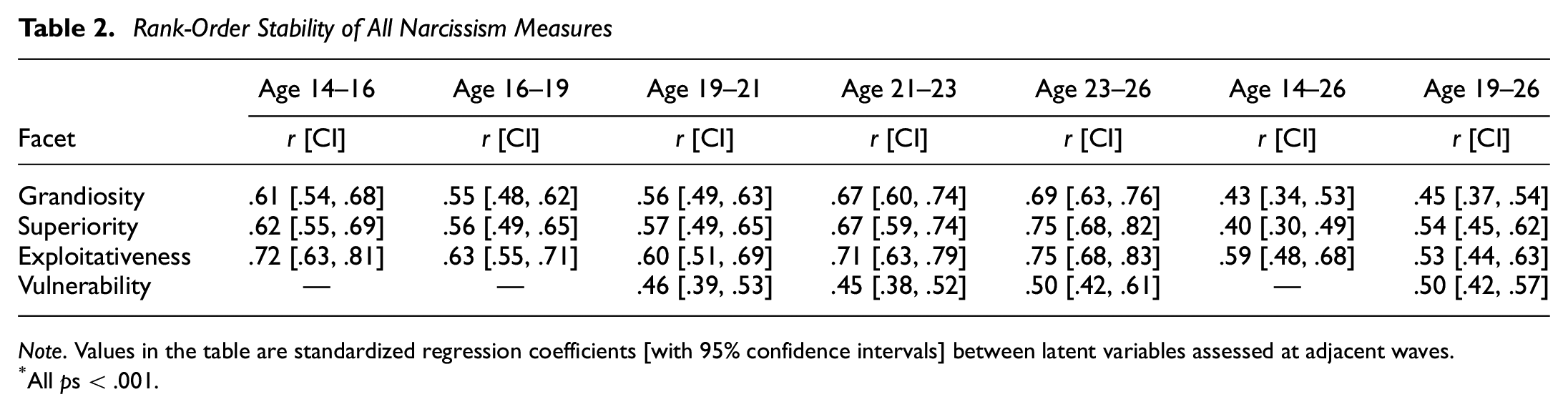
Note. Values in the table are standardized regression coefficients [with 95% confidence intervals] between latent variables assessed at adjacent waves.
All ps < .001.
Mean-Level Trajectory of Grandiose and Vulnerable Narcissism
We examined mean-level change in grandiose and vulnerable narcissism by comparing three growth models—no growth, linear growth, and latent basis. For all measures, we retained a linear growth model due to model fit and parsimony (Supplementary Table S6). On average, individuals exhibited small linear increases in grandiosity (
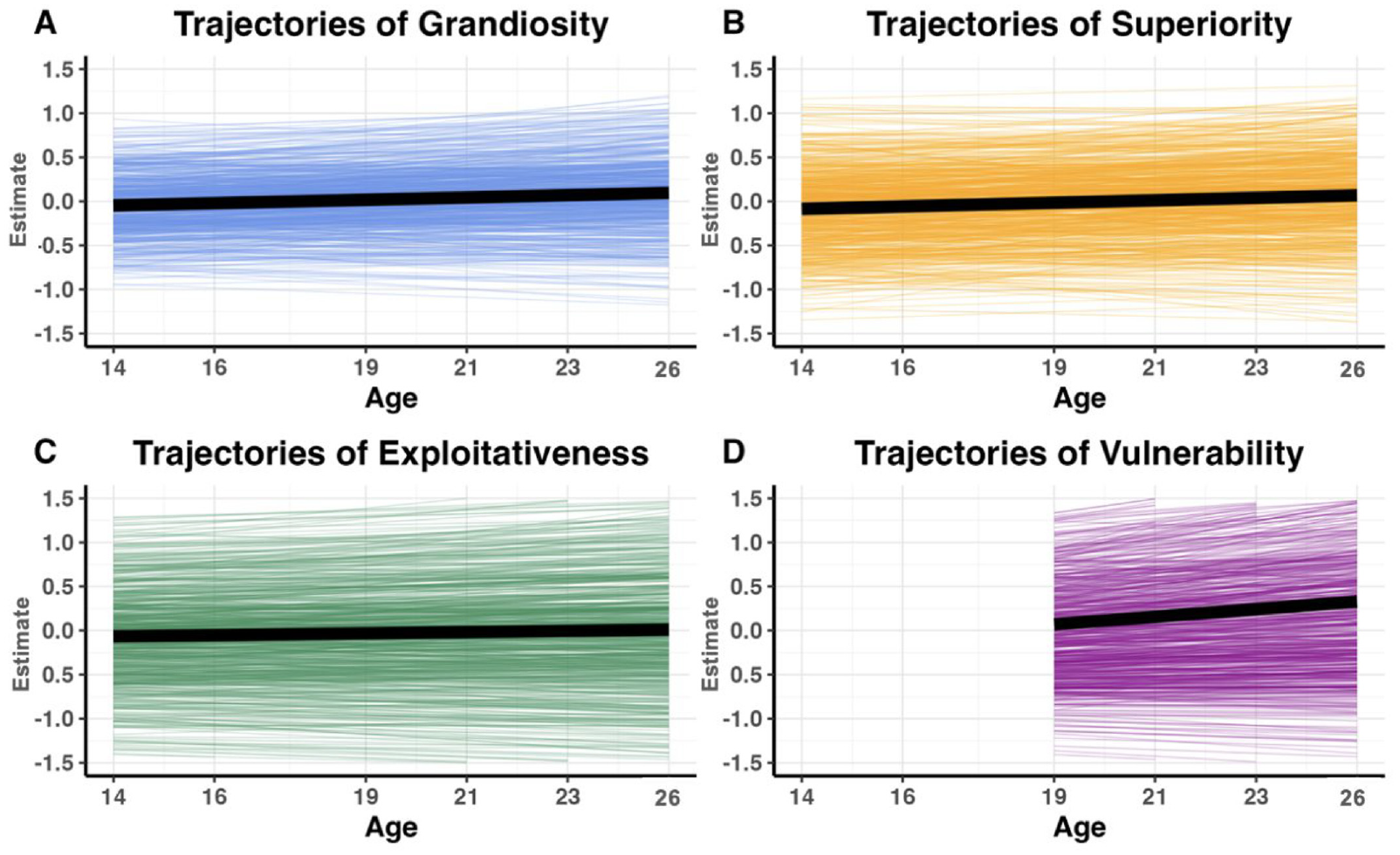
Trajectories of All Narcissism Measures Over Time
Although the slope values indicate average increases in all narcissism scales, we found significant variance in the slopes, which indicates systematic variability in how youth’s narcissism levels changed over time. Thus, we examined the proportion of individuals who significantly increased, decreased, or showed no change in narcissism (Table 3). A majority of youth (54.7%–67.1%) increased in all components of narcissism, consistent with the aggregate trends, but one quarter to one third (25.9%–32.2%) declined in narcissism across the 12- or 7-year period. A small percentage (7.0%–13.0%) showed no statistically significant change.
Estimates of Individual Differences in Change From Bootstrapped Latent Growth Models
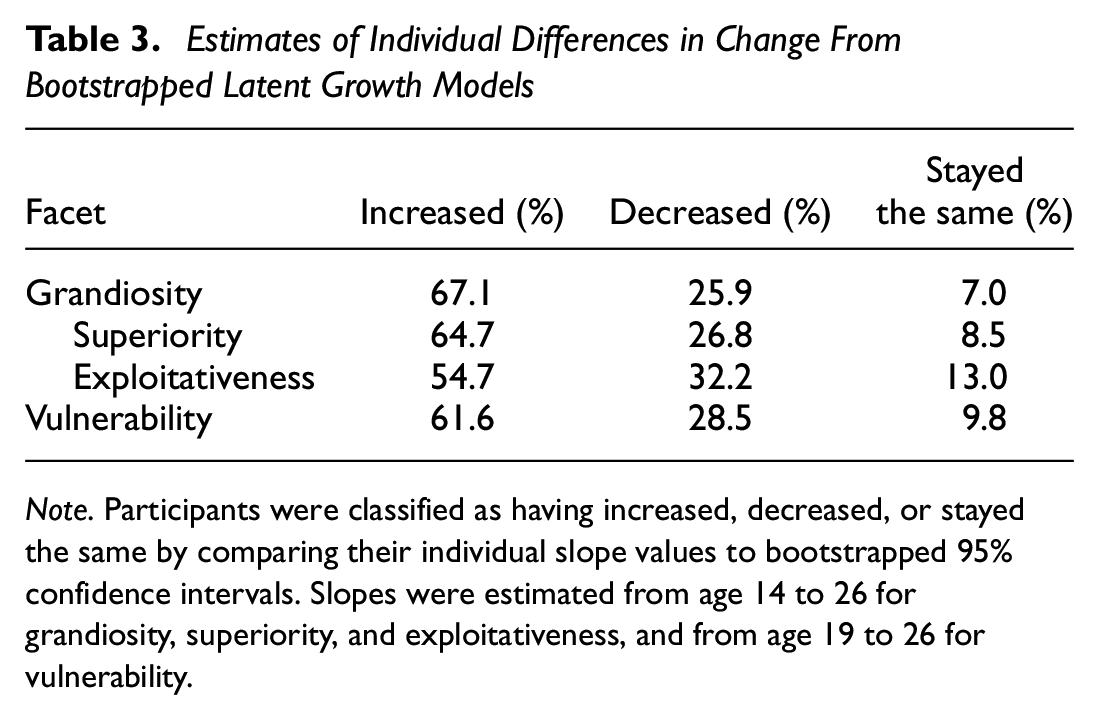
Note. Participants were classified as having increased, decreased, or stayed the same by comparing their individual slope values to bootstrapped 95% confidence intervals. Slopes were estimated from age 14 to 26 for grandiosity, superiority, and exploitativeness, and from age 19 to 26 for vulnerability.
Generalizability Across Gender and Nativity
Finally, we tested whether the findings differed by gender, nativity, or gender × nativity (Supplementary Tables S9–S14). We did not find significant differences in rank-order stability for grandiosity and its facets. For vulnerable narcissism, girls (rgirls = .57) showed higher rank-order stability than boys (rboys = .40) across the 6-year span. No significant nativity differences were found for any narcissism measures. Thus, except for the gender difference in vulnerability, the stability of narcissism was similar for boys and girls and for youth born in the United States and Mexico.
With regard to mean-level change, we did not find significant gender differences in the intercepts for grandiosity or its facets, but we did find differences in the slopes; boys exhibited larger increases than girls in grandiosity (
There were no significant nativity differences in either the levels or slopes of any of the narcissism trajectories, suggesting that youth born in the United States and Mexico show similar patterns of narcissism development.
Discussion
This study examined rank-order stability and mean-level change in grandiose and vulnerable narcissism from adolescence to emerging adulthood, as well as individual differences in change.
Do Narcissistic Adolescents Remain Narcissistic in Emerging Adulthood?
We found moderate to high rank-order stabilities of grandiose and vulnerable narcissism. The level of stability is comparable with the stability of self-esteem (Trzesniewski et al., 2003) and the Big Five personality traits (Bleidorn et al., 2022), suggesting that narcissism is a relatively stable and enduring characteristic during adolescence and emerging adulthood. Exploitativeness was particularly consistent over time, perhaps indicating that this facet is less reactive to normative life transitions, or that exploitative individuals are more successful at selecting themselves into environments that allow them to engage in manipulative behaviors. In comparison, the densely packed transitions to adult social roles may have a stronger impact on the degree to which an individual experiences vulnerability and fragility in their self-views.
Although the rank-order stability of grandiose and vulnerable narcissism was high over relatively short (2 to 3 years) periods, it was somewhat attenuated across the full 7- or 12-year period, as is generally observed for psychological traits (Fraley & Roberts, 2005). These results, coupled with individual differences in the trajectories, suggest that individuals are shifting in their levels of narcissism relative to others, and that this reshuffling becomes more pronounced over longer intervals, highlighting the cumulative impact of time on the relative ordering of people. The decreased rank-order stability of narcissism across the entire study period might reflect a diminishing effect of long-term developmental factors (e.g., genetic predispositions) or the accumulating effects of stochastic processes beyond the individual’s control. The fact that rank-order stabilities did not approach zero even over a relatively longer time interval (i.e., 12 years) suggests that there may be time-invariant influences on narcissistic traits (Fraley & Roberts, 2005). Future research should identify specific factors that increase or reduce the rank-order stability of narcissism across adolescence and the transition to emerging adulthood. In summary, adolescents who are relatively high in narcissism tend to remain more narcissistic than others in emerging adulthood, but this becomes less true across longer periods of time.
Do People Become More or Less Narcissistic as They Transition From Adolescence Into Emerging Adulthood?
We found mean-level increases in all facets of narcissism. Specifically, individuals became more grandiose, superior, and exploitative from age 14 to 26 and more vulnerable from age 19 to 26. These findings are counter to theories of personality development. For example, Social Investment Theory suggests that transitions to adult social roles and other life experiences that occur during adulthood would lead to lower levels of narcissism, since adult roles typically entail more responsibility toward and consideration of others (Lodi-Smith & Roberts, 2007). It is possible that increases in narcissism may be adaptive in emerging adulthood, providing some benefit as one navigates a tumultuous world of changing identities and increased autonomy. For example, a belief in one’s superiority and a willingness to exploit others for personal gain may protect the self from inevitable setbacks and failures experienced during times of transition into new social roles, before declining later in adulthood when it is no longer adaptive for sustaining one’s position in the social hierarchy, forming close relationships with romantic partners, or finding purpose and meaning in life (Chopik & Grimm, 2019; Wetzel et al., 2020). This demonstrates the need to understand lifespan patterns of person–situation transactions, given that narcissism may offer greater benefits for the success and well-being of emerging adults as opposed to later in adulthood (Hill & Roberts, 2012).
The observed increase in narcissism is also counter to cross-sectional research showing that narcissism is lower in emerging adulthood than in adolescence (Foster et al., 2003), and longitudinal studies that found null or mixed results during this developmental period (Carlson & Gjerde, 2009; De Clercq et al., 2017; Farrell & Vaillancourt, 2021; Grosz et al., 2019). The inconsistent findings across studies may be due to the considerable individual variability in the slopes that often result in little change on average. In the present study, we found that slightly less than two thirds of the youth in our sample significantly increased in narcissism, consistent with the overall trend. However, one quarter to one third of participants significantly decreased in all components of narcissism, contrary to the overall trend. Such variability highlights the need for greater attention to narcissistic etiology and provides opportunities to identify developmental antecedents of who increases and decreases in narcissism over time. In summary, although most people become more narcissistic after transitioning into adulthood, many do not and some even decline significantly.
These findings should be considered in the context of our Mexican-origin sample. Both theory and research suggest that overall levels of narcissism should decline or remain the same during the transition into emerging adulthood. It is possible that being a member of a socioeconomically disadvantaged minoritized ethnic group—one that is subject to systemic and structural barriers, such as discrimination that contribute to reduced opportunities and resources—necessitates a boost in narcissistic tendencies to successfully adapt to adult social roles. In other words, minoritized individuals may not have the luxury of letting go of their narcissistic tendencies when they transition into emerging adulthood because they will get pushed down by the majority if they do not stand up for themselves. In addition, culture-specific expectations and scripts about when and how normative transitions into adult social roles occur may impact patterns of change. Specifically, Mexican-origin youth tend to hit key milestones (e.g., entering the workforce, starting a family) at an earlier age than national norms due to cultural values and expectations about the importance of providing financial support for one’s family (Schaeffer & Aragão, 2023). Yet, the paucity of research on the development of narcissism among Latinx youth and other minoritized communities makes it difficult to draw conclusions. Future research on narcissism should use more diverse samples and consider whether findings based on WEIRD samples—and the associated theories—generalize to understudied populations.
Another factor to consider is the potential overlap of grandiosity and vulnerability with other personality constructs, such as the Big Five domains. It is possible that short-term fluctuations in personality states might magnify individual differences in long-term changes in narcissism (Grosz et al., 2019). Narcissism can be viewed as a conglomerate of high extraversion, low agreeableness (high antagonism), and high neuroticism (high vulnerability). Using the same data set, Ringwald et al. (2024) found that agreeableness increased and neuroticism decreased from age 14 to 23, which would imply a decline in grandiosity and vulnerability whereas we found increases in these traits. Thus, changes in grandiosity and vulnerability are not fully captured by the Big Five trajectories.
Do the Findings Generalize Across Gender and Nativity?
We also examined whether our findings generalized across gender and nativity. Rank-order stability generally did not differ for boys and girls or for youth born in the United States versus Mexico, with one exception. Vulnerable narcissism was more stable among girls than boys, suggesting that boys experience greater individual differences in change in vulnerability. The transitions into adult social roles may have a less normative impact on boys compared with girls; future research should examine both the long-term and stochastic-developmental life events that impact the degree to which girls increase or decrease in characteristics, such as entitlement, contingent self-esteem, devaluing others, and feelings of shame.
With regard to the narcissism trajectories, boys and girls did not differ in their initial levels of grandiosity, contrary to meta-analytic findings that men score higher than women in grandiose narcissism and that this gender differences holds from childhood to old age. However, girls were higher in vulnerable narcissism, with a larger gender gap (d = .47) than that reported by Grijalva et al. (d = .04). This may be due, in part, to the overlap between vulnerable narcissism and neuroticism (Miller et al., 2018), as girls are more susceptible to mood disorders compared with boys (Li & Graham, 2017; Seney & Sibille, 2014). We found that boys showed larger increases in grandiose narcissism than girls, which may reflect gender differences in societal norms and expectancies about what it means to be a mature adult and how narcissistic traits are perceived in men and women. That is, because of gender-stereotyped social roles (i.e., women are socialized to “get along” whereas men are socialized to “get ahead”), grandiosity in women may come at greater cost in work and family contexts, because grandiose women place agentic needs ahead of communal needs and thus violate traditional gender role attitudes that are prominent in traditional Mexican culture (Knight et al., 2016); in contrast, grandiosity may have some adaptive advantages for men, who are following normative gender and cultural expectations by placing agentic needs ahead of communal needs. Thus, to the extent that grandiose narcissism is viewed as more socially desirable for men, and perhaps even confers benefits for men, it seems reasonable that men would devote greater effort toward cultivating their grandiosity whereas women would go to greater lengths to suppress theirs.
Limitations and Conclusion
The present study has several strengths, including the measurement of change at the aggregate and individual level, the assessment of grandiose and vulnerable narcissism, the breakdown of grandiosity into two facets, the use of well-validated measures of narcissism, and the examination of narcissism development in an understudied ethnic minority sample whose trajectories may reflect, in part, culture-specific processes that have yet to be explored.
However, the present study also has limitations. First, vulnerable narcissism was first measured at age 19, whereas grandiose narcissism, superiority, and exploitativeness were first measured at age 14. Age 14 is clearly within the adolescent period whereas age 19 is on the border between adolescence and emerging adulthood, so the two starting points span different developmental windows. Second, we were not able to examine vulnerability at the facet level due to a lack of items. Third, our measures did not allow us to distinguish between agentic and antagonistic facets of grandiosity, which may show different patterns of stability and change over time. Fourth, it is possible that short-term fluctuations in personality states might magnify individual differences in long-term changes in narcissism (Grosz et al., 2019). Finally, although our study provides insight into the development of grandiose and vulnerable narcissism from adolescence to emerging adulthood, future research should aim to identify the developmental antecedents and processes that explain why some individuals increase in their narcissistic tendencies while others decrease during this developmental period.
The present study presents a picture of stability and change in narcissism across adolescence and emerging adulthood. People largely maintained their rank-ordering of grandiose and vulnerable narcissism, and although most individuals increased during this period, there was significant variability in the magnitude and direction of change.
Supplemental Material
sj-docx-1-spp-10.1177_19485506241280324 – Supplemental material for Stability and Change in Narcissism From Adolescence to Emerging Adulthood: Findings From a Longitudinal Study of Mexican-Origin Youth
Supplemental material, sj-docx-1-spp-10.1177_19485506241280324 for Stability and Change in Narcissism From Adolescence to Emerging Adulthood: Findings From a Longitudinal Study of Mexican-Origin Youth by Winkie Ma, Emorie D. Beck and Richard W. Robins in Social Psychological and Personality Science
Footnotes
Handling Editor: Park Lora
Declaration of Conflicting Interests
The author(s) declared no potential conflicts of interest with respect to the research, authorship, and/or publication of this article.
Funding
The author(s) disclosed receipt of the following financial support for the research, authorship, and/or publication of this article: Winkie Ma and Richard W. Robins were supported by the National Institute on Drug Abuse Grant (R01DA017902) and the National Institute of Mental Health Grant (R01MH123530).

Supplemental Material
The supplemental material is available in the online version of the article.
Notes
Author Biographies
References
Supplementary Material
Please find the following supplemental material available below.
For Open Access articles published under a Creative Commons License, all supplemental material carries the same license as the article it is associated with.
For non-Open Access articles published, all supplemental material carries a non-exclusive license, and permission requests for re-use of supplemental material or any part of supplemental material shall be sent directly to the copyright owner as specified in the copyright notice associated with the article.
