



Abstract
Imagining a narcissist likely calls to mind someone who thinks that they are well-liked and admired—perhaps unrealistically so. But are narcissists’ beliefs about how others see them systematically too positive? Across four samples (total N = 1,537) that included different contexts (group vs. dyadic) and levels of acquaintanceship (new acquaintances vs. close friends), we used condition-based regression analysis to test whether narcissism is associated with overly positive metaperceptions. Results suggested that although people higher in narcissistic admiration expected positive evaluations across several attributes, their beliefs about their reputation were not overly positive, a pattern that held when controlling for self-perceptions at low levels of acquaintanceship. Conversely, people higher in narcissistic rivalry assumed others saw them negatively. These findings add to a growing literature suggesting that grandiose narcissism is not defined by enhancement per se but is related to positive self-views, including positive metaperceptions.
Historically, scholars have considered overly positive self-views to be integral to grandiose narcissism (Campbell et al., 2000; Grijalva & Zhang, 2016; Miller et al., 2021; Morf et al., 2011; Paulhus, 1998). However, recent work found that although narcissism is associated with holding positive self-views, it is not associated with overly positive self-views compared with behavioral criteria (i.e., there is no evidence of self-enhancement; Mielke et al., 2021). If narcissists’ self-perceptions are not systematically biased, how else might they maintain their grandiose sense of self? We suggest that because people higher in narcissism tend to be especially concerned with gaining social admiration and power (Campbell & Campbell, 2009; Morf & Rhodewalt, 2001), they might maintain their grandiose self by believing that others see them in more desirable ways than they really do. That is, narcissism might be marked by overly positive metaperceptions, or beliefs about how one is seen, rather than by overly positive self-perceptions.
The Role of Metaperceptions in Narcissism
The self-regulatory model of narcissism (Morf & Rhodewalt, 2001) posits that narcissists develop and maintain their self-concept via several intrapersonal strategies (e.g., unduly taking credit for successes) and interpersonal strategies (e.g., derogating others). Furthermore, narcissists use the social arena to maintain their self-esteem (Campbell & Campbell, 2009) by seeking social status, popularity, and leadership, and by engaging in a host of behaviors (e.g., self-promotion) to secure this form of social success (Grapsas et al., 2020). Given that self-esteem is developed and maintained both through people’s beliefs about how they are seen (Cooley, 1902; Srivastava & Beer, 2005; Swann & Buhrmester, 2012), it stands to reason that narcissists might maintain their grandiose self-image by perceived social approval (Morf & Rhodewalt, 2001). Taken together, narcissists’ grandiosity might be reinforced by their beliefs about how positively others see them independently of how positively they are actually seen (Campbell et al., 2002; Morf & Rhodewalt, 1993). Although less work has explored this possibility, this process could also work in reverse, with grandiosity filtering narcissists’ beliefs about how others see them. Either way, people higher in narcissism likely believe they make positive impressions—either in service of maintaining their grandiosity or owing to their grandiosity. Assuming people higher in narcissism think they make more desirable impressions, do they systematically overestimate how positively they are seen? Recent work suggests that most people’s metaperceptions are too negative relative to the actual impressions they make (Elsaadawy & Carlson, 2022), but some people are too positive. While research has not explicitly tested if narcissists are more inclined to enhance their metaperceptions, given that they are generally concerned with getting others to see them in positive ways, it is possible that higher levels of narcissism are associated with more positive gaps between metaperceptions and the actual impressions people make. That said, in some contexts (e.g., first impressions) and for some impressions (e.g., assertiveness, status), narcissists do tend to make good impressions (Carlson & DesJardins, 2015; Carlson et al., 2011; Leckelt et al., 2015). Overall, then, while it seems likely that people higher in narcissism expect positive evaluations from others, it is unclear if those beliefs are biased.
In the current work, we test whether narcissists overestimate how positively they are seen by comparing metaperceptions to others’ impressions using condition-based regression analysis (CRA; Humberg et al., 2018). Although it is possible to index the association between narcissism and enhancement using the discrepancy between metaperceptions and impressions, this approach produces ambiguous results because associations with discrepancy scores could be driven by metaperceptions (or impressions) versus the discrepancy between the two (Humberg et al., 2018; Mielke et al., 2021). Thus, difference scores render it impossible to test competing hypotheses, such as whether people higher in narcissism only form systematically positive metaperceptions.
Conversely, CRA models difference scores while retaining information from the components of difference scores. Specifically, narcissism (Z) is jointly predicted by metaperceptions (M) and others’ impressions (O) (
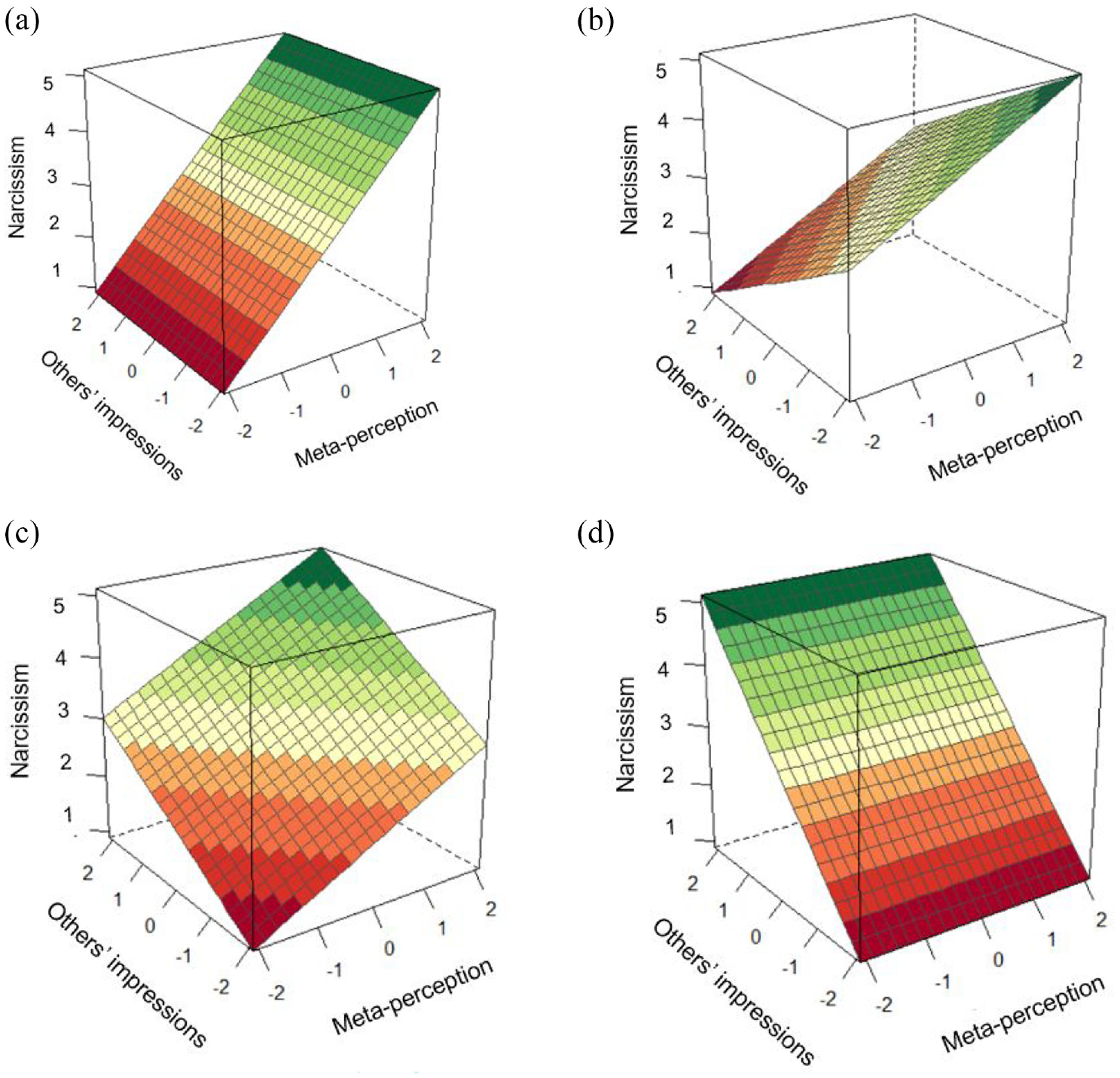
Hypothetical Regression Surfaces Corresponding to Different Patterns of Coefficients
Metaperception Hypothesis
Do people higher in narcissism tend to think they make good impressions? Given that people higher in narcissism can make good impressions, strong evidence for this hypothesis would be observed if, given two people who make the same impression, the person higher in narcissism assumes they make a better impression. In CRA, evidence for the metaperception hypothesis would be observed if metaperceptions are positively associated with narcissism (
Enhancement Hypothesis
Do people higher in narcissism think they make better impressions than they really do, above and beyond their general tendency to make and think that they make good impressions? That is, do people higher in narcissism tend to systematically enhance their metaperceptions? In CRA, evidence for the enhancement hypothesis is observed when: (a) Among people who make the same impression, people higher in narcissism think they make more positive impressions (
Notably, what sets this hypothesis apart from the metaperception hypothesis is that narcissism is associated with enhancement, not the main effects (metaperceptions and impressions). Consider the example of Nancy and Nate who are rated by others and guess how they are seen on likeability on a 1 to 7 scale.
1
Nancy enhances more than Nate because she thinks she is more likable than she really is (metaperception: 6, impression: 5, enhancement: 1) compared with Nate (metaperception: 6, impression: 6, enhancement: 0). If enhancement is related to narcissism, Nancy should be more narcissistic than Nate. Likewise, Noah, who makes and thinks he makes a less positive impression than Nancy and Nate, but still believes he made a more positive impression than he really did (metaperception: 4, impression: 3, enhancement: 1) should be as narcissistic as Nancy and more narcissistic than Nate. Thus, enhancement is observed above and beyond main effects if the discrepancy between metaperceptions and impressions
Joint-Effects Hypothesis
Perhaps people higher in narcissism make and believe they make desirable impressions, but their beliefs are neither systematically accurate nor biased. For example, Nancy (metaperception: 7, impression: 5), Niall (metaperception: 5, impression: 7), and Nia (metaperception 6, impression 6) make and think they make relatively good impressions, but all three have the same level of narcissism, even though Nancy is negatively biased, Niall is positively biased, and Nia is accurate. We call this possibility the joint-effects hypothesis; it is visualized in Supplemental Figure 1C and would be observed if
Reputation Hypothesis
While we assume people higher in narcissism will believe they make desirable impressions, it is possible that given two people who believe they make the same impression, narcissists tend to make especially good (or bad) impressions. For example, Nick and Naomi might both believe they are seen positively (metaperception: 5), but Nick, who scores higher on narcissism (6) than Naomi does (5), makes a better impression (5) than Naomi does (4). We call this pattern the reputation hypothesis; it is shown in Supplemental Figure 1D and would be observed if
Attribute Content, Facets of Narcissism, and Length of Acquaintanceship
These four patterns might depend on three factors. First, given that people higher in narcissism value social status (e.g., popularity) and agentic traits (e.g., intelligence; Campbell et al., 2002; Carlson, 2013), narcissists might be especially motivated to assume others see them positively for these attributes. However, because narcissists do not much value communal traits (e.g., agreeableness) and readily admit to being (and being seen as) lower on communal attributes (Carlson et al., 2011), narcissists might assume others see them more negatively on communal attributes. Thus, we explore a variety of attributes that are related to agency (i.e., intelligence, extraversion, conscientiousness), communion (i.e., agreeableness), and social status (i.e., liking and meta-liking, status, attractiveness) as well as the Big Five traits that do not fit into the agency/communion framework (i.e., neuroticism, openness).
Second, there are two paths through which narcissistic individuals maintain their positive self-views, namely, narcissistic admiration and rivalry (Back et al., 2013), which roughly correspond to other proposed facets of narcissism (i.e., grandiosity/leadership and entitlement, respectively; Raskin & Hall, 1979). For narcissistic admiration, this is accomplished through self-promotion, whereas for narcissistic rivalry, this is accomplished through other-derogation. Notably, the admiration path tends to be associated with positive outcomes (e.g., popularity, leadership) whereas the rivalry has a negative array of correlates (e.g., low popularity, rejection) (Back et al., 2013; Leckelt et al., 2019). Thus, admiration might be associated with positive metaperceptions and/or impressions whereas rivalry might be associated with a negative metaperceptions and/or impressions.
Third, the behavioral manifestations of narcissistic admiration, such as dominance, are especially noticeable in first impressions and tend to be received well initially (Back et al., 2013). However, over time, the antagonistic tendencies associated with rivalry become more apparent, and narcissists are often seen more negatively as time goes on (Back et al., 2013; Carlson et al., 2011; Leckelt et al., 2020). Thus, at low levels of acquaintanceship, we might see support for the metaperception and/or joint-effects hypotheses. Conversely, over time, narcissists might hold onto their initially positive metaperceptions while others’ impressions decrease, which might lead to narcissists overestimating how positively they are seen, in line with the enhancement hypothesis.
Research Overview
Recent work suggests that people higher in narcissism have systematically positive but systematically enhancing self-views, which begs the question of whether narcissism is really defined by enhancement. Here, we explore the possibility that narcissism is associated with enhanced metaperceptions given their use of the social arena for self-regulation. In four samples (total N = 1,537), we use CRA to explore four ways that narcissists’ metaperceptions might be related to the actual impressions they make, each of which has unique implications for narcissism. To provide a robust test, we explore different lengths of acquaintanceship (first impressions vs. close friends) and several attributes (agentic and communal traits, social status). Finally, given the strong overlap between self-perception and metaperception (Kenny & DePaulo, 1993), we control for self-views in secondary analyses (Supplement H) to isolate the unique role of metaperception in narcissism.
All analyses were exploratory and the samples used were collected with other research questions in mind. 2 Our data, R code, study materials, and supplemental analyses are openly available at https://osf.io/eqtxm/
Method
The institutional review boards at McGill University (Samples 1 and 2) and the University of Toronto (Samples 3 and 4) granted ethical approval for all study procedures (protocol #: Sample 1: 1781015, Sample 2: 3171217, Sample 3: 100832, Sample 4: 000714/000856).
Participants
Participants (final Ns: Sample 1 N = 858, Sample 2 N = 191, Sample 3 N = 227, Sample 4 N = 261) in all samples were undergraduate students at North American universities who were above the age of 18. Table 1 provides sample-specific demographic information. In Samples 1 and 2, we excluded dyadic interactions of those who reported knowing each other (exclusions from Sample 1: ndyads = 268, Sample 2: ndyads = 13). In Sample 4, participants with at least two non-parent informant-reports were retained (nexcluded =134).
Overview of the Samples
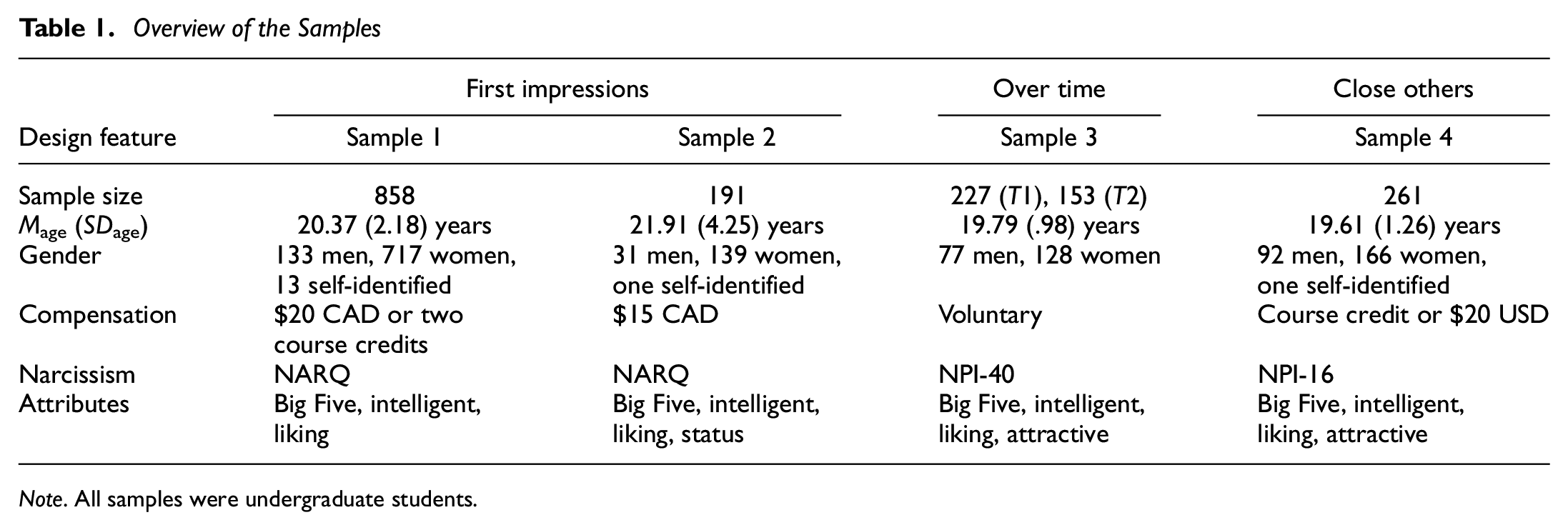
Note. All samples were undergraduate students.
To examine the power achieved by the present sample, we followed the method used by Mielke et al. (2021) by conducting a simulation study (see https://osf.io/eqtxm/ for R code). Our samples were well-powered to find moderate effects (R2 = .10; Sample 1: 99% power, Sample 2: 90% power, Sample 3: 99% power, Sample 4: 99% power). 3
Procedures
In the first impression samples (Samples 1 and 2), participants came into the lab in groups of four to eight (Sample 1 Ngroups = 134, Sample 2 Ngroups = 39) and reported their personality traits. In Sample 1, participants then engaged in short (2–3 minutes) dyadic conversations with each group member (i.e., a round-robin design), and in Sample 2, participants engaged in a series of group-based activities (e.g., Public Goods Game, Man on the Moon Task). Following each conversation (Sample 1) or activity (Sample 2), participants provided their impressions and metaperceptions of their partner (Sample 1) or group (Sample 2). At the end of the sessions, participants provided ratings of their narcissism, among other measures. For Sample 2, we use the final round of ratings because, by that point, participants would have acquired more information on which to base their impressions and metaperceptions.
In the overtime sample (Sample 3), 4 participants in two sections of a personality course completed the study as part of a class. During the first week, participants were instructed to form groups of 3 to 5 with people they did not know. Several times throughout the semester, participants met in their groups to engage in a structured discussion about a topic they were given. After each discussion, participants provided their impressions and metaperceptions of their group members. We use ratings from their first (T1; N = 227) and last (T2; N = 153; T2) meetings.
In the close-other sample (Sample 4), participants from two waves of data first completed a background survey, which included the narcissism measure. Then, participants engaged in a brief (5 minutes), unstructured interaction with a new acquaintance. Participants also provided contact information for three people who knew them well and provided their metaperceptions of each nominated informant. Informants later rated the targets on the attributes outlined in Table 2. In the current work, we use only data for informants. On average, participants knew their informants for 4.7 years and 3.3 months, and they were reasonably close (5.9 on a 1 [not at all] to 7 [extremely] scale).
Descriptive Statistics of Primary Measures
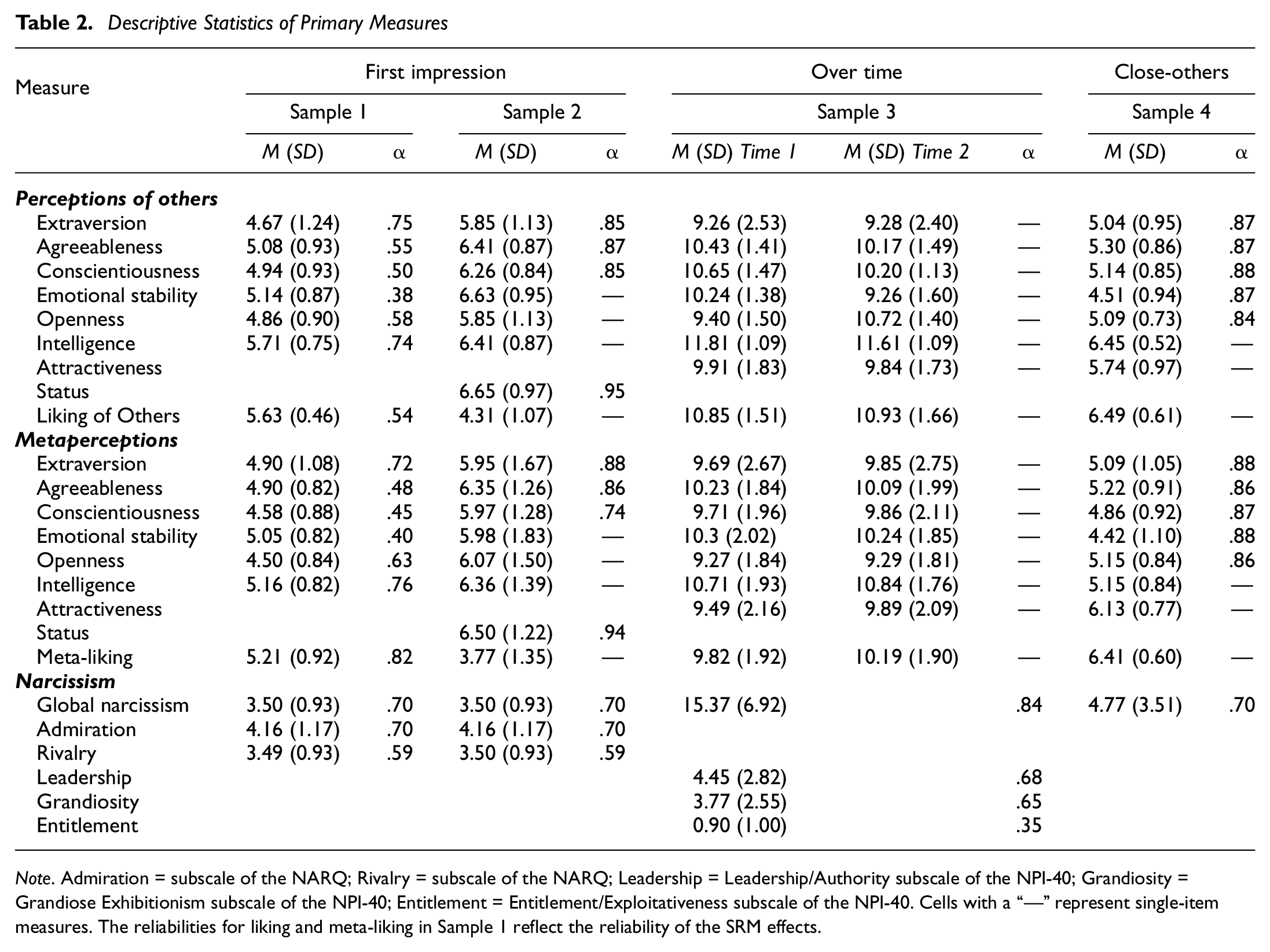
Note. Admiration = subscale of the NARQ; Rivalry = subscale of the NARQ; Leadership = Leadership/Authority subscale of the NPI-40; Grandiosity = Grandiose Exhibitionism subscale of the NPI-40; Entitlement = Entitlement/Exploitativeness subscale of the NPI-40. Cells with a “—” represent single-item measures. The reliabilities for liking and meta-liking in Sample 1 reflect the reliability of the SRM effects.
Measures
See Table 2 for descriptive statistics of all primary measures across samples, and Supplement A for a list of the specific items in each sample.
Attribute Ratings
Participants provided their metaperceptions and impressions of several attributes (Table 2). In all samples, liking and meta-liking were rated dyadically: “I like this person” and “I think this person likes me” on 1 (strongly disagree) to 7 (strongly agree) Likert-type scale.
In Sample 1, self-perceptions of the Big Five were measured with the 44-item Big Five Inventory (BFI; John & Srivastava, 1999). Metaperceptions and impressions of the Big Five were rated with 10 items from the BFI-44 (see Supplemental Table A1 for specific items). Intelligence was measured with two items: “is intelligent” and “is bright.” All items were rated on a 1 (strongly disagree) to 7 (strongly agree) Likert-type scale.
In Sample 2, self-perceptions, metaperceptions, and impressions of Big Five traits were measured with one to four trait adjectives (e.g., outgoing, sociable, and dominant for extraversion; see Supplemental Table A1 for specific items), and intelligence was measured with one item; these items were all rated on 9-point bipolar scales (e.g., unintelligent–intelligent). Status was measured as a composite of five items (respected, status, influence, popular, liked by the group) which were measured on a 1 (not at all) to 9 (extremely) scale. Metaperceptions in this sample were made at the group level (e.g., “The group sees me as someone who is . . .”).
In Sample 3, all perceptions of the Big Five were measured using the Ten-Item Personality Inventory (TIPI; Gosling et al., 2003) on a 1 (disagree strongly) to 15 (agree strongly) scale. Physical attractiveness was measured with one item (“This person is/This person sees me as physically attractive”) on the same 15-point scale.
In Sample 4, self-perceptions, metaperceptions, and impressions of the Big Five were measured with the BFI-44 (John & Srivastava, 1999) using a 1 (strongly disagree) to 7 (strongly agree) scale. Attractiveness was measured using the same item as in Sample 3 but was rated on a 7-point scale.
Narcissism
In Samples 1 and 2, global narcissism and its facets (i.e., narcissistic admiration and narcissistic rivalry) were measured via the six-item Narcissistic Admiration and Rivalry Questionnaire (NARQ; Back et al., 2013). Scores for the NARQ were obtained by taking the average of the relevant items.
Sample 3 included the 40-item Narcissistic Personality Inventory (NPI; Raskin & Hall, 1979); we computed narcissism scores for global narcissism and for the three subscales outlined by Ackerman et al. (2011): Leadership/Authority (LA), Grandiose Exhibitionism (GE), and Entitlement/Exploitativeness (EE). In this framework, LA and GE most align with elements of admiration whereas EE approximates rivalry (Back et al., 2013). In Sample 4, the 16-item NPI was used, which is unidimensional, so that, we only computed global narcissism scores. Scores for the NPI were computed as sum scores.
Analyses
All analyses were conducted using R version 4.2.1 (R Core Team, 2022). In Samples 1, 2, and 3, we first ensured that there was sufficient target variance in others’ impressions (i.e., consensus on how people were viewed by group members) and sufficient perceiver variance in metaperceptions (i.e., a general assumption about how group members viewed the self). To accomplish this, we used the Social Relations Model (SRM; Kenny, 1994) analyses using the TripleR package (Schönbrodt et al., 2012). We exported the target effects of impressions and the perceiver effects of metaperceptions for each participant on each attribute. Notably, target and perceiver effects are group-mean-centered, and therefore, account for group-specific dynamics and idiosyncrasies.
To test our main hypotheses, we employed a two-step CRA (Humberg et al., 2018) using the lavaan R package (Version 0.6-11; Rosseel, 2012). Following Humberg et al. (2018), all variables were standardized prior to analysis. In the first step, predicted a participant’s level of narcissism from their general belief about how others viewed them (c1) and their reputation (c2) on some trait. Note that we ran separate models using total narcissism scores and subscale scores as the dependent variable.
To test the enhancement hypothesis, in the second step, we used these regression coefficient estimates to calculate the following parameters: (c1–c2), which represents the discrepancy in judgments, (c1+c2), which represents the joint effect of judgments, and abs:=–c1–c2|—|c1+c2,| which represents whether the discrepancy outweighs the main effects. Evidence for the enhancement hypothesis would be observed if abs > 0 and (c1–c2) > 0. Evidence for the metaperception hypothesis would be observed if the c1 only is significant (i.e., c2 and abs are not significant) while evidence for the reputation hypothesis would be observed if the c2 only is significant (i.e., c1 and abs are not significant). Evidence for the joint-effects hypothesis would be observed if c1 and c2 are in the same direction and significant as well as the c1 +c2 effect (Humberg et al., 2018).
Because we are conducting many tests, we focus on the effects that remained significant after applying a False Discovery Rate (FDR; Benjamini & Hochberg, 1995) correction. The FDR correction has been suggested as an alternative to the Bonferroni correction as the latter is often overly conservative (Chen et al., 2017). For completeness, we present the uncorrected p-values at .05, .01, and .001 thresholds in all tables in both the article and the Supplemental Materials.
Results
All coefficients from the CRA analyses and their 95% confidence intervals appear in Tables 2–5. Effects that remained significant after a FDR correction at p < .05 are presented in bold. The final column in each of these tables summarizes which of the hypotheses was supported. To focus our interpretations, we present the c1, c2, and abs coefficients in the article; CRA plots for these analyses are provided in Supplement F and the results for global narcissism for Samples 1 to 3 are presented in Supplement G.
Overall, we did not find evidence for enhancement, suggesting people higher in narcissism did not systematically overestimate the impressions they made on others. There was weak evidence for the reputation hypothesis (i.e., a few effects observed in Sample 3), suggesting that people higher in narcissism generally did not make systematically more positive or negative impressions. Finally, there was no evidence that people higher in narcissism made and thought they made more positive impressions (i.e., joint effect).
Instead, the metaperception hypothesis garnered the most support, but notably, the direction and the strength of this evidence depended on the facet under examination. With respect to the admiration subscale of the NARQ and the leadership and grandiosity subscales of the NPI, people higher in these facets tended to think they were seen as more emotionally stable (Sample 1), extraverted, open, intelligent (Samples 1 and 2), attractive (Sample 3, Time 1), higher in social status (Sample 2), and that they were liked more (Samples 1, 2, and Time 1 for Sample 3). Put differently, given two people who made similar impressions, people higher in narcissistic admiration, leadership, and grandiosity thought they were seen more positively, especially on agentic attributes.
For the rivalry subscale of the NARQ and the entitlement subscale of the NPI, there were fewer effects for metaperception and the associations were generally negative. People higher in these facets believed they were seen as less agreeable (Sample 1; Sample 3, Time 2), as well as less conscientious and less emotionally stable (Sample 1). Taken together, these findings underscore the importance of considering the facets of narcissism in addition to global narcissism scores.
Notably, however, these patterns were especially apparent in first impressions (Tables 3 and 4) but were relatively less apparent over time (Table 5). In the close-others context, which had only a measure of global narcissism but not its facets, we found that narcissists believed their close-others saw them as extraverted, agreeable, and attractive (Table 6), consistent with the metaperception hypothesis.
Summary of CRA Results for Narcissistic Admiration and Rivalry Facets in Sample 1 (First Impression)
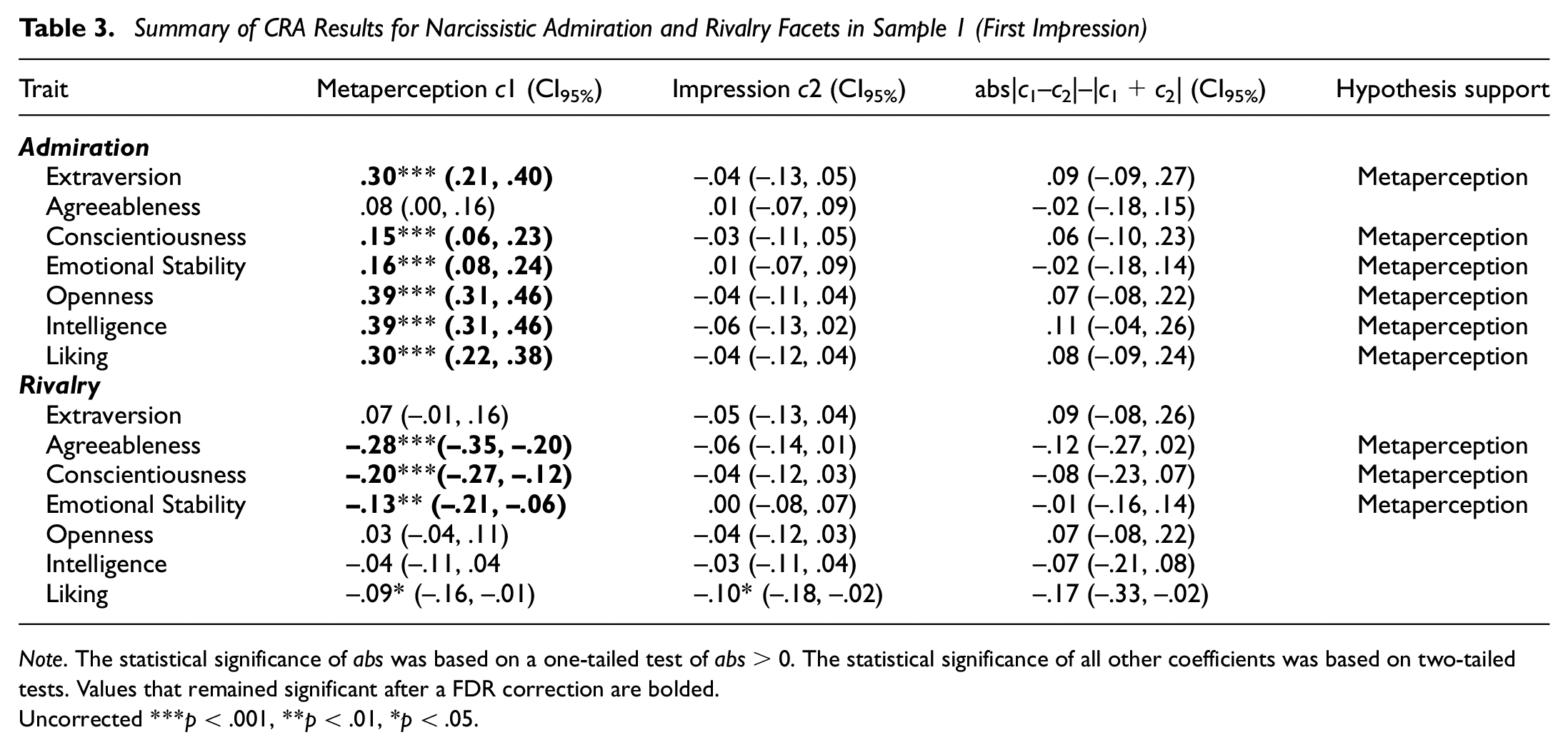
Note. The statistical significance of abs was based on a one-tailed test of abs > 0. The statistical significance of all other coefficients was based on two-tailed tests. Values that remained significant after a FDR correction are bolded.
Uncorrected ***p < .001, **p < .01, *p < .05.
Summary of CRA Results for Narcissistic Admiration and Rivalry Facets in Sample 2 (First Impression)
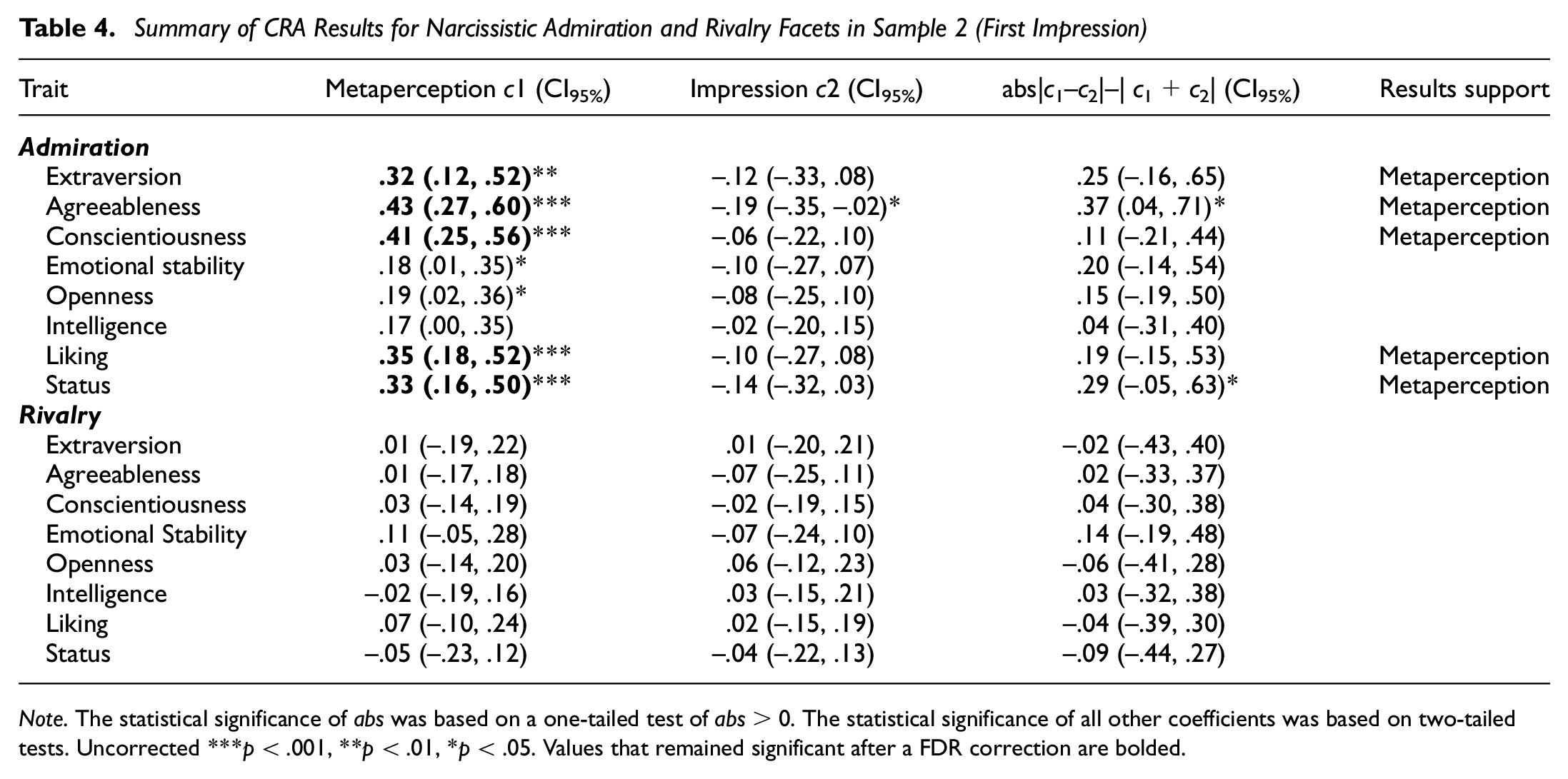
Note. The statistical significance of abs was based on a one-tailed test of abs > 0. The statistical significance of all other coefficients was based on two-tailed tests. Uncorrected ***p < .001, **p < .01, *p < .05. Values that remained significant after a FDR correction are bolded.
Summary of CRA Results for the NPI Facets in Sample 3 (Over Time)
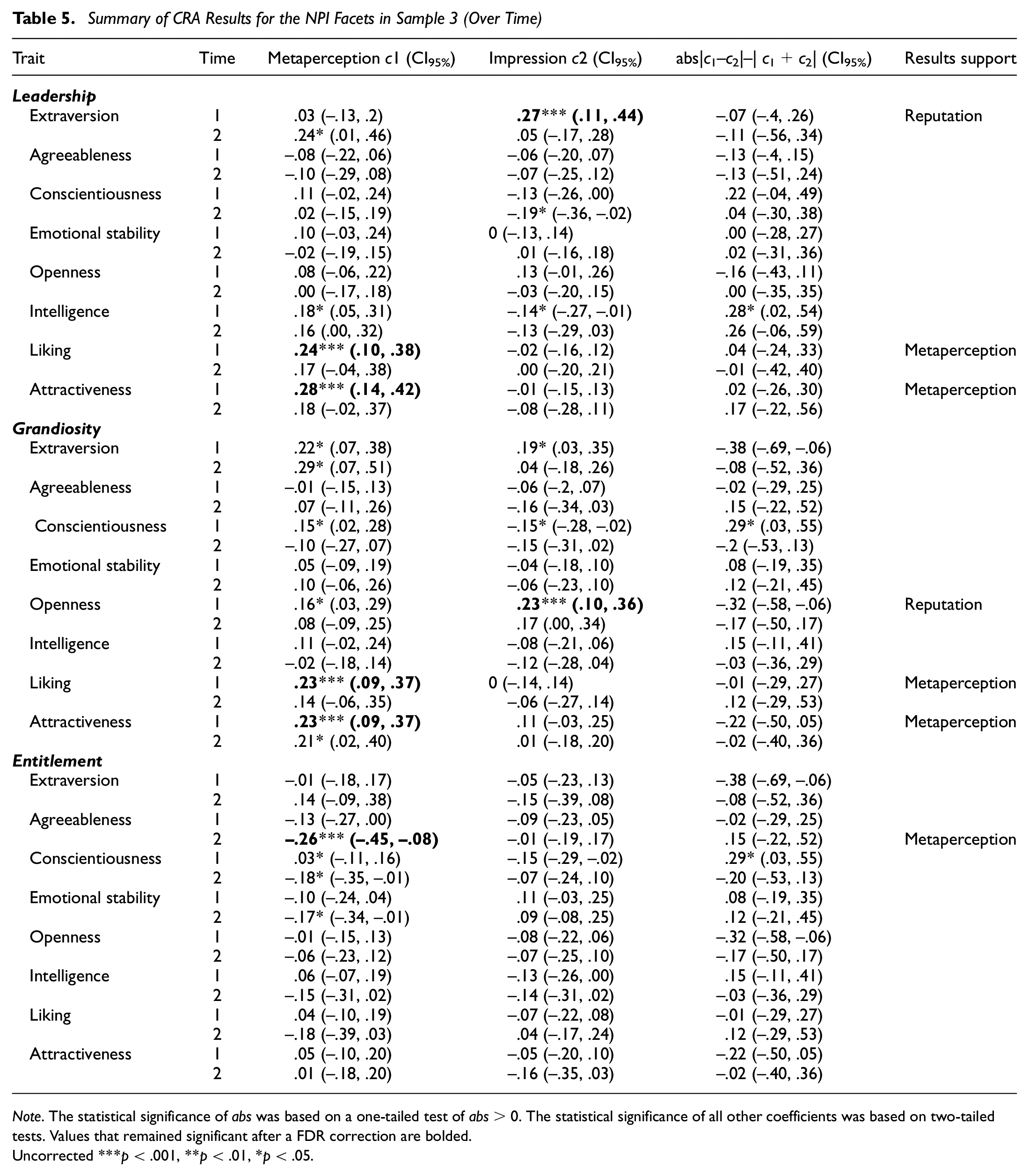
Note. The statistical significance of abs was based on a one-tailed test of abs > 0. The statistical significance of all other coefficients was based on two-tailed tests. Values that remained significant after a FDR correction are bolded.
Uncorrected ***p < .001, **p < .01, *p < .05.
Summary of CRA Results for Global Narcissism in Sample 4 (Close-Others)
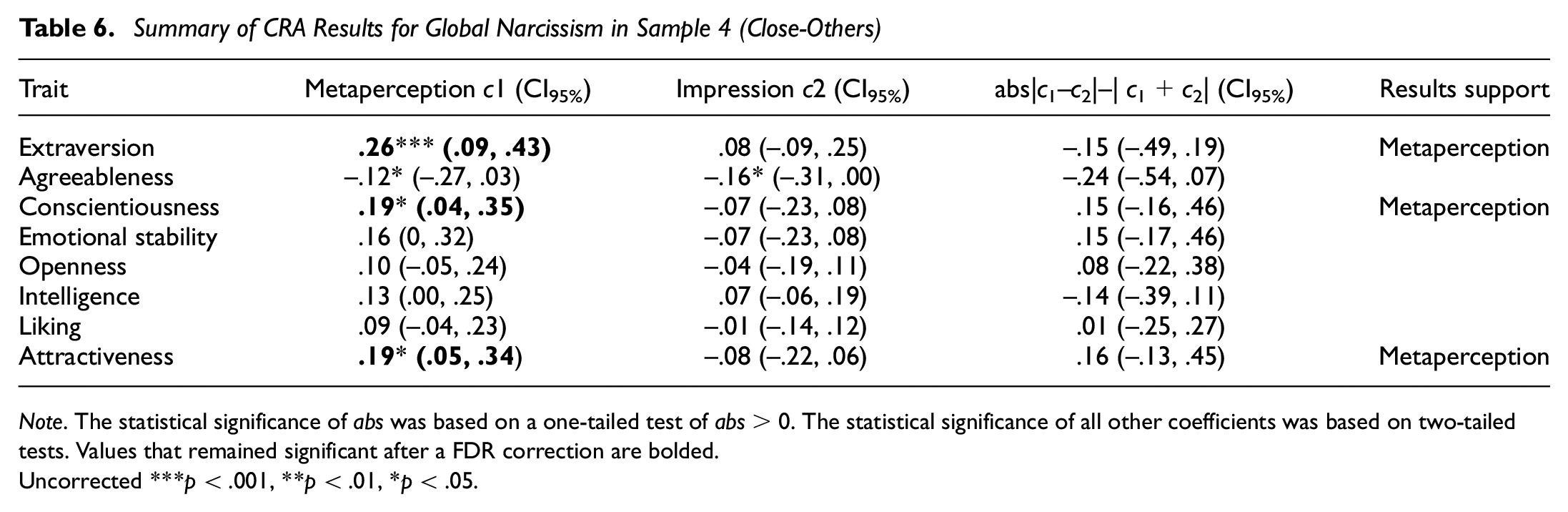
Note. The statistical significance of abs was based on a one-tailed test of abs > 0. The statistical significance of all other coefficients was based on two-tailed tests. Values that remained significant after a FDR correction are bolded.
Uncorrected ***p < .001, **p < .01, *p < .05.
Given that self- and metaperceptions tend to be highly correlated (see Supplement C), were these effects driven by self-perception (e.g., people higher in admiration expect to be seen positively because they see themselves positively)? As shown in Supplement H, metaperceptions and self-perception in first impressions (Samples 1 and 2) play unique roles in narcissism whereas in the over-time and close-others contexts (Samples 3 and 4, respectively), all metaperception effects were explained by self-perceptions. Overall, then, metaperceptions seem to play a unique role in narcissism at low levels of acquaintanceship.
Discussion
In four samples, we found no support for the notion that people higher in narcissism think they make better impressions than they really do. Instead, we found that people higher in the admiration (NARQ), leadership, and grandiosity (NPI) facets tended to believe they were seen positively, mainly for agentic attributes (e.g., extraversion, status), whereas the rivalry (NARQ) and entitlement (NPI) facets were associated with a few negative metaperceptions, mainly for communal attributes (e.g., agreeableness). Overall, regardless of how they were actually seen by others, people higher in narcissism tended to believe they were seen in ways that reflect narcissistic values—that is, highly agentic and socially successful yet not especially communal. That people higher in narcissism tended to assume they were seen positively aligns with existing theories of narcissism, which conceive of grandiosity as involving inflated self-views, though our findings add nuance to these theories by suggesting that narcissists are not systematically biased per se (i.e., we did not find evidence of enhancement). This may be because sometimes they are indeed seen positively, and other times they are not. Or, it could be that some narcissists are seen positively and others are not. Regardless, the mere fact that narcissists assumed they were seen positively is possibly a regulatory strategy in and of itself to feel good about themselves.
Notably, the robustness of the link between narcissism and metaperception weakened as acquaintanceship increased from a first impression (Samples 1, 2 and Time 1 of Sample 3) to acquainted (Time 2 of Sample 3) and close-other contexts (Sample 4). Furthermore, the few observed links between narcissism and metaperception among acquainted and close-others were largely explained by self-perceptions. Thus, to the extent that narcissists’ metaperceptions support, or are driven by, grandiosity, their role seems to wane over time. Interestingly, though, these results were not entirely explained by self-perceptions either. We tested the possibility that people higher in narcissism simply used their self-views to form especially positive or negative metaperceptions, yet our results suggest that metaperceptions play a unique role in narcissistic admiration beyond self-perceptions, especially at low levels of acquaintanceship. Taken together, it seems that the unique effect of metaperceptions might diminish over time and with higher levels of acquaintanceship. To better understand the role of metaperception in early acquaintanceship, future work might explore the sources of metaperceptions. For example, given that narcissists are often seen positively in early acquaintanceship, it is possible that they experience more positive emotions when meeting new people, which in turn could affect the valance of their metaperceptions, especially for attributes that they deem socially important. Over time, however, self-views might become a more salient source (vs. emotional experience) from which to infer how they are seen.
Notably, unlike past work, we did not find that people higher in narcissism made a particular impression, either systematically positive or negative, both before and after controlling for metaperceptions (see Supplement D). Yet, past work has shown that people higher in narcissism make more negative impressions on some traits (Leckelt et al., 2015). This discrepancy might have occurred because the contexts in our samples were low-stakes, which offered fewer opportunities for narcissistic behavior to occur. Indeed, past work has sometimes structured group discussions to evoke disagreements between group members (e.g., Back et al., 2013) which could make narcissistic behavior clearer. Future work might therefore benefit from using larger samples (if the effect is in fact small) and more specific and/or extreme situations (e.g., a competitive context, a debate) to elicit stronger impressions. Nevertheless, our results suggest that at least in relatively naturalistic, neutral settings, narcissists are not systematically biased about the impressions they think they make.
We note the following limitations of our work. First, although the relatively large sample sizes and heterogeneity in the designs across samples allowed us to more robustly test whether narcissists’ metaperceptions are biased in different contexts, these samples were composed largely of female undergraduate students in a nonclinical setting. Given some work suggesting that women tend to be lower in the antagonistic features of narcissism (Grijalva et al., 2015), these results may be less generalizable to samples with a more balanced (or predominantly male) gender composition. Likewise, although our use of nonclinical samples and measures are useful for understanding how people with less extreme levels of narcissism view their reputation, this approach leaves room for future work to examine these questions using a clinical sample where people with clinical levels of narcissism might make especially negative impressions. Furthermore, our measures and designs were not perfect replications (e.g., we used different narcissism measures and had only one longitudinal design). As such, it is important to replicate these effects.
Second, our measures and level of acquaintanceship varied among samples. In addition, the rivalry and entitlement subscales often had lower reliability and were somewhat skewed, which might have contributed to the weaker effects that we observed. We have interpreted the pattern of results observed across the samples in the current work as suggesting that the link between narcissism and metaperception changes over time, but it would be worthwhile to replicate our findings using the same measures across contexts (unacquainted individuals, new acquaintances, close-others; both in dyads and in groups).
Conclusion
In sum, we tested whether narcissists’ beliefs about how they are seen are overly positive and we found no evidence of enhancement: although narcissists believe that they are seen positively, their metaperceptions are not systematically biased. Furthermore, the ways in which metaperceptions are related to narcissism depended on the facet of narcissism.
Supplemental Material
sj-docx-1-spp-10.1177_19485506241263636 – Supplemental material for Do Narcissists Think They Make a Better Impression Than They Really Do? Re-Evaluating Enhancement as a Dominant Feature of Narcissism
Supplemental material, sj-docx-1-spp-10.1177_19485506241263636 for Do Narcissists Think They Make a Better Impression Than They Really Do? Re-Evaluating Enhancement as a Dominant Feature of Narcissism by Victoria Pringle, Hasagani Tissera, Norhan Elsaadawy, Erika Carlson and Lauren Human in Social Psychological and Personality Science
Footnotes
Handling Editor: Rodica Damian
Author Contributions
Declaration of Conflicting Interests
The author(s) declared no potential conflicts of interest with respect to the research, authorship, and/or publication of this article.
Funding
The author(s) disclosed receipt of the following financial support for the research, authorship, and/or publication of this article: This research was supported in part by funding from the Templeton Foundation’s Moral Beacon Grant awarded to Erika N. Carlson, Lauren J. Human, and Matthew Feinberg, and two grants provided by the Social Sciences and Humanities Research Council (SSHRC) of Canada (awarded to Lauren Human, grant 435-2016-0499, and to Erika Carlson, grant 435-150611).

Data Availability
Supplemental Material
The supplemental material is available in the online version of the article.
Notes
Author Biographies
References
Supplementary Material
Please find the following supplemental material available below.
For Open Access articles published under a Creative Commons License, all supplemental material carries the same license as the article it is associated with.
For non-Open Access articles published, all supplemental material carries a non-exclusive license, and permission requests for re-use of supplemental material or any part of supplemental material shall be sent directly to the copyright owner as specified in the copyright notice associated with the article.
