




Abstract
We investigate whether the social cure properties of groups vary across cultures, testing hypotheses that the associations between multiple group memberships (MGM) and depressive symptoms will (a) be mediated by social support and uncomfortable normative pressures, and (b) vary systematically with sample-level relational mobility. Analyses of data from a survey (N = 5,174) conducted within k = 29 samples show that MGM is negatively associated with depressive symptoms, an association fully mediated by social support and uncomfortable normative pressures. In line with our theorizing, in samples with higher levels of relational mobility constraints, the association between MGM and depressive symptoms is weaker, the associations between MGM and social support and between MGM and normative pressures are stronger, and the association between social support and depressive symptoms weaker. The indirect link between MGM and depressive symptoms via social support is significant at both low and high levels of relational mobility constraints.
Research investigating the social cure properties of groups has shown convincingly that group memberships are good for you. Being a member of a greater number of positive and subjectively important group memberships is robustly and causally related to positive health and well-being outcomes, including reduced depressive symptoms (C. Haslam et al., 2016, 2019; Cruwys et al., 2014; Steffens et al., 2016). However, almost all the research documenting the social cure has been conducted in Western Europe, the United States, or Australia. The few investigations outside of these areas tend to find weaker or non-existent associations between multiple group memberships (MGM) and health and well-being outcomes (Chang et al., 2016; Lam et al., 2018).
We argue that these findings could reflect differences across cultures in how individuals and groups relate to each other. It is only in some societies—typically labeled as individualistic but better described as those with high levels of relational mobility (Smith & Easterbrook, 2017; Thomson et al., 2018)—that individuals can choose to enter or leave groups based on whether the groups provide nourishing social identities and thus act as strong social cures. That is, in relationally mobile societies, individuals can decide which groups to be members of according to whether the group offers them a positive social identity and social connections, and thus benefits their psychological health. In other societies—those often labeled as collectivistic but better described as having low levels of relational mobility—individuals cannot simply leave unsatisfying groups because group boundaries tend to be less permeable. In these societies, social behaviors are dictated, molded, and coordinated by the demands that strong group norms and impermeable boundaries place on individuals, meaning that the benefits of groups are tempered by costs, reducing the social cure properties of groups. These are extreme exemplars and we expect most societies will fall somewhere between the two. We test these predictions with new data collected from 29 societies.
The Psychological Function of Groups in Different Cultures
Research from Western Europe, Australia, and the United States suggests that one key function of groups is to provide psychological benefits to their members. Groups can furnish individuals with a positively distinct social identity if the group’s status compares favorably in intergroup comparisons to relevant outgroups (Tajfel & Turner, 1979). Research demonstrates that such groups are strongly identified with (Easterbrook & Vignoles, 2012; Thomson et al., 2018), elicit intergroup bias (Verkuyten & Reijerse, 2008), satisfy psychological needs (Greenaway et al., 2016; Kyprianides, Easterbrook, & Brown, 2019), and foster a sense of psychological connection between group members that forms the foundations for giving and receiving social support (S. A. Haslam et al., 2005; Junker et al., 2019; Steffens et al., 2016). Through these processes, groups can support and enhance psychological health and well-being (Greenaway et al., 2016; S. A. Haslam et al., 2012; Kyprianides, Easterbrook, & Brown, 2019; Steffens et al., 2019).
Yet, in these societies, the psychological benefits associated with groups depend heavily on contextually relevant intergroup comparisons, such that only high-status groups seem to offer psychological health benefits. Low-status groups, in contrast, tend to be sources of stigma and discrimination and can corrode health and well-being (Kyprianides, Easterbrook, & Cruwys, 2019; Schmitt et al., 2014). If possible, individuals tend to discard low-status groups for higher-status groups through upward individual mobility (Ellemers, 1993; Mummendey et al., 1999; Verkuyten & Reijerse, 2008). This is possible because group boundaries tend to be highly permeable and overlapping in these societies, so that social identities are highly fluid (Smith & Easterbrook, 2017; Turner et al., 1987). The groups that people in these societies identify with are likely, therefore, to be those that people choose to be members of because of the psychological rewards they offer.
Indeed, correlational (C. Haslam et al., 2016; Steffens et al., 2016), experimental (Greenaway et al., 2016; Kyprianides, Easterbrook, & Brown, 2019), and intervention (C. Haslam et al., 2016, 2019) research conducted in Western Europe, the United States, and Australia have shown that being a member of a greater number of positive and subjectively important groups is robustly and causally associated with positive health and well-being outcomes, including reduced depressive symptoms (Cruwys et al., 2014; Steffens et al., 2019). In these societies, groups are perhaps best understood as resources that members can utilize to improve well-being (Jones & Jetten, 2010).
Given the importance of group memberships, relationship harmony, and in-group loyalty within some East Asian collectivist cultures, one might expect the social identity approach and the social cure phenomenon to be more applicable and thus groups to be more psychologically beneficial in East Asian collectivistic cultures rather than more individualistic western cultures. However, this does not appear to be the case.
Individuals in East Asian collectivistic cultures tend to be embedded within a small and fixed number of highly entitative groups with impermeable boundaries (Triandis, 1989, 1995). Impermeable group boundaries mean that individuals cannot simply leave a low status group for a higher status one in the quest for a positively distinct social identity (Markus & Kitayama, 1991), rendering the motive for positive distinctiveness less relevant to group processes. Indeed, groups demand loyalty, even when they perform poorly and thus could reflect badly on the individual members. A study by Chen and colleagues (1998) illustrates this well. They assessed in- and out-group evaluations after manipulating both individual and in-group success or failure on a task. They found that U.S. respondents evaluated their in-group much more negatively than Chinese respondents after they were told that they had succeeded as an individual but that their in-group had failed, a finding that reflects the motivation among U.S. participants to leave their poorly performing group. In contrast, Chinese respondents maintained their positive in-group evaluations under these conditions.
Indeed, the drive to achieve positively distinctive social identities does not seem to be strong or as widely applicable in some East Asian cultures. In a study of Chinese and British Hongkongers during the British handover of Hong Kong to China, Bond and Hewstone (1988) found that Chinese Hongkongers identified more strongly with their in-group than did British Hongkongers, but that they also showed much less intergroup differentiation, perceiving greater similarity between themselves and the out-group, and were more friendly toward the out-group. This suggests that groups are important to the identities of members of some East Asian cultures, but that intergroup comparisons and the motive for positive distinctiveness, a core premise of social identity theory (Tajfel & Turner, 1979), may not be as powerful (Yamagishi et al., 1998; Yuki & Takemura, 2014). Indeed, Yamagishi et al. (2008) found lower levels of in-group bias toward artificial groups among Japanese than New Zealanders, suggesting that the motive for positive distinctiveness is not activated by group memberships as strongly nor as widely in some East Asian cultures as it is in more individualistic cultures (see also Heine & Lehman, 1997). This is not to say that ingroup bias or prejudice will be weaker in some East Asian cultures. Indeed, evidence suggests the opposite is the case (Fischer & Derham, 2016) because impermeable group boundaries mean that outgroup members are psychologically distant, irrelevant, and of little value (Markus & Kitayama, 1991). However, there does appear to be less of a motivation among those from some East Asian cultures to positively distinguish their group’s social identity from relevant outgroups.’
Instead, groups in some East Asian cultures seem to dictate reciprocal social behaviors among their members (Yamagishi et al., 1998; Yuki & Takemura, 2014). One study, for example, found that, while group status predicted group identification and loyalty among U.S. respondents, these relationships did not exist among Japanese respondents (Yuki, 2003). Instead, group loyalty was predicted by interpersonal knowledge of the intragroup relational structure among Japanese respondents; groups were valued to the extent that the group members knew each other and were embedded within a web of interpersonal networks through which roles were enacted and duties reciprocated (Markus & Kitayama, 1991; Schwartz, 1990; Yuki, 2003; Yuki & Takemura, 2014).
In these cultures, resources and support are given within groups, but they are not received for free; reciprocity and adherence to group norms are expected, even if they go against individual motivations and desires (Bond & Smith, 1996; Kim et al., 2006, 2008; Taylor et al., 2004). Thus, strong norms and impermeable boundaries may mean that individuals may be pressured to engage in behaviors that they would rather not do, and, although social support is bounded within groups, it can be less attractive and beneficial because it is associated with costs as well as potential benefits (Chang et al., 2016; Kim et al., 2008).
This reasoning suggests that multiple group memberships will be associated with psychological benefits within cultures typically described as individualistic (Western Europe, the United States, and Australia), whereas this association will be weaker within cultures typically described as collectivistic. This may be accounted for by differences in the beneficial effects of social support, and the normative pressures groups exert on their members. Indeed, the few investigations into the social cure properties of groups that include cultures outside of Western Europe, the United States, or Australia tend to support this premise (Chang et al., 2016; Lam et al., 2018). One paper reported that the association between group memberships and well-being was absent among Asians in Australia and students in Singapore, and suggested that this was because of the reluctance of participants to enlist social support because of the demands of reciprocity (Chang et al., 2016). Another (Lam et al., 2018) found that, while the associations between multiple group memberships and subjective health and well-being were positive and significant for retirees across cultures, the associations were weaker in collectivist cultures, although this study did not investigate differences in social support or normative pressures as possible explanations for these differences.
Relational Mobility
We argue that the societal-level socioecological variable of relational mobility is most relevant and likely to explain the variation in the social cure properties of groups across societies. Relational mobility is defined as the amount of “freedom and opportunity a society affords individuals to choose and dispose of interpersonal relationships based on personal preference” (Thomson et al., 2018, p. 7,521). Although relational mobility has been studied mainly in relation to interpersonal relationships (Kito et al., 2017), its measurement and underlying theory refers also to groups. It is positively correlated with individualism (Thomson et al., 2018), and societies with high levels of relational mobility include western, typically individualistic cultures such as the US, Germany, and Australia, whereas those with low levels of relational mobility include many East Asian, more collectivistic cultures such as China and Japan. Yet, relational mobility is more closely aligned than individualism-collectivism with our above theorizing and so we suggest that it captures an aspect of cultural orientation that is most relevant to understanding variation in the social cure properties of groups.
Empirical investigations have supported the claim that relational mobility is determined in part by the dominant subsistence style within a society (Thomson et al., 2018). Herders tend to move location frequently, meaning that there are few opportunities to develop long-lasting and strong bonds or groups, leading to societies with high levels of relational mobility. Individuals that stay together or form a group are likely to do so only if the group provides a net psychological benefit to the individual members. Rice paddy farming, in contrast, requires mass cooperation between individuals and ties them to one geographical location, leading to long-term relationships and necessitating continuous cooperation between individuals within a group. This leads to low relational mobility societies. Individuals cannot leave their group for fear of forfeiting their subsistence and so must stay within the group even if it is not psychologically beneficial.
It follows from these descriptions that the level of relational mobility within a society is likely to be related to the psychological benefits groups offer. In high relational mobility societies, groups can be easily left or joined and so individuals seek out groups that are psychologically beneficial and leave groups that are not. Groups that offer psychological benefits are worth fighting for, while those that do not can be ditched. In line with this theorizing, individuals in societies with high levels of relational mobility seem to be more psychologically invested in their relationships and groups: societal-level measures of relational mobility are positively associated with measures of trust and self-disclosure within personal relationships (Schug et al., 2010; Thomson et al., 2018).
In low relational mobility societies, impermeable group boundaries mean that individuals cannot simply leave a low status group for a higher status one in the quest for a positively distinct social identity or to be free from uncomfortable normative pressures (Markus & Kitayama, 1991). Indeed, the motive to positively distinguish one’s group from relevant outgroups is weaker in these societies. Instead, groups provide strong norms that dictate reciprocal social behaviors and designate the boundaries within which social support is given and received. Yet, the costs associated with reciprocity and the enforced norms mean that groups are not necessarily beneficial to psychological health in these societies. Group memberships, then, are likely to be more beneficial for psychological functioning in societies with high levels of relational mobility, even though social behavior is more strongly dictated by group memberships in societies with low levels of relational mobility.
Relational mobility, we argue, will thus determine the benefits of social support. Although social support is mainly given and received within groups, we suggest that, in low relational mobility societies, receiving social support is not only beneficial but also encompasses a duty to reciprocate and thus a recognition that giving social support not only helps the recipient but also puts pressure on them to return the deed, which may not always be welcome and entirely beneficial (Kim et al., 2008). Thus, while social support is likely to be given and received within groups to a greater degree in societies with low relational mobility—because groups rigidly structure social relations and require reciprocity—there may be fewer benefits associated with social support.
Similarly, because individuals cannot leave groups with strong norms that may enforce behaviors that individuals would not otherwise choose to do, we expect multiple group memberships to be associated with stronger normative pressures in societies with low levels of relational mobility.
This theorizing informs our formal hypotheses:
Method
Participants
A total of 5,174 participants from 24 countries took part in the study. In five countries, data were collected from regions with known cultural differences, so these samples were further separated according to the location of data collection, resulting in a dataset with k = 29 samples. Sample size was maximized as much as possible according to the resources available. Sample sizes were finalized by (a) excluding respondents who were not nationals of the nation sampled; (b) excluding respondents who failed tests of careless responding (overall average 11% per sample). This yielded an average of n = 178 participants per sample (see Table 1).
Details of Samples
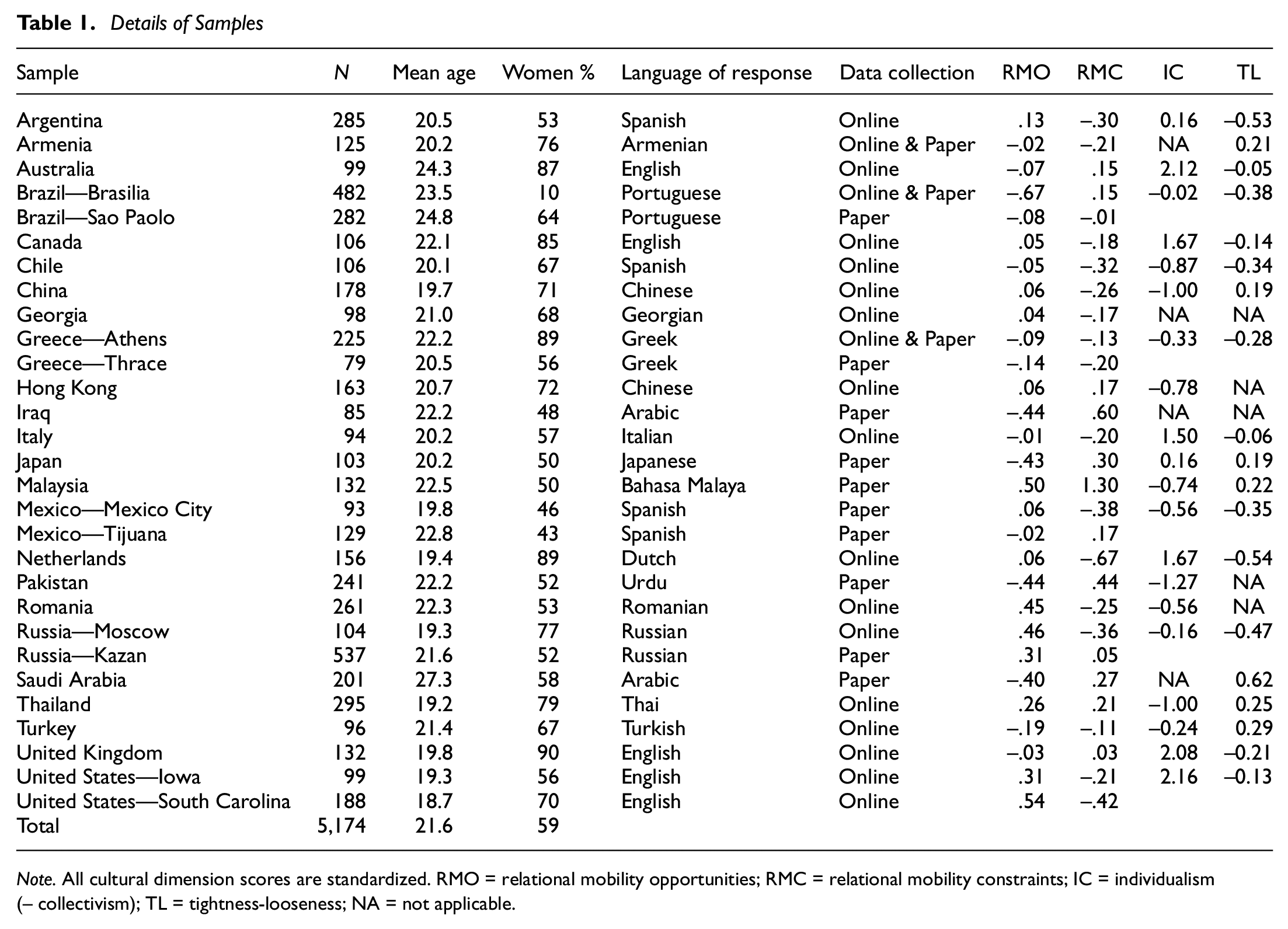
Note. All cultural dimension scores are standardized. RMO = relational mobility opportunities; RMC = relational mobility constraints; IC = individualism (– collectivism); TL = tightness-looseness; NA = not applicable.
The smallest effect of interest is the cross-level interaction between MGM and sample-level relational mobility. We conducted sensitivity power analysis with simr package in R (Green et al., 2016) to determine the power for observing an interaction effect of small to medium size. Based on the results of 1,000 simulations, we have 67.7% probability of finding a small interaction effect (b = 0.10, α = .05) and 99.9% probability of finding a medium interaction effect (b = 0.20, α = .05).
Procedure and Measures
The surveys were conducted either online or on paper (see Table 1). Ethical consent for the research project was obtained from each university that was sampled. Participants either received course credit or were thanked for their participation. Participants provided details of their age, gender, country of birth, nationality, ethnicity, and religion, and completed measures of depression, multiple group memberships, social support, and relational mobility. Other measures included in the survey are reported elsewhere (Smith et al., 2020, 2021). The survey was originally constructed in English and was then translated into the language for use at each location by first-language-speaking authors and their collaborators, with subsequent independent back-translation and correction based on discussion (van de Vijver & Leung, 1997). We tested the configural, metric, and scalar invariance of all constructs included in the study (see Supplementary Online Materials [SOM] for details).
Depressive symptoms were measured with the 20-item version of the Center for Epidemiological Studies Depression scale (CES-D) (Radloff, 1977). The original version of the scale showed unsatisfactory fit to the data (comparative fit index [CFI] = .820, standardized root mean square residual [RMSEA] = .094, root mean square error of approximation [SRMR] = .071). The scale was modified by excluding two items that loaded on the latent construct in opposing directions across the samples (“I felt that I was just as good as other people” and “I felt hopeful about the future”) and adding residual correlations between similarly worded items (see SOM). The revised version of the scale showed acceptable fit to the data (CFI = .902, RMSEA = .075, SRMR = .057) and partial metric and scalar invariance across the samples.
MGMs was assessed with four items (e.g., “I belong to a lot of groups”) from the Exeter Identity Transition Scales (EXITS, C. Haslam et al., 2008) with a response scale from 1—“strongly disagree” to 7—“strongly agree.” The scale showed full configural and partial metric and scalar invariance across the samples (see SOM for details).
Social support was measured with four items adapted from S. A. Haslam et al. (2005) (e.g., “I get the emotional support that I need from other people”) with a response scale from 1—“strongly disagree” to 7—“strongly agree.” The scale showed full configural and metric and partial scalar invariance across the samples (see SOM for details).
Normative pressure was measured with six items tapping into the feeling of discomfort from having to follow norms that groups in a society impose upon their members (e.g., “In some situations, you are expected to behave in ways that would make you feel uncomfortable”) with a response scale from 1—“doesn’t describe me at all” to 5—“describes me exactly” (Smith et al., 2020; Smith et al., 2021). The scale showed full configural and partial metric and scalar invariance (see SOM).
Relational mobility was measured with the 12-item scale by (Thomson et al., 2018). We conducted a multilevel CFA 1 to test whether the relational mobility scale performs well at the sample level (Thomson et al. only tested the scale at the individual level). Following original model specification, we specified two factors, meeting and choosing, loading on a single higher-order factor of relational mobility at both individual and sample levels. To control for response style, we included a method factor at the individual level, as in Thomson et al. (2018). Although the model showed an overall acceptable fit (CFI = .920, Tucker–Lewis Index [TLI] = .898, RMSEA = .049, SRMR_within = .045, SRMR_between = .306), the model performed well only on the individual level. Four out of six items did not load significantly on the choosing factor on the sample level (see Model 1 in SOM). After exploring correlation matrices at the sample level, we re-specified the sample-level model, keeping the individual-level identical to the original. At the sample level, we specified two correlated constructs: relational mobility opportunities (positively worded items) and constraints (negatively worded items). The revised model showed a better fit to the data (CFI = .927, TLI = .906, RMSEA = .047, SRMR_within = .045, SRMR_between = .204). All items loaded significantly in the expected direction on both levels (see Model 3 in SOM). At the individual level, the meeting and choosing factors loaded significantly on the common higher-order factor of relational mobility (βmeet = .80*** and βchoose = .87***). At the sample level, however, the two factors of opportunities and constraints were uncorrelated (r = −.26, p = .229). Since the factor structure of the scale is different across the two levels of analysis, testing its measurement equivalence based on individual-level factor structure is not meaningful, as the sample-level scores have to be based on the factor structure that is found at the sample level.
We expect that relational mobility constraints rather than opportunities will moderate the associations between group memberships, social support, and depressive symptoms. Constraints capture whether an individual can leave a group at will. If an individual cannot leave a group, then social support may be considered a burden. Opportunities to join new groups can offer new sources of social support, but, if groups cannot be left, then that social support is likely to become a burden. However, for completeness, we test our hypotheses using both dimensions of relational mobility.
As per recommendations for multilevel models (Aguinis et al., 2013; Hox, 2010; Mathieu et al., 2012), we Z-standardized all independent variables and then group-mean centered individual-level variables (MGM and social support) and grand-mean centered sample-level relational mobility.
Results
All study materials, data, and code are available on the Open Science Framework: https://osf.io/r5kw7/. 2
The samples differed significantly by age, F(28) = 35.8, p < .001, and gender, χ2(28) = 912, p < .001, therefore both variables were included as controls. In a multilevel regression model using lme4 in R (Bates et al., 2015), consistent with H1, MGM predicted lower depression: b = −.06, 95% CI [−.07, −.04], SE = .009, t(5131) = −6.59, p < .001 without controls, and b = −.06, 95% CI [−.08, −.04], SE = .009, t(5124) = −6.62, p < .001 when controlling for age and gender. The link between MGM and depression varied significantly across samples (σ2 = .004, p < .001).
To test the indirect effect of MGM on depression through social support and normative pressures, we ran a multilevel path model with lavaan (Rosseel, 2012). In line with H2, MGM was associated with lower depression via social support (b = −.05, 95% CI [−.06, −.04], p < .001) and, in line with H3, it was associated with higher depression via normative pressures (b = .005, 95% CI [.001, .008], p = .011). The benefits of MGM outweighed the costs (total effect: b = −.06, 95% CI [−.07, −.04], p < .001). All four slopes varied significantly across samples.
Next, we tested whether the relationship between MGM and depression was moderated by sample-level relational mobility. At the sample level, relational mobility constraints were associated with higher levels of depressive symptoms, b = .20, 95% CI [.07, .32], SE = .06, t(26) = 3.06, p = .005. Relational mobility opportunities were unrelated to depression, b = −.04, 95% CI [−.19, .12], SE = .08, t(23) = −0.45, p = .659. In line with H4, relational mobility constraints moderated the MGM-depression link: MGM was a weaker predictor of depression in contexts with higher relational mobility constraints, b = .13, 95% CI [.06, .21], SE = .04, t(38) = 3.50, p = .001 without controls; b = .12, 95% CI [.04, .19], SE = .04, t(36) = 3.15, p = .003 with controls, see Figure 1. Simple slopes analysis revealed that the negative effect of MGM on depression was present at low (b = −.11, 95% CI [−.14, −.07], p < .001) and average (b = −.07, 95% CI [−.09, −.04], p < .001) levels, but not at high levels of relational mobility constraints (b = −.02, 95% CI [−.06, .01], p = .263). The interaction effect remained significant when using the full relational mobility scale (b = −.12, 95% CI [−.19, −.03], p = .009), but not when using the relational mobility Opportunities subscale (b = −.04, 95% CI [−.13, .06], p = .485).
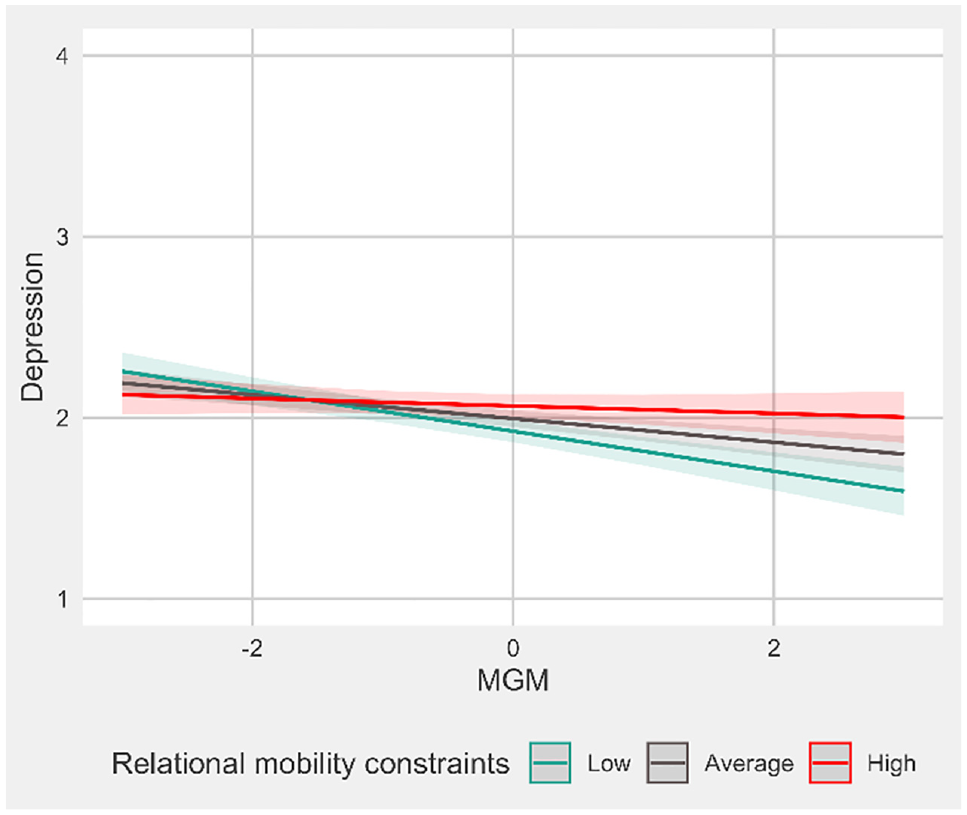
Depression as a Function of MGM and Sample-Level Relational Mobility Constraints
We also investigated the theoretical specificity of our predictions by testing whether other related constructs, such as individualism-collectivism or cultural tightness-looseness, have a similar moderating effect. We tested the cross-level interaction with individualism-collectivism using Hofstede’s country scores (Hofstede et al., 2010) and the interaction with tightness-looseness using the latest published country scores for this dimension (Gelfand et al., 2021). Note that the statistical power of these tests is lower than that of relational mobility tests, as these indices are only available at nation (not sample) level; the scores for tightness-looseness were available for 19 nations represented in our sample, and the scores for individualism-collectivism for 20. Neither individualism-collectivism (b = −.02, SE = .01, p = .209), nor tightness-looseness (b = .003, SE = .05, p = .956) moderated the MGM-depression link.
To test H5-H7, we ran a multilevel moderated mediation model with lavaan. To the path model predicting depression from MGM via social support and normative pressures, we added the sample-level relational mobility constraints as a Level 2 predictor of depression and cross-level interactions between constraints and all four paths in the model (see Figure 2). In contexts with higher relational mobility constraints, the positive association between MGM and social support was stronger (b = .21, 95% CI [.13, .28], SE = .04, z = 5.5, p < .001), supporting H5. The slope was positive at low (−1SD: b = .31, SE = .03, p < .001) and high (+1SD: b = .46, SE = .02, p < .001) levels of relational mobility constraints, but stronger when constraints were high. Simultaneously, the link between social support and depression was weaker (b = .10, 95% CI [.11, .15], SE = .03, z = 3.7, p < .001), supporting H6. The slope was negative at low (−1SD: b = −.18, SE = .02, p < .001) and high (+1SD: b = −.10, SE = .02, p < .001) levels of relational mobility constraints, but weaker when constraints were high.
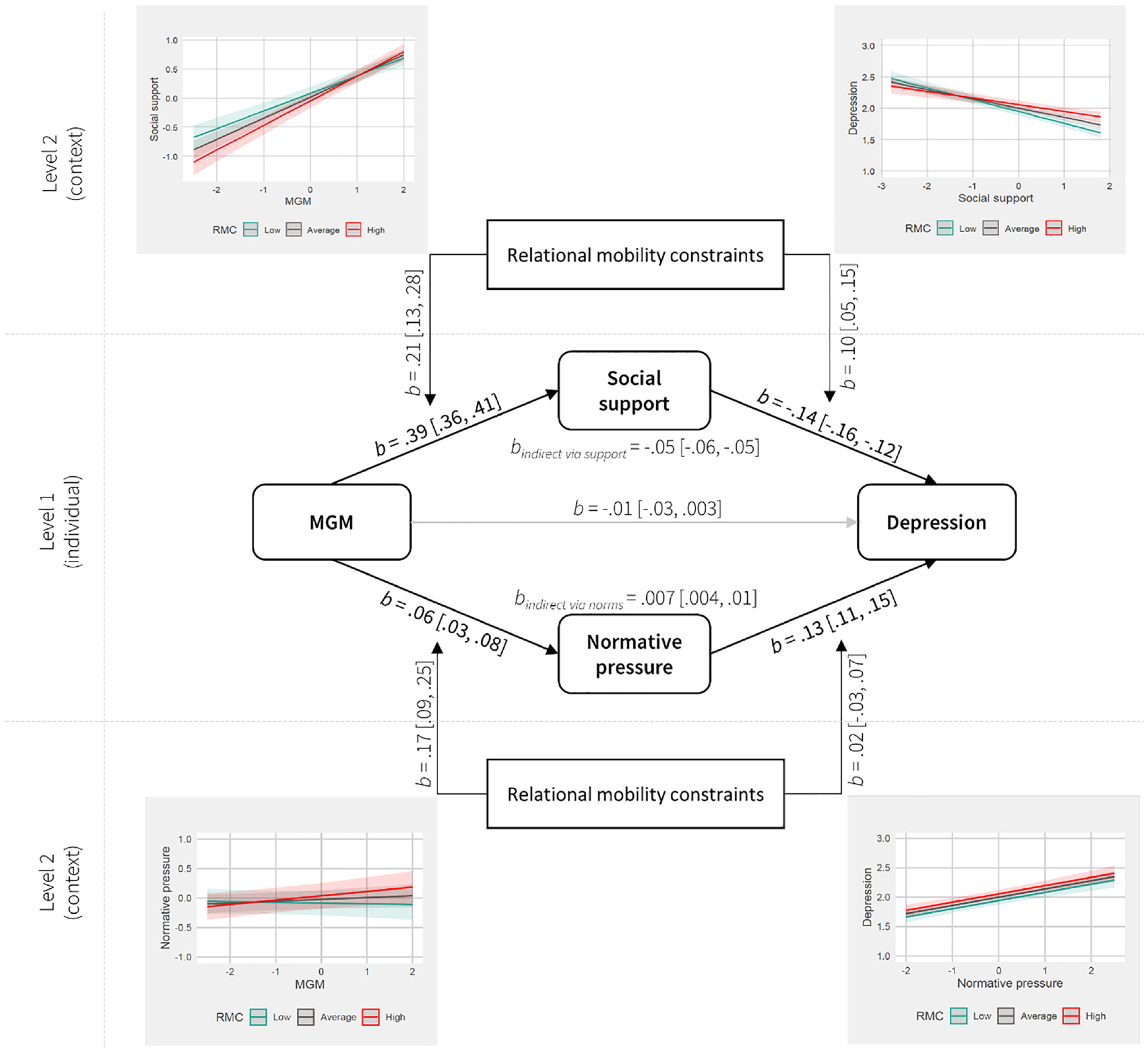
The Moderated Parallel Mediation Model Predicting Depressive Symptoms From MGM and Sample-Level Relational Mobility Constraints, via Social Support and Normative Pressures
The link between MGM and normative pressures was stronger in contexts with high relational mobility constraints, supporting H7 (b = .17, 95% CI [.09, .25], SE = .04, z = 4.1, p < .001). The link was present when constraints were high (+1SD: b = .12, SE = .02, p < .001), but not when they were low (−1SD: b = −.009, SE = .03, p = .731). Relational mobility constraints did not moderate the link between normative pressures and depression (b = .018, 95% CI [−.03, .07], SE = .02, z = 0.7, p = .485).
The total indirect effect of MGM on depression was significant at both low (b = −.06 [−.07, −.04], z = −8.84, p < .001) and high levels of relational mobility constraints (b = −.03 [−.05, −.01], z = −3.80, p < .001).
The interactions with social support remained stable when testing with the full relational mobility scale and the Opportunities subscale, but the interactions with normative pressures did not. The link between MGM and normative pressures was moderated by the Constraints subscale, but not by the Opportunities subscale (b = .05, SE = .04, p = .240) or by the full relational mobility scale (b = −.07, SE = .04, p = .059). Instead, the interaction with the second path became significant: the link between normative pressures and depression was stronger in contexts with more relational mobility opportunities (b = .13, SE = .02, p < .001; with full RM scale: b = .07, SE = .03, p = .010).
Discussion
Using data from 5,174 individuals across 29 societies, we found that belonging to many groups was associated negatively with depressive symptoms. This relationship could be decomposed into a negative indirect effect via increased social support, and a positive indirect effect via increased normative pressures, with the positive effect of social support overpowering the negative effect of normative pressures. In general, these results support the social cure approach (Cruwys et al., 2014; S. A. Haslam et al., 2005; C. Haslam et al., 2016; 2019; Junker et al., 2019; Steffens et al., 2016). Although the multiple group membership to depressive symptoms effect was small—one standard deviation increase in MGM measure was associated with 0.06 decrease in depressive symptoms on a 4-point scale—small effects can be meaningful when they have large cumulative consequences (Cortina & Landis, 2009). This small protective effect of group memberships can accumulate both across the lifespan of an individual and across individuals in a society, resulting in different depression prevalence rates across societies.
Advancing the social identity and social cure literatures, we showed that the strength of the social cure properties of social groups was conditional upon the ability of individuals to leave the unsatisfying groups they belong to. The negative link between multiple group memberships and depressive symptoms was significantly weaker in societies with low relational mobility. Importantly, this effect was driven by relational mobility constraints rather than opportunities: the social cure properties of groups were weaker when people were unable to leave groups but was not conditional upon the opportunities people had to join new groups. We also showed that the association of multiple group memberships with social support and normative pressures were stronger in less relationally mobile societies, demonstrating the importance of groups to social behaviors within less relationally mobile societies. Finally, however, we found social support did not translate into lower depressive symptoms as strongly in low relationally mobile societies as it did in more relationally mobile societies.
These findings reflect our argument that, in low relational mobility societies, groups dictate social behavior more strongly (explaining the stronger associations between MGM and social support, and between MGM and normative pressures). In cultures with high levels of relational mobility, groups provide individuals with psychologically nourishing, positively distinct social identities that lay the foundation for positive social support. However, because groups tend to have permeable boundaries in societies with high levels of relational mobility, individuals leave groups that are unsatisfying or exert strong normative pressures for more satisfying groups through individual mobility. The groups that individuals remain members of—especially those that come to mind when answering survey questions of the type we used (Cruwys et al., 2016)—are likely to be highly satisfying and thus beneficial for psychological health and well-being.
Furthermore, in societies with high levels of relational mobility, social support is not as rigidly bounded within groups as it is in low relational mobility societies, which accounts for our finding that multiple group memberships was not as strongly associated with social support in these societies. Yet, when social support is received, it does not entail the necessary reciprocity that it does in low relational mobility societies and so is more strongly associated with health and well-being benefits. Indeed, it is in societies with high levels of relational mobility that evidence for the social cure properties of groups has been documented (Cruwys et al., 2014; S. A. Haslam et al., 2005; C. Haslam et al., 2016, 2019; Steffens et al., 2019).
However, in societies with low levels of relational mobility, groups more clearly demarcate the boundaries of who to give and receive social support from, and more strongly determine social behaviors. In these societies, individual social behavior is strongly dictated by group memberships, so that multiple group memberships is more strongly positively associated with social support and with uncomfortable normative pressures. Social support, however, is not as psychologically beneficial. We argue that this is likely to be because receiving it entails a duty to reciprocate and may therefore become a burden. However, social support may not be as psychologically beneficial in such societies also because of the type of social support provided. European American couples have been found to provide more emotional support, motivated by the goal of increasing the recipient’s self-esteem, whereas Japanese couples provide more problem-focused support (Chen et al., 2012).
Our findings cohere with other social cure work, which has found (Lam et al., 2018) and suggested (Chang et al., 2016) that groups are not as beneficial in cultures outside of the highly individualistic, high relational mobility ones in which the majority of social cure work has been conducted. However, our study is the first to demonstrate the moderating effect of relational mobility and the role of social support and normative pressures in a large cross-cultural sample.
Our empirical findings suggest that the social cure properties of groups are weaker in contexts where relational mobility constraints are high. These findings have practical implications. They suggest that, while interventions that aim to scaffold positive social identities—such as Groups 4 Health (C. Haslam et al., 2016)—are likely to effectively reduce depressive symptoms, they are likely to be less effective in low relational mobility societies.
Although we had a large sample of participants and sufficient power to detect effects of interest, the number of samples was fairly limited and did not include any African societies. Future studies should, therefore, aim to replicate our results across a larger and more diverse set of cultures. Furthermore, although we measured all constructs using a bespoke survey and achieved at least partial scalar invariance for all measures, the data are correlational and so we cannot make any claims about causality. Future studies should aim to experimentally test our hypotheses.
Nevertheless, our findings suggest that groups act as social cures across societies, but not to the same degree. Groups appear to be more important for psychological health and well-being in high relational mobility societies because individuals can choose to leave unsatisfying groups. In low relational mobility societies, groups more strongly dictate social behavior but are less beneficial for psychological health.
Supplemental Material
sj-docx-1-spp-10.1177_19485506241230847 – Supplemental material for The Social Cure Properties of Groups Across Cultures: Groups Provide More Support but Have Stronger Norms and Are Less Curative in Relationally Immobile Societies
Supplemental material, sj-docx-1-spp-10.1177_19485506241230847 for The Social Cure Properties of Groups Across Cultures: Groups Provide More Support but Have Stronger Norms and Are Less Curative in Relationally Immobile Societies by Matthew J. Easterbrook, Lusine Grigoryan, Peter B. Smith, Yasin Koc, Vivian Miu Chi Lun, Dona Papastylianou, Claudio Torres, Maria Efremova, Bushra Hassan, Ammar Abbas, Heyla al-Selim, Joel Anderson, Susan E. Cross, Gisela Isabel Delfino, Vladimer Gamsakhurdia, Alin Gavreliuc, Dana Gavreliuc, Pelin Gul, Ceren Gunsoy, Anna Hakobjanyan, Siugmin Lay, Olga Lopukhova, Ping Hu, Diane Sunar, Maria Luisa Mendes Texeira, Doriana Tripodi, Paola Eunice Diaz Rivera, Masaki Yuki, Natsuki Ogusu, Catherine T. Kwantes, Rolando Diaz-Loving, Lorena Perez Floriano, Trawin Chaleeraktrakoon and Phatthanakit Chobthamkit in Social Psychological and Personality Science
Footnotes
Correction (December 2024):

Handling Editor: Lowell Gaertner
Author Note
For the purpose of open access a Creative Commons Attribution (CC BY) license is applied to any Author Accepted Manuscript version arising from this submission.
Author Contributions
M.J.E., L.G., and P.B.S. are responsible for conceptualization. M.J.E. and P.B.S. designed the study. L.G. conducted the analyses. M.J.E. and L.G. wrote the manuscript. All authors contributed to data collection and read, commented on, and approved the manuscript.
Declaration of Conflicting Interests
The author(s) declared no potential conflicts of interest with respect to the research, authorship, and/or publication of this article.
Funding
The author(s) disclosed receipt of the following financial support for the research, authorship, and/or publication of this article: The work of Olga Lopukhova was supported by the Kazan Federal University Strategic Academic Leadership Program (PRIORITY-2030). Lusine Grigoryan’s work on this project was supported by DFG individual grant #464524346. Maria Efremova’s work on this project was supported within the framework of the Basic Research Program at the National Research University Higher School of Economics (HSE University).
ORCID iDs
Supplemental Material
The supplemental material is available in the online version of the article.
Notes
Author Biographies
References
Supplementary Material
Please find the following supplemental material available below.
For Open Access articles published under a Creative Commons License, all supplemental material carries the same license as the article it is associated with.
For non-Open Access articles published, all supplemental material carries a non-exclusive license, and permission requests for re-use of supplemental material or any part of supplemental material shall be sent directly to the copyright owner as specified in the copyright notice associated with the article.
