




Abstract
The present research examined cultural differences in interpersonal memories and forecasts, situated in a currently salient positive or negative interpersonal context. We found that a negative focal event, compared to a positive one, led to more negative memories and forecasts of interpersonal encounters. The effect was stronger among Euro-Canadians than among Chinese. This was true regardless of whether the salient focal event was imagined or a real-life experience. Furthermore, focal thinking—the extent to which individuals think about the salient focal event—mediated cultural differences in interpersonal memories and forecasts as moderated by the focal event valence. Relational memories and forecasts positively predicted perceived relationship quality, willingness to help, and forgiveness. The findings highlight both cultural similarities and differences in interpersonal memories and forecasts, which contribute significantly to the literature on culture and relationships.
How do people’s present relationship experience influence their thoughts about past and future interactions? Research has revealed a temporal projection bias, where individuals’ recollections of the past and expectations for their future are often influenced by their present experiences (Karney & Coombs, 2000; Lemay et al., 2015). For example, research has found that current negative emotions bias people’s memory of past emotions (Chang et al., 2018), and current relationship challenges lead individuals to recall past transgressions as more frequent or severe and to anticipate more negative future interactions (Lemay et al., 2015; Luchies et al., 2013). The specific influence of presently salient relationship experiences on relationship memories and forecasts, however, has received limited attention, particularly in cross-cultural settings.
To address this literature gap, the present research examined the effect of the current relationship situation—positive or negative—on relationship memories and forecasts between Euro-Canadians and Chinese. Furthermore, we investigate the underlying mechanisms and interpersonal consequences of these potentially biased cognitions. Adding a novel perspective to the field, the research can shed light on how individuals construct past and anticipate future interactions in relationships. It also offers valuable insights into the complex dynamics of relationship cognition, thus contributing to a more comprehensive understanding of how relationship cognition operates across cultures.
Interpersonal Memories and Forecasts May Depend on Current Experiences
How people reconstruct their past in a close relationship may be shaped by their current feelings and perceptions (Cortes et al., 2017; Holmberg & Holmes, 1994; McFarland & Ross, 1987). According to Bower’s (1981) mood-congruence theory and Holmberg and Holmes’s (1994) mental model of memories, individuals’ current mood and understanding of their relationship often trigger similarly valenced memories. Various daily diary and longitudinal research support that people with declining current relationship satisfaction tend to remember their past more negatively. In contrast, those with improving relationship satisfaction tend to recall their past more positively (Holmberg & Holmes, 1994). In general, people overestimate the similarity between the present perceptions and the past (Karney & Coombs, 2000; McFarland & Ross, 1987; Patihis et al., 2019).
Similarly, individuals’ current mood can influence their predictions about the future (Gilbert et al., 2002). Lemay et al. (2015) examined romantic dyads’ daily affective and behavioral forecasts over 2 weeks and found that participants’ future predictions tend to be similar to the present. When individuals had especially good (or bad) days, their forecasts of affect and partner behaviors for tomorrow were more positive (or negative) than their actual future experience. Peetz and colleagues (2022) showed that participants projected their current positive feelings onto their future (and past) relationship quality. Thus, people’s future projection seems biased by present feelings and perceptions.
The present research examines how individuals’ current interpersonal experiences can shape the accessibility of specific memories and forecasts in close relationships. While previous research has focused on the effects of present mood on memory and predictions, limited research has focused on the effect of interpersonal situations (Lemay et al., 2015). While existing research has primarily concentrated on the valence of memories or forecasts, our research focuses on their accessibility.
Furthermore, we aimed to provide insight into cultural differences in individuals’ interpersonal memories and forecasts by recruiting both Euro-Canadian and Chinese participants. We further proposed that these cultural differences might be explained by focal thinking (or focalism)—a cognitive tendency to focus too much on a focal event and fail to consider the influence of other events (Lam et al., 2005; Wilson et al., 2000).
Culture and the Role of Focal Thinking in Relational Memories and Forecasts
Previous research highlights culture’s significant impact on cognition (Nisbett, 2003; Yap et al., 2018). Holistic thinkers, prevalent among East Asians like Chinese, Japanese, and Koreans, are more influenced by non-focal elements, while analytic thinkers, common among European North Americans, are centered on the focal target (Chua et al., 2005; Ji et al., 2000, 2008, 2009; Kitayama et al., 2003; Masuda & Nisbett, 2001). For example, Japanese judgments are more influenced by surrounding people’s emotions compared to Americans (Masuda et al., 2008). Holistic thinking aligns with reduced focal thinking, as seen in East Asians’ less extreme happiness predictions following positive events (Lam et al., 2005). This research suggests that focal thinking affects affective forecasting and cognitive responses to salient events.
We hypothesized that European North Americans focus more on and are more influenced by focal events than East Asians. Supporting this, studies show that, compared to the Chinese, North Americans are more influenced by the focal price trend when predicting stock market trends (Ji et al., 2001, 2008). Furthermore, Chinese have a broader temporal information focus, considering the past and future more than Euro-Canadians (Ji et al., 2018). These findings suggest that European North Americans may be more biased by current salient experiences in recalling past experiences and forecasting future relationships, compared to the Chinese.
Implications of Relationship Memories and Forecasts
Recollections and forecasts of negative relationship experiences are usually associated with negative relationship outcomes. The more people ruminate about past negative experiences during a current relationship conflict, the less constructive their conflict responses will be and the lower their relationship satisfaction is (Cortes & Wilson, 2016). Likewise, negative relationship forecasts make it harder for individuals to respond constructively and protect their relationship (Murray et al., 1998, 2000, 2001).
Conversely, positive memories and forecasts predict positive outcomes, including improved emotional responses to a negative relationship situation (Lemay & Neal, 2013), more positive responses to conflicts (e.g., forgiveness; McCullough et al., 1998; Rusbult et al., 1991; Van Lange et al., 1997; Wohl & McGrath, 2007), and more pro-relationship efforts and perseverance (e.g., responding constructively during a conflict; Assad et al., 2007; Murray & Holmes, 1997; Srivastava et al., 2006). Limited cross-cultural research, however, investigates how negatively biased memories and forecasts influence relationship quality and pro-relationship behaviors, which is a gap that the present research fills.
The Present Research
Using a thought-listing procedure, we examined how highlighting a relationship scenario currently would influence Euro-Canadian and Chinese individuals’ spontaneous recollection (Studies 1 and 2) and forecast (Study 3) of interpersonal encounters in close relationships. Based on cultural differences in focal thinking, we hypothesized that Euro-Canadians would recall and forecast more negative (or less positive) interpersonal events in negative than in positive salient conditions and the effect would be weaker among Chinese participants. We also proposed that cultural differences in individuals’ memories and forecasts would be partially explained by participants’ focal thinking tendencies. Finally, we explored the implications of these interpersonal memories and forecasts on individuals’ perceived relationship quality and pro-relationship behaviors. All Studies were conducted online during the COVID-19 pandemic.
Study 1
Study 1 examined cultural differences in spontaneous memories by making a positive vs. negative relationship situation salient. We expected the salient situation to influence Euro-Canadians more than Chinese recall. We explored focal thinking as a potential underlying mechanism and examined interpersonal implications.
Method
Participants
An a priori power analysis using G*Power3.1 (Faul et al., 2009) estimated that N = 351 is required to detect a small interaction effect, f = .15, in a 2 (culture) × 2 (condition) ANOVA with power = .80,
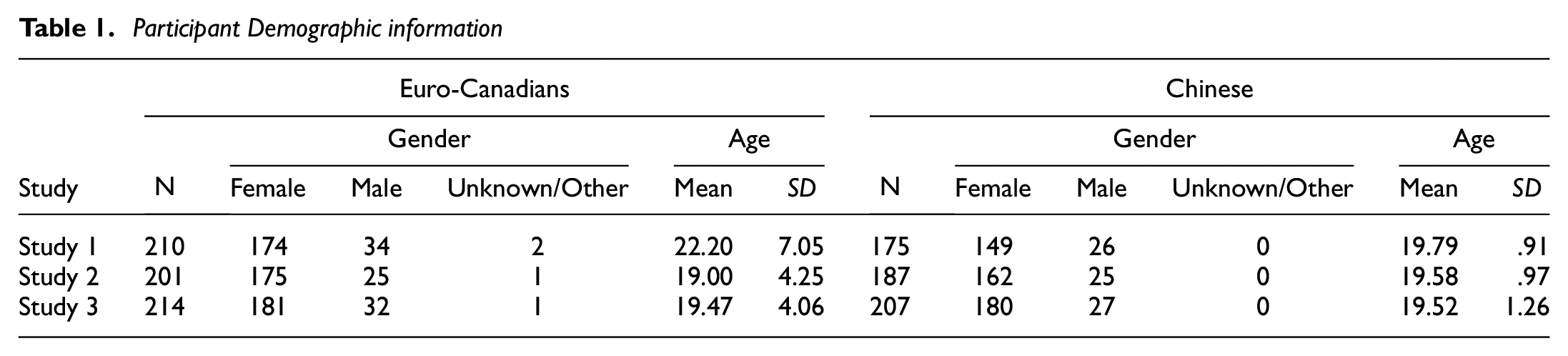
Participant Demographic information
Procedure
Randomly assigned to either a positive or a negative condition, 1 participants imagined a situation where a close other supported/helped them (Positive condition) or hurt/wronged them (Negative condition). They noted the person’s initials, their relationship, 2 closeness (1 = not close at all; 7 = very close), and how positive/negative the imagined situation would be to them and how happy or unhappy they would feel (−5 = very negative/very unhappy; +5 = very positive/very happy). 3
In the supposedly unrelated second part of the study, participants recalled interpersonal events by completing (up to 10) sentences with specific behaviors/actions (instead of personal characteristics) that their nominated close other did to/for them. Each sentence began with “My close other. . .” After completing the sentences, they rated the valence of each recalled event (−5 = Very negative; +5 = Very positive). The dependent variables were the proportion of negative memories and the overall valence of all memories. 4
As a measure of focal thinking, participants reported how much they thought about the imagined relationship scenario during the sentence task (0 = not at all, 10 = absolutely).
To explore potential relationship implications, we measured participants’ current relationship appraisal (1 = Not at all; 7 = Very much) using an adapted 6-item version of the Satisfaction and Trust subscales of the Perceived Relationship Quality Scale (Fletcher et al., 2000). For example, “How satisfied are you with your relationship with < close other> right now” (
Participants also responded to hypothetical relationship scenarios: (1) “Suppose your close other is going through a difficult and stressful time right now. How willing are you to go out of your way to help/support them in this situation?” (1 = Not willing at all; 7 = Completely willing), and (2) “Suppose your close other betrayed your trust and lied to you right now. How long (in number of days) would it take you to forgive them in this situation?”
Results
Data and code are available by contacting the corresponding author.
Proportion of Negative Interpersonal Memories
Chinese (M = 7.52, SD = 2.85) completed more sentences than Euro-Canadians (M = 6.82, SD = 2.61), F(1, 381) = 6.21, p = .013,
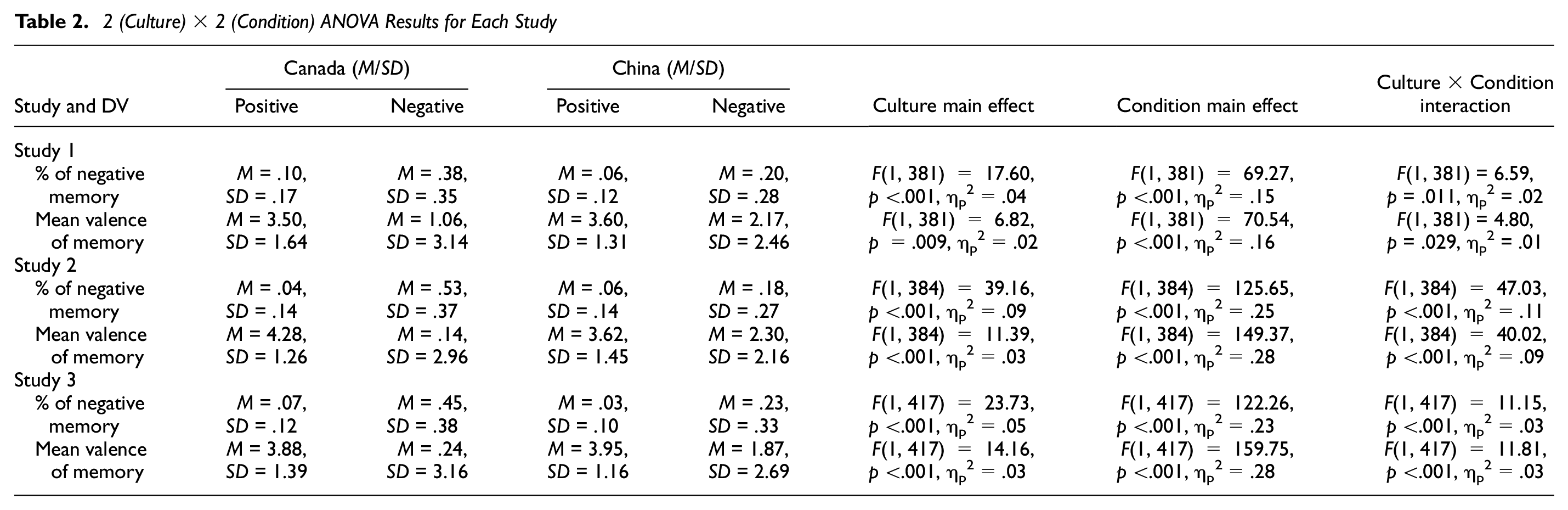
2 (Culture) × 2 (Condition) ANOVA Results for Each Study
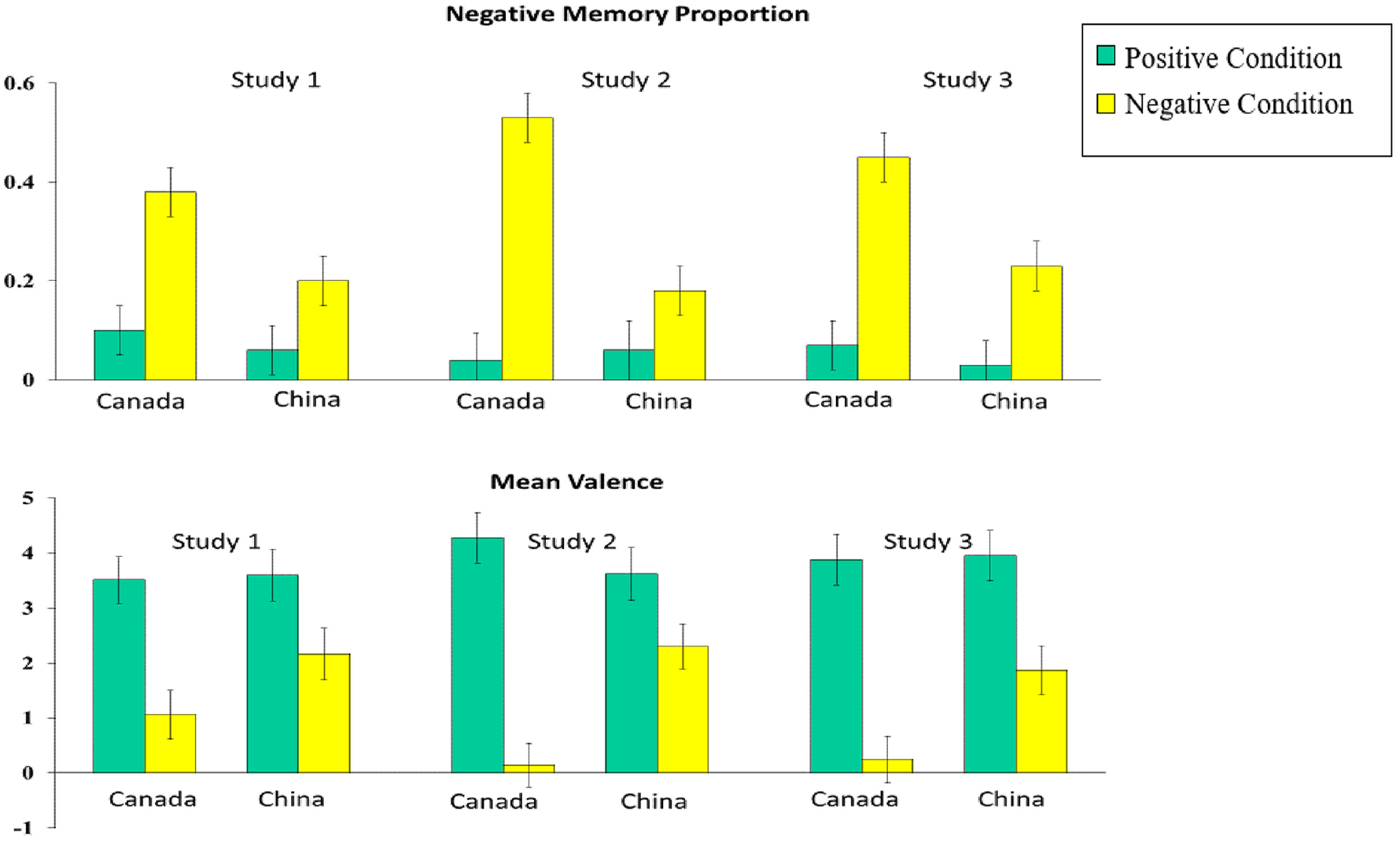
Memories or Forecasts Generated by Euro-Canadians and Chinese in three Studies
Valence of Overall Memories
A 2 (Culture) × 2 (Condition) ANOVA on the mean valence showed significant main and interaction effects (Table 2). Both Euro-Canadians, F(1, 381) = 61.57, p < .001,
Focal Thinking
A 2 (Culture) × 2 (Condition) ANOVA revealed a significant Condition main effect only, F(1, 381) = 113.48, p < .001,
Relationship Implications
Finally, we examined the association between memory and relationship consequences. Consistent with past literature, the more negative individuals’ memories about their close other were, the poorer they perceived their relationship quality to be (i.e., being less satisfied with their relationship, and trusting their close other less) and the less willing they were to help/support their close other in need (see Table 1S in Supplementary Material). Individuals’ memories, however, were not associated with the number of days it would take to forgive their close other.
Study 1 found that the currently salient relationship scenario influenced Euro-Canadians’ interpersonal memory more than Chinese participants’. Furthermore, remembering more negative behaviors by their close others was linked to lower perceived relationship quality and reduced willingness to offer support, but it did not predict the time taken to forgive a close other’s transgression.
We ensured comparability by asking participants to imagine an event, but it relied on people’s imagination of hypothetical events, which may be less impactful than real-life events. In the next two studies, we examined whether these findings hold true using real-life experiences.
Study 2
In Study 2, we made a recent interpersonal event salient and examined its impact on participants’ recall. We expected that the valence of the salient event would influence Euro-Canadians more than Chinese participants. We also examined whether self-reported focalism would mediate the cultural difference. Finally, we expected memory valence to be associated with perceived relationship quality and relationship sentiments.
Method
Participants
We recruited 243 Euro-Canadian undergraduates in Canada and 269 Chinese undergraduates in China. After excluding 42 Euro-Canadians and 82 Chinese who did not follow the instructions, 8 the final analysis included 201 Euro-Canadians and 187 Chinese (Table 1).
Materials and Procedure
Randomly assigned, participants were asked to think of a recent relationship event in which a close other made them feel happy/loved (Positive condition) or upset/hurt/angry (Negative condition). Participants then indicated the initial of, their relationship and their closeness 9 with, the close other. Participants also reported the valence and their feelings about the event (−5 = Very negative/unhappy; +5 = Very positive/happy), 10 and indicated the event date. 11
Next, as in Study 1, participants did the sentence completion task, reported how much they thought about the focal event during sentence completion, completed the perceived relationship quality scale (
Results
Degrees of freedom varied across different analyses due to missing data.
Proportion of Negative Interpersonal Memories
A 2 (Culture) × 2 (Condition) ANOVA on the proportion of negative memories revealed significant main and interaction effects (Table 2). Consistent with Study 1, both Canadians, F(1, 384) = 169.66, p
Valence of Overall Recollection
A 2 (Culture) × 2 (Condition) ANOVA on the mean memory valence showed significant main and interaction effects (Table 2). Euro-Canadians recalled more positive memories in the positive than negative condition, F(1, 384) = 178.81, p
Mediation Analysis
To explore the indirect effect of culture on memory through focal thinking moderated by condition, we ran Model 15 in SPSS Process Macro (Hayes, 2018), where b and c paths were condition-moderated. The 95% CI for the moderated indirect effect (b = .04, se =.02) based on 10,000 percentile bootstrap samples was entirely above zero [.01, .08], indicating a significant indirect effect of culture on memory through focal thinking moderated by condition (Figure 2). Specifically, Euro-Canadians reported greater focal thinking than did Chinese. Greater focalism predicted more negative memory about their close other in the negative condition but less negative memory in the positive condition. 15
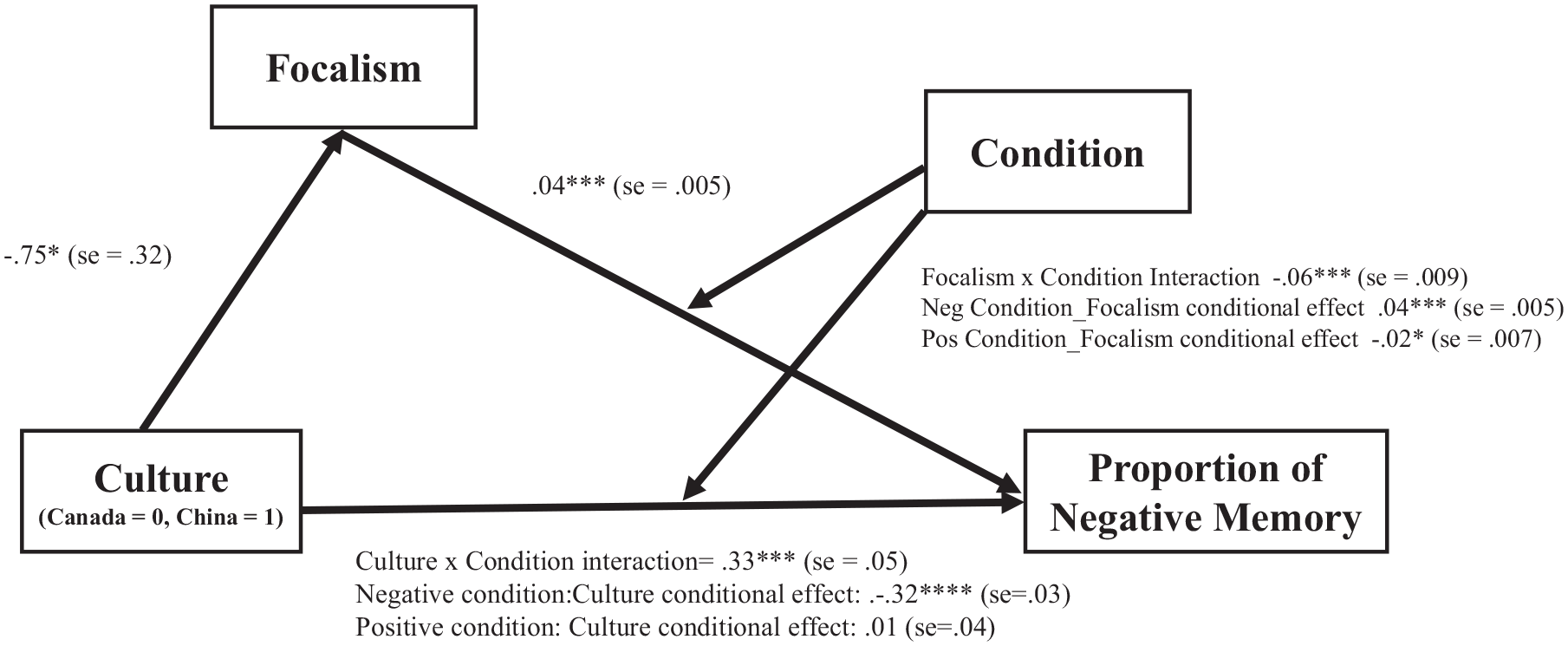
Relationship Between Culture and Proportion of Negative Memories as Mediated by Focal Thinking Moderated by Condition in Study 2 (Unstandardized Regression Coefficients)
Relationship Implications
As seen in Table 2S in Supplementary Material, more negative memories about close others correlated with lower perceived relationship quality, reduced motivation to help/support close others in need, and decreased willingness to forgive transgressions, ps
Thus, making an interpersonal event salient influenced Euro-Canadians’ recall more than Chinese participants’ recall. As predicted, Euro-Canadians reported stronger focal thinking than the Chinese, 16 and focal thinking mediated the effects of culture by condition on interpersonal memory. Furthermore, interpersonal memory predicts relationship quality, willingness to forgive, and motivation to help close others.
Study 3
Study 3 extended the research to future forecasts, considering the potential similarities (e.g., they share a common neural network; Okuda et al., 2003) and differences (e.g., in terms of intensity of emotions elicited; Caruso, 2010; Guo et al., 2012) between thinking about the past and future. We aimed to examine how a salient focal event may influence people’s forecast of future interactions with close others. We also measured focal thinking as a potential mediator and examined potential relationship outcomes.
Method
Participants
We recruited 238 Euro-Canadian undergraduates and 297 Chinese undergraduates, including 24 Euro-Canadians and 90 Chinese who failed to follow the instructions. The final analyses included 214 Euro-Canadians and 207 Chinese.
Materials and Procedure
Participants were asked to recall a recent relationship event 17 in which a close other 18 made them feel happy/loved (Positive condition) or upset/hurt (Negative condition). The procedure was identical to Study 2 except for the sentence completion task, in which participants completed each sentence with a future specific/concrete behavior/action that their close others would do to/for them.
Results
Degrees of freedom varied across different analyses due to missing data.
Proportion of Negative Interpersonal Forecasts
A 2 (Culture) × 2 (Condition) ANOVA on the proportion of negative forecasts showed significant main and interaction effects (Table 2). Both Euro-Canadians, F(1, 417) = 105.06, p
Valence of Overall Forecasts
Likewise, a 2 (Culture) × 2 (Condition) ANOVA revealed significant main and interaction effects (Table 2). Euro-Canadians’ forecast, F (1, 417) = 131.00, p<.001,
Mediation Analyses
To examine the indirect effect of Culture on individuals’ forecasts as moderated by Condition through their self-reported focal thinking, we ran Model 15 in SPSS Process Macro (Hayes, 2018). The 95% CI for the moderated indirect effect (b = .04, se =.01) based on 10,000 percentile bootstrap samples was entirely above zero [.01, .06], indicating a significant indirect effect of culture on forecast through focal thinking moderated by condition (Figure 3). Specifically, Euro-Canadians reported greater focal thinking than did Chinese. Greater focal thinking predicted more negative forecasts about their close other in the negative condition but not in the positive condition. 21
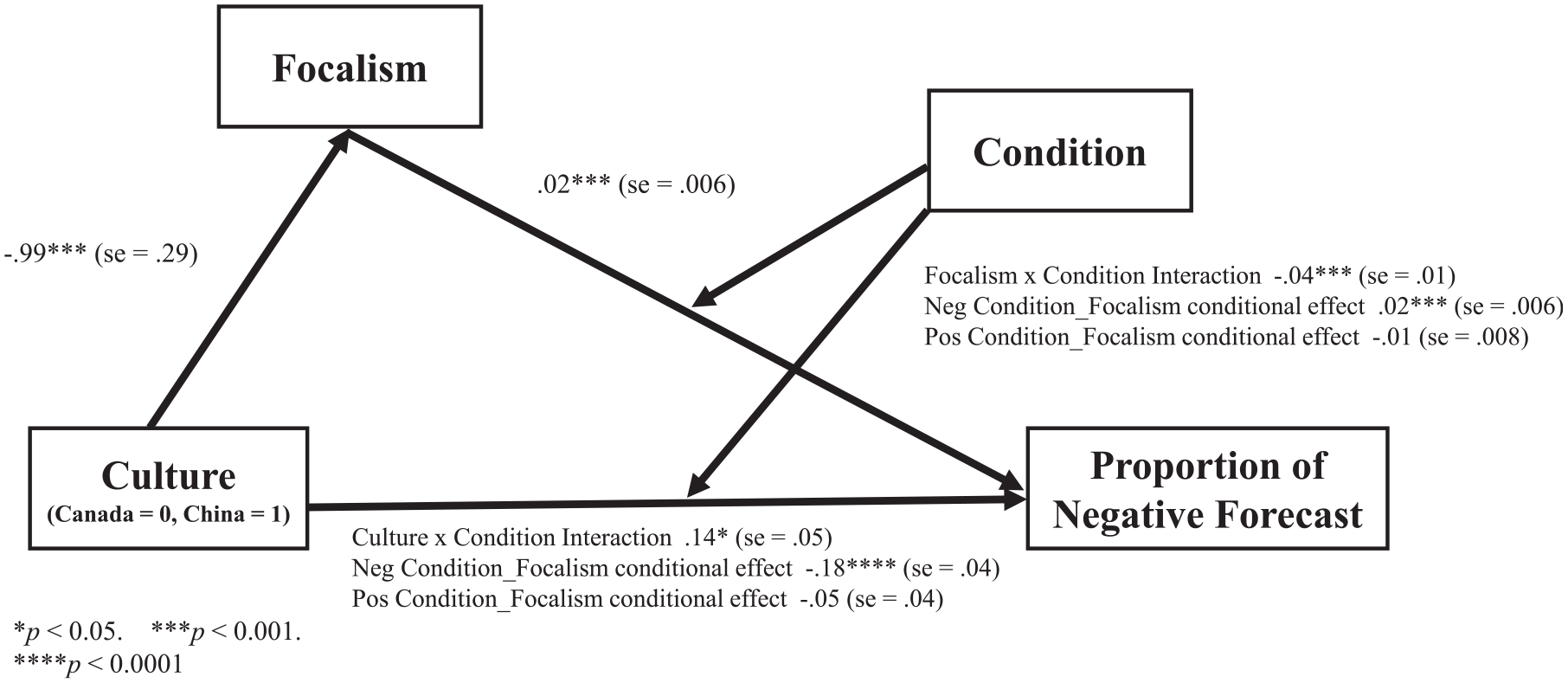
Unstandardized Regression Coefficients for the Relationship between Culture and Proportion of Negative Forecasts as Mediated by Focal Thinking moderated by Condition in Study 3
Relationship Implications
Consistent with Studies 1–2 and our hypothesis, negative forecasts about close others were associated with poorer perceived relationship quality, lower willingness to forgive, and lower motivation to help or support close others (Table 3S in Supplementary Material).
General Discussion
We examined cultural differences in individuals’ interpersonal memories and forecasts when a positive or negative relationship situation was made salient at present. As hypothesized, participants recalled more negative memories (Studies 1 and 2) and generated more negative forecasts (Study 3) about their close others in negative than positive conditions, and the effects were stronger for Euro-Canadians than Chinese. This is true for both hypothetical (Study 1) and real-life relationship encounters (Studies 2 and 3). Focal thinking mediated the cultural differences. Furthermore, the heightened accessibility of negative memories and forecasts was associated with poorer perceived relationship quality, lower motivation to help/support close others, and less willingness to forgive them.
The simple effects of culture were statistically significant in the negative but not positive condition. This may have to do with the negativity bias—people focus more on and more extensively process negative than positive information (Boals et al., 2014; Ito et al., 1998; Larsen, 2009; Mickley & Kensinger, 2008; Vaish et al., 2008). Consequently, negative relationship events have a greater psychological impact than positive ones (Baumeister et al., 2001). A recent study (Soroka et al., 2019) on psychophysiological reactions to real video news content from participants across 17 countries showed the pervasiveness of negativity biases across cultures with some variations. For example, Canadian participants consistently showed a negativity bias, whereas Chinese participants did not show a significant result, although a direct comparison between the two cultures was not conducted. If cultural differences in the negativity bias are reliable, this may suggest a possible explanation for the observed cultural effects on memory and forecast.
Theoretical Implications
This research fills gaps in the literature and underscores the importance of interpersonal situations and cultural factors in shaping individuals’ memories and forecasts. It provides the first evidence of differential patterns in how Euro-Canadians and Chinese individuals anchor their relational memories and forecasts to salient focal situations. Unlike previous research focusing on the accuracy of memories/forecasts (e.g., Lemay et al., 2015), this research examined the accessibility of memories/forecasts, showing that currently salient relational experiences make experience-consistent memories and forecasts more accessible, especially among Euro-Canadians.
Consistent with previous research on focal thinking (Ji et al., 2001, 2008; Lam et al., 2005; Nisbett et al., 2001), our research demonstrates that Euro-Canadians were more influenced than the Chinese by a currently salient relationship event while recalling or forecasting their close other’s behaviors. Furthermore, it extends the findings of cultural differences in visual-spatial attention (Masuda et al., 2008) to people’s attention to events or experiences along the temporal dimension.
The present research enriches the culture and focal thinking literature in several ways. First, cultural differences in focal thinking influence not only one’s own affect forecasting but also the forecasting of other’s behavior. Furthermore, focal thinking applies not only to predicting future encounters but also to recalling past experiences. Finally, adding to the past research that focal thinking leads to more errors in individuals’ affective forecasts for positive events (Lam et al., 2005; Wilson et al., 2000; Wilson & Gilbert, 2003), our research shows that focal thinking can also influence individuals’ memories and forecasts for interpersonal events.
The findings highlight the significant relationship implications of recalling and forecasting close others’ negative behaviors. This may be particularly important among Euro-Canadians who exhibit a stronger temporal projection bias. It seems that Euro-Canadians’ current relationship state profoundly influences their memories and forecasts, amplifying the impact of negative events on their overall relationship perceptions, making them more susceptible to fluctuations based on their current relationship state. Specifically, when confronted with negative (vs. positive) interpersonal events in the present, they are more prone to recalling past negative experiences and anticipating negative future interactions, which in turn predicts negative relationship outcomes. This dynamic may contribute to a relationship roller-coaster.
Limitations and Future Research
We presented correlational evidence suggesting that focalism may explain the observed cultural differences in temporal projection. It is important, however, to consider alternative explanations. In addition to the negativity bias discussed earlier, one possibility pertains to cultural differences in lay theories of change, with Chinese individuals having a greater expectation of change in events (Ji, 2005, 2008; Ji et al., 2001). However, our investigation did not support this explanation (footnotes 1, 12, and 21). Another alternative explanation is response bias, but it does not apply to the proportion data, as ratings were not involved. For the valence ratings on a scale from −5 to +5, Euro-Canadians indeed provided responses closer to the middle point (0), ruling out moderacy response bias as an explanation.
We had to exclude a substantial number of participants due to non-compliance, but this exclusion rate is comparable to the typical dropout rates in online social psychological studies (ranging from 30% to 50%; Zhou & Fishbach, 2016). Exclusion rates were similar across experimental conditions, except for Chinese participants in Study 3 (see Table 4S in Supplementary Material). An exploratory analysis with less stringent exclusion criteria revealed similar results, suggesting that selective attrition is unlikely to compromise internal validity. Nonetheless, future research should aim to reduce exclusion rates and consider measuring the temporal distance of the memories or forecasts to examine its potential impact on the valence of memories or forecasts.
Our research did not capture participants’“in-the-moment” memories/forecasts during a current relationship event. Future research may consider using diary studies to examine the accessibility and accuracy of individuals’ memories/forecasts immediately following a conflict with their close others.
Future research may extend the present work by (1) exploring different measures of accessibility of relational memories and forecasts (e.g., reaction time), (2) examining actual behaviors beyond self-reports to measure relationship implications, and (3) broadening the cultural samples. The present research provides a foundation for investigating broader implications in real-life interactions (e.g., conflict behaviors and responses) and extending beyond close relationships to various social contexts (e.g., workplace relationships).
Conclusion
In summary, we have shown that a current salient relationship situation/encounter—hypothetical or real-life—influences one’s relationship memories and forecasts, and such temporal projections are stronger among Euro-Canadians than among Chinese. This research sheds light on cultural similarities and differences in individuals’ relational memories and forecasts and contributes to a better understanding of the interplay among culture, cognition and close relationships.
Supplemental Material
sj-docx-1-spp-10.1177_19485506231211628 – Supplemental material for Projecting the Current Salient Relational Situations Into the Past and Future Across Cultures
Supplemental material, sj-docx-1-spp-10.1177_19485506231211628 for Projecting the Current Salient Relational Situations Into the Past and Future Across Cultures by Suhui Yap, Li-Jun Ji, Xin-Qiang Wang, Baorui Chang and Mingzhu Mao in Social Psychological and Personality Science
Supplemental Material
sj-docx-2-spp-10.1177_19485506231211628 – Supplemental material for Projecting the Current Salient Relational Situations Into the Past and Future Across Cultures
Supplemental material, sj-docx-2-spp-10.1177_19485506231211628 for Projecting the Current Salient Relational Situations Into the Past and Future Across Cultures by Suhui Yap, Li-Jun Ji, Xin-Qiang Wang, Baorui Chang and Mingzhu Mao in Social Psychological and Personality Science
Footnotes
Acknowledgements
We thank the Culture and Cognition Lab at Queen’s University for their help with data collection. We thank Audrey Pope for their comments on earlier versions of the paper.
Handling Editor: Yuri Miyamoto
Authors’ Note
This paper is based on Suhui Yap’s PhD dissertation under the supervision of Li-Jun Ji at Queen’s University.
Declaration of Conflicting Interests
The author(s) declared no potential conflicts of interest with respect to the research, authorship, and/or publication of this article.
Funding
The author(s) disclosed receipt of the following financial support for the research, authorship, and/or publication of this article: The research was supported by grants from the Social Science and Humanities Research Council of Canada (SSHRCC Grants 435-2012-1279 and 435-2018-0061) to Ji.

Supplemental Material
The supplemental material is available in the online version of the article.
Notes
Author Biographies
References
Supplementary Material
Please find the following supplemental material available below.
For Open Access articles published under a Creative Commons License, all supplemental material carries the same license as the article it is associated with.
For non-Open Access articles published, all supplemental material carries a non-exclusive license, and permission requests for re-use of supplemental material or any part of supplemental material shall be sent directly to the copyright owner as specified in the copyright notice associated with the article.
