




Abstract
Four experiments investigated the perceived virtue of curiosity about religion. Adults from the United States made moral judgments regarding targets who exhibited curiosity, possessed relevant knowledge, or lacked both curiosity and knowledge about religion and comparison topics (e.g., science). Participants attributed greater moral goodness to targets who displayed curiosity compared with targets who were ignorant or knowledgeable about the domain. This preference was consistent across Jewish, Protestant, Catholic, and other Christian participants but was absent when atheists evaluated religious curiosity. Perceptions of effort partially mediated judgments: Participants viewed curious characters as exerting more effort and consequently rated them as more moral. To test causality, we manipulated perceptions of effort and showed that participants viewed curious characters who exerted effort as particularly moral. This work fosters novel insights into the perceived virtue of curiosity and further illuminates similarities and differences between religious and scientific cognition.
What makes people virtuous? While people widely regard prosociality as central to goodness (Piazza et al., 2019; Schein & Gray, 2018), curiosity has a mixed reputation. Curiosity—the intrinsic motivation to fill knowledge gaps through question-asking or exploration (Kidd & Hayden, 2015; Loewenstein, 1994)—can be a valuable pathway to learning that fosters knowledge-seeking (Vogl et al., 2019) and knowledge-retention (Gruber et al., 2014; Halamish et al., 2019; Kang et al., 2009; von Stumm et al., 2011). Despite substantial literature on the predictors and outcomes of curiosity, little evidence exists regarding how observers perceive expressions of curiosity. Curious people’s eagerness to rectify their ignorance may signal socially desirable traits such as openness to novel perspectives (Kashdan et al., 2013; Silvia & Christensen, 2020) and willingness to put in effort (Celniker et al., 2023). However, curiosity may also elicit negative social evaluations because it implies ignorance and might be directed toward the risky pursuit of information better left alone (e.g., “curiosity killed the cat”). For some topics, people may perceive curiosity as useless and even immoral if it signals a lack of faith or interest in heretical topics.
Four experiments assessed how observers evaluate curious individuals and investigated boundary conditions of curiosity’s perceived virtue. We tested whether evaluations differ when curiosity is directed toward different knowledge domains and how the perception of effort expended by curious individuals might drive moral evaluations. We focused on curiosity about religion and tested generalizability across Christian denominations that emphasize faith, Jewish denominations that emphasize practice and may be more open to religious questioning, and atheists.
Seeking novel information to satisfy curiosity has a long history in scientific practice and research about scientific learning (e.g., Jirout & Klahr, 2012; Legare, 2014; Schulz & Bonawitz, 2007; Wootton, 2016). Norms favoring scientific curiosity suggest that many people hold positive views of scientific questioning. Religious and scientific knowledge are similar in many respects: Both involve culturally transmitted worldviews containing socially valued beliefs, causal models, values, and practices that determine what is real and true (Harris & Corriveau, 2014; Johnson et al., 2011). People are most curious when they perceive novel information as valuable (Dubey et al., 2019; Liquin & Lombrozo, 2020), and given that religious individuals often express strong commitments to both scientific and religious traditions (e.g., Legare et al., 2012), curiosity may play an important role in learning about both topics. One key mechanism driving these effects could be the perception that curiosity signals a willingness to exert effort to achieve socially desirable goals. Effort elicits positive moral evaluations (Celniker et al., 2023; Furnham, 1984), and the effortful pursuit of information to fill gaps in valued knowledge may likewise signal virtue. Thus, religious observers may positively evaluate religious and scientific curiosity.
However, differences between religious and scientific cognition suggest that findings regarding scientific curiosity may not generalize to religion. People express more confidence about the existence of scientific versus religious entities (Clegg et al., 2019; Cui et al., 2020; Davoodi et al., 2019) and report that religious statements reveal more about the person expressing them than do factual statements (Heiphetz et al., 2014). People are also more likely to use evidence to justify scientific versus religious claims (McPhetres & Zuckerman, 2017; Shtulman, 2013), view explanation-seeking as more appropriate for scientific claims while tolerating mystery regarding religion (Liquin et al., 2020), and use scientific explanations to satisfy epistemic motives and religious explanations to satisfy non-epistemic goals (Davoodi & Lombrozo, 2020). Gill and Lombrozo (2019) found that observers view seeking information to support claims as morally good across both religious and scientific topics; however, seeking information signaled commitment to science, whereas abstaining from information search signaled religious commitment. Part of the reason for different social inferences regarding scientific versus religious information-seeking may be that religious beliefs can signal identity, morality, and group commitments (Gervais et al., 2017; Sharp & Leicht, 2020; Sosis & Alcorta, 2003). Exerting effort to satisfy curiosity might therefore signal that someone is not a good group member because they do not know the right answer or are willing to engage with heretical perspectives.
Negative views of religious curiosity may be especially strong among Protestants, who typically emphasize beliefs and other mental states, compared with Jewish traditions that often prioritize behaviors over faith and value questioning of accepted teachings (Cohen & Hill, 2007; Laurin & Plaks, 2014; Li et al., 2012; Pew Research Center, 2013; Sigel et al., 2007; Silverman et al., 2016). Jewish participants may hold more positive views of targets who are currently ignorant of and asking questions about religious teachings. Alternatively, both Protestant and non-Protestant religious participants may perceive virtue in religious curiosity because it is directed toward learning socially valued information and signals positive traits like willingness to put in the effort to succeed (Furnham, 1984; Uhlmann & Sanchez-Burks, 2014). If this is the case, atheists—who may not value religion—may show the most disapproval of religious curiosity.
Four experiments tested competing hypotheses regarding whether participants would evaluate targets who express religious curiosity as more versus less moral than targets who (a) were ignorant and not curious or (b) already possessed religious knowledge. We further tested whether positive evaluations were limited to curiosity about valued information, such as widely endorsed religious beliefs (Studies 1–4) and scientific knowledge (Study 1), without extending to learning innocuous skills or improving one’s capacity to transgress (Study 4). Finally, we investigated possible differences between members of different groups (Protestants, Catholics, other Christians, Jews, and atheists) that vary in cultural norms surrounding epistemic practices and the importance of religious knowledge. Studies 2 to 4 tested whether participants expected curious people to put in the effort to learn and if these perceptions underlay evaluations of curious individuals.
Study 1
Study 1 provided an initial test of the virtue of curiosity by comparing how Christians and Jews evaluated individuals who were curious about religion or science relative to evaluations of targets who either (a) lacked knowledge but were not curious or (b) were knowledgeable about the topic without being curious.
Method
Prior to running this study, we preregistered the methods and analyses (https://aspredicted.org/pt44p.pdf). Materials, data, and analysis scripts for all studies are available at https://osf.io/3cvaz/. All studies received ethics approval from the institutional review board at Columbia University or York University.
Participants
We recruited U.S. adults through Prolific for an online survey. The United States is a religiously diverse nation where cultural narratives express possible conflict between science and religion (Elsdon-Baker & Lightman, 2020; Pew Research Center, 2015). This context therefore provides a conservative test of possible similarities across religious groups and domains. Using Prolific’s prescreening criteria, we recruited participants from four religions: Mainline Protestants, Catholics, other Christians (Christians of no particular denomination or Pentecostal), and Jews. We excluded participants who reported different religious affiliations within the survey (n = 34) or failed preregistered attention check questions (n = 30; see Supplementary Materials for details).
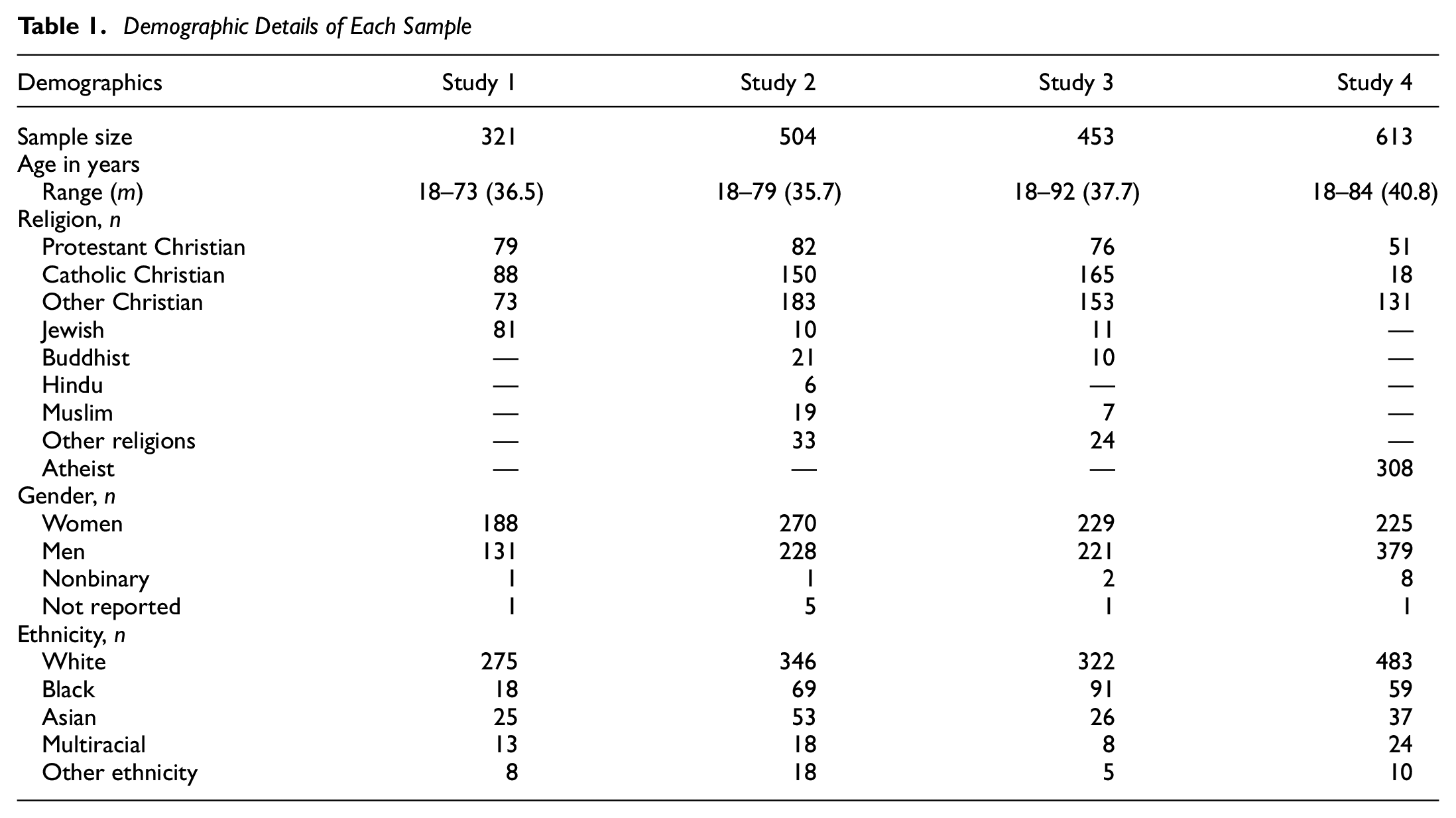
We aimed to recruit 80 participants from each religious group, sufficient to detect within-group effects of dZ = 0.32 or between-group effects of d = 0.45 with 80% power in a t test, well within the medium-to-large effect sizes from prior research on evaluations of information-seeking and religious/scientific topic differences (e.g., Heltzel & Laurin, 2021; Liquin et al., 2020; McPhetres & Zuckerman, 2017). 1 We recruited new participants to reach the final sample size. The final sample consisted of 321 participants (see Table 1 for the demographics of all samples).
Demographic Details of Each Sample
Materials and Procedure
In all studies, participants first passed an English-language comprehension check and provided consent, then answered several demographic questions. In Study 1, participants then read about target characters in six conditions that manipulated the domain of inquiry and the target’s level of curiosity. All participants viewed three vignettes from each of the six conditions for a total of 18 trials describing different targets. We randomized the order of science versus religion vignettes and the order of trials within each domain. To manipulate curiosity, vignettes described targets who were (a) unknowledgeable and curious, (b) unknowledgeable and non-curious, or (c) already knowledgeable (see Table 2). Both the non-curious and knowledgeable targets allowed us to compare perceptions of curious targets to targets who did not engage in curiosity-motivated information search but who varied in whether they lacked versus possessed the focal knowledge. This allowed us to distinguish whether already possessing knowledge is perceived as an acceptable reason to lack curiosity and whether people might simply prefer competence to ignorance.
Sample Vignettes Describing Targets Who Were Curious, Non-Curious, and Knowledgeable About Religion (Science in Parentheses), Study 1
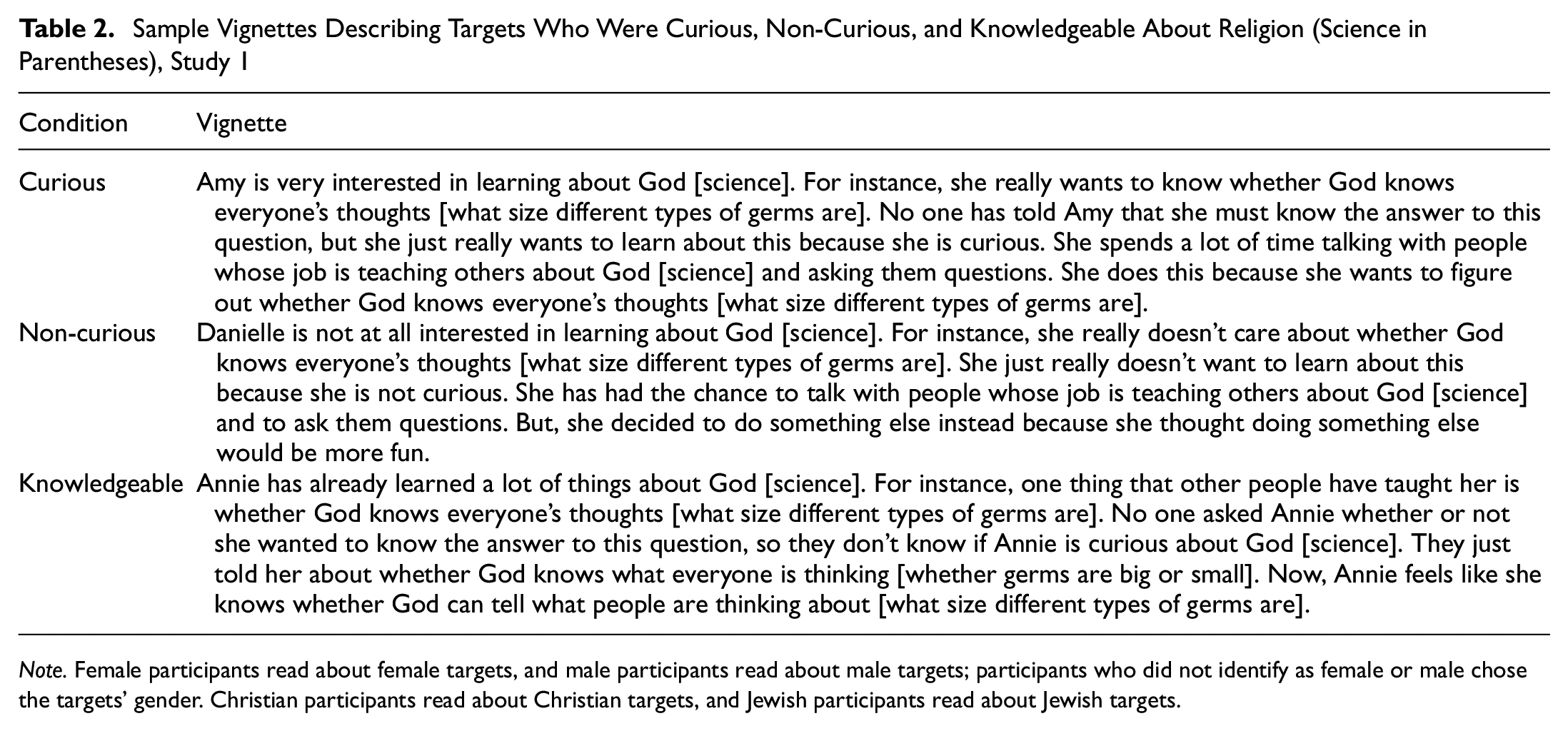
Note. Female participants read about female targets, and male participants read about male targets; participants who did not identify as female or male chose the targets’ gender. Christian participants read about Christian targets, and Jewish participants read about Jewish targets.
To manipulate domain, each vignette focused on one of three religious questions (whether God knows everyone’s thoughts, whether God can do miracles, whether God can hear prayer) or one of three scientific questions (what size different types of germs are, why there are no more dinosaurs alive right now, how magnets work). Each topic addressed widely endorsed, unobservable entities from scientific or religious (Christian and Jewish) belief systems. Although scientific items covered a broader range of entities than religious items, similar patterns emerged for each topic in each domain (see Supplementary Materials).
To measure perceptions of targets’ moral virtue, participants evaluated (in random order) whether the target was “a good person or a bad person” and “a nice person or a mean person” as well as whether their behavior was “good or bad” and “right or wrong.” Participants rated all items on 6-point scales counterbalanced for whether 1 corresponded to the most negative or the most positive evaluations; we scored all responses such that higher numbers indicated more positive evaluations and averaged responses into a composite score (α = .95).
Results
The main analysis consisted of a multilevel regression model (fit with the lme4 and lmerTest packages in R) that predicted evaluations from target curiosity, domain of inquiry, participant religion (all dummy coded), and all interactions between these variables. Models included random intercepts for participants to account for within-subjects data (but did not include preregistered random intercepts for each vignette due to little evidence of clustering and unreliable estimates due to the small number of vignettes). Below, we describe the pattern of model-derived simple effects (which indicate curiosity’s effect among each topic and religious group) and interactions (which indicate whether the curiosity effects significantly differ in size across topics and religions; see Supplementary Materials for full results).
As depicted in Figure 1 and Table 3, participants from all religious backgrounds evaluated curious targets significantly more positively than knowledgeable targets, whom, in turn, they evaluated more positively than non-curious targets. We next tested whether the topic and religious denomination moderated these effects. We did not observe significant interactions between topics (religion versus science) and the more positive evaluations of curious over knowledgeable targets among participants from any religious background, interaction bs < .06, ps > .49. This result indicates consistent perceptions that curious targets were more moral than knowledgeable targets. However, the difference between curious and non-curious targets did show significant Target × Topic and Target × Topic × Denomination interactions: Members of all Christian denominations viewed the non-curious target more negatively in the domain of religion versus science, Target × Topic interaction: bCatholic = −0.19 [−0.34, −0.03], p = .019; bProtestant = −0.25 [−0.42, −0.09], p = .002; bOther = −0.48 [−0.65, −0.31], p < .001. In contrast, Jewish participants showed a greater curious/non-curious difference for science versus religion, Target × Topic interaction b = 0.47 [0.31, 0.64], p < .001; Denomination × Topic interactions for Jewish/Catholic contrast: b = 0.24 [0.08, 0.40], p = .003; Jewish/Protestant contrast: b = 0.31 [0.14, 0.46], p < .001; Jewish/Other contrast: b = 0.31 [0.15, 0.48], p < .001.
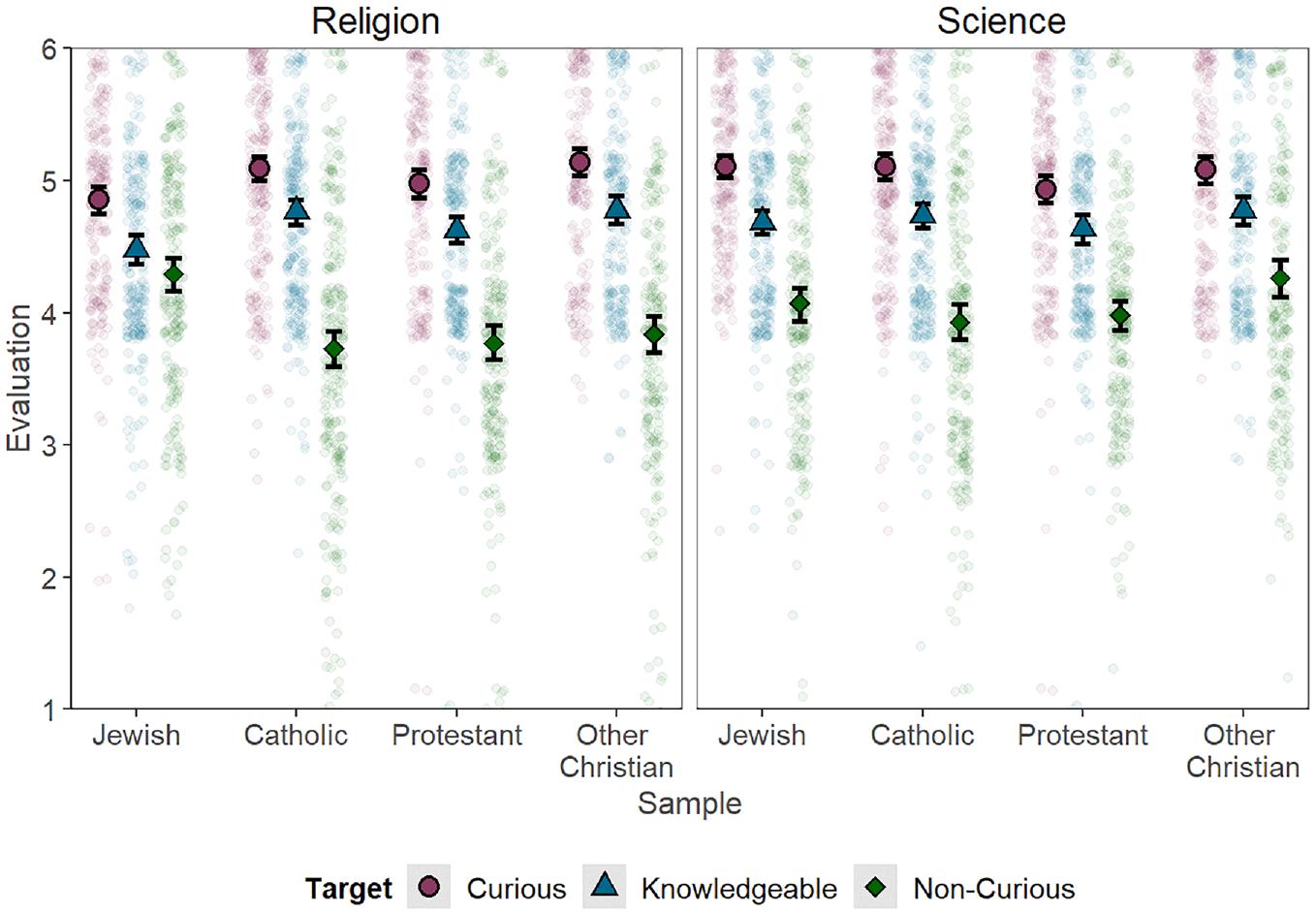
Mean Evaluations of Targets Who Were Curious, Non-Curious, or Knowledgeable About Religious Topics and Scientific Topics for Members of Each Religious Denomination. Confidence Intervals Indicate Bootstrapped 95% CIs for the Means
Simple Effects Depicting the Size (b [95% CI]) of the Difference Between Conditions for Participants From Each Religious Denomination for Religious and Scientific Topics Derived From the Preregistered Multilevel Regression Model Predicting Evaluations
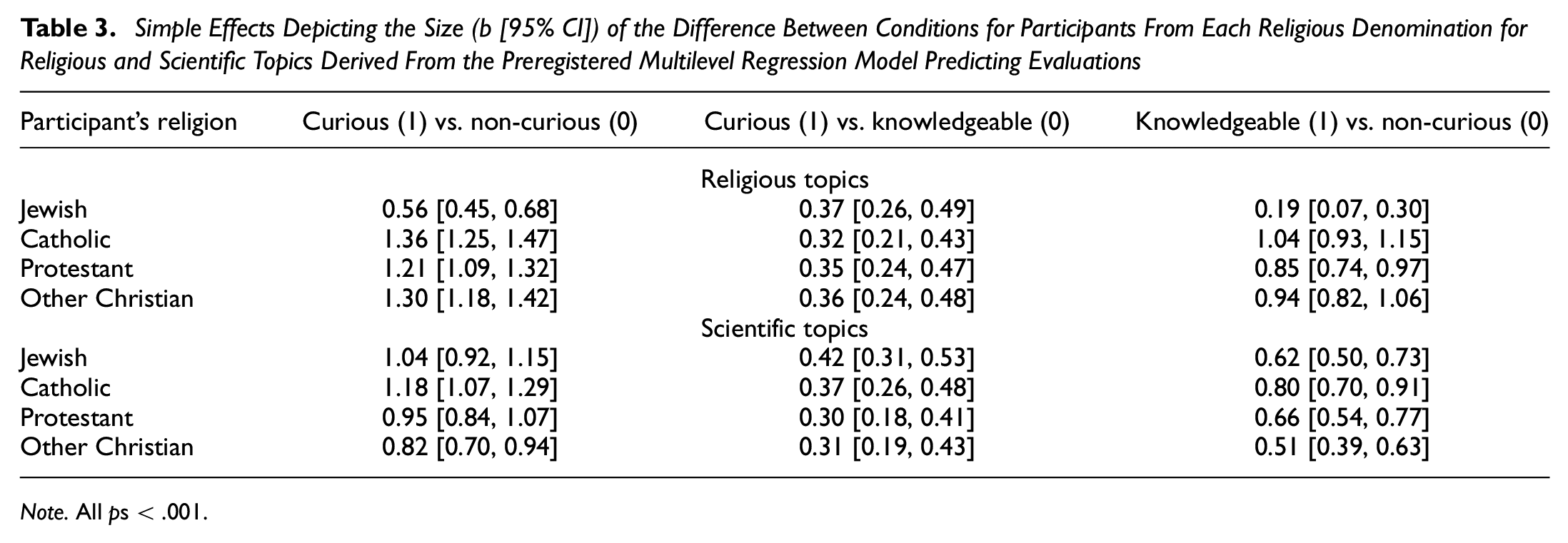
Note. All ps < .001.
Study 2
Study 1 documented widespread positive evaluations of curious targets compared with targets who overtly lacked curiosity and knowledgeable targets, for both religion 2 and science, among Christians and Jews. Study 2 asked why participants might evaluate curiosity positively. In particular, we focused on religion and investigated whether perceptions of effort exerted by curious targets underlie these evaluations. We hypothesized that curiosity-motivated information-seeking would signal a willingness to exert effort to achieve socially valued pursuits (including learning). Positive moral evaluations of exerting effort (Celniker et al., 2023; Furnham, 1984) could therefore partially explain positive evaluations of curious targets. To simplify the analyses, this study dropped the noncurious targets (who received the least positive evaluations in Studies 1 and 2) and only compared curious and knowledgeable targets as a conservative test of whether perceptions of effort could explain the perceived virtue of curious targets, beyond the already positive evaluations of knowledgeable targets.
Method
We preregistered the methods and analyses prior to running the study (https://aspredicted.org/zr8ui.pdf).
Participants
We recruited participants using the same method and exclusion criteria as Study 1. However, due to the consistent effects across different religious denominations in Study 1, Study 2 was available to any religious affiliate (excluding atheists, agnostics, or non-religious respondents), and we analyzed all participants together in a single sample. We also increased the final desired sample size to 500 participants to ensure sufficient power to detect small-to-medium mediation effects (Fritz & MacKinnon, 2007). The final sample included 504 participants.
Materials and Procedures
Participants read vignettes depicting targets who were curious or knowledgeable about religion (three targets each, presented in random order) using Study 1’s stimuli. Participants first used a 7-point Likert-type scale to rate whether each target “is a hard worker,” “has a strong work ethic,” and “puts in the effort required to succeed” (α = .95). Then, participants evaluated the target’s moral goodness using the four items from Study 1 (α = .94).
Results
Replicating Study 1, participants evaluated curious targets, m = 5.07 [5.03, 5.10], more positively than knowledgeable targets, m = 4.53 [4.48, 4.57], t(503) = 17.38, p < .001, dZ = 0.77 [0.67, 0.87]. We next tested whether perceptions of effort mediated this effect using multilevel regression analyses that included random intercepts by participants and dummy coded experimental conditions (Figure 2). Participants perceived curious targets as exerting more effort than non-curious targets, and the more participants perceived effort, the more favorably they evaluated those targets, indirect mediated effect: b = 0.33 [0.29, 0.36], total effect: b = 0.54 [0.50, 0.57], all ps < .001. Follow-up analyses, available in Supplementary Materials, confirmed that this mediated relationship was especially strong among participants high in Protestant Work Ethic, an individual difference in the view that hard work and effort are especially moral.
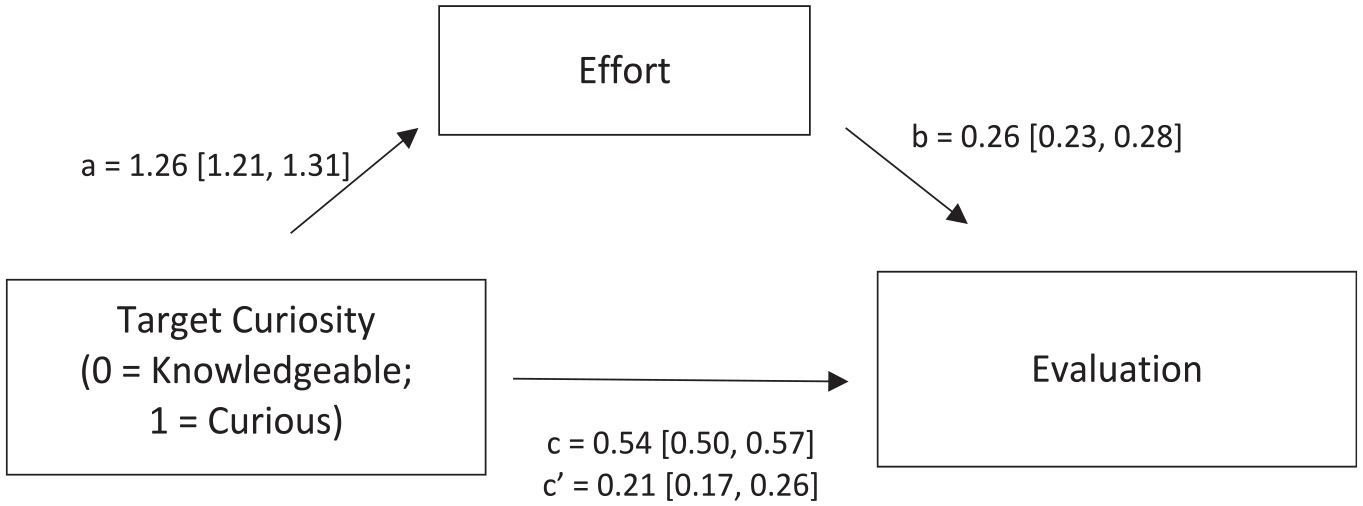
Model Depicting Effort as a Mediator of More Positive Evaluations of Curious Targets. All ps < .001
Study 3
To confirm the causal role of perceived effort in evaluations of curious targets, Study 3 manipulated how much effort curious targets expended to learn. We hypothesized that even if people expressed curiosity through a desire to acquire new information, observers would view those who actually exerted effort to seek this information more positively than those who expressed curiosity but did not follow through with effortful action or who already acquired knowledge without effortful action.
Method
We preregistered the planned methods and analyses prior to running this study (https://aspredicted.org/qd8q8.pdf).
Participants
Using the same method and exclusion criteria as Study 2, we aimed to recruit a final sample of 150 participants per condition (sufficient to detect within-condition effects of dZ = 0.23 or between-condition effects of d = 0.32—half the size of the curiosity versus knowledge condition difference in evaluations in Study 2—with approximately 80% power). The final sample consisted of 453 participants.
Materials and Procedure
Participants viewed one of three randomly assigned between-subjects conditions that manipulated targets’ levels of curiosity and effort, reading about targets who were (a) curious about religion and put in a lot of effort to learn about it, (b) curious about religion but did not put much effort into learning about it, or (c) knowledgeable about religion. All participants evaluated three gender-matched targets who were each curious/knowledgeable about a different question.
Curious targets wanted to know the answer to a religious question because they were curious and first asked a close other (e.g., roommate) what the answer was. In the high-effort curious condition, this person did not provide a satisfactory answer; therefore, the target sought out a religious leader and spent a lot of time asking questions and reading several books about the topic. In the low-effort curious condition, the target spent a little time talking with close others and did not seek out other people to answer the question and read a short magazine article to learn more. Both targets, therefore, displayed an intrinsic desire to know the answer to a religious question, but the high-effort target put in more time and asked more people to find an answer. The knowledgeable target learned the same information from a religious leader without actively seeking it out.
Participants reported their perception that the target exerted effort (α = .92) as a manipulation check and then evaluated the target’s moral goodness (α = .88), using items from Studies 1 and 2.
Results
Preliminary analyses confirmed that our manipulation was effective: Participants perceived curious targets whom we described as exerting more effort as putting in more effort (m = 5.91, 95% CI [5.83, 5.99]) than curious targets whom we described as not putting in effort (m = 4.76, 95% CI [4.64, 4.86]), b = −1.16 [−1.38, −0.93], p < .001. Participants viewed knowledgeable targets as exerting much less effort (m = 5.03 [4.92, 5.12]) than high-effort curiosity targets, b = −0.88 [−1.11, −0.66], p < .001, and slightly more effort than low-effort curiosity targets, b = 0.27 [0.05, 0.50], p < .001.
Our focal analysis applied a multilevel model to compare evaluations of targets across conditions (Figure 3). Participants viewed high-effort curious targets more positively than knowledgeable targets, b = −0.41 [−0.55, −0.26], p < .001. Participants also viewed high-effort curious targets more positively than low-effort curious targets, b = −0.31 [−0.45, −0.16], p < .001. There was no significant difference between low-effort versus knowledgeable targets, b = 0.10 [−0.05, 0.25], p = .19. These results confirm that curious individuals’ effort to learn accounted for observers’ positive moral evaluations.
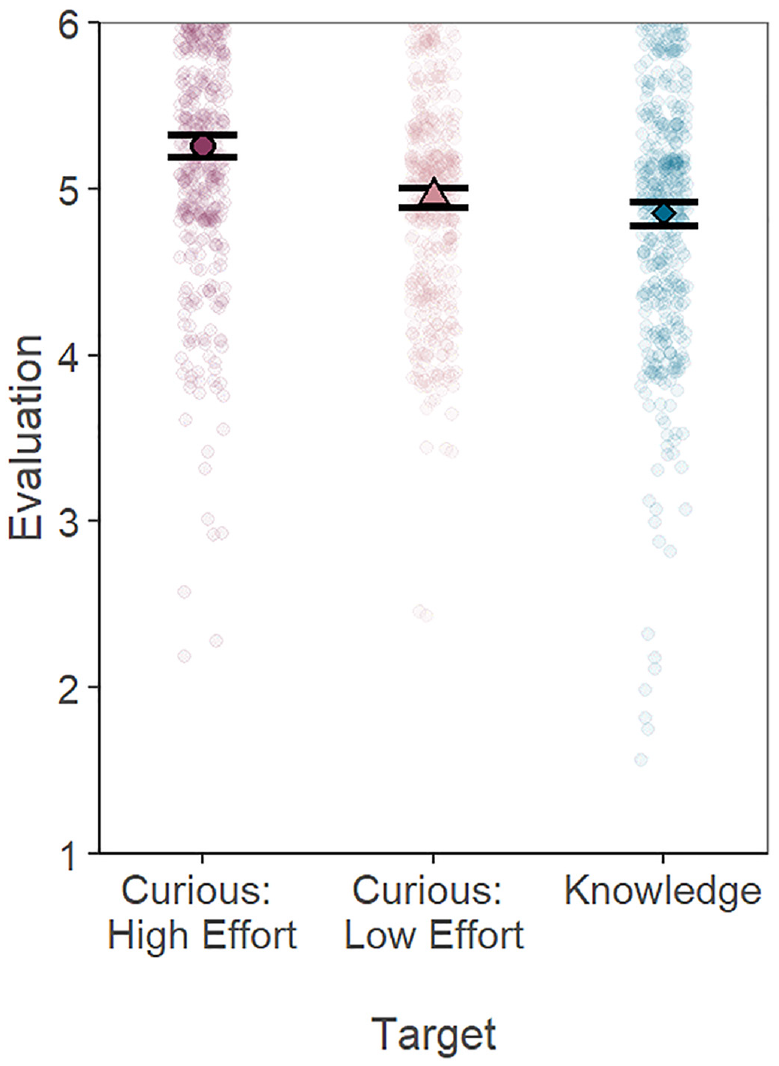
Mean Evaluations (With 95% Confidence Intervals) of Targets Who Were Curious and Put in a Lot of Effort, Curious but Did Not Put in Much Effort, or Knowledgeable
Study 4
Studies 1 to 3 demonstrated that religious participants viewed those who expressed curiosity about religion as more moral than those who were not curious and those who already received knowledge, partly due to the perception that curious targets exerted effort. Study 4 tested whether this effect is limited to domains of knowledge that observers view positively. We expected that directing curiosity to learn immoral or inappropriate information would signal negative character traits and lead observers to less moral evaluations. We therefore expected that religious curiosity would not elicit favorable moral evaluations from self-identified atheists, who do not endorse religious beliefs, and that both religious and non-religious participants would disapprove of curiosity directed toward learning how to effectively commit immoral actions. In addition, it was unclear in Studies 1 to 3 whether curiosity affected moral evaluations specifically or positive impressions more generally. Therefore, Study 4 also measured perceptions of the target’s warmth and competence, which comprise distinct dimensions of positive impressions (Goodwin et al., 2014).
Method
We preregistered the methods and analyses prior to running this study https://aspredicted.org/6gw8r.pdf.
Participants
We recruited United States adults who identified as either Christian or atheist in their Prolific profile, aiming for a sample size of 300 per sample (similar to the overall samples in Study 1 to 3 and sensitive to detect small within-sample effects [dZ = 0.16] with 80% power). After excluding participants who failed a comprehension check or selected an ineligible religion within the survey, the final sample included 613 participants.
Materials and Procedure
Participants read vignettes that manipulated the topic domain and whether the target was curious or not curious. Specifically, Study 4 included three domains: religious activity (prayer or religious celebrations, that is, information religious participants would likely view as positive and socially valued), hobbies (making pasta or collecting coins; neutral topics), or immoral behaviors (cheating in university or lying on a job application; negative topics). We expected these domains to vary in whether participants valued the information, allowing us to test whether positive evaluations might be limited to targets who demonstrated curiosity regarding valued (or at least neutral) topics. We compared curious and non-curious targets rather than knowledgeable targets to assess whether abstaining from certain types of (immoral) information may signal virtue. All participants evaluated 12 randomized targets (two for each curiosity-by-domain condition).
After reading a passage describing a target character, participants evaluated whether or not they were curious (a single-item manipulation check, answered on a 7-point Likert-type scale), competent (composite of “intelligent,” “competent,” and “clever”), warm (composite of “sociable,” “warm,” and “friendly”), and moral (composite of being a “good person,” “nice person,” and performing a “right” behavior) as well as the extent to which targets generally put in effort (from Study 3). Participants answered experimental items using 6-point bipolar scales scored so higher values indicated more positive evaluations. Participants also evaluated how moral the focal action was (one 7-point item, adapted to the vignette topic, e.g., “How immoral or moral is it to pray to God?”) and to what extent the target was committed to the action (one 5-point item, adapted to vignette topic, e.g., “Is she committed to praying to God?”). Question phrasing matched the gender of the target.
Results
Evaluations Across Conditions
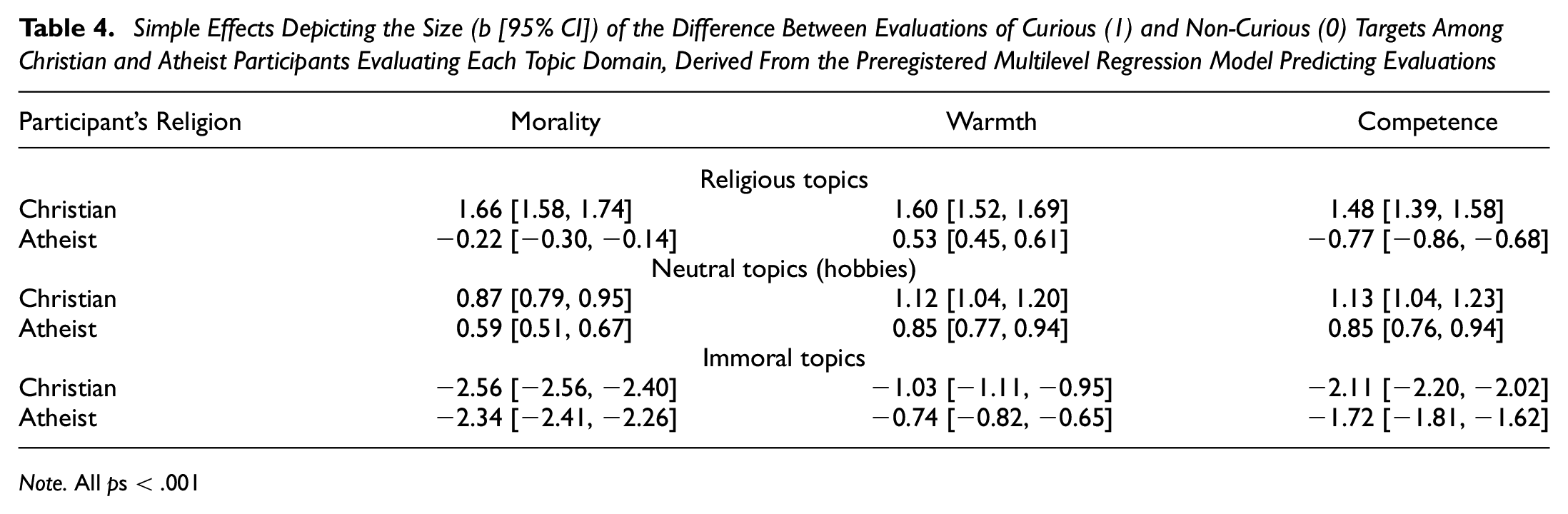
Preliminary analyses (available in the Supplementary Materials) confirmed that we successfully manipulated curiosity and domain valence. The main analyses were multilevel regression models that predicted evaluations from target curiosity, topic domain, participant religion (all conditions dummy coded), and all interactions between these three variables, with random intercepts by the participant. We conducted three separate analyses predicting evaluations of the target character’s morality, warmth, and competence. The models (available in full in the Supplementary Materials) revealed significant two-way interactions between curiosity and domain, domain and participant religion, and curiosity and participant religion, with interaction bs > 0.80 for moral evaluations, bs > 0.49 for warmth, and bs >0.35 for competence, ps < .001. We also observed significant three-way interactions between domain, curiosity, and participant religion, interaction bs > 1.60 for morality, bs > 0.80 for warmth, and bs > 1.96 for competence, ps < .001. To break down these results, Figure 4 depicts mean evaluations and Table 4 depicts model-derived simple effects of the difference between evaluations of the curious and non-curious targets.
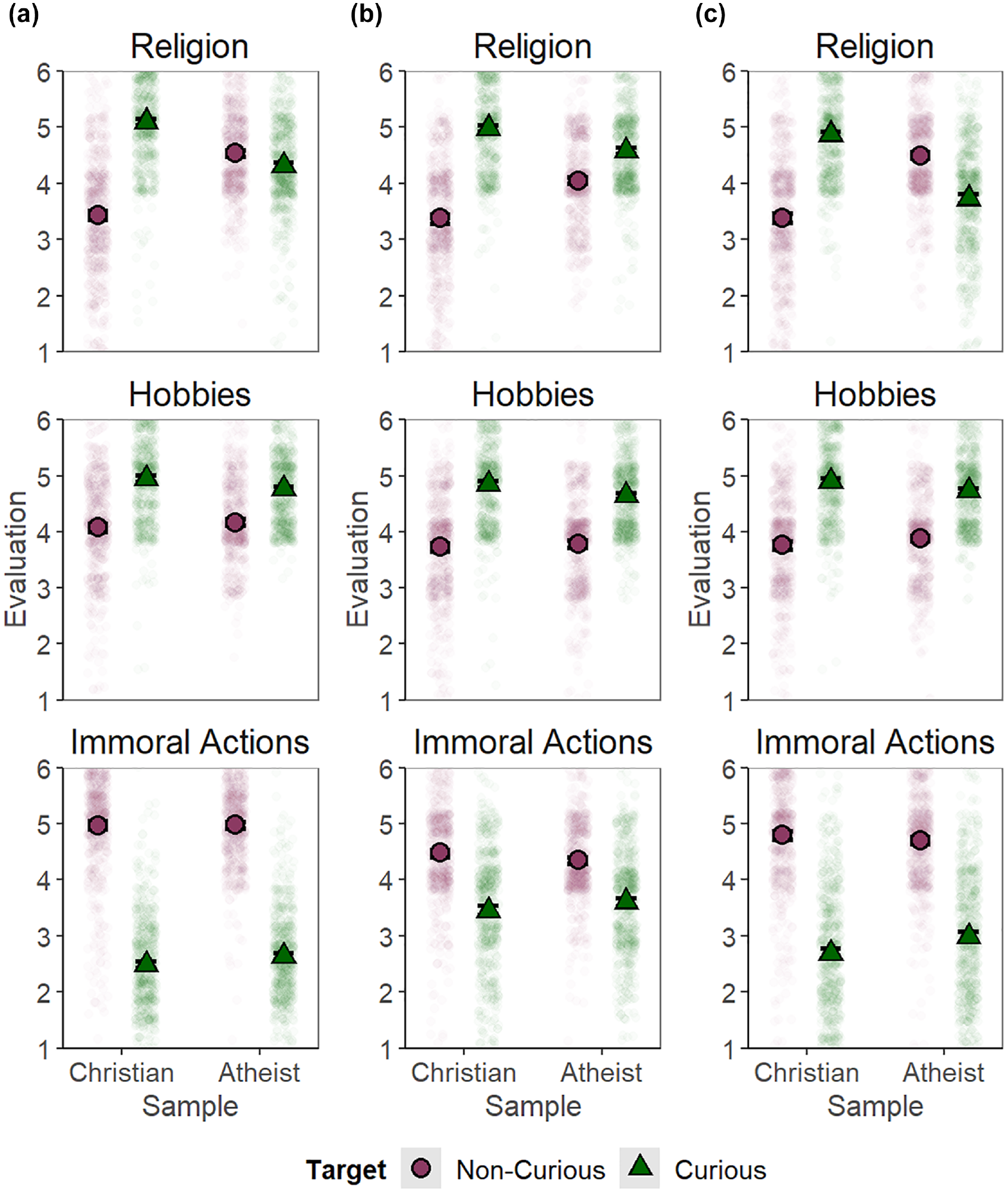
Mean Evaluations (With 95% Confidence Intervals) of Targets Who Were Curious Versus Non-Curious About Religion, Hobbies, or Immoral Behaviors Among Christian and Atheist Participants. Participants Evaluated Each Target’s (a) Moral Character, (b) Warmth, and (c) Competence
Simple Effects Depicting the Size (b [95% CI]) of the Difference Between Evaluations of Curious (1) and Non-Curious (0) Targets Among Christian and Atheist Participants Evaluating Each Topic Domain, Derived From the Preregistered Multilevel Regression Model Predicting Evaluations
Note. All ps < .001
For religion, we replicated the previous findings that Christian participants viewed the curious target as more moral than the non-curious target. Furthermore, Christians viewed curious targets as more warm and more competent than non-curious targets. Atheists showed a different pattern, viewing religiously curious targets as slightly less moral and less competent than non-curious targets, although atheists also rated religiously curious targets as warmer than non-curious targets.
When the topic of curiosity was hobbies or immoral behaviors, Christians and atheists showed similar evaluations. For hobbies, both Christians and atheists viewed curious targets as more moral, warmer, and more competent than non-curious targets, although among Christians the positive curiosity effect about hobbies was significantly smaller than the positive effect about religion. This result indicates that Christians were especially likely to infer positive traits when someone was curious (versus non-curious) about religion. Curiosity about how to perform immoral actions showed the opposite pattern: Both Christians and atheists rated curious targets as highly immoral, lower in warmth, and low in competence, and they positively evaluated non-curious targets.
Mediators of the Relations Between Curiosity and Moral Evaluations
We next tested the extent to which perceptions of effort mediated the relationships between target curiosity and moral evaluations and probed whether participants’ religion moderated these indirect pathways. These analyses, available in full in the Supplementary materials, replicated the findings of Studies 2 and 3. For religion, observers perceived that curious targets put in more effort, and effort predicted more favorable moral evaluations, although this indirect effect was stronger among Christians, b = 0.94 [0.86, 1.03], than among atheists, b = 0.29 [0.24, 0.34], ps < .001. Hobbies showed a similar moderated-mediation effect (indirect effort effect among Christians, b = 0.80 [0.73, 0.87], and among atheists, b = 0.55 [0.49, 0.61]). Immoral topics showed the opposite association such that curiosity predicted less effort; however, an effort still predicted more favorable moral evaluations, leading to a negative indirect effect among both Christians, b = −0.99 [−1.08, −0.91], and atheists, b = −0.83 [−0.92, −0.74].
Additional exploratory analyses applied this same moderated mediation model to predicting warmth and competence and found a similar pattern: curiosity indirectly predicted warmth and competence via effort. To test the uniqueness of the indirect pathway via effort, we added warmth, competence, and commitment to the topic as additional indirect pathways between curiosity and morality. For religion, warmth and competence were the strongest mediators, suggesting that part of the association between effort and moral evaluations was due to the perception that people who put in the effort were also warmer and more competent, which in turn predicted perceptions of morality (see Supplementary Materials for full results).
General Discussion
Across four experiments, religious participants viewed curiosity about religion—lacking knowledge but wanting to learn—as more virtuous than receiving knowledge without being curious and lacking knowledge without trying to remedy one’s ignorance. The most positive evaluations did not come from merely knowing the answers (a positively evaluated signal of competence; Fiske et al., 2007) but from a curiosity-motivated pursuit of information when knowledge was lacking. These positive impressions of curious individuals indicate that curiosity often serves as a signal of virtue rather than vice. Participants judged that curiosity was morally good across domains including in-group religions, out-group religions, and science, a pattern that expands scientific understanding of the parallels and discrepancies between religious and scientific cognition (Clegg et al., 2019; Liquin et al., 2020; Shtulman, 2013). We found no evidence that religious curiosity generated negative evaluations among members of any religious denomination. Only atheists evaluated a lack of religious curiosity more positively than its presence, but even atheists evaluated religious curiosity as morally neutral or slightly positive. Atheists also perceived religiously curious targets as warmer (if not more moral or competent) than noncurious targets, consistent with the expectation that interest in religion signals trustworthiness even among atheists (Gervais et al., 2017).
The perception that curious individuals put in effort to acquire knowledge partly explained this moral valuation of curiosity, as evident in both observers’ perceptions (Studies 2 and 4) and through the elimination of a curiosity/knowledge difference when curious targets only put in minimal effort to learn information (Study 3). People in many cultures (e.g., the United States, South Korea, and France) perceive expending effort as morally valuable and indicative of good cooperation partners (Celniker et al., 2023; Furnham, 1984). Our findings provide novel evidence that expressions of curiosity elicit positive impressions in part by signaling a person’s willingness to put in the effort, signaling morality even in the absence of competencies in socially valued domains. A willingness to exert effort to satisfy curiosity is, therefore, another component of lay theories of virtue that is distinct from being merely competent or prosocial toward others. Curiosity may signal a range of socially desirable traits, including being hardworking, warm, and even competent (despite lacking knowledge), and observers view targets with these virtues as morally good (Study 4).
The strength of curiosity’s effect on moral evaluations varied among groups and topics, suggesting that curiosity signals morality most strongly when it motivates effort to acquire desirable information. Evangelical Christians displayed the most positive moral evaluation of curiosity-motivated religious information-seeking, whereas Jews and non-evangelical Christians showed smaller effects, and atheists viewed a lack of religious curiosity as particularly moral. Among Christians, curiosity’s effect on morality was also stronger for religious than innocuous topics, although curiosity about hobbies also elicited positive evaluations, whereas curiosity about how to perform immoral actions elicited negative evaluations among all groups. This pattern indicates that observers generally perceive curiosity as a virtue when directed toward learning valued information. Abstaining from seeking religious information may be problematic when it means failing to acquire valued information such as appropriate religious beliefs. However, curiosity may serve as a weaker or more negative social signal when directed toward acquiring less-valued information.
Future research may reveal additional religious groups or situations where individuals do not value curiosity. Our studies tested a range of stimuli about unobservable entities and group norms, but there may be additional topics that are especially controversial and therefore not perceived as appropriate for curiosity-motivated investigation. While religious people generally value science, religion and science sometimes make competing claims (e.g., about human evolution or climate change), and religious adherents may view scientific claims as inappropriate targets of curiosity in these contexts (Elsdon-Baker & Lightman, 2020; Sharp & Leicht, 2020). People may also disapprove of curiosity about questions that could reflect negatively on their religion, such as why God lets bad things happen to good people or curiosity about religious out-groups that people believe are their enemies.
The United States provided an appropriate context for our initial tests because it is relatively religiously diverse and moderately high in cultural narratives about science/religion conflict (Elsdon-Baker & Lightman, 2020; Pew Research Center, 2015), thus providing a plausible context to find variation across domains and denominations. However, different patterns may appear among members of other religious communities living in other countries, especially where people ascribe less virtue to effortful actions or independent information-seeking. In these contexts, people may value religious curiosity less and for different reasons than what we observed.
Altogether, our studies demonstrate positive moral evaluations of people who express curiosity about religion and science due to the perception that curious individuals work hard to resolve gaps in valued knowledge domains. These findings expand scientific understanding of moral cognition, curiosity, and the cognitive science of religion by illuminating the perception that curiosity is a virtuous way to learn socially valued information, where knowledge is less important than having the right mindset toward learning something new.
Supplemental Material
sj-docx-1-spp-10.1177_19485506231195915 – Supplemental material for Adults Show Positive Moral Evaluations of Curiosity About Religion
Supplemental material, sj-docx-1-spp-10.1177_19485506231195915 for Adults Show Positive Moral Evaluations of Curiosity About Religion by Cindel J. M. White, Ariel J. Mosley and Larisa Heiphetz Solomon in Social Psychological and Personality Science
Footnotes
Handling Editor: Will Gervais
Declaration of Conflicting Interests
The author(s) declared no potential conflicts of interest with respect to the research, authorship, and/or publication of this article.
Funding
The author(s) disclosed receipt of the following financial support for the research, authorship, and/or publication of this article: This project was made possible through the support of Grant #61808 from the John Templeton Foundation to LHS and an SSHRC Insight Development Grant (#430-2022-00762) to CJMW. The opinions expressed in this publication are those of the authors and do not necessarily reflect the views of the John Templeton Foundation.

Supplemental Material
The supplemental material is available in the online version of the article.
Notes
Author Biographies
References
Supplementary Material
Please find the following supplemental material available below.
For Open Access articles published under a Creative Commons License, all supplemental material carries the same license as the article it is associated with.
For non-Open Access articles published, all supplemental material carries a non-exclusive license, and permission requests for re-use of supplemental material or any part of supplemental material shall be sent directly to the copyright owner as specified in the copyright notice associated with the article.
