




Abstract
Regulatory selection flexibility—the ability to flexibly choose emotion regulation strategies that are appropriate to dynamic contextual demands—has been theorized as a critical component of adaptive emotional functioning. Despite this, little research has investigated whether individual differences in regulatory selection flexibility influence real-time emotional experiences. The current study aimed to test the effectiveness of regulatory selection flexibility in reducing negative affect while exposed to emotion-eliciting stimuli. Using a behavioral regulatory selection task, participants viewed negative images that differed in emotional intensity and selected between engagement cognitive change (reappraisal) or attentional disengagement (distraction) strategies to manage their emotional responses. Negative affect was rated immediately before and after the regulatory period, to index emotional experience. Greater regulatory selection flexibility was associated with greater reductions in negative affect. Our findings offer preliminary evidence for the immediate psychological benefit of regulatory selection flexibility and highlight some promising avenues for future research.
There is a growing consensus that the adaptiveness of any given emotion regulation strategy is context-dependent, rather than universal, and depends on the appropriateness of the strategy to the specific situation in which it is used (strategy-fit hypothesis, Aldao et al., 2015). Consequently, emotion regulation flexibility, which refers to the ability to vary one’s regulatory behavior to match differing situational demands, has been theorized as a central aspect of adaptive emotional responding (Aldao et al., 2015; Bonanno & Burton, 2013). One important type of emotion regulation flexibility is regulatory selection flexibility referring to an individual’s capacity to select between different emotion regulation strategies in a way that is attuned to dynamic contextual demands (Sheppes, 2020).
Research has found an association between regulatory selection flexibility and psychological functioning. For instance, Levy-Gigi et al. (2016) found that regulatory flexibility moderated the relationship between trauma exposure and post-traumatic stress disorder (PTSD) among war-exposed firefighters. A significant positive correlation between trauma exposure and PTSD was only evident among participants who also exhibited low regulatory selection flexibility. For those with high regulatory selection flexibility, there was no significant association between trauma exposure and PTSD. Relatedly, Fine et al. (2021) found that university students with high levels of PTSD symptoms as well as women diagnosed with PTSD due to prior childhood sexual assault both demonstrated significantly reduced regulatory selection flexibility compared with matched controls. These studies highlight the potential significance of regulatory selection flexibility as a mechanism linked to psychopathology and suggest that targeting flexibility may be a fruitful avenue for clinical treatments. However, despite these promising findings, the immediate impact of regulatory selection flexibility on emotional experiences following aversive emotional stimuli has not yet been investigated. Testing whether there is a direct temporal link between regulatory selection flexibility and subsequent emotional experiences is an important experimental step in verifying regulatory flexibility as a mechanism underpinning psychological functioning.
To investigate a link between regulatory selection flexibility and emotional outcomes, research designs that include both a measure of the emotional context and an assessment of emotion regulation strategy selections are needed. Prior experimental investigations of regulatory selection flexibility (Fine et al., 2021; Levy-Gigi et al., 2016) have employed the regulatory selection paradigm as a way to behaviorally measure regulatory selection flexibility (Sheppes, 2020; Sheppes et al., 2011). Although there are a myriad of ways that the features of situations can differ, the current study focuses on emotional intensity as an important factor that influences regulatory behavior. It has been robustly demonstrated that the emotional intensity of stimuli, when experimentally manipulated, prompts divergent emotion regulation strategy choices (see Matthews et al. (2021) for a meta-analysis, see Sheppes (2020) for a review]. Healthy individuals, over a range of unpleasant stimuli (e.g., negative images, words and sounds, electric shocks), change their regulatory behavior in line with differing levels of emotional intensity (Sheppes, 2020). Under high-intensity conditions, healthy individuals exhibit a strong preference for distraction, as a means to disengage their attention early to prevent emotional processing and the likely development of strong negative emotions. Conversely, under low-intensity conditions, there is a strong preference for reappraisal, to allow engagement with, and reinterpretation of the meaning of, the emotional information as a way to modulate the subsequent emotional response. In support of this, distraction has been found to be effective in regulating affect in response to high-intensity stimuli, while reappraisal has been found to be effective in regulating negative affect in response to low-intensity stimuli (Shafir et al., 2016).
Consequently, the regulatory selection paradigm operationalizes regulatory selection flexibility as a greater tendency to select distraction in response to high-intensity emotional stimuli, and reappraisal in response to low-intensity emotional stimuli (Fine et al., 2021; Levy-Gigi et al., 2016; Shabat et al., 2021). In the regulatory selection paradigm (Sheppes et al., 2011), participants view a series of negative images and, for each image, are prompted to choose either reappraisal or distraction to help reduce their negative emotion while viewing that image. These images are categorized into either low or high negative emotional intensity based on normative ratings. Accordingly, regulatory flexibility has been operationalized in this paradigm as a greater capacity to match one’s strategy selections to the image intensities, by preferencing distraction for high-intensity images and reappraisal for low-intensity images. In practice, this is evidenced by an increase in the use of distraction for high-intensity image trials (where such use of distraction is considered most appropriate), compared with low-intensity images (where the use of distraction is less appropriate than reappraisal) (Fine et al., 2021; Levy-Gigi et al., 2016; Shabat et al., 2021). Consequently, it offers an ecologically valid approximation of regulatory behavior that adheres to the prevailing definitions of regulatory flexibility (Aldao et al., 2015; Bonanno & Burton, 2013).
The Present Research
We aimed to investigate the effectiveness of regulatory selection flexibility in reducing negative affect when dealing with negative emotional events. We adapted Sheppes et al.’s (2011) original regulatory selection paradigm to include two additional variables; pre-regulation negative affect and implementation efficacy. First, a pre/post design that measured negative affect prior to, and immediately following, the regulation period was important to determine the effectiveness of regulation selection flexibility in reducing negative affect. This is because post-regulation negative affect is only interpretable after accounting for variation in pre-regulation negative affect (Sheppes, 2020). The inclusion of a measure of pre-regulation negative affect (i.e., negative affect prior to the regulation period) allowed us to more accurately investigate the impact of regulatory selection flexibility on negative affect and account for individual differences in participants’ initial level of emotional reactivity to the images. Second, participants’ capacity to implement the specific emotion regulation strategies used in the study (i.e., implementation efficacy) was also measured. This variable was included to control for individual variation in how skilled each participant was in using reappraisal and distraction. We did this to reduce the possibility that the effectiveness of regulatory selection flexibility was not confounded by participants who may have had a skills deficit in one or both strategies. Furthermore, a prior study by Gruber et al. (2012) comparing the regulatory behavior of participants with and without bipolar disorder found that while these two groups made similar regulatory selections, participants with bipolar reported lower implementation efficacy, reporting that they used more effort and felt less able to use the chosen strategy. Of interest, this discrepancy in implementation efficacy, despite similar regulatory behavior, appeared to be especially related to reappraisal choices. This finding highlights the importance of measuring trial-level implementation efficacy as a way to control for the influence of individual differences in participants’ execution of specific strategies on our outcome variable (negative affect). We hypothesized that greater regulatory selection flexibility would be associated with lower negative affect, over and above the influence of strategy implementation efficacy.
Method
Participants
129 Australian university students participated in the current study, in exchange for research credit (aged 17–44, mean age 20, 98 females). One participant’s experimental data did not save due to an unexpected E-Prime error and was thus excluded from analysis. The majority of participants reported having an Asian cultural background (65%), followed by Anglo-Saxon/European (23%), Middle Eastern (4%), and Other (8%).
Procedure
The present study was conducted in a research laboratory using E-Prime. The experimental procedure closely followed that of Sheppes et al. (2011) with the addition of pre-regulation negative affect ratings and implementation efficacy ratings. The paradigm comprised three phases; a teaching phase, a practice phase, and an experimental phase. During the teaching phase, participants received written and verbal instructions (Sheppes et al., 2014) on how to employ reappraisal and distraction (counterbalanced). Following each instruction, participants completed two practice trials. Participants then completed eight practice trials, where participants chose either reappraisal or distraction while viewing each image. During the teaching and practice phases, participants spoke out loud what they were thinking while viewing each image, and the experimenter provided corrective feedback if a participant’s response suggested they had misunderstood or misapplied the emotion regulation strategy.
The experimental phase (see Figure 1) comprised 30 trials. First, participants viewed a fixation cross before an image was previewed on the screen. Participants then rated their negative affect (pre-regulation negative affect). Next, participants were prompted to select either reappraisal or distraction to use when the image reappeared. Once a regulatory choice was made, participants were given 2000ms to prepare before the image reappeared for 5000ms. When the image reappeared, participants were instructed to use only their chosen strategy. After each image, participants rated their negative affect (post-regulation negative affect) and implementation efficacy. The order of the images was randomly generated for each participant. To verify participants’ adherence to their selected strategy, at the end of eight randomly selected trials, participants were asked to type one sentence describing how they implemented their selected emotion regulation strategy. A judge who was blinded to participants’ choices subsequently coded the sentences for adherence to reappraisal or distraction. Consistent with past research (Levy-Gigi et al., 2016), levels of agreement were near perfect (99.3%).
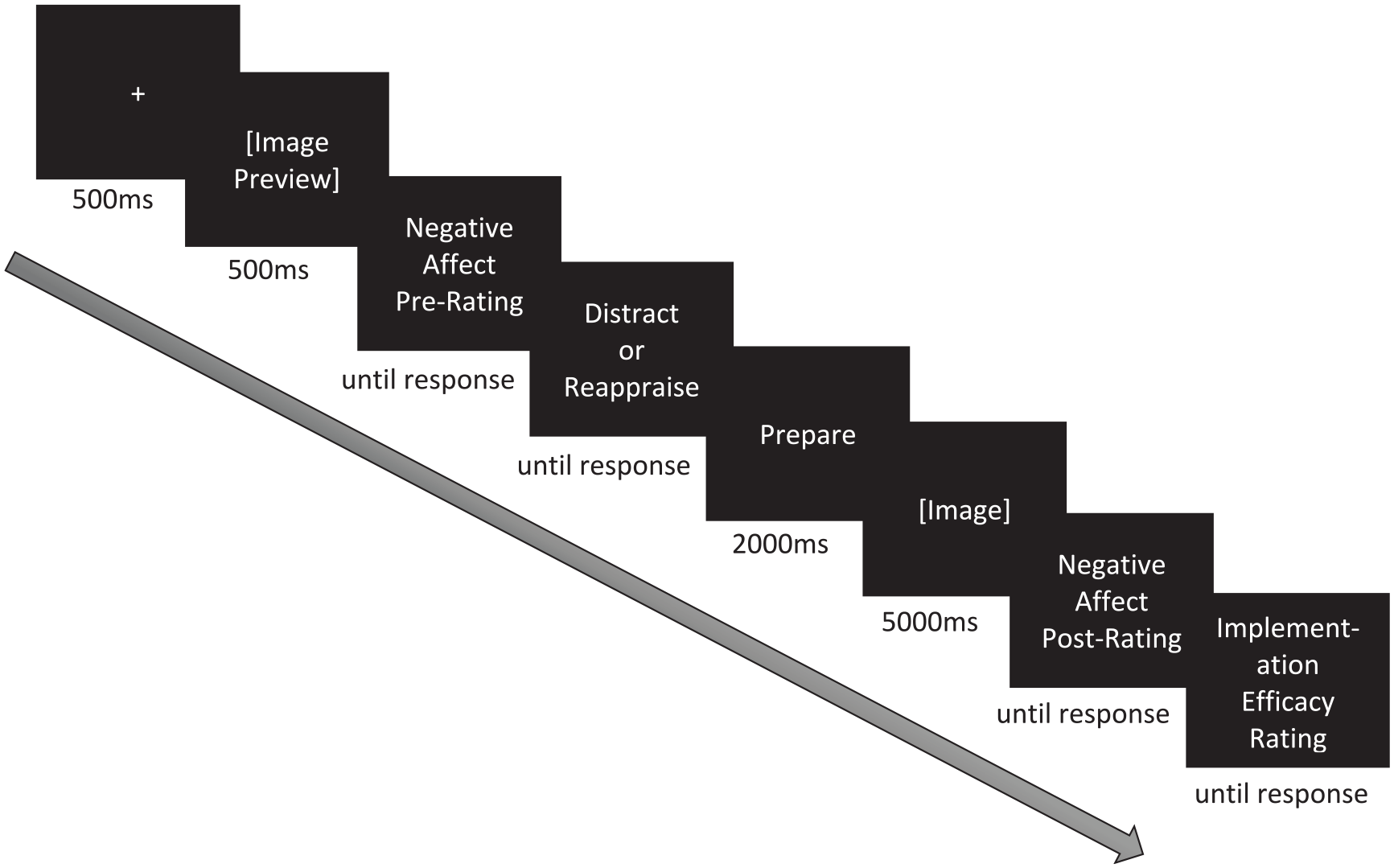
Illustration of Experimental Trial Structure in the Adapted Regulatory Selection Paradigm
Measures and Materials
See Supplemental Material available online for further information on the study materials.
Negative Affect
Consistent with past studies (Sheppes et al., 2014), participants rated how negative they felt using a 9-point Likert-type-like scale (1 = not negative at all; 9 = very negative). Two means were created; one indexing overall negative affect before emotion regulation strategy use (pre-regulation negative affect) and one indexing overall negative affect following emotion regulation strategy use (post-regulation negative affect).
Implementation Efficacy
Adapted from Sauer et al.’s (2016) study, participants rated how well they were able to implement the emotion regulation strategy they had selected using a 5-point Likert-type scale (1 = I was completely unable to employ the strategy effectively; 5 = I was completely able to employ the strategy successfully). A mean of these items was calculated to index overall implementation efficacy.
Stimuli
Stimuli used in the regulatory selection paradigm comprised 30 international affectice picture system (IAPS) images that were identical to the original regulatory selection studies (Sheppes et al., 2011). Although the regulatory selection paradigm has been validated using a wide variety of experimental stimuli, including electric shocks, negative words, aversive sounds, positive stimuli and Coronavirus-related threats, negative images are most commonly used (Matthews et al., 2021). A key benefit of using the IAPS is that it provides a standardized image battery that ensures that participants are responding to uniform stimuli (rather than idiosyncratic stressors). The IAPS image battery in the present study comprised 15 low-intensity, and 15 high-intensity, images, pre-determined by normative arousal and valence ratings. The images depicted deaths, injury/mutilation, war-related violence, and interpersonal violence.
Data Analysis
Research has robustly demonstrated that healthy individuals predominantly select reappraisal to regulate low-intensity images and distraction to regulate high-intensity images (see Matthews et al., 2021 for meta-analysis). Therefore, this pattern of strategy selection can be taken to indicate an adaptive use of each strategy across these emotional contexts. Accordingly, adaptive regulatory selection flexibility has been operationalized as a maximal switch in regulatory preference from selecting reappraisal (or not selecting distraction) during low-intensity images to selecting distraction during high-intensity images (Levy-Gigi et al., 2016). In line with past studies (Fine et al., 2021; Levy-Gigi et al., 2016; Shabat et al., 2021), regulatory selection flexibility was calculated using a subtraction score where the proportion of distraction choices while viewing low-intensity images (i.e., maladaptive regulatory choices) was subtracted from the proportion of distraction choices while viewing high-intensity images (i.e., adaptive regulatory choices). This yielded a continuous variable that represented the extent to which each participant’s distraction choices increased from low- to high-intensity trials, where higher scores reflected greater regulatory flexibility. Previous research has demonstrated adequate internal and test–retest reliability of this indicator (Fine et al., 2021; Levy-Gigi et al., 2016).
To test our hypotheses, a linear mixed model analysis was conducted using SPSS version 29. Trial-level data were clustered within participants. Random effects were modeled using variance components as the covariance structure and intercepts were included as random coefficients. There was no missing data across the predictor or dependent variables. Trial-level predictors of post-regulation negative affect were image intensity (low vs. high), regulatory choice (reappraisal vs. distraction), and the interaction of the linear effects of image intensity and regulatory choice. Person-level predictors of post-regulation negative affect were regulatory selection flexibility. Control variables were pre-regulation negative affect (trial-level) and implementation efficacy (trial-level). This model allowed us to investigate the impact of regulatory selection flexibility on post-regulation negative affect, after accounting for trial-level processes, as well as explore the effectiveness of pairing certain strategy choices with different image intensities on a trial level. Re-running this analysis without the control variables (i.e., a mixed model with only the linear effects of image intensity, regulatory choice, and regulatory selection flexibility, and the interaction effect of image intensity and regulatory choice) yielded slight differences in parameter estimates but unchanged overall findings. A post hoc sensitivity power analysis conducted using GPower 3.1.9.7 indicated that our sample size was sufficient to detect a small-medium effect (f 2 = 0.08) with power (1−β) of .80 and α of .05.
Results
Preliminary Analyses
Verification of Image Intensity Categories
We included this verification step as past research has shown that individualized brain reactivity to experimental images predicted regulatory choices (Shafir et al., 2016). Accordingly, to verify the low- and high-intensity categories, all 30 images were rank ordered according to baseline emotional reactivity (pre-regulation negative affect), where a low rank represented images that elicited less negative emotion among our sample. We expected that the 15 lowest ranked images would comprise the 15 images that were part of the pre-designated low-intensity category based on prior IAPS norms, while the 15 highest ranked images would comprise the 15 pre-designated high-intensity images. Almost all images (28/30) were consistent with normative ratings. However, one ostensibly high-intensity image actually elicited relatively low negative affect (rank order = 6/30) in our sample. In addition, one ostensibly low-intensity image elicited relatively high negative affect (rank order = 16/30). Accordingly, we switched the designated image intensity categorization for these two images.
We conducted paired-samples t-tests to confirm that negative affect ratings significantly differed between low- and high-intensity images. As expected, the high-intensity images elicited significantly greater negative affect than the low-intensity images at both pre, t(127) = −32.621, p < .001, and post, t(127) = −25.933, p < .001, indicating that the experimental manipulation of image intensity to generate two distinct emotional contexts was successful.
A regulatory selection bias, consistent with the original paradigm, was also replicated; an increase in distraction choices from low-intensity (32.8%) to high-intensity (58.4%) trials was significant, χ2(1) = 254.095, p<.001.
Correlations
Bivariate correlations were computed. Post-regulation negative affect was significantly correlated with pre-regulation negative affect (r = .809, p < .001), implementation efficacy (r = −.497, p < .001), and regulatory selection flexibility (r = −.212, p = .008). In addition, pre-regulation negative affect was correlated with implementation efficacy (r = −.200, p < .001).
Linear Mixed Model Analysis
Results of the linear mixed model analysis are presented in Table 1. 1 As hypothesized, after accounting for trial-level variables, greater regulatory selection flexibility predicted significantly lower post-regulation negative affect. Also, as expected, both trial-level control variables significantly predicted post-regulation negative affect. Specifically, greater pre-regulation negative affect predicted greater post-regulation negative affect, and greater implementation efficacy predicted lower post-regulation negative affect.
Linear Mixed Model Results: Effect of Regulator Selection Flexibility and Trial-Level Variables on Post-Regulation Negative Affect
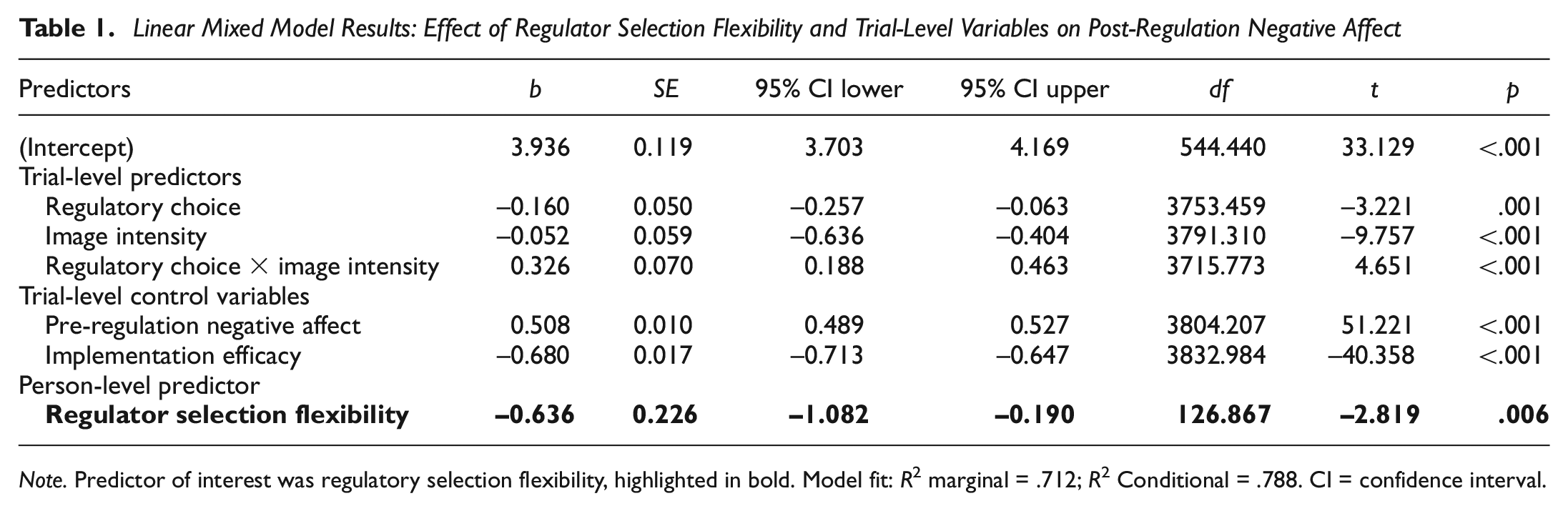
Note. Predictor of interest was regulatory selection flexibility, highlighted in bold. Model fit: R 2 marginal = .712; R 2 Conditional = .788. CI = confidence interval.
Although not the primary focus of the present study, results from the linear mixed model also indicated that all trial-level predictors were significantly associated with negative affect. First, regarding regulatory choice, reappraisal choices were associated with significantly lower post-regulation negative affect than distraction choices. This pattern of results was to be expected, given that reappraisal was chosen significantly more for low-intensity image trials (i.e., where negative affect was significantly lower). Second, regarding image intensity, high-intensity images were associated with significantly greater post-regulation negative affect than low-intensity images. Again, this pattern of results is to be expected and indicated that the experimental manipulation of image intensity to generate two distinct emotional contexts was successful. Finally, the regulatory choice x image intensity interaction effect was also significant. When disaggregating this effect, we found no significant difference in post-regulation negative affect between reappraisal versus distraction choices over low-intensity trials (Mreappraisal = 2.206, Mdistraction = 2.144, p = .160) or high-intensity trials (Mreappraisal = 4.311, Mdistraction = 4.396, p = .130). Instead, this interaction effect appeared to emerge in the comparison between low- versus high-image intensity. Specifically, choosing reappraisal for low-intensity images was associated with lower post-regulation negative affect than choosing reappraisal for high-intensity images (p<.001) and similarly, choosing distraction for low-intensity images resulted in lower post-regulation negative affect than choosing distraction for high-intensity images (p<.001).
Discussion
The current study, to our knowledge, was the first to investigate the immediate impact of regulatory selection flexibility on negative affect in response to aversive emotional stimuli. We sought to test the effectiveness of regulatory selection flexibility in reducing negative affect while viewing negative images of differing emotional intensity. As hypothesized, we found that greater regulatory selection flexibility during the behavioral task was associated with lower post-regulation negative affect, over and above the influence of trial-level processes including pre-regulation negative affect (i.e., baseline emotional reactivity) and implementation efficacy (i.e., strategy execution). This finding suggests that the adoption of a flexible pattern of regulatory selection conferred an immediate psychological benefit. Our finding offers evidence in support of regulatory selection flexibility as an effective approach to managing emotional responding.
Our finding also aligns with prior investigations suggesting the relevance of regulatory selection flexibility to trauma-related psychopathology. For instance, Fine et al. (2021) found that both student and clinical samples with greater PTSD symptomology evidenced significantly reduced regulatory selection flexibility compared with PTSD-free matched controls. In addition, Levy-Gigi et al. (2016) found that regulatory selection flexibility moderated the link between trauma exposure and PTSD among war-exposed firefighters. Specifically, the well-established dose–response relationship seen in PTSD research, where greater trauma exposure predicts greater PTSD symptom severity (Brewin et al., 2000), was only evident among firefighters with low regulatory flexibility. Firefighters who demonstrated higher regulatory flexibility, as indexed by the regulatory selection paradigm, showed no association between trauma exposure and PTSD symptomology. These studies highlight the potential role of regulatory flexibility as a psychological mechanism underpinning trauma-related psychopathology. Our finding extends existing knowledge by demonstrating the temporal link between regulatory flexibility and emotional experiences immediately following exposure to aversive emotional stimuli. In this way, our study offers initial evidence that greater regulatory flexibility may aid in down-regulating negative emotions while exposed to emotional triggers and thus may have the potential to function as a protective psychological mechanism in the context of trauma-related psychopathology. It would be valuable for our study to be replicated with clinical samples to explore whether the effectiveness of regulatory selection flexibility is influenced by the presence of psychopathology. As the current study did not measure baseline levels of psychopathology, it remains unclear whether psychopathology moderates the extent to which participants displayed, or benefited from, regulatory flexibility. Such research is particularly relevant as prior studies have identified that psychopathology may be associated with a deficit in regulatory flexibility, where regulatory flexibility has been observed in up to 90% of healthy controls yet less than 50% of PTSD patients (Fine et al., 2021; Sheppes, 2020).
Of note, regulatory selection flexibility remained a significant predictor of post-regulation negative affect after controlling for all trial-level processes including pre-regulation negative affect, implementation efficacy, regulatory selection, stimulus intensity and the interaction between regulatory selection and stimulus intensity. The present study adapted Sheppes et al.’s (2011) original paradigm to additionally measure participants’ initial levels of emotional reactivity to each image (pre-regulation negative affect) as well as how skilled participants were in implementing their chosen strategies (implementation efficacy). We did this to ensure the interpretability of the post-regulation negative ratings (Sheppes, 2020), as well as to directly test the impact on regulatory flexibility over and above these factors, as we reasoned that these variables would likely also influence post-regulation negative affect. Accordingly, our findings suggest that regulatory selection flexibility uniquely influenced participants’ capacity to down-regulate negative affect.
It is noteworthy that both pre-regulation negative affect and implementation efficacy emerged as distinct and significant predictors. Our finding that greater pre-regulation negative affect predicted greater post-regulation negative affect is consistent with prior research suggesting participants’ baseline levels of emotional reactivity is a relevant consideration when investigating subsequent outcomes (Kuo et al., 2018). Although we are unaware of research specifically investigating the influence of self-reported implementation efficacy on regulatory flexibility, research by Sauer et al. (2016) found that participants with depression or borderline personality disorder reported feeling less successful in implementing emotion regulation strategies than control participants, despite often making similar emotion regulation choices as control participants during the regulatory selection task. Taken together, this indicates that participants who have higher baseline levels of emotional reactivity or feel less skilled in using emotion regulation strategies, may have poorer psychological outcomes when confronted with triggers. It may be fruitful for future investigations to explore whether explicit instruction in regulatory flexibility may be especially beneficial to such individuals to overcome these vulnerability factors.
Also of interest, the interaction between trial-level regulatory choice and stimuli intensity emerged as a significant predictor of negative affect. There was a significant difference in negative affect between low- versus high-intensity images for both reappraisal choices and distraction choices. Specifically, reappraising low-intensity images resulted in lower negative affect than reappraising high-intensity images, and distracting during low-intensity images resulted in lower negative affect than distracting during high-intensity images. This finding is to be expected and suggests that it is easier to regulate low-intensity images relative to high-intensity images. However, there was no significant difference between reappraisal versus distraction choices for either low- or high-image intensity trials, which differs from findings in previous regulatory selection research. Prior research has demonstrated that selecting reappraisal (instead of distraction) for low-intensity emotional stimuli and selecting distraction (instead of reappraisal) for high-intensity emotional stimuli confers a neuro-affective benefit, of larger Latent Positive Potential modulation, and (in instances where reappraisal is chosen instead of distraction for low-intensity stimuli) better memory of the emotional information (Ilan et al., 2020; Shafir et al., 2016; Sheppes, 2020). Furthermore, previous studies have found that participants who adopt this pattern of regulatory selections also exhibit better psychological functioning (Fine et al., 2021; Shabat et al., 2021). It is, thus, unexpected that in our trial-level analysis we did not find reappraisal choices to result in lower negative affect than distraction choices for low-intensity images, or distraction choices to result in lower negative affect than reappraisal choices for high-intensity images. Indeed, the descriptive pattern of the means suggested virtual equivalence between the two strategies across both low- and high-intensity trials. Taken together, while reappraising low-intensity emotional stimuli, and distracting during high-intensity emotional stimuli, is a robust regulatory preference that has been linked (in previous studies) to adaptive outcomes, our finding suggests that the immediate differences in the impact of reappraisal versus distraction on self-reported affect appear to be negligible. In other words, it may be that the adaptive benefits of particular strategy selections only emerge as an accumulative or longer-term effect. However, as few studies have explored the immediate impact of regulatory choices on self-reported affect, replication of our study is an important next step to verify the robustness of this finding. In addition, it is important to acknowledge that this interaction effect may be confounded by a number of factors, which make interpretation of its result, as a definitive test of the strategy-fit hypothesis, limited. The regulatory selection paradigm allows participants to freely choose between reappraisal and distraction for each image trial. Accordingly, strategy choices are not randomly assigned, but rather, influenced by variables such as stimulus intensity, as evidenced by our replication of the regulatory selection bias. This means that we would not necessarily expect to see significant differences between the effectiveness of distraction versus reappraisal choices across either low- or high-intensity trials precisely because of the interdependence between these two variables (regulatory choice and image intensity). Future investigations where regulatory choices are randomly assigned, or instructed, may allow for a more accurate test of the effectiveness of the strategy-fit hypothesis on a trial level.
Notwithstanding this, the lack of a significant difference between regulatory strategies across either low- or high-intensity images may indicate that, while reappraisal was predominantly chosen for low-intensity images and distraction was predominantly chosen for high-intensity images, choices that did not follow this pattern did not necessarily confer significantly poorer affective outcomes on a trial-level. For example, for participants who were less emotionally activated by putatively “high-intensity” images, it may have been that choosing to reappraise during such trials was an appropriate choice. Indeed, emerging research using the regulatory selection paradigm has demonstrated that an individual’s personal appraisal of the emotional intensity of the images is a strong predictor of subsequent regulatory choices (Matthews et al., 2021). Although tentative, given the potential interpretation complexities within this interaction effect, our finding raises interesting questions regarding the trial-level processes involved in regulatory selection; specifically, who benefits most from reappraising low-intensity images and distracting high-intensity images, and under what circumstances? Our findings contribute to a growing field within emotion regulation research seeking to investigate specific person-level and trial-level factors that influence the efficacy of regulatory choices (Matthews et al., 2021) and highlight that further research aimed at disentangling these factors is warranted.
Several limitations and avenues for future research are worth noting. First, we cannot infer the causal role of regulatory flexibility on post-regulation negative affect. As participants were able to freely choose between strategies, it is possible other factors may have influenced participants’ strategy selections and subsequent negative affect (Sheppes, 2020). It may be fruitful for future studies to develop a paradigm in which flexibility is experimentally manipulated, such as by instructing participants to use either a flexible or inflexible emotion regulation approach during the behavioral task. Although this represents a different operationalization of regulatory flexibility, such a paradigm may be helpful in testing whether more flexible regulatory approaches are directly responsible for lower negative affect. Second, while the current study conceptualized implementation efficacy as a control variable, it would be interesting for future research to explore the potential mediating role of implementation efficacy in the relationship between regulatory flexibility and affective outcomes. Furthermore, we acknowledge that the extent to which participants can accurately self-evaluate implementation efficacy may be limited. Future studies could be improved by triangulating self-report ratings with more objective indicators, like psycho-physiological markers, or more global indicators, like trait generalized self-efficacy. We also note that, while we had a culturally diverse English-speaking sample, a majority of individuals were from Asian backgrounds. Future studies are needed to explore the cross-cultural specificity of our findings.
Finally, though experimentally rigorous, the use of the regulatory selection paradigm to assess flexibility necessarily limits the generalizability of our findings. The specific parameters of the paradigm used in the present study, such as the emotional stimuli (images), the feature of the stimuli that was manipulated (varying stimulus intensity) and emotion regulation strategies (reappraisal and distraction) represent just one way that regulatory flexibility could be operationalized. Although a strength of Sheppes et al.’s (2011) paradigm is that it manipulates contextual features to offer a standardized experimental measure of regulatory flexibility, it would be valuable to replicate this study using diverse operationalizations of flexibility to better approximate real-world situations. For instance, regarding emotional stimuli, while images are most widely used as emotional stimuli, studies have also used audio scripts, film clips, and text (Sheppes, 2020). Regarding stimuli manipulation, other features may also be relevant to our understanding of regulatory behaviors, such as the discrete emotion the stimuli elicit (Young & Suri, 2020). Finally, regarding emotion regulation strategies, participants in the current study could only choose between reappraisal and distraction. Although these two strategies have been well-established as relevant to psychological functioning, other strategies also merit investigation, including acceptance, suppression, rumination, and problem-solving (Aldao et al., 2010).
The current study tested the effectiveness of regulatory flexibility in reducing negative affect while viewing emotion-eliciting stimuli. We found that participants who demonstrated greater regulatory selection flexibility subsequently reported lower negative affect. Our finding provides preliminary evidence of a temporal link between regulatory flexibility and emotional experiences and also offers experimental evidence for the psychological benefit of regulatory flexibility as an adaptive tool when navigating dynamic situational stressors. The present study contributes to a growing body of research suggesting that regulatory flexibility may be an important mechanism underpinning adaptive emotional responding (Aldao et al., 2015; Fine et al., 2021; Levy-Gigi et al., 2016) and highlight the utility of further experimental and clinical research investigating regulatory flexibility.
Supplemental Material
sj-docx-1-spp-10.1177_19485506231189002 – Supplemental material for Does Emotion Regulation Flexibility Work? Investigating the Effectiveness of Regulatory Selection Flexibility in Managing Negative Affect
Supplemental material, sj-docx-1-spp-10.1177_19485506231189002 for Does Emotion Regulation Flexibility Work? Investigating the Effectiveness of Regulatory Selection Flexibility in Managing Negative Affect by Philippa Specker, Gal Sheppes and Angela Nickerson in Social Psychological and Personality Science
Footnotes
Handling Editor: Veronika Job
Declaration of Conflicting Interests
The author(s) declared no potential conflicts of interest with respect to the research, authorship, and/or publication of this article.
Funding
The author(s) disclosed receipt of the following financial support for the research, authorship, and/or publication of this article: P. Specker was supported by a University of New South Wales Scientia PhD Scholarship. G. Sheppes was supported by the Israel Science Foundation (1130/16). A. Nickerson was supported by a National Health and Medical Research Council Clinical Career Development Fellowship (1037091).

Supplemental Material
Supplemental material is available in the online version of the article.
Notes
Author Biographies
References
Supplementary Material
Please find the following supplemental material available below.
For Open Access articles published under a Creative Commons License, all supplemental material carries the same license as the article it is associated with.
For non-Open Access articles published, all supplemental material carries a non-exclusive license, and permission requests for re-use of supplemental material or any part of supplemental material shall be sent directly to the copyright owner as specified in the copyright notice associated with the article.
