




Abstract
We investigate how threats to White identity operate among White Democrats and Republicans. We evaluate four identity threats that prior work has underexplored: distinctiveness threat (loss of unique ingroup attributes), power threat (perceiving outgroup collusion), morality threat (impugning an ingroup’s integrity), and meritocratic threat (questioning an ingroup’s advantages). We pinpoint which threats catalyze White identity among specific partisans—and with what political consequences. Leveraging a pre-registered experiment with 2,000 White Democrats and 2,000 White Republicans, we find most identity threats significantly catalyze White identity among all partisans at comparable intensity (d = .20). However, among White Democrats, a heightened sense of racial identity generates more downstream opposition to pro-outgroup policies (e.g., pathway to immigrant citizenship) and greater support for pro-ingroup policies (i.e., legacy college admissions) than among White Republicans. These indirect effects are highly robust and underscore White identity’s viability as a key mechanism behind contemporary partisan politics.
Today, nearly 40% of Americans are people of color (PoC), including Black, Asian, Latino, and other racially minoritized individuals (Pérez, 2021). This fact is widely heralded, with research showing that Whites feel threatened by this demographic trend (Craig & Richeson, 2014). White people have long held more power and prestige than PoC (Sidanius & Pratto, 1999). Growing racial diversity is unsettling this position, causing many Whites to seek political measures to maintain their rank (Jardina, 2019). But what, exactly, threatens Whites in a changing racial order?
Some psychologists identify Whites’ demographic decline as a culprit (Craig & Richeson, 2014), while others highlight PoC’s increased political power (Knowles et al., 2022). These two concerns can be construed as narrower manifestations of status threat. Yet it is plausible there is wider conceptual separation between them, since demographic decline centers on the ingroup (Whites), while increases in political power focus on the outgroup (PoC). Other scholars highlight the disrupted meaning of being White amid growing racial diversity as a major threat to White identity (Danbold & Huo, 2015). Meanwhile, uncertainty remains about how partisan polarization might influence threats to Whites’ racial self-identification (Bai, 2023; Zhirkov & Valentino, 2022), since polarization deeply structures contemporary civic life (Mason, 2018).
We throw new light on these matters. An extensive literature pinpoints several, sometimes overlapping, threats to White identity. For example, Whites who sense their ingroup is demographically declining express a conservative ideological shift (Craig & Richeson, 2014), bolstering the status quo benefiting Whites (Jardina, 2019). Less clear is whether this reaction is uniquely motivated by perceived population decline (Danbold & Huo, 2015) or PoC’s political ascendance in the wake of Whites’ declining population (Bai & Federico, 2020; Knowles et al., 2022). Demographic change has many bundled implications that complicate diagnoses of threats to White identity. For example, an ingroup can be demographically smaller than other outgroups and still be more politically powerful than them, as evidenced by cross-national evidence (e.g., White South Africans during apartheid; Alawites in Syria under Assad regime; see Horowitz, 1985). Unpacking these identity threats gains urgency when we consider the nature of threats and the reactions they produce among Whites (Knowles et al., 2014). For instance, believing that racial diversity is changing the meaning of Whiteness might spur individuals to police the edges of this ingroup through social efforts (e.g., shunning intergroup friendships), but minimal political activity (Abascal, 2020). However, a sense that PoC are politically colluding is likely to trigger Whites’ political mobilization to counter this threat (Knowles et al., 2022).
This leads to the question of reactions that particular identity threats generate. All identity threats jeopardize some aspect of an ingroup, but do not necessarily produce similar responses to outgroups. One common threat to ingroups involves affronts to their positive value. Among Whites, this can manifest by impugning their morality (Leach et al., 2015), as evidenced by active or passive support for efforts that retain their ingroup’s advantages (e.g., White supremacist principles) (Jardina, 2019). Although dominant groups are motivated to preserve their superior station in a hierarchy (Sidanius & Pratto, 1999), criticisms about these efforts can undermine the ingroup’s probity. These criticisms can trigger morality threat, which stirs ingroup members to repair a perceived loss of integrity, sometimes by softening their reactions to outgroups (Leach et al., 2015). Moreover, Knowles et al. (2014) suggest that impugning a dominant ingroup’s advantages—that is, meritocratic threat—can compel members to distance themselves from their ingroup identity. Thus, although some identity threats (e.g., power threat) can prompt harsh reactions to outgroups, other identity threats (e.g., morality threat) may produce less outgroup hostility by diluting White identity’s strength.
Finally, White people are internally heterogeneous (cf. Turner et al., 1987), which means some Whites might be more predisposed to racial identity threats. One relevant moderator is partisanship, which shapes contemporary social and political interactions for White individuals and their perspectives about PoC (Ahler & Sood, 2018; Bai, 2023; Huber & Malhotra, 2017; Iyengar & Westwood, 2015; Martherus et al., 2021; Mason, 2016; Mason & Wronski, 2018; Westwood & Peterson, 2022). Some studies suggest White identity finds more fertile ground among racially conservative Republicans (Zhirkov & Valentino, 2022), while other work suggests White identity’s downstream effects are stronger among White Democrats, who inhabit a more racially diverse party (Pérez et al., 2021). These patterns beg for more research into how partisanship moderates reactions to White identity threats, and whether once catalyzed, White identity has asymmetrical downstream impacts by partisan allegiance.
We address these questions with a large, stratified, pre-registered experiment on White Democrats and Republicans (N = 4,000). We assigned White partisans to a control group or one of four treatments: (a) distinctiveness threat (loss of unique ingroup attributes), (b) power threat (an ingroup perceiving outgroup collusion), (c) morality threat (impugning an ingroup’s integrity), and (d) meritocratic threat (questioning an ingroup’s advantages). Post-treatment, participants reported their White identity levels, followed by preferences for policies benefiting racial outgroups (e.g., flexible policy toward undocumented immigrants) and their ingroup (i.e., legacy university admissions).
We find that most identity threats reliably and uniformly catalyze racial identity among White Democrats and Republicans (d = .20). We also find that racial identity steers White partisans toward greater opposition to policies that implicate PoC and more support for policies that benefit Whites. However, these downstream patterns are generally stronger among White Democrats than Republicans. We discuss the viability of White identity as a mechanism for partisan politics in a diversifying U.S. polity.
Theory and Hypotheses
Our framework clarifies when, with what consequences, and among who White identity operates among U.S. partisans.
When Is White ID catalyzed?
U.S. race relations are highly unequal (Zou & Cheryan, 2017). Within America’s racial hierarchy, Whites collectively enjoy more power and prestige than PoC. In stable hierarchies, dominant ingroups (e.g., Whites) strive to preserve their superior station (Tajfel, 1981), especially in light of identity threats. We believe the nature of a threat determines the type of reaction it elicits.
Several studies validate perceived demographic decline as a menacing stimulus with political consequences among Whites (Craig & Richeson, 2014; Danbold & Huo, 2015). Yet demographic decline has multiple implications for a dominant ingroup’s status, including a loss in cultural primacy and political power (Hodson et al., 2022). Seminal work (Craig & Richeson, 2014) teaches us that status threat—operationalized by perceived demographic decline—causes Whites to express defensive political reactions (i.e., conservative shift). More recent work implies that perceived political collusion between PoC also threatens White individuals (Knowles et al., 2022), raising the prospect of distinct manifestations of status threat as reflected in losses of cultural and political primacy. We focus on ingroup concerns about distinctiveness and power as possibly independent manifestations of status threat, each explaining unique variance in White identity levels.
Prior research shows that distinctiveness threat arises when an ingroup is insufficiently differentiated from an outgroup(s) on a comparative dimension (Branscombe et al., 1999; Jetten et al., 1997a, 1997b). Social categories provide clarity and meaning for individuals in a complex world (Tajfel, 1981). Thus, ingroup members are strongly motivated to preserve those attributes that make one’s category special and different from outgroups (Brewer, 1991). This distinctiveness allows ingroup members to bolster their self-worth, thereby cementing their ingroup identification. The present research departs from previous work by tracing distinctiveness threat to White people’s weakened ability to define the superordinate category, American. Following Pérez et al. (2019), we reason that part of what used to make White people distinct was their ability to project their racial group’s attributes onto the category, American (cf. Waldzus et al., 2004). Indeed, to be White was to be American, with this tight association between categories emerging in self-reports (Pérez et al., 2019) (r = .63) and indirect measures (i.e., IAT, d > .60; Devos & Banaji, 2005). This ingroup projection is now complicated by growing numbers of Asian and Latino individuals, many of whom also lay claim to being American (Pérez et al., 2019; Silber Mohammed, 2017; Tsai et al., 2002). Thus, Whites’ distinctiveness as Americans is possibly compromised because they no longer confidently define this high-status category, which once differentiated them from PoC. For example, Danbold and Huo (2015) show that when Whites sense they are losing ownership over unique American characteristics, they express more opposition to racial diversity. Thus, we predict that (H1) when Whites’ sense of distinctiveness as Americans is disrupted, they will react by affirming their unique sense of racial identity.
Still, it is plausible that White identity is catalyzed by perceived collusion between PoC, given their growing demographics (Bai & Federico, 2020; Knowles et al., 2022). This sensed power threat is partly steeped in reality. Pérez (2021) establishes that Black, Asian, and Latino individuals share a broad people of color identity, which unifies their political views as a superordinate group. Thus, we expect that (H2) power threat will cause Whites to affirm their own racial identity.
We also consider two other identity threats suggested by political and social psychologists. Morality threat is faced by a dominant ingroup when its integrity is questioned (Leach et al., 2010). Research on White identity suggests morality threat may lead Whites to distance themselves from their racial identity (Knowles et al., 2014). Ingroup identification is one channel for individuals to bolster their self-worth (Tajfel, 1981). This means that impugning an ingroup’s integrity might complicate the link between group membership and self-esteem. Thus, we hypothesize that (H3) morality threat will cause Whites to disavow their racial identity.
Finally, since Whites have relatively more power than PoC, we think their racial identity can be catalyzed by questioning their advantages. Known as meritocratic threat, Knowles and colleagues (2014) reason that Whites endorse an idealized notion of meritocracy—that is, achievements attained through individual effort, rather than systemic advantages. This leads Whites to attribute their individual successes to internal factors and their failures to external ones. Belief in meritocracy can allow Whites to justify the inequities between themselves and PoC (Sidanius & Pratto, 1999) (i.e., “I work hard and they don’t”). However, meritocratic threat can complicate White people’s rationalizations for their successes and failures, making White identity a less attractive vehicle for self-affirmation and worth. Thus, we predict that (H4) meritocratic threat will cause White people to disavow their racial identity.
Among Who Is White ID triggered?
America’s major parties have sorted along social, ideological, and economic lines, producing greater intraparty homogeneity and interparty distance (Levendusky, 2009; Mason, 2018). Racial identity is crucial here (Westwood & Peterson, 2022; Zhirkov & Valentino, 2022), with racially conservative Whites aligning with Republicans and racially liberal Whites affiliating with Democrats (Valentino & Sears, 2005). This suggests White Republicans are especially sensitive to racial identity threats because they endorse symbols and principles that bolster the racial status quo. But as Pérez et al. (2021) show, White Republicans (at baseline) display higher racial identity levels than Democrats. Consequently, White Republicans find it harder to bolster their already higher sense of racial identity in light of threats to it. This implies White Democrats might have wider berth to react to racial identity threats. Thus, we expect that (H5) Democrats (versus Republicans) will react more strongly to identity threats.
The Downstream Impacts of Heightened White Identity
Insofar as White identity is catalyzed, we think it will produce two broad reactions stemming from a threat’s nature. We reason that distinctiveness and power threat will spur White individuals to focus on how outgroups affect their ingroup’s vitality. If one believes an outgroup is causing White’s power loss, then we expect White identity will generate political efforts that limit an outgroup’s ascendance. In light of distinctiveness or power threat, we predict that (H6) White individuals will be more opposed to pro-outgroup policies and more supportive of pro-ingroup policies.
We also stipulate that morality and meritocratic threat will encourage Whites to look inward to repair a corrupted aspect of their ingroup. Leach et al. (2015) suggest morality threat prompts ingroup members to repair their category’s public-facing image, including newfound flexibility in their stance toward outgroups. Thus, we hypothesize that (H7) morality and meritocratic threat will catalyze White identity and boost support for pro-outgroup policies and decrease support for pro-ingroup policies.
Our last hypotheses anticipate that partisanship will moderate White identity’s downstream influences. One prediction is that, once energized, (H8) White identity will be associated with stronger opposition to pro-outgroup policy and stronger support for pro-ingroup policy among Republicans, given that PoC are broadly linked in memory to Democrats—the outparty for Republicans (Zhirkov & Valentino, 2022). Alternatively, it is plausible that, once galvanized, (H9) White identity will produce stronger opposition to pro-outgroup policy and stronger support for pro-ingroup policy among White Democrats, who have relatively lower baseline levels of White identity (Pérez et al., 2021).
Research Design
We test our hypotheses with a stratified, pre-registered experiment conducted in late May 2022 with 2,000 White Democrats and 2,000 White Republicans (N = 4,000) (see Supplementary Information [SI], Section 1). Power analyses with G*Power3 revealed that N = 394 per cell was needed to detect a small effect (d = .20) with .80 power. We partnered with YouGov to administer our study. Eligible non-Hispanic White adults from YouGov’s panel, who self-identified as Democrats or Republicans, were invited to participate. YouGov interviewed 4,114 non-Hispanic Whites from their panel, who were then pared to N = 4,000. This sample was blocked by partisanship. YouGov then matched these respondents (via propensity scores) to a sampling frame on gender, age, and education based on known characteristics of Democrats and Republicans from the 2020 Cooperative Election Survey.
Our sample’s average age is 53.5 years, with 52.68% of respondents being female and 40.65 % holding a college education. Reflecting prior work (Jardina, 2019), we find that White Republicans report higher racial identity levels than White Democrats, d = .766, t(3,998) = 26.128, p < .001, two-tailed. However, Table 1 indicates partisanship’s intensity is comparable across Democratic and Republican participants. Indeed, given our large sample, we find a reliable but trivial difference in partisan intensity between Democrats and Republicans (d = .068, p < .032). 1
Distribution of Partisanship
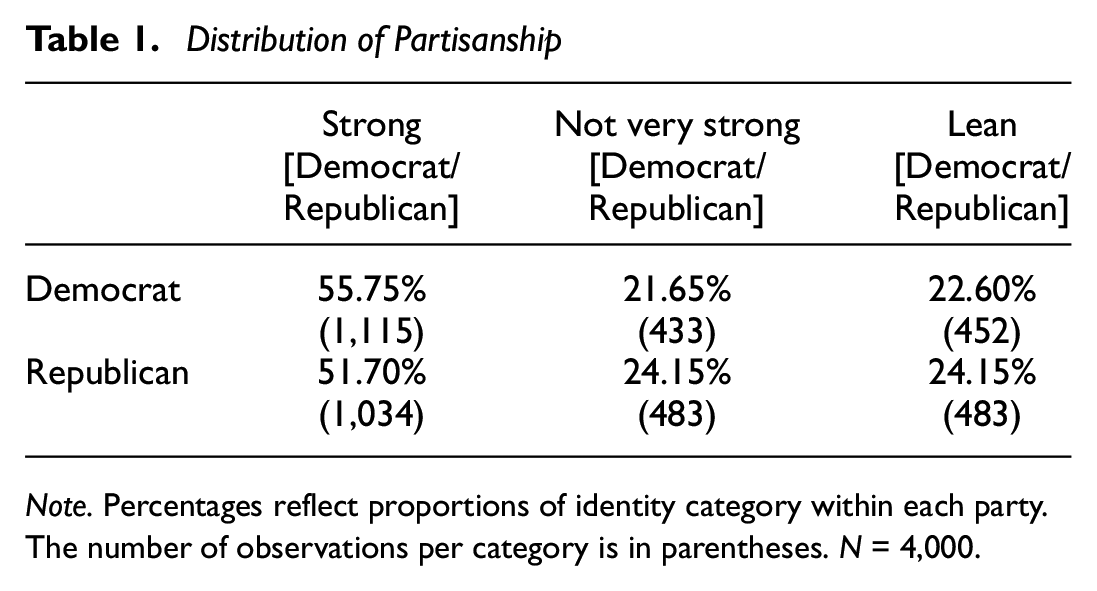
Note. Percentages reflect proportions of identity category within each party. The number of observations per category is in parentheses. N = 4,000.
After consenting, participants reported demographic data and were then assigned to read a control news brief about the extinction of giant tortoises or one of four treatment articles that manipulated (a) distinctiveness threat, (b) power threat, (c) morality threat, and (d) meritocratic threat (see SI.2 for complete wording).
Each manipulation was a news brief attributed to the Associated Press. We communicated each threat through a brief’s title. For example, our distinctiveness threat article indicated “The Continued Growth in U.S. People of Color Is Transforming What It Means to be ‘American,’ Giving the United States a New Look and Traditions.” Here, we undermined Whites’ distinctiveness by highlighting changing notions of being American—a category they have molded in their image (Danbold & Huo, 2015). Our power threat article was titled “With No End in Sight, the Continued Growth of People of Color in the U.S. Is Gradually Shifting the Center of Power in Politics, the Economy, and Society.” Here, we call attention to a discernible increase in PoC’s collective power. Our morality threat manipulation was titled “From the Fringes to the Core: ‘White Supremacy’ Is Becoming a Defining Form of Thinking and Action for Average Whites, Even If They Call It Something Softer.” Our aim here was to impugn the integrity of White identity by tying it directly to White supremacist thinking (Knowles et al., 2014). Finally, our meritocratic threat article was labeled “Mediocre but Still Advantaged: Growing Evidence That Many White Individuals Owe Their Successes to Systems That Benefit Them, Not ‘Hard Work.’” We call attention here to the notion of unearned racial advantages (Knowles et al., 2014).
Participants then completed four items tapping White identity. Following Tajfel (1981), we conceptualize White identity as the degree to which the category, White, is cognitively and emotionally significant to a person. Accordingly, identity centrality is a fundamental indicator of White identity, since it captures how integral this category is to a person’s self-image (Ellemers et al., 1997). Drawing on Jardina (2019), we appraised additional cognitive and affective aspects of White identity, including pride in being White (affective), recognition of commonality with other Whites (cognitive), and consciousness about a group’s social position (cognitive and affective). We used four statements on a 7-point scale from strongly disagree/agree: (a) Being White is an important part of how I see myself; (b) White people in this country have a lot to be proud of; (c) Whites in this country have a lot in common with each other; and (d) Whites should work together to improve their position.
This more holistic measurement of White identity has not been psychometrically validated before. Thus, it is possible these indicators are correlated, but not unified measures of White identity. Factor analyses of these items (see SI.4) yielded a one-factor model of White identity with exceptional fit in our total and partisan samples (comparative fit index/Tucker–Lewis index at or near to 1.00; root mean square error of approximation at or near .000) and no evidence of large residual correlations (e.g., standardized root mean square residual values at or below .006). We combine these items into a summated scale, normed to a 0 to 1 range (MWhite ID = .525, SD = .231, α = .816).
In our sample, the correlation between Republican partisanship and White identity is positive and reliable (r = .378, p < .001), reflecting the positive correlations between these constructs that Jardina (2019) reports (r = .11–.15, p < .05). The difference in correlation sizes here stems from our pre-registered exclusion of true Independents from our partisanship scale. SI.3 reports the distributions of White identity by partisanship in our survey and the 2012–2020 American National Election Studies (ANES). These distributions are quite similar, with rich variation across the high/low ends of these scales. Thus, any reported effects are unlikely driven by ceiling (floor) effects.
After our mediator, participants completed three (randomized) batteries of support for policy proposals on a 7-point scale from strongly disagree/agree. We picked policies that strongly implicate Latino, Asian, and Black people. Specifically, we measured White opinions about flexible policies toward undocumented and high-skilled immigration, which implicate Latinos and Asians, respectively (Pérez, 2021). For policy toward unauthorized immigrants, participants completed two statements: (a) Provide a pathway to citizenship for undocumented immigrants; and (b) Expand the number of border patrol agents along the U.S.-Mexico border. For policy toward high-skill immigrants, participants completed two items: (c) Increase the number of H1-B visas, which allow U.S. companies to hire people from foreign countries to work in highly skilled occupations, such as engineering, computer programming, and high-technology, and (d) Expand the number of visas available to legal immigrants wishing to enter the United States, primarily from Asian countries. Finally, we tapped White opinions toward affirmative action, where Blacks are deemed the outgroup (Federico & Sidanius, 2002; Sears et al., 1997; Sidanius et al., 2000). Specifically, we gauged support for legacy college admissions, which primarily benefit Whites (Jardina, 2019), (e) Require universities to have “legacy admissions,” which admit some students based on whether their parents or grandparents attended a school, and (f) Allow colleges to give special consideration to the children or grandchildren of people who graduated from their campus. We combine these items into three summated scales: pro-outgroup policy (unauthorized immigrants) (M = .442, SD = .314, α = .763), pro-outgroup policy (high-skill immigrants) (M = .554, SD = .271, α = .776), and pro-ingroup policy (legacy admissions) (M = .290, SD = .258, α = .845). Participants were debriefed after these outcomes.
We use Stata 15.1’s
Results
Our replication materials are available at: https://osf.io/asz3y/?view_only=None
The Effects of Identity Threats
Table 2’s left-most columns indicate our proposed threats generally impact our mediator, White identity. Except for meritocratic threat, all coefficients are correctly signed. Specifically, compared with our control, Whites exposed to distinctiveness threat—a sense that the meaning of being White is disrupted by growing racial diversity—display a 4% increase in their White identity (.043, p < .001). Moreover, exposure to power threat—that PoC are politically colluding—increases White identity by another 3% (.032, p < .003). These effects support our hypotheses about the impacts of distinctiveness (H1) and power threat (H2), which expected a heightened White identity.
Identity Threats and Their Effects on White Identity (Pooled Across Partisanship)
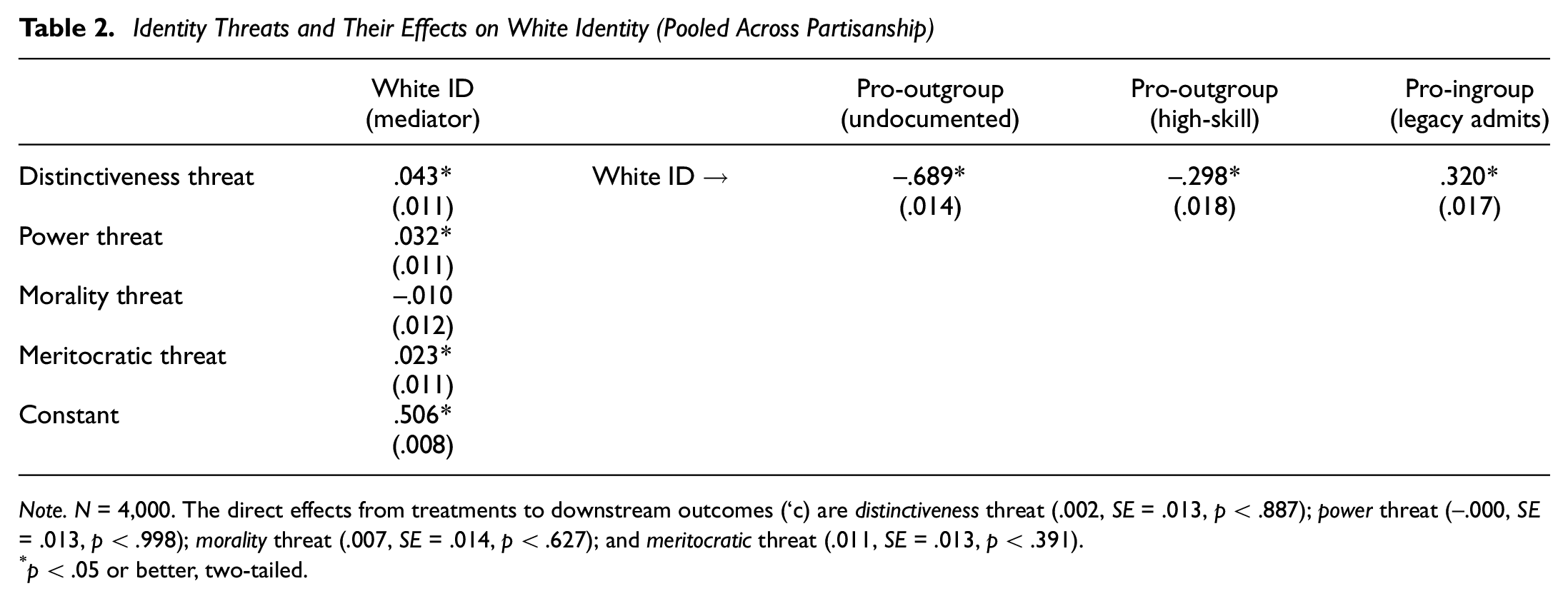
Note. N = 4,000. The direct effects from treatments to downstream outcomes (‘c) are distinctiveness threat (.002, SE = .013, p < .887); power threat (–.000, SE = .013, p < .998); morality threat (.007, SE = .014, p < .627); and meritocratic threat (.011, SE = .013, p < .391).
p < .05 or better, two-tailed.
We also stipulated that morality and meritocratic threat would lead Whites to disavow their racial identity. Table 2 shows that, relative to our control, individuals who faced morality threat display a 1% decrease in their White identity. This suggests that participants who were exposed to morality threat perhaps stifled their White identity’s activation (i.e., suppression effect). This pattern directionally aligns with our hypothesis, but is unreliable at conventional levels (–.010, p < .403), yielding weak support for this identity threat (H3). 3
In turn, we find directionally unexpected evidence for meritocratic threat. We hypothesized that meritocratic threat would cause White individuals to distance themselves from their racial identity. Instead, it reliably increases White identity by two percentage-points (.023, p < .044) (H4). Thus, out of four threats, three (distinctiveness, power, meritocratic) reliably increase White identity, with one (meritocratic) contradicting our expectations. These treatment-to-mediator effects generally re-emerge on each component of our White identity scale (SI.5).
Treatment Effects Moderated by Partisanship
Figure 1 displays our treatments’ marginal effects on our mediator (White identity), with Democratic partisanship as a moderator (full results in SI.6). We see that partisanship has negligible moderating effects on our treatments, thereby rejecting (H5). Indeed, a block F-test shows that the interaction terms for these threats are indistinguishable from zero, (F4, 3990) = .72, Prob>.579, which favors Table 2’s more parsimonious model without interactions.
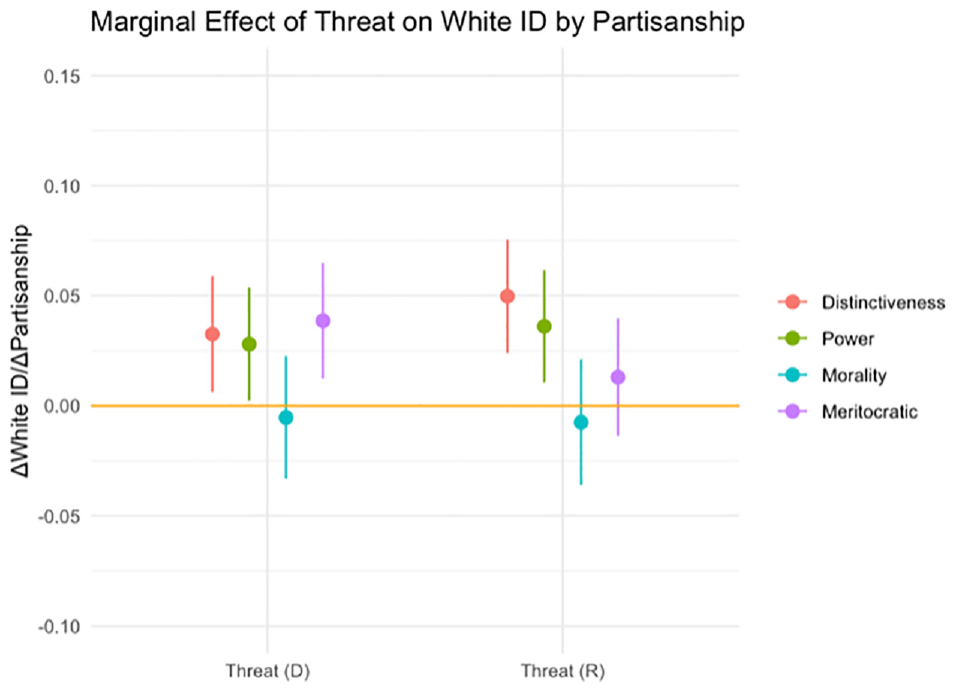
White Identity Threats Not Moderated by Partisanship
White Identity’s Downstream Influence
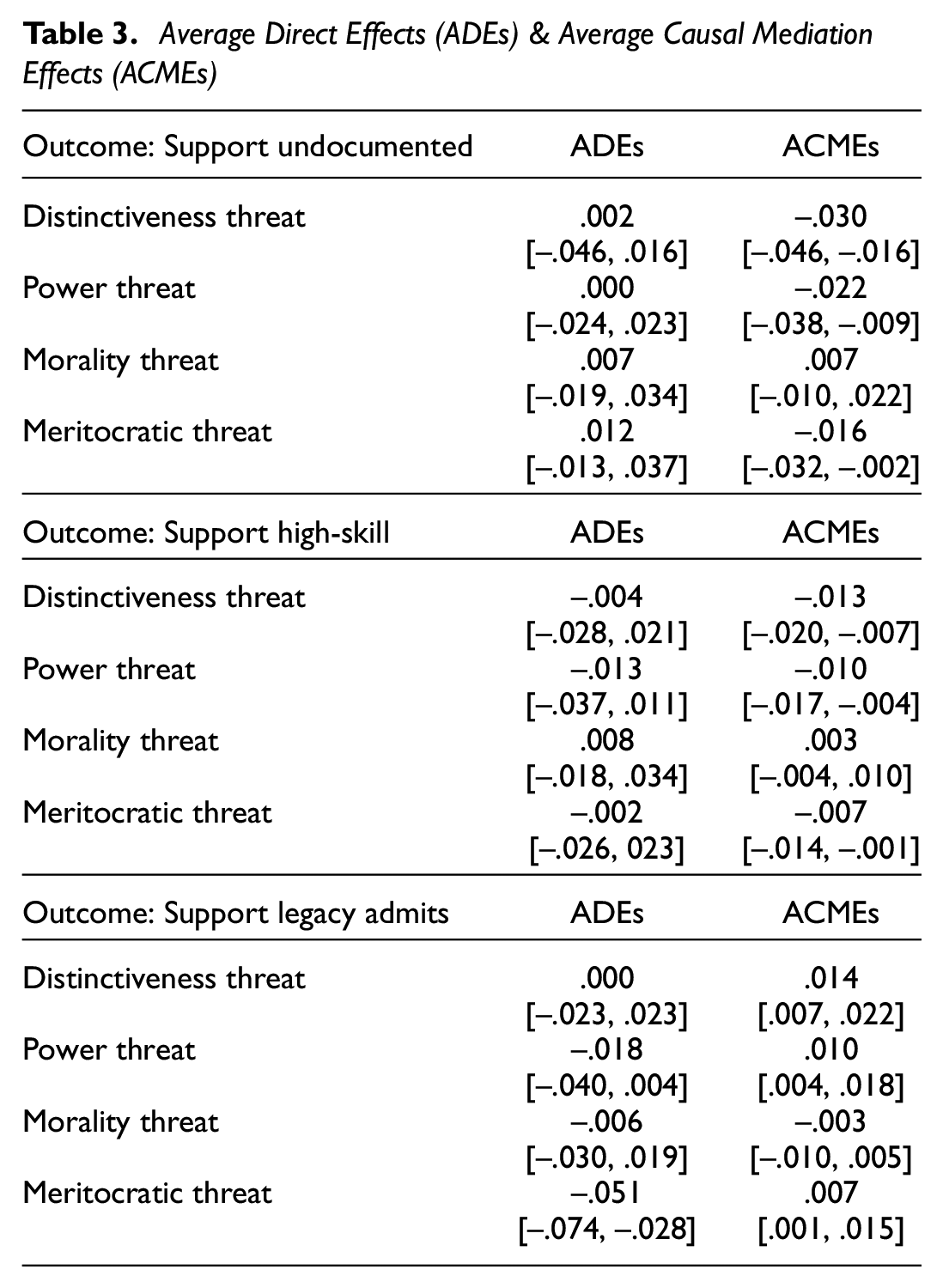
Table 2’s coefficients support our claim that heightened racial identity steers Whites toward greater opposition to pro-outgroup policies, but greater support for pro-ingroup policies (H6). Row entries to the right of the label White ID → indicate that heightened White identity is associated with substantial reductions in support for more flexible policies toward undocumented immigrants (–.689, p < .001) and high-skill immigrants (–.298, p. 001), which implicate Latinos and Asian Americans, respectively (Pérez, 2021). These shifts represent one- to two-thirds of the range in these outcomes. This miserly stance toward racialized outgroups changes when the outcome is pro-ingroup policy. Here, heightened White identity is associated with stronger support for legacy college admissions (.320, p < .001), a shift of nearly a third of this outcome’s range. Table 3 reports the Average Direct Effects (ADEs) and Average Causal Mediation Effects (ACMEs) from our analyses. These results show our treatments operate primarily through our proposed mediator, White identity, as indicated by the general absence of any reliable ADEs, but consistently reliable ACMEs.
Average Direct Effects (ADEs) & Average Causal Mediation Effects (ACMEs)
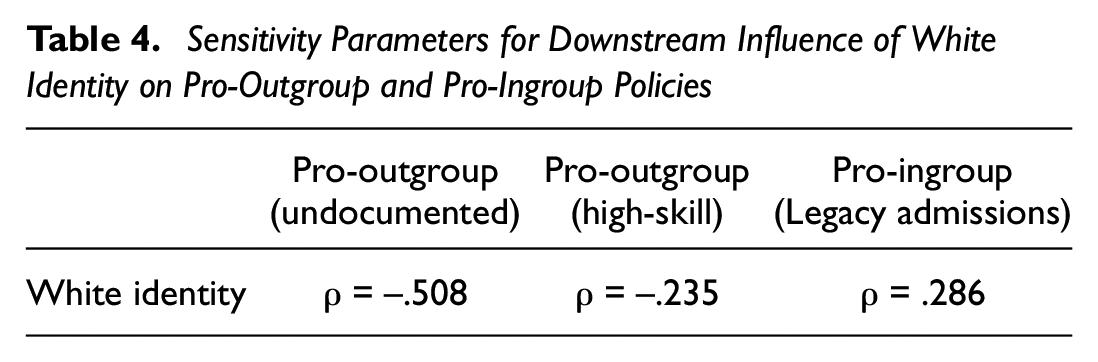
We measured our mediator, White identity, because it is difficult and unethical to randomly assign racial identity levels. This introduces the possibility of confounding in the downstream path. Thus, we undertake a sensitivity analysis to estimate how large the error correlation (ρ, rho) between our mediator and an unmodeled confounder must be for our mediated effect to be compromised (Imai & Yamamoto, 2013). Table 4 shows our mediation effects are generally robust. For instance, on our pro-outgroup (undocumented immigration) outcome, we would need to observe a ρ = –.508 for our estimated mediation effect to vanish.
Sensitivity Parameters for Downstream Influence of White Identity on Pro-Outgroup and Pro-Ingroup Policies
One potential confounder suggested by political scientists is racial resentment: a contemporary form of prejudice that shapes White support for policies toward African Americans (e.g., affirmative action) and other PoC (e.g., immigration) (Kinder & Sanders, 1996). We did not measure racial resentment because, per social identity theory (Tajfel, 1981), we view outgroup hostilities as a consequence of ingroup favoritism. However, our sensitivity analyses let us gauge how much of a threat to inference racial resentment’s omission is. We also consider other relevant covariates, including ideology, preference for limited government, and favorability toward non-White racial groups (Jardina, 2019).
Drawing on the 2012, 2016, and 2020 American National Election Studies (ANES), we estimate the correlation between White identity and racial resentment in each cross-section. Racial resentment is assessed in scale form with four extensively validated statements answered on a scale from 1 (strongly disagree) to 7 (strongly agree) (see Kinder & Sanders, 1996), normed to 0 to 1 interval. One of these items states: Irish, Italians, Jewish and many other minorities overcame prejudice and worked their way up. Blacks should do the same without any special favors.
We find significant but modest associations between White identity and resentment (2012 ANES r = .127, p < .001; 2016 ANES r = .170, p < .001; 2020 ANES r = .182, p < .001; average r = .161). By comparing this value to Table 3’s sensitivity parameters, we conclude that racial resentment’s omission is unlikely driving our mediation results, with similar inferences about ideology, preference for limited government, and favorability toward non-White racial groups (see SI.7).
Does Partisanship Moderate White Identity’s Impact on Downstream Outcomes?
We hypothesized that, once catalyzed, White identity’s downstream impacts are moderated by partisanship (H8). We therefore re-estimate our models in Table 2 by adding an interaction between White identity and Democratic (vs. Republican) partisanship in each downstream path.
Figure 2 depicts the downstream influence of White identity on each outcome displayed separately for Republicans (R) and Democrats (D). Heightened racial identity leads White Democrats to display more opposition to pro-outgroup policy toward unauthorized immigrants (–.534, SE = .020, p < .001) than White Republicans (–.166, SE = .024, p < .001). A similar difference emerges in White support for pro-ingroup policy (legacy college admissions), where White Democrats express more support (.529, SE = .026, p < .001) than White Republicans (.138, SE = .030, p < .001). No meaningful difference emerges on support for flexible policy toward high-skill immigrants. SI.8 reports the index of moderated mediation for each of these patterns (Hayes, 2022). These indexes reveal the extent to which each indirect effect on an outcome is moderated by partisanship’s downstream influence. These additional results reaffirm partisanship’s moderating role in this mediation process.
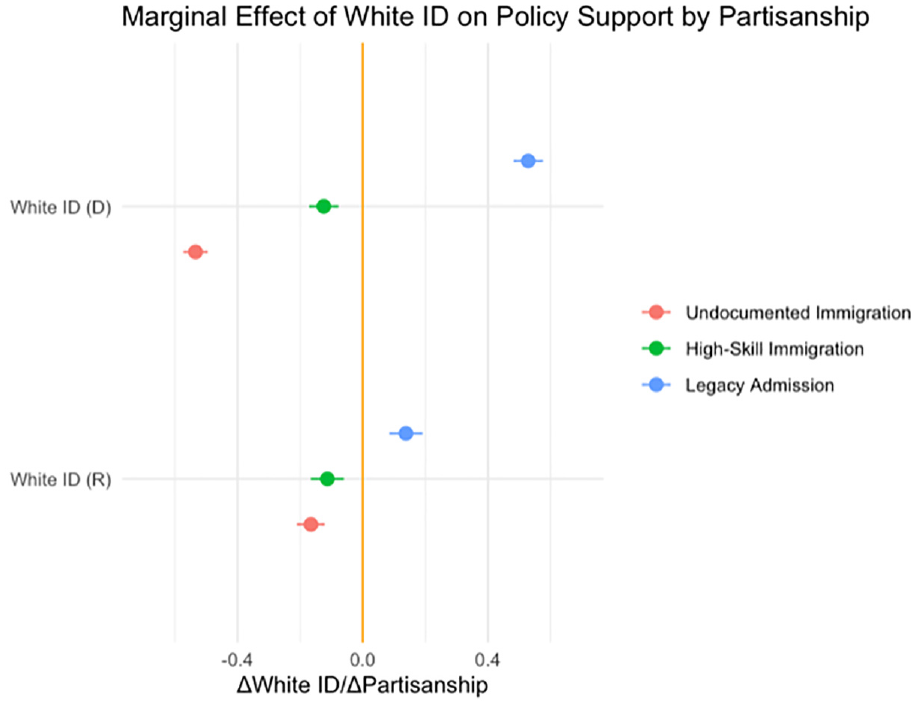
White Identity’s Impact on Downstream Outcomes Moderated by Partisanship
Implications
Our investigation found that distinctiveness, power, and meritocratic threat each uniquely catalyze White racial identity. We also learned, unexpectedly, that these triggers, as operationalized here, performed uniformly across White Democrats and Republicans, suggesting White individuals in each party (not just Republicans) are similarly susceptible to affronts to their racial ingroup. Of course, we did observe a negative (but unreliable) effect from morality threat to White identity. We think that with added strength, this threat might reliably cause Whites to distance themselves from their racial identity (Knowles et al., 2014), as originally hypothesized.
We also discovered that once catalyzed, White identity leads White individuals to express more opposition to pro-outgroup policies and greater support for pro-ingroup policy. This co-occurrence of pro-outgroup and pro-ingroup stances is instructive. Social psychologists remind us that ingroup “love” is not tantamount to outgroup “hate” (Brewer, 1999). Indeed, the correspondence between these is more likely to manifest when an identity is institutionally enshrined in a system with zero-sum features, such as America’s political system is. Future improvements on deactivating White identity should consider whether this deactivation minimizes pro-ingroup or pro-outgroup stances—or both.
Critically, we also learned that heightened White identity had substantially stronger impacts on the policy preferences of Democrats than Republicans. This highlights the difference between baseline levels of White identity and their consequences after it is threatened. At rest, White Democrats report weaker White identity levels than Republicans. Yet in light of identity threat, these levels rise significantly and propel White Democrats toward greater opposition to pro-outgroup policy and stronger support for pro-ingroup policy. This suggests that for White Republicans, racial identity is already keyed at a sufficiently high range to produce the reactions we observed. But among White Democrats, threats to racial identity can countermand their otherwise flexible stance toward outgroups and looser affinity to their racial ingroup.
We conclude by discussing three possible extensions to our results. Of the four identity threats we considered, morality threat was correctly signed, but fell short of statistical significance. This does not mean morality threats do not matter but rather that our operationalization (a news brief) was insufficiently strong to cause a reliable reduction in White identity. We think it is productive to reconsider this threat since some work suggests reductions in a racial identity can sometimes lead ingroup members to bounce back from a reduced sense of identity by “digging in their heels” in favor of their ingroup (Pérez & Kuo, 2021).
In addition, we encourage political psychologists to consider whether distinctiveness threat, power threat, and meritocratic threat each stem from a shared source—namely, the sense of status loss that follows from Whites’ demographic decline (Craig & Richeson, 2014; see also Hodson et al., 2022). Although we found that each of these threats explained unique variance in White identity, this pattern is also consistent with a view that each manipulation tapped into status threat, more generally.
Finally, although identity threats can catalyze racial identity among White Democrats and Republicans, it is plausible this effect can be blunted by information that counteracts its subsequent influence. For instance, if White identity increases due to power threat (i.e., PoC colluding politically), then a downstream manipulation reminding Whites about how hard it is for PoC to unify politically given their diverse interests might soften White identity’s influence (Pérez, 2021). This would provide more direct evidence about White identity’s causal effects, while isolating some conditions under which the effects of White identity weaken or dissipate.
Supplemental Material
sj-docx-1-spp-10.1177_19485506231180650 – Supplemental material for Manifold Threats to White Identity and Their Political Effects on White Partisans
Supplemental material, sj-docx-1-spp-10.1177_19485506231180650 for Manifold Threats to White Identity and Their Political Effects on White Partisans by Efrén Pérez, Jessica HyunJeong Lee, Ana Oaxaca, Tania Solano Cervantes, Jasmine García Rodríguez, Kimberly Lam and David McFall in Social Psychological and Personality Science
Footnotes
Handling Editor: Christopher Federico.
Declaration of Conflicting Interests
The author(s) declared no potential conflicts of interest with respect to the research, authorship, and/or publication of this article.
Funding
The author(s) received no financial support for the research, authorship, and/or publication of this article.

Supplemental Material
The supplemental material is available in the online version of the article.
Notes
Author Biographies
References
Supplementary Material
Please find the following supplemental material available below.
For Open Access articles published under a Creative Commons License, all supplemental material carries the same license as the article it is associated with.
For non-Open Access articles published, all supplemental material carries a non-exclusive license, and permission requests for re-use of supplemental material or any part of supplemental material shall be sent directly to the copyright owner as specified in the copyright notice associated with the article.
