




Abstract
The ability to process information abstractly functions to traverse psychological distance and expand one’s mental horizons. Therefore, abstract (vs. concrete) thinking may expand (vs. contract) one’s social scope. Accordingly, it was hypothesized that concrete (vs. abstract) processing makes one less (vs. more) susceptible to the perspective of others, attenuating (vs. increasing) public—but not private—self-awareness. Four studies (total N = 708) tested this idea. In a pilot study, a positive correlation between abstraction and public (but not private) self-awareness was found. In Studies 1a, 1b, and 2, manipulated concrete (vs. abstract) thinking reduced public self-awareness but not private self-awareness. Study 1b additionally indicated that public self-awareness was reduced by concrete thinking rather than increased by abstract thinking. Study 2 also investigated the effect of abstraction on social anxiety and embarrassment. It was demonstrated that concrete (relative abstract) thinking indirectly reduced social anxiety and embarrassment via public self-awareness. Implications of the findings are discussed.
Humans developed the ability to think abstractly to mentally move beyond their current experience (Gilead et al., 2020; Liberman & Trope, 2014; Trope et al., 2021; Trope & Liberman, 2010). One important dimension of such “mental travel” is traversing the social distance between oneself and other individuals, enabling the understanding of others’ beliefs, desires, and intentions. Accordingly, abstract processing may involve a third-person view of the self, whereas concrete processing may attenuate public self-awareness. The present research investigated the idea that abstraction affects public self-awareness. In addition, it tested whether abstraction has possible downstream consequences for social anxiety and embarrassment via public self-awareness.
The Function of Abstraction
Individuals process information on a certain abstractness level (i.e., level of construal) that may vary from person to person and from situation to situation (Burgoon et al., 2013). As proposed by construal level theory (CLT, Liberman & Trope, 2014; Trope et al., 2021; Trope & Liberman, 2010), abstractions include relatively more primary, defining features that are relatively global and invariant—allowing individuals to expand their focus to take a more generalized, superordinate perspective (e.g., when representing a dog as “an animal”). Concrete representations, in contrast, add secondary aspects, more details, and contextual information (e.g., when representing the dog as “our golden retriever Pluto”)—contracting the mental scope to the specific here-and-now (Trope et al., 2021).
It has been argued that the capacity of abstraction has evolved as a mental tool that equips individuals with the ability to expand their mental horizons to regulate expansively (vs. contractively; Gilead et al., 2020; Trope et al., 2021). Abstract processing affords, for instance, the consideration of future outcomes, alternative possibilities, and others’ perspectives (Liberman & Trope, 2014; Trope et al., 2021). Thus, an important psychological function of abstraction is that it enables individuals to traverse psychological distance and transcend the here-and-now. This is visible in numerous studies demonstrating that individuals are likely to use more abstract construals with increasing psychological distance to a target object (for reviews, see Trope et al., 2021; Trope & Liberman, 2010).
Importantly, individuals use abstraction to traverse social distance. For instance, individuals identify actions of a socially distant (vs. near) target person in relatively more superordinate terms (i.e., why the person performs them) rather than subordinate terms (i.e., how the person performs them; Liviatan et al., 2008). Likewise, individuals prefer to use abstract (vs. concrete) construals when communicating with socially distant (vs. near) others (Amit et al., 2013; Joshi et al., 2016) or with a broader, heterogeneous audience than with only one single individual (Joshi & Wakslak, 2014). Taken together, individuals process information more abstractly when confronted with socially distant (vs. near) targets, indicating that abstraction represents an appropriate tool to traverse social distance.
But individuals do not only spontaneously use abstraction to traverse distance, abstraction does actually afford the overcoming of social distance by broadening one’s social scope. That is, abstraction moves attention away from the egocentric “me here and now” toward the “we” that subsumes “me” and “you” (Rossignac-Milon et al., 2020). For instance, manipulated abstraction facilitates visual perspective-taking (Libby et al., 2009), the use of more first-person plural pronouns (“We/Us”) than first-person singular pronouns (“I/Me”; Yin et al., 2022), and a cognitive orientation that encourages broader, more inclusive categorization (Levy et al., 2002; Wakslak et al., 2008), supporting the idea of a broader social scope when thinking abstractly (vs. concretely). As a consequence, abstraction allows individuals to more accurately predict how others evaluate them (Eyal & Epley, 2010) and to attribute a mind to others (Kozak et al., 2006).
In sum, abstraction is a tool that supports the process of traversing social distance and enables individuals to expand their social horizons. This type of processing may increase the possibility that one mentally “slips into the shoes of others” and makes one susceptible to the perspective of others so that individuals are more likely to see even themselves from an outward perspective. This is because a third-person view of the world includes a third-person view on the own person. In other words, abstract (relative to concrete) processing may come along with increased public self-awareness.
Does Abstraction Influence Public Self-Awareness?
According to the theory of objective self-awareness, attention can be shifted from aspects of the environment to oneself and vice versa (Duval & Wicklund, 1972), with attention to oneself including the dimensions of private and public self-awareness (Fenigstein et al., 1975). In private self-awareness, individuals attend more to internal, personal aspects (e.g., memories, thoughts, feelings). In public self-awareness, individuals attend more to their own features that are presented to others, thereby viewing the self as a social object from a third-person perspective (Fenigstein et al., 1975).
Private self-awareness is presumably left unaffected by abstraction because internal aspects can be narrow (e.g., when attending to current feelings), but also broad in scope (e.g., when attending to personal memories or future plans). Therefore, abstraction may affect the content of private self-awareness but not the amount of private self-awareness. We thus would not expect abstraction to influence private self-awareness.
Public self-awareness, in contrast, may be influenced by abstraction. This is because abstraction broadens one’s social scope so that it is likely that one adopts a third-person perspective on oneself. As abstract (concrete) thinking expands (contracts) one’s social scope, it should increase (attenuate) public self-awareness. Relatedly, it has been demonstrated that being observed (a factor known to increase public self-awareness; Carver & Glass, 1976; Govern & Marsch, 2001) can trigger abstract processing (Luan & Li, 2020). This finding can be taken to mean that being observed triggers abstract processing, allowing one to adopt an outside view of oneself and to include the perspective of others in one’s own. Thus, the finding supports the idea that abstract processing serves the psychological function of expanding the social scope.
If abstraction functions to broaden one’s social scope, manipulating concrete relative to abstract processing may attenuate public self-awareness. We investigated this idea in four studies: A pilot study correlated dispositional public and private self-awareness with a trait measure of abstraction. Studies 1a, 1b, and 2 experimentally manipulated abstract versus concrete processing and measured state public and private self-awareness; Study 2 additionally tested whether abstraction affected possible downstream consequences of public self-awareness, namely, social anxiety and embarrassment.
Pilot Study
To test whether abstraction was positively related to public self-awareness, a pilot study correlated abstraction (a) with dispositional public (b) and private (c) self-awareness, respectively. Abstraction correlated positively with public self-awareness, rab,c = .24, p = .032 (rab = .28, p = .013), but it did not correlate with private self-awareness, rac,b = .13, p = .267 (rac = .19, p = .097). Details of the pilot study (see Online Appendix A) and all data and materials of the studies are available at https://osf.io/2nrsd/?view_only=949498b44ed246ba8e0b0dc70a64dcfd.
Studies 1a and 1b
In Study 1a, abstraction (i.e., level of construal) was manipulated and state self-awareness was assessed. Study 1b was a high-powered replication of Study 1a and included an additional control group. We assumed that concrete relative to abstract processing would reduce public but not private self-awareness.
Method
For Study 1a, 176 participants (87 female, 89 male; age: M = 38.11, SD = 11.68, range: 18–66) were recruited from the platform clickworker.de to take part in the study in exchange for €0.40. A required minimum sample size of N = 175 was determined a priori (see Online Appendix B for details on how the sample sizes required for each study were calculated). Participants were randomly assigned to one of two construal-level conditions (low, high).
For Study 1b, 432 participants (209 female, 220 male; age: M = 37.95, SD = 12.31, range: 14–73) were randomly assigned to one of three construal-level conditions (low, high, control). A required minimum sample size of N = 346 was determined a priori. To prepare for exclusions, we commissioned the collection of N = 400 participants on clickworker.de. However, exclusions were not necessary, and 32 additional participants unexpectedly joined the study without claiming their payment, resulting in a total of 432 participants. We emphasize that the significance level of the results had no impact on stopping the data collection. Study 1b was preregistered (https://aspredicted.org/pi6i2.pdf).
In both Studies 1a and 1b, participants provided demographical data after welcoming and consent. To prime construal level, participants were provided with a series of 40 words (e.g., pasta, book, professor; Fujita et al., 2006). In the high-level condition, participants were asked to generate a superordinate category to which each word belonged. In the low-level condition, participants were asked to generate a subordinate exemplar of each of the words. Numerous studies have shown that generating categories versus exemplars effectively induces abstract versus concrete processing (e.g., Hansen, 2019; Hansen & Trope, 2013; Wakslak & Trope, 2009). The control group of Study 1b did not complete either task (for the same procedure, see Katz et al., 2017; Mueller et al., 2014).
Next, participants filled in the Situational Self-Awareness Scale (SSAS, Govern & Marsch, 2001). The scale consisted of nine items, of which three each measure public self-awareness, private self-awareness, and awareness of immediate surroundings, respectively. The Public Self-Awareness subscale included the items “Right now, I am concerned about the way I present myself”; “Right now, I am concerned about what other people think of me”; and “Right now, I am self-conscious about the way I look” (Cronbach’s α = .87 [Study 1a] and .72 [Study 1b]). The Private Self-Awareness subscale included the items “Right now, I am conscious of my inner feelings”; “Right now, I am aware of my innermost thoughts”; and “Right now, I am reflective about my life” (Cronbach’s α = .79 [Study 1a] and .88 [Study 1b]). The Awareness of Immediate Surroundings subscale included the items “Right now, I am conscious of all objects around”; “Right now, I am conscious of what is going on around me”; and “Right now, I am keenly aware of everything in my environment” (Cronbach’s α = .83 [Study 1a] and .79 [Study 1b]). Participants were instructed to indicate their agreement with the items on a scale ranging from strongly disagree (1) to strongly agree (7). The nine items were presented in random order.
Next, as a manipulation check, participants filled in the Behavior Identification Form (BIF, Vallacher & Wegner, 1989) by indicating their preference for one of two alternative descriptions for a series of behaviors—one alternative describing the concrete means of implementing the behavior, the other describing its abstract ends. The items were presented in random order (Cronbach’s α = .83 [Study 1a] and .82 [Study 1b]). Although the BIF was originally developed to measure individual differences (Vallacher & Wegner, 1989), it can also be used as a validation measure for abstraction manipulations (e.g., Freitas et al., 2004; Hansen & Steinmetz, 2019; Liberman & Trope, 1998; Liviatan et al., 2008).
Results
The manipulation check revealed that the construal-level manipulation was successful: Participants who generated categories chose a higher proportion of abstract alternatives in the BIF (Study 1a: M = 58.02%, SD = 22.08; Study 1b: M = 56.54%, SD = 21.93) than participants who generated exemplars (Study 1a: M = 50.33%, SD = 19.58; Study 1b: M = 50.99%, SD = 18.84), Study 1a: t(174) = 2.44, p = .016, d = 0.37; Study 1b: t(295) = 2.34, p = .020, d = 0.27. The control group in Study 1b ranged in between the other two groups (M = 52.36%, SD = 21.64) and did neither differ from the abstract group, t(281) = 1.61, p = .109, d = 0.19, nor the concrete group, t(282) < 1, F(2, 429) = 2.842, p = .059,
The respective three items of the three subscales of the SSAS were averaged and, for Study 1a, analyzed with an independent-samples t test with construal level as the independent variable. As hypothesized, public self-awareness was affected by construal level, t(174) = 2.34, p = .020, d = 0.35. Specifically, participants who generated categories showed a higher public self-awareness (M = 3.21, SD = 1.53) than participants who generated exemplars (M = 2.70, SD = 1.39). Private self-awareness (Mabstract = 3.59, SD = 1.45; Mconcrete = 3.47, SD = 1.36), t(174) < 1, p = .581, d = 0.08, and awareness of immediate surroundings (Mabstract = 4.37, SD = 1.35; Mconcrete = 3.97, SD = 1.34), t(174) = 1.96, p = .051, d = 0.30, were was not affected by construal level.
As public self-awareness correlated both with private self-awareness (r = .62, p < .001) and awareness of immediate surroundings (r = .27, p < .001), parts of the variance in public self-awareness can be explained by the other two facets. To control for this variance, we separately entered the two variables as covariates into the analysis. The effect of construal level on public self-awareness was still significant when controlling for private self-awareness, F(1, 173) = 6.41, p = .012,
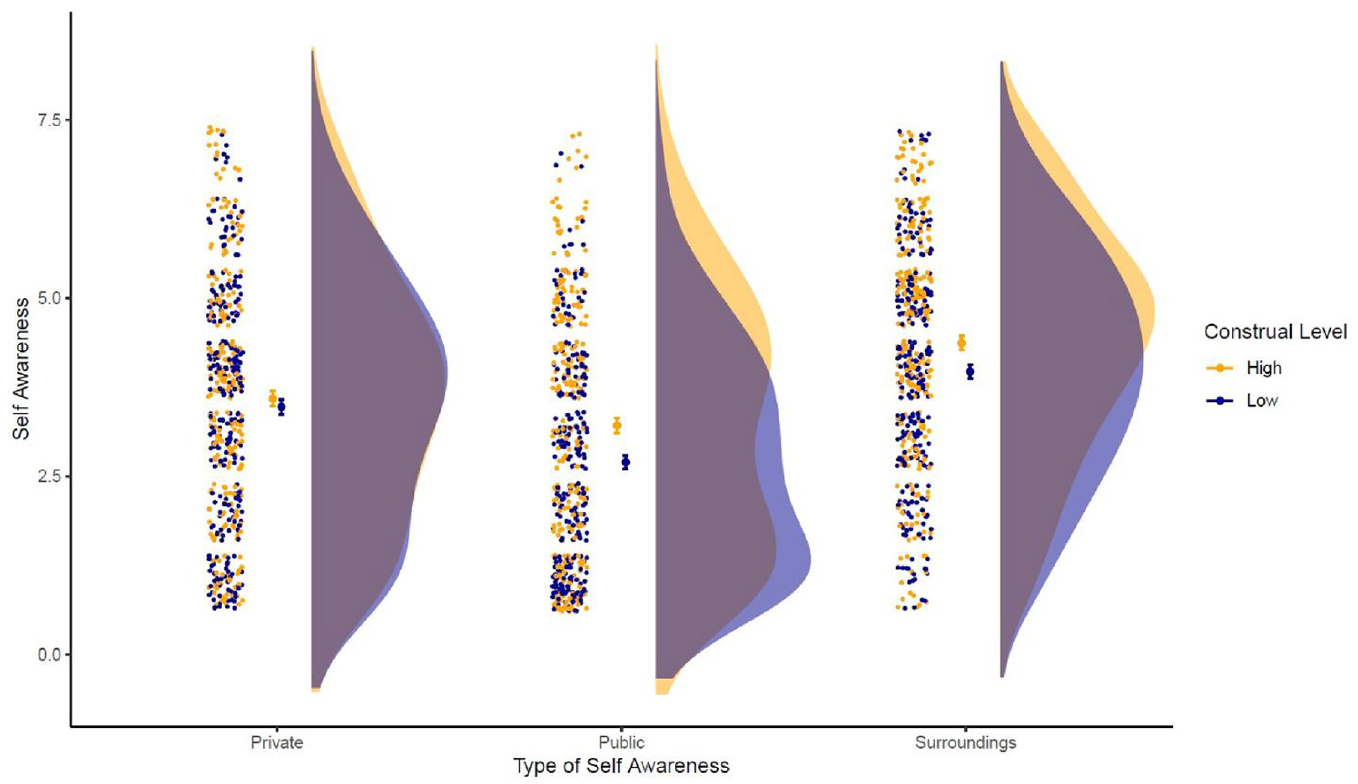
Responses to the SSAS as a Function of Construal Level and Type of Self-Awareness in Study 1a
In Study 1b, the effect of abstraction on public self-awareness was replicated (Mabstract = 2.71, SD = 1.21, Mconcrete = 2.43, SD = 1.09), t(294) = 2.16, p = .032, d = 0.25. In addition, the control group showed higher public self-awareness (M = 2.78, SD = 1.21) than the concrete group, t(282) = 2.62, p = .009, d = 0.31, but did not differ from the abstract group, t(280) < 1, p = .637, d = 0.06, F(2, 428) = 3.80, p = .023,
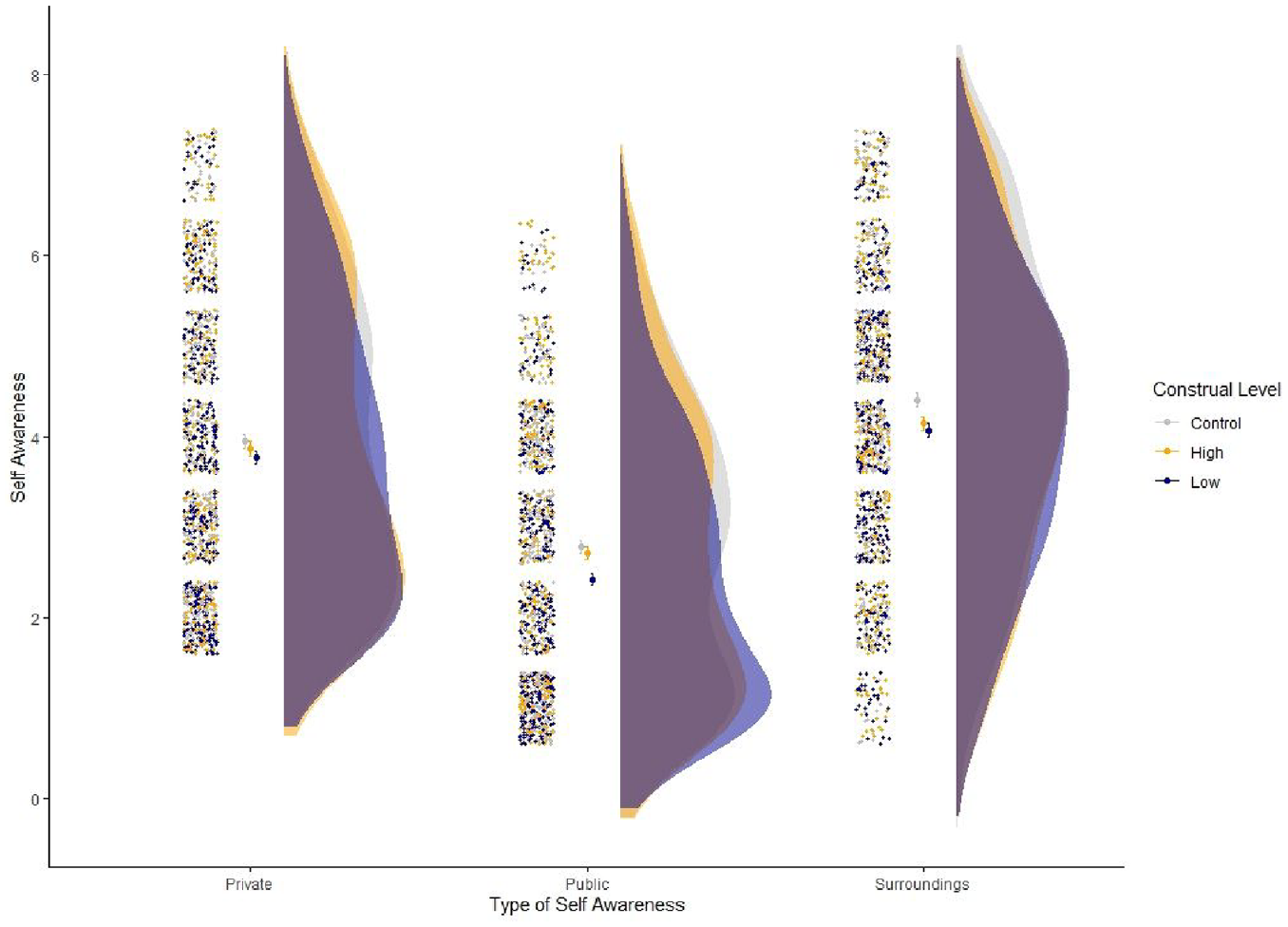
Responses to the SSAS as a Function of Construal Level and Type of Self-Awareness in Study 1b
To corroborate the findings of Studies 1a and 1b (and also Study 2), we additionally conducted linear mixed-effects models. The results of these analyses (reported in Online Appendices C, D, and E) are comparable with the results reported in the main text.
Discussion
Studies 1a and 1b provided support for the idea that concrete versus abstract processing affects public self-awareness. The data of Study 1b suggest that this effect is driven by concrete thinking attenuating public self-awareness. In line with the Pilot Study, we did not find an influence of abstraction on private self-awareness. We will come back to this issue in the “General Discussion” section.
Although it was not the focus of the present research, the findings additionally showed that concrete thinking marginally decreased a focus on immediate surroundings compared with abstract thinking. From a CLT perspective, this finding seems to be puzzling, because concrete (vs. abstract) processing contracts the mental scope to the specific here-and-now and attunes people to details and contextual information. Therefore, we would expect that concrete processing should lead to higher (and not lower) awareness of the immediate surroundings. However, the subscale measuring awareness of immediate surroundings includes the item “Right now, I am conscious of all objects around.” Perhaps, this item is critical here. That is, a contracted mental scope when thinking concretely is accompanied by a less inclusive mind-set so that a statement that describes a conscious focus on all—that is, many—objects at the same time is less likely agreed with. The reduction of the effect of construal level on public self-awareness when controlling for awareness of the immediate surroundings supports the interpretation that the effect on public self-awareness may partly be driven by the same process as the effect on awareness of immediate surroundings.
Importantly, concrete (vs. abstract) processing caused participants to focus less on other people’s thoughts (public self-awareness). This effect may have consequences for downstream effects, two of which were investigated in Study 2.
Study 2
Study 2 explored possible consequences of public self-awareness triggered by concrete relative to abstract processing, namely, feelings of discomfort and awkwardness when judged by others. As public self-awareness directs attention to features of the self that are presented to others (such as mannerisms and physical features), public self-awareness increases the expectation of being judged by others (Pfattheicher & Keller, 2015) and triggers an increased reaction to negative interpersonal evaluations (Fenigstein, 1979). Thus, it may trigger social anxiety (Fenigstein, 1979) and embarrassment (Darvill et al., 1992). Indeed, previous research has found positive correlations between public self-awareness and social anxiety (Fenigstein, 1979; Lennox & Wolfe, 1984; Matthews & Wells, 1988) and between public self-awareness and embarrassment (Darvill et al., 1992; Edelmann, 1985). Accordingly, we expected that concrete (vs. abstract) processing would attenuate not only public self-awareness (as in Studies 1a and 1b) but also anxiety and embarrassment via public self-awareness.
Method
Participants and Design
A total of 145 participants were recruited from the University of Salzburg to take part in an online study in exchange for course credit. Participants were randomly assigned to one of the two construal-level conditions (concrete vs. abstract). Seventeen participants were excluded because they discontinued the study after reading the poem, leaving N = 128 participants (95 female, 33 male; age: M = 22.98, SD = 7.81, range: 18–64). The required sample size of N = 131 was almost reached.
Materials and Procedure
After welcoming and consent, participants provided some demographical data. Next, participants filled in the category-exemplar task (Fujita et al., 2006) and the SSAS (Govern & Marsch, 2001), as in Studies 1a and 1b.
Next, participants were presented with the poem “Herbst-Serenade” (“Autumn Serenade”) by Olga N. Tschumina. They were instructed to recite the poem and film themselves while doing so with their smartphones. Participants were informed that they would ostensibly send the video to the experimenter at the end of the study. This task was developed to create a situation in which participants would experience at least a minimum of social anxiety and embarrassment in an online study format. After recording the recitation of the poem, participants filled in a newly developed scale of state social anxiety. Specifically, we used nine items of the Social Anxiety subscale of the Self-Consciousness Scale (Fenigstein et al., 1975) and of the State-Trait Anxiety Inventory (Laux et al., 1981), which we adapted to the recitation situation (see Online Appendix F). The scale included items such as “I was nervous while reciting the poem”; “I felt tense in the situation”; and “I felt agitated when I was reciting the poem” (Cronbach’s α = .94). Participants were instructed to indicate their agreement with the items on a scale ranging from strongly disagree (1) to strongly agree (7). The nine items were presented in random order.
Next, to induce a situation in which participants would experience embarrassment, participants were asked to watch their recorded recitation. To measure embarrassment, participants filled in an eight-item scale which was targeted on facial expressions and physiological sensations while watching themselves reciting the poem because embarrassment is marked by certain facial expressions (e.g., an averted gaze) and physiological sensations (e.g., blushing; Keltner & Buswell, 1997). This newly developed scale included items such as “Watching the video made my face feel hotter than usual”; “I tried to avoid looking at the video at times”; and “While watching the video, I noticed a tense smile on my face” (Cronbach’s α = .88, see Online Appendix F). Participants were instructed to indicate their agreement with the items on a scale ranging from strongly disagree (1) to strongly agree (7). The eight items were presented in random order.
At the end of the study, participants filled in some control items (i.e., mood, number of readings, number of training trials before recording, number of recordings, previous knowledge of the poem, subjective quality of the poem, and credibility of the cover story). Participants were debriefed, informed that they could delete the recording without sending it to the experimenter, and thanked.
Results
As in Studies 1a and 1b, public self-awareness (Cronbach’s α = .85) was affected by construal level (Mabstract = 3.56, SD = 1.54; Mconcrete = 2.99, SD = 1.49), t(126) = 2.13, p = .035, d = 0.38. Private self-awareness (Cronbach’sα =.77) and awareness of immediate surroundings (Cronbach’s α = .81) were not affected by construal level, t(174) < 1, p = .550, d = 0.11, and t(174) < 1, p = .837, d = 0.04, respectively. The effect of construal level on public self-awareness held when controlling for private self-awareness, F(1, 125) = 4.16, p = .043,
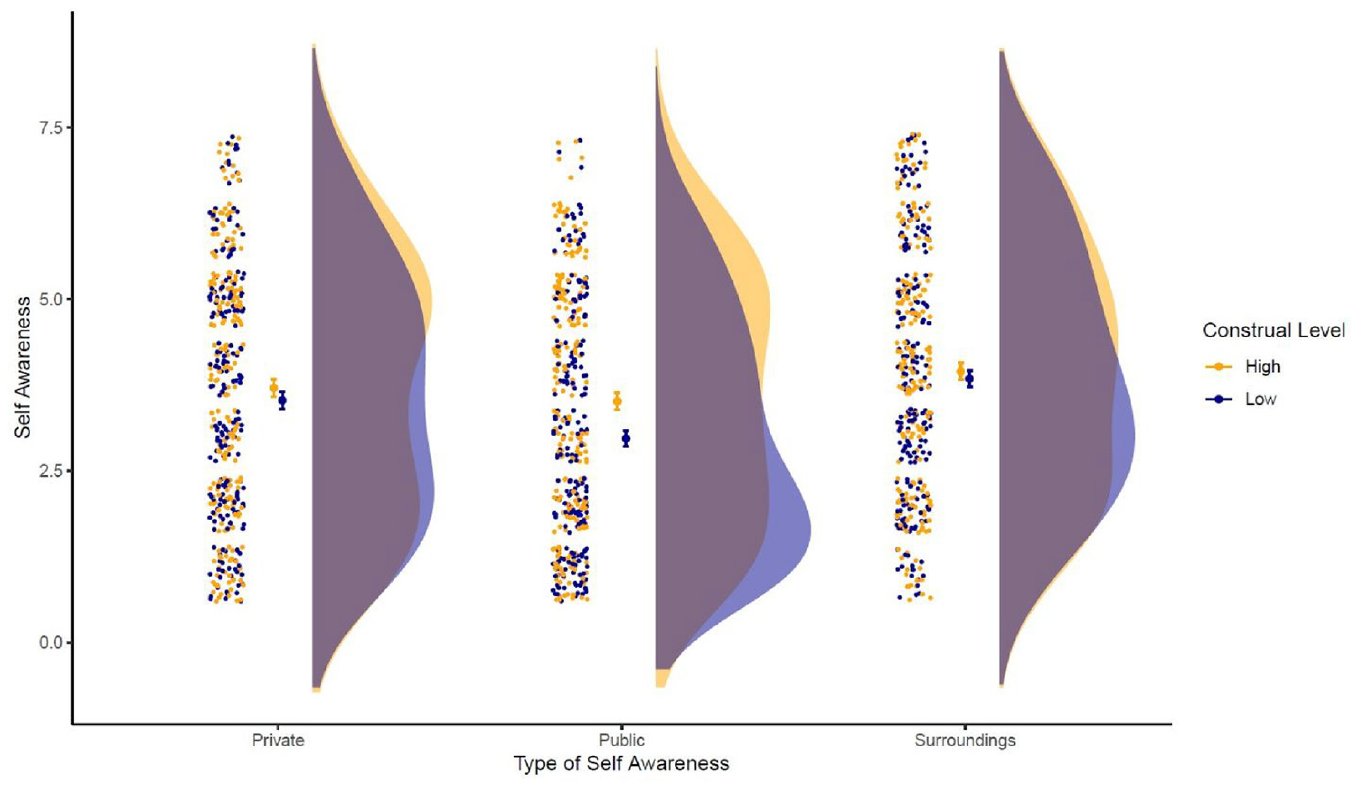
Responses to the SSAS as a Function of Construal Level and Type of Self-Awareness in Study 2
To test whether concrete (vs. abstract) processing influences social anxiety via attenuated public self-awareness, a simple mediation model with abstraction (1 = concrete vs. 2 = abstract) as the independent variable, public self-awareness as the mediator, social anxiety as the criterion, and private self-awareness as a covariate was computed (Model 4 in the PROCESS macro for SPSS). Regression weights and 95% confidence intervals (CIs) were estimated using 5,000 bootstrap samples. The mediation model explained a significant proportion of variance, F(3, 124) = 5.43, p = .002, R2 =.116. As can be seen in Figure 4A, compared with a concrete construal level, an abstract construal level predicted higher levels of public self-awareness, which predicted higher social anxiety. Although the total effect of abstraction on social anxiety was not significant, the indirect effect was significant, b = .18, SE = .11, 95% CI [0.01, 0.41], and reduced the effect of abstraction on social anxiety from b = .17 to b = –.02.
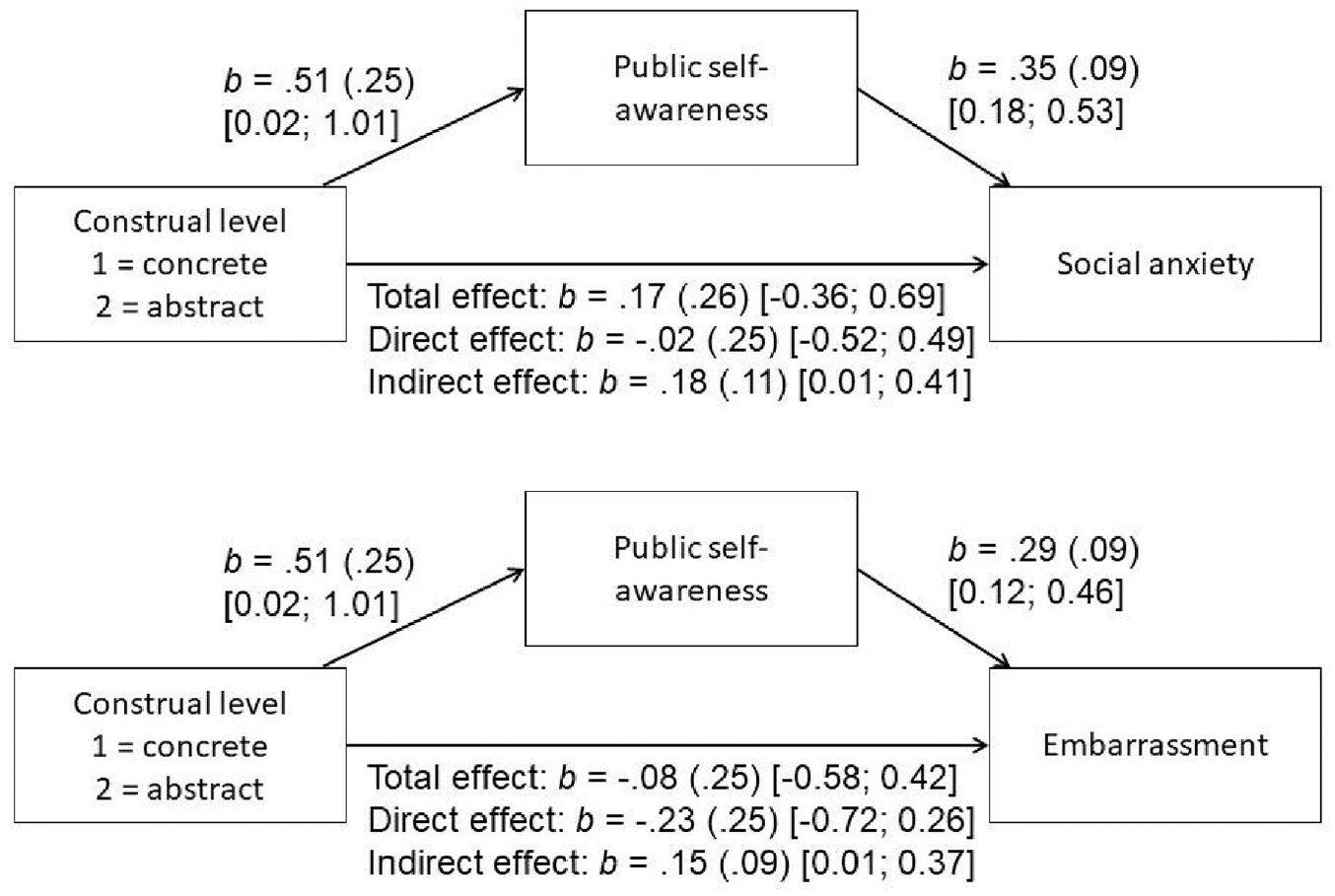
Mediation Model With Public Self-Awareness as a Mediator of the Relation Between Construal Level and Social Anxiety (A) and Construal Level and Embarrassment (B)
A comparable result was found with embarrassment as the dependent variable (see Figure 4B), F(3, 124) = 4.80, p = .003, R2 = .104.
Discussion
The findings of Study 2 replicated the findings of Studies 1a and 1b: Concrete (relative to abstract) thinking decreased public self-awareness while leaving private self-awareness unaffected. In addition, based on mediation analyses that established significant indirect effects, the study provides support for the proposed effect of abstraction on social anxiety and embarrassment via public self-awareness.
However, we did not observe a direct effect of abstraction on social anxiety and even found a (non-significant) negative effect of abstraction on embarrassment that worked in the opposite direction as the indirect effect via public self-awareness, which in total produced a null effect. A likely explanation of the absent direct effect is that other psychological processes work in addition to increased public self-awareness. For instance, abstraction has been found to increase self-control (Fujita et al., 2006), self-affirmation (Wakslak & Trope, 2009), and long-term self-change motivation (Belding et al., 2015)—processes that should diminish social anxiety and embarrassment. In contrast, abstraction may increase task importance (Ülkümen & Cheema, 2011), thereby possibly raising levels of social anxiety and embarrassment. In other words, abstract processing triggers many psychological processes—some of them increasing, some diminishing social anxiety and embarrassment—which may all contribute to the effect of construal level on social anxiety and embarrassment and possibly also on other emotions (Moran & Eyal, 2022; Williams & Moulds, 2007; see also Niese et al., 2022). Importantly, the present findings demonstrate the indirect effect of abstraction on social anxiety and embarrassment via public self-awareness (which may constitute one contributing subprocess under many). This could imply that possible diminishing effects of abstractness on anxiety and embarrassment (e.g., abstraction may cause individuals to welcome others’ perspectives on the self even if they include criticism; Belding et al., 2015) may have been underestimated in the literature.
To create a situation that would likely evoke anxiety and embarrassment, participants were asked to film themselves reciting a poem. As public self-awareness is heightened when one is placed in front of a video camera, this procedure could have undermined differences in public self-awareness induced by abstraction, leading to the observed absence of a direct effect of public self-awareness on social anxiety and embarrassment. However, this additional explanation for the lack of a direct effect of concrete (vs. abstract) processing on embarrassment and social anxiety would imply a heavily inflated grand mean of public self-awareness. Although the grand mean of public self-awareness seems to be higher in Study 2 than in Studies 1a and 1b, it is far from the ceiling, which renders undermined differences in public self-awareness induced by abstraction rather unlikely.
General Discussion
The present research provided evidence for the effect of abstraction on public self-awareness. A pilot study revealed that abstraction was associated with public self-awareness but not with private self-awareness on a trait level. Studies 1a, 1b, and 2 showed an effect of manipulated abstraction on state public self-awareness while leaving private self-awareness unaffected. The findings complement previous research that demonstrated that being observed (a condition known to trigger public self-awareness) enhances abstract processing (Luan & Li, 2020); in the present research, the converse causal relation was supported.
Interestingly, the results of Study 1b suggest that the effect of abstraction on public self-awareness is probably driven by concrete processing. Comparing the responses of the two experimental conditions with those of the control group showed that public self-awareness was reduced by concrete processing rather than increased by abstract processing. This observation may be a general one and thus of interest for other research on construal level: It may well be that the regulatory scope is shrunk by concrete processing instead of broadened by abstract processing.
A null effect of abstraction on private self-awareness was apparent in all experiments and the correlational pilot study. It seems that the items of the Private Self-Awareness subscale (e.g., “Right now, I am conscious of my inner feelings”; “Right now, I am reflective about my life”) do not (only) refer to the “self in the here-and-now” but leave open the possibility to expand one’s mental horizon. That is, the wording of the items seems to refer to contemplating the past and the future (e.g., “reflective about my life”) instead of contracting one’s mental scope to the present here and now. In addition, the null finding can be interpreted in line with CLT which states that abstraction expands one’s mental scope and does not shift it so that a “contractive scope is included in expansive scope” (Trope et al., 2021, p. 207). For the present discussion, this means that abstract processing includes the public dimension in one’s mental representations without necessarily reducing the private dimension but concrete processing excludes the public dimension from one’s mental representations.
As in previous research on self-awareness, public self-awareness was not operationalized simply as attention to the self as a social object but more specifically as involving concerns about one’s public self-image. Although both concepts are related to each other (as argued by the theory of objective self-awareness; Duval & Wicklund, 1972), such an operationalization may introduce a confound as the measurement of public versus private self-awareness involves not only a difference in self-perspective but also a difference in one’s subjective state. If so, it could be argued that the reduced public self-awareness following a manipulation of concrete thinking observed in Studies 1a, 1b, and 2 was due to concrete thinking preventing concern about the self. Furthermore, the reduced levels of anxiety and embarrassment among participants in the concrete-thinking condition in Study 2 could result from their stronger rejection of statements expressing concern about the self rather than from “actual” decreased public self-awareness. The disentanglement of concern from attention is an important task for future research on public self-awareness in general. For instance, future endeavors could develop scales that dissociate attention from concern.
In Study 2, concrete (vs. abstract) processing indirectly decreases social anxiety and embarrassment via public self-awareness. As concrete thinking decreases public self-awareness, it may have other far-reaching consequences associated with public self-awareness. For instance, previous research has shown that public self-awareness increases compliance (Froming & Carver, 1981) and prosocial behavior (van Bommel et al., 2012). Concrete thinking may reduce such behaviors, mediated by reduced public self-awareness. Indeed, previous research demonstrated that concrete (relative to abstract) processing decreases conformity (Ledgerwood & Callahan, 2012) and prosocial behavior (e.g., Singh & Teoh, 2013). Future research may investigate whether these effects are (partly) mediated by public self-awareness.
In addition, when making judgments, concrete (vs. abstract) processing causes individuals to rely more (vs. less) on metacognitive feelings (such as fluency; Tsai & McGill, 2011). In light of the present findings, this effect may be explained by concrete (relative to abstract) thinking reducing public self-awareness, as public self-awareness (manipulated by being observed vs. not) has been shown to reduce the reliance on fluency in judgments (Noah et al., 2018). Future research may address these and other questions arising from the relationship between abstraction and the susceptibility to the perspective of others.
Supplemental Material
sj-docx-1-spp-10.1177_19485506231179772 – Supplemental material for Abstraction Allows Susceptibility to the Perspective of Others: The Case of Decreased Public Self-Awareness Due to Concrete Thinking
Supplemental material, sj-docx-1-spp-10.1177_19485506231179772 for Abstraction Allows Susceptibility to the Perspective of Others: The Case of Decreased Public Self-Awareness Due to Concrete Thinking by Jochim Hansen, Nicole Neumeier and Magdalena Höller in Social Psychological and Personality Science
Footnotes
Handling Editor: Bar-Anan Yoav
Declaration of Conflicting Interests
The author(s) declared no potential conflicts of interest with respect to the research, authorship, and/or publication of this article.
Funding
The author(s) received no financial support for the research, authorship, and/or publication of this article.

Supplemental Material
Supplemental material for this article is available online.
Author Biographies
References
Supplementary Material
Please find the following supplemental material available below.
For Open Access articles published under a Creative Commons License, all supplemental material carries the same license as the article it is associated with.
For non-Open Access articles published, all supplemental material carries a non-exclusive license, and permission requests for re-use of supplemental material or any part of supplemental material shall be sent directly to the copyright owner as specified in the copyright notice associated with the article.
