




Abstract
Social interaction and loneliness have received much research interest. However, the direction of their relationship is unclear—does social interaction shape loneliness, or does loneliness shape willingness to interact? We explored dynamics of these social experiences under exceptional circumstances: COVID-19 lockdowns, which were necessary for public health but impacted people’s social lives. We investigated the relationship between social interaction and loneliness in and out of lockdown in Australia. We used experience sampling methodology to follow 233 people across 1 week (Mage=30; 8,495 surveys) in a period that spanned one of the longest lockdowns in the world. Although loneliness did not predict subsequent social interaction, having a social interaction predicted lower subsequent loneliness, particularly in (vs. out of) lockdown. These findings suggest social interactions may limit loneliness, especially during physical isolation. In short, times when we are apart from others may be times we benefit from interacting with them the most.
Social experiences are vital for health and well-being. When people are dissatisfied with current social connectedness levels, they can experience loneliness, which is associated with mental and physical health problems (Hawkley & Cacioppo, 2010). One key indicator of social connectedness is social interaction, which has been theorized as both a predictor and consequence of loneliness. Nevertheless, the dynamic relationship between social interaction and loneliness has not been extensively tested.
Understanding the dynamics of these social experiences is especially important in light of COVID-19, in which restrictions such as lockdown—defined as stay-at-home or heavy movement-restriction orders (Meyerowitz-Katz et al., 2021)—altered the social landscape. In the current study, we used experience sampling methodology (ESM) to investigate people’s daily social experiences during one of the longest and strictest lockdowns in the world, in Melbourne, Australia (Ritchie et al., 2020). We sampled people seven times per day for 7 days, with data collected over 3 months that spanned times when Melbourne was in and out of lockdown. Our central aim was to explore the direction of the relationship between loneliness and social interaction. As an ancillary aim, we tested whether these dynamics were different out of versus in lockdown—when it is arguably most important to stay socially connected.
Dynamics of Social Experiences
We explored the relationship between two social experiences: social interaction and loneliness. A social interaction is an instance of social contact with another person(s). Loneliness is an aversive psychological state experienced when people perceive a discrepancy between their desired and actual connectedness level, reflected in the frequency and closeness of their social interactions (Peplau & Perlman, 1982). Given that both represent common and potentially interconnected social experiences (Coyle & Dugan, 2012), their dynamic relationship is of theoretical interest: Does social interaction predict loneliness, does loneliness prompt social interaction, or both?
Research assessing social interactions alongside loneliness suggests these constructs are related (e.g., Leigh-Hunt et al., 2017). Evidence regarding their directional association is sparse, although longitudinal evidence does exist. For example, in a 5-year study, Hawkley and Kocherginsky (2018) found older adults who interacted more frequently with others felt less lonely over time than those who interacted less frequently. A daily diary design that captured everyday experiences also revealed that having more social interactions was associated with lower loneliness on subsequent days (Kuczynski et al., 2022).
Greater theoretical attention has been paid to the alternate direction: that loneliness prompts social interaction. One prominent theory suggests loneliness is a psychological signal warning people they may be lacking in social resources (Cacioppo & Cacioppo, 2018). According to this view, loneliness should motivate people to interact. Paradoxically, the theory posits that loneliness can also motivate social withdrawal, as people seek to avoid the costs of poor social interactions for self-preservation.
Researchers have squared conflicting ideas that loneliness motivates people to both approach and avoid social interaction by considering the time course of loneliness. For instance, Qualter and colleagues (2015) distinguish between transient (state-like) and prolonged (trait-like) loneliness. Whereas short-term increases in state loneliness may spur people to reconnect with others, chronically elevated levels of loneliness may negatively bias people’s perception of social cues and thus motivate them to avoid interacting. Although there is evidence that chronic loneliness is associated with social withdrawal (e.g., Cacioppo et al., 2006; Cassidy & Asher, 1992; Nurmi et al., 1997; Qualter et al., 2013; Watson & Nesdale, 2012), direct evidence that state loneliness prompts social interaction is limited. This is, in part, because past research has often studied the relationship between loneliness and social interaction over years, which may be too long to observe transient effects of loneliness on social interaction (e.g., Hawkley & Kocherginsky, 2018, cf. Kuczynski et al., 2022).
In sum, prior research hints at a bi-directional relationship between social interaction and loneliness. Testing this idea requires disentangling transient state feelings from more stable trait feelings of loneliness, by assessing short-term dynamic associations between loneliness and social interaction as they play out in daily life. Prior work has used daily diary methods (Kuczynski et al., 2022), but transient loneliness may be felt in the moment and dissipate by the day’s end. Gaining greater temporal resolution requires narrowing assessments from days to hours to capture these experiences close to when they occur. To meet this need, we investigated the relationship between social interaction and loneliness multiple times per day using ESM. Having multiple observations per person means we can distinguish transient (within-person) variation in state-like loneliness from more stable (between-person) differences in trait-like loneliness. We can, thus, model whether a recent social interaction predicts subsequent state loneliness—or conversely, whether feeling lonely predicts subsequent social interaction—over the course of hours. Furthermore, because our data encompassed days on which people were and were not in lockdown, we can model how the temporal dynamics of social interaction and loneliness differ as a function of being physically disconnected.
Social Experiences During COVID-19
Disentangling the dynamics of social interaction and loneliness also has applied relevance in the wake of COVID-19, during which many governments introduced lockdown orders. These orders restricted movement and encouraged physical isolation (Ritchie et al., 2020), raising concerns about potentially detrimental effects (e.g., Aknin et al., 2022; Brooks et al., 2020; Courtet et al., 2020). These concerns were not entirely unfounded—there is evidence that loneliness increased during initial lockdowns of 2020 (Killgore et al., 2020; Macdonald & Hülür, 2021). However, other work suggested that while loneliness surged following the introduction of lockdown, it returned quickly to baseline (Foa et al., 2022; Fried et al., 2022). Furthermore, a recent review concluded loneliness did not increase during 2020, despite lockdown restrictions, because physical isolation compelled people to find ways to interact that did not require physical proximity (e.g., via technology; Aknin et al., 2022).
One possibility is that lockdowns curtail social experiences directly, although whether and to what extent is debated. Another possibility is that the social impact of lockdown is more indirect, shaping the degree to which people benefit from—or are motivated to engage in—social experiences. Put in terms relevant to our investigation, lockdown status (in vs. out) may alter the strength of the relationship between social interaction and loneliness. For instance, lockdown may weaken this relationship because people do not feel allowed or able to interact with others while under government stay-at-home orders. Alternatively, lockdown may exacerbate the impact of having social interactions on loneliness (Kuczynski et al., 2022), such that people benefit from social interaction most when they are isolated from others. Indeed, research points to the importance of staying socially connected while physically isolating: social interaction quantity and quality have been shown to predict better mental health outcomes during COVID-19 (Forbes et al., 2022; Nitschke et al., 2021; Sommerlad et al., 2022).
The Extended Lockdown Context
We investigated the dynamic relationship between social interaction and loneliness in the context of extended lockdown. This approach makes two contributions to the literature. First, some existing research has compared lockdown samples to pre-COVID-19 samples (e.g., Bu et al., 2020; Elmer et al., 2020; Macdonald & Hülür, 2021). Thus, it is hard to disentangle the impact of lockdown per se from the effect of the pandemic more broadly, because the impact of lockdown has not always been contrasted with a relevant comparison condition (i.e., participants out of lockdown, but also experiencing COVID-19). Second, most published research focused on the initial lockdown experience in the first few months of the pandemic. The impact of extended lockdown has received little attention, limiting insight to how lockdown interacts with social experiences over a longer period once its novelty fades. This blind spot is a concern, given that research on the effects of quarantine suggests that duration is a risk factor for mental ill-health (Brooks et al., 2020).
Addressing these issues, we collected data in Melbourne, Australia, which experienced one of the longest and strictest lockdowns in the world. From 2020 to 2021, Melburnians underwent six lockdown periods, spanning 262 days in total (Zhuang, 2021). In lockdown, non-essential industries were shut down, a curfew was enforced, and citizens not permitted to leave their homes except for 1 hr of daily exercise, or to conduct an essential activity (i.e., purchasing groceries, caregiving). Our data, collected as participants went in and out of Melbourne’s final three lockdowns, offered a unique opportunity to test the relationship between social interaction and loneliness both in and out of lockdown, while keeping constant the broader COVID-19 context (i.e., 18 months since pandemic onset).
Participants reported on their social experiences seven times per day for 7 days, during a period in which Melbourne went in and out of lockdown. Taking advantage of this natural experiment, we descriptively modeled the degree to which loneliness and social interactions—whether they occurred, as well as their quality, and the medium through which they occurred—changed by lockdown status.
Addressing our central aim, we tested the directionality of the dynamic association between social interaction occurrence and loneliness. Addressing our ancillary aim, we tested how this relationship changed in vs. out of lockdown. Although we made no formal hypotheses due to mixed evidence in the literature, we pre-registered the data collection procedure (https://osf.io/5ze6p), and the analysis plan (https://osf.io/s4wxt/); where data and code are also available.
Method
Participants
An a priori power analysis using the t-method for multilevel models (Murayama et al., 2022), with alpha = .05 and t = 2.50 (d = .20), indicated 200 participants minimum was required to achieve 80% power. After pre-registered exclusions, 1 our final sample comprised 2332 participants aged 18–79 (M = 30.00, SD = 10.87; 70.8% women). Participants were 56.7% Caucasian, 15.5% South East Asian, 14.6% East Asian, and 13.2% other ethnicities. Of note, our sample largely comprised individuals who had pandemic privilege (Smith & Judd, 2020), with most participants being university graduates (70.4%) without care-giving role(s) (91.8%), lived with others (82.8%), were in relationships (60.9%), and were either casually (33%), part-time (16.7%) or full-time (31.3%) employed (see Supplemental Material A for more detailed sample demographics).
Design and Procedure
Participants were recruited via an undergraduate research participation program (n = 54; 23%) and community advertising (n = 179; 77%), and reimbursed according to ESM compliance. 3 The study comprised two stages: a baseline survey and a subsequent 7-day ESM period. Although each participant was in the study for 8 consecutive days, they were not recruited in the same period. Data collection occurred over 77 days, from May 17 to June 16, 2021; and from July 6 to August 20, 2021 (see Figure 1 for detailed timeline).
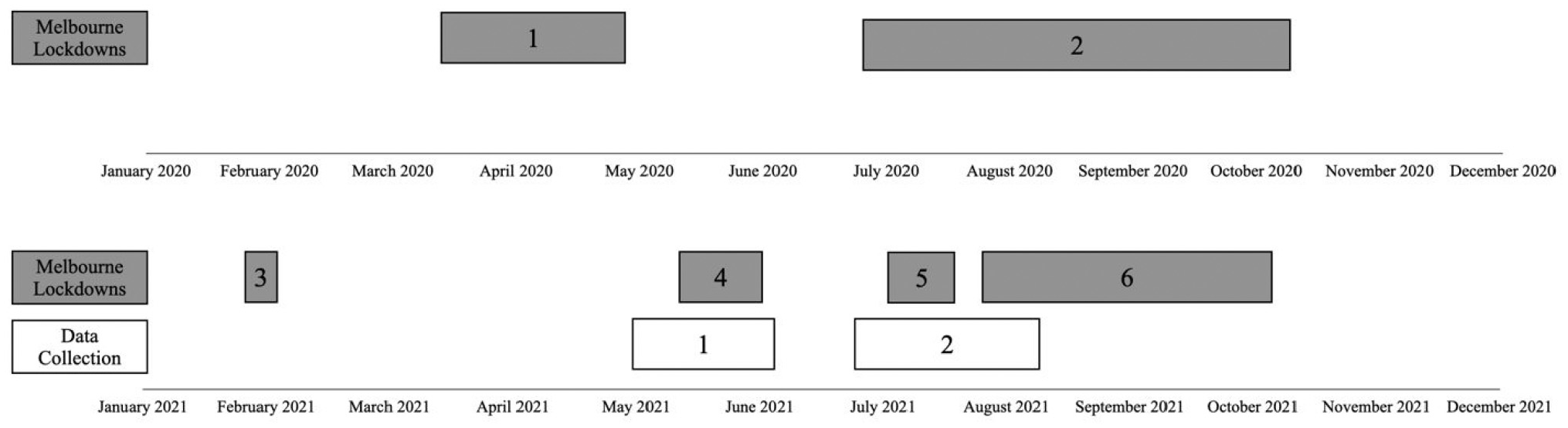
Timeline of Lockdowns in Melbourne, Australia (2020–2021) and Data Collection (2021)
Baseline Survey
On Day 0, participants provided informed consent and completed trait measures. Participants then downloaded the SEMA3 smartphone app (Koval et al., 2019), which delivered the ESM surveys.
ESM Survey
On Day 1, eligible participants began the 7-day ESM period. Participants were prompted to complete seven surveys per day (49 total). 4 On average, surveys occurred 89.99 min apart (SD = 12.63). To promote compliance, participants were sent email reminders on Days 2 and 5. These emails encouraged participants who had completed <50% of surveys to increase compliance, and participants who had completed >50% of surveys to keep up the good work. Overall compliance was relatively high (M = 74.80%, Median = 79.59%, SD = 19.05, skewness = −1.17). Most of the sample (89.27%) had ≥50% compliance. In total, participants completed 8,495 surveys.
Measures
ESM surveys had two alternate branches, depending on whether participants reported having a social interaction. Branches were comparable in length to ensure participants were not incentivized to respond in a certain way to answer fewer questions. Below we report on variables of interest for the present study; see data collection pre-registration for a full list of measures (https://osf.io/5ze6p).
Loneliness
Participants first responded to the item “Since the last survey, how lonely have you felt?” on a slider from 0 (not at all) to 100 (very much).
Social Interaction
For each ESM survey, participants were reminded of the definition of interaction included in this study: “a verbal exchange (e.g., in person, via phone or video chat) or a written exchange (e.g., social media, text message) with another person that lasted more than two minutes.” Participants then reported whether they had engaged in a social interaction since the last survey (0 = no, 1 = yes). If a social interaction occurred, we asked participants to answer the following questions about the most significant interaction since the last survey.
Social Interaction Medium
Participants indicated in what medium the interaction occurred (0 = in-person, 1 = digitally, 2 = other).
Social Interaction Quality
Participants also rated the quality of the interaction on a 0–100 scale (0 = very negative, 100 = very positive).
Lockdown Status
We defined lockdown as restrictions imposed by state governments that included stay-at-home orders. We determined the lockdown status of each Australian city daily using news articles and government data (see Supplemental Materials B), and combined that information with participants’ location. In Melbourne—where 97% of our participants were based—of the 77 days of data collection, 44 (non-consecutive) days were in lockdown, and 33 were out of lockdown. For each participant, we coded all observations on a given day as 0 = not in lockdown, or 1 = in lockdown.
Data Analytic Strategy
We pre-registered our analytic strategy (https://osf.io/s4wxt/) and note in text any deviations from this plan. Analyses were conducted using R (version 4.1.2) using the package lme4 (version 1.1–30; Bates et al., 2015). We replaced 36 items (0.1% of all relevant items), and 62 ESM surveys (0.7% of all surveys) with missing data, following criteria of excluding items completed in <650 ms and entire surveys where ≥50% items were completed in <650 ms (Geeraerts, 2020).
We conducted cross-classified models that cluster ESM observations (N = 8,495) by time (i.e., study collection day) and participants (N = 233). All models included random intercepts for participant (representing between-person variation in mean levels of the outcome variables) and day (representing variation in lockdown restrictions across study days), except when noted below. This cross-classified structure allowed each observation to vary both by day (on which lockdown was either enforced or not) and by participant. For parsimony, we did not include random slopes for each time-varying predictor. However, a robustness check with analyses including random slopes yielded no substantive differences from the results reported below (see Supplemental Materials C). We analyzed categorical outcomes (e.g., social interaction) using logistic cross-classified models, and continuous outcomes (e.g., loneliness) using linear cross-classified models.
We post hoc supplemented our frequentist model results with Bayesian analyses. This approach allowed us to quantify the level of evidence for both the presence and absence of effects, which cannot be quantified based on p values alone (Dienes, 2014). We report and interpret Bayes Factor in favor of alternative hypothesis (BF10) following Wetzels et al.’s (2011) guidelines. These guidelines suggest that the data (a) support the presence of the effect if BF10>1, (b) support the absence of the effect if BF10<1, or (c) support neither if BF10 roughly equals 1.
Central Aim
For analyses concerning temporal dynamics of social interaction and loneliness (Models 1a and 1b), we regressed each outcome onto a lagged version of the predictor (i.e., the predictor’s value at the previous occasion, excluding overnight lags, as recommended by Palmier-Claus et al., 2019) and the lagged outcome, to control for carry-over in the outcome (for similar procedures, see Kalokerinos et al., 2019; Pauw et al., 2022). When state loneliness was included as a predictor, we first person-mean centered it (subtracting each participant’s mean loneliness score from their score at each measurement occasion) before lagging, to remove between-person variance. However, following Nezlek (2012), we entered the categorical variable social interaction as an uncentered predictor to enhance the interpretability of our results.
For analyses concerning social interaction as an outcome (Models 1b and 1d), we calculated within-person and between-person versions of loneliness as the predictor. Adding between-person loneliness departed from our pre-registration (which included only within-person loneliness) but meant we could distinguish the effects of state and trait-like loneliness (Hamaker & Wichers, 2017). Within-person loneliness was person-mean centered and between-person loneliness was grand-mean centered (subtracting each participant’s mean score from the sample’s mean score; Enders & Tofighi, 2007).
Ancillary Aim
For analyses concerning the impact of lockdown on these dynamics (Models 1c and 1d), we included an interaction between lockdown (in/out) and the lagged predictor, as well as the lagged outcome as fixed effects.
Descriptive Analyses
For descriptive analyses concerning the relationship between lockdown and social experiences (loneliness, social interaction occurrence, quality, and medium; Models 2a and 2d), we included lockdown (in/out) as a fixed effect.
Results
Table 1 displays the descriptive statistics for all variables. Social interactions occurred on >60% of measurement occasions, and were mostly in person. When people had interactions, they were on average high quality (M = 71.70/100). By comparison, state loneliness was, on average, relatively low (M = 13.60/100). Social interaction quality and loneliness negatively correlated both within-person (i.e., correlations between momentary measures within each participant; r =−.25) and between person (i.e., correlations between participants’ mean score; r =−.33), ps < .001.
Descriptive Statistics of Social Experiences for Observations In and Out of Lockdown
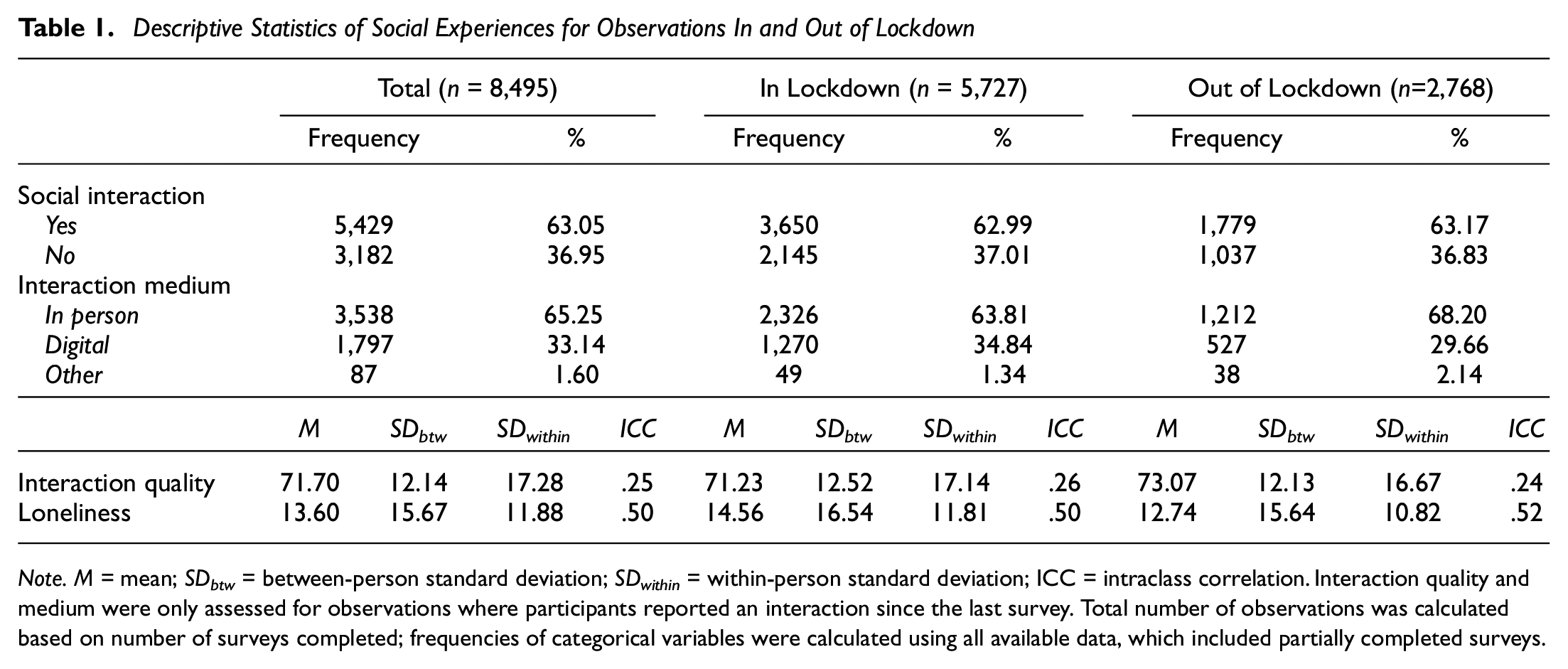
Note. M = mean; SDbtw = between-person standard deviation; SDwithin = within-person standard deviation; ICC = intraclass correlation. Interaction quality and medium were only assessed for observations where participants reported an interaction since the last survey. Total number of observations was calculated based on number of surveys completed; frequencies of categorical variables were calculated using all available data, which included partially completed surveys.
Central Aim: Dynamics of Social Experiences
We examined the temporal dynamics of social interaction and loneliness (Table 2). First, we tested whether social interaction at the previous occasion predicted loneliness at the current occasion, controlling for loneliness at the previous occasion (Model 1a). Having a prior social interaction predicted lower state loneliness. Although this effect amounted to a reduction of 0.94 units on a 0–100 scale, the associated Bayes Factor indicated decisive evidence for this effect (see BF10 for Model 1a in Table 2).
Results From Mixed Effect Models to Examine the Temporal Dynamics of Social Experiences
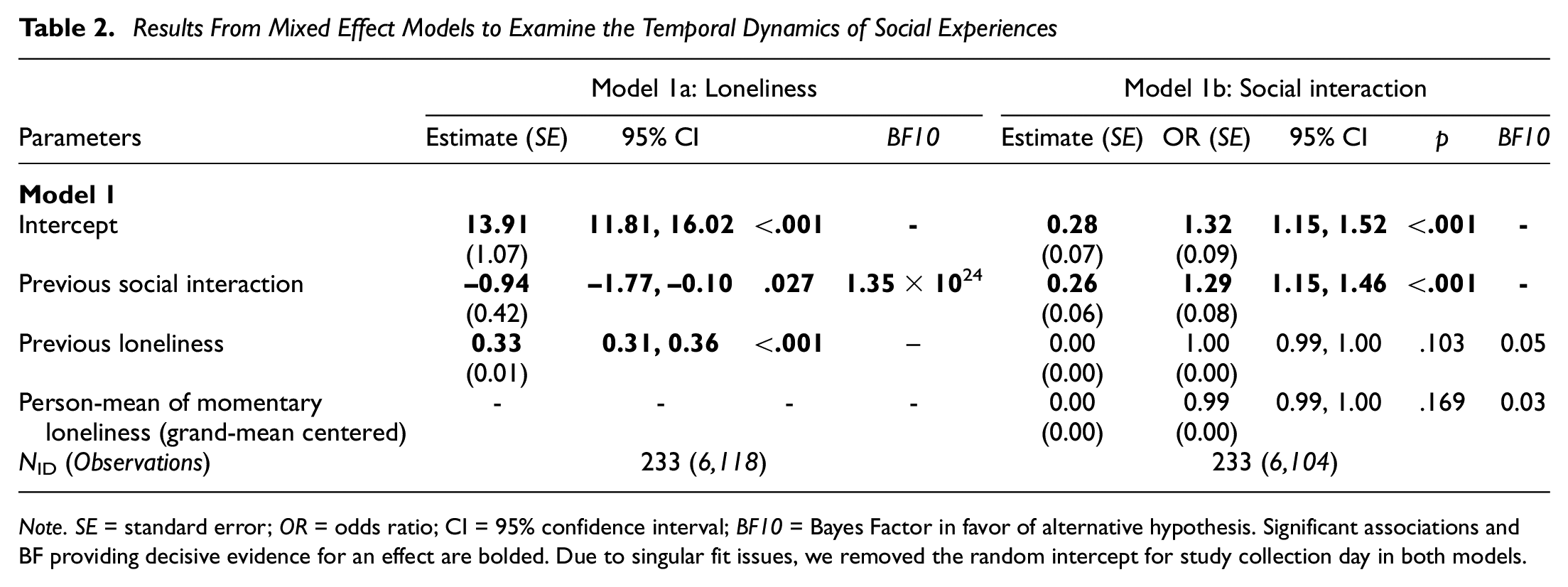
Note. SE = standard error; OR = odds ratio; CI = 95% confidence interval; BF10 = Bayes Factor in favor of alternative hypothesis. Significant associations and BF providing decisive evidence for an effect are bolded. Due to singular fit issues, we removed the random intercept for study collection day in both models.
We next tested whether loneliness at the previous occasion (lagged loneliness) predicted the likelihood of having a current social interaction, controlling for whether a social interaction occurred at the previous occasion (lagged social interaction; Model 1b). This model included fixed effects of both between-person and within-person loneliness, allowing us to distinguish whether a person reported feeling lonelier than their personal average (within-person) and whether a person was lonelier than others in the sample (between-person). We found that neither within-person nor between-person loneliness predicted the likelihood of social interactions occurring at the subsequent measurement occasion. Bayesian analyses provided decisive evidence for the null hypothesis (see BF10s for Model 1b in Table 2).
Ancillary Aim: Dynamics of Social Experiences in the Context of Lockdown
We tested whether lockdown moderated the temporal relationship between social interaction and loneliness (Table 3). Model 1c revealed a significant interaction between lockdown and lagged social interaction (controlling for lagged loneliness): having a prior social interaction predicted lower state loneliness in lockdown (b =−2.44, 95% CI = [−4.18, −0.69], p=.006), but not out of lockdown (b = 0.69, 95% CI = [−0.74, 2.12], p=.341). Bayesian analyses revealed decisive evidence for the moderating effect of lockdown on the relationship between lagged social interaction and subsequent loneliness (Wetzels et al., 2011). However, lockdown did not moderate the relationship between lagged loneliness and subsequent social interaction (controlling for lagged social interaction; Model 1d), and Bayesian analyses provided decisive evidence for the null hypothesis (Wetzels et al., 2011).
Results From Mixed Effect Models Examining the Interaction Between Lockdown and Social Experiences
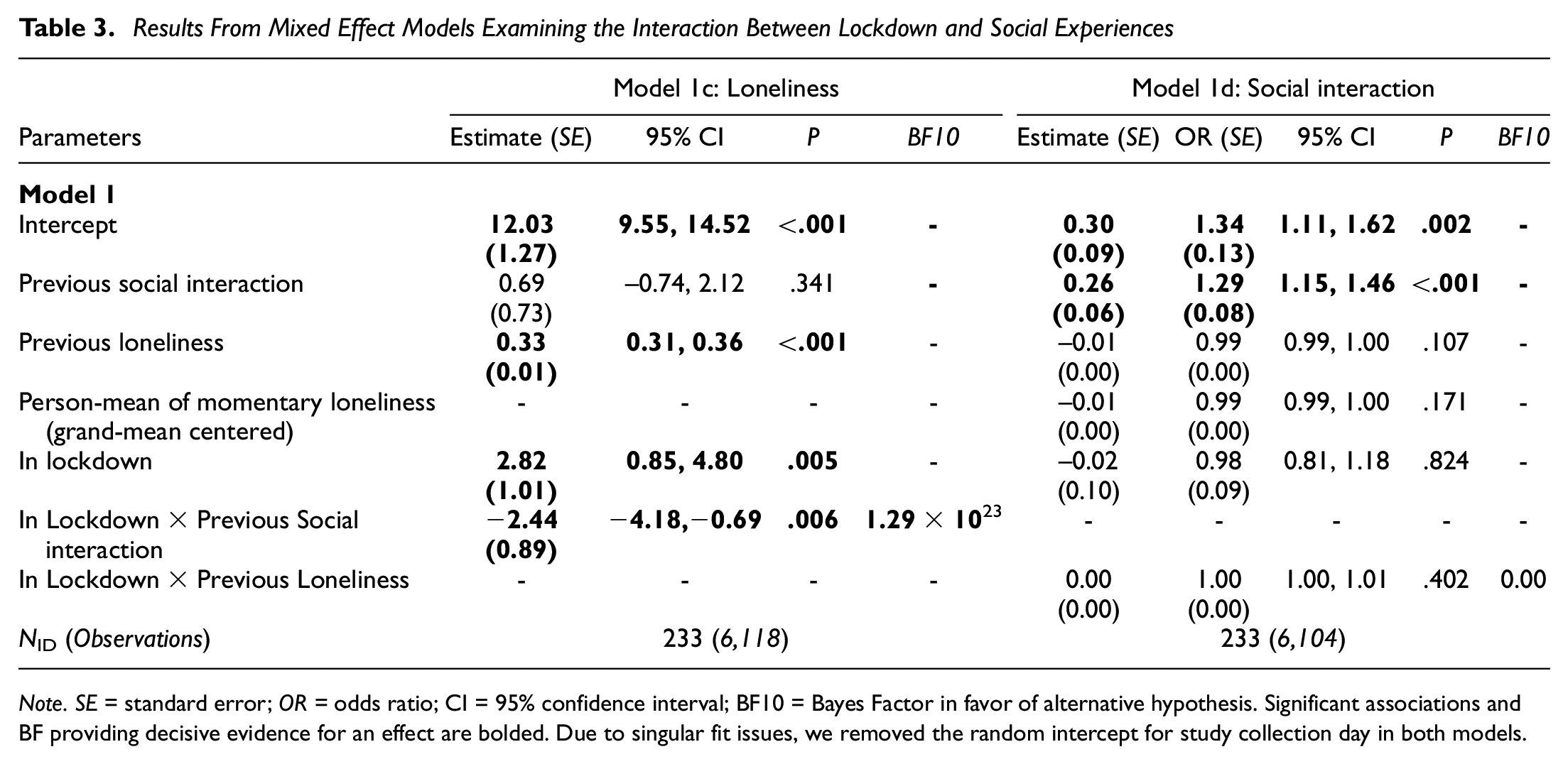
Note. SE = standard error; OR = odds ratio; CI = 95% confidence interval; BF10 = Bayes Factor in favor of alternative hypothesis. Significant associations and BF providing decisive evidence for an effect are bolded. Due to singular fit issues, we removed the random intercept for study collection day in both models.
Descriptive Analyses: Impact of Lockdown on Social Experiences
We did not detect a significant difference in the likelihood of having a social interaction in versus out of lockdown (see Table 4). Lockdown also did not predict the likelihood of a given interaction occurring in person compared with digitally. However, lockdown was a significant predictor of social interaction quality, such that quality was slightly higher out of, compared with in, lockdown. This difference was small, amounting to a 2.55-point improvement in quality on a 0–100 scale. Indeed, Bayesian analyses provided only anecdotal evidence for this effect (Wetzels et al., 2011). Finally, lockdown did not predict loneliness.
Results From Mixed Effect Models to Examine the Relationship between Lockdown and Social Experiences
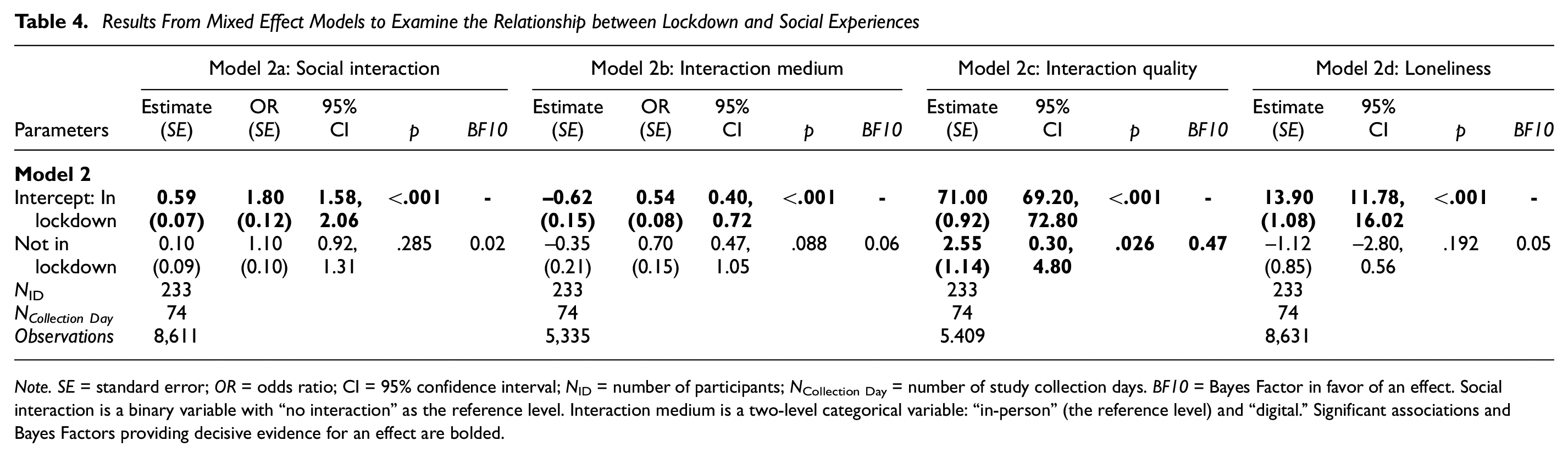
Note. SE = standard error; OR = odds ratio; CI = 95% confidence interval; NID = number of participants; NCollection Day = number of study collection days. BF10 = Bayes Factor in favor of an effect. Social interaction is a binary variable with “no interaction” as the reference level. Interaction medium is a two-level categorical variable: “in-person” (the reference level) and “digital.” Significant associations and Bayes Factors providing decisive evidence for an effect are bolded.
Supplemental Analyses: Social Interaction Desire
Although our main analyses focused on occasions when an interaction occurred, we also explored occasions when people had no interaction. Specifically, we assessed whether people felt a stronger desire to interact with others when they felt lonely on occasions when they did not have a social interaction. This exploratory analysis was not pre-registered but was prompted by the results of Models 1a and 1b in the main analysis, which revealed that a previous interaction predicted subsequent loneliness, but previous loneliness did not predict having a subsequent interaction. Because this finding was inconsistent with reaffiliation motive theory (Cacioppo & Cacioppo, 2018), we investigated whether loneliness predicted the desire to have an interaction, in the absence of having an interaction itself. Full results are in Supplemental Material D.
We found social interaction desire was predicted by both within-person (b = 0.18, 95% CI = [0.14, 0.23], p <.001) and between-person loneliness (b = 0.71, 95% CI = [0.58, 0.84], p <.001), such that the lonelier a person was—compared with how they usually felt, or how they felt relative to others—the more they desired social interaction at the subsequent measurement occasion. Bayesian analyses provided decisive evidence for both effects (Wetzels et al., 2011).
Discussion
We captured everyday experiences of loneliness and social interaction seven times per day for a week, following participants as they were in and out of COVID-19 lockdown. Results showed having a social interaction predicted subsequent decreases in loneliness, especially during lockdown. However, the reverse was not true: Loneliness did not predict the likelihood of subsequently engaging in social interactions, regardless of lockdown status or whether loneliness was assessed within-person or between-person. Lockdown status was not associated with how lonely people felt, whether they had an interaction, or in which medium the interaction occurred, but there was weak evidence that being in lockdown was associated with lower interaction quality. Together, these findings provide insights into the temporal dynamics of loneliness and social interactions, particularly in a restricted social landscape.
Dynamics of Social Experiences
Our central aim was to test the dynamic association between social interaction and loneliness. Researchers have long been interested in the direction of the relationship between these experiences (e.g., Hawkley & Kocherginsky, 2018; Qualter et al., 2013). Our experience sampling study, which surveyed social experiences roughly 90 min apart, offered an opportunity to gain fine temporal resolution to this question. We found having a social interaction was associated with reduced subsequent loneliness, but feeling lonely was not associated with subsequent likelihood of having a social interaction.
Although some theorists suggest that state loneliness is likely to be associated with greater social interaction and trait loneliness is likely to be associated with less social interaction (Qualter et al., 2015), other work suggests that having a social interaction interrupts the loneliness cycle (Hawkley & Kocherginsky, 2018; Kuczynski et al., 2022). Our findings are consistent with the latter view: Social interactions may help disrupt loneliness. That said, while we found no evidence that state loneliness was associated with subsequent social interaction, exploratory analyses revealed that there was an association between loneliness and desire for social interaction. On occasions when people did not report having a social interaction, feeling lonelier than usual (or being a lonelier person than others) predicted subsequent desire to have a social interaction (see Supplemental Materials D). This finding may indicate an intention–behavior gap (Sheeran & Webb, 2016), such that when people feel lonely, they may want to interact with others, but not necessarily actually interact with others. Thus, loneliness may prompt a reaffiliation motive (Cacioppo & Cacioppo, 2018) but not necessarily reaffiliation behavior.
We also found lockdown moderated the relationship between social interaction and loneliness. Specifically, the effect of having a social interaction on subsequent loneliness was stronger when people were in (vs. out of) lockdown. This finding suggests that social interactions may be most linked with subjective interpretations of our social state when they are most salient and necessary—when the social landscape is restricted by factors outside of people’s control. This finding complements other research that identifies mental health benefits to staying socially connected while physically isolated (Forbes et al., 2022; Nitschke et al., 2021; Sommerlad et al., 2022).
Social Experiences During COVID-19
In addition, we wanted to understand the association between lockdown and social experiences, given concerns about the detrimental social effects of lockdown. The extended social disruption experienced by our participants made their data suitable to test the impact of lockdown on social experiences: if effects were to emerge, we would expect them when lockdown is both long and strict.
We found participants went about their lives in and out of lockdown with few significant changes in how lonely they felt, or whether and how they interacted with others. Lockdown had a small negative relationship with social interaction quality, but Bayesian analyses suggested weak evidence for this effect. In terms of these largely null findings, we note that our sample predominantly comprised people who were employed, lived with others, and were in relationships. Hence, they had more opportunities to engage with others, which may have shielded them from the repercussions of living alone or being unemployed through the pandemic (Taylor, 2019).
Our findings on the association between lockdown and social experiences help clarify mixed findings from past research. Although some research has pointed to a potential social risk posed by lockdowns (Killgore et al., 2020; Macdonald & Hülür, 2021), our findings, and those of others, present a different view. Building on conclusions drawn by Aknin et al. (2022) in the first year of the pandemic, our findings suggest that extended lockdown was not directly associated with how lonely people felt in the second year of the pandemic. Yet, being in versus out of lockdown still moderated the association between social interaction and subsequent loneliness in everyday life, such that having a previous social interaction was associated with subsequent loneliness during lockdown. Therefore, the impact of lockdown on social experiences may be more nuanced than previously thought. Although people may find ways to interact with others while distanced, lockdown may curb their ability to find meaning in, and gain benefit from, the social interactions they have.
Limitations and Future Directions
One major limitation of our study is that our sample had high pandemic privilege (i.e., highly educated, working, living with others). Therefore, our findings may not capture the experiences of people who were most vulnerable and thus less resilient to lockdown (Smith & Judd, 2020). The generalizability of our findings would benefit from a larger and more diverse sample.
Because ESM necessitates brevity to minimize response burden, participants could only report one significant social interaction in each survey. It could be that participants had interactions across different mediums between surveys but could only report on one interaction. As such, our data may not provide a holistic picture of whether and how social interactions occurred. Future studies might consider adopting an event-contingent design, which captures roughly 1.6 times more social interactions than the signal-contingent design used here (Himmelstein et al., 2019). Another limitation concerns the measurement of social interaction in our study. Classifying interactions as present or absent is a crude measure of social contact. Future work should capture social interactions with more nuance.
A further consideration is the sampling frequency. Because the interval between surveys was around 90 min, our lagged analyses included a predictor occurring around 90 min before the outcome. This surveying frequency is higher than in previous work, but the effect of loneliness on social interaction may still be too transient to be detected at our timescale. Future studies employing an even higher sampling frequency may find an effect of loneliness on social interaction over time. Nonetheless, we did observe a significant impact of lagged social interaction on state loneliness, suggesting that our sampling scheme was appropriate to detect a relationship in at least one direction.
Finally, while we found a directional relationship between social interaction and loneliness, and that lockdown moderated this relationship, these were small effects. Bayesian analyses provided decisive evidence for the presence of these effects, which were comparable to the median interaction effect observed in applied psychology (Aguinis et al., 2005). Although small effects can still be valuable (Gabriel et al., 2019), their size does call into question how noticeable they may be in daily life. Data captured in daily life must contend with unmeasured variance, which may result in weaker effects than a more tightly controlled environment. This speaks to the importance of basing policy and practical recommendations on evidence gathered using a range of methods that combine experimental control with ecological validity. Our findings contribute a piece to this puzzle by examining people’s social experiences as they play out in daily life. We can confidently say that having a social interaction is associated with a small reduction in loneliness within a matter of hours, particularly under conditions of social restriction.
Conclusion
We used ESM to examine how everyday social experiences were temporally related, and whether their relationship changed in extended lockdown. On a theoretical front, our study provides evidence that social interaction may help mitigate feelings of loneliness, while feelings of loneliness may affect the desire to interact more so than actual interaction. On an applied front, the COVID-19 pandemic has forced policymakers to grapple with the tradeoff between implementing lockdown restrictions to protect the physical well-being of the population, and the toll lockdown may take on people’s psychological well-being (Smith et al., 2020). Our finding that lockdown did not strongly damage people’s social experiences provides one datapoint to weigh in balancing the costs and benefits of extended lockdown measures for future pandemics. More broadly, the key to social health remains the same for lockdown as in other contexts—reaching out to others guards against feeling isolated and alone.
Supplemental Material
sj-docx-1-spp-10.1177_19485506231176603 – Supplemental material for Dynamics of Social Experiences in the Context of Extended Lockdown
Supplemental material, sj-docx-1-spp-10.1177_19485506231176603 for Dynamics of Social Experiences in the Context of Extended Lockdown by Anh Tran, Valentina Bianchi, Ella K. Moeck, Beth Clarke, Isobel Moore, Skye J. H. Burney, Peter Koval, Elise K. Kalokerinos and Katharine H. Greenaway in Social Psychological and Personality Science
Footnotes
Handling Editor: Veronika, Job
Declaration of Conflicting Interests
The author(s) declared no potential conflicts of interest with respect to the research, authorship, and/or publication of this article.
Funding
The author(s) disclosed receipt of the following financial support for the research, authorship, and/or publication of this article: This work was supported by an Australian Research Council Discovery Project awarded to the final two authors (DP190103072) and an Australian Research Council Future Fellowship awarded to the senior author (FT190100300).

Supplemental Material
The supplemental material is available in the online version of the article.
Notes
Author Biographies
References
Supplementary Material
Please find the following supplemental material available below.
For Open Access articles published under a Creative Commons License, all supplemental material carries the same license as the article it is associated with.
For non-Open Access articles published, all supplemental material carries a non-exclusive license, and permission requests for re-use of supplemental material or any part of supplemental material shall be sent directly to the copyright owner as specified in the copyright notice associated with the article.
