




Abstract
Ingroup favoritism can represent a challenge for establishing cooperation beyond group boundaries. In a behavioral experiment conducted across 17 societies (N = 3,236), we tested pre-registered hypotheses forwarded by social identity and material security frameworks to account for ingroup favoritism in trust toward national ingroups. We related individual-level measures of national identification and perception of institutions to trust, trustworthiness, and behavioral expectations of partner’s trustworthiness toward a national ingroup, outgroup, or unidentified stranger in a trust game. Our findings support a social identity framework, as national identification was positively associated with greater ingroup favoritism. However, in contrast to predictions from a material security framework, perceptions of national institutions as trustworthy and benevolent were positively associated with greater ingroup favoritism. These findings suggest some potential challenges that support for national institutions might pose to the establishment of trust beyond group borders.
Humans display a surprising amount of trust toward unrelated strangers, exposing themselves to vulnerability to exploitation (Rousseau et al., 1998). Decades of research have found that trust toward strangers is often parochial––people tend to trust strangers that are part of their own group (Foddy et al., 2009), even at personal cost (Balliet et al., 2014). Ingroup favoritism has been shown to be widespread across many behavioral domains, displayed early on in life (Lazić et al., 2021), and ubiquitous around the world (Romano et al., 2017a, 2021). Given the potential threats that the pervasiveness of ingroup favoritism poses to establishing trust and cooperation across borders, many theories have been proposed to account for such phenomenon. Here we tested predictions forwarded by two frameworks: social identity theory (SIT; Tajfel & Turner, 1979) and the material security hypothesis (MSH; Hruschka & Henrich, 2013b). 1
SIT posits that individuals are motivated to boost the relative advantage of their group––as compared with a salient outgroup––to increase a positive self-concept and maintain self-esteem (Tajfel & Turner, 1979, 1986). Accordingly, when individuals identify with a relevant group, they acquire benefits conferred to the ingroup (De Cremer & Van Vugt, 1999). Hence, SIT hypothesizes that group identification is positively associated with ingroup favoritism (Aberson et al., 2000). According to MSH (Hruschka & Henrich, 2013b), institutions that effectively provide material assurance can guarantee safe interactions with others outside their immediate entrusted network. Thus, MSH hypothesizes that when institutions cannot be trusted to support people from being exploited, then individuals become inclined to rely on their ingroup to meet their needs and, thus, display more ingroup favoritism.
To date, studies on the role of institutions in ingroup favoritism have exclusively operationalized the quality of institutions through objective indicators of institutional performance at the country level (e.g., government effectiveness; Hruschka & Henrich, 2013a), despite the fact that perceptions of institutions do not always reflect actual institutional performance (e.g., Baniamin et al., 2019). In addition, only a limited number of studies have tested these predictions across societies. Here, we report findings from a behavioral experiment conducted across 17 societies that tested pre-registered hypotheses from SIT and MSH frameworks to account for individuals’ favoritism in trust toward national ingroups.
Identity and Ingroup Favoritism
SIT offers a motivational explanation to account for ingroup favoritism. According to this perspective, groups are a central part of an individual’s self-concept (Tajfel, 1974), and associations with positively valued groups become a way to maintain a positive identity and bolster self-esteem (Tajfel & Turner, 1979). In intergroup contexts, the motivation to enhance self-esteem results in beliefs and behaviors that aim to positively differentiate the ingroup from others (Turner et al., 1987). The predictions forwarded by SIT have been tested in numerous studies and, although there is mixed evidence on the relationship between self-esteem and discrimination (e.g., Rubin & Hewstone, 1998), ingroup favoritism has been consistently found in several domains, such as resources allocations (e.g., Perreault & Bourhis, 1998), evaluations (e.g., Mullen et al., 1992), affective responses (e.g., van der Schalk et al., 2011), and cooperation (e.g., Yamagishi et al., 2008).
Ingroup favoritism also occurs in trust, with individuals displaying higher trust toward ingroup members to maintain a positive social identity (Brewer, 2007). Compared with other characteristics (such as competence and sociability), the perception of the ingroup as trustworthy strongly contributes to its positive evaluation (Leach et al., 2007). For instance, across 30 ethnic groups from non-industrialized societies, individuals systematically exhibited biased positive evaluations of the ingroup in terms of perceived trustworthiness (Brewer & Campbell, 1976). Similarly, a shared social identity has been identified as a strong predictor of trust behavior, especially when cues about individual characteristics are not available (e.g., with strangers, Tanis & Postmes, 2005). In fact, individuals tend to invest more monetary resources to ingroup members in trust games played with both arbitrary (e.g., Hargreaves Heap & Zizzo, 2009) or natural groups (e.g., Falk & Zehnder, 2013). Such tendencies have been observed in response to information such as partner’s nationality (Kuwabara et al., 2007), an identity cue that is commonly provided in daily-life interactions that require considerable trust (e.g., buyer-seller transactions on sharing-economy platforms, Abrahao et al., 2017).
A key hypothesis from SIT is that ingroup favoritism is strongly influenced by group identification (Aberson et al., 2000). Identification can be considered as evidence that a certain social category has been internalized and it became part of social identity (Stroebe et al., 2016) and that individuals might have shifted motives from self-interest to group interest (Brewer, 2008). In experimental settings, participants who identified more strongly with members of their own group tend to distribute more resources to ingroup members in resource allocation tasks (e.g., Leonardelli & Brewer, 2001; Perreault & Bourhis, 1998) and to perceive them as more trustworthy compared with outgroup members (Voci, 2006). In the context of national groups, identification can be a powerful driver of ingroup favoritism, as nationality is a pervasive social category that is stable over time and can influence socialization processes (Dorrough et al., 2022).
Institutions and Ingroup Favoritism
MSH accounts for ingroup favoritism by focusing on the role of formal institutions in regulating social interaction beyond own immediate groups, such as with outgroup members and strangers (Richerson & Boyd, 2001). In this context, well-functioning institutions provide “rules of the game” (North, 1990) that increase the predictability of others’ behavior by enabling and constraining specific actions (e.g., through laws), and imposing costs to norm violators (e.g., through law-enforcing sanctioning mechanisms; Guala, 2018). According to MSH, well-functioning institutions mitigate risks by providing material and symbolic assurance (Hruschka et al., 2014), and encourage trust toward outgroup members and strangers. Consequently, reliance on the ingroup becomes less necessary (Hruschka & Henrich, 2013a). Conversely, when institutions do not permit individuals to meet their basic needs, individuals are forced to rely on their groups to mitigate threats, fostering ingroup favoritism as a form of social insurance (Hruschka et al., 2014). For example, in societies in which wrongdoers are effectively prosecuted, individuals do not need to rely only upon their personal networks to have access to valuable resources that require a certain amount of trust (e.g., child care services) but can benefit from a broader market in which the same services are outsourced to outsiders.
The extent to which institutions are defined as well-functioning (i.e., are able to provide for individuals’ needs) has been operationalized in previous research through a wide range of objective indicators of economic and political performance gathered at the country or local level, such as the quality of public services (i.e., government effectiveness, Hruschka & Henrich, 2013a), economic wealth and strength of rule of law (e.g., GDP, Gini index; Romano et al., 2017a, 2021). Previous research following this approach has yielded mixed findings. Some studies found a consistent association between ingroup favoritism and objective indicators of institutional performance. For example, Hruschka and Henrich (2013a) found that government effectiveness within a country (e.g., quality of public services such as courts) was negatively associated with ingroup favoritism, operationalized as endorsement of collectivistic values, nepotism, and strength of family ties. Similarly, in an experiment conducted across eight societies, individuals made more impartial allocations of valuable resources between ingroup and outgroup members in societies with higher government effectiveness (Hruschka et al., 2014). More recent studies, however, failed to provide support for this hypothesis, showing no relation between country-level indicators of institutional performance and ingroup favoritism trust (Romano et al., 2017a) and cooperation (Romano et al., 2021), as well as less cooperation with strangers from Bolivian villagers with higher access to markets (Pisor & Gurven, 2016).
In this work, we used a different approach by focusing on individuals’ subjective perceptions of institutions, rather than objective indicators of performance. We propose that, when it comes to making trust decisions toward unknown others, individuals might act on their perception of formal institutions as able to provide security (e.g., Spadaro et al., 2020), and that this might ultimately drive ingroup favoritism. In fact, individuals do not always have access and rely on objective information about institutions. Rather, they develop their own perceptions of institutions based, for example, on daily interactions with institutional representatives or news broadcasted in the media, that can be more or less aligned with actual institutional performance. Existing evidence suggest that there might be a mismatch between these two dimensions and that investigating subjective perception can illuminate inconsistent findings. For example, in economic games, individuals’ subjective expectations of costly punishment from third-party institutional representatives might not be correlated with actual levels of punishment from those institutional representatives (e.g., Spadaro et al., 2023). At the societal level, individuals’ trust toward state institutions can be high despite poor government and economic performance (e.g., Baniamin et al., 2019), or might be unrelated to performance (e.g., Miller & Listhaug, 1999). Also, recent research suggests that interpersonal trust can be better accounted for by perceptions of inequality, rather than objective inequality captured by the Gini coefficient (Knell & Stix, 2021). Crucially, no prior study has investigated whether individuals’ subjective perception of institutions relates to ingroup favoritism in trust.
Hypotheses and Overview of the Study
In this study, we tested predictions from SIT and MSH approaches to examine whether national identification and individuals’ perceptions of institutions are associated with favoritism toward national ingroups. This latter variable captures a motive to treat ingroup members favorably compared with non-ingroup members and was operationalized as a contrast comparing decisions toward an ingroup member versus outgroup member and stranger. Specifically, we forwarded the following hypotheses
Hypothesis 1 (H1): We expected to observe greater ingroup favoritism from individuals who more strongly identified with own nation.
Hypothesis 2a–c (H2a–c): We hypothesized to observe less ingroup favoritism from individuals perceiving formal institutions as trustworthy, benevolent, and able to provide security.
These hypotheses were tested in an experiment conducted across 17 societies, in which participants made trust decisions in a trust game with national ingroup members, outgroup members, or unidentified strangers.
Method
Prior to analyzing the data, the study proposal and analyses plan were pre-registered on the OSF (https://osf.io/qj3a7). The research was approved by the Massey University Human Ethics Committee: Northern Application MUHECNNOR 16/31. A recent published article used a similar outcome variable from the same dataset (i.e., trust behavior) to address different research questions related to ingroup favoritism (Romano et al., 2017a). All publications resulting from this data collection are listed at https://osf.io/dpgqu.
Participants
Participants were recruited through a U.S.-based international polling company to take part in a longitudinal cross-cultural study (Word Digital Influence Project; Gil de Zúñiga & Liu, 2017). We only retained data from participants who took part in all three waves of the study, as our key dependent variable was collected at Wave 3 (W3). To detect an effect of partner’s group membership on behavior in the trust game (d = 0.26, Balliet et al., 2014), an a priori power analysis determined a requirement of 93 participants per country to achieve 0.80 statistical power. The final sample ranges from 95 to 336 for each country, and includes 3,236 participants resident in 17 countries (47.34% female, Mage = 43.66, SDage = 13.53), stratified by age, gender, and region of residence (Table 1). Countries were heterogeneous with regard to cultural groups as classified by World Values Survey (Inglehart & Baker, 2000) and several indicators of institutional performance (see Table S19 for an overview of the indicators). Additional details about sampling are reported in Gil de Zúñiga and Liu (2017).
Societies, Sample Sizes, and Descriptive Statistics of the Participants Included in the Analyses
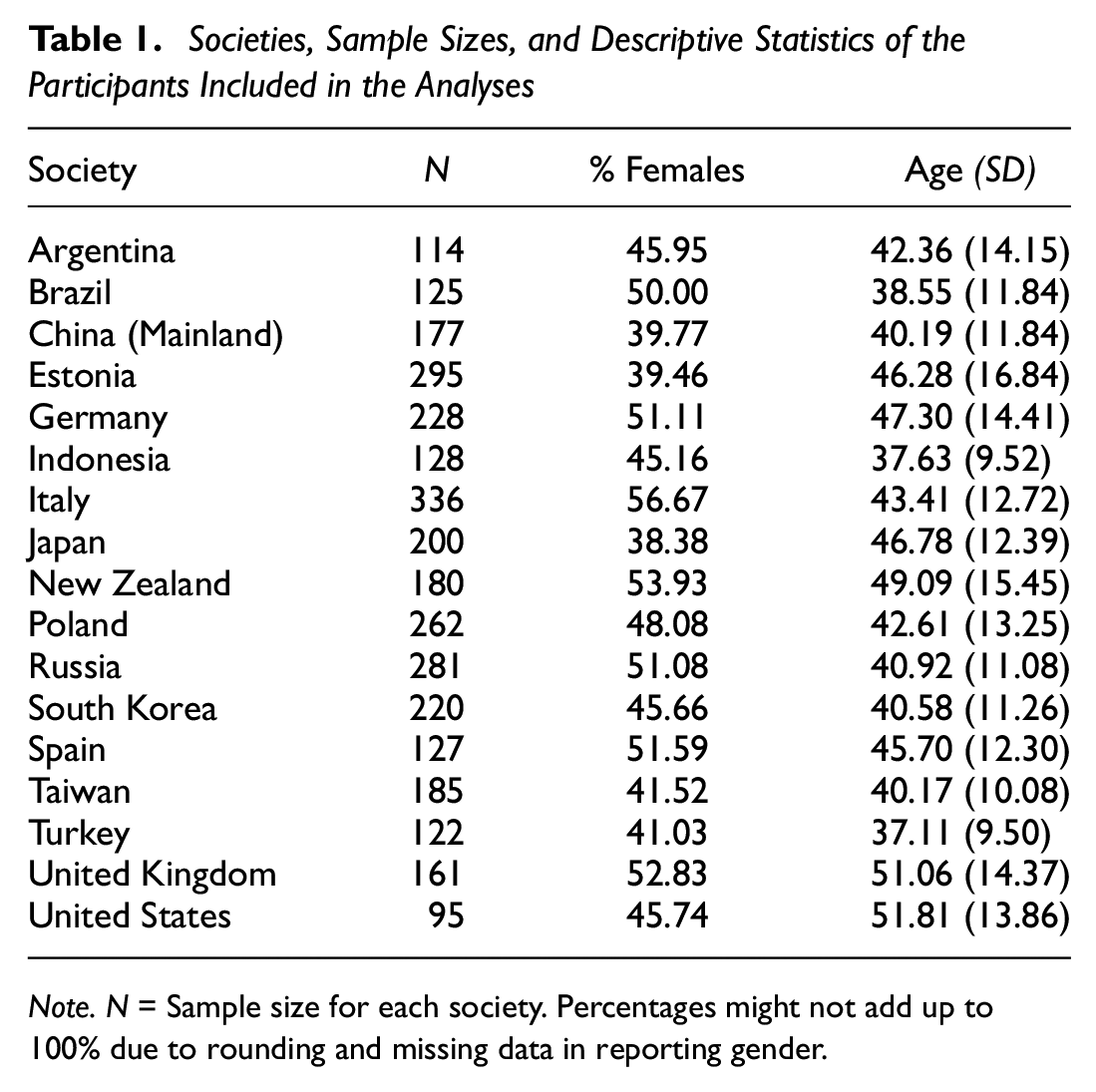
Note. N = Sample size for each society. Percentages might not add up to 100% due to rounding and missing data in reporting gender.
Procedure and Experimental Design
The broader data collection effort included survey items (W1 and W2) and a behavioral measure of trust (W3). In all waves, participants provided their informed consent. All measures were initially developed in English, translated by native-speaker researchers, and back-translated using a team approach (Behling & Law, 2000) or committee method (Brislin, 1980).
Survey Measures
We selected four sets of items operationalizing constructs to test hypotheses from SIT and MSH and computed the mean of the available items for each scale. Responses, except when otherwise noted, were given on a seven-point Likert-type scale from one (disagree completely) to seven (agree completely). Except for institutional security, all measures were administered in W1 and W2 and then aggregated. Reliability estimates are reported in Table S2. The intraclass correlation coefficient (ICC) displayed substantial amount of between-society variation in institutional perceptions (i.e., ICC > .10; Byrne & Van de Vijver, 2014) (ICC InstTr = .149; ICC Ben =.146; ICC Sec = .141), but less between-society variation in national identification (ICC Nat > .09).
National Identification
We assessed identification with own national group through a four-item measure in W1 and W2. Participants from the different countries received targeted questions based on their country of residence. Example items include “I identify with my nationality” (Cronbach’s αw1 = .92, αw2 = .93, with good test–retest reliability across waves, r = .76). Higher scores indicate higher identification.
Institutional Trust
Trust toward institutions was measured through a three-item measure in W1 and W2. These items represent the “trust in government” component from the Global Trust Inventory (Liu et al., 2018). Participants were asked to rate their trust toward their National government, Local government, and Prime Minister or President on a 7-point Likert-type scale from 1 (do not trust at all) to 7 (trust completely) (Cronbach’s αw1 = .88, αw2 = .88, with good test–retest reliability r = .71). Higher scores indicate higher institutional trust.
Benevolent Authorities
Participants’ perception of benevolence of authorities was assessed through a four-item scale in W1 and W2 (Liu et al., 2015). Example items include “most of the leaders in our country are not greedy or corrupt.” (Cronbach’s αw1 = .76, αw2 = .77, with adequate test–retest reliability r = .63). Higher scores represent greater perception of benevolence of authorities.
Institutional Security
We measured participants’ feelings of security enhanced by institutions with two items in W2 (i.e., “my government provides the things me and my family need” and “my government keeps me and my family safe”). Reliability was estimated as Spearman-Brown-corrected correlation rs = .855. Higher scores represent a greater perception of institutions as able to provide security.
Behavioral Measures
The study involved an experimental study design, in which group membership of the interaction partner in a trust game (ingroup vs. outgroup vs. stranger) was manipulated as a within-subjects factor. 2 Ingroup favoritism was operationalized by using a contrast variable comparing trust behavior, trustworthiness, and expectations toward an ingroup partner vs. outgroup and stranger in a trust game (see Romano et al., 2017a, 2021 for a similar approach).
Trust, Trustworthiness, and Expectations in the Trust Game
Participants completed an online experiment and made 14 one-shot decisions in a trust game with different partners (TG; Berg et al., 1995), both as the trust (TP) and return person (RP), in randomized order. As TP, they were endowed with five Monetary Units (MUs), and could decide how many to keep for themselves and how many to give to the RP (0–5) (i.e., trust), knowing that any invested MU will be tripled. Then, as RP, participants could send back any received amount (i.e., trustworthiness). Trustworthiness decisions were elicited through the strategy method (Mitzkewitz & Nagel, 1993), so that players were asked to make five decisions to be matched afterward (i.e., conditional to receiving 1–5 MUs). These returns were then re-scaled as percentages of endowment and averaged to compute an aggregated measure (0–100). As TP, participants were additionally asked to report the number of MUs they expected to receive in return (0–15) (i.e., expectations). Trust decisions in the TG were based on hypothetical outcomes. 3 To compare decisions across societies, participants were asked to imagine that each MU was worth 5 min of the national average hourly wage. Full instructions are provided at https://osf.io/r8kwt.
Partner’s Group Membership
Group membership was manipulated by providing information about the nationality of the partner in the TG. Participants were informed that their choice would be matched with a partner from the same (i.e., ingroup), a different (i.e., outgroup), or undisclosed nation (i.e., stranger). In the ingroup treatment a flag of participants’ own country was shown alongside the instructions. In the outgroup treatment, a flag containing several flags was shown to avoid eliciting national stereotypes. In the stranger treatment, no flag was shown.
Analytic Strategy
We tested our hypotheses using mixed-effects models with participants and societies as random factors. Specifically, we ran four sets of models, each including the interaction between partner’s group membership (i.e., ingroup vs. outgroup and strangers) and the specific individual-level variable selected to test our hypotheses as predictor. All models included knowledge of partner’s group membership as fixed effects. 4 Each set of models included behavioral measures of trust, trustworthiness, and expectations as dependent variables. Correlations among study variables are reported in Tables S3–6.
Results
First, we tested three invariance measurement steps (i.e., configural, metric, and scalar) on the individual-level measures across all 17 societies, as both structure and meaning of trust in institutions may vary in different cultural zones (Liu et al., 2018; Zhang et al., 2019). Although partial scalar invariance was not reached, the partial metric confirmatory factor analysis model (CFA) displayed good fit, as suggested by the fit indices comparative fit index (ΔCFI) and root mean square error approximation (ΔRMSEA). Thus, all subsequent analyses were performed across the entire set of countries. Details about the invariance analysis, including model fit indices are reported in Section 3 in the SI.
As expected, across societies, participants showed greater trust when interacting with a partner from the same society, compared with a partner from a different society or a stranger, either in terms of trust behavior (b = 0.220, p < .001), trustworthiness (b = 1.354, p < .001), and expectations (b = 0.390, p < .001). This pattern remained consistent when accounting for whether the knowledge of partner’s group membership was common or unilateral (p-values < .001). For a discussion of these findings, see Romano et al. (2017a).
To test our hypotheses, we first examined whether individuals with greater national identification were more likely to display ingroup favoritism (H1). Results from the mixed-effects regression models showed a significant and positive interaction between partner’s group membership and national identification to predict trust (b = 0.055, p < .001; Table 2), trustworthiness (b = 0.346, p = .003), and expectations about partner’s trustworthiness (b = 0.135, p < .001; Table S8). To further elucidate this interaction and test our hypothesis, we fitted a mixed-effects regression with national identification predicting ingroup favoritism. Our findings were in line with SIT and our hypothesis, showing that, across the 17 societies, higher identification with own nation was associated with greater ingroup favoritism across all three operationalizations of trust (p < .005; Table 3).
Mixed-Effects Models Testing Hypotheses About Trusting Behavior in the Trust Game
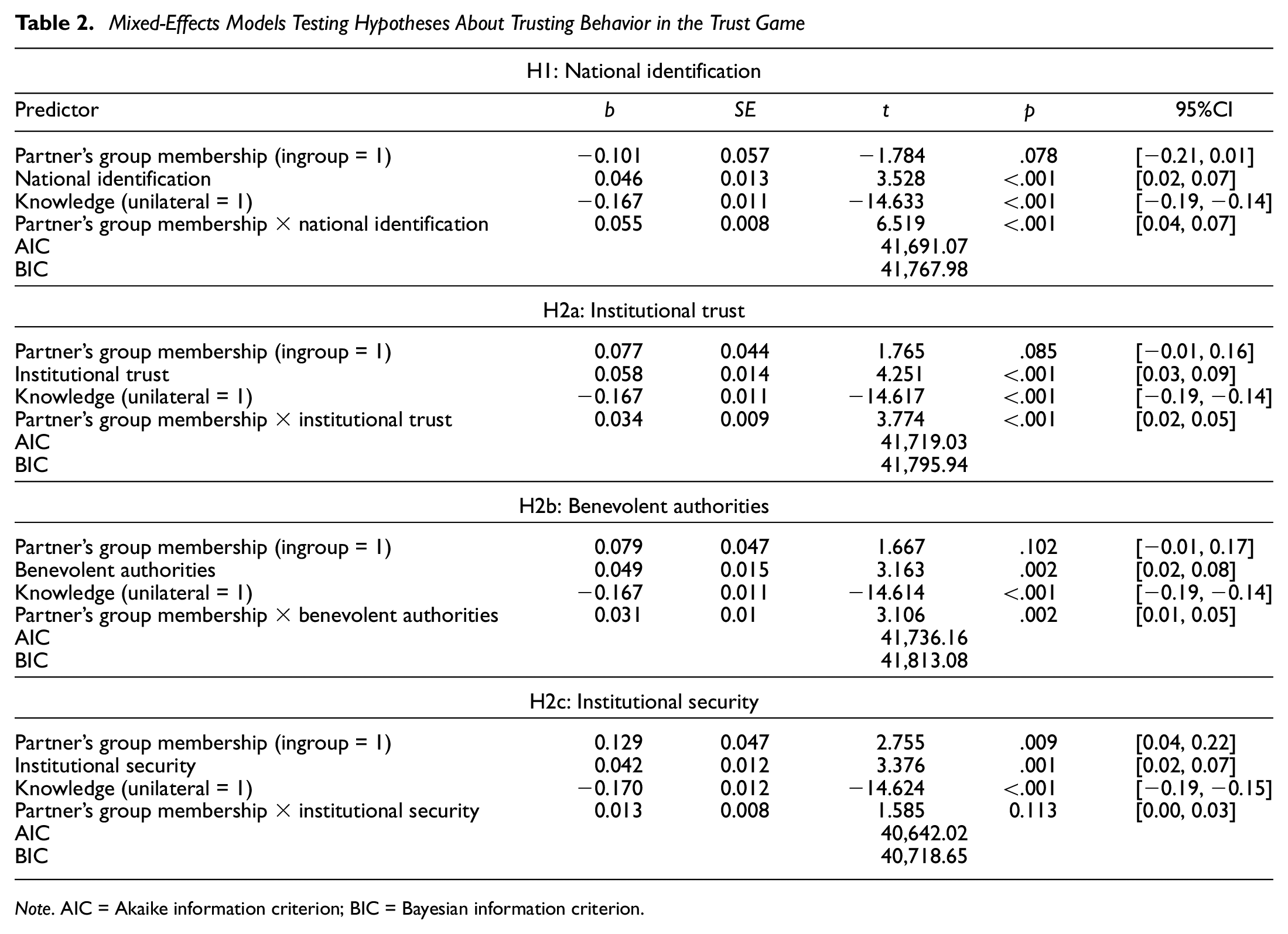
Note. AIC = Akaike information criterion; BIC = Bayesian information criterion.
Mixed-Effects Models Predicting Ingroup Favoritism Including a Single Predictor to Test Hypotheses
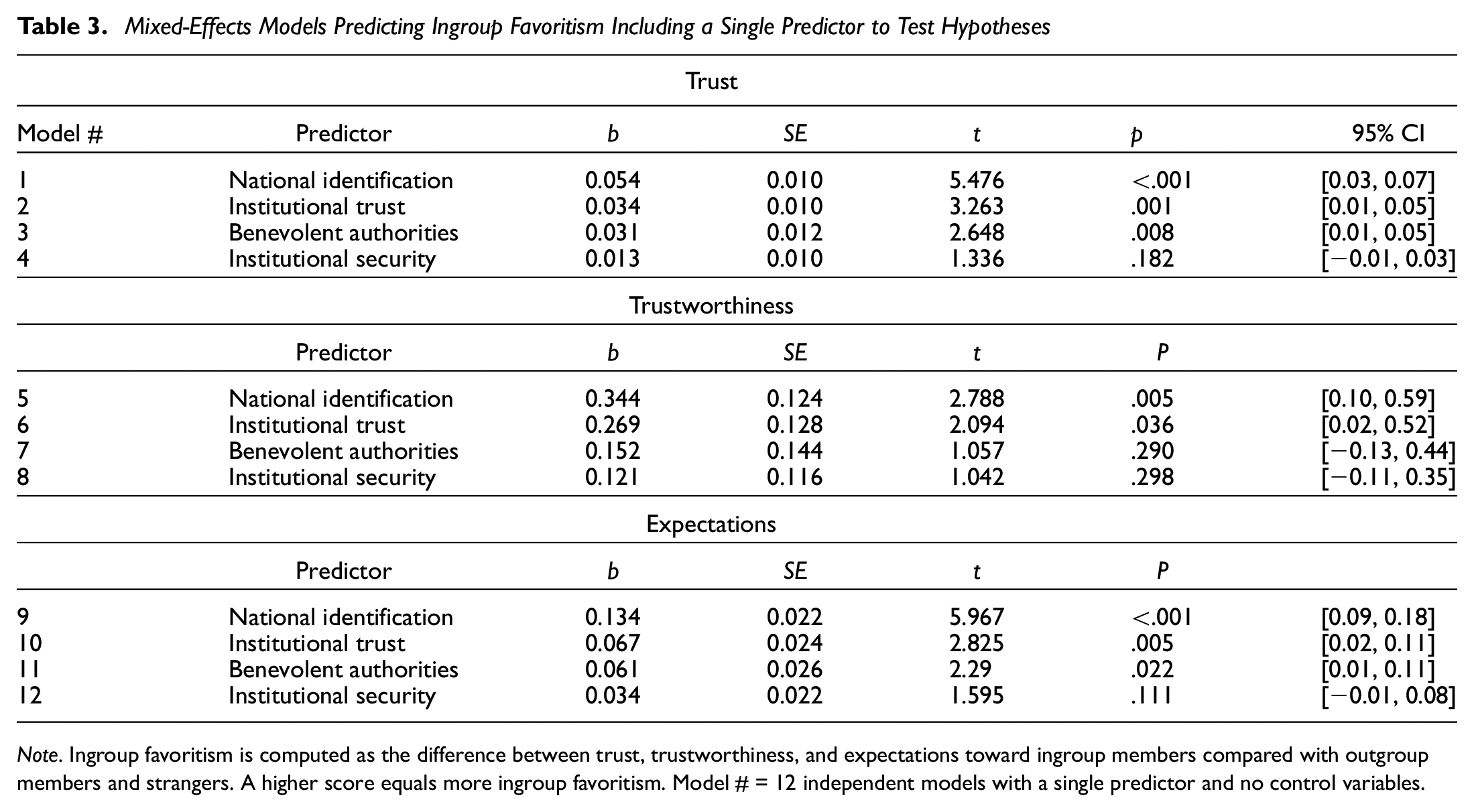
Note. Ingroup favoritism is computed as the difference between trust, trustworthiness, and expectations toward ingroup members compared with outgroup members and strangers. A higher score equals more ingroup favoritism. Model # = 12 independent models with a single predictor and no control variables.
Then, to test the hypotheses forwarded by the MSH approach, we followed the same analytic strategy applied above, by including the interaction between partner’s group membership and the different operationalizations of material security as predictor. Findings from the mixed-effects models showed a significant and positive interaction between partner’s group membership and institutional trust to predict trust (b = 0.034, p < .001; Table 2), trustworthiness (b = 0.267, p = .026), and expectations about partner’s trustworthiness (b = 0.063, p = .002; Table S8). The direction of the regression coefficient of the interaction suggests that these findings did not provide support for the hypothesis (H2a). Instead, our findings showed a positive and significant relationship between institutional trust and the different operationalizations of ingroup favoritism (p < .036), suggesting that individuals who perceived formal institutions as more trustworthy displayed greater (not lower) levels of ingroup favoritism. When examining the perception of benevolence of authorities (H2b), we observed the same pattern. We detected a positive and significant interaction of this variable with partner’s group membership in predicting trust (b = 0.031, p = .002) and expectations about partner’s behavior (b = 0.056, p = .016). As for institutional trust, the perception of authorities as benevolent was associated with greater (not lower) ingroup favoritism in trust and expectations (p < .022; Table 3). Last, we did not observe a significant interaction between partner’s group membership and feelings of institutional security for any of the measures of trust (p-values > .086), failing to provide support for H2c. All results from the mixed-effects model are reported in Tables 2–3, S8.
Discussion
Decades of research have found that individuals tend to selectively trust members of their group more than members of outgroups or strangers in situations of interdependence (Balliet et al., 2014). With the progressive shift of modern societies toward interactions beyond tight-knit groups (Henrich et al., 2010), ingroup favoritism might be a challenge for establishing cooperative relationships at a global scale. In the present study, we drew upon two prominent theoretical perspectives advanced to account for ingroup favoritism in trust and tested hypotheses across 17 societies. Below, we further discuss these findings, the limitations of our design, and suggest directions for future investigation.
We observed greater ingroup favoritism from participants who identified more strongly with their nation. In line with SIT (Tajfel & Turner, 1979, 1986), a strong group identification indicates that individuals have internalized a relevant social category into their self-concept (Aberson et al., 2000; Stroebe et al., 2016) which could explain ingroup favoritism observed repeatedly in past research, including this experiment. Despite the abundance of research investigating the relationship between group identification and ingroup favoritism within the same society (e.g., Leonardelli & Brewer, 2001; Voci, 2006), fewer studies have tested it across societies and cultures. In the context of trust, the relationship between group identification and ingroup favoritism is stronger in some societies compared with others (e.g., United States vs. Japan, Yuki et al., 2005). In the present study, participants describing themselves as strongly identified with their own nation displayed more trust, trustworthiness, and positive expectations toward national ingroups (as compared with outgroup and strangers). This association was significant across 17 societies, but strongly differed in magnitude (Table S7), suggesting that cultural features might moderate this relationship. Future research can investigate whether specific cultural values, such as collectively-oriented ones, can account for this cross-societal variation.
In stark contrast to predictions from the MSH (Hruschka & Henrich, 2013b), we observed greater ingroup favoritism from individuals who perceive public institutions as trustworthy, benevolent, and able to provide security. One prominent difference between the present study and past research on the MSH is the operationalization of institutional quality as subjective perception of institutions, compared with societal-level measures of institutional performance (e.g., government effectiveness, Hruschka & Henrich, 2013a; Romano et al., 2017a). Existing evidence suggest that there might be a mismatch between perceptions of institutions and objective institutional performance (e.g., Baniamin et al., 2019; Miller & Listhaug, 1999), and that investigating subjective perceptions can illuminate inconsistent findings (e.g., Knell & Stix, 2021). Our individual-level measure of institutional trust seems to align with societal levels of confidence in the government (r = .78) but displayed a mixed pattern of correlations with indicators of institutional performance gathered and examined in an exploratory fashion (see SI Section 6). In additional exploratory analyses, we assessed the robustness of these findings by controlling for relevant individual differences associated with perception of institutions, namely political orientation and right-wing authoritarianism (Altemeyer, 1981). Findings were consistent with the confirmatory analyses (Tables S14 and S15). At the same time, however, we found that institutional trust was not associated with ingroup favoritism after controlling for national identification (Table S12). According to Norris (2017), national identification and institutional trust are both indicators of political support, a multidimensional phenomenon essential to guarantee the good functioning of institutions and citizens’ compliance. The extent to which these two dimensions contribute to two different processes that result in ingroup favoritism remains a topic for future investigation, together with the question of whether other individual dispositions or more general states (such as positive affect) can account for our findings.
Our study also involved different groups, compared with previous work on the MSH. In the study by Hruschka et al. (2014), individuals from eight societies interacted with ingroup or outgroup members within the same society (e.g., people from “another village”). Here participants interacted with partners of different nations and, thereby, living under different institutions. Accordingly, a potential interpretation of our findings is that, in this study, institutions could not actually mitigate the risk inherent in interactions with outgroup and strangers (e.g., through imposing shared rules, Guala, 2018; North, 1990), as these interactions all occurred outside the reach of institutions. To explore this possibility, we performed additional exploratory analyses on a subset of United Nations (UN) countries, assessing trust toward the UN––a shared institution prescribing cooperative norms across countries––and trust in the European Union (EU). 5 Results showed that a partner’s group membership did not interact with either trust toward the UN (p≥ .228) or the E.U. (p≥ .364) to predict trust, trustworthiness, and expectations. This suggests that it is unlikely that our findings can be explained by the fact that the interactions occurred outside the reach of a shared institution that could enforce cooperation. Previous experimental evidence is also in line with this idea, showing that individuals formed more positive expectations about strangers in experimental settings regulated by institutions, even after institutions were removed (Engl et al., 2021) or had no actual power to regulate cross-country interactions with foreigners (Spadaro et al., 2020). In addition, merely priming individuals with security-related constructs led to reduced bias in ingroup evaluations (Mikulincer & Shaver, 2001). Having said that, however, compared with the EU or the UN, national states still have a predominant influence in regulating social exchange within nations. Thus, future work should involve the assessment of institutions’ perception in interactions under the reach of institutions (e.g., local institutions or experimentally-implemented ones).
Some limitations to the generalizability of the current study are worth noting. Despite the included countries being heterogeneous with regard to cultural groups and institutional performance, the limited number of societies prevents us to draw conclusions about the mixed pattern of associations identified across countries between (a) our measures of institutional perceptions and (b) perceptions of institutions and ingroup favoritism (Table S7). In addition, our findings concern favoritism in trust and might not necessarily generalize to different outcomes that fall within the broader category of prosociality (Thielmann et al., 2020). For example, a previous meta-analysis found weaker ingroup favoritism in situations characterized by low outcome interdependence, such as generosity in a dictator game (Balliet et al., 2014). Last, our hypotheses were tested through a correlational approach, which limits our ability to infer the causes of ingroup favoritism.
Concluding Remarks
The tendency to discriminate behavior in favor of one’s own group is widespread and pervasive across societies (Romano et al., 2021). Identification with valued groups is associated with preferential behavior and more positive expectations toward ingroup members, as shown in our study. Although previous research hypothesized that institutions might reduce favoritism, our findings provide initial evidence that a positive perception of institutions might actually be associated with greater ingroup favoritism. These findings, despite preliminary, bring our attention to some potential challenges that support for national institutions might pose to the establishment of trusting relationships beyond borders.
Supplemental Material
sj-doc-1-spp-10.1177_19485506231172330 – Supplemental material for Identity and Institutions as Foundations of Ingroup Favoritism: An Investigation Across 17 Countries
Supplemental material, sj-doc-1-spp-10.1177_19485506231172330 for Identity and Institutions as Foundations of Ingroup Favoritism: An Investigation Across 17 Countries by Giuliana Spadaro, James H. Liu, Robert Jiqi Zhang, Homero Gil de Zúñiga and Daniel Balliet in Social Psychological and Personality Science
Footnotes
Acknowledgements
The authors thank Angelo Romano for valuable comments to an earlier version of the paper.
Handling Editor: Richard Slatcher
Declaration of Conflicting Interests
The author(s) declared no potential conflicts of interest with respect to the research, authorship, and/or publication of this article.
Funding
The author(s) disclosed receipt of the following financial support for the research, authorship, and/or publication of this article: Grant from the Asian Office of Aerospace Research and Development (#FA2386-15-1-0003) awarded to James H. Liu and to Homero Gil de Zúñiga, and a ERC Consolidator Grant (#864519) awarded to Daniel Balliet.

Supplemental Material
The supplemental material is available in the online version of the article.
Notes
Author Biographies
References
Supplementary Material
Please find the following supplemental material available below.
For Open Access articles published under a Creative Commons License, all supplemental material carries the same license as the article it is associated with.
For non-Open Access articles published, all supplemental material carries a non-exclusive license, and permission requests for re-use of supplemental material or any part of supplemental material shall be sent directly to the copyright owner as specified in the copyright notice associated with the article.
