




Abstract
Right-wing populism which had been considered fringe just a few years ago became gradually more mainstream. Given the epidemic impact of divisive populist rhetoric on hostile behavior and its strong association with anti-immigration, it is important to ask whether people endorsing populism also justify attacks against asylum seekers. Using the German General Social Survey data (N = 3,268), we tested a model in which the endorsement of populist beliefs predicted sympathy for attacks against asylum seekers in Germany, through national pride and moral justification of political violence. Results showed that people who evinced higher endorsement of populist beliefs showed also higher sympathy for attacks against asylum seekers. Furthermore, national pride and moral justification of political violence mediated the relationship between populist beliefs and sympathy for attacks against asylum seekers. The role of right-wing populism in the justification of violence toward outgroups is discussed within a contemporary social-psychological framework.
In recent years, right-wing extremists have increasingly attacked immigrants, asylum seekers, and refugees in various countries (e.g., Colarossi, 2021; Jones, 2018; Schumacher, 2016; Taylor, 2021). For example, as the so-called “migrant crisis” emerged in Europe in 2016, more than 2,500 attacks against asylum seekers were reported in the same year in Germany, more than 1,700 were reported in 2018, and 1,600 in 2020 (Bathke, 2022). During that time, more than 150 asylum seekers in Germany were severely injured in these violent attacks according to police reports. Another report counted 129 attacks by far-right groups on refugee camps in 2019 (Human Rights Watch, 2021). According to official data for the first 6 months of 2020, more than 9,000 politically-right-motivated hate crimes were reported (Deutscher Bundestag, 2020). In February 2020, one of the most extreme examples of far-right-motivated hate crimes was the anti-immigrant attack committed in Hanau, Frankfurt. Eleven people were killed, and five others were wounded by a right-wing extremist, who targeted two Turkish hookah bars (Pladson, 2020).
These examples illustrate the destructive consequences of the normalization of violence that seem to derive from right-wing populism. Right-wing populist leaders, their followers, and endorsement of the populist beliefs that had been considered to be at the fringe of society a few years ago have gradually become more mainstream and seen as somewhat “acceptable” (e.g., Ekman, 2022; Mondon & Winter, 2020; Portelinha & Elcheroth, 2016; Stathi & Guerra, 2021; Wodak, 2020). Recent studies showed that populist beliefs are highly associated with a higher level of authoritarianism (Bakker et al., 2016), lower support for pro-refugee policies (Uysal, 2022), and higher threat perception against migration (Dennison & Turnbull-Dugarte, 2022). Given the “epidemic” impact of divisive rhetoric on hostile behavior (Bilewicz & Soral, 2020), it is important to examine whether people, who endorse populist beliefs, would also justify politically motivated violence in line with the rhetoric of right-wing populist leaders. Crandall et al. (2018), for example, longitudinally and experimentally showed that the perceived acceptability of prejudice toward societal minorities that were singled out by Donald Trump increased after the 2016 presidential election. The researchers concluded that social norms might have changed, which would now allow for prejudice to be openly expressed. Moving this one step further, we argue that changing social norms in the populist zeitgeist may result in supporting hate crimes against targeted minority groups. In this study, we aimed to investigate the social-psychological link between populist beliefs and sympathy for attacks against asylum seekers. Specifically, we aimed to examine whether populist beliefs predict sympathy for attacks against asylum seekers through heightened national pride and moral justification of political violence in Germany.
Populism and Anti-immigration
Populism is defined as a “thin-centered ideology” (Mudde, 2004, p. 544) that addresses only specific political agendas or political questions and is compatible with various political positions. In populist rhetoric, it is usually evident that there is a group of “others” who do not belong to the nation or the people (Albertazzi & McDonnell, 2008). The identity of these “others” determines whether populist beliefs will evolve into right-wing or left-wing populist views. Considering the thin-centered nature of populism, it needs to host ideologies. Taggart (2000), hence, defines populism as an empty-hearted ideology. When populist beliefs are combined with anti-immigrant attitudes, authoritarianism, nativism, and conservatism as host ideologies, it is defined as right-wing populism. For left-wing populism, host ideologies of populism are mostly anti-elitism, classism, and economic victimhood narratives of the working class (Rooduijn & Akkerman, 2015).
According to populist thinking, society is separated into two opposing groups: The good and the evil (Mudde & Rovira Kaltwasser, 2017). Right-wing populists put immigrants on the evil side as outgroups and “the ordinary and pure” aggrieved people on the good side as the ingroup. Right-wing populist leaders present themselves as representatives of the ordinary people, hence, as ingroup leaders, who promise to save the ingroup from the antagonism of the evil outgroup (Betz & Johnson, 2004; Jansen, 2011). Thus, these outgroups become the target of right-wing populist leaders’ derogatory rhetoric.
In the populism literature, outgroups are defined—and targeted—vertically and horizontally according to their social positions (Bos et al., 2020; Hameelers & de Vreese, 2020). For instance, the elites represent vertical outgroups and are the typical nemesis of traditional populist logic (Bakker et al., 2016; Barr, 2009; Hawkins, 2009; Mudde, 2004, 2017) Their verticality stems from the elites’ higher social position in comparison with aggrieved “ordinary people,” whereby the elites can be blamed by right-wing populist leaders as responsible for the relative deprivation of the aggrieved “ordinary people.” Not surprisingly then, intergroup differentiation between the ordinary people and the elites creates anti-establishment sentiments and political distrust among populist voters, especially among those who do not feel represented by mainstream politics or elites (Geurkink et al., 2020; McKay et al., 2021).
On the other hand, societal outgroups based on cultural, ethnic, or religious grounds are horizontal outgroups, which are seen as being unjustly favored by the elites at the expense of ordinary people (Hameelers & de Vreese, 2020). Immigrants are a source for right-wing populist leaders, against whom these leaders can stir ethnocentric sentiments among the general population (cf. Billig, 1988). Seen this way, immigrants serve as the horizontal nemesis, against which right-wing populists can build their rhetoric and mobilize their followers (Akkerman et al., 2017; Hirsch et al., 2021; Rothmund et al., 2020). Intergroup differentiation between ordinary people and immigrants leads to exclusionist populist beliefs (Bos et al., 2020; Hameelers & Fawzi, 2020), which may lead to political violence following the divisive rhetoric of right-wing populist leaders. Similarly, Leander et al. (2020) showed that the disempowerment among dominant group members as a consequence of the victimhood narrative of White nationalism leads to sympathy for violent extremist attacks in various contexts. Hence, elites (as evidenced by, for example, the 2021 Capitol attack in Washington), as well as immigrants, can become targets of open hostility (Jagers & Walgrave, 2007; Jay et al., 2019; Mols & Jetten, 2016). However, the latter group is frequently the target of discrimination and hostility due to its comparatively higher vulnerability, and therefore, they are the focus of the current research. Considering prior findings evincing a relationship between populism and anti-immigrant attitudes (Bakker et al., 2016; Rothmund et al., 2020; Uysal, 2022), we hypothesized that higher endorsement of populist beliefs would be associated with higher sympathy for attacks against asylum seekers (Hypothesis 1).
Populism and National Pride
Intergroup differences do not automatically lead to prejudice and discrimination as enacted prejudice. Rather, acting on prejudicial views requires a specific distinction between “us” (as “virtuous”) and “them” (as “immoral” and “evil”). Such distinction may actively mobilize the ingroup against an outgroup (e.g., Bos et al., 2020; Flannery et al., 2021; Marchlewska et al., 2018). In that sense, populism can be conceived of as an antagonistic political understanding based on the psycho-political construction of the “real” people of a nation (Albertazzi & McDonnell, 2008; Uysal et al., 2022). This construction needs the category of “evil immigrants” as a reference point to highlight the authenticity of the “real” people and to mobilize them (Laclau, 2005). Hence, populist beliefs are based on moralization via the means of national identification, which differentiates “us” from “them” by attaching qualities such as purity and authenticity to the “real” people, on one hand, and immorality, non-nativism, and self-serving interests to “corrupt elites” and their “partners in crime”—the immigrants, on the other (Mudde, 2017). Hence, populist political beliefs turn nationalist, when the elites are framed in national terms, and then the ordinary people base their identity on a strong and exclusionist national identification (Elad-Strenger & Kessler, in press; Uysal, 2022).
Populist leaders position the ingroup of the “real” people against the threat posed by immigrants; thereby they unite citizens under a common politicized social identity and create a moral majority, who is supposed, according to populist rhetoric, to overcome the economic and cultural threats (Jay et al., 2019; Mols & Jetten, 2016). Hence, by stressing shared grievances, populist rhetoric frames the problems and inequalities created by the prevailing liberal democracies as the irreconcilable differences between group identities and norms, which boosts intragroup homogeneity and intergroup differentiation (Uysal et al., 2022). In other words, while populism addresses individuals’ shared grievances, it also fosters a positive collective self-perception by highlighting national pride (via intragroup homogeneity) and a populist solution (via intergroup differentiation between ordinary people and immigrants).
Although differentiation between ingroup (e.g., “real” ordinary people) and outgroup (e.g., immigrants) is an important basis for negative behavior toward the outgroup (Brewer, 1999; Tajfel et al., 1971), the perception of threat and strong intergroup emotions (e.g., anger, contempt) may motivate more aggressive behavior such as hate crimes (Struch & Schwartz, 1989). For instance, Walters et al. (2016) discussed the perception of intergroup threats and their concurring emotions (e.g., anger) as a potential determinant of hate crimes. Although the role of negative intergroup emotions (e.g., anger) is frequently discussed in hate crimes in the social psychology literature (e.g., Mackie et al., 2000), positive emotions (e.g., pride) may also trigger aggressive behaviors toward outgroups (e.g., Hoerst & Drury, 2021). Relevant ingroup norms, interests, and values that frame the national pride can then influence what is seen as appropriate and legitimate behavior of the ingroup. Considering pride is a mobilizing emotion (Tausch & Becker, 2013), group identity–related pride can become the basis of power and a tool to perceive and present even violent acts toward the outgroup as “virtuous” (Reicher et al., 2008; Turner, 2005). Hence, we hypothesized that populist beliefs would be associated with national pride (Hypothesis 2) and that national pride would predict sympathy for attacks against asylum seekers (Hypothesis 3).
Populism and Moral Justification of Political Violence
Individuals tend to follow social norms within the framework of what is morally right or wrong in their social and political behaviors (Skitka & Bauman, 2008; Skitka et al., 2005; van Zomeren et al., 2012). Social and moral norms provide prescriptions that compel people to behave in certain ways under certain conditions. Yet, people, who have a higher level of moral disengagement, feel less stressed when they engage in behaviors that may otherwise be considered immoral or unethical by others (Moore et al., 2012). Erisen et al. (2021) showed that moral disengagement is positively associated with populist attitudes, especially when they involve a Manichean outlook that conceives of the world (hence, also politics) as a war between light and darkness, or between the good “ordinary people” and the evil immigrants supported by elites. However, what appears as “morally disengaged” is mostly in line with the actors’ ingroup norms (Hoerst & Drury, 2021). Moral disengagement is understood as distancing from moral standards in a specific situation (cf. Bandura, 1999). On the contrary, when social identities become salient, people tend to comply with identity-relevant (e.g., ingroup) values and norms (McGarty et al., 2011; Reicher et al., 1995). In the case of supporting far-right populist violence, people are not disengaging from a prior moral standard, but they are consistent with a moral prior of the ingroup: Violence against targeted outgroups is a justified tool to protect ingroup resources.
Populist beliefs help to construct the ingroup of the “real” ordinary people, which also tends to mobilize, activate, politicize, and trigger a widespread and deep-rooted socio-cultural conflict in society (Ostiguy, 2017) following salient ingroup norms. The populist political logic sees politics as enmity between two opposing groups (i.e., goods vs. evil; Mudde, 2017; Mudde & Rovira Kaltwasser, 2013), which can radicalize collective mobilization to political violence. In other words, the category of “real” ordinary and national people created and sustained by populist rhetoric is mobilized against the “immoral” non-native immigrants, who are allegedly beneficiaries of the ingroup grievances created by elites and who threaten the ingroup’s moral community (Bieber, 2018; Bonikowski, 2017).
In line with the above, we expected that people, who endorse populist beliefs to a greater extent, would also be supportive of political violence and thereby provide the normative background for potential hate crimes. We suggest that by viewing this behavior as in line with the ingroup’s norms and values, violence would be morally justified and be seen as necessary (cf. Reicher et al., 2008), even if this behavior may be considered immoral by an outgroup or a third-party perspective. Thus, we hypothesize that populist beliefs will be associated with higher moral justification of political violence (Hypothesis 4), and moral justification of political violence will predict sympathy for attacks against asylum seekers (Hypothesis 5). Finally, we hypothesize two significant mediational pathways: Endorsement of populism will be associated with sympathy for attacks against asylum seekers via increased national pride (Hypothesis 6) and higher moral justification of political violence (Hypothesis 7).
Method
Participants
The German General Social Survey (ALLBUS) 1 is a trend panel survey project conducted by GESIS – Leibniz Institute for the Social Science. Data collection is based on multiple methods such as both computer-assisted and paper-and-pencil face-to-face interviews, and self-administered standardized questionnaires. The sampling procedure is based on the population probability, which is using the weights to reach given benchmarks for the population. ALLBUS has been collecting data every 2 years since 1986. The current study used the data collected in 2018 as some of our key variables (such as national pride and moral justification of political violence) were added to the survey in 2018 (GESIS, 2019). The data were collected between April and September 2018. The original data set recruited 3,477 participants. We removed 209 participants who were not German citizens because no measures for national pride and sympathy for attacks against asylum seekers were included for these participants. The final sample was 3,268 participants (1,610 women and 1,658 men). The average age of participants was 52.36 (range = 18–95, SD = 17.58).
Measures
The response scale ranged from 1 (completely disagree) to 5 (completely agree) unless otherwise stated.
Populist Beliefs
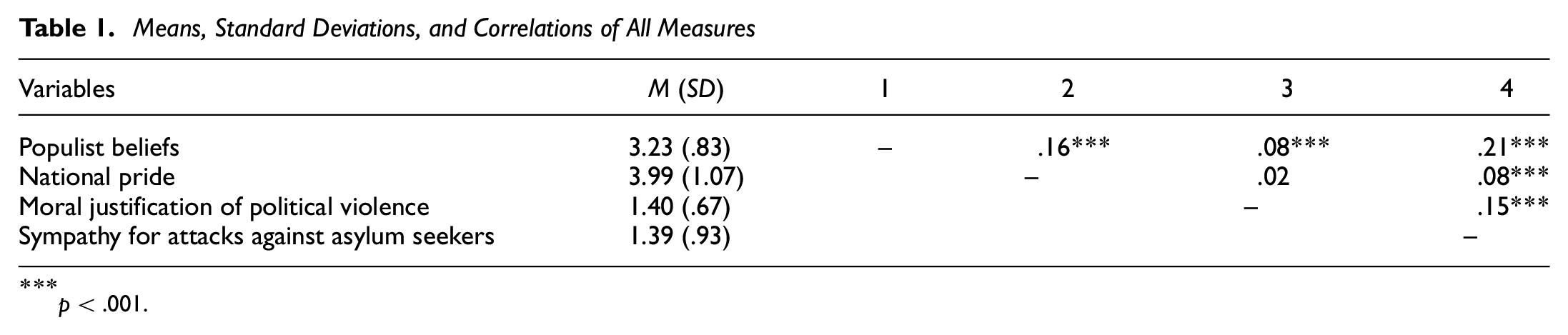
While ALLBUS 2018 used a seven-item populism scale, we used five of these items following a principal component analysis. Since all items loaded on a single factor, we choose five items that have factor loadings from .71 to .75. Hence, we removed two items that have less than .60 factor loading. 2 Items read as “Politicians talk too much and do too little (PA1),” “An ordinary citizen would represent my interests better than a professional politician (PA2),” “What they call compromise in politics is in reality just a betrayal of principles (PA3),” “The people and not politicians should make the important political decisions (PA4),” and “Politicians only care about the interests of the rich and powerful (PA5).” Populist beliefs were operationalized as a latent variable in structural equation modeling (SEM). For ease of interpretation, we also report reliability coefficients for composite scores, which were created by averaging the items in the scale: α = .80. The composite score was also used to calculate the correlations among variables (Table 1).
Means, Standard Deviations, and Correlations of All Measures
p < .001.
National Pride
We measured national pride with a single item that read, “I am proud to be German.”
Moral Justification of Political Violence
We measured the variable with a single item that read, “Violence can be morally justifiable in order to achieve certain political goals” (1 = do not agree at all; 4 = completely agree).
Sympathy for Attacks against Asylum Seekers
We used a single item to assess the extent to which people show sympathy for attacks against asylum seekers in Germany: “I can understand that people carry out attacks on homes of asylum seekers.”
Results
The descriptive statistics and zero-order correlations between our variables are depicted in Table 1. Inspection of the means through one-sample t test shows that, on average, participants reported higher levels of populist beliefs compared with the scale mid-point (M = 3.23, SD = .83, t = 15.79, p < .001). The participants also reported higher national pride than the scale midpoint (M = 3.99, SD = 1.07, t = 52.72, p < .001). Participants showed low moral justification of political violence (M = 1.40, SD = .67, t = −93.94, p < .001) and low sympathy for attacks against asylum seekers (M = 1.39, SD = .93, t = −99.26, p < .001). Only 7.1% of participants reported that violence can be morally justifiable to achieve political goals. Similarly, 6.1% of participants reported that they can understand that people carry out attacks on asylum seekers’ homes.
Next, we performed SEM to test our hypothesized model, using the lavaan package in R (Rosseel, 2012). The model tested whether (a) populist beliefs predict national pride and moral justification of political violence and (b) populist beliefs, national pride, and moral justification of political violence predict sympathy for attacks against asylum seekers in Germany.
Single-item variables were treated as latent constructs by fixing the loading coefficients at 1. 3 As our moral justification of political violence and sympathy for attacks against asylum seekers variables are non-normally distributed and most of the variables are ordinal, we used the “diagonally weighted least squares” (DWLS) estimator for the structural equation model. DWLS is specifically designed for ordinal data, and it makes no distributional assumptions about the observed variables (Li, 2016; Robitzsch, 2020).
Overall, fit indices indicated that our model showed a good fit with data, χ2 = 56.169, df = 18, p < .001, goodness of fit (GFI) = .997, adjusted goodness of fit (AGFI) = .995, comparative fit index (CFI)= .994, Tucker–Lewis index (TLI) = .991, root mean square error of approximation (RMSEA) = .026, standardized root mean square residual (SRMR) = .023. 4 As Figure 1 illustrates, populist beliefs predicted higher sympathy for attacks against asylum seekers (b = .22, SE = .02, p < .001), supporting Hypothesis 1. People who endorsed more populist beliefs showed sympathy for attacks against asylum seekers in Germany. Considering Hypotheses 2 and 3, populist beliefs predicted higher national pride (b = .19, SE = .02, p < .001) and national pride predicted higher sympathy for attacks against asylum seekers (b = .04, SE = .02, p = .015). As for Hypotheses 4 and 5, populist beliefs predicted higher moral justification of political violence (b = .09, SE = .01, p < .001) and moral justification of political violence predicted higher sympathy for attacks against asylum seekers (b = .13, SE = .03, p < .001). We also tested the model by adding control variables such as age, gender, education level, and living in Eastern vs. Western Germany. The standardized estimates of the main variables did not change. Younger participants (b = −.11, SE < .01, p < .001), participants with lower education levels (b = −.20, SE = .02, p < .001), participants who live in Eastern Germany (b = .04, SE = .04, p = .043), and men (b = −.04, SE = .03, p = .017) showed higher sympathy for attacks against asylum seekers.
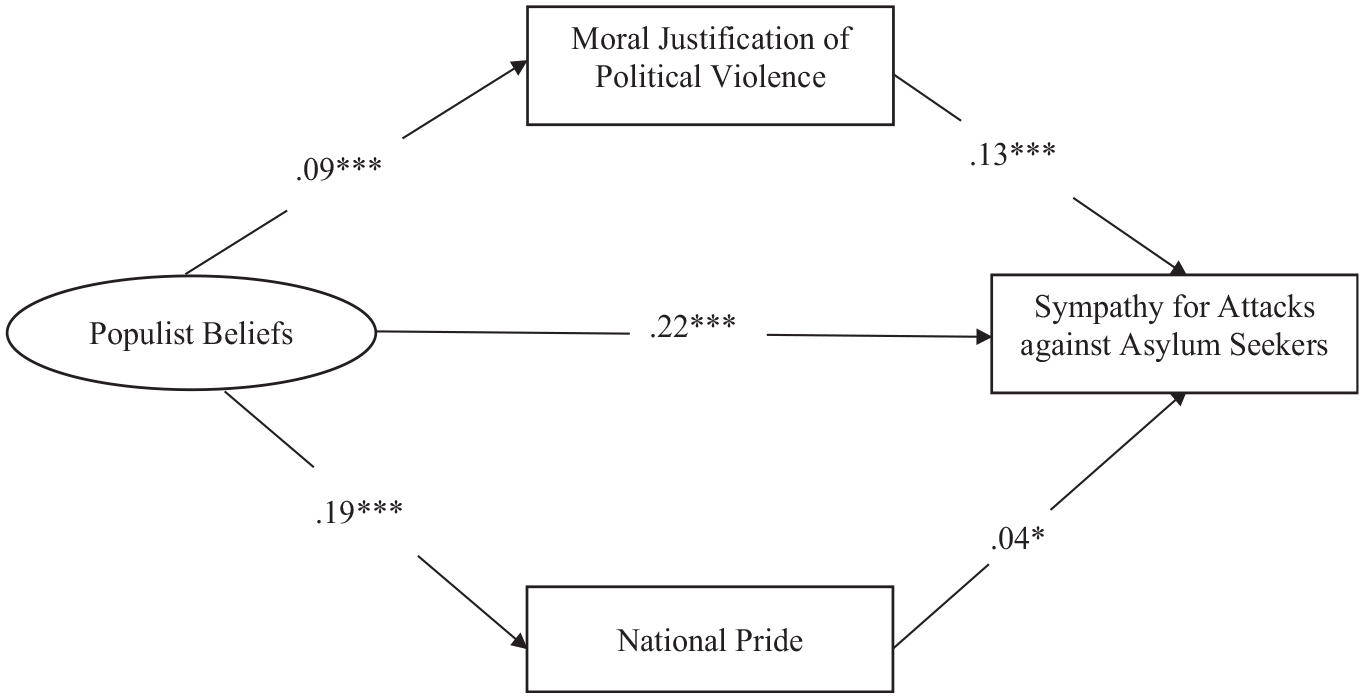
Simplified Model Testing the Populist Beliefs on Sympathy for Attacks Against Asylum Seekers
Furthermore, we conducted mediation analyses to test the mediating roles of national pride and moral justification of political violence on the relationship between populist beliefs and sympathy for attacks against asylum seekers (Hypotheses 6 and 7). We used a bootstrap re-sampling method (with 5,000 repetitions) to examine the indirect effects of populist beliefs on sympathy for attacks against asylum seekers. The indirect effect of populist beliefs on sympathy for attacks against asylum seekers through national pride was significant, b = .01, SE = .01, 95% CI [.00, .02], z test = 2.383, p = .017, indirect/total effect = 4.15%. Moral justification of political violence also significantly mediated the relationship between populist beliefs and sympathy for attacks against asylum seekers, b = .02, SE = .01, 95% CI [.01, .03], z-test = 3.505, p < .001, indirect/total effect = 4.98%.
Discussion
In this study, we sought to investigate the relationship between the endorsement of populist beliefs and sympathy for attacks against asylum seekers. In particular, we examine whether populist beliefs predict sympathy for attacks against asylum seekers through moral justification for political violence and national pride. The results of our study show that higher endorsement of populist beliefs is associated with higher national pride, more moral justification of political violence, and higher sympathy for attacks against asylum seekers. Moreover, sympathy for attacks against asylum seekers is predicted by populist beliefs, national pride, and moral justification. Finally, together with the direct prediction pattern, our results suggest significant indirect effects of populist beliefs on higher sympathy for attacks against asylum seekers, mediated by increased national pride and higher moral justification of political violence.
The theoretical underpinnings for this research, as we have suggested, lie in the Manichean, divisive, and exclusionist nature of right-wing populism. Right-wing populist leaders construct immigrants and asylum seekers as evil. To overcome societal divisions in fighting against the so-called immigrant influx, enhanced national pride among the ingroup of “real people” (i.e., German nationals) is crucial for the populist agenda (Jay et al., 2019; Mols & Jetten, 2016). Hence, it is not surprising that national pride—as an emotional and mobilizing aspect of national identity—mediates the relationship between the endorsement of populism and sympathy for attacks against asylum seekers. Crucially, we suggest that individuals must perceive their support for anti-immigrant action as virtuous, and therefore perceive themselves as being in the moral majority and that to achieve this, right-wing populist leaders attach such moral sentiments to their agendas (cf. Reicher et al., 2008). That is when people believe that they are legitimate and moral victims of this kind of societal conflict, attacks against outgroups can be morally justifiable because the outgroup is evil (e.g., Leander et al., 2020). Our results show that moral justification of political violence indeed explained the relationship between populist beliefs and sympathy for attacks against asylum seekers supports these arguments. However, one could argue that without a high level of national pride and moral justification populist beliefs can perfectly predict sympathy for attacks against asylum seekers, as the indirect effects are relatively smaller than the direct effects.
Our study contributes to examining the theoretical and practical relevance between populist beliefs and sympathy for attacks against asylum seekers. German politics in recent years highlighted how populism and support for hate crimes are interconnected. For instance, the right-wing populist party AfD (Alternative für Deutschland) managed to increase their votes by almost 10% in the 2017 election, presumably aided by constructing so-called “refugee flows” as a national threat to the German nation and “real” nationals (Fang, 2022; Muno & Stockemer, 2021). Although in the 2021 election votes for the AfD decreased by around 2%, they still succeed in obtaining 10% of the votes. While mainstream parties use national pride to establish political trust for the political system and their parties (e.g., Widmann, 2021), populist parties such as the AfD may use national pride to moralize ingroup identity and make salient the moral distinction between national ingroup and foreign outgroups.
To challenge the negative impact of populist beliefs on intergroup relations, we need a broader social-psychological understanding of the underlying motivations and varieties of populism and populist beliefs. Although recent approaches improved theorizing in the intersection of political science, communication, and social psychology by introducing social identity premises (e.g., Bos et al., 2020; Hameelers & de Vreese, 2020; Mols & Jetten, 2020; Uysal, 2022), we believe that current trends still lack the conceptualization of the right-wing populism in psychological terms. We argue that populism should be understood through an active mobilization and subjective understanding of the individuals who endorse populist beliefs and collective victimhood narratives instead of intergroup relations based on objective social status (e.g., Armaly & Enders, 2022; Reicher & Uluşahin, 2020; Uysal et al., 2022).
Despite the implications of the current study, we acknowledge that the findings should be interpreted with caution due to some limitations. First, the study is correlational, thus it would be problematic to assume causality between variables (e.g., between populist beliefs and sympathy for attacks against asylum seekers). Second, our findings focused on sentiments regarding attacks against asylum seekers, rather than violence against broader marginalized groups, such as immigrants. It is thus important to be cautious while generalizing our findings to hate crimes against immigrants. Third, our outcome variable “sympathy for attacks against asylum seekers” does not necessarily mean support, approval, or endorsement of these attacks. As the expression kann ich gut verstehen that is used in the original German scale means to sympathize or even endorse and also “making sense” or “providing intellectual explanation,” we cannot directly generalize our findings to support or approval of hate crimes. This should prompt us to consider and conceptualize the different levels of positive (or at least non-negative) sentiments on attacks against asylum seekers. Moreover, we conducted our analyses with secondary data collected in 2018. Considering the possibly changing nature of attitudes toward asylum seekers after Ukrainian refugees in Europe, we cannot readily generalize our findings to all immigrant groups. Future studies may consider the impact of other characteristics of immigrants, such as religion, ethnicity, and perceived similarity when focusing on support for hate crimes. We believe that discussing how Europeans developed different sentiments against different immigrant groups within a framework of the social psychology of populism can provide great avenues for future research. If there are different underlying motivations for anti-immigration against minorities from the global North, such as Europe, and the global South, such as the Middle East and North Africa (MENA) regions and Latin America, research should focus on how populism interacts with these underlying motivations and map violence against different groups among populists and non-populists.
Finally, it is important to acknowledge that our findings are limited to the German context, hence, to intergroup relations and politics in Germany. Germany provides a unique lens considering its post-war reconciliation efforts. Although after the reunification in the 1990s, a series of violent attacks had been taking place in Germany, with some of them ending in mass homicides of immigrants, expressing support for such attacks had been normatively uncommon in the country. Furthermore, due to post-war reconstruction, Germany has long been hosting immigrants. Thus, we may not be able to generalize our findings to “new” immigration contexts. To address this, more studies are needed that focus on the link between populist beliefs and political violence while considering the socio-historical context of immigration.
Conclusion
In this study, we explored the relationships between populist beliefs, national pride, moral justification of political violence, and sympathy for attacks against asylum seekers in Germany. The results show that people who endorse more populist beliefs report higher sympathy for attacks against asylum seekers in Germany, and this relation is explained via higher national pride and moral justification of political violence. Taken together, this research highlights the importance of considering the detrimental effects of populism on politically motivated violence and points to the need for a more nuanced, psychologically informed understanding of right-wing populism.
Footnotes
Handling Editor: Danny Osborne
Declaration of Conflicting Interests
The author(s) declared no potential conflicts of interest with respect to the research, authorship, and/or publication of this article.
Funding
The author(s) received no financial support for the research, authorship, and/or publication of this article.
