



Abstract
Helping decisions are susceptible to many biases—partly due to the helpers’ spontaneous emotional reactions to the appeal diverting their attention from the need to maximize the impact of their help. Attempts to overcome these biases by prompting deliberative thinking—namely, by asking participants to think deeply—have often been unsuccessful. Here, we propose a way of directing people’s attention to the most important aspects of their decisions, by asking them to rate the extent to which such attributes should be considered. In two experiments involving real-world crises, participants who underwent such structured analysis of their personal criteria were more likely to make decisions that maximized the number of lives saved. Moreover, their decisions were more in line with their personal values. We conclude that this method is a simple, efficient way of improving the quality of helping decisions in life-and-death situations.
People’s intuitive decisions often deviate from more deliberate ones. Dual-process models suggest that this gap stems from the different cognitive processes held under the two ways of thinking. Intuitive processes are quick and associative, while deliberate processes are slower and rule-governed (e.g., Kahneman & Frederick, 2002). However, in many cases, deliberative thinking does not improve decisions (Hogarth, 2005; Small et al., 2007). Here, we suggest that this occurs because thinking deeply or thoroughly does not necessarily mean considering the most important aspects of the situation. When people overlook important aspects of the decision context, and do not know what exactly to consider, their decision may deviate from what they themselves would judge to be optimal. Previous research has demonstrated biases caused by inattention to relevant attributes in the decision context—even when people engage in deliberative thinking (e.g., Hsee & Rottenstreich, 2004). Accordingly, we suggest that directing people’s attention to such attributes by asking them to consider their importance can improve decisions. We examine this idea while using a consideration that most people perceive to be central—namely, human lives.
Despite the common notion that human life is valued above all else (Slovic, 2007), this guiding principle is often not reflected in people’s actual behavior. In helping situations, people often fail to treat human life as a top priority, assigning greater weight instead to other, more salient attributes, such as their emotional responses (e.g., Small et al., 2007), the victims’ social group (e.g., Dovidio et al., 1997; Levine & Thompson, 2004) or whether the situation occurs suddenly or develops slowly over time (Epstein, 2006). Numerous studies have attempted to overcome some of these biases by prompting deliberative, rational thinking (e.g., Bartels, 2006; Cryder et al., 2017; Small et al., 2007), often with only limited success.
Here, we propose a way to increase people’s focus on the potential impacts their decisions can have on the lives of others by a structured consideration of one’s personal criteria. Rather than asking participants to freely think deeply about their decision, we ask them to rate the extent to which central attributes of the situation should affect their decision. By doing so, we focus participants’ attention on the most important situational attributes, as well as on their own personal views and beliefs, which typically include the importance of human life. That refocusing of their attention, in turn, leads to better decisions on their part that maximize the number of lives saved. Importantly, we suggest that this occurs only if they perceive that parameter to be the most important in the given situation.
Biases in Life-and-Death Decisions and Judgments
When faced with a life-and-death decision, such as a charitable donation or helping others in need, people tend to rely on their intuitive, emotion-driven system (Slovic, 2007; Västfjäll & Slovic, 2020), which may lead to systematic biases in judgment and behavior (Baron & Szymanska, 2011; Erlandsson, 2021). We use the term bias to refer to decisions that are incompatible with the normative model or that deviate from the decision maker’s own preferences (e.g., Rieskamp et al., 2006). For example, single identifiable victims stimulate stronger feelings of empathy and distress, therefore eliciting more donations than unidentified victims (e.g., Kogut & Ritov, 2005a, 2005b). Attractive victims recruit more help than less attractive—albeit more needy—victims (Cryder et al., 2017). Crises that arouse immediate emotional response receive larger donations, regardless of the amount of people affected (Huber et al., 2011). These examples highlight the potential for spontaneous, suboptimal helping decisions (in terms of lives saved) that often do not optimally reflect people’s actual preferences and intentions.
Debiasing Decisions by Manipulating Thinking Modes
A vast literature suggests that sometimes, instructing people to engage in deliberative thinking can debias such decisions (Bartels, 2006; Cryder et al., 2017; Gneezy et al., 2014; Mrkva, 2017; Small et al., 2007). However, deliberative thinking can also backfire. While deliberation does indeed diminish the identifiable victim effect, it does so by reducing donations to the identified victim, rather than by increasing donations to unidentified ones, (Moche et al., 2022; Small et al., 2007). We suggest that this occurs because people often fail to acknowledge key aspects that should be considered in each situation, thereby failing to allocate attention to the central attributes of a dilemma (Mrkva et al., 2020; Mrkva & Van Boven, 2017; Pachur et al., 2018). Thus, it is not enough to ask people to “think hard”—they should also be focused on what to think about. Building on findings by Huber (2010) that asking people to think about the extent to which relevant, yet overlooked, attributes should be considered increases decision quality (e.g., by reducing bias, or enhancing consistency), we propose the use of “structured analysis of personal criteria” (hereafter, structured analysis) as a way to direct decision makers’ attention to the most prominent aspects in the decision context—which, in the case of situations involving human lives, is saving lives. However, while Huber’s work examined contexts in which there was a normative decision—which most people would perceive as the better choice—here we focus on decision problems in which the “right” choice depends on the decision maker’s values and beliefs. We propose that when the decision context includes saving human lives, asking people to rate the extent to which saving lives (and other relevant attributes) should affect their decisions, can increase their attention to this important aspect, and maximize the number lives saved.
Moreover, while Huber (2010) demonstrated the advantage of structured analysis in improving decisions compared with no intervention, we expand on those findings by comparing the structured analysis method to the well-studied method of eliciting deliberative thinking. We propose that structured analysis has the potential to improve decisions in life-saving contexts above and beyond the classic deliberative method, as it helps the decision maker identify the most relevant attributes of the situations, bring them to the forefront, and increase behaviors that align with them.
Current Study
We test the effect of structured analysis on subsequent life-maximizing decisions in two distinct contexts. To achieve high external validity, we measured participants’ responses to naturally occurring real-life events. In Experiment 1, we tested the effect of structured analysis on people’s preferences regarding COVID-19 pandemic mitigation policies. Specifically, we tested whether structured analysis could increase people’s preferences for policies attempting to minimize the number of pandemic victims, despite its financial and psychological burdens. In Experiment 2, we explored whether structured analysis can overcome the well-known in-group bias and lead people to prefer to donate to more out-group members over fewer in-group members.
Data and materials are publicly available at https://osf.io/xuez4/?view_only=26473c5a72ce40f38b2c9efec31164ba
Experiment 1
Experiment 1 was performed during the peak of the first wave of the COVID-19 pandemic when countries around the world had adopted a range of different disease mitigation policies. By April 2020, nearly half of the world’s population was under some sort of lockdown (Sanford, 2020). These measures, of course, had massive economic consequences (Faber et al., 2020; Ke & Hsiao, 2022; Prickett et al., 2020). Policymakers worldwide struggled with the same difficult dilemma between saving lives and saving economies: to protect as many people as possible, should authorities impose lockdowns (with their significant economic and societal costs), or should they avoid lockdowns, thus forfeiting an important means of virus mitigation and risk increased rates of infection and death. Put differently, governments had to put a price on human life in terms of the magnitude of economic loss that they were willing to accept to save lives (Jessop, 2020). Public opinion on this issue has been bitterly divided and has become a point of contention among experts and laymen alike. We examined whether structured analysis can shift people’s preference toward saving lives (rather than saving the economy) by increasing the value they assign to human life, thereby reducing the number of lives saved by a lockdown that would justify implementing it. Hence, we tested whether structured analysis would lead people to be willing to accept greater economic losses for fewer lives saved.
Method
Participants
Two hundred and fifty-one Israeli students (167 females; Mage = 25.22; SDage = 3.58) were recruited to participate in an online study for a raffle of 8 prizes of 50 NIS (∼$16) each. A sensitivity analysis revealed that this sample size had a 95% power to detect a small-to-medium effect (f = 0.249) with α = .05.
Procedure
After reading short general information about the COVID-19 virus and the varied mitigation policies that different countries have adopted, participants read about an ongoing debate about whether to impose a lockdown to control the spread of the virus. They read that the ministry of health was calling for a strict lockdown for at least 1 month, without which it estimated that an additional 5,000 people will die of COVID-19. The ministry of finance, on the contrary, estimates that such a lockdown would cost the Israeli economy 150 billion NIS (∼$40 billion) and negatively affect the well-being of 75% of the population. Participants were then asked to imagine they had to make the decision. 1
Participants were randomly assigned to one of three thinking styles (structured analysis/deliberation/control). In the structured analysis condition, after reading the vignette participants were asked to rate how important should four considerations be in their decision (1 = not at all important to 7 = top priority). These items were designed to highlight two general considerations in the decision problem—saving the lives of few or maintaining the well-being of many. We chose two items reflecting saving life considerations (saving human lives and maintaining the health of the sick and elderly) and two items reflecting considerations—prominent in the media at that time—against the continuation of the lockdown (saving the Israeli economy from financial collapse and caring for the well-being of the entire population). In the deliberation condition, after reading the vignette participants were instructed to think carefully about their decision and rely on rational considerations only. Participants in the control group received no further instructions and were asked to make their decisions immediately after reading the vignette. For the participants to be engaged in reading the scenario, they were asked to mark their preference on a 6-point scale (1 = definitely prefer lockdown, 6 = definitely prefer leaving the economy open). Nevertheless, although we did analyze participants’ responses to this question, this was not our main variable of interest.
To get a continuous measure of the value participants put on human lives, we were interested in the minimum number of lives that would have to be saved to justify the imposition of a lockdown. To ensure that participants understood the logic of this measure (i.e., that reducing the number of lives saved by a lockdown that would justify implementing it, reflects a greater preference for saving lives), after reading the vignette and recording their decision, participants were presented with examples of different (extreme) views regarding the imposition of a lockdown. Specifically, they read that some people might support the imposition of a lockdown even if it would only save 20 people, whereas other people might resist the imposition of a lockdown even if the cost would be 20,000 lives lost. Participants were asked to rate the extent to which they agreed with each view (see Supplemental Materials) and to provide their own view by stating the minimum number of lives that would have to be saved to justify the imposition of a lockdown of at least 1 month.
After making their decisions, all participants rated the extent to which they considered each of the four attributes presented in the structured analysis condition in their decision. Finally, participants answered several demographic questions.
Results and Discussion
Our main variable of interest was the minimum number of lives saved that would justify a lockdown. Because the distribution was extremely skewed (skewness = 14.50, kurtosis = 212.05), we log-transformed the entire scale. We excluded eight participants who answered “0” (meaning that a lockdown is justified even if it does not save a single human life). The inclusion of those participants in the analysis did not change the pattern of the results (see Supplemental Materials). The final analysis included 243 participants (skewness = −.06, kurtosis = −.40). An analysis of variance with thinking style as the independent factor and the (log-transformed) minimum number of lives that would justify a lockdown as the dependent variable revealed the hypothesized main effect of thinking style. Participants in the structured analysis condition defined the minimum number of lives saved that would justify a lockdown as lower (M = 2.31, SD = 1.39; raw value = 204) than those in both the control (M = 2.82, SD = 1.38; raw value = 661; p = .023) and the deliberation (M = 2.84, SD = 1.53; raw value = 693; p = .019) conditions, F(2, 240) = 3.61, p = .029, η2 p = .029 (Figure 1).
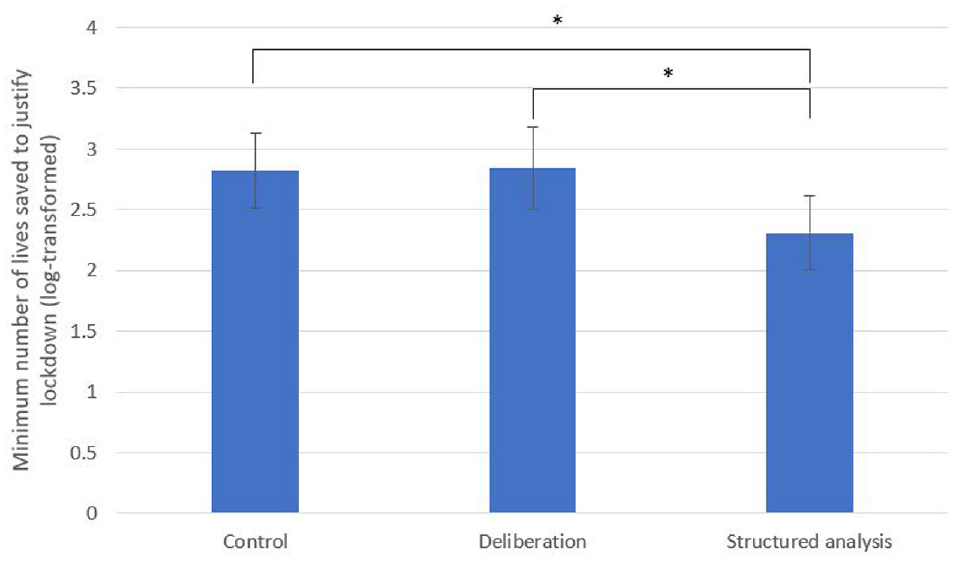
Minimum Number of Lives Saved That Would Justify a Lockdown in the Different Experimental Conditions in Experiment 1. Error Bars Denote 95% CI.
Contrarily, the thinking style did not affect participants’ initial preference for a lockdown (control: M = 3.87, SD = 1.19; deliberation: M = 3.79, SD = 1.12; structured analysis: M = 4.01, SD = 0.99; F < 1).
Finally, we tested the extent to which the participants in each thinking style condition considered each of the four attributes while making their decision. The correlations between the attributes are presented in Table 1. We found no significant difference in the extent to which participants considered the well-being of the entire population, control: M = 5.06, SD = 1.47; deliberation: M = 5.37, SD = 1.31; structured analysis: M = 5.53, SD = 1.13; F(2, 240) = 2.69, p = .070, or saving the economy (F < 1). However, thinking style did affect the extent to which participants considered saving human lives, control: M = 5.84, SD = 1.13; deliberation: M = 5.92, SD = 1.16; structured analysis: M = 6.45, SD = 0.81; F(2, 240) = 8.85, p < .001, η2 p = .063, and caring for the sick and elderly, control: M = 5.43, SD = 1.34; deliberation: M = 5.39, SD = 1.39; structured analysis: M = 5.90, SD = 1.04; F(2, 240) = 4.14, p = .017, η2 p = .033, see Figure 2. Because the four items reflected two general attributes, we averaged each pair and ran the same analysis with the two general items. This analysis yielded similar results (see Supplemental Materials). A mediation analysis confirmed that the effect of the thinking style on the minimum number of lives saved that would justify a lockdown was mediated by the extent to which participants considered saving human lives and caring for the sick and elderly (see Supplemental Materials).
Correlations Between the Four Postdecision Attributes Measured in Experiment 1
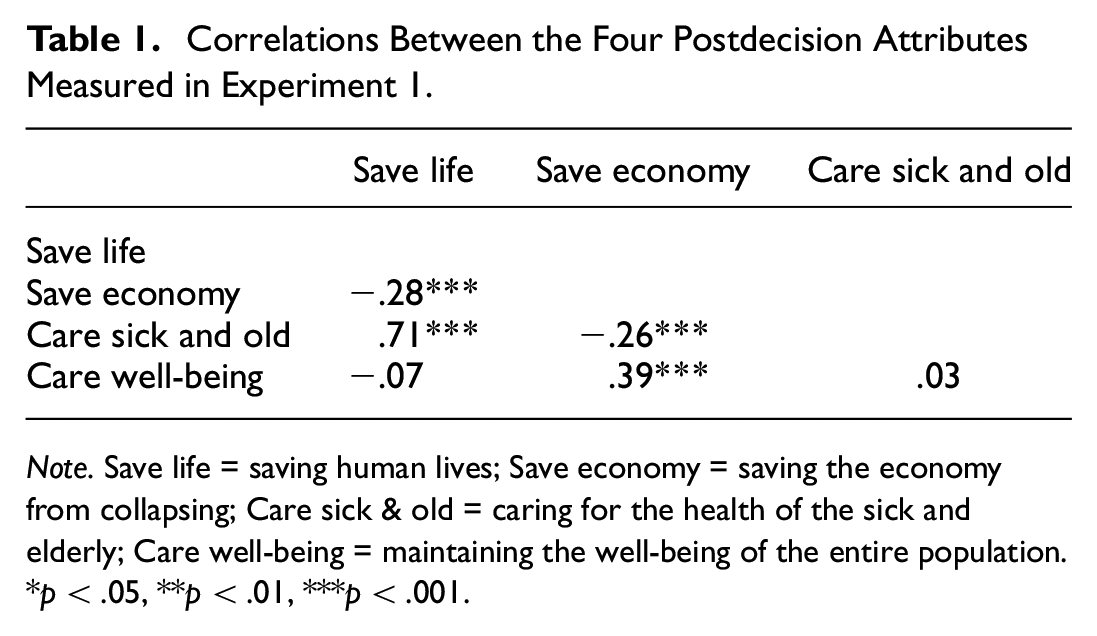
Note. Save life = saving human lives; Save economy = saving the economy from collapsing; Care sick & old = caring for the health of the sick and elderly; Care well-being = maintaining the well-being of the entire population. *p < .05, **p < .01, ***p < .001.
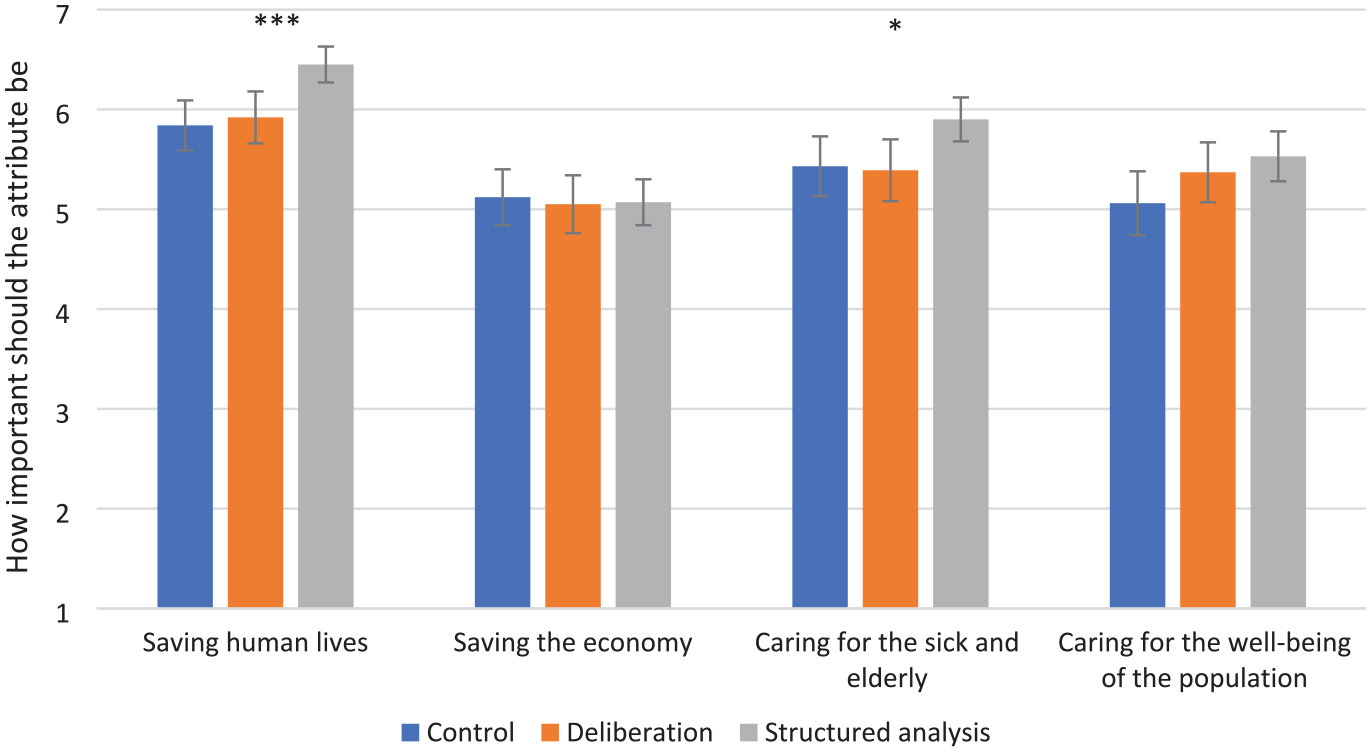
Level of Importance Participants Assigned to Different Considerations When Making Their Decisions in Experiment 1. Error bars denote 95% CI.
Using a difficult dilemma that governments around the world have been struggling with, the results of Experiment 1 corroborated our hypothesis that structured analysis emphasizes the importance of human life in life-and-death decisions. Asking participants to rate the extent to which different attributes should affect their decision highlighted the normative value people put on human life, which led participants to state lower minimum numbers of lives saved that would justify a lockdown. The maximum number of lives that people were willing to lose in the structured analysis condition was approximately 200 compared with approximately 670 in the other conditions. These stark findings clearly emphasize the dramatic results that can be obtained through structured analysis.
In contrast, the structured analysis did not affect participants’ overall approval for a lockdown. The study was run in Israel at the beginning of April 2020 when the COVID-19 death toll was merely a few dozen people. Hence, an estimation of 5,000 deaths might have been seen as widely exaggerated. Therefore, while structured analysis had indeed increased the value of human lives, it was not sufficient to affect decisions that seemed to involve relatively few lives. In Experiment 2, we elaborated on these findings and examined whether structured analysis can overcome a central, well-known helping bias, namely, the in-group bias.
Experiment 2
Being social creatures, people typically identify themselves as members of certain groups, i.e., their in-group (Tajfel & Turner, 2001). Accordingly, people care more about members of their in-group, feel a greater obligation to help them (Erlandsson et al., 2015; Tomasello, 2020), and indeed help them more than they would help people from the out-group (e.g., Duclos & Barasch, 2014; Fiedler et al., 2018; James & Zagefka, 2017; Tajfel et al., 1971; Weisel & Böhm, 2015).
In-groups can take an almost infinite variety of forms, such as family connections, spatial distance, shared values and culture, and even gender, to name but a few (Waytz et al., 2019). Here, we focused on in-groups based on nationality (Baron et al., 2012; Bennett et al., 2004; Kogut & Ritov, 2007; Kumar et al., 2021). We tested whether structured analysis can overcome in-group bias and lead participants to make a donation that, although would save more lives, would help out-group (and not in-group) members.
In September 2019, Hurricane Dorian struck the Bahamas, leaving in its wake catastrophic damage, dozens of casualties, and hundreds of missing people. We asked American participants to decide whether to donate money to assist in the rescue attempts of three American civilians or five Argentinian civilians. We hypothesized that structured analysis would emphasize the value of human life over other attributes like nationality, thereby leading participants to prefer to help the larger group of Argentinians. We also tested whether one’s personal values moderate this effect. If structured analysis affects decisions by emphasizing one’s values and beliefs, then it is expected to alter people’s behavior to be more in line with their personal values.
Method
Participants
Three hundred and fifty-seven participants (145 females; Mage = 36.67; SDage = 11.82) enrolled in a two-part study via Amazon Mechanical Turk (MTurk) for a participation fee of $ 0.40 for each part. A sensitivity analysis revealed that this sample size had a 95% power to detect a small-to-medium effect (Cramer’s V = 0.208) with α = .05.
Procedure
The study consisted of two parts to reduce the risk of carry-over effects. Part 1 of the study ran from September 5 to September 6 (2–3 days after Hurricane Dorian struck the main island of the Bahamas). Participants received an invitation to sign up for part 2 of the study on September 7. Only the participants who completed part 2 by September 13 were included in the final analysis.
In Part 1 of the study, participants completed the Identification With All Humanity scale (IWAH; McFarland et al., 2012), which measures respondents’ identification with their community (α = .912), their nationality (i.e., Americans; α = .879) and all of humanity (α = .884). In part 2 of the study, participants read about two rescue teams searching for survivors in the Bahamas after Hurricane Dorian struck the area. Rescue team A was attempting to reach a group of three Americans (John, Mark, and Dan) while rescue team B was attempting to reach a group of five Argentinians (Franco, Martin, Fabricio, Daniel, and Santiago). The nationalities of the rescue teams were not mentioned. Participants were told that the lab would contribute $5 on their behalf to one of the rescue teams, and were asked to choose to which rescue team they preferred to donate. Hence, participants could choose whether to make their contribution based on the scope of the problem (i.e., the number of people who would be saved) or to be scope insensitive and base their donation on the nationality of the survivors.
As in Experiment 1, participants were randomly assigned to one of three thinking style conditions (Structured analysis/Deliberation/ Control). After reading the vignette, participants in the structured analysis condition were asked to rate how important two situational attributes—the number of people who would be rescued and whether the victims are of their own nationality—should be in their decisions (1 = not at all important to 7 = top priority). These two items were designed to highlight the two considerations we contrasted in the vignette: saving fewer people of one’s own nationality or saving more people of another nationality. The deliberation and control conditions were identical to those described in Experiment 1.
After making their decisions, all the participants rated the extent to which their decision was based on intuition (compared with rational considerations), and the extent to which they considered (a) the degree of empathy the case elicited, (b) the number of people who would be saved and (c) whether the victims belonged to their nationality. Finally, participants answered several demographic questions.
Results and Discussion
Of the 357 participants who completed part 1 of the study, 297 (83.19%) also completed part 2 of the study. To ensure that participants perceived Americans as their national in-group and Argentinians as their national out-group, we excluded from the analysis any participants who were not born in the United States or who were of South American decent (n = 46). Including these participants in the analysis did not change the pattern of the results (see Supplementary Materials). Hence, the final analysis included 251 participants.
Supporting our prediction, a logistic regression with condition (dummy coded with the control condition as reference) predicting the likelihood to be scope sensitive (i.e., donate to the rescue of the five Argentinians) revealed an effect for the structured analysis condition (78.82%, 67 of 85; Wald χ 2 = 13.43, p < .001, odds ratio [OR] = 3.54, 95% confidence interval [CI] = [1.80, 6.98]). The deliberation condition (65.48%, 55 of 84) was not statistically different than the control condition (51.22%, 42 of 82), Waldχ2 = 3.44, p = .063, OR = 1.81, 95% CI = [0.97, 3.37] (Figure 3).
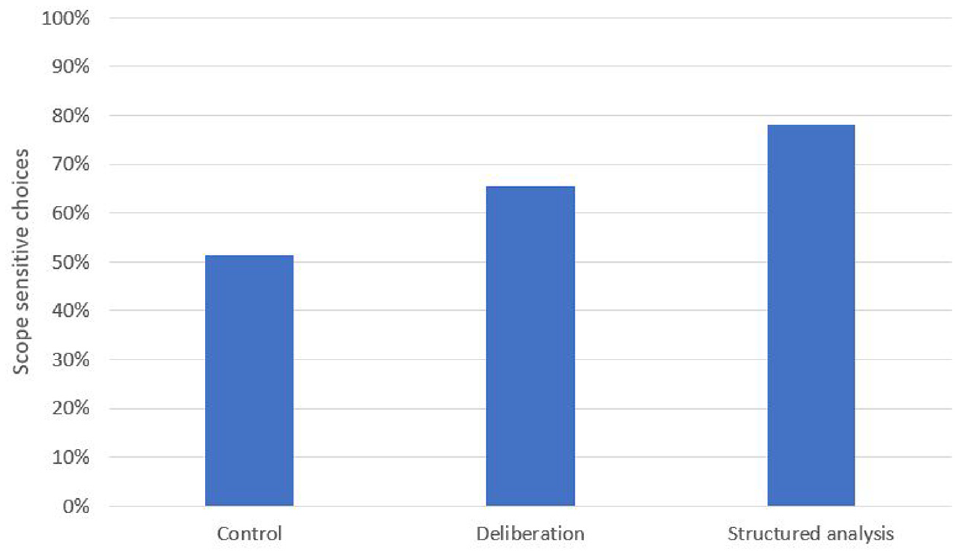
Likelihood of Choosing the Scope-Sensitive Option in the Different Experimental Conditions in Experiment 2.
To allow a direct comparison between the structured analysis condition and the two other thinking style conditions, we ran the same logistic regression model, but with the structured analysis condition as the reference category. The analysis revealed an effect for the control condition, Wald χ 2 = 13.43, p < .001, OR = 0.28, 95% CI = [0.43, 0.55], as well as a marginal effect for the deliberation condition, Wald χ 2 = 3.69, p = .055, OR = 0.51, 95% CI = [0.26, 1.01].
Next, we examined whether the subscales of the IWAH affected donation decisions and moderated the effect of the thinking style. First, a logistic regression with the condition (dummy coded with the control condition as reference) identification with Americans, and their interactions predicting the likelihood to be scope sensitive revealed the main effects for the structured analysis condition, Waldχ2 = 12.38, p < .001, OR = 3.47, 95% CI = [1.74, 6.95] and for identification with Americans, Waldχ2 = 11.36, p < .001, OR = 0.93, 95% CI = [0.89, 0.97]. In addition, the analysis revealed a structured analysis × identification with Americans interaction, Waldχ2 = 4.48, p = .034, OR = 0.88, 95% CI = [0.77, 0.99]. In the control condition, identification with Americans did not predict scope sensitivity, Waldχ2 < 1. However, participants who identified with Americans were less likely to be scope sensitive in both the structured analysis (Waldχ2 = 8.70, p = .003, OR = 0.85, 95% CI = [0.77, 0.95]) and the deliberation (Waldχ2 = 5.32, p = .021, OR = 0.91, 95% CI = [0.84, 0.99]) condition.
Next, we ran the same logistic regression with the condition (dummy coded with the control condition as reference), identification with all humanity and their interactions predicting the likelihood to be scope sensitive. The analysis revealed a main effect for the structured analysis condition, Waldχ2 = 13.19, p < .001, OR = 3.53, 95% CI = [1.79, 6.98], but no main effect for identification with all humanity nor interactions with any of the conditions, ps > .072.
Finally, we tested the extent to which the participants in the different thinking style conditions considered each attribute (number of lives saved, whether the victims belong to one’s in-group, the level of empathy the case elicits) in their decision. The correlations between these attributes are presented in Table 2. In accordance with the behavioral findings, the extent to which participants considered the number of people that would be saved differed between conditions, control: M = 5.27, SD = 2.07; deliberation: M = 5.76, SD = 1.70; structured analysis: M = 6.16, SD = 1.39; F(2, 248) = 5.56, p = .004, η2 p = .043. Mirroring these findings, the different thinking style conditions also affected the extent to which participants considered whether the victims’ nationality matched theirs, control: M = 4.41, SD = 2.19; deliberation: M = 3.92, SD = 2.37; structured analysis: M = 3.41, SD = 2.07; F(2, 248) = 4.28 p = .015, see Figure 4. A mediation analysis confirmed that the effect of the thinking style on the likelihood to be scope sensitive was mediated by the extent to which participants considered the number of people that would be saved and the nationality of the victims (see Supplemental Materials).
Correlations Between the Four Post-Decision Attributes Measured in Experiment 2.
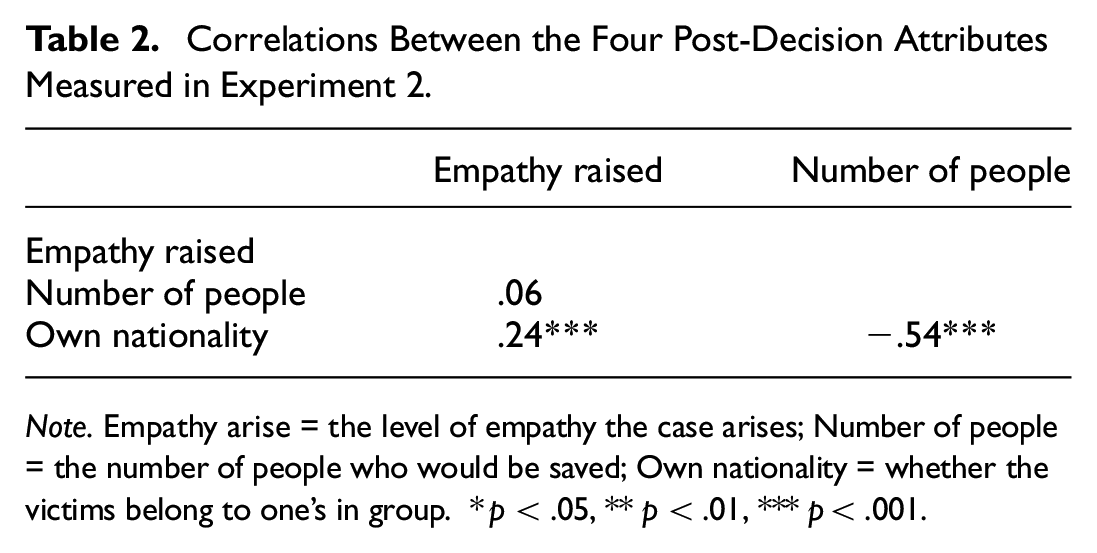
Note. Empathy arise = the level of empathy the case arises; Number of people = the number of people who would be saved; Own nationality = whether the victims belong to one’s in group. *p < .05, ** p < .01, *** p< .001.
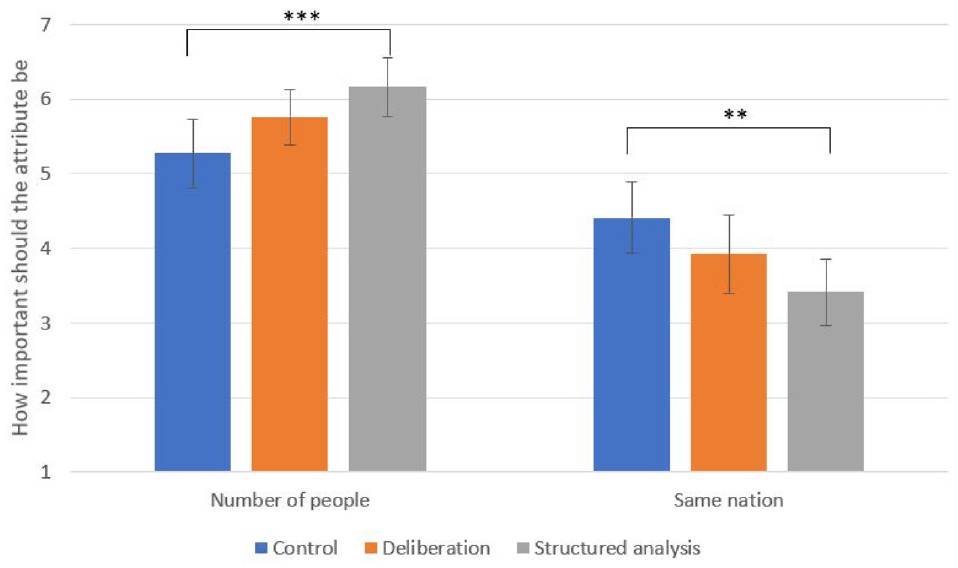
Level of Importance Participants Assigned to Different Considerations When Making Their Donation Decisions in Experiment 2. Error Bars Denote 95% CI.
The results of Experiment 2 further support our hypothesis that structured analysis increases people’s focus on saving lives in their decisions. The structured analysis helped participants overcome the in-group bias, as they were more likely to choose saving more out-group victims than fewer in-group ones. Specifically, participants in the structured analysis group were 1.5 times more likely to be scope-sensitive than those in the control group—which once again demonstrates the dramatic effect of this manipulation. Moreover, the structured analysis also helped participants make decisions that better aligned with some of their personal values, measured a day before the experiment. While structured analysis generally reduced the in-group bias, for those who felt a strong group affiliation (i.e., identification with Americans), structured analysis actually heightened the in-group bias. Thus, the method appears to help people in heeding their own preferences, rather than external considerations.
General Discussion
When focused on a single task, people often fail to perceive highly relevant and clear information that is presented to them, a phenomenon known as inattentional blindness (Simons & Chabris, 1999). Similarly, when making helping decisions, people often fail to acknowledge highly relevant attributes, such as the number of lives that could be saved or the actual neediness of the recipients, instead focusing their attention on less relevant attributes, such as physical appearance or the identifiability of the victim (e.g., Cryder et al., 2017; Kogut & Ritov, 2005a; Small et al., 2007). Building on work by Huber (2010), we present a thinking paradigm, namely, structured analysis of personal criteria, that helps people focus their attention on the most relevant attributes of the decision, which in the case of humanitarian causes—is saving lives. The results of two experiments revealed that rating the extent to which relevant attributes should affect one’s decision in such situations increased participant’s willingness to pay the price of significant harm to the economy (Experiment 1) or to prefer to help out-group over in-group members (Experiment 2) to make a decision that maximizes the number of lives saved. Experiment 2 further revealed that this was the case only when human life was indeed the most important attribute to the decision maker. When other attributes (such as national identity) were more important, they figured more prominently in the decision makers’ donation decisions following the structured analysis.
Taken together, our findings support the novel method of increasing people’s attention to relevant attributes in life-and-death decisions. Since most people view human life as the most important feature of such situations (Slovic, 2007), emphasizing this aspect of the situation helps potential donors to arrive at a decision that reflects their beliefs. Importantly, this method does not force people to adopt values and beliefs they do not endorse. In Experiment 2, participants who scored higher on identification with Americans were actually less likely to favor the number of lives saved over the nationality of the victims following a structured analysis. Thus, the structured analysis method merely helps people make decisions that align with their morals and values, rather than directing them toward a specific decision.
The results of the present study somewhat contradict those of a recent study showing no effect for structured analysis on the alleviation of the singularity effect (Moche et al., 2022). A critical difference between the two studies, however, is that here, we used a joint evaluation decision method, in which participants had to choose between two presented options, whereas Moche and colleagues used a separate evaluation method in which participants were asked to donate either to a single victim or to a group of victims. The contradicting results may illuminate the mechanism by which structured analysis can influence decisions: By highlighting the relevant attributes, structured analysis renders them more accessible, thus promoting a better comparison of the alternatives. Such a comparison, however, is relevant only when done in a joint evaluation context, where one alternative plays as a reference point for the other regarding the relevant attributes (Hsee, 1996).
One might assume that a decision that better reflects the decision maker’s values would result in greater satisfaction from that decision. However, the results of Experiment 2 do not bear that out. Thus, future research is needed to directly examine this question, to provide further insights into the adequacy of the use of this method by decision-makers. Moreover, in the present study participants in the structured analysis condition were asked to rate the importance of attributes provided by the experimenters. However, the question as to whether or not people can use this method freely, by stating the attributes they deem to be important (rather than the rating given attributes) to improve their decisions, is yet to be examined.
In the current paper, we present the effectiveness of a relatively understudied thinking style—namely, structured analysis of personal criteria, which deviates from the classic dual-system approach (Kahneman, 2011; Stanovich & West, 2000). Our work expands on previous findings (Huber, 2010) by demonstrating the advantages of structured analysis in situations with no normative decision and above and beyond the effect of deliberation. We hope that our findings will inspire policymakers to use this method by explicitly stating the attributes that might affect their own decisions and those of others. By doing so, people would be better able to make decisions that are consistent with their values and beliefs, and less susceptible to decisional biases.
Supplemental Material
sj-docx-1-spp-10.1177_19485506221141987 – Supplemental material for Think of What Really Matters: Structured Analysis of Personal Criteria can Save Lives
Supplemental material, sj-docx-1-spp-10.1177_19485506221141987 for Think of What Really Matters: Structured Analysis of Personal Criteria can Save Lives by Tom Gordon-Hecker and Tehila Kogut in Social Psychological and Personality Science
Footnotes
Acknowledgements
We thank Leaf van Boven for his constructive feedback on an earlier version of the manuscript.
Handling Editor: Malgorzata Kossowska
Declaration of Conflicting Interests
The author(s) declared no potential conflicts of interest with respect to the research, authorship, and/or publication of this article.
Funding
The author(s) disclosed receipt of the following financial support for the research, authorship, and/or publication of this article: This work was supported by the National Science Foundation (NSF), grant no. 1757315, and by the NSF-BSF, grant no. 2021727.

Supplemental Material
The supplemental material is available in the online version of the article.
Notes
Author Biographies
References
Supplementary Material
Please find the following supplemental material available below.
For Open Access articles published under a Creative Commons License, all supplemental material carries the same license as the article it is associated with.
For non-Open Access articles published, all supplemental material carries a non-exclusive license, and permission requests for re-use of supplemental material or any part of supplemental material shall be sent directly to the copyright owner as specified in the copyright notice associated with the article.
