




Abstract
Do populist attitudes predict a growth in feelings of hate? Or does experiencing hate predict a growth in populist attitudes? Previous research has not yet examined the relation between populist attitudes and hate over time. We conducted a two-wave study with a Dutch adult sample in the Netherlands, to examine the time-extended associations between populism and hate, thereby focusing on other individuals (N = 943) or groups (N = 851) as targets of hate. For interpersonal and intergroup hate, results uncovered an association between populist attitudes and hate, such that, earlier populist attitudes predict later feelings of hate, while the reverse associations were virtually absent. The findings provide new evidence that a populist worldview might fuel feelings of hate over time, rather than the reverse, highlighting the intense and strong negative feelings that the populist worldview can inspire among people. Further implications are discussed.
Populism is predicated on the idea that people are ruled by corrupt elites against their general will. There is an ongoing surge of right- and left-wing political movements in Latin America, North America, and Europe since the 1990s. Left-wing leaders and movements showing a populist tendency are, for example, Nicolás Maduro in Venezuela, Evo Morales in Bolivia, Podemos in Spain, Die Linke in Germany, and the Socialistische Partij (SP) in the Netherlands. Right-wing leaders and movements with a populist tendency are, for example, Jair Bolsonaro in Brazil, Alvaro Uribe in Colombia, Donald Trump in the United States, Front National (FN) in France, Alternative für Deutschland (AfD) in Germany, or the Partij voor de Vrijheid (PVV) in the Netherlands. This rise of populism has been accompanied by extensive research revealing what these populist movements and leaders along the entire ideological spectrum have in common (e.g., Akkerman et al., 2014; Mudde, 2007; Yilmaz & Morieson, 2021). In the midst of the strong antagonisms fueled by the populist discourse, the mobilization of negative emotions is a central feature, and the relationship between populism and hate feelings is of paramount relevance in the current global political landscape.
The strategies by which populist parties and charismatic populist leaders mobilize their ideologies to attract voters to their party lines (i.e., the supply-side of populism) have been studied extensively (e.g., Custodi, 2021; Jagers & Walgrave, 2007; Reinemann & Aalberg, 2018). However, only recently, research has started to examine the psychological traits that facilitate the reception of the populist message among people (i.e., the demand-side of populism) (e.g., Akkerman et al., 2014, 2017; Erisen et al., 2021). So far, research has emphasized what factors make people susceptible to a populist worldview, in terms of demographic (e.g., Kriesi et al., 2008), socio-political (e.g., Geurkink et al., 2020; Steenvoorden & Harteveld, 2018), and psychological (e.g., Bakker et al., 2021; Erisen et al., 2021; Van Prooijen et al., 2022) correlates. However, less is known about people’s prior emotional experiences, and particularly about the relationship between populism and negative emotions over time. Only a handful of discrete emotions (notably anger, nostalgia, and fear) have been studied mostly from the supply-side (e.g., Martella & Bracciale, 2022; Steenvoorden & Harteveld, 2018). Surprisingly, feelings of hate—often portrayed as critical for understanding political polarization and ideological-based conflicts (Halperin et al., 2009, 2012; Staub, 2011)—have not been studied yet in relation to populist attitudes. Do feelings of hate pave the way for adopting populist attitudes over time, or vice versa: do populist attitudes lead to the development of hate feelings over time? As argued below, On the basis of core features of populism that stimulate threat perceptions and antagonism between individuals and groups, we expect positive and stable associations between populist attitudes and hate across interpersonal and intergroup targets, and we expect to find evidence supporting the hypothesis that holding populist attitudes predict the development of increased hate feelings over time, and not in the opposite direction.
Populism
Populism is a political mentality portraying society as divided into two homogeneous and antagonistic groups, “the pure people,” and the “corrupt elites.” This definition assumes two components, namely, people-centrism (i.e., “the people” as sovereign, pure and moral, referred to as “the silent majority” or “the ordinary decent people”; Oliver & Rahn, 2016), and anti-elitism (i.e., the “elites”—which may include political, economic, and intellectual elites, and the media—who seek to exploit “the people”; Jagers & Walgrave, 2007). It is a thin-centered ideology that people attach to host ideologies like conservatism, liberalism, or socialism, emerging at both the political left and right (Akkerman et al., 2014; Mudde, 2007). Relatedly, populism is distinct from political extremism: Populist worldviews emerge across the political spectrum, including the center and the extremes (Van Prooijen et al., 2018). Nevertheless, political extremism is associated with features that may lead to hate feelings, such as higher intolerance (Brandt et al., 2014; Van Prooijen & Krouwel, 2017), stronger negative emotions and out-group derogation (Van Prooijen et al., 2015), and the use of angry language (Frimer et al., 2019; Zwicker et al., 2020). We therefore empirically control for political ideology and political extremism in our models.
A populist worldview frequently assumes a moral and antagonistic struggle between the “good” people and the “evil” elites (i.e., a “Manichean outlook”), depicting a charismatic populist leader as protector of the people (Erisen et al., 2021). Such populist antagonism can be understood simultaneously on a vertical dimension, with the oppressive elites on top and the oppressed people at the bottom, and on a horizontal dimension of homogeneity/exclusion, with the homogeneous “good decent” people on one side, and other groups within society who do not share the “people’s” values on the other side (Custodi, 2021; Jagers & Walgrave, 2007; Reinemann & Aalberg, 2018). Right-wing populist parties often use a form of exclusionary populism, based on nativist, nationalist and xenophobic sentiments, reflected in their support to anti-immigration policies, whereas left-wing populist parties focus on exploitation by powerful elites and strive for income equality (Bernhard & Kriesi, 2019; Jagers & Walgrave, 2007; Reinemann & Aalberg, 2018). It is not surprising that strong negative emotions emerge between the antagonist groups as part of this worldview. Although research has demonstrated that anger is consistently associated with the supply and demand sides of populism, even more than fear (Martella & Bracciale, 2022; Rhodes-Purdy et al., 2021; Rico et al., 2017), populism might instill even stronger and enduring feelings, and hate has a particularly good fit with the populist worldview.
Hate
We conceptualize hate as a unique strong, intense, and enduring feeling, intended to harm or eliminate its targets physically, socially, or symbolically (Fischer et al., 2018; Martínez et al., 2022; Sternberg & Sternberg, 2008). Hate is a distinct yet composite feeling comprising elements of anger, contempt, and disgust (Martínez et al., 2022; Sternberg, 2003; Sternberg & Sternberg, 2008). Hate emerges when these three emotions are activated simultaneously in different degrees, and at the same time, it is experienced as distinct from each of these emotions alone (Matsumoto et al., 2016, 2017). For instance, compared to anger, contempt, and disgust alone, hate is experienced as more emotionally arousing, hate targets are perceived as more threatening, and people are more willing to attack them (Martínez et al., 2022). Moreover, whereas anger aims to change target’s behaviors, contempt to derogate the targets, and disgust to avoid the targets (Hutcherson & Gross, 2011; Schriber et al., 2017; Tybur et al., 2009), hate is oriented to harm the targets, and eliminate them from one’s life.
Hate can be experienced toward particular individuals (Aumer & Bahn, 2016) or entire groups (Halperin, 2008), and could last for years without dissipating completely (Halperin et al., 2012; Sternberg, 2003; Verduyn & Lavrijsen, 2015). Hate has been described as a reaction to moral violations (Van Bavel et al., 2018), to dispositional attributions of targets perceived as dangerous, immoral or evil (Baumeister, 1997; Zeki & Romaya, 2008), and to symbolic threats to values and identity (Martínez et al., 2022a; Baumeister & Butz, 2005; Staub, 2005). Among hate’s consequences are intolerance, moral exclusion, hate speech, verbal and physical aggression, and violence (Chetty & Alathur, 2018; Fischer et al., 2018; Halperin et al., 2009; Staub, 2011). The match between characteristic features of populism (i.e., its vertical and horizontal antagonisms and its Manichean outlook) and hate’s antecedents (i.e., the symbolic threats to values, identity and the appraisal of the targets as evil), lead us to think that populist attitudes might progressively give rise to increasing hate feelings.
How Populism May Give Rise to Hate
We propose that the populist worldview sets the stage for developing hate feelings over time in three ways. First, it stimulates individuals to mentally divide society into antagonistic groups vertically (i.e., people vs. elites) and horizontally (i.e., people vs. outsiders) (Jagers & Walgrave, 2007). Second, it fuels confrontation by carefully crafting people’s social identity (Mols & Jetten, 2014), on the basis of national, ethnic, or class memberships depending on the political orientation of the parties (Kinnvall, 2018; Marchlewska et al., 2018). In this process, a populist worldview portrays the elites and their supporters as threats to the identity of “the true people,” unleashing in-group emotions (e.g., pride, hope), and out-group emotions (e.g., anger, fear, indignation) typical of intergroup conflict. Finally, the Manichean outlook implicit in a populist worldview moralizes this political confrontation, framing the opponents as intrinsically immoral and evil individuals who should be removed from society (Abts & Rummens, 2007), channeling the out-group emotions toward hate, which has precisely the motivational goal of eliminating its targets on the basis of their dispositional evil attributions (Fischer et al., 2018; Sternberg & Sternberg, 2008). Thus, we propose that once people adopt populist attitudes, they might enter in a downward spiral of increasing negative emotions toward their targets, escalating over time into stronger hate feelings.
The Current Research
The present study was conducted within a large-scale panel research in the Netherlands. According to Akkerman et al. (2014), the Netherlands is an exceptional context for studying populism for at least two reasons. First, it has a multiparty system with various populist options as exit alternatives from traditional mainstream parties. Second, the Netherlands shows a strong presence of populist parties and is one of the few countries in Europe where left- and right-wing populist parties both have been successful at the same time (e.g., the left-wing SP and the right-wing PVV). We measure populist attitudes, hate, and our control variables in two Waves of data collection, and employ a two-wave cross-lagged panel design to test our predictions. Although populism is primarily an intergroup phenomenon, political attitudes also affect interpersonal relationships (e.g., Buliga & MacInnis, 2020), therefore, we examine hate (in relation to populist attitudes) at both the interpersonal and intergroup levels aiming to generalize our findings across targets.
Method
Procedure
Data collection was conducted through an online questionnaire in two Waves from a larger panel research conducted in the Netherlands in 2021, coordinated by Kieskompas (“Election compass”)—a Dutch political research organization (https://www.kieskompas.nl/en/). The sample was drawn from a larger panel that is pre-stratified to be nationally representative on the benchmarks of gender, age, education, geographical region, ethnicity, and voting in the last Dutch election. The first Wave took place in April and the second Wave two months later in June. In both Waves, Kieskompas stopped data collection when no significant number of responses was registered anymore (approximately 2–3 weeks after launching the study). In both Waves, we asked participants to report an interpersonal and an intergroup hate target (i.e., “Please think about a [person/group] that for any reason you believe you either hate, or have hated in the past, and in a short paragraph describe this [person/group] and explain how you came to hate them”), and to answer a hate scale concerning each reported target, a populist attitudes scale, a political ideology measure, and a socio-demographic form (all described below).
Kieskompas adheres to General Data Protection Regulation (GDPR; i.e., EU privacy), which is closely monitored by the Dutch privacy authority for the Protection of Personal Information (“Autoriteit Persoonsgegevens”), and acts in line with the ethical norms of the Vrije Universiteit Amsterdam. The study was preregistered before running the second Wave. The preregistration, data, materials, and reproducible analyses are available on the Open Science Framework (osf.io/hate&populism).
Participants
A total of 2,502 Dutch participants voluntarily participated in both Waves, from which N = 953 reported interpersonal hate targets and N = 864 intergroup hate targets consistently across Waves, and the rest were excluded. We screened and excluded meaningful multivariate outliers using Mahalanobis distances within the interpersonal (10) and intergroup sub-sets (13), obtaining a final interpersonal hate sub-sample of N = 943, 58.6% males (age M = 59.6, SD = 14.4), 36.4% females (age M = 59.1, SD = 13.7), 4.98% not answered; and a final intergroup hate sub-sample of N = 851, 62.3% males (age M = 59.7, SD = 15), 33.6% females (age M = 58.8, SD = 14.6), 4.11% not answered. Missing data within the final samples were pairwise dropped from each of the main analyses. There is no clear consensus about the adequate sample size estimation for fitting structural equation models. Based on the N:q ratio of required number of participants by model parameter, our sub-samples are adequate across multiple recommended standards in a range from 5:1 to 20:1 (Bentler & Chou, 1987; Kline, 2015; Schreiber et al., 2010).
Measures
Hate was measured with an adaptation of the Passionate Hate Scale (Zeki & Romaya, 2008) based on the triangular theory of hate (Sternberg & Sternberg, 2008). It is a composite scale comprising three sub-scales (1 = strongly disagree to 7 = strongly agree), with four items each, measuring anger (e.g., I have aggressive thoughts about this person/group); contempt (e.g., I really despise this person/group); and disgust (e.g., this person/group is really disgusting). The overall hate scale showed good reliability for the interpersonal (α = .84) and intergroup targets (α = .83). Populist attitudes was measured with the populist attitudes scale (Akkerman et al., 2014), consisting of eight items (1 = totally disagree, 5 = totally agree), (e.g., ordinary citizens, not politicians, should make the most important political decisions), (α = .86). We measured political ideology on an 11-point scale from left (0) to right (10), and we computed a political extremism index by “folding over” the political ideology scale into a 5-point scale (0 = less extreme and 5 = more extreme). Finally, we measured education, gender, and age. The study was part of a multi-wave battery of measures that were contributed by multiple researchers for various independent research projects. More information about the panel research is available upon request.
Design and Analytical Strategy
As a first indication of the association between populist attitudes and hate, we conducted binomial logistic regressions with the entire sample to estimate participants’ likelihood of reporting (or not) interpersonal and intergroup hate targets across Waves given their levels of populist attitudes, while controlling for political ideology and extremism. Then, with the retained sample of participants who consistently reported hate targets (and therefore completed the hate scale), we tested our main predictions fitting a two-wave cross-lagged panel model that tested the auto-regressive effects, the cross-sectional correlations, and the cross-lagged effects of hate and populist attitudes using the lavaan package in R (Rosseel, 2012). We included political ideology, political extremism, education, age, and sex as control variables in the preregistered models. 1 We conducted separate analyses for the interpersonal and intergroup hate targets. Finally, we employed 1,000 bootstrapping for computing confidence intervals for the model parameters.
Results
Populist Attitudes as Predictor of Reporting Hate Targets
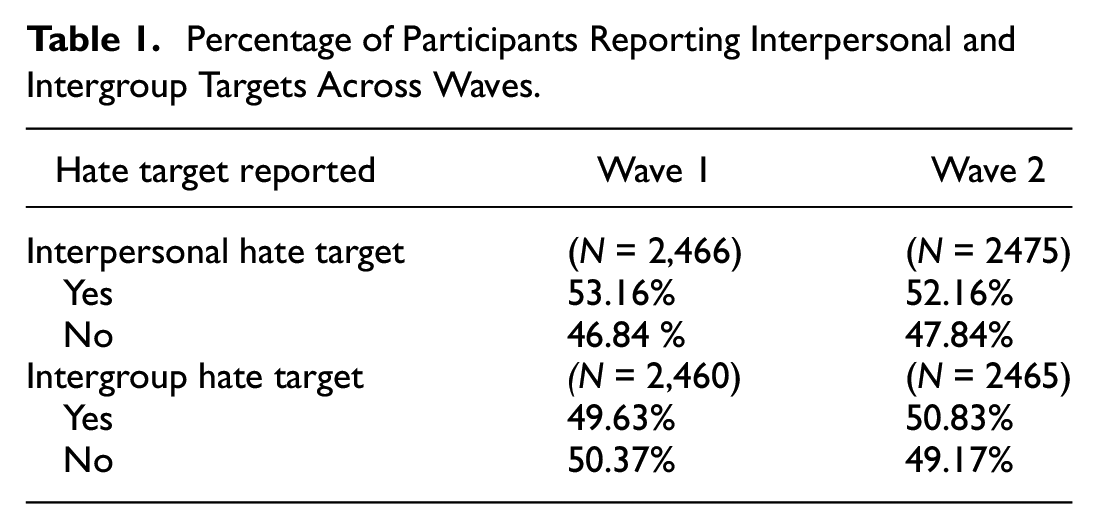
Before excluding participants who did not report hate targets for the main analyses, we estimated the probability of reporting (or not) hate targets depending on the levels of populist attitudes with the entire sample. The percentage of participants reporting interpersonal and intergroup targets across Waves are summarized in Table 1. Results revealed significant effects of populist attitudes, suggesting that participants scoring high in populist attitudes are more likely to report interpersonal hate targets both in the first Wave, B = −0.15 (.05), p < .001, OR = 0.86, 95% CI [0.77, 0.95], and the second, B = −0.18 (.05), p < .001, OR = 0.84, 95% CI [0.75, 0.93]. Similarly, results indicate that participants scoring high in populist attitudes are more likely to report intergroup hate targets both in the first wave, B = −0.15 (.05), p < .001, OR = 0.86, 95% CI [0.77, 0.96], and the second, B = −0.20 (.05), p < .001, OR = 0.81, 95% CI [0.73, 0.91]. Results are summarized in Table 2. Overall, these findings suggest that holding populist attitudes and extreme political views (but not necessarily leaning toward a particular political orientation) increase the chances of reporting hated individuals and groups.
Percentage of Participants Reporting Interpersonal and Intergroup Targets Across Waves.
Logistic Regression Models of Populist Attitudes, Political Ideology, and Political Extremism as Predictors of Reporting Hate Targets Across Waves.
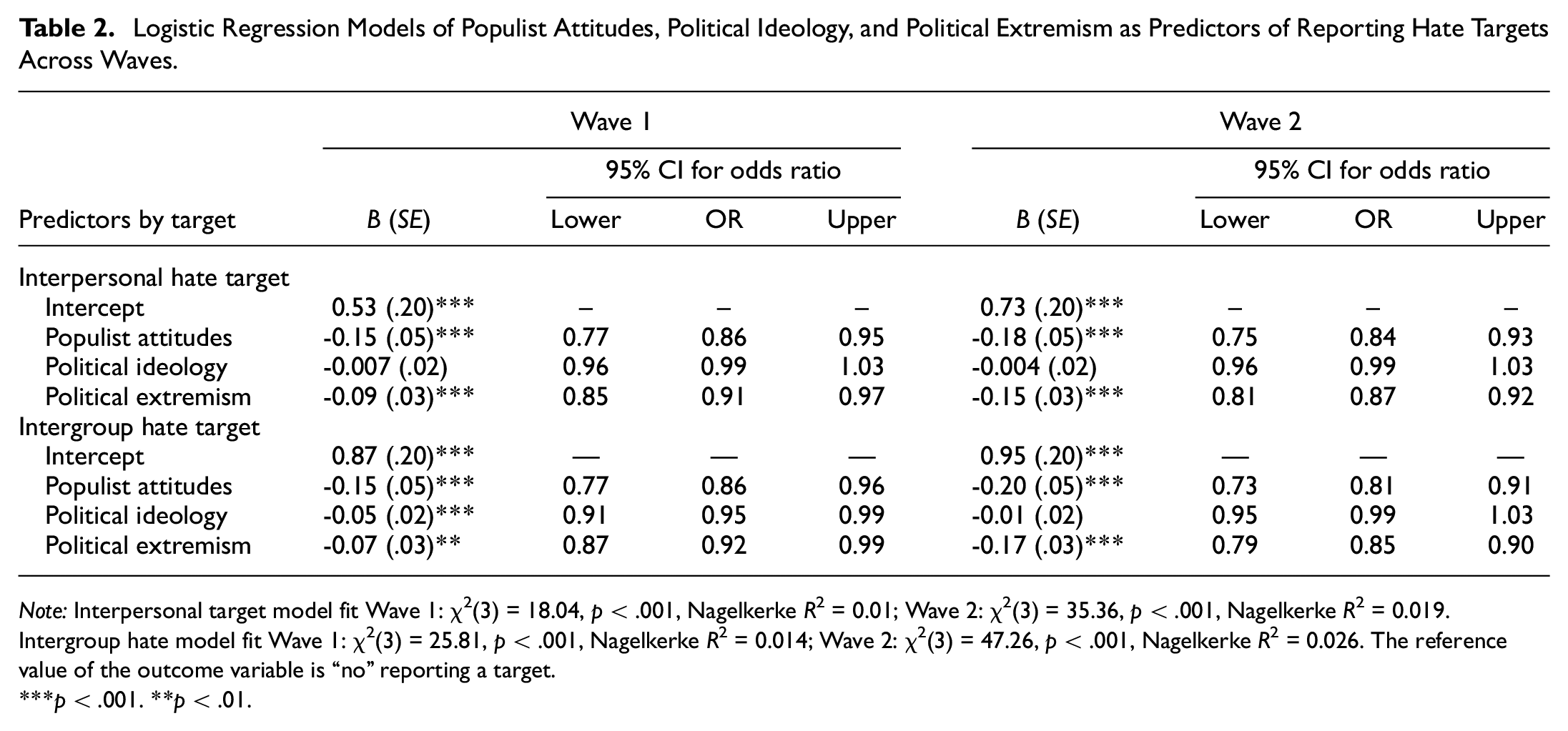
Note: Interpersonal target model fit Wave 1: χ2(3) = 18.04, p < .001, Nagelkerke R2 = 0.01; Wave 2: χ2(3) = 35.36, p < .001, Nagelkerke R2 = 0.019. Intergroup hate model fit Wave 1: χ2(3) = 25.81, p < .001, Nagelkerke R2 = 0.014; Wave 2: χ2(3) = 47.26, p < .001, Nagelkerke R2 = 0.026. The reference value of the outcome variable is “no” reporting a target.
p < .001. **p < .01.
Interpersonal Hate
Descriptive statistics and inter-correlations of the measured variables are summarized in Table 3. The auto-regressive effects in the interpersonal hate model χ2(10, N = 589) = 124.09, p < .001, comparative fit index (CFI) = 0.92, Tucker–Lewis index (TLI) = 0.75, root mean square error of approximation (RMSEA) = 0.16, standardized root mean square residual (SRMR) = 0.10 (see Figure 1A), shows that populist attitudes in Wave 1 predict populist attitudes in Wave 2, (β = .89, z = 42.65, p < .001, CI [0.85, 0.93]), and hate at Wave 1 predicts hate at Wave 2, (β = .52, z = 11.11, p < .001, CI [0.43, 0.63]). Moreover, as expected, the synchronous correlations indicate that populist attitudes are significantly correlated with interpersonal hate at Wave 1, r = .26, t (728) = 7.18, p < .001, 95% CI [0.19, 0.33], and at Wave 2, r = .27, t (771) = 7.81, p < .001, 95% CI [0.20, 0.33]. The cross-lagged regressions indicate that hate at Wave 1 does not significantly predict populist attitudes at Wave 2, (β = .009, z = 0.45, p = .654, CI [−0.03, 0.04]), but on the contrary, populist attitudes at Wave 1 does predict interpersonal hate at Wave 2 (β = .09, z = 2.39, p = .017, CI [0.02, 0.20]).
Means, Standard Deviations, and Inter-Correlations Between the Measured Variables Across Interpersonal and Intergroup Targets.
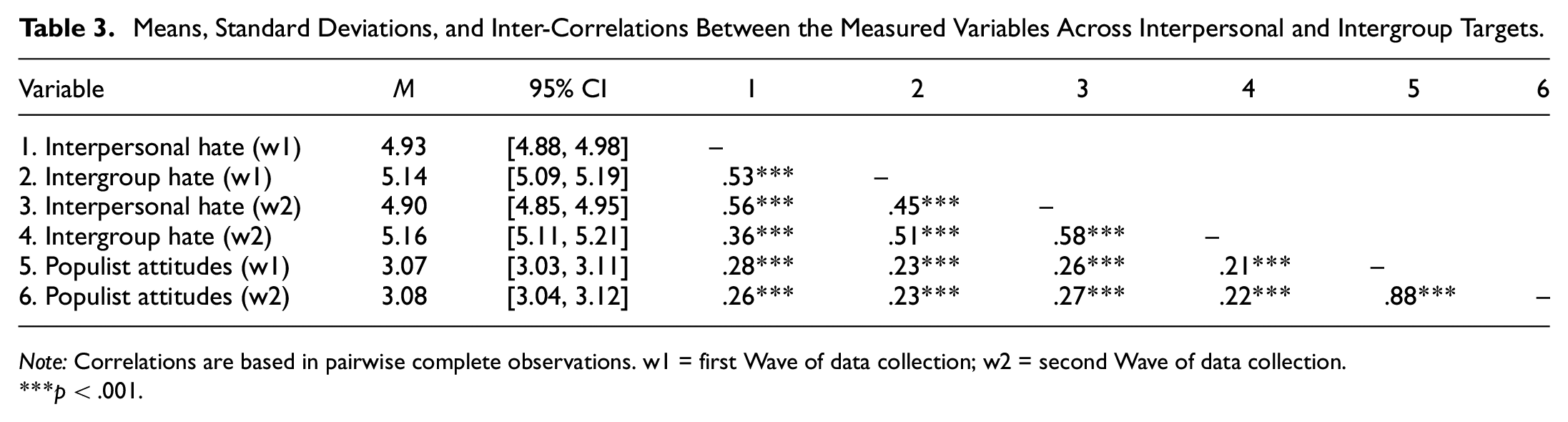
Note: Correlations are based in pairwise complete observations. w1 = first Wave of data collection; w2 = second Wave of data collection.
p < .001.
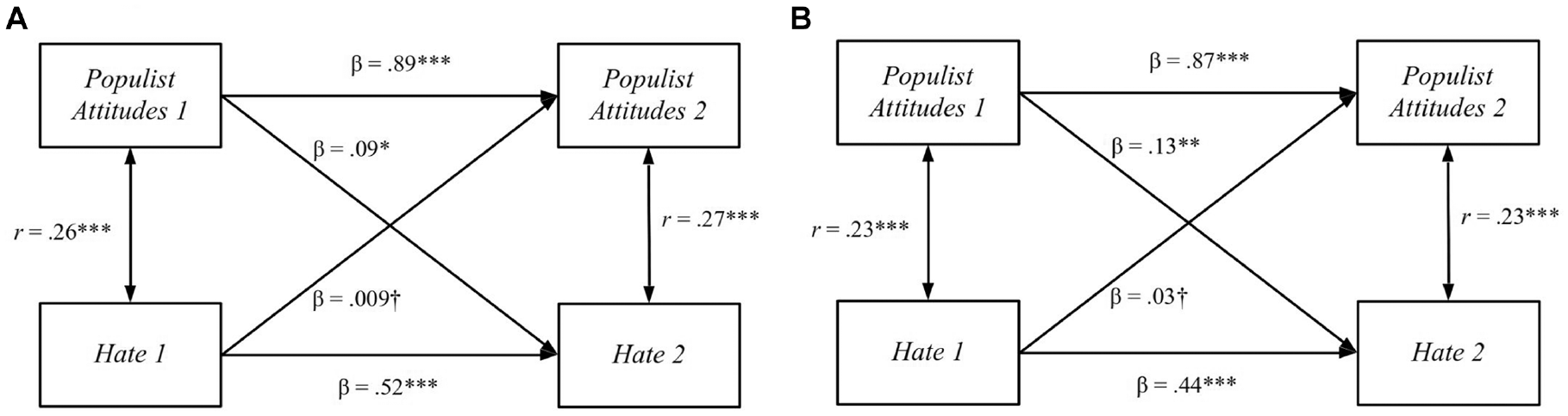
(A) Interpersonal and (B) Intergroup Cross-Lagged Models of the Associations Between Hate and Populist Attitudes.
The fit of the overall model improves when controlling only for political ideology, χ2(2, N = 618) = 46.30, p < .001, CFI = 0.97, TLI = 0.84, RMSEA = 0.19, SRMR = 0.08. When covariates are not included the model is saturated, χ2(6, N = 633) = 1,355.98, p < .001, CFI = 1.00, TLI = 1.00, RMSEA = 0.00, SRMR = 0.00. In both cases, results replicate the initial model. In sum, populist attitudes and interpersonal hate are positively associated. Furthermore, populist attitudes, interpersonal hate, and their association, seems to be stable over time. Importantly, the cross-lagged regressions suggest that it is more likely for populist attitudes to predict interpersonal hate over time than vice versa, as expected.
Intergroup Hate
The auto-regressive effects in the intergroup hate model χ2(10, N = 615) = 128.31, p < .001, CFI = 0.90, TLI = 0.74, RMSEA = 0.16, SRMR = 0.10 (see Figure 1B), indicates that populist attitudes at Wave 1 predict populist attitudes at Wave 2, (β = .87, z = 41.04, p < .001, CI [0.83, 0.92]), as well as hate at Wave 1 predicts hate at Wave 2, (β = .44, z = 10.64, p < .001, CI [0.36, 0.56]). Moreover, as expected, the synchronous correlations indicate that populist attitudes are significantly correlated with intergroup hate at Wave 1, r = .23, t (737) = 2.28, p < .001, 95% CI [0.16, 0.29], as well as at Wave 2, r = .23, t (722) = 6.38, p < .001, 95% CI [0.16, 0.30]. The cross-lagged regressions indicate that hate at Wave 1 does not significantly predict populist attitudes in Wave 2, (β = .03, z = 1.55, p = .121, CI [−0.007, 0.06]), but again on the contrary, populist attitudes at Wave 1 do predict interpersonal hate at Wave 2 (β = .13, z = 3.01, p = .003, CI [0.06, 0.23]).
Model fit improves when controlling only for political ideology, χ2(2, N = 639) = 54.90, p < .001, CFI = 0.96, TLI = 0.79, RMSEA = 0.20, SRMR = 0.09. When covariates are not included the model is saturated, χ2(6, N = 648) = 1,223.03, p < .001, CFI = 1.00, TLI = 1.00, RMSEA = 0.00, SRMR = 0.00. In both cases, results replicate the initial model. In sum, in a similar pattern as in the interpersonal hate model, populist attitudes and intergroup hate are positively associated. Once again, populist attitudes, intergroup hate, and their association, seem to be stable over time, and the cross-lagged regressions suggest again that it is more likely for populist attitudes to predict intergroup hate over time than for intergroup hate to predict populist attitudes. 2
Discussion
Using a two-wave panel design with data drawn from a large pre-stratified panel, we examined if populist attitudes are associated with hate feelings, if experiencing hate predicts increased populist attitudes over time, or if holding populist attitudes predicts increased hate feelings over time. Results revealed three main findings across interpersonal and intergroup targets. First, hate feelings and populist attitudes are stable over time. Second, populist attitudes and hate are positively associated, and their association is stable over time. And third, populist attitudes predict a growth of hate over time, and not vice versa.
The mistrust in traditional politics, social division, vertical and horizontal antagonisms, and the symbolic threats based on identity concerns promoted by the populist worldview, might explain the stable and positive associations between populist attitudes and hate, a feeling whose characteristics match well with the ingredients of populism. Emotions are goal-oriented, and evolved as signaling mechanisms which coordinate individuals’ physiological, cognitive, and behavioral systems to face threats to their goals (Cottrell & Neuberg, 2005; Keltner & Gross, 1999; Tooby & Cosmides, 2008). Accordingly, hate has been conceptualized as a result of triggering factors rather than a cause of them (Sternberg & Sternberg, 2008). Therefore, it is reasonable to think that hate is an outcome of the perceived threats settled by the populist worldview instead of thinking on populism as a suitable worldview to adopt for people with a tendency to experience hate feelings. Consistently, populist attitudes are not only a consequence but also a cause of political discontent (Rooduijn et al., 2016). Future research should examine how the continuous exposure to populist messages, and the endurance of the threats portrayed by populism contribute to the increase of hate over time.
One might expect that populist attitudes predict intergroup hate stronger than interpersonal hate, because of the intergroup antagonism that is part of a populist worldview. Although the cross-lagged effects indeed point in that direction, it is worth highlighting the positive associations of populist attitudes and interpersonal hate over time, which could be explained by interpersonal political differences among people. Political disagreements negatively affect close interpersonal relationships between friends (e.g., Buliga & MacInnis, 2020), family members (e.g., Lee, 2021) and romantic partners (e.g., Fangmeier et al., 2020; Huber & Malhotra, 2016). Likewise, interpersonal hate is also developed often toward individuals as close as relatives, friends, and romantic partners (Aumer & Hatfield, 2007), as well as single individual politicians and political opponents (Martínez et al., 2022). The present findings highlight the underestimated influence that macro-level political factors can pose to individuals’ close relationships via negative affect, fostering tensions and division even within friendships and families.
Implications
The present findings pose at least three main implications. First, our findings suggest that populist attitudes predict the development of hate feelings beyond anger alone, as previous research on populism has suggested (e.g., Martella & Bracciale, 2022; Rico et al., 2017). Anger tends to emerge in reaction to an external agent (e.g., the elites) who is responsible for intentionally obstructing one’s goals, fostering behaviors like protest or voting for change (Rico et al., 2017). Our findings imply, however, that the populist worldview might instill hate feelings intended not only to change the circumstances or target’s intentions, but also to harm and eliminate the elites and their supporters physically or symbolically. The populist worldview therefore could be sowing the seed of intense and long-lasting hate feelings, closely associated with affective polarization, conflict, terrorism, and violence (e.g., Staub, 2011; Sternberg, 2003).
Second, the link between populist attitudes and hate feelings has hitherto received little research attention. The emergence of hate has been associated with structural and sociopolitical factors, such as poverty, lack of resources, economic turmoil, political, criminal and institutional violence, rigid cultural values, authoritarianism, extreme political or religious views, or ideological propaganda (Fischer et al., 2018; Staub, 2005; Sternberg & Sternberg, 2008). Populism mainly has been addressed theoretically in relation to hate, as a part of a generalized societal sentiment coined as ressentiment, mediating macro-level sociocultural and economic factors and support of right-wing populism (Salmela & von Scheve, 2017). Our findings provide empirical support to this theoretical possibility.
Finally, the present findings reveal that populist attitudes, hate, and their association, are stable over time. It is interesting to see that populist attitudes are highly stable over time (interpersonal, β = .89; intergroup, β = .87, see Figure 1), and therefore meets one criterion for serving as causal agent in facilitating stronger and equally persistent feelings of hate. Although the cross-lagged effects sizes seem small compared to common standards (e.g., Cohen, 1988), they are meaningful compared to more appropriate effect size benchmarks in psychological research (∼r = .10), and compared to research examining the associations between populist party support and political discontent (ranging from r = .06 to r = .15.) (Rooduijn et al., 2016). These findings raise the question about the function of hate within the populist worldview. Does hate facilitate psychologically or symbolically eliminating threats posed by the elites and their sympathizers? Does it help to protect stable national, ethnic or class identities? And finally, does it help to defend convictions and worldviews? Clearly, from both a scientific and societal perspective, the functions of hate constitute a topic worthy of future research.
Strengths and Limitations
The present research has some notable strengths. First, we obtained robust estimates in our models based on a large sample of participants who consistently reported their hate targets across two Waves. Second, our sample was balanced by political orientation, and the relationship between populist attitudes and hate emerged independently of people’s political orientation (see supplementary materials). We also controlled for relevant covariates, such as age, sex, and education. Finally, all the predictions and planned analyses were preregistered, and data, materials and reproducible analyses are publicly available on the Open Science Framework.
The present research also poses some limitations. First, our sample is limited to the Netherlands, and the findings have limited generalizability to other countries with different political landscapes. Future research should replicate our findings using cross-national samples. Second, although our design is appropriate for establishing the temporal directionality of the associations we examined, the time interval that we captured with the two Waves is relatively short, which limits the establishment of a longitudinal trend and causality. Because politics are dynamic, future research should conduct longitudinal studies and employ methods that account for time variability in the associations between populism and hate (e.g., latent growth models). Third, we asked participants to report their own interpersonal and intergroup hate targets. Although this method increases external validity—and results showed that regardless of the reported targets, hate levels are stable over time—future research should examine further if the kind of target (e.g., different hated groups) moderates the cross-lagged effect observed here, as well as whether the power relations with the reported out-groups (e.g., higher vs. lower status) influences the emergence of hate. Although removing the covariates from our models in a step-wise fashion significantly improves the fit and replicate the main findings, we preferred to report the models exactly as preregistered.
Conclusion
The present research constitutes a first examination of the associations between hate feelings and populist attitudes across interpersonal and intergroup targets. The key finding is that hate and populist attitudes are stable and positively associated over time, and that it is more likely that populist attitudes pave the way to the development of hate feelings over time and not in the opposite direction. Our findings highlight the intense and strong negative feelings that the populist worldview can inspire among people, and illuminate the ways in which the populist strategy intended to gain supporters, both from the left and right, may fuel further antagonism, division and hate in societies.
Supplemental Material
sj-docx-1-spp-10.1177_19485506221127491 – Supplemental material for The Hateful People: Populist Attitudes Predict Interpersonal and Intergroup Hate
Supplemental material, sj-docx-1-spp-10.1177_19485506221127491 for The Hateful People: Populist Attitudes Predict Interpersonal and Intergroup Hate by Cristhian A. Martínez, Jan-Willem van Prooijen and Paul A. M. Van Lange in Social Psychological and Personality Science
Footnotes
Handling Editor: Malgorzata Kossowska
Declaration of Conflicting Interests
The author(s) declared no potential conflicts of interest with respect to the research, authorship, and/or publication of this article.
Funding
The author(s) disclosed receipt of the following financial support for the research, authorship, and/or publication of this article: This work was supported by the Administrative Department of Science, Technology and Innovation (Colciencias) [Scholarship number 783, 2017]

Supplemental Material
Supplemental Material for this article is available online.
Notes
Author Biographies
References
Supplementary Material
Please find the following supplemental material available below.
For Open Access articles published under a Creative Commons License, all supplemental material carries the same license as the article it is associated with.
For non-Open Access articles published, all supplemental material carries a non-exclusive license, and permission requests for re-use of supplemental material or any part of supplemental material shall be sent directly to the copyright owner as specified in the copyright notice associated with the article.
