




Abstract
The present research addresses three key questions about social, emotional, and behavioral (SEB) skills. First, how do SEB skills relate with the Big Five traits and Collaborative for Academic, Social, and Emotional Learning (CASEL) core competencies? Second, how do SEB skills relate with consequential outcomes in adolescence? Third, do SEB skills provide incremental validity beyond personality traits? Results from a diverse sample of high school students (N = 897) indicate that SEB skills converge with the Big Five traits and CASEL competencies in expected and conceptually meaningful ways. Analyses of self-reported and school-reported outcomes extend SEB skills’ nomological network by showing that they predict academic achievement and engagement, occupational interests, social relationships, civic engagement, and well-being. Finally, tests of incremental validity indicate that SEB skills provide unique information beyond personality traits and that this information matters for predicting outcomes during adolescence. These findings advance our understanding of the nature, correlates, and consequences of SEB skills.
Keywords
What factors predict whether someone will be happy, healthy, socially connected, and successful in life? A growing research literature indicates that consequential outcomes are predicted not only by someone’s intelligence and opportunities but also by their social, emotional, and behavioral (SEB) characteristics. Much of this research has investigated the role of trait-like characteristics, such as the Big Five personality traits and grit (Beck & Jackson, 2022; Duckworth et al., 2007; Ozer & Benet-Martiä nez, 2006; Soto, 2019, 2021). These constructs represent how someone tends to think, feel, and behave, averaged across situations. Recent work has also begun to examine the importance of skill-like constructs, such as SEB skills: people’s capacities to maintain social relationships, regulate emotions, manage goal-directed behaviors, and learn from experience (Napolitano et al., 2021; Soto et al., 2022). In contrast with traits, SEB skills represent how someone is capable of thinking, feeling, and behaving when the situation calls for it.
Capabilities and tendencies are inherently related, in that someone must be capable of performing a behavior before they can enact it habitually across situations. However, the distinction between skills and traits may still be consequential, in that someone might tend to act one way but still be highly capable of acting differently when needed (Soto et al., 2021). For example, a person may generally be quiet and introverted, but also capable of asserting themselves as a leader when a particular situation or task demands it. However, it is not yet clear whether SEB skills provide unique information beyond personality traits that matters for predicting outcomes. Therefore, the present research was designed to extend the nomological network of SEB skills by testing (a) how they relate with the Big Five traits, as well as the core competencies identified by the Collaborative for Academic, Social, and Emotional Learning (CASEL; Payton et al., 2000), (b) whether they predict a range of consequential outcomes in adolescence, and (c) whether they provide incremental validity beyond personality traits.
Five Major Domains of SEB Skills
Evidence that SEB characteristics predict life outcomes, and can change over time, has led to growing interest among researchers and practitioners (Casillas et al., 2015; Duckworth et al., 2007; Durlak et al., 2011; Farrington et al., 2012; Kautz et al., 2014; National Research Council, 2012; Organization for Economic Co-Operation and Development [OECD], 2015). It has also led to a proliferation of terms and models, such as 21st-century competencies, non-cognitive skills, socioemotional learning competencies, and soft skills (Abrahams et al., 2019; Duckworth & Yeager, 2015). Indeed, one recent project identified 136 frameworks for such constructs (Berg et al., 2017).
To help integrate these terms and models, scholars have recently noted that many specific skills (i.e., skill facets) can be organized in terms of five major domains that resemble the Big Five personality traits—Extraversion, Agreeableness, Conscientiousness, Neuroticism (vs. Emotional Stability), and Openness to Experience—in terms of their SEB referents, but are defined as functional capacities rather than behavioral tendencies (Abrahams et al., 2019; Casillas et al., 2015; Kautz et al., 2014; OECD, 2015; Soto et al., 2021). We define these five skill domains as:
Social Engagement Skills: capacities used to actively engage with other people;
Cooperation Skills: capacities used to maintain positive social relationships;
Self-Management Skills: capacities used to effectively pursue goals and complete tasks;
Emotional Resilience Skills: capacities used to regulate emotions and moods;
Innovation Skills: capacities used to engage with novel ideas and experiences.
Conceptually, these domains encompass the most prominent psychological aspects of interpersonal behavior (i.e., capacities to enact agentic and communal behaviors; DeYoung et al., 2013), emotional life (i.e., capacities to regulate positive and negative affect; Diener et al., 2003), and educational and occupational attainment (i.e., capacities to complete tasks and apply knowledge; Noftle & Robins, 2007; Wilmot & Ones, 2019).
Moreover, there is growing empirical support for this five-domain taxonomy. One recent study (Walton et al., 2021) analyzed the structure of high school students’ self-reports on the Big Five traits and CASEL core competencies: Self-Awareness, Social Awareness, Self-Management, Relationship Skills, and Responsible Decision-Making. It found that these constructs formed a joint five-factor structure. Similarly, a second study examined the structure of middle and high school students’ self-reports on an inclusive set of personality traits, strengths and difficulties, and self-evaluations (Primi et al., 2016). It found that these constructs could be organized in terms of factors resembling the five skill domains defined above, plus a sixth factor representing generalized self-efficacy beliefs.
Building on this work, we recently reviewed a selection of SEB measures and identified more than 30 facet-level constructs that could be readily conceptualized as SEB skills (Soto et al., 2022). We then developed and validated the Behavioral, Emotional, and Social Skills Inventory (BESSI) to assess these skills. Across multiple samples of adolescents’ and adults’ self-reports and observer-reports, we showed that the BESSI’s 32 specific skill facets can be organized in terms of Self-Management, Social Engagement, Cooperation, Emotional Resilience, and Innovation skill domains. Taken together, this recent conceptual and empirical work indicates progress toward a consensus, five-domain model of SEB skills.
Relations of Traits and Skills With Life Outcomes
Much previous research has shown that trait-like SEB characteristics relate with a broad range of consequential life outcomes (Beck & Jackson, 2022; Ozer & Benet-Martiä nez, 2006; Soto, 2019, 2021). For example, within the Big Five framework, Extraversion and Agreeableness positively predict interpersonal outcomes including social status and peer acceptance (DesJardins et al., 2015; Vater & Schröder-Abé, 2015). Conscientiousness positively predicts performance in school and work (Noftle & Robins, 2007; Wilmot & Ones, 2019). Emotional Stability predicts greater subjective well-being and lower risk of psychopathology (Brandes & Tackett, 2019). Finally, Openness to Experience predicts greater interest and achievement in artistic and investigative occupations (Hurtado Rúa et al., 2019).
Skill-like SEB qualities also relate with important life outcomes. For example, emotional intelligence (the capacity to understand, reason about, and apply emotional information) positively predicts relationship quality, academic and job performance, and well-being (Andrei et al., 2016; Mayer et al., 2008). Similarly, children’s capacity to delay gratification in favor of long-term rewards prospectively predicts academic achievement, as well as psychological and behavioral adjustment (Mischel et al., 1989; Watts et al., 2018). Moreover, school-based socioemotional learning interventions have been shown to increase academic performance and prosocial behaviors, as well as decreasing emotional distress and conduct problems (Durlak et al., 2011; Taylor et al., 2017). However, this intervention work has not consistently distinguished between traits and skills, leaving it uncertain whether their benefits are driven by gains in students’ traits, skills, or both (Ura et al., 2020).
In an effort to extend and clarify the nomological network of SEB skills, we recently examined their relations with a broad range of outcomes (Soto et al., 2022). We found a number of distinctive skill-outcome relations that remained robust even while controlling for background characteristics and overlap between the five major skill domains. However, this study did not also measure trait-like constructs, such as the Big Five. It therefore could not directly test whether SEB skills provide incremental validity beyond personality traits.
Overview of the Present Research
In sum, previous research indicates that both personality traits and SEB skills can be organized in terms of five major domains and relate with consequential life outcomes. However, it remains unclear whether skills provide unique information beyond traits for predicting these outcomes. We therefore conducted the present research to address three key questions. First, do the SEB skill domains of Self-Management, Social Engagement, Cooperation, Emotional Resilience, and Innovation Skills relate with the Big Five personality traits and CASEL core competencies in expected ways? Second, how do these skill domains relate with consequential outcomes in adolescence? Third, do SEB skills provide incremental validity beyond personality traits? We broadly hypothesized that SEB skills would converge with conceptually relevant personality traits and core competencies, that they would meaningfully predict both self-reported and school-reported outcomes, and that they would provide incremental validity beyond the Big Five traits. Table 1 presents the specific hypothesized relations.
Hypothesized Relations of SEB Skill Domains With Big Five Personality Traits, CASEL Core Competencies, and Outcomes.
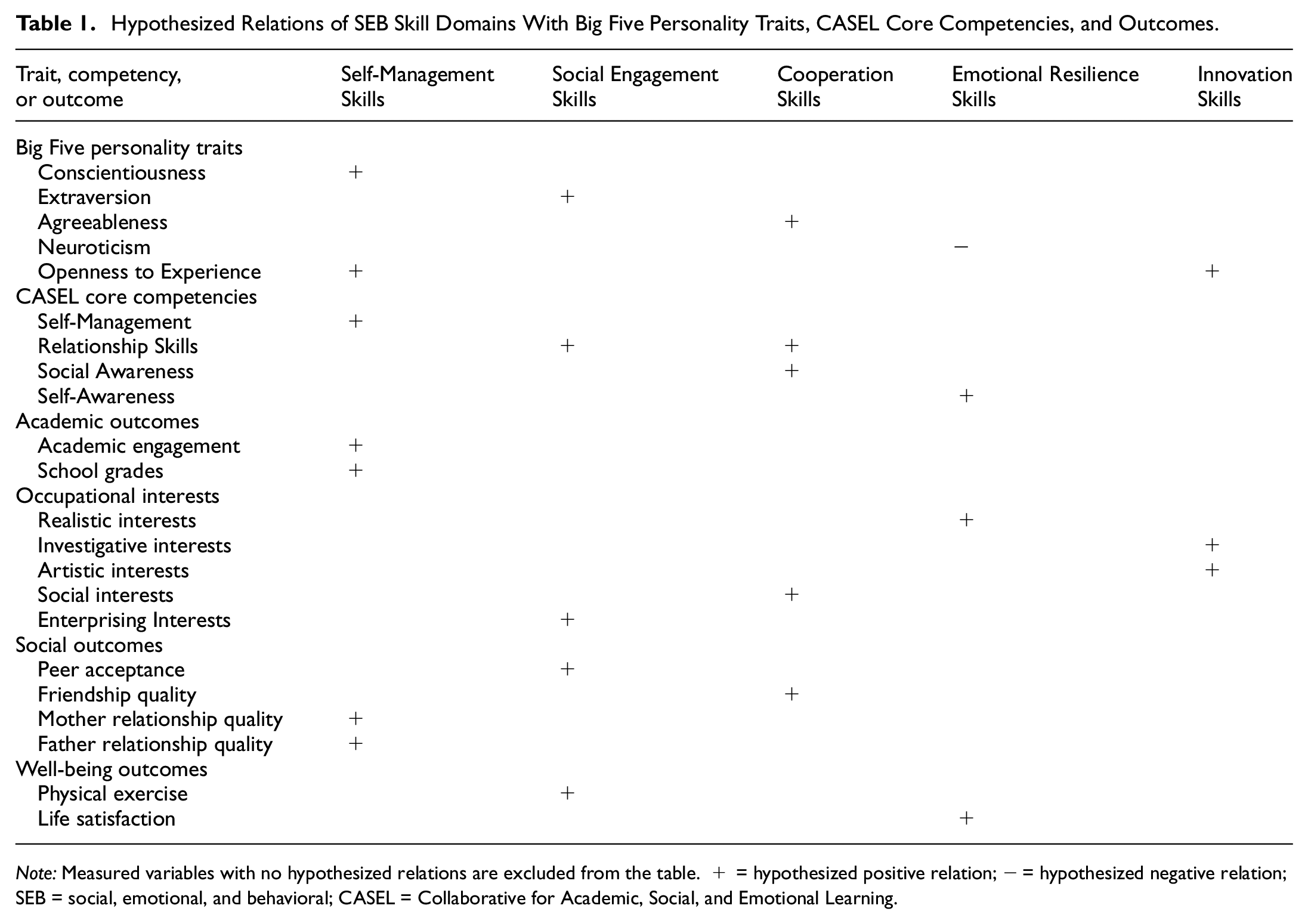
Note: Measured variables with no hypothesized relations are excluded from the table. + = hypothesized positive relation; − = hypothesized negative relation; SEB = social, emotional, and behavioral; CASEL = Collaborative for Academic, Social, and Emotional Learning.
We tested these hypotheses by analyzing data from a diverse sample of high school students. Each student rated their SEB skills, core competencies, and Big Five traits. They also reported a broad range of outcomes including academic engagement, occupational interests, social relationships, civic engagement, and well-being. Moreover, students’ schools reported information about their grades, attendance, and behavior. These data allowed us to examine the relations of skills and traits with both self-reported and school-reported outcomes.
Method
Participants and Procedure
Participants were 897 students from high schools in the United States. They completed an online survey on the Qualtrics platform as part of the Character Lab Research Network, a consortium of schools across the country working collaboratively with scientists to advance scientific insights that help kids thrive (Duckworth, 2019). The sample was approximately balanced in terms of gender (53.5% female, 41.8% male, 2.6% another gender, 2.2% not reported), and most participants (99.1%) were 14 to 18 years old (M = 15.55, SD = 1.04). The sample was diverse in terms of grade level (27.9% 9th grade, 28.5% 10th grade, 28.6% 11th grade, 15.1% 12th grade, 0.1% not reported) and race/ethnicity (59.3% White/Caucasian, 38.5% Hispanic/Latino, 20.8% Black/African American, 8.2% Asian/Asian American, 1.3% another race, 2.0% multiracial, 8.2% not reported, with some participants reporting multiple identifications). Potential participants were excluded from the sample if they completed the survey in less than one third of the median completion time (i.e., less than 7.80 min). Within each of three survey blocks, participants were excluded from analysis if they failed either of two attention-check items. Within each measure, participants were excluded if they answered less than 90% of the items. Data collection was approved by the Advarra Institutional Review Board.
For two-tailed tests at the α = .05 significance level, the full sample size of 897 participants provides high (i.e., 95%) statistical power for detecting effects of ρ = .12 or stronger, and adequate (i.e., 80%) power for detecting effects or ρ = .10 or stronger. The effective sample size varies across measures but always exceeds the minimum of 250 observations recommended for estimating correlation-based statistics (Schönbrodt & Perugini, 2013).
Self-Report Measures of Skills, Traits, and Competencies
Social, Emotional, and Behavioral Skills
SEB skills were measured using the 45-item short form of the Behavioral, Emotional, and Social Skills Inventory (BESSI-45; Soto et al., 2022). The BESSI-45 is designed to measure five major skill domains: Self-Management, Social Engagement, Cooperation, Emotional Resilience, and Innovation Skills. Each item is a short phrase describing a thought, feeling, or behavior. Respondents rate how well they can perform that behavior on a scale from 1 = not at all well to 5 = extremely well. In the present sample, Cronbach’s alpha reliabilities for the nine-item scales were .85 for Self-Management, .86 for Social Engagement, .82 for Cooperation, .87 for Emotional Resilience, and .81 for Innovation. All versions of the BESSI are freely available for research use at http://www.sebskills.com.
Big Five Personality Traits
The Big Five personality traits were measured using the 15-item extra-short form of the Big Five Inventory-2 (BFI-2-XS; Soto & John, 2017). The BFI-2-XS items are short, descriptive phrases that respondents rate on an agreement scale ranging from 1 = disagree strongly to 5 = agree strongly. Alpha reliabilities for the three-item scales were .58 for Extraversion, .50 for Agreeableness, .52 for Conscientiousness, .70 for Neuroticism, and .42 for Openness to Experience.
CASEL Core Competencies
The CASEL core competencies were measured using the 17-item short form of the Social and Emotional Competency Assessment (SECA-SF; Davidson et al., 2018). The SECA is designed to assess Self-Awareness, Social Awareness, Self-Management, Relationship Skills, and Responsible Decision-Making. Its items are phrases describing specific competencies. Respondents rate how easy or difficult it is for them to enact each competency on a scale coded as 1 = very difficult to 4 = very easy. Alpha reliabilities were .73 for Self-Awareness (4 items), .58 for Social Awareness (3 items), .76 for Self-Management (6 items), .33 for Relationship Skills (2 items), and .44 for Responsible Decision-Making (2 items). The low reliabilities for some competencies likely reflect their short scale length, as well as uncertainty about the SECA’s factor structure (Gordon et al., 2022).
Self-Reported Outcomes
Self-reported outcomes were assessed using a survey battery. Academic engagement was measured using eight items selected from the Engagement versus Disaffection with Learning measure (EDL; Skinner et al., 2008). Realistic, investigative, artistic, social, enterprising, and conventional interests were measured using the 30-item O*Net Mini Interest Profiler (Rounds et al., 2016). Peer acceptance was measured using two items adapted from the Behavior Report Form (Paunonen, 2003) and a previous study of social status (Anderson et al., 2001). Friendship quality was measured using eight items selected from the Friendship Qualities Scale (FQS; Bukowski et al., 1994). Relationship quality with participants’ mothers and fathers was measured using six items adapted from the Dunedin Study of lifespan development (see Belsky et al., 2001). Social responsibility values, civic skills, informal helping, and voting intention were measured using a total of 15 items from the Youth Civic and Character Measures Toolkit (Syvertsen et al., 2015). Civic organization involvement was assessed by an item asking participants whether they are part of any political/social organizations supporting issues important to them (Finlay et al., 2011). Activism was assessed by two items asking participants whether they have ever participated in a political or social movement online or in person (Hope et al., 2016). Volunteerism was measured using three items adapted from a previous study (Carlo et al., 2005). Physical exercise was measured using the three-item Godin Leisure Time Exercise Questionnaire (Godin & Shephard, 1985). Anxiety and depression were measured using 10 items adapted from the Hospital Anxiety and Depression Scale (HADS; Zigmond & Snaith, 1983). Finally, life satisfaction was measured using the five-item Satisfaction With Life Scale (SWLS; Diener et al., 1985). Additional details about these measures’ format, scoring, and reliability are reported at https://osf.io/bcgq7/?view_only=3ac692bd87c54aa0b4f2d6aafc0f4b5f.
School-Reported Outcomes
School Grades
Participants’ course grades during the fall 2021 academic quarter were reported by their schools, transformed onto a 0 to 100 scale, and aggregated into an overall grade point average (GPA) for the term.
School Attendance
Schools reported the total number of instruction days that each participant was enrolled in school during the fall quarter, as well as the number of days missed due to an unexcused absence. These frequencies were used to compute the proportion of instruction days that were either attended or excused.
School Discipline
Schools reported the number of times each participant was referred for discipline or suspended from school. Due to these variables’ low frequency counts, we combined them into a dichotomous variable representing whether each participant was ever (n = 33) versus never (n = 790) referred or suspended.
Preregistration, Data, Materials, and Analyses
The study design, hypotheses, and planned analyses were preregistered prior to data collection. The complete preregistration protocol is available at https://osf.io/b7pzq/?view_only=a1854003f5304db3bab9e7f338678ae7. All data, analysis code, research materials, and supplemental materials are available at https://osf.io/bcgq7/?view_only=3ac692bd87c54aa0b4f2d6aafc0f4b5f. All hypothesis tests were conducted as two-tailed tests at the .05 significance level.
Results and Discussion
How Do SEB Skills Relate With Personality Traits and Core Competencies?
Our first set of planned analyses examined how SEB skills relate with personality traits and the CASEL core competencies. To test these relations, we first computed partial correlations of the BESSI skill domains with the Big Five traits and CASEL competencies while controlling for gender and grade level. These correlations are presented in Table 2, and the corresponding correlations without demographic controls are presented in Supplemental Table S1. To further test these relations while also controlling for overlap between the skill domains themselves, we regressed each Big Five trait or CASEL competency on the set of five BESSI skill domains, as well as gender and grade level. The standardized coefficients from these regressions are also presented in Table 2 and coefficients without demographic controls in Supplemental Table S1.
Partial Correlations and Standardized Effects of SEB Skill Domains With the Big Five Personality Traits and CASEL Core Competencies.
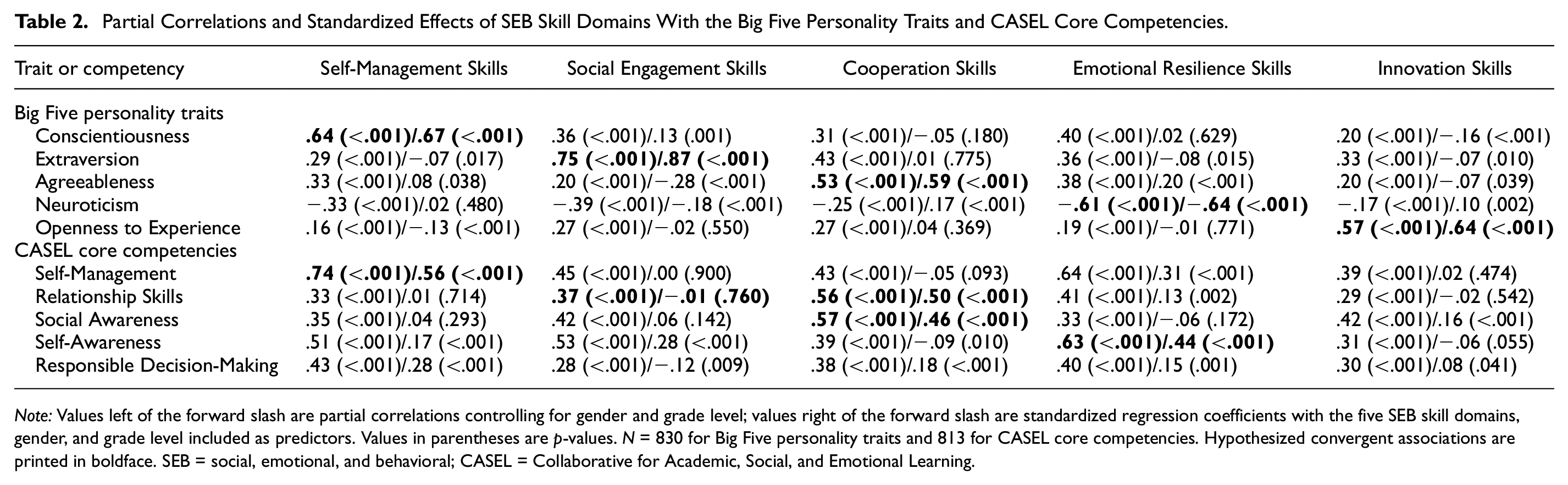
Note: Values left of the forward slash are partial correlations controlling for gender and grade level; values right of the forward slash are standardized regression coefficients with the five SEB skill domains, gender, and grade level included as predictors. Values in parentheses are p-values. N = 830 for Big Five personality traits and 813 for CASEL core competencies. Hypothesized convergent associations are printed in boldface. SEB = social, emotional, and behavioral; CASEL = Collaborative for Academic, Social, and Emotional Learning.
We hypothesized 10 specific relations of SEB skills with personality traits and the CASEL competencies, and Table 2 shows that almost all of these predictions were strongly supported. Regarding personality traits, as hypothesized, Self-Management Skills related strongly with Conscientiousness; Social Engagement Skills with Extraversion; Cooperation Skills with Agreeableness; Emotional Resilience Skills with low Neuroticism; and Innovation Skills with Openness to Experience. All five of these associations remained statistically significant (ps < .001) and large in size (absolute rs and βs ≥ .53) across analyses that did or did not control for demographics, as well as overlap between the skill domains.
Regarding core competencies, as hypothesized, Self-Management Skills related with the same-named CASEL competency; Social Engagement with Relationship Skills; Cooperation with Relationship Skills and Social Awareness; and Emotional Resilience with Self-Awareness. All five of these relations generalized between analyses that did or did not control for demographics (rs ≥ .37, ps < .001). Moreover, four of the five (all except the relation between Social Engagement and Relationship Skills) held while controlling for overlap between the skill domains themselves (βs ≥ .44, ps < .001). Taken together, these results indicate that SEB skills relate with personality traits and core competencies in expected ways that reflect their shared behavioral referents.
How Do SEB Skills Relate With Consequential Outcomes in Adolescence?
Our second set of planned analyses tested whether SEB skills predict consequential adolescent outcomes. Paralleling the previous analyses, we computed partial correlations of the BESSI skill domains with 25 self-reported and school-reported outcomes while controlling for gender and grade level. We then regressed each outcome on the set of five BESSI skill domains, as well as gender and grade level, to further test these skill-outcome relations while also controlling for overlap between the skill domains. The correlations and standardized regression coefficients from these analyses are presented in Table 3, and the corresponding results without demographic controls are presented in Supplemental Table S2.
Partial Correlations and Standardized Effects of SEB Skill Domains With Self-Reported and School-Reported Outcomes.
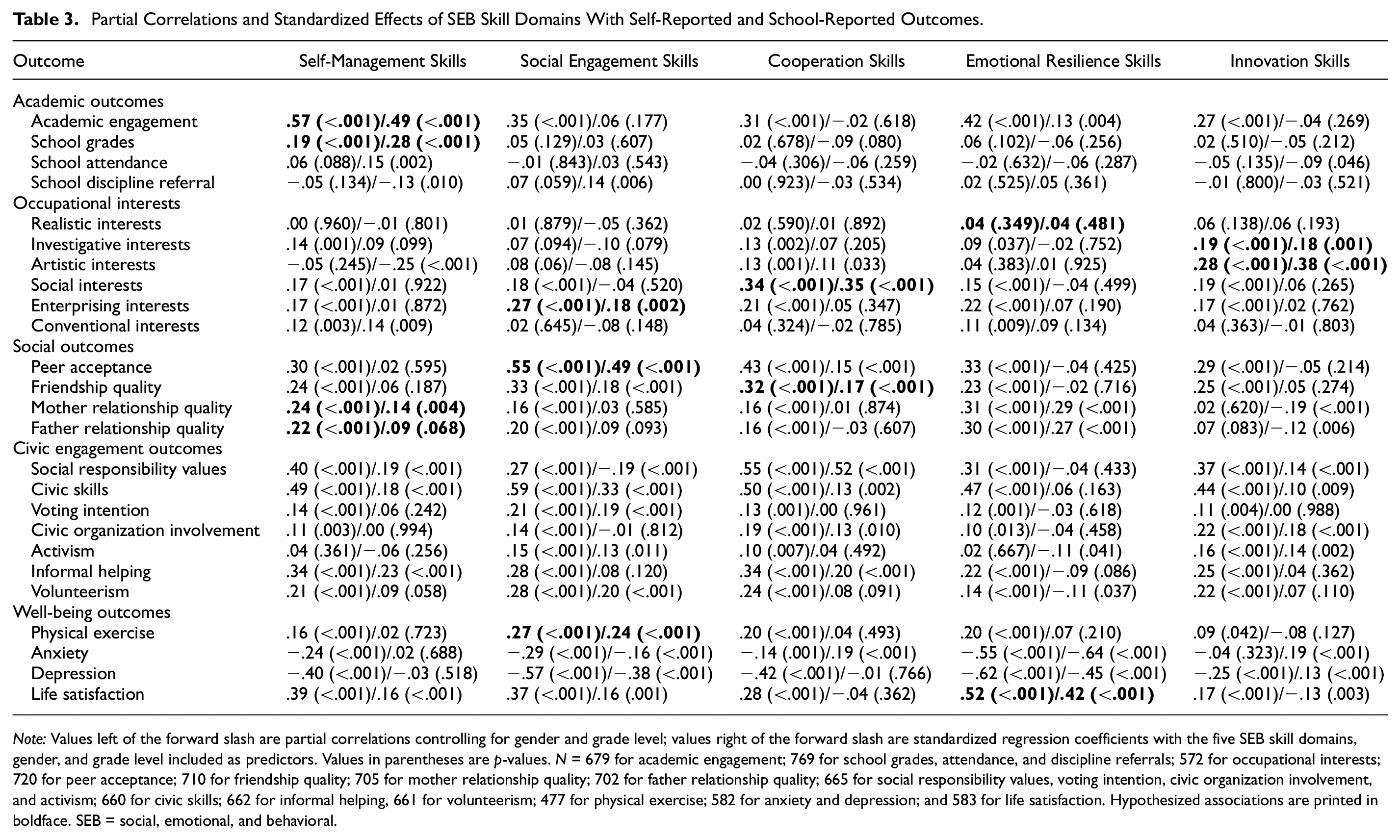
Note: Values left of the forward slash are partial correlations controlling for gender and grade level; values right of the forward slash are standardized regression coefficients with the five SEB skill domains, gender, and grade level included as predictors. Values in parentheses are p-values. N = 679 for academic engagement; 769 for school grades, attendance, and discipline referrals; 572 for occupational interests; 720 for peer acceptance; 710 for friendship quality; 705 for mother relationship quality; 702 for father relationship quality; 665 for social responsibility values, voting intention, civic organization involvement, and activism; 660 for civic skills; 662 for informal helping, 661 for volunteerism; 477 for physical exercise; 582 for anxiety and depression; and 583 for life satisfaction. Hypothesized associations are printed in boldface. SEB = social, emotional, and behavioral.
We hypothesized 13 specific skill-outcome relations, and Table 3 shows that these predictions were consistently supported. Eleven of the 13 hypothesized relations were statistically significant across all analyses: Self-Management Skills positively predicted school grades, academic engagement, and mother relationship quality; Social Engagement Skills predicted peer acceptance, enterprising occupational interests, and exercise; Cooperation Skills predicted friendship quality and social occupational interests; Emotional Resilience Skills predicted life satisfaction; and Innovation Skills predicted investigative and artistic occupational interests (ps < .01). Of the two remaining hypothesized relations, one was only supported by the correlational analyses (Self-Management Skills with father relationship quality; ps < .001), while the other was only supported in analyses without demographic controls (Emotional Resilience Skills with realistic occupational interests; ps < .01). Across the hypothesized relations, significant effects range in size from modest to large (absolute rs = .18–.57, βs = .10–.50).
Beyond these hypothesized effects, 28 additional skill-outcome relations emerged as robust across all four analyses: Self-Management Skills positively predicted social responsibility values, civic skills, informal helping, conventional occupational interests, and life satisfaction; Social Engagement Skills predicted friendship quality, civic skills, voting intention, activism, volunteerism, and life satisfaction, as well as low anxiety and depression; Cooperation Skills predicted peer acceptance, social responsibility values, civic skills, civic organization involvement, informal helping, and artistic occupational interests; Emotional Resilience Skills predicted academic engagement and mother and father relationship quality, as well as low anxiety and depression; and Innovation Skills predicted social responsibility values, civic skills, civic organization involvement, and activism. All of these effects remained statistically significant regardless of whether the analyses did or did not control for demographics and overlap between the skill domains. Their effect sizes ranged from small to very large (absolute rs = .13–.63, βs = .09–.68). Taken together, these results indicate that SEB skills robustly predict a broad range of consequential adolescent outcomes including academic achievement and engagement, occupational interests, social relationships, civic engagement, and well-being.
Do SEB Skills Provide Incremental Validity Beyond Personality Traits?
Given SEB skills’ substantial convergence with the Big Five personality traits, our final set of planned analyses tested whether SEB skills provide incremental validity beyond the Big Five. To do this, we regressed each of the 30 CASEL core competencies, self-reported outcomes, and school-reported outcomes on (a) the set of five BESSI skill domains, (b) the Big Five traits, and (c) the combined set of 10 skill domains and traits. Each regression also included gender and grade level as demographic covariates. The proportion of variance in each competency or outcome explained by each set of predictors is presented in Table 4, and the corresponding results without demographic controls are presented in Supplemental Table S3.
Incremental Validity of SEB Skills and Big Five Traits for Predicting Competencies and Outcomes.
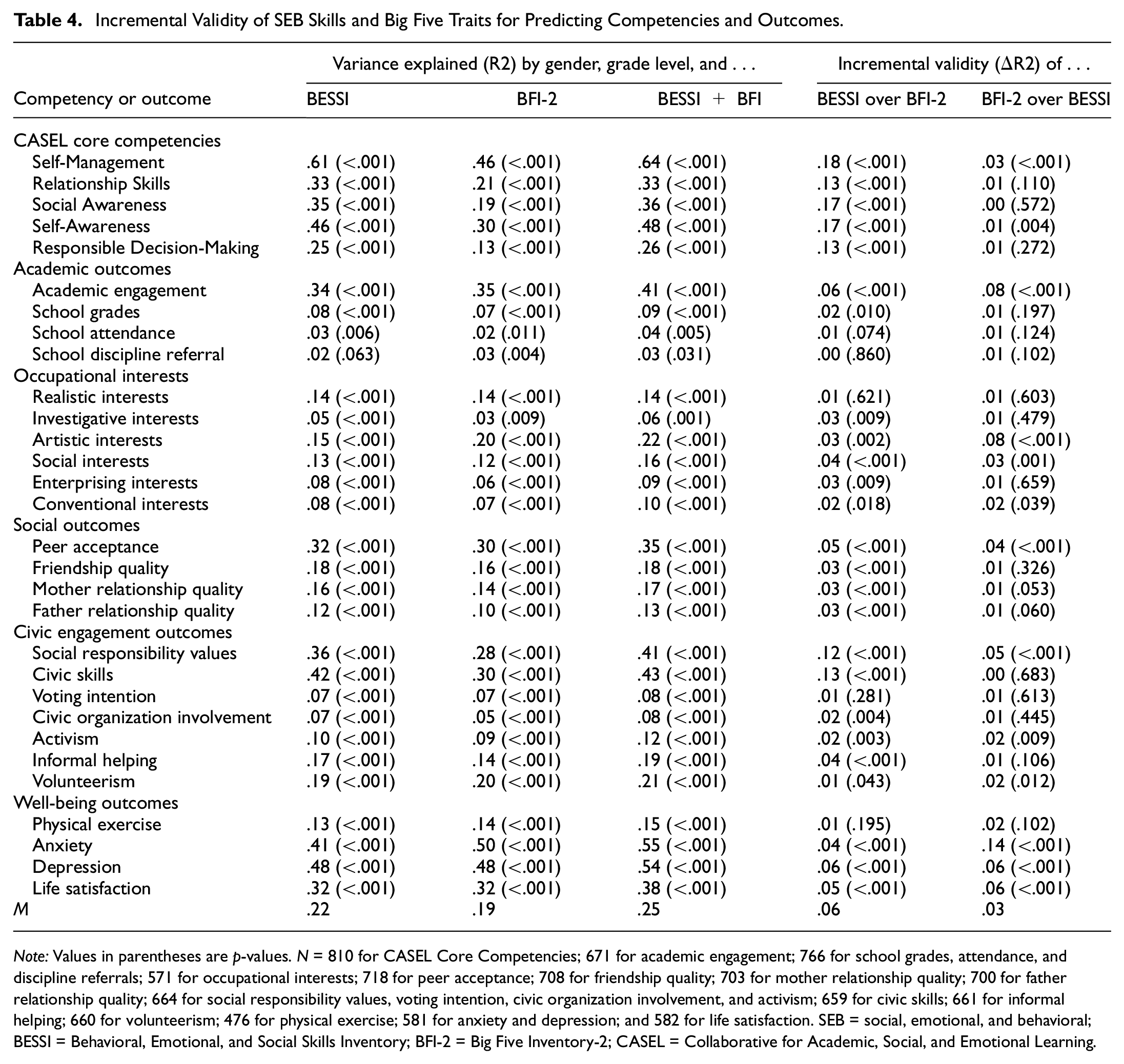
Note: Values in parentheses are p-values. N = 810 for CASEL Core Competencies; 671 for academic engagement; 766 for school grades, attendance, and discipline referrals; 571 for occupational interests; 718 for peer acceptance; 708 for friendship quality; 703 for mother relationship quality; 700 for father relationship quality; 664 for social responsibility values, voting intention, civic organization involvement, and activism; 659 for civic skills; 661 for informal helping; 660 for volunteerism; 476 for physical exercise; 581 for anxiety and depression; and 582 for life satisfaction. SEB = social, emotional, and behavioral; BESSI = Behavioral, Emotional, and Social Skills Inventory; BFI-2 = Big Five Inventory-2; CASEL = Collaborative for Academic, Social, and Emotional Learning.
These results show that adding the BESSI domains as predictors provided a statistically significant increment in explained variance (over the Big Five) for 25 of the 30 competencies and outcomes, with a mean increment of ΔR2 = .06. By comparison, adding the Big Five traits as predictors provided a significant increment over the BESSI domains for 13 competencies and outcomes, with mean ΔR2 = .03. 1 Thus, despite the substantial convergence between SEB skills and the Big Five traits, skills still provide unique information beyond traits, and this information matters for predicting consequential outcomes.
General Discussion
Summary of Findings and Broader Implications
The present results support three key conclusions about the nature, correlates, and consequences of SEB skills. First, SEB skills relate with the Big Five personality traits, as well as the CASEL core competencies, in expected and conceptually meaningful ways. Regarding personality traits, each SEB skill domain converged strongly with one and only one Big Five trait. In contrast, the SEB skill domains showed a more complex pattern of relations with the CASEL competencies.
These findings build on previous work in further highlighting key differences between the BESSI, Big Five, and CASEL frameworks. As intended, the BESSI skill domains have behavioral referents very similar to the Big Five traits (Soto et al., 2021). Thus, the BESSI and Big Five frameworks differ primarily in terms of their direct focus on skills (how someone is capable of behaving) versus traits (how someone tends to behave). Conversely, the BESSI and CASEL frameworks are similar in their focus on skills, but differ in terms of their behavioral content (Payton et al., 2000). Specifically, Social Engagement and Innovation Skills are captured more fully by the BESSI framework, whereas Responsible Decision-Making is represented more prominently in the CASEL framework. Thus, the BESSI framework effectively bridges the personality and competency literatures: by merging the robust Big Five structure with a direct focus on capacities, it provides a comprehensive framework for conceptualizing and assessing SEB skills that should prove useful for both researchers and practitioners.
The similarities and differences between skills and traits may also have implications for understanding personality dynamics, as well as developmental potential and growth (Allport, 1961). Recent dynamic models of personality focus on identifying patterns of intra-individual variability across situations and time (e.g., Blum et al., 2018; Fleeson & Jayawickreme, 2021). From this perspective, someone’s skill level represents their capability to express trait-relevant behavior in particular situations. Moreover, someone’s trait level can be conceptualized as the joint product of their skill at enacting trait-relevant behavior, their situationally afforded opportunities to enact such behavior, and their motivation to do so. Future research can further investigate the dynamic relations between skills, traits, motives, and opportunities.
From a developmental perspective, traits reflect someone’s current behavior, whereas skills may be crucial for understanding their future potential. For example, imagine that Miguel has a low level of trait Conscientiousness, but relatively strong Self-Management Skills. He is not routinely organized, hard-working, and responsible, but is capable of behaving in these ways when motivated to do so. This pattern may signal that Miguel has the potential to become more conscientious over time, by enacting these behaviors often enough that they become habitual (Magidson et al., 2014; Wrzus & Roberts, 2017). Future longitudinal research can investigate the relations of skills and traits with potential and growth.
Our second key conclusion is that SEB skills predict consequential outcomes during adolescence. As listed in Table 5, the present results highlight dozens of specific skill-outcome relations across multiple life domains that proved highly robust. Several of these relations successfully replicate previous results (Soto et al., 2022), here using a brief measure that reduced the BESSI’s length by more than 75%. Other relations extend SEB skills’ nomological network, due to the broader outcome set assessed in the present study. Taken together, these findings indicate that SEB skills are essential for adolescents’ health, happiness, social connection, and success (Casillas et al., 2015; Durlak et al., 2011; Farrington et al., 2012; Kautz et al., 2014; National Research Council, 2012; OECD, 2015).
Summary of Robust Skill-Outcome Relations.
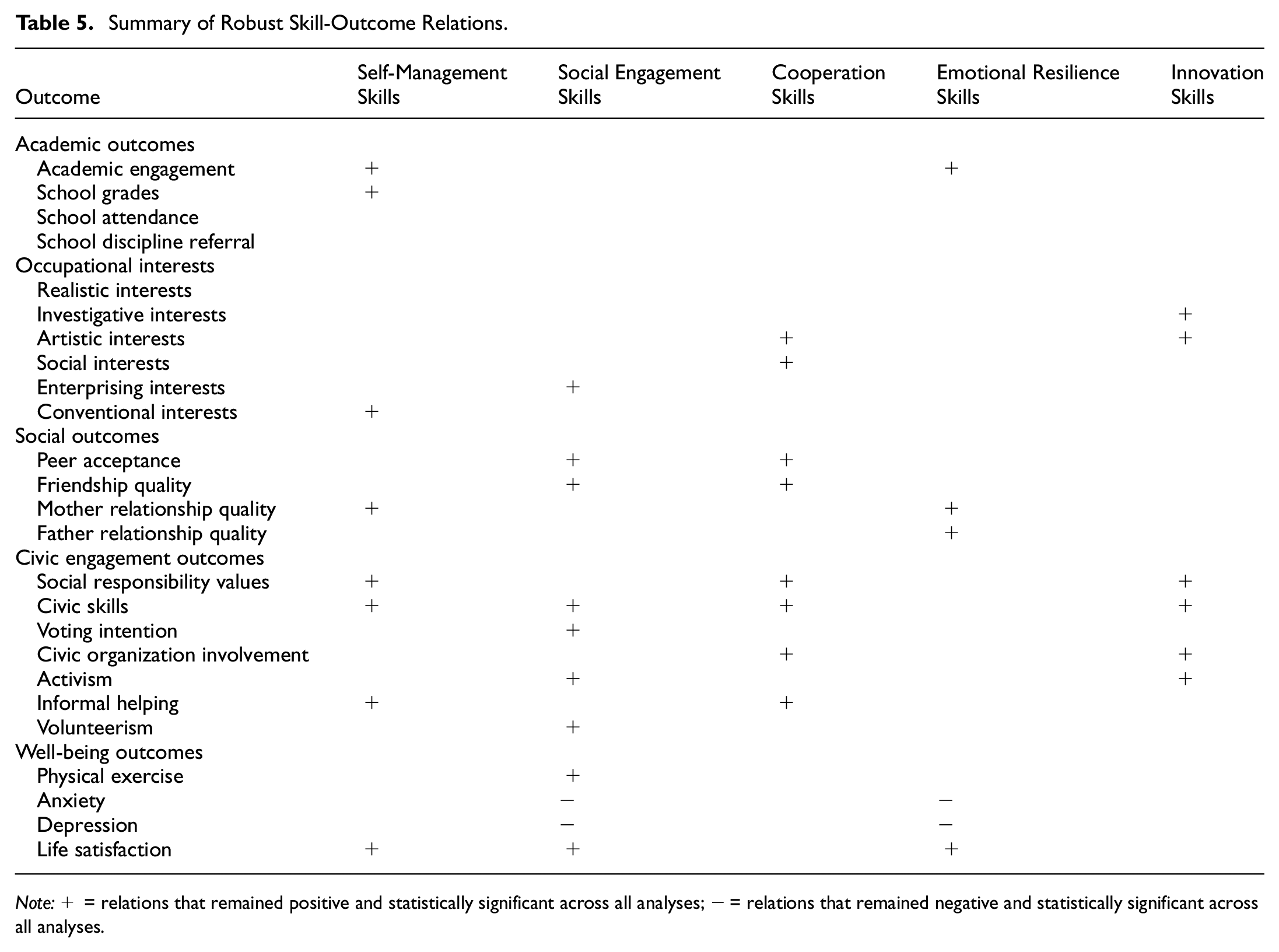
Note:+ = relations that remained positive and statistically significant across all analyses; − = relations that remained negative and statistically significant across all analyses.
A third and final conclusion is that, despite substantial convergence between SEB skills and the Big Five, skills do provide unique information beyond traits. For almost all of the outcomes and competencies assessed here, (a) both skills and traits provided a significant increment in predictive power over demographic characteristics and (b) skills also contributed incremental validity over traits. Thus, for attaining positive outcomes, it does indeed matter how someone typically thinks, feels, and behaves (Beck & Jackson, 2022; Ozer & Benet-Martiä nez, 2006; Soto, 2019, 2021). But beyond that, a person’s capacity to adjust their thoughts, feelings, and behavior when the situation calls for it also matters for success and thriving.
This conclusion implies that much research on life outcomes stands to benefit from assessing both personality traits and SEB skills. For example, some outcomes may be largely determined by someone’s consistent pattern of behavior over time and therefore best predicted by traits. Conversely, some outcomes may be strongly affected by whether someone can rise to a key situation and therefore best predicted by skills (Marcus et al., 2007; Ployhart et al., 2001). The present findings regarding incremental validity provide some support for this hypothesis, but additional research is needed to further investigate it.
A related implication is that in some contexts it may be more important to assess skills than traits, or vice versa. For example, some socioemotional learning interventions focus on shifting learners’ existing preferences and habits, whereas others focus on teaching and practicing new behaviors (Durlak et al., 2011; Taylor et al., 2017). In our view, the former interventions target traits, whereas the latter target skills. Thus, detecting the full effect of an intervention may well depend on assessing the appropriate kind of construct (Ura et al., 2020), and we encourage researchers and practitioners to consider this issue in future intervention work.
Limitations and Future Directions
The present research had important strengths, including its diverse sample of adolescents, assessment of both personality traits and SEB skills, and inclusion of self-reported and school-reported outcomes across multiple life domains. However, it also had some limitations. One concerns the fact that adolescents’ skills, traits, and competencies were all assessed using brief, self-report measures. While self-reports do provide meaningful information, they can also be prone to bias (Vazire & Carlson, 2011). Moreover, brief measures sacrifice reliability and validity for efficiency (Soto & John, 2019). Future work can thus investigate whether full-length measures and alternative assessment methods, such as observer-reports and behavioral tasks, add unique information and predict objectively recorded outcomes other than school grades, attendance, and disciplinary records (for one recent example, see Breil et al., 2022). It can also examine how SEB skills relate with other aspects of personality, such as motives, goals, and values (McAdams & Pals, 2006).
Other limitations include the present study’s cross-sectional design and focus on a single developmental period. Participants’ skills, traits, competencies, and outcomes were all assessed at a single measurement occasion. Thus, future research that longitudinally assesses all of these constructs (including a planned longitudinal extension of the present study) can directly test their interrelations over time. It can also investigate the importance of SEB skills during other developmental periods, such as among adult learners and workforce professionals.
Conclusion
The present research advances our understanding of SEB skills in three key ways. First, it successfully replicates previous findings that SEB skills converge with personality traits and core competencies in expected and conceptually meaningful ways. Second, it extends SEB skills’ nomological network by showing that they predict consequential adolescent outcomes, including academic achievement and performance, occupational interests, social relationships, civic engagement, and well-being. Third, it provides new evidence that SEB skills capture unique information beyond personality traits and that this information matters for predicting outcomes.
Footnotes
Handling Editor: Peter J. Rentfrow
Declaration of Conflicting Interests
The author(s) declared the following potential conflicts of interest with respect to the research, authorship, and/or publication of this article: The first, second, and fifth authors hold the copyright for the Behavioral, Emotional, and Social Skills Inventory (BESSI), which was used in this research.
Funding
Data collection for this article was supported by the Character Lab Research Network.

Supplemental Material
The supplemental material is available in the online version of the article.