




Abstract
The human mind harbors various mechanisms for coping with stress, but what role does physical behavior play? Inspired by ethological observations of autogrooming activity across species, we offer a general hypothesis: cleaning attenuates effects of stressful events. Preregistered behavioral and psychophysiological experiments (N = 3,066 in United Kingdom, United States, and Canada) found that (a) concrete visual simulation of cleaning behavior alleviated residual anxiety from a stress-inducing physical scene, an effect distinct from touch, and (b) actual cleaning behavior enhanced adaptive cardiovascular reactivity to a highly stressful context of social performance/evaluation, which provides the first physiological evidence for the attenuation of stress-related effects by cleaning. Overall, actual cleaning and simulated cleaning attenuate effects of physical or psychological stressors, even when they have nothing to do with contamination or disease and would not be resolved by cleaning. Daily cleaning behavior may facilitate coping with stressors like physical risks and psychological threats to the self.
Introduction
Stress has long been recognized as a contributor to illness and ill-being (Selye, 1950). Unfortunately, stressors are part of life, be it emotional struggles, interpersonal conflicts, or work demands. Stress can also result from isolated, potent threats. For example, when terrorists hijacked and crashed domestic flights into the World Trade Center on September 11, 2001, the Twin Towers’ collapse left indelible marks on American minds, followed by immediate acute stress and elevated posttraumatic stress symptoms for months (Silver et al., 2002).
How do people cope with stress? As a topic of long-standing scientific and clinical interest, many biological and psychological interventions have been developed, tested, and implemented. Here, we propose the existence of a coping aid that has been embedded in people’s daily routine but whose potential has not been properly appreciated: cleaning behavior.
Animal Behavior
Our proposal is inspired by observations in animal behavior. Ethological work (Spruijt et al., 1992) shows that autogrooming, or self-grooming (i.e., cleaning behavior directed at one’s own body), 1 is ubiquitous across the vast animal taxa, from arthropods to fish to birds to mammals (Sachs, 1988). An evolutionarily ancient behavior generated by the brainstem, cerebellum, and neostriatum (Berridge, 1989; Cromwell & Berridge, 1996; Strazielle & Lalonde, 1998), autogrooming serves adaptive functions beyond care of the body surface, such as the “3Ds”: defense, displacement, and de-arousal.
Specifically, autogrooming enhances animals’ defense against physical threats to survival such as ectoparasites, contaminants, bacteria, and odors that attract predators (Feusner et al., 2009). It is a basic, unlearned behavior, capable of overriding learned behaviors like conditioned flavor avoidance (e.g., among pine voles and rats; Mason et al., 1985; Reidinger et al., 1982). Autogrooming has also been observed as a displacement activity when conflicting behavioral systems are activated or when an activated behavioral routine is blocked in an animal (e.g., honeybee, pigeon, rhesus monkey; Delius et al., 2010; Diezinger & Anderson, 1986; Pflumm, 1985), with the potential function of stress reduction. Indeed, autogrooming can be elicited by stressors such as novelty, footshock, agonistic conflict, and intense light and noise (Spruijt et al., 1992). When rats were exposed to recorded rat screams, they showed significant increases in “total grooming time, number of grooming bouts, percentage of the total grooming time attributable to face washing, and the number of sample periods in which grooming occurred” (J. A. Cohen & Price, 1979, p. 177). Excessive autogrooming can also be induced in rats by intraventricular injection of the adrenocorticotropic hormone (ACTH1–24, a hormone typically produced in response to stress; Gispen & Isaacson, 1981). In short, autogrooming may be considered a form of restorative action, involving de-arousal, especially in mammals like rodents and primates.
Given these observations about cleaning behavior, its elicitation, and its adaptive functions in a wide range of nonhuman species, is there a similar link between stress and cleaning in humans?
A Psychological Link Between Stress and Cleaning
As part of the behavioral immune system (Schaller, 2015), cleaning behavior serves adaptive biological functions by separating physical threats (e.g., infectious pathogens) from the body. It reduces threat-related anxiety, especially when the threat is highly salient, as in times of a global pandemic (e.g., COVID-19; Trougakos et al., 2020). Beyond biological functions, however, an emerging perspective suggests that cleaning behavior involves physical acts of separation that serve higher-order mental functions by providing a concrete, sensorimotor grounding for abstract, generalizable procedures of separating psychological experiences (e.g., past failures) from the self (Lee & Schwarz, 2021). When a psychological experience induces stress (e.g., by posing a threat, regardless of whether it is contagious or not), mentally separating it from the self should attenuate its effects.
This conceptual analysis is compatible with a number of existing findings across domains. In the moral domain, people typically feel guilty after recalling their own transgressions and compensate by helping others, but an opportunity to clean their hands with an antiseptic wipe reduces their moral guilt and their compensatory prosocial behavior (Zhong & Liljenquist, 2006). Similar ``clean–moral'' effects have been found using other manipulations and measures (Gino et al., 2015; Lee et al., 2015; Reuven et al., 2014; Xu et al., 2014), with boundary conditions as shown in direct and conceptual replications and nonreplications (e.g., Earp et al., 2014; Fayard et al., 2009; Gámez et al., 2011 for a review, see Lee & Schwarz, 2021). Beyond its metaphorical associations with morality (Lakoff & Johnson, 1999), cleaning behavior has been shown to reduce the influence of other psychological threats to the self (Lee & Schwarz, 2011). After making a free choice between similarly attractive options (e.g., vacation in Paris vs. Rome), people often experience cognitive dissonance (“did I make the right choice?”), which motivates them to justify their choice by developing a stronger preference for the chosen over the rejected option (Brehm, 1956). This classic effect of postdecisional dissonance is eliminated when people wash or wipe their hands clean (De Los Reyes et al., 2012; Lee & Schwarz, 2010, 2018). The endowment effect, which is a form of self-enhancing response to implicit threats to the self (Chatterjee et al., 2013), also diminishes as a result of hands-cleaning (Florack et al., 2014). In the domain of competence, after failing to solve a problem, people typically feel less optimistic about their future performance and compensate for it by working harder, but having a chance to clean their hands restores their optimism and leads them to work less hard (Kaspar, 2012). Such diverse effects of cleaning behavior (in contexts that threaten the moral self, the rational self, and the competent self), together with the ethological observations, point to a general hypothesis: Cleaning may attenuate effects of stressful, self-threatening events.
From this general hypothesis, three specific predictions can be derived and tested. (a) Cleaning can be physically enacted or visually simulated. To the extent that detailed mental simulation partially reenacts the sensorimotor and introspective states of actual experience (Barsalou, 2008), visually simulated cleaning in a concrete manner should produce qualitatively similar effects to actual physical cleaning. (b) Stressors can be physical or psychological in nature. Existing work on cleaning effects has focused on psychological ones and ignored physical ones, but both should be subject to cleaning effects. (c) Attenuated effects of stressful events by cleaning can be measured experientially and physiologically. The latter has never been examined.
We tested these predictions integratively in behavioral and psychophysiological experiments (total N = 3,066). An exploratory behavioral experiment, its preregistered replication, and its preregistered extension tested if concrete visual simulation of cleaning behavior would alleviate residual anxiety from a stress-inducing physical scene. A preregistered psychophysiological experiment tested if actual cleaning behavior would alter cardiovascular reactivity to a highly stressful context of social performance and evaluation. Across experiments, we found that cleaning attenuated effects of the stressful event.
All statistical tests in the present research were two-tailed. Material, data, and code are available at https://osf.io/dzhm4/?view_only=32d40addb392482296161c538591f3e5.
Experiments 1a (Exploratory) and 1b (Preregistered Replication): Visually Simulated Cleaning Alleviates Residual Anxiety From a Stress-Inducing Physical Scene
Method
To test if visually simulated experience of cleaning behavior in a concrete manner would alleviate residual effects of a stress-inducing physical scene, participants (Mage = 37.66, SDage = 14.68; 714 female, 439 male, 8 unspecified) were recruited from the United Kingdom to complete an online study on “behavior and decision-making.” First, they watched an 86-s video clip of a physical scene (pilot tested to elicit anxiety and arousal; Supplemental Material), imagined being in it, and described what would happen if they were in this situation and how they would feel.
Next, they were randomly assigned to watch one of three video clips, all 47 s in duration, which showed how to properly wash one’s hands (experimental condition), or draw a circle, or peel an egg (two control conditions). All three clips involved hand movements demonstrated in a concrete manner over their typical duration in real life. Two nonwashing control conditions (rather than one) were included to reduce the chances that any difference found between the washing and the nonwashing conditions would be due to idiosyncratic features of a particular nonwashing video.
Afterward, participants completed both pictorial and verbal dependent measures of their current feelings. Three pictorial, nonverbal items assessed the extent to which participants experienced pleasure, arousal, and dominance at the moment (Bradley & Lang, 1994). Principal components analysis of these basic emotional dimensions suggested one principal component, labeled as anxiety (Table S1) because it involved low pleasure, high arousal, and low dominance (Mehrabian, 1996). The pictorial measure was chosen because relative to verbal measures, it tracks people’s experience of dominance better and tracks pleasure and arousal just as well (Bradley & Lang, 1994). Five verbal items (verbal in the sense of “involving words” rather than “spoken”) were also included that focused on the specific experience of tension at the moment (tensed, anxious, stressed, uneasy, relaxed; McNair et al., 1971), which loaded on one principal component (Table S2).
Finally, to capture different experiences of the manipulation video clips, participants in the three conditions rated the clip they had watched on eight items, which loaded on three principal components (video unengagingness, unclarity, and loudness; Table S3). These principal components differed between conditions, F(1, 1,151)s ≥ 46.780, ps < .001, and were controlled for in hypothesis testing according to our preregistered analytic plan. Participants concluded the experiment by providing demographic information and receiving payment.
A power analysis—based on an estimated effect size of d = 0.1796 (f = 0.0898), α = 0.05, power = 0.80, number of conditions = 3, and number of covariates = 3—determined the required sample size to be 976. The estimated effect size was the smallest among hypothesized effects in a previous experiment (which used the same experimental design but had a considerably smaller sample size, N = 393). Because of expected dropouts and a series of exclusion criteria as specified in the preregistration (https://osf.io/d4ya2/?view_only=b554ea0e920d46f2ad189b7863dc0942), we oversampled by 50% and recruited 1,464 participants via Prolific. A tricky attention check embedded in the otherwise straightforward demographics section asked participants to indicate their weight by ignoring the nature of the question and simply dragging one of two sliders to 57 pounds. This turned out to exclude over half of the participants who otherwise met all inclusion criteria, which would render the study underpowered. We decided to drop this criterion and treat the experiment as exploratory rather than confirmatory. Applying all the other exclusion criteria resulted in a final sample size of 1,150. To verify the robustness of results from this exploratory experiment, we conducted a preregistered replication.
The same experimental design was used in the preregistered replication except that participants were recruited from the United States via Amazon Mechanical Turk and that the tricky attention check was dropped from the list of exclusion criteria (consistent with emerging recommendations; Hauser et al., 2019), as specified in the preregistered plan (https://osf.io/sz65y/?view_only=d95053ba68924a34a8554e60a34d4f6e). A power analysis—based on an estimated effect size of d = 0.1796 ( f = 0.0898), α = 0.05, power = 0.90, number of conditions = 3, and number of covariates = 3—determined the required sample size to be 1,305. We oversampled by 40% and recruited 1,827 participants. Applying all the exclusion criteria resulted in a final sample size of 1,377.
Results
Did watching the handwashing clip (vs. nonwashing clips) reduce residual effects of the stress-inducing physical scene? As predicted (Figure 1), the pictorial measure of anxiety differed significantly between the three conditions (p = .003). It was lower after the handwashing clip than the circle-drawing clip (p = .002) or the egg-peeling clip (p = .002) or both combined (p = .001), which did not differ from each other (p = .814). The verbal measure of tension did not differ significantly between conditions (p = .133; Table S4). The preregistered replication found an identical pattern of results (Figure 1 and Table S4).
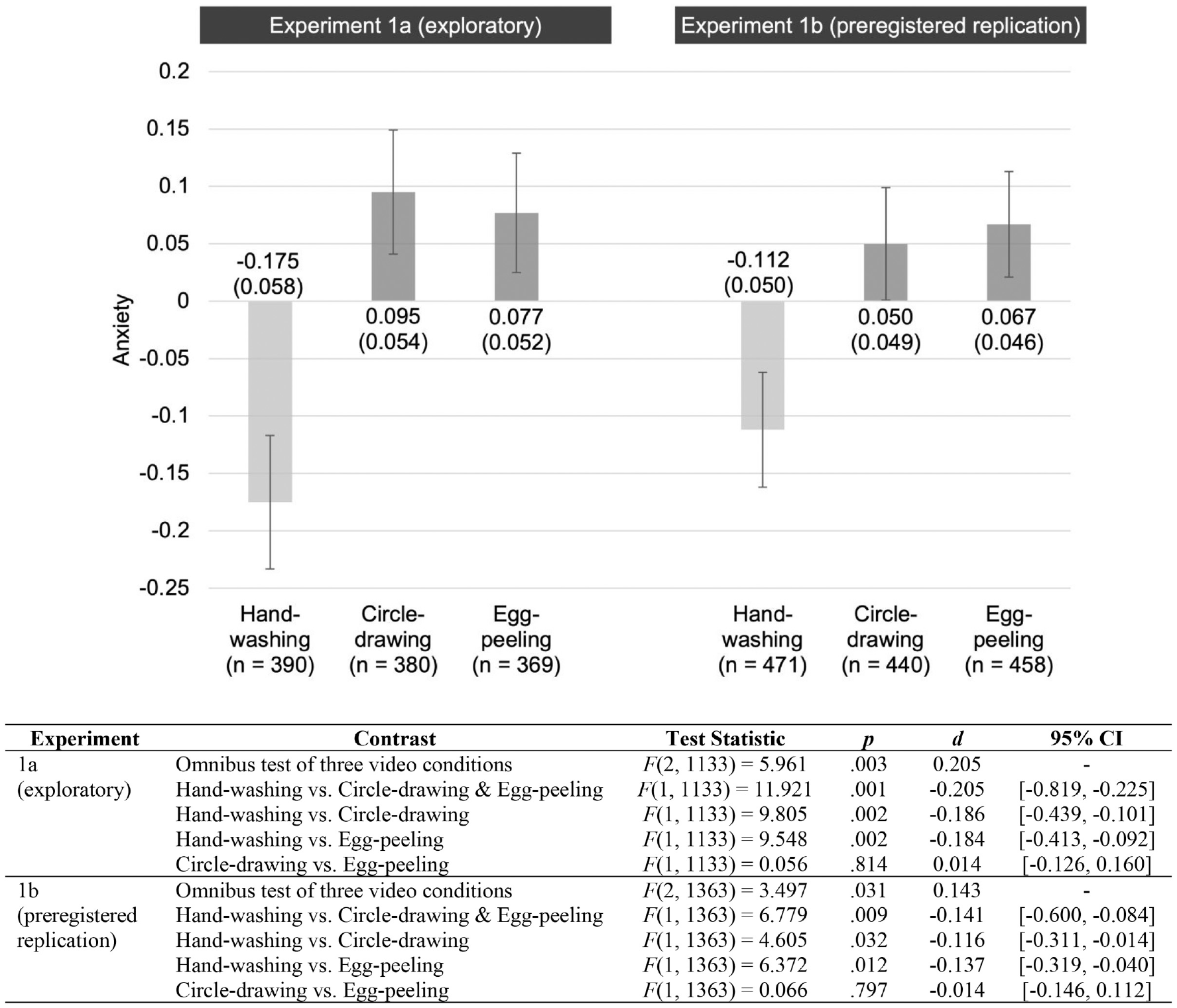
Anxiety as a Function of Condition in Experiments 1a (Exploratory) and 1b (Preregistered Replication).
Visually simulated experience of cleaning behavior reduced residual anxiety from a stress-inducing physical scene. The manipulation involved mere visual simulation, with effect sizes (ds = 0.205 and 0.141) in the expected small range by traditional standards (J. Cohen, 1988) and comparable with those in contemporary preregistered between-subjects research (Schäfer & Schwarz, 2019). The effect was observed and replicated on a pictorial measure of anxiety derived from basic emotional dimensions, not on a verbal measure of tension in particular. It suggests that the psychological effect of cleaning may be more observable with indirect measures than direct ones, a theme we will see again in Experiment 2 (using physiological measures) and revisit in the Discussion section.
Two limitations of Experiments 1a and 1b are noteworthy. First, the experimental condition involved the element of touching oneself (in visually simulated handwashing), whereas the control conditions did not (in visually simulated circle-drawing and egg-peeling). It is plausible that the observed cleaning effects might be due to touch, given prior evidence that imagined touch by a romantic partner can reduce adults’ stress (Jakubiak & Feeney, 2016) and actual touch by a mother can reduce infants’ physiological reactivity to stress (Feldman et al., 2010). Because touch is soothing and calming, what appeared to be cleaning effects might have been touch effects instead. Second, although all three video clips in Experiments 1a and 1b involved concrete demonstrations of hand movements, as noted earlier, they differed in video engagingness, clarity, and loudness (Table S3), which were controlled for in our preregistered hypothesis testing. The video clips might have differed in other ways that we failed to measure and account for. To address both limitations, Experiment 1c directly compared the effects of visually simulated cleaning with touch, without using any video clips.
Experiment 1c (Preregistered Extension): Visually Simulated Cleaning Results in Different Effects From Visually Simulated Touch
Method
Participants (Mage = 38.38, SDage = 14.02; 278 female, 175 male, 12 other) were recruited from the United States via Prolific to complete an online study on “visual experiences.” All procedures of data collection, exclusion, and analysis followed the preregistered plan (https://osf.io/cew8m/?view_only=2ada07201dd3420095137b653e38df44).
First, participants completed the same stress-inducing task as in Experiments 1a and 1b. Then, they were randomly assigned to one of three conditions: They were asked to “imagine you are getting your arms, face, neck, and hair thoroughly cleansed with water” (cleaning condition) or “imagine you are touching your arms, face, neck, and hair to thoroughly feel yourself” (touch condition), and to “visualize the experience in detail in your mind. After visualizing the experience, take a minute to describe below how you would actually cleanse yourself with water (or touch and feel yourself).” Participants in the control condition skipped this task.
Afterward, all participants completed the same dependent measures as in Experiments 1a and 1b, which were also submitted to the same principal components analyses and scoring (Tables S1 and S2). Participants in the cleaning and touch conditions completed several additional manipulation check items: “What was your visualized experience about?” (cleansing yourself; touching yourself; charging your phone; parking your car). Participants who answered it incorrectly were excluded from analysis. “To what extent did your visualized experience feel clean?” and “To what extent did your visualized experience involve touching your arms, face, neck, and hair?” (0 = not at all, 6 = highly). The visualized experience felt cleaner in the cleaning condition (M = 4.03, SD = 1.51) than in the touch condition (M = 3.57, SD = 1.78; t(301) = 2.433, p = .0156) and involved more touching in the touch condition (M = 4.95, SD = 1.37) than in the cleaning condition (M = 4.35, SD = 1.70; t(303) = 3.396, p = .0008), suggesting that the manipulation was effective. All participants concluded the experiment by providing demographic information and receiving payment.
A power analysis—based on an estimated effect size of partial η2 = 0.017257749 (f = 0.1325172), α = 0.05, power = 0.80, numerator df = 1, and number of conditions = 3—determined the required sample size to be 449. The estimated effect size was based on a pilot study (which used the same experimental design but had a smaller sample size, N = 180). With an expected attrition rate of 10%, we recruited 449 / 90% = 499 participants. Applying the exclusion criteria resulted in a final sample size of 465.
Results
Did visually simulated cleaning produce different effects from visually simulated touch or no simulation? As predicted (Figure 2), anxiety differed significantly between the three conditions (p = 1.106e−06). It was lower after simulated cleaning than simulated touch (p = .0011) or no simulation (p < .0001) or both combined (p < .0001). It was also marginally lower after simulated touch than no simulation (p = .0629). Tension showed a similar pattern. It differed significantly between the three conditions (p = 6.159e−11) and was lower after simulated cleaning than simulated touch (p = .0027) or no simulation (p < .0001) or both combined (p < .0001). It was also lower after simulated touch than no simulation (p = .0001).
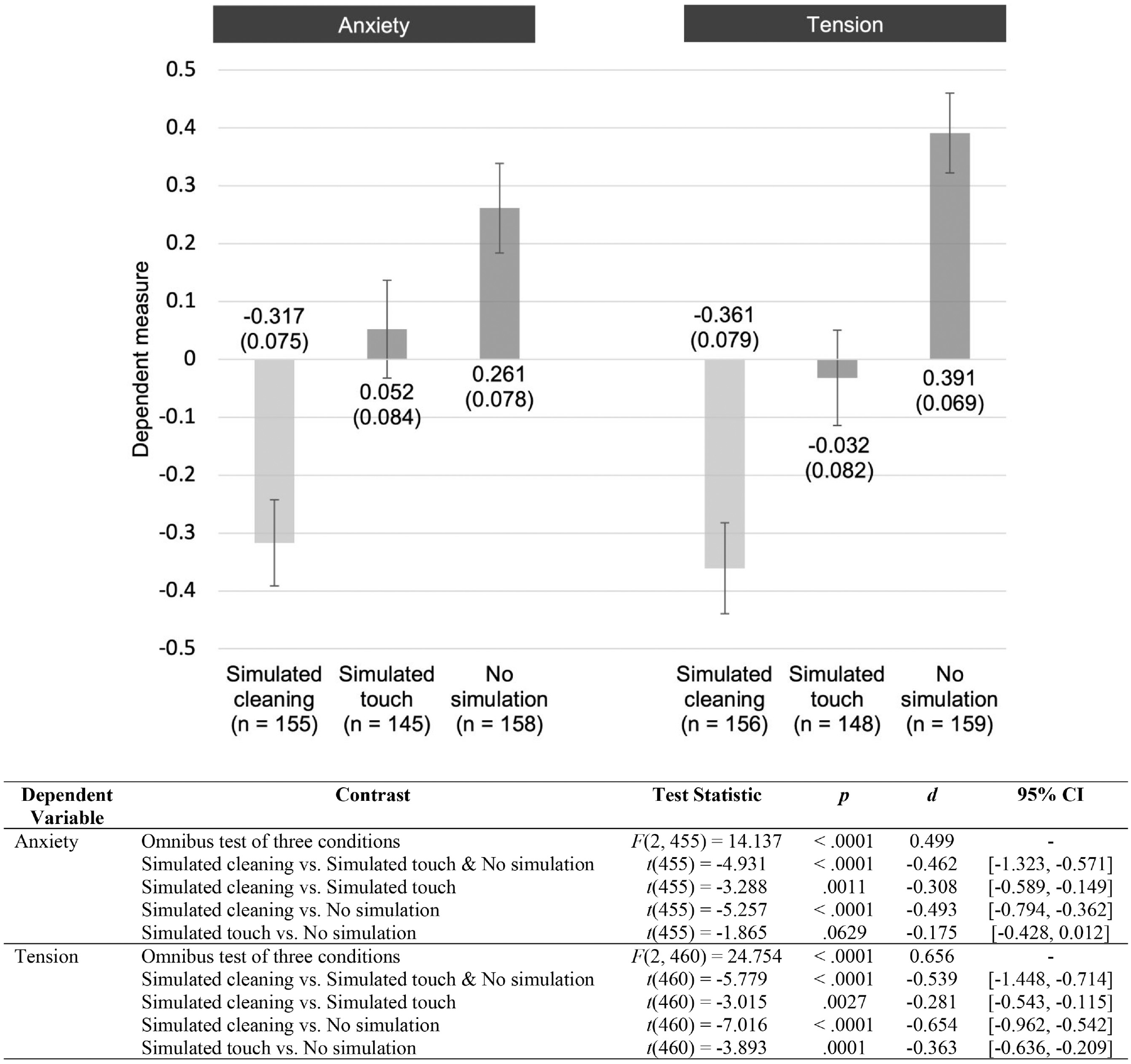
Anxiety and Tension as a Function of Condition in Experiment 1c (Preregistered Extension).
Although simulated touch had some soothing effects (relative to no simulation), touch could not account for the stronger cleaning effects, because the aforementioned manipulation check analyses found that participants’ visual simulation in the cleaning condition involved less touching than participants’ visual simulation in the touch condition. Furthermore, exploratory analyses showed that when each of the dependent measures (anxiety and tension) was regressed on both of the manipulation check items (how clean the visualized experience felt and how much it involved touching oneself), only clean feelings significantly predicted lower anxiety (β = −0.1215, SE = 0.0353, t(295) = −3.437, p = .0007) and lower tension (β = −0.1693, SE = 0.0344, t(299) = −4.924, p = 1.41e−06), whereas touch involvement did not significantly predict anxiety (β = 0.0550, SE = 0.0375, t(295) = 1.469, p = .1429) and predicted higher tension (β = 0.0759, SE = 0.0369, t(299) = 2.056, p = .0407). In sum, cleaning effects were distinguishable from and could not be explained away by touch effects.
Experiment 2 (Preregistered): Actual Cleaning Changes Cardiovascular Reactivity to a Potent Social Stressor
Building on the results above, we conducted a psychophysiological experiment with a preregistered plan to investigate the cardiovascular effects of cleaning behavior in the context of a nonphysical stressor. Using the challenge–threat research paradigm (Blascovich et al., 2011), we created a highly stressful context of social performance and evaluation. We predicted that an actual experience of cleaning would change participants’ cardiovascular physiology from a more threatened profile to a less threatened one.
Method
In an elaborate procedure lasting 2 hr, participants (students at a large university in Canada) went through two rounds of the modified Trier Social Stress Test (TSST; Kudielka et al., 2007), one prior (TSST1) and one subsequent (TSST2) to a cleaning (vs. no cleaning) manipulation. TSST was chosen because it is a validated, robust method for acute stress induction (Allen et al., 2014). TSST1 was designed to be highly stressful for all participants before the cleaning manipulation. TSST2 was designed to be less stressful so that if the cleaning manipulation had any effect, we would have a chance to detect it.
Because the experiment involved an elaborate procedure that lasted 2 hr, utilized multiple physiological equipment and sensors, and required participants to stay relatively still to accomplish stable measurement, both our pilot runs and prior work (Hoyt & Blascovich, 2010; Seery et al., 2010) led us to expect a data attrition rate of roughly 30%. With a preregistered target sample size of 64 (https://osf.io/mw6ke/?view_only=68019a941d4e4074a6aa9e75addd54a3),we oversampled and had 92 participants complete the full procedure.
Upon arrival at the research lab, participants began by having sensors attached to their torso and wrist for tracking their heart rate, pre-ejection period, stroke volume, and mean arterial pressure. They were told that the experiment was about physiological responses to intellectual and academic tasks. They were accustomed to the equipment while completing several individual differences measures, including self-esteem (10 items; Rosenberg, 1965), personality (10 items; Gosling et al., 2003), and locus of control (12 items; Levenson, 1973); these would be entered as covariates in our preregistered analyses, resembling prior research (Tomaka et al., 1993), especially in experimental designs involving repeated inductions of stress (Kudielka et al., 2007, 2009). After completing the individual differences measures, participants’ baseline cardiovascular state was assessed during a 5-min resting period (the first baseline, B1).
To instantiate a nonphysical but highly stressful context, we used a modified version of the TSST (Kudielka et al., 2007). Participants were given the description of a demanding job (team lead in a consulting firm) and instructed to give a 5-min speech, in front of two judges (blind to condition), explaining why they were a qualified job candidate, followed by a 2-min period of questions and answers (Kassam et al., 2009). Participants were told that they were being video-recorded for later analysis and that the judges were trained experts in nonverbal communication. The judges were in white lab coats and looked stern the whole time, with blank stares, no smiling, and no indication of approval. Cardiovascular measures were taken during the TSST (the first round, TSST1).
Following TSST1, participants were randomly assigned to either actually use or simply examine (without using) an antiseptic wipe on their nondominant hand, and provided ratings and answered open-ended questions about it (under the pretense of product evaluation) for 5 min. Note that the control condition here was designed to involve neither cleaning nor detailed visual simulation of cleaning, as participants only took a quick look at the antiseptic wipe and evaluated the product, whereas the experimental condition in Experiments 1a to 1c did involve detailed visual simulation; these designs were based on existing findings that a brief thought is not sufficient for producing mental simulation effects but a concrete, elaborate visual simulation is sufficient (Morewedge et al., 2010). To allow some time for physiological recovery from TSST1, participants completed a 10-min filler task, where they made relative frequency judgments on pairs of low-arousal words (i.e., which of two words are more frequently used in the English language; Warriner et al., 2013). To reinforce the cleaning manipulation, participants did a 5-min evaluation of another cleaning product, sanitizing gel, by either actually using or simply examining it, consistent with their randomly assigned condition earlier. Their cardiovascular state was then assessed during a 5-min resting period (the second baseline, B2).
To test if the cleaning manipulation might influence cardiovascular reactivity to a subsequent stressful event, participants completed a second round of the TSST (TSST2), which was designed to be less stressful than TSST1. While the goal of TSST1 was to induce a powerful stress response for all participants, the goal of TSST2 was to allow room for potential effects of the cleaning manipulation to emerge. As such, the job for which participants were interviewed was less demanding (fundraising assistant in a not-for-profit organization); the judges were in a more positive mood and responded with more affirmative feedback such as smiles, nods, and other paralinguistic cues. Cardiovascular measures were taken during TSST2.
Three cardiovascular variables during TSST2 were of interest, all operationalized as reactivity scores (i.e., change from B1 to TSST2) as in prior work (Behnke & Kaczmarek, 2018; Blascovich et al., 2004; Blascovich & Mendes, 2010), including cardiac output (CO; higher scores = more blood pumped by the heart, more adaptive within the TSST context of motivated performance), total peripheral resistance (TPR; higher scores = greater blood circulatory resistance, less adaptive), and the challenge–threat index (normalized CO reactivity minus normalized TPR reactivity; higher scores = less “threatened” or more “challenged,” more adaptive). These dependent variables were submitted to regression analyses. 2
Importantly, the three cardiovascular variables are interpretable through the challenge–threat theoretical lens only if people are motivationally engaged in the task at hand, not if they are disengaged, according to extensive research on cardiovascular reactivity (Blascovich et al., 2011). In other words, motivational engagement is a precondition for applying the challenge–threat framework. Cardiovascular indicators of motivational engagement include higher heart rate (i.e., faster heart beat) and shorter pre-ejection period (i.e., faster and more forceful ventricular contraction of the heart). 3 Both were measured in the present experiment, permitting two sets of exploratory analyses to test if the effect of cleaning behavior on subsequent cardiovascular reactivity was more prominent among participants who showed greater proportional increase in heart rate (Set 1) or greater proportional decrease in pre-ejection period (Set 2) during the critical task (TSST2 after cleaning manipulation) relative to baseline.
Finally, participants were probed for awareness of the experimental hypothesis, presented with questions about demographics and alcohol, caffeine, and nicotine intake (Kudielka et al., 2007), assisted with the removal of all sensors, and fully debriefed. Further details about the health criteria for participation in this psychophysiological experiment, its procedure, data acquisition, processing, and analysis are available in the Supplemental Material.
Of the 92 participants who completed the full procedure, three knew the experimental hypothesis; 15 had marked procedural delays during the manipulation and filler phase (duration between TSST1 and B2 exceeding 35 min) due to necessary equipment adjustment or temporary measurement error. The extra time could enhance cardiovascular recovery, result in a different baseline state (B2), and confound potential effects of the cleaning manipulation. These participants were thus excluded from analysis, rendering a final N of 74, slightly larger than our preregistered target of 64 and comparable with typical sample sizes in prior studies (Hoyt & Blascovich, 2010; Jamieson et al., 2012). For transparency, we conducted a sensitivity analysis by loosening the inclusion criterion of duration between TSST1 and B2 in 1-min increments, starting with the minimum above the preregistered target sample size of 64, to examine its impact on the effects of interest. Indeed, as we included participants with more procedural delays, the effects generally became smaller in size; in other words, with stricter inclusion criteria, the effects were larger in size (Table S5).
Results
Without taking motivational engagement into account, cleaning (vs. no cleaning) enhanced subsequent CO reactivity, t(64) = 2.049, p = .045, 95% CI [0.007, 0.579], but did not influence the challenge–threat index, t(57) = 1.426, p = .159, 95% CI [−0.162, 0.966], or subsequent TPR reactivity, t(57) = −1.132, p = .262, 95% CI [−220.71, 61.26]. Taking motivational engagement into account, both of its cardiovascular indicators interacted with the cleaning manipulation to influence CO reactivity (proportional change in heart rate × cleaning manipulation, t(62) = 3.333, p = .001, 95% CI [1.330, 5.316]; proportional change in pre-ejection period ×cleaning manipulation, t(60) = −3.672, p = .001, 95% CI [−3.131, −0.922]). Floodlight analyses identified the Johnson–Neyman points (Spiller et al., 2013) indicating that cleaning (vs. no cleaning) enhanced subsequent CO reactivity significantly when heart rate increased by 13% or more (Figure 3, top panel) or when pre-ejection period decreased by 11% or more (Figure 3, bottom panel). In contrast, when heart rate decreased by 11% or more, or when pre-ejection period increased by 20% or more (indicating motivational disengagement), cleaning (vs. no cleaning) significantly reduced subsequent CO reactivity. The challenge–threat index showed the same pattern as its component CO reactivity (while TPR reactivity did not): When heart rate increased by 18% or more (Figure S1, top panel), or when pre-ejection period decreased by 19% or more (Figure S1, bottom panel), cleaning (vs. no cleaning) shifted participants’ subsequent cardiovascular reactivity significantly toward a more adaptive state (more “challenged,” less “threatened”). Cleaning effects on these indirect (physiological) measures, similar to Experiments 1a and 1b, occurred in the absence of significant effects on direct verbal measures of subjective threat and experienced stress (Supplemental Material).
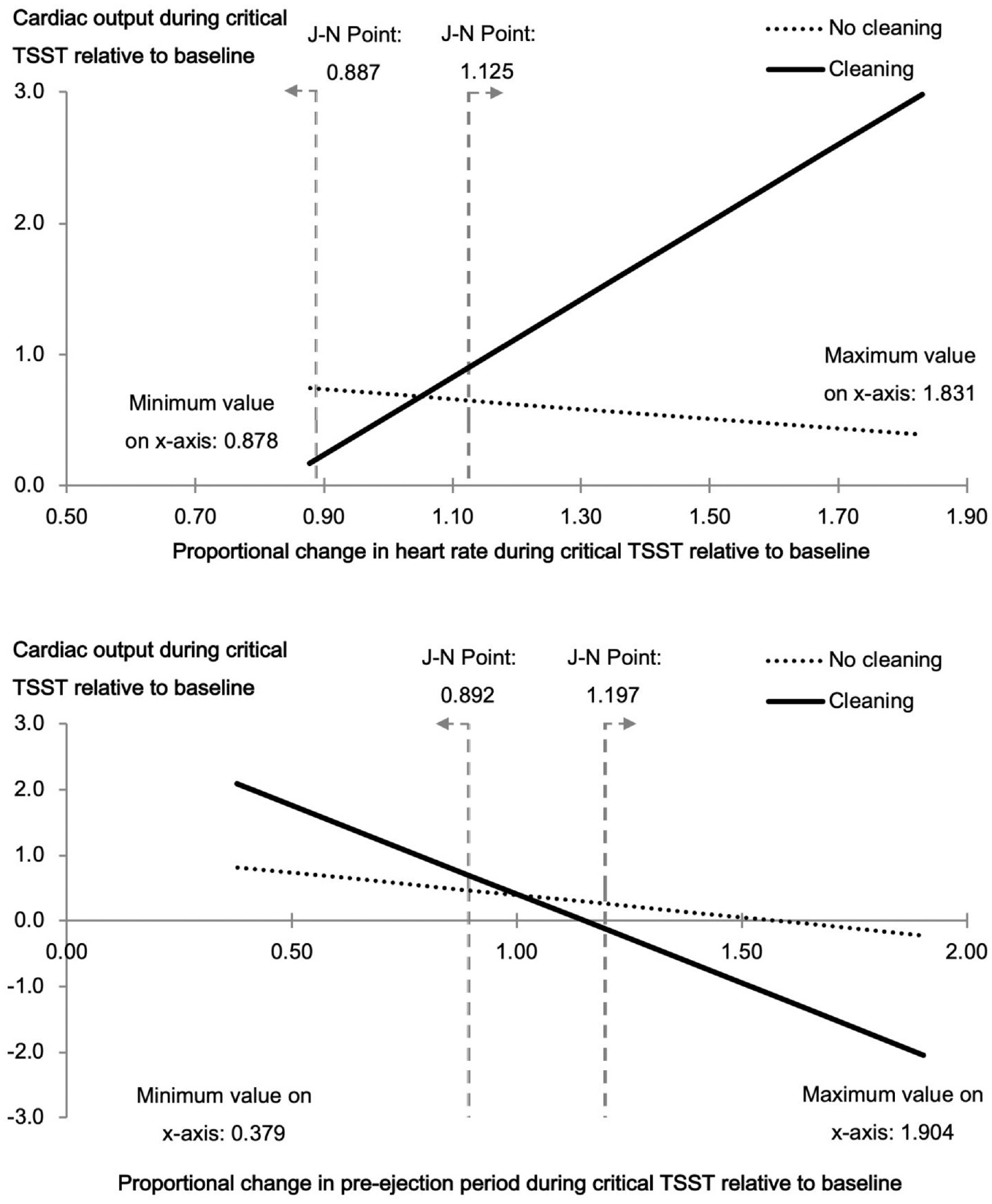
Moderation of Cleaning Effects on Cardiac Output by Two Indicators of Motivational Engagement in Experiment 2.
In short, actual cleaning behavior results in a more adaptive profile of cardiovascular reactivity, with greater CO, especially if people are motivationally engaged. Could this cleaning effect be due to a momentary drop in peripheral body temperature when people clean their hands? It is unlikely, because CO is generally unaffected by temperature except for prolonged acute coldness (Wagner & Horvath, 1985), and it tends to decrease, not increase, in cold winter season (Izzo et al., 1990). CO is also a particularly reliable physiological factor—more so than TPR—in differentiating between challenge and threat states, according to recent research using a data-driven, unsupervised machine-learning approach (Wormwood et al., 2019). This may account for our finding of a significant increase in CO after cleaning but no significant effect on TPR. Another reason may be that recovery from vasoconstriction (higher circulatory resistance; induced by TSST1 before the cleaning manipulation) to vasodilation (lower circulatory resistance) is governed by the hypothalamic–pituitary–adrenal axis and is known to be a slow process (Blascovich & Mendes, 2010), whereas changes in CO are governed by the sympathetic and parasympathetic nervous systems and can occur more quickly. The potential occurrence of cleaning effects on subsequent circulatory resistance as a function of recovery time between threats deserves future attention.
Discussion
Results from preregistered behavioral and psychophysiological experiments converge with observations of animal behavior across species in pointing to a link between stress and cleaning. Specifically, stressful situations and cues prompt arthropods, fish, birds, and mammals to engage in cleaning behaviors, which serve biological functions such as defense and de-arousal. In humans, concrete visual simulation of cleaning alleviates residual anxiety from a stress-inducing physical scene (Experiments 1a and 1b). This cleaning effect is empirically distinguishable from the effect of touch (Experiment 1c). Actual cleaning behavior enhances adaptive cardiovascular reactivity to a highly stressful context of social performance and evaluation, especially for people who are motivationally engaged (Experiment 2). Altogether, both concrete visual simulation and actual experience of cleaning can attenuate effects of stressful events, be it physical or psychological in nature.
Such attenuation effects were found even though cleaning would not actually resolve or reduce any of the stressors per se, which had nothing to do with contamination or disease. The absence of disgusting or immoral elements from the stress inductions also suggests that the results cannot be attributed to common theoretical accounts for cleaning effects, such as the emotion of disgust (Chapman & Anderson, 2013; Lee & Ellsworth, 2013; Oaten et al., 2009; Rozin et al., 2008; Rozin & Fallon, 1987; Russell & Giner-Sorolla, 2013; Tybur et al., 2013) and the conceptual metaphor of moral purity (Lakoff & Johnson, 1999; Landau et al., 2010; Lee & Schwarz, 2011; Zhong & Liljenquist, 2006). Instead, our findings are compatible with the emerging perspective that cleaning oneself not only serves basic biological functions of separating physical entities from the body, but also serves higher-order mental functions by grounding abstract procedures of separating psychological experiences from the self (Lee & Schwarz, 2021). 4 When a psychological experience induces stress, mental separation of it from the self attenuates its effects.
Our work also provides the first physiological evidence for the attenuation of stress-related effects by cleaning, extending the hitherto mostly experiential evidence to a new level of analysis. An additional nuance is that cleaning effects in some of the present experiments were evident for indirect measures, including pictorial assessment of basic affective dimensions and physiological markers, but not for direct verbal measures that used specific emotion terms, which can operate independently (Mauss et al., 2005; Nisbett & Wilson, 1977). The dissociation here is compatible with prior evidence that verbal assessment using specific emotion terms involved distinct psychological effects (Kassam & Mendes, 2013). It also raises the question of whether or when psychological consequences of cleaning occur without people’s explicit awareness or conceptualization of them (Nisbett & Wilson, 1977); empirical tests await.
Either way, the potential utility of cleaning for coping with stressors such as physical risks and psychological threats bears theoretical and practical importance. Hygienic care is a human universal (Brown, 1991) and a part of our everyday life, for good reasons. Cleaning behavior confers significant personal and public health benefits (Boyce & Pittet, 2002) and is one of the most recommended daily routines by the World Health Organization for reducing pathogen risks (Pittet et al., 2009). Beyond its physical benefits, cleaning carries rich abstract meanings, hearkening back to classic anthropological insights on the association between purity and danger across societies (Douglas, 1966) and on purification rituals (available in all major religions) that symbolically separate one’s past, worse self (which threatens one’s positive self-view) from one’s future, better self. Washing and cleaning are also the most common behavioral symptoms of obsessive–compulsive disorder, which involves a dysfunctional security motivation system (Szechtman & Woody, 2004). All of these diverse phenomena involve concerns with risk or threat and are compatible with the possibility that cleaning behavior plays a role in them because of its ability to attenuate their effects.
More broadly, people generally experience a sense of self “as competent, good, coherent, unitary, stable, capable of free choice, capable of controlling important outcomes” (Steele, 1988, p. 373). Threats to any of these are known to undermine executive functioning and well-being (Baumeister, 1998), so it is not surprising that people harbor a variety of mental mechanisms for dealing with psychological threats (e.g., by affirming one’s worth, derogating others, distancing from others; Tesser, 2000). Paralleling such mental mechanisms, we observe that cleaning can attenuate the effects of psychological threats to one’s self—as moral (West & Zhong, 2015), as rational (Lee & Schwarz, 2010), as competent (Kaspar, 2012), and as socially accepted (the present findings). This opens up a broad and exciting avenue for future research: Daily cleaning behavior, mundane as it seems, may serve supplementary coping functions that not only attenuate stress but also sustain positive self-evaluation (Tesser, 2000) and curb defensive behaviors (Steele, 1988) in the face of threats to any facet of the self.
Supplemental Material
sj-docx-1-spp-10.1177_19485506221099428 – Supplemental material for Actual Cleaning and Simulated Cleaning Attenuate Psychological and Physiological Effects of Stressful Events
Supplemental material, sj-docx-1-spp-10.1177_19485506221099428 for Actual Cleaning and Simulated Cleaning Attenuate Psychological and Physiological Effects of Stressful Events by Spike W. S. Lee, Kobe Millet, Amir Grinstein, Koen H. Pauwels, Phillip R. Johnston, Alexandra E. Volkov and Arianne J. van der Wal in Social Psychological and Personality Science
Footnotes
Acknowledgements
The authors thank Wendy Berry Mendes, Elizabeth Page-Gould, Brett Ford, Jennifer Stellar, William Ryan, and Michael Inzlicht for psychophysiological advice and support; members of the Mind and Body Lab for research assistance; David Hauser, Sam Maglio, Norbert Schwarz, Arjen I. J. G. van Lin and members of the Social/Personality Research Group at the University of Toronto for feedback.
Author Contributions
K.M., A.J.v.d.W., and A.G. designed the pilot test, conducted it, and analyzed its data. S.W.S.L. and K.M. designed Experiments 1a and 1b, S.W.S.L. conducted them, and analyzed their data. S.W.S.L. designed and conducted Experiment 1c and analyzed its data. S.W.S.L., P.R.J., and A.E.V. designed Experiment 2, P.R.J. and A.E.V. conducted it with the aid of research assistants and preprocessed its data, and S.W.S.L. submitted the preprocessed data to statistical analyses. S.W.S.L. wrote the manuscript; others revised it.
Declaration of Conflicting Interests
The author(s) declared no potential conflicts of interest with respect to the research, authorship, and/or publication of this article.
Funding
The author(s) disclosed receipt of the following financial support for the research, authorship, and/or publication of this article: S.W.S.L. acknowledges support by the Social Sciences and Humanities Research Council (Insight Grant no. 435-2017-0127; Insight Development Grant no. 430-2021-00060), Ontario Ministry of Research, Innovation and Science (Early Researcher Award—Round 13), Netherlands Institute for Advanced Study (Theme-Group Fellowship 2015), and University of Toronto (Connaught New Researcher Award 2014–2015; Rotman Small-Scale Matching Research Grant 2017) while preparing this article.

Supplemental Material
The supplemental material is available in the online version of the article.
Data availability
Notes
Author Biographies
Handling Editor: Lowell Gaertner
References
Supplementary Material
Please find the following supplemental material available below.
For Open Access articles published under a Creative Commons License, all supplemental material carries the same license as the article it is associated with.
For non-Open Access articles published, all supplemental material carries a non-exclusive license, and permission requests for re-use of supplemental material or any part of supplemental material shall be sent directly to the copyright owner as specified in the copyright notice associated with the article.
