




Abstract
In three studies (N = 886), we hypothesized and found that women’s and men’s endorsement of the culturally idealized form of masculinity, hegemonic masculinity (HM), predicted more positive evaluations of a political figure accused of sexual violence (Supreme Court Justice Kavanaugh) and more negative evaluations of the women who made accusations of sexual assault. HM predicted these evaluations over and above political party, gender, race, education, and sexism (Study 1), rape myth endorsement (Study 2), and the likelihood to sexually harass (Study 3). Implications for the maintenance of the status quo and the prevalence of sexual violence against women in the United States are discussed.
Following the inauguration of President Donald Trump, millions of people across the United States joined various “Women’s Marches” protesting the election of a man with allegations of sexual assault and a history of sexism (Cooney, 2019; Fahrenthold, 2016; Graves & Morris, 2021). In the wake of Trump’s inauguration, allegations of sexual assault surfaced for other high-profile men in Hollywood (e.g., Harvey Weinstein, Bill Cosby) and politics (e.g., Roy Moore, Al Franken) igniting an anti-sexual harassment movement identified with the hashtag #MeToo (Chicago Tribune, 2021). This movement increased awareness of sexual violence against women, reporting of sex crimes, and increased protections for victims (Levy & Mattsson, 2021; North, 2019, 2020).
However, sexual violence against women remains a pervasive problem in the United States. An estimated 433,648 Americans aged 12 and older are sexually assaulted each year in the United States, with as many as three in four sexual assaults going unreported (Rape, Abuse & Incest National Network, 2020). In addition, one in five American women has been the victim of rape (Centers for Disease Control and Prevention, 2021), and one in three American women has been the victim of intimate partner violence (National Coalition Against Domestic Violence, n.d.). Thus, a current tension exists between the recognition of sexual violence against women as a pervasive issue in the United States and the policies and laws that reduce sexual violence.
The present work examines the political arena as a site where sexual violence is accepted and becomes institutionalized, both establishing and maintaining a culture where men have dominance over women (MacKinnon, 1989). We hypothesized that masculinity functions as a cultural ideology that legitimates and justifies sexual violence through support for political figures accused of sexual assault. We first define hegemonic masculinity (HM) before reviewing existing research on masculinity, sexual violence, and politics, which the present work builds upon using data collected during the Senate confirmation hearings of Justice Brett Kavanaugh who was nominated to the Supreme Court despite allegations of sexual misconduct.
Hegemonic Masculinity
HM refers to the idealized form of masculinity within a given culture, defined by the dominant group (Connell, 1995). HM reflects the ideals of those who hold power (i.e., White, middle-class, able-bodied, straight men in Western cultures; e.g., Brannon, 1976; Carter, 2007; Kimmel, 1994). In the United States, HM prescribes that men should be high in power, status, dominance, and toughness, while repudiating all that is associated with femininity and/or gayness (Brannon, 1976; Courtenay, 2000; Pascoe, 2007; Thompson & Pleck, 1986). Thus, men/masculinity, but not women/femininity, are linked to power and success, and men strive to achieve and maintain idealized forms of masculinity. However, few men actually embody HM (Connell, 1995), making masculine identities hard won, easily lost, and eliciting a host of compensatory attitudes and behaviors meant to restore one’s masculinity (e.g., Vandello & Bosson, 2013; Vandello et al., 2008). Recently, these compensatory reactions have come under the umbrella term of “toxic masculinity.” While there is no agreed upon definition of toxic masculinity, discussions often focus on extreme and situational embodiments of HM (e.g., school shootings; see Daddow & Hertner, 2021; C. Harrington, 2021; Sculos, 2017). The present work focuses on the possible precursor to these extreme embodiments by examining the quotidian attitudes and behaviors that legitimize HM as a widely accepted cultural ideology.
As a cultural ideology, HM elevates the idealized and dominant form of masculinity above femininity and all other constructions of masculinities (e.g., working class, gay, Latino) and is endorsed and perceived as beneficial by most members of a society. HM, therefore, is endorsed by both dominant group members who benefit from the prescribed ideals and marginalized group members who are disadvantaged by the prescribed ideals (e.g., women, gay men, racial minority men; Connell, 1995). In other words, although HM benefits White, middle- to upper-class men, for it to remain hegemonic, the ideology must be internalized and reinforced through the attitudes and practices of most people regardless of gender, race, education, or socioeconomic status. Thus, HM is separable from masculine identities, being a broader cultural ideology endorsed by most that justifies and legitimates men’s dominance over women.
Masculinity and Sexual Violence
Feminist scholars long have suggested that sexual violence is a tool of the patriarchy (e.g., Dobash & Dobash, 1979; Fahlberg & Pepper, 2016 see also Brownmiller, 1975; Dworkin, 1991; Kimmel, 2008). Findings from two lines of psychological research are consistent with this notion. First, research shows correlations between sexual violence and sexist attitudes. For example, acceptance of and participation in sexual violence is linked to men’s hostile attitudes toward women and the endorsement of rape myths (Russell & King, 2020). Second, sexual violence has also been linked to threats to masculinity. When men’s masculinity is experimentally threatened by leading men to believe that they do not live up to standards of HM, men are more likely to sexualize women (Dahl et al., 2015), sexually harass women (Maass et al., 2003), and blame victims (not perpetrators) of sexual assault (Munsch & Willer, 2012). Similarly, correlational findings show that men who self-report higher levels of stress at the thought of failing to live up to hegemonic standards are more likely to accept and participate in sexual violence (Reidy et al., 2015), including reporting greater likelihoods to sexually harass (LSH) women (Mellon, 2013), fantasize about sexual violence (Scaptura & Boyle, 2020), and aggress against intimate partners (A. G. Harrington et al., 2021; Jakupcak et al., 2002; Moore et al., 2010; Schwartz et al., 2005).
Beyond research that connects men’s experiences of masculinity threats to sexual violence, findings from two studies have connected HM to sexual violence. Specifically, men’s endorsement of beliefs associated with HM (i.e., that men should be high in power/status, toughness, and nothing like women) were found to be associated with increased odds of recent perpetuation of intimate partner violence (Willie et al., 2018) and greater sexual harassment proclivities (Wade & Brittan-Powell, 2001). However, both of these studies relied on male-only samples. In addition, prior research has not examined whether HM uniquely predicts acceptance of sexual violence over and above demographic variables associated with the dominant group as described above (e.g., gender, race). The current work tested the novel hypothesis that women’s and men’s endorsement of HM would predict unique variance in acceptance of sexual violence over and above demographic variables. Because HM justifies men’s dominance over women, we also predicted that this relationship would hold over and above other variables shown to be associated with the acceptance of and participation in sexual violence, including sexism, endorsement of rape myths, and LSH. We tested predictions in a political context given the theoretical relevance of politics to processes of hegemony.
Masculinity and Politics
State and state-sponsored institutions reflect the ideology of dominant groups (Marx & Engels, 1846/1970) and promote the broad endorsement and acceptance of cultural ideologies, which functionally reinforce and maintain the status quo (Henry & Pratto, 2010; Jost & Banaji, 1994; Pratto et al., 1994). Given that men have more physical, social, and economic power than women do (Pratto & Walker, 2004), the state institutionalizes a male point of view (Fernbach, 1981; MacKinnon, 1982). As a result, masculinity becomes embedded within the state and politics (MacKinnon, 1989; Young, 2003), and is made material through laws, policies, and social practices (Enloe, 2000).
In the United States, political campaigns have been suggested to be about masculinity, with Republicans bolstering their masculinity by positioning their candidates and policies as tough and aggressive (Ducat, 2004; Katz, 2016). Supporting this suggestion, men who experienced stress at failing to live up to masculine standards more strongly supported aggressive policies (policies largely associated with the Republican party) and were more likely to vote for Trump in the 2016 U.S. Presidential election (DiMuccio & Knowles, 2021). Republicans (vs. Democrats) and men (vs. women) were also more likely to believe that America is growing “soft and feminine” (i.e., gendered nationalism), and this belief led to a greater likelihood of voting for Trump in 2016 (Deckman & Cassese, 2019). In addition, and consistent with the notion that masculinity functions as a cultural ideology, men and women who define themselves using more masculine (vs. feminine) personality traits more strongly identify with the Republican party (McDermott, 2016) and endorsement of masculine ideology is associated with conservatism for both men and women (McDermott et al., 2021).
Although masculinity is associated with political party, it also predicts unique variance in political attitudes (Vescio & Schermerhorn, 2021). In other words, findings show that men’s and women’s endorsement of HM—over and above political party affiliation, gender, race, and education—predicted support for Trump in both the 2016 and the 2020 Presidential elections (Vescio & Schermerhorn, 2021). Therefore, the present work uses the political arena to extend previous work on masculinity, sexual violence, and politics to examine the link between women and men’s endorsement of HM and the acceptance of sexual violence.
Politics and Sexual Violence
Allegations of sexual misconduct (including sexual harassment, assault, and violence) among politicians have been rampant in U.S. politics, but have had very limited impacts on politicians’ careers (Barnes et al., 2020; Carlson et al., 2000; Doherty et al., 2011, 2014) Since 2017, over 90 state lawmakers have been accused of sexual misconduct (Associated Press, 2019), and Trump promoted both sexism and the glorification of violence throughout his presidency (Pizarro-Sirera, 2020).
Partisanship has been the strongest predictor of reactions to politicians who have been accused of sexual misconduct. In fact, one’s political party identification is a stronger predictor of their attitudes toward sexual harassment than one’s sex (Hansen & Dolan, 2020), with people being more likely to defend a politician accused of sexual misconduct if he is a member of their own party (Klar & McCoy, 2021; Taber & Lodge, 2006). Furthermore, political conservatism is associated with stronger rape-supportive attitudes (Alter, 2017; Anderson et al., 1997; Barnett & Hilz, 2018; Graf, 2018), and Republican men are more accepting of sexual assault myths and are less likely to perceive sexual assault as a problem (Ortiz & Smith, 2021).
Consistent with the notion that sexual violence is a particularly effective tool in maintaining men’s dominance over women, we hypothesized that men’s and women’s endorsement of HM would predict unique variance in support of a political figure accused of sexual misconduct. To test the hypotheses, we collected data assessing support for Kavanaugh during his Senate confirmation hearings in 2018, which included testimony from Dr. Christine Blasey-Ford, a professor who accused Kavanaugh of sexual assault when the two were in high school. Specifically, we predicted that women’s and men’s endorsement of HM would predict support for Kavanaugh (and a lack of support for his accusers) over and above demographic variables. Although HM was expected to be correlated with sexism, rape myths, and LSH, we also predicted that HM would predict unique variance in support for Kavanaugh and lack of support for his accusers, over and above the variance accounted for by these sexist attitudes.
Studies 1 to 3
In three studies, we tested whether women’s and men’s endorsement of HM predicted more positive evaluations of Kavanaugh and more negative evaluations of the women who accused him of sexual misconduct, over and above demographic variables (i.e., political party affiliation, race, gender, and education) and sexism (Study 1), belief in rape myths (Study 2), and the LSH (Study 3). The procedure was identical for Studies 1 to 3, with one exception. In Studies 2 and 3, we also sought to replicate previous findings showing that men’s and women’s endorsement of HM would predict more positive evaluations of then-President Trump’s performance as president (Vescio & Schermerhorn, 2021).
Method
Participants
Using effect sizes from previous work (Vescio & Schermerhorn, 2021), power analyses using G*Power (Faul et al., 2009) revealed a required sample size between 85 and 234 participants to detect a large and small effect, respectively, with 80% power (see Supplemental Materials for details of power analysis). Data and code for all studies can be found at https://osf.io/sqr36/.
Table 1 provides full demographic information. To rapidly collect data in real time during Kavanaugh’s Senate hearing and confirmation, we collected data using both Amazon’s Turk Prime and the Pennsylvania State University’s psychology subject pool.
Demographic Information.
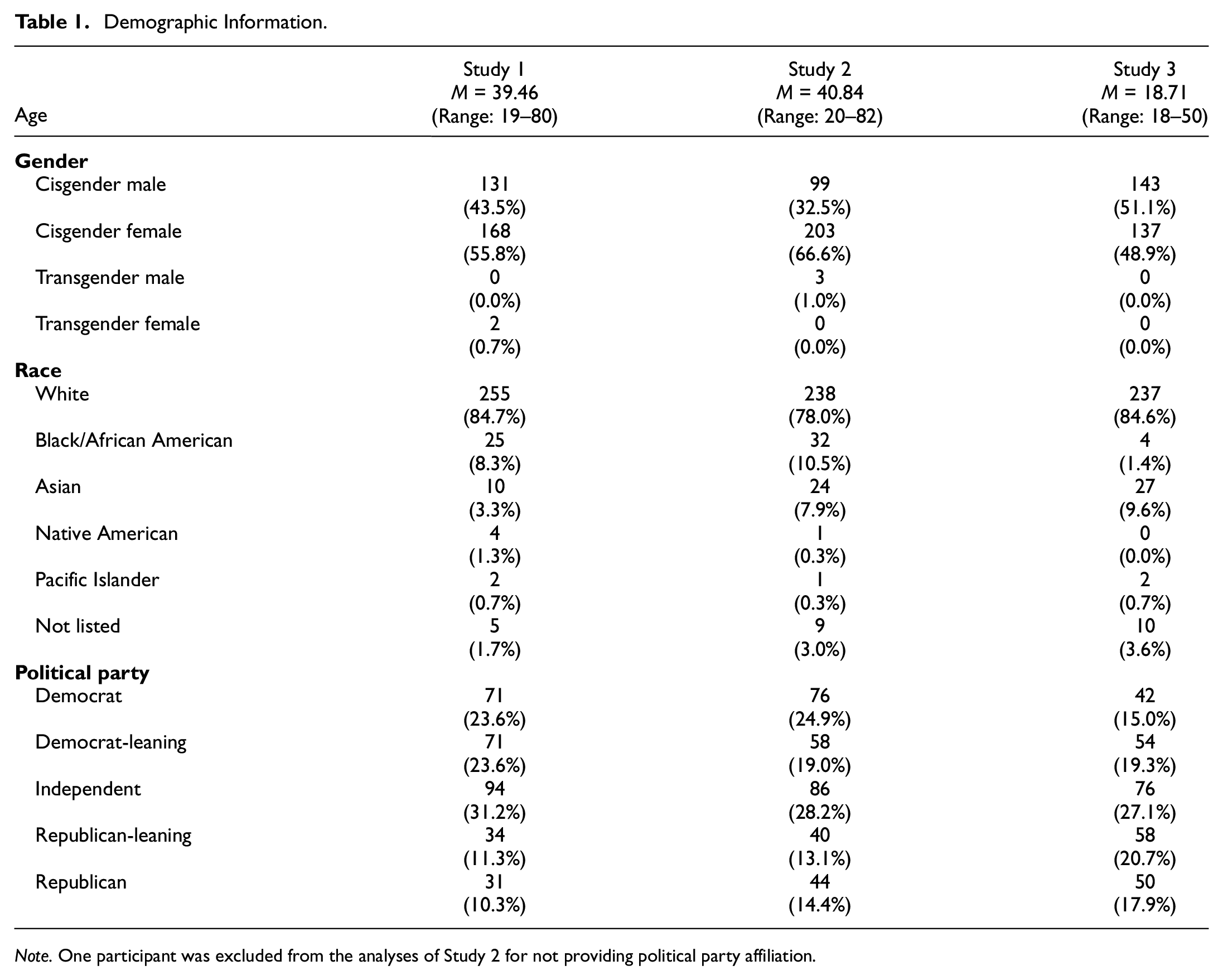
Note. One participant was excluded from the analyses of Study 2 for not providing political party affiliation.
Study 1
Participants (N = 301) were recruited from Amazon’s Turk Prime and were compensated $ 0.50.
Study 2
Participants (N = 305, independent from Study 1) were recruited from Amazon’s Turk Prime and were compensated $ 0.50.
Study 3
Participants (N = 280) were undergraduate students from the Pennsylvania State University’s psychology subject pool and received partial course credit.
Procedure
Study 1 was conducted the day before the testimonies of Kavanaugh and Blasey-Ford to the U.S. Senate Judiciary Committee (September 26, 2018). Study 2 was conducted on the day that Blasey-Ford testified before the Senate Judiciary Committee (September 27, 2018). Study 3 was conducted between October 2 and 16, 2018: the days surrounding the full Senate vote (51–49) to confirm Kavanaugh on October 6, 2018.
After giving consent, participants completed a measure of sexism (Study 1), belief in rape myths (Study 2), or one’s LSH (Study 3). Participants completed a measure of HM, evaluated Kavanaugh, and evaluated the women who accused Kavanaugh (presented in random order). Participants then completed questions about their political beliefs, evaluations of Trump, and provided demographic information.
Measures
Hegemonic Masculinity
Participants completed the 26-item Male Role Norms Scale (Thompson & Pleck, 1986). Using a 7-point scale (1 = strongly disagree, 7 = strongly agree), participants indicated the extent to which they believed men should be high in power and status (e.g., “success in his work must be a man’s central goal in this life”), tough (e.g., “a man should never back down in the face of trouble”), and should reject femininity (e.g., “it bothers me when a man does something that I consider ‘feminine’”). After reverse coding appropriate items, we averaged across items to calculate a single score (Study 1: α = .93; Study 2: α = .92; Study 3: α = .91); higher scores indicated a stronger endorsement of HM.
Evaluations of Kavanaugh and Accusers
Using a 7-point scale (1 = far below average, 7 = far above average), participants rated Kavanaugh and his accusers on 10 dimensions (competent, honest, trustworthy, respectable, logical, intelligent, fair, moral, truthful, leader-like). Because multiple women came forward accusing Kavanaugh of sexual assault (Hauser, 2018), we asked participants to evaluate “the women who have accused Kavanaugh of sexual assault.” We averaged across items to create a Kavanaugh evaluation variable (Studies 1 and 2: α = .97; Study 3: α = .96) and an accuser evaluation variable (all studies: α = .98); higher scores indicated more positive evaluations.
Sexism (Study 1)
In Study 1, participants completed the Ambivalent Sexism Inventory (Glick & Fiske, 1996). Using a 7-point scale (1 = strongly disagree, 7 = strongly agree), participants completed 11 items measuring hostile sexism (e.g., “women are too easily offended”) and 11 items measuring benevolent sexism (e.g., “men should sacrifice to provide for women”). After reverse coding, we averaged across appropriate items to create hostile sexism (α = .93) and benevolent sexism (α = .89) variables; higher scores indicated a greater sexism.
Rape Myth Acceptance (Study 2)
In Study 2, participants completed the 45-item Illinois Rape Myth Acceptance Scale (Payne et al., 1999), using a 7-point scale (1 = strongly disagree, 7 = strongly agree). The items tap seven rape myths, including she asked for it (e.g., “when women go around wearing low-cut tops or short skirts, they’re just asking for trouble”), it wasn’t really rape (e.g., “a rape probably didn’t happen if the woman has no bruises or marks”), he didn’t mean to (“when men rape, it is because of their strong desire for sex”), she wanted it (e.g., “many women secretly desire to be raped”), she lied (e.g., “a lot of women lead a man on and then they cry rape”), rape is a trivial event (e.g., “being raped isn’t as bad as being mugged and beaten”), and rape is a deviant event (e.g., “men from nice middle-class homes almost never rape”). We averaged across items to create a rape myth acceptance variable (α = .97); higher scores indicated a greater endorsement of rape myths.
Likelihood to Sexually Harass (LSH) Scale (Study 3)
In Study 3, participants completed six scenarios from the LSH Scale (Pryor, 1987). Participants imagined themselves as the protagonist of each scenario which all described a situation in which someone of the same gender as the participant has power over someone of the other gender (e.g., women read about a woman having power over a man). For each scenario, using a 7-point scale (1 = not at all likely, 7 = very likely), participants responded to three questions: (a) how likely they are to offer an opportunity to the subject, (b) how likely they are to exchange the opportunity for “sexual favors,” and (c) how likely they are to offer to meet for dinner to discuss the topic in the scenario. Responses to question (b) (i.e., blatant quid-pro-quo sexual harassment; see Pryor, 1987) were averaged across the six scenarios to create a self-reported LSH variable (α = .92); higher scores indicated a greater LSH.
Evaluations of Trump (Studies 2 and 3)
In Studies 2 and 3, using a 5-point scale (1 = far below average, 5 = far above average), participants evaluated Trump on a series of dimensions related to his role as President (e.g., qualified for the job, ability to have control; Vescio & Schermerhorn, 2021). We averaged across items to create an evaluation variable (Study 2: α = 97; Study 3: α = .94); higher scores indicated more positive evaluations.
Voting (Studies 2 and 3)
Using a 7-point scale, participants first indicated how likely they would be to vote for Trump in 2020 (1 = extremely unlikely, 7 = extremely likely). Using a 7-point scale, participants also indicated which party they favored in the 2018 Midterm elections (1 = strongly favor Democrats, 4 = no preference, 7 = strongly favor Republicans) and how likely it was that they would vote in the 2018 Midterm elections (1 = extremely likely, 7 = extremely unlikely). The same pattern of findings emerged on midterm voting; therefore, for ease of presentation, only voting for Trump is reported.
Political Identity
Participants indicated their political party affiliation (1 = Democratic, 3 = Independent, 5 = Republican) and their political ideology (1 = very liberal, 5 = very conservative). Because the election of Trump in 2016 led to an increased partisan divide (Bartels, 2020), and because political party identification predicts political attitudes (Barber & Pope, 2019) including support for Kavanaugh during his confirmation hearings (Pew Research Center, 2018), we used political party affiliation in the analyses reported below. However, the two questions were highly correlated (Study 1: r = .760, p < .001; Study 2: r = .801, p < .001; Study 3: r = .737, p < .001) and the same pattern of results emerged on both variables.
Results
We performed a series of hierarchical regressions to test the hypotheses that HM—over and above political party, gender, race, and education—would predict positive evaluations of Kavanaugh. We also sought to replicate earlier findings (Vescio & Schermerhorn, 2021) that HM would predict more positive evaluations of then-President Trump, another politician accused of sexual violence and Kavanaugh’s Supreme Court nominator. In each hierarchical regression, political party was entered in Step 1, gender (1= male, −1 = female), race (1 = White, −1 = non-White), and education 1 were entered in Step 2, and HM was entered in Step 3. Finally, the two-way interactions between HM and each of the demographic variables (i.e., HM × Political Party, HM × Gender, HM × Race, HM × Education) were entered in Step 4; we only report significant interactions associated with a significant ΔR 2 in Step 4.
Consistent with predictions, as shown in Table 2 (Step 3), stronger endorsement of HM predicted more positive evaluations of Kavanaugh (left panel) and more negative evaluations of his accusers (right panel) across all three studies. These effects held for men and women, Democrats and Republicans, and regardless of race and level of education. As shown in Table 2, political party was a strong and consistent predictor of each variable in each step. However, when controlling for political party as well as gender, race, and level of education, the inclusion of HM in Step 3 was associated with a unique ΔR 2 across all analyses; additionally, within Step 3, HM was the only variable to consistently account for significant variance beyond political party affiliation. These effects were not qualified on evaluations of Kavanaugh and his accusers, as indicated by the lack of significant interactions in Step 4 (see Table 2). In addition, by replicating previous findings (Vescio & Schermerhorn, 2021), HM predicted more positive evaluations of Trump and a greater likelihood of voting for him in 2020 over and above political party, gender, race, and education (see Table S1 in the Supplemental Materials).
Results of Hierarchical Regressions, Studies 1 to 3.
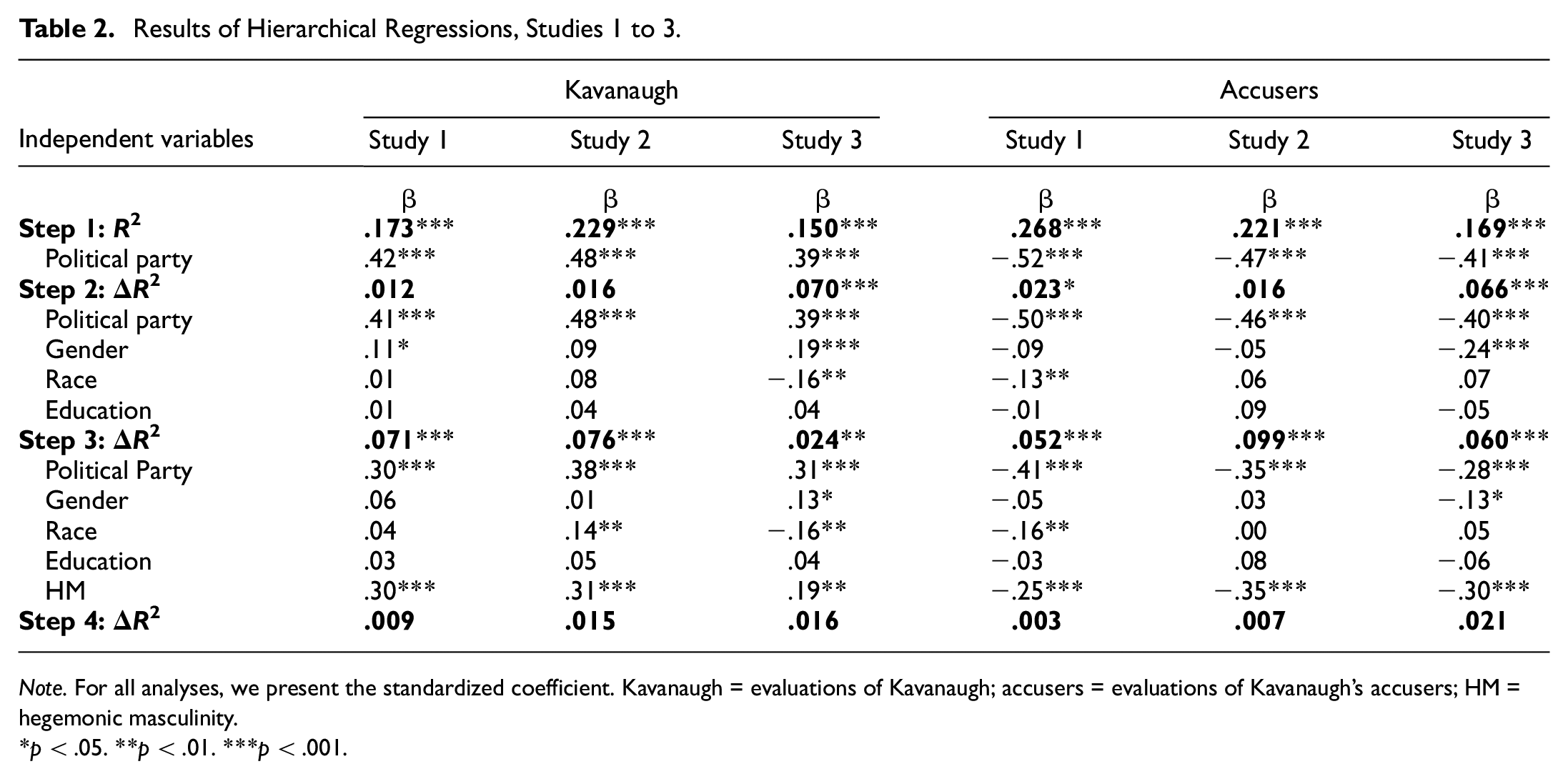
Note. For all analyses, we present the standardized coefficient. Kavanaugh = evaluations of Kavanaugh; accusers = evaluations of Kavanaugh’s accusers; HM = hegemonic masculinity.
p < .05. **p < .01. ***p < .001.
We next not only tested whether HM would be associated with attitudes relating to sexual violence (i.e., sexism, rape myths, LSH), but also predicted unique variance in (a) positive evaluations of Kavanaugh and (b) negative evaluations of the women who have accused Kavanaugh of sexual assault. Table 3 presents the correlations among variables measured in Studies 1 to 3; HM was significantly correlated with each attitude. We then performed hierarchical regressions entering attitudes relating to sexual violence (sexism, rape myths, or LSH) in Step 3, after political party (Step 1) and demographics (Step 2), but before HM (Step 4) and the same two-way interactions in the previous analyses (i.e., HM × Political Party, HM × Gender, HM × Race, HM × Education) as well as the two-way interactions between HM and each sexist attitude (i.e., HM × Benevolent Sexism, HM × Hostile Sexism in Study 1; HM × Rape Myths in Study 2; HM × LSH in Study 3) in Step 5.
Correlations, Studies 1 to 3.
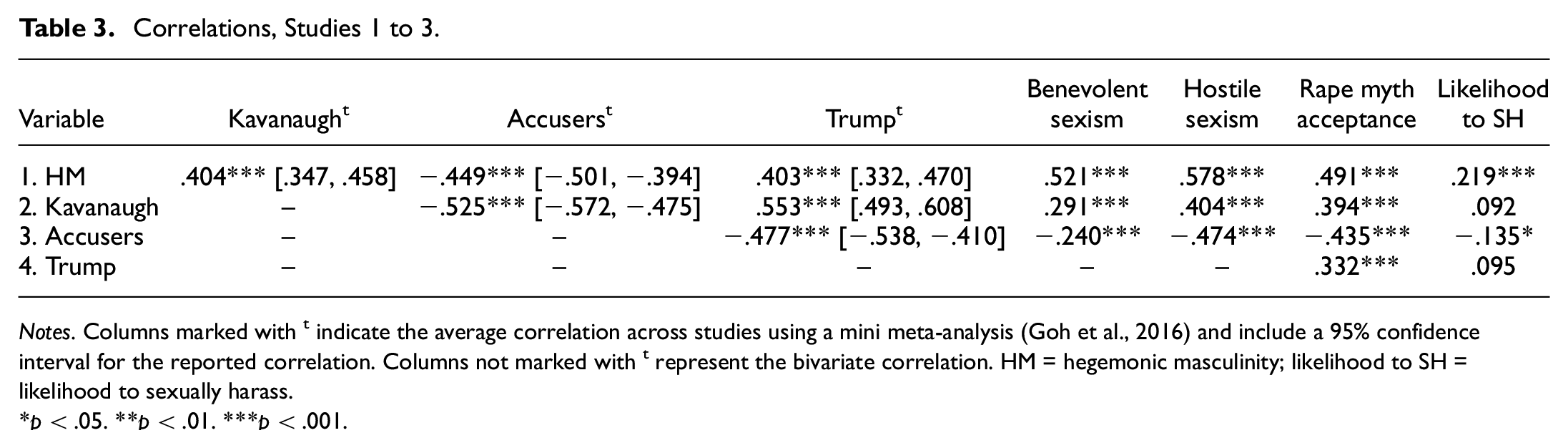
Notes. Columns marked with t indicate the average correlation across studies using a mini meta-analysis (Goh et al., 2016) and include a 95% confidence interval for the reported correlation. Columns not marked with t represent the bivariate correlation. HM = hegemonic masculinity; likelihood to SH = likelihood to sexually harass.
p < .05. **p < .01. ***p < .001.
Benevolent sexism, hostile sexism, and the endorsement of rape myths, but not the LSH, 2 predicted positive evaluations of Kavanaugh and negative evaluations of his accusers (see Table 4, Step 3). Consistent with predictions, HM accounted for unique variance when entered in Step 4 (see Table 4); stronger endorsement of HM predicted more positive evaluations of Kavanaugh and more negative evaluations of his accusers over and above political party, demographics, sexism, endorsement of rape myths, and the LSH. In addition, stronger endorsement of HM also predicted more positive evaluations of Trump and a greater likelihood of voting for him in 2020 controlling for the demographic variables and sexist attitudes in Studies 2 and 3 (see Table S1 in the Supplemental Materials). Therefore, despite the correlations between HM and each of the attitudes relating to sexual violence, they are unique constructs each predicting attitudes toward a politician accused of sexual assault and the women who have come forward to accuse him.
Results of Hierarchical Regressions Including Attitudes Related to Sexual Violence, Studies 1 to 3.
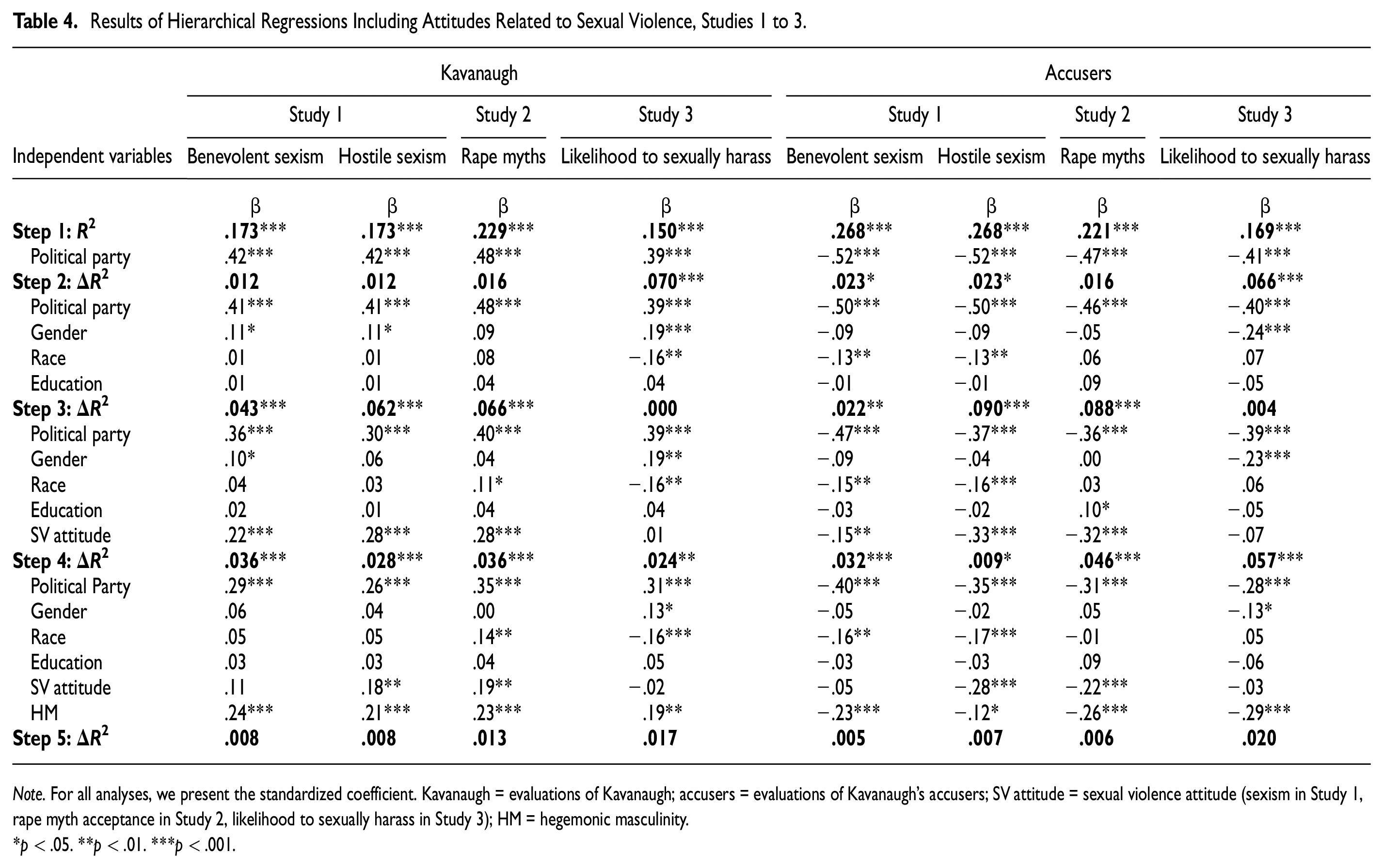
Note. For all analyses, we present the standardized coefficient. Kavanaugh = evaluations of Kavanaugh; accusers = evaluations of Kavanaugh’s accusers; SV attitude = sexual violence attitude (sexism in Study 1, rape myth acceptance in Study 2, likelihood to sexually harass in Study 3); HM = hegemonic masculinity.
p < .05. **p < .01. ***p < .001.
Additional Analyses
As noted, we included participants’ political party affiliation in the analyses reported above. We conducted identical analyses using participants’ political ideology (e.g., liberal/conservative). The pattern of results was identical, and we report all findings in the Supplemental Materials (see Tables S2–S4) Because our hypotheses were based on the full HM scale (rather than individual subscales), and because the subscales are highly correlated which could lead to multicollinearity, we report the results of analyses that include the single HM score. However, we include identical analyses to those reported above breaking HM into its three subscales (i.e., power/status, toughness, anti-femininity) in the Supplemental Materials (see Tables S5–S13).
General Discussion
Consistent with predictions, findings across three studies revealed that women’s and men’s endorsement of HM predicted more positive evaluations of Kavanaugh and more negative evaluations of the women who accused him of sexual misconduct. Importantly, HM predicted these outcomes over and above political party affiliation, gender, race, education, and sexism (Study 1); rape myths (Study 2); and the LSH (Study 3). In Studies 2 and 3, HM also predicted more positive evaluations of and intent to vote for Donald Trump in 2020—another political figure accused of sexual assault—replicating findings from the 2016 and 2020 U.S. Presidential elections (Vescio & Schermerhorn, 2021). As predicted, HM (a) was correlated with an array of sexist attitudes previously suggested to be associated with the acceptance of and participation in sexual violence, but (b) predicted support for Kavanaugh and lack of support for his accusers over and above each of these sexist attitudes, as well as the aforementioned demographic variables.
Together, the present findings support the notion that HM is an ideology that legitimizes men’s dominance over women and is separate from more explicit sexist attitudes. In addition, HM can be endorsed regardless of one’s gender, race, and education. By examining the role of HM in predicting support for Kavanaugh as he was being accused of sexual assault during his confirmation hearings, the present work is an initial examination of ideologies that maintain the perpetration of sexual misconduct in the political sphere and contribute to the larger downplaying of sexual violence in the United States. During the confirmation hearings, 65 women who went to high school with Kavanaugh wrote a letter in support of his character (Golshan, 2018), and women who supported Kavanaugh saw the allegations as a political maneuver by the Democratic party (Kinnard, 2018). Thus, certain women were more likely to support Kavanaugh and dismiss the claims made by Blasey-Ford; our findings suggest that those women, like men, endorse HM.
Despite the contributions of the present findings, there are two main limitations to the present research. First, although we did not measure participants’ knowledge about the confirmation hearing of Kavanaugh and the allegations made against him, we collected data during the confirmation process, when Kavanaugh and Blasey-Ford were heavily featured in daily news cycles. Therefore, respondents likely had at least a basic knowledge of the controversy surrounding Kavanaugh’s nomination and confirmation. Second, as outlined above, masculinity has largely been associated with Republican politicians, and Republicans are more likely to downplay the severity of sexual misconduct. Although we found that HM predicted our outcomes over and above political party affiliation, the present work focuses on a conservative political figure. Future work should examine how HM influences attitudes toward Democratic politicians accused of sexual misconduct, particularly because evidence suggests Democrats more frequently hold members of their own party accountable for sexual misconduct (Astor, 2021).
Furthermore, HM prescribes ideals defined by the dominant group and these prescriptions are also racialized, with White masculinity being elevated above other forms of masculinity. Existing research on masculinity and politics shows that the masculinity of racial minority men is evaluated differently than that of their White counterparts. For example, Barack Obama had to navigate stereotypes about the “angry Black man” as he performed elements of HM that have become associated with the Presidency (Cooper, 2008). Future research must examine how HM influences attitudes toward non-White politicians accused of sexual misconduct and non-White women who accuse them of sexual misconduct (e.g., Clarence Thomas and Anita Hill). Future research must also recruit more diverse samples to examine differences between the individual endorsement of HM given that, for example, White women are more likely to endorse candidates who prescribe to HM’s ideals than non-White women (e.g., Tien, 2017).
Despite these limitations, the present theory and research provides evidence that women’s and men’s endorsement of HM uniquely contributes to the acceptance of sexual violence. In addition, understanding the links between HM and support of politicians accused of sexual violence has important implications for policies and procedures surrounding the reporting of sexual assault. For example, the Trump administration implemented a complete overhaul of Title IX guidance making reporting more difficult for those who have experienced sexual violence and limiting the types of sexual misconduct that colleges and universities are required to investigate (see Bedera, 2020). Similarly, Kavanaugh’s judicial history indicates a disregard for women’s rights and, as public sentiment reflected, the potential for his vote to eliminate abortion rights (e.g., Buchanan & Frye, 2018; Matthews, 2018). Future research should examine how the election and/or appointment of political figures who have been accused of sexual misconduct contributes to the cycle of prioritizing assailants (usually men) over the victims (usually women), further justifying and legitimating male dominance and perpetuating the normality of sexual violence.
In sum, HM is a legitimating ideology, distinct from other sexist attitudes, that influences political attitudes. Understanding how the endorsement of HM predicts support for candidates who maintain the existing status quo will help us to better understand how individuals indirectly reinforce men’s dominance over women and may participate in their own subordination.
Supplemental Material
sj-docx-1-spp-10.1177_19485506221077861 – Supplemental material for Hegemonic Masculinity Predicts Support for U.S. Political Figures Accused of Sexual Assault
Supplemental material, sj-docx-1-spp-10.1177_19485506221077861 for Hegemonic Masculinity Predicts Support for U.S. Political Figures Accused of Sexual Assault by Nathaniel E. C. Schermerhorn, Theresa K. Vescio and Kathrine A. Lewis in Social Psychological and Personality Science
Footnotes
Handling Editor: Jennifer Bosson
Declaration of Conflicting Interests
The author(s) declared no potential conflicts of interest with respect to the research, authorship, and/or publication of this article.
Funding
The author(s) received no financial support for the research, authorship, and/or publication of this article.

Supplemental Material
The supplemental material is available in the online version of the article.
Notes
Author Biographies
References
Supplementary Material
Please find the following supplemental material available below.
For Open Access articles published under a Creative Commons License, all supplemental material carries the same license as the article it is associated with.
For non-Open Access articles published, all supplemental material carries a non-exclusive license, and permission requests for re-use of supplemental material or any part of supplemental material shall be sent directly to the copyright owner as specified in the copyright notice associated with the article.
