




Abstract
Previous studies suggested that people feel better after revenge taking, while other studies showed that they feel worse. The interpretation of this research is however ambiguous due to its extensive reliance on self-report measures. The present research examined spontaneous affective responses after retaliatory punishments in a laboratory task using an indirect measure of affect (affect misattribution procedure). Experiment 1 showed positive reactions after noise punishments of a provocateur compared to a control person, but only in revenge-seeking participants. Experiment 2 replicated this finding and revealed that punishing either individual led to less positive responses than not punishing anyone. It is suggested that revenge taking is associated with brief pleasurable responses that can ameliorate negative affective consequences of retaliatory action. Revenge is sweet because it makes one feel better about one’s punitive action.
Victims of interpersonal transgressions often seek revenge by punishing the offender (Jackson et al., 2019). There has been a discussion about how people feel after revenge taking. In line with the folk concept of “sweet revenge,” studies found that revenge feels satisfying and is associated with greater activations in the brain’s reward circuitry (Chester, 2017; Chester & DeWall, 2016; de Quervain et al., 2004). Research also suggested that retaliation can be used for mood repair (Bushman et al., 2001; Chester & DeWall, 2017). Other studies, by contrast, reported a paradoxical increase in negative affect following revenge. For example, provoked participants in one study felt even worse after a justifiable punishment of the provocateur, presumably because they started to ruminate about the provocation (Carlsmith et al., 2008). This line of research also suggested that victims of interpersonal transgressions often overestimate the effectiveness of revenge for a mood repair and/or the restoration of self-esteem. In fact, when Lambert and colleagues (2014) asked participants how they felt after being reminded of the retaliatory killing of Osama bin Laden, they expressed a strong belief that the reminder made them feel better, even though it actually made them angrier. In sum, research on affective processing of revenge taking produced mixed results, finding evidence for both positive and negative feeling states that should affect an individual’s desire to seek vengeance (Frijda, 1994).
For an account of this mixed state of the evidence, Eadeh and colleagues (2017) proposed that revenge is capable of producing both negative and positive affective reactions. According to their “bittersweet model,” victims of interpersonal transgressions feel satisfied when they perceive that the transgressors have been appropriately punished for their misdeeds, which is a positive (“sweet”) affective response. However, the revengeful act also makes them think more about the interpersonal transgression that motivated revenge in the first place, which is a negative (“bitter”) affective response. The outcome of revenge is a mixed feeling state characterized by positive and negative feelings. Eadeh and colleagues tested this model in several MTurk studies in which participants read a story about the retaliatory killing of Osama bin Laden. They found that reading the story leads to writing styles indicative of both negative and positive affect, in line with a mixed feeling state.
However, the interpretation of these study results is not without problems. One issue with studies using aggressive narratives is that it is unclear what story element triggered the (positive) affective response. For example, U.S. citizens reading a story about the assassination of Osama bin Laden could have been satisfied about the revenge of 9/11, or they could have been proud of the own army performing a complex military operation, or they could have looked forward to living in a safer world. Thus, narratives unrelated to the revengeful act could have elicited an affective reaction. A second issue concerns the measurement of affective responses with questionnaires and free writing tasks. Gloating over someone’s death, even if the killing was done for a seemingly justified reason, contradicts social norms. Some participants could hence have masked socially inappropriate affective reactions. Neurophysiological measurements of affective responses using brain imaging can circumvent these problems, but their interpretation is complex due to the reverse-inference problem (Poldrack, 2006) and difficulties in distinguishing affective and motivational responses on neural levels (Berridge, 2019).
Most important for the present research, it is plausible that revenge taking generates fleeting affective responses that could not be appropriately captured with self-report measures and functional magnetic resonance imaging methods with a poor temporal resolution. Specifically, an immediate pleasant reaction is hypothesized by the bittersweet model for the time period immediately after having seen the revenge; however, this positive reaction should be only temporary because the retaliation will also remind the revenge taker of the original transgression, which will again prompt bitter feelings (Carlsmith et al., 2008). Sweet feelings should hence dominate immediately after the revengeful act, which means that the measurement of the affective reaction must be linked to the time period following the revengeful act.
Experiment 1
In the present research, we addressed these issues with a laboratory aggression task that included an indirect measurement task of affect immediately after a revengeful act. Participants played a competitive reaction time task (CRTT) against two other (fictitious) players; one of them behaved inappropriately and provoked retaliation. In a subsequent “punishment phase,” participants could decide which player should receive a noise blast; its delivery was however determined by the computer, which allowed blasting of both players. Affective reactions after each noise punishment were measured with the affect misattribution procedure (AMP; Payne et al., 2005), which provides a composite measure of momentary affects that is fairly robust against strategic deliberations (Deutsch & Gawronski, 2009; Eder & Deutsch, 2015; Hazlett & Berinsky, 2018; for a review, see Payne & Lundberg, 2014). If sweet feelings dominate following revenge, AMP positivity scores should be larger following punishments of provoking compared to nonprovoking players.
Method
Participants
An a priori power analysis revealed that a sample of 71 participants would be required to detect a small-to-medium sized effect of dz ≥ .3 with acceptable power (80%) in a one-sided matched-samples t test with α level set to .05. However, and in line with our preregistered study plan, more data sets than this were collected to compensate for data dropouts. In total, 121 volunteers (97 female, M age = 24.1 years, SD = 4.63, range = 18–51) participated in exchange for payment (8€). Eighteen data sets had missing data due to unsystematic crashes of the experiment software. An additional 12 data sets had to be removed due to our preregistered criterion of 90% or more single keypresses in the AMP trials. The final sample size was n = 91 (69 females). An informed consent was obtained from all research participants before participation. The study protocol was approved by the ethics committee of the Department of Psychology, University of Würzburg (reference no. 2015-08). Study plan, exclusion rules, and data-analytic strategy were preregistered at OSF.
In our preregistration document, we also described a manipulation check that probed for the effectiveness of the provoking player’s demeanor to provoke revenge-seeking behavior from the participant. Specifically, it was hypothesized that the majority of participants will select the provoking player as a target for a noise punishment in the CRTT trials more frequently. We preregistered plans to remove a small number of participants from the data analyses if they did not display revenge-seeking behavior in the CRTT—or alternatively, to form a group variable with revenge-seeking participants (yes vs. no) if their numbers are substantial for a statistical analysis. We hypothesized that the differences in AMP scores (indexing momentary affects) after punishments of provoking versus nonprovoking players in the test (noncatch) trials of the punishment task should be larger if seeking revenge. Deviating from our preregistration, we used a restricted-likelihood mixed-model analysis with revenge seeking as a metric predictor (for details, see Data Analysis Strategy section).
Apparatus and Material
The experiment was programmed with Inquisit 5 (Millisecond Software, Seattle). Participants were seated in cubicles equipped with personal computers and circumaural headphones. A 2-s long recording of white noise was used for noise punishments. Its intensity was varied in 5 dB steps corresponding to each volume level (one to five). Participants heard the loudest and softest sounds before the start of the experiment for a check that they were appropriate. Two male player pictures with neutral facial expressions matched for ratings of facial attractiveness and aggressiveness were taken from a previous study (Eder et al., 2020). Two hundred black on white Chinese ideographs (256 × 256 px) were used for the AMP. A white noise image of the same size served as mask stimulus.
Procedure
Participants first provided information about themselves which was ostensibly shared with the players of the competitive RT game. As shown in Figure 1, participants then alternated between trial blocks of the CRTT and trial blocks of the punishment task, each of which included AMP trials for a measurement of spontaneous affective responses after noise punishments. At the end, they answered several questionnaires and were debriefed and paid for participation. We report all measures, manipulations, and exclusions. The interested reader is also referred to our open data archive (OSF https://osf.io/cv6wy/) in which we disclose the pilot research that led to the development of the present tasks (for a summary of the pilot research, see also the Supplementary information file).
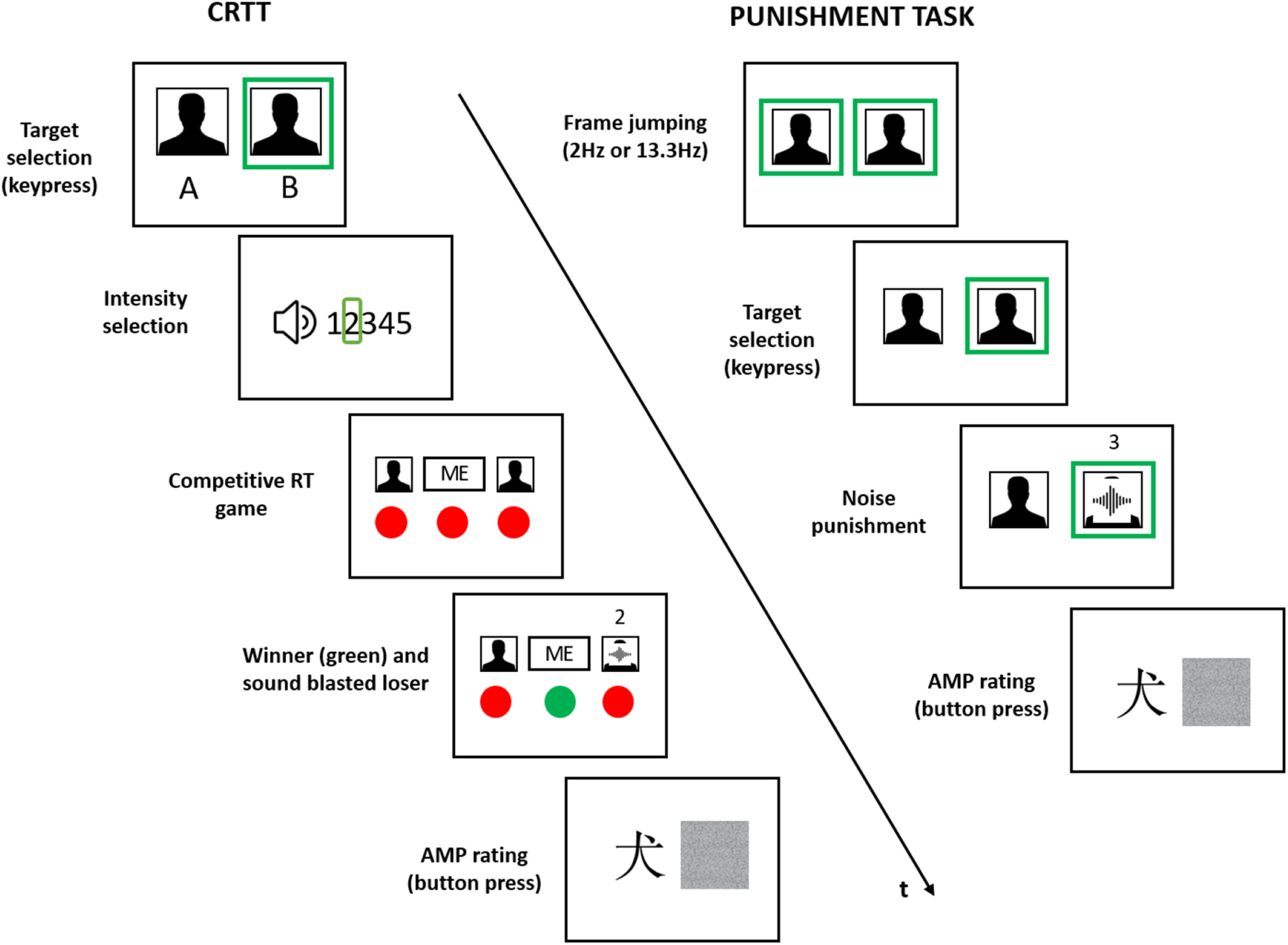
Sequence of trial events in the competitive reaction time task (CRTT) and in the punishment task. Participant first completed a CRTT block and then a punishment task block (total of five CRTT and punishment pairs).
In the following, each task procedure is described in more detail.
Self-disclosure task
Participants were informed that some of their personal information would be anonymously shared with their interaction partners. They were first asked basic demographic questions (sex and age). Then, they were asked about their degree of economic socialism (7-point scale from very liberal to very socialist) and their conservatism in social matters (7-point scale from very progressive to very conservative). Finally, instructions stated that the two players connected via internet would be shown this information (without biographic data), but not their picture, and that they in turn were assigned to a condition in which they could see pictures of the other players, but had no further information, while the other players could not see them. The self-disclosure procedure was included to provide participants with a plausible reason why one of the players may behave aggressively during the competitive RT game, as this partner may not have liked the responses they gave.
CRTT
The left panel in Figure 1 shows the sequence of events in a trial. Participants were first asked to choose which player should receive a noise blast if they win, followed by an indication of the intensity of the sound blast on a 5-point scale. Next, participants saw pictures of the two players in the top left and right hand of screen and a box containing the German word “ICH” (engl., “ME”) in the center top half of the screen. Below each picture and the box was a red circle. After a random interval between 500 and 800 ms, the three circles turned green and the participant has to press the space bar as quickly as possible. After a further 1,000 ms, the circles turned back to red bar the one below the winner in this game. After 400 ms, a numeric intensity level appeared above the loser who was selected as target for the sound blast. In addition, a soundwave video was superimposed over the picture of the loser as a visual indicator of the noise punishment. If the participant was the selected target, she heard a noise blast of corresponding intensity. The noise and video lasted for 2,000 ms. Then, an AMP trial followed, described in detail below. If the participant responded too early or failed to respond within 1,000 ms, an error message was displayed for 2,000 ms, and the competitive RT game was restarted (with the selected target and intensity choice).
Although task instructions stated that the participant would compete against two other human players, the winner in each trial was actually drawn from randomized lists. The lists were constructed in such a way that there were a total of five lists (one for each block of the task); each player won at least eight of the 30 trials per task block. This list construction resulted in an even split of winning trials per player over the whole experiment (50 per player). When the participant had won a game trial, a visual indication of a noise punishment appeared on the picture of the selected target. When the nonprovoking player won, the intensity of the noise blast was always set to the minimum (Level 1) and the noise punishment affected either the participant or the other player with an equal distribution. When the provoking player won, the participant was blasted in 75% of the cases and the other player in 25% of the cases, with the intensity of the noise blast set to a very high level (four or five). The positioning of the two player pictures at left and right screen positions, as well as the assignment of the provoking and nonprovoking roles, was counterbalanced across participants.
Punishment task
After each block of the CRTT, participants completed a block of the punishment task that consisted of six catch trials and 20 test trials in randomized order. The sequence of events in these trials is displayed on the right side of Figure 1.
In a catch trial, a green picture frame jumped between the two player pictures every 500 ms (2 Hz). Participants were instructed to select a player to receive a noise blast of fixed medium intensity (Intensity 3) by pressing the space bar when their desired target was framed. Following the press of the space bar, the green frame stopped, and a noise punishment was visually indicated in the same way as in the CRTT.
Test trials were identical to the catch trials except that the time interval between frame jumps was reduced to 75 ms (13.3 Hz). In these trials, the target was ostensibly selected by the participant’s pressing of the space bar, but in fact, the provoking and nonprovoking player were each selected in 50% of the trials. The high frame jump frequency ensured participants did not notice they were not actually selecting the target. The “selected” player then received a noise blast for 2,000 ms. After each noise blasting, an AMP trial was presented as a measurement of the participant’s affective reactions.
AMP
First, a Chinese ideograph was presented for 200 ms, followed by a blank screen for 75 ms and the mask stimulus. Participants rated the masked ideograph as either pleasant or unpleasant using the left and right mouse buttons (assignment of button to evaluation counterbalanced across participants). Instructions emphasized the importance of spontaneous responding without much thinking. A message with a reminder to respond more spontaneously was displayed for 4,000 ms after a slow response (RT > 2,000 ms). The AMP was presented after each noise punishment in the CRTT and in the punishment task. AMP scores were calculated as proportion of “pleasant ratings” in each condition.
Questionnaires
After the main study (and before debriefing), participants responded to the long-form scales “BIS II” (sadness), “Anger,” and “BAS II” (joy) from the German ARES questionnaire (Hartig & Moosbrugger, 2003). These scales were included for exploratory analyses.
Data Analysis Strategy
In line with our preregistered criteria, trials from the first pair of task blocks (CRTT and punishment task) were removed as practice. For our statistical hypothesis test, we first looked at the participants’ selection of targets in the CRTT trials, which constituted our manipulation check of revenge seeking. Participants selected the provocative player as the target for the noise punishment in the CRTT trials more frequently (M = 64.6%, SD = 20.1%), t(90) = 6.95, p < .001, d = 0.72. Intensities selected for noise punishments were also higher for the provocative player (M = 2.68, SD = 1.11) compared to the nonprovocative player (M = 1.81, SD = 0.77), t(83) = 7.48, p < .001, dz = 0.81 (note that seven participants were not included in this test because six selected exclusively the provocative player and one exclusively the nonprovocative player). However, 40 of 91 participants (44%) did not choose the provoking player in at least 60% of the CRTT trials. In line with our conditional preregistered data analysis plan, we therefore included revenge seeking as a factor in the statistical analyses.
The dependent variable of primary interest was the AMP positivity score in the test trials of the punishment task. According to the satisfaction (“revenge is sweet”) hypothesis, the positive reaction to the punishment of the provoking player should be misattributed as positive evaluation of the ideograph. This means AMP positivity scores (i.e., the proportion of pleasant ratings) should be higher after punishments of the provoking player relative to the nonprovoking player in the punishment task. This affective reaction should be potentiated by seeking revenge. Although our preregistration called for an analysis of variance (ANOVA)-based analysis with revenge seeking as a group factor, we instead report a restricted-likelihood mixed-model analysis of responses in the AMP trials (coded 0 = unpleasant and 1 = pleasant) with punished player as a discrete predictor and number of CRTT trials in which the provoking player was selected as a target (revenge seeking) as a metric predictor, as well as subject intercept and AMP stimulus intercept as random factors. This analysis is able to capture the metric nature of our revenge-seeking measure and was preregistered for use in Experiment 2 (see below); thus, we present it here for consistency. The preregistered ANOVA analyses are presented in the Online Supplemental Material.
We had no specific hypotheses for AMP responses in the CRTT task because several affective evaluations could have affected AMP ratings in this phase (e.g., joy about having won a CRTT trial; relief of having averted a sound punishment). However, AMP scores in this phase should be higher after having won versus lost a CRTT trial, which would confirm the validity of the AMP as a measure of affective reactions. Corresponding analyses are reported in the Online Supplemental Material.
Results
In the mixed-model analysis, the main effect of revenge seeking was not significant, F(1, 89.0) = 0.41, p = .523. The main effect of punished player achieved significance, F(1, 7155.5) = 54.42, p < .001, and was qualified by an interaction with revenge seeking, F(1, 7153.0) = 96.17, p < .001, model pseudo-R 2 = 17.3% (see Figure 2). Follow-up comparisons of model estimates showed that for modeled participants who were indifferent between selecting the provoking or the nonprovoking player in the CRTT (selecting the provoking player in 60/120 trials), the model estimates showed no difference in positive responses after punishing the provoking (M = 50.1%, SE = 2.5%) and nonprovoking player (M = 50.6%, SE = 2.5%), F(1, 7153.9) = 0.13, p = .720; however, modeled participants who selected the provoking player preferentially (90/120 trials) showed significantly more positive response estimates after punishing the provoking (M = 55.3%, SE = 2.3%) compared to the nonprovoking player (M = 42.4%, SE = 2.3%), F(1, 7142.4) = 110.43, p < .001.
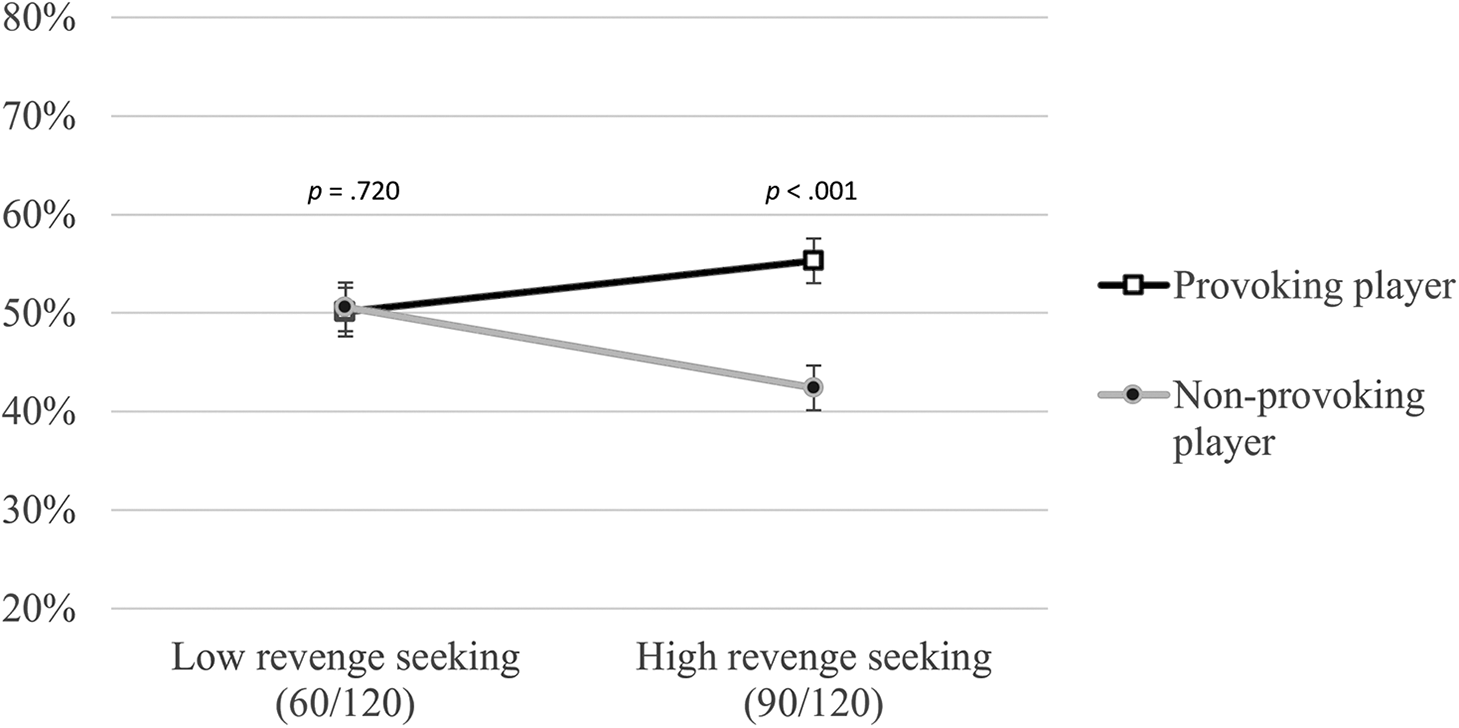
Model estimates of proportions of “pleasant” responses in the affect misattribution procedure after noise punishments of provoking and nonprovoking players as a function of revenge-seeking behavior in the competitive reaction time task (CRTT), Experiment 1. Pictured values are estimates from the multilevel model for a (hypothetical) participant who selected indifferently in the CRTT (60/120, low revenge seeking) versus one who selected the provoking player with an odds ratio of 3 (90/120, high revenge seeking). Error bars denote the standard error of the mean.
In addition, revenge seeking in the CRTT correlated positively with the number of selections of the provoking player as a target for noise punishment in the catch trials, r(90) = .516, p < .001. This confirms the behavioral validity of our revenge seeking measure.
Experiment 2
The first study revealed that revenge-seeking participants reacted more positively to punishments of the provoking player compared to the nonprovoking player. In the absence of other comparisons, it is however not clear whether this effect indicates positive feelings about punishments of provoking players, a negative reaction to the punishment of the nonprovoking player, or both. To address this issue, we included a no punishment condition as an additional response option in Experiment 2: In each punishment task trial, participants could select whether they wanted a punishment of the provoking player, the nonprovoking player, or neither players. We had no predictions about how often participants would select the no-punishment option. Using relative comparisons of AMP scores in each punishment condition, we could examine whether the effect is predominantly driven by positive feelings of having avenged oneself on the provoking player or by negative feelings of seeing the other (nonprovoking) person punished.
Method
Participants
In this study, our main hypothesis referred to a comparison of positive responses after blasting either the provoking or nonprovoking player or blasting nobody contingent on revenge-seeking behavior. In anticipation of an uneven distribution of revenge-seeking behavior, we decided to recruit 80 participants. As we planned to use multilevel models to analyze the data, direct a priori sensitivity analyses could not be calculated. However, as this analysis should have greater power compared to an analogous ANOVA, we calculated sensitivity analyses for such an ANOVA as a lower bound (2 × 3 mixed-model design, assumed within-subjects correlation of r = .5), which revealed our planned sample to be 95% sensitive to a small-to-medium effect size of f ≥ .181.
A total of 82 volunteers (61 female, M age = 24.6 years, SD = 6.73, range = 18–61) participated in exchange for payment (8€). Four data sets had to be removed due to unsystematic crashes of the experiment software and a further four data sets due to noted language comprehension problems. An additional eight data sets had to be removed due to our preregistered criterion of 90% or more single keypresses in the AMP trials. Although we had originally preregistered to replace invalid cases until 80 valid data sets had been collected, logistical pressure resulting from the Covid19 pandemic prevented us from replacing cases after the initial data collection period. The final sample size thus was n = 66 (48 females). Study plan, exclusion rules, and data-analytic strategy were preregistered at OSF.
Apparatus, Stimuli, and Procedure
This experiment was identical to Experiment 1 except for the following changes: First, we implemented an individualized volume selection for the strength of the noise blasts at the beginning of the experiment (after providing informed consent). Second, due to prevailing restrictions from the Covid19 pandemic, the wearing of protective facemasks was mandated during the experiment, which necessitated an adjustment of our stimuli. Third, we implemented a no-blast option and improved the temporal parameters of catch trials in the punishment task.
Individualized volume selection
The volume was adjusted for each participant in a stepwise procedure. After hearing an initial blast of 75 dB volume, participants were asked to indicate their subjective discomfort on a 10-point Likert-type scale (1 = inaudible, 2 = just above audible, 5 = unpleasantly loud, and 10 = unbearably loud). The sound was replayed after the participant responded, with any response below five adjusting the volume upward and any response above five adjusting the volume downward (for details, see our preregistration). The procedure was designed to produce final volumes of the loudest noise blasts used in the experiment of 2.5 dB above participants’ measured threshold for “unpleasantly loud.”
Stimuli with facemasks
We replaced the pictures of the two fictitious interaction partners with similarly posed pictures in which the two White male individuals wore standard protective cloth facemasks covering their noses and mouths. All materials are available online.
Punishment task
Each block of the punishment task consisted of six catch trials and 21 test trials in randomized order. Instead of only seeing the two interaction partners, participants additionally saw a no-blast symbol in the center of the screen (between the other two players). The green frame jumped irregularly between the three pictures, stopping when the participant pressed the space bar. If another player was selected, a noise punishment of medium intensity was visually indicated in the same way as Experiment 1 for 2,000 ms, whereas the experiment simply paused for 2,000 ms if the no blast option was selected. In catch trials, the green picture frame remained on each picture for 550–750 ms and pressing the space bar stopped the frame where it was. In test trials, the green picture frame remained on each picture for 100–650 ms. Pressing the space bar ostensibly selected the target, but in fact, the frame jumped to a target selected by the computer (33% provoking player, 33% nonprovoking player, and 33% no blast). As before, after each selection, an AMP trial was presented as a measurement of the participant’s affective reactions.
Results
We calculated a restricted-likelihood mixed-model analysis of responses in the AMP trials (coded 0 = unpleasant and 1 = pleasant) with punished player (provoking player vs. nonprovoking player vs. no blast) as a discrete predictor and number of CRTT trials in which the provoking player was selected as a target as a metric predictor, as well as subject intercept and AMP stimulus intercept as random factors. Figure 3 shows the results. The main effects of revenge seeking, F(1, 64.0) = 1.03, p = .313, and punished player, F(1, 5447.4) = 2.43, p = .088, did not achieve significance. However, the interaction term was significant, F(1, 5447.4) = 13.07, p < .001, model pseudo-R 2 = 18.1%. Follow-up comparisons of model estimates showed that modeled participants who did not seek revenge according to our CRTT measure (selecting the provoking player in 60/120 trials) showed the most positive reactions after a no blast outcome (M = 60.9%, SE = 2.7%), less positive reactions after punishing the provoking player (M = 52.7%, SE = 2.7%), and the least positive reactions after punishing the nonprovoking player (M = 45.1%, SE = 2.7%), all differences p < .001. Modeled participants who selected the provoking player preferentially (90/120 trials) showed a similar pattern with regard to the no blast outcome (M = 60.7%, SE = 2.8%) and punishing the provoking player (M = 53.1%, SE = 2.8%), but noticeably less positive reactions after punishing the nonprovoking player (M = 37.0%, SE = 2.8%), all differences p < .001.
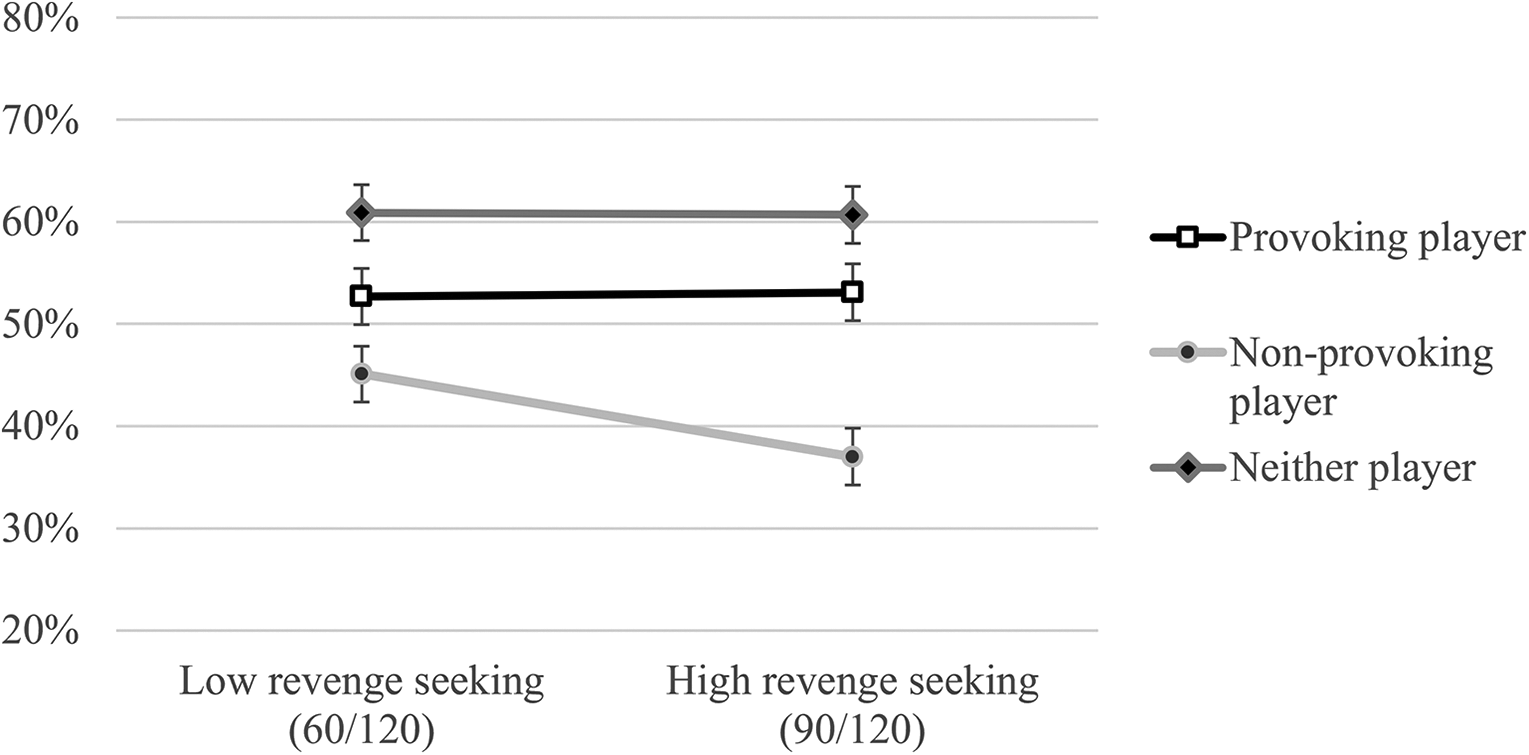
Model estimates of proportions of “pleasant” responses in the affect misattribution procedure after noise punishments of provoking and nonprovoking players as well as not punishing either player as a function of revenge-seeking behavior in the competitive reaction time task (CRTT), Experiment 2. Pictured values are estimates from the multilevel model for a (hypothetical) participant who selected indifferently in the CRTT (60/120, low revenge seeking) versus one who selected the provoking player with an odds ratio of 3 (90/120, high revenge seeking). Error bars denote the standard error of the mean. All differences at a given level of revenge seeking are significant at p < .001.
As in Experiment 1, revenge seeking in the CRTT correlated with the number of selections of the provoking player as a target for noise punishment in the catch trials, r(65) = .319, p = .009, once again confirming the behavioral validity of our revenge-seeking measure. Additional analyses are reported in the Online Supplemental Material.
General Discussion
The present study examined affective reactions following retaliatory punishments in a laboratory task using an implicit measurement task of affect (AMP). Our first experiment revealed more positive AMP responses after noise punishments of a transgressor compared to a control person, in line with the folk concept that revenge is “sweet.” A positive reaction was however only observed when participants sought revenge, as indexed by a separate behavioral measure (CRTT); in the absence of retaliatory motivation, AMP scores were not different. A second experiment contained an additional no-punishment condition for comparisons; participants could decide whether they wanted a punishment of the provoking player, the nonprovoking player, or neither player. Results replicated the finding of Experiment 1 but also showed that blasting neither player was the most attractive for participants, even when they wanted revenge. This pattern of results indicates that our study participants generally disapproved of the noise blasting of other players; however, whereas revenge-seeking participants disapproved of the blasting of nonprovoking players most strongly, those who were not seeking revenge were more indifferent about who received the blast. The revenge-seeking group hence reacted more positively to punishments of provoking players, but even this reaction was below the positivity experienced after no punishment. This pattern suggests that revenge taking may feel sweet because it makes the revenge-seeking person feel less bitter about her own punitive action.
Overall, our findings support models that argue that revenge is neither wholly sweet nor wholly bitter (Eadeh et al., 2017). People feel bitter about a provocation and most people dislike hurting other people, even if these punishments allegedly serve a scientific purpose. For revenge-seeking people, these bitter feelings are intensified by punishments of an innocent person but not of a previous transgressor. The latter finding suggests a relative increase in positive affect, which is in line with other research suggesting that revenge can be used for a mood repair (Bushman et al., 2001; Chester & DeWall, 2017). The sweet reaction is however only temporary, giving way again to negative thoughts about the initial transgression (Carlsmith et al., 2008). The outcome could be an escalating revenge cycle that negatively reinforces punitive actions against a transgressor.
The present study also has limitations. Firstly, AMP positivity scores can only provide a bipolar measure of positive and negative affects and must not be interpreted in an absolute sense. This means the measure cannot distinguish between an increase in positive affect and a concomitant decrease in negative affect (and vice versa). Consequently, the present interpretation is linked to emotion theories assuming a bipolarity of experienced affect (Barrett & Russell, 1999). Furthermore, research has questioned the validity of a misattribution of affect, proposing a general misattribution mechanism that can operate on affective feelings and (valenced) semantic concepts (e.g., Blaison et al., 2012; Gawronski & Ye, 2014). Hence, more research is needed on the underlying processes of the AMP effects.
Secondly, a substantial group did not seek revenge. It could be that our provocation treatment was not effective enough or that they generally mistrusted the CRTT setup. Future studies could try other provocation methods (Lobbestael et al., 2008). Thirdly, participants had only limited control over the distribution of punishments in the punishment task, which was necessary to have sufficient punishments of the nonprovoking player in this task. Punishments could hence have triggered an emotion of schadenfreude that was independent of the participant’s choice. Future studies should clarify the role of active choice for the production of aggressive pleasures. Finally, one could argue that the positive reaction evoked by the observed punishment of the provoking opponent was happiness about the correctly timed button press in the test trials of the punishment task. While this interpretation could explain the positivity after punishments of the provoking opponent in Experiment 1 (who was participants’ preferred punishment target), it cannot explain why only the revenge-seeking group exhibited a positive reaction. In addition, it cannot account for the positive reaction in Experiment 2, in which participants preferred no punishment in most of the trials. For an account, one must assume that the positive reaction about punishments of the provoking player was tied to the participant’s intention to harm the provoking opponent, which renders the correct-timing account indistinguishable from the revenge-satisfaction account.
To sum up, the present research suggests that taking revenge is “sweet” because it makes revenge-seeking people feel better about their own retaliatory actions. The relative improvement likely reinforces the revengeful action, fueling escalation of violence in retributive cycles.
Supplemental Material
Supplemental Material, sj-docx-1-spp-10.1177_19485506211019923 - Sweet Revenge Feels Less Bitter: Spontaneous Affective Reactions After Revenge Taking
Supplemental Material, sj-docx-1-spp-10.1177_19485506211019923 for Sweet Revenge Feels Less Bitter: Spontaneous Affective Reactions After Revenge Taking by Andreas B. Eder, Anand Krishna and Vanessa Mitschke in Social Psychological and Personality Science
Footnotes
Authors’ Note
Preregistration documents, experiment program files, raw data, and data analysis syntax files can be accessed at OSF ( ). The study protocol adhered to the ethical standards as laid down in the 1964 Declaration of Helsinki, and it was approved by the ethics committee of the Department of Psychology, Julius-Maximilians-University of Würzburg (reference no. 2015-08). The funding agency had no role in the study design, collection, analysis, or interpretation of the data; writing the manuscript; or the decision to submit the paper for publication.
Acknowledgment
We thank our laboratory research assistants for their help with data collections.
Declaration of Conflicting Interests
The author(s) declared no potential conflicts of interest with respect to the research, authorship, and/or publication of this article.
Funding
The author(s) disclosed receipt of the following financial support for the research, authorship, and/or publication of this article: This research was supported by grants Ed201/7-1 and Ed201/7-2 of the German Research Foundation (DFG) to AE.
Supplemental Material
The supplemental material is available in the online version of the article.
References
Supplementary Material
Please find the following supplemental material available below.
For Open Access articles published under a Creative Commons License, all supplemental material carries the same license as the article it is associated with.
For non-Open Access articles published, all supplemental material carries a non-exclusive license, and permission requests for re-use of supplemental material or any part of supplemental material shall be sent directly to the copyright owner as specified in the copyright notice associated with the article.
