



Abstract
Organizations often put children front and center in campaigns to elicit interest and support for prosocial causes. Such initiatives raise a key theoretical and applied question that has yet to be addressed directly: Does the salience of children increase prosocial motivation and behavior in adults? We present findings aggregated across eight experiments involving 2,054 adult participants: Prosocial values became more important after completing tasks that made children salient compared to tasks that made adults (or a mundane event) salient or compared to a no-task baseline. An additional field study showed that adults were more likely to donate money to a child-unrelated cause when children were more salient on a shopping street. The findings suggest broad, reliable interconnections between human mental representations of children and prosocial motives, as the child salience effect was not moderated by participants’ gender, age, attitudes, or contact with children.
Children are often featured in campaigns to support issues such as disaster relief (Donate to Africa, 2019), healthy living (National Health Service, 2020), and environmental protection (Department of Energy and Climate Change, 2009), expressly calling for sympathy and assistance. These campaigns reveal a widespread assumption that children elicit sympathetic reactions. Consistent with this assumption, images of Aylan Kurdi, a child who died during the 2015 Syrian refugee crisis, elicited strong reactions of empathy and solidarity with refugees (Smith et al., 2018). More generally, children and adults with neonatal facial features elicit greater empathy and helping behavior (Keating et al., 2003; Lishner et al., 2008), and they trigger protective and caretaking motivations toward them (Bleske-Rechek et al., 2010; Glocker et al., 2009). Further evidence suggests that making suffering children or parenthood salient is linked with higher risk aversion (Gilead & Liberman, 2014; Lu & Schuldt, 2016; Palomo-Vélez et al., 2020) and stronger rejections of norm violations (Eibach et al., 2009), both of which likely stand in the service of protecting one’s own children from harm. Collectively, these findings suggest that adults are motivated to help and protect their own children and children needing help.
Importantly, however, there may be a much broader and more substantial role for children, one in which the salience of children per se (i.e., not only one’s own children or children in need) elicits higher prosocial motivation toward others in general. Indirect support for this broader impact of children comes from an evolutionary perspective, which suggests that the caretaker role in human societies was shared by group members to facilitate the survival and thriving of the group’s offspring (Hrdy, 2005). This caretaker role can be triggered by the salience of any child, and child-like adults, animals, or even cars (e.g., Little, 2012; Miesler et al., 2011; Sherman et al., 2009).
Moreover, this caretaker role is assumed to involve a range of motivations and behaviors that go beyond immediate benefits to children. For instance, children may be more likely to survive and thrive if they grow up in a cooperative, supportive group than in a competitive, hostile group (Best, 1993). Similarly, primates that share the caretaking role more often demonstrate spontaneous prosocial behaviors that are not directly linked to infants (e.g., food sharing, social tolerance) than independently breeding primates (Burkart & van Schaik, 2010; Snowdon & Cronin, 2007). Together, these perspectives suggest that a range of child-related stimuli can motivate adults to engage in prosocial behaviors toward others in general, pointing to an ingrained link between humans’ mental representations of children and prosocial motivation.
However, psychological research has not directly tested a child salience effect that goes beyond immediate caretaking of children. The present research significantly extends the literature by examining whether children and prosocial motives are intrinsically linked, thus providing a better understanding of the role of mental representations of children in adult social motives.
Human Values
We focus on human values as indicators of prosocial motives because of cross-cultural commonalities in them and their important role as life-guiding principles, suggesting that values provide an ideal opportunity to test the potentially broad role of child salience. People around the world indicate that values like equality and achievement are important to them, and such values are integral to human social judgment and behavior (e.g., Hurst et al., 2013; Wolf et al., 2019). According to the most prominent theory of values in psychology, the quasi-circumplex model (Schwartz, 1992), values differ in the goals or motives they express, which are structured along two orthogonal dimensions of self-transcendence/self-enhancement and openness/conservation (see Figure 1). Our research focuses on the former dimension as an indicator of prosocial motives, with self-transcendence values promoting the welfare of others (e.g., helpfulness, responsibility), and self-enhancement values promoting self-interested principles (e.g., power, success). Consistent with these definitions, there is extensive evidence that higher self-transcendence values and lower self-enhancement values predict and elicit more prosocial attitudes and behaviors (e.g., Boer & Fischer, 2013; Sagiv et al., 2017).
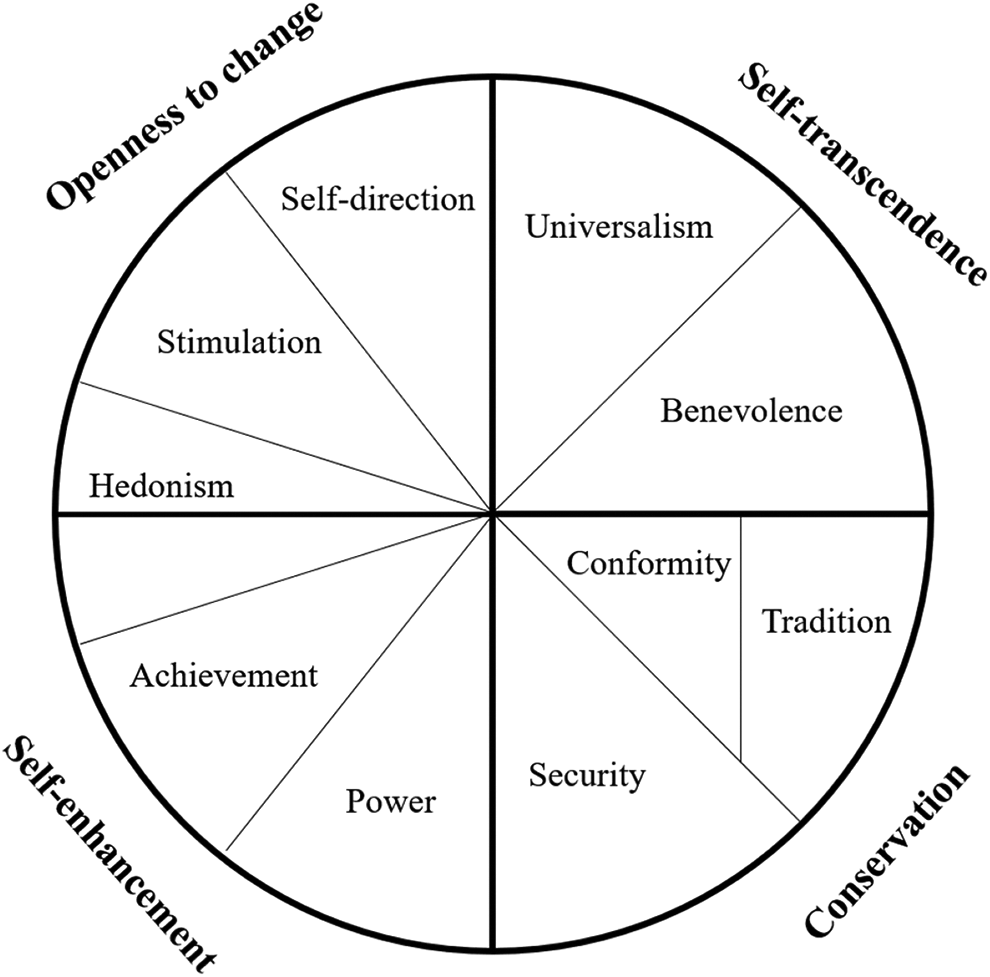
Schwartz’s theory of human values. Note. Values are universally structured along two orthogonal dimensions of self-transcendence/self-enhancement and openness/conservation.
Schwartz’s model has been replicated in over 80 nations (Bilsky et al., 2011; Schwartz et al., 2012). Although values are thought to be relatively stable over time (Schwartz, 1994), research has shown that there is considerable potential for change in values, either through life-changing events (Bardi et al., 2009), age (Vecchione et al., 2016), or experimental manipulations (e.g., Karremans, 2007; Maio et al., 2009). These changes follow the model’s two-dimensional structure, with values on the same end of a dimension changing in the same direction and values on opposing ends of a dimension changing in the opposite direction. Thus, an index of self-transcendence and self-enhancement values can be expected to be sensitive to a shift in people’s prosocial motives. The present research examines the extent to which there is a latent psychological link between human mental representations of children and compassionate, prosocial values such that the salience of children per se increases the importance people attach to these values.
The Present Research
We tested our hypothesis in eight experiments that manipulated the salience of children using description tasks and examined the effects on prosocial motives (i.e., self-transcendence vs. self-enhancement values). Adult participants were randomly assigned to either a child salience condition, a nonchild control condition, or a baseline control condition. These experiments also examined a range of potential moderators (e.g., parenthood, gender, age, attitudes toward children). Following previous recommendations for multistudy articles (Lakens & Etz, 2017), we describe a meta-analysis of the effects of child salience to summarize the findings. We expected that the salience of children would increase the importance adults attach to prosocial values.
Building upon the results of the meta-analysis, we conducted an observational field study to examine the practical, behavioral implications of the presence of children in everyday life. This study recorded the number of children and adults on a shopping street and collected donations from adult passersby for a cause not specifically related to children. We expected that a higher proportion of children (relative to adults) would predict more donations from passersby. The study materials and data (including explanations and syntax) described in this article will be publicly available under 10.17605/OSF.IO/VFQA7 upon publication. All studies reported here follow American Psychological Association and British Psychological Society ethical standards and received ethical clearance from the ethical review committees of the respective universities.
Meta-Analysis
Method
Overview of experiments
Table 1 provides an overview of the individual experiments, all of which examined additional, unique research questions (see Supplement for full details).
Experimental Designs.
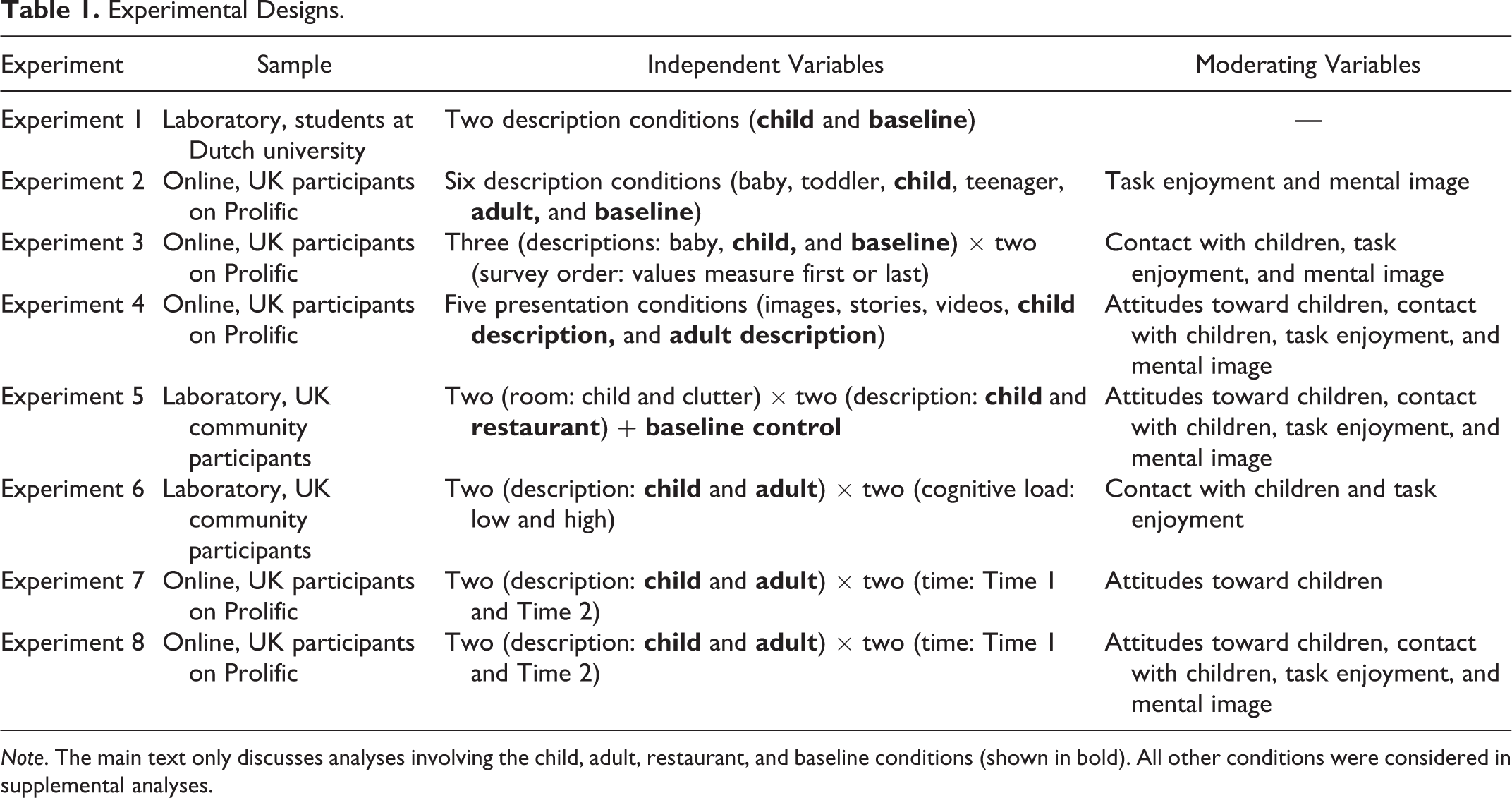
Note. The main text only discusses analyses involving the child, adult, restaurant, and baseline conditions (shown in bold). All other conditions were considered in supplemental analyses.
Experiment samples
Given the lack of past evidence on child salience effects, we based our power analyses on a medium effect size. The required sample size to detect a medium effect with a power of .90, two-tailed tests, and a critical significance level of .05 was 86 participants per condition. All experiments exceeded this requirement.
We used the same exclusion criteria in each study. Participants were excluded from analyses if they completed the description task too quickly (more than 1 SD below mean completion time) or if they failed a reading check (e.g., asking participants to ignore the question and click Response Option 1). Across all experiments, 77 participants did not meet these criteria and were excluded. Table 2 shows the number of participants and demographic statistics in each experiment after exclusions.
Demographic Characteristics.
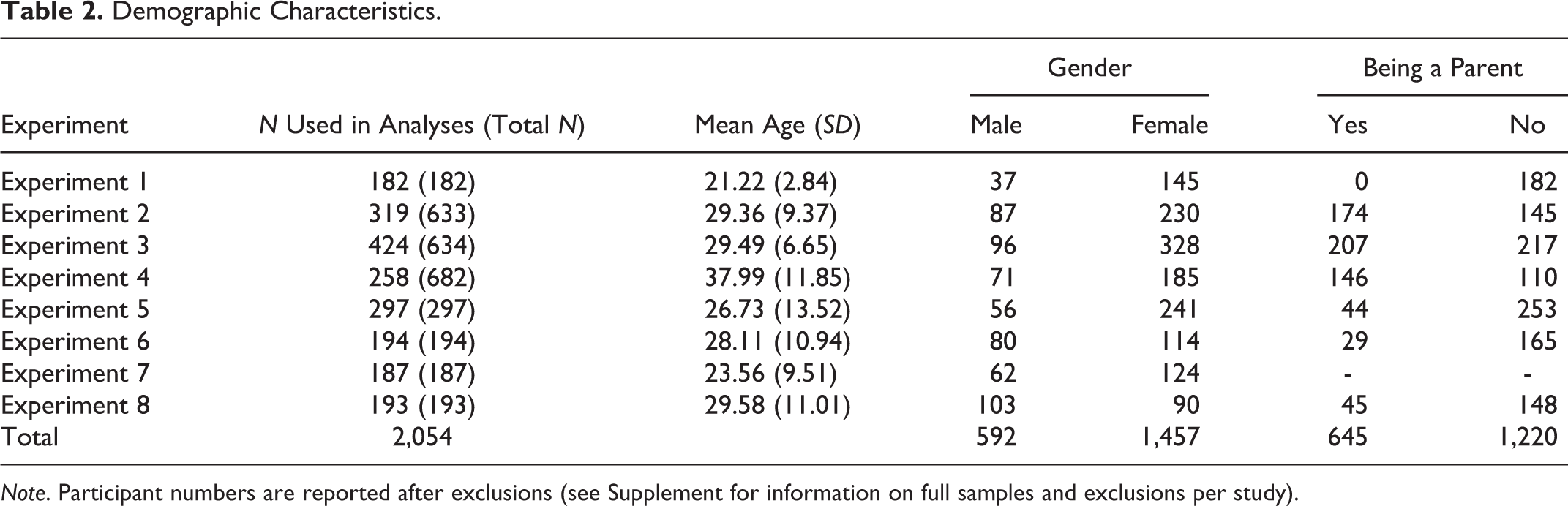
Note. Participant numbers are reported after exclusions (see Supplement for information on full samples and exclusions per study).
Child salience manipulation
All eight experiments manipulated child salience using written descriptions, consistent with evidence that such tasks increase category accessibility (e.g., Marhenke & Imhoff, 2020). Participants were randomly assigned to either a child salience condition, a nonchild description condition, or a no-task baseline condition in between-participants designs. In the child salience condition, participants described what a typical primary school–age child is like. Participants wrote about a child’s appearance and personality, what a child typically does, and the types of situations this would involve. Six of the experiments included a nonchild description condition that involved a similar description of either an adult or a mundane event (i.e., being at a typical restaurant). Four of the experiments included a no-task baseline condition, which did not involve a description task.
Prosocial motivation
Across all eight experiments, prosocial values were the primary dependent variable. We used items from the Schwartz Value Survey (SVS; Schwartz, 1992) and the aspiration index (AI; Grouzet et al., 2005) to assess Schwartz’s higher order value types including self-transcendence (nine items, e.g., “helpfulness”) and self-enhancement (eight items, e.g., “power”). Initially, 12 values were selected from the SVS to assess the two value types (i.e., helpfulness, responsibility, forgiveness, equality, honesty, broadmindedness, protecting the environment vs. power, wealth, success, ambitious, influence). Next, three items were added from the SVS that showed strong conceptual overlap with items from the AI (social justice, love vs. competence). Finally, two further items were added from the AI (image and popularity), which were conceptually related to the higher order value types but not covered by our original item selection. All items were presented in an adapted SVS format: To assess the importance attributed to each goal/value, participants indicated to what extent they will try to attain it, using a scale from 1 (I will never try to attain this goal) to 11 (I will always try to attain this goal). This future-oriented scale was used to avoid anchoring participant responses in inferences from their past behavior, which is a route to responding in standard values measures; our adaptation made the scales more reflective of current motivational states. The items were presented on separate pages, one for each higher order value type.
We examined Tucker’s congruence coefficient, derived from multidimensional scaling analyses, to confirm that the pattern of responses conformed to Schwartz’s quasi-circumplex model (Bilsky et al., 2011). In cross-study analyses including all values, Tucker’s coefficient was .969, indicating good fit (Lorenzo-Seva & ten Berge, 2006). 1 In line with Schwartz’s model, we aggregated scores across self-transcendence and across self-enhancement values (αs = .74–.87 across all studies; see Supplement for details) and subtracted the self-enhancement from the self-transcendence aggregate (Schwartz, 1994). Thus, higher positive scores indicate higher prosocial values.
Meta-analysis information
The meta-analysis included 10 effect sizes generated across the eight experiments (total N = 2,054). Two types of effects were included: six comparing child salience to the nonchild description controls (total N = 1,295) and four comparing child salience to the baseline control (total N = 1,001). 2 Effect sizes (Hedge’s g) were estimated using a fixed effects model in R based on standard mean differences between the child salience condition and the nonchild description condition or the baseline condition. Effect sizes of .2, .5, and .8 represented small, medium, and large effects, respectively. Heterogeneity was assessed using I 2 statistics; values of 25% indicated low levels, values of 50% indicated moderate levels, and values of 75% indicated high levels.
Results and Discussion
Our meta-analysis first compared (a) the child description and nonchild description conditions and (b) the child description and baseline conditions. Next, we addressed potential moderators to determine the generality of the observed effects.
Child versus nonchild description
The experiments comparing the child salience and nonchild description conditions showed very low heterogeneity (I 2 = 0%, p = .483), suggesting that the effects within this comparison are consistent across experiments (Figure 2, upper panel). The aggregated effect size was small and significant, .12 (95% CI [.01, .23], z = 2.09, p = .037). 3
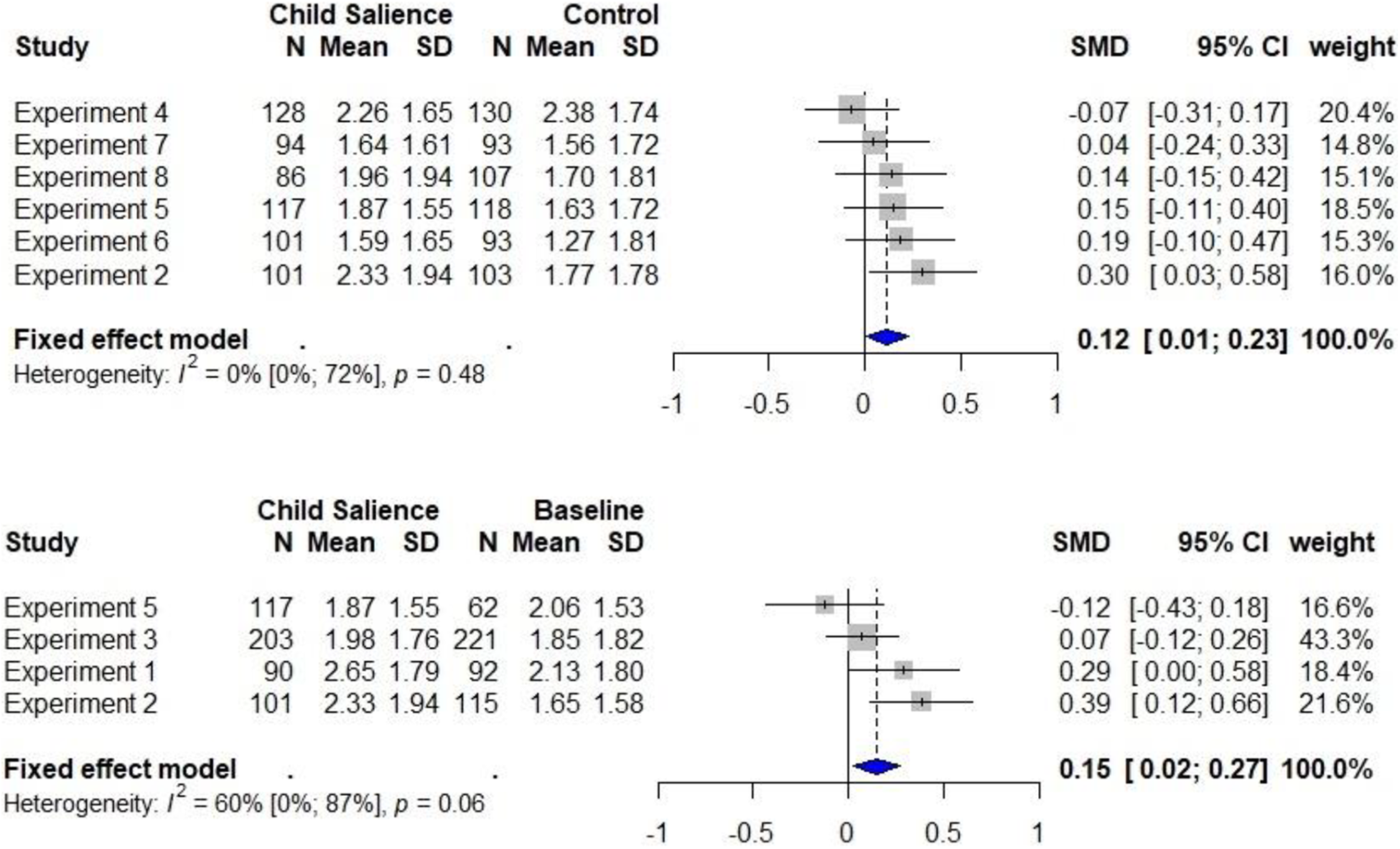
Meta-analytic findings. Upper panel: Main effects of child description condition versus the nonchild description condition. Lower panel: Main effects of child description condition versus the baseline condition. Note. SMD = standardized mean difference.
Child description versus baseline
The comparison between the child salience and baseline conditions showed moderate, but nonsignificant, heterogeneity (I 2 = 60%, p = .06; Figure 2 lower panel). The aggregated effect size across experiments, .15 (95% CI [.02, .27], z = 2.30, p = .021), replicated the significant difference between the child and nonchild description conditions.
Moderation analyses
Using PROCESS (Model 1, 5,000 iterations; Hayes, 2018), our moderation analyses entered condition (i.e., child salience vs. nonchild control or child salience vs. baseline) as the predictor, prosocial values as the outcome, and each potential moderator in separate analyses (see Table S3 in the supplement for analysis outcomes).
Description task moderators
In comparisons between the child salience and nonchild description conditions, we examined the extent to which participants were able to form a clear mental image of the described child/adult (1 = not at all to 7 = very much; five experiments) and how enjoyable participants found the description task (1 = not at all to 7 = very much; six experiments) to test whether the child salience effect emerges more strongly among those who show the ability and willingness to engage with the task. The interaction between child salience and mental image clarity was significant, b = .19, 95% CI [.05, .34], p = .010. The simple effect of child salience pointed in the expected direction at higher and intermediate levels of mental imagery, though the effect was only reliable at intermediate levels (M = 5.35), M child salience = 2.09, SD = 1.71 versus M nonchild = 1.70, SD = 1.72, t(781) = −2.56, p = .011, but not at higher levels (>+1SD; 6.90), M child salience = 2.32, SD = 1.75 versus M nonchild = 1.99, SD = 1.83, t(781) = −1.26, p = .211. The simple effect of child salience at lower levels of mental imagery was nonsignificant and pointed in the opposite direction (<−1SD; 3.54), M child salience = 2.03, SD = 1.83 versus M nonchild = 2.47, SD = 1.83, t(781) = 1.22, p = .226. Hence, child salience elicited higher prosocial values more strongly when participants reported forming a clearer mental image during the description task. Task enjoyment did not moderate the impact of child salience on prosocial values (p = .63). 4
Child-specific moderators
Four experiments comparing the child salience and nonchild descriptions included the Attitudes Towards Children Scale (Wolf et al., 2020) to measure perceived affection toward children (α = .74–.95; e.g., “Children make me feel happy”) and perceived stress elicited by children (αs = .77–.84; e.g., “Children make me feel anxious”) on a scale from −3 (strongly disagree) to +3 (strongly agree). Wolf et al. found consistent support for the scale’s two-factor structure and the unique predictive validity of each factor (see Supplement for more details). Contact with children over the past weeks was measured in five experiments (1 = no time at all to 7 = a lot of time): Four compared the child salience and nonchild description conditions, and two compared the child salience and baseline conditions. None of these variables moderated the impact of child salience in the comparisons between the child salience and no-child description conditions (affection: p = .28, stress: p = .93, and contact: p = .75) and between the child salience and baseline conditions (contact: p = .053; see Supplement for a breakdown of the marginally significant interaction with contact).
Demographic moderators
We considered three demographic moderators: participant age, gender, and parenting status. None of these variables significantly interacted with the impact of child salience across the comparisons between the child salience and nonchild description conditions (age: p = .78, gender: p = .58, and parenthood: p = .59) and between the child salience and baseline conditions (age: p = .22, gender: p = .076, parenthood: p = .55; see Supplement for a breakdown of the marginally significant interaction with gender).
Summary
The aggregate findings across eight experiments revealed small but consistent effects of the salience of children on prosocial values. The effects were more reliable among participants who reported forming a relatively clear mental image of the described child/adult. Of interest, child salience increased prosocial values regardless of participants’ attitudes toward or contact with children, age, gender, or parenthood status. The persistence of the child salience effect across these variables is revisited in our General Discussion.
Field Study
An observational field study examined the behavioral implications of the salience of children in everyday life. We expected that a higher proportion of children relative to adults on a public shopping street would elicit more donations from adult passersby.
Method
Procedure
Donations to a cause not specifically related to children were observed in a naturalistic environment. Two researchers carried donation buckets with a bone marrow charity logo and wore sweaters from the charity during data collection. Data collection occurred on a residential shopping street in a UK city, on 12 days in March 2019. The area was chosen because of its relatively high footfall and proximity to several schools. Because schools in the area finished at approximately 3:30 p.m., we collected data between 3 and 5 p.m., given that children could be expected to be most salient during that time of the day. During data collection, one researcher collected donations using the prompt “Any spare change for Bath Marrow?” while the other researcher recorded the weather and the number of children and adults present every 2 min. When a donation was made, the researcher noted the donor’s gender and whether the donor was accompanied by a child. Children were identified as being in school uniform or clearly under 16 years of age.
Data preparation
The final data set contains 721 two-minute intervals. Each interval shows the proportion of children to adults (i.e., child salience), the number of donations (i.e., prosocial behavior), the weather, and how many of the donations were made by women, men, adults with a child, or adults without a child. We combined the 2-min timeslots into 142 ten-minute timeslots to reduce noise. 5 These 10-min timeslots served as the units of analysis.
Because the proportion of children to adults showed a right-skewed distribution, we used the square root of this proportion in analyses. For moderation analyses, we computed an index indicating the relative number of men and women per timeslot by subtracting the number of female donors from the number of male donors. A similar index was computed for accompanying children by subtracting the number of donors without a child from the number of donors with a child. Weather was coded as sunny (+1), cloudy (0), and rainy (−1). Finally, we tested whether the effect depended on the time of day.
Results and Discussion
Across the 142 ten-minute intervals of data collection, 231 adults donated, 122 of which were male, 109 female, 34 were accompanied by children, and 197 without children. The analysis showed a significant positive correlation between the proportion of children present and the number of donations, r(142) = .22, p = .009.
We next tested whether this effect was dependent on donor gender, whether they were with a child, the weather, and the time of the day. Zero-order correlations showed that the proportion of children did not correlate with donor gender, accompanying child, weather, or time of day (all ps > .27). We next ran two-step regression analyses with the proportion of children and the potential moderator simultaneously entered in the first step, their interaction entered in the second step, and donations entered as the outcome. Results indicated that the effect of proportion of children remained significant in each analysis, with no moderating impact of the added moderator variables (gender: p = .50, accompanying child: p = .25, weather: p = .59, time of day: p = .16; see Supplement for the regression coefficients).
Summary
People were more likely to donate when children were relatively more salient on a shopping street. This association was not dependent on whether the donor was male or female, whether the donors were accompanied by a child, the weather, or the time of day.
General Discussion
We conducted eight experiments and one field study testing whether the salience of children elicits general prosocial motivation and behavior in adults. The analysis of child salience effects across our eight experiments supports this prediction. Participants who completed a task making children salient subsequently reported higher prosocial values (e.g., helpfulness, social justice) than those who completed control tasks making adults or a mundane situation salient or those who completed the study at baseline. These effects were not moderated by participant gender, age, parenthood, attitudes toward children, and self-reported contact with children.
We also found that child salience predicts behavior in a naturalistic setting. When children were more salient on a busy pedestrian street, adults were more inclined to make a donation for a cause not specifically related to children. This effect was present irrespective of whether the donor was male or female, whether they were themselves accompanied by a child, the weather, and the time of day.
Overall, these findings indicate that the salience of children elicits higher prosocial motivation and behavior in adults, and this effect emerges across different settings and a range of demographic variables. From a broader perspective, these findings go beyond previous evidence supporting links between (one’s own) children and compassion (e.g., Bleske-Rechek et al., 2010; Palomo-Vélez et al., 2020) and point to a broad link between mental representations of children per se and prosocial values and behavior in adults (e.g., Best, 1993; Burkart & van Schaik, 2010; Snowdon & Cronin, 2007). Moreover, the finding that child salience effects emerge across demographic variables is consistent with observations that the caretaker role in human societies is shared among group members (Hrdy, 2005) such that parents and nonparents develop similar motivations linked with children.
It is noteworthy that the effect of child salience on prosocial values is reliable though relatively small in our chosen experimental paradigm. Inferences from this effect size must be situated by the fact that our description task depended on participants’ ability and willingness to briefly describe children, as evidenced by our moderation analyses showing that child salience effects are more pronounced among those who reported forming a relatively clear mental image of a child/adult. Importantly, the meta-analysis provides consistent support for the expected child salience effect in both experimental comparisons, giving more confidence in the effect. Moreover, the effect of child salience on donations in a public street was reliable and of small-to-medium size, despite the high level of distractions in a naturalistic setting. Future research would benefit from devising additional realistic but involving ways to evoke mental representations of children (e.g., interacting with children) and from studying the extent to which the effects are generalizable to other contexts and cultures.
There are further interesting questions to explore regarding the mechanisms that connect mental representations of children to prosocial values. Our approach was most closely related to work on indirect semantic goal or behavior priming, wherein the presentation of semantic content (here: children) increases the accessibility of an associated goal or behavior, making it more likely that those behaviors are executed (Janiszewski & Wyer, 2014; Weingarten et al., 2016). Although behavioral priming research has been met with intense scrutiny after the emergence of prominent replication failures (e.g., Shanks et al., 2013), closely related literatures on evaluative priming and behavioral mimicry are established beyond doubt (Bargh, 2014; Ferguson & Mann, 2014), and more recent meta-analyses find reliable evidence for behavioral priming effects that are robust to publication bias and questionable research practices (Shariff et al., 2016; Weingarten et al., 2016). Nevertheless, Weingarten et al.’s meta-analysis also found that both original studies and replication attempts were severely underpowered, producing nonsignificant results at a rate of 4:1, and many behavioral priming researchers acknowledge that additional research is needed to shed light on relevant moderators and mediators of the effects for better replicability (Cesario, 2014; Higgins & Eitam, 2014; Newell & Shanks, 2014). The present research provides a well-powered example that making a social category salient can influence related goals and behavior and suggests that the level of task immersion (i.e., forming a clear mental image of a child/adult) may be a useful moderator. It is further conceivable that we found a reliable effect because the prime was self-generated (Cesario & Jonas, 2014; Loersch & Payne, 2014), children are generally viewed positively and are universally relevant, meaning that effects may be stronger and more comparable across participants (Cesario & Jonas, 2014; Wheeler et al., 2014), and the outcomes were flexible enough to detect shifts (Fujita & Trope, 2014). Future research could further explore the underpinning mechanisms at work, including whether the accessibility (i.e., ease of retrieval) of prosocial motives functions as a mediator of child salience effects on behavior.
Of importance, we do not expect that the obtained effects are unique to children. Other human and nonhuman social categories may elicit broad prosocial motivations and behaviors, including groups that are viewed as deserving of help (e.g., the elderly, victims) and groups that are themselves associated with prosocial behavior (e.g., nurses, superheroes; Aarts et al., 2005; Van Tongeren et al., 2018). We chose to examine the effects of child salience not because they are the only category to elicit such effects but because the social cognitive effects of this category have the potential for high global relevance, and these effects may be underestimated in their pervasiveness and potential impact. This impact may be particularly important for a range of reasons. Children are generally viewed as more innocent, naive, and vulnerable than other groups (Goff et al., 2014; Wolf et al., 2020), and they trigger empathy and caretaking motivations (Bleske-Rechek et al., 2010; Glocker et al., 2009). Moreover, children may be unique in motivating adults to be good role models, while setting prosocial injunctive norms (e.g., to avoid swearing in front of children) which may drive effects on broad prosocial motivation. Another important attribute of children may be their relative powerlessness, which has been found to evoke feelings of social responsibility (Handgraaf et al., 2008). Future research could explore the extent to which these and other attributes of children (e.g., age, gender, mood) are relevant to the effects of child salience, while considering a range of outcomes beyond prosocial motives (e.g., aggression, creativity, temporally distant cognition).
The primary dependent measures in our research were values and donations, which have been shown to reflect prosocial attitudes and behavior (e.g., Boer & Fischer, 2013; Sagiv et al., 2017). Some of our studies explored additional outcomes, including prosocial intentions (Pavey et al., 2011), social value orientations (SVO; Murphy et al., 2011), and empathic emotions (Batson et al., 1995). Noting that interpretations of these additional outcomes are constrained by the lower sample size, only empathic emotions showed consistent effects of child salience such that child salience elicited more empathic emotions (e.g., sympathy) with other people’s adversities in concrete scenarios (see Supplement for cross-study analyses on these outcomes). It may be the case that the measures of prosocial intentions and SVO were influenced by social desirability concerns or that the child salience effect triggers a spontaneous/emotional response that impacts responses on measures of values, empathy, and donation behavior but not these arguably more deliberate outcomes. Future research could explore this possibility directly and test other prosocial or pro-environmental outcomes.
The present research provides a glimpse of a much bigger picture. Children are indirectly dependent on how adults behave toward each other and toward the planet as a whole. Yet, children are separated from many adult environments, such as workplaces, bars, and restaurants, and from political bodies where important decisions affect their future (Webb, 2004; Westman, 1991). Relatedly, there have been calls for child parliaments or for the explicit consideration of children in legislative bodies (Graham et al., 2017; Read, 2012), and some organizations have been set up for this purpose (e.g., Children’s Parliament, 2020). The finding that child salience motivates adults to be more prosocial may encourage more explicit or implicit integration of children in contexts where adults make important long-term decisions. Through further study of the role of children in prosocial motivation, we can better understand when and how children affect adults’ social motivations, with broad ramifications for further developments in the inclusion of children in adult spheres of activity and decision making.
Supplemental Material
Supplemental Material, sj-docx-1-spp-10.1177_19485506211007605 - The Salience of Children Increases Adult Prosocial Values
Supplemental Material, sj-docx-1-spp-10.1177_19485506211007605 for The Salience of Children Increases Adult Prosocial Values by Lukas J. Wolf, Sapphira R. Thorne, Marina Iosifyan, Colin Foad, Samuel Taylor, Vlad Costin, Johan C. Karremans, Geoffrey Haddock and Gregory R. Maio in Social Psychological and Personality Science
Footnotes
Acknowledgements
We thank all of the following students at the University of Bath for their help with data collection: Hannah Bratt, Si Lok Chan, Paige Davies, Alice Drake, Maddie Holden, Katya Kowalski, Kristin Lee, Angie Min, Rebecca Rogers, Summer Law, Chris Shine, George Skingley, Lorraine Sun, Cody Yen.
Declaration of Conflicting Interests
The author(s) declared no potential conflicts of interest with respect to the research, authorship, and/or publication of this article.
Funding
The author(s) disclosed receipt of the following financial support for the research, authorship, and/or publication of this article: This study was supported by Economic and Social Research Council (grant ID: ES/P002463/1).

Supplemental Material
The supplemental material is available in the online version of the article.
Notes
Author Biographies
Handling Editor: Igor Grossmann
References
Supplementary Material
Please find the following supplemental material available below.
For Open Access articles published under a Creative Commons License, all supplemental material carries the same license as the article it is associated with.
For non-Open Access articles published, all supplemental material carries a non-exclusive license, and permission requests for re-use of supplemental material or any part of supplemental material shall be sent directly to the copyright owner as specified in the copyright notice associated with the article.
