




Abstract
Romantic relationships activate a process of psychological attunement whereby self-esteem becomes responsive to the romantic bond, thereby potentially benefitting relationship quality and bolstering self-esteem. Yet some people are romantically single, raising the question: Do single people also exhibit psychological attunement? In a 2-year longitudinal study of young adults (N = 279), we test whether singles psychologically attune to their friendships. Multilevel modeling revealed that within-person fluctuations in friendship quality predicted within-person fluctuations in self-esteem, and this association was stronger for singles than for partnered people. A cross-sectional mediation analysis also revealed that singles invested more in their friendships than partnered people, and greater friendship investment predicted greater friendship quality and self-esteem later on. Finally, singles maintain their friendship quality over time while partnered people experience declines. Taken together, these results suggest that singles are psychologically attuned to their friendships, and such attunement may benefit their belongingness and self-esteem.
Keywords
“I am someone who is looking for love. Real love. Ridiculous, inconvenient, consuming, can’t-live-without-each-other love.”
“Friendships don’t magically last forty years…you have to invest in them.”
—Carrie Bradshaw, Sex and the City (Star, 2002-2004)
Idealized notions of romantic love and coupledom are ubiquitous. As reflected in the first quote, above, popular culture emphasizes the all-consuming nature of romantic love. Indeed, the romantic bond is revered by the general public and experts alike (Fingerman & Hayes, 2002). Certainly, high-quality romantic relationships can provide a wealth of benefits including a steady source of entertainment and joy, a secure base from which to explore, and a confidant in times of trouble (for a review, see Finkel et al., 2017).
Yet not everyone has a romantic partner, either by choice or by circumstance, and many people spend the majority of their lives without one (i.e., single; DePaulo, 2006). Despite this reality, psychological scientists have largely ignored the single experience (DePaulo & Morris, 2005). In the current research, we take steps toward addressing this critical oversight by investigating how singles meet their belongingness needs in a world that prioritizes romantic relationships.
Belongingness and Psychological Attunement to Romantic Relationships
Humans possess a deep-rooted need to belong that drives them to pursue and invest in high-quality, long-term, mutually caring relationships (Baumeister & Leary, 1995). Within a culture that prioritizes romantic bonds, it is unsurprising that many people meet their need to belong, in part, by seeking and working to maintain high-quality romantic relationships (Gere et al., 2013), sometimes even at the expense of other relationships (Burton-Chellew & Dunbar, 2015). In such a culture, it is also unsurprising that psychologists have devoted considerable time and energy to understanding the psychological adaptations that people possess to facilitate their romantic belongingness goals (Finkel et al., 2017).
Many of these psychological adaptations amount to a fundamental shifting of the self to prioritize the romantic bond. For example, when people fall in love, the attachment system shifts to focus on the beloved, who often becomes the primary attachment figure (Hazan & Shaver, 1987). Most germane to the present research, the self-esteem system also adapts to prioritize the romantic bond, a process that we call psychological attunement (see Anthony et al., 2007).
The self-esteem system is thought to have evolved to serve the need to belong (Leary & Baumeister, 2000). It accomplishes this goal by closely monitoring the social world for cues of acceptance and rejection and using this information to form an internal appraisal of one’s relational value (i.e., global self-esteem). Then, using this internal appraisal as a guide, the self-esteem system motivates behaviors to regulate belonging. The self-esteem system is thought to accomplish these functions, in part, by attuning to important relationships, including romantic bonds. For example, compared to their single counterparts, people in romantic relationships (i.e., partnered people) have self-esteem that is more strongly correlated with domains of the self-concept that are highly prized within romantic relationships (Anthony et al., 2007). Partnered people’s self-esteem is also responsive to the quality of their romantic relationships, such that high-quality romantic relationships enhance self-esteem, whereas poor quality romantic relationships undermine self-esteem (Murray et al., 2003). Thus, psychological attunement to their romantic relationship doubly motivates partnered people to invest in the quality of their romantic bonds because doing so could benefit both their feelings of belonging and their self-esteem. Accordingly, partnered people exhibit relationship-enhancing processes like positive illusions and psychological attachment, which help to maintain rewarding relationships (e.g., Murray et al., 2002).
So partnered people’s psychological attunement to their romantic bonds is seemingly adaptive, benefiting their feelings of belongingness and bolstering self-esteem. Yet these benefits of psychological attunement raise the question: Do single people also exhibit psychological attunement to the important relationships in their lives?
Singlehood and Psychological Attunement to Friendships
As illustrated by the second quote that opened this manuscript, singles are known for their long-lasting friendships (Kislev, 2020). This devotion is warranted. High-quality friendships support psychological health and well-being (Deci et al., 2006; Sun et al., 2019), especially for singles (Ermer & Proulx, 2019). So it would be beneficial for singles to possess psychological adaptations that facilitate their friendship belongingness goals. To this end, we propose that singles psychologically attune to their friendship bonds.
Although friendships have been vastly understudied relative to romantic relationships (Harris & Vazire, 2016), there is some evidence that singles rely on their friendships to meet their need to belong. Singles have more friends than partnered people (Gillespie et al., 2015), and they are more likely to keep in touch with and exchange support with their friends compared to their partnered counterparts (Sarkisian & Gerstel, 2016). Singles also seem to possess psychological adaptations that prioritize their friendships in much the same way that partnered people psychologically prioritize their romantic bonds. For example, singles often develop an attachment bond with their friends (Brumbaugh, 2017). So it is reasonable to propose that singles will exhibit psychological attunement to their friendships. Indeed, self-esteem is responsive to friendship quality, such that higher quality friendships predict increases in self-esteem over time (Stinson et al., 2008). Together, this body of research leads us to propose that singles will be psychologically attuned to their friendships and that singles’ psychological attunement to their friendships will positively predict their belongingness and self-esteem.
Research Overview
We will test our hypotheses using eight waves of data collected from emerging adults during the first 2 years of their university experience. Young adults often strike out on their own and form new friendships and relationships in university (Rawlins, 1992). Thus, emerging adulthood may be a time when psychological attunement to friendships is particularly important for singles.
We examine singles’ psychological attunement to friendships in a few different ways. First, we determine whether people’s self-esteem is attuned to the quality of their friendships in general by examining how closely self-esteem tracks within-person fluctuations in friendship quality over time. Second, we compare people’s psychological attunement to their friendships at waves when they are single versus waves when they are in a romantic relationship, which will reveal whether the self-esteem system dynamically shifts priorities as opportunities for belongingness change. Although we suspect that the self-esteem system is capable of attuning to more than one important relationship at a time (like its cousin the attachment system; e.g., Hazan & Shaver, 1994), we also propose that the self-esteem system prioritizes relationships that offer the best opportunity for need fulfillment (again like the attachment system; Hazan & Shaver, 1994). Thus, we expect that within-person fluctuations in friendship quality will be positively associated with within-person fluctuations in self-esteem for everyone (Hypothesis 1a), but people’s self-esteem will be more strongly attuned to friendship quality at waves when they are single compared to waves when they are in a romantic relationship (Hypothesis 1b).
We also examine whether singles’ psychological attunement to their friendships predicts benefits to their belongingness and self-esteem over time. As we have already reviewed, partnered people’s attunement to their romantic relationships motivates them to invest in their romantic bonds, and such investments benefit their relationship quality (i.e., belongingness) and self-esteem. Similarly, we predict that relative to partnered people, singles’ greater investment in a close friendship at one point in time will predict greater friendship quality and self-esteem at a later point in time (Hypothesis 2a). Moreover, given the relationship-enhancing processes that are thought to follow from psychological attunement to a particular relationship, including investment, we expect that relationship status will moderate the trajectory of friendship quality over time. Specifically, we predict that singles’ friendship quality will remain stable or increase over time, whereas partnered people’s friendship quality will decrease over time (Hypothesis 2b).
Taken together, our research will not only reveal the process of psychological attunement to friendships but also demonstrate how this attunement may change depending on one’s relationship status. Our research therefore stands to illuminate yet another way in which the self-esteem system functions to optimize belongingness (e.g., Anthony et al., 2007; Hoplock et al., 2019; Leary, 2005). Ultimately, then, our research will advance scientific understanding of singlehood, friendship, and belonging by providing necessary and nuanced insight into how belongingness needs are met outside of a romantic relationship.
Methods
All measures, additional analyses (e.g., attunement to family relationship; the trajectory of family and romantic relationship quality over time; testing alternative mediation models) and R code are available in the online supplemental materials (OSM), which are available on the Open Science Framework (doi: 10.17605/OSF.IO/SEUXD). Because this study was conducted before current open science norms were adopted, we do not have consent to share participant data.
Participants and Procedure
Participants were first-year university students taking part in a 2-year longitudinal study of early adult life. 1 We analyze data from eight of 10 waves of internet-based data collection because those waves included the relevant measures. In total, 279 participants completed Wave 1 (80.29% women, 19.71% men; 56% single, 44% partnered; M age = 18.79 years, SD age = .71; 73.97% White, 15.07% Asian). Approximately 2 years later, 98 of these participants completed Wave 8 (80.61% women, 19.39% men, 59.18% in relationship, 40.82% single, M age = 21.04, SD age = .69; 85.92% White, 5.63% Asian). Participants received partial course credit for participating in the initial recruitment phase of the study and had their names entered in a draw for prizes each time they completed a wave of data collection.
The researchers recruited as many participants as possible during a 2-year period. Based on Scherbaum and Ferreter’s (2009) power calculator, our observed power to detect a small (δ = 0.20) and medium effect (δ = 0.50) was 0.60 and 0.99, respectively.
Measures
Relationship status
At each wave, participants reported whether they were in a romantic relationship (1 = yes, 0 = no).
Self-esteem
At each wave, participants used a 7-point scale (1 = strongly disagree to 7 = strongly agree) to indicate their agreement with a four-item version of Rosenberg’s Self-Esteem Scale (1965; average α = .73).
Friendship quality
At Waves 1–3 and Waves 5–8, participants used the same 7-point scale to indicate their comfort being close to their friends, their relational doubts about their friendships (reverse-coded; e.g., Cook, 2000; Fraley et al., 2000), and general friendship satisfaction (Fletcher et al., 2000). These items were averaged to form a composite measure of general friendship quality (average α = .71).
Close friendship investment
At Wave 4 only, participants used the same 7-point scale to indicate their agreement with four items tapping investment in their closest friendship (adapted from Rusbult et al., 1998; e.g., “I have put a great deal into my friendship that I would lose if my friendship were to end.”). These items were averaged to form a composite measure of close friendship investment (α = .84).
Results
Preliminary Analyses
Participants who completed all eight waves did not differ from those who completed only Wave 1 in terms of self-esteem or friendship quality. We controlled for gender (0 = women, 1 = men; measured at recruitment) in the following analyses because gender predicted many of the variables in our models. However, we do not report or interpret gender main effects because of the uneven distribution of gender in our sample (note that gender did not moderate any of the results we report).
Singles Are Psychologically Attuned to Their Friendships
We tested Hypotheses 1a and 1b using multilevel modeling of data collected during Waves 1–3 and Waves 5–8 because only those waves included all of the relevant measures. Using this approach, a stronger association between within-person fluctuations in self-esteem and within-person fluctuations in friendship quality at any given wave reflects a higher degree of attunement between self-esteem and friendship quality.
To test these hypotheses, we used the nlme multilevel modeling package (Pinheiro et al., 2020) in R to examine the associations between friendship quality and self-esteem at any given wave (i.e., collapsing across waves). We used full maximum likelihood estimation, which uses all of the available information to estimate the model parameters (Raudenbush & Bryk, 2002) and allows for missing data at Level 1 but not at Level 2. Cases with completely missing data at Level 1 are dropped during analysis using list-wise deletion. Because waves were nested within participants, we included random intercepts in all models. Partial effect sizes were obtained by calculating the R 2 for individual predictors (Edwards et al., 2008).
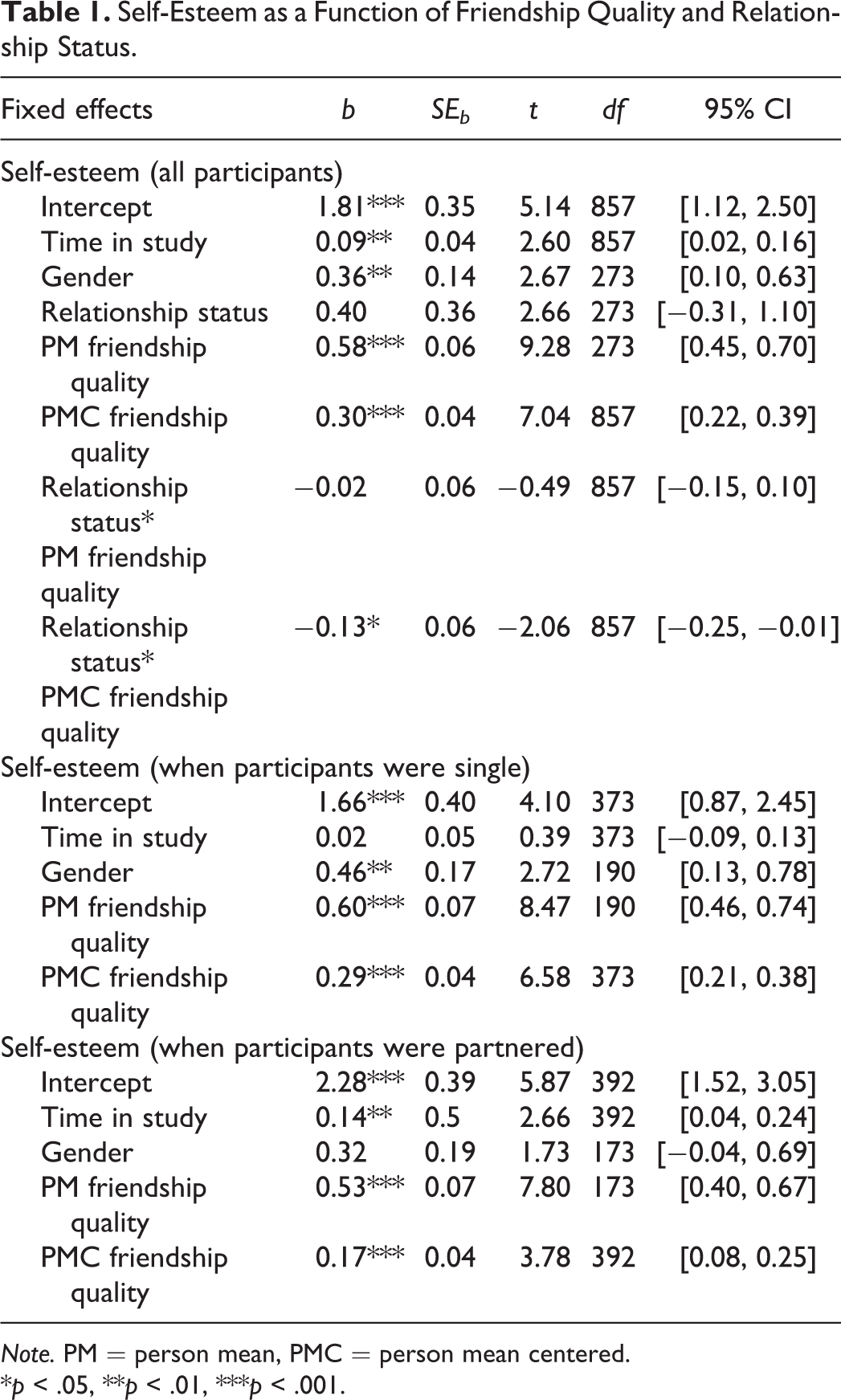
We regressed self-esteem onto time in study at each wave (measured in years elapsed between Wave 1 and each subsequent wave; to control for change in self-esteem over time), relationship status at each wave (0 = single, 1 = partnered), person mean (PM) and person mean centered (PMC) friendship quality, and the interaction between relationship status and each friendship quality index (please see Table 1; following Kowalski et al., 2018). We included two indices of friendship quality in our model: The average friendship quality for participants over the course of the study (i.e., PM friendship quality) and each participant’s deviation around their own mean level of friendship quality (i.e., PMC friendship quality). By including both indices of friendship quality in our model, we can assess between- and within-person associations between self-esteem and friendship quality as a function of relationship status, independent of time (time is therefore included as a covariate in the model). This approach also allows us to observe the attunement of self-esteem to friendship quality (i.e., within-person associations) independent of any between-person association between self-esteem and friendship quality.
Self-Esteem as a Function of Friendship Quality and Relationship Status.
Note. PM = person mean, PMC = person mean centered.
*p < .05, **p < .01, ***p < .001.
A main effect of time indicated that participants’ self-esteem increased slightly over the course of the study (R 2 = 0.005; 0.5% variance explained). Between-person friendship quality (i.e., PM friendship quality) was also positively associated with self-esteem, such that participants with friendship quality that was above the sample average also had self-esteem that was above the sample average (R 2 = 0.17; 17% of variance explained). However, as predicted by Hypotheses 1a and 1b, within-person increases in friendship quality (i.e., PMC friendship quality) also predicted within-person increases in self-esteem (R 2 = 0.05; 5% variance explained), and relationship status moderated this attunement effect (R 2 = 0.005; 0.5% variance explained). As detailed in the bottom two panels of Table 1, participant’s self-esteem was more strongly attuned to their friendships across waves when they were single (b = .29) than across waves when they were partnered (b = .17). Additional analyses revealed that our measures of friendship quality and self-esteem did not differ in terms of their reliabilities or their ranges for single versus partnered participants at each wave (see OSM). We can therefore be reasonably sure that this observed difference in attunement is not a methodological artifact.
Singles’ Psychological Attunement to Their Friendships Positively Predicts Friendship Quality and Self-Esteem
Friendship investment, friendship quality, and self-esteem
The results of our analyses testing Hypothesis 2a are presented in Figure 1. Because we have a measure of close friendship investment only at Wave 4, we tested this mediation model using a measure of relationship status at Wave 4 and measures of general friendship quality and self-esteem at Wave 5. We used hierarchical linear regression to derive the standardized path coefficients in Figure 1, and we used Hayes’ (2013) PROCESS Macro in SPSS to estimate the indirect effects in our model (Model 6 with 5,000 bootstrap estimates).
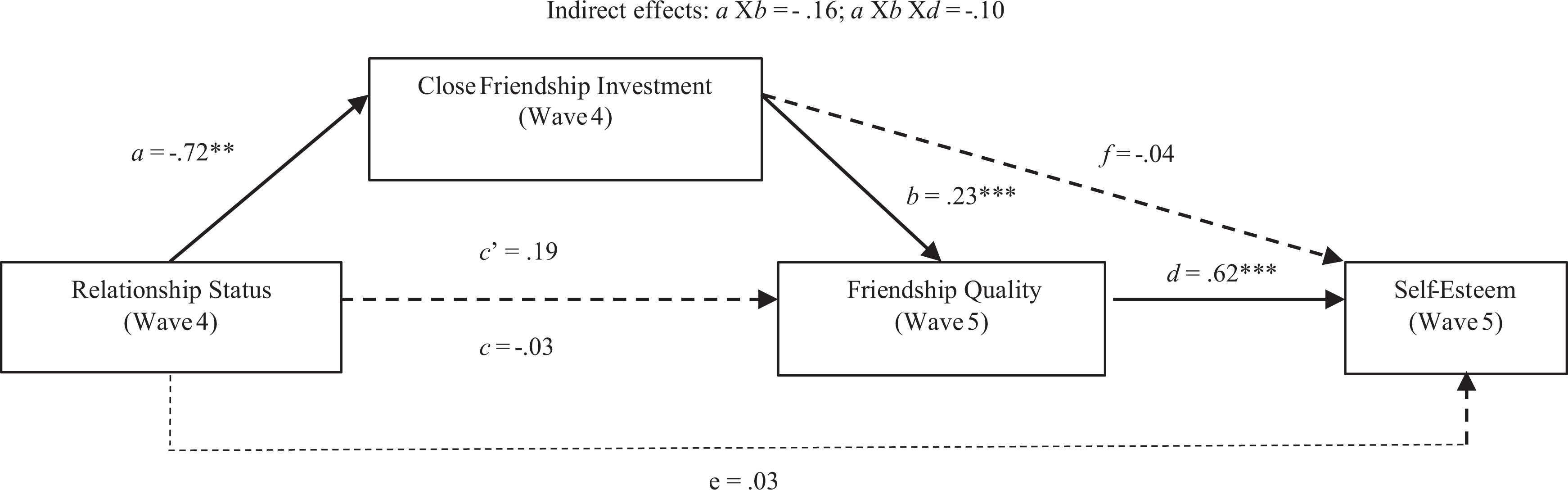
Mediation model describing the associations among relationship status, close friendship investment, general friendship quality, and self-esteem.
As expected, single participants were more invested in their closest friendship than partnered participants at Wave 4, b = −.72, B = −.23, SE = .27, t(126) = −2.66, p = .009. Furthermore, participants who were more invested in their closest friendship at Wave 4 reported better general friendship quality at Wave 5, nearly two months later, b = .23, B = .30, SE = .07, t(125) = 3.42, p < .001. The indirect path from relationship status to general friendship quality via close friendship investment was also present, b = −.16, SE = .08, 95% CI [−.33, −.03], (i.e., Path a × b in Figure 1). In turn, and consistent with the results of the multilevel modeling, we reported previously greater general friendship quality at Wave 5 predicted higher self-esteem at the same timepoint, b = .62, B = .59, SE = .08, t(123) = 7.67, p < .001. Consistent with Hypothesis 2a, singles’ high level of investment in their closest friendship was associated with benefits for their general friendship quality and their self-esteem over time, b = −.10, SE = .05, 95% CI [−.21, −.02], (i.e., Path a × b × d in Figure 1). 2
It is worth noting here that there was no total effect of relationship status on later general friendship quality in these analyses, b = −.03, B = .01, SE = .21, t(126) = 0.15, p = .88 (i.e., Path c in Figure 1), and this lack of a total effect of relationship status on general friendship quality is also apparent at other waves of data collection (see OSM). These findings are seemingly inconsistent with our proposal that singles’ greater attunement to their friendships benefits their friendship quality, relative to partnered participants. However, the absence of a total effect between two variables—in this case, relationship status and general friendship quality—does not preclude the possibility of indirect effects (Hayes, 2013), and the analyses depicted in Figure 1 affirm that exactly such an indirect path from relationship status to general friendship quality via close friendship investment exists. Yet it is also notable that when this indirect path is included in the model, the direct effect of relationship status on friendship quality increases (though the parameter estimate remains statistically nonsignificant; i.e., Path c’ in Figure 1). Overall, this pattern of effects hints at the possibility of inconsistent mediation or suppression. Hence, it is possible that partnered people maintain their general friendship quality through means other than close friendship investment, at least in the short term. We will return to this issue after we have examined how friendship quality changes over the long term as a function of relationship status. Additional analyses testing alternative versions of this model are reported in the OSM.
Friendship quality over time
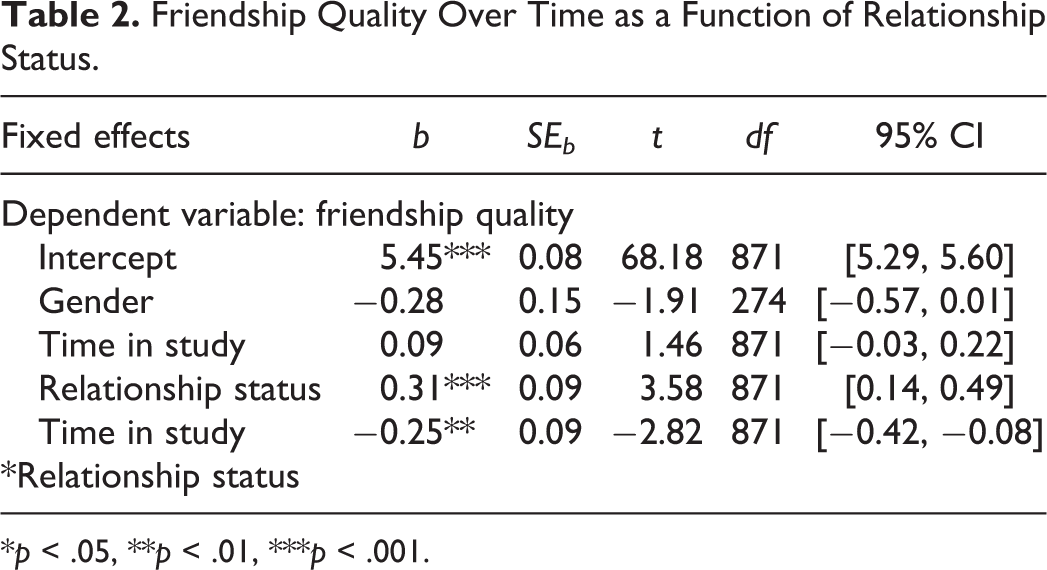
Next, we tested Hypothesis 2b by examining the estimated trajectory of friendship quality over time for singles and partnered people. 3 We used data from Waves 1–3 and Waves 5–8 for these analyses because each of these waves included all relevant measures. We used the same multilevel modeling package in R that we described previously. We tested a model in which friendship quality was regressed onto gender (measured at recruitment), time in study at each wave, relationship status at each wave, and the interaction between time and relationship status; we included random intercepts in each model.
Results are presented in Table 2. As indicated by the relationship status effect for friendship quality, partnered participants were estimated to have higher friendship quality than single participants at the beginning of the study period. However, as predicted in Hypothesis 2b, there was also an interaction between relationship status and time in study (R 2 = 0.008; 0.8% variance explained). The estimated slope of change in friendship quality for singles remained stable or even tended to increase over time, b = .09, SE = .06, t(871) = 1.45, p = .15. In contrast, and as expected, the estimated slope of change in friendship quality for partnered people decreased over time, b = −.16, SE = .06, t(871) = −2.50, p = .01. These findings suggest that even though relationship status did not directly predict general friendship quality in the short term (i.e., at any single wave of data collection; please see Figure 1 and the OSM), singles’ and partnered people’s differential investments in their friendships, among other processes, may have longer-term, cumulative consequences for their friendship quality.
Friendship Quality Over Time as a Function of Relationship Status.
*p < .05, **p < .01, ***p < .001.
Discussion
We expected that singles would exhibit psychological attunement to their friendships. Consistent with this prediction, our multilevel modeling analyses revealed that within-person fluctuations in friendship quality were positively associated with within-person fluctuations in self-esteem, and this association was stronger when people were single than when they were in a romantic relationship. These results support and extend past research demonstrating the contextual sensitivity of self-esteem and belonging (Adamczyk, 2018; Anthony et al., 2007) and provide novel evidence that the self-esteem system attunes to the specific relationships that are most likely to offer a sense of belonging given an individual’s particular relational context.
Our cross-sectional mediation analysis also demonstrated that singles were more invested in their friendships than partnered people, and greater friendship investment predicted greater friendship quality and self-esteem over time. Furthermore, although partnered people’s friendship quality was estimated to decrease over a 2-year period, singles’ friendship quality was estimated to remain stable over the course of the study. These processes may be unique to friendships: Supplemental analyses revealed that relationship status does not predict attunement to nor the trajectory of family relationship quality over time (see OSM for details). Thus, our results suggest that psychological attunement to friendships may have downstream implications for both single’s and partnered people’s belongingness and self-esteem.
For example, despite beginning the study with higher quality friendships than singles, partnered people’s friendship quality declined over the course of the study. Moreover, partnered people’s romantic relationship quality did not increase over time to compensate for these declines in friendship quality (see OSM). It is possible that the all-consuming nature of romantic love (Coontz, 2005; Finkel, 2017) may lead partnered people to invest less in their friendships resulting in the decline of these important bonds over time. This possibility is worrisome given that most young adults’ romantic relationships will end sooner, rather than later (Macskassy, 2013). Thus, young adults who experience a romantic breakup may suffer double blows to their belonging and self-esteem as they contend with the pain of a breakup and the realization that some of their friendships lack the closeness they once had. Unfortunately (or fortunately!), breakups were not frequent enough in our study to test this possibility. Still, our research provides a more holistic and nuanced understanding of the oft-overlooked experiences of singles and highlights a potential pitfall of prioritizing romantic love over friendships during emerging adulthood.
Questions That Remain
What is the direction of causation among self-esteem, investment, and friendship quality?
Because our data are correlational, we cannot make causal claims about the association between psychological attunement and friendship quality. The results of our mediation analyses are consistent with the sociometer model of self-esteem (Leary & Baumeister, 2000), which proposes that self-esteem is an internal reflection of the quality of one’s social bonds. By this account, investing in one’s friendships not only improves the quality of those friendships but also benefits the self. However, the reverse pathway is also possible. Risk regulation theory (e.g., Murray et al., 2006) suggests that people who are higher in trust, who tend to have higher self-esteem, prioritize connection goals and engage in relationship-enhancing behaviors that deepen their investment and strengthen their relationships. Either way, self-theorists acknowledge that self-esteem is both a reflection of the quality of one’s relationships and a motivational and behavioral guide (e.g., Leary & Baumeister, 2000). Thus, it is probable that psychological attunement is a self-reinforcing and recursive process. Singles’ attunement to their friendships may lead them to invest more in those relationships, which may yield interpersonal rewards like increasing friendship quality and personal rewards like increasing self-esteem, which in turn may strengthen psychological attunement, leading to still greater investment, and so on. Thus, psychological attunement and feelings of belongingness may form a feedback loop that ultimately supports well-being. Future research should explore these possibilities.
Are these results specific to university students?
Participants in the current research were recruited during their first 6 months at university––a time of great social and personal upheaval (Adamczyk, 2016). Moving to a new school or city and leaving old friends and relationships behind may heighten the salience and importance of both friendships and romantic relationships for belonging. So our results may not generalize to other life stages, especially ones that offer more stability. However, we suspect that psychological attunement to friendships is important for belonging at any age, especially for singles. Past research highlights the well-being benefits of friendships across the life span and especially in late life (Chopik, 2017; Deci et al., 2006). Nonetheless, future research should examine the process and patterns of psychological attunement to friendships as they unfold across the life course.
What about investment behaviors?
Typically, psychological investment is accompanied by relationship-enhancing behaviors like accommodation, responsiveness, and willingness to sacrifice (Rusbult et al., 1994; Wieselquist et al., 1999). Unfortunately, the current research did not include behavioral measures of investment, nor do we have partner or friend reports of participants’ behavior. We cannot determine whether the processes we observed are “in the head” phenomena, primarily involving participants’ feelings and perceptions or whether singles’ psychological attunement to their friendships translates into observable behavior. We suspect that it is the latter. Although it is possible that people possess adaptive psychological mechanisms that are specific to their romantic relationships, we suspect that psychological attunement is a more general adaptation aimed at helping people meet their need to belong no matter their romantic relationship status. Thus, we suspect that singles’ investment in their friendships is qualitatively similar to partnered people’s investment in their romantic relationship. Future research should test whether this is true.
Conclusions
Our research is the first to examine people’s psychological attunement to friendships and among the first to examine whether psychological processes that were identified within the context of romantic bonds can generalize to the friendship bond. Specifically, our research suggests that the self-esteem system may dynamically shift to prioritize relationships that offer the best chance to optimize opportunities for belonging. For singles, this means that self-esteem attunes to friendships. By studying these processes, our research not only sheds light on an important yet understudied relationship—that is, friendship—but also highlights the critical role that friendships play in supporting singles’ belongingness and self-esteem needs. Our research also points toward a potential pitfall of “couple culture” and the all-consuming nature of romantic love: Namely, that it may contribute to the decline of important friendship bonds. We hope our findings will set the stage for continued investigation of singles’ well-being and the friendships that nourish them.
Supplemental Material
Supplemental Material, Singlehood_and_Attunement_Supplemental_Materials_V3 - Singlehood and Attunement of Self-Esteem to Friendships
Supplemental Material, Singlehood_and_Attunement_Supplemental_Materials_V3 for Singlehood and Attunement of Self-Esteem to Friendships by Alexandra N. Fisher, Danu Anthony Stinson, Joanne V. Wood, John G. Holmes and Jessica J. Cameron in Social Psychological and Personality Science
Footnotes
Authors’ Note
This research constituted part of Alexandra N. Fisher’s doctoral dissertation. The authors are grateful to our research assistants for their help, especially Danielle Gaucher and Megan Boston.
Declaration of Conflicting Interests
The author(s) declared no potential conflicts of interest with respect to the research, authorship, and/or publication of this article.
Funding
The author(s) disclosed receipt of the following financial support for the research, authorship, and/or publication of this article: This project was supported by Social Sciences and Humanities Research Council of Canada grants awarded to D.A.S. [435-2014-1579] and J.V.W. [410-2004-0949].

Supplemental Material
The supplemental material is available in the online version of the article.
Notes
References
Supplementary Material
Please find the following supplemental material available below.
For Open Access articles published under a Creative Commons License, all supplemental material carries the same license as the article it is associated with.
For non-Open Access articles published, all supplemental material carries a non-exclusive license, and permission requests for re-use of supplemental material or any part of supplemental material shall be sent directly to the copyright owner as specified in the copyright notice associated with the article.
