




Abstract
The coronavirus 2019 (COVID-19) pandemic presented policymakers with the need to change people’s behavior in a fundamental way and for an extended period of time. Changing habits is difficult and requires sustained effort, and sustaining effort is especially difficult when it does not seem to yield conspicuous results. The COVID-19 pandemic presented exactly this difficulty, as numbers of infected people continued to rise despite the public’s efforts. In a representative sample from Israel (N = 600), collected online during the first outbreak of the pandemic, we found that compared to control conditions in which information on only actual infection cases was presented, counterfactual information on the number of averted cases enhances the perceived effectiveness of following the guidelines, which, in turn, enhances perceived importance and intention of doing so (e.g., intention to restrict mobility), but only among those who understood the information. The findings align with self-regulation theories and have practical implications for policymakers.
The outbreak of the coronavirus 2019 (COVID-19) pandemic gave rise to guidelines and regulations that sought to introduce vast changes in people’s everyday behaviors. People were instructed to increase familiar behaviors (e.g., wash hands more frequently), adopt novel routines (e.g., put on face masks when in public places), and refrain from habitual actions and procedures (e.g., going out with friends, using public transportation). The new situation was not only difficult but also imposed on people massive social and economic costs. The goal of all these immense efforts was to prevent or slow down the spread of infection. But were they helpful toward that end? And if so, were they perceived in that way? We suspect that the answer to the latter question is negative and suggest that this might have reduced people’s compliance with guidelines and restrictions. We then describe and test an intervention aimed at mitigating this problem.
The Self-Regulation Challenge of Following Guidelines and Mobility Restrictions Related to COVID-19
What makes people persist? Theories of self-regulation offer many important insights, suggesting that persistence increases when people have a clear goal and/or a specific end state toward which they work (e.g., Amir & Ariely, 2008; Brendl & Higgins, 1996; Emanuel et al., submitted; Erez, 2015; Katzir et al., 2020; Latham & Locke, 1991; Locke & Latham, 2002). Effort and persistence increase closer to the goal/end state (e.g., Bonezzi et al., 2011; Emanuel, 2019; Heath et al., 1999; Kivetz et al., 2006; Lewin, 1951; Tucker et al., 2006) and also increase when progress is clear and is continuously monitored (as opposed to a situation in which the actor has no sense about extent of progress; e.g., Carver & Scheier, 1982; Fishbach & Dhar, 2005; Fishbach et al., 2009, 2010; Hofmann & Kotabe, 2012; Kotabe & Hofmann, 2015). Effort also increases to the extent that the actor perceives their efforts as effective (e.g., Cryder et al., 2013; Freund & Hennecke, 2015; Hemed et al., 2020; Hennecke, 2019; Higgins, 2012; Kivetz et al., 2006; Koo & Fishbach, 2012; Molden et al., 2016) and to the extent that they see a clear contingency between the effort they invest and its desired effect (e.g., Dreisbach & Fröber, 2019; Eitam et al., 2013; Erez, 1977; Fröber & Dreisbach, 2014; Haggard et al., 2002; Hofmann & Fisher, 2012; Hommel, 2009; Karsh & Eitam, 2015a, 2015b; Karsh et al., 2016, 2020; Kotabe et al., 2019; Liberman & Dar, 2009; Locke et al., 1988; White, 1959). If the means people are taking to achieve a given goal prove ineffective, they reduce effort, shift to other means, and, if those are unavailable, disengage from the goal all together (e.g., Brandstätter & Schüler, 2013; Brehm & Self, 1989; Carver & Scheier, 1982; Kruglanski et al., 2002; Richter et al., 2016; Wrosch et al., 2003).
Viewed in light of these theories, the governmental guidelines and mobility restrictions that were aimed to contain the spread of COVID-19 posed a considerable self-regulation challenge. The situation clearly did not support persistence, both because people did not know when the mobility restrictions would end and because the most frequently presented piece of information was the (inevitably rising) cumulative number of infected people, which could have made invested efforts seem futile. We reasoned that one way to communicate to people the effectiveness of their effort would be to present information about a worse counterfactual state that the public’s effort helped to avert. We reasoned that increasing perceived effort effectiveness would, in turn, increase people’s motivation to adhere to mobility restrictions and other regulations.
The Current Research
We investigated whether providing participants with easy-to-understand information about averted infection cases, in addition to actual cases (relative to providing them only with the latter), would make them see their effort as more effective and would positively influence their motivation to comply with mobility restrictions and other governmental regulations aimed at containing the spread of COVID-19. We thus provided to some participants a graph depicting counterfactual information, namely the predicted daily number of people who would have been infected had the mobility restrictions not been imposed (i.e., explicated-counterfactual condition). We compared this condition to two control conditions, in which only the number of infected people was presented in the graph (i.e., with no counterfactual information). We examined how presenting averted cases influenced the perceived effectiveness of mobility restrictions, and how it further affected behavioral intentions to follow regulations.
Methods
Participants
We aimed for 200 participants in each of the three conditions (a total of N = 600) to detect a small to medium effect size (Cohen’s f = 0.15) with more than 80% chance at an α level of .05. Sample size was determined using G*Power.
Six hundred and one people (299 men, 302 women, ages 18–74, M = 42.61, standard deviation [SD] = 15.76) participated for pay via the Israeli surveying service “The Midgam Project.” The sample was a representative sample of Israeli Jews. We excluded one participant who completed the experiment in less than 1 min, and two participants who took more than an hour to complete the experiment, assuming too fast and too slow responses were inattentive. 1 The final sample included 598 participants (297 men, 301 women, ages 18–74, M = 42.66, SD = 15.79; demographic information was provided by the company that conducted the study). There were 198 participants in the large-range condition, 198 in the small-range condition, and 202 in the experimental condition.
Procedure and Materials
Time of study
We conducted the study in Israel, on April 13–14, 2020, when Israeli citizens were still under lockdown. The mobility restrictions in Israel were announced on March 12, 2020. Fearing that people will not maintain social distancing during Passover (a major family holiday), more severe mobility restrictions were announced on Passover eve, April 8, 2020, such that people were not allowed to go further than 100 m beyond their homes until April 12, at which time the less severe mobility restrictions were reinstated.
Questions and manipulation
Baseline measure of urgency of acting on COVID-19
After giving informed consent, participants answered on 5-point Likert scales three questions aimed at assessing their initial sense of urgency at acting on COVID-19 (“I follow COVID-19-related guidelines and restrictions”; “It is important to follow COVID-19-related guidelines and restrictions”; and “The Coronavirus is dangerous”). These questions served as a baseline measure for people’s sense of urgency of acting on COVID-19.
Establish knowledge about the pandemic
The next set of questions was designed to set the stage for our manipulation by assessing participants’ knowledge about the pandemic and giving them feedback. Specifically, we asked “How many confirmed cases of COVID-19 have been reported until now in Israel according to the Ministry of Health?” (The response options were “between 0 and 2,000”; “between 2,000 and 4,000”…; “between 14,000 and 16,000”). The correct answer was “between 10,000 and 12,000,” as participants were informed on the following screen, where they read that according to the ministry of health, on April 12, 2020, there were 11,032 confirmed cases in Israel. 2 We then presented to participants five statements and asked them to mark all the correct ones. There were four correct statements (“The COVID-19 virus may spread via droplets of saliva caused by coughing and sneezing”; “The incubation period of the Coronavirus is between 2 and 14 days”; “Some patients with COVID-19 do not show any symptoms”; and “Recovery takes between 2 weeks, in mild cases, and 6 weeks, in more severe cases”) and one incorrect statement (“You can contract COVID-19 only from those who show symptoms of the disease [and not from asymptomatic patients]”). 3
Manipulation
After receiving feedback, participants were introduced to the experimental manipulation. Specifically, they were shown one of three graphs depicting daily 4 confirmed cases from March 12 until April 8, 2020. The cumulative number of confirmed cases appeared in red. Participants read that the mobility restrictions were imposed on March 12, 2020, and that according to experts, their effect would show 2 weeks after that, from March 26, 2020. Participants in the explicated-counterfactual (experimental) condition read that experts built a model that, based on rate of infection, projected the daily infection rates that would have been likely observed without the mobility restrictions, 5 and that these were shown on the graph as well. A column of “saved” cases, namely, the number of people who would have been infected had there been no mobility restrictions, appeared in green on top of each red column of confirmed cases (Figure 1A).
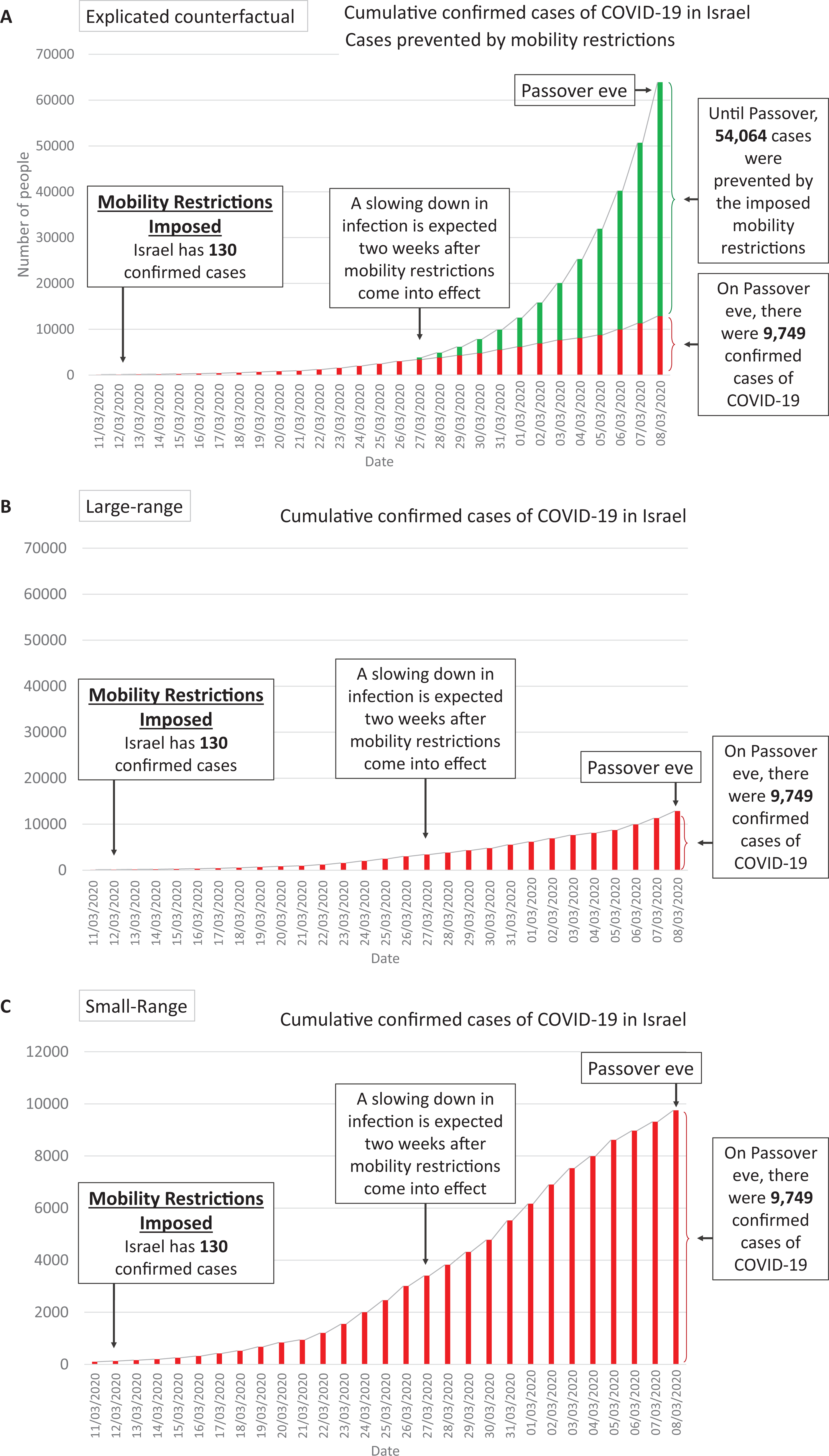
Graphs presented to participants in the explicated-counterfactual condition (A), the large-range control condition (B), and the small-range control condition (C).
We compared the experimental condition to two control conditions: In the large-range control condition, the y-axis was similar to the y-axis in the experimental condition and ranged between 0 and 70,000 (Figure 1B). In the small-range control condition, the y-axis was more conventional and ranged between 0 and 12,000, a value slightly above the highest column (Figure 1C).
Graph comprehension
With the graph still shown, participants rated their extent of agreement (1 = do not agree at all, 5 = totally agree) with a comprehension statement (“I understand the graph”).
Graphs’ impact on perceived effectiveness of the mobility restrictions
Following the comprehension question, while still exposed to the graph, participants answered, on the same 5-point scale (1 = do not agree at all, 5 = totally agree), their agreement with the following statements: “In light of the data, I think that the mobility restrictions were effective,” “The data show that the spread of the disease was slowed down,” “The Graph shows that the effort of the citizens paid off,” “The Graph shows that the mobility restrictions were the right decision,” and “The Graph demonstrates that it is important to follow the guidelines and restrictions.” 6
Post-manipulation urgency of acting on COVID-19
Finally, to examine whether sense of urgency of acting on COVID-19 was influenced by the experimental manipulation, participants answered again the three urgency of acting on COVID-19 items. The question that assessed adherence with guidelines was modified to reflect behavioral intentions for the upcoming week (“How do you intend to behave in the upcoming week? Do you intend to follow the COVID-19-related guidelines and restrictions?”). Importantly, based on the classic theory of planned behavior (e.g., Ajzen, 1991; Ajzen & Fishbein, 1980), we contend that intentions are likely to be good predictors of behavior. The link between intentions and behavior has been also demonstrated in the context of the COVID-19 pandemic, where it was shown that intentions to comply with regulations were associated with reduced infections (Lennon et al., 2020).
Results
In all analyses, we contrast-coded the condition variable into two orthogonal contrasts, creating two variables. The first variable compared the explicated-counterfactual condition (−0.667) to the large-range (0.333) and the small-range (0.333) control conditions (we refer to it as the “experimental contrast”), and the second compared the large-range condition (0.5) to the small-range condition −0.5), but not the explicated-counterfactual condition (0; we refer to it as the “controls contrast”).
Understanding of the Graph
A regression analysis with the two condition contrasts as independent variables indicated that understanding was high (M = 4.24, SD = 0.99, see Figure 2A) and did not differ between conditions; b = 0.02, SE = 0.09, 95% CI [−0.15, 0.19], t(595) = 0.20, p = .840; for the experimental contrast; and b = 0.04, SE = 0.10, 95% CI [−0.16, 0.23], t(595) = 0.35, p = 0.724 for the controls contrast. This is important because the experimental condition presented more complicated data, raising the concern that it would be less understood. Only a minority of participants (20.23%) reported not understanding the graph “to a large extent” (i.e., chose 1, 2, or 3 on the 5-point scale that assessed agreement with “I understand the graph;” 21.8%, 19.7%, and 19.2% in the explicated-counterfactual, the large-range, and the small-range conditions, respectively). We nevertheless thought that it would be important to examine how understanding was related to the impact of the graphs. Obviously, a graph is expected to have less impact on people who report not understanding it.
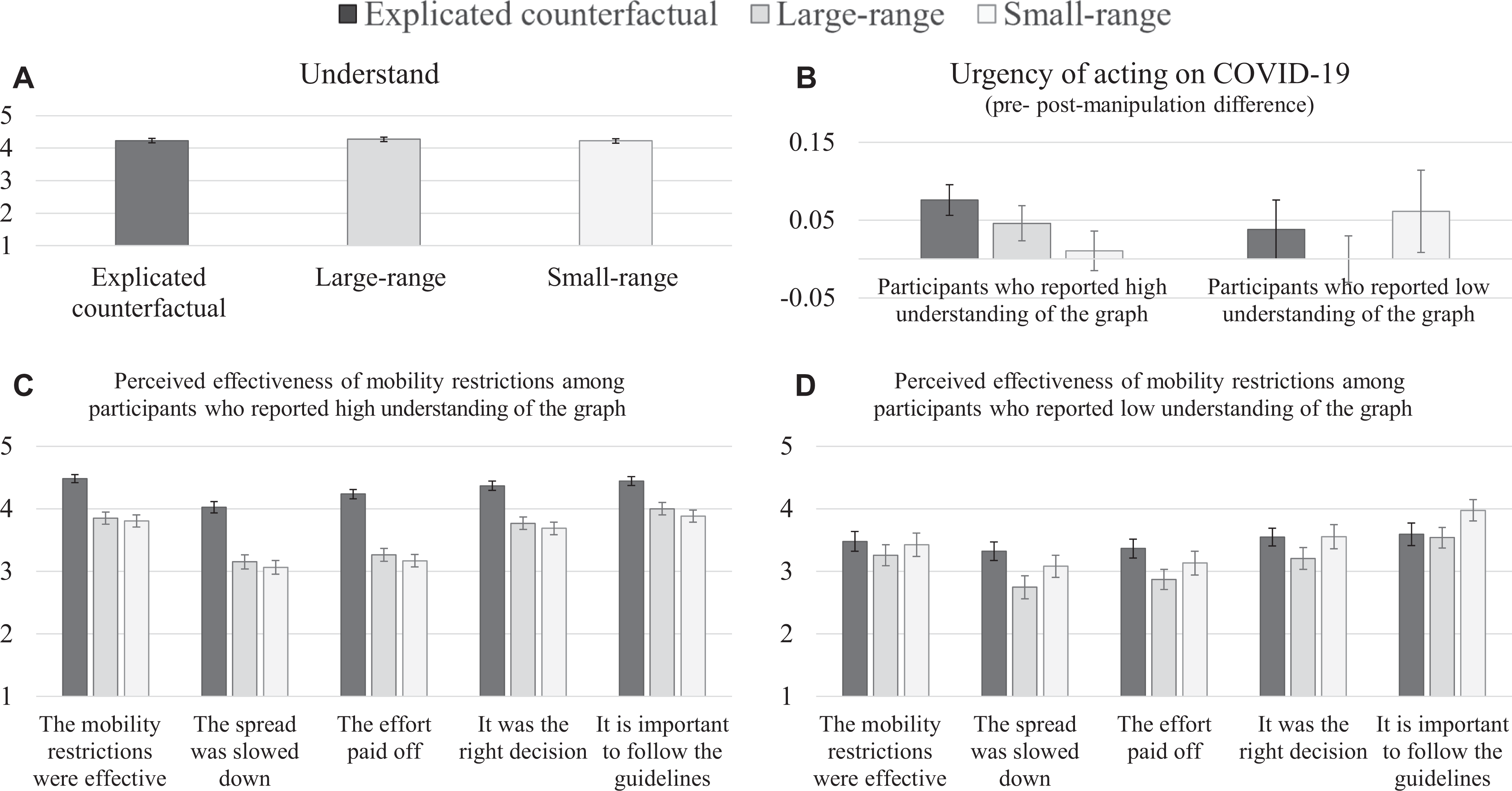
Understanding of the graph (A) as a function of condition. Effectiveness of the mobility restrictions (C and D) and the difference between urgency of acting on COVID-19 before and after the manipulation (B) as a function of condition and self-reported understanding of the graph.
Graphs’ Impact on Perceived Effectiveness of the Mobility Restrictions
Participants’ answers to the questions about the graphs are presented in Figure 2C and D. We conducted a series of regression analyses, in which the two condition contrasts and their interactions with understanding (centered) were the independent variables, and the items concerning the effectiveness of the mobility restrictions (“the mobility restrictions were effective,” “the spread of the disease was slowed down,” “the effort of the citizens paid off,” “the mobility restrictions were the right decision”) were the dependent variables. The results (reported in Table 1) showed that, quite expectedly, the more people understood the graph, the more impact it had on them, all bs > 0.14, all t(592)s > 2.70, all ps < .007. Most importantly, a significant experimental contrast indicated that participants in the explicated-counterfactual condition, more than those in the control conditions, perceived the mobility restrictions as slowing down the spread of the disease, as being effective, as paying off, and as being the right decision, all bs < −0.53, all t(592)s < −5.73, all ps < .001. An interaction between understanding and the experimental contrast; all bs < −0.22, all t(592)s < −2.07, all ps < .039; showed, in addition, that these effects emerged among participants who understood the graph; all bs < –0.64, all t(592)s < −5.62, all ps < .001; but were lower and nonsignificant for those who didn’t, all bs < −0.14, all t(592)s < −0.67, ps < .504.
Regression Analyses of Questions About the Graph.
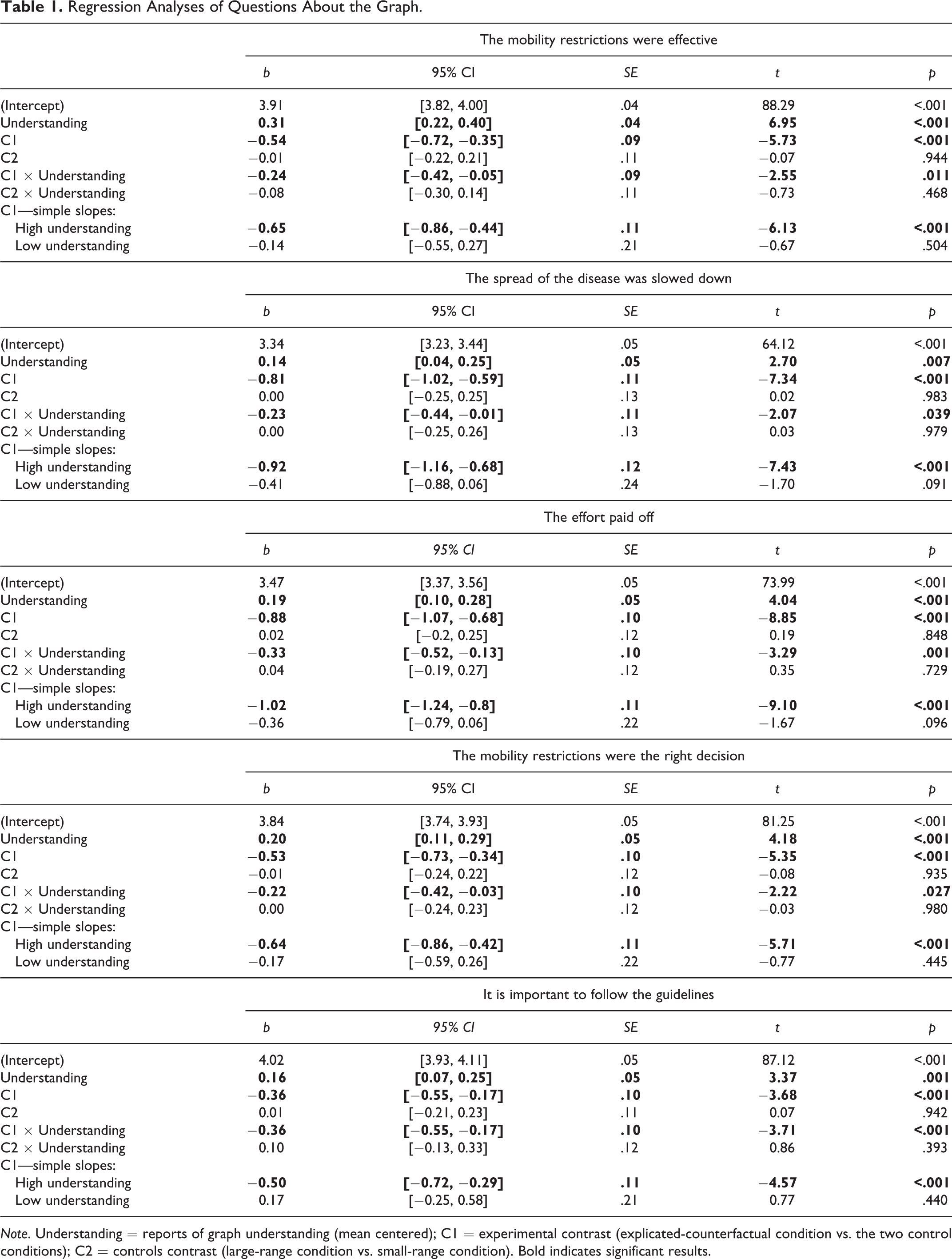
Note. Understanding = reports of graph understanding (mean centered); C1 = experimental contrast (explicated-counterfactual condition vs. the two control conditions); C2 = controls contrast (large-range condition vs. small-range condition). Bold indicates significant results.
In all these analyses, the controls contrast showed neither main effect; |bs| < .02, all |t(592)s| < 0.19, all ps > .848; nor interaction with understanding the graph, |bs| < .08, all |t(592)s| < 0.73, all ps > .468.
Graphs’ Impact on Perceived Importance of Following the Guidelines
The experimental manipulation also influenced perceived importance of following guidelines (see Table 1). Specifically, participants in the explicated-counterfactual condition assigned higher importance to following the guidelines compared to the control conditions, b = −0.36, t(592) = −3.68, p < .001. This, too, interacted with understanding, b = −0.36, t(592) = −3.71, p < .001, such that this effect emerged among participants who understood the graph, b = −0.50, t(592) = −4.57, p < .001, but not among those who didn’t, b = .017, t(592) = 0.77, p = .440.
The controls contrast showed neither main effect; b = 0.01, SE = .11, t(592) = 0.07, p = .942; nor interaction with understanding the graph, b = 0.10, SE = .12, t(592) = 0.86, p = .393.
Perceived Urgency of Acting on COVID-19
Pre-manipulation urgency of acting on COVID-19
Even before the manipulation, participants thought that acting on COVID-19 was fairly urgent (M = 4.54, SD = 0.70; M = 4.52, SD = 0.73; M =3.94, SD = 0.93; for “follow COVID-19-related guidelines and restrictions,” “it is important to follow COVID-19-related guidelines and restrictions,” and “the coronavirus is dangerous,” respectively).
The effect of the manipulation on perceived urgency of acting on COVID-19
To examine how the experimental manipulation affected perceived urgency of acting on COVID-19, we subtracted the mean urgency on Time 1 (Cronbach’s α = .68) from that on Time 2 (Cronbach’s α = .74) and used this difference as the dependent variable in a regression, in which the experimental contrast, the controls contrast, understanding, and the interactions of understanding with each of the two contrasts were the independent variables. The means are presented in Figure 2B. There was no effect for understanding, b = 0.004, SE = 0.01, 95% CI [−0.02, 0.03], t(592) = 0.388, p = .698, and the experimental contrast, although directional, was not significant, b = −0.04, SE = 0.02, 95% CI [−0.09, 0.008], t(592) = −1.62, p = .105. A marginal interaction of the experimental contrast with understanding, b = −0.04, SE = 0.02, 90% CI [−0.08, −0.002], t(592) = −1.74, p = .082, indicated that the experimental contrast was marginal among participants who understood the graph, b = −0.05, SE = 0.03, 90% CI [−0.09, −0.002], t(592) = −1.74, p = .083, but was insignificant among those who didn’t, b = −0.007, SE = 0.05, 90% CI [−0.09, 0.08], t(592) = −0.14, p = .893. Given the high pre-manipulation values of the urgency index, it is not surprising that the experimental effect on the difference was small. There was no effect for the controls contrast; b = 0.02, SE = 0.03, 95% CI [−0.04, 0.07], t(592) = 0.60, p = .547, nor did it interact with understanding, b = 0.02, SE = 0.03, 95% CI [−0.04, 0.08], t(592) = 0.68, p = .498.
Did Perceived Effectiveness of the Mobility Restrictions Mediate the Experimental Effect on Urgency of Acting on COVID-19?
Although the effect of the experimental manipulation on post-manipulation urgency of acting on COVID-19 did not reach significance, we turn to examine the indirect effect of the manipulation via perceived effectiveness of the mobility restrictions. 7 Following the recommendations by Hayes and Rockwood (2017), we used the Process macro (Version 3.4; Hayes, 2013) for SPSS (Version 23) to conduct a moderated mediation analysis (Model 8) using 10,000 bootstrapped samples, in which we examined whether the perceived effectiveness of the mobility restrictions (an average score of the four graph questions, Cronbach’s α = .86) mediated the effect of the experimental contrast on urgency of acting on COVID-19 (i.e., the average score of the post-manipulation urgency items, at Time 2), and whether this mediation was moderated by self-reported understanding of the graph. As recommended by Hayes and Rockwood (2017), the pre-manipulation measure of urgency of acting on COVID-19 was entered as a covariate to the model. The independent variable was the graph condition, and it was entered as a two-condition contrasts (defined as “Helmert contrasts” in Process): One contrast compared the experimental, explicated counterfactuals condition to both controls (the experimental contrast), and the second contrast compared the two control conditions to each other (the controls contrast). The results of this analysis are depicted in Figure 3.
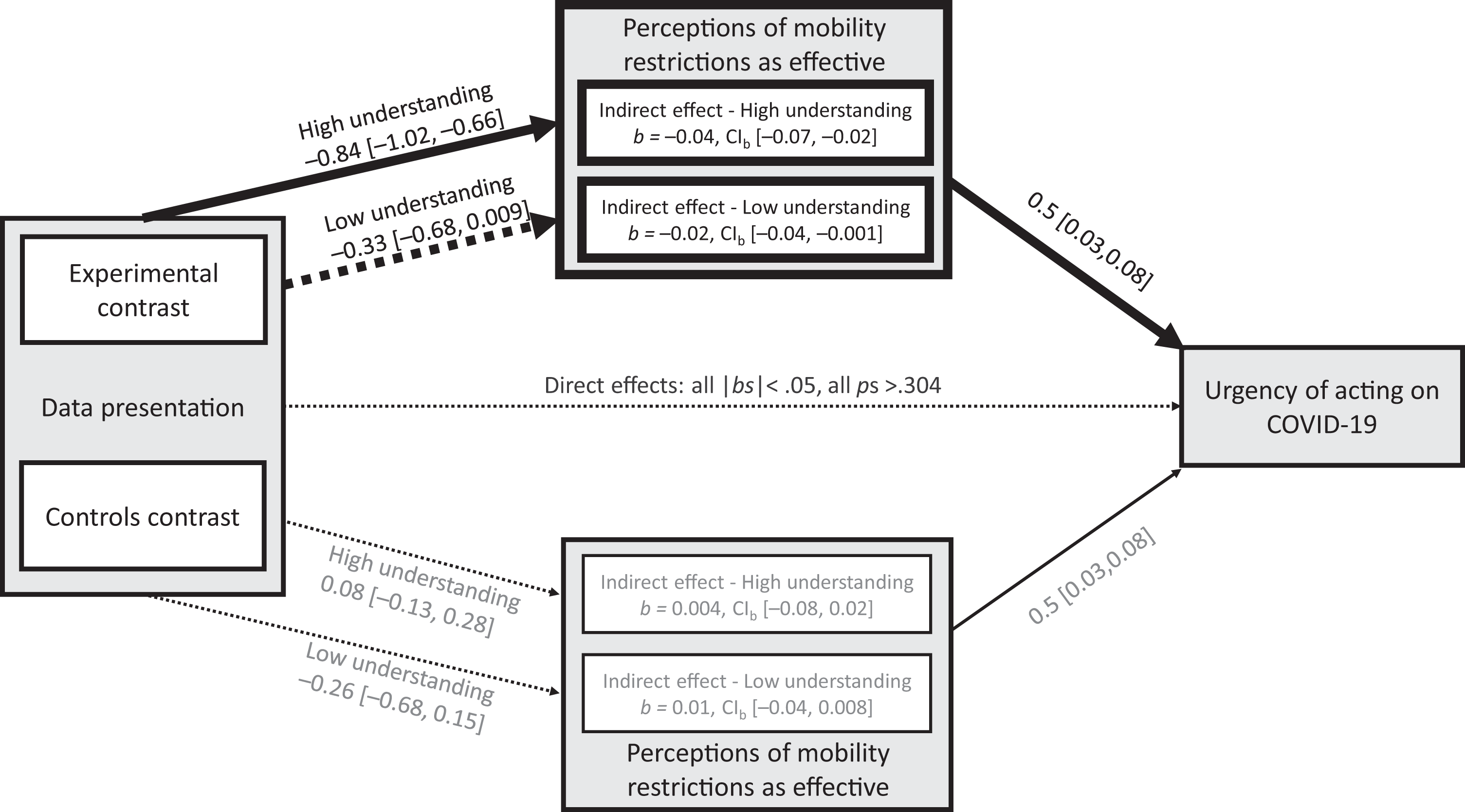
Moderated mediation analysis. The experimental contrast (explicated counterfactual vs. controls) affected urgency of acting on COVID-19 by affecting perception of mobility restrictions as effective. This mediation was moderated by graph understanding. The controls contrast (comparing the two control conditions) was not associated with perceptions of mobility restrictions as effective or with urgency of acting on COVID-19. There were no direct statistically significant effects. Bold lines indicate significant effects and dotted lines indicate nonsignificant effects. Significant indirect effects are indicated by thick lines.
The analysis indicated that the effect of the experimental contrast on urgency of acting on COVID-19 was mediated by perceptions of the mobility restrictions as effective and that this effect was moderated by understanding of the graph, index for moderated mediation was −0.03, SEb = .01, 95% CI b [−0.05, −0.007]. The indirect effects are consistent with the possibility that participants in the explicated-counterfactual condition saw more urgency in acting on COVID-19 because they perceived the mobility restrictions as more effective. This mediation, moreover, was stronger among those who reported high understanding of the graph, b = −0.04, SEb = 0.01, 95% CI b [−0.07, −0.02], compared to those who reported low understanding, b = −0.02, SEb = 0.01, 95% CI b [−0.04, −0.001].
No such indirect effects emerged for the controls contrast, whether participants reported high, b = 0.004, SEb = 0.01, 95% CI b [−0.04, 0.008]; or low understanding of the graph, b = 0.01, SEb = 0.006, 95% CI b [−0.08, 0.02]. This pattern gave rise to an insignificant index for moderated mediation of 0.02, SEb = 0.01, 95% CI b [–0.007, 0.05], for the controls contrast.
Age, Gender, and Education
More educated people reported understanding the graph better. They also agreed less with the statement that the graph shows that the mobility restrictions were effective, or that it shows that it is important to follow the guidelines. Older people tended to think more that the graph shows that the effort paid off.
Women (compared to men) and less educated (compared to more educated) participants reported more pre-manipulation urgency of acting on COVID-19. No such effect emerged for the post-manipulation measure. Age was unrelated to either the pre- or post-manipulated urgency of acting on COVID-19.
Rerunning the regression analyses reported above with age, gender, and education as additional predictors (Table 1 in the Supplementary Material) did not change the pattern and the significance of the experimental contrast and its interactions with understanding.
Discussion
In an attempt to prevent the spread of COVID-19, the Israeli government ordered citizens to stay home except for necessary activities, to maintain social distancing (avoid meeting friends and relatives), to wear face masks in public places, and to increase hand washing. In a field experiment conducted a month after these guidelines and mobility restrictions came into effect, we found that providing people with counterfactual information about averted infection cases due to these guidelines and mobility restrictions (i.e., the predicted daily number of people who would have been infected had the mobility restrictions not been imposed), in addition to information about confirmed cases, relative to providing them only with the latter, made people see their effort as more effective. Counterfactual information (compared to only factual information) also positively influenced people’s motivation to comply with governmental guidelines and mobility restrictions aimed at containing the spread of COVID-19.
Complying with COVID-19 guidelines and mobility restrictions required a massive change in behavior which was hard to sustain over time. With the number of infected people continuing to rise despite the public’s efforts and the personal, social, and economic costs, it seemed as if all these efforts were in vain. We reasoned that presenting people with averted cases would give them a sense that their efforts paid off. Supporting this notion, we find that our intervention’s effect on urgency of acting on COVID-19 was mediated by perceptions of the imposed mobility restrictions as effective. These findings are in line with self-regulation theories emphasizing the important role perceived action efficiency plays in persistence (Carver & Scheier, 1982; Dreisbach & Fröber, 2019; Eitam et al., 2013; Fröber & Dreisbach, 2014; Hemed et al., 2020; Higgins, 2012; Karsh & Eitam, 2015b; Koo & Fishbach, 2012; Liberman & Dar, 2009; White, 1959; Wrosch et al., 2003).
Previous research on the role of counterfactual thinking in self-regulation has focused on how affective responses to considered counterfactuals influence motivation (e.g., McMullen & Markman, 2000). For example, in the domain of protective health behavior, enacting health-related behaviors was linked to anticipating feeling regret (Abraham & Sheeran, 2004; Leder et al., 2015). Our work suggests that counterfactual thinking may also influence self-regulation by promoting adherence to prevention goals. Counterfactual information that helps to see one’s action as efficient is particularly useful for prevention goals, for which a clear indication of progress (and therefore of the efficiency of one’s effort) is lacking (Brendl & Higgins, 1996; Liberman & Dar, 2009). Providing counterfactual information is expected to work only to the extent that it is perceived as potent (i.e., likely to occur, Petrocelli et al., 2011). In the midst of a pandemic, information on averted infections may be perceived as potent because the warnings in the media and the extreme measures taken (e.g., a lockdown) may make the conditional counterfactual outcome (i.e., an exponential increase in infection rate) seem likely. Perhaps, in light of the high potency, our manipulation may have further stimulated another psychological process—prefactual thinking (Sanna, 1996)—namely, anticipating the spread of the infection in the future if preventive measures will not be taken. Prefactuals have been found to enhance intentions on health-related behaviors (e.g., Bertolotti et al., 2016) and to depend on potency (Petrocelli et al., 2012). We think that in view of these past findings, we could predict that prefactuals would also enhance adherence to COVID-19-related behaviors. This prediction awaits future research.
Maintaining the citizens’ trust in the authorities is of utmost importance, especially in times of crisis (Blair et al., 2017; Dohle et al., 2020; Oksanen et al., 2020; Plohl & Musil, 2020; Rubin et al., 2009; Vinck et al., 2019). In light of this, it is important to provide only accurate, trustworthy information. Could this be done in view of the many models and divergent opinions that the scientific community voiced during the COVID-19 pandemic? We think that the answer is positive, because despite this divergence, consensus could be found. For example, as far as we know, all the models agreed that without intervention, infection rates would grow exponentially, even if they predicted different numbers. Because transparency is a key element in enhancing trust and compliance in times of national crisis (Menon & Goh, 2005; Spalluto et al., 2020), it is important to communicate transparently also the source of the information and the method by which it was obtained, as we did in this experiment. Future research should determine whether providing several estimations based on different models would further promote trustworthiness of such a manipulation.
The experimental manipulation included presenting complex information in a graph. Reassuringly, graphs were understood to the same high extent in all experimental conditions, with only 20% of the participants (evenly distributed between conditions) reporting not understanding the graph to a high extent. It is possible that this figure will be lower among people who do not have access to the internet (and therefore are under-represented in online surveys). Indeed, in our sample, less educated participants reported understanding the graph less. Quite expectedly, the effects of the graphs were more pronounced for those who understood them. This finding suggests an important limitation of the manipulation, namely, that interventions of the type we examined here are expected to affect no more than 80% of the population. Future studies might seek to improve the communication of counterfactual information to reach also the less educated population. For example, instead of presenting model predictions, a different intervention may present actual infected cases in communities that did not impose restrictions. Another possibility would be to supplement statistical information with individual cases (e.g., a story about an individual who had died from COVID-19 she contracted at an unauthorized wedding). Future research is needed to test the effectiveness of communicating this type of information.
Our effective, easy-to-implement intervention is particularly relevant in situations where the impact of costly, nonhabitual behaviors is not easily seen or experienced. Our work can also inform policymakers who seek to change public behavior in other fields such as environment conservation (Hao et al., 2020; Hopper & Nielsen, 1991; Hou et al., 2019; Moser, 2010; Semenza et al., 2008; Wolf & Moser, 2011) and personal health (Bruvold, 1993; Danaei et al., 2009; Dohle & Dawson, 2017; Dohle & Hofmann, 2019; Finucane et al., 2011; Hofmann et al., 2008; Malik et al., 2013; Sieverding et al., 2020; Vogel et al., 2016). A prominent example is behaviors aimed at counteracting climate change, such as recycling, conserving energy, and using public transportation. These behaviors incur immediate personal costs, and despite the best of intentions, efforts often seem futile as global temperatures continue to rise, pollution increases, and wildlife is being damaged. Providing the public with positive information about the effectiveness of their efforts (e.g., information on how much worse things would have been without the concerted efforts) could contribute to enhancing such behaviors.
This study was conducted in the midst of the first wave of the COVID-19 pandemic in Israel. Whether the findings would generalize across places, across time, and situations, and whether it would influence actual behavior, is unknown and awaits future research. Our study does demonstrate that this can be tested in real time. We also think that it demonstrates that counterfactual information can have profound effects on people’s intentions to adhere to regulations. Moreover, this work exemplifies how theories and research on self-regulation may help design policies and educational campaigns directed at behavioral change.
Supplemental Material
Supplemental Material, sj-pdf-1-spp-10.1177_1948550620986288 - Information on Averted Infections Increased Perceived Efficacy of Regulations and Intentions to Follow Them
Supplemental Material, sj-pdf-1-spp-10.1177_1948550620986288 for Information on Averted Infections Increased Perceived Efficacy of Regulations and Intentions to Follow Them by Maayan Katzir and Nira Liberman in Social Psychological and Personality Science
Footnotes
Authors’ Note

Declaration of Conflicting Interests
The author(s) declared no potential conflicts of interest with respect to the research, authorship, and/or publication of this article.
Funding
The research reported in this paper was supported by the Argentina Chair for Social Psychology, granted to N.L.
Supplemental Material
The supplemental material is available in the online version of the article.
Notes
Author Biographies
Handling Editor: Eva Walther
References
Supplementary Material
Please find the following supplemental material available below.
For Open Access articles published under a Creative Commons License, all supplemental material carries the same license as the article it is associated with.
For non-Open Access articles published, all supplemental material carries a non-exclusive license, and permission requests for re-use of supplemental material or any part of supplemental material shall be sent directly to the copyright owner as specified in the copyright notice associated with the article.
