




Abstract
What happens when a primary resource people draw from in times of need is at odds with maintaining a threatened, yet valued, identity? Four studies (N total = 806) examined whether men cognitively disengage from romantic relationships following masculinity threats. As hypothesized, romantically attached men reported less closeness, commitment, and interdependence in their romantic relationships (Study 1), and both single and romantically attached men expressed less positive commitment beliefs (Study 2) following masculinity threats. Supporting a strategy of distancing from interdependence to protect masculinity, perceivers evaluated men who used more interdependent language to describe their relationships as less masculine and more feminine (Studies 3a and 3b). However, exhibiting less interdependence did not restore third-party evaluations of masculinity following a public masculinity threat (Study 3b). Thus, subverting relationship interdependence to protect perceptions of masculinity is an ineffective strategy for restoring masculinity in the eyes of others and may cause unnecessary strain on relationships.
Social identities enable people to organize information about the self in meaningful and purposeful ways, help them cope with the uncertainty of life, and are a source of social capital in the eyes of others (Hogg & Adelman, 2013; Jenkins, 2014; Roccas & Brewer, 2002). Thus, maintaining social identities is important, and people are motivated to think and behave in ways that will restore valued identities when they are threatened. For example, masculinity is a high-status, yet precarious, social identity (Bosson & Vandello, 2011). Masculinity is constructed, enacted, and preserved through gender roles and stereotypes and is associated with social status, power, and dominance over women (Bosson et al., 2005; Wood & Eagly, 2009). Narrow definitions of masculinity can lead men to inhibit emotional expression and avoid dependence on others (Berger et al., 2005; O’Neil, 2008). And masculinity threats have been linked to concerns about public self-presentation, anger, physical violence, and the subordination and objectification of women (e.g., Bosson & Vandello, 2011; Dahl et al., 2015).
In contrast to these antagonistic outcomes, self-threats can also heighten the need for social connection. Drawing closer to others is effective because relationships not only offer instrumental support to manage threats (Overall et al., 2010) but also restore self-worth by signaling love, acceptance, and approval (Baumeister & Leary, 1995; Leary & Baumeister, 2000; Taylor, 2006). Consistently, when both men and women experience self-threats, they typically respond by drawing closer to their relationships (e.g., Feeney & Collins, 2015; Murray et al., 2020; Park & Maner, 2009; Plusnin et al., 2018). This is possible because close relationships function as a self-affirmational resource (e.g., Hart et al., 2005; Murray et al., 2001). And, while the decision to approach a close other in times of vulnerability is often constrained by personality (e.g., Brennan & Bosson, 1998; Downey & Feldman, 1996; Murray et al., 1996; Park, 2010; Simpson et al., 1992), gender differences seldom emerge. In fact, even men with unstable self-views evaluate their relationships more positively in an attempt to defensively improve how they see themselves (Zeigler-Hill et al., 2011). For identity threats in particular, romantic relationships have the added value of functioning as a social identity people can invest in (Day, 2015). Being romantically attached is idealized, whereas single men and women are stigmatized as lonely, unhappy, and unfulfilled (DePaulo & Morris, 2006). Thus, when people experience identity threats, such as a threat to their masculinity, they should not only be motivated to draw closer to their partners because of instrumental benefits but also because it provides a way of affirming and investing in a valued social identity.
However, the precariousness of masculinity could make men reluctant to seek connection with their partners after masculinity threats, thus eliciting the opposite pattern than is typically seen in response to self-threats. Men are often unwilling to violate gender norms or engage in behaviors considered to be stereotypically feminine (Bosson et al., 2005; Croft et al., 2015) because those types of behaviors are generally socially devalued (Block et al., 2019), and men are not socialized to internalize goals that would prompt them to enact such behaviors (Block et al., 2018). Feminine qualities are associated with caring for others, seeking and enjoying dependence, and communal orientations, whereas masculine traits are often associated with prioritizing agency and independence over social connection and dependence (Eagly, 1987; Glick & Fiske, 1996). Relationship interdependence—the extent to which partners mutually depend on and influence one another (Kelley & Thibault, 1978)—is considered stereotypically feminine, despite both men and women benefiting equally from interdependent partnerships (Gabriel & Gardner, 1999). This creates a potential paradox for men who have experienced a threat to their masculinity: Although drawing closer to their romantic partner may help them cope with the threat and align themselves with an alternative valued identity, increasing interdependence with a partner may further subvert and undermine their already threatened masculine identity. Consequently, masculinity threats may motivate men to cognitively uncouple from and downplay the importance of their relationships as an attempt to performatively and publicly restore their threatened masculinity.
Eschewing interdependence may temporarily protect masculinity but can also have serious consequences for relationship well-being. When people prioritize goals that reduce interdependence and focus on the self over communal goals, their partners and relationships suffer (Lamarche & Murray, 2014; Lamarche & Seery, 2019; Le et al., 2018; Murray et al., 1996). By contrast, espousing interdependence is associated with relationship-enhancing thoughts and behaviors and greater relationship stability over time (Rusbult et al., 2004). Thus, even if disengaging from an identity (i.e., the relationship) serves the utilitarian function of protecting their masculinity in the eyes of others, it may ultimately be impractical if it erodes the foundations upon which relationships exist.
Current Research
The current research tested whether masculinity threats motivate men to cognitively disengage from their romantic relationships and undermine relationship interdependence. We hypothesized that masculinity threats would motivate men to distance from their relationships by minimizing relationship closeness, commitment, and cognitive interdependence (Hypothesis 1, Studies 1 and 2). We also tested whether minimizing interdependence publicly restores masculinity. We hypothesized that men who used more interdependent language to describe their relationship would be evaluated as more feminine and less masculine (Hypothesis 2, Studies 3a and 3b) and that using less interdependent language would help restore masculinity in the eyes of others following a public masculinity threat (Hypothesis 3, Study 3b). Studies 1 and 3b were preregistered, and the aggregate data, study materials, and preregistration documents are publicly available on Open Science Framework (OSF): https://osf.io/ju3kw/.
Study 1
Study 1 tested whether romantically attached men respond to masculinity threats by cognitively disengaging from their romantic relationships and curtailing their interdependence.
Method
Participants
One hundred and thirty-nine romantically attached male volunteers over the age of 18 were recruited to participate in this study as part of an undergraduate project. Forty-three participants were removed from the sample for not completing the survey to the end (31 quit before exposure to the manipulation, 12 quit after the manipulated feedback [masculinity threat n = 7, no threat n = 5]), leaving a final sample of 96 participants. 1 The men in this study (M age = 30.91, SD = 12.97) predominantly identified as heterosexual (89%, 2% gay, 7% bisexual, and 2% other) and were predominantly White (89%, 4% Asian, and 7% mixed or multiple ethnic backgrounds). Participants were either casually dating (2%), in a committed dating relationship (55%), or engaged or married (43%) and had been together for 7 years on average (M Rel. Length = 7.41, SD = 9.47). Nearly, all (99%) of our participants reported that they were monogamous (1% consensually nonmonogamous).
Materials and Procedures
Participants were invited to participate in a study of self-perceptions and interpersonal interactions. Eligible participants completed the demographic questionnaire followed by personality measures unrelated to this project. 2 Next, participants completed a series of 40 questions testing their general knowledge. This paradigm was based on masculinity threat manipulations used successfully in the past (Dahl et al., 2015). Following the knowledge test, participants were told that their “gender self-concept” would be calculated based on the knowledge test and that their score would be compared to other men in the United Kingdom. Next, half of the participants received feedback that they had scored on the 37th percentile compared to other men in the United Kingdom, and half received feedback that they had scored on the 83rd percentile compared to other men in the United Kingdom. This feedback was accompanied by a graphical representation of their score placing them in the pink feminine self-concept region (threat condition) or blue masculine self-concept region (no-threat condition). Finally, participants were asked to complete the target measures of closeness, commitment, and cognitive interdependence. Participants completed additional relationship-focused measures unrelated to this project and were debriefed.
Measures
Closeness
A 10-item measure (α = .93; Murray et al., 2002) assessed how close participants felt to their partners (e.g., “I am closer to my partner than any other person in my life”; “I would choose to spend time with my partner over anyone else in my life”) and how close participants perceived their partners felt to them (e.g., “My partner is closer to me than any other person in their life”; “My partner would choose to spend time with me over anyone else in their life,” 1 = not at all true, 9 = completely true).
Commitment
A six-item measure (α = .93; adapted from Rusbult et al., 1998) assessed how committed participants were to maintaining their relationship with their partner long term (e.g., “I am committed to maintaining my relationship with my partner”; “I want my relationship to last for a very long time”) and how committed participants believed their romantic partners were to maintaining the relationship (“My partner is committed to maintaining our relationship”; “My partner wants our relationship to last for a very long time,” 1 = not at all true, 9 = completely true).
Cognitive Interdependence
A four-item measure (α = .72) of cognitive interdependence assessed the extent to which men integrated their relationship into their self-concept (Agnew et al., 1998; “In comparison to other parts of your life [e.g., work, family, friends, religion], how central is your relationship with your partner,” 1 = not at all central, 7 = extremely central).
Results and Discussion
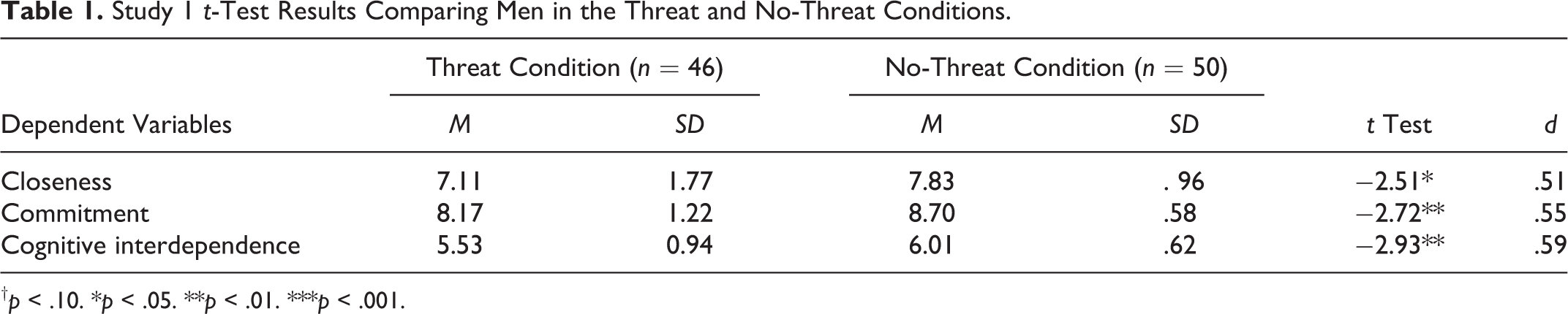
Independent-sample t tests were used to predict closeness, commitment, and cognitive interdependence from masculinity threat condition (Table 1). Consistent with the hypotheses, men in the masculinity threat condition reported significantly less closeness, t(94) = −2.51, p = .01, 95% confidence interval (CI) [−1.29, −0.15], d = 0.51; commitment, t(94) = −2.72, p = .01, 95% CI [−0.90, −0.14], d = 0.55; and cognitive interdependence, t(94) = −2.93, p = .004, 95% CI [−0.79, −0.15], d = 0.59, than those in the no-threat condition.
Study 1 t-Test Results Comparing Men in the Threat and No-Threat Conditions.
† p < .10. *p < .05. **p < .01. ***p < .001.
Study 2
Study 2 aimed to conceptually replicate Study 1 by capturing shifts in commitment beliefs following a masculinity threat. Threatened men were expected to endorse the benefits of relationship commitment to a lesser extent than men in the no-threat condition.
Method
Participants
One hundred and fifty-five male volunteers over the age of 18 were recruited to participate in this study as part of an undergraduate project. Fifty-six participants were removed from the sample for not completing the survey to the end (35 quit before the manipulation, 21 quit after the manipulation [masculinity threat n = 11, no threat n = 10]), leaving a final sample of 99 participants. The men in this study (M age = 24.24, SD = 6.31) predominantly identified as heterosexual (88%, 4.0% gay, 7% bisexual, and 1% other) and White (70%, 9% Asian, 7% Black, and 6% mixed or multiple ethnic backgrounds). Participants were either single (41%) or in a relationship (17% casually dating, 32% exclusively dating, and 8% engaged or married; M Rel. Length = 6.53, SD = 6.06), and nearly, all (93%) of our participants typically practice monogamy (3% consensually nonmonogamous and 4% other style not listed).
Materials and Procedures
Participants in Study 2 completed the same demographic questions and masculinity threat manipulation as those in Study 1. Following the manipulation, participants completed a 16-item measure (α = .83) of commitment beliefs that assesses perceived benefits of being in a committed relationship (Sedikides et al., 1994; “I enjoy being single [reversed],” “I enjoy being dependent on my partner in a relationship,” 1 = strongly disagree, 5 = strongly agree).
Results
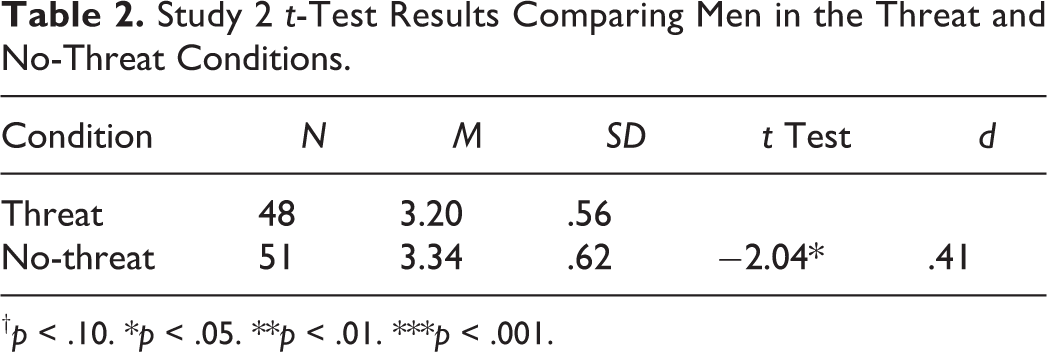
An independent-sample t test was used to predict commitment beliefs from masculinity threat condition (Table 2). Consistent with the hypothesis and the findings from Study 1, men in the masculinity threat condition endorsed commitment beliefs to a lesser extent than men in the no-threat condition, t(97) = −2.04, p = .04, 95% CI [−0.48, −0.01], d = 0.41. 3
Study 2 t-Test Results Comparing Men in the Threat and No-Threat Conditions.
† p < .10. *p < .05. **p < .01. ***p < .001.
Studies 3a and 3b
Masculinity is upheld by personal beliefs and performative behaviors visible to others (Croft et al., 2015). Although cognitively uncoupling from the relationship may be harmful to the relationship structure, it may serve the utilitarian function of mitigating masculinity threats by giving men the opportunity to performatively restore their masculinity in the eyes of others. Studies 3a and 3b examined whether other people perceive more interdependent men as less masculine (Studies 3a and 3b) and whether presenting oneself as less interdependent can restore masculinity in the eyes of others following a public masculinity threat (Study 3b). We hypothesized that people would rate a male target as less masculine and more feminine when he used more interdependent language (Studies 3a and 3b); as less masculine and more feminine when he received a more feminine gender knowledge score (Study 3b); and, that gender knowledge scores and interdependent language would interact, such that less interdependent language would buffer male targets against the public costs of a masculinity threat (Study 3b).
Study 3a
Method
Participants
Study 3a recruited 155 male and female volunteers over the age of 18 to participate in this study as part of an undergraduate dissertation project. Nineteen participants were removed from the sample for not completing the survey to the end (interdependence condition n = 10, agentic condition n = 9), leaving a final sample of 136 participants. The majority of the participants (M age = 27.40, SD = 11.60) in Study 3a were women (62%, 37% men, and 2% other gender identity not listed), were of White (81%) or Asian (10%) ethnic backgrounds, and were either single (33%), casually dating (3%), in a committed dating relationship (44%), or engaged or married (20%).
Materials and Procedures
In Study 3a, participants were told they were taking part in an impression formation study and would make evaluations of others based on limited information. Participants were then randomly presented with one of two profiles: In Profile 1, the man described the importance of his relationship using interdependent language (interdependent condition). In Profile 2, the man described the importance of his relationship using agentic language (agentic condition). Interdependent statements in the profiles were drawn from items in the closeness and cognitive interdependence measures used in Study 1 (e.g., “My partner is an important part of my life because she gives my life so much meaning and I feel closer to her than anyone else” is a combination of Items 2 and 3 from the cognitive interdependence measure and Item 1 from the closeness measure). Next, participants were asked to rate the target across eight dimensions (likability, confidence, masculinity, femininity, extroversion, likelihood for success, commitment to their partner, and likelihood their marriage would last; 1 = not at all, 7 = extremely). Masculinity and femininity ratings were the target evaluations, with the others serving as foils to mask the true purpose of the study.
Results
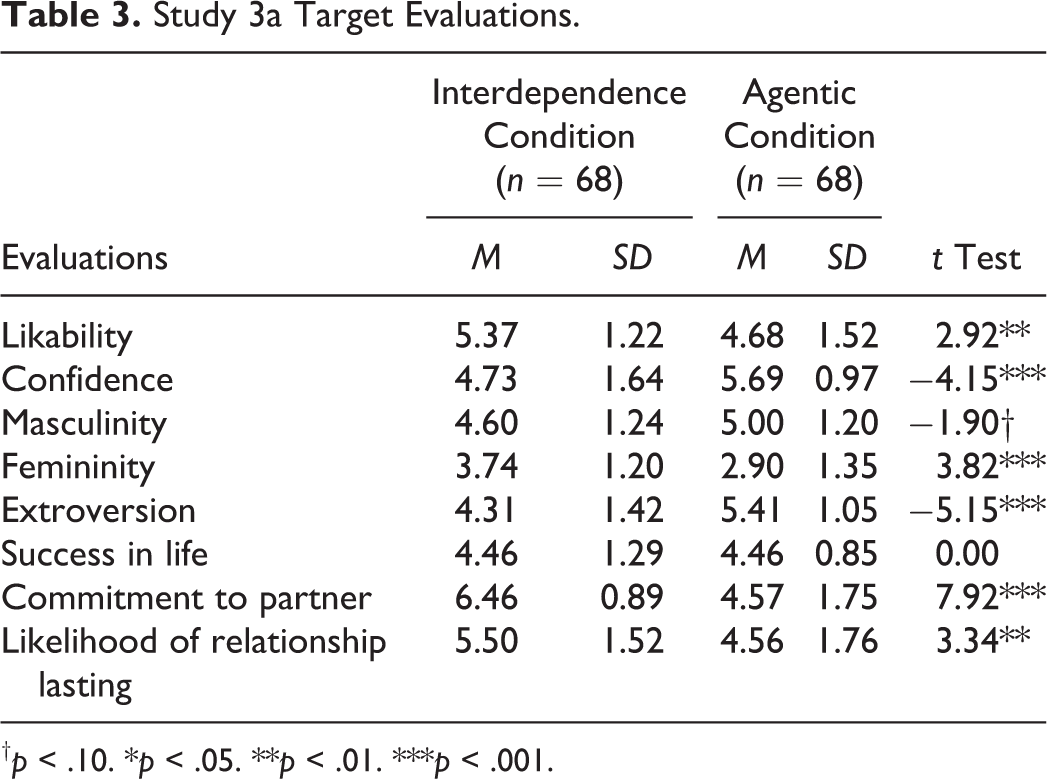
An independent sample t test was used to predict masculinity and femininity ratings from interdependence condition in Study 3a (Table 3). Consistent with our hypothesis, targets who used more interdependent language to describe their relationship were evaluated as nonsignificantly less masculine, t(134) = −1.90, p = .059, 95% CI [−0.81, 0.02], d = 0.33, and significantly more feminine, t(134) = 3.82, p < .001, 95% CI [0.40, 1.27], d = 0.65, by the participants compared to men who used more agentic language. Furthermore, exploratory tests suggested that participants also viewed the target who used more interdependent language as more committed to his partner, t(134) = 7.98, p < .001, 95% CI [1.41, 2.35], d = 1.36, and believed that the target’s relationship would last longer, t(134) = 3.34, p = .001, 95% CI [0.38, 1.50], d = 0.57, compared to targets who used more agentic language. Thus, Study 3a suggests that people perceive men who use more interdependent language as less masculine and more feminine than those who use more agentic language. People also recognize that using more interdependent language signals a greater likelihood of success for that partnership in the future. 4 Although we had no a priori predictions for the other filler questions, significant differences emerged across likability, confidence, and extroversion but not success in life (see Table 3). Men in the interdependence condition were seen as more likable but likewise less confident or extroverted. These ratings, along with the relationship commitment and persistence ratings, map onto traditionally masculine (extroversion, confidence) and feminine qualities (likability, commitment, and persistence). However, caution should be used in interpreting these findings as they were not hypothesized a priori and fall outside the scope of this research.
Study 3a Target Evaluations.
† p < .10. *p < .05. **p < .01. ***p < .001.
Study 3b
Method
Participants
Study 3b recruited 497 participants over the age of 18 from undergraduate subject pools for course credit at the researchers’ universities in the United Kingdom and the United States. Responses from 20 participants were dropped because they had been presented with two conditions (Conditions 2 and 4) concurrently following a computer glitch. An additional 22 participants were removed from analyses for not completing the survey to the end (Condition 1 n = 2; Condition 4 n = 20), leaving a final sample of 455 participants. The majority of participants (M age = 19.71, SD = 3.19) in Study 3b were women (70%, 30% men); were of White (55%), Asian (12%), or mixed ethnic backgrounds (18%); and were either single (53%), casually dating (12%), in a committed dating relationship (33%), or engaged or married (3%).
Materials and Procedures
In Study 3b, participants were provided with the same information regarding the purpose of the study and the same profiles as Study 3b. However, in order to assess whether using less interdependent language restores masculinity in the eyes of others following a threat, the profiles were paired with the target’s gender knowledge scores using the same feedback as Studies 1 and 2 (ostensibly as if the targets had taken the gender knowledge test and this was the outcome). Thus, Study 3b used a 2-interdependence (interdependence vs. agentic) × 2-masculine gender knowledge (masculine vs. feminine) factorial design. Participants then completed the same dependent variables as Study 3a.
Results
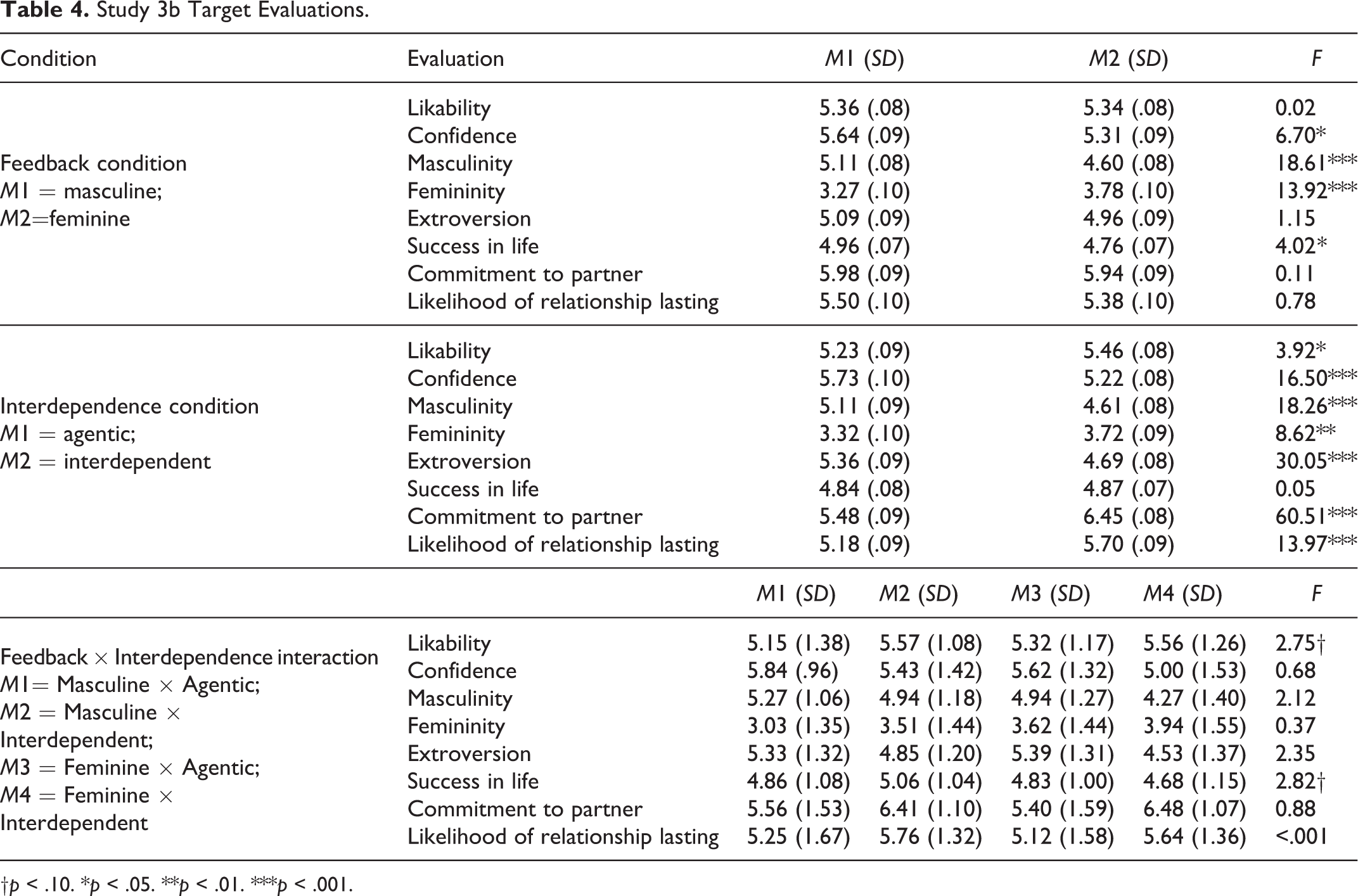
In Study 3b, a factorial analysis of variance was used to predict target masculinity and femininity from interdependence condition, gender knowledge condition, and their two-way interaction (Table 4). Consistent with the hypotheses, targets who used interdependent language were evaluated as significantly less masculine, F(1, 451) = 18.26, p < .001,
Study 3b Target Evaluations.
†p < .10. *p < .05. **p < .01. ***p < .001.
Finally, consistent with the hypotheses, participants rated targets with more feminine gender knowledge scores as less masculine, F(1, 451) = 18.62, p < .001,
General Discussion
Relationships are a valued identity that provide people with both a supportive, self-affirmational resource when vulnerable (Feeney & Collins, 2015; Hart et al., 2005; Hazan & Shaver, 1987; Zeigler-Hill et al., 2011) and a desired social identity with which to affiliate (Day, 2015). It is therefore unsurprising that the typical response is to draw closer to this valuable resource following a self-threat (Murray et al., 2001; Park & Maner, 2009; Plusnin et al., 2018). However, some identities may clash, making it unproductive to compensate for a threat in one by affirming the other. This raises the question, do people default to the typical response of affirming their relationship interdependence when masculinity is threatened? And are these defensive strategies successful in performatively restoring perceptions of masculinity in the eyes of others? In our studies, men compensated for feedback that undermined their masculinity by espousing less interdependence and commitment in their relationships. At first blush, this appeared to be a reasonable strategy, as people evaluated men who used more interdependent language to describe their relationships as significantly less masculine and more feminine. However, the use of interdependent language and public masculinity threats did not interact, suggesting that subverting relationship interdependence to bolster masculinity may not be enough to restore perceptions of masculinity once it is lost in the eyes of others.
Our studies do not directly speak to the relationship implications of cognitively uncoupling in response to a masculinity threat. Nonetheless, our findings may have important consequences for relationship well-being. Effectively balancing and maintaining mutual responsiveness and interdependence is a fundamental cornerstone of happy, long-lasting relationships (Kelley & Thibaut, 1978; Murray & Holmes, 2009). Interdependence is also transformative, shifting people’s thoughts and feelings to focus on the needs, wants, and expectations of their partners rather than just themselves (Holmes, 1981; Rusbult & van Lange, 2008). Thus, the more interdependent people are, the closer they feel, the more important their partners are to them, and the more committed they are to the relationship persisting (Agnew et al., 1998; Berscheid et al., 1989; Clark et al., 1998; Reis & Shaver, 1988). Interdependence therefore signals the health and viability of a relationship. Congruently, in our studies, people saw men who used less interdependent language as less committed to their relationship and doubted the relationship would last. Thus, people are attuned to the benefits of interdependence even when expressed by men who may be encouraged to stereotypically downplay or undermine it. The current findings suggest that when men’s masculinity feels precarious, they may attempt to restore it by withdrawing from a relationship that could otherwise provide care and support. Not only could this harm the well-being of their relationship and directly affect their romantic partners, but our studies also suggest that this tactic may not be an effective strategy to restore masculinity in the eyes of others.
Limitations and Future Directions
Despite their novelty and strength, our findings also inspire important questions for future work to address. First, our findings demonstrate that the common response to draw closer to one’s relationship following a self-threat can be upended for men who experience a masculinity threat. Although this pattern is inconsistent with models showing relationships as a haven during times of stress, it is reminiscent of the “tend and befriend” model of stress and coping, which suggests that women may prioritize affiliative motivations following a stressor compared to men who seemingly prioritize the “fight and flight” stress response pattern (Taylor, 2002, 2006). However, our studies cannot speak to whether masculinity threats are the only self-threat that motivate men to upend the relationship as a safe haven or whether other types of self-threats elicit a similar desire to uncouple from the relationship. Further research is therefore needed to specifically examine what other types of self-threats share similar characteristics with masculinity threats.
Second, our studies focus on one-off masculinity threats and men’s reactions as they pertain to their relationship perceptions. It is possible that while men may express feeling less interdependent, they do not act any differently toward their partner. Alternatively, prior research has shown that men become more aggressive and derogatory toward women in general following a masculinity threat (Dahl et al., 2015). Thus, masculinity threats could lead men to direct more agentic, aggressive, and dismissive behaviors toward their actual partners. Future studies examining the day-to-day interactions between partners could shed additional light on how masculinity threats impact relationship well-being. This would also help clarify whether defensively cognitively uncoupling from the relationship following a masculinity threat helps men restore their own feelings of masculinity or whether this represents a socialized response that may neither be adaptive to the relationship nor functionally repair the threatened identity.
Finally, though not deliberate, our studies were heterocentric in their focus. Although Studies 1 and 2 did not exclude participants based on sexual orientation, the targets evaluated in Studies 3a and 3b were presented as heterosexual men. Gender and sexual orientation are separate identities, but they can interact such that people tend to view gay men as less masculine than straight men (Fiske et al., 2002), despite research suggesting that gay men value appearing masculine (Vogel et al., 2011). The importance and value of interdependence in relationships cuts across gender and sexual orientation. However, it is interesting to note that gay men often express greater interest in low-commitment partnerships and short-term mating strategies (Schmitt et al., 2001). It is unclear from prior research whether these preferences are evolutionarily driven, with men opting for less interdependence and less commitment especially when these goals are facilitated by like-minded partners, or whether they reflect more socially driven expectations about masculinity and interdependence. Our findings may shed new light on these processes. Notably that the extent to which gay men respond to their relatively marginalized and stereotyped masculinity by eschewing interdependence in their relationships could help explain how internalized homophobia and minority stress may contribute to relationship instability among gay men (Fingerhut & Maisel, 2010; Greene & Britton, 2015).
Conclusions
Masculinity is socially valuable yet precarious. When masculinity is threatened, men are motivated to restore it. Although people typically turn to their partners when they feel threatened, dependence is perceived as stereotypically feminine, which may create a conflict for men experiencing a masculinity threat. Our findings suggest that men may in fact cognitively uncouple following a masculinity threat, but this strategy may only spell harm for their relationship as it is ineffective at restoring masculinity lost in the eyes of others.
Footnotes
Authors’ Note

Acknowledgments
The authors would like to thank Hazel Jackson and Bethany Back for their assistance with participant recruitment and data collection for some of the studies reported in this article.
Declaration of Conflicting Interests
The author(s) declared no potential conflicts of interest with respect to the research, authorship, and/or publication of this article.
Funding
The author(s) received no financial support for the research, authorship, and/or publication of this article.