




Abstract
Social networking sites (SNS) are frequently criticized as a driving force behind rising depression rates. Yet empirical studies exploring the associations between SNS use and well-being have been predominantly cross-sectional, while the few existing longitudinal studies provided mixed results. We examined prospective associations between SNS use and multiple indicators of well-being in a nationally representative sample of Dutch adults (N ∼ 10,000), comprising six waves of annual measures of SNS use and well-being. We used an analytic method that estimated prospective effects of SNS use and well-being while also estimating time-invariant between-person associations between these variables. Between individuals, SNS use was associated with lower well-being. However, within individuals, year-to-year changes in SNS use were not prospectively associated with changes in well-being (or vice versa). Overall, our analyses suggest that the conclusions about the causal impact of social media on rising mental health problems in the population might be premature.
Keywords
Social media use has been on a steady rise since its invention. The question of what consequences this development has on individuals’ well-being has spurred dozens of research papers. Some investigations have often painted a rather gloomy picture of social media, making it responsible for loneliness, depression, and even raising suicide rates in adolescents (for a recent example, see Twenge et al., 2018). These findings have led the media to adopt such terms as Facebook depression, raising the alarm in parents and the general public (Keeffe & Clarke-Pearson, 2011) and making governments consider interventions to curtail the harmful consequences of social media use (UK Commons Select Committees, 2019).
There are multiple pathways through which the use of social networking sites (SNS) might lead to mental health problems. For example, according to the social displacement hypothesis (Kraut et al., 1998), the more time people spend on social media, the less time is left for real-life social interactions, resulting in compromised well-being. From the evolutionary mismatch perspective, social media might damage well-being as they activate the need for a self-disclosure and deep intimate connectedness but can only accommodate public and superficial social exchanges (Sbarra et al., 2019). SNS use has been shown to encourage upward social comparisons (Feinstein et al., 2013; Steers et al., 2014), stimulating envy, undermining self-esteem, and fostering a sense of inferiority (Appel et al., 2016). Finally, SNS use (and screen time more generally) might promote a sedentary lifestyle undermining health and well-being (Kim et al., 2010). Consistent with these claims, several longitudinal studies reported a negative effect of initial levels of social media use on subsequent levels of well-being (Booker et al., 2018; Kraut et al., 1998; Kross et al., 2013; Shakya & Christakis, 2017; Verduyn et al., 2015; cf. Dienlin et al., 2017). For example, using objective data on participants’ behavior on Facebook, Shakya and Christakis (2017) found frequent activity on the site (e.g., status updates and likes) at baseline to be associated with worse mental health and lower life satisfaction a year later. Similarly, in a 14-day-long experience sampling study, Kross et al. (2013) showed that the more participants interacted with Facebook at one time point, the worse they felt the next time they were surveyed.
Conversely, other researchers have suggested that initially low levels of well-being might predispose individuals to more SNS use (e.g., Heffer et al., 2019). This idea is consistent with the mood management theory, according to which individuals use social media in an attempt to improve their mood (Johnson & Knobloch-Westerwick, 2014). People often admit to use social media to cope with loneliness (LaRose et al., 2003), and feeling disconnected has been shown to precede increased engagement with Facebook (Sheldon et al., 2011). In addition, boredom and passing time are one of the most frequently reported reasons for using social media (Whiting & Williams, 2013). Importantly, several longitudinal studies provided evidence of prospective associations between well-being and SNS use, suggesting that lower well-being predicted increased social media use over time (Aalbers et al., 2018; Frison & Eggermont, 2017; Heffer et al., 2019; Nesi et al., 2017). For example, in an experience sampling study, fatigue and loneliness predicted more time spent on watching and reading others’ social media updates at a later time point (Aalbers et al., 2018). In another study, adolescents’ depressed mood predicted increased posting on Instagram 6 months later (Frison & Eggermont, 2017).
Yet longitudinal evidence supporting both the effect of SNS use on well-being and vice versa has one important limitation. Most studies used statistical techniques that have been criticized for confounding the effects at between- and within-person level (Berry & Willoughby, 2017; Hamaker et al., 2015). In other words, the prospective effects reported in these studies might reflect time-invariant between-person correlations between SNS use and well-being, rather than within-person changes. One study (Aalbers et al., 2018) that differentiated between- and within-person effects showed within-person changes in well-being to predict SNS use but not the other way around. Yet another study (Houghton et al., 2018) showed that even though more frequent users tended to have higher depression rates, within-individual changes in social media use were not associated with within-individual changes in depression (or vice versa). Finally, Orben et al. (2019) demonstrated that within-person changes in SNS use predicted within-person changes in life satisfaction and another way around, yet these effects were tiny, not consistent across different measures and analytic techniques used, and potentially restricted to female adolescents. From an applied perspective, however, it is crucial to understand whether constraining an individual’s SNS use relative to this individual’s previous use (rather than relative to other people) is likely to be associated with increasing well-being or not.
This Study
Does social media use lead to lower well-being over time? Or does poor well-being make one more likely to use social media in the first place? Or do these associations exist only at a between-person but not within-person level? In the latter case, heavy SNS users might have lower well-being than less heavy users or nonusers, without changes in use in one individual being associated with changes in well-being in the same individual (or vice versa). In this study, we sought to answer these questions using an advanced statistical technique that allowed us to estimate both causal directions at a within-person level while separately estimating between-person associations (latent trait-state model with autoregression; Prenoveau, 2016).
This study adds to the existing literature on SNS use and well-being in a number of ways. First, despite the recent increase in studies using longitudinal designs, research on SNS use and well-being remains predominantly cross-sectional. Furthermore, even though SNS use has been associated with a large variety of well-being outcomes (life satisfaction, positive and negative emotions, loneliness, and self-esteem) in cross-sectional research, virtually all existing longitudinal studies focused exclusively on depression. Third, although many existing longitudinal studies relied on relatively large samples (up to over 1,000 participants), most of them were not representative of the general population but focused on adolescents. Yet even though adolescents might represent a particularly vulnerable group, they constitute only 6% of active Facebook users (Statista, 2019). Finally, existing longitudinal research has predominantly relied on methods that conflate within- and between-person effects (Hamaker et al., 2015), and the few studies that took this issue into account (Aalbers et al., 2018; Houghton et al., 2018; Orben et al., 2019) produced mixed findings. This study addresses these limitations by analyzing a large (N ∼ 10,000) nationally representative sample of Dutch adults that has been followed for 6 years, including various annual measures of well-being (life satisfaction, affect, self-esteem, and loneliness), and employing an analytical strategy that disentangles between- from within-person effects (latent trait–state model with autoregression; Prenoveau, 2016).
Method
Preregistration
Our analysis plan was preregistered at the project’s open science framework home page: https://osf.io/jgsnv. The analysis scripts can be accessed at https://osf.io/nc6p5/, and the data are available for download at https://www.lissdata.nl/. Although we worked with this data set before, this prior work has not included an examination of the SNS use variables. Hence, we did not conduct analyses involving these variables prior to preregistering this project. We report the analyses testing our central research questions in the manuscript. Several further analyses testing additional (preregistered) research questions are summarized in the Supplementary Materials.
Participants
The data come from the Longitudinal Internet Studies for the Social Sciences (LISS panel), a nationally representative panel study of the Dutch population who are asked to complete online surveys (referred to as modules) on different topics, ranging from economic participation to personality. Although the panel started in 2008, it is only in 2012 (Wave 5) that the measures of social media use were included for the first time. Therefore, our analyses were based on the data spanning 6 years from 2012 till 2017. Participants completed measures of SNS use and well-being annually. Our sample consisted of 10,398 individuals aged between 15 and 100 years (M age in 2012 = 44.65, SD age in 2012 = 18.86), 45.7% of whom were male.
This study was based on a combined analysis of two modules—Social Integration and Leisure (that included measures of social media use and loneliness) and Personality (that included measures of life satisfaction, self-esteem, and positive and negative affect). Although these modules take place once a year, they are fielded in different months of the year (see Supplementary Materials for more details). For about 92% of the participants and waves, measures of SNS use temporally preceded measures of subjective well-being within each specific year. Only in 2015, for about 8% of participants, subjective well-being measures were administered before the SNS measures. We excluded these participants from the analyses but also conducted sensitivity analyses with the complete sample that provided very similar results (see Supplementary Materials). In addition, as the waves slightly differed in what months the different modules were administered, there was some variability in the time lags between SNS use and well-being assessments. Additional analyses that included the length of the time lag between the assessment of SNS use and well-being as a moderator showed that this variability did not affect our findings (see Supplementary Materials).
Measures
Social media use
The data set included several questions on SNS use. First, participants were asked if they ever spend time on SNS (yes vs. no). We refer to this measure as general SNS use. Then, participants responded to two additional questions measuring their frequency and intensity of SNS use. To measure frequency of use, participants indicated how often they made use of social network sites in the past 2 months, on a scale ranging from 1 = never to 7 = several times per day. To measure intensity of use, participants indicated how many hours per week, on average, they spent on social network sites, like Facebook, Twitter, etc. (this question was not asked if participants indicated to never use SNS before). An open response format was used, and participants’ responses ranged between 0 and 168 hr. There were slight changes in the phrasing of this question across the waves. Specifically, between 2012 and 2014, this question measured the number of hours participants spend on “social network sites,” while between 2015 and 2017, it measured the number of hours participants spent “reading and viewing social media.” Our analyses took this into account by including a method factor indicating what version of the question was used (see below for more details). The exact phrasing of all questions is included in the Supplementary Materials.
Consistent with our preregistered analysis plan, we checked the distribution of the variables. The intensity of use variable was severely skewed (7.09, on average across waves) and included implausible values (e.g., the maximum number of hours per week dedicated to SNS was 168 hr, i.e., the total amount of hours in a week). Based on the distribution of values (see Supplementary Materials), we decided to cap the intensity of use variable at 40 hr per week, assigning everyone who indicated to use SNS more than 40 hr per week the value of 40 (sensitivity analyses using the original variable provided identical results, see Supplementary Materials). We log-transformed the variable to correct the skewness. As the variables measuring frequency and intensity of SNS use were not very strongly associated (on average across the waves, r = .43, p < .001), we decided to conduct separate analyses with them. Overall, our analyses included three measures of SNS use: general SNS use (yes vs. no), frequency of use (1- to 7-point scale), and intensity of use (hours). 1
Loneliness was measured with the following items: “I have a sense of emptiness around me,” “There are enough people I can count on in case of a misfortune,” “I know a lot of people that I can fully rely on,” “There are enough people to whom I feel closely connected,” “I miss having people around me,” and “I often feel deserted.” Responses were given on a 3-point scale (1 = yes, 2 = more or less, and 3 = no), except for 2012 where a dichotomous (yes vs. no) response option was used. In addition, respondents indicated “how satisfied they were with their social contacts” (0 = not at all, 10 = completely satisfied). We recoded the items when necessary, standardized them within each wave, and averaged them into a Loneliness Scale (Cronbach’s α between .89 and .91, depending on the wave).
Life satisfaction was measured with the Satisfaction with Life Scale (Diener et al., 1985). The scale includes 5 items (e.g., “I am satisfied with my life”), answered on a 7-point scale (1 = strongly disagree, 7 = strongly agree; Cronbach’s α between .89 and .90, depending on the wave).
Positive and negative affect was measured with the Positive and Negative Affect Schedule (PANAS) (Watson et al., 1988). Using a scale ranging from 1 = not at all to 7 = extremely, participants indicated to what extent they felt 10 positive (“interested,” “excited,” “strong,” “enthusiastic,” “proud,” “alert,” “inspired,” “determined,” “attentive,” and “active”) and 10 negative (“distressed,” “upset,” “guilty,” “scared,” “hostile,” “irritable,” “ashamed,” “nervous,” “jittery,” and “afraid”) emotions at the time of the survey (“right now”). Participants’ responses were averaged into a scale of positive (Cronbach’s α between .87 and .88, depending on the wave) and negative (Cronbach’s α between .93 and .94, depending on the wave) affect.
Self-esteem was measured with a 10-item Self-Esteem Scale (Rosenberg, 1979). A sample item is “I take a positive attitude toward myself.” Participants’ responses were given on a 7-point format (1 = strongly disagree, 7 = strongly agree) and were (after reverse-scoring negative items) averaged into a Self-Esteem Scale (Cronbach’s α between .90 and .91, depending on the wave).
In 2012, 2015, and 2017, PANAS and self-esteem measures were administered to a subset of respondents, 2 resulting in a smaller number of cases with values on these variables in these three waves (ranging between 409 and 1,400; see Table 1). In the cross-lagged analyses, we used a full information maximum likelihood estimation to deal with missing values.
Analytic Strategy
To test the prospective associations between SNS use and well-being, we used a latent state-trait model with autoregression—LST-AR (Prenoveau, 2016; Steyer et al., 1992). Similar to a standard cross-lagged model, it includes autoregressive and cross-lagged paths of both SNS use and well-being, allowing us to assess their reciprocal prospective effects on each other. In contrast to a standard cross-lagged model, however, LST-AR involves a separate estimation of the associations between the variables at the between- and within-person levels. Specifically, it has been increasingly recognized that the cross-lagged effects in standard cross-lagged models might reflect a difficult to interpret mix of the associations between the constructs at the between- and within-person levels (Curran et al., 2014; Hamaker et al., 2015). The LST-AR belongs to a group of methods (including random intercept-cross-lagged model; Hamaker et al., 2015) that solve this problem by separately estimating the associations at the between-person level, such that the lagged effects reflect within-person dynamics only. Specifically, the model isolates the stable between-person variance in SNS use and well-being across the waves by estimating latent trait variables. The residuals from these trait variables represent wave-specific deviations from a person’s average well-being and SNS use (within-person state factors). As these time-specific deviations or state factors are used to estimate the cross-lagged relationships, the obtained cross-lagged coefficients capture within-person changes in one variable as a function of previous within-person changes in the other variable. The analyses were conducted with the package lavaan (version 0.6-5) (Rosseel, 2012) in R.
Results
Table 1 provides zero-order associations between SNS use and well-being. Given multiple tests, we corrected the p values for false-positive discoveries using the method by Benjamini and Yekutieli (2001) as implemented in the multtest package (version 2.44.0) (Benjamini and Yekutieli [BY] method: Pollard et al., 2005). On average across the waves, the three measures of SNS use showed small negative or close-to-zero associations with life satisfaction (r between −.06, p < .001, and .002, p = 1.00), positive emotions (r between −.04, p < .001, and −.06, p < .001), and self-esteem (r between −.07, p < .001, and −.11, p < .001), and positive associations with negative emotions (r between .06, p < .001, and .10, p < .001). The associations between measures of SNS use and loneliness were very small and significant only for general SNS use (r = .04, p < .001) and SNS use intensity (r = .02, p = .049).
Zero-Order Correlations and Descriptive Statistics.
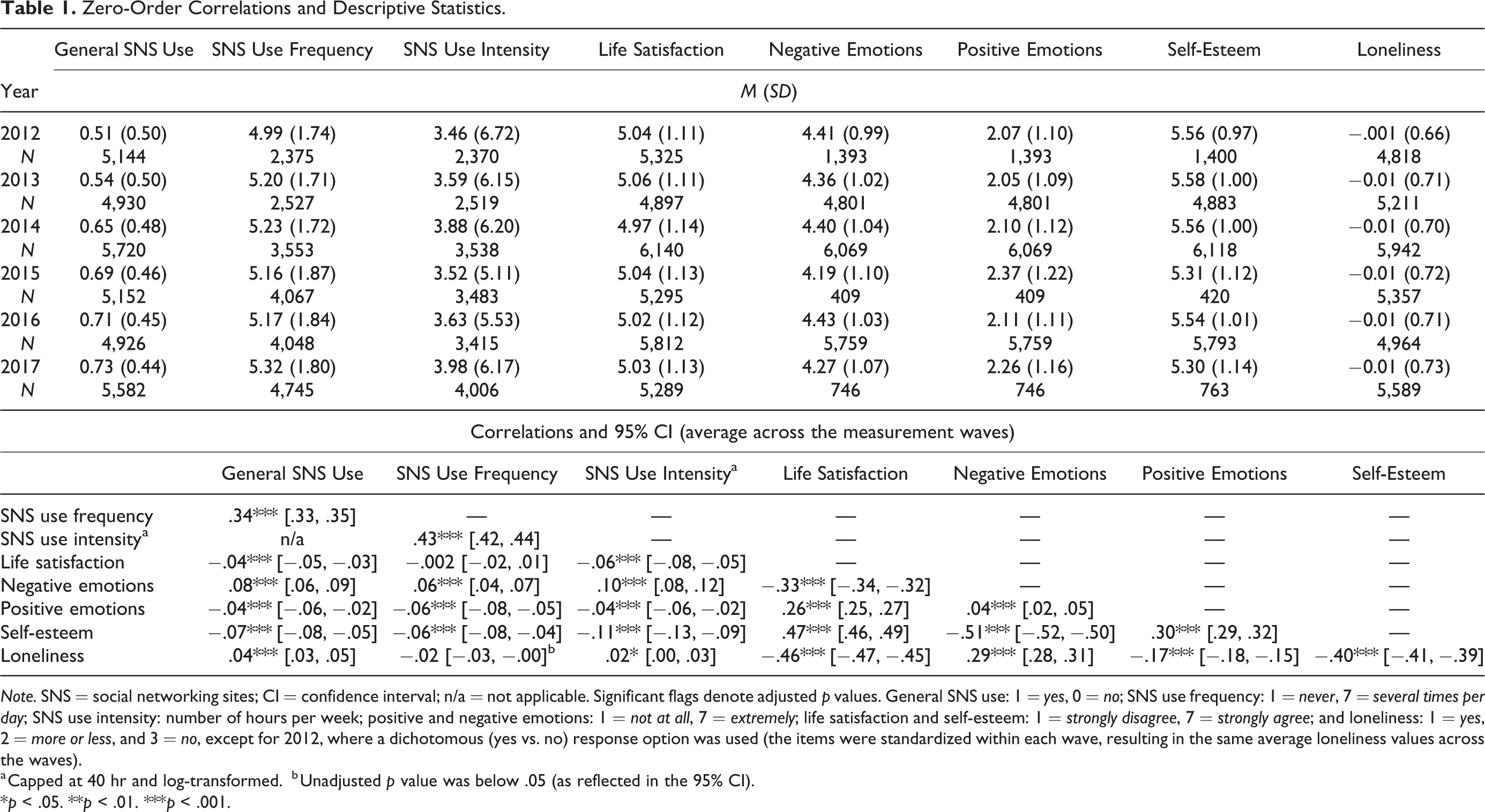
Note. SNS = social networking sites; CI = confidence interval; n/a = not applicable. Significant flags denote adjusted p values. General SNS use: 1 = yes, 0 = no; SNS use frequency: 1 = never, 7 = several times per day; SNS use intensity: number of hours per week; positive and negative emotions: 1 = not at all, 7 = extremely; life satisfaction and self-esteem: 1 = strongly disagree, 7 = strongly agree; and loneliness: 1 = yes, 2 = more or less, and 3 = no, except for 2012, where a dichotomous (yes vs. no) response option was used (the items were standardized within each wave, resulting in the same average loneliness values across the waves).
a Capped at 40 hr and log-transformed.
b Unadjusted p value was below .05 (as reflected in the 95% CI).
*p < .05. **p < .01. ***p < .001.
Longitudinal Analyses
We ran separate models for each combination of SNS use and well-being indicators. Following the instruction in Prenoveau (2016), we created two latent trait factors using observed scores of SNS use and well-being across all waves as indicators of between-person differences in SNS use and well-being. These latent trait factors represent individuals’ average values across the waves (similar to random intercepts in the random intercept-cross-lagged panel model; Hamaker et al., 2015). Because we were only interested in associations between latent variables, we constrained the variances of the manifest indicators of the latent SNS use and well-being variables to 0. To capture within-person state differences in SNS use and well-being, we created latent time-specific factors with observed scores of SNS use and well-being for each wave as indicators of the respective latent factors (with the loadings fixed to 1). Latent trait factors were modeled as independent from the latent time-specific factors by fixing their covariances to 0. These time-specific latent factors were used to estimate cross-lagged paths. As they reflect within-person variations in SNS use and well-being, cross-lagged parameters indicate whether within-individual changes in one variable (e.g., SNS use) at time point t predict within-individual changes in the other variable (e.g., well-being) at t + 1 while controlling for this individual’s value in this variable (e.g., well-being) at t. Models with the SNS use intensity indicators also included a method factor that controls for between-wave differences in the phrasing of the SNS use intensity item.
We corrected the p values for false discovery rate using the BY method (Benjamini & Yekutieli, 2001). We applied separate corrections for within-person effects of SNS use on well-being, within-person effects of well-being on SNS use, and between-person effects in the path models.
The results are presented in Figure 1 and Supplementary Tables S1–S3. All reported parameters represent standardized effects. All models showed good fit (confirmatory fit index > .90, Tucker–Lewis index > .90, and root mean square error of approximation < .08; see Supplementary Tables S1–S3). 3
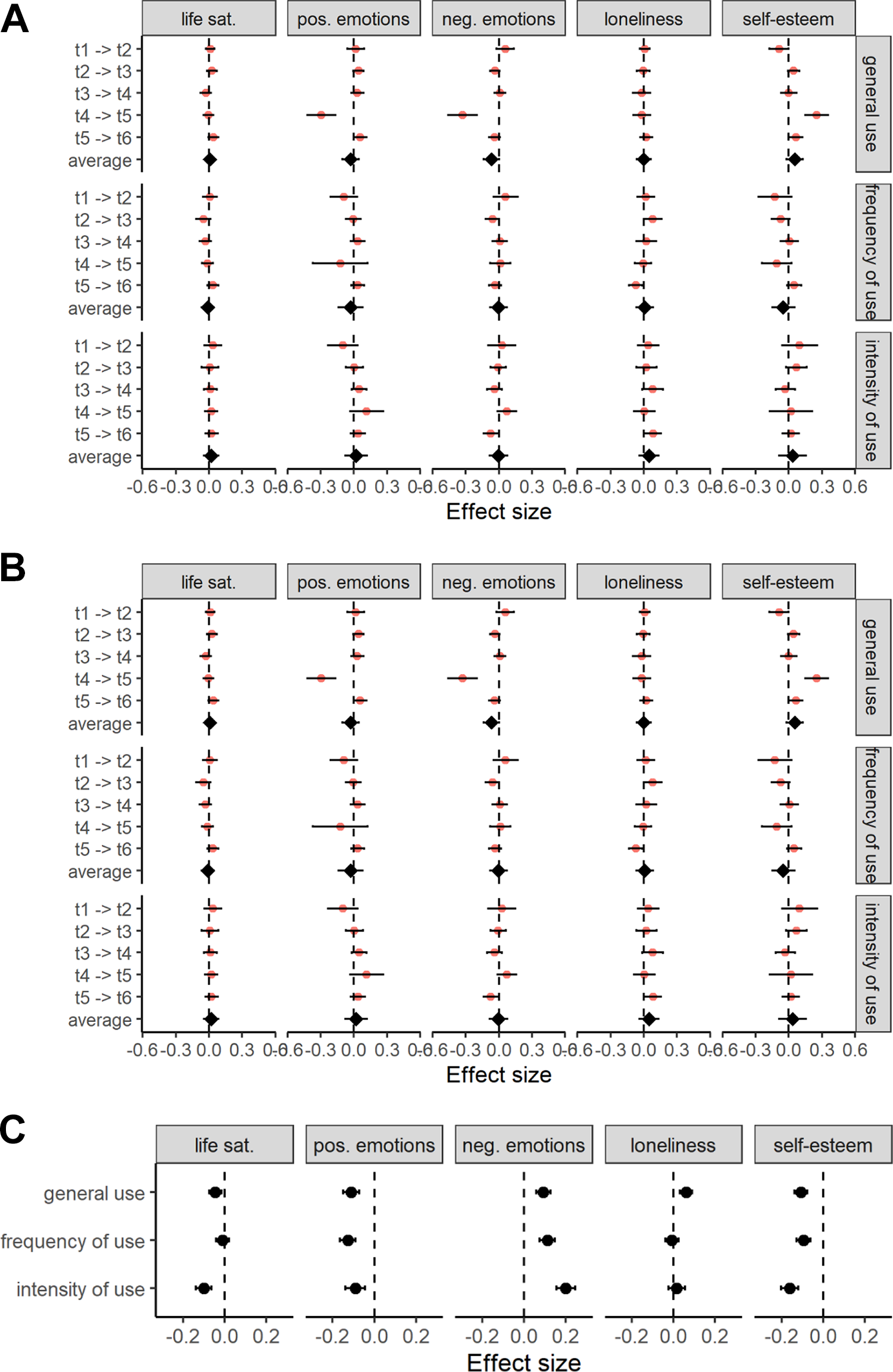
Overview of within- (A and B) and between- (C) person associations between well-being measures and SNS use. (A). Within-person effects: SNS use → SWB. (B). Within-person effects: SWB → SNS use. (C). Between-person asscoaitions. Note. Between-person effects are correlations between latent trait factors of SNS use and well-being; within-person effects are lagged effects of time-specific latent trait factors of SNS use and well-being. Average effects (A and B) are average within-person effects estimated across the five paths. Error bars denote 95% confidence intervals.
Between-Person Associations
Examination of the covariances between latent trait factors of well-being and SNS use showed that, on average across the waves, individuals who reported using SNS (vs. not) had a lower life satisfaction (r = −.046, p = .008, 95% confidence intervals [CI] [−.075, .016]), less positive (r = −.112, p < .001, 95% CI [−.150, −.073]) and more negative emotions (r = .093, p < .001, 95% CI [.058, .129]), a lower self-esteem (r = −.107, p < .001, 95% CI [−.138, −.075]), and more loneliness (r = −.06, p < .001, 95% CI [.031, .090]). Similarly, a higher frequency of SNS use was associated with less positive emotions (r = −.128, p < .001, 95% CI [−.166, −.090]), more negative emotions (r = .112, p < .001, 95% CI [.076, .149]), and a lower self-esteem (r = −.095, p < .001, 95% CI [−.128, −.061]), but not life satisfaction or loneliness (r = −.01 and r = −.008, respectively, both ps = 1.00). Finally, spending more hours on SNS (i.e., a higher frequency of SNS use) was associated with a lower life satisfaction (r = −.101, p < .001, 95% CI [−.139, −.063]), less positive (r = −.092, p < .001, 95% CI [−.139, −.045]) and more negative emotions (r = .201, p < .001, 95% CI [.156, .246]), and a lower self-esteem (r = −.162, p < .001, 95% CI [−.203, −.122]), but not loneliness (r = .015, p = 1.00). Overall, between individuals, SNS use was thus associated with lower well-being, with the associations being particularly consistent in case of positive and negative emotions and self-esteem.
Prospective Effects (Within-Person Effects)
Did SNS use contribute to a lower well-being over time? The lagged effects are displayed in Figure 1. The lagged effects of SNS use on well-being reflect the extent to which within-person deviations in SNS use from individuals’ baseline predicted within-person deviations (from the baseline) in well-being a year later. Even though some of the paths from SNS use to well-being reached significance, they were the exception of 75 tests of lagged effects, only 13 (17%) reached significance. After applying the false discovery rate adjustment (Benjamini & Yekutieli, 2001), the number of significant effects dropped to 2 (2.6%). It is noteworthy that these two significant effects were somewhat inconsistent with each other: General SNS use at t3 predicted less positive emotions (b = −.24, p < .001, 95% CI [−.36, −.11]) but more self-esteem at t4 (b = .31, p < .001, 95% CI [.17, .44]). Overall, we tend to conclude that the few significant paths probably reflect sampling error rather than actual effects.
Did initial level of well-being predict more SNS use over time? Of 75 tests of lagged effects, only 8 (11%) were significant at an α level of .05. After applying the false discovery rate adjustment (Benjamini & Yekutieli, 2001), the number of significant effects was reduced to 3 (4%): More positive and more negative emotions at t4 predicted a lower probability of using SNS at t5 (b = −.30, p < .001, 95% CI [−.42, −.17]; b = −.33, p < .001, 95% CI [−.46, −.20]), and higher self-esteem at t4 predicted a higher probability of using SNS at t5 (b = .25, p < .001, 95% CI [.15, .36]). Hence, the present data failed to provide consistent support to the idea that lower well-being predisposes people to more SNS use.
Discussion
Social media are often criticized as a driving force behind the current depression epidemics (Twenge et al., 2018). Yet the empirical evidence supporting the harmful effect of social media use on individuals has been based on predominantly cross-sectional data, while the few existing longitudinal studies provided mixed results. Herein, we used a large nationally representative panel of Dutch adults who contributed to a maximum of six yearly assessments of both SNS use and various indicators of well-being. Importantly, in contrast to many previous longitudinal studies, we relied on advanced statistical methods that are able to disentangle between- from within-person effects. Given policy makers’ recent interest in interventions aimed at curbing the suspected harmful consequences of social media use (UK Commons Select Committees, 2019), assessing whether SNS use is indeed associated with poorer well-being over time at a within-person level is particularly important.
Our results showed that, on average, more heavy SNS users indeed tended to consistently report slightly lower well-being—even though, consistent with recent large-scale cross-sectional studies (Orben & Przybylski, 2019a, 2019b), these effects were small. Importantly, despite the presence of between-person associations, within-individual changes in SNS use were not associated with within-individual changes in well-being (and vice versa). Importantly, our sample size would have allowed us to detect even tiny effects at an α level .05 (N = 10,000 gives a 99% power to detect a correlation of .04), suggesting that these null effects are unlikely to be explained by a lack of power.
How can we reconcile the presence of negative associations between SNS use and well-being at the between-person level with the absence of the prospective effects in either direction? One rather mundane explanation is that between-person associations might be driven by confounding with some third variables. For example, emotionally unstable and introverted individuals might be more likely to use social media (Liu & Campbell, 2017) and to report lower well-being (Diener et al., 2003). As a result, interindividual differences in personality traits, such as neuroticism or introversion, might be responsible for both higher SNS use and lower well-being. Relatedly, the negative between-person associations between SNS use and well-being could be (at least partially) driven by common method variance (Orben & Lakens, 2019). Future research should investigate these possibilities.
Alternatively, SNS use and well-being might affect each other, but on a shorter timescale, such as hours, days, or weeks (rather than years). Hence, assessing SNS use and well-being with shorter time intervals, for example, using daily diary or experience sampling methods would shed some light on this question. Nevertheless, it is important to note that even if SNS use affects daily fluctuations in well-being, the fact that these short-term associations do not translate into longer term effects, as indicated by our results, is worth further investigations.
The presence of between-person associations combined with the lack of within-person prospective effects in our findings might have implications that go beyond the field of social media effects. Specifically, it adds to the literature on the importance of separating effects at different levels of analysis more generally (Curran et al., 2014). The associations between the variables at one level of analysis (e.g., individuals) do not necessarily mirror the associations between these variables at another level (e.g., groups), and using the relations at one level to make inferences about the relations at another level represents an error of inference (ecological fallacy; Robinson, 1950). This has been common knowledge in other social science disciplines, such as sociology or education research, for decades (Raudenbush & Willms, 1995; Robinson, 1950). As psychologists have recently been showing increasing interest in exploring psychological phenomena across different levels of analysis too (e.g., within-person vs. between-person), using methods that allow for a proper differentiation of between- from within-person effects is essential (Usami et al., 2019).
It is important to note this study’s limitations. While the data set we used allowed us to include a broad range of well-being indicators, it did not offer a differentiated selection of SNS use measures. Specifically, the available variables mainly reflected a quantitative aspect of use, such as frequency and intensity. However, the mere number of hours spent on SNS might matter less that the content one is exposed to and the type of activities one is engaged in. For example, researchers have recently started differentiating between passive (browsing other people’s profiles) and active (posting messages and status updates) SNS use, showing that only the former (but not the latter) was associated with lower well-being (Verduyn et al., 2015). In addition, SNS use might have different consequences depending on what motives individuals pursue, with using social media for making new friends (vs. for social skills compensation) having positive (vs. negative) correlates (Teppers et al., 2014). Ultimately, while this study used self-report measures of SNS use, we hope that future studies will rely on objective measures, such as obtained from smartphone screen time applications (Ellis et al., 2018). In addition, our attempt to include as many diverse measures of well-being as possible resulted in varying time lags between SNS use and different measures of well-being. Although our additional analyses (see Supplementary Materials) showed that the length of time lag had no consistent effect on the associations between SNS use and well-being, we hope that data sets will become available with even more regular and fine-grained assessments than LISS.
Conclusion
While social media have been increasingly criticized for compromising individuals’ well-being, the results of longitudinal analyses of over 10,000 individuals spanning 6 years suggest that the interface between SNS use and well-being might be more complex. Even though SNS use was associated with lower well-being at a between-person level, we did not detect prospective effects in either direction. This is particularly important in light of the discussion regarding the direction of causality of the associations between SNS use and well-being. Specifically, as these causal relations are usually assumed to exist at the within-individual level (Usami et al., 2019) that is particularly relevant for planning interventions, our failure to detect within-person prospective effects in either causal direction, despite a very large sample size, suggests that there might be little evidence for direct causal effects after all. We therefore conclude that the role of social media in rising depression rates of individuals might be overstated and that future studies should further examine between-person factors that might underlie small concurrent associations.
Supplemental Material
Supplemental Material, Supplementary_materials_(6) - Does Using Social Media Jeopardize Well-Being? The Importance of Separating Within- From Between-Person Effects
Supplemental Material, Supplementary_materials_(6) for Does Using Social Media Jeopardize Well-Being? The Importance of Separating Within- From Between-Person Effects by Olga Stavrova and Jaap Denissen in Social Psychological and Personality Science
Footnotes
Declaration of Conflicting Interests
The author(s) declared no potential conflicts of interest with respect to the research, authorship, and/or publication of this article.
Funding
The author(s) received no financial support for the research, authorship, and/or publication of this article.

Supplemental Material
The supplemental material is available in the online version of the article.
Notes
References
Supplementary Material
Please find the following supplemental material available below.
For Open Access articles published under a Creative Commons License, all supplemental material carries the same license as the article it is associated with.
For non-Open Access articles published, all supplemental material carries a non-exclusive license, and permission requests for re-use of supplemental material or any part of supplemental material shall be sent directly to the copyright owner as specified in the copyright notice associated with the article.
