




Abstract
Unlike the presentation format in a typical delay discounting task (e.g., “Would you prefer [A] US$4.3 today OR [B] US$7.5 in 22 days?”), Magen et al. inserted a zero to each alternative (e.g., “Would you prefer [A] US$4.3 today and US$0 in 22 days OR [B] US$0 today and US$7.5 in 22 days?”) and found this manipulation effectively reduced delay discounting (d = .84), which was referred to as the hidden-zero effect. Study 1 was a direct replication of this effect. In Study 2, we tested whether the explicit-zero format could buffer against the detrimental effect of exposure to sexy cues on delay discounting. In Study 3, we explored the mechanism underlying the hidden-zero effect. Taken together, the hidden-zero effect was consistently found across all studies (N = 2,440) and our internal meta-analysis yielded a medium to large effect size (d = .52).
In the classic marshmallow experiment, a group of 3- to 5-year-old children chose between enjoying a marshmallow in front of them immediately and gaining one more marshmallow by waiting for the experimenter to come back (Mischel et al., 1972). As adults, we often face a similar dilemma in our daily life while the reward has been changed from marshmallow to money, career, spouse, health, and so forth. Given the tendency to discount the value of delayed outcomes that occur in the future, it is difficult for people to forgo a smaller-sooner reward (SSR) in order to obtain a larger-later reward (LLR). Therefore, researchers have begun testing methods for reducing delay discounting (for a recent systematic review, see Rung & Madden, 2018).
Magen et al. (2008) introduced a simple way on this matter that only taps the presentation format of the SSR and LLR outcomes. In a typical delay discounting task, the SSR alternative and the LLR alternative are described in a way that directly contrasts a good alternative soon with a better alternative later (e.g., “Would you prefer [A] US$4.3 today OR [B] US$7.5 in 22 days?”). Magen et al. (2008) argued that this presentation format does not explicitly show the fact that receiving one alternative also means not receiving the other. They reframed the presentation of the SSR and LLR outcomes by inserting a zero to show that receiving a good alternative soon also means receiving nothing later and receiving a better alternative later also means receiving nothing soon (e.g., “Would you prefer [A] US$4.3 today and US$0 in 22 days OR [B] US$0 today and US$7.5 in 22 days?”). They found this manipulation could effectively reduce delay discounting as manifested by participants’ decreased choices of the SSR alternative (d = .84), which was referred to as the hidden-zero effect.
During the past decade, however, this effect has rarely been replicated. Given the importance of reducing delay discounting to facilitate people’s decision making and the advantage of Magen et al.’s (2008) manipulation (i.e., ease of use), the current article aims to test the robustness of the hidden-zero effect in a series of high-powered studies and explore the mechanism underlying this effect. Study 1 is a direct replication of the hidden-zero effect. In Study 2, we test whether the explicit-zero format could buffer against the detrimental effect of certain factors on people’s intertemporal decision on the traditional hidden-zero format. Specifically, previous research suggests that there is a general reward system in the brain that is activated for different rewarding stimuli such as sexy cues, food, money, and drugs (Camerer et al., 2005). Once activated, the general reward system will drive people to seek reward in a nonspecific way. Accordingly, exposure to rewarding stimuli in one domain will result in reward seeking in another domain (e.g., Berger & Shiv, 2011; Gal, 2012; Li, 2007; Wadhwa et al., 2008). For example, studies have shown that rewarding stimuli in the domain of sex increased impatient choices in the domain of money (e.g., Van den Bergh et al., 2008). Therefore, we test whether exposure to sexy cues would exacerbate delay discounting in a typical delay discounting task with the traditional hidden-zero format. More importantly, we test whether intertemporal decisions made with the explicit-zero format are immune to exposure to sexy cues.
In Study 3, we explore the mechanism underlying the hidden-zero effect. Two explanations have been proposed (Radu et al., 2011). The improving sequence hypothesis suggests that people tend to prefer alternatives in which their prospects improve as time progresses. The inclusion of null outcomes in the explicit-zero format may create the impression of a sequence. Specifically, the SSR alternative (e.g., US$4.3 today and US$0 in 22 days) shows a declining sequence, whereas the LLR alternative shows an improving sequence (e.g., US$0 today and US$7.5 in 22 days). In contrast, the temporal attention hypothesis suggests the explicit-zero format shifts attention away from a natural inclination to focus on the present, therefore mitigating the value of the immediate reward. Although the two hypotheses make the same predictions regarding future discounting, they make opposite predictions regarding past discounting. When choosing between two past reward alternatives (e.g., “Would you prefer [A] US$4.3 1 hr ago OR [B] $7.5 22 days ago?”), the improving sequence hypothesis predicts that the explicit-zero format would increase the tendency to choose the alternative that implies an improving sequence (e.g., US$4.3 1 hr ago and US$0 22 days ago), whereas the temporal attention hypothesis predicts that the explicit-zero format would increase the tendency to choose the alternative that implies a larger reward at a time point away from the present (e.g., US$0 1 hr ago and US$7.5 22 days ago). Radu et al.’s (2011) results supported the temporal attention hypothesis. However, it is still unclear how people’s attention is shifted away from the present. It could be caused by either the null outcome in the SSR alternative or the null outcome in the LLR alternative. Although Radu et al. (2011) suggested the former by writing that “explicit-zero framing increases patience by emphasizing the unpleasant distant consequences associated with present responding” (p. 366), they did not test it directly. We explore this mechanism in Study 3.
Study 1
In Magen et al.’s (2008) experiment, they compared participants’ preferences in two conditions. In the hidden-zero condition, participants received 15 choice pairs presented in a traditional way (e.g., “Would you prefer [A] US$4.3 today OR [B] US$7.5 in 22 days?”). In the explicit-zero condition, the same 15 choice pairs were presented in a way that explicitly shows receiving one alternative means not receiving the other (e.g., “Would you prefer [A] US$4.3 today and US$0 in 22 days OR [B] US$0 today and US$7.5 in 22 days?”). The dependent measure was the total number of the SSR alternatives that were chosen by participants in each condition. They found a large effect size (d = .84) in a sample consisting of 112 participants. Study 1 is a direct replication of this experiment. The materials, data, and code can be found here (https://osf.io/3fe6w/). We aim to replicate the hidden-zero effect in a sample with at least 220 participants (110 in each condition) in order to achieve a power of .95 (two tails) to detect a medium effect size (d = .50).
Method
We collected data in two samples, one Chinese sample and one Swedish sample. In the Chinese sample, the 15 choice pairs were translated into Chinese and the amount of money was multiplied by 10 and stated in Yuan (e.g., “Would you prefer [A] 43 Yuan today and 0 Yuan in 22 days OR [B] 0 Yuan today and 75 Yuan in 22 days?”). Four hundred twenty-eight college students (136 males and 292 females) were recruited through the sampling service that was run by a Chinese online survey company. They were randomly assigned to the hidden-zero condition and the explicit-zero condition.
In the Swedish sample, the 15 choice pairs were translated into Swedish and the amount of money was multiplied by 10 and stated in SEK (e.g., “Would you prefer [A] 43 SEK today and 0 SEK in 22 days OR [B] 0 SEK today and 75 SEK in 22 days?”). Two hundred eighty-five participants were reached (111 males, 166 females, and 8 without gender information; mean age = 27.94 years, SD = 8.02) by sending a questionnaire link to several Facebook groups. They were also randomly assigned to two conditions. Note that our final samples were larger than previously determined because after the sample size reached 220, there were still many participants who finished the survey before we terminated the online sampling. In order to maximize the statistical power, we included all participants who finished the survey.
Results
In the Chinese sample, participants in the explicit-zero condition (M = 5.74, SD = 3.74) chose less SSR alternatives than did those in the hidden-zero condition (M = 8.76, SD = 3.52), t(426) = 8.59, p < .001, d = .83, 95% CI = [0.63, 1.03]. A similar pattern was found in the Swedish sample. Participants in the explicit-zero condition (M = 5.55, SD = 4.02) chose less SSR alternatives than did those in the hidden-zero condition (M = 6.87, SD = 4.51), t(283) = 2.60, p = .010, d = .31, 95% CI = [0.07, 0.54]. Therefore, the hidden-zero effect was successfully replicated in both samples.
Study 2
Van den Bergh et al. (2008) found exposure to sexy cues led to higher delay discounting. In their experiment, male participants were assigned to watch either a group of pictures of landscapes or pictures of sexy women. After this manipulation, they were asked to specify the amount of money they would require in 1 week and the amount they would require in 1 month to make them indifferent to receiving €15 now. Higher amount would indicate higher delay discounting. Results showed that male participants who watched pictures of sexy women, compared with those who watched pictures of landscapes, required more delayed money to make them indifferent to receiving €15 now.
In Study 2, we test whether the detrimental effect of sexy cues could be conceptually replicated in a typical delay discounting task with the traditional hidden-zero format. That is to say, we test whether exposure to sexy cues would lead to more SSR choices in the hidden-zero condition. More importantly, we also test whether people’s preferences in a delay discounting task with the explicit-zero format would be immune to sexy cues. Therefore, it is a 2 (cue type: sexy cues vs. control cues) × 2 (presentation format: hidden-zero vs. explicit-zero) between-subject design. The software G-Power 3.1.9.4 shows that at least 180 participants need to be recruited to obtain a power of .80 to detect a medium effect size (f = .25). The materials, data, and code are available here (https://osf.io/jse8g/).
Method
Four hundred twenty-three male participants (mean age = 34.67 years, SD = 8.24) were recruited through the sampling service that was run by a Chinese online survey company. First, they were randomly assigned to the sexy cues condition and the control cues condition. Those in the sexy cues condition were asked to rate the attractiveness of eight pictures of sexy women wearing swimsuit or lingerie on a 7-point scale, whereas those in the control cues condition rated the attractiveness of eight pictures of landscapes. The pictures were presented one by one. After this manipulation, participants were randomly assigned to the hidden-zero condition and the explicit-zero condition to fulfill the delay discounting task used in Study 1. Our final sample was larger than previously determined due to the same reason described in Study 1.
Results
A two-way analysis of variance (ANOVA) with the total number of the SSR alternatives chosen by participants as the dependent measure revealed a main effect of the presentation format, F(1, 419) = 17.82, p < .001, partial η2 = .04. Participants in the explicit-zero condition (M = 6.27, SD = 3.83) chose less SSR alternatives than did those in the hidden-zero condition (M = 7.87, SD = 4.04). The interaction was also significant, F(1, 419) = 3.93, p = .048, partial η2 = .01. Simple effects analysis showed that in the hidden-zero condition, exposure to sexy cues (M = 8.54, SD = 4.05) led male participants to choose more SSR alternatives than did exposure to control cues (M = 7.21, SD = 3.93), F(1, 419) = 6.07, p = .014, partial η2 = .01. However, in the explicit-zero condition, male participants showed comparable preferences after exposure to sexy cues (M = 6.18, SD = 3.94) and control cues (M = 6.36, SD = 3.74), F(1, 419) = 0.09, p = .768. The pattern is displayed in Figure 1. To describe the interaction in another way, simple effects analysis showed that when exposed to control cues, participants in the explicit-zero condition tended to choose less SSR alternatives than did those in the implicit-zero condition, but the difference did not reach significance, F(1, 419) = 2.54, p = .112. When exposed to sexy cues, participants in the explicit-zero condition chose much less SSR alternatives than did those in the implicit-zero condition, F(1, 419) = 19.10, p < .001, partial η2 = .04.
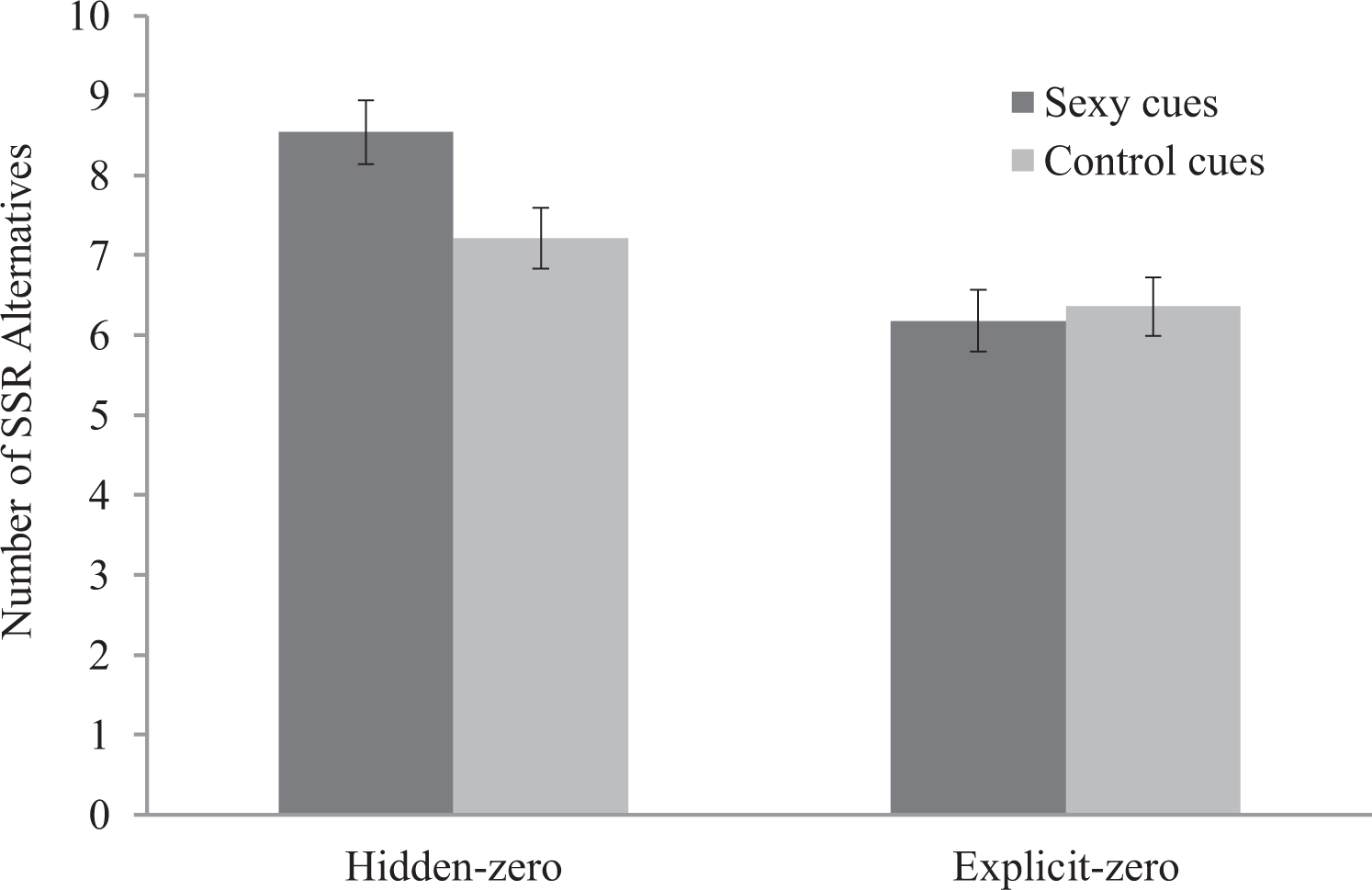
Interactive effect of cue type and presentation format on people’s choices in a delay discounting task in Study 2.
Then, we tested whether our results would be influenced by the attractiveness of different types of cues. Participants’ ratings of the eight pictures were averaged. The t test showed there was no significant attractiveness difference between sexy cues (M = 5.67, SD = 0.99) and control cues (M = 5.71, SD = 0.75), t(421) = 0.49, p = .623. Including the averaged attractiveness rating as a covariate in the two-way ANOVA, we have done did not change the results.
Study 3
In order to explore whether the attention shift away from the present is caused by the null outcome in the SSR alternative, we manipulated the presence of the null outcome in both the SSR alternative and the LLR alternative, which led to a 2 (SSR format: hidden-zero vs. explicit zero) × 2 (LLR format: hidden-zero vs. explicit zero) between-subject design. If the attention shift is caused by the null outcome in the SSR alternative alone, there should be only a main effect of the SSR format such that people choose less SSR alternatives when the SSR alternative contains the null outcome, no matter how the LLR alternative is phrased. In the same vein, if the attention shift is caused by the null outcome in the LLR alternative alone, there should be only a main effect of the LLR format such that people choose less SSR alternatives when the LLR alternative contains the null outcome, no matter how the SSR alternative is phrased. If the attention shift is caused by the null outcome in both the SSR and the LLR alternative, there should be an interaction such that people choose less SSR alternatives only when both the SSR and the LLR alternatives contain the null outcome. In addition, because trait self-control has been found to be negatively correlated with delay discounting (e.g., Guan & He, 2018), we measured this personality trait to test whether the effect of our manipulation could still hold after controlling the potential influence of trait self-control. The software G-Power shows that at least 180 participants need to be recruited to obtain a power of .80 to detect a medium effect size (f = .25).
Method
Four hundred seventy participants (220 males and 250 females; mean age = 32.72 years, SD = 19.68) were recruited through the sampling service that was run by a Chinese online survey company. They were randomly assigned to four conditions: the SSR-hidden-zero/LLR-hidden-zero condition (i.e., the hidden-zero condition in previous studies), the SSR-hidden-zero/LLR-explicit-zero condition, the SSR-explicit-zero/LLR-hidden-zero condition, and the SSR-explicit-zero/LLR-explicit-zero condition (i.e., the explicit-zero condition in previous studies). Participants first answered the 15 choice pairs with different presentation formats according to their conditions. After that, they fulfilled the Brief Trait Self-Control Scale consisting of 13 items that participants rated on a 5-point scale from “not at all” to “very much” (Tangney et al., 2004). Finally, participants reported their age and gender. The data, materials, and code are available here (https://osf.io/uhm5a/). Our final sample was larger than previously determined due to the same reason described in Study 1.
Results
A two-way ANOVA with the total number of the SSR alternatives chosen by participants as the dependent measure revealed a significant main effect of the SSR format, F(1, 466) = 24.00, p < .001, partial η2 = .05. As shown in Figure 2, participants chose less SSR alternatives when the zero was explicitly presented in the SSR alternative (M = 6.31, SD = 4.13), compared with when the zero was absent in the SSR alternative (M = 8.14, SD = 3.92). The main effect of the LLR format, F(1, 466) = 0.58, p = .446, and the interaction, F(1, 466) = 2.09, p = .149, were not significant. These results indicate that the attention shift mainly depends on the presence of the null outcome in the SSR alternative.
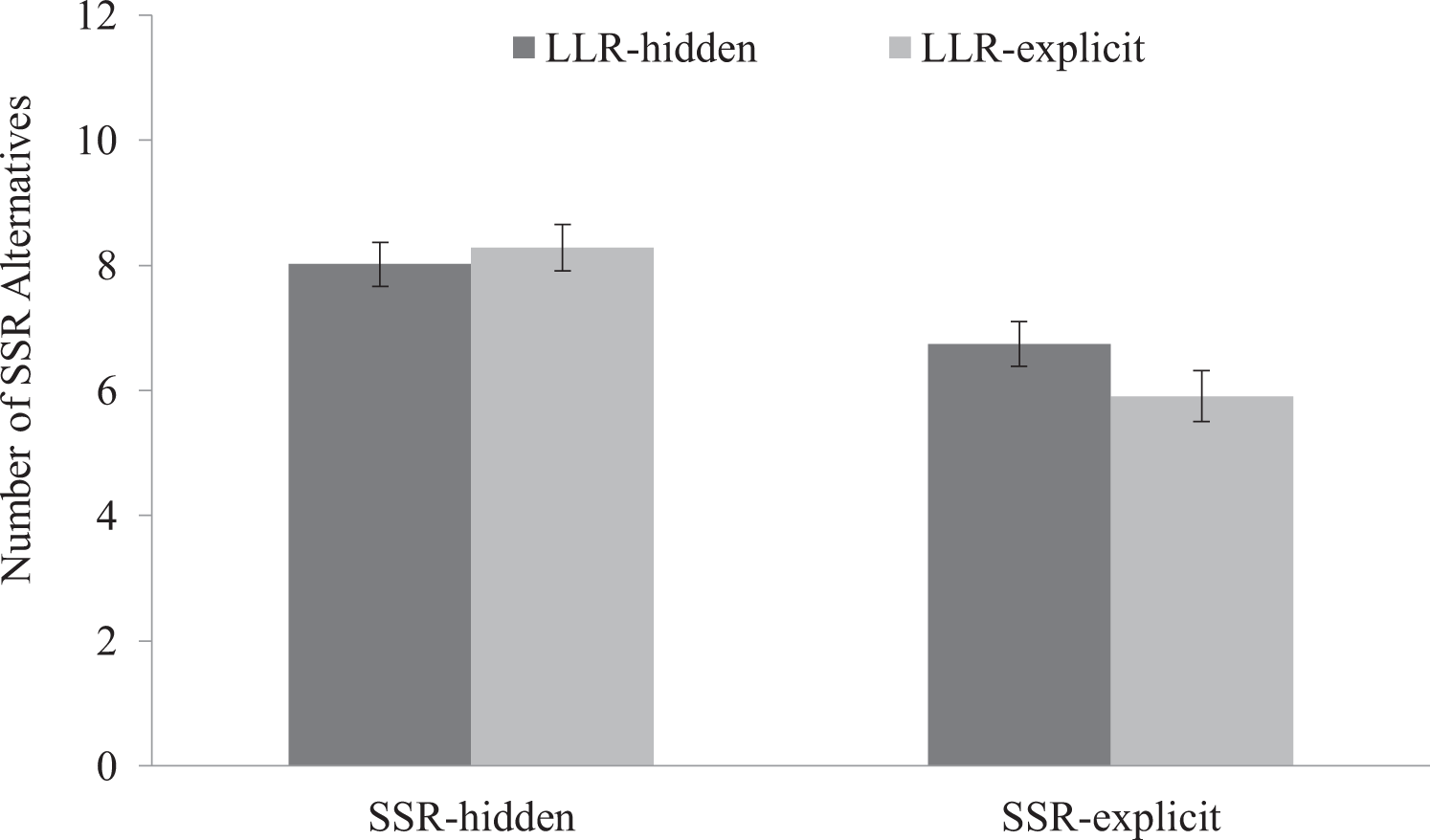
Impact of presentation format on people’s choices in a delay discounting task in Study 3.
The Brief Trait Self-Control Scale showed a good internal consistency (Cronbach’s α = .84). When trait self-control was included as a covariate in the two-way ANOVA, its effect was significant, F(1, 465) = 6.41, p < .012, partial η2 = .01. Consistent with previous studies (e.g., Guan & He, 2018), trait self-control was negatively correlated with the number of SSR alternatives chosen by participants, r = −.133, p = .004. However, our main results were not affected by including trait self-control as a covariate, such that the main effect of the SSR format was significant, F(1, 465) = 22.38, p < .001, partial η2 = .05, whereas the main effect of the LLR format, F(1, 465) = 0.69, p = .408, and the interaction, F(1, 465) = 1.48, p = .225, were not significant.
Internal Meta-Analysis
In order to estimate the average effect of the presentation format manipulation across a range of situations in which it might be implemented and a range of unmeasured variables that could be at play, we collapsed the sexy cues condition and the control cues condition in Study 2 as well as the LLR-hidden-zero condition and the LLR-explicit-zero condition in Study 3. In the Supplemental File, we reported a field experiment with a 2 (hunger manipulation: hunger vs. satiation) × 2 (presentation format: hidden-zero vs. explicit-zero) between-subject design in a Chinese sample (N = 617) and a Swedish sample (N = 217). The hunger condition and the satiation condition were also collapsed. Then, we conducted an internal meta-analysis by choosing the random effects model, which yielded a medium to large effect size, d = .52, 95% CI = [0.37, 0.67], Z = 6.81, p < .001. The forest plot is shown in Figure 3. The code of the analysis is available here (https://osf.io/uhm5a/).
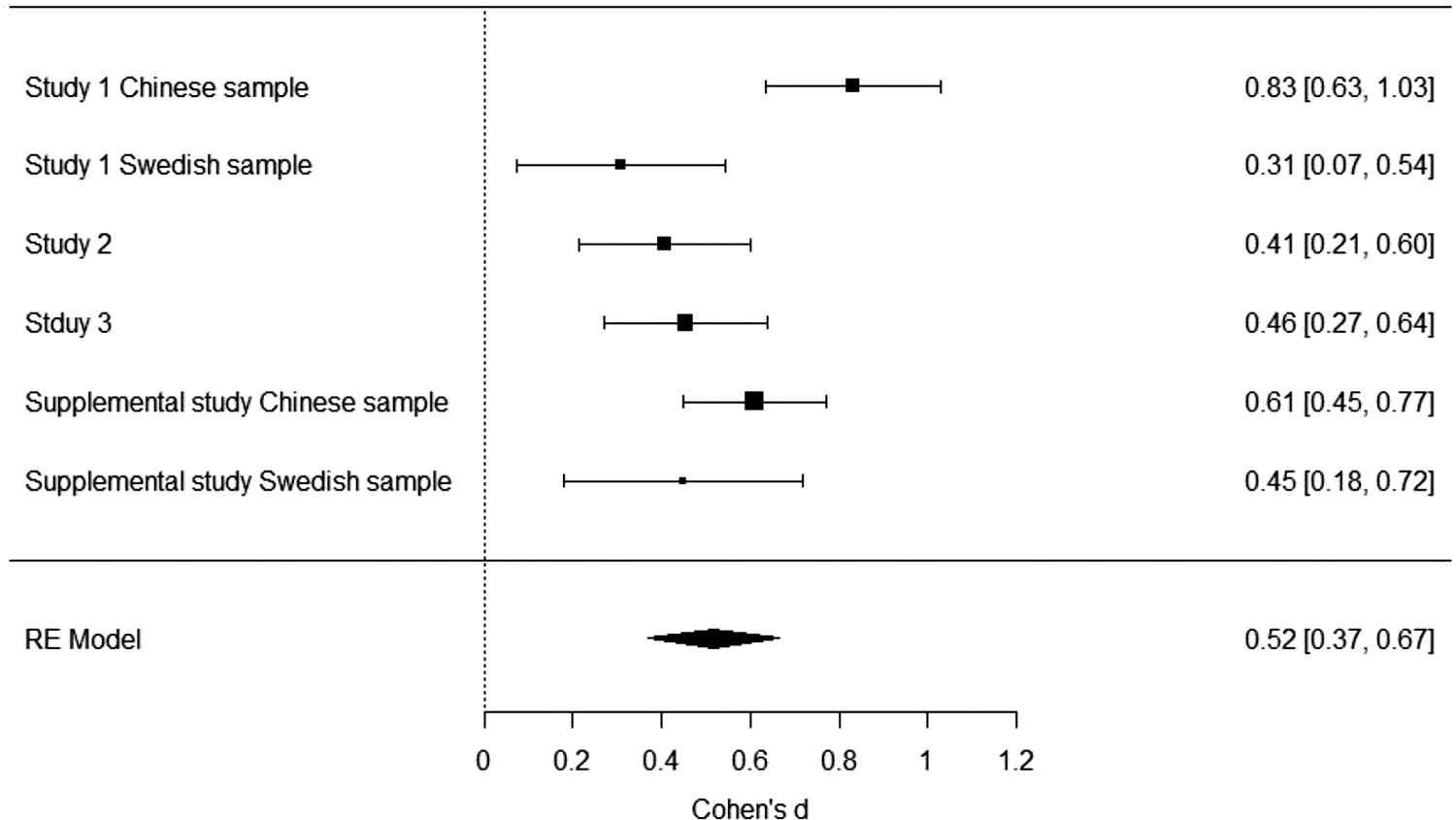
Forest plot for the internal meta-analysis.
Discussion
The current research replicated and extended Magen et al.’s (2008) findings in a series of high-powered studies (N = 2,440). First, the results suggest the hidden-zero effect is robust. This effect was consistently found across all studies and our internal meta-analysis yielded a medium to large effect size (d = .52 or r = .25) according to the conventional criteria (Lipsey &Wilson, 2001). Recent research suggests that an effect size around r = .30 indicates a large effect that is potentially powerful in both the short and the long run (Funder & Ozer, 2019). This effect also holds in both China and Sweden, suggesting a high generalizability. Second, although exposure to sexy cues exacerbated delay discounting in the traditional hidden-zero format, this effect was muted by the explicit-zero presentation format. Taken together, the current research suggests the explicit-zero presentation format is an efficient method for reducing delay discounting and improving self-control outcomes due to its high effectiveness and low implementation cost. Future studies are encouraged to examine the reproducibility of other methods for reducing delay discounting (Rung & Madden, 2018).
Our Study 3 found the hidden-zero effect was mainly driven by the null outcome in the SSR alternative, whereas the null outcome in the LLR alternative exerted no effect on delay discounting. This finding suggests people are aware of the null outcome in the LLR alternative even it is presented in a hidden-zero format. However, they may not be fully aware of the null outcome in the SSR alternative if it is presented in a hidden-zero format. When the null outcome in the SSR alternative is revealed by the explicit-zero format, the unpleasant distant consequence associated with the SSR alternative becomes explicit, thus mitigating the value of the immediate reward and leading to more patient choices. This mechanism is similar to reminding people of the opportunity costs of purchase. It has been found that, although consumers often fail to generate the alternatives that their purchase would displace (i.e., the opportunity costs), providing them with various cues to consider the opportunity costs could effectively reduce impulsive purchase (Frederick et al., 2009).
Given the high efficiency of the explicit-zero presentation format for reducing delay discounting, future research should consider evaluating its effectiveness on many important one-off choices in our real life (e.g., choosing to change a new car or choosing to save for the children’s education), as have been done in other areas (e.g., Yeager et al., 2016). Further, current evidence suggests delay discounting might play a causal role in the development of addiction, obesity, and pathological gambling (Rung & Madden, 2018). Therefore, future research should explore how the mechanism revealed in our Study 3 could facilitate efficient translation to clinical interventions.
Supplemental Material
supplemental_study_(2) - The Beauty of the Zero: Replications and Extensions of the Hidden-Zero Effect in Delay Discounting Tasks
supplemental_study_(2) for The Beauty of the Zero: Replications and Extensions of the Hidden-Zero Effect in Delay Discounting Tasks by Junhua Dang, Xiaoping Liu, Shanshan Xiao, Lihua Mao, Ka Tung Chan, Chaoyu Li, Meihan Lin, Zanzan Liu, Yanran Luo, Yumingzi Sun, Yu-Hsin Wu and Helgi B. Schiöth in Social Psychological and Personality Science
Footnotes
Declaration of Conflicting Interests
The author(s) declared no potential conflicts of interest with respect to the research, authorship, and/or publication of this article.
Funding
The author(s) disclosed receipt of the following financial support for the research and/or authorship of this article: Junhua Dang is supported by the Swedish Research Council (2018-06664). Lihua Mao is supported by the National Natural Science Foundation of China (Project 31871098). Helgi B. Schiöth is supported by the Swedish Research Council.

Supplemental Material
The supplemental material is available in the online version of the article.
References
Supplementary Material
Please find the following supplemental material available below.
For Open Access articles published under a Creative Commons License, all supplemental material carries the same license as the article it is associated with.
For non-Open Access articles published, all supplemental material carries a non-exclusive license, and permission requests for re-use of supplemental material or any part of supplemental material shall be sent directly to the copyright owner as specified in the copyright notice associated with the article.
