




Abstract
Our research deals with the question how people look back at their ex-partners—those with whom they were once romantically involved? Such views are important because they may shape our views of current relationships or new (potential) partners. Across three studies (total N = 876), we find that men hold more positive attitudes towards their female ex-partners than women do towards their male ex-partners. Gender-related variables provide further insight into this phenomenon. Ex-partner attitudes correlated positively with more permissive sexual attitudes and the amount of social support that individuals perceived from their ex-partners (both higher in men), whereas the ex-partner attitudes correlated negatively with attributions of greater responsibility for the breakup to ex-partner or relationship itself (both higher in women). Both men and women reported more positive ex-partner attitudes if they were single or had lower breakup acceptance.
Romantic relationships are central to human functioning. One key theme raised in decades of research centers on the question: What promotes vital, gratifying relationships and what undermines their quality and stability (Clark & Monin, 2006; Finkel, Simpson, & Eastwick, 2017; Rusbult & Van Lange, 2003)? In the present research, we adopt a different approach. Instead of focusing on the qualities of ongoing relationships, we focus on how individuals look back on their past relationships after a breakup. How do people evaluate their former partners and, more importantly, do men and women differ in how they evaluate their ex-partners? What might distinguish men and women in the ways they view their ex-partners?
Examining judgments and feelings about former relationships is important for at least three reasons. First, feelings of attachment or love may still be connected to a past relationship, and perhaps men and women cope differently with relationship dissolution—for example, with regard to the need for emotional support, men may be less willing than women to break all ties with their former partners. Second, people often have “invested” in their relationships, some of which involve important resources (e.g., shared friends, joint possessions, joint children), which cause partners to be interdependent for an extended time into the future (e.g., Rusbult & Van Lange, 2003). Third, the quality of individuals’ past relationships, as well as the nature of their dissolution, is likely to have an impact on people’s feelings of attachment, beliefs regarding relationships in general, and possibly the current relationship in particular (Spielmann, Joel, MacDonald, & Kogan, 2012). Experience with an abusive relationship, for example, may undermine trust in future partners or relationships and sometimes even in the opposite sex in general. These reasons highlight the importance of past relationships and illustrate that there may be meaningful differences between men and women in how they perceive former romantic partners.
The major purpose of the present research is to investigate gender differences in judgments of former partners—those with whom one was once romantically involved. Do men or women evaluate their former partners more positively? Or is there no difference? We must admit that we stumbled on this question after examining the effects of experimental manipulations on evaluations of former partners. These two initial studies did not yield any significant findings regarding the manipulations, but they did uncover a consistent and meaningful difference between men and women in their evaluations of former partners. Following the two initial studies, we conducted a third study in which we not only sought to replicate the finding but attempted to discover some key variables that correlate with ex-partner attitudes as well. We then conducted a fourth study about laypeople’s beliefs about the gender difference. All four studies are reported in this article.
Are There Differences Between Men and Women in Beliefs About Former Partners?
We suggest the importance of two complementary frameworks: one rooted in evolutionary psychology and the other in the literature on gender roles. From an evolutionary perspective, the major outcome linked to close relationships is survival and especially reproduction in order to enhance genetic fitness (Kenrick & Trost, 2004). In this context, differences between men and women become manifest in differential parental investment (Trivers, 1972). Relative to men, women need to invest more energy and resources in their offspring, at least initially, due to pregnancy and nursing. Men, in contrast, are not biologically constrained by extended parental investment, so they might be able to increase their genetic fitness by obtaining more sexual partners (Buss & Schmitt, 1993). Consequently, men should have evolved a stronger tendency to desire multiple sexual partners.
Consistent with this reasoning, relative to women, men do report having a larger number of sexual partners, more permissive sexual attitudes (Petersen & Hyde, 2010), and value sex more strongly as a physical act that gives pleasure (Hendrick, Hendrick, & Reich, 2006). Also, men are more likely to endorse a “game-playing” attitude to love, whereas women are more likely to hold “pragmatic” love attitudes (Hendrick & Hendrick, 2006), including stronger preference for long-term, more exclusive relationships (Hendrick & Hendrick, 2006). Based on this reasoning, men should be more likely than women to hold favorable views of their former romantic partners to the extent that playful love attitudes and more permissive sexual attitudes sustain positive memories of sex in the past or keep the door open for rekindling a sexual relationship with former partners in the future. Women should hold less favorable views about their former partners, given their generally stronger interest in exclusive, long-term relationships.
A second complementary line of reasoning is rooted in a large body of gender role–related research that has identified three interrelated differences between men and women with regard to dependence in the relationships, perceptions of the causes of breakups, and coping with breakups. To begin with, there may be systematic gender differences in dependence. Men tend to be more dependent on their female partners for emotional and practical needs than is true of women with respect to their male partners (Hatfield & Rapson, 1993). Women typically rely less on their male partners partly because they are more likely than men to find emotional support outside of their romantic relationships—especially with female friends (Antonucci & Akiyama, 1987; Fydrich, Sommer, Tydecks, & Brähler, 2009; Rueger, Malecki, & Demaray, 2008). This is one reason why breakups are, on average, more costly (i.e., have more negative outcomes) for men than for women (Helgeson, 1994), a finding that is well supported for the termination of dating relationships (Choo, Levine, & Hatfield, 1996; Tashiro & Frazier, 2003), marriages (Gähler, 2006), and a partner’s death (Stroebe, Stroebe, & Schut, 2001).
Second, there may be gender differences in the perceived causes of breakups. Women blame their male partners more often for breakups than men blame their female partners (Choo et al., 1996). In addition, women more frequently report problematic partner behaviors as the reason for a breakup, such as infidelity, substance abuse, and mental or physical abuse (Amato & Previti, 2003; Morris, Reiber, & Roman, 2015). Men, in contrast, are more likely to claim that they do not know what caused their past breakups (Amato & Previti, 2003).
Third, there may be gender differences in coping after breakups. The strongest case in point is a meta-analysis by Tamres, Janicki, and Helgeson (2002), which revealed that women are more likely to engage in active coping strategies such as seeking emotional support from friends, deliberating about the problem, or engaging in positive self-talk (Davis, Shaver, & Vernon, 2003). Coping behaviors most characteristic of men include “distraction,” which is enacted by engaging in excessive work or sports (Choo et al., 1996), quickly entering rebound relationships (Shimek & Bello, 2014), or using more drugs or alcohol (Davis et al., 2003). This literature also suggests that women engage in more constructive coping than men do, which provides women with stronger feelings of closure, including greater assurance that their ex-partner was not a good partner for them. Men, by comparison, usually experience greater ambivalence, especially if they cope ineffectively with the new situation. As a result, men often remain emotionally attached longer (Shimek & Bello, 2014), are less likely to believe that their ex-partner was not right for them, and, consequently, should be more likely to preserve positive evaluations of their ex-partners.
Studies 1 and 2
Studies 1 and 2 were experimental investigations designed to influence attitudes about former romantic partners. The ex-partner attitudes were always measured right after an experimental manipulation. 1 In addition, we measured variables such as attachment styles, who initiated the breakup, perceived separation suffering, and friendship with the ex-partner. However, we present only the information relevant to the current paper below. All studies were conducted in a laboratory at the University of Graz (Austria). More detailed information about the aims, methods, and results of Studies 1 and 2 as well as data, syntax, and raw materials for Studies 1–3 can be found on https://osf.io/bqvsk/.
Method
Study 1
Only individuals who were in a heterosexual relationship for at least 4 months and had an ex-partner with whom the relationship had also lasted for at least 4 months were eligible to participate in the study. Furthermore, the former relationship could not have ended more than 5 years ago. Seventy-three women and 59 men participated in the study. The mean age of women was 22.55 years (SD = 3.13), and the mean age of men was 24.25 years (SD = 3.87). A sensitivity power analysis in G*Power (Faul, Erdfelder, Lang, & Buchner, 2007) for two groups, α error probability = .05 and 1 − β = .80, indicated that our sample of N = 132 was sufficient to detect a medium effect size of d = .50.
Study 2
The procedure and recruitment criteria were the same as in Study 1. Because one goal of Study 2 was to replicate the gender difference in Study 1, we made sure that the sample was balanced for men and women. One hundred and sixty-three individuals (82 women and 81 men) participated. Participants differed in their relationship status, with half of both men and women being single and half being in a new relationship. No selection criteria concerning the new partner existed for singles. The mean age of women was 23.44 years (SD = 3.29), and the mean age of men was 26.78 years (SD = 3.84). For 163 participants, a sensitivity power analysis (Faul et al., 2007) suggested that the sample size was sufficiently high to detect an effect of d = .44.
Ex-Partner Attitudes Scale
We used an 18-item scale that has been adapted for ex-partner attitudes by Imhoff and Banse (2011) in both studies. The scale assesses cognitive, behavioral, and affective attitudes (e.g., “My ex-partner has many positive traits,” “I avoid touching my ex-partner” [reverse-keyed], “When I think about my ex-partner, I get angry” [reverse-keyed]). Participants indicated their agreement with the statements on 5-point Likert-type scales ranging from completely true to not true. Cronbach’s α was good in both studies (Study 1: α = .83; Study 2: α = .80). Higher scores indicate more positive attitudes toward ex-partners.
Results
In both studies, we found gender differences for ex-partner attitudes that emerged independently of the experimental conditions (for more detailed description, see Supplemental Material). In general, men had more positive attitudes toward their ex-partner than women did (Study 1: M men = 2.82, SD = 0.75 vs. M women = 2.53, SD = 0.75; Study 2: M men = 3.22, SD = 0.53 vs. M women = 3.01, SD = 0.61). The effect sizes were small to medium in magnitude (Cohen, 1988): Study 1 d = .38 with a 95% CI [.04, .73] and Study 2 d = .37 with 95% CI [.06, .68]. Their confidence intervals included the effect size of the sensitivity power analysis and did not overlap with zero. None of the additionally obtained variables (e.g., relationship status, attachment styles, breakup initiator role, breakup suffering, or friendship with the ex-partner) were significantly associated with differences between men and women in their attitudes about their former partners.
Study 3
The goal of Study 3 was to (a) replicate the findings of Studies 1 and 2 and (b) examine additional variables linked to purported evolutionary differences between men and women, along with gender differences in dependence, attributions of blame for breakups, and coping styles after breakups. We expected that these variables would correlate with both ex-partner attitudes and gender and, therefore, would provide new insights regarding associations with the latter two variables.
Method
Participants
Six hundred and twelve individuals (singles: 160 woman and 92 men/in a current relationship: 254 women and 106 men) participated. The mean age of women was 26.78 years (SD = 8.41), and the mean age of men was 30.68 years (SD = 10.14). The requirement for participation was having a heterosexual orientation and a former romantic relationship that had lasted at least 4 months. We conducted sensitivity power analysis using G*Power for multiple regression. For our single predictors, an α error probability = .05, 1 − β = .80, suggested a sample of N = 612, which was capable explaining additional variance of
Measures
Participants answered scales listed below, indicating their responses on 6-point Likert-type scales ranging from completely true to not at all true. Measures that are not relevant to the present analyses are not described (but see OSF: https://osf.io/bqvsk/).
Ex-partner attitudes
We measured ex-partner attitudes with the same questionnaire used in Studies 1 and 2. Again, its Cronbach’s α was high (α = .86).
Social support from the ex-partner and from the broader social network before the breakup
We used the 14-item short form developed by Fydrich, Sommer, Tydecks, and Brähler (2009). Participants answered each item twice, one time in relation to ex-partner support before the breakup and one time in relation to support from their broader social network (e.g., “I received lots of understanding and security from my ex-partner/from my social network [friends, family]”). Cronbach’s α for social support from the ex-partner was .93; for general social support, it was .93.
Coping behavior
We used the Brief Cope Scale by Carver (1997; Knoll, Rieckmann, & Schwarzer, 2005) to assess coping behavior. The scale measures 14 coping behaviors, each with 2 items (behavioral disengagement, denial, use of emotional support, self-distraction, positive reframing, humor, active coping, substance use, use of instrumental support, venting, planning, acceptance, self-blame, religion). In order to reduce information without losing variation in the data, we conducted a principal component analysis on all 14 coping behavior scores using Varimax rotation with Kaiser normalization. Two factors explained 42.43% of the total variance. The first factor was bipolar with acceptance, positive reframing, humor, and self-distraction defining one pole and with denial, self-blame, and substance use defining the other pole. We interpreted this factor as the amount of breakup acceptance (vs. denial). The second factor included the use of both instrumental and emotional support, planning, active coping, self-distraction, venting, and religion. We labeled this factor as the amount of active coping. Higher scores on the first factor indicate more breakup acceptance, whereas higher scores on the second factor correspond with more active coping.
Breakup reasons
We assessed the seven most prominent breakup reasons (infidelity, did not fit together, substance abuse, drifting apart, personal problems, lack of communication, and physical/mental abuse) identified by Amato and Previti (2003). For infidelity, substance abuse, personal problems, and physical/mental abuse, we asked participants whether the reason for a breakup was due to themselves or their partner (e.g., own infidelity or partner infidelity). This resulted in 11 possible reasons for breakups. For each reason, we constructed a statement (e.g., “I was unfaithful”). Participants were asked to indicate on a Likert-type scale the degree to which that reason applied to them. We then conducted a factor analysis on the 11 items and found three factors that explained 42.83% of the total variance. The first factor included reasons that lay in the partner (e.g., substance abuse of the partner), the second factor included reasons that lay in oneself (e.g., my substance abuse), and the third factor included reasons that were attributed to both partners (e.g., lack of communication).
Love attitudes
We also administered the short form of the Love Attitudes Scale (Bierhoff, Grau, & Ludwig, 1993; Hendrick, Hendrick, & Dicke, 1998). We used three of the six subscales: Ludus (i.e., playful love attitudes; e.g., “Sometimes, I had to prevent that two of my partners would find out about each other”), Pragma (i.e., pragmatic love attitudes; e.g., “It is important for me that my family thinks well about my partner”), and Mania (i.e., possessive and dependent love attitudes; e.g., “I cannot relax when I assume that my partner is together with someone else”). The Cronbach’s α values of these scales were rather low (Ludus α = .52, Pragma α = .56, and Mania α = .55).
Sexual attitudes
We also administered two of the subscales from the Sexual Attitudes Scales: Permissiveness and Instrumentality (Hendrick et al., 2006). The Permissiveness Scale consists of 10 items (e.g., “I do not need to be committed to a person to have sex with him/her”). Cronbach’s α was .85. The Instrumentality Scale has 5 items (e.g., “Sex is best when you let yourself go and focus on your own pleasure”). Cronbach’s α was .65.
Results
The primary aims of Study 3 were to (a) provide a replication of Studies 1 and 2 and (b) identify variables that might be systematically associated with ex-partner attitude differences between man and women in this regard. To examine the importance of all variables that might correlate with ex-partner attitudes in relation to gender, we conducted a multiple regression analyses that included all variables.
Gender Differences Concerning Ex-Partner Attitudes and Other Variables
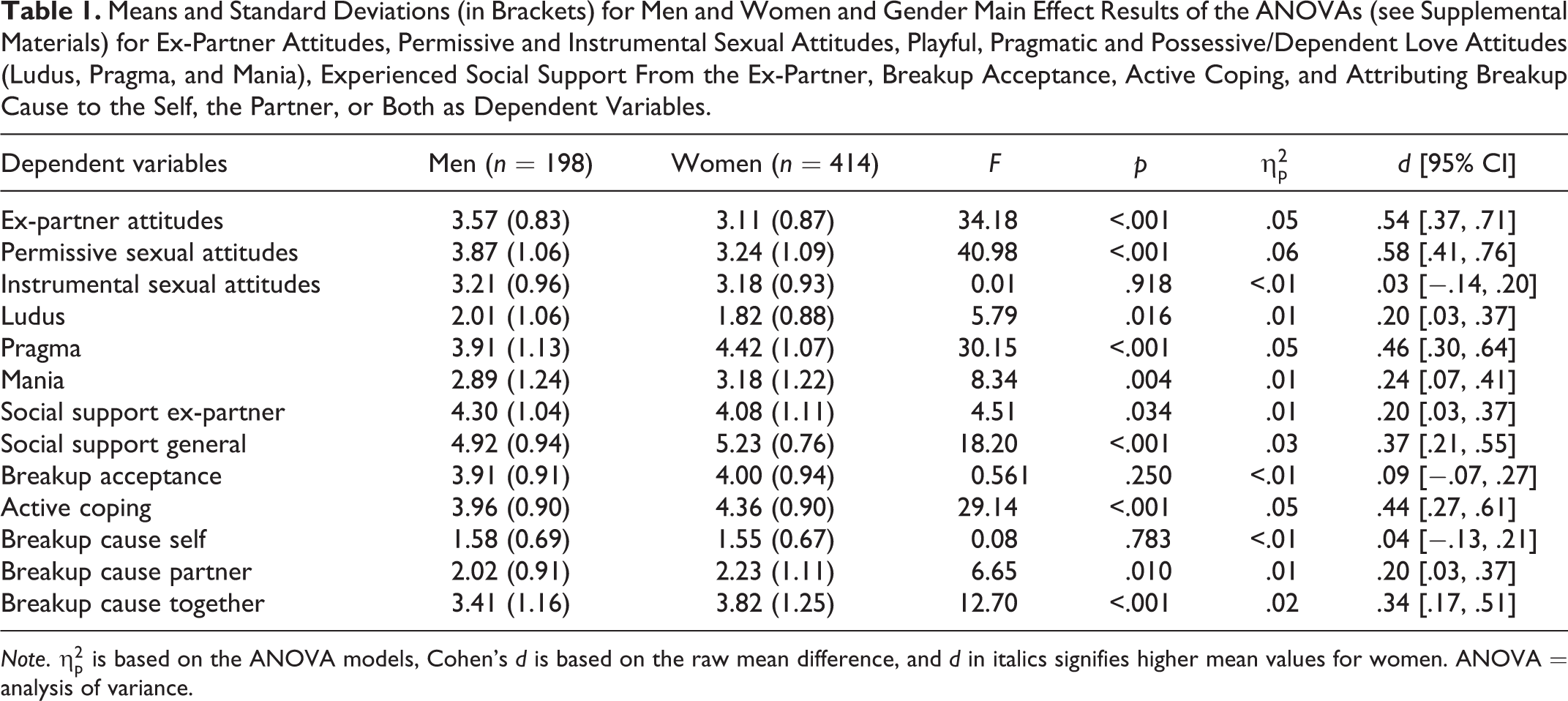
A gender (men vs. women) by status (single vs. involved) analysis of variance (ANOVA) treating evaluation of former partners as the dependent measure revealed two significant main effects. Similar to Studies 1 and 2, men had more positive attitudes toward their ex-partner (M = 3.57) than women did (M = 3.11). The effect size was about the same as the two prior studies, d = .48 (see also Table 1). Additionally, relationship status was a significant predictor, revealing that singles had more positive attitudes toward their ex-partners (M = 3.43) than did individuals involved in relationships (M = 3.14). This effect did not emerge in our prior studies but is consistent with some earlier evidence (Imhoff & Banse, 2011). This finding led us to include relationship status in the correlational analyses reported below. Furthermore, an analysis treating breakup initiator role (self vs. partner) as an independent variable was performed, which revealed no significant main effect, F(1, 600) = 3.70, p = .250, d = .16. Consistent with the initial studies, we did not find an attitude difference between individuals who initiated the breakup versus those who did not, so this variable was not included in the correlational analyses.
Means and Standard Deviations (in Brackets) for Men and Women and Gender Main Effect Results of the ANOVAs (see Supplemental Materials) for Ex-Partner Attitudes, Permissive and Instrumental Sexual Attitudes, Playful, Pragmatic and Possessive/Dependent Love Attitudes (Ludus, Pragma, and Mania), Experienced Social Support From the Ex-Partner, Breakup Acceptance, Active Coping, and Attributing Breakup Cause to the Self, the Partner, or Both as Dependent Variables.
Note.
To provide deeper insight into the association between each variable and gender differences in ex-partner attitudes, we present the means for women and men in Table 1. 2 As expected, men and women differed in their permissive sexual attitudes, with men being more permissive and having more playful love attitudes (Ludus) than women. Women reported more pragmatic love attitudes (Pragma) and more possessive and dependent love attitudes (Mania) compared to men. Also in line with our expectations, men reported that they received more social support from their ex-partners during their relationship than women did, whereas women reported receiving more social support from their social surroundings than men did. Furthermore, women once again reported more active coping behavior than men did, and they attributed the breakup cause more to their partner or as residing within the relationship than men did. We found no gender differences for breakup acceptance, breakup attribution toward the self, or for instrumental sexual attitudes.
Correlations Among Ex-Partner Attitudes and All Considered Variables
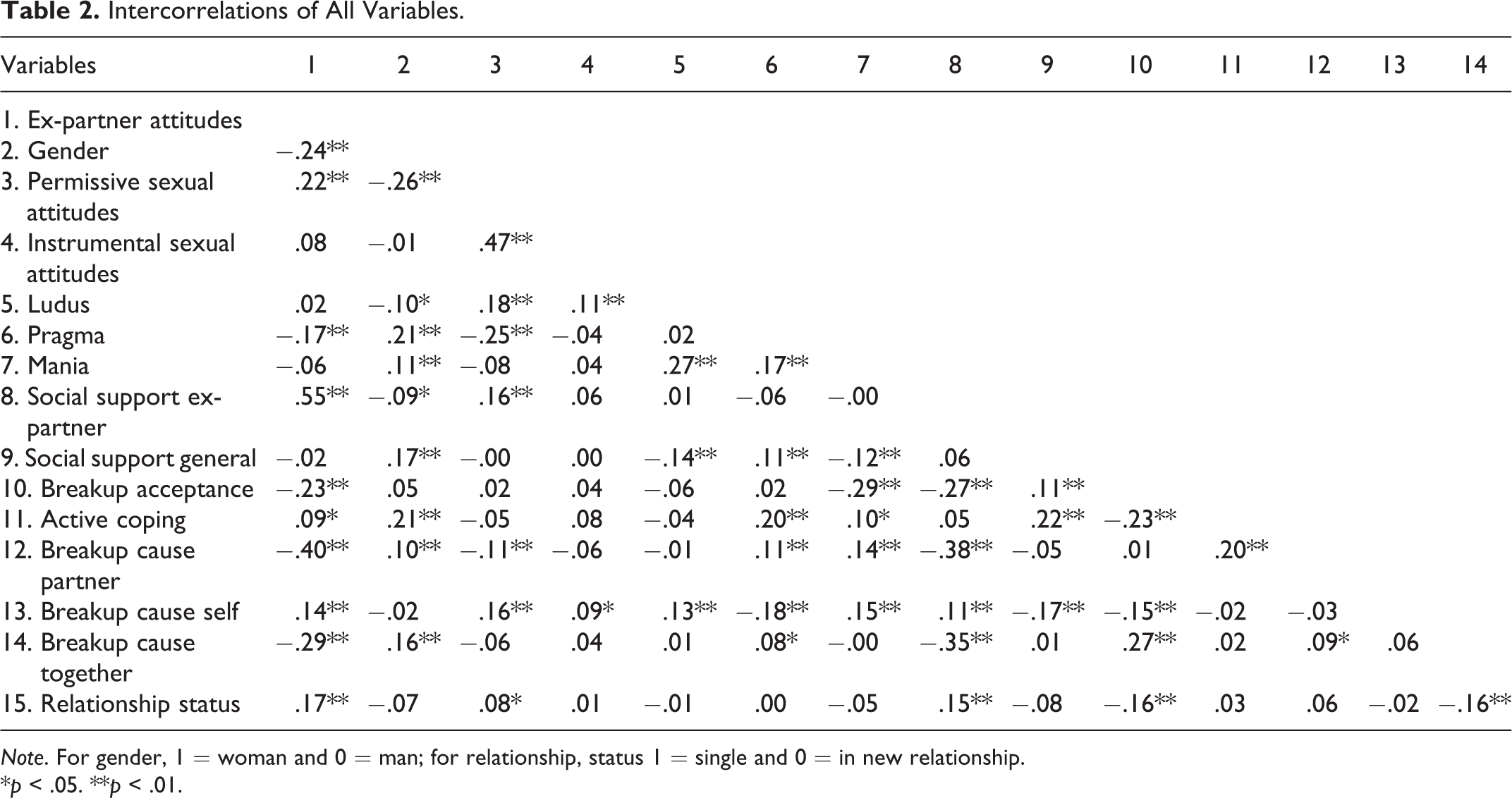
Table 2 shows the intercorrelations of all variables we considered. Most of the variables correlated with ex-partner attitudes, as expected. Permissive sexual attitudes (r = .22, p < .001), perceived social support from the ex-partner (r = .55, p < .001), and attributing the breakup cause to the self (r = .14, p = .001) each correlated positively with ex-partner attitudes. Pragmatic love attitudes (Pragma, r = −.17, p < .001), breakup acceptance (r = −.23, p < .001), active coping (r = −.09, p = .020), and attributing breakup causes to the partner (r = −.40, p < .001) or to the relationship (r = −.29, p < .001) correlated negatively with ex-partner attitudes. However, no significant correlations were found for instrumental sexual attitudes, playful love attitudes (Ludus), possessive/dependent love attitudes (Mania), and (as expected) general social support.
Intercorrelations of All Variables.
Note. For gender, 1 = woman and 0 = man; for relationship, status 1 = single and 0 = in new relationship.
*p < .05. **p < .01.
Multiple Regression Analysis
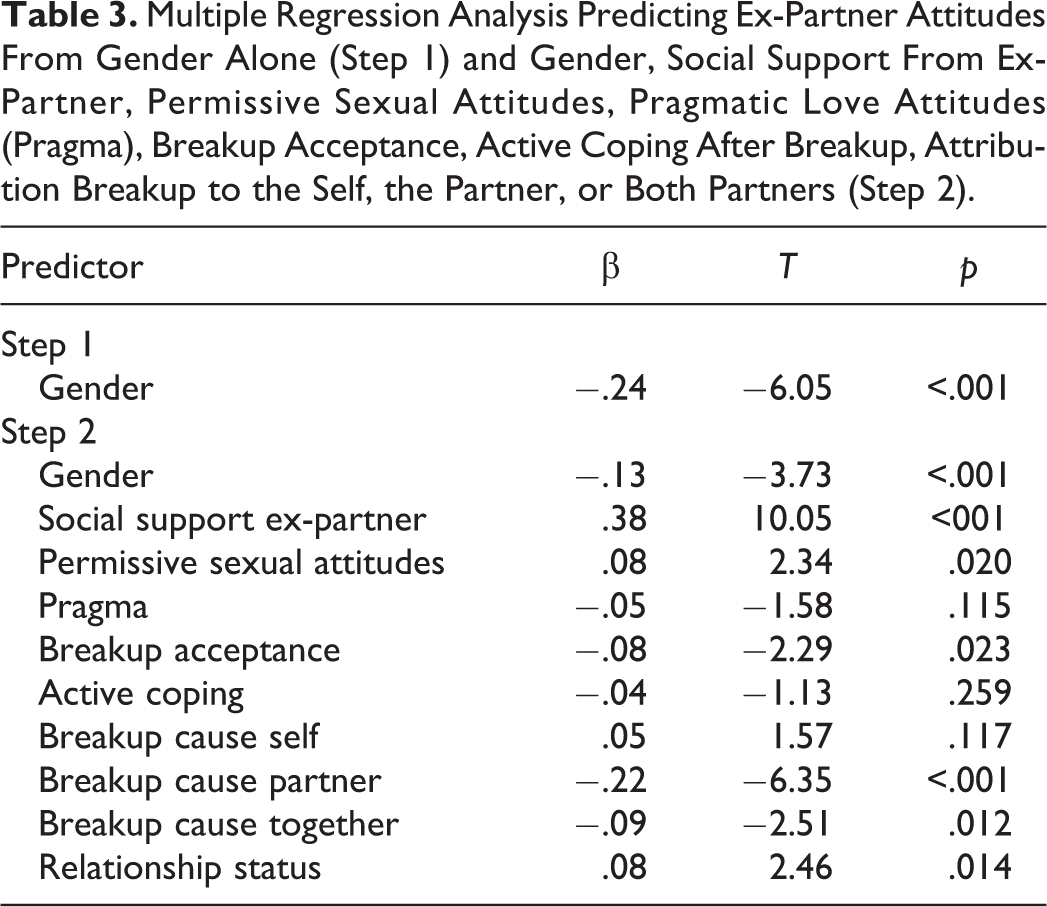
Only the variables that correlated significantly with ex-partner attitudes were included in the regression analysis as predictor variables. To examine whether any of these variables explained the common variance between gender and ex-partner attitudes, we regressed ex-partner attitudes on gender in the first step, Model 1:
Multiple Regression Analysis Predicting Ex-Partner Attitudes From Gender Alone (Step 1) and Gender, Social Support From Ex-Partner, Permissive Sexual Attitudes, Pragmatic Love Attitudes (Pragma), Breakup Acceptance, Active Coping After Breakup, Attribution Breakup to the Self, the Partner, or Both Partners (Step 2).
Study 4
The results of the first three studies document a reliable phenomenon. These gender differences, however, may not be intuitively obvious to most laypersons. The goal of Study 4, therefore, was to determine the degree to which laypeople anticipate this gender difference. To accomplish this goal, we conducted another online survey that investigated laypersons’ views and knowledge about ex-partner attitudes of men and women (for complete information, see https://osf.io/dspgt/).
Sample and Method
Using an e-mail distribution system at the University of Graz, we recruited 589 participants. Applying preregistered exclusion criteria and based upon power analysis (designed to detect a small effect of
Results
Of the 487 participants, 62% (n = 302) indicated that they did not believe in the gender difference. However, 24% (n = 119) considered men to have more positive attitudes toward their ex-partners, and only 14% (n = 66) thought that women hold more positive attitudes, χ2(df = 2) = 188.90, p < .001. There were no differences due to participants’ gender, χ2(df = 2) = 1.36, p = .507. Moreover, we analyzed the 2 continuous items (with either men or women as targets) within a 2 (participant’s gender) × 2 (target) mixed ANOVA. This analysis revealed only a main effect for item reference, F(1, 485) = 18.93, p < .001,
General Discussion
Two studies revealed that men are more likely than women to evaluate their former romantic partners more favorably. A third, larger study replicated this finding. All three studies yielded medium effect sizes (Cohen, 1988). A fourth study indicated that these findings are not intuitively obvious to most laypersons since only one in four laypeople (24%) anticipated these findings (and with most people predicting no gender difference).
Ex-partner attitudes have not been studied extensively until now. To the best of our knowledge, the present research is the first to document that men and women differ in how they tend to view their ex-partners. What are the psychological implications of these differences? Interestingly, Imhoff and Banse (2011) have also reported correlations between ex-partner attitudes and both subjective well-being and life satisfaction. Moreover, Spielmann, Joel, MacDonald, and Kogan (2012) found that individuals who longed for their ex-partners were more likely to experience lower relationship quality in their subsequent relationships. Our results imply that men’s new relationships might suffer more than women’s new relationships. Because the present research is largely exploratory, however, our answers remain speculative and tentative. Nevertheless, some possibilities and issues for future research seem worth sharing.
Permissive sexual attitudes significantly predicted ex-partner attitudes, and this variable was also related to gender. These findings build on recent research by Mogliski and Welling (2017) who found that men rate sexual access (more than women do) as a reason for staying in touch with an ex-partner. Consistent with evolutionary theorizing, greater permissive sexual attitudes held by men (compared to women) might underlie their more favorable views of former partners. For example, it is possible that men, in their stronger pursuit of multiple partners and more playful orientation to love, do not want to close the door to sexual intimacy with their former partners completely. Clearly, favorable ex-partner views support this mind-set, even if their former (female) partners are unlikely to welcome it (Meltzer, McNulty, & Maner, 2017).
Moreover, all of the variables that correlated with ex-partner attitudes can be linked in theory to gender roles. For example, evidence exists that most men tend to profit more from romantic relationships than most women partly because they receive more social support from their female partners (Antonucci & Akiyama, 1987; Fydrich et al., 2009; Rueger et al., 2008). These insights might make it easier for men (rather than women) to look back on their ex-partners in a more friendly and favorable manner.
Our results also revealed that breakup attributions regarding the partner (or relationship) correlate with the ex-partner attitudes. Given that women tend to make these attributions more than men, we assume that it is “something about him” that may launch many romantic breakups. Although psychology often emphasizes differences in construal, we suspect both subjective and objective differences in men-as-partners and women-as-partners are responsible for instigating breakups. Men are, in fact, much more likely than women to engage in harmful behaviors following breakups, including various addictions and mental and/or physical partner abuse (Capezza, D’Intino, Flynn, & Arriaga, 2017; Reid et al., 2008). Thus, our findings may also reflect gender differences happening in romantic relationships, with women actually being more supportive than men vice versa.
Last but not least, we found support that ex-partner attitudes may serve as a sign that individuals have overcome a breakup. This is most likely true of participants who are in a new relationship and report greater breakup acceptance. This result is consistent with other recent research (e.g., Brumbaugh & Fraley, 2015) showing that individuals in new relationships have more resolution from their ex-partners and feel more confident in their own desirability. Our research also indicates that after entering new relationships, both men and women hold less favorable ex-partner views.
In closing, the present research documents a new phenomenon that seems far from obvious to most people. Women tend to have more negative attitudes toward their former romantic partners than men do. While our studies document this stable gender difference, we do not know its specific origins. Even though both evolutionary and gender role theories provide some valuable insights, additional research is needed to pin down the key origins. The use of longitudinal studies in which individuals are followed across time and relationships to determine how and why ex-partner views develop will be particularly helpful in this regard.
Supplemental Material
Supplemental Material, ex_partner_supplemental_material_rev - Men View Their Ex-Partners More Favorably Than Women Do
Supplemental Material, ex_partner_supplemental_material_rev for Men View Their Ex-Partners More Favorably Than Women Do by Ursula Athenstaedt, Hilmar Brohmer, Jeffry A. Simpson, Sandra Müller, Nina Schindling, Adam Bacik and Paul A. M. Van Lange in Social Psychological and Personality Science
Footnotes
Authors’ Note
Ursula Athenstaedt is the leading researcher for all studies and wrote the first draft of the article. Hilmar Brohmer performed Study 4. Jeffry A. Simpson provided critical revisions. Sandra Müller and Nina Schindling performed Study 3. Adam Bacik provided critical revisions. Paul A. M. Van Lange accompanied and developed all studies and provided critical revisions. All studies have been approved by the ethics committee of the University of Graz.
Acknowledgments
The authors would like to thank Tamara Reicher, Lina Penaso, and Verena Wieser for their help with data collection.
Declaration of Conflicting Interests
The author(s) declared no potential conflicts of interest with respect to the research, authorship, and/or publication of this article.
Funding
The author(s) received no financial support for the research, authorship, and/or publication of this article.

Supplemental Material
The supplemental material is available in the online version of the article.
Notes
References
Supplementary Material
Please find the following supplemental material available below.
For Open Access articles published under a Creative Commons License, all supplemental material carries the same license as the article it is associated with.
For non-Open Access articles published, all supplemental material carries a non-exclusive license, and permission requests for re-use of supplemental material or any part of supplemental material shall be sent directly to the copyright owner as specified in the copyright notice associated with the article.
