



Abstract
Engaging in personally costly within-group cooperation benefits one’s in-group members but also impacts other groups by benefiting, neglecting, or harming out-group members, leading to a range of potential consequences for between-group relations (e.g., collaboration vs. competition). We introduce the Intergroup Parochial and Universal Cooperation (IPUC) game to investigate the prevalence of the individual preferences underlying these different expressions of within-group cooperation: universalism, weak parochialism, and strong parochialism. In two online experiments with natural groups, we show that the IPUC has value beyond existing economic games in measuring these preferences separately. In a third experiment conducted in the lab, we show how dispositional measures traditionally associated with within- and between-group cooperation, that is, social value orientation, social dominance orientation, honesty-humility, and empathic concern, predict different preferences. Thus, the IPUC provides a tool to better understand within- and between-group interactions and to test interventions to overcome intergroup conflict.
To survive and thrive, humans need to cooperate within groups (Nowak, 2006). Within-group cooperation poses a social dilemma, where each individual benefits by acting selfishly, but the joint welfare of all in-group members is maximized by mutual cooperation (Dawes, 1980). Evolutionary adaption has selected mechanisms that promote within-group cooperation (Bowles & Gintis, 2004; Rand & Nowak, 2013), and psychological research has offered various explanations for its occurrence, such as reciprocity between in-group members and shared social identities (Brewer, 1999; Tajfel & Turner, 1986; Yamagishi, Jin, & Kiyonari, 1999).
However, the underlying motivation of within-group cooperation can be ambiguous, benefiting, neglecting, or harming other groups (Bornstein, 2003; Dawes, 1980). Previous research in psychology and beyond has proposed different individual preferences in within- and between-group interaction: Firstly, individuals might strive to benefit both the in-group and the out-group equally; universal cooperation (Buchan et al., 2009). Secondly, they might want to benefit the in-group but not the out-group; weak parochial cooperation (e.g., neither actively harming nor actively helping out-group members; see Aaldering, Ten Velden, Van Kleef, & De Dreu, 2018; Bernhard, Fischbacher, & Fehr, 2006). Thirdly, individuals might want to engage in within-group cooperation to actively harm the out-group; strong parochial cooperation (Böhm, Rusch, & Gürerk, 2016; Choi & Bowles, 2007). For example, one may choose to enlist for military service to promote peace for all countries (universal cooperation), to protect the own country (weak parochial cooperation), or to harm other countries (strong parochial cooperation). Notably, all these preferences are reflected in within-group cooperation because they are costly for the contributing individuals (e.g., time, effort, risk of injury) while benefiting their in-group’s welfare. However, they can lead to diametrically opposed consequences in intergroup relations, ranging from coalition and peaceful coexistence to conflict and violence (Bowles & Gintis, 2004; De Dreu, Balliet, & Halevy, 2014).
There is much evidence that individuals generally prefer to cooperate with in-group over out-group members, that is, they display parochial cooperation (for a meta-analysis, see Balliet, Wu, & De Dreu, 2014). Parochialism has become a catch-all term, referring to either an ignorance or an aversion toward out-groups, reflecting weak versus strong parochialism, respectively (e.g., Bernhard et al., 2006; Choi & Bowles, 2007). Yet behavioral measures assessing parochial (vs. universal) cooperation cannot univocally distinguish between universal versus weak parochial versus strong parochial cooperation (Böhm, Rusch, et al., 2018). As a consequence, little is known about the differential psychological processes associated with each of these preferences.
Here, we introduce the Intergroup Parochial and Universal Cooperation (IPUC) game and use it in three preregistered and incentivized online and lab experiments with natural and minimal group identities to (i) behaviorally disentangle these preferences and (ii) estimate their prevalence. We (iii) demonstrate the unique value of the IPUC game over other economic games in separating universal versus weak parochial versus strong parochial cooperation as well as egoism, and (iv) identify interindividual differences predicting unique behavioral preferences.
Economic Games of Within- and Between-Group Interaction
Economic games form a prime measurement tool of cooperative behavior (Murnighan & Wang, 2016). However, the preferences underlying cooperation can only be understood when there are behavioral options corresponding with specific individual preferences.
Two games measuring within- and between-group cooperation are the Intergroup Prisoner’s Dilemma-Maximizing Differences (IPD-MD; Halevy, Bornstein, & Sagiv, 2008) and the Nested Social Dilemma (NSD; Wit & Kerr, 2002). The IPD-MD separates two pools to which a player can choose to contribute an individual endowment at personal cost: one that benefits the in-group (within-group pool; resembling weak parochial cooperation) and one that benefits the in-group while harming the out-group (between-group pool; resembling strong parochial cooperation). While this game can capture differences in the preference for weak parochialism (or in-group love) and strong parochialism (or out-group hate; see e.g., Halevy et al., 2008, 2012; Weisel & Böhm, 2015), it provides no option for individuals who want to benefit both groups equally; universal cooperation. Someone with a preference for universal cooperation may instead contribute to the closest alternative available, the within-group pool, and/or decide to contribute less. In the IPD-MD, contributions to the within-group pool therefore intertwine the preferences for universal and weak parochial cooperation.
The NSD, in contrast, separates contributions to a local pool (like the within-group pool of the IPD-MD, resembling weak parochial cooperation) and contributions to a global pool, benefiting both groups equally (resembling universal cooperation). However, there is no pool for strong parochial cooperation. The best alternative to benefit the in-group while harming the out-group would be to contribute to the local pool. Thus, the preference underlying contributions to the local pool in the NSD can be either weak or strong parochial cooperation.
In sum, neither the IPD-MD nor the NSD can unequivocally separate weak parochial cooperation from other potentially relevant preferences. This is remarkable given the widespread debate in the psychological literature and beyond on the nature of parochial cooperation (Choi & Bowles, 2007; Corr, Hargreaves Heap, Seger, & Tsutsui, 2015; Rusch, 2014; Rusch, Böhm, & Herrmann, 2016; Thielmann & Böhm, 2016). We thus devised the IPUC game to model universal, weak parochial, and strong parochial cooperation separately (for a game-theoretical analysis, see Supplemental Material). As in the NSD, contributions to the first pool benefit both groups equally (universal cooperation). And as in the IPD-MD and NSD, contributions to the second pool solely benefit in-group members (weak parochial cooperation). As in the IPD-MD, contributions to the third pool benefit in-group members, while harming out-group members (strong parochial cooperation). Alternatively, individuals may choose to egoistically keep their endowment and contribute it to neither of the pools.
The Present Research and Hypotheses
As a first step, we aimed to demonstrate the added value of the IPUC over the IPD-MD (Experiment 1) and the NSD (Experiment 2). We expected universal and weak parochial cooperation to be relevant behavioral motivations, each with larger-than-zero contributions in the IPUC (Hypothesis 1). Moreover, because the within-group pool in the IPD-MD intertwines universal and weak parochial cooperation, whereas these preferences are behaviorally separated by different pools in the IPUC, we expected larger contributions to the within-group pool in the IPD-MD compared with the weak parochial cooperation pool in the IPUC (Hypothesis 2). Given the equivalence in the preferences underlying contributions to the strong parochial pool in both games, we did not expect contribution differences here (Hypothesis 3). When comparing the IPUC with the NSD, we expected larger contributions to the local pool in the NSD (Hypothesis 4), which resembles weak parochial cooperation but is also the closest available alternative for strong parochial cooperation, than to the weak parochial cooperation pool in the IPUC.
As a second step, we aimed to exploit the advantages of the IPUC by investigating how interindividual differences predict unique preferences in within- and between-group interaction (Experiment 3). We propose that the generally prosocial traits of social value orientation (SVO), empathic concern (EC), and honesty-humility (H-H) each uniquely correlate with contributions to the pool reflecting the respective preference.
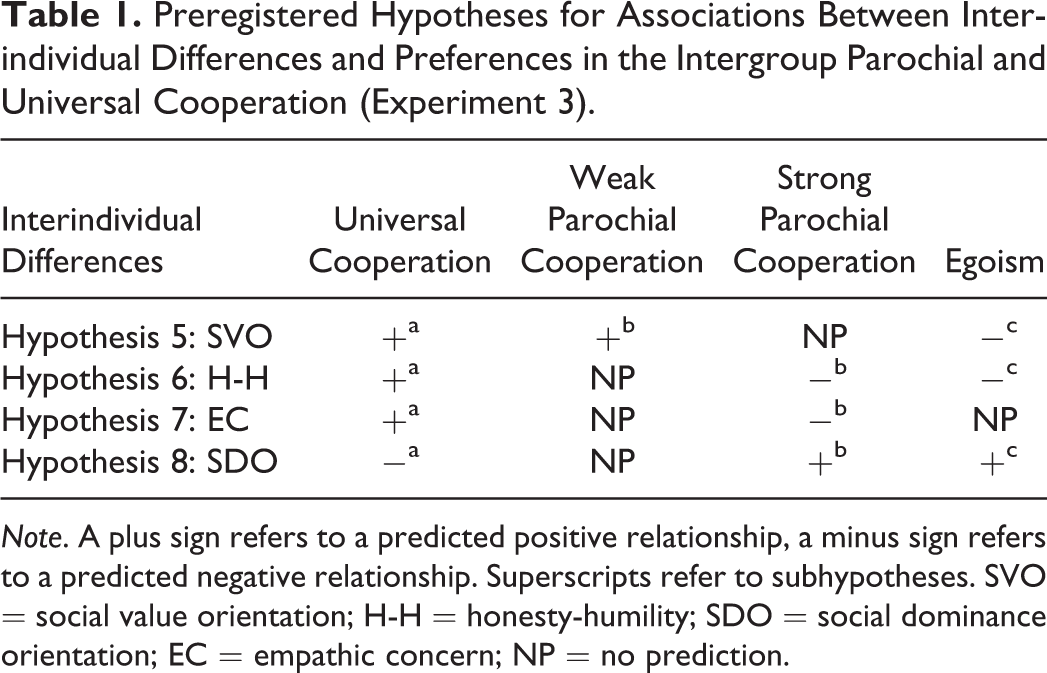
SVO reflects individuals’ preference for distributing outcomes between themselves and someone else (Van Lange, 1999). A pro-social value orientation generally predicts cooperation (Balliet, Parks, & Joireman, 2009); hence, SVO should be positively associated with universal cooperation and negatively with egoism. However, pro-socials’ cooperation is oftentimes confined to their own group (Aaldering, Greer, Van Kleef, & De Dreu, 2013; De Dreu, 2010), sometimes even at the expense of another group (Abbink, Brandts, Herrmann, & Orzen, 2012). Using the IPUC, we test whether pro-socials’ concern is limited to the in-group (weak parochial cooperation) when universal cooperation is possible as well (Hypotheses 5a–c; see Table 1).
Preregistered Hypotheses for Associations Between Interindividual Differences and Preferences in the Intergroup Parochial and Universal Cooperation (Experiment 3).
Note. A plus sign refers to a predicted positive relationship, a minus sign refers to a predicted negative relationship. Superscripts refer to subhypotheses. SVO = social value orientation; H-H = honesty-humility; SDO = social dominance orientation; EC = empathic concern; NP = no prediction.
H-H is a general inclination to be sincere, fair, and modest (Lee & Ashton, 2004). It is associated with fairness and concern for others’ welfare, irrespective of group membership (Gerpott, Balliet, Columbus, Molho, & De Vries, 2017; Thielmann & Böhm, 2016; Zettler, Hilbig, & Heydasch, 2013). Higher values of H-H should therefore be associated with more universal cooperation but with less strong parochial cooperation and less egoism (Hypotheses 6a–c).
EC is the proneness to feel compassion and sympathy and a general understanding of the emotional state of others (Batson & Shaw, 1991). EC is related to pro-social behavior and decreased biases against out-groups and associated with helping of out-group members (Batson et al., 1997; Böhm, Theelen, et al., 2018). This should be mirrored in more universal cooperation and less strong parochial cooperation (Hypotheses 7a and 7b).
In contrast with these pro-social traits stands social dominance orientation (SDO), an ideology concerning preferences for a group-based hierarchy in a society (Pratto, Sidanius, Stallworth, & Malle, 1994). High SDO is associated with a competitive and discriminatory mind-set toward out-group members (Ho et al., 2015; Kteily, Ho, & Sidanius, 2012; Pratto et al., 2013, Whitley, 1999). Moreover, individuals high in SDO keep resources withheld from the out-group to themselves rather than contributing them to help their in-group (Halali, Dorfmann, Sun, & Halevy, 2018). This should be reflected in more strong parochial cooperation and egoism and in less universal cooperation (Hypotheses 8a–8c).
Experiment 1
To test Hypotheses 1–3, we compared the contributions in the IPUC and the IPD-MD using a natural group setting, with group membership being determined by political identification, consisting of U.S. Democrats versus Republicans.
Method
Participants
U.S. participants were recruited online via Prolific Academic. An a priori power analysis revealed a required sample size of 128 participants to achieve a power of 1 − β = .80 for detecting an effect size of d = 0.5 in a one-way analysis of variance (ANOVA) to test Hypothesis 2. We originally collected data of 174 participants. Twenty-eight participants were removed from the data because they did not identify with either Democrats or Republicans. Furthermore, we preregistered to remove participants who would fail in more than half of the comprehension questions (n = 19). The final sample size was N = 127 (51% female, M age = 28.23, SD = 7.61). 1
Procedure
The experimental procedure received institutional review board (IRB) approval. Participants provided informed consent and were randomly assigned to play either the IPUC or the IPD-MD. Their identification with the political group of Democrats versus Republicans (1 = very much Democrat to 7 very much Republican) was used as covariate in the analyses. Depending on their identification (responses smaller or larger than the midpoint of the item), participants were assigned to a four-member group composed of Democrats or Republicans and received task instructions referring to their respective group membership. Following extensive game instructions, participants completed a number of comprehension questions and made their contribution decisions. Each game was played 3 times in a row without feedback on others’ contributions in between.
In the IPUC (IPD-MD), participants could choose how to contribute an endowment of 10 monetary units (MUs; 1 MU = £0.5) among three (two) pools in three consecutive rounds. The behavioral options (and the preferences they capture) as well as the respective payoff consequences are shown in Table 2. Pools were labeled neutrally, that is, Pool A, Pool B, and so on. The mean contribution over three rounds constituted our dependent variable with Cronbach’s α between .92 and .98 for all contribution options in both games.
Return Per Contributed Monetary Unit for the Contributor, Each In-Group Member, and Each Out-Group Member, Depending on the Behavioral Option in Each Game.
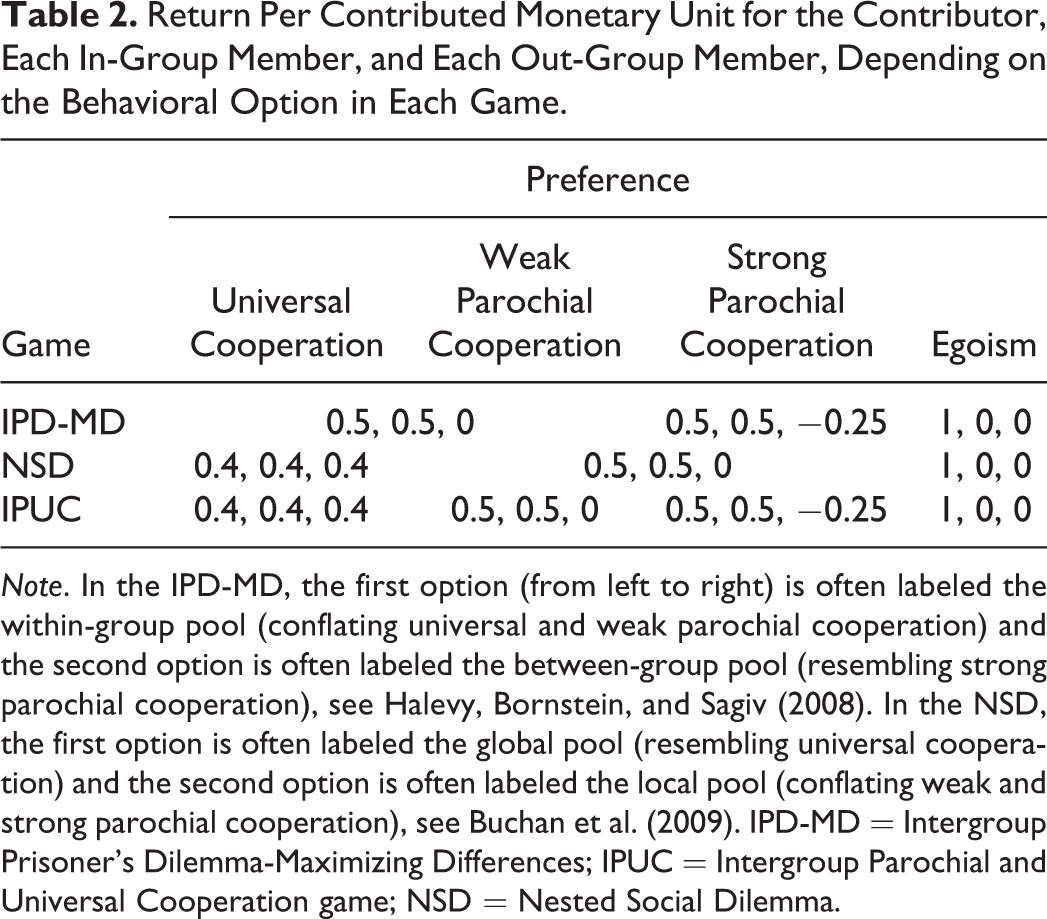
Note. In the IPD-MD, the first option (from left to right) is often labeled the within-group pool (conflating universal and weak parochial cooperation) and the second option is often labeled the between-group pool (resembling strong parochial cooperation), see Halevy, Bornstein, and Sagiv (2008). In the NSD, the first option is often labeled the global pool (resembling universal cooperation) and the second option is often labeled the local pool (conflating weak and strong parochial cooperation), see Buchan et al. (2009). IPD-MD = Intergroup Prisoner’s Dilemma-Maximizing Differences; IPUC = Intergroup Parochial and Universal Cooperation game; NSD = Nested Social Dilemma.
Upon completion, participants were paid £0.85. Additionally, one out of eight participants received a bonus payment based on the own and other participants’ contributions in one randomly chosen round (up to £26.30). Bonus payments were determined after completion of the study by randomly selecting one eighth of participants and matching four Democrats and four Republicans to groups.
Results
Distribution of contributions to each preference in each game as well as means and confidence intervals (CIs) are shown in Figure 1. 2 Supporting preregistered Hypothesis 1, participants playing the IPUC contributed significantly more than zero to the universal cooperation pool, t(61) = 6.74, p < .001, Cohen’s d = 0.86, 95% CI [2.30, 4.25], as well as to the weak parochial cooperation pool, t(61) = 6.79, p < .001, Cohen’s d = 0.86, 95% CI [1.71, 3.31]. While not explicitly hypothesized, we also obtained significantly larger-than-zero contributions to the strong parochial cooperation pool, t(61) = 3.92, p < .001, Cohen’s d = 0.50, 95% CI [0.60, 1.83], as well as to the egoistic option, t(61) = 6.89, p < .001, Cohen’s d = 0.87, 95% CI [2.09, 3.81].
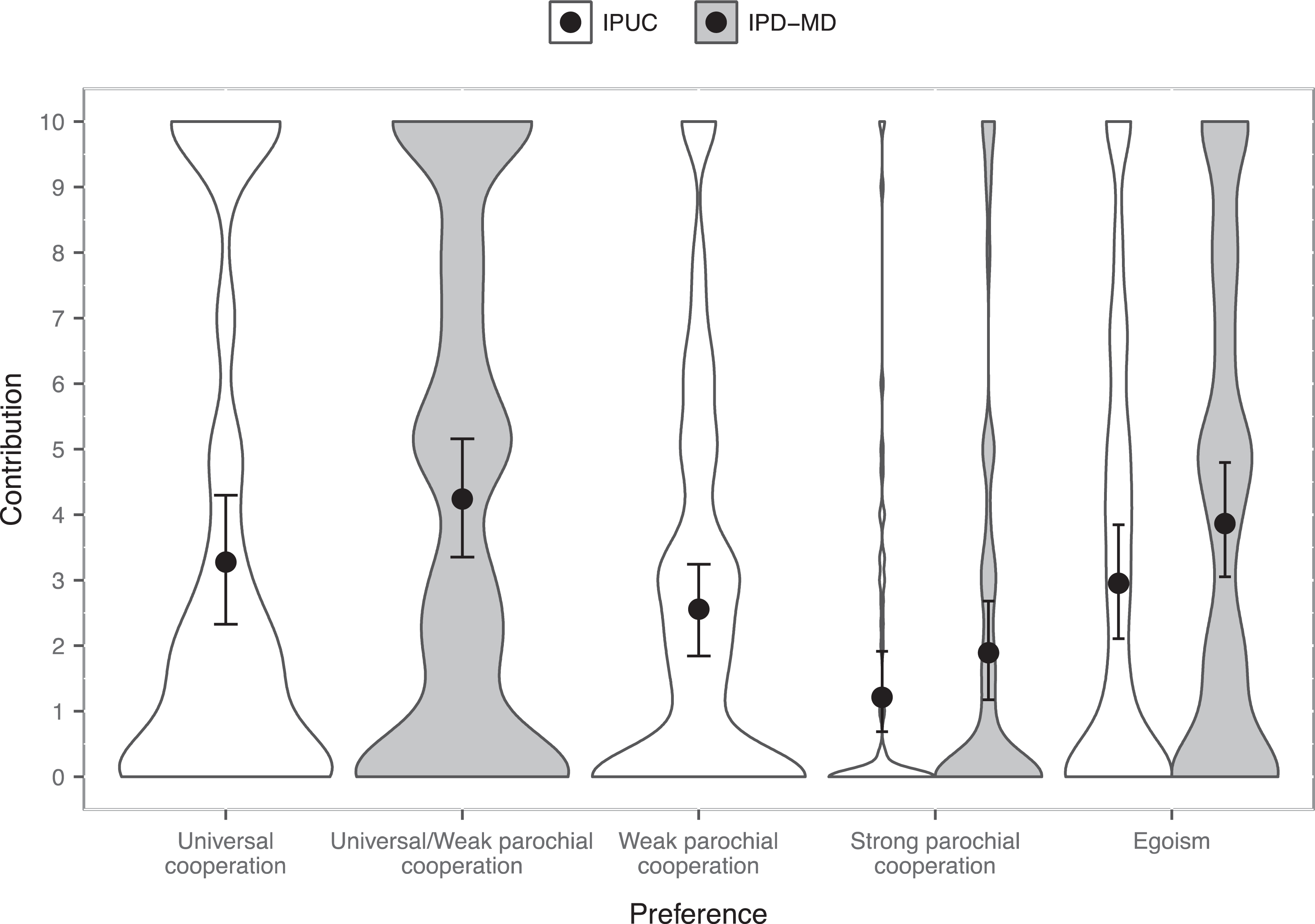
Contributions indicating different preferences in the Intergroup Parochial and Universal Cooperation (n = 62) and in the Intergroup Prisoner’s Dilemma Maximizing Differences (IPD-MD; n = 65; Experiment 1) games. Points represent mean values, error bars represent bootstrapped 95% confidence intervals (1,000 iterations). White and gray areas represent rotated kernel density distributions. In the IPD-MD, universal and weak parochial cooperation are intertwined by contributions to the within-group pool and strong parochial cooperation is captured by contributions to the between-group pool.
An analysis of covariance (ANCOVA) with political identification as covariate supported preregistered Hypothesis 2, showing larger contributions to the within-group pool in the IPD-MD (intertwining universal and weak parochial cooperation) than to the weak parochial cooperation pool in the IPUC, F(1, 124) = 7.37, p = .008,
Because null effects cannot be interpreted as supportive of a null hypothesis (Hypothesis 3), we tested whether the level of strong parochial cooperation in the IPD-MD versus IPUC was indeed statistically equivalent using the two-one-sided-t-test (TOST) procedure (Lakens, 2017). We determined the equivalence bounds based on a small effect size, d = 0.02. The equivalence test of two one-sample t tests was not significant, t lower quivalence bound(121.37) = 2.50, p < .001, and t upper equivalence bound (121.37) = 0.24, p = .595. We can therefore not reject the hypothesis that there exists a true effect of a small size in the difference in strong parochial cooperation between the IPD-MD and the IPUC.
Discussion and Introduction to Experiment 2
Results of Experiment 1 demonstrate the prevalence of each behavioral motivation as well as the added value of the IPUC over the IPD-MD in disentangling universal and weak parochial cooperation. Experiment 2 was designed to compare the IPUC to the NSD, testing Hypotheses 1 and 4.
Method
Participants
U.S. participants were recruited online via Prolific Academic. An a priori power analysis revealed a required sample size of 178 participants to achieve a power of .80 for detecting an effect size of d = 0.42 for Hypothesis 4 (determined based on the effect size obtained in Experiment 1 for the structurally equivalent Hypothesis 2) in a one-way ANOVA. Nine of our original 226 participants were removed from the analyses because they did not identify with either Democrats or Republicans. In accordance with a priori specifications, 37 participants were removed from the analyses because of our preregistered exclusion criteria (they failed more than half of the comprehension questions), leading to a final sample of N = 180 (41% female, M age = 30.33, SD = 7.22).
Procedure
The experimental procedure received IRB approval. The procedure was the same as in Experiment 1, with the exception that half of the participants played the NSD (and not the IPD-MD, as in Experiment 1). The behavioral options and respective payoff consequences are shown in Table 2; the instructions and comprehension questions were adapted accordingly. Cronbach’s α ranged between .93 and .97 over the three contribution rounds for all behavioral options in both games.
Results
Distribution of contributions to each preference in each game as well as means and confidence intervals are shown in Figure 2. Contributions to each of the pools in the IPUC differed from zero, supporting preregistered Hypothesis 1: t(93) = 9.09, p < .001, Cohen’s d = 0.94, 95% CI [2.22, 3.46], for contributions to the universal cooperation pool; t(93) = 10.93, p < .001, Cohen’s d = 1.13, 95% CI [2.60, 3.75], for contributions to the weak parochial cooperation pool; and t(93) = 5.77, p < .001, Cohen’s d = 0.59, 95% CI [0.93, 1.90], for contributions to the strong parochial cooperation pool. Egoism was a significant preference too, t(93) = 8.71, p < .001, Cohen’s d = 0.90, 95% CI [1.98, 3.15].
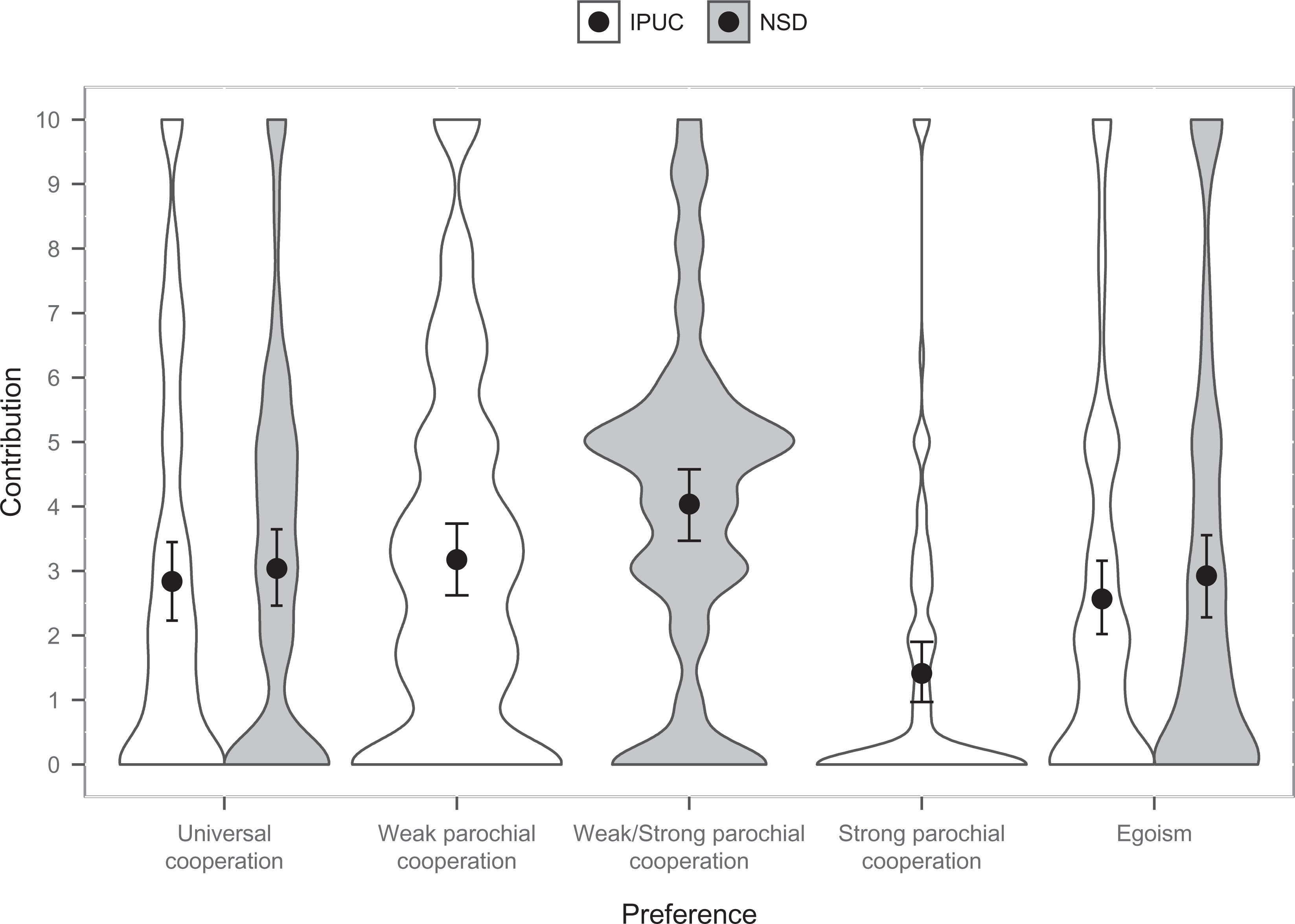
Contributions indicating different preferences in the Intergroup Parochial and Universal Cooperation game (n = 94) and in the Nested Social Dilemma (NSD; n = 86; Experiment 2). Points represent mean values, error bars represent bootstrapped 95% confidence intervals (1,000 iterations). White and gray areas represent rotated kernel density distributions. In the NSD, weak and strong parochial cooperation are intertwined by contributions to the local pool and universal cooperation is captured by contributions to the global pool.
An ANCOVA with political identification as covariate showed larger contributions to the local pool in the NSD (intertwining weak and strong parochial cooperation) than to the weak parochial cooperation pool in the IPUC, F(1, 177) = 4.12, p = .044,
Discussion and Introduction to Experiment 3
Experiment 2 replicated the relevance of the behavioral preferences and supported the additional value of the IPUC over the NSD in separating weak and strong parochial cooperation. Experiment 3 was designed to elucidate which individuals would be more likely to adopt each of the preferences—measured in the IPUC—by testing their unique association with interindividual differences in SVO, H-H, SDO, and EC (see Table 1).
Method
Participants
This study was conducted with undergraduate students at a Western-European university in the laboratory using minimal groups (Tajfel & Turner, 1986). An a priori power analysis revealed a required sample size of 173 participants to achieve a power of .80 for detecting a small- to medium-sized correlation of r = .21 (based on the mean correlation in social and personality psychology; see Richard, Bond, & Stokes-Zoota, 2003). After excluding 12 of the 192 participants based on our preregistered criteria of having scored two or more standard deviations above the mean error rate in the comprehension questions, N = 180 participants remained in the sample (45% female, M age = 24.54, SD = 4.46). 4
Materials
SVO was measured with the 6 primary items of the SVO slider measure (Murphy, Ackerman, & Handgraaf, 2011). Participants were asked to decide about the distribution of MUs (100 MUs = €1) between themselves (sender) and an anonymous other (receiver). In each choice, they were presented with nine options, with varying outcomes for themselves and the other person (between 15 and 100 MUs). Based on their responses, the SVO angle was computed, with higher scores referring to a more prosocial orientation, reflecting greater concern for equality and/or social welfare. All players completed the measure in the role of the sender. At the end of the experiment, the role of sender and receiver was determined randomly, one sender was matched to one receiver, and participants received their payments for 1 randomly selected item.
H-H was measured with a translated version of the 60-item HEXACO personality inventory (Ashton & Lee, 2007; translation: Moshagen, Hilbig, & Zettler, 2014) using a 5-point Likert-type scale ranging from strongly disagree to strongly agree (10-item H-H subscale with Cronbach’s α = .80). To ensure the validity of the measurement, all subscales of the HEXACO were administered (not analyzed further).
SDO was measured with a translated adaption of the scale developed by Pratto, Sidanius, Stallworth, and Malle (1994; translation: Cohrs & Asbrock, 2009). The 12 items used a 7-point Likert-type scale ranging from strongly disagree to strongly agree (Cronbach’s α = .88).
Lastly, EC was measured with a translated adaptation of the interpersonal reactivity index (Davis, 1983; translation: Paulus, 2009). The 16 items used a 7-point Likert-type scale ranging from strongly disagree to strongly agree (Cronbach’s α = .75; excluding the subscale Personal Distress following Paulus, 2009).
Procedure
The experimental procedure received IRB approval. Participants took part in experimental sessions of 24 participants each and were randomly seated in separated computer cubicles. Instructions were provided via the computer screen. The order of task completion was counterbalanced between experimental sessions: Half of the participants started with the SVO measure, followed by questionnaires assessing HEXACO, SDO, and EC (in this order), and ended with the IPUC. The other half started with the IPUC, followed by the questionnaire, and ended with the SVO measure. 5
Before participants made their decisions in the IPUC, they performed an estimation task to form minimal groups (Böhm, Rothermund, & Kirchkamp, 2013). Here, participants completed five trials estimating the varying number of objects shown for about half a second on the screen. Based on the median estimation in the respective session, they were then assigned either to the “overestimators” group or “underestimators” group. 6 Four members of each group were matched to each other. After this group composition task, all participants answered questions regarding their group identification (Doosje, Ellemers, & Spears, 1995).
The IPUC was described as in Experiments 1 and 2 with the exception that the own group was described as over- or underestimator group, and the out-group vice versa. Each participant received an endowment of 10 MUs (1 MU = €0.5) and could decide how to allocate the tokens to the four behavioral options. After answering six comprehension questions, participants made their contribution decision once (rather than 3 times as in the earlier experiments).
Participants received €1 flat fee payment for completing the questionnaire. The decisions in the SVO slider measure and IPUC were paid decision contingently. On average, participants received €10.50 (between €5 and €17) for the 60-min experiment.
Results
Table 3 displays means and standard deviations of all predictor and outcome variables as well as their zero-order correlations. We ran a multivariate analysis of variance, with SVO, H-H, SDO, and EC as predictor variables of contributions to each of the IPUC pools. All multivariate effects were followed-up with one-way ANOVAs including all predictors to test the prespecified hypotheses.
Descriptive Statistics and Zero-Order Correlations With (Bootstrapped Bias Accelerated 95% Confidence Intervals, 1,000 Resamples) Between Preferences Measured in the Intergroup Parochial and Universal Cooperation Game and Interindividual Differences (Experiment 3).
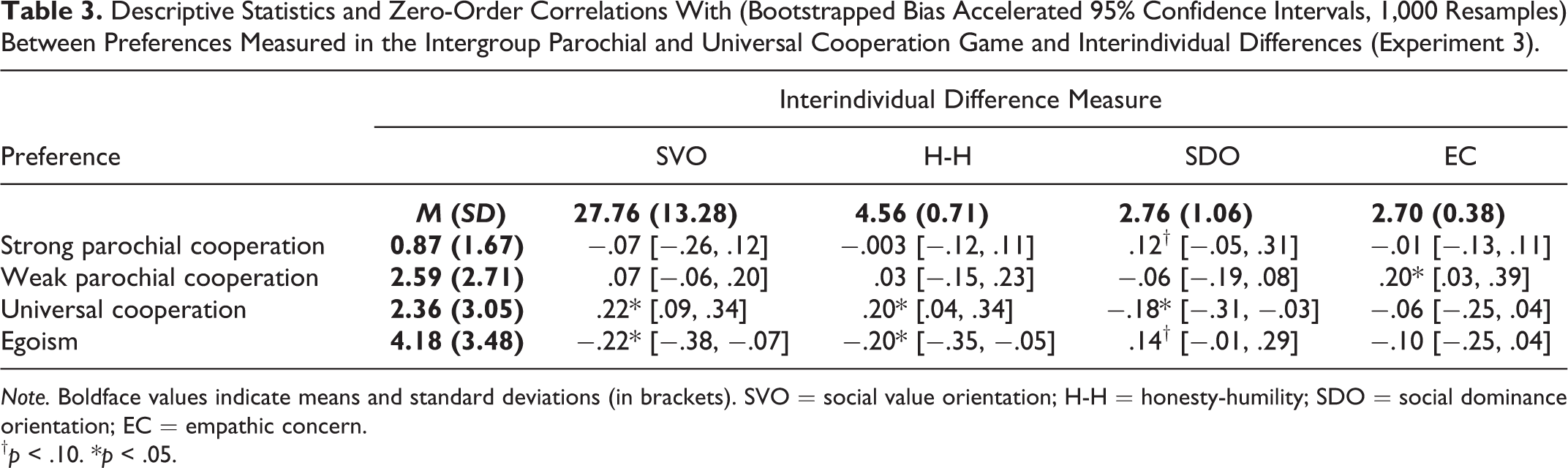
Note. Boldface values indicate means and standard deviations (in brackets). SVO = social value orientation; H-H = honesty-humility; SDO = social dominance orientation; EC = empathic concern.
† p < .10. *p < .05.
For SVO, there was a multivariate effect on contributions, F(3, 173) = 3.61, p = .014,
While there was no multivariate effect on contributions for H-H, F(3, 173) = 1.58, p = .196,
The multivariate effect of EC on contributions was significant, F(3, 173) = 2.93, p = .035,
Finally, despite the lack of a multivariate effect of SDO on contributions, F(3, 173) = 2.09, p = .103,
Discussion
Results of Experiment 3 show how interindividual differences differentially predict the preference to benefit versus neglect versus harm the out-group in the IPUC. While some of the hypotheses were supported, unexpectedly, EC predicted weak parochial rather than universal cooperation. This supports recent findings on “parochial empathy” (Bruneau, Cikara, & Saxe, 2017). Moreover, in contrast with earlier studies (De Dreu, 2010; Aaldering et al., 2018), SVO did not predict weak parochial cooperation. This suggests that behaviors and interpretation thereof in within- and between-group interaction can differ substantially depending on the experimental paradigm used, further supporting the value of the IPUC.
General Discussion
Understanding individual cooperation in within- and between-group interaction is crucial in psychological science and beyond (Balliet et al., 2014; Brewer, 1999; Choi & Bowles, 2007; De Dreu et al., 2014). We introduce the novel IPUC game to distinguish behavioral preferences underlying within-group cooperation with different consequences for out-groups. The IPUC is the first game to isolate weak parochial cooperation from other preferences. Weak parochial cooperation is intertwined either with universal cooperation or with strong parochial cooperation in the IPD-MD and the NSD, respectively. 7 Experiments 1 and 2 demonstrate the relevance of universal, weak parochial, and strong parochial cooperation as well as egoism and suggest how these preferences can potentially determine the course of between-group relations: from competition (strong parochial cooperation; Böhm et al., 2016) to coalition (universal cooperation; Buchan et al., 2009).
Experiment 3 shows that these different preferences may follow from interindividual differences: A preference for hierarchies can fuel hostilities between groups by instigating strong parochial cooperation, while EC limits cooperation to the in-group. Conversely, a general concern for equality and social welfare facilitates between-group (universal) cooperation. We are looking forward to future research replicating and extending these findings, for instance by investigating preferences depending on other variables, such as relative deprivation (Halevy, Chou, Cohen, & Bornstein, 2010) and right-wing authoritarianism (Altemeyer, 1998).
A potential methodological criticism regarding Experiments 1 and 2 could address the comparison of games with different numbers of behavioral options, which could invite demand characteristics (e.g., Bardsley, 2008). We do not believe that such effects undermine our interpretations because we found no significant differences in contributions between games when the options capture the same preference (e.g., strong parochial cooperation in the IPD-MD vs. IPUC, universal cooperation in the NSD vs. IPUC). Nevertheless, future research using the IPUC could relate measures of interindividual differences to contributions in different games among the same participants (within subjects). This would provide a strong test of the idea that individuals change their contribution behavior between games depending on their motivational and personality differences but not based on the mere salience of certain options. Relatedly, future research should identify circumstances that facilitate shifts in behavioral preferences, for example from parochial to universal cooperation. Such research can be helpful in solving national or global cooperation challenges (Buchan et al., 2009).
In sum, by introducing the IPUC, we allow future research to move beyond adjusting structural options within the game to steer behavior, and instead to focus on psychological factors that impact behavioral preferences, and to refine psychological theories of within- and between-group interaction accordingly.
Supplemental Material
Supplemental Material, SOM-R_R1_parochial_vs._universal_cooperation_Aaldering_Boehm - Parochial Versus Universal Cooperation: Introducing a Novel Economic Game of Within- and Between-Group Interaction
Supplemental Material, SOM-R_R1_parochial_vs._universal_cooperation_Aaldering_Boehm for Parochial Versus Universal Cooperation: Introducing a Novel Economic Game of Within- and Between-Group Interaction by Hillie Aaldering and Robert Böhm in Social Psychological and Personality Science
Footnotes
Open Practices Statement

Declaration of Conflicting Interests
The author(s) declared no potential conflicts of interest with respect to the research, authorship, and/or publication of this article.
Funding
The author(s) received no financial support for the research, authorship, and/or publication of this article.
Supplemental Material
The supplemental material is available in the online version of the article.
Notes
References
Supplementary Material
Please find the following supplemental material available below.
For Open Access articles published under a Creative Commons License, all supplemental material carries the same license as the article it is associated with.
For non-Open Access articles published, all supplemental material carries a non-exclusive license, and permission requests for re-use of supplemental material or any part of supplemental material shall be sent directly to the copyright owner as specified in the copyright notice associated with the article.
