




Abstract
Demographic changes lead to growing political power of immigrants and their children, which raises important social psychological questions. In a survey experimental study among a national sample of the native Dutch, feelings toward Muslim immigrants’ political party representation were examined. The strategy of group representation (participate in the existing political system with a Muslim party) elicited the strongest feelings of power threat and therefore was evaluated most negatively. Compared to group representation, the descriptive representation strategy (participate as Muslims in existing political party) and the strategy of disengagement (reject political representation) were evaluated less negatively but more negatively compared to a situation in which politics was not mentioned. Furthermore, participants who more strongly endorsed ethnic national belonging had more negative feelings but not in the disengagement condition.
The continuing increase in the number of immigrant-origin citizens in many Western countries implies a growing political power of these citizens and their children. This demographic development can threaten majority members’ dominant position leading them to resist immigrants’ political participation. While social psychological research has studied majority members’ feelings of economic and cultural threat (Gallagher, 2003; Outten, Schmitt, Miller, & Garcia, 2012; Semyonov, Raijman, Yom Tov, & Schmidt, 2004), the feeling of threat in relation to the political participation of immigrant-origin groups is largely ignored (but see Milojev, Sengupta, & Sibly, 2014). One exception is a recent set of studies examining Dutch natives’ attitudes toward different forms of political participation of Muslim immigrants (Hindriks, Verkuyten, & Coenders, 2015, 2016; Verkuyten, Hindriks, & Coenders, 2016). The current research, also conducted in the Netherlands, adds to this work in two important ways.
First, the previous research has examined perceived power threat as an individual difference variable that moderates the way in which people respond to forms of Muslim political participation. Individuals who, in general, perceive higher power threat tend to be more negative toward political participation of Muslim immigrants. Theoretically, it is important, however, to also investigate whether different forms of political participation elicit different feelings of power threat. Such an examination improves our understanding of perceived power threat as the underlying social psychological mechanism that drives majority members’ feelings.
Second, nations are political institutions, and conceptions of national identity have implications for who qualifies for national belongingness and therefore is entitled to participate in national politics (Yogeeswaran & Dasgupta, 2014). Specifically, people who more strongly endorse an ethnic conception of nationality tend to deny equal citizenship to those who are not part of the native population. This could mean that feelings toward the political participation of Muslim immigrants depend on individual differences in the endorsement of ethnic national identity.
Using a national sample and an experimental vignette design, I investigated the attitudes toward different forms of political party participation of Muslim immigrants and whether these attitudes are driven by perceived power threat and depend on the endorsement of ethnic national identity.
Political Minority Representation
There are several ways in which immigrants and ethnic minority members can participate politically, such as voting, joining political rallies, contacting politicians, signing petitions, or Internet activism (Carlisle & Patton, 2013; Marien, Hooghe, & Quintelier, 2010). Previous social psychological research (Hindriks et al., 2015, 2016) has examined majority members’ attitudes toward minority group political participation in terms of group interests and goals and the related acculturation strategies (Berry, 1997): Whether minorities try to advance the interests and goals of their ethnic minority group (separation), of the society as a whole (assimilation), or of both their in-group and the society (integration).
Another possibility for examining the political participation of minority groups is in terms of political party representation (Verkuyten et al., 2016). In political science, a distinction is made between various ways in which immigrants and ethnic minority members can have an influence on party politics (Dancygier & Saunders, 2006). In addition to voting (“the minority vote”; e.g., Goldsmith & Holzner, 2015), there is descriptive representation and group representation. The former refers to preferential “coethnic voting” based on cultural affinity and minority group-based interests that leads to minority members being represented in, and representatives of, existing political parties (e.g., Bloemraad, 2013; Schildkraut, 2013; Sobolewska, 2013; Tate, 2003). The latter refers to participation in democratic politics with an ethnic or religious minority political party which is a realistic possibility in countries with a multiparty political system such as the Netherlands and other European countries. In the present research, I consider how Dutch natives react to Muslim immigrants becoming active in the democratic system, either by joining existing political parties (descriptive representation) or by establishing an Islamic party (group representation), and I compared these two situations with Muslims disengaging from party politics. Furthermore, the experimental design also includes a control condition in which no reference to Muslim political participation is made. This allows me to examine whether the mere mentioning of political participation of Muslims invokes negative feelings in Dutch natives (Verkuyten et al., 2016). Additionally, the use of a control condition allows to examine whether the mediating role of perceived power threat and the moderating role of ethnic nationhood for feelings toward Muslim immigrants are specific for political representation of Muslims.
Perceived Power Threat (PPT)
Majority members are likely to fear that the more influence immigrants gain, the more power they themselves will lose. Beliefs about zero-sum competition is an important cause for anti-immigrant attitudes (e.g., Esses, Jackson, & Bennett-AbuAyysash, 2010; Wagner, Christ, & Heitmeyer, 2010). Minority members who are seen as being in a position to enact societal change can be perceived as potential competitors for influence and power. The perceived competition is probably highest when Muslims want to secure their interests and express their views by participating in the democratic political system with their own political party (group representation strategy). Descriptive representation is likely to elicit a lower level of resistance because this strategy implies that Muslim immigrants prefer cobelievers to participate within existing parties. Yet, the presence of a minority representative within an existing party can act as a cue that activates group-based concerns (i.e., minority group clientelism) in the minds of majority members (McConnaughy, White, Leal, & Casellas, 2010; Van den Dool, 2013). Majority members can be expected to feel the least negative toward Muslim immigrants who disengage from host society politics. These immigrants do not wish to participate in political parties and therefore do not pose a challenge to the power position of the native majority group. Previous research has indeed found that majority members have the most negative feelings toward political group representation of immigrants, followed by descriptive representation, and to be least negative about political disengagement (Verkuyten et al., 2016). However, this research did not examine whether perceptions of power threat do indeed underlie these differences in negative feelings.
Rather, previous research has examined the moderating role of individual differences in perceived power threat and found that individuals who, in general, perceive higher group-based power threat have more negative feelings toward political representation of Muslim immigrants but less so toward politically disengaged immigrants (Hindriks et al., 2015; Verkuyten et al., 2016). However, thinking about different forms of Muslim political party representation can be expected to elicit different degrees of perceived power threat. Specifically, perceived power threat might explain why the different strategies of political representation lead to different levels of negative feelings. Political representation of Muslim immigrants can be expected to trigger stronger threat feelings about the in-group’s power than descriptive representation and political disengagement. The latter does not have an impact on the existing system of political representation and therefore should trigger the least power threat. Thus, we expected that, compared to descriptive representation, group representation leads to higher perceived power threat and therefore to more negative out-group feelings. Further, descriptive representation was expected to lead to higher power threat compared to political disengagement and therefore to relatively more negative out-group feelings.
Ethnic National Identity
Political participation of immigrants is often met with controversy. Some sections of the majority population will have doubts about the right to participate in the political process, whereas other sections of the population will support immigrants’ ability to fully participate in society, also politically (e.g., Sniderman & Hagendoorn, 2007). Nations are political institutions and involve psychological conceptions of citizenship that are less or more open to immigrant-origin groups (Yogeeswaran & Dasgupta, 2014). Survey research in different national contexts has shown that among the public, there are individual differences in the endorsement of an ethnic conception and criteria of national belonging (e.g., Jones & Smith, 2001; Levanon & Lewin-Epstein, 2010; Reeskens & Hooghe, 2010). Ethnic citizenship defines the nation as a community of people of shared descent: a natural and essentialized entity that reflects the native majority. When group membership requires ancestry, the legitimacy of full citizenship is denied to anyone who is not part of the native population. Thus, immigrants who do not have native ancestry cannot fulfill the ascribed, fixed citizenship criteria and therefore do not (fully) belong. In accordance with this, survey and experimental research has consistently found that ethnic national identity is associated with negative attitudes toward immigrants, immigration policies, minority rights, and multiculturalism (e.g., Meeus, Duriez, Vanbeselaere, & Boen, 2010; Wakefield et al., 2011; Wright, 2011; Wright, Citrin, & Wand, 2012). And research has demonstrated that for native majority members who more strongly endorse an ethnic understanding of national belonging, the association between national identification and prejudice toward immigrant groups is stronger (Pehrson, Brown, & Zagefka, 2009). In the current study, it is expected that individuals who more strongly endorse an ethnic conception of national belonging have more negative feelings toward the different forms of Muslim political party representation.
The Current Study and Dutch Context
With a survey-embedded experiment among a national sample of the native Dutch, I expected to find that the group representation strategy elicits the strongest negative feelings, followed by descriptive representation and the strategy of disengagement. Furthermore, I expected that these differences in negative feelings are due to differences in perceived group-based power threat. In addition, I expected that the importance of the three forms of political representation for negative feelings is stronger for people who more strongly endorse an ethnic conception of nation belonging.
I tested these hypotheses in relation to Muslim immigrants and in the context of the Netherlands. I specifically looked at Muslims’ political representation because the integration of Muslim immigrants is placed at the heart of European immigration and integration debates (Alba, 2005; Sniderman & Hagendoorn, 2007). The Netherlands constitutes an ideal setting because of the presence of Muslim representatives in existing mainstream (left- and right-wing oriented) political parties and the existence of Muslim political parties. The Netherlands is a country with a great many political parties, 13 of which are currently (2017) represented in Parliament. Voters have a range of parties which fit their beliefs and political orientation, including several small Christian parties and different one-issue parties (e.g., “party for the elderly”). These parties represent specific sections of the population and try to achieve their particular goals within the existing political system. Several of these parties have representatives who are Muslim. In addition and similar to, for example, Spain, Belgium, and Denmark, there are and have been several political parties in the Netherlands that try to participate in host society politics by explicitly presenting themselves as Islamic or that claim to draw inspiration from Islam. Some of these political parties have secured seats in municipality councils in the last Dutch local elections (2014; e.g., “NIDA” in Rotterdam and “Islam Democrats” and “Party for Unity” in The Hague) and also in Dutch parliament in the last national election (2017; “DENK”).
Method
Participants
A probability sample of Dutch majority members (18 years and older) was drawn by I&O Consult, a bureau specialized in collecting national data. In May 2016, participants received an online questionnaire about Dutch society, history, identity, and cultural diversity. The original sample consisted of 1,235 participants. The questionnaire contained several survey-embedded experiments (Jackson & Cox, 2013), and four of the eight versions of the questionnaire contained a separate section with the experiment on Muslim political participation that is central in the current article. The participants in this subsample (n = 624) came from all regions of the Netherlands and were between 18 and 87 years (M = 56.62, SD = 12.64) with 55.5% males and 45.5% females. Further, 19% had a low educational level, 51% a medium level of education, and 29% a high level of education.
Experimental Procedure and Measurements
Participants were randomly assigned to one of the four experimental conditions. Using the design of previous research (Celeste, Brown, Tip, & Matera, 2014; Matera, Stefanile, & Brown, 2011; Verkuyten et al., 2016), participants first read a short excerpt from a fictitious interview that “was recently published in a well-known morning newspaper.” In this excerpt, a 30-year-old Muslim named Ahmed was interviewed. The focus on a male person was for reasons of relevance because Muslim males are much more likely to be involved in politics than females. Ahmed described himself as being born in Turkey but as having been living in the Netherlands for the last 20 years. When asked by the interviewer if he had a clear idea about Dutch politics, Ahmed answered “Yes, I do.” In the control condition, no further information was given. In the three other conditions, Ahmed was asked whether he thinks it is important that Muslims are politically active in the Netherlands. Participants were then presented with either one of the three answers that reflected the three political strategies. In the group representation condition, Ahmed answered “Yes, they should try as much as possible to have an influence through an Islamic political party.” In the descriptive representation condition, Ahmed answered: “Yes, they should try as much as possible to have an influence in established, mainstream political parties.” In the disengagement condition, Ahmed answered: “No, they should not get involved in party politics.”
PPT was measured on 7-point scales (1 = fully not agree, 7 = fully agree) directly after the experimental manipulation by 4 items (see Hindriks et al., 2015; Verkuyten et al., 2016), for example, “some people feel that Muslims are getting too much influence in our country. To what extent do you agree with this?” and “some people feel that because of the growing number of Muslims, the native Dutch people are gradually losing their say. To what extent do you agree with this?” The 4 items were averaged into a single score (α = .90, M = 4.79, SD = 1.39), and a higher score indicates more perceived power threat.
For assessing feelings toward Muslim immigrants, participants were subsequently asked to indicate “their feelings toward people like Ahmed” (Hindriks et al., 2015; Verkuyten et al., 2016). Six emotion terms were used: sympathy (reversed coded), irritation, fear, worry, admiration (reversed coded), and trust (reversed coded). For each emotion, a 7-point scale was presented ranging from 1 = not at all to 7 = very much, with 4 = average as the midpoint. The items were averaged into a single, reliable scale (α = .88) with a higher score indicating more negative feelings (M = 3.80, SD = 1.17).
The endorsement of ethnic nation identity was measured in a separate section before the experimental manipulation. Four items (7-point scales) were used taken from previous research in the Netherlands (Verkuyten & Martinovic, 2015). Two sample items are “A real Dutch person is someone who is of Dutch origin” and “A real Dutch person has Dutch ancestors.” An average score was computed with a higher score indicating stronger endorsement of ethnic nation identity (α = .74, M = 4.02, SD = 1.42). This endorsement was significantly associated with perceived power threat (r = .55, p < .001) and with negative feelings toward Muslims (r = .40, p < .001). PPT and negative feelings were also significantly associated (r = .55, p < .001).
Results
In an analysis of variance, I first examined whether the endorsement of ethnic nation identity differed between the four experimental conditions and this was not the case, F(3, 624) = 1.20, p = .31. However, as shown in Table 1, for the mediator variable PPT, there was a significant difference, F(3, 624) = 4.413, p = .004, partial η2 = .021. As expected, PPT was highest in the group representation condition, followed by the descriptive representation condition and then the two other conditions. Post hoc tests (Bonferroni) indicated that the group representation condition differed significantly from the disengagement condition and control condition and marginally (p = .077) from the descriptive representation condition. The disengagement, descriptive, and control conditions did not differ from each other.
Means Scores and Standard Deviations for Perceived Power Threat and Negative Feelings Toward Muslims in the Four Experimental Conditions.
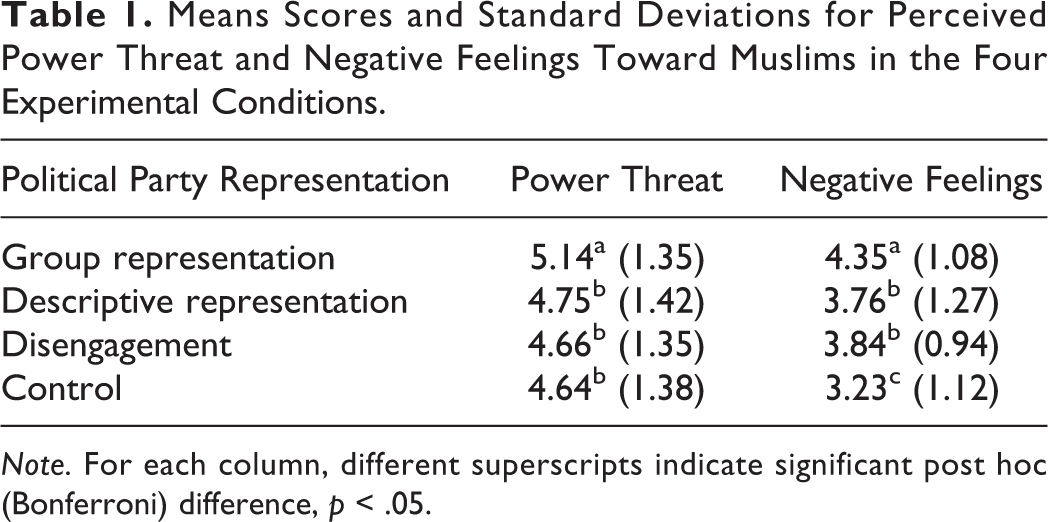
Note. For each column, different superscripts indicate significant post hoc (Bonferroni) difference, p < .05.
For negative out-group feelings, there was also a significant and large effect (Cohen, 1988) for experimental condition, F(3, 624) = 31.875, p < .001, partial η2 = .112. As expected, negative feelings were strongest in the group representation condition, followed by the descriptive representation and disengagement conditions and then the control condition (Table 1). Post hoc tests (Bonferroni) indicated that in the group representation condition, participants had more negative feelings compared to the descriptive and disengagement conditions in which the mean scores were similar but significantly more negative compared to the control condition.
Feelings Toward Muslim Political Participation
Using Hayes’s (2013) macro (Model 5, with 10,000 bootstraps), I examined the mediating role of PPT and the moderating role of ethnic nationhood. Following rules for the construction of contrasts (Keppel & Wickens, 2004), I coded three contrast: one comparing the group representation condition and the descriptive representation condition (group representation = 1, descriptive representation = −1, disengagement = 0, control = 0), a second one comparing the descriptive representation condition with the disengagement condition (0, 1, −1, 0), and a third one corresponding to the control condition in comparison to the other three conditions (1, 1, 1, −3).
In a first regression analysis, the contrast comparing the group representation and descriptive representation conditions was the independent variable, and the other contrasts were controlled for (Hayes & Preacher, 2014). Participants in the group representation condition indicated higher PPT, B = .288, t = 3.23, p = .001, 95% CI [.113, .463], and more negative feelings, B = .271, t = 4.72, p < .001, 95% CI [.158, .384]. Furthermore and as expected, there was a significant indirect effect of this contrast on negative feelings via PPT, B = .103, [.041, .173]. Thus, participants in the group representation condition had more negative feelings than in the descriptive representation condition because they perceived more power threat. The interaction effect between the group representation and descriptive representation contrast with ethnic national identity was not significant, B = −.026, t = 0.71, p > .35, 95% CI [−.097, .045].
In a second analysis, the contrast between the descriptive representation condition and the disengagement condition was the independent variable, and the other contrasts were included as control variables. This analysis indicated a significant effect of this contrast on PPT, B = .186, t = 2.13, p = .034, 95% CI [.014, .357], but not an independent effect on negative feelings, B = .089, t = 1.45, p = .148, 95% CI [−.032, .211]. However, the indirect effect of this contrast on negative feelings through PPT was significant, B = .067, 95% CI [.008, .135]. Furthermore, the interaction between this contrast and ethnic nation identity was significant, B = .158, t = 3.98, p < .001, 95% CI [.079, .236]. Participants who endorsed ethnic national belonging (+1 SD) had more negative feelings in the descriptive representation condition compared to the disengagement condition, B = .313, t = 3.65, p < .001, 95% CI [.145, .481]. Participants with low endorsement of ethnic belonging (−1 SD) did not have significantly different feelings in both conditions, B = −.134, t = 1.65, p = .099, 95% CI [−.295, .026].
In a third analysis, the contrast between the control condition and the other three conditions was the independent variable, and this analysis indicated a significant effect of this contrast on negative feelings, B = .175, t = 8.51, p < .001, 95% CI [.134, .215]. Yet, there was no significant effect on PPT, B = .053, t = 1.64, p = .102, 95% CI [−.011, .117] and therefore also no significant indirect effect on negative feelings via PPT. The interaction between this contrast and ethnic national identity was also not significant, B = −.029, t = 1.90, p = .057, 95% CI [−.058, .001].
Another way for understanding the interaction between experimental conditions and the endorsement of ethnic nation belonging is by investigating the association between ethnic national identity and negative feelings in the four conditions while controlling for PPT. A general linear model revealed that higher endorsement of ethnic belonging was associated with more negative feelings in the group representation condition, B = .18, t = 3.55, p < .001, partial η2 = .020, the descriptive representation condition, B = .25, t = 3.34, p < .001, partial η2 = .030, and in the control condition, B = .23, t = 4.07, p < .001, partial η2 = .026, but not in the disengagement condition, β = −.06, t = 1.19, p > .24.
Discussion
Continuing migration and changing demographics have implications for all domains of life including the political representation of immigrant-origin members. The democratic political power of a group is based on its relative size, and people make inferences about relative group power based on numbers (Gallagher, 2003; Semyonov et al., 2004). Among a national sample of Dutch natives, I found that majority members have the most negative feelings toward Muslims who opt for the political group representation strategy, followed by those who prefer descriptive (coethnic) representation, whereas the strategy of political party disengagement was evaluated less negatively (see also Verkuyten et al., 2016). The effect size of the experimental manipulation was substantial (Cohen, 1988), which indicates that majority group members reacted relatively strongly toward the difference between these forms of political party strategies. The relatively strong effect might be related to the use of a nonstudent, national sample because students tend to be less conservative than the general public, and this may have an effect on their evaluation of immigrants’ political representation and out-group attitudes more generally (Henry, 2008).
Political participation deals with questions of who gains and who loses power and influence. The feeling toward Muslim immigrants in the group representation strategy was the most negative because an Islamic party elicited the greatest threat to the privileged power position of the native majority group. This strategy means that Muslim immigrants organize themselves and collectively compete with other parties for influence and power within the democratic political system, similar to what Christian political parties and one-issue parties do. This means that natives are faced with a more organized Muslim front and consequently feel more threatened. Further, the descriptive representation strategy and disengagement strategy elicited similar negative feelings, but the perceived power threat was somewhat stronger in the former compared to the latter condition. This difference suggests that majority members are concerned about the likelihood that Muslim representatives might influence existing party’s agenda setting and political program or about the possibility of clientelism by minority group politicians (Lemarchand & Legg, 1972; Van den Dool, 2013).
However, disengagement of party politics does not mean that all concerns are removed. When Muslim political representation was not mentioned (control condition), participants were more positive than in the disengagement condition in which political representation was explicitly rejected (Verkuyten et al., 2016). Thus, the mere mentioning of Muslim immigrants in relation to political party participation seems to invoke negative feelings among Dutch natives. In the Netherlands, Muslims are often seen as being politically untrustworthy and trying to Islamize the country (Shadid, 2006; Sniderman & Hagendoorn, 2007), and an explicit distancing from party politics does not seem to fully take away these suspicions.
Yet, political disengagement did appear to reassure natives who more strongly endorse an ethnic conception of national belonging. Stronger endorsement of ethnic national identity was associated with more negative feelings toward Muslims in all experimental conditions, except in the disengagement one in which political representation was explicitly rejected. Survey and experimental research has found that an ethnic citizenship understanding is associated with and elicits negative attitudes toward immigrant-origin and ethnic minority groups (e.g., Meeus et al., 2010; Pehrson et al., 2009; Wakefield et al., 2011). The current findings demonstrate that this is not the case when Muslim immigrants do not want to participate in political parties (disengagement condition). Ethnic national belonging implies that equal citizenship is denied to those who are not part of the native population, and the strategy of political disengagement suggests that immigrants do not want full political citizenship.
Conclusion
Among a national sample and using an experimental design, this research demonstrates that majority members respond quite strongly to the different democratic forms of political party representation of Muslim immigrants. Dutch natives preferred Muslim immigrants not to get involved in party politics and only in this disengagement condition were individual differences in the endorsement of ethnic national belonging not associated with differences in out-group feelings. Participants felt most threatened and therefore were most negative about the establishment of a Muslim minority group party for participating democratically in the political system (group representation). Compared to this, perceived power threat and negative feelings were lower in the situation in which Muslim immigrants wanted to join existing political parties (descriptive representation).
Ongoing immigration and increasing diversity raise important economic, social, and political questions. Political underrepresentation of immigrant-origin members might increase political alienation among immigrants and can be considered a democratic deficit (Bloemraad & Schönwälder, 2013). Politics is about influence and power, and the demographic changes due to immigration make the question about “who can decide” increasingly relevant and salient. The current findings demonstrate that immigrants’ participation in party politics might lead to quite strong negative feelings. This indicates that it is important for social psychological research on immigration and cultural diversity to go beyond the existing emphasis on identity, culture, and intergroup contacts and to also focus on questions of influence and power.
Future research should examine whether similar feelings exist in other countries. Similar to countries such as Belgium and Denmark, the Netherland has a system of proportional representation with numerous political parties which offers the possibility for small parties to have real political influence. How majority members react to immigrants’ political strategies might be different in other countries with different political systems (e.g., United Kingdom or Germany). Furthermore, we focused on democratic political representation which is an important and standard way of looking at politics. Yet, future research could examine other forms of political behavior, such as joining political organizations and Internet activism (Carlisle & Patton, 2013; Marien et al., 2010). The way majority members evaluate these political activities might be different than for political party membership.
Footnotes
Declaration of Conflicting Interests
The author(s) declared no potential conflicts of interest with respect to the research, authorship, and/or publication of this article.
Funding
The author(s) received no financial support for the research, authorship, and/or publication of this article.