




Abstract
This article presents the findings of a study that explored the composition of Canadian educational music. Particularly, the authors focus on the analyses of composers’ scores on creating new string compositions for young musicians within the New Sounds of Learning Project. On a macro level, the composers predominantly composed multiple movements (three to four), using single section (A), binary (AB), ternary, or variation forms (A, A’, A”, A”’, etc.), and they adopted simple meters throughout. At the micro-level, the majority of the compositions also included a technical element that was used to further skill development, that is, lack of meter to focus attention, syncopation to develop rhythmic fluency, interactive rhythms between parts to promote player coordination, modular structure to address varied skill levels, or free rhythm to promote imaginative thinking. The findings will be of interest to those members of the music profession who promote or would like to promote the dissemination of new music for strings within educational settings in Canadian music classrooms.
Introduction
There is a limited amount of new Canadian music available for students enrolled in school music programs, primarily due to a lack of familiarity by many composers of the nature of educational music and very few commissions to compose educational music (Bartel et al., 1999; Andrews, 2012). New Sounds of Learning: Composing Music for Young Musicians, a Social Sciences and Humanities Research Council (SSHRC) project, seeks to obtain an in-depth understanding of how professional composers compose music appropriate for young musicians enrolled in school music programs and private music studios (Andrews, 2012). The research involves a partnership with the Canadian Music Center and the Ottawa Catholic School Board who provided the funds to commission 16 professional composers to create educational music for strings (eight composers) and winds (eight composers), respectively.
The different ways that young musicians interpret sound and the varied levels of technical ability depend on their level of musical training and exposure (Ericsson et al., 1993), which can be different among students when they begin music classes in school. The ranging musical expertise and training among them produce unique challenges for composers creating new music for students enrolled in elementary and secondary school music programs. This, in addition to composers’ lack of formal training on how to write educational music for ensembles, poses unique challenges. These challenges cannot be resolved by conventional methods alone (i.e., through textbooks, score study, and listening activities) but require problem-solving and contact with young performers (Colgrass, 2004). The New Sounds of Learning Project explores the creative solutions that composers implement in generating new music for student ensembles. The study is based on the assertion that the development of high caliber works appropriate for young people is contingent on effective practice, that is, on successful engagement between composers and students in the creative process within classrooms, studios, and rehearsal halls. By holistically examining the parameters of composing music for young musicians, that is, the composers’ background (questionnaire), the compositional process (reflective journal), the composers’ personal learning (interview), and the music (compositional analysis), this study provides valuable insights and deepens our understanding of how to compose new music for young musicians. This article focuses on the compositional analyses provided by the string composers partnered with the Canadian Music Center.
Exposition
Research in Music Composition
Wallas (1926) proposed a Stage Theory of creativity: preparation, incubation, illumination, and verification. Graf (1947) applied these categories to music composition: productive mood (preparation), conception (incubation), sketching (illumination), and composition (verification) (Graf, 1947). Bennett’s (1976) research elaborated on Graf’s categories but shifted the focus. Specifically, Bennett focused on the writing process itself (i.e., sketches and drafts) as opposed to the feelings (productive mood) and thoughts (musical conception). He suggested that composing involves a process of discovering a germinal idea (preparation), a brief sketch (incubation), a first draft and then elaboration and refinement (illumination), and completion and revisions to a final copy (verification). In addition, other researchers proposed models based on stage theory. Sloboda (1985) proposed a broad two-stage approach: (a) the inspirational stage and (b) the execution stage. Roozendaal (1993) proposed that the process of music composition involved (a) planning, (b) the development of large-scale concepts, (c) noting coherence between parts, and (d) working on musical units. For Roozendaal, problem-solving was seen as recursive as opposed to sequential. More recently proposed models of the process of music composition have maintained some commonalities between the different proposed models of the compositional process. For example, Freed-Garrod (1999) proposed that the compositional stages included exploring, selecting, performance/sharing, and evaluation/assessment. Similarly, Christiansen (1993) proposed that exploration, organization, and polishing were the stages of composition.
While compositional stages are still recognized as a viable explanation for music composition, the notion that composing occurs in progressive stages has been criticized. More recent research (Katz & Gardner, 2012) has indicated that these stages are more fluent than Wallas (1926) and Bennett (1976) proposed. According to Katz and Gardner, another major criticism of the stage theory of music composition is that it “does not take into account composers’ cognitive ecological orientation towards their pieces” (p. 109). Furthermore, it “does not address what is happening in the composers’ minds from a cognitive psychological perspective nor does it provide in-depth information about the nature and sources of their inspiration” (p. 120).
Since Wallas’ (1926) proposed his model of creativity, other researchers have proposed other models of the compositional process, using Stage Theory as its basis. In 2009, Katz’s study offered what Stage Theory studies lacked by exploring (a) the mindset of composers during the writing process; (b) the factors that inspired them; and (c) the large-and small-scale choice points that move the process forward. This led to the idea that there were two principal ways in which composers approached writing a new musical work. Specifically, Katz (2009) has proposed that the two approaches are the “Within-Domain” and the “Beyond-Domain” approach.
The “Within-Domain” approach focuses on the small musical elements and musical material itself (e.g., pitch, rhythm, and phrasing). During the preparation/incubation stage, imagination plays a key role. Once composers are able to hear the music, they begin to shape and reshape the material. Improvisation also plays a key role in these early stages for exploration and development of ideas. During the illumination stage, composers rely on kinesthetic memory or instinct (their ear), which appears to have no clear musical or extra-musical framework, to move the work forward into a coherent piece. During the verification stage, the musical materials are further developed and more extensively notated (filling in the details). Composers who use this approach tend to use sounds that promote a coherent sound impression and “seem to recognize the music theory underpinning their work gradually as opposed to setting up a conceptual model at the outset” (Katz & Gardner, 2012, p. 113).
Counter to the “Within-Domain” approach, the “Beyond-Domain” approach focuses on the larger context and goal of the music composition. During the preparation/incubation stage, composers develop an overarching conceptual framework (i.e., previous experience) that is then translated into music. During the illumination stage, composers develop their concepts into something more cohesive, and their extra-musical models are “solidified.” They use formal devices such as metaphors (conceptual schemas that express the relationship between extra-musical domains and music and do not carry literal or linguistic meaning) and images (visual arts). During the verification stage, further details (smaller elements) are filled in relating to the broad framework. Composers “develop conceptual frameworks to their fullest by testing ideas that spin-off from the broader conceptual framework. These ideas usually translate into music at the note level, phrase level, and into other smaller parts of music” (Katz & Gardner, p. 120). It can be challenging and time-consuming to determine what constructs will influence their pieces as it is often quite personal to the composer (Trueman, 2012). Composers who use this approach develop guidelines or parameters for their work and work within those parameters as they compose. Regardless of which approach is used, there is an overall consensus among researchers that the compositional process begins with experimentation, and then, as musical and conceptual ideas start to take shape, they are developed more fully into detailed musical ideas.
Research in Educational Music Composition
The research outlined in the previous section on music composition assumes that composers are writing works for professional ensembles with musicians who have a high level of expertise and skill in performing music. While research and literature on the musical composition process are substantial, research in the area of educational music composition is limited. Part of the reason for this is that when it comes to writing educational music; however, composers lack the knowledge to execute this effectively. This is due to the fact that composition classes on how to write educational music are not typically offered or required in higher education music degree programs (Colgrass, 2004). Thus, composers are able to write music for professional musicians but not for amateurs. In examining how composers approach writing educational music, Andrews (2009) found that composers used specific compositional techniques for educational purposes, such as (a) repetition to reinforce learning, (b) short melodic units to facilitate retention, (c) pulsating rhythms to develop motor responses, (d) contrasting chord progressions to provide harmonic variation, and (e) equal instrumental parts to keep students engaged and motivated. In both the United States and Canada, published educational music is given a grade that is intended to help music educators know the level of musical proficiency required of students to play the piece, which is outlined in detail along with the appropriate grade level (Co-author, 2011).
In the New Sounds of Learning Project, composers composed music specifically for high school ensembles (i.e., educational music) with varying degrees of knowledge and proficiency (Andrews, 2012). Eight Canadian composers, each recommended by Canadian Music Center (CMC) staff, were assigned to a high school string instrumental ensemble with varying levels of difficulty. Each composer completed four protocols: a questionnaire on their musical background (Andrews, 2013); a reflective journal on the compositional process (Andrews & Giesbrecht, 2014); a compositional analysis of their new work (the focus of this article); and an interview on their personal learning (Duncan & Andrews, 2015).
The eight string composers participating in the New Sounds of Learning Project who completed the questionnaire on their musical backgrounds (Andrews, 2013) viewed educational music as often lacking a pedagogical purpose. Composing for young musicians was not addressed in their training; however, composing for amateurs and/or students made them aware of the challenges of composing for musicians with less technical ability. Their primary interest in composing educational music was to address the lack of contemporary Canadian music for students. The commissions enabled these composers to create new music that was suitable for the Canadian context and to broaden their compositional skills. For them, the key factors in composing for strings are the students’ abilities, the pedagogical dimension, and musical quality. The composers pursued an educational commission to raise students’ awareness of contemporary music and to create new music for instruments with a limited repertoire. Their compositional training and experience enabled them to work within technical limitations and to create music appropriate to the students’ abilities that developed their musical skills and challenged them artistically.
In their reflective journals, the eight string composers involved in the New Sounds of Learning Project provided evidence of their attempts to modify their compositions to accommodate the students’ technical abilities, such as the use of repetition to reinforce learning and rhythmic variety to maintain interest, which is essential to composing effective educational music (Andrews & Giesbrecht, 2014). The composers from the aforementioned 2014 study did not indicate that inspiration, in the traditional sense where musical ideas simply came to them, played a significant part in their works that have been identified as a factor in music composition. To be inspired, the composers learned to play repertoire themselves on the students’ instruments to familiarize themselves with their unique characteristics, and they organized their compositions in basic forms, such as binary, ternary, and variation, to facilitate learning. This provided a solid foundation and understanding from which the composers began their composition. At the same time, composers were equally concerned about challenging and maintaining student interest. This was accomplished by reframing the relationship of pedagogy and music composition by integrating into their compositions improvisation, variable interpretation, modular parts, and singing and playing simultaneously. Although such techniques can be risky, as students’ unfamiliarity with them can result in difficulties in knowing how to properly execute them, such reframing of educational music is essential if new compositions for young musicians are to enhance their musical development, challenge and maintain interest, and invigorate the repertoire of schools, conservatories, and post-secondary institutions.
In their interviews for the New Sounds of Learning Project (Duncan & Andrews, 2015), the string composers indicated that they had to learn how to compose educational music for strings through their involvement with the project. They gained this knowledge by collaborating with the music teachers and by having contact with the students. The composers found the process of writing educational music to be difficult, interesting, and challenging. Lack of training in educational music was the key factor in causing difficulties in composing for young musicians. If educational music composition had been addressed in the composers’ training, there is less likelihood that these difficulties would have occurred. Despite this situation, all the composers composed educational music that they felt challenged the students and maintained their interest. Most importantly, the composers reached a consensus that there are four specific conditions necessary to compose successful educational music: direct contact with the students; acquiring a working knowledge of the instrument(s); a desire to compose good quality and pedagogically valid music; and obtaining knowledge of their students’ technical abilities (Duncan & Andrews, 2015).
Development
Research Process
Integrated inquiry (Andrews, 2008) involves combining data from multiple qualitative and/or quantitative protocols or data from a single protocol administered to different groups of participants or similar groups in separate time periods. It is a multiple-measures method that employs the use of qualitative and/or quantitative data protocols or the use of a protocol in different time periods with different groups of participants. Unlike mixed methods approaches that require qualitative and quantitative data (Creswell & Creswell, 2018), the integrated inquiry may employ multiple qualitative and/or multiple quantitative protocols or the use of a single protocol in different time periods. The integrated inquiry method was employed throughout all the phases of data collection within the New Sounds of Learning Project—questionnaire, reflective journal, interview, and compositional analysis—by combining data from participants in two different time periods; that is, the 2007 to 2008 school year and the 2009 to 2010 school year. This article reports on the findings from the analysis and interpretation of the compositional analyses of the musical scores to respond to the principal research question:
Analysis of Data
The eight string composers were asked to answer four questions about their musical composition: (a) How is the composition organized?; What is the musical structure?; (b) How are the musical ideas organized and developed?; (c) What musical learnings are reinforced throughout the composition?; and (d) What are the unique features of the composition? One composer declined to participate in the compositional analysis. For the most part (six of the seven), the compositions were written in a series of movements with each movement using single section (A), binary (AB), or ternary (ABA) forms. One of the compositions (the seventh) involved seven movements, each representing a variation in the first movement (i.e., A, A’, A”, A’”, etc.).
The composers also used compositional techniques that are supported in the literature as being effective compositional techniques for composing new music for young musicians: (a) repetition, (b) pulsating rhythms, (c) harmonic variation, and (d) equal instrumental parts (Andrews, 2009).
Although the compositions appear simple on the surface, there are specific learning objectives that are integrated into the composition to help improve technique and skill proficiency. Several composers focused on developing rhythmic skills through various approaches and techniques. For example, “Encounters,” by Aris Carastathis, 1 “forces the performer to pay close attention to the accompanying part because of the lack of concrete meter and note value counting” (see Figure 1).
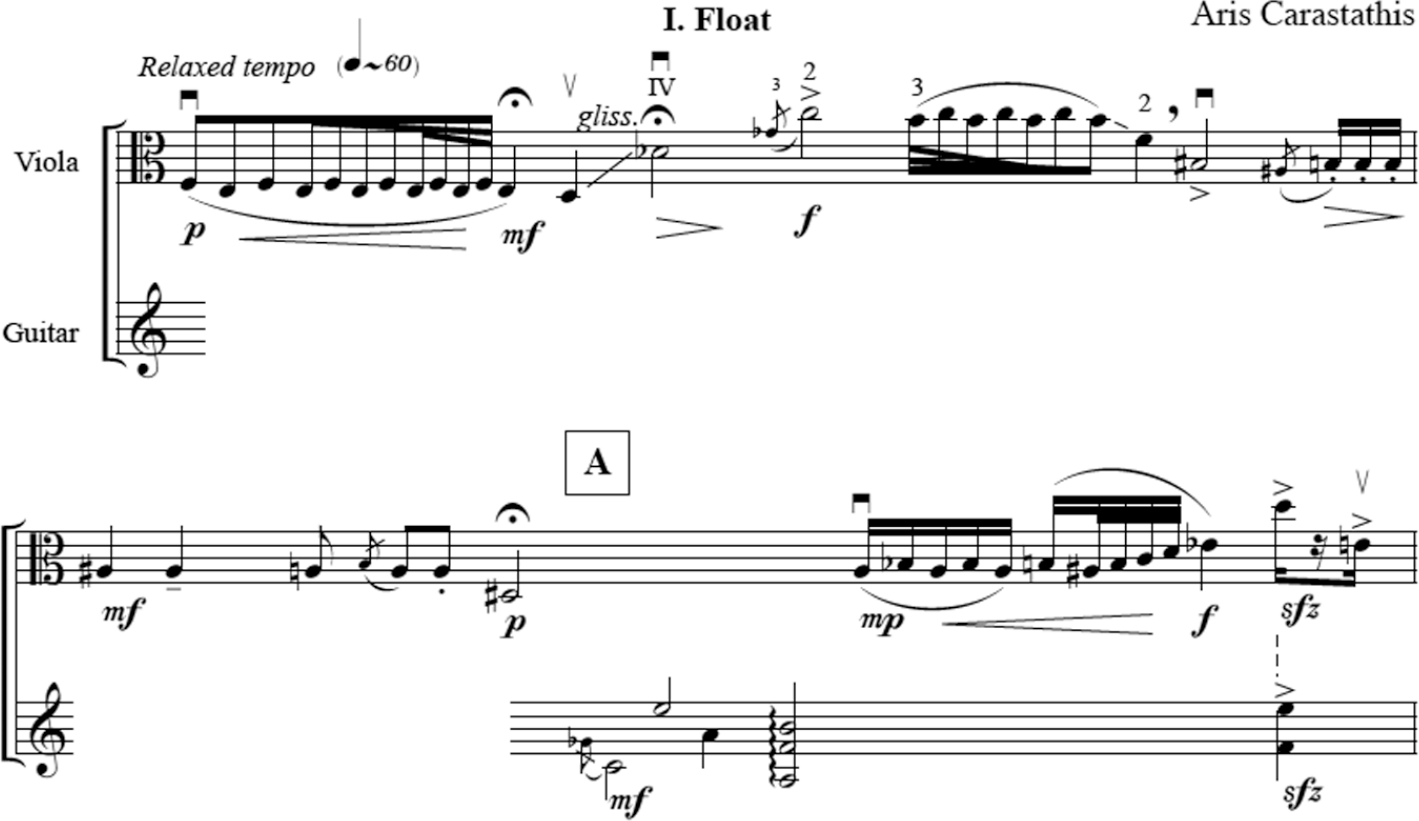
No set meter (or bar delineation) and later entry by guitar.
By using jazz and Latin rhythms, beat anticipation was used in Kye Marshall’s composition “Bossa Antiqua” (see Figure 2). Abigail Richardson’s piece “Labyrinth” included “interactive rhythms between parts, [ . . . ] subdividing the beat in a variety of challenging rhythms and contemporary techniques” (see Figure 3).

Example of beat anticipation and rhythmic repetition.
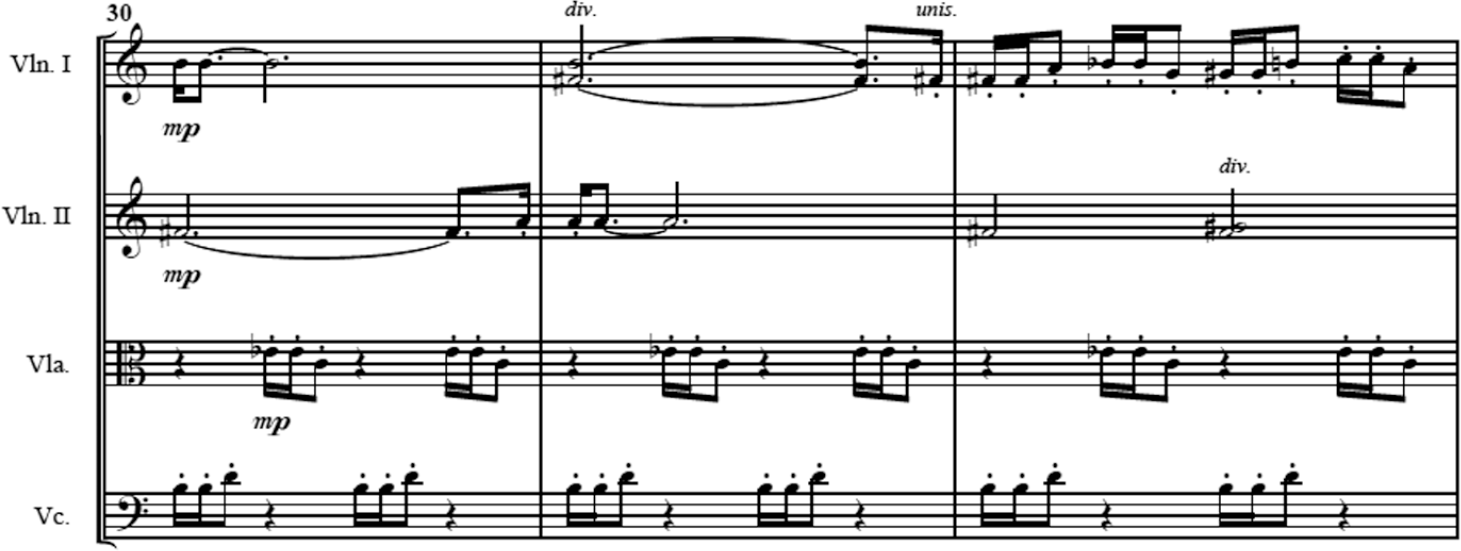
Example of “interactive rhythms between parts.”
When asked about what made their compositions unique, several composers cited technical elements as being unique characteristics of their works. For example, Christopher Mayo stated that the “modular structure and the fact that each performance of the piece could be different depending on the musical abilities of the performers involved” made his composition unique (see Figure 4). Similarly, Abigail Richardson stated that her “piece is unique in its use of shape and contemporary techniques,” such as free rhythm, which she further states “requires students to play technically imaginatively, and musically” (see Figure 5). The notion of using a specific instrumental technique or technical element to further the student performers’ musical development is a common feature of the compositions, as Aris Carastathis commented: “The work emphasizes exposure and training in contemporary viola technique and understanding of performance practices.”
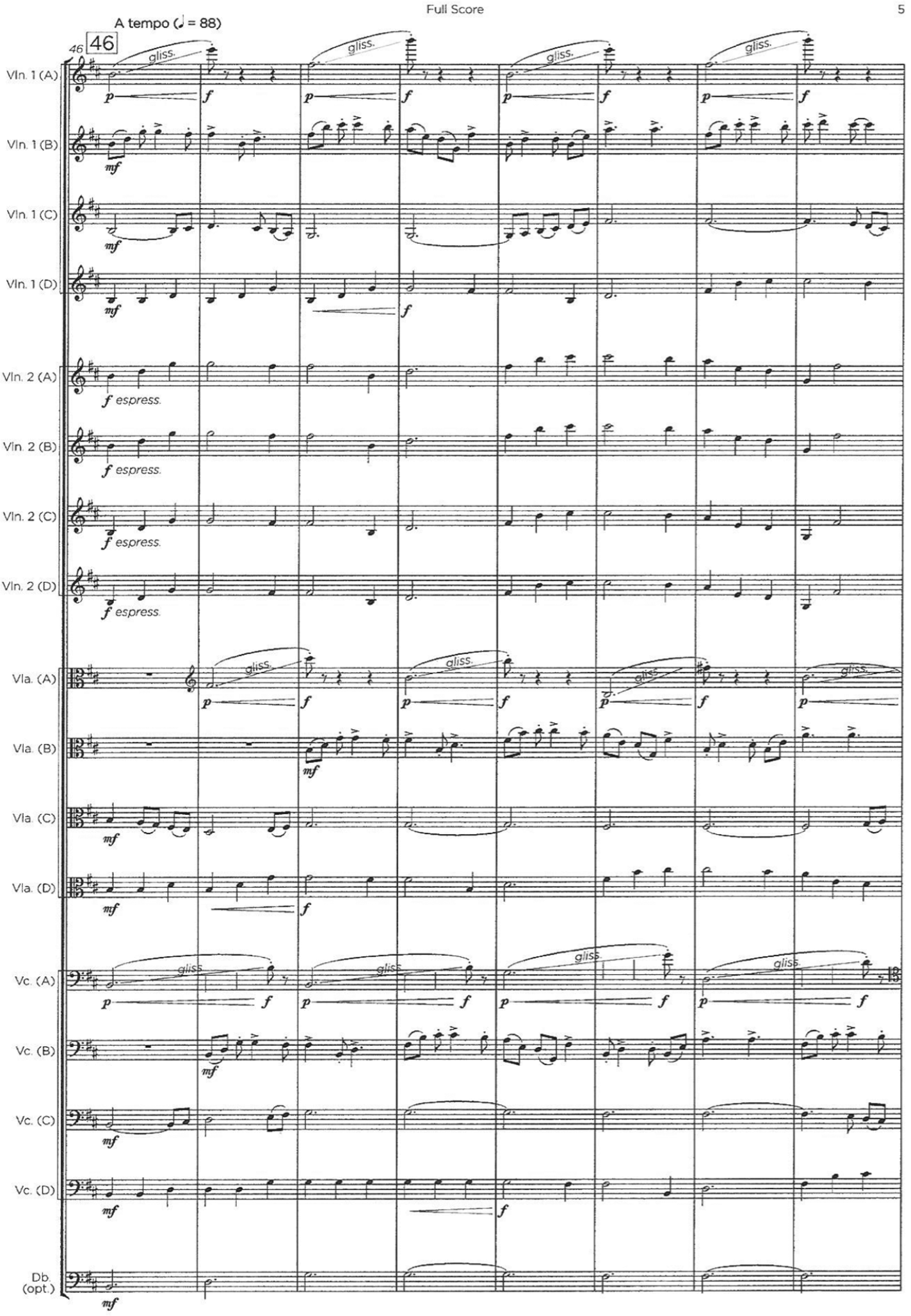
Modular structure. Parts can be selected depending on the level of students’ technical abilities. It is possible that no two versions of the piece will sound the same.
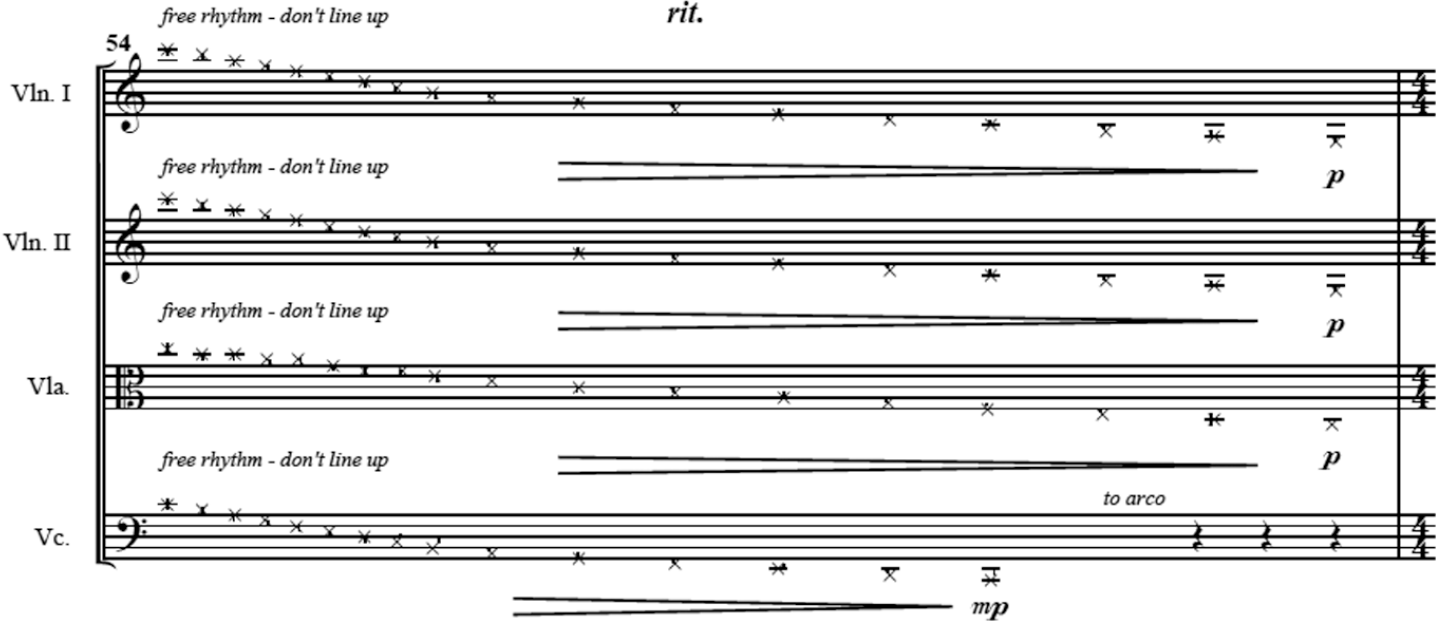
Students are given an opportunity to “play technically imaginatively, and musically.”
Recapitulation
Commentary
The findings of this study found that composers approached their works on both macro (i.e., ‘Beyond-Domain’) and micro- (i.e., ‘Within-Domain’) levels (i.e., Katz & Gardner, 2012). On a macro level, the composers predominantly composed multiple movements (3–4), using single section (A), binary (AB), ternary, or variation forms (A, A’, A”, etc.), and they adopted simple meters throughout. On a micro-level, consistent with previous research, they strived for equality of parts throughout to maintain interest, and they employed repetition to develop rhythmic skills, short melodies (including call and response) to focus attention, pulsating rhythms to develop rhythmic skills, and contrasting chords to develop harmonic awareness (Andrews, 2009). The majority of the compositions also included a technical element that was used to further skill development:
lack of meter to focus attention;
syncopation to develop rhythmic fluency;
interactive rhythms between parts to promote player coordination;
modular structure to address varied skill levels; or
free rhythm to promote imaginative thinking.
In some way, large or small, each of the participant composers composed educational music with the goal of developing their proficiency of one or more technical skills while also encouraging the student musicians to think abstractly about what is possible in music composition. For example, Aris Carastathis states that he hopes that his work, “Encounters,” will “contribute to the existing body of works that is geared towards the study of viola [for which he composed his piece] but not necessarily through technical exercises but through performing an actual repertoire piece.” While all of the composers voiced similar sentiments, Christopher Mayo perhaps encapsulated it best by stating that he hoped that his composition: . . . introduces the performers to new ways of thinking about musical structure, both on a small- and large-scale. I hope that the melody, harmony, rhythm, and form of this piece would help expand a young performers’ notion of how musical elements can be structured and developed. [ . . . ] I hope that it would make young performers think about content and form in a more abstract.
In addition to the technical elements, all of the composers agreed there were other key elements that allowed them to write successful educational music: direct contact with the students and the ability to work with the teachers; gaining a working knowledge of the instruments in a student ensemble; and perhaps most importantly, a want to compose high-quality educational music that has pedagogical value and musicality that does not simply sound like a technical exercise.
We recommend replicating this study to verify the findings and would encourage further research in this area as it is a limited area of study, particularly within Canada. Replication of this study would also contribute to the library of Canadian educational compositions. Although the idea of commissioning a work specifically for a school ensemble may seem like a daunting task, school boards have funds to commission educational works (Swanson, 2016); Canadian composers are very willing to collaborate to produce high-quality educational works as evidenced by this project.
Footnotes
Declaration of Conflicting Interests
The author(s) declared no potential conflicts of interest with respect to the research, authorship, and/or publication of this article.
Funding
The author(s) disclosed receipt of the following financial support for the research, authorship, and/or publication of this article: This study was funded by the Social Sciences and Humanities Research Council (SSHRC) Grant No. 410-2006-2529.
