



Abstract
Background:
The German Biobank Node (GBN) coordinates the national network of academic biobanks in Germany; the German Biobank Alliance (GBA). At the beginning of 2025, the GBA consisted of 42 biobanks. With an upcoming strategic reorientation, the GBN/GBA was interested in understanding the perspectives of their community to ensure that strategic decisions were aligned with their needs and interests.
Materials and Methods:
An online survey with a cross-sectional design was conducted with the GBA community, targeting mostly first-line management of GBA biobanks. The invitation to the survey was sent via an internal GBA mailing list. It addressed primarily satisfaction with GBN/GBA services, organization of and collaboration within GBN/GBA, and expectations/wishes for the future. Responses were analyzed using descriptive statistics and qualitative content analysis.
Results:
Participants generally considered being part of GBA to be important to very important. They emphasized the opportunity to network and exchange with colleagues as particularly helpful, but also training opportunities and quality management (QM) tools provided. In terms of organization, they found that the benefits of cooperating within GBA largely outweighed efforts and that opportunities to participate in processes were adequate. However, they also identified areas for improvement, for example, in the provision of information on how to join or establish working groups. In terms of relevant future topics, participants identified lobbying, networking within and outside GBA, training, and QM as particularly important priorities for GBN/GBA, as well as securing funding and strengthening local cooperation for individual biobanks.
Discussion:
The findings have informed the strategic development of GBN/GBA, with QM, education, and networking being the top future priorities. In terms of networking, the GBN/GBA has emphasized the importance of making the perspective of the community heard in other national networks. How to address sustainable funding remains an open question.
Keywords
Introduction
The German Biobank Alliance
With the establishment of the first centralized academic biobanks at the beginning of the century, governments in the European Union (EU) recognized that cooperation and exchange among them would be essential to maximize their benefits. At the European level, this was realized by establishing the pan-European network “Biobanking and Biomolecular Resources Research Infrastructure—European Research Infrastructure Consortium” (BBMRI-ERIC) with the goal to bring together the main players in the biobanking field to make new treatments possible through the continuous improvement of biobanking services. 1 The German Federal Ministry of Education and Research (BMBF) initiated the German Biobank Node (GBN) in 2013 to represent the German perspective within BBMRI-ERIC but also to serve as a central hub for German academic biobanks. After a first funding period, which was mainly used for concept development, the German Biobank Alliance (GBA) was founded with 13 biobanks and 2 IT development centers as members. While GBN and GBA often act as one due to joint goals and processes, GBN is the coordinating institution with its own office in Berlin. It organizes meetings and trainings, initiates discussions and work processes within GBA, and coordinates GBA working groups. In working with GBA, it strives to serve the whole academic biobanking community. Since its inception, GBA has grown considerably, with 42 academic biobanks and 1 IT development center joining forces within the alliance. To join GBA as partners, biobanks had and have to fulfill certain criteria, such as the willingness to make biosamples and related data available to researchers outside of the respective institutions via a common IT infrastructure and a functional quality management (QM) approach. Starting in 2021, GBA has invited biobanks that are still developing their operational procedures to join as observers, allowing them to learn from others and benefit from the resources made available via the network. Observers can later become partners if they meet the specified criteria. At the beginning of 2025, GBA consisted of 22 partner and 20 observer biobanks with the youngest member having been founded 1 year ago and the oldest having been operational for 14 years. a While GBA is the only nationwide network for academic biobanks focusing specifically on human biosamples and related data, there also exists a network for cryobanks (Gemeinschaft Deutscher Kryobanken e.V.) with 16 members, including both biobanks for nonhuman specimens and biobanks from the industry sector.
Together, GBN and GBA partner biobanks have developed various products and activities to improve biobank services and foster exchange. The repertoire of products is diverse, including among other services measures to support QM such as a QM manual 2 or proficiency tests, 3 training opportunities for biobank staff, focusing also on technicians, 4 a common IT infrastructure with a sample locator b function for researchers, or the “GBA equipment fleet,” which lists all technical solutions and infrastructure used by GBA biobanks to facilitate exchange. c While there are many benefits in joining GBA, there are also certain efforts required. Partners as well as observers are required to supply GBN annually with key figures about their operation, and their collections have to be listed within the BBMRI-ERIC Directory. d Partners are asked additional tasks like taking part in regular friendly audits and connecting to the sample locator with their collections. Further input is instrumental but voluntary like collaboration in working groups, taking part in biannual in-person meetings or supporting the drafting of publications, concept papers, or QM protocols.
To reflect the close collaboration between GBN and GBA and to simplify external communication, both entities will operate under the joint name “German Biobank Network” from mid-2025 onward. The former GBN will continue in its role as the coordinating office, maintaining strategic and operational oversight of the network. In this publication, we deliberately continue to use the names GBN and GBA, as the survey on which this work is based was conducted prior to the name change.
Stakeholder engagement within GBN/GBA
An important activity of GBN/GBA is stakeholder engagement. Calls for, and theories of, stakeholder engagement or participation have been developed in very different contexts, such as technology development, 5 research, 6 or organizational development. 7 While there are similarities between the ideas of participation that have been developed, there are also considerable differences—both between and within disciplines—regarding the purpose of participation, but also the extent to which power sharing is required.8,9 The perspective from which GBN/GBA developed its stakeholder engagement approach was primarily inspired by management ideas advanced in organizational development. GBN/GBA modeled its approach toward engagement in accordance with the stakeholder analysis model proposed by Bjugn and Casati. 10 This model is primarily instrumental in nature, as it builds on the premise that the success of organizations depends on the satisfaction of their main stakeholders. A stakeholder is thereby defined as someone—a person or a group such as a company or party—that is affected by or can influence the actions of an organization (or person) at hand. 11 Engagement strategies can thereby take many forms, ranging from purely informative events, to eliciting stakeholder advice on strategic decisions, to joint decision-making with stakeholders.
In the context of biobanking, stakeholder engagement is important throughout the process, from sample and data collection to sharing, to ensure that their knowledge and experiences are considered and to align with their values and expectations.12,13 Engaging with citizens and research participants provides insights into the expectations and concerns about informed consent, sample and data use, as well as biobank research more broadly.14,15 Engagement with users of biobank services and their knowledge of and views on local biobanks can be vital for the sustainability of biobanks. 16 Even biobank risk assessment has been shown to benefit from engagement with relevant stakeholders. 17
A network organization such as GBN has to take into account a wide range of stakeholders, from researchers/users of biospecimens, to patients and healthy subjects as biobanking participants who share their biospecimens, to technicians working in biobanks, to funders, and—more distant but influencing the discursive space—the professional public as well as the media. However, as partners in the coordinated alliance, GBA biobanks are also important stakeholders. For the strategic planning of activities and product development, it is essential to understand their perspectives, needs, and wishes, not only to ensure that products are used but also because GBA depends on input of time, energy, and information of its members, who are not (any longer) remunerated. In 2024, with a funding period and, respectively, a project planning period coming to an end, the GBN/GBA was able to review key activities and processes. In order to move forward, it was considered essential to give GBA members a say in which aspects of GBN/GBA’s work should be prioritized in the future and how to shape the network’s operation. This was to mirror the development of GBN/GBA from a top-down initiative to a community project driven by and serving the biobanking community. Accordingly, a survey was implemented to provide a space for the free exchange of views. The insights gained thereby enable GBN/GBA to align strategic planning decisions with the needs of their community.
Methods
The Checklist for Reporting of Survey Studies (CROSS) 18 was used as orientation point for reporting of this study.
Study design and data collection method
In 2018, GBN had already conducted a member survey focusing on satisfaction with work processes and services provided. 19 For the past survey, GBN had chosen an online approach and made positive experiences with this population in terms of response rate, but also with participants providing candid answers. It was therefore decided to conduct an online survey with a cross-sectional design.
GBN planned to build on the existing survey. However, as the aim of this survey was considerably different, most questions had to be developed anew. The survey was divided into five sections, addressing the background of the participant, importance of GBA membership and general satisfaction, collaboration and networking, expectations for the future, and a concluding section for final remarks. Due to word count, not all results can be presented here. The article focuses on those issues most important for strategic planning of the GBN/GBA but also those considered most relevant to the whole biobanking community.
The survey was designed to dynamically adapt questions based on participants’ previous answers, so that the process was tailored to their input. This was because participants represented diverse perspectives within the community. Certain questions (e.g., how important it is for observers to become partners) could only be answered by members with a certain perspective and were therefore only posed to them. Accordingly, the length of the survey was not the same for all participants. In total, the survey contained 36 questions (plus informed consent), of which 1 was a rank-order question, 1 was a rating scale, 6 were dichotomous choices (yes/no), 14 were open-ended, and 14 were multiple-choice questions. The multiple-choice questions often contained a space for specifying certain options, most often “other/miscellaneous.”
The survey was developed by the GBN office and pretested by a GBN/GBA working group (WG Stakeholder Engagement), most of whose members are “biobankers.” The working group critically read and commented on the content of the survey as well as the comprehensibility of the questions. Subsequently, the survey was revised and implemented using the software LamaPoll. The final survey can be accessed directly on LamaPoll: https://survey.lamapoll.de/GBA-Umfrage_2024_DE_pub (available only in German). In addition, PDFs containing the survey questions are provided as Supplementary Data (for German see S1, for English see S2).
Survey administration
As the survey addressed overarching aspects of biobanking, GBN was particularly interested in the opinions of first-line managers of GBA biobanks. GBN has set up various mailing lists to enable different staff groups within the community to network (IT, technicians, management staff). The invitation was sent to the general GBA mailing list (no sample was drawn), which mainly connects directors and project managers of GBA biobanks. Almost 100% of the first-line management of GBA biobanks are on this mailing list; however, other staff groups are also allowed to join it and were invited to participate in the survey. The email was sent on January 11, 2024, with the deadline communicated to be January 31. The GBN office sent a reminder on January 22 and another on February 2, extending the deadline to February 9. The survey closed on this date. In total, the survey invitation was sent to 121 email addresses, including contacts of 50 biobank directors/managers, 16 project managers, 5 general email addresses of biobanks, and 50 other positions (among them 10 quality managers and 4 IT staff). No incentives were offered for participation in the survey.
Sample characteristics
Thirty-seven people finished the survey (response rate of 31%) and were therefore included in the analysis. Twenty-seven people started the survey but did not complete it. Participants who finished self-identified as biobank directors/managers (n = 19), project management (n = 12), QM (n = 9), IT staff (n = 2), laboratory management (n = 1), and other positions (n = 4), including coordination, laboratory, and academic staff as well as basic IT support (see Fig. 1). Some participants held more than one position.

Profile of the responders.
Data analysis
Descriptive statistical analyses were conducted to provide an overview of the responses. The open-ended survey questions were analyzed by two team members using qualitative content analysis, adapted from Schreier. 20 Excel and Word were used for data analysis.
Apart from excluding all responses from unfinished surveys, no further correction method was applied to the dataset. The authors decided to exclude all unfinished survey responses because most (>85%) stopped before the third page, where content-related questions began, and thus no relevant information was lost. Furthermore, we wanted to avoid double counting. As we did not collect any identifying information and therefore could not allow people returning to the survey after closing it, we do not know whether some finished the survey at a later date as new entries. Reasons for noncompletion were not addressed, but it can be assumed that realization of a lack of knowledge to answer the questions, as well as time constraints and the need to complete the survey at another time, were the main driving factors.
Ethical considerations
As this study cannot be considered research, but rather a quality improvement initiative (QII), the authors did not consider an approval by the local research ethics committee necessary. It is generally accepted that QIIs that do not aim to generate generalizable knowledge but to improve programs or services of organizations do not need to undergo ethics review.21,22 As participants did not provide any identifying information (the survey was conducted anonymously; no IP addresses were collected), and the responsibility to check open-ended questions for identifying information and to remove it if necessary was explicitly stated, the risk was considered minimal, and therefore no ethics review was needed. Furthermore, the participants’ autonomy was respected by providing the most relevant information about the survey on the first page. Informed consent for data processing was given by ticking a box on the first page (it was not possible to fill in the survey without ticking the box).
Results
The value of GBA membership
First, GBN was interested to understand how biobanks assessed the importance of being part of GBA as a national hub for biobanking. Sixty-two percent (n = 23) answered “very important,” 35% (n = 13) “rather important,” 3% (n = 1) “nice to have,” and no one thought it was unimportant. To understand why membership in GBA is considered important, the survey asked about the benefits of membership (with the opportunity to select multiple answers). The most frequently mentioned benefits were “networking opportunities with other biobanks” (100% of participants, n = 37), “exchange of experience” (92%, n = 34), and “improving the quality of work, e.g., through training offers” (62%, n = 23) (see Fig. 2 for a complete overview). Participants were also asked whether the biobank had ever experienced any disadvantages as a result of being part of GBA, which was negated by all.
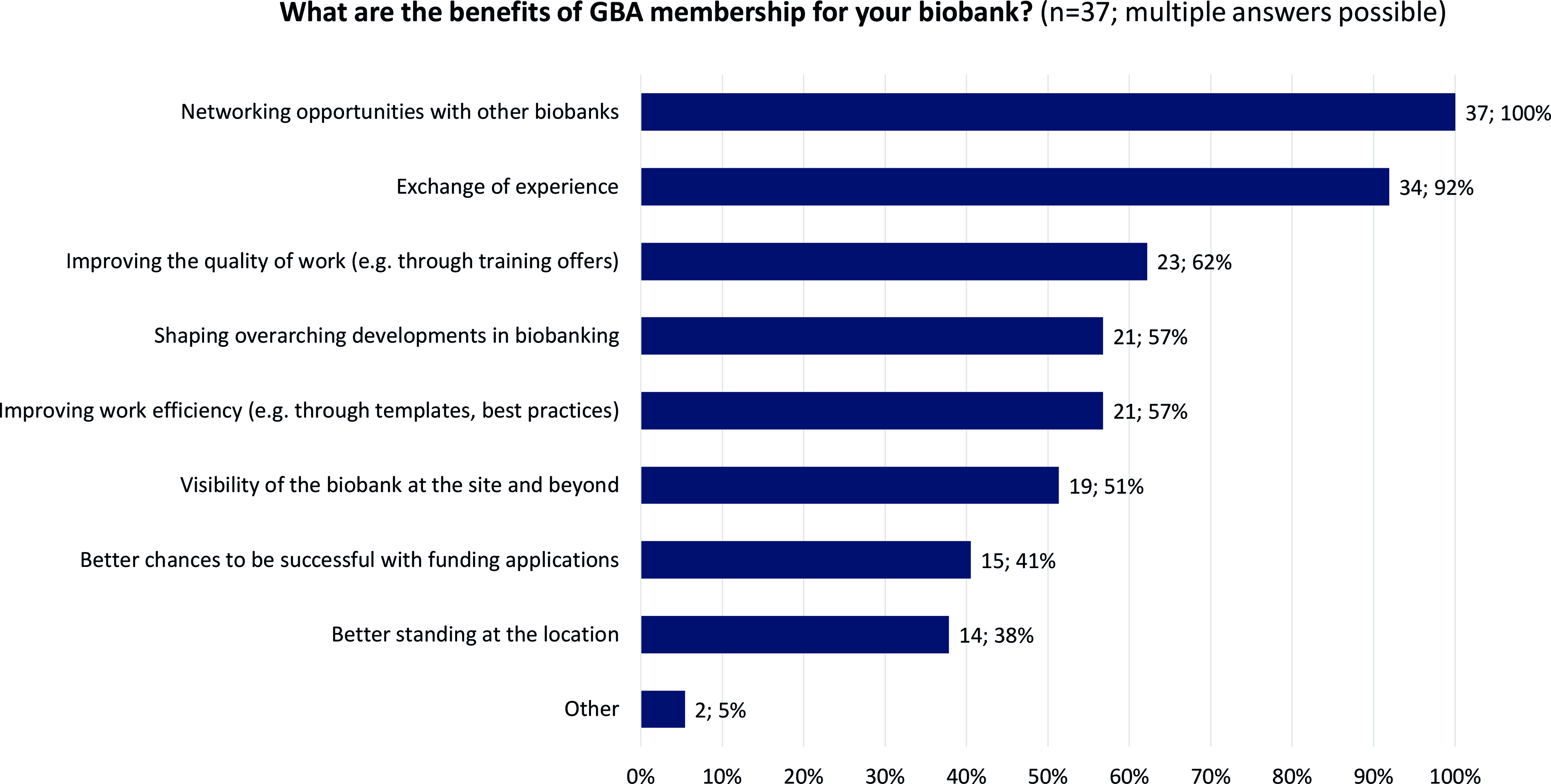
Advantages of being a GBA member. GBA, German Biobank Alliance.
The open-ended follow-up question, “What do you personally value most about GBA membership?” reiterated the findings from the quantitative question, with a focus on exchange of information/experience and training programs. However, it was also notable that many answers emphasized the development of a community spirit where there is little rivalry but rather a sense of solidarity. This is captured by responses such as “Great community!” or “It should be particularly emphasized that the exchange of knowledge between the biobanks works excellently and that help is always available for individual topics.” e
Participants were then asked to identify the top GBN/GBA services for biobanks, with choices limited to five (see Fig. 3 for a full overview of responses). QM activities were voted as the top service by 84% (n = 31), followed by training programs, including diverse webinars and an online introductory biobanking course, with 73% (n = 27), and intra- and international networking, including at European level through BBMRI-ERIC, with 62% (n = 23). Offers in the areas of public relations (38%, n = 14), lobbying (32%, n = 12), and stakeholder engagement (5%, n = 2) were chosen by fewer respondents. Participants were asked to give reasons for their choices, which often read as a repetition of their choice. Where participants provided reasons, they explained that they value services that have an impact on their daily work (which was mentioned with regard to QM), services that contribute to sustainable funding of biobanking (mentioned with regard to lobbying, networking, and public relations services), and activities that transcend the capacities of a single biobank (such as international networking efforts).
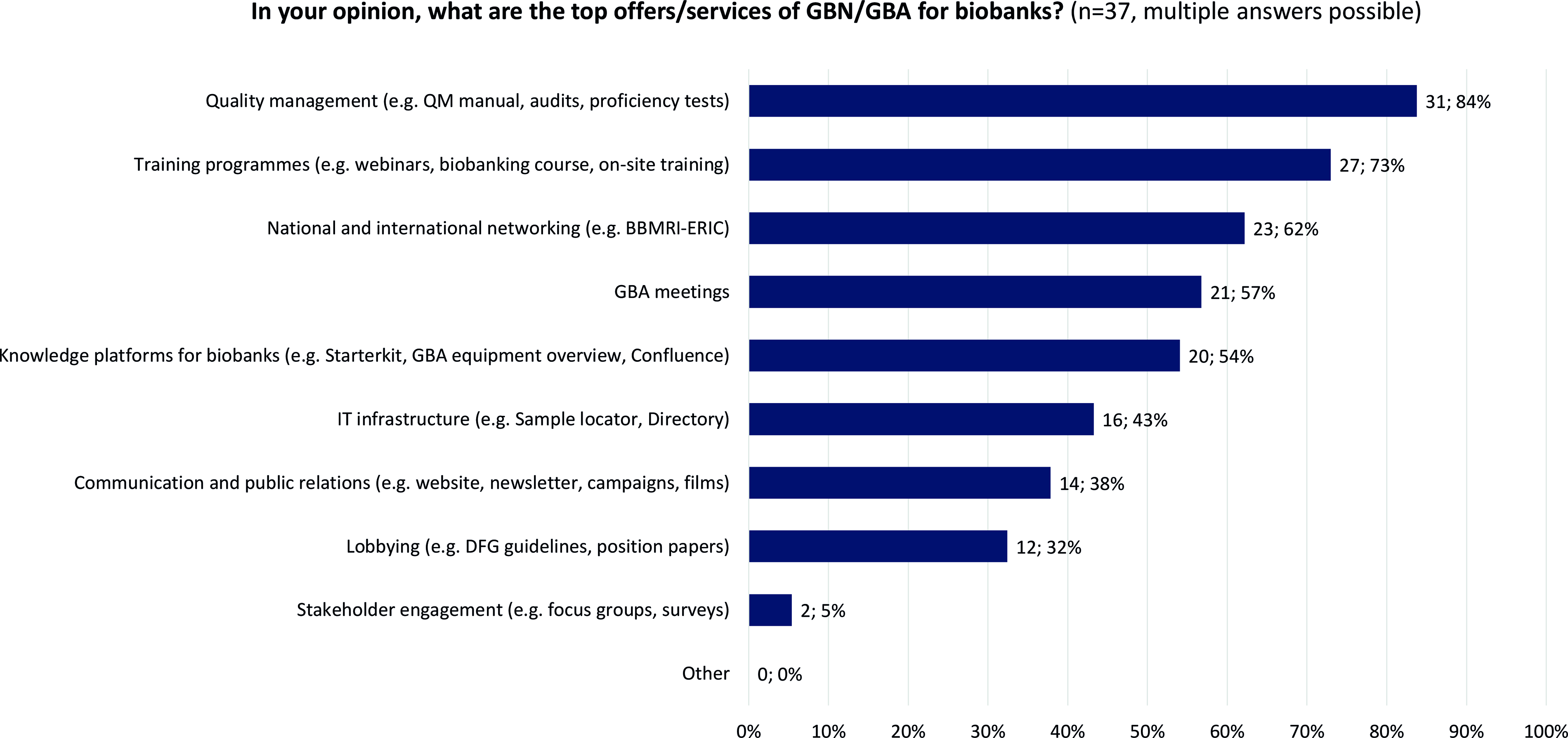
Top services of GBN/GBA. GBN, German Biobank Node; GBA, German Biobank Alliance.
Finally, participants identified as biobank leadership (n = 19) were asked to identify the most important developments (positive as well as negative) of their biobanks in the last three years in a multiple-choice question (see Fig. 4) and the influence of GBA membership on these developments (open question). Cooperation with local or federated data infrastructures, particularly with the data integration centers of the German Medical Informatics Initiative (MII; selected by 63%, n = 12), infrastructural changes (53%, n = 10), and human resource development (42%, n = 8) were considered most important. Participants were given the opportunity to elaborate on the chosen developments, which were often quite specific (e.g., integration of specific storage facilities). It was noteworthy that where negative aspects were mentioned, they were most often related to lack of (sustainable) funding and subsequent problems with staff retention.

Most important developments of the last three years.
Overall, GBA was perceived as a positive factor in the development of the respective biobank, with only four participants stating that GBA membership had no immediate impact. GBA was seen as helpful in pushing for and supporting collaboration in data networks, in pooling and providing relevant information on diverse topics, and in increasing visibility and trust in biobanks, thereby facilitating the use of biobanks by both academic researchers and researchers from industry contexts.
Operation of and collaboration within GBN/GBA
Concerning working procedures and operations, GBN was interested in how participants perceived the relation between the efforts put in and the benefits gained from GBA membership. Participants were asked to rank the relation on a scale from −100 (labeled “efforts outweigh benefits strongly”) to 100 (“benefits outweigh efforts strongly”), with 0 being “balanced.” Twenty-four percent (n = 9) experienced membership as balanced in terms of efforts/benefit ratio, 8% (n = 3) found efforts to predominate (but not strongly, as all participants rated the relation at −50 or higher), and a large majority of 68% (n = 25) found benefits to outweigh efforts, of which almost a third (n = 9) said they did so strongly (ratio of equal to or above 50).
Another question addressed whether participants felt that they had sufficient opportunities to shape the activities of GBN/GBA. Thirty participants answered, with 93% (n = 28) replying they had sufficient opportunities to participate, and only 7% (n = 2) stating they did not. Those who answered “no” were given the opportunity to specify. One respondent (open question) expressed the wish to be given the opportunity to shape meeting agendas and propose discussion points.
One way for GBA members to shape the alliance is through participation in working groups. At the time when the survey was sent out, seven working groups had been formed within GBA, providing space for exchange or for activities on different topics. Topics addressed were data stewardship, financing, education and training, industry cooperation, control cohorts, stakeholder management, and compilation of a “starter kit” for young biobanks. Much of the positive impact of GBN/GBA depends on the active involvement of members in these groups. GBN was therefore interested to know why survey participants did (not) partake in working groups. Eighteen participants were current or former members of a working group, and 19 were not. Members of one or more working groups stated (open question) that they were motivated by social responsibility, such as the conviction that the work was important to develop the biobanking landscape, a will to help shape biobanking in Germany, and to contribute their own experience. One participant stated in this regard: “Enthusiasm for advancing the biobanks at all levels.” Others emphasized local/personal reasons such as interest in the topic, welcome exchange with colleagues, and the belief that involvement might help their biobank through increased visibility or additional knowledge. The nonmembers were asked in a multiple-choice question why they were not active in any working group, with 39% (n = 7) indicating “lack of time,” 11% (n = 2) “lack of relevant expertise,” and 67% (n = 12) “other reasons,” with no one selecting “lack of interest in topics.” Other reasons given (open question) were that participants were new to the field, but also that it was not well communicated how to join established working groups. One participant specified: “I don’t know how to become part of a working group. It feels like these groups are already full and it’s not possible to join.” Other issues that were considered relevant to be addressed in future working groups were (open question): tissue biobanking, joint funding opportunities, validation and verification, data protection and broad consent, data quality, public relations, sustainability of biobanks, and development of relevant methods (e.g., microbiome analysis).
Finally, GBN wanted to know if additional formats were desired to improve interactive cooperation within GBA (open question). Responses included the promotion of regional networking through, for example, workshops, formats aimed specifically at observer biobanks or for specific staff groups, and a fixed lecture series once or twice a month with updates on relevant developments.
Moving forward: the future of GBN/GBA
GBN wanted to know what issues will be relevant in the future. Participants who identified themselves as biobank leadership (n = 19) were asked to name the five most important goals for their biobank over the next three years (multiple-choice question). Sixty-three percent (n = 12) mentioned securing funding as one of the top goals, 58% (n = 11) chose improving collaboration with local institutions, and 42% (n = 8) identified expansion/improvement of facilities as an important future goal (see Fig. 5 for full overview). It is interesting to note that patient engagement was not considered an important goal by any participant, and only one participant identified lobbying or green biobanking as a priority goal. Two participants chose to specify other goals; these were (a) supporting local research (e.g., clinical trials) and (b) integrating new collections.

Most important goals for the next three years.
Participants (irrespective of their role in the biobank) were then asked to rank potential future activities of GBN in descending order of importance. To present the findings, the median rank was calculated for each option (see Table 1). “Lobbying” and “being a forum for exchange between biobanks” were considered to be the most important future tasks (each median rank 2 out of 12) by participants, followed by “national networking” (median rank 4), “quality management,” and “training programs” (both median rank 5).
Tasks for GBN for the Next Three Years Ranked by Importance

Participants in the survey were asked to rank the listed topics according to their personal priorities. The displayed priority position of each topic reflects the median position assigned to it by the survey participants.
GBN, German Biobank Node; BBMRI-ERIC, Biobanking and Biomolecular Resources Research Infrastructure—European Research Infrastructure Consortium; EU, European Union.
Lastly, participants were asked (open question) what role they envisioned for GBN/GBA in other national networks. Participants were not united on this question but saw different roles as appropriate for GBN/GBA. The roles formulated were (a) being a broker connecting networks and individual biobanks, (b) lobbying for all biobanks, and (c) being a consultant on biobanking issues. In addition, the objective that GBN/GBA should ensure that no duplicate structures are created was mentioned several times. One participant stated in this regard: “A role which ensures previous activities are taken into account and that GBN/GBA and other networks do not have to reinvent the wheel.”
In a last open question, which gave participants the opportunity to state further points that were important to them, three took that opportunity. One wanted to include other biobanks operating in other contexts in the community (e.g., institutes of the Fraunhofer-Gesellschaft), one pointed out the necessity for meetings of certain staff groups, namely IT, to discuss group-specific issues, and the third would find the development of templates (standard operating procedures, user regulations, material transfer agreements, etc.) particularly helpful.
Discussion
This article presents findings from a survey on the perspectives of German academic biobanks on their national network, GBA, as well as on (future) topics important to them. The results will be particularly relevant for GBN/GBA in developing its future strategy and services. However, the findings may also be of interest to BBMRI-ERIC in its strategic development. For national hubs in other countries, it might be an interesting starting point to engage with their own communities. For nonacademic biobanks considering collaborating with GBA, the results may also be insightful in showing what issues are important to members, the direction the network is taking, and whether these focal points correspond to biobanks operating in other contexts.
For other national organizations working through and for local actors, GBN/GBA could be an interesting example of how to sustainably lead a national network even when funding is reduced. From GBN’s perspective, it is noteworthy that biobanks are still committed to working with GBN/GBA and investing significant time and resources, even after direct funding has ceased. Without the work of its members, GBN/GBA would not be able to operate in the way it does, and it is encouraging that survey participants overwhelmingly stated that the benefits of GBA clearly outweigh the efforts of membership. The overall positive feedback implies that the services provided are meeting the needs of the community and that those involved in working groups perceive their engagement as worthwhile and meaningful. GBN/GBA have been able to create a community that is willing to support each other and to shape a path forward together. Taking the opinions of its members seriously and engaging with the community’s needs and wishes have been essential in building this. While more research would be necessary to see what factors were most conducive to this development, surveys such as this can be one way of engaging with the community.
Accordingly, the findings were used to help in shaping the future strategy of GBN/GBA. In March 2024, a strategy meeting with the Steering Committee (SC) f was held, where the survey results were presented and discussed. In line with the findings, it was decided that future focus points should be QM, education, and networking. In terms of networking outside of GBA, the main goal should be to work together with other national actors to ensure that duplicate structures are not created and that national approaches are aligned with community objectives. In this context, GBN is being integrated into the Netzwerk Universitätsmedizin, which offers new opportunities for strategic alignment and more effective collaboration across the German health research landscape. Beyond this, GBN/GBA will strive to initiate or deepen exchange and cooperation with national networks/institutions that shape health research, including the Deutsche Zentren für Gesundheitsforschung, Technologie- und Methodenplattform für die vernetzte medizinische Forschung e.V., Netzwerk Koordinierungszentren für Klinische Studien, Medizininformatik-Initiative, but also with BBMRI-ERIC and its individual members, respectively. In addition, several challenges of collaboration within GBA have been addressed. For example, information on the working groups and how to join them is now prominently displayed in the joint online working environment, Confluence. In meetings, the possibility to contribute to working groups has been repeatedly addressed, and participants have been invited to get involved. A task force on “local hubs” has been established and is developing guidance for biobanks on how to improve collaboration with different actors at their sites. Further working groups have been set up based on the interests expressed in the survey, specifically on tissue biobanking, data quality, sustainable funding, and refining best practices for peripheral blood mononuclear cells (PBMCs).
While the results were generally helpful, the interpretation of some findings is less straightforward. For example, it seemed odd to the authors that lobbying was rated as a top priority for the future, but not as a top activity in the past. Although the outcome may be partly explained by the way the question was phrased (identifying the top five offers/services), it raised the question of whether lobbying had not lived up to expectations or had not been visible enough to the community. However, lobbying has been an area of intense activity for GBN/GBA with notable successes in recent years. For example, in a pioneering initiative, GBN/GBA and various patient organizations developed a joint position paper to strengthen the use of academic biobanks and intensify patient involvement in biomedical research, which was widely endorsed. g GBN/GBA is also in constant contact with funders to emphasize the importance of, among other things, sustainable funding for biobanks. One explanation for this result could be that such activities do not have the same impact on everyday interactions in the biobanks as QM or training activities and are therefore less likely to be noticed to have an impact. The authors believe that this may explain the lower rating of meso-level activities, as participants themselves explained that they most valued services that had an impact on their everyday work.
The question was also raised as to what should be done about activities that were considered to be very important by GBN and the SC but rated as lower priorities for the future by the participants. For example, stakeholder engagement is considered essential for the long-term success of biobanks by the authors and GBN/GBA leadership, but was seen as a lower priority by the participants. Where views and needs of important stakeholders—particularly users of biobank services and patients as providers of data and biospecimens—are not adequately addressed, biobanks will simply not be used. 16 We can only speculate as to why patient engagement was not ranked as a higher priority by survey respondents. From our experience of engaging with biobanks, we know that patient engagement is widely recognized as important, not least because funding bodies increasingly require it. However, there are several reasons that may explain why it was not prioritized more highly. First, many biobanks are currently facing more pressing challenges, particularly regarding sustainable funding and long-term infrastructure as reflected in our data. Second, while the general value of patient engagement is recognized, there is still some skepticism in practice. Engaging with patient representatives requires resources in terms of both staff time and financial compensation for patient contributors and involves a cultural shift. Biobanks are not yet systematically set up to include patient representatives in decision-making processes. Third, GBN/GBA have already carried out a wide range of activities in the area of stakeholder engagement and outreach in the past, both in terms of gathering information on perspectives of relevant stakeholders (e.g., with a survey of potential biobank users 16 ) and in terms of providing communication material (e.g., films explaining biobanking services to patients and researchers h ). So far, the uptake of these offers has been good (e.g., films are used widely), which shows that there is interest in the services from GBN/GBA and motivation to engage with relevant stakeholders, but members might also consider that the most important work is already done.
Similarly, it is unclear why networking at EU level is rated so low, while to secure funding, networking and cooperation at EU level may become increasingly important. GBN and the SC are aware that other issues, particularly regarding sustainable funding or activities that are directly linked to day-to-day operations, such as QM and staff training, may simply be more pressing. This might be particularly true for “younger” biobanks who are still setting up operating procedures, but further research would have to examine that relation. While GBN/GBA take local interests and priorities of biobanks into account in their future strategy, more overarching issues will continue to be on the agenda, and GBN/GBA will strive to make offers in this regard.
As already mentioned, the survey has highlighted that sustainable funding is an important issue for the academic biobanking community. This is not surprising as the topic has already been intensively discussed within the international biobanking community.23–25 The limited institutional funding (compared with third-party funding) with the resulting consequence of temporary contracts for the majority of academic personnel has been emphatically criticized in German academia. 26 This is also a challenge for academic biobanks. While it has been argued that a mixed funding strategy can be sustainable in the long term, 24 biobanks need a sound financial basis for stable operation and staff retention. Otherwise, gaps in funding between projects will result in biobanks losing well-trained staff and having to start recruiting again and again, which is at the very least inefficient, but also potentially detrimental to the biobanks’ mission. The GBN/GBA has already positioned themselves and have made propositions on how to organize biobank funding in a sustainable way, i but lobbying efforts in this regard may need to be intensified. Furthermore, industry cooperation might have to be considered as an opportunity for cost recovery. To support such cooperation, GBN/GBA has already formulated a position statement 27 formulating orientation points for interacting with industry researchers and engaged with patient representatives via focus groups to ensure governance structures and processes are acceptable to potential donors. j In 2024, 18 GBA biobanks have worked with industry researchers at least in individual projects.
Limitations
For ethical reasons, we did not collect IP addresses. Therefore, we cannot completely rule out the risk of people taking the survey twice or giving the link to others outside the target population. However, as invitations were only sent to members of the alliance with an interest in the proper performance of the network, we consider this risk to be minimal.
In addition, the response rate at 31% was acceptable, but not high. This can at least partly be explained by the mailing list used, which is an imperfect approximation of the population (first-line management of biobanks) that the authors wanted to primarily reach. Technicians, for example, might have felt less confident in answering questions about GBA activities and therefore not taken the survey. In addition, as there are regularly several people from the same biobank on the mailing list, it is to be expected that they coordinated as to have only one fill out (and thereby represent) the views of that particular biobank. With 19 biobank directors/managers among the participants, the sample represents a significant number of biobank sites (assuming a limited number of first-line management at each location). The authors therefore consider the findings to be robust. However, as we did not ask nonresponders about their reasons for not participating, we could not control for relevant differences between groups.
Lastly, the survey was limited to academic biobanks in Germany. While we believe that the findings will likely also be relevant to other contexts, we cannot say which of the issues identified will also be relevant for industry biobanks or biobanks in other national contexts.
Conclusion
The survey provides relevant insights into the topics that are important to the academic biobanking community in Germany. The findings have helped to tailor future developments at GBN/GBA to community needs and interests. For a network built on community effort, it is crucial to continue to listen to the community, and surveys are an important tool for doing so.
Authors’ Contributions
J.S., V.H., and C.S. designed the study and the survey. R.K. and R.B. critically revised the survey. J.S. and C.K. analyzed the data. C.K. interpreted the data and prepared the article for publication. All authors revised the draft critically for important intellectual content. All authors have read and approved the article.
Footnotes
Acknowledgments
The authors thank the working group on stakeholder engagement for helpful feedback on former versions of the survey and the draft of the article: Heidi Altmann, Jörg Fuchs, Michael Hummel, Roland Jahns, Stefanie Köhler, and Christina Schüttler. They also thank Ida Steier for support in preparing figures and further operative tasks.
Author Disclosure Statement
The authors declare that they all are or have been working for or are associated with GBN/GBA.
Funding Information
This study was funded by the Federal Ministry of Education and Research (BMBF) of Germany (funding code: 03EY2001A).
Supplemental Material
Supplemental Material
References
Supplementary Material
Please find the following supplemental material available below.
For Open Access articles published under a Creative Commons License, all supplemental material carries the same license as the article it is associated with.
For non-Open Access articles published, all supplemental material carries a non-exclusive license, and permission requests for re-use of supplemental material or any part of supplemental material shall be sent directly to the copyright owner as specified in the copyright notice associated with the article.
