



Abstract
Western culture is (re)developing an increasing awareness of the more-than-human web that stabilises and sustains our existence. Within this moment, this article asks: What themes within environmental futures do contemporary artists see as pressing through their work? To address this, this article draws upon a dataset of 205 artworks and artist’s statements, from artists whose practices engage with concerns of environmental futures, and in particular, what is being termed here as more-than-human futures. The article finds that artist’s environmental and existential worries, and hopes, are ingrained in the aesthetics and narratives they produce. This article contributes these imagined more-than-human futures as concerns of Futures Studies, due to their potential impacts on human engagements with planetary concerns, and their ability to help point culture towards a more interspecies-inclusive future.
Keywords
Introduction
This article seeks to identify current interests, motivations, and concerns among ecologically-focused new media artists, concluding that the future of interspecies relations, within broader Environmental Futures Studies, is a key concern that many media artists are displaying through their themes. I draw from diverse fields such as digital art, techno-art, Sci-Fi art, bio-art, interspecies/multispecies interactive art, animal-computer interaction design, digital games, and digital narratives, to identify the ways in which practitioners imagine alternative futures for relations between humans and other species through their practices. I find that conceptualizing the future as ‘more-than-human’ by centring interspecies cultural practices, is central to much current thinking across the future-focused arts. Discussions of the more-than-human turn in artistic practices have been made previously by scholars such as Madeline Boyd (2015), Fiona French (2022), Melanie Sehgal and Alex Wilkie (2024), and my own previous research (Krauth 2024). This article builds upon these previous viewpoints by forecasting to more-than-human futures as a pressing concern in contemporary art practices. I thus wish to contribute ‘more-than-human futures’ as a concern for the field of Futures Studies, due to its potential to renegotiate relations between humans and ecosystems, and potential ability to help point culture towards positive interspecies-inclusive practices.
To address this, I use a mixed-methods methodology informed by exploring artworks experientially, as well as thematically investigating the artist’s statements of 205 speculative and future-focused contemporary artworks, in order to uncover artist’s intentions regarding the environmental futures they envision. These two approaches complement each other in building a bigger picture of these practices, informed both through the experience of the artworks, and recognizing the intentions of the artist’s themselves through their words. Together, they allow me to develop a bestiary of contemporary more-than-human themes. The themes I focus on here are: (1) Anxious Futures; (2) Interdependent Futures; (3) Caring Futures; (4) Recognizing Nonhuman Agency; (5) Playful Futures; (6) Rewilded and Re-evaluated Futures. These themes are fluid, evolving, and not intended to be prescriptive. They represent a snapshot in time, ripe for adopting new insights and developments as the future becomes the present. This research is offered for its ability to enhance clarity and communication surrounding the more-than-human turn in contemporary arts, and to consider the diverse, intertwined aspects of potential future interspecies relations.
‘More-than-human futures' is a concept already emergent in interdisciplinary design fields such as speculative design, where imaginative and provocative artifacts and scenarios are used to explore possible futures (Dunne and Raby, 2024; Redström, 2017). In these fields, the concept is approached as a critical framework for decentering the human and reimagining design as entangled with nonhuman actors and ecologies (Tironi et al., 2023; Kirksey, 2015). However, exploring how this critical framework has been engaged with in other fine and contemporary art forms has been slower. 1 Researching how contemporary new media artists are also contributing towards more-than-human futures has many benefits for futures studies. When artists are interested in exploring alternative or possible futures, this can result in narratives that cause audiences to question, consider, and/or meditate on what is and what could be. It has been noted by Moore and Milkoreit (2020) that studying the future relies heavily on strong imaginations, and Bussey and Jaworski (2024) suggest that much of the wider social imagination is always-already derived from works of art—films, literature, music, visual art—that fuels public imagination. Embedding the ideas of futures studies into creative cultural practices allows those ideas to pass into wider cultural domains. Further, according to Melanie Challenger (2024), contemporary and new media artistic methods, where new technologies are often experimented with, have particularly strong purposes for creatively imagining futures via artists’ abilities to innovate in ways that corporate technology companies may not explore. In other words, artists are often the people with the knowledge and means to not just imagine futures but to test out futures within the present.
Background: Unearthing the Environmental Futures Aesthetic ‘Paradox’
What Is “Nature”, Now?
In Ecology without Nature (2007), Timothy Morton argues that the Western conceptualization of ‘nature’ 2 positions humans as patriarchal onlookers, with the environment being aesthetically objectified by this gaze. Morton, alongside others such as Braidotti (2013), Lorimer (2015), and Haraway (2016), argue that in order to culturally recognize humans as part of a wider ecological web, we must reconsider the bifurcation between humans and the environment as a nature that is out there and detached from our immediate lives. Morton further suggests we should relinquish the idea of nature entirely. Here, they do not mean we are free to pave paradise, but that we need to disorganize the human gaze such that we reorient our relationship with the more-than-human world as a system that we are a part of, not apart from. This human gaze has allowed us to view nature as an aesthetic object of wonder separate to our existence—a landscape for us to conquer—leading to an unhealthy relationship of ownership and desire which Morton terms a “paradoxical act of sadistic admiration” (2007, 4-5). Morton’s point can also be applied to individual species of animals and plants, wherein the human gaze towards aesthetically-pleasing species, governed by principles of cleanliness, cuteness, or homogeneity, has direct effects on which species we care for, which can ultimately lead to a lack of species diversity and to ‘charismatic’ animals receiving care over others (Lorimer 2015; Nagy and Johnson 2013). These humanist aesthetic principles can be counter to the reality of what makes ecosystems work well: they can skew feelings by allowing culture to give more moral worth to species and environments we find physically appealing.
Following this call to action, scholars have since suggested different ways of linguistically re-engaging what we once called nature. For example, Lorimer (2015) suggests the concept of nature should be replaced with ‘wildlife’, as while there are no corners of the world left that are not in some way affected by human activities, there are still living species of animals and plants who exist across almost all types of environments. The term that appears to have come into common use across the arts and humanities is the ‘more-than-human world’. This phrase recognizes that humans are a creature of the environment who are not ecologically central to its functioning. The term ‘more-than-human is drawn from the work of David Abram (1996) who traced spiritual connections between cultures and their environments, then through feminist thinkers such as Donna Haraway (2016) who helped to reframe it as a term referring to the collaborative and symbiotic ways in which we are always-already more-than-humans through our bodily connections to other species. Fieuw, Foth and Caldwell (2022) define more-than-human as: “[A]n approach to account for nonhuman agencies, recognise humanity’s entanglements with ecosystems and the planet, work towards multispecies justice, and design for cohabitation. Such new ways of conceptualising sustainable development—perhaps the most pressing global agenda in the wake of what Earth scientists call the ‘Holocene (or sixth mass) extinction’—are a pressing and urgent endeavour.”
Their definition centres on the importance of nurturing interspecies entanglements, and the justice and ethics required to allow other species agency in our current agendas. Engaging the more-than-human world as a future thus challenges the privileged centrality of human knowledge and redefines human social actor networks as wider multispecies networks. Moving towards a more-than-human future means to embody an understanding that the environment is not simply an aesthetic object for our pleasure, instead we are, and have always been, an active part of its larger ecology.
The Conundrum of Aesthetics
Morton's damning appraisal of the treatment of nature as an aesthetic object has led to some defining questions for the arts and human creativity: how do we reconsider representational views of the more-than-human, and consider appropriate creative ways of engaging with more-than-human agency, while also recognizing our inability to move beyond our own subjectivity in order to understand a more-than-human perspective? How can artists address the conundrum of decentering the human aesthetic experience, while still maintaining practices that are accessible, understandable, and affective for human audiences? Or should the human audience be abandoned altogether in more-than-human futures?
There are inherent issues with posing these questions. While this paper argues that creative practices engaged in rethinking human objectification of nature are well positioned to envision more-than-human futures, the arts have historically played a central role in positioning humans as separate from the more-than-human world. The arts’ human-centered focus on the onlooker inadvertently marginalizes more-than-human perspectives by privileging human sensory perceptivity and phenomenological experiences (Braidotti 2013), and in doing so, contributes to Morton's notion that the environment is seen as an object of beauty external to the self. Philosophizing looking as an act of artistic judgement sets up a bifurcation between the mind that comprehends, and the world it looks upon (Sehgal and Wilkie, 2024; Wilkie and Michael, 2023), where we are positioned as the experiencers, and the world around us as the matter that is experienced. And while aesthetic pleasure is understood to include much more than just visual appearance, lending also to the sonic, the haptic, the edible, and so forth, such aesthetic pleasure is still inherently subjective and judged through individual subjective experiences often labelled as perceptual, sensory, or affective (Hume 1986; Kivy 1993; Krauth 2024). This keeps notions of aesthetic critique within a human experiential framework. Additionally, it has been argued throughout the 18th–20th centuries that creativity, and the creative ‘genius', is what ethically separates us from other species (Bartha, 2023; Wiggins et al., 2015), wherein an ability to produce art is central to what makes us special. This places the human at the center of questions of creativity and who we consider capable of creative production, and thus who is elevated from nature. By keeping ourselves at the centre of who gets to look upon the world, aesthetically judge it, and create art within it, we inadvertently keep ourselves at the center of who gets to imagine our combined futures through creative practices.
Any cautious redirection of this conundrum requires working to separate the limited prescriptions of subjective beauty from the notion of aesthetics. Doing so is valuable because imagining futures can require a turn toward, rather than away from, aesthetic experiences. As Line Marie Thorsen suggests, “it is with and in aesthetics, that spaces can be imagined, and from where we can begin to grapple with more-than-human worlds and modes of knowledge production” (2019, 3). Désirée Förster (2023) further argues that this is because art that stages encounters with the more-than-human can heighten our sensitivity to ecological issues and our own place within this ecology. For both Thorsen and Förster, aesthetic registers are not oppositional to more-than-human futures, indeed they are key to becoming actively attuned to them, which “may help articulate more-than-humans as political: as worlds to see, listen and attend to. Not as Nature ‘out there' but reimagined [...] as slipping and always partially connected to [...] ‘realpolitik'” (Thorsen, 2019, 3). Therefore one method to approach this separation may be to, as alluded to in Thorsen's words, recognize aesthetics as inherently political rather than solely pleasing, since many current and future political issues involve interrelations between humans and nonhuman others.
Another method to redirect this conundrum may be to return aesthetics to earlier etymological uses of the Ancient Greek aisthētikós, which pertains to the use of sensory perceptions for acts of learning—not just acts of looking upon (French, 2022). One avenue for doing so has been formulated in my previous research (Krauth, 2024) where I suggest an aesthetic of sensory affordances that recognizes the potential value systems of other species as aesthetic registers. A sensory affordances view of aesthetics is receptive towards, and inclusive of, other species' needs and desires when creating objects, spaces, and technologies. Förster gives another angle in the form of processual aesthetics, which positions humanity in a more-than-human web of symbiotic and parasitic exchanges between bodies and environments, in which these processes of exchange and being together are considered aesthetic experiences. Through this, she argues that the subjective experience of aesthetics should not be seen as only an internal, body-centric experience, “but as one element among many, linked to nature in multiple ways” (Förster, 2023, 238). These methods for redirecting our subjective experiences of aesthetics toward speculative more-than-human aesthetic registers suggest potential ways forward for decentered engagements between artists and more-than-human worlds.
Methods
From Engagement to Interpretation
To recognize the rich concepts and themes imbrued within artistic objects, it is methodologically common to engage with them directly. My engagements have occurred across 205 works that I would consider to have ecological themes and future-focused narratives. In this context, engagement included viewing, direct interaction, or other forms of perception or immersion, dependent on how the object is presented to the public. The presentations of these works included gallery experiences, online interactive experiences, video documentation, image documentation, virtual reality, live events, or artist’s talks and lectures. 3 I would term this form of engagement-as-interpretation a combined narratological and phenomenological approach, following Seymour Chatman’s (1978) understanding that a work’s themes can emerge from the way a story is told, not just through what is told. 4 Building on Merleau-Ponty’s (1964) account of perception as an active, bodily openness to the world, engagement is a bodily praxis through which themes can be understood through the senses. In practice, this engagement-as-interpretation requires close first-person description on each work studied, plus phenomenological narration of the researcher’s own reflections in order to combine first-person accounts with contextual analysis. Portions of these notes are synthesized into the Analysis section of this paper.
Extracting Themes From Artist’s Statements
I also want to develop an understanding of how creative practitioners envision more-than-human futures through their creations, not just how a visitor may interpret this—though the two are entangled when appreciating objects of art. Further, I recognize that my position as a perciever can turn my accounts of an artwork into a fabula, which David Bordwell (1985) positions as the viewers constructed version of a presented narrative. To address this, I take the artist’s statements of all works experienced, and examine these to identify commonly worded themes, serving as a cursory exploration of the creators’ stated intentions. Artist’s statements accompanying the works were examined through thematic analysis (Braun and Clarke 2006, 2021), identifying recurring concepts used by artists to articulate their intentions. The artist’s statements have been found via artist’s websites, exhibitions, or other public portals where their artworks have been shown. This approach complements the embodied analysis of the artworks themselves by situating the artists’ own discursive accounts. While thematic analysis of such diverse artworks could be seen as reductive towards the individual richness they convey, it serves here as a launch-pad for recognizing some of the key issues that artists perceive as relevant for environmental futures through their work. 5
Analysis
How Do Artists Consider More-than-human Futures Through Their Artist’s Statements?
MAXQDA Analytics Pro was used as helpful software wherein 205 artist’s statements were assigned theme-based codes during the reading process. Due to varying statement lengths, the results were normalised through a secondary process of deleting any code that appeared more than once per statement, so that it was possible to see which themes arose most often, rather than which were given the most space per statement.
6
This project did not begin with a pre-set list of themes/codes, instead 21 codes emerged as the statements were read through, leading to the particular wording seen in Figure 1. Visualization of thematic codes.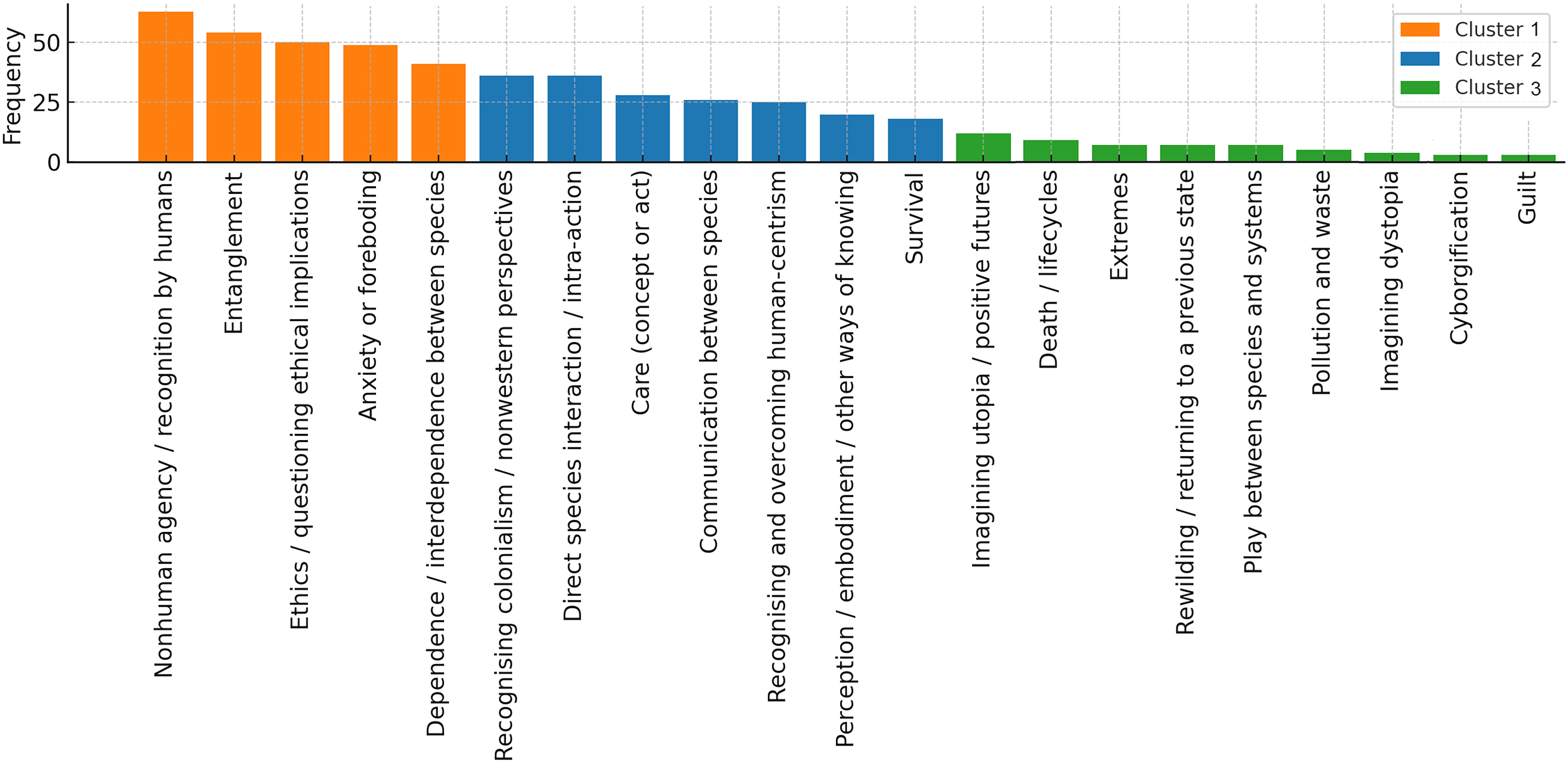
Figure 1 outlines each resultant code and the quantity of artist’s statements that include each code. The three most common being nonhuman agency, entanglement, and ethics, suggesting artists are grappling with questions of interconnectedness and shared agency across species or systems, and the moral implications of doing so. Anxiety or foreboding also ranks highly, indicating common concern about ecological futures. In sentences functioning under this code, several artists also mentioned concern towards the role/s humanity and technology play within that future. The less frequent themes like cyborgification, pollution, and guilt point to niche explorations within the broader themes of human-nonhuman-technology relations and human impacts on the environment. Themes of utopia, dystopia, death, and rewilding show that artists are imagining a wide range of different future trajectories, some of which include hopeful restoration, and others include anxiety towards our ability to engage in multispecies futures and the potential for destruction or extinction to follow.
In considering how these codes may interrelate with each other, they have been grouped in Figure 1 into three color clusters based on their frequency of appearance. I consider Cluster 1—the five most common codes ranging between 63 and 41 statements—to reflect the central philosophical and affective drivers of this dataset, where artists appear to be most preoccupied with the ethics, emotions, and complex interdependencies of more-than-human relations. This cluster represents the overall thematic umbrellas that arguably form the conceptual nucleus of what these artists see as important to more-than-human futures. Whereas Cluster 2—seven themes of mid-range frequency ranging between 36 and 18 statements— perhaps better expresses how these umbrella concepts might be achieved, through for example, decolonial or caring responses. This suggests artists are not just highlighting issues, but many are also interested in solutions through aspects of care, mutual survival, and attempts at other forms of communication and knowing. Cluster 3 are the least seen codes, ranging from 12 down to 3 statements. I see this cluster as representing edge explorations and peripheral themes. They still expand the discourse by showing niche explorations such as specifying problem or harmful spaces, and at times proposing fixes to these through concepts such as rewildling, however many Cluster 3 themes can also be seen as sitting within the broader umbrellas from Cluster 1.
Although several of the themes identified in this analysis exhibit some conceptual overlap, their coexistence is deliberate. Particularly within creative and affective practices, themes (and their meanings) are often entangled, and indeed, unravelling them completely can be reductive. For example, conceptually overlapping codes such as anxiety and survival, or pollution and guilt arguably all fit within broader ethical concerns, but reflect the complexity of artists’ imaginings of ecological futures. Retaining these overlaps allows for a more nuanced mapping that acknowledges the work of creative practitioners as functioning across categorizations.
Review From Direct Engagement With Key Works Across Identified Themes
Below is a review of key works that make tangible a range of the broader thematic areas identified above. Based on the above codes, here I focus not solely on the most common, but also on those that suggest emergent interests in the community.
Anxious Futures
Autocthonia (2022) by Audax M. Gawler “explores our human dependency upon soil’s complex and living systems” (Gawler 2023a) through an installation with a sci-fi video component, that projects a future in which soil has become a scarce, state-rationed resource. Humans live off-planet and ingest pill-sized soil supplements, grasping at minimal, bureaucratized connections to earthly geology. The focus of the video artwork revolves around a solitary human whose desire for earthly contact leads to a physical yearning for soil. This world appears inherently cold; a tech-dependent world where humans invested in the wrong direction. There is an imagined tactility one feels towards the soil pill and the act of swallowing it, giving this dependence on earth a tangibility.
Gawler imagines: “In present-day grappling with soil depletion, these artefacts look forward to a future of off-planet habitation to explore the corporeal dependency of human forms on earth ecologies, and interrogate how the continuation of human life in any location will only be facilitated through models of care, reciprocity and stewardship beyond-the-human” (Gawler 2023a).
Gawler’s work recognizes the importance of the more-than-human world to future human survival. Yet, it also represents the anxiety seen in the work of so many artists in this dataset, wherein it is acknowledged that humans may not have the capacity to fix, restore, or reimagine healthy planetary living. Instead, Gawler’s main character must find other ways to function, or to survive but not flourish (Gawler 2023a) due to their limited connection to earth. Autocthonia shows no palatable way out of this conundrum, suggesting only that when more-than-human connection is in extremely limited supply, we must accept that limitation. This interplay between collaborative survival and the threat of failure to flourish suggests a potentially realistic and non-romanticized planetary future in which humans have recognized our interdependence with the more-than-human world, but have failed to successfully retain it.
Interdependent Futures
A further area of concern highlighted by this research is that of direct interaction between species’ bodies, questioning and/or promoting biological interdependencies between organisms, and questioning our ability to make such bodies mutually beneficial. Artists are recognizing the intrinsic connection between beings not only at the level of ecology but at the cellular level, showcasing ways in which global medical practices have always been more-than-human. This speaks to a moment in history marked by over-consumption of nonhuman bodies, reminding us that science has a long history of dependence on animal bodies to help our own, often without reciprocal relations (Haraway 2016).
In the three video artwork series A000000000001000AA011 (2020-2022), artists Lilia Li-Mi-Yan and Katherina Sadovsky “explore the possibility of human interaction and connection with other forms of existence. What would happen if we had new bodies, created through interaction with new technologies, materials, bacteria?” (Li-Mi-Yan and Sadovsky 2023). The characters within their videos have noticeable biological growths, wherein their bodies have “learned to reproduce the critical organ systems and [have] also become something like a farm for growing cells and cellular organoids” (Li-Mi-Yan and Sadovsky 2023). The artists liken these growths to something akin to organic tumours, deformities, parasites, or symbionts. The videos withhold any explanatory exposition, instead presenting episodic interview-style encounters that the viewer uses to build meaning. Yet, it is clear the interdependence between species is inherently vulnerable; a world in which we offer up our bodies, and if we fail to do so, we may not survive.
Li-Mi-Yan and Sadovsky are asking important questions regarding what the human is and will become by centring more-than-human bodily coexistence as a part of everyday life. Human bodies are already hosts to symbionts and parasites, and this work forecasts a future where this becomes highly visible. That we already share our bodies with other entities is a topic many perceive as ‘gross’ (Olexa 2018), which can lead to negative opinions of the more-than-human body-scape. Making those relations visible has the potential to engage us in new aesthetic discussions of what is culturally perceived as an acceptable body, and how the body acts as a site of shared use. Though, like Gawler’s work, there is an anxiety that brews regarding the intentions of humans to coexist and share with others, as if symbiosis is a struggle that must be won by one species over the other. Their work suggests that humans may use symbiotic entities for our own gain, remaining focused on human-centric ideals, rather than being capable of truly mutually beneficial bodily coexistence.
Caring Futures
Kinning with other species is often associated with indigenous approaches in creative practices (Turner et al., 2024), but also suggests post-Western approaches to interspecies care, such as the ideals in Audax M. Gawler’s CARRYKIN (2023). Gawler imagines in their artist’s statement: “In a future shaped by Climate Recovery and a redefined approach to multispecies care, CARRYKIN presents a collection of artifacts from an interspecies surrogacy program operating within a speculative Community Care Clinic. The Carrykin Program refigures multibeing kinship by providing temporary internal stewardship to marine species experiencing precarity due to habitat loss. In this speculative scape, artificial womb implants (Biobag™) allow humans to cross biological boundaries, temporarily carrying and nurturing multispecies kin in the most intimate internal terrain” (Gawler 2023b).
CARRYKIN reimagines present-day human care facilities into spaces that accommodate the care of other species, and attempts to make more-than-human care palatable to current sensibilities. The work turns the act of nurturing into a sensory experience, presenting as a room-sized installation of a futuristic fertility clinic where medical care can be received for gestating a marine mammal via a womb implant. The installation is replete with medical paraphernalia, including posters and fliers to help expectant parents choose the best care for their calf’s gestation. The installation allows participants to engage in dialogue about the potential of new family and kinship models, and to imagine bodily processes that are both familiar and queered, extending the imaginable contours of the participant’s body into something posthuman.
An important symbol in CARRYKIN is the ‘Biobag’ womb implant, which, to my senses, metaphorically connects wombs with ‘kits’ used by wildlife rescuers to transport injured animals. The Biobag and the many other items in the installation, draw upon recognizable aesthetics of wildlife care and veterinary practices, queering clinical material objects from human and animal care professions together into interspecies tools. By making ideas of interspecies care more accessible within our cultural consciousness, works like this may help us to imagine ways forward for accepting human, nonhuman and more-than-human beings as equally deserving of care.
Recognizing Nonhuman Agency
The agency of the non-human other is of central concern to creative practices focused on the more-than-human world. The work of Lindsey French Urushiol Tattoos (2016) addresses this through the power of physical pain by reminding participants of the agency of poison ivy to harm and physically change human skin. Using urushiol—the active ingredient derived from poison ivy—she draws on participant’s skin, creating painful, raised markings that remain present and uncomfortable for around 2 weeks. French wants participants to sit with this discomfort, and through this, reflect on ways in which exposure to other species can induce purposeful reactions in humans, wherein we are reminded that living in a more-than-human world can often mean keeping a respectful distance from others (French 2016).
While French’s work reminds participants that plants are living creatures with agendas, the poison ivy is not (necessarily) a knowing and active participant in French’s work, nor is it capable of providing consent. An example that aims to provide more active agential participation for non-human users is Robo-Bonobo (2012) by Ken Schweller, which presents as a half-ape-half-robot made to be controlled by bonobos at the Bonobo Hope Great Ape Trust Sanctuary, Iowa. Schweller describes, “[t]he idea is to provide the bonobos with a safe way to interact with visitors and have some fun—the robot comes equipped with a squirt gun” (Schweller 2012). The significance of the Robo-Bonobo lies in its ability to allow bonobos a level of agency over whether they are observed by visitors. Bonobos can harness this agency by squirting onlookers with a water gun and watching them run away. Recognizing that the bonobos using this tool are captive and in need of this enrichment because they are not in the wild, the central concern of Robo-Bonobo is to allow such non-releasable and zoo-kept animals a chance at a momentary level playing field with human onlookers, and raises questions regarding who gets to decide to be the onlooker, and who gets to be looked upon in the name of fun.
Understanding non-humans as being capable of acting as the onlooker, or indeed as active interactors, has strong implications for our general understandings of aesethetically pleasing objects and experiences, as it opens art to the opinions and judgements of other species (Krauth 2024). Works like Robo-Bonobo aim towards positive subjective experiences for other species. A future wherein nonhuman decision-making and judgements are taken into account in acts of creation and design would have lasting implications, and has the potential to make human-centric spaces and experiences more accessible and beneficial to other species (Krauth 2022).
Playful Futures
More-than-human futures are also attempting to be playful, exemplified in the work of Brittany Ransom. Her Jabblrs (2016-) cement themselves as part dog toy, part interactive artwork, made for augmenting play time between dog and human companions. Each Jabblr reports a different sensory function through touch/mouthing: for instance, movement data or gyroscopic data. By linking her arts practice to notions of positive play between species, Ransom’s work intrinsically aims to promote ethical interaction: Jabblrs speak to the unique relationship between dogs and humans wherein playtime is broadly considered positive and enriching for both species. Ransom’s work examines the nature of interspecies play as an aesthetic for both dogs and humans, with the potential for dog participants to draw their own meanings and rewards from the intermediary objects involved.
Discussions of play are vitally important to more-than-human futures. Firstly, recognizing that other species perform in ways that we would call play, regardless of the reasons why they may do so, helps us to recognize other species as minded and conscious. It appeals to an inbuilt cultural bias in which we may believe only intelligent creatures can understand the abstract qualities of play and the learnt rules of games. Of course, engaging undomesticated species in interspecies play is not necessarily an ethical act (Krauth 2022), but recognizing their capacity for play can help us to recognize our similarities. 7 Perhaps it is because we recognize the playful in ourselves that we are better able to empathize with others who play.
Given that play is prevalent across numerous species, it can be understood within various umwelten, rendering it a genuinely multispecies concept. For instance, imagine a play-wrestle between a human and a domesticated dog: both species have learned, through mutual teaching, the rules and objectives of shared physical play; both parties have learnt that games have boundaries—they should not cause physical harm, and there is a defined beginning and end that may be initiated, concluded, or rejected, by either party. Additionally, both recognize that the wrestle is an imagined fight in which none of the actions are truly confrontational and exist only within the shared imaginative world inhabited in the moment. Incorporating an object learnt/understood across human/dog culture, such as a ball or Ransom’s Jabblrs, further illustrates the concept: not all dogs immediately recognize the purpose of a toy, but through active interactions between humans, bouncy objects, and dogs, both species learn how to play with such toys together. This has broader implications for art and our appreciation of aesthetics, because perhaps to a dog, a Jabblr is much more likely to serve as an exemplar of an aesthetic object as opposed to, for instance, a painted landscape scene.
Rewilded and Re-Evaluated Futures
The more-than-human turn in the arts has emphasized non-western branches of knowledge, particularly with consideration to how we care for, live with, and relate to other species. This is exemplified in the long-term Carbon_Dating (2021-) project, led by Keith Armstrong and a team of artists developing experiments and environmental campaigns. These experiments seek to shift relationships with grasses by helping native grass species reclaim their ancestral areas of Australia. In particular, the group looks to Indigenous Australian methods of grass-care, Indigenous Australian methods of land burning for rejuvenation, and the re-introduction of native grasses to otherwise urban and suburban areas. While each artist in the Carbon_Dating project creates artefacts that meditate on the importance of native grass, they are also ultimately caretaker-volunteers, where a large portion of their practice is dedicated to planting and maintaining grassland. While one could argue that these are collaborative practices with grass species themselves, it seems more pertinent to call Carbon_Dating a series of co-benefiting relations, where the care, maintenance, agency, and physical appearance of the species in question drives the ultimate aesthetic of the artworks produced. In the artist’s words: “We chose to focus on Australian indigenous grasses because - as plants and then ‘minor ones’ at that for many - we typically disregard them, or consider them uninteresting, weedy or dull; forgetting how dependent we are upon them for our well being […] in this time of environmental stress, we called upon adventurous humans [and] vivacious grasses to ‘conspire’ together – to breathe life into radically new kinds of relationships with each other” (Armstrong 2024).
The Carbon_Dating Project looks to a future in which onlookers recontextualize biases against species based on appearances. Armstrong (2024) explains that Australian indigenous grasses are typically disregarded as “dull” in the local culture by comparison to imported species. The replacement of natives with imported grasses has created backyard monocultures, ultimately leading to homogeneity that has flow on effects for keystone insects and other species (Meyer and Kersten 2016). Having a perfectly manicured lawn is an aesthetic trend wherein we allow ourselves to gaze upon mathematically satisfying grass (Weiss 1995). Doing so contributes to an aesthetic of law and order that conquers and contains the chaos of the rhizome, but results in a formal aesthetic that is without functional quality. By contrast, Carbon_Dating urges culture away from the manicured aesthetics of order, and towards one that embraces the visual chaos that comes with high functioning ecosystems and diversity. This dedication to arguably less charismatic grass species, the “uninteresting, weedy or dull” (Armstrong 2024), suggests that all grass species have the ability for aesthetic charisma, in Armstrong's (2024) words they can be “vivacious” and have the agency to “conspire”. Imagine all the future engagements with grass that could be had: grass as companion species, grass as playmate, grass as friend!
Discussion
Toward More-Than-human Futures in Creative Practices
I have suggested throughout this article that more-than-human futures are artistic imaginaries that make visible the agencies and relations that constitute shared worlds across species. In this dataset of 205 artworks, artists most frequently appear to emphasize futures led by nonhuman agency and flourishing entanglement between species, while others point to the ethical concerns of doing so and feelings of anxiety and foreboding towards this future. The prominence of nonhuman agency and entanglement as artistic themes suggests a shift from human-exceptionalism to relational ontologies that position futures as emerging from cross-species and cross-system dynamics. Works such as Ransom’s suggest potentially positive ways of reaching this goal by recognizing material objects as shared across species’ cultures, Armstrong’s team suggest decolonial practices as the way forward for mututally beneficial relations, and Gawler’s work suggests surragacy-as-sacrifice as a way to imagine our response-ability in shared futures. Within these future goals, Li-Mi-Yan and Sadovsky raise an important question central to all of these potential futures: can humans be trusted to act ethically in situations where species must interact to survive? History certainly tells us otherwise. Indeed, the appearance of death, anxiety and survival themes within these works suggests that more-than-human futures are perceived as likely to take place under resource scarcity and other affectively-fraught conditions.
While much scholarship on more-than-human artistic practice draws on the posthumanist tradition of advocating for decentering human subjectivity (Boyd 2015; French 2022; Sehgal and Wilkie 2024), the thematic patterns revealed across these artworks suggest that artists do indeed continue to position the human as a highly visible and implicated participant within more-than-human assemblages. Indeed, the most common singular thematic word in the dataset of 205 statements is 'human', with 'world', 'species', environment' and 'other' coming shortly thereafter. 8 Across these artworks, the human experience and the potential consequences of human interaction with others remain primary sites of concern. Artists are instead attempting to critically situate humans within broader ecological and technological systems, without erasing them. Thus, more-than-human futures, from the perspective of many artists, can be read as a recalibration of the human’s position within a shared future, but not an absolute decentering of the human experience.
Environmentally-Focused Futures Studies Meets the Arts of More-Than-Human Futures
The conundrum of aesthetics, creativity, and environments outlined earlier in this paper, and the beginnings of its questioning through the more-than-human futures-engaged artistic practices uncovered in this article, serves as an example of what creative practitioners contribute to the field of Futures Studies. Futures Studies and futures-focused arts hold a shared recognition of speculation, imagination, and attentive observation as productive methods for generating artefacts and/as results (Liu, Byrne and Devendorf 2018; Tsing 2015). Within these methodologies, Futures Studies often emphasizes the importance of tools that help us to imagine the future, and artistic practice can be seen as both a tool and an approach to allowing the public to engage with scientific concepts, data, and modelling in ways that may be central to their social acceptance. As Bussey and Jaworski (2024) suggest: “It is vision and its anticipatory elements that informs the personal, social and anticipatory imagination which Futures Studies engages with … much of the social imagination and individual conceptions regarding the future comes from works of art: film, literature, television, music genres, poetry, comics. Whether through representation or abstraction, Art can enable people to understand and engage with the complexity of futures concepts and bring the unseen to light.”
Futures can thus be shaped by their forms of aesthetic presentation, where stories, symbols, images, ideas, concepts, and metaphors can all inspire or convince our sense of what lies ahead (Slaughter 1996; Van Lente 2012; Van Lente and Peters 2022). The future becomes-with the ways in which it is aesthetically presented in the present, as these presentations help guide us in imagining what futures we do and do not want to eventuate. This complements natural and ecological scientific approaches by making futures experiential (Dewey 1934). Further, as Futures Studies has moved toward an acknowledgement of uncertainty (Böhnert 2025; Meristö 1989; Saritas, Burmaoglu and Özdemir 2022), it arguably benefits from artistic practice approaches that champion uncertainty and exploration in ways that other fields may find too experimental. Where scientific models aim to reduce public uncertainty, artworks can invite publics to inhabit the discomfort of such uncertainties (Ahmed 2004; Anderson 2010).
Arguably, we can also understand ourselves as individuals who are always-already creative practitioners with regards to futures—we all actively co-construct futures through engagements in the present. The future emerges from a polyphony of presents (Koselleck 2003; Tsing 2015) where engagement in socio-cultural and material practices with imaginaries, objects, and technologies, and decisions on how and when to engage them, all co-construct our shared futures (Böhnert 2025; Tutton 2017; Suchman, 2007). In this understanding of time, futures are “embedded in a social world of practitioners, meanings and material realities” (Oomen, Hoffman, and Hajer, 2022, 257). In other words, futures are created, and this notion draws sharp focus onto our individual agency as cultural contributors, where we each act as a practitioner crafting shared futures.
However, the possibilities raised here for more-than-human futures teach us is that futures are not solely constructed by human-led socio-cultural and material practices, they are co-created among the web of interspecies more-than-human life we become-with. Species and living systems are also constructing futures on their own, and can act as active futures-making partners. Futures research already documents how imagined futures are collected through artefacts, and expanding that lens to include more-than-human collaborators also gives clarity to why certain sociotechnical imaginaries become real, while others fail when there is misalignment between human and nonhuman needs and practices. As Haraway (2003; 2016) reminds, becoming-with other species entails mutual worlding, where lives co-evolve over time through shared practices of adaptation and response to the present. Nonhuman materials have the agency to redirect human projects (Barad 2003; Bennett 2010), but animal and plant agencies directly influence possibilities of life and survival by shaping the ecological and social trajectories that humans then interpret as futures (Tsing 2015; van Dooren, Kirksey, and Münster 2016). As you read this, pollinators and microbial communities will be materially altering the futures of agriculture; forest ecologies will be affecting carbon storage in ways that affect human health; companion animals will be helping to shape what future families look like; mammal and bird migratory movements will be uncovering future climate and land distribution patterns.
This kind of multispecies knowledge is being brought into artistic practices, such as those seen in the Carbon_Dating project that brings humans, grass, pollinators, and soil into co-creation exercises of urban rewilding, developing spaces made for both humans and other species. Speculative material practices are also making visible how nonhumans participate in co-worlding, such as through Brittany Ransom's Jabblrs, through which dogs and humans learn aspects of interspecies play as forms of mutual enrichment. In these projects, futures become-with distributed interactions and intra-actions between species, wherein each actor shapes possibilities for the others. Here, other species help to constrain and/or enable trajectories, and sometimes surprise by steering humans toward novel or unexpected outcomes. Creating futures alongside them can make our worlds less human-centric in ways that may lead toward the more robust, interesting, and mutually-beneficial.
Conclusion
This article has explored the intersection of contemporary arts with environmental futures, focusing on how contemporary artistic practices engage with the concept of more-than-human futures. I have identified several thematic directions within a diverse dataset of artworks that reflect emerging concerns in environmental futures more broadly, and more-than-human futures more specifically. These include, but are not limited to (1) Anxious Futures (2) Interdependent Futures; (3) Careful Futures; (4) Recognizing Nonhuman Agency; (5) Playful Futures; (6) Rewilded and Re-evaluated Futures. These six categories are not meant to be prescriptive, instead they aim to contribute to a broader understanding of the role artistic practices play in imagining environmental futures, wherein they imagine the decentering human exceptionalism while keeping human engagement entangled in more-than-human worlds. The work of these artists’ support the findings that more-than-human futures aim to be ontologically relational and co-articulated with nonhuman actors, and are concerned with ethics regarding interactions between humans and other species, including interactions that may involve care, play, or symbiosis. Based on this, more-than-human futures thus covers artistic orientations that acknowledge distributed agency, while committing in some form to anti-anthropocentrism and attempting to work through affective conditions of risk and care.
Potential ecological crises are the stuff of affect and lived experience, and require us to confront their implications. Artistic practices can help us to imagine these futures in the present. We receive the world through art and narratives, and they prepare us for coming events, even if those events do not eventuate. In this sense, practices that engage concepts of more-than-human futures are crucial for engaging publics with long-term environmental thinking. Importantly, constructions of the future must recognize that futures are crafted alongside the multispecies assemblages that give them force and form, and these agencies are not forces to work against, they are forces to actively work with and within.
Footnotes
Declaration of Conflicting Interests
The authors declared no potential conflicts of interest with respect to the research, authorship, and/or publication of this article.
Funding
The authors received no financial support for the research, authorship, and/or publication of this article.
