




Abstract
As hydroclimatic extremes such as droughts and floods intensify, the Amazon basin is increasingly positioned as central to debates on sustainable futures. Yet riverine communities are rarely included in futures-making processes which are often driven by national and international narratives that tend to overlook hydrosocial relations, emotions, and lived temporalities. This study analyzes how four riverine communities in the Peruvian Amazon – Bajo Belén, Punchana, Tamshiyacu, and El Chino – relate to the future as they live with river rhythmicity. Drawing on 48 storytelling sessions conducted in 2023, we identify three orientations of futures: futures as sacred and unknowable, futures as (im)possibilities, and futures as present. Futures as sacred and unknowable assign autonomy to divine force, foregrounding daily attentiveness to river cues. Futures as (im)possibilities emphasize change, hopelessness, and the recognition that the river may undo their preparation efforts. Futures as present highlight commitments to maintaining peaceful and meaningful lives through ongoing practices. Together, these orientations reveal tensions within everyday futuresmaking and show how riverine communities inhabit the present while negotiating uncertainty about the not-yet.
Introduction
Across contemporary scholarship, futures studies have expanded into a diverse field of methods and interventions aimed at anticipating and steering social-ecological change. Much of this work, however, remains oriented toward predictive modelling, scenario projection, and expert-led deliberation – approaches that risk privileging technocratic control and abstracted trajectories over situated, experiential knowledge (Inayatullah 2008; Kuosa 2011). While global discourses offer critical insights into planetary dynamics, they also reflect technocratic approaches that prioritize predictive control and quantification over lived experience (Barendregt et al. 2024; Bastos Lima et al. 2021; Paes 2022; Pereira et al. 2018; Raymond et al. 2010). What is often missing is an engagement with how communities relate to their own futures, everyday anticipations, situated temporalities, and local aspirations – how communities living with river rhythmicity narrate, embody, and negotiate their own futures (Andrade 2018; Cruz and Kahn-Parreño 2022a).
Within this broader debate, the Amazon occupies a paradoxical position in global futures imaginaries. It is frequently represented through technocratic, utopian, or dystopian framing, yet these narratives often overlook how futures are lived and negotiated by the people who inhabit riverine landscapes (Barendregt et al. 2024; Bastos Lima et al. 2021; Paes 2022). Such framings risk obscuring the everyday anticipatory practices through which Amazonian engage with uncertainty, environmental change, and temporal rhythms. As an example of a local response, in October 2025, the Yaku Mama flotilla – a vessel carrying thousands of Indigenous and riverine residents – travelled from the Ecuadorian Amazon to Belém, Brazil ahead of COP30 to demand recognition of their territories and exclusion from climate decision-making (Greenpeace International, 2025; 350.org, 2025; YAKU MAMA, 2025). Their mobilization underscores that those who live within, shape and are directly affected by changes in the Amazonian basin remain peripheral to global debates about climate futures, despite carrying the everyday burdens of extractivism and socio-political neglect. The Amazonian flotilla is a living example of why futures should be relational, situated, and rooted in local hydrosocial histories and aspiration.
The Peruvian Amazon is a region shaped by the rhythmic cycles of its rivers. Communities along the rivers live with vaciante and creciente – the seasonal ebb and flood pulses that shape when communities can plant, fish, travel, or repair houses (Gorenstein 2021; Langill and Abizaid 2025; Mendoza et al. 2025). These rhythmic cycles constitute a lived temporal framework in which life unfolds through engagement with the river, the forest, and weather. Hence, within this context, time is experienced not as a linear progression, but as rhythmic, relational, interdependent, and linking human activity with ecological rhythms (Harris 2018; Langill and Abizaid 2025). For riverine communities, knowledge of the river is generated through daily anticipatory practices: raising houses on stilts in preparation for creciente or in extreme cases, floods; adjusting fishing schedules or locations depending on water levels; or reading environmental cues to anticipate seasonal shifts (Langill and Abizaid 2025; Mendoza et al. 2025; Valenzuela et al. 2023). The river emerges as an active agent shaping what futures are possible, permissible, or foreclosed. Attending to these epistemologies of everyday futures resonates with decolonial calls to pluralize temporalities and acknowledge entangled timescapes (Cruz and Kahn-Parreño 2022b; Escobar 2020; Terry et al. 2024).
This research responds to this gap by engaging with the everyday futures of riverine communities to foreground how futures are non-linear, lived, sometimes unknowable, changeable, and present (De La Cadena 2015; Donkers 2022; Escobar 2020; Iossifidis and Garforth 2022; Terry et al. 2024). Rather than eliciting formal visions or scenarios, we engage with stories shared by riverine communities to explore how futures are sensed and inhabited in conditions of hydrosocial uncertainty. We conceptualize these engagements as orientations of futures: ways of relating to the not-yet that encompass anticipation, apprehension, hopelessness, commitment, and refusal. This paper explores the following research question: what orientations of futures can be identified from the stories shared by riverine communities in the Peruvian Amazon?
Temporal Tensions of Engaging in Futures-Making
Research across anthropology, decolonial scholarship, and hydrosocial studies demonstrates that time is not a singular, linear continuum but a constellation of overlapping temporalities shaped by ecology, history, spirituality, and everyday practice (Bear 2014; Birth 2012; De La Cadena 2015; Escobar 2020; Strang 2020). In Amazonian contexts, temporal orientations emerge from close, embodied relations with rivers, forests, and seasonal rhythms. Linguistic and ethnographic studies show that Amazonian communities conceptualize time through cyclical, event-based, and relational schemas shaped by vaciante-creciente cycles, mobility along river courses, and unpredictability of flood pulses (da Silva Sinha, 2019). These temporalities diverge from Western linear chronologies by foregrounding continuity, rupture, and uncertainty as coexisting features of lived experience. Uncertainty, in this context, is a condition of life with dynamic and shifting environments (Opas 2014; Viveiros de Castro 2014).
Against this backdrop, we draw on and rework the push-pull dynamics articulated in the Futures Triangle (Inayatullah 2008, 2023). The Futures Triangle conceptualizes futures as shaped by three forces: pull of the future (visions, hopes, scenarios); push of the present (drivers, pressures, trends); and weight of history (constraints, path dependencies) (Inayatullah 2023). Rather than using the Futures Triangle to build scenarios, we take the Futures Triangle’s focus on temporal tension as a point of departure surfacing how emotions, expectations, and uncertainties shape everyday futures-making. We adapted the three temporal forces through an iterative-reflexive process of engagement with the participants’ narrations – what they talked about when asked about the future, what they felt when thinking about the future, and what they aspired for in the future. What emerged were three orientations toward the futures: futures as sacred and unknowable; futures as (im)possibilities; and futures as present. This reframing maintains the logic of the Futures Triangle – that the different dimensions interact in (re)making futures – while also allowing us to reflect the Amazonian temporal epistemologies, riverine life, and hydrosocial negotiations (Boelens et al. 2016; Harris 1998). This reframing also allows us to depict how time is not static, but an ever-changing horizon requiring riverine communities to enact on their daily anticipations of how the future might unfold (Jackson et al. 2025; Langill and Abizaid 2025). These orientations of futures extend the Futures Triangle by translating its temporal forces into lived configurations of restraint, anticipation, and engagement. They show how the pull of the future may be muted, destabilized, or anchored in the present, depending on how riverine communities negotiate uncertainty and hydrosocial change. While we build on empirical results to adapt the Futures Triangle, this paper also makes a case for conceptual contribution that highlights the importance of surfacing situated temporal tensions within and among individuals as they think about futures (Cusicanqui 2012; De La Cadena 2015). For communities that have been in the periphery of futures-making, understanding how they inhabit the present and engage in everyday futures can be a starting point for engaging in a futures-making process.
Futures as Sacred and Unknowable
Futures as sacred and unknowable refers to an orientation in which the future is not merely uncertain, but fundamentally beyond human anticipation. Unknowability is not a cognitive limitation or informational gap, but a normative and ontological boundary grounded in religious authority. In many Amazonian contexts, the future is understood as residing within the agency of divine beings, ancestral forces, and sentient landscapes – rivers, forests, and spirits that actively participate in temporal unfolding (De La Cadena 2015; Viveiros de Castro 2014). Envisioning or predicting the future may therefore be considered inappropriate, forbidden, or hubristic, rather than simply difficult.
This orientation aligns with anthropological work showing how Indigenous and riverine communities cultivate epistemic humility toward forces that exceed human control (Opas 2014). Unknowability becomes a mode of living with river rhythmicity grounded in reverence and attentiveness. Scholars studying Amazonian uncertainty show how people live with indeterminacy as an ordinary condition of riverine life (Jackson et al. 2025; Langill and Abizaid 2025; Opas 2014). Importantly, this does not imply passiveness as people continue to act, adapt, and care for their environments, while explicitly refusing claims to foresight or mastery. The future, in this sense, is sacred precisely because it is not open to human design or speculation.
Futures as (im)possibilities
Futures as (im)possibilities, in contrast, frames the future as an open yet unstable field of potential transformation – one that can be partially anticipated, pragmatically engaged with, and continually revised. The vaciate-creciente cycles render futures imaginable through experience, while simultaneously undermining predictability due their fluctuating timing, intensity, and impacts. Such conditions produce hydrological volatility, structuring livelihood mobility, and everyday decision-making around provisional expectations rather than fixed plans (Brondizio 2025; Brondizio and Moran 2008).
Uncertainty does not prohibit anticipation; instead, it shapes a mode of cautious preparedness where futures are understood as simultaneously possible and precarious. This orientation resonates with broader anthropological scholarship on anticipation under conditions of fluc, where people learn to live with contingency, reversibility, and ever-present possibility that efforts may be undone (Adams et al. 2009; Bryant and Knight 2019). Feelings of frustration or hopelessness emerge from sustained exposure to environmental precarity and socio-political marginalization that constrain people’s capacity to turn possibilities into concrete outcomes (Bastos Lima et al. 2021).
Futures as Present
Futures as present expounds the future as a continuation of present practices. These are framed through ongoing commitments – reforestation, environmental care, community organizing, and learning with non-state actors. Latin American scholars have similarly argued that Indigenous and riverine temporalities often emphasize preservation of relational worlds – with river, forest, kind, and community – as a form of futurity (Bear 2014; da Silva Sinha 2019; Sinha and Da 2019). This orientation toward the future reflects temporalities where continuity, relational care, and everyday ethical labor extend into the not-yet (Sools 2020).
These three orientations of futures foreground situated and relational modes of temporal experience. An epistemic refusal to predict the future coexists with adaptive practices in the face of hydrosocial uncertainty and with commitments that extend the present into the future. This pluralization challenges dominant foresight approaches that rely on stable trajectories, linear predictions, or scenarios logics detached from local epistemologies (Escobar 2020; Inayatullah 2008; Terry et al. 2024). By adapting the Futures Triangle to the Amazonian hydrosocial contexts, this paper contributes conceptually by demonstrating how situated temporalities can reshape foresight frameworks grounded on linear and predictive frameworks; and contributes methodologically by demonstrating that storytelling methods can hold safe spaces for participants to express uncertainty, refusal, and sacredness.
Methodology
This section is structured as follows: description of case study areas; storytelling as an entry point into lived everyday futures; positionality; and narrative analysis.
Summary and Description of Case Study Areas.
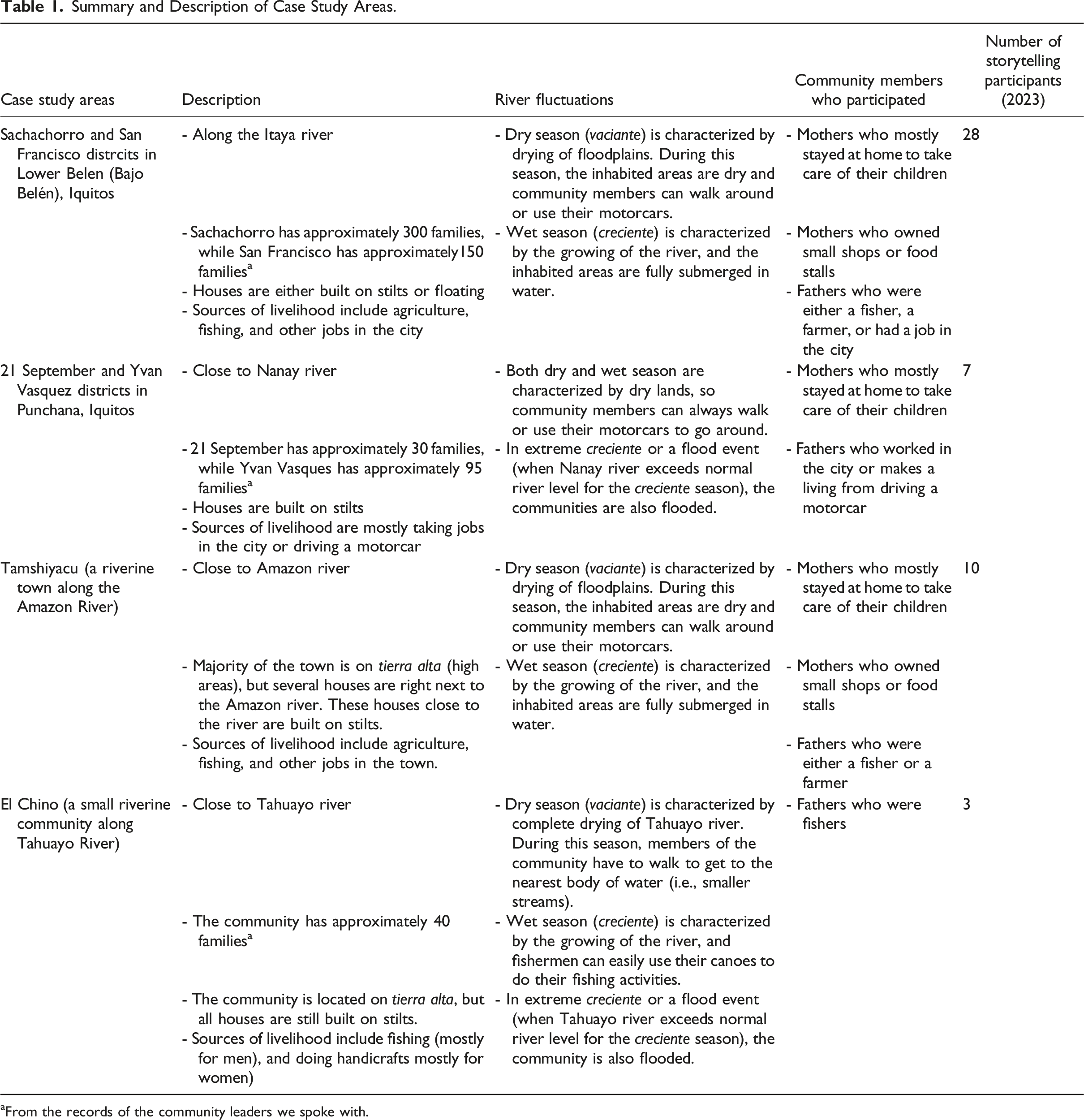
aFrom the records of the community leaders we spoke with.
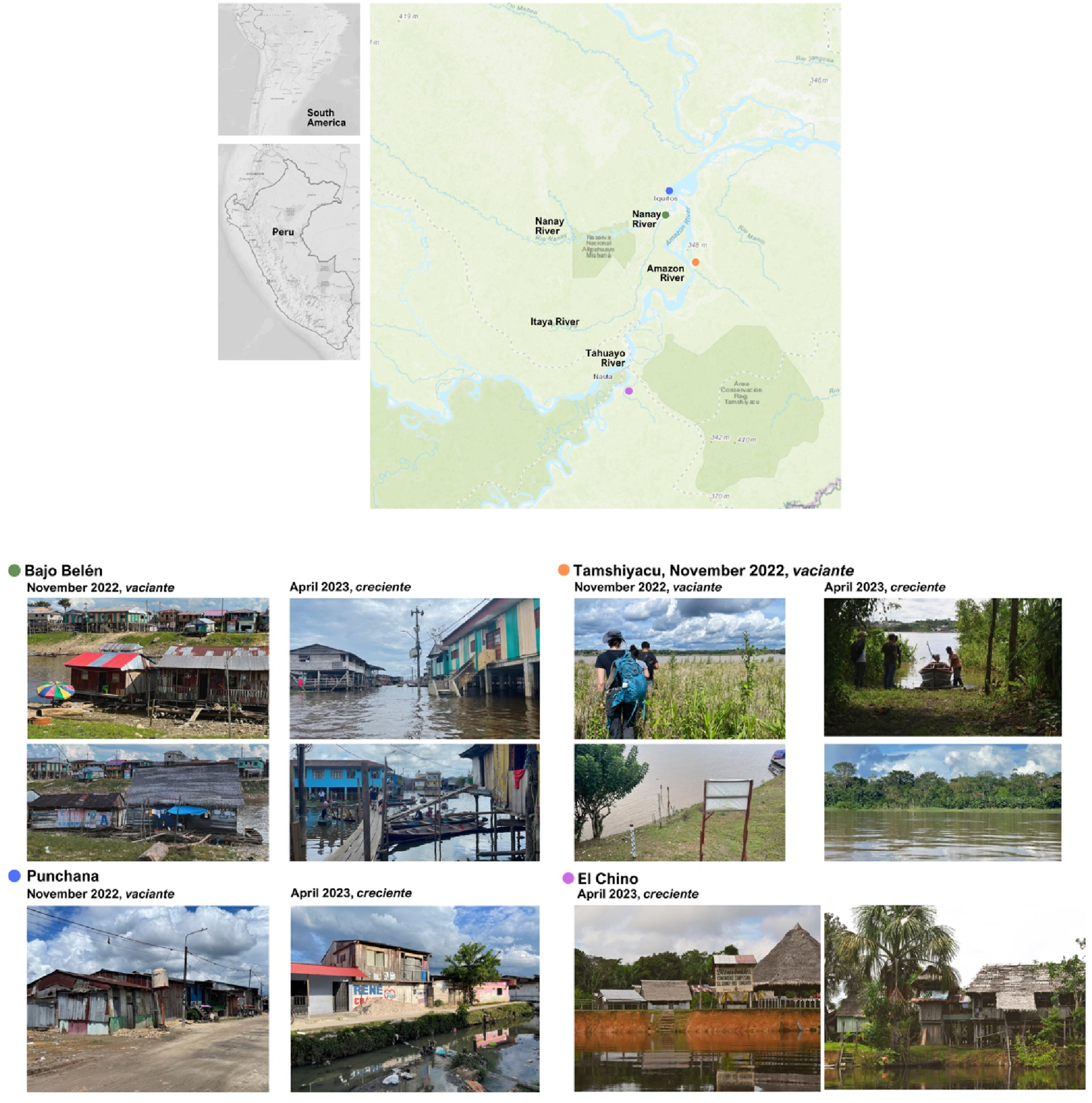
Map and photos of the case study areas depicting dry and wet seasons (vaciante and creciente).
Storytelling as an Entry Point into Everyday Futures
In this study, we used storytelling as a methodological entry point because it allows participants to narrate stories in their own terms, without the scaffolding of facilitated techniques and expectations to arrive at a certain or fixed futures scenarios. Storytelling foregrounds affective and experiential dimensions – fear, hope, uncertainty, resilience – that often remain hidden in facilitated settings, especially when done in a group setting where participants are not well acquainted with one another (McAlpine 2016; Riessman 2008; Sools 2020). It also creates space for individuals to link futures to their everyday anticipations: raising houses before floods, adjusting fishing strategies to shifting water levels, or aligning practices with spiritual leanings. These narratives reveal not only what futures are imagined but how futures are lived as situated, cyclical, and relational (Cusicanqui 2012; De La Cadena 2015).
Crucially, the storytelling sessions began from participants’ affective orientations toward the future rather than from abstract visions of what “should” be imagined. We used open-ended interview methods to elicit stories. The overarching open-ended questions focused on aspirations of living with the river, changes in river dynamics, and thinking about the next generations who will live in the area. Specifically, we asked the questions: “In the future, how do you see yourself and your family still living in this area?” “What do you think will the river be or look like in the future?” and “If your child (or grandchild) asked you what you think the future looks like, what story will you tell them?” This methodological stance aligns with calls for narrative futuring (Sools 2020), in which individuals articulate or even question futures from their own perspectives, embedded in cultural, ecological, and spiritual frames of reference. In the Amazonian riverine context, this meant recognizing that futures are often narrated in ways that are unknowable, inseparable from change, and present in the daily. Thus, storytelling allows an engagement with the situated, affective, and relational aspects of futures. It provides an avenue to trace futures as they are lived, felt, and entangled with the river and forest.
The storytelling sessions were done by the first author together with research assistants from the area. Alongside the storytelling sessions, the fieldwork group also conducted river walks together with community members to walk along the river, and visit their farms. Before conducting the storytelling sessions, we visited the community leaders to introduce our research objectives and activities. During these introductory meetings, the community leaders helped plan the fieldwork activities and logistics. Each storytelling session began with a discussion of the research aims where the team carefully explained the participant’s role within the research. We discussed that if they felt uncomfortable during the session, they can immediately let us know so we would also end the session with a short debriefing. Consent was obtained verbally, following participants’ preferences. All names and identifiable information were anonymized to protect confidentiality. The fieldwork was carried out from 10 April to 19 May 2023. In total, 48 individual storytelling sessions were facilitated with community members; the sessions lasted about 1.5 h. The community members who participated reflect who were available and willing to engage in the storytelling sessions during the fieldwork. Pseudonyms were used in reporting, in accordance with the consent granted to us by the research participants.
Positionality
Our positionality emerges from liminal and intersecting spaces where multiple epistemologies, identities, and worlds meet (Anzaldúa 1987). Considering the research group’s (inter)disciplinary academic backgrounds, cultural upbringings, identities, and multiple epistemic stances, we work together in in-between space – neither fully inside nor outside the worlds we study. This borderlands perspective makes visible the tensions of translation, the negotiations of meaning, and the partiality of any knowledge we produce. The first author also takes inspiration from the notion of halo-halo (mixture) ecologies that highlights the productive potential of hybridity, mixture, and multiplicity (Paredes and Montefrio 2025). Her research practice is shaped by such halo-halo epistemologies: drawing from academic training and experience in the Philippines, Western academic frameworks, decolonial theory, and the lived knowledges of and encounters with Amazonian communities. Rather than seeking purity or coherence, she recognizes her scholarship as a layered and hybrid formation. Following Anzaldúa’s borderlands and Paredes’ halo-halo ecologies, we embrace this liminality as a space of accountability and creativity. It reminds us that our role is to attend to the plurality of temporalities and epistemologies that riverine communities live by, and to engage them as co-constitutive of what futures studies might yet become.
Narrative Analysis
Summary of the Codes Used for Inductive Coding of the Transcribed Interviews.
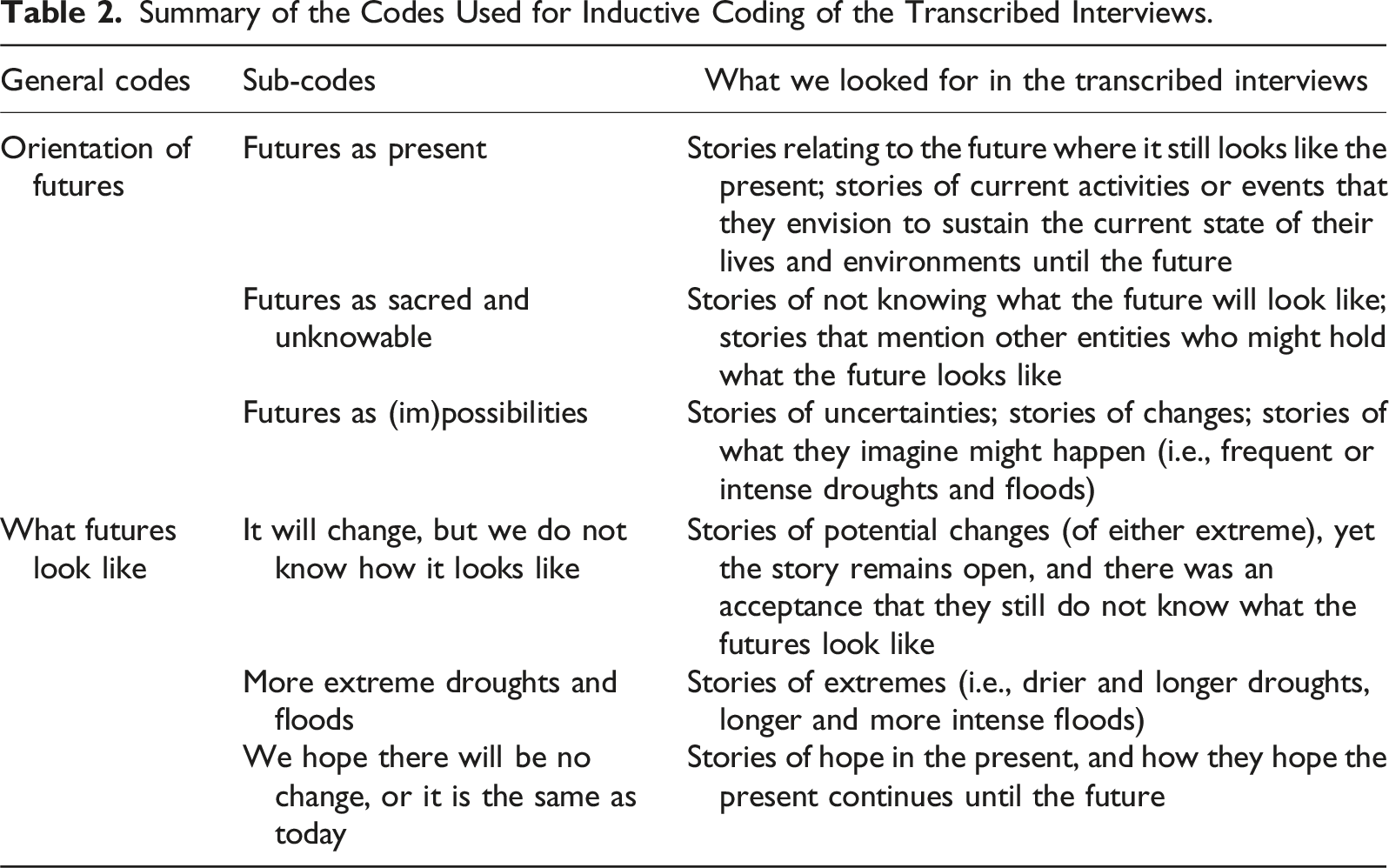
The second step involved inductive coding of the full transcripts to identify recurring themes, resonances, and divergences across participants (Braun and Clarke 2006). Rather than imposing predetermined categories, the analysis traced emergent orientations toward the future as narrated through ecological rhythms and social obligations. This reflexive interplay between fieldwork and theory echoes calls for futures research to engage with lived temporalities (Bryant and Knight 2019; Jackson et al. 2025; Sools 2020). To respect participants’ consent and anonymity, pseudonyms were used in reporting the results.
Results
This section presents the orientations of futures based on the storytelling sessions in Bajo Belén, Punchana, Tamshiyacu, and El Chino. These orientations are embedded within the lived realities of riverine communities where the river shapes what livelihoods they can do (i.e., farming during vaciante, increased fishing activities during creciente); and how the river both provides opportunities and limits their day-to-day (i.e., when a normal creciente turns into a flood, their livelihoods can be negatively impacted or when the season turns out as expected they can prepare with enough lead time).
Futures as Sacred and Unknowable
When asked about what they about the river and how their lives might unfold in the future, some participants expressed that future is an unknowable sphere. They explained that the future is within the hands of God, and while they can speculate, it is still totally up to God to determine how the future will unfold. In this sense, the future is a sacred space where they cannot intend to control nor to take over. This sacredness comes with a sense of unknowability pertaining to how the seasons (vaciante and creciente) might change in the coming years.
“De eso (el futuro) yo no puedo decir, porque no soy Dios.”
(I cannot tell you about the future, because I am not God.) - Flora, San Francisco, Bajo Belén
“No sé qué será, joven, eso no sabemos cómo se dará el cambio pues, joven, no te puedo decir eso. Eso son cosas de Dios después lo que hace todo es por el mundo.”
(I don't know what will be, we don’t know how the change will happen because I can’t tell you how it will be. That’s God’s thing, then what he does is all for the world.) - Maria, San Francisco, Bajo Belén
“De repente con el tiempo más grande no se sabe. Bueno solo Dios lo sabe antes vivía en un pueblo llamado San Roque de ahí vine más abajo y no se sabe si estaré aquí, el destino te hace ir más allá te quedas hasta que Dios te recoja.”
(Well, only God knows. I used to live in a village called San Roque, from there I came further down, and I don’t know if I’ll be here, destiny makes you go further, you stay until God picks you up.) - Raymond, Tamshiyacu
“Como te vuelvo a repetir, eso yo no puedo, solamente Dios él es lo que hace como esta escribo, nosotros los hombres no podemos hacer nada ni tampoco poder atinar por que el hombre no debe practicar, eso nos prohíbe la escritura, nosotros no podemos ser chistosos, no podemos estar engañando o no podemos estar como querer atinar que cosa vamos a hacer, solamente damos cuenta a Dios solamente Dios es el que sabe, porque pensamientos de hombres pues no sirve, todo lo que el hombre hace es vanidad.”
(I repeat, I can’t do that, only God is the one who does as it is written, we men can't do anything nor can we be able to guess because man should not practice guessing, that is forbidden in the scripture, we can’t be jokes, we can't be deceiving or we can’t be trying to guess what we are going to do, only God is the one who knows, because the thoughts of men are useless, everything that man does is vanity.) - Kevin, Tamshiyacu
Their statements do not point to a lack of capacity to imagine, but to an ontological boundary that recognizes the authority of a divine being. This boundary signifies recognition that the unfolding of futures is not solely a human endeavor, and while they can think about the future, they cannot certainly say what might happen.
When asked how they deal with an unknowable future, they mentioned daily acts of improvisation to live with the river. The participants told stories of daily reading the weather and the river (i.e., when the rain starts and how long it lasts, how high or low the river gets, if the vaciante or creciente season is late), and base their daily decisions on these daily cues. For residents of Bajo Belén, their improvisations include trying to repair boats if the river level suddenly increases during a vaciante; selling cooked food when income or harvest is not sufficient; or looking for other income opportunities within or outside the community. Fisherfolks in Tamshiyacu and El Chino improvise through looking for alternative or new places where they could fish when vaciante and creciente rhythms are beyond normal. Farmers improvise through adjusting planting calendars while also planting other crops where possible. Their everyday futures unfolds as they make livelihood decisions based on today’s cues.
Futures as (im)possibilities
For other participants, future surfaces emotions of hopeless, heightened uncertainty, and an open space where the river can either be exteremely dry or be in extreme flooding conditions. They explained that the future is a space of both possibilities and impossibilities. In the future, it is possible that the river might be drier or it can also continue with its normal rhythms. They also mentioned that the future is a space of impossibilities where it might be impossible to secure enough resources such as drinking water and fish. While the vaciante and creciente mark two distinct and regular seasons, participants emphasized how each year unfolds differently: the timing of when the water rises or recedes, the length of each season, or the intensity of dryness and flooding. This variability makes thinking of futures possible, but not with full certainty.
“Yo creo que puede haber, acá puede haber una variación de la naturaleza en la selva. Puede haber, no podemos a decir a ciencia cierta porque esta variado. Si las cosas van cambiando puede secarse. Si se escasea la lluvia puede haber un cambio, nada está dicho.”
(I think there may be, there may be a change in the nature of the jungle. There may be, we can't say for sure because it changes. If things change, it may dry up. If there is a shortage of rain, there may be a change, nothing is certain.) - Luigi, Tamshiyacu
“Este año va a haber
bastante sequias muy bajo y otro año no va a haber sequia porque ya no se puede controlar ese tiempo climático ya, en este tiempo ya debería estar empezando la merma pero no hay creciente grande, todo está descontrolado, ya no puede decir una cosa que va ser y otra cosa que no va ser, ya estamos siguiendo a la suerte, todo es una desgracia nuestro campo ya está mal, eso debemos tener cuidado.”
(This year there will be a very low drought and another year there will be no drought because we can no longer control the weather, at this time the decline should already be starting but there is no big increase, everything is out of control, we can no longer say one thing that will be and another thing that will not be, we are already following luck, everything is a disgrace, our area is already bad, we must be careful.) - Gino, San Francisco, Bajo Belén
“Va a ser más fuerte porque va a
ser horrible ya como dice mi padre. Porque ya no va a haber agua, eso lo que vez allá va a ir desbarrancándose, ya no va a haber agua en esta zona, no va a haber futuro. Creo que será más temeroso porque va a ser más fuerte la creciente, que tipos de animales vendrán por esa creciente, horrible digo yo.”
(It’s going to be stronger because it’s going to be horrible, as my father says. Because there won’t be any more water, what you see over there is going to go down the drain, there won’t be any more water in this area, there won't be any future. I think it will be more frightening because the floods will be stronger, what kind of animals will come because of the floods, horrible, I say.) - Paula, Sachachorro, Bajo Belén
“Va a cambiar, porque en cada año,
la creciente se le ve diferente. Va a cambiar bastante. Porque antes de acá nomas se cruzaba, todo ese de ahí ha quedado como tierra, o sea no hay inundación grande y de acá nomas se camina porque no ha crecido mucho. Yo no creía antes que cada 10 años la creciente viene así de grande, pero ahora sí.”
(It’s going to change, because every year, the wet season looks different. It's going to change a lot. Because before, you could just cross from here, all that has remained as land, that is, there is no big flooding, and you can just walk from here because it hasn’t grown much. I didn't believe before every 10 years the flood comes this big, but now it does.) - Aquina, San Francisco, Bajo Belén
“.. yo, pienso quizás que
va a cambiar. Quizás radical, yo pienso así ah. Porque ahorita se está notando un cambio muy importante, un cambio rotundo en nuestra forma de vivir, ha cambiado mucho. Por ejemplo antes cuando era niño, había bastante mitayo, de todo había animales, en abundancia había, pero quien iba a pensar que iba a ver una escasez muy grande. Yo a veces me pongo a pensar solito, tú te vas a cavar y no sacas nada, como antes no. Ponemos una trampa para cazar pescar puedes sacar, pero antes las trampas le hallabas sumido llenecito.”
(I think things are going to change. Maybe radically, that’s what I think. Because right now, we’re seeing a very important change, a complete change in our way of life, it’s changed a lot. For example, when I was a child, there was a plenty of food, there were animals of all kinds, there was an abundance, but who would have thought that there would be such a great scarcity? Sometimes I think to myself, you go out there and you don’t get anything, not like before. We set up a trap to fish, and you’d fine the traps completely full.) - Gino, Tamshiyacu
Alongside this recognition of change, participants also voiced a sense of hopelessness and fear. Thinking about the future brought about disappointment, a sense of loss, or unmanageable shifts. In this framing, change was not always a source of possibility, but also a reminder of the limits of human control and the fragility of livelihoods tied to the river. Stories of preparing for floods that did not come or of anticipating planting cycles disrupted by unexpected drought revealed tensions between perceived changes and lived realities. Participants also acknowledged that no matter how much they prepare, the river might still undo their efforts. “Yo he me preparado para cada creciente, total nada creció (I prepared for every creciente, in the end the river didn’t rise),” Frederico from Tamshiyacu responded when asked about how they prepare as they anticipate different possibilities for the upcoming seasons. Future as impossibility then is also about acknowledging hopelessness as part of inhabiting an unpredictable environment. However, this hopelessness does not stop them from daily engaging with the river: they continue to prepare, plant, and adapt even as they acknowledge that change may undo these efforts.
Within the (im)possibilities orientation of futures also resides stories of preparation and anticipating what might happen that is beyond their usual anticipation of the river dynamics and outcomes of livelihood activities such as fishing. “(En el futuro) para mí, menos, porque recuerdo cuando tenía 8 años había muchos peces, se pescaba mucho y ahora ya no se ve, así como antes ((In the future) for me, even less so, when I was 8 years old there were many fish, a lot (of people) were fishing, and now you don’t see it like before)),” Pablo from Tamshiyacu mentioned when asked about how his fishing activities might change in the future. On the other hand, acknowledging that the river can have completely different dynamics challenges them to think beyond their established everyday practices. They mentioned that they prepare for possible extreme cases through storing more food and water, and through increasing the level of their houses when finances allow. For both fisherfolks and farmers, recognizing the (im)possibilities within their daily activities mean looking for alternative activities that can sustain their families if it is not possible to fish or to use their farms for agricultural purposes.
Futures as Present
Several participants expressed the future through a continuation of the present. When asked about how the future might unfold, they highlighted that would like some aspects of their present to continue until the future. They mentioned activities they currently value such as reforestation, caring for animals, and participating in capacity-building initiatives with local organizations. They expressed contentment and hope that if such activities continue and are maintained, they can expect the future to be like the present that they value. Futures as present was also expressed as a hope to continue to live the present peaceful lives that they value.
“Yo creo que el rio con la conservación que hacemos, protegiendo los bosques y toda la fauna, se va a mantener. Pero si cortamos los árboles se va a secar. Pero como te digo ya casi el 90 percent ya está incentivado en la comunidad a cuidar los animales y los árboles. Y por eso pensamos que el rio debe seguir manteniéndose.”
(I believe that the river, with the conservation we do, protecting the forests and all the fauna, will be maintained. But if we cut down the trees it will dry up. But as I said, almost 90 percent of the community is already encouraged to take care of the animals and the trees. And that's why we think that the river should continue to be maintained.) - Rodolfo, El Chino
“Esperemos que no haya muchos cambios... porque ya han venido muchas ONG a enseñarnos o capacitarnos y no estamos talando árboles. Hemos talado muchos aguajes y eso estamos esperando que no haya cambios.”
(Hopefully there won't be much change... because many NGOs have already come to teach or train us and we are not cutting down trees. We have cut down many aguajes and we are hoping that there won't be any change.) - Rodolfo, El Chino “Mis hijos me quieren llevar a Iquitos, pero yo me siento tranquilo aquí. Aquí no hay delincuencia, tal vez cuando ya no pueda trabajar. Pero por el momento si, mientras pueda trabajar. Nosotros solo estamos, mi señora vende su comida y yo voy a la chacra, si quiera algo por la vida hacemos.” (My children want to take me to Iquitos, but I feel at peace here. There is no crime here, maybe (that happens) when I can no longer work. But for now, yes, while I can still work. It’s just us, my wife sells her food and I go to the farm, at least we make something of our lives.” - Dino, Tamshiyacu
Several participants also highlighted that they value the present sense of peace that they enjoy from living with the river, and from having a community that is open to help them during difficult times. “Cuando ha sucedido eso (una sequía) de las familias afectadas, el teniente hace una reunión con las familias para si quiera ayudar con algo a las familias afectadas (When (a drought) happens to the affected families, the community leader holds a meeting with them to see if he can offer any assistance),” Cristina from San Franciso, Bajo Belén mentioned the importance of having a sense of support within community when asked about if she sees herself living in the area in the future.
In these accounts, hope is grounded in the present. Rather than projecting futures as distant or abstract, participants emphasized the importance of nurturing what already exists: protecting the forest, strengthening community capacities, and maintaining harmonious relations with the environment. Their stories conveyed a sense of joy and fulfillment in being able to contribute to these ongoing practices, and live peaceful lives with their environment. By framing futures as present, they expressed a temporal orientation where continuity becomes aspirational for the future. Within the present orientation of futures also resides stories of active learning towards conserving their environment. Their everyday futures unfold through appreciating current activities and partnerships that help them continue living the lives they value with the river. For fisherfolks in El Chino, they mentioned that they contribute to conserving aquatic ecosystem by releasing small fish back to the river.
Drawing from these results, we present an adapted Futures Triangle that reflects how different orientations of futures shape the riverine communities’ everyday futures (Figure 2). The Triangle illustrates how futures are continually enacted through attentiveness to daily cues – such as when fishers and farmers observe river levels, rainfall, and seasonal timing – through improvisational responses to uncertainties, and through values and relations that anchor life in the present. Across the three orientations, futures take form through practical judgments about when to act, wait, repair, move, or care for family and neighbors. By foregrounding these everyday engagements, the adapted Futures Triangle makes visible how futures are lived and negotiated under conditions of hydrosocial variability, where anticipation is provisional, and future remains closely entangled with the rhythms and demands of daily life. Temporal tensions of everyday futures.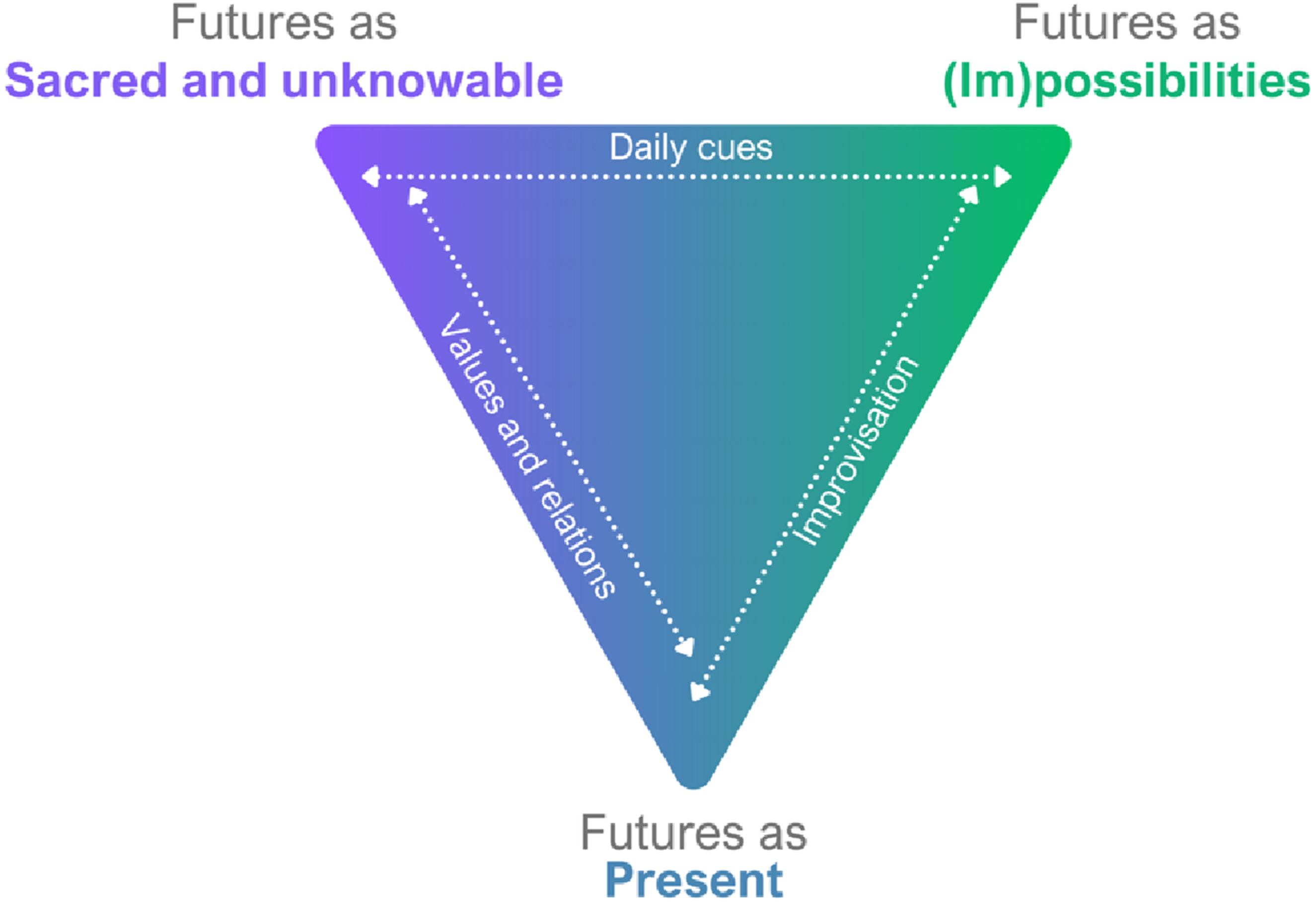
Discussion
This section discusses how the emerging orientation of futures identified in this study – sacred and unknowable, (im)possibilities, and present – relate to the established push-pull dynamics of the Futures Triangle (Inayatullah 2008, 2023). Building on these insights, we then elaborate how the stories of riverine communities reveal hydrosocial futures shaped by everyday negotiations with unknowability, uncertainty, and river rhythmicity. The findings foreground four key dimensions of everyday futures: (1) place-based temporal epistemologies; (2) the distribution of futures; (3) futures as ongoing process; and (4) the relational nature of hydrosocial futures. Together, these insights point that futures are daily practices shaped by overlapping temporalities, ecological rhythms, and dynamic human-river relations (Bear 2014; De La Cadena 2015; Terry et al. 2024).
Hydrosocial Futures Triangle: Everyday Tensions and Negotiations
The orientations of futures identified – sacred and unknowable, (im)possibilities, and present – can be understood as lived configurations of the push-pull dynamics articulated in the Futures Triangle (Inayatullah 2008, 2023). Rather than using the Futures Triangle as a tool for generating scenarios, we mobilize and rework it as an analytical device to examine how temporal forces are unevenly activated, constrained, or ethically bounded through hydrosocial relations. The stories shared by riverine communities show that futures emerge through everyday negotiations with a divine being, river dynamics, and seasonal uncertainty. This reveals how the push of the present, the pull of the future, and the weight of history are continually reworked in and engaged with in practice (Jackson et al. 2022, 2025; Mendoza et al. 2025; Silva 2015; Viveiros de Castro 2014). Across the stories, futures-making foregrounds a daily practice of interpreting environmental cues and responding to variability while also acknowledging limits. In this sense, the Futures Triangle is not only descriptive of macro-level temporal forces, but also useful for understanding how futures are inhabited and negotiated in everyday life.
Sacred and Unknowable Within the Futures Triangle
The orientation of futures as sacred and unknowable foregrounds a constrained or withdrawn pull of the future. Participants attributed the unfolding of the future to divine agency, positioning it as beyond human knowledge and control. Within the adapted Futures Triangle, this orientation is shaped primarily by the weight of history, understood as inherited religious beliefs, moral frameworks, and cosmologies that delimit what kinds of anticipation are permissible. Importatnlt, this does not result in passivity or fatalism. As anthropological scholarship on uncertainty and religious temporalities demonstates, recognizing the limits of foresight often coexists with active engagement in the present (Opas 2014).
Everyday practices such as monitoring river levels, repairing houses, or preparing for floods illustrate how the push of the present remains salient, even when the future is not envisioned or articulated. Similar dynamics have been documentd in Amazonian and Indigenous contexts, where futures are treated as relational and ethically bounded rather than as domains for projection od optimization (De La Cadena 2015; Viveiros de Castro 2014). Here, sacred unknowability shapes futures-making by regulating how people relate to what lies ahead, rather than foreclosing engagement altogether.
Futures as (im)possibilities: Volatility and Fragile Anticipation
The orientation of futures as (im)possibilities reflectes a more explicit tension between the push of the present and the pull of the future. Participants articulated pressures arising from environmental variability, economic precarity, and political neglect, while simultaneously expressing tentative hopes for change (Coomes et al. 2016; Gorenstein 2021; Mendoza et al. 2025). In this configuration, futures are imaginable but fragile: anticipation is repeatedly undermined by hydrosocial volatility and the recognition that the river may undo preparation efforts.
This finding resonates with scholarship on lived precarity and anticipatory adaptation which emphasizes that uncertainty can function both as a constraint and as a condition for possibility (Adam 2008; Adam and Groves 2007; Sardar 2010). Within the Futures Triangle, futures as (im)possibilities retain a pull toward change, but one that is continually destabilized by the push of the present. Unlike sacred and unknowable futures, anticipation here is not restricted; rather, it is persistently attempted and frequently frustrated.
Futures as Present: Anchoring Futures in Continuity
The orientation of futures as present anchors the Futures Triangle through everyday practices, relationships, and values that sustain life in the here and now. Participants emphasized commitments to family and community, fishing, and land – often described what they value and what they need to protect. In this configuration, the pull of the future is weak or indirect, while the push of the present is reframed as a site care and continuity.
This orientation aligns with research showing that under conditions of environmental uncertainty, practices of maintenance and care can become forms of grounded or slow futurity (Barbosa et al. 2016; Barendregt et al. 2024; Maru et al. 2014). Futures then become oriented towards sustaining valued ways of life. Within the Futures Triangle, futures as present highlight how futurity can be enacted without projection, by extending relational commitments forward through practice.
Implications for Futures Studies: Everyday Futures
Together, these orientations underscore the importance of everyday futures – futures that are sensed and negotiated through daily life. Everyday futures demonstrate that futures-making can take the form of attentiveness, restraint, and improvisation under conditions of uncertainty. From this, we put forward three implications on futures studies: place-based engagement with futures, distributing futures, and engaging in futures as a process.
Place-Based Engagement With Futures
Across the four communities, ways of knowing and relating to the future are inseparable from river rhythmicity. Vaciante and creciente function as temporal anchors through which households organize repair, planting, fishing, and storage practices (Coomes et al., 2016; Gorenstein, 2021; Langill and Abizaid, 2020, 2025; Mendoza et al., 2025). These practices reflect knowledge-practice-belief complexes in which ecological understanding emerges through lived engagement rather than through external control (Berkes 1999). Riverine communities must continually adapt to flux and unpredictability. For futures research, this highlights an opportunity for closer engagement with daily and lived epistemologies that often are grounded on uncertainty and relational adaptability (Miller 2018; Sardar 2010).
Distributing Futures
The capacity and spaces to engage with futures are unevenly distributed. Economic precarity, limited institutional support, and seasonal instability constrain who can imagine and articulate futures beyond immediate needs (Brondizio 2025; Pomeroy et al. 2020). Futures are shaped by power relations and structural inequalities that determine whose aspirations count (Leach et al. 2010; Mendoza and Cruz 2023). The storytelling sessions functioned as entry point to alternative futures-making: they created a space for participants to share uncertainty, concern, and hope without requiring them to produce concrete visions or scenarios. In this way, narrating their stories and uncertainties towards the future can become a way of engaging with their own future, even when control is impossible (Sools 2020).
Engaging in Futures as Process
Finally, the findings reinforce the importance of engaging with futures as ongoing processes rather than as discrete outputs. Participants’ stories emphasized learning, adjustment, and responsiveness in farming, fishing, and day-to-day living with the river – highlighting futures as iterative acts of making and remaking under uncertainty (Granjou et al. 2017). This challenges futures imaginaries that equate foresight with static products; instead futures emerge as relational processes in which recognition of limits and everyday negotiations are central resources (Appadurai 2013; Leach et al. 2010).
Conclusion
This research is situated as a pause from dominant, predictive approaches that treat futures as quantifiable products for planning for decision-making, yet often exclude the very communities most affected by environmental change. Through storytelling with riverine communities in the Peruvian Amazon – whose lives are shaped by the vaciante-creciente cycles, and extreme droughts and floods – we explored how riverine communities relate to and anticipate futures in hydrosocial settings marked by uncertainty. Adapting the Futures Triangle to this context allowed us to identify three orientations of futures that emerged from their stories: futures as sacred and unknowable, futures as (im)possibilities, futures as present. Futures as sacred and unknowable assign autonomy to divine force, foregrounding daily attentiveness to river cues. Futures as (im)possibilities emphasize change, hopelessness, and the recognition that the river may undo their preparation efforts. Futures as present highlight commitments to maintaining peaceful and meaningful lives through ongoing practices. Drawing on these orientations, we highlight four key aspects of everyday futures: (1) place-based engagement with futures; (2) the need to distribute futures; (3) futures as an ongoing process; and (4) relational nature of hydrosocial futures.
Our study is limited in its ability to explore how these orientations might evolve into more detailed or collective imaginaries of hydrosocial futures. Longitudinal and iterative futures processes would enable deeper engagement with personal and communal temporalities. Nonetheless, we hope this work encourages researchers to expand narrative approaches that make space for communities to articulate their own futures and the emotions that come along with it. Ultimately, listening to narrations of everyday living with the river and the uncertainties that come with it underscores that future-making is not a product, but a relational and iterative process. For riverine communities in the Amazon, futures-making is an everyday practice that entails anticipating based on daily cues, acknowledging what is possible, and what can be carried throughout time. Recognizing and working with diverse orientations of futures – rather than seeking coherence, neatness, or static visions – opens possibilities for humbler and hydosocially-attuned ways of reimagining and shaping the everyday and the not-yet.
“Navegamos para recordarle al mundo que la verdadera acción climática no se firma en acuerdos, se vive y se defiende en nuestros territorios cada día.”
(We sailed to remind the world that true climate action is not signed in agreements, it is lived and defended in our territories every day.)
Footnotes
Declaration of Conflicting Interests
The authors declared no potential conflicts of interest with respect to the research, authorship, and/or publication of this article.
Funding
The authors disclosed receipt of the following financial support for the research, authorship, and/or publication of this article: This work was supported by the H2020 European Research Council (ERC-2020-StG 948601).
Author Biographies
