




Abstract
Teaching sustainable design praxis to next generation designers during their higher education is considered crucial to aiding societal transitions to more environmentally responsible futures. However, much scholarship detailing sustainable design methodology focusses upon its application in external settings e.g., commercial and organisational contexts, and speaks less to facilitating design tutors to embed sustainable design concerns, strategies and tools into their teaching and learning delivery. Responding to this lacuna, this paper utilizes a UK university design studio module as a substrate to explore how novel systemic and technological futures methods More-than-Human-Centred Design and Speculative Design can be leveraged, alongside Constructive Alignment techniques and ‘glocal’ education policies, to reimagine sustainable pedagogic practice. The paper argues that through this novel approach, educators can develop curricula and learning outcomes which better equip students with the critical and creative mindset and skills they will need to tackle growing sustainability challenges once post-study and designing for the real world.
Keywords
Introduction
Anthropogenic driven climate change is the most pressing crisis of our time. The teaching of effective Sustainable Design theory and practice during higher education has long been considered to play a significant role in galvanizing next generation designers to tackle socio-environmental problems through design (Boehnert et al. 2022). This endeavour is, in turn, seen as a facilitator for wider societal transitions to future, more environmentally responsible ways of life (Bhamra and Dewberry 2007). Aiming to ameliorate the exponential impacts of mass-production, consumption and waste whilst fostering design cultures which are equitable, inclusive, and just, a substantial body of post-war scholarship has been generated which expounds methodology for implementing Sustainable Design. Yet, much existing literature focusses on the application of such theory and practice by designers working in external settings, such as commercial and organisational contexts, and speaks less to embedding sustainability concerns and strategies into the teaching and learning of design. Seminal contributions by luminaries such as Papanek (1971) and Fry (1999) are exceptions rather than the rule. They eruditely outline society’s unsustainable and inequitable wicked problems, whilst persuasively calling upon the design discipline and its practitioners to counter them. Each redefined design pedagogy at different junctures and continue to inspire and empower a wide range of voices in promoting design education.
However, with planetary boundaries near tipping point (Intergovernmental Panel on Climate Change 2023), it is evident much pedagogic work still needs to be done. The World Commission on Environment and Development report’s (1987) conclusions remain portent – our younger and future generations will, in the coming decades, bear the biggest brunt of humanity’s past and present environmental transgressions. From Sustainable Design and pedagogic literature, through systemic and technological futures design methods, to surveying teaching policies and applying pragmatic tools like Constructive Alignment, this paper responds by reimagining pedagogic practice which integrates sustainable strategies into university level design teaching and learning. By developing curricula and learning outcomes which engender More-than-Human Design Pedagogy, the paper begins to demonstrate to readers how students can be equipped with the critical and creative mindset, skills, and resilience they need to tackle growing socio-technical sustainability challenges once post-study. The paper argues that by embracing this pedagogic shift, tutors can better understand how to support students in developing new ways of designing that contribute to the evolution of the discipline beyond its modernity-rooted values such as profit, efficiency and progress and reorient it as a practice predicated on planetary regeneration and care (Sachs Olsen 2022; Stead 2024).
A More-Than-Human Sustainable Design Education
Sustainable Design is vast and multifaceted field which is underpinned by a plethora of practical and pedagogic approaches that aim to redress unsustainability through various techniques and scales (Ceschin and Gaziulusoy 2020). This heterogeneity is unsurprisingly a reflection of the ‘wicked’ nature (Buchanan 1992) of global unsustainability. Increasingly difficult to solve outright, unsustainability is a complex, evolving confluence of issues including carbon driven climate change, pollution and biodiversity loss, poverty and social inequity, and mass-production and overconsumption. Unsustainability can thus be considered what Morton (2013) describes as a hyperobject, where “the more data we have about hyperobjects the less we know about them – the more we realise we can never truly know them.” As Buchanan (1992) stresses, such wicked problems can only be approached through long-term action, where multiple interventions and actors are involved over the course of many years. Escobar’s (2018) concept of pluriversality reinforces the intricacy and uncertainty of designing for sustainability. One community’s vision of a sustainable future might present unsustainable challenges for others – “the earth may be one, but the world is not” (World Commission on Environment and Development 1987).
Redressing the inherent complexity of unsustainability using design is a challenge students regularly find difficult to attend to through their creative praxis. This paper takes the position that educators must support students in shifting their focal point for Sustainable Design from solely responding to present-day problems. Students must instead be encouraged to utilise design to consider how their designed intervention(s) might continue to impact the planet in the longer-term. Furthermore, tutors also need to teach emerging designers how to robustly consider the perspectives of the non-human actants (material artefacts, including technologies, and the natural world) that exist alongside human needs as part of today’s deeply entangled design assemblages. This refocus responds to calls in design to consider multiple worldviews whilst avoiding occluding others (e.g., Akama et al 2020; Redström 2017). In doing so, next generation designers can begin to acknowledge diverse perceptions, interrogate alternate conceptions of time and navigate the different yet interdependent problems that constitute unsustainability like climate change, biodiversity loss, social inequity, and overconsumption.
Reviewing Existing Sustainable Pedagogic Practice
In this section, a selection of prior key literature is explored to provide context and rationale for developing a More-than-human-based approach to sustainable pedagogy for 21st century design and technology education. Giard and Schneiderman (2013) emphasise how sustainability concerns and strategies need to be robustly incorporated into designers’ education as tool in their creative toolbox. Bhamra and Dewberry (2007) agree but note how traditional teaching practices often focus on improving students’ ability to accumulate facts and techniques within specific disciplinary boundaries. This ‘top-down’ transmission of knowledge means that the delivery of theoretical and practical content can often be ‘rigid’ and siloed. This presents a core problem for Sustainable Design-focused education as it often restricts students from pedagogic development which is exploratory and creative. Further, because achieving sustainability is a complex, interdisciplinary issue, it requires teaching and learning which expediates reflective and iterative practice by students, enabling them to identify and work across disciplinary perspectives and processes (Ceschin and Gaziulusoy 2020).
Burns’ (2009) Model of Sustainability Pedagogy (Figure 1) is a recognised framework for embedding sustainability into teaching and learning practice, giving it the potential to be: Transformative and meaningful when learning … focuses on interconnected systems, and co-creates content; critically questions dominant norms and incorporates diverse perspectives; utilizes active, participatory, experiential, and relational processes. (Burns et al. 2019, 3) Burns’ Model of Sustainability Pedagogy (Stead 2026 after Burns 2009).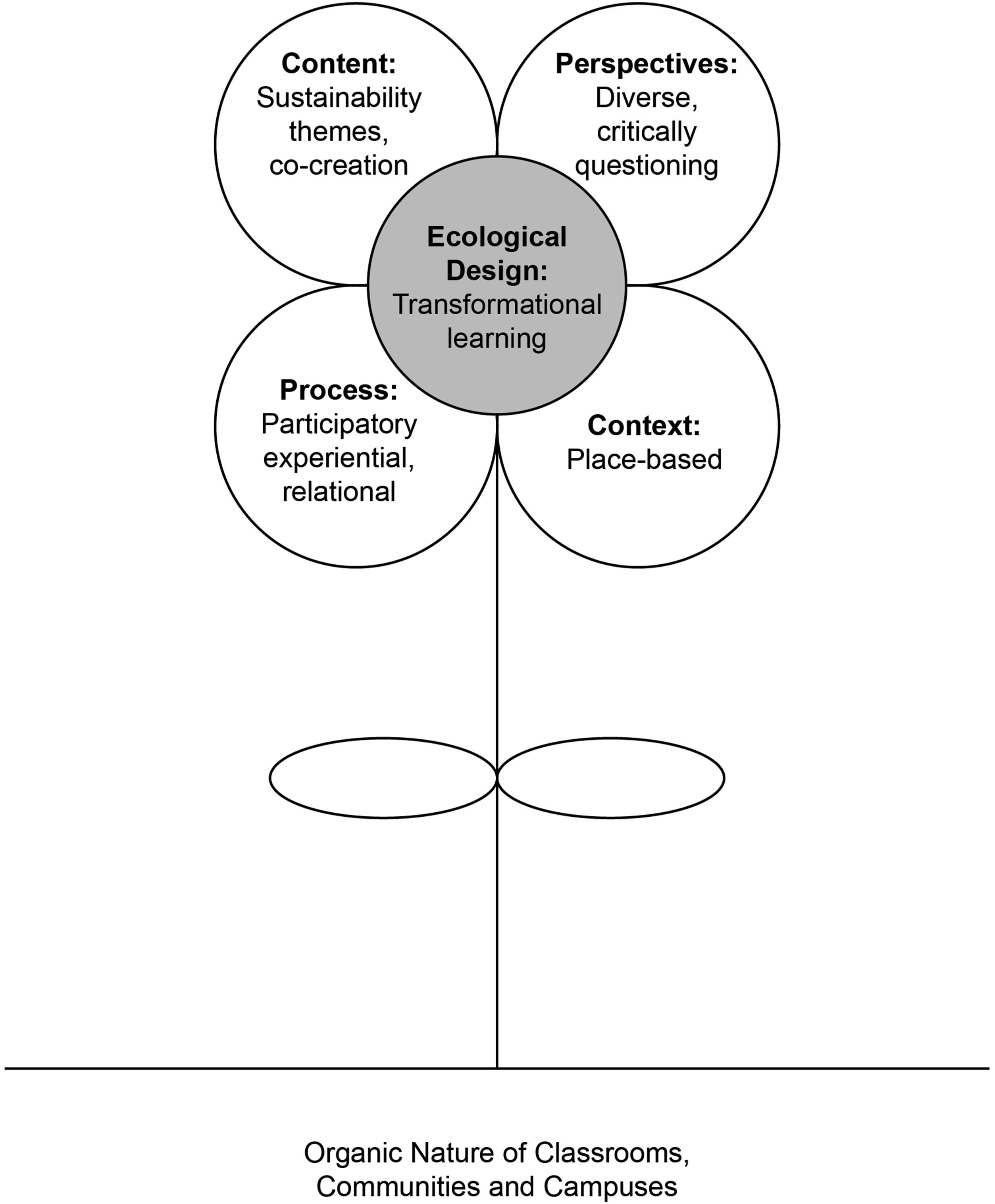
Burns’ (2009) model aligns with Kolb’s (1984) holistic view of learning which should be regularly grounded in concrete, situated, experiential activities which are participatory in nature. This allows students to reflect on their experiences, and form knowledge and understanding based on that experiential learning. In addition, Boehnert et al. (2022) argue that sustainability-focussed design pedagogy can challenge the ‘dominant norms’ that have long held in undergraduate design education by questioning what exactly what constitutes ‘good design’. They also warn against the common but ineffective practice of simply ‘bolting on’ sustainability ideas to existing teaching and learning plans. They assert that without deeper engagement with core Sustainable Design concepts and processes, students will not have the necessary foundation to tackle the complex socio-technical sustainability challenges of tomorrow.
Quam (2016) asserts that it is conducive to establish sustainable literacy amongst design students at the earliest opportunity. This will allow them to start to engage with complex sustainability challenges and integrate this understanding as a part of their ongoing problem-solving activities. These discussions lead to the importance of threshold concepts (Meyer and Land 2003). Students must first digest core Sustainable Design concepts because doing so will act as a ‘gateway’ or ‘portal’ for later, richer, epistemic understanding and application. Boehnert et al. (2022, 22) suggest that this approach can help align design education with cutting-edge knowledge and “our discipline will be better prepared to help in the ways [Victor] Papanek and other design visionaries have theorised and demonstrated for decades.”
Décamps et al. (2017) believe that to engender sustainable futures, educators should not only offer ‘tools’ and develop ‘skills’ with students but fundamentally change their mindsets – compelling them to become committed to designing a sustainable future and allows them to make informed and effective decisions towards enacting this goal. Micklethwaite (2022) contends that design education become innately reflexive and proactively translate sustainable values into principles that students can in turn embed into their design practice. This, they contend, will enrich such practice, and go on to manifest said sustainable values in designed outputs across society.
These viewpoints reflect the influential work of Tony Fry who denounces designers themselves for creating unsustainable futures. Outlining pedagogic tenets for what he terms redirective practice, Fry (1999) appropriates the philosopher Aristotle’s concept of phronesis. Fry uses the term to represent a type of ‘practical wisdom’, wherein design theory and praxis function together with foresight, to bring about positive future design. Designers, Fry contends, have a moral duty to think about the environmental implications of their designed outputs before they put them into production and use, rather than perpetuating the Global North’s capitalist status quo which negates potential futures for humanity and non-human actants, e.g., flora, fauna, and climate. Fry (2020, 10) argues designers regularly carry out defuturing practice because “we do not understand how the values, knowledge, worlds and things we create go on design-ing after we have designed and made them.” To temper defuturing, Fry argues for redirective practice to sit at the very core of design education to imbue students with a profound sense of social, cultural, economic, political, and environmental responsibility.
Noel et al. (2023) share Fry’s stance, arguing that design educators must broaden both their own and their students’ frame of reference to redress the unsustainable, unethical, and inequitable hegemony of modernist Global North design culture. To aid others in redirecting their practice, they present four critical and exploratory lenses through which they believe future, more responsible design/design education should be conducted: • Pluriversality – where omnipotent Western design narratives are rejected for a corpus of decentralised locally rooted perspectives. • Positionality – where we seek to understand our individual and collective pasts, presents and positive futures. • Ontological Design – where circular feedback loops are developed between human design activities and the designed world. • Relationality – where indigenous knowledge is respected by imbuing these values into the design of socio-technical infrastructures and policy.
Crucially, there is a growing disparity between the knowledge being generated through this progressive design research and that which is being communicated through day-to-day design education. Boehnert et al. (2022) note how teaching and learning regularly falls behind research with university students left unexposed to the cutting edge inter-disciplinary Sustainable Design concepts, methods and skills which are being originated through academia.
Engendering Sustainable Futures Through Design Teaching and Learning
This section builds upon the existing literature by introducing key technological futures and systemic design research methods which will provide a theoretical scaffold for developing More-than-Human Design Pedagogy.
Speculative Design
To facilitate the design of sustainable futures, Micklethwaite (2022, 4) argues tutors must help students to envision “alternatives to what we take for granted, and these visions must be successfully communicated via storytelling.” Over the past decade or so, a ‘speculative turn’ has taken place across design research, whereby methods such as Speculative Design (Auger 2013), Critical Design (Dunne and Raby 2013), and Design Fiction (Bleecker et al. 2022) are increasingly used to create provocative visions and prototypes of potential futures. Stead and Coulton (2022a) assert that the latter form of speculative practice – Design Fiction – is a highly effective method through which storytelling and worldbuilding (Zaidi 2019) can be used to envision sustainable futures that seek to counter the unsustainable status quo of normative design. Through the development of “diegetic prototypes [which] suspend [audiences’] disbelief about change” (Bruce Sterling, quoted in Bosch 2012), Design Fiction practitioners can create imaginary products, services and/or systems which appear ‘material’ and/or fully functional in ‘diegesis’, in other words, ‘embedded’ within a fictional narrative (Kirby 2010). Application of Design Fiction then should not be seen as a method for generating specific sustainable solutions or innovations, but as a strategy for enabling more inclusive debate about how and why futures are being designed and what they might mean – for the natural environment and society. Bleecker (2009) asserts that diegesis creates a discursive space in which prototypes are free of capitalist constraints such as economics, usability, and aesthetics, and can consequently challenge peoples’ often insular and habituated expectations of the role both designed outputs and design practice itself play in everyday life.
Having adopted similar speculative approaches directly within their teaching, Micklethwaite outlines its pedagogic advantages for engendering sustainable futures practice amongst students: Disciplinary conventions and norms provide security, and so their removal can be challenging. Permission and encouragement to speculate and go beyond existing practice is therefore given from the beginning of the student journey. (Micklethwaite 2022, 15)
Design Fiction prototypes can be created using a wide variety of ‘new media’ including three-dimensional artefacts, graphics, web-based content, computer games, illustration, and video/film (Hales 2013). This broad canvas enables practitioners to pose arguments about potential futures by demonstrating that future in a medium and/or context which wider audiences can more easily understand (Tanenbaum et al. 2017). This accessibility and inclusivity correspond with Quam’s (2016) belief that design’s creative and ‘visual nature’ has the unique ability to communicate environmental threats and promises across cultural, language and sectoral boundaries, whilst also concretising sustainable thinking amongst design works’ audiences. The range of creative, exploratory, strategic, and reflective qualities and techniques that Design Fiction can bring to design teaching and learning (Figure 2) make it an important tool for students’ socio-technical sustainable pedagogic development. The practical and critical skillset developed through conducting speculative Design Fiction practice (Stead 2026).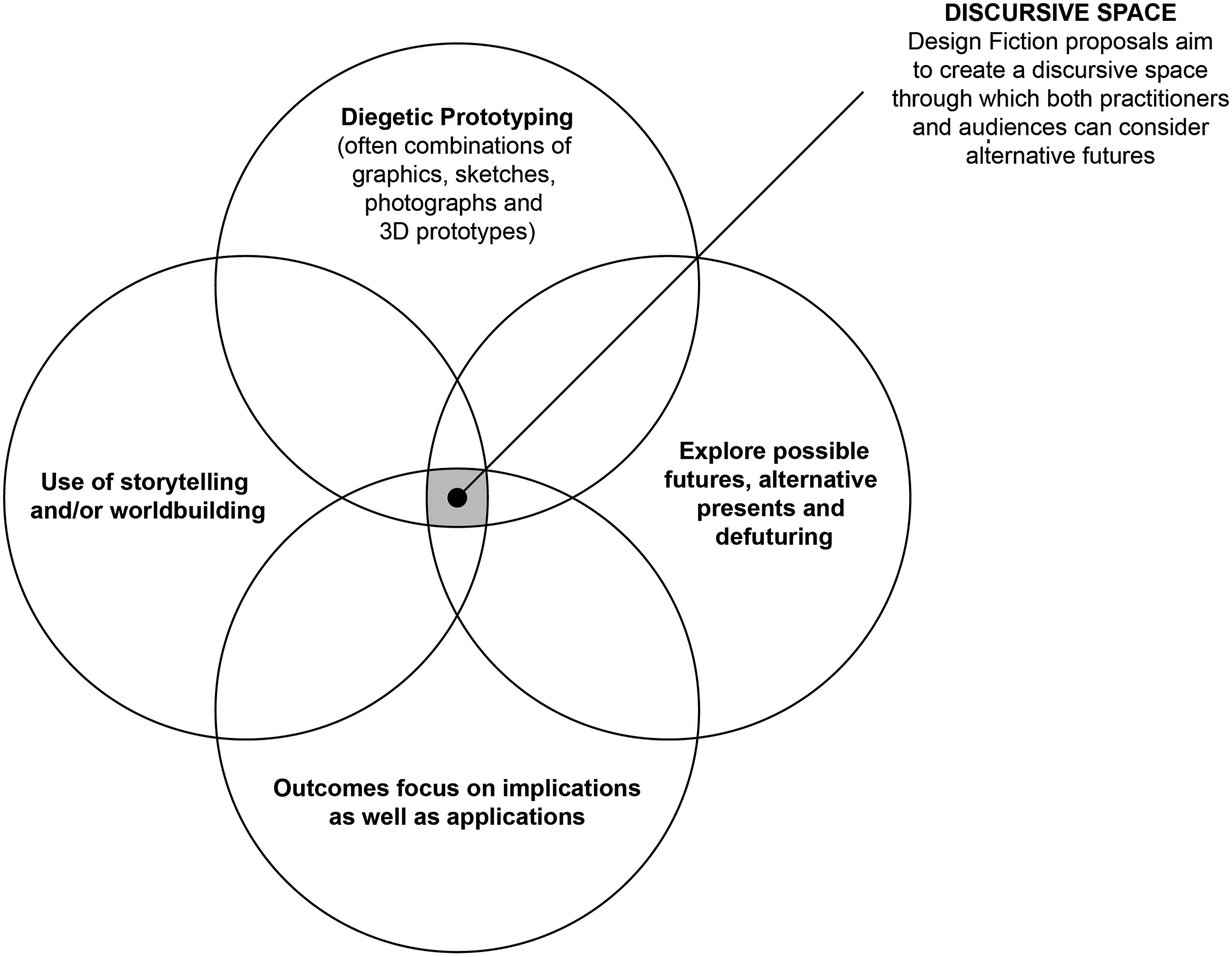
More-Than-Human-Centred Design
When calling for pluriversality, positionality, ontological design, and relationality to become fundamental tenets of next generation design education, Noel et al. (2023, 181) highlight how increasing students’ awareness and understanding regards the “complexity and inter-connectedness among natural, socio-cultural, and technological aspects of life” will acutely aid this transition. Other scholars also discuss how a combination of ontological, epistemic, and systemic thinking should be a fundamental element of sustainable design pedagogy. Sociologist John Law (2015) has long sought to dismantle established anthropocentric framings of design which position humans at the centre of the design process and resultant designed outcome. Using the term One-World-World, Law emphasises how modernist, tech-no-science-oriented Global North cultures continue to promote the notion of a singular fixed reality across contemporary society. Escobar (2018, 4) extends this concept and urges design education to “transition from the hegemony of modernity’s one-world ontology to a pluriverse of socio-natural configurations” where no single accepted present reality persists but a plethora of “history, beliefs, values, and fiction are all implicated in the cultural construction of past, present, and future realities” (Stead and Coulton 2022b, 3). Such a shift requires new design frameworks which must account for the deepening physical and meta-physical entanglements between “place, the environment, experience, politics, and the role of digital technologies in transforming design contexts” (Escobar 2018, 27).
Taking a more pragmatic viewpoint, Ceschin and Gaziulusoy (2016, 118) developed a Design for Sustainability Evolutionary Framework – a timeline which maps the progressive transferences across the field in recent decades. From Green Design through Product-Service-System Design to Design for Systemic Transitions, the framework is a valuable schema which clearly illustrates how sustainable design has evolved from “a technical and product-centric focus towards large scale system level changes in which sustainability is understood as a sociotechnical challenge.” In sum, the above perspectives collectively serve as a rebuke against the myopia of mainstream practice, and, to a degree, design education, which regularly obfuscate designed activities wider implications, principally their injurious environmental and societal impacts.
The notion of More-than-Human-Centred Design (MtHCD) holistically encapsulates the above perspectives and can serve as a locus to help open-up and redirect design teaching and learning towards more radical systemic, epistemic, and ontological possibilities. Originating within the field of cultural geography (Whatmore 2006), the term More-than-Human has been used to articulate the need for a transition from largely anthropocentric perspectives to one that acknowledges peoples’ deeply entangled relationships with non-human actants as part of increasingly complex design assemblages. This broadening of perception aims to facilitate new forms of design participation between humans and non-human actants that operate across different scales and timeframes (Akama et al. 2020; Fry 2020; Pschetz and Bastian 2018). Resultantly, through this lens, non-human actants such as flora, fauna, climatic phenomena, landscapes and viruses can all be considered active stakeholders in the design process and its outputs (Franklin 2017; Stead 2024).
MtHCD closely corresponds with other emerging pluralistic and relational approaches in design (Escobar 2018; Escobar et al. 2024) like New Materialism (Ingold 2013) and the notion of polyphony where the ‘multiplicity of independent and unmerged voices and consciousnesses… each with equal rights and its own a world [that] combine, but do not merge, into the unity of an event’ (Bakhtin 1984, 208). Further, MtHCD practice also strongly intersects with Posthumanist thought, an intellectual movement that similarly seeks to critique ‘human centeredness’ and recalibrate humans as part of non-hierarchical relationships with non-human entities (Braidotti 2019; Haraway 2016). Mapping the discourse across disciplines including Science and Technology Studies and Arts and Media Studies, Forlano (2017) identifies various key strands of Posthumanism such as Object-oriented Ontology (Harman 2018), Feminist Materialism (Borthwick et al. 2022) and Actor-Network Theory (Latour 1996). Like MtHCD, these posthuman theories acknowledge the autonomous reality of non-human objects in the world (Barad 2003; Tsing 2021). By adopting this positioning, Bridle (2022, 120) argues that designers can begin to create artefacts and systems that “widen and extend our view across time and space so that we may become more attuned to the broader scale of the world we are entangled with.”
As Figure 3 illustrates, through application of MtHCD, students can also work to decenter humans from being the primary focus of their design practice (Wakkary 2021). Importantly, the MtHCD lens also affords students the opportunity to explore the growing impact of technological non-human actants, e.g., data, algorithms, Artificial Intelligence, smart devices, and robotics, upon the other ecological non-human and human actants that exist within the same design assemblages (Stead and Coulton 2022b). In this way, MtHCD challenges conventional theoretical and practice boundaries that exist within the wider field of design. For example, Micklethwaite (2022, 14) discusses how Product Design was once preeminent in design pedagogy “but can now be critiqued by an understanding that sustainability is an emergent property of systems, not a feature of products” and students must now attend “more to the context of how and why products are made… as they realise that the answer to a sustainability challenge is not always an object.” Decentering humans and considering technological actants is crucial to designing for More-than-Human sustainable futures (Stead 2026).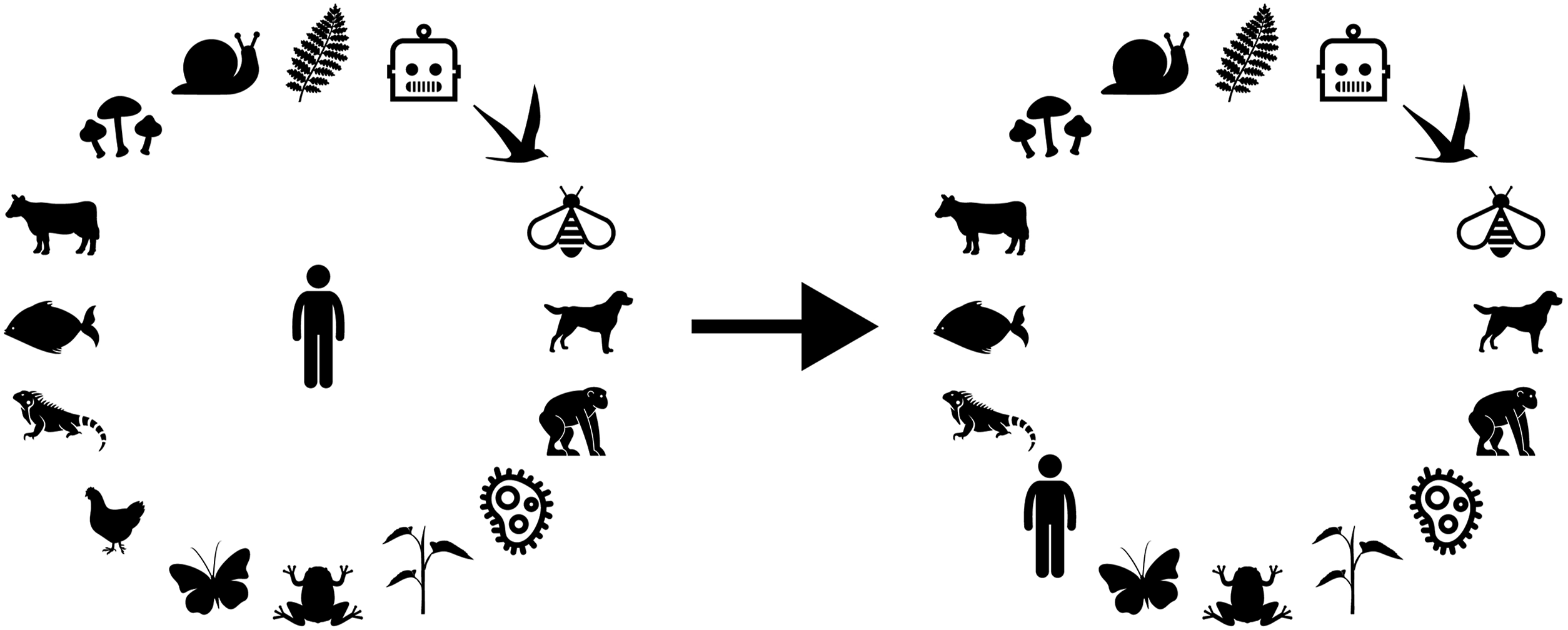
Thus, the advantage of operationalising MtHCD is that it allows students to better consider the tangible, material effects that occur outside of the boundaries of their immediate design output and/or activity. By reflecting upon the interdependent and independent perspectives of human and non-human (ecological and technological) actants in today’s entangled, socio-technical design assemblages, students can also negotiate notions of pluriversality, positionality, ontological design, and relationality through their practice. Further, when applied in conjunction with speculative Design Fiction, MtHCD will enable students to creatively speculate regards why, how, where and when positive environmental, societal, and economic change can potentially be implemented, and by/with whom – which citizens, community, culture and/or context are best placed to ethically, and responsibly, action such systemic transitions towards sustainable futures?
Developing More-Than-Human Design Pedagogy
Rooted upon systemic, ontological, and epistemic foundations, MtHCD presents a valuable lens through which to drive 21st century sustainable design pedagogy, whilst speculative Design Fiction offers a complimentary future-focused scaffold for students to carry out exploratory, creative sustainable design practice. However, these radical approaches can only be embedded into everyday design teaching and learning under the correct ‘contextual conditions.’ Successful integration of novel methods must balance with various external factors that “impact design education such as government regulations, requirements from professional design associations, and accreditation standards” (Giard and Schneiderman 2013, 122). In this section, principal ‘contextual conditions’ for further developing More-than-Human Design Pedagogy (MtHDP) are surveyed.
Situated Context
An existing UK university undergraduate design module provides a situated context for this paper’s exploration of MtHDP. Taught in the Imagination Design Research Lab at Lancaster University, UK, the module introduces students to practical envisioning techniques like analogue sketching and 2D/3D digital software applications, alongside grounding in design ideation, iteration and critical reflection and exposure to visual communication theory and historical/contemporary design exemplars. To deliver this skillset, the course design is oriented around weekly in-person theory and praxis studio workshop. The 40–50 strong cohort are a mixture of UK and International students. Student deliverables are assessed on an individual basis in a summative manner. Submissions take the form of Annotated Portfolios (Gaver and Bowers 2012) – collections of practice-based work (often combinations of graphics, sketches, photographs, and 3D digital prototypes) which also include theory discussion, critiques of other existing practice and students’ reflections regard their application of tools and theory to create their design outputs.
An ‘inherited module’, the author has sought to integrate elements of sustainable design theory and practice into the module albeit on an informal, ad hoc basis. There are evident opportunities for incorporating progressive sustainability-oriented activities into the module that effectively align with and support the overarching learning outcomes of the entire undergraduate course (Hattie 2009). Building upon discussed literature and methods, the rationale for this revision is three-fold: (1) Whilst the module focusses on crafting design artefacts, students must be made keenly aware of the wider contexts in which their work will potentially operate and its potential, ensuing environmental impacts. (2) The module’s current learning outcomes are highly generic. Students should be taught how their practice can become a vessel through which to engage with the climate emergency. (3) Embedding research methods and insights will help close the gap between academic and educational practice. This also corresponds with Lancaster University’s wider commitments to instil sustainability research into everyday teaching and learning.
Learning Outcomes
The UK university design module’s current generic LOs
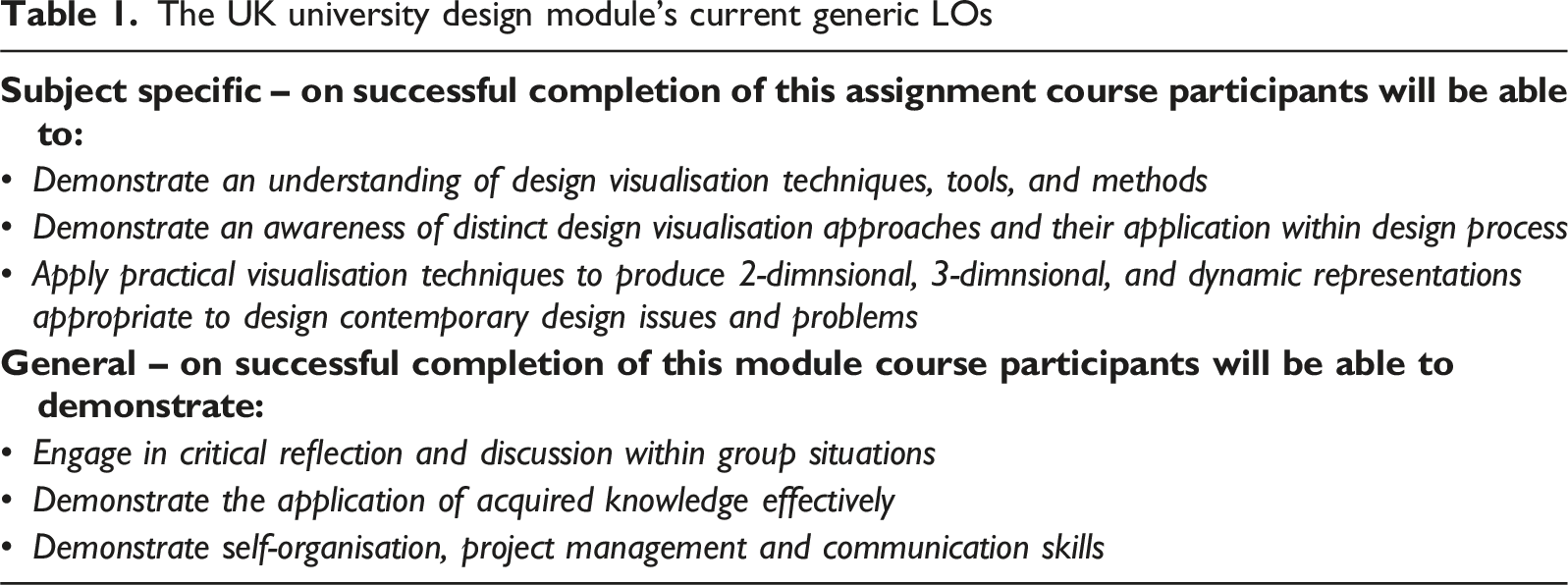
For example, Figure 4 depicts student work which has been developed in response to the identified module’s generic LOs (Table 1). One can see that while there is effective, creative use of tools and some conceptual engagement with technology and sustainability, exploration of the latter issue is not fundamental to the designed outcome. This deficit is by no means the fault of the student but that of the delivered curricula and indeed my approach as design tutor. To use Boehnert et al’s (2022) terminology, in this case sustainability concerns were ‘bolted on’ ad hoc to the existing teaching plans and LOs. This incongruity between intent and outcome evidences the need to develop MtHDP principles that specifically embed sustainable design as a core element of the module’s LOs. Example of student work developed in response to ‘bolted on’ sustainable design criteria (©Robyn Woods 2024).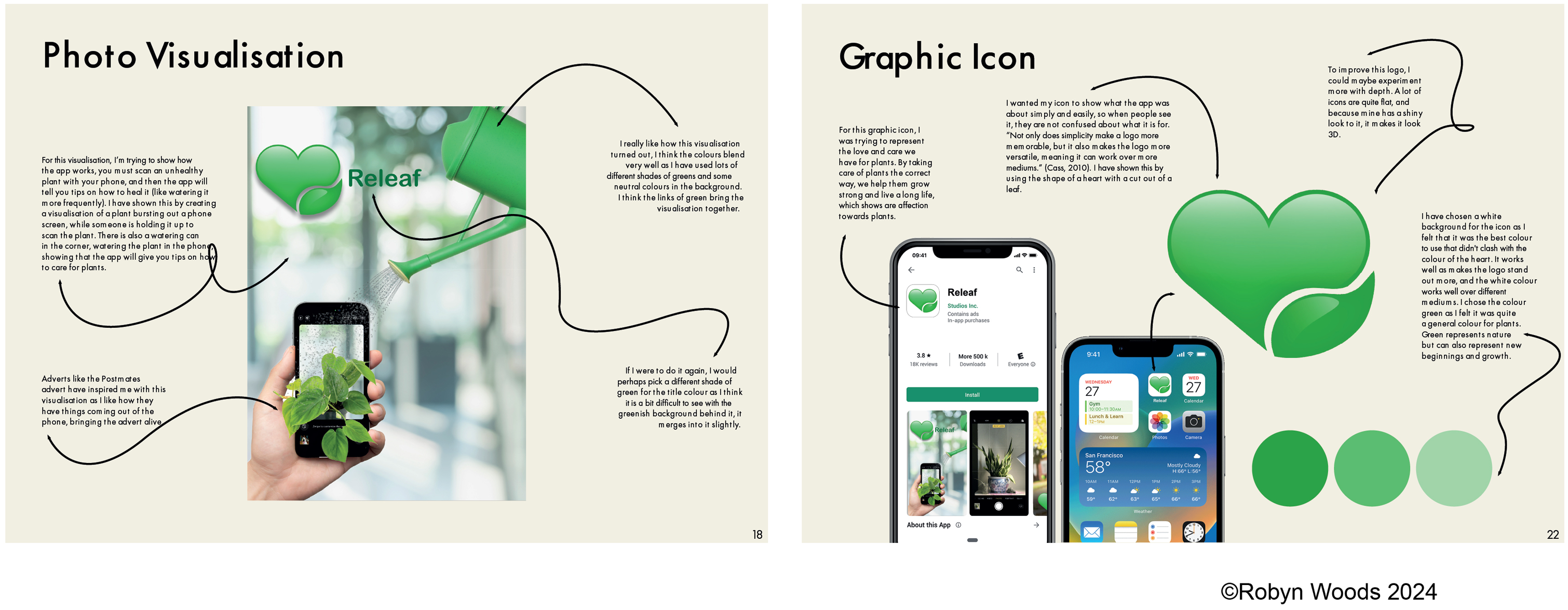
Some scholars warn regards issues that may arise when changing the scope of existing LOs. They should not become so dense and convoluted that the route to students’ deeper understanding becomes counterproductive and only feeds simplistic surface learning (Knight 2001). Revised LOs may also require adoption and/or development of alternative tools to assess students’ responses to them (Callahan et al. 2009).
Design Studio Teaching and Learning
Studio-based activities like workshops are often sites of ‘informal’ pedagogy in which tutors facilitate ‘less hierarchical’ learning environments (Lim et al. 2012). The studio is also seen as an effective context for students to embrace richer, ‘deeper’ forms of learning delivery (Logan 2006), with potential for increasing sustainable thinking amongst cohorts: Embedding knowledge of sustainability into the studio experience… permits students to grasp the interdependency of sustainability to the design process. (Giard and Schneiderman 2013, 129).
These ‘deeper’ attributes correlate with how knowledge is often generated through design via the confluence of tacit praxis and engagement with theory (Ramsden 2003). Much of Design’s epistemic and ontological underpinnings emanate from the interconnected concepts of Piaget’s Constructivism and Papert’s Constructionism (Ackermann 2001). The Constructionist perspective is often predicated in design practice and research (Frayling 1993) because it involves tangible, material construction of designed ideas like visualisations, models, and prototypes. Through the tacit acts of their creation, this practice in turn reflexively informs the practitioner’s (students’) understanding and knowledge of their own design processes and theory (Crotty 1998; Schön 1983).
Corazzo and Gharib (2021, 147) stress how studio workshops become fertile arenas for iterative, Constructionist practice. These environments expediate peer-oriented learning and comparison, where design practices and values are disseminated across the cohort – “students learn to locate themselves within the group and gain insight into their abilities – relative to their peers.” Nelson and Stolterman (2012, 224) note the importance of this, stating that the “process of becoming a designer is not a solitary, individual undertaking. It always takes place within a design milieu.” Informal peer dialogues provide important formative feedback (as opposed to end of module tutor-led summative assessment) argues Gray (2013) which is difficult to measure but highly significant to learning. Corazzo and Gharib (2021) are however keen to stress that the design studio is not an immutable entity but a setting where informal pedagogies do still crossover with formal counterparts like lectures. Moreover, this interchange plays a significant role in helping to support students to learn to design practice and evolve into fully fledged designers.
‘Glocal’ Education Policies
UK Professional Standards Framework (PSF) criteria relevant to More-than-Human-Centred Design Pedagogy (after AdvanceHE 2023)
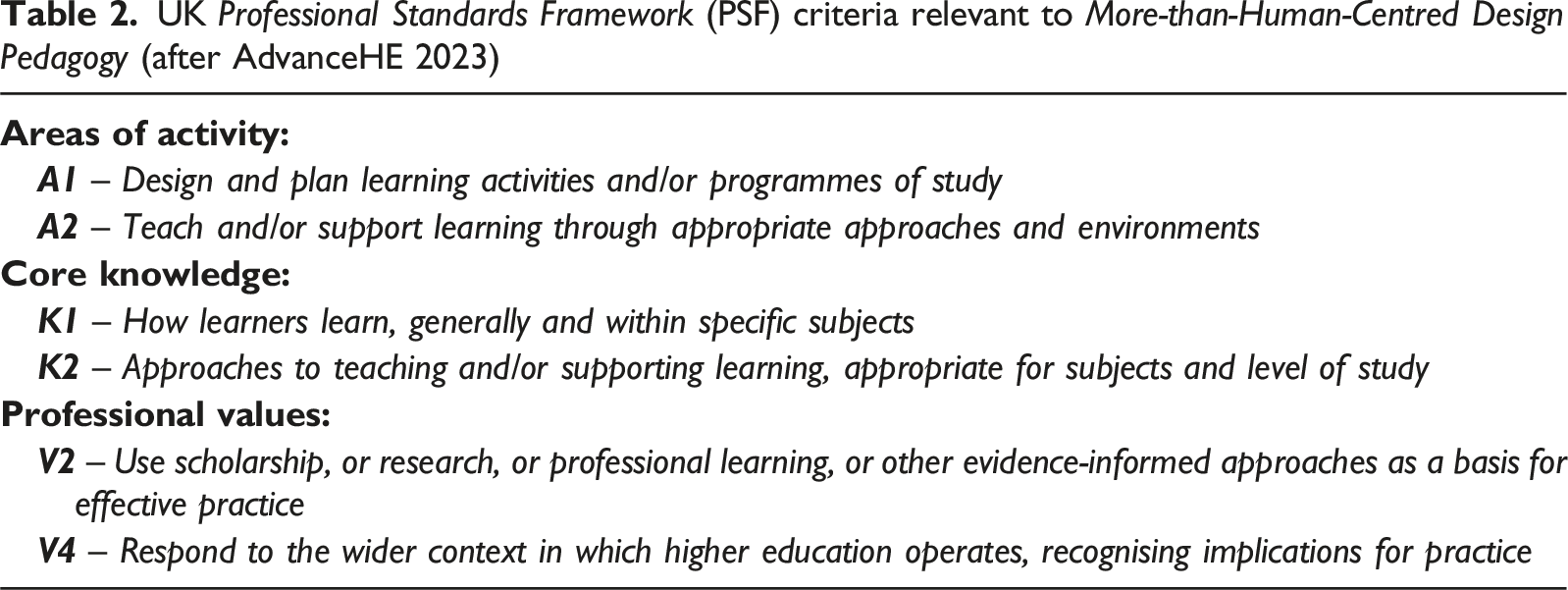
Looking more broadly, the UK’s AdvanceHE and Quality Assurance Agency for Higher Education bodies maintain that tutor engagement with their Education for Sustainable Development policy can lead to learners being equipped with: The knowledge, skills, attributes, and values required to pursue sustainable visions of the future. Using active pedagogies learners are supported in addressing complex or ‘wicked problems’ and identifying how they can contribute to solutions that address environmental integrity, social justice, and economic prosperity. (AdvanceHE 2020).
This advice is chiefly based upon the work of UNESCO (2017) and their internationally recognised Education for Sustainable Development: Learning Goals. These goals are themselves an extension of the eminent 17 UN Sustainable Development Goals. Collectively, the above policies provide valuable guidance as well as inspiration to redevelop module LOs to integrate sustainable thinking and skills in the chosen module through MtHDP.
Constructive Alignment
Constructive Alignment is a useful strategy to apply during curriculum (re)development. Biggs (1996) contends that alignment has potential fundamental implications for teaching and learning across three modalities: • Presage (student composition and teaching context) • Process (teaching and learning activities) • Product (LOs)
For a curriculum design to be successfully aligned, the module in question (and the wider programme it sits within) will ensure that students have every opportunity to learn and achieve the LOs effectively (Biggs 1996). Through strong alignment, learning environments can be created which facilitate autonomy amongst cohorts which allows them to construct their knowledge as interpreted through their own explorative learning. Students can subsequently construct “meaning from what they do to learn; [due the pre-alignment of the] planned learning activities with the learning outcomes.” (Hattie 2009, 6). Figure 5 depicts how the above perspectives have been applied to help better align the module’s presage, process, and product as part of the MtHDP process. Constructively aligning More-than-Human-Centred Design Pedagogy (Stead 2024 after Biggs 1996).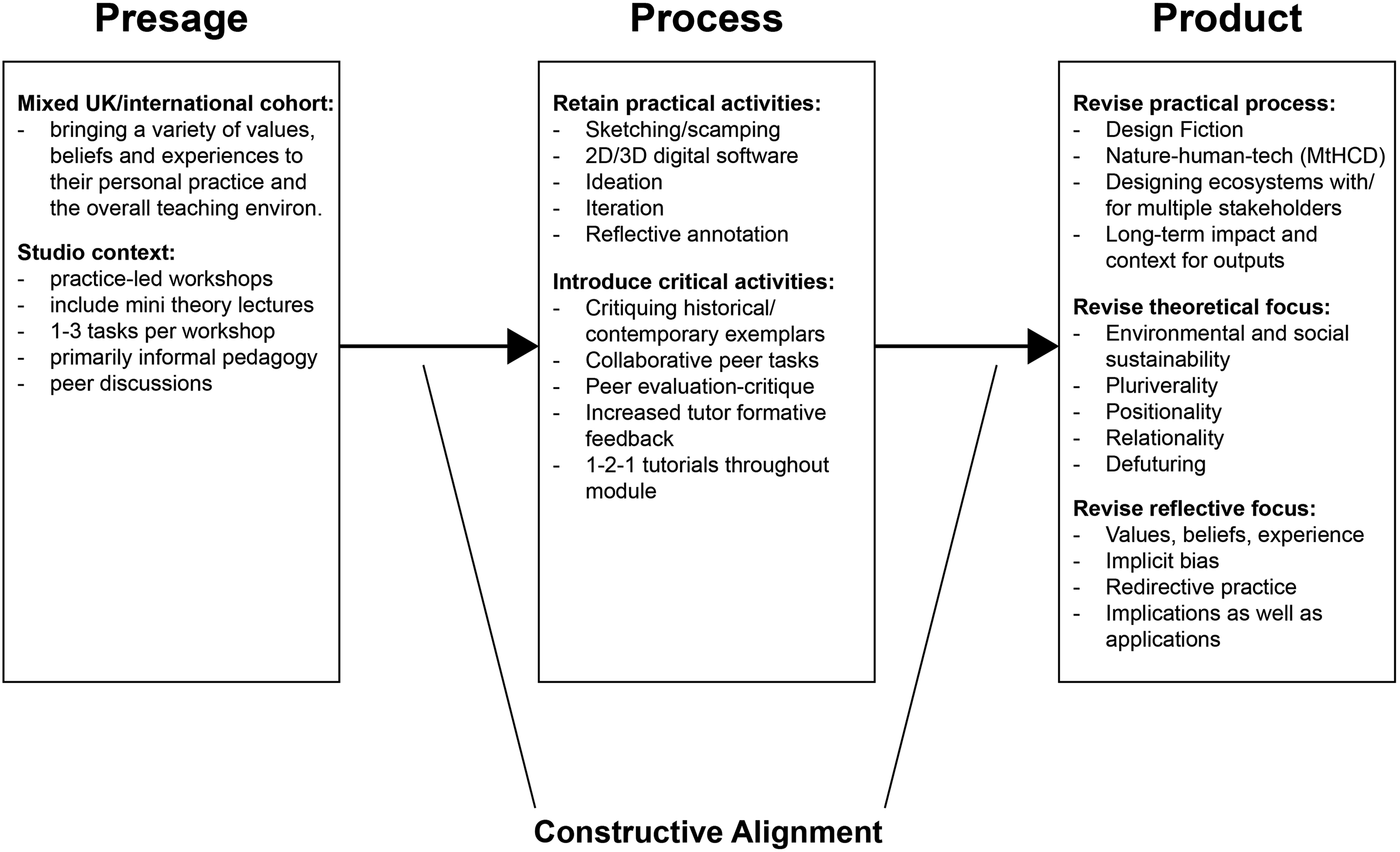
Learning Outcomes for More-Than-human-Centred Design Pedagogy
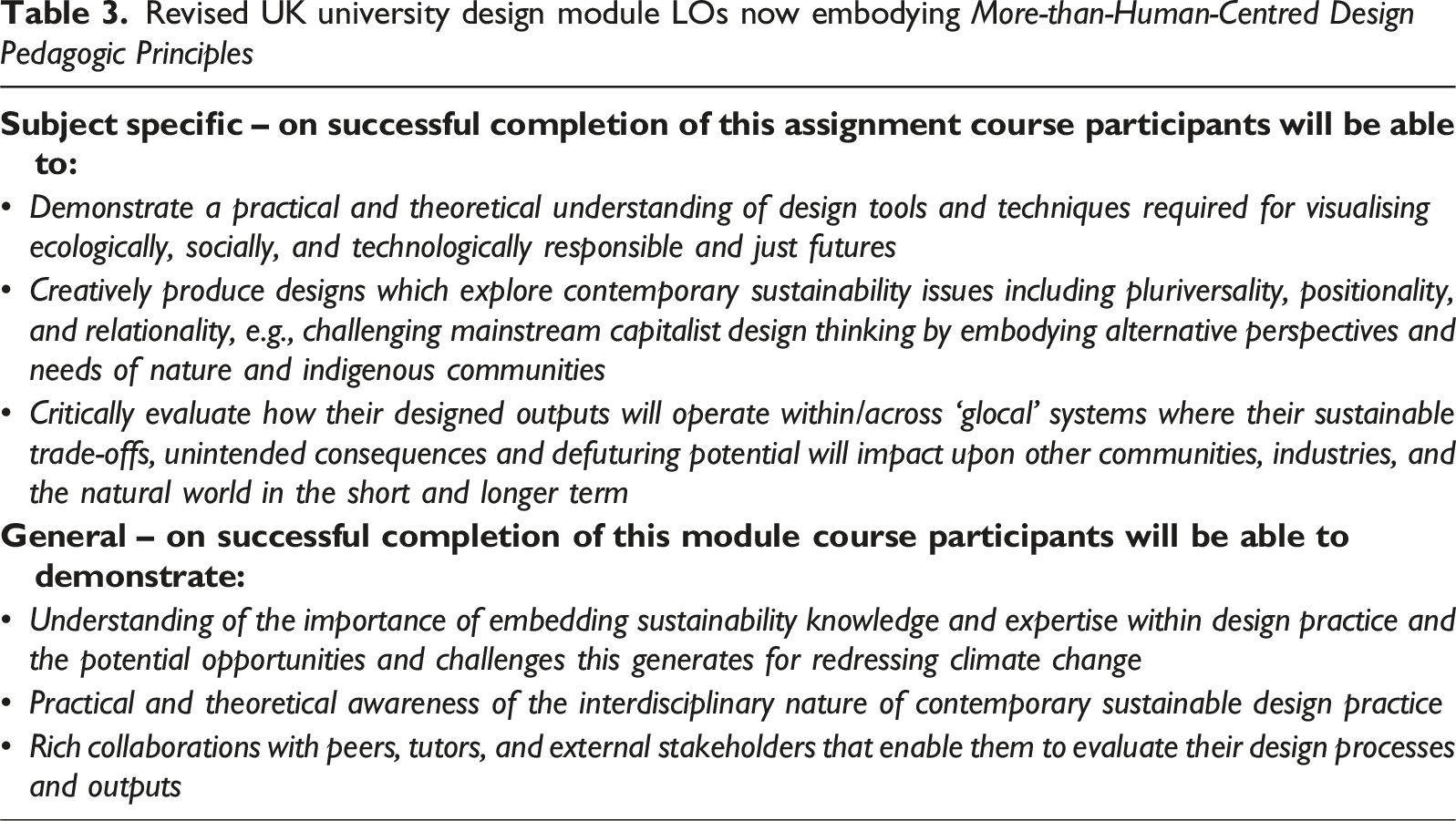
Revised UK university design module LOs now embodying More-than-Human-Centred Design Pedagogic Principles
MtHDP Student Case Study
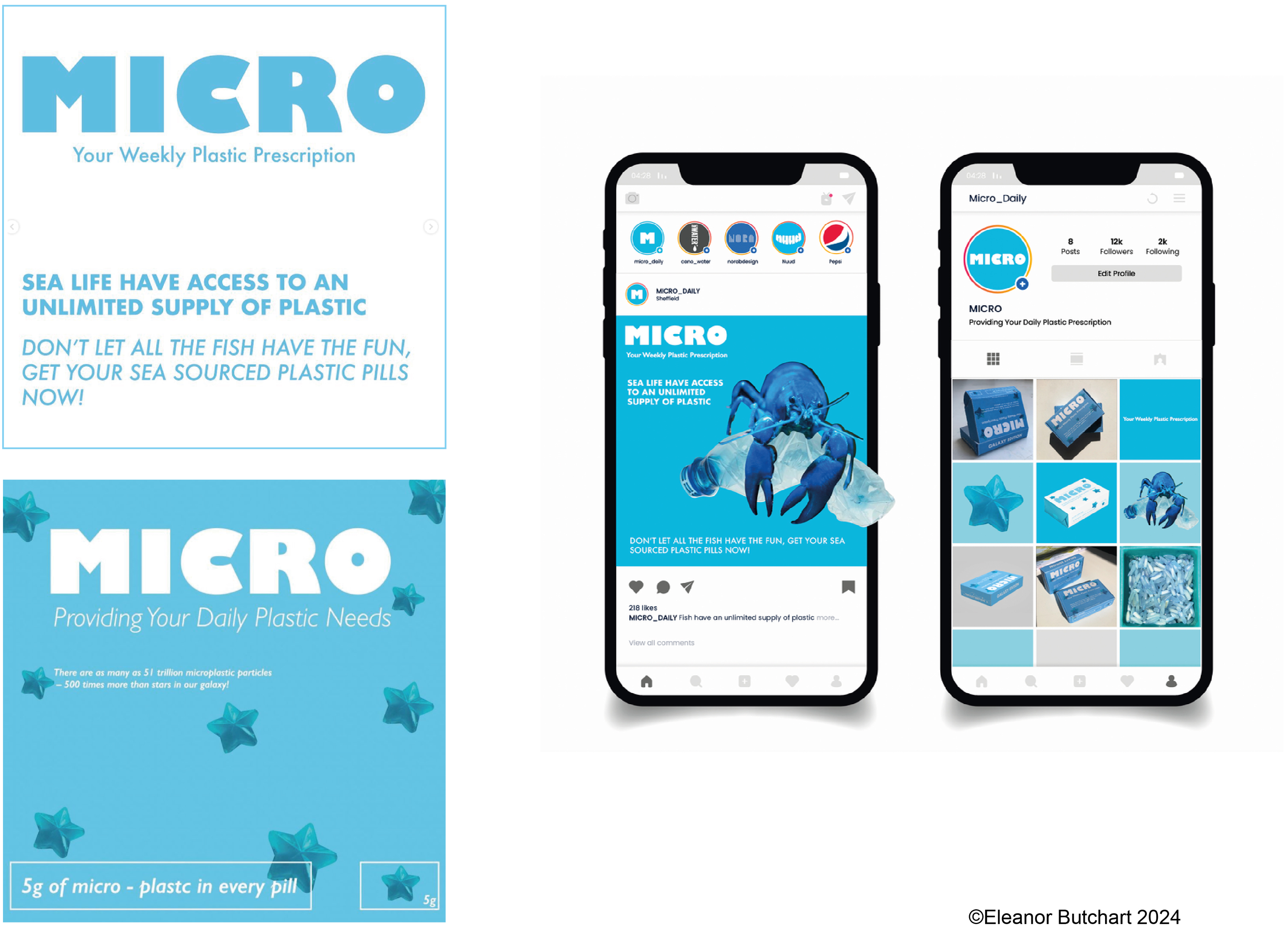
In this final section, a visual case study is presented which showcases undergraduate design work that embraces the ethos, theory, and skillset of MtHDP as embodied by the new LOs. Produced by Eleanor Butchart, the work was generated during a guest teaching and practice series delivered at Sheffield Hallam University, UK in 2024. The sessions introduced students to sustainability, MtHCD and systemic technology design issues and asked them to apply speculative Design Fiction techniques to envision and interrogate more radical sustainable futures. The design brief (Figure 6) given to students drew upon the UNESCO Sustainable Development Learning Goals (2017) as a threshold concept (Meyer and Land 2003). Using the goals as a contextual substrate for MtHDP, Eleanor’s work explores the environmental, health and technological impacts of micro-plastic pollution for human and animal populations. Figure 7 details ideation for their concept via sketches and scamps, while Figure 8 depicts branding elements and digital app visualizations. These speculative visions show how Eleanor’s thinking and approach evolved from initial, normative technocentric solutions for eradicating micro-plastics across human and marine life into more critical outputs designed to generate discussion and change audience perceptions of the issue. The guest teaching series More-than-Human-Centred Design project brief (Stead 2024). Eleanor Butchart’s More-than-Human concept ideation via sketches and scamps (©Eleanor Butchart 2024). Branding and visualising fictive digital interactions for the ‘Micro’ concept (©Eleanor Butchart 2024).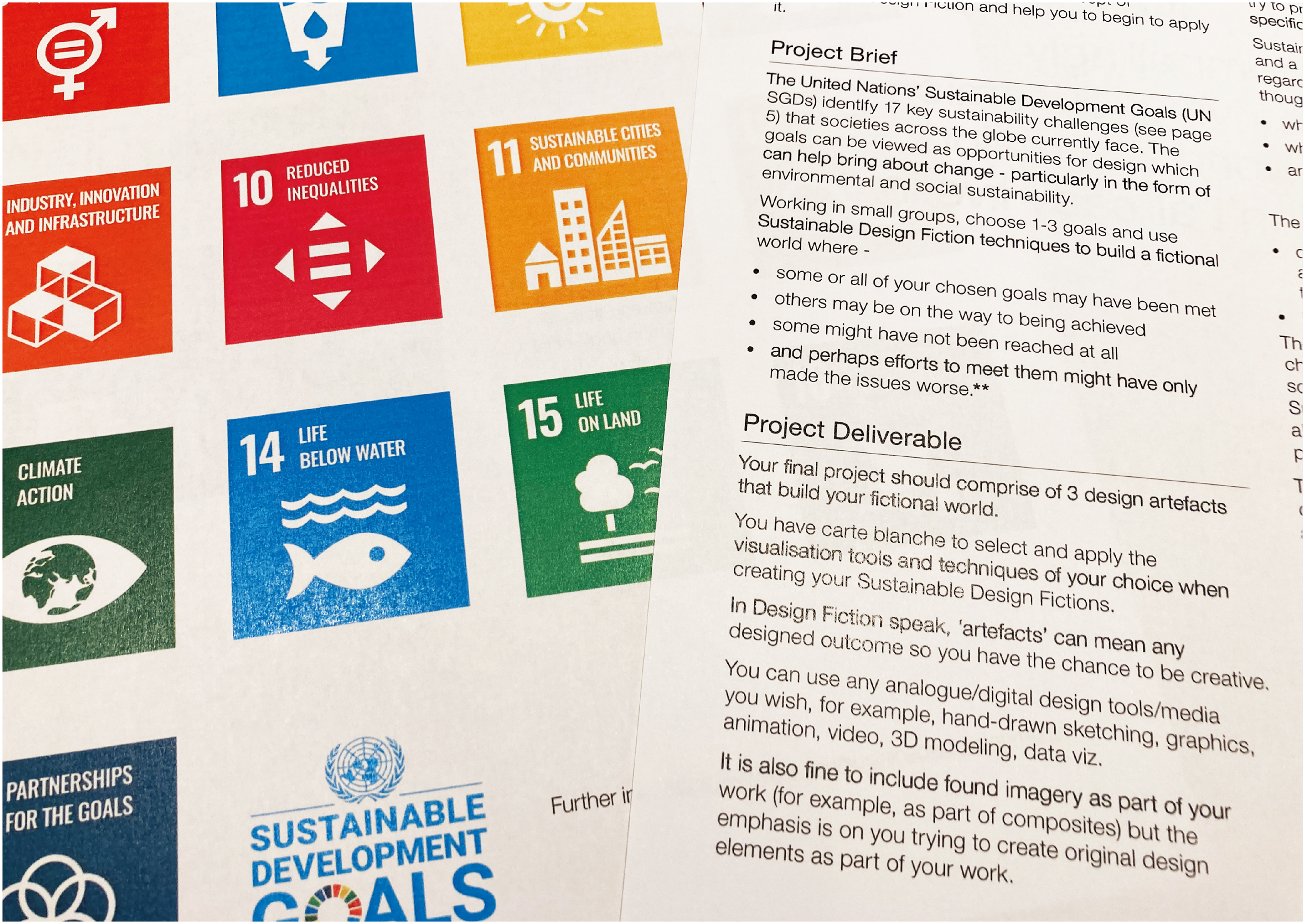
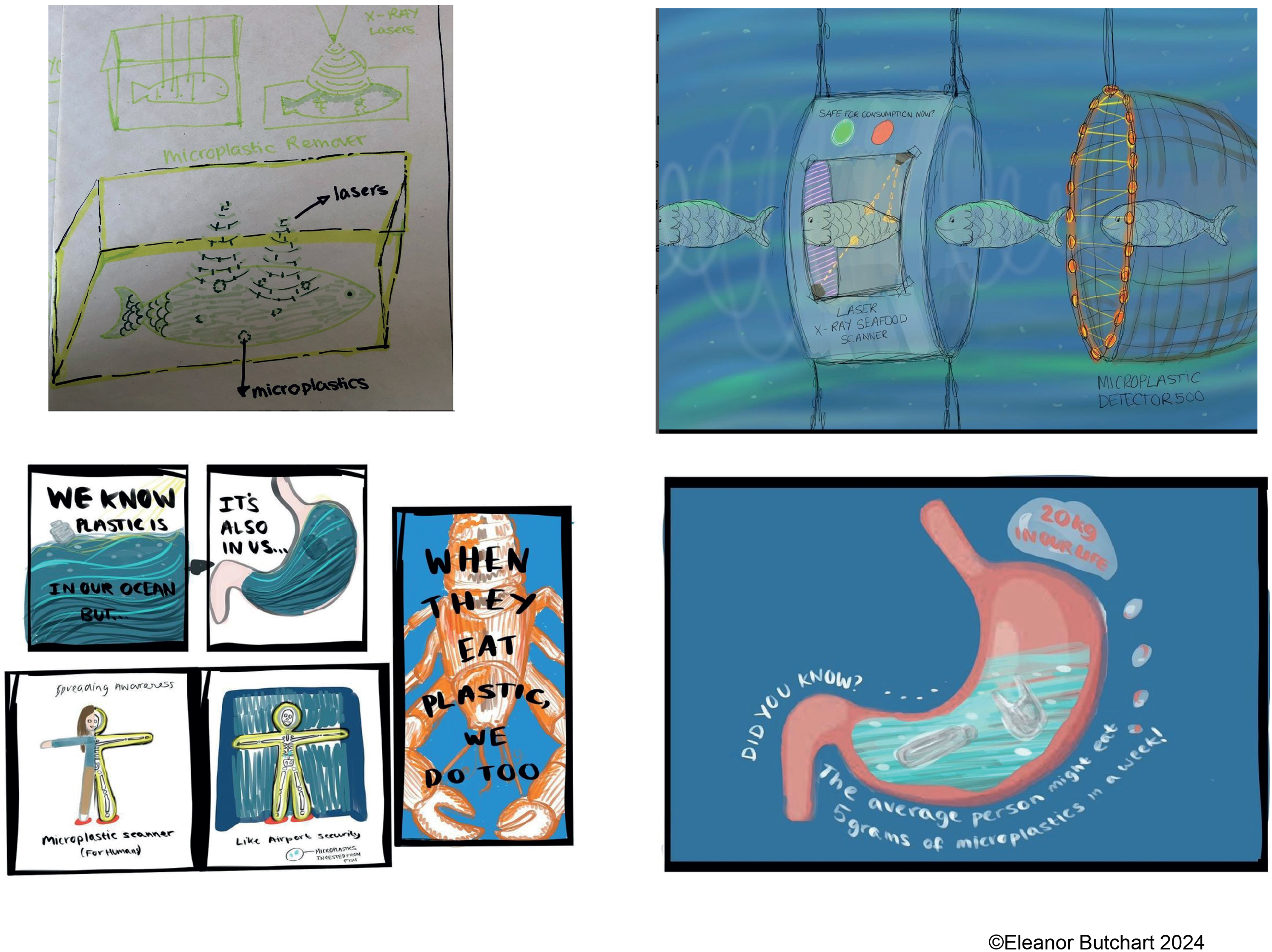
The cohort was asked to display their work during a ‘pin up and critique’ session run towards the end of the Sheffield Hallam University guest series. In Figure 9, additional student MtHDP concepts are pictured alongside that of Eleanor’s work. The other designs explored interesting MtHCD issues including future recycling infrastructures for electric vehicle batteries and farmable regenerative materials for manufacturing everyday electronic devices. The ‘pin up and critique’ session also reflected the LOs, specifically the need to collaborate with peers and tutors as a means to enable students to evaluate their design processes and iterate their outputs based on received feedback. Figures 10 and 11 illustrate how Eleanor continued to channel this and push their concept further than their student colleagues. They augmented their two-dimensional graphic visualisations for the Micro concept like the digital app and branding, by tacitly creating three-dimensional ‘diegetic’ prototypes. These iterations work together to generate a fictional narrative and build a world in which the Micro concept might exist (Kirby 2010; Zaidi 2019). Students’ More-than-Human-Centred Design concepts displayed during a collaborative ‘pin up and critique’ session (©Eleanor Butchart 2024). Eleanor Butchart’s prototyping three-dimensional ‘Micro tablet’ artefacts (©Eleanor Butchart 2024). Final designs for the ‘Micro’ project (©Eleanor Butchart 2024).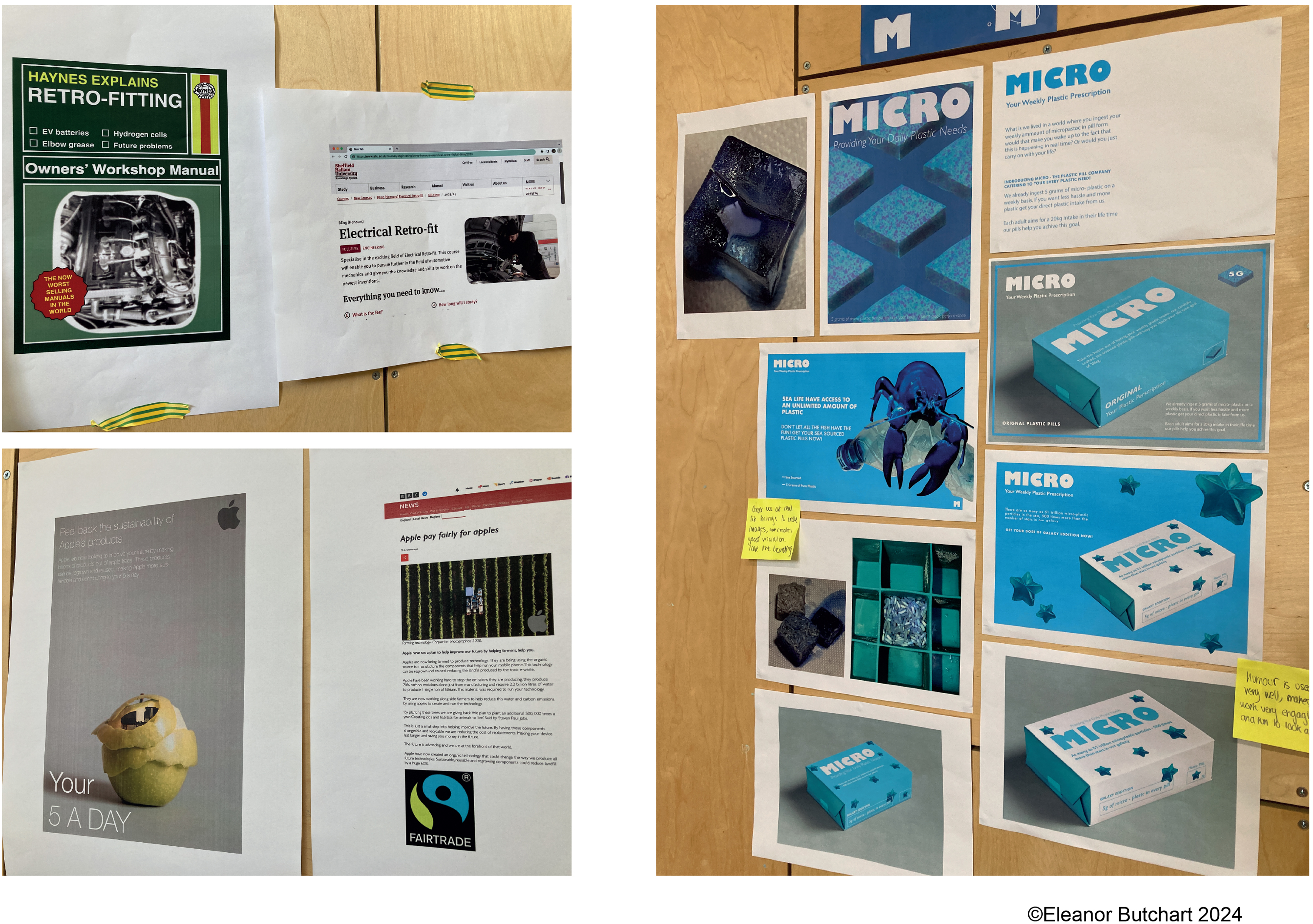
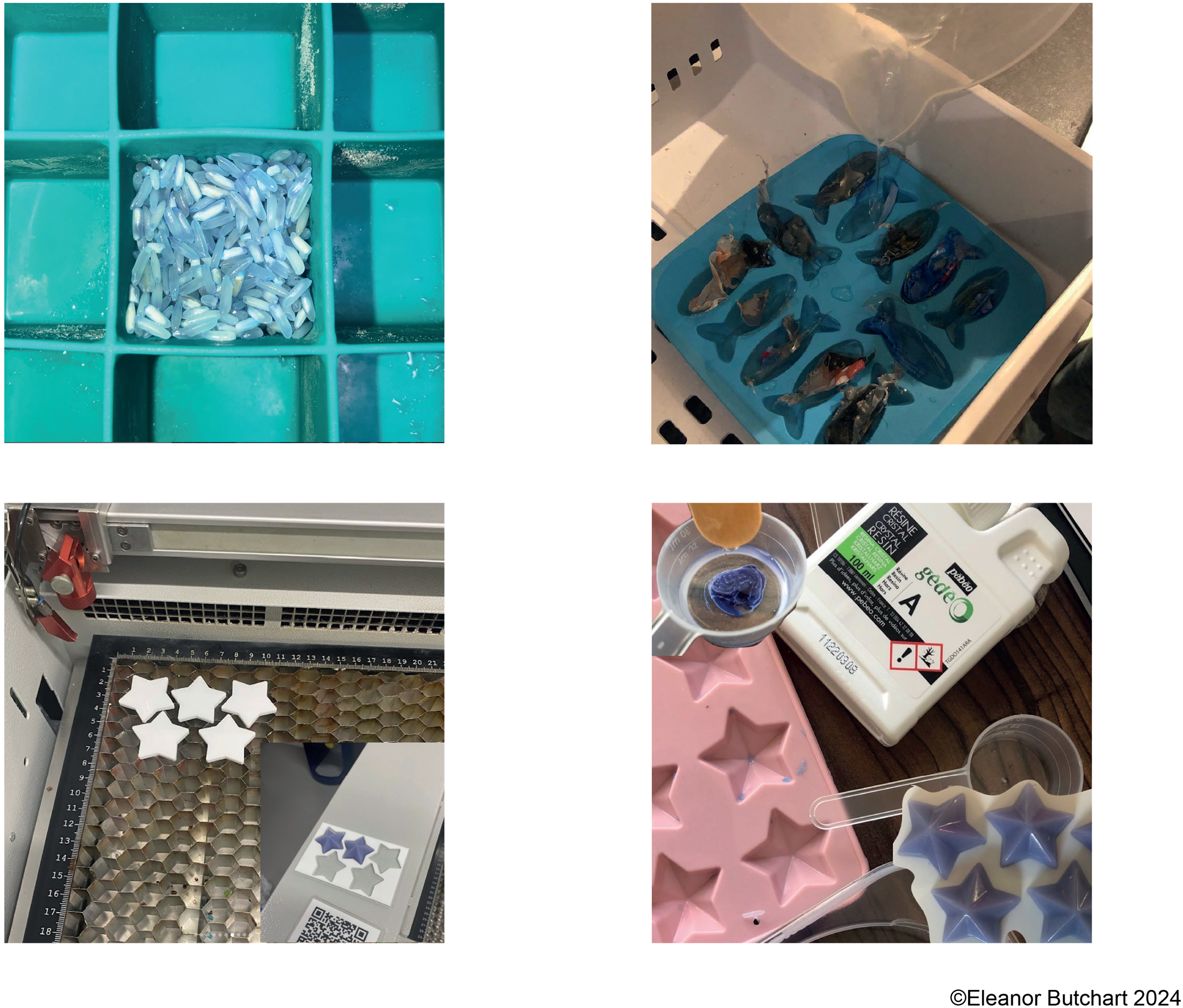
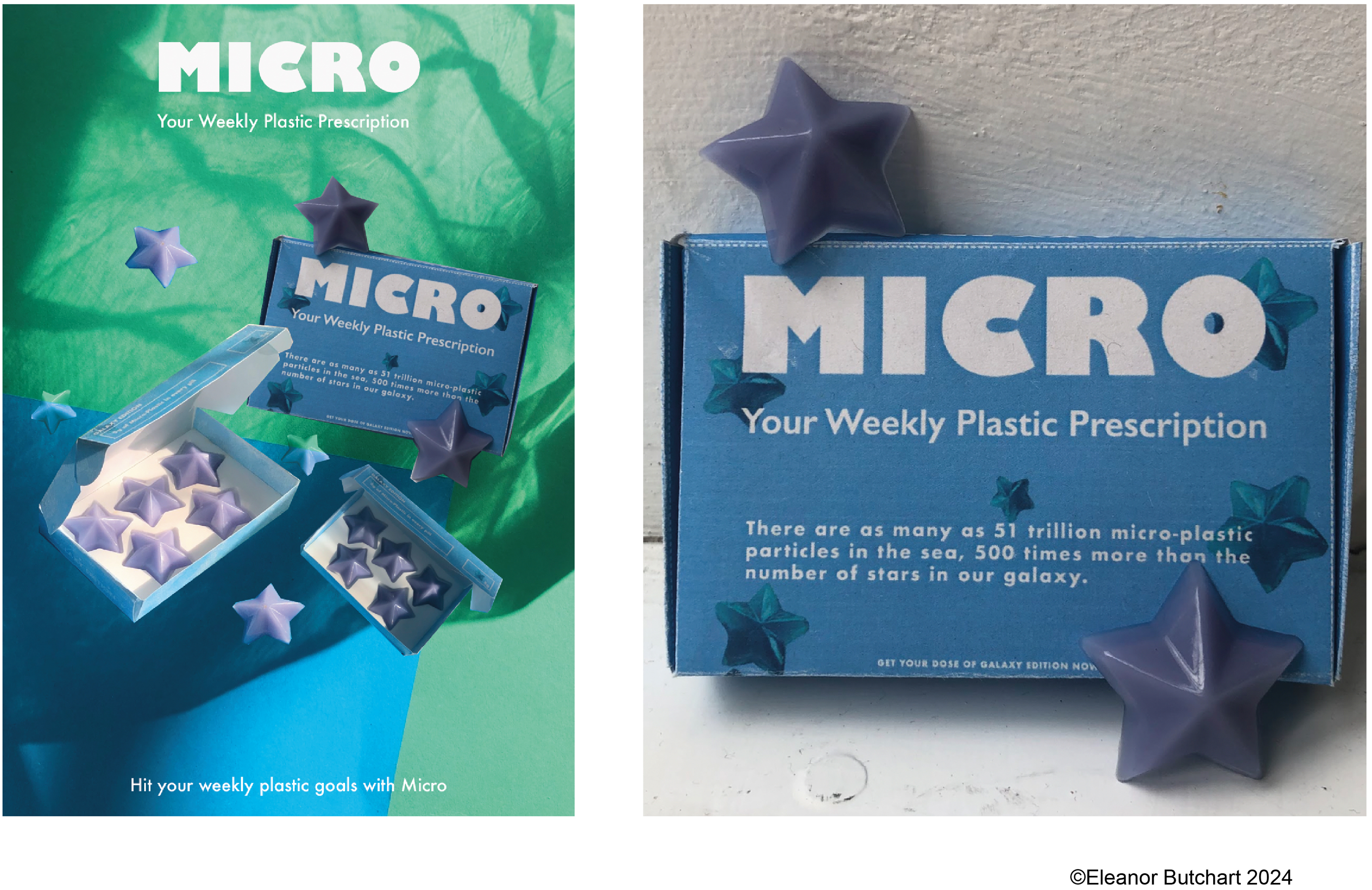
Playful yet provocative, ‘Micro’ embodies and subverts mainstream capitalism ideals through the imaginary prescriptive medicine like product. These ‘Micro’ tablets (fictively) equate to the average amount of micro-plastics that a person unknowingly consumes on a daily basis. In essence, the work is raising awareness of the injurious environmental and health implications of such socio-technical pollution upon human and natural ecologies by materialising the issue in a creative, disruptive, and discursive format. In doing so, Eleanor’s explorations respond to the new LOs by demonstrating practical application of design tools and techniques required for visualising and critiquing ecological, social, and technological futures. They imaginatively interrogate how the contemporary issue of micro-plastics relates to sustainable pluriversal, positional, and relationalist thinking. As such, Eleanor’s project critically questions the futuring and defuturing potential of trying to combat micro-plastic pollution.
Novel and ambitious, Eleanor’s MtHDP project is demonstrative of how design education must “seek to enable students to contribute to designing sustainability itself, by first developing their own vision of sustainable change, and then designing routes to achieving that vision” (Micklethwaite 2022, 4). Building upon the work of Gonzatto et al (2013), the More-than-Human-Centred Design Pedagogic framework (Figure 12) encapsulates the new LOs’ theoretical and practical intent, which Eleanor’s project in turn begins to engender. Like Eleanor, through engagement with this framework. Further students can work to begin to embed the important sustainability expertise within their design practice. More-than-Human-Centred Design Pedagogic framework (Stead 2026).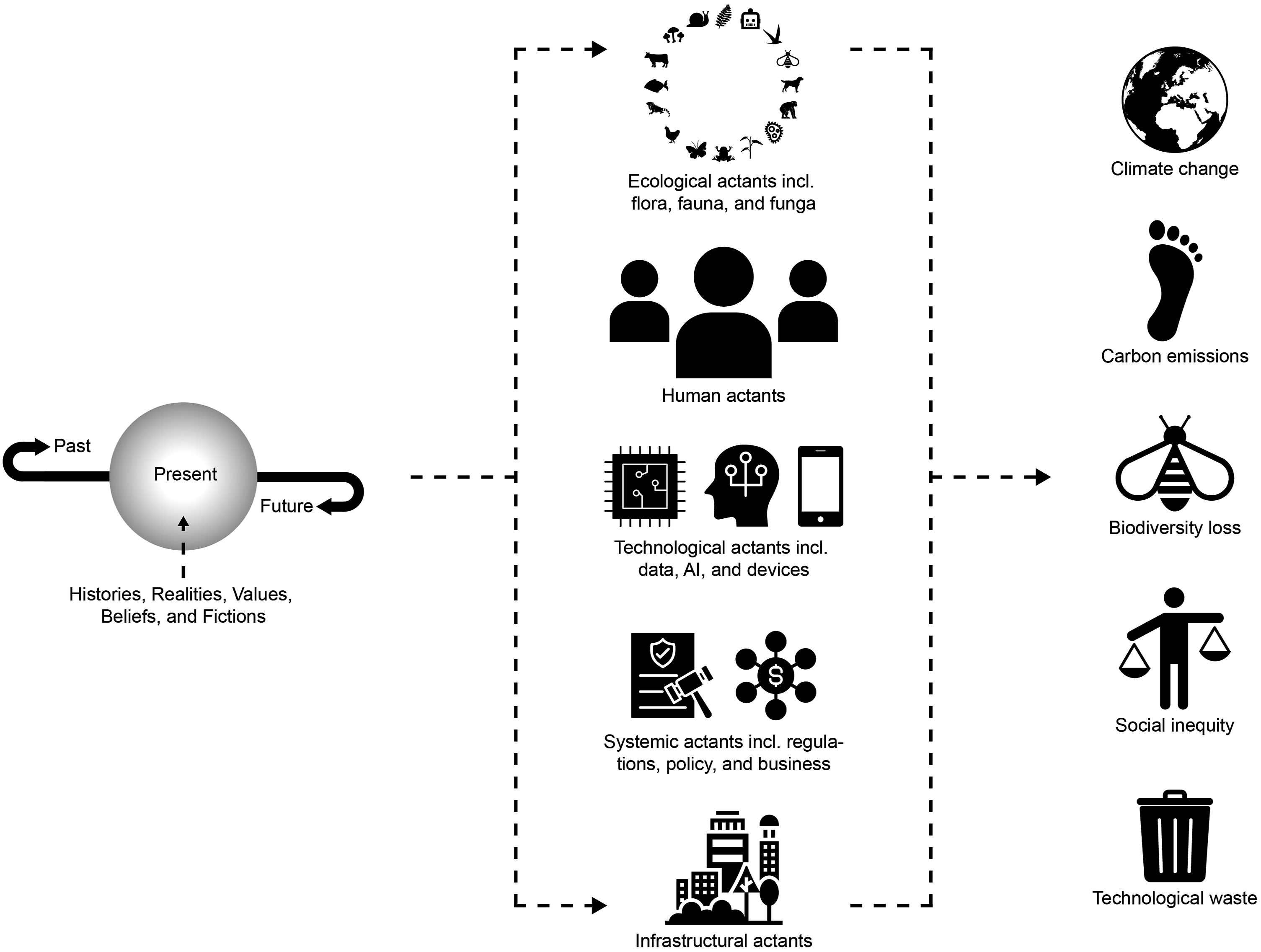
Closing Reflection
This paper has explored new directions for improving the teaching and learning of sustainable theory and practice within 21st century design and technology education. Reflecting the need to afford sufficient space and time for sustainable literacy to become a core element of students’ creative expertise (Quam 2016), the redevelopment of LOs reflecting MtHDP has been conducted through an undergraduate design module lens. Significantly, the range of literature, concepts and criteria examined demonstrates that embedding sustainability principles into a design module is not a straightforward task which creates limitations. The work currently does not explore formal, ratified implementation of the LOs nor tangible adoption and evaluation by students across a full 20-week module. Institutional procedures (e.g., Lancaster University’s Course Approvals and Information Tool (CAIT) process) which validate curriculum changes still need to be negotiated. Additionally, wider module content (e.g., design briefs), delivery-contact time, and assessment, would also need to be completed. Longitudinal delivery of the new curricula would provide better clarity and metrics on such issues.
It is also important to acknowledge the implicit impact of the UK module lens, the choice of literature and methods, and indeed the author’s own epistemic/ontological bias. These will run through the resulting MtHDP and LOs. How cultural and structural contexts and agendas shape design process and practice are no doubt a growing point of reflection for many Global North designers-educators who seek to design and educate on sustainability issues. The new LOs therefore actively embrace these complexities by asking students to explicitly engage with outlined core concepts including pluriversality (Escobar 2018), positionality (Noel et al. 2023) and defuturing (Fry 2020), and to embody these through their practice. The aim is to build students’ awareness and understanding of such ethical quandaries, as well as of the impact their own identity and experiences may potentially play when they design for sustainable futures for their own and others’ communities.
Despite the outlined complexities, this paper showcases substantial possibilities for improving students’ sustainable design literacy and practice within higher education contexts, particularly Global North settings. Crucially, the work provides a practical exemplar for other design educators to consider. MtHDP practice reflects how design education must begin to proactively facilitate students to explore sustainability concerns and opportunities in a critically and creatively manner through their design and technology practice. To reiterate the paper’s objective – by adopting this pedagogic shift, tutors can better support students in developing new ways of designing that contribute to the evolution of the discipline beyond its modernity-rooted values such as profit, efficiency and progress, and reorient it as a practice predicated on planetary regeneration and care Given the ever-increasing spectre of climate change, this endeavour is more essential than ever before.
Footnotes
Acknowledgements
The author wishes to express sincere gratitude to designers Eleanor Butchart and Robyn Woods for allowing their work to be featured in this manuscript. The author would like to thank Dr. James Corazzo of Sheffield Hallam University, UK for providing the teaching and learning context in which to begin this pedagogical research. The author would also like extend deepest thanks to Dr. Ann-Marie Houghton of Lancaster University, UK for their advice and support during the initial stages of this research endeavour.

Ethical Considerations
The work presented here was carried out in part in relation to ethics application – FASSLUMS-2023-3399-SA-2 Fixing the Future: The Right to Repair and Equal-IoT – as approved by Lancaster University’s Faculty of Arts & Social Science/Lancaster Management School Research Ethics Committee.
Consent for Publication
Thank you to designers Eleanor Butchart and Robyn Woods whose work is featured and who have provided written consent that their work can be discussed and published within the manuscript.
Funding
The author disclosed receipt of the following financial support for the research, authorship, and/or publication of this article: The work presented here was partly developed in connection to research funded by the UKRI Engineering Physical Sciences Research Council – the Fixing the Future: The Right to Repair and Equal-IoT project (EP/W024780/1).
Declaration of Conflicting Interests
The author declared no potential conflicts of interest with respect to the research, authorship, and/or publication of this article.