




Abstract
In this article, we reflect on how Transition Design can benefit from artistic practices and theories in the context of generating transformative futures. This reflection is empirically grounded in two recent workshops about (re)imagining “rurban” presents and futures in the Netherlands and involving the co-creation of methods by researchers and creative practitioners through transdisciplinary processes. Drawing on defamiliarization, a concept borrowed from art theory and practice, we show how arts-based methods allow us to “make strange” taken-for-granted meanings. Our analysis focuses on defamiliarizing disconnections in meaning and practice between the urban and rural, humans and nature. Such a process of defamiliarization, particularly when place-based and collaboratively undertaken, may generate affective encounters of refamiliarization with the more-than-human world. The knowledge that arises from such encounters allows for non-dominant voices to come to the fore and new meanings to emerge. We describe the knowledge that is generated in these encounters as patchy and sticky. While not directly transferable, this knowledge can be analytically “glued” together as part of open-ended and situated design and meaning making processes, offering potential for wider transformations. By discussing this creative process, we want to draw attention to the significance of contextual specificity, value plurality, and transformative postures and mindsets for Transition Design and the achievement of sustainable and just futures.
Introduction
“But, Miss, bacteria don’t speak English…” - Workshop participant, 2023, “Listing to the Soil”.
One sunny day in June, we find ourselves with a group of young people at the outskirts of Amsterdam, on a plot of land at the “urban” edge of the city, Lutkemeerpolder. After it, current land zoning maps tell us that the city ends and the “rural” starts. This is a site of struggles, caught in-between the aims of the municipality to use it for industrial purposes and an activist initiative, Foodpark Amsterdam, that aims to reclaim it as an agro-ecological commons. We see this site of struggle located at a crossroads between two different kinds of potential futures: one, reproducing current unsustainable forms of production and consumption, and another one that entails ‘rurban’ modes of relating with the living world and inhibiting future environments.
Recognizing the strangeness of the current rural-urban dichotomy (with its ensuing implications on how humans relate to nature and the socio-ecological impacts of this) and consequently, shifting perspective, is not an easy task. It is linked to a “lack of imagination” (Bendor 2018) that has arguably prevented us from conceiving alternative, transformative futures. Such transformative futures should go beyond merely adjusting flaws within the current system, but instead tackle what Transition Design addresses as “wicked problems” and generate new imaginaries, practices, and ways of being that make the old system obsolete, which resonates with the field of transformative change (e.g., O’Brien 2012; Pelling et al. 2015; West et al. 2020). This growing need to imagine an otherwise has also been expressed by futures scholars through calls for imaginative practices and experiential futures that connect the cognitive and the material, thus allowing us to imagine the previously unimaginable by dismantling existing worldviews, values and perspectives (Ketonen-Oksi and Vigren 2024, 9).
While urbanization blurs the lines between “rural” and “urban” - the city is spreading into the countryside and food is sourced through global trade networks - planning policies artificially retain clean lines between these domains, reinforcing human disconnections from nature. On “urban” land, a distribution center becomes then an obvious choice, while food production needs to be pushed outside, as not “natural” to the city. Yet, activist initiatives like Foodpark Amsterdam, challenge these artificial rural-urban lines, showing how urban development is at odds with the city’s branding as a green front-runner. 1 Instead of accepting the current development plans in the Lutkemeerpolder as evident, they propose “rurban” modes of relating to the socio-ecological realm, through using and managing land as a commons. If paid attention to, such initiatives provide glimpses into alternative, transformative futures that show in the present that other practices and ways of being are indeed possible.
However, despite an uptake in interest around sustainability experimentation (Newton and Frantzeskaki 2021; Sengers et al. 2019), bottom-up initiatives like the controversial Foodpark Amsterdam remain at the fringes and struggle to gain recognition among policymakers as having transformative potential. Instead of engaging with such “living” alternatives and the knowledge produced locally, there is a tendency towards establishing “living labs” that are hoped to provide immediately practical and neatly representable and transferable knowledge for targeted action. In this process, living labs become instruments to stabilize social imaginaries around externally defined and specific visions of the future, smoothing down value frictions rather than defamiliarizing the status quo, inviting new meanings to emerge, or pluralising futures. As there is consequently the risk that the dominant worldviews and values get perpetuated, this raises further questions about the inclusivity of these visions (Pfotenhauer et al. 2022), about who has the democratic capacity to imagine and whose sensibilities are thought to make sense (Chuh 2019).
Yet, when visions emerge from local needs and aspirations, and when they clash with the visions perceived to be desirable from the outside, frictions unfold, exposing alternative perspectives, values, postures and mindsets. Tightly linked to the politics of excluding alternative ways of knowing and living, not making space for different meanings risks erasing diversity through striving for universal solutions. We propose instead that in order to move towards the unimaginable and find alternatives, there is a need for understanding that knowledge is context-specific in the way it emerges and also in the way it attaches itself to new meaning. Specifically, in this article we aim to address possibilities for transformation and transformative futures from a place-based perspective. We engage critically and creatively with the struggles that unfold when visions clash, solutions are not universal, and knowledge is appreciated for being local and situated. We therefore choose to “stay with the trouble” (Haraway 2016) that rejects clear-cut definitions by focusing on where the “rural” and the “urban” meet, the meanings these situated encounters generate and the questions they raise regarding human-nature interactions and relations.
The emerging field of Transition Design is centered around the question of how sustainability transitions can be ultimately designed. In our research, this question becomes: How might affective “rurban” encounters be “designed” in ways that allow reimaging alternative human-nature relations and conceiving of other ways of being in the world? In this article we propose that making space for alternatives can be created through processes of “gluing” - bringing together methods, practices, forms of knowledge and ways of knowing that are context-specific, account for diverse values, and focus on crafting relations rather than outputs. To give substance to this proposition, we reflect on our collaborations (as researchers) with artists and designers to co-create methods for fostering situating encounters as a way to reimagine alternative futures inspired by human-nature relations that transcend the present rural-urban dichotomy. The co-created methods depart from the “strange” notion of “rurban” and its manifestation in a specific context, while leaving its definition open to defamiliarize participants with common sense understandings of the urban and the rural, invite new and diverse meanings, and probe the imagination beyond the status quo.
“But, Miss, bacteria don’t speak English…” was the perplexed answer of a participant to one of the workshops discussed here, titled “Listening to the Soil”. This question provoked the group of young people taking part in the workshop to experientially engage with the struggles of the Lutkemeerpolder site and gain embodied knowledge of alternative ways of relating to the more-than-human world. By switching focus onto the entities of the natural environment that are not human, this was a starting point for imagining futures otherwise - beyond what they already knew or experienced in their everyday lives. While a strange question for young urbanites living in a dense city like Amsterdam, the workshop set-up in which we explored it exposed the importance of engaging with sustainability issues through affect, and not only through facts. As we will discuss, we took this aim further through a subsequent workshop addressing “green intimacies” with nature on our university campus. While the meanings produced through these co-created methods cannot neatly scale up to systemic change, we can analytically “glue”, patch them together and reflect on how they might alter and shift “rurban” imaginaries. In the context of Transition Design, we specifically reflect on how productive relationships between artistic methods, science, and politics could generate necessary affective attachments as well as cognitive states that sustain regenerative efforts and a “speculative commitment to think about how things could be different if they generated care” (Puig de la Bellacasa 2017).
Transition Design Turns to Art: Defamiliarizing Common “Sense”
Transition Design as an academic field is itself in constant transition. In the paper “The Emerging Transition Design Approach”, Terry Irwin proposes Transition Design as a “design-led approach needed to address the complex, wicked problems confronting societies in the twenty-first century” (Irwin 2018), such as climate change, water security, poverty, or loss of biodiversity. These problems are not only complex, but often also highly contested, involving unclear or limited problem definitions due to the diversity of the contexts where they manifest, uncertain or unpredictable future trajectories, and lacking given or testable solutions (Brown et al. 2010). In contrast to “traditional design approaches”, she argues that “new” approaches should have a more comprehensive commitment to include “all stakeholders” (Irwin 2018, original emphasis). Moreover, this “new and design-led approach” should “provide a rationale for ‘intervening’ in complex systems and ‘solutioning’ over long periods of time (dozens of years or even decades) vs. creating short-term, one-off solutions” (Irwin 2018). This marks an important turn away from the idea that there are quick techno-fixes that may solve our problems, as reflected in the influential framework developed by Irwin et al. (2020), which usefully maps four areas of co-evolving knowledge and skillsets of Transition Design. These areas include Visions for transition, Theories of change, Posture and mindset, and New ways of designing. Historically, design was focused mostly on “new ways of designing”. However, in order to engage in transitions that are truly transformative, as the framework shows, it is necessary to also address the areas of visions, theories of change, posture and mindset. Considering these dimensions pose questions about the politics of knowledge. With this paper, we want to raise attention to the risk of going about these challenges without questioning the dominant framings and power relations that shape how these wicked problems are addressed, including whose knowledge is found important, circulated, or mediatized (Turnhout 2024; Turnhout et al. 2019).
We will further discuss this critical knowledge-imagination-power nexus in Transition Design that emerges through discourse and frame analysis by taking a closer look at how arts-based methods are employed within the field. In doing so, we also aim to introduce new conceptual tools from the arts to the field of transition design for further reflexivity. As cultural theorist Chuh helps us to understand, aesthetic inquiry “orients critical focus on the conditions of possibility that subtend the dominant order, to the production and sustenance of the sensus communis”, that is “common sense” (Chuh 2019, 15). In this argument, Chuh “insists upon the double valence of sensibility as a reference to both what is held to be reasonable and what is viscerally experienced” (Chuh 2019, 15). This, to Chuh, is about “the procedure of calling into question the structures and processes of (e)valuation that subtend the sensus communis and the means by which sensibilities that differ dissent from liberal common sense are brought to bear” (Chuh 2019, 3). In other words, using conceptual tools from the arts may help to describe how common knowledge is constructed and subverted aesthetically, that is, how knowledge is generated through specific encounters that address the senses, including vision, hearing, smell and touch.
There are many art and design-led approaches that already turn towards “visceral” and embodied modes of imagination to call into question what is stated as reasonable and “common sense”. For instance, experiential futures approaches acknowledge the transformative potential of embodied experiences of alternative futures, which engage participants in immersive ways with how future living otherwise could be like (Candy and Dunagan 2017; Kuzmanovic and Gaffney 2017). To this aim, artistic methods and settings, such as interactive exhibitions or VR installations, have been employed as a means to provoke debates among participants and reshape imaginaries (Bendor 2018). In relation to climate change, these practices can highlight the political dimensions of ecological crises (Latour 2015), challenge “catastrophe” narratives (Bulfin 2017) or even address calls for reconsidering our relationships with the environment and other species (Rose et al. 2012; van Dooren et al. 2016). Moreover, by envisioning alternative futures and presenting the world in ways that people could not otherwise see, artistic practices can capture the public’s imagination and instigate action (Pelzer and Versteeg 2019). Light et al. propose that art and creative practices have a special role to play in expanding imaginations (Light et al. 2019), because they are relieved of the duty of coherence; they can be associative and open in meaning. Still, as Vervoort et al. put it, “so far there is little understanding of how to evaluate the transformative potential of creative practices concretely” (Vervoort et al. 2024), while more explicit consideration needs to be made to nature-society relations (Fitzgerald and Davies 2022).
In their article, “Imagination for change: The Post-Fossil City” Pelzer and Versteeg make an important attempt to understand the transformative potential of art and design methods as they provide a “tentative typology” that can be used to understand “what kind of futuring intervention” at stake, in other words, what are the “set of principles underlying or constituting an imaginative intervention” (Pelzer and Versteeg 2019, 12). One of these ‘imaginative logics” they identify is “defamiliarizing” which they describe as “relating to a new, or insufficiently considered issue” (Pelzer and Versteeg 2019, 12, 19). In the context of the research presented here, we find particular useful the concept of defamiliarization and how it has been introduced to the larger field of futures studies. In what follows, we want to build on this idea by further unpacking how defamiliarization was formulated by going back to one of the most well-known thinkers of defamiliarization, Victor Shklovski (1917/19), and how this may be further enriched through contemporary aesthetic theory with the work of Kandice Chuh (2019).
Literary theorist Victor Shklovsky is often used as an authoritative voice on the theory of defamiliarization, also within the larger field design (e.g., Bell et al. 2005; Wilde et al. 2017). As the most recent translation and edited reader provided by Alexandra Berlina shows, there is no easy translation of the complicated word of ostranenie, which has been most often translated as defamiliarization, but could be also read as making strange, estrangement and entrangement (Berlina 2017, 58). Shkovsky was interested in understanding what distinguishes poetry from prose and practical language, which drew his attention to the form of the text and how style was employed. Such a distinction is insightful also for our purpose of aiming to understand the unique contribution arts-based methods may provide besides all the other work of designing transition requires. Shklovsky proposes that poetic language distinguishes itself by being “hard-to-pronounce”, (Shklovsky [1917/1919] 2017, 78) it is “difficult, laborious language, which puts the brakes on perception” (Shklovsky [1917/1919] 2017, 94). This makes it a device to drawing attention to itself rather than being object to “automatization” (Shklovsky [1917/1919] 2017, 79). This break with automized perception is what defamiliarization is about. Shklovsky puts it succinctly when he writes: “The goal of art is to create the sensation of seeing, and not merely recognizing, things; the device of art is the “ostranenie” of things and the complication of the form, which increases the duration and complexity of perception, as the process of perception is its own end in art and must be prolonged. Art is the means to live through the making of a thing; what has been made does not matter in art” (Shklovsky [1917/1919] 2017, 80, emphasis original in translation by Berlina 2017).
A century later, aesthetic theorists are still thinking about the role of art in denaturalizing bourgeois common sense and disidentifying with associated modes of making sense (Chuh 2019, 51) as the work of Chuh exemplifies. Her project of aesthetic inquiry is about foregrounding the plural “conditions of possibility” that are hidden by what is taken as common sense, a reality where dominant modes of perception and reasoning are taken for granted (3, 15). Her primary project is to understand how “sensory encounters” with art may denaturalize “the human around which the modern condition has been organized” (p. 3, 51). It is in this way, that other ways of being, or what with Escobar we might term “thinking-feeling” may be opened up (Escobar 2019). With Chuh, the emphasis lies on finding modes of accessing different notions of subjectivity that go beyond the bourgeois subject, that historically has been identified to be white, male, able-bodied.
Thus, building on Shklovsky and Chuh, we understand defamiliarization as a technique to defamiliarize common sense and create “conditions of possibility” where new modes of sensing and sense-making can emerge, and with them, alternative imaginaries. Both Shklovsky and Chuh develop their thinking through analyzing artistic objects, be they literary or visual. We will employ this notion as a lens to examine arts-based methods, even if in the instances under examination the emphasis is on the artistic co-creative process and not on a finished object or artifact that might be generally recognized as art by cultural institutions like publishers and museums. In what follows, we will show how defamiliarization can be used as an aesthetic and analytical approach for creating and analyzing co-created and situated encounters.
Approach
In the research presented here, we use, in Shklovsky’s language, the “laborious” concept of “rurban” to defamiliarize common distinctions between “rural” and “urban”. The notion of rurban has been addressed in various academic domains, for instance: in urbanization studies, in relation to the fading lines between urban sprawl and the rural hinterland where urban and rural activities meet and new rurban landscapes emerge (Kolhe and Dhote 2016; Zaleskienė and Gražulevičiūtė-Vileniškė 2014), in the context of sustainable development and urban greening (Orîndaru et al. 2020), in relation to smart rural-urban regions in the Global South (Malek and Adawiyah 2019; Singh and Rahman 2018), as well as in the context of enhancing urban resilience through collaborative civic practices (Petrescu et al. 2016).
In our research we use “rurban” as an open notion that defamiliarizes common distinctions and allows engaging diverse perspectives, meanings and imaginations around “rural” and “urban” issues. By creating situated encounters (like workshops where the notion of rurban is explored in relation to specific contexts, as discussed in the next section) we aim to make strange and thus destabilize current narratives and problem framings, and in this process, creating space for alternative imaginaries. With this, we aim to shift focus beyond transitioning to a more sustainable, green or circular city, which still retains a focus on current forms of urbanization and assumed improvements in spatial rural-urban linkages, to transformative engagements and relations between humans and nature in given environments.
Staying with the trouble, we purposely leave the notion of rurban open and mutable, abandoning the “god trick” of the “conquering gaze from nowhere” (Haraway 1988, 581) according to which it would be possible to draw clear-cut distinctions between differently designated types of landscapes and social ecologies. Instead of aiming to find universal solutions to wicked problems, we increase our attention to specific contexts that bring up diverse rurban conditions and possibilities, while illustrating how sustainability challenges materialize in different locations. As researchers, we stimulate this increased attentiveness to context through collaborations with creative practitioners (artists and designers) to co-create relevant methods through transdisciplinary coproduction (Eijnden et al. 2022). Instead of moving knowledge from the research (or artistic) domains to society, we place an emphasis on learning as an embodied process co-generated in context. We co-create methods that make sense in a specific locality, a moment in time and for the participants involved. Departing from the typical way of thinking about methods as having a clear purpose within a specific approach (Mingers and Brocklesby 1997), we allowed the term “method” itself to be open to various interpretations and ways of knowing.
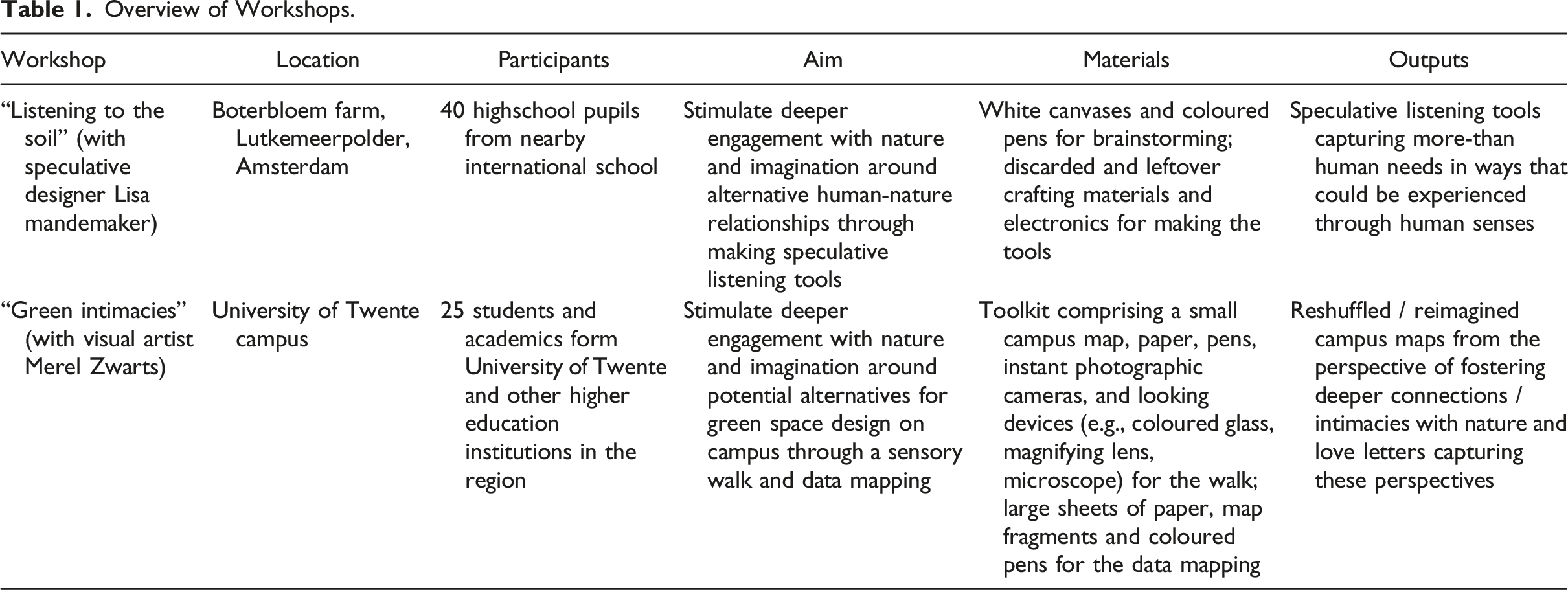
Overview of Workshops.
Defamiliarizing Through Rurban Encounters: Insights from the Field
In this section, we discuss two examples of workshops that we developed in collaboration with two creative practitioners. We present them as “vignettes” of our researcher - artist collaborations involving co-created methods, transdisciplinary and context-based coproduction. We use the workshops to illustrate how defamiliarization could be employed in Transition Design as well as by futures scholars.
Workshop 1: “Listening to the Soil” - An Exercise in Defamiliarization
The first workshop (June 2023) was developed with speculative designer Lisa Mandemaker and involved the making of speculative instruments to “listen to the soil”. Critical to the method were the location of the workshop, the struggles of the activist initiative that inspired us to organize it and one of their campaigns at the time, aimed at engaging the wider public with the issues concerning the land that generated these struggles.
The workshop was held at Boterbloem [Buttercup], an ecological care farm in Amsterdam Nieuw-West in the politically contested area of the Lutkemeerpolder and connected to Foodpark Asmterdam initiative. The farm is located on a piece of agricultural land at the edge of the city, destined to become an industrial area, while the activist initiative, Foodpark Amsterdam, are trying to stop these plans. As researchers, we have been involved in these struggles over land through a multi-year collaboration with Foodpark Amsterdam involving participatory action research (BioTraCes Horizon Europe project). We see this site of contestation as a quintessential “rurban” territory (Image 1). The Lutkemeerpolder 2023, a place with competing future plans (credits: the authors).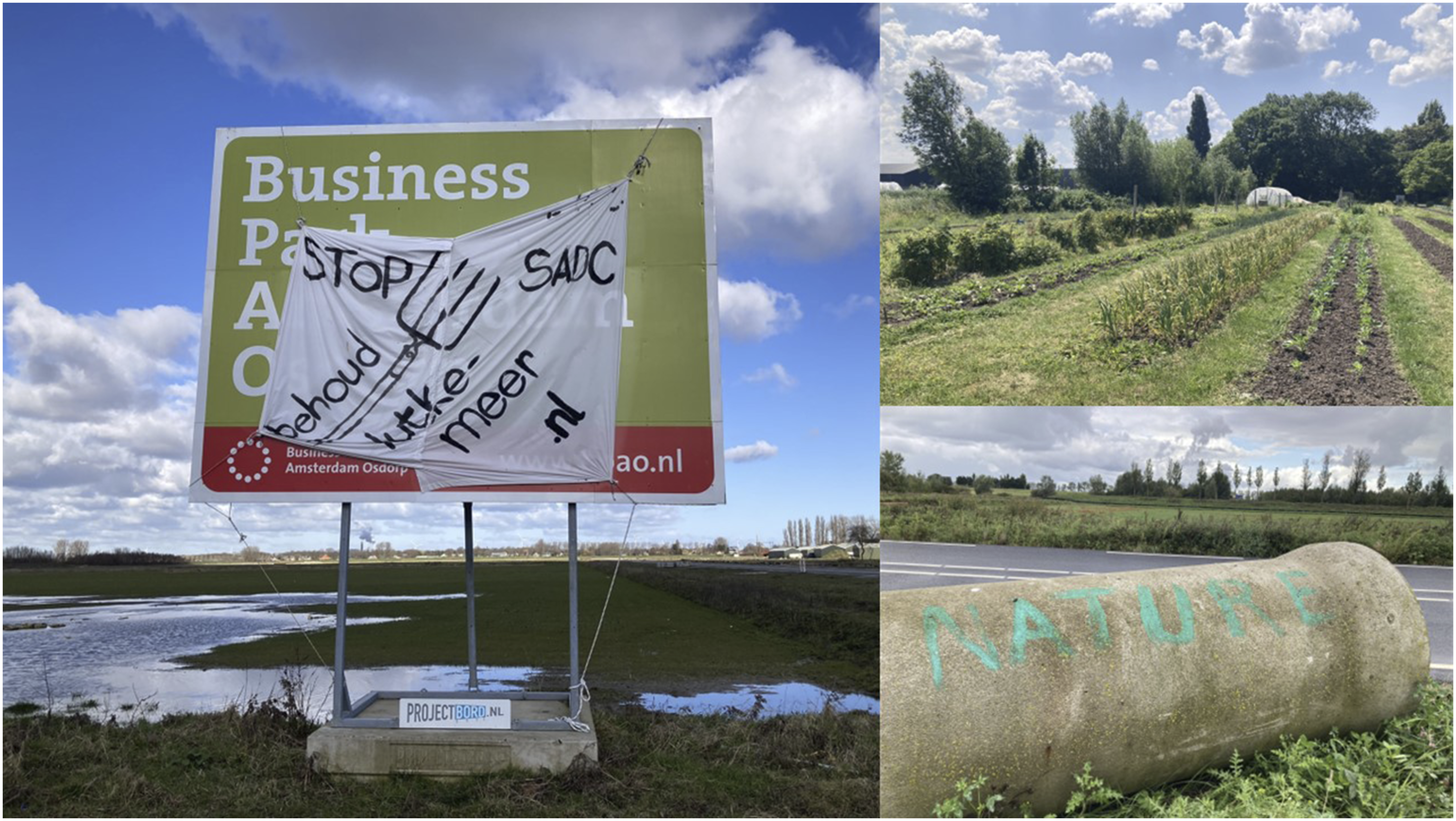
Through this close relationship with Foodpark Amsterdam, we became involved with their public outreach campaign at the time, titled “Give the soil your voice” (original: geef de bodem jouw stem). We expanded on this theme together with Lisa Mandemaker, an Amsterdam-based speculative designer. As researchers and engaged field workers, we provided the context and problem framing, while the designer took the lead in developing the creative steps and formats for the speculative workshop. The workshop was aimed at engaging different participants (outside the Foodpark Amsterdam initiative) with the specificities of this site in a way that could increase sensitivity to more-than-human needs and expand the imagination around alternative human-nature relationships in the city. For this, we invited as participants young people from a local public international high-school, who were not familiar with the area or the initiative. Listening to the soil workshop set-up (credits: the authors).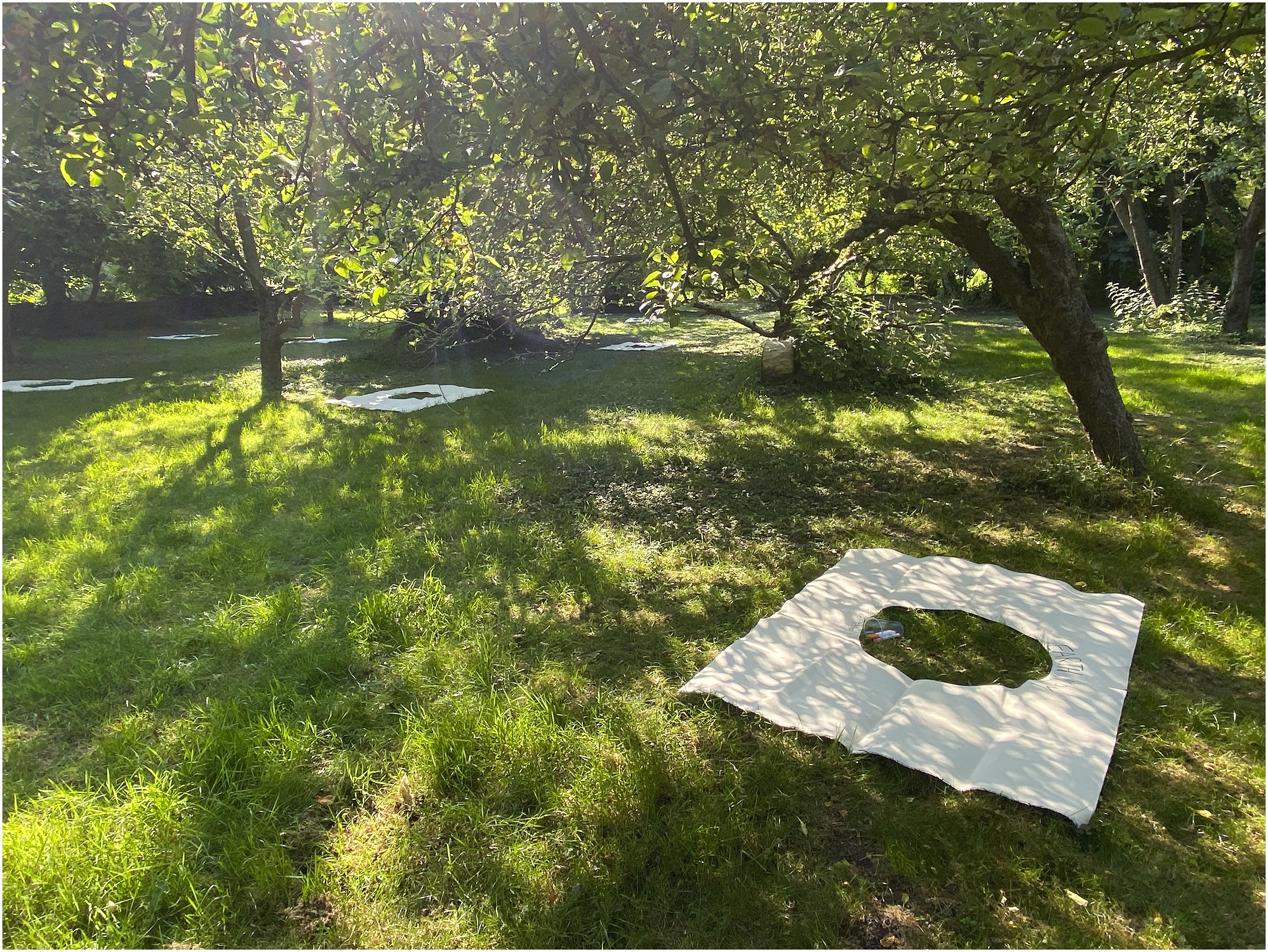
To enhance the connection with the land and possibilities for “listening to the soil” as a starting point for futuring alternative human-nature relations, we decided to hold the workshop in an old orchard, next to the farm. The participants worked in groups around brainstorm-canvases placed on the grass (Image 2). They were asked to think from the perspective of a given non-human actor, e.g., fungi, bacteria, or roots, about the soil network. Choosing a “human sense” and a “soil sense”, they had to elaborate on the notion of “listening” and brainstorm on possible interactions between humans and soil performing this action (e.g., hearing as well as caring for). Based on this, they were then asked to imagine and “design” speculative communication instruments that could bring up the needs of the soil in ways available to human senses, which they built from various discarded or leftover crafting materials (Images 3 and 4). Participants working on their canvases (credits: the authors). Brainstorm canvas and subsequent device for thinking about communicating with soil bacteria (credits: Lisa Mandemaker).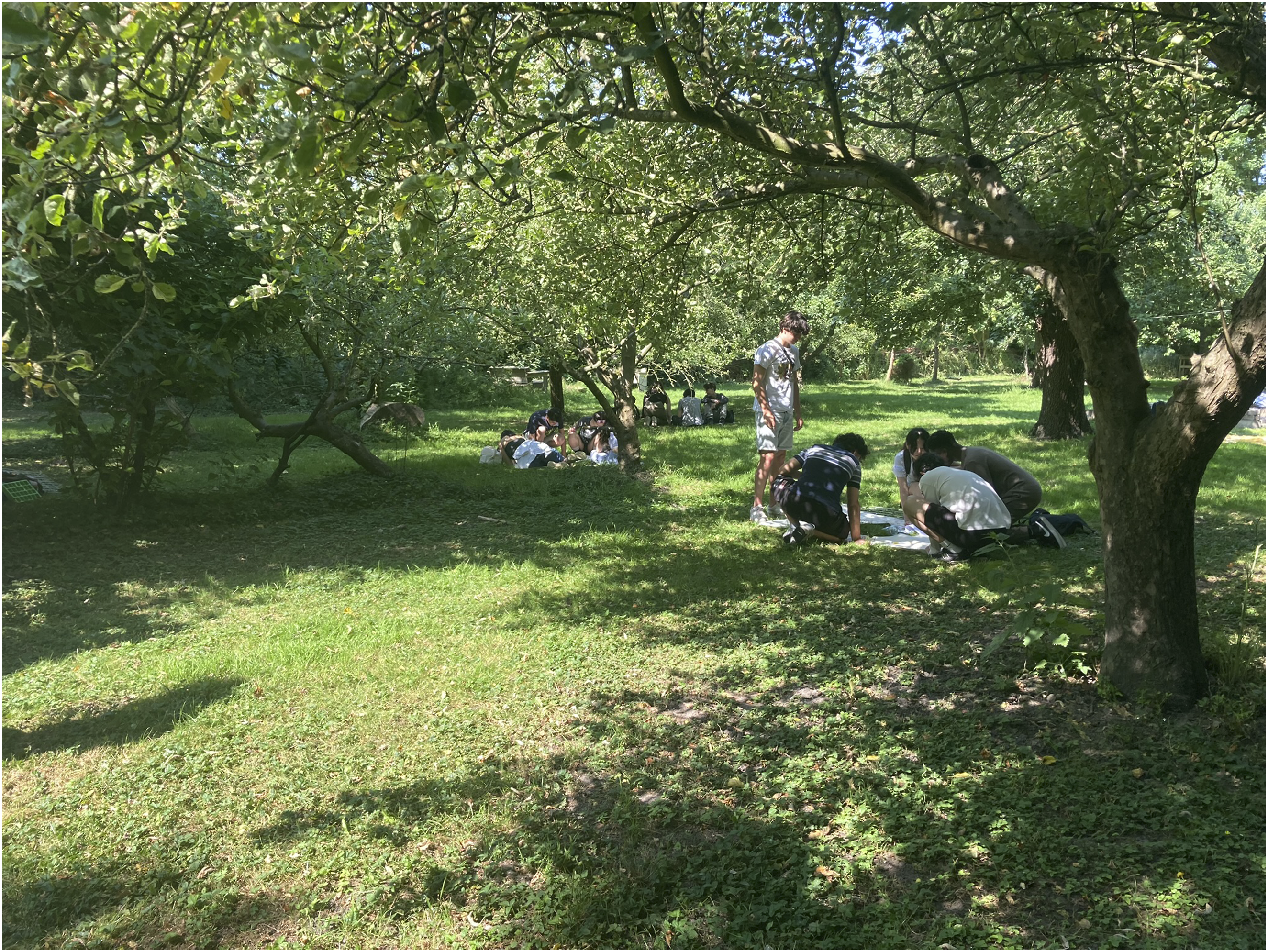
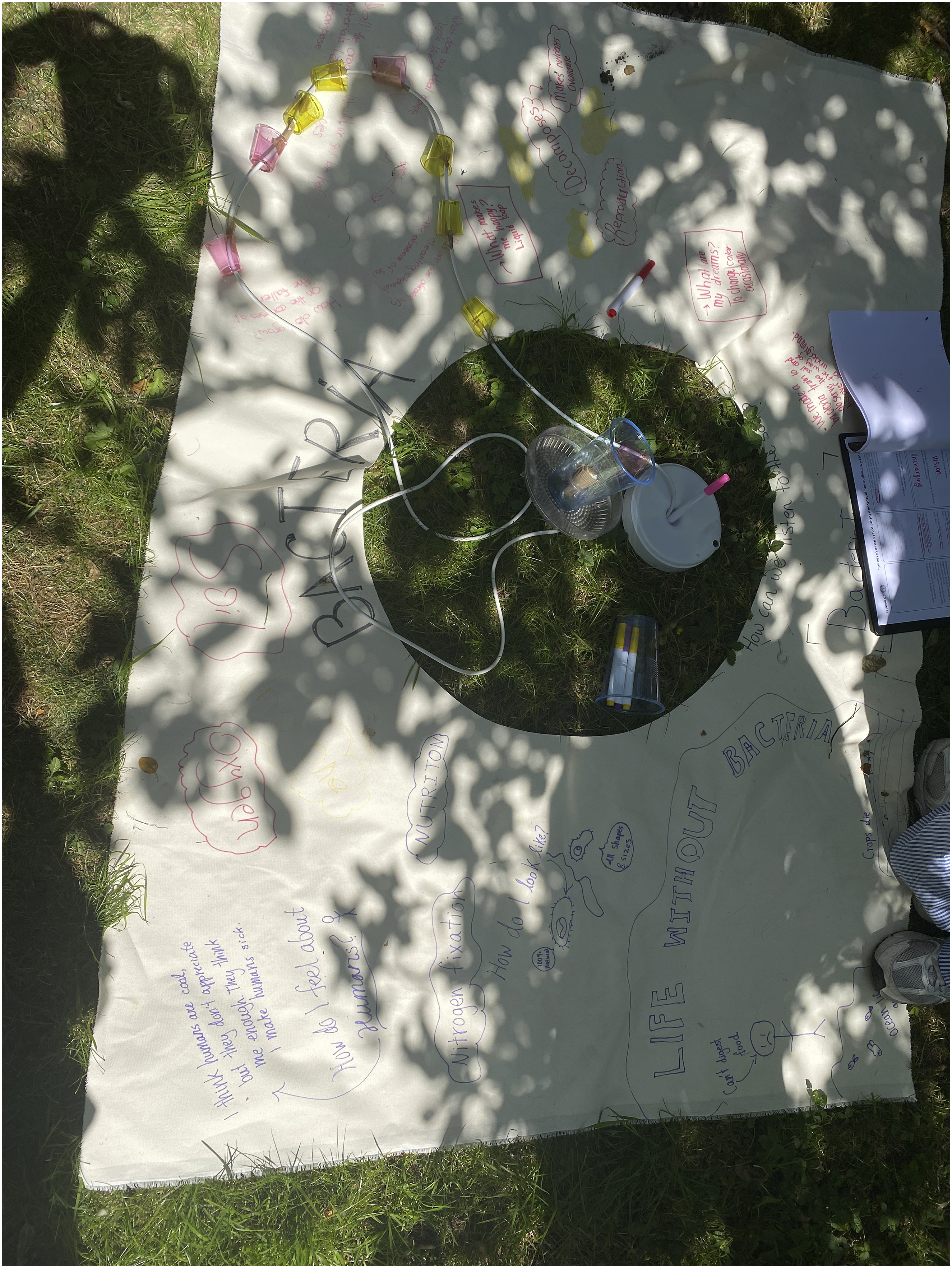
This speculative prototyping of “listening” instruments was an exercise in defamiliarization, as the participants were asked to depart from the usual ways of thinking about, and making sense of soil (e.g., as the solid matter that carries steps, mud that dirties shoes and clothes, or something that can be measured along the pH scale). In prompting other ways of listening, the perspectives were shifted and what before may have appeared as solid and mute matter was now bursting with life. Reality, as we knew it, was defamiliarized in a Shklovskyan way, as it allowed a new perspective. This provoked one participant to explain to his teacher: “But, Miss, bacteria don’t speak English…”
Defamiliarization is arguably always about going beyond one’s comfort zone, suspending what is familiar at that moment. For young urbanites, living in a dense and cosmopolitan city like Amsterdam where soil is not something one would typically think about from a biodiversity perspective, the shift in perspective we provoked through the workshop brought up uneasy feelings. The following example, which is a statement made by one of the participants after the workshop, shows well the “uneasiness” that is involved in defamiliarization. “The day started off with a workshop that wanted us to use random materials to invent something. I personally found this a little useless as there is little to no point in doing this. […] While the invention didn’t lead to much, it was still interesting to learn about earthworms, as they are usually an inconspicuous species that no one cares about, this led me to learn more about unremarkable species in the dirt, which did mean my perception improved.”
The quote points to the impatience that less scientific and goal-oriented modes of knowing oftentimes provoke and suspicion to more open-ended experimentation, easily dismissed as “random” and “useless”. At the same time, the statement shows a recognition that they learned something about earthworms, a reality which otherwise they would have thought to be “inconspicuous” and “unremarkable” and concluded that their “perception improved” through the exercise. While being a strange exercise, the task to design speculative communicative devices for earthworms stimulates imagination around alternative futures that reconnect human and non-human worlds, to generate new values and perspectives. Such a recognition may bring up political questions like how to organize the land so that it allows for the cohabitation of human and more-than-human species as relevant “stakeholders”? Perhaps then, defamiliarizing through speculative and arts-based design methods that cross disciplinary boundaries may present a tool or method, that to Ketonen-Oksi and Vigren are needed to “dismantle existing worldviews, values, aims, and perspectives” generating thus space for “new encounters” (Ketonen-Oksi and Vigren 2024, 9).
Whereas defamiliarization is often conceived as alienation and estrangement, defamiliarization as a shift towards a more-than-human perspective simultaneously denotes a familiarization with another point of view. In other words, taking another (or one other’s) perspective is deeply intimate, which also denotes an act of familiarization. We see this as an affective dimension, well-illustrated in the following description of listening to earthworms by one participant: “[...] we brainstormed what it would be like to be a worm, and how worms look up to us humans. We saw worms from a different perspective and made a product that explored love from and towards the soil. [...] We used an old way of communication that was mostly used by children before inventing all telephonic devices. […] Our product was named “soil mates” […]. The soil is the home of worms where love is possible” (Image 5 Soil phone (credits: the authors).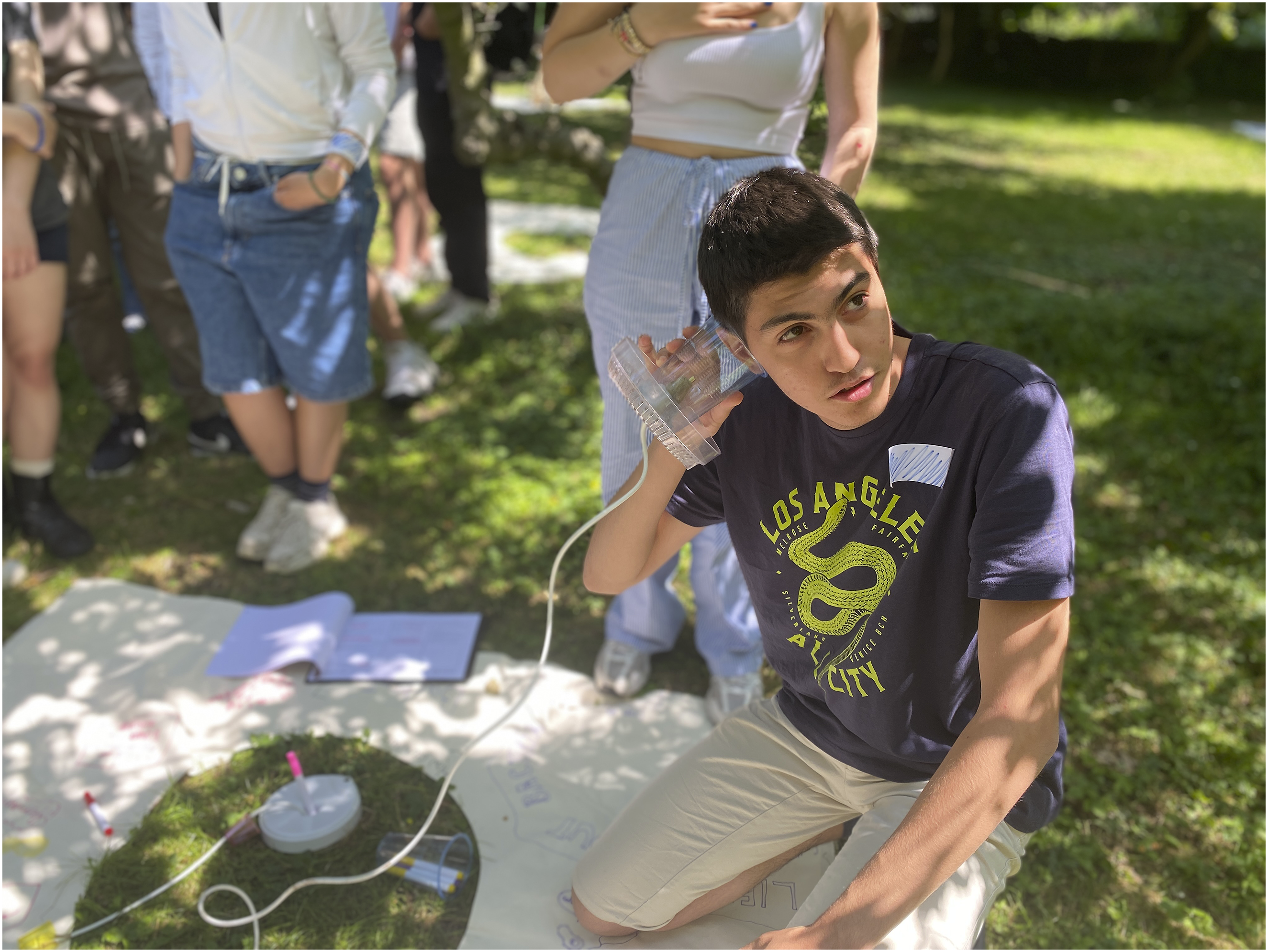
Workshop 2: “Green Intimacies” - An Exercise for Affective Encounters
The second workshop helps to further understand how defamiliarization, whilst alienating, may be also profoundly intimate. This was co-created with visual artist Merel Zwarts (member of The Outsiders artist collective) and involved sensorial walks and experiential mappings to reimagine “green intimacies” with nature. The workshop method builds on a long-standing collaboration related to the ongoing project, The Travelling Farm Museum of Forgotten Skills, of the artist collective (Zwarts et al. 2024). Building on previous collaborations with the artist, the workshop was developed as a “walk-shop”, combining a self-guided walk with a futuring workshop. The walk-shop was held in November 2023, during the University of Twente “Sustainability Week”, on the university campus, which is located on former farming land, at the edge of the city of Enschede. The theme of the workshop was connected to a research project at the time that explored the potential of green infrastructure to address climate change through multi-sensory walk-shop methods. Participants comprised academic staff from various disciplines students from the university and other academic institutions in the region. Campus landscape on the day of the workshop (credits: Sry Handini Puteri).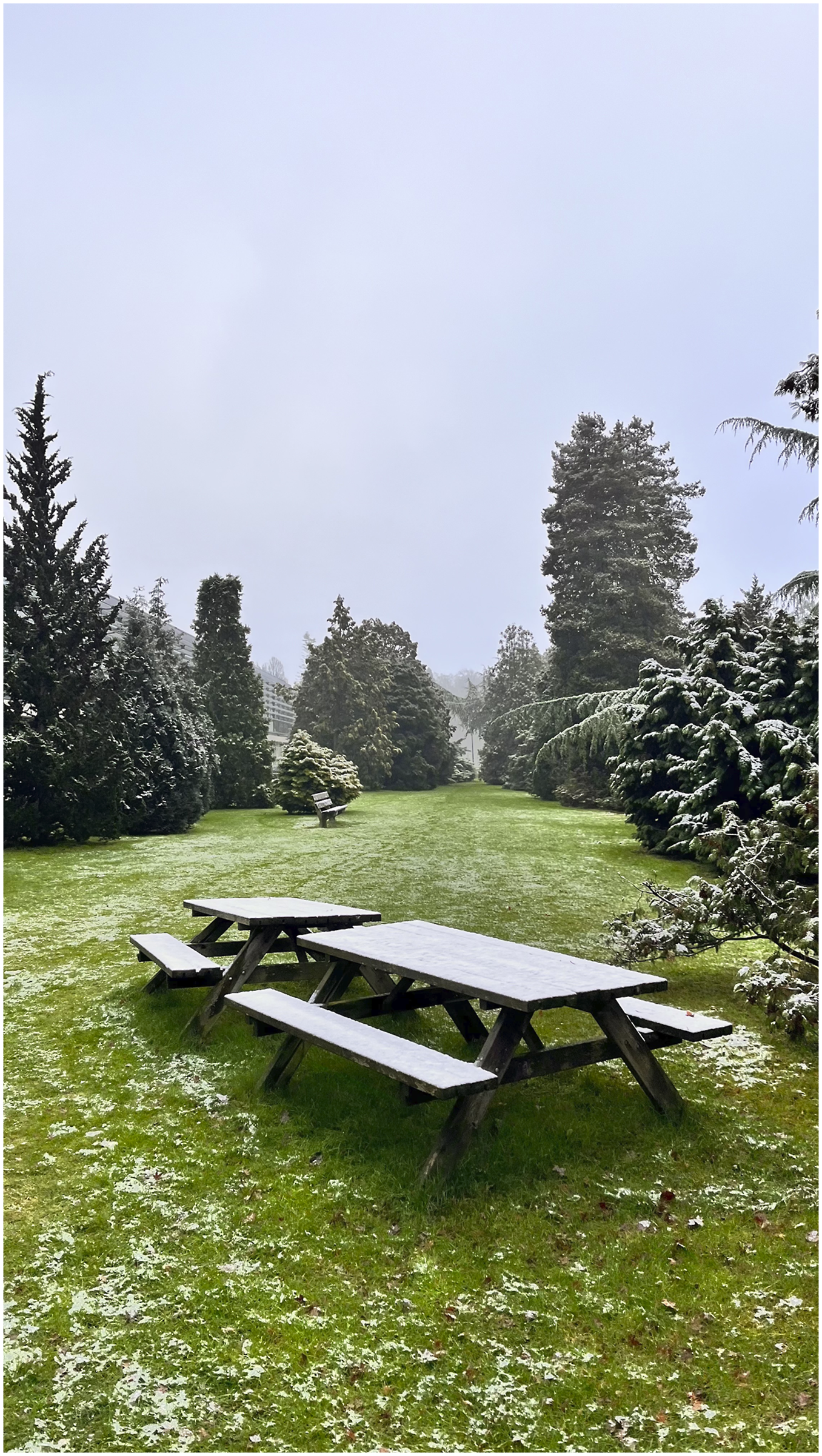
As an artistic twist on the terminology of “green infrastructure” (GI), which was the theme of the research, we decided to provoke the participants to think about “green intimacies(GI)” instead as a form of defamiliarization, with the aim to address non-technical dimensions of green infrastructure, including the kinds of human-nature relations it supports. This terminology emerged through discussions and reflections between the artist and the researcher during a preparatory walk to experience green space on campus. While the campus still presents a “rural” dimension, through the presence of older wooded areas, it has an “urban” character through the relative density of faculty and laboratory buildings and the carefully curated arboretum. To us, this illustrated another type of “rurban” territory, where both different kinds of relationships with nature as “green” environments could be experienced (Image 6).
Focusing on the term of green intimacies, the main aim of the walk-shop was to stimulate sensory and affective experiences of green space on campus as a starting point for futuring new design possibilities for green infrastructure. To defamiliarize the participants with what they already knew about green space on campus (as many worked or studied at the university), the first part of the workshop sent the participants out for a walk, in small groups of 4–6 people. The task was for each group to explore places where humans and other living species met, record feelings and values they associated with these places, and collect “data” on what they felt as “green intimacies”. As a further prompt in the defamiliarization process, different roles were assigned within the group, inspired by other data walking methods (Powell 2018). The roles included a note-taker, a mapmaker, and a photographer equipped with an instant camera. Moreover, we provided the groups with various “looking tools”, like colored glass, a microscope and a magnifying lens, aimed at stimulating playful interactions and focusing attention on present and potential (or alternative) relations to nature. These tools were selected from what we, as organizers, already had available among our work materials - a reuse ethic, which is also reflected in the choice of prototyping materials from the first workshop (Image 7). Tools used in the walk (credits: Sry Handini Puteri).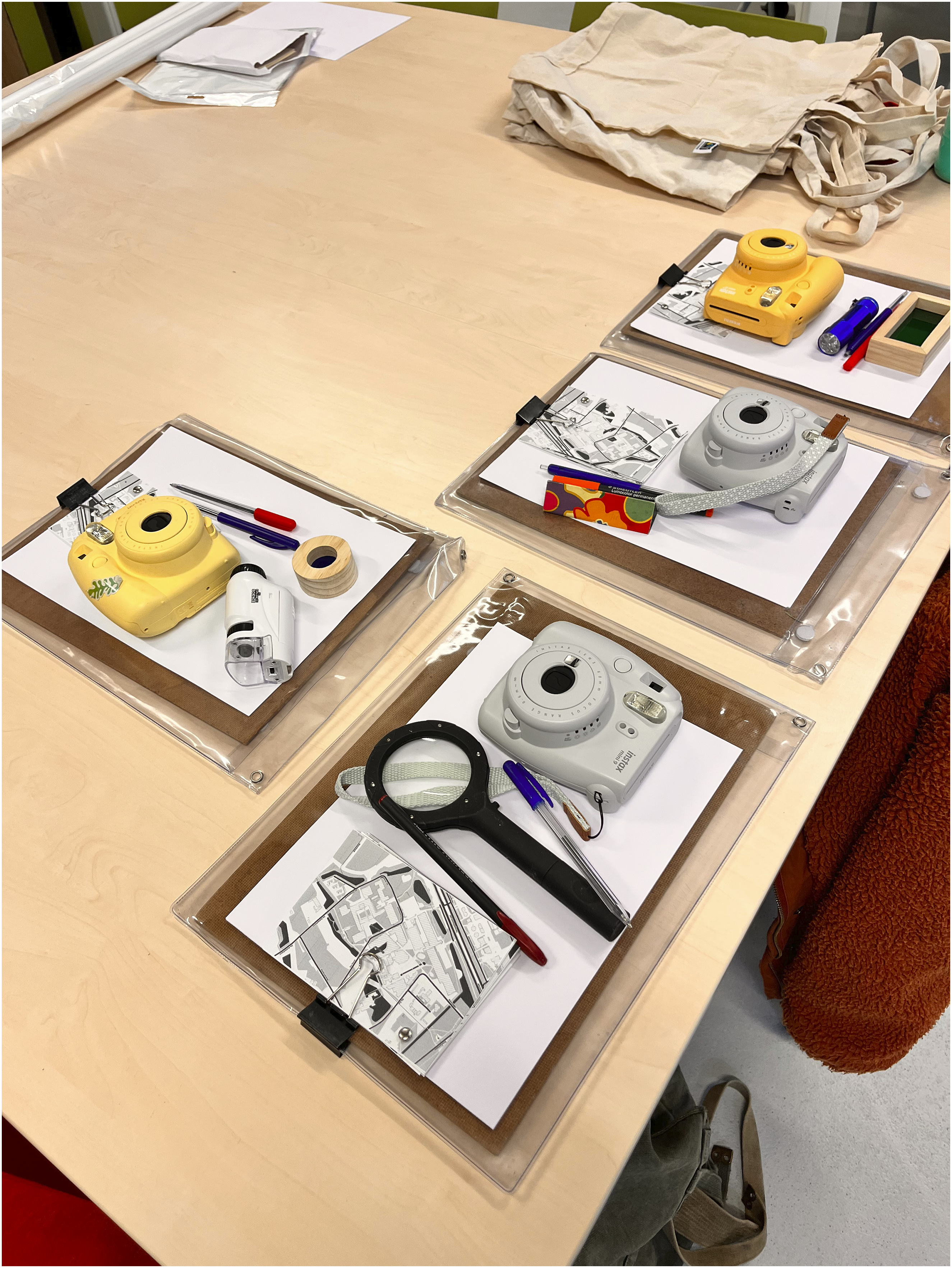
By leaving the definition of “green intimacies” purposely open, the data collected from the walk experience ranged widely, often depending also on the extent of the route. While all groups had 40 minutes to conduct the walk before returning to the workshop space, some walked further than others, which also reflected in the type of intimacies gathered. For example, the group that stayed closest to the workshop space, explored with enhanced attention a very small area nearby, designed and maintained as a park. In their case, intimacy was built by paying close and playful attention. In her notes, the note-taker of this group mentioned a tiny mushroom that “caught our eye and while intensely observing this soft body some of us suddenly wished to be closer”. These are some of the notes describing the encounter: ∼ creamy yellow ∼ also a little fungus ∼ is it edible? ∼ looks like chicken bread ∼ ding dong little white mushroom ∼ cute ∼ soft texture ∼ creamy color ∼ I JUST WANT TO BE UNDER THE HOOD. This enhanced attention to nature made one of the other group members observe that “I can’t remember the last time I looked at nature so closely. I go to the forest, but that is for my own walking” Mapping exercise after walk-shop by mushroom group (credits: Merel Zwarts).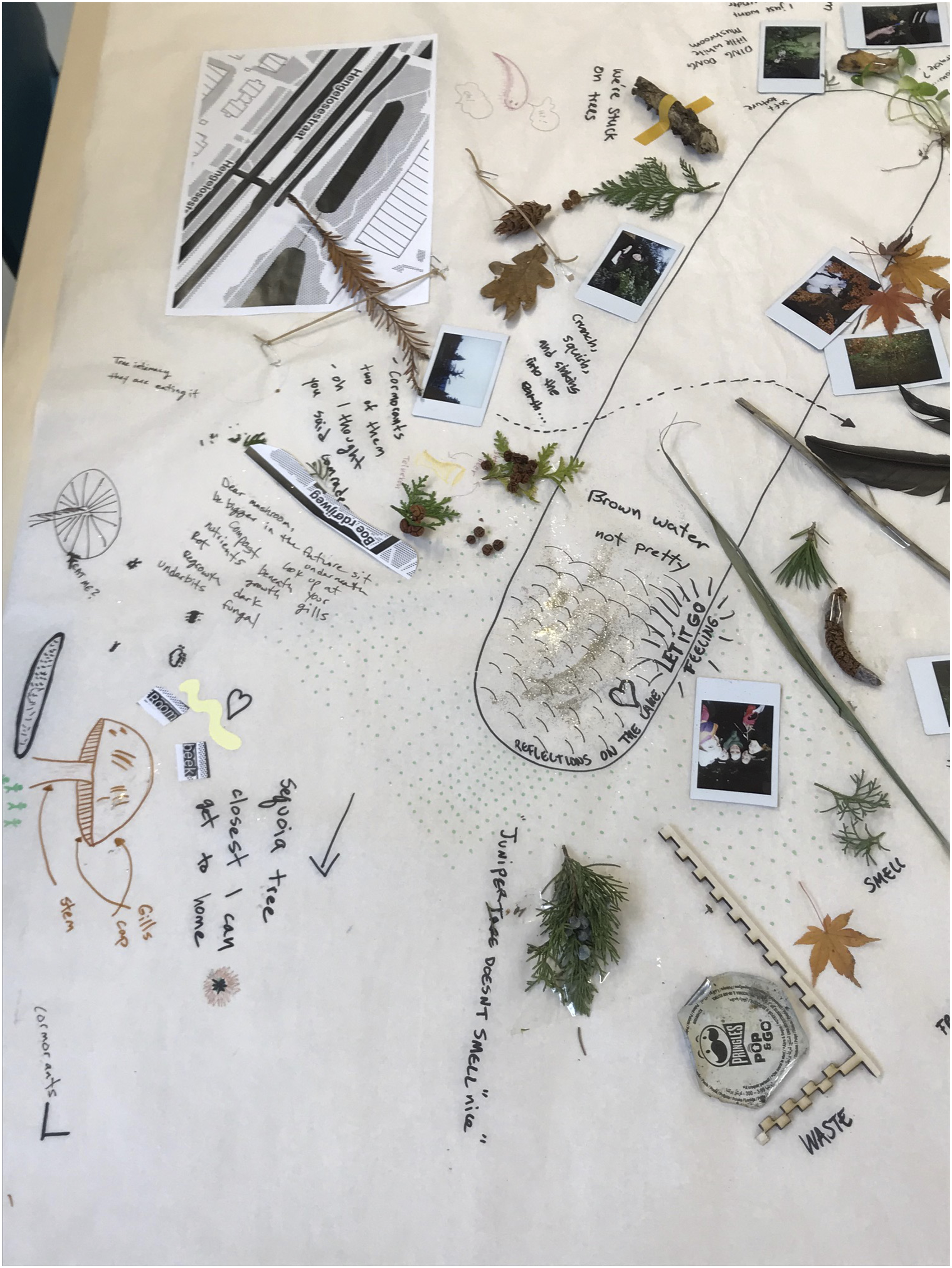
The second step of the workshop involved patchworking a large campus map with “green intimacies” by mapping the data collected in the walk, such as notes on experiences, photos, objects and non-living nature elements, like fallen leaves, found along the way (Image 8). This workshop step was used as a prompt in stimulating alternative design visions for how green infrastructure could be conceived on campus, with the values and feelings - green intimacies - identified during the walk. Thus, after having mapped their walk data, the groups were asked to “reshuffle” the map and reimagine green infrastructure on campus by expanding the green intimacy experiences to other places where alternative relationships with nature were needed (Image 9).
The observations made by the “mushroom group” in their walk came back in the mapping through questions like: “is it edible? [it] looks like chicken bread”, which ‘reshuffled’ and consequently defamiliarized the dominant distinction between “food” and “park” (as green infrastructure) in this part of the world, where food belongs to the supermarket and parks are places for leisure. Another group, when asked to “reshuffle” their map, reimagined the campus like a food forest for people and animals. This would then shift the perspective of “green” as a pristine landscape to be admired, to green as an enticing, productive, and flavorsome environment we can get involved with and taste. Campus re-imagined as a Foodforest (credits: Merel Zwarts).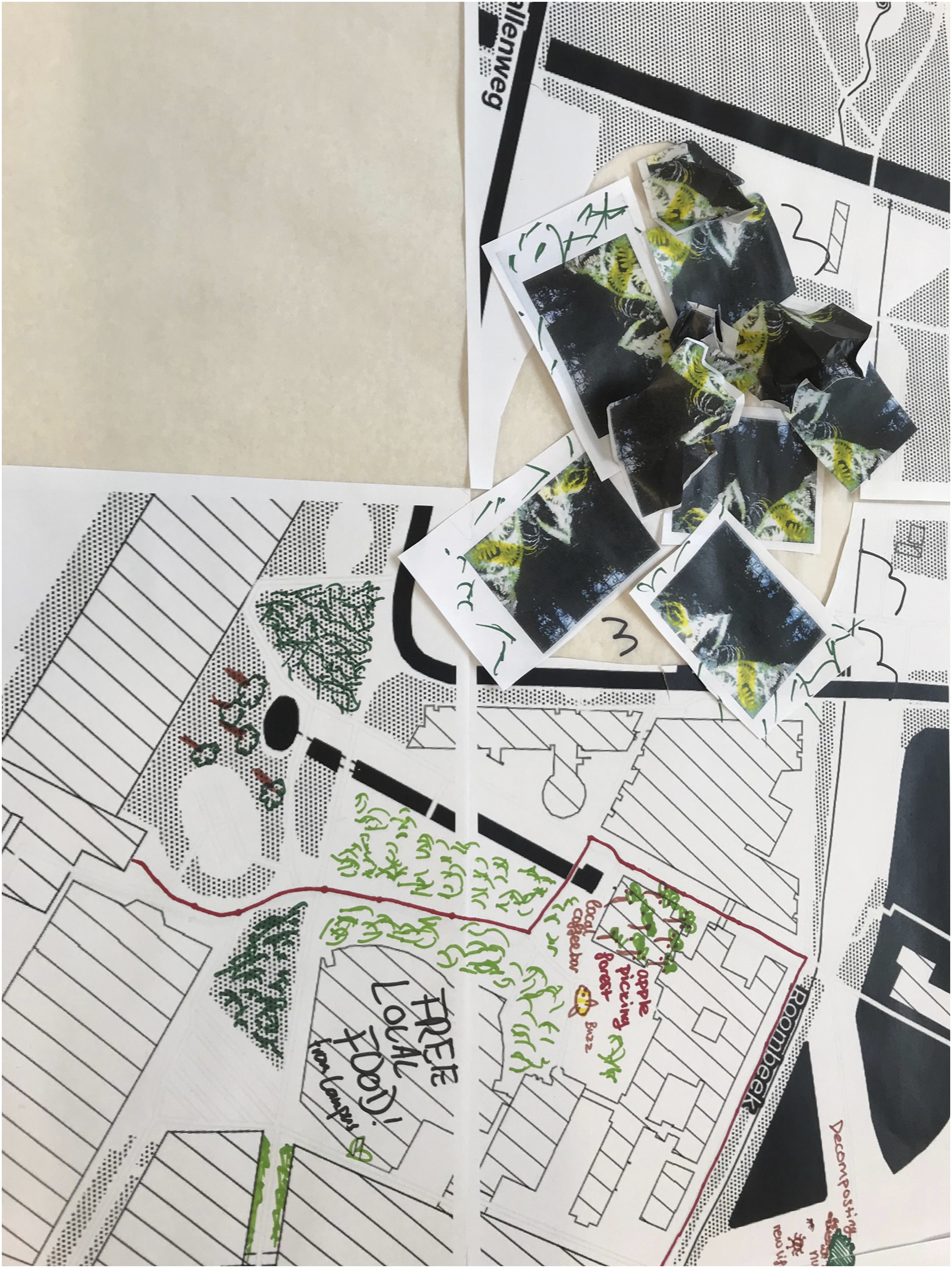
Like the walk, the mapping and the reshuffling tasks were embodied activities, involving gluing, cutting, and re-gluing the map in new arrangements, and could also be seen as an exercise in defamiliarization as they changed the typical way of seeing nature on campus. To stimulate reflection on this defamiliarization process, in the last walk-shop step, the groups were asked to articulate their “green intimacies” through short narratives expressed in the form of love letters to the places where they found them . For instance, the green intimacy experienced by the mushroom group related to the “under the hood” augmented perspective that allowed for enhanced attention to the mushroom: “Dear Mushroom, be bigger in the future to sit underneath”. The group then drew a mushroom from beneath where, in place of the lamellas they wrote keywords about the things the mushroom meant to them: “Underbits / Beneath / Growth / Fungal / Gilles / Dark / Regrowth / Compost / Rot.” Other groups, opted for formats that were more generally recognizable as love letters, and that showed more clearly how in fact the defamiliarization exercised in the walk-shop, was again an act of becoming familiar with nature. This is illustrated well by a group who experienced the intimacy of becoming a family with nature, addressing their letter to “Dear Mother” and signing it with “your wild thing” (Image 10). “Dear Mushroom” and “Dear Mother” letter on the map (credits: Merel Zwarts).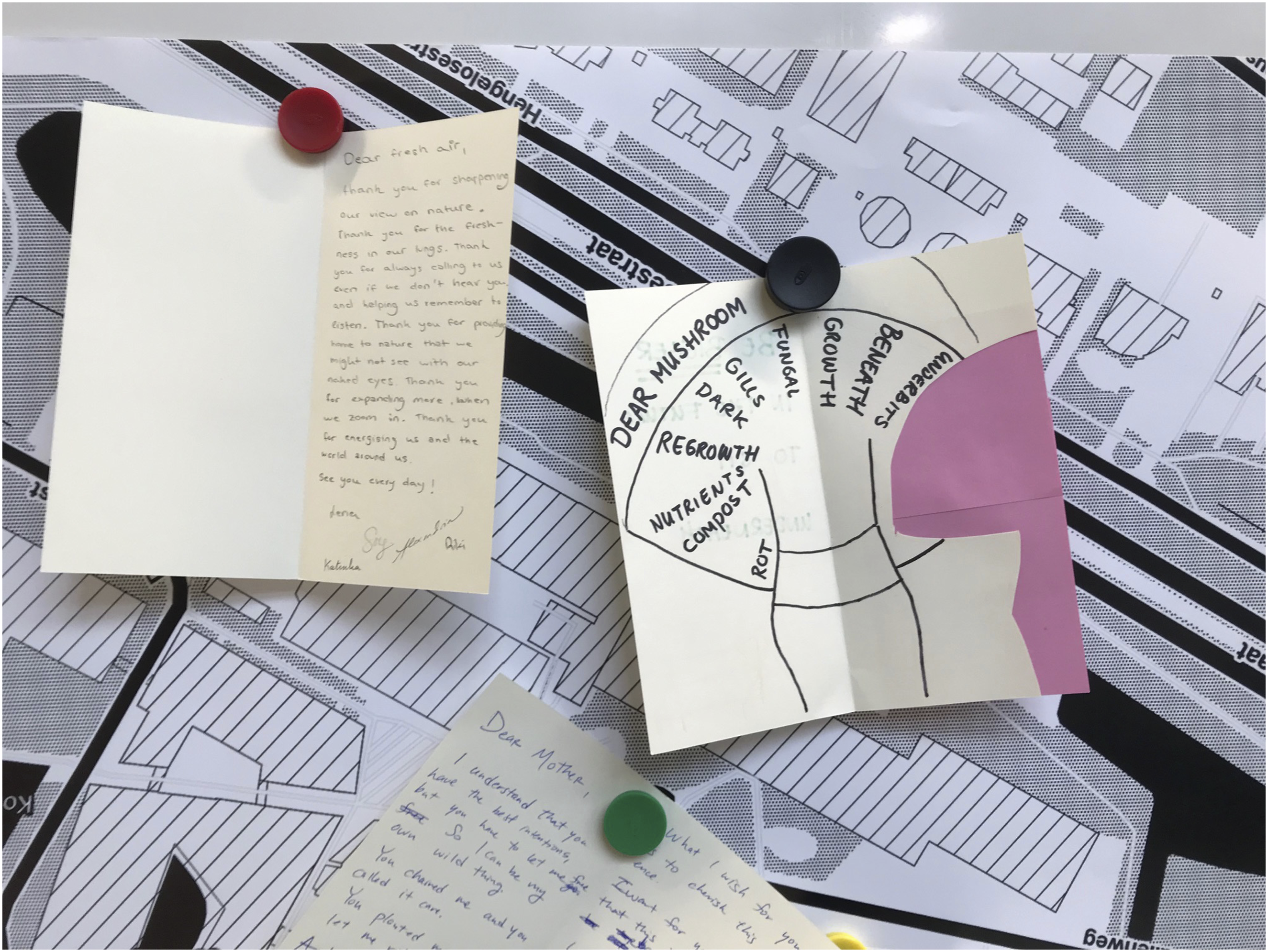
Thus, the workshop was a moment during which we could collaboratively imagine an otherwise by searching for and experimenting with alternative modes of relating. As this workshop experience shows, this is a practice that involves defamiliarization with the ways we usually engage with our surroundings which simultaneously is also a gesture of familiarizing and becoming intimate with a world that otherwise might be alien to us or recede to the background. It is this pairing of defamiliarization and refamiliarization which provides the basis for futuring methods that serve to imagine transformational futures beyond the status quo.
Discussion: “Gluing” Affective Rurban Meanings and Alternative Future Imaginaries
In both vignettes, the co-created, arts-based methods were employed for “poetic” purposes as they were precisely about defamiliarizing the everyday as a way to stimulate alternative imaginaries centered on different ways of relating to the more-than-human world. This defamiliarizes, or makes strange, routinized modes of perception, narratives, and problem framings that retain the divide between the urban and the rural. In this process, new meanings emerged: soil was not understood to belong to “nature out there”, but to be in a soulful companionship with humans; while parks were understood not only as places to be used for leisure but as immersive environments where food grows, and we meet other species. These new meanings were made possible through temporarily opening up rurban in-between spaces, through situated encounters. In these encounters, an increased attentiveness to context was expressed as an affective relation towards an aspect of that place, such as an earthworm, or a mushroom. Thus, new meanings were generated not only through humans collaborating, but also by humans letting more-than-human natures enter their minds and, importantly, the imagination.
These new meanings come along with their own challenges and limitations. They cannot be fixed, or neatly represented. Also, this knowledge is not immediately “actionable”, “scalable” to other contexts and thus applicable as a “solution”. All this presents difficulties to assess the efficacy of the methods, an issue Ketonen-Oksi and Vigren consider a limitation in their integrative literature review on imagining transformative futures, particularly when it comes to the knowledge generated in “individual workshops or short-term processes” (2024, 9).
Recognizing the partiality and limitations of the knowledges that are generated in situated encounters, we propose that the meanings that are generated can be analytically “glued” to build new conceptual worlds and potentially, alternative imaginaries. Once existing meanings were defamiliarized and reshuffled, new meanings were “glued” together by the participants through the co-creation of group artifacts that generated reflections and critical questions about the topics explored (Image 11). On an immediate level, the materiality implied by the metaphor of “glue” (i.e., a sticky, adhesive substance used to bind things together and create attachments) was reflected in the creative process of making things together, like the listening instruments or the maps. The concept of “gluing” was originally developed as a conceptual-analytical framework to explore the role of (architectural) design in the coproduction of alternative imaginaries of sustainable futures (Baibarac-Duignan and Medeşan 2023). In our analysis, this conceptualization of gluing in relation to imaginaries is given further nuance, specifically in terms of forming new attachments that are material, semiotic and affective. It is the creative process of bringing together methods, practices, forms of knowledge and ways of knowing, which are context-specific and account for diverse values, that emphasizes crafting relations rather than outputs. While gluing is primarily associated with human activity of sticking things together, literally re-purposing what has been apart, the production and use of adhesive substances is used by different species across the ecosystems in meaningful ways to build new structures and acquire vital nutrients (like bees or spiders). It is in this way that we find the notion of gluing valuable here - in its broadest and most ecological sense - as the process of producing new meanings and thus creating possibilities for new imaginaries.
When seen as a gluing process, the coproduction of alternative imaginaries creates possibilities for new ways of being and acting in the world (Moore and Milkoreit 2020). These alternative imaginaries can emerge when design pays increased attention to context, to a plurality of values (including more-than-human nature values) and to future relations (Baibarac-Duignan and Medeşan 2023). By zooming into the creative processes entailed by the two workshops through a gluing lens, we can start to derive some useful findings for how affective encounters and the knowledge generated through such encounters can benefit Transition Design and the futures community. Specifically, we trace the knowledge that emerged during the workshops as “patchy” and “sticky”, offering possibilities for longer-term collaborative and mutually enhancing relations.
Patchy Knowledge
With multispecies ethnographer Anna Tsing, “Landscape and landscape knowledge develop in patches” (Tsing [2015] 2017, 228). Patchiness is not only something that appears in multispecies ethnographies, but also in the field of design. Sharma et al., for example paraphrases Veeraraghavan’s notion of “‘patching’ as the process of iteratively redesigning interventions when new information concerning an intervention emerges” (Sharma et al. 2023, 19). From a transformative change perspective, Mehta et al. write about “‘patches of transformation’”: “Patches are sites where specific processes (alliances, initiatives) are challenging dominant trajectories of development, and where relations of power and knowledge are being reconfigured in more heterogeneous and deliberative ways to challenge dominant framings of nature-society relations and create spaces in which new practices emerge” (Mehta et al. 2021, 112).
To us, the knowledge that is generated through affective encounters is patchy, because there is some kind of inherent refusal of total representation. The learning that happened in the encounter cannot be relayed in its entirety in facts or measurable indicators. It is not something that can be graded with a number or formulated neatly into a “stakeholder need” that is subsequently translated into a solution. It is an embodied experience that goes beyond language (“bacteria don’t speak English”) and about an affective relationship, as expressed in the idea of “soil mates” or in the desire to be protected by a mushroom. This patchiness makes the experience less applicable for deriving a comprehensive road map. It is also in this way that it is laborious and difficult, that patchiness is a poetic tool for defamiliarization.
This patchy quality of knowledge thus generated, however, still reveals something important when working together with different stakeholders. It shows that representation is always also a political question about whose voices are being heard. As Veeraraghavan (2021) and Mehta et al. (2021) make clear, patchiness is always also a question about power. This brings about critical questions that can expand Transition Design, for instance: If Transition Design is about considering “all stakeholders” (Irwin 2018), how will the more-than-human world be taken on board? If more-than-human nature will be considered, it will not be by weighing against each-other different species’ interests. It becomes clear that “all stakeholders”, as an all-encompassing entity, will always be a target that will be missed. This suggests that nature does not only need a “better lobby,” but rather a more generally cultivated affective attunement that prioritizes mutual flourishing to calibrate priorities and matters of care for sustainable and just futures, for an ecosystem of human and nonhuman entities.
Sticky Knowledge
The knowledge generated in a situated, affective encounter is also sticky, in ways that it cannot be disentangled from context. Feminist theorist Ahmed proposes the concept of stickiness when analyzing how certain words accumulate affects and meanings in public discourses in relation to national identity. She describes stickiness “as an effect of the histories of contact between bodies, objects, and signs” and in this sense “stickiness involves a form of relationality, or a “withness”, in which the elements that are ‘with’ get bound together” (Ahmed 2014, 90 emphasis removed, 91). In a more generalized fashion, Ahmed’s notion of stickiness is also useful for understanding the significance of meanings generated in situated encounters, as a way of making palpable that the specific knowledges that are generated here carry attachments to the specific (historical, political) landscape formations (agricultural land, a park) and all the life involved. It matters that we learned about the earthworm or the mushroom in a situated and affective encounter. It is in a specific place and in relation to others and other objects, that things become saturated with affect. It is this contact that makes them sticky (Ahmed 2014, 11, 18). What the earthworm, or the mushroom meant during the workshop cannot be detached from the social situation around the Lutkemeerpolder or the campus.
Yet, stickiness in this sense does not mean that meanings that emerged in a specific place, only remain meaningful in that context and at that moment in time. Stickiness, in fact, also has a pedagogical potential where learnings from one place may be glued - become sticky - and generate new relationships that can make the meaning generated through a situated affective encounter travel to other places. Potawatomi botanist Robin Wall Kimmerer describes this potential in Braiding Sweetgrass when she writes that the power of a garden “goes far beyond the garden gate - once you develop a relationship with a little patch of earth, it becomes a seed itself” (Kimmerer 2013, 126–127). Sharing affective encounters with group (credits: the authors).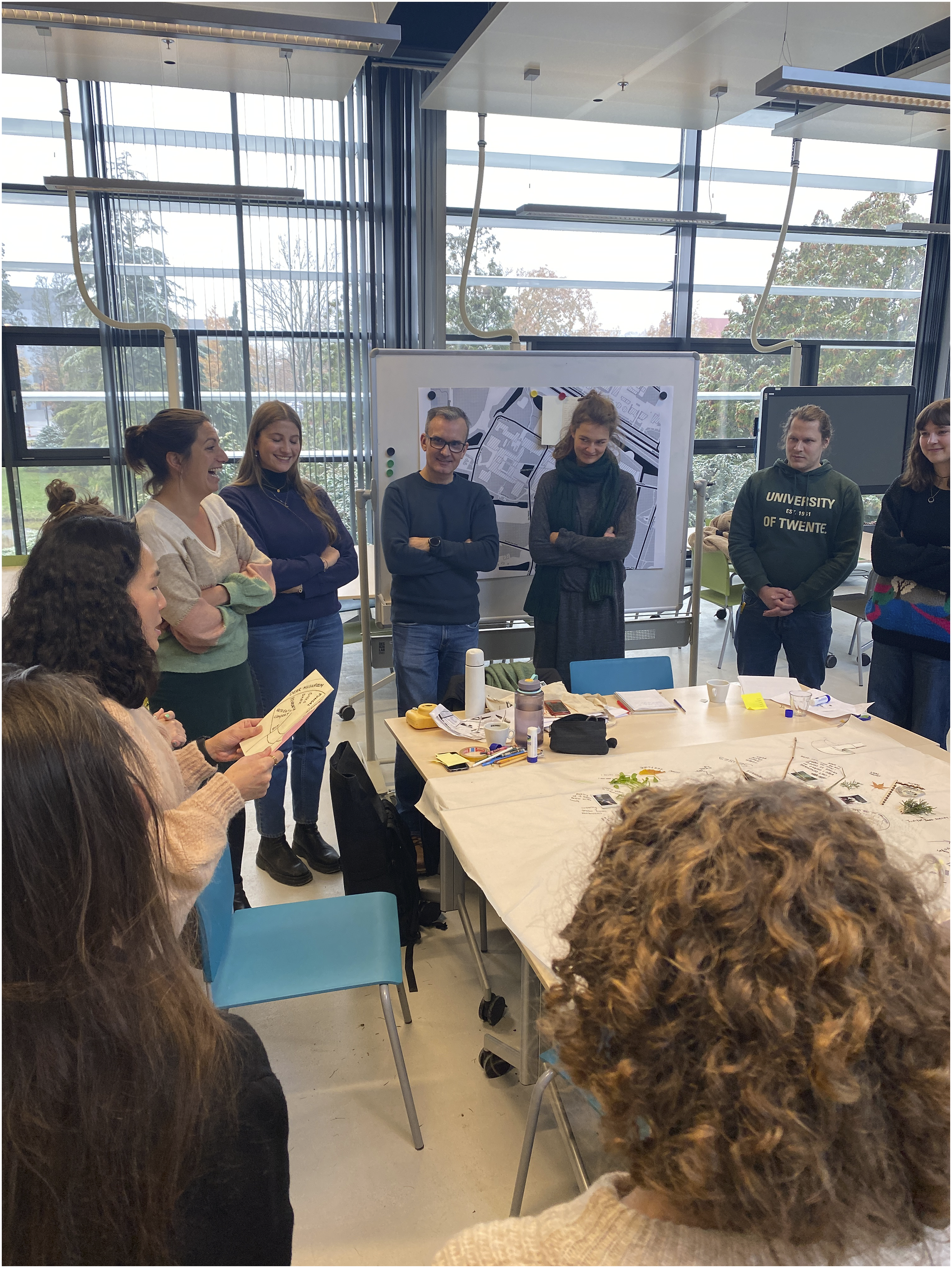
Conclusion
In this paper, we engaged with the fields of Transition Design and futures studies from the perspective of creative arts-based methods. In doing so, we align with approaches that argue for a move beyond transitions and towards transformations - which, at their deepest leverage points, entail transformations in fundamental ways of making sense of the world (Davelaar 2021; Vervoort et al. 2024). The way meanings are socially constructed has profound implications on how the future is imagined and what horizons for actions are in sight. Mindsets and paradigms, as Irwin, Tonkinwise, and Kossoff relay by referring to Meadows, are perhaps “the single most powerful leverage point for change” (2020, 44). Tying our work back to the Transition Design framework and its four areas of co-evolving knowledge and skillsets, in this paper we showed how arts-based methods present a tool to experiment with transformative postures and mindsets.
There is already a growing body of research that sees the relevance of “experimental productions” (Vervoort et al. 2024) and art and design works (Pelzer and Versteeg 2019). This paper further deepens the site-specific and co-creative aspects of art and design at the very outset of the creative process as there is still a tendency to examine artworks, like immersive installations (Bendor 2018), that are predominantly used to engage audiences after the artist finished them (e.g., 2018 exhibition Places of Hope 2 ). In such a way, we aim to foreground the process of creative productions, which “troubles” the idea of knowledge as an outcome that can consequently be implemented to solve wicked problems. This process, as we showed, is a collaborative one, which is an important condition for making the future a project that involves the participation of various stakeholders, particularly those that are too often excluded from transition design processes. In our workshop, this meant young people from a local public international high-school, and the more-than-human world.
Paying attention to the process of creative production drew our attention to the meaning making process the artistic design exercises allowed for. In this process, we identified defamiliarizing, the technique of poetically making strange the current situation, as an important dynamic that consequently made space for alternatives and different modes of sense-making. As our examples showed, this is a multi-sensory process that not only allows for new perspectives but also for new modes of affectively relating and forming attachments, allowing ultimately a form of intimate refamiliarization with the more-than-human world. This dynamic defamiliarization-refamiliarization process invites alternative meanings beyond rural urban dichotomies that potentially could bring about imaginaries with transformative potential.
A focus on how meaning emerges in the process of affective encounters confronts us with the patchy and sticky aspects of knowledge generation. Recognizing these aspects of knowledge generation does not only provide limitations. It also offers possibilities for refining how to think about knowledge transfer as an inherently pluralizing process. Place-based, situated knowledge that is “glued” into new compositions, or ecologies rooted in place will invite new meanings due to its patchy and sticky nature, which makes it a creative and ongoing process of leaving out and adding on. Further building on the pedagogical power of “Kimmerer’s garden”, we may see seeds as a plant’s leap of faith for the future that after blooming is dispersed in all kinds of directions generating new and different lives, depending on where they land. Similarly, the sticky and patchy knowledges generated through arts-based methods remain deeply connected to the place it was generated. In new environments and through a process of “creative crossings” between different epistemic cultures (Verhoeff and Dresscher 2020), it may connect to new assemblages of meaning generating new place-specific expressions of alternative future imaginaries. From this perspective, stickiness can be seen as a form of knowledge dispersion that emerges through necessary place-based patchiness. Specifically, it points to how different context-specific expressions may expand collectively to shift dominant narratives and problem framings, making way for other futures through new postures and mindsets.
Thus, understanding knowledge as sticky and patchy shows the tension between intimately place-based meanings and learnings and the structural and complicated problems that transcend the local. Such an orientation leaves us then not with a stabilized, institutionalized social imaginary (Jasanoff and Kim 2015) but with a dynamic mosaic where affective visions are continuously pieced, or metaphorically glued, together. Reflecting with feminist Science and Technology scholar Karen Barad, this may be understood as a “matter of possibilities for reconfiguring entanglements” (Barad 2012, 7), where creating possibilities for new imaginative spaces can generate possibilities for new ways of being and acting in the world. Instead of searching for smooth transitions between these different scales and epistemic cultures, in this paper we turned to the notion of gluing to make connections and attachments between different knowledges and ways of knowing. Loveletter designed by Merel Zwarts from the Green Intimacy workshop as exhibited on the University of Twente campus (credits: Merel Zwarts).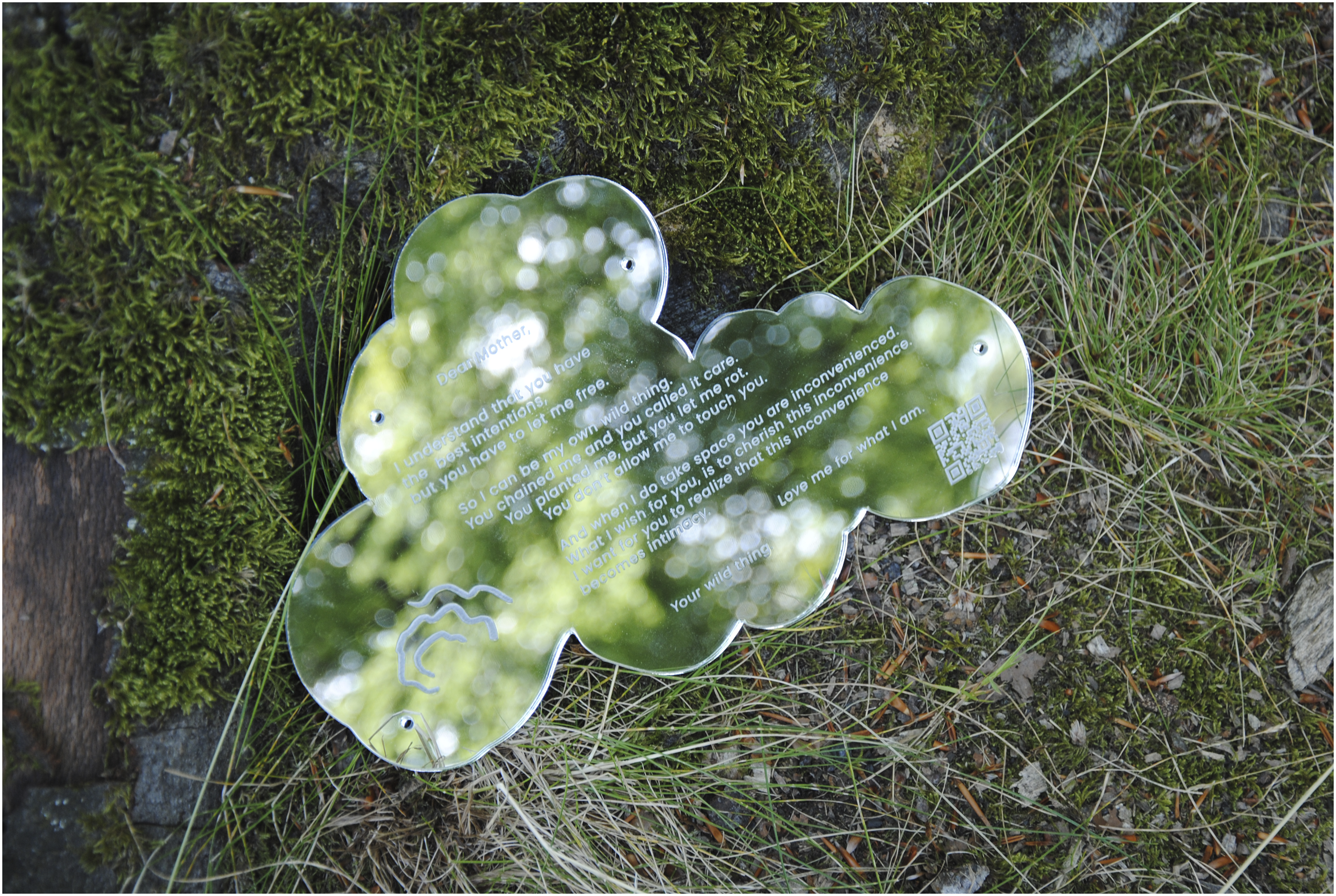
How to share knowledge that is produced in this way? In this article, we have tried to share a condensed yet comprehensive version of our methodologies, observations and thinking process. We hope that some of our readers will be inspired and activate this approach in other contexts. Others might even find themselves visiting the University campus where, in the branches of a tree or by a grass patch, they will be able to bump into quirky love letters printed in colorful plexiglass (Image 12). These are the material traces of the Green Intimacies workshop during which the different groups expressed their affective encounters with some of the green spaces on campus during their walks. These love letters are there to be found by students and colleagues and inspire them to pause and look around differently. Bacteria don’t speak English. And we have a lot to learn about how to make our love understandable to the more-than-human living world. But that should not stop us from reaching out, listening, feeling intimate with, and letting ourselves be changed through encounters with the nature around us.
Footnotes
Declaration of Conflicting Interests
The author(s) declared no potential conflicts of interest with respect to the research, authorship, and/or publication of this article.
Funding
The author(s) disclosed receipt of the following financial support for the research, authorship, and/or publication of this article: This work was supported by the HORIZON EUROPE Food, Bioeconomy, Natural Resources, Agriculture and Environment (BioTraCes project, grant agreement No. 101081923).
