



Abstract
In an ever-changing technological landscape, organizations stand at a pivotal juncture, seeking to harness the transformative potential of Artificial Intelligence (AI) while confronting the spectre of workforce upheaval. This study extends on an exploratory journey into the profound impact of mindset, drawing inspiration from images of the future. It delves into how these mental landscapes shape organizational responses to imminent disruptions ushered in by AI. Employing an innovative participatory research approach, participants reviewed previously created hand drawn images of the future to conduct a thematic analysis and haiku poetry contribution. Participants envisioned a world where AI implementation led to employee displacement. This essay extends on this transformative research journey and showcases participant-generated summative poetry contributions. The essay deepens the profound relevance of cultivating creative and anticipatory mindsets within people as they navigate AI-induced disruptions.
Keywords
Mindset shapes the path, Compassion heals, growth empowers, AI’s impact vast. (by the Author)
Introduction
An anticipatory stance holds the power to shape our approach to the uncertain terrain of organisational futures. Previous studies, such as Farrow (2020) acknowledged the significance of embracing a specific mindset and consciously transitioning between states, enabling individuals to anticipate and perceive the future positively and understand the dark side of futures.
This essay explores the research question of ‘how the use of poetic expression can foster creative and anticipatory mindsets amidst the disruptive waves of AI within organisational settings?’ Combining images of the future (Polak 1973) and poetry creation relating to Dweck’s (2017) fixed and growth mindsets in organisational contexts, is unique. Through a participatory methodology, new insights into how the creative lense can inspire leaders and teams navigating the integration of Artificial Intelligence into their organisational ecologies are discovered. The research participants reflected and thematically analysed 156 hand drawn images of the future and extended the expression and insight via the poetic expressions of haikus.
Research and Workshop Methodology
Wildman and Inayatullah (1996, 730) state “futures studies and futures generations research…is far more sensitive to the role of myth and symbols, it is that which often creates the future at the deepest level, which inspires us to continue.” Images of the future and poetry are often interpretive and symbolic (Bussey 2013). One hundred and fifty six (156) images were generated in Farrow’s (2020) original research and workshop methodology via participatory workshops across four distinct settings (i.e. conferences and company gatherings). The four workshops involved 126 participants from various genders, ages, ethnicities and professional backgrounds. The hand drawn base images of the future (see selected examples in Image 1) were generated in 2019 in a pre-pandemic world. The images were created by each person individually in response to a scenario where there was disruption to their workplace role with a likely replacement by Artificial Intelligence. Each of participants in these earlier workshops were invited by the facilitator to embody a growth or fixed mindset and draw an image of the future (or use a word if they were more comfortable). Embodiment occurred with a simple ‘eyes closed’ moment to ‘feel’ and ‘think’ in the mindset being explored at the time. From this process 156 images such as those in Image 1 were created. The remaining 96 words from the original research were not tabled in this research extension. The green (right) cards being growth mindset and the pink (left) relating to a fixed mindset. Sample of 156 growth mindset (green), fixed mindset (pink) images of the future (xx).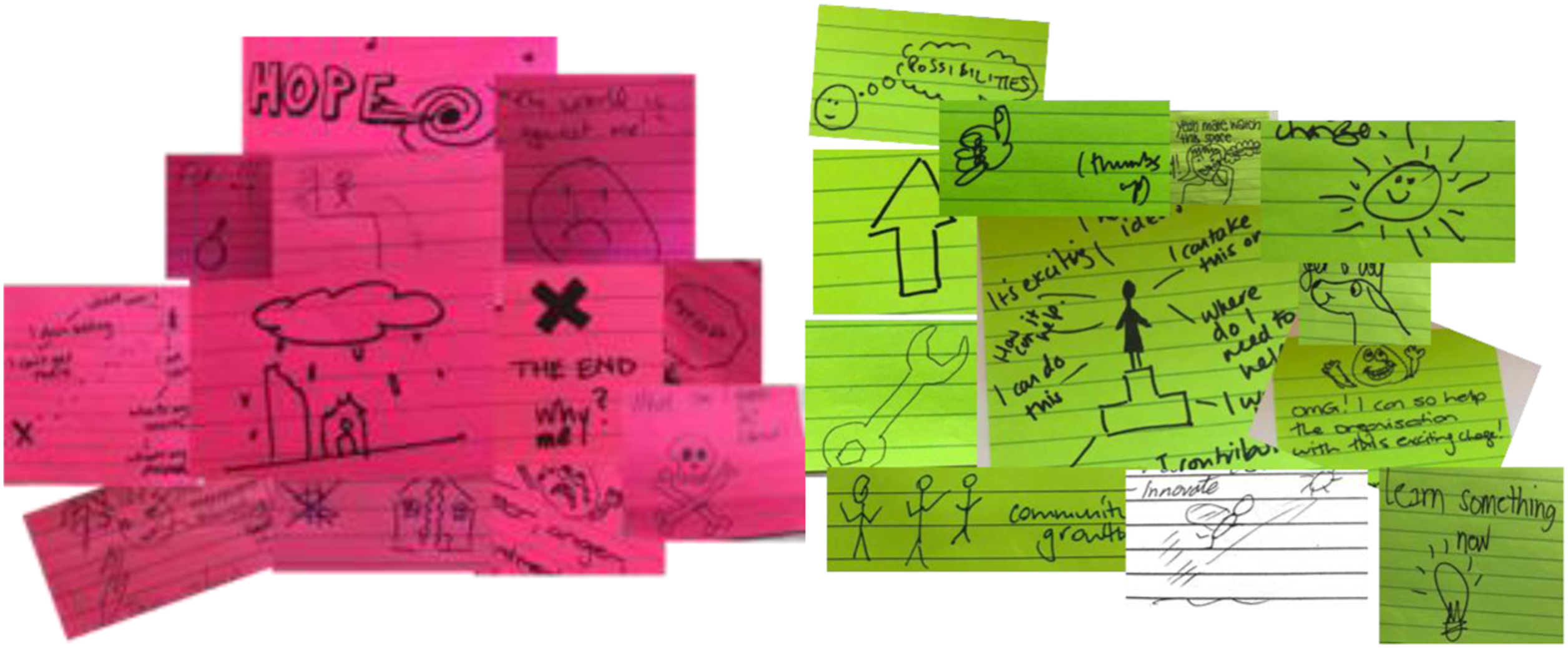
In early 2023 a subset of this original cohort (12 people) met in a 4 hours workshop, in Brisbane Australia and revisited the 156 anonymous original images of the future. The involvement in the workshop was a voluntary process with Brisbane based original attendees being invited to participate. The invitation supported with Japanese inspired tea and cake. As the observer and facilitator of the process it was an interesting to note the initial reaction by participants was that the images, despite being 3 years old, were still relevant and just as impactful to each of them emotionally, as it was in the original workshop setting. The group also expressed a positive curiosity about exploring what this poetic extension of the base analysis would mean for the adaptation approach in organisations. With leaders needing to decide on the investment and approval of AI business cases and then a steady adaptation strategy needing to be actioned.
The first part of the process was a thematic analysis where the whole group discussed and co-created five base themes Themes 1–5 (see workshop output Image 2). 1. Compassion and authenticity for healing and personal empowerment 2. Mindset embodiment and futures anticipation 3. Mindset influence on hierarchies of need 4. Willingness to learn and shared learning 5. Societal impact, equity and care Compassion and Authenticity for Healing and Personal Empowerment. Mindset Embodiment and Future Anticipation. Mindset Influence on Hierarchies of Needs. Willingness to Learn and Shared Learning. Societal Impact, Equity and Care. Themes generated from workshop to inform haiku generation.





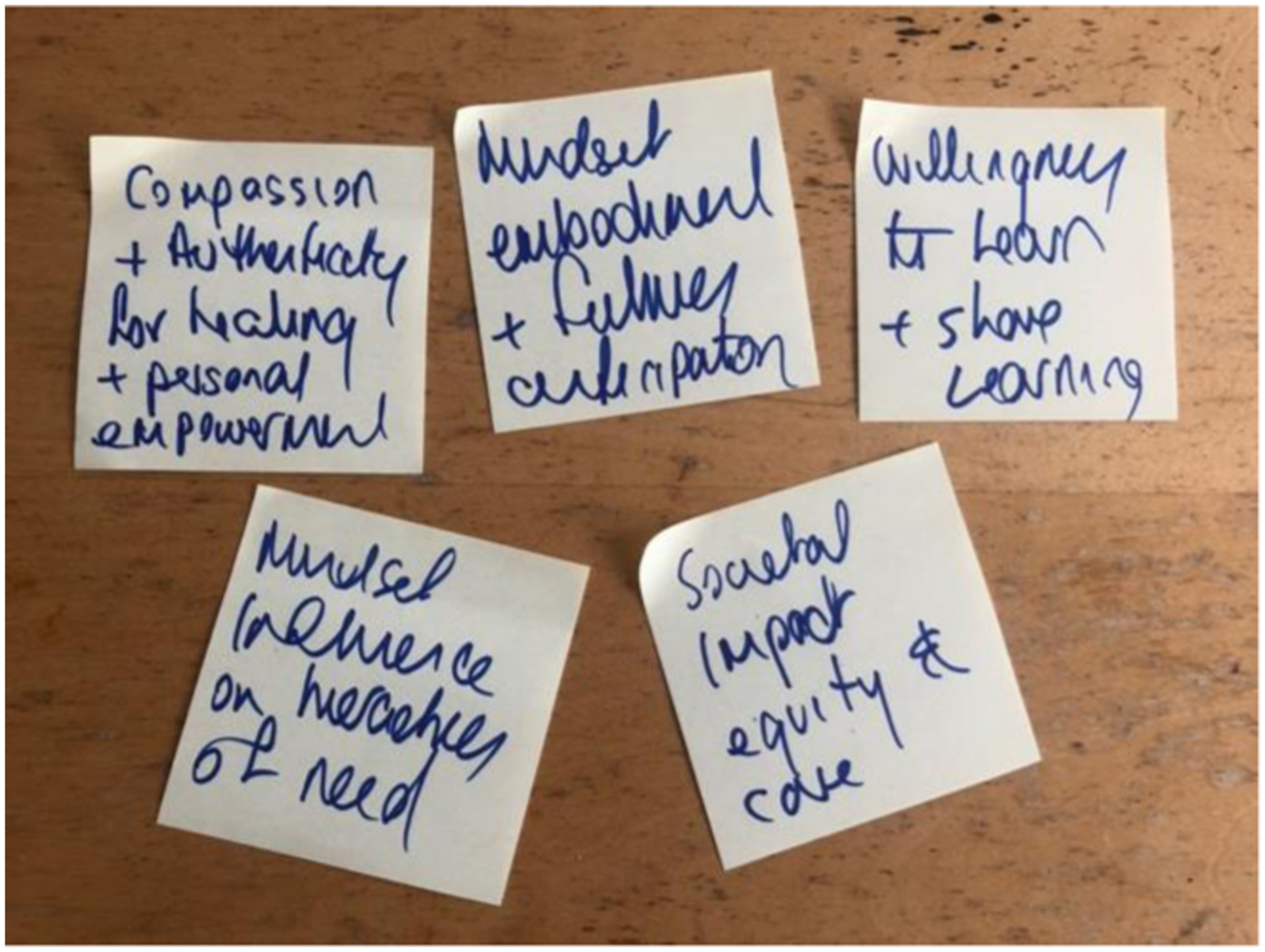
To create the themes the participants used a prioritisation process (linked to preference, consensus, image sorting and alignment). These five themes were then explored by the 12 participants individually and collectively and a growth and fixed mindset inspired haiku was generated for each theme. These themes were connected to the research question ‘How the use of poetic expression can foster creative and anticipatory mindsets amidst the disruptive waves of AI within organisational settings?’ Haikus are a form of Japanese poetry created by Matsuo Basho (Britannica, 2023). The haiku was selected as the poetry composure in this research, due to its contemplative simplicity and visual appeal, but also because the 5-7-5 syllable patterning is manageable within a workshop format. Haikus can condense complex ideas into a minimal form, using just three lines. This conciseness can encapsulate imagery or concepts related to the future, present or the past, making them easy to remember and reflecting various planes of potential futures.
All participants had come across the growth and fixed mindset concept before and needed a simple framing of the workshop. In Australian organisational settings, ‘mindset’ theory has been a regular part of organisational cultural and professional development since Dweck (2017) first released her book ‘Mindset: Changing the way you think to fulfil your potential’ in 2006. The basic premise of Dweck (2015, 10) theory on fixed and growth mindset is that “in a fixed mindset, people believe that basic talents and abilities are fixed traits … in a growth mindset, people believe that basic abilities can be developed through hard work, good strategies, and good mentoring. People can have different mindsets in different areas”.
Crafting the haikus about the future requires participants to not only understand the process, which 30% of participants knew, and then be able to demonstrate imaginative thinking and distil complex thoughts into a concise form. The space where the workshop was held was in an organisational setting with large open space collaboration space, filled with light and a tree lined view. This created a more relaxed corporate organisational context and atmosphere that fostered creative contemplation about potential futures. The images of the future were on cards on tables for viewing and sorting. Various iterations of Haiku were drafted by the participants individually, presented to the group and then collectively refined before the two in each theme were selected by the group to be part of this essay.
Discussion – Key Findings and Contributions
When haiku creation is applied to analysing images of the future, they force the creator to focus on the most important aspects or emotions evoked by the images, to distil a clear understanding (Polak 1973). Emotional response is a necessary part of any organisational adaptation approach (Farrow 2020). It assists with the process of personally connecting to possible or real futures and building a desire or compelling reason to move toward or away from that future. In this discussion section the haikus chosen by participants (from the 30 generated) will be shared and their in-workshop dialogue and reflection summaries that expand the five themes outlined.
Participants reviewed the images provided for a fixed mindset and determined that they predominantly exhibited initial responses akin to grief stages, expressing shock, denial, anger, and powerlessness. Contrastingly, growth mindset images exhibited adaptive stages, reflecting acceptance and readiness for change. The impact of AI on the future of work, organisations and service design stirred strong emotional responses. Participants agreed that this would require a compassionate approach in organisational AI adaptation. Participants agreed that the adaptation process must integrate empathy, supporting individuals through the mindset shift and ‘healing’ required to navigate AI-induced changes.
Fixed mindset images often reflected fear and an inability to engage in anticipatory planning. In contrast, a growth mindset images depicted optimism and solution-focused approaches to future scenarios. To the research participants there was a strong theme of transformation planning having an arc, where a growth mindset needed to be embraced. They expressed given the uncertainty of the future that all workers and leaders need the ability to envision and plan for favourable futures. The growth mindset haiku highlighted the significance of a positive mindset in seeding anticipation and adaptability. The embodiment a way of feeling the future, much like an improvised scene or stepping out a time machine to face a new future or past.
Fixed mindset responses revolved around concerns for the base needs of Maslow’s (1943) hierarchy of needs. The images identified needs like safety and security, family resilience being overshadowed or forgotten. The images relating to growth mindset were aligned with higher-order needs such as learning, growth, success and self-actualisation. Participants suggested that adapting to AI will involve a reprioritisation of attachments in current lifestyle toward embracing personal and community growth and innovation.
Dweck’s (2017) work was originally based in the field of education and then in later studies expanded to be relevant in any field where learning (both adult and child) is required. Mindset selection has been demonstrated to impacted participants’ receptiveness to adaptation (Farrow 2020). Participants expressed that the images relating to fixed mindsets often were about resistance to learning, citing age or inability or attitudes such as ‘why bother.’ The participants reflected that the images relating to growth mindsets seemed to relate more to embracing curiosity, ability and attitude that learning was possible, and collective problem-solving. Participants felt that in organisations of the future having an adaptive mindset would foster broader organisational adaptative capacity, open-mindedness and facilitate greater engagement, thriving futures and collaboration.
The final theme related to broader impacts of AI adaptation that extend beyond organisational boundaries. Fixed mindset images reviewed to participants related to more than the workplace, and reflected impacts on families, communities, and the broader societal systems. Fixed mindset images showed concern for personal stability, family disruption and isolation. Growth mindset images focused on broader societal contributions and universal wealth, cooperation and health. Participants felt that understanding and assessing the larger societal impact is critical for sustainable AI adaptation strategies to be developed and implemented.
Implications for Organisational Adaptation to AI
The concept of creating and describing alternative images of the future plays a pivotal role in supporting individuals’ adaptive capacities and sustaining a growth mindset in the face of impending changes, such as those induced by the implementation of AI (Farrow 2020). These future images and memorable haikus act as mental frameworks that extend beyond the limitations of the present, encouraging individuals, teams and leaders to envision potential scenarios and possibilities. Including a form of poetic engagement in the adaptation approach offers a unique avenue to navigate the challenges posed by AI, encouraging adaptive capacities and inspiring innovative responses. Strategically incorporating poetry (such as haikus) into the organisational adaptation process can serve several key functions. • Expanding Cognitive Horizons: Imagining alternative futures allows individuals to transcend the constraints of their current circumstances. By envisioning different scenarios, individuals can explore diverse pathways and potential outcomes, thereby expanding their cognitive horizons beyond immediate challenges. • Fostering Adaptability: Future images and poetry provide a platform for individuals to mentally prepare for potential disruptions or changes. When confronted with the prospect of AI-induced job displacement, for instance, visualising various future scenarios allows individuals to mentally rehearse responses and adaptability strategies. This mental rehearsal cultivates flexibility and readiness for change. • Encouraging Growth Mindset: Engaging in the process of envisioning different futures aligns with the principles of a growth mindset, as proposed by Dweck (2017). Individuals operating from a growth mindset believe in their capacity to develop skills and navigate challenges through effort and learning. Envisioning future scenarios fosters a belief that challenges can be overcome, skills can be developed, and opportunities can emerge, thereby reinforcing the growth mindset. • Providing Resilience: Imagining alternative future scenarios helps individuals build resilience by mentally preparing for adversities. It allows them to explore potential obstacles, devise coping mechanisms, and adapt strategies for overcoming setbacks, contributing to greater resilience in the face of uncertainty. • Enhancing Decision-Making: Envisioning future images offers a framework for informed decision-making. By contemplating various potential outcomes, individuals can make more informed choices in the present, aligning their actions with their envisioned future goals and scenarios. • Sustaining Change: Integrating haikus into ongoing communication strategies can maintain a focus on the purpose and benefits of the change. Haikus in learning materials can also convey complex concepts related to the change, making them more accessible and memorable.
The process of using poetic expression can supports individuals and groups in maintaining an anticipatory mindset. By weaving emotions and insights into concise and suggestive verses, such as haikus, individuals can explore nuanced perspectives, fostering a creative lens for anticipating and grappling with the many impacts of AI. The process needs to be used strategically and integrated as part of an approved change strategy and plan. Haiku’s can convey powerful messages in a concise and focused manner, making them ideal for capturing key ideas in a busy work environment. As an anticipatory tool haikus can also instil a sense of agency, fostering adaptability, and encouraging proactive engagement with change. The structure and rhythm of a haiku in this research makes them easy to remember.
In the ever changing landscape of organisations, reinforcing pivotal messages and enhancing retention of crucial information is paramount. Creative processes play a vital role in guiding individuals, teams and leaders through uncertainty, encouraging the embrace of challenges with a lens focused on learning, reflection, development, and resilience. Thus, the utilisation of poetry, with its unique power to distil complex ideas into concise and suggestive forms, emerges as an additional tool in reinforcing the journey towards positive futures.
Conclusion
The process of “creating and describing alternative images of the future encourages the extension of thoughts and perceptions beyond the confines of the present” (Masini 1998, 344). The co-creation process and haiku poetry format extended the hand-drawn images and evoked emotions both positive and negative (Bussey 2013). Haikus in this participatory futures workshop context have been demonstrated to not only capture the essence of a particular vision, triggering the imagination, and allowing readers to visualise scenarios more vividly.
In the many futures of work shaped by technological advances, such as AI, poetry can become an inspiration, fostering an anticipatory and creative futures mindset. Poetry when strategically applied can contributes not only to communication but to the promotion of a cooperative culture that can flow with the challenges and opportunities that lie ahead.
Extending this research to wider societal settings is imperative. Encouraging an anticipatory futures mindset supported by images and creative expressions of the future, can foster the envisioning and extension of futures scenarios (Farrow 2020; Hautala and Ahlqvist 2022). What is revealed through this research is that simple forms of poetry are powerful influencers. Haikus can be a democratic and inclusive tool for communication. Anyone, regardless of their role or background, can participate, fostering a sense of inclusivity and shared ownership of the change narrative. Organisations will benefit from fostering open, creative spaces for staff to address doubts and move forward purposefully amidst AI strategies. There is also benefit of a practical and balanced set of messages and experiences to support the AI adaptation strategy. The adaptation strategy endorsed by decision makers need to. • Embrace compassion and authenticity in the adaptation process, considering individuals’ emotional responses and supporting their mindset shift. • Promote a growth mindset culture to enhance anticipation, assessment, and adaptability for favourable future scenarios. • Acknowledge and address higher-order needs by encouraging personal growth, resilience, and innovation in the face of AI-induced changes. • Foster a learning-oriented environment that encourages the use of creative expression processes, ensure collective problem-solving and facilitate shared insights. • Consider broader societal implications in AI adaptation, recognising the interconnectedness of individual, family, organisational, and societal systems.
As AI continues to disrupt industries and challenge personal sense making, this research provides insights into the human dimension of adaptation within organisations. The utilisation of haikus within the realm of analysing and exploring images of the future are a testament to their versatile and insightful nature. Their succinctness does not diminish their impact; instead, it serves as a catalyst for deeper reflection, encouraging a focused exploration of the nuances within these emerging myths and metaphors. Haikus, stand as invaluable tools for futurists, strategists, and visionaries, enabling understanding and creative expression of the range of organisational future scenarios that lie ahead. Haikus paint whispers, Future’s canvas in verse told, Tomorrow’s secrets (by the author)
Footnotes
Declaration of conflicting interests
The author(s) declared no potential conflicts of interest with respect to the research, authorship, and/or publication of this article.
Funding
The author(s) received no financial support for the research, authorship, and/or publication of this article.
