




Abstract
The field of futures studies has done little work on analysis of films and movies, with the exception of the science fiction genre. There has been little attempt to wrestle with and analyze other film genres, integrating such analyses into futures studies. This article makes an attempt at bridging that gap by analyzing the 2018 Palme d’Or winning film Shoplifters by Japanese filmmaker Hirokazu Kore-eda. In the article, we examine the film as a signal of transformation in the Japanese family by comparing this new form of the family to the Japanese family in the past. Using Shoplifters as a guiding post, I contextualize the transformations portrayed in the film with research on and trends in Japanese society. By using Shoplifters, I show how we can use films as guiding posts and as valuable sources of information.
In The Art of The Long View, Schwartz (1991) suggests to futurists that they constantly engage and remain curious about the world around them, which includes paying attention to various forms of cultural expression for potential signals of change (60–70). Films and movies are not mere forms of entertainment. This essay will attempt a preliminary analysis of this cultural form to show how it can be read and analyzed as a signal of change.
Before we begin, it must be admitted that the field of futures studies has done some work on filmic analysis. However, this is limited to the science fiction genre, which is more easily relatable to futures studies (see for example, Carrasco, Ordaz, and Lopez 2015; Lombardo and Ramos 2015). There is even some interpenetration between science fiction films and futures studies: films like Minority Report took the advice of Peter Schwartz and consulted with futures-adjacent figures like Stewart Brand and Jaron Lanier for ideas (Wired 2012).
However, futurists have written less about non-science fiction genres: there has not yet been an attempt to wrestle with and analyze other film genres, integrating such analyses into futures studies. This is an unfortunate gap: it extends the “masculine” bias (of a part) of futures studies towards technology and science. As Milojevic writes “[i]f futures studies opted to work within ‘feminine’ guiding principles it would most likely prioritise the futures of education, parenting, community, relationships and health—the real grand issues”! (Milojevic 1999, 69). How might expanding futures studies’ scope of interest to non-science fiction genres provoke an exploration of these other important topics?
This article makes a humble attempt at bridging the gap. Instead of advancing a theory or even a methodology, I merely point out that films and movies are products of the present conjuncture and, as such, act as guiding posts that are, following anthropologist Claude Levi-Strauss’ phrase, “good to think with.” To show this, I will work through a specific case study. I analyze the 2018 Palme d’Or winning film Shoplifters by Japanese filmmaker Hirokazu Kore-eda, examining the film as a signal of transformation in the Japanese family by comparing this new form of the family to the Japanese family in the past. Using Shoplifters as a guiding post, I look to the past to contextualize the transformations portrayed in the film and then use Shoplifters as a guiding post to a possible future, looking at trends in Japanese society. I then analyze the transformation using Inayatullah’s Causal Layered Analysis (CLA) to show how such information may lead to a better understanding of the future. Through Shoplifters, I show how we can use films as guiding posts and as valuable signals of change.
We begin with a short description of the Japanese family in the past. The Chrysanthemum and the Sword is a study by celebrated anthropologist Ruth Benedict, which gives descriptions of family life in Japan in the early-mid twentieth century. The Japanese family described in the study is in a hierarchical structure: generation, gender, and primogeniture determine one’s position in the hierarchy. Being in a position of authority does not give one the prerogative to exercise power arbitrarily. Individual interest is subsumed under the needs of the family, and positions of authority come with the burden of responsibility (Benedict 1946, 49–57). Within the traditional three generation Japanese family, family solidarity is reinforced by mutual obligations of debt. An example of this is filial piety, the debt that children owe to their parents (Benedict 1946, 119–123).
In stark contrast, Kore-eda portrays an evocative illustration of a contemporary Japanese family in Shoplifters. Kore-eda is a filmmaker known for his family dramas, and Shoplifters initially portrays what appears to be a conventional family. The film centers on what appears to be an economically precarious, but loving, three-generation Japanese family. Osamu and Nobuyo are the husband and wife working menial, precarious jobs; Aki, introduced as Nobuyo’s younger sister, works as a “hostess” in an adult club; Shota is the son; finally, there is granny Hatsue, the old matriarch whose pension and home contributes to the whole family’s survival. They engage in petty acts of shoplifting and thievery to make ends meet (Kore-eda 2018).
The five are soon joined by a sixth family member, the preschooler Yuri, who is left locked outside on a ground-floor apartment balcony, and who they decide to “shoplift” on a whim. They rechristen her Lin and cut her hair to change her appearance, deciding to keep her upon seeing burn marks and evidence of domestic abuse at the hands of her biological parents. Yuri is an outsider but she joins the family by choice, and conversely, the family makes the choice to keep her. We find out at the end of the film that Yuri’s case is not an outlier for this particular family: the shoplifting family are strangers and not connected by biological ties—this “family” is an arrangement of convenience; it is a performance put on by a band of misfits collected together for survival (Kore-eda 2018).
As discussed before, the film is a guiding post—it is a product of a culture’s self-expression that points the way to a specific social and cultural reality. With this in mind, we move onto this question: what does Shoplifters point towards? In the rest of the essay, we attempt to contextualize the transformation, looking towards the past and the present, and use Shoplifters as a guiding post towards potential futures. This process of following the film as a guiding post demonstrates what an alert futurist could do to find insights about the future when viewing and analyzing movies and films.
We begin by exploring the context of precarity, which is the persistent backdrop of the Shoplifters. Japan has not been immune to the onset of precarity in the past few decades. This is in contrast to the past: Japanese society was once organized around a system of lifelong employment, providing the foundation for Japan’s middle class and consumer economy (Allison 2013, 22). However, things changed after Japan’s asset price bubble burst in 1991, leading to the liberalization of the economy, when companies began to restructure, leading to layoffs and irregular, temporary work; temporary workers began to multiply in the 1980s and throughout the 1990s (Allison 2013, 29).
Precarity and changing socio-economic conditions have changed everyday relationships. Allison (2013) notes these transformations in Precarious Japan: “Sociality today has become more punctuated and unhinged. Along with replaceable work and workers is the rhythm of social impermanence: relationships that instantaneously connect, disconnect, or never start up in the first place. One-third of all Japanese live alone these days and the phenomena of both NEET (not in education, employment, or training) and hikikomori (social withdrawal) are well known among youths” (8). We follow the guiding post into the past and see how Shoplifters points the way backwards in time, gesturing towards the transformation of Japanese society towards precarity.
Kore-eda’s own comments on his film supplement and confirm this changing reality in an interview (Wise 2018): “The traditional concept of family was already being dismantled or destroyed in Japan … In Shoplifters, I was looking at three generations living together, because that’s typically what you’d find in a Japanese household. But I wanted to play with that, and show that even within those terms the nuclear family is undergoing a permanent change.” He remembered back to 2002 … “At that time, all the kids we saw were living in close proximity to their grandma or grandpa or both, and you could hear it in their vocabulary … [But] that has ceased to be the case. More elderly people are living alone. It’s very rare these days to see a family where the children ave that kind of close contact with their grandparents, or live in traditional family structures.”
So far, our investigation demonstrates how Shoplifters acts as a guiding post, pointing the way into the past to explain the present. While the past is important, futures studies deals with the future. What kind of future might Shoplifters point towards?
To we answer this question, we look into a trend in contemporary Japanese society to anchor our response. This is a trend that may act as a mirror into a possible future, and one which operationalizes the logics of the transformed family in Shoplifters. We examine Family Romance, which received widespread attention through director Herzog’s (2019) Family Romance, LLC, released at around the same time as Shoplifters. Family Romance is a company that offers family member rentals in Japan. It is a small-scale service and not a mainstream trend. However, the emergence of this service signals a shift in the culture: Family Romance fills in needs in response to the Japanese family’s mutation.
Similar to the family in Shoplifters, Family Romance creates temporary families, that, while formally similar to the family of the past, is an arrangement of convenience. Additionally, according to the founder of the company, Family Romance draws on a flexible labour force of around 2000 employees who are housewives, underemployed workers, salarymen, and pensioners to provide their service on-demand (Asian Boss 2019). Like Shoplifters, Family Romance operates with a backdrop of precarity and operates with a similar understanding of the family as a flexible social grouping. It provides us with a newfound understanding of ‘family’ as a commodity, something to be bought and sold in the market.
Having followed the guiding post—Shoplifters—to the past, the present, and the future, we are now in a position to use Inayatullah’s (1998) Causal Layered Analysis (CLA) to better understand the implications on the possible futures of the Japanese family. We use CLA to analyze two possible futures: one, the traditional family as described by Ruth Benedict and two, the transformed family, as exemplified by Family Romance. 1
Causal layered analysis opens up four layers of analysis, which allows us to thoroughly explore the underlying worldviews and metaphors that are the basis of ideas about the future. The first layer is litany, which invites exploration into the disconnected, surface-level trends and issues that are often expressed quantitatively and often provoke a political reaction (Inayatullah 1998). The second level is the system: this level goes deeper into the issues, delving into the political, economic, and cultural factors for a more substantial analysis. However, the deeper assumptions are only analyzed on the third level, the level of worldview. In this third level we see how the worldview that frames the issue can be a part of the problem. The level of worldview invites us to question our assumptions and adopt alternative assumptions and worldviews to frame the problem differently. The fourth layer is the level of the metaphor, which are, as Inayatullah (1998) describes, “the deep stories, the collective archetypes, the unconscious dimensions of the problem” which “provides a gut/emotional level experience to the worldview under inquiry” (p. 820). Analyzing this fourth dimension uncovers the emotional attachments beneath the worldviews.
We begin with the future represented by the traditional Japanese family. On the level of the litany, this version of the family is described using statistics on declining rates of family formation, shared and problematized by the media (e.g., Lau and Fukutome 2023). On the level of the system, there are a variety of systemic analyses hypothesizing reasons for declining rates of traditional family formation, like changing economic conditions, declining wages, and low-quality youth employment (e.g., Matsuda et al. 2021). Underlying these analyses is the worldview that takes the traditional Japanese family as standard: this worldview assumes the nuclear, patriarchal family to be the foundation of society as described in Benedict’s (1946) analysis. Finally, there is the layer of the myth and metaphor. The operational metaphor in the traditional Japanese family is the family as destiny—a lifelong, inescapable commitment.
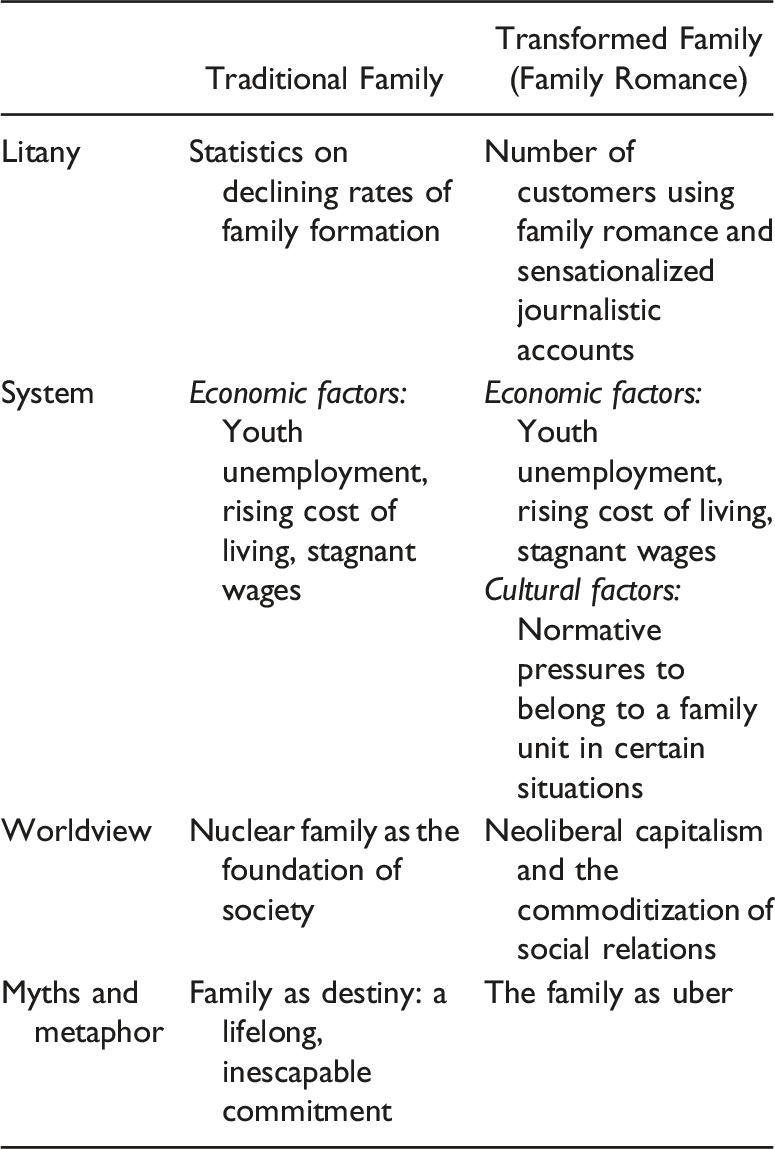
We can easily imagine how these insights can be applied as a part of a foresight project to mitigate future uncertainties in Japan, especially given Japan’s demographic challenges. Kore-eda’s Shoplifters prompted these insights, and prompted us to consider how traditional family structures are transforming. It is not just an evocative filmic illustration; we see how it has been actualized in the market through the service of Family Romance.
What did we find by applying CLA for further analysis? The family—the traditional site of social solidarity, a lifelong, inescapable commitment—may be transformed into a performance by individuals. This new family is a flexible arrangement, one which could be bought and sold in the market as a commodity, leading to the uber-ization of the family.
Footnotes
Declaration of Conflicting Interests
The author(s) declared no potential conflicts of interest with respect to the research, authorship, and/or publication of this article.
Funding
The author(s) received no financial support for the research, authorship, and/or publication of this article.
