



Abstract
Will adding an artistic layer to our future exercises eventually improve them? Why? How? Will this supposed improvement contribute to the entire exercise or only to some of its aspects? Moreover, will such an improvement have long-term, stable consequences or only momentary and occasional ones? The research question I would like to unfold may then be summarized by the claim “Works of art as gates to the future.” Unsurprisingly, this claim needs further qualifications, such as works of are always/often/occasionally/rarely/never gates to possible/preferable/obnoxious future. Furthermore, what does it mean to be a “gate to the future”? To make the future visible? To make the future understandable? To pave the way toward the future? This vast array of preliminary qualifications suggests that the question of the connection between works of art and the future is awfully tangled. I would be satisfied if this paper provides a frame to be eventually improved by subsequent works. Specifically, I would be happy to explain the first, basic question: why works of art may eventually improve futures exercises. I will focus primarily on Nicolai Hartmann, and secondarily on Roman Ingarden and Ernst Bloch. The conclusion I shall arrive at is that works of art can definitely improve futures exercises, because both aesthetic objects and the futures are unreal objects and presents irreducible points of indeterminateness.
Keywords
Introduction
I would like to see whether works of art can improve, enhance, widen our capacity to work with the future. Will adding an artistic layer to our future exercises eventually improve them? Why? Moreover, how, in which ways? Will this supposed improvement contribute to the entire exercise or only to some of its phases/aspects? Moreover, will such an improvement have long-term, stable consequences or only momentary and occasional ones?
The research question I would like to unfold may then be summarized by the claim “Works of art as gates to the future.” Unsurprisingly, this claim needs further qualifications, such as works of are always/often/occasionally/rarely/never gates to possible/preferable/obnoxious future. Given its two sets of variations, it is easier to read that sentence in a graphical way (see Box 1 below). The two sets of variations.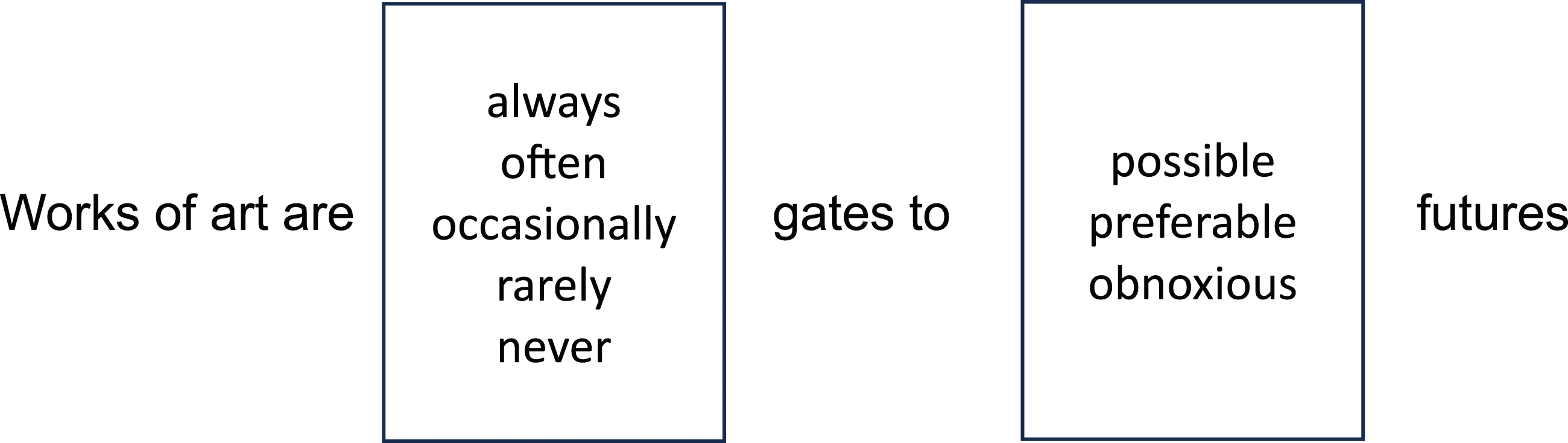
Furthermore, what does it mean to be a “gate to the future”? To make the future visible? To make the future understandable? To pave the way toward the future?
This vast array of preliminary qualifications suggests that the question of the connection between works of art and the future is awfully tangled. I would be satisfied if this paper provides a frame to be eventually improved by subsequent works. Specifically, I would be happy to explain the first, basic question: why works of art may eventually improve futures exercises.
In the following I will rely on selected references, namely: • Nicolai Hartmann, Moeglichkeit und Wirklichkeit 1938 (En. Possibility and Actuality, (Hartmann 2013)), and Aesthetik 1953 (En. Aesthetics, (Hartmann 2017)). • Roman Ingarden, Das literarische Kunstwerk 1931 (En. The Literary Work of Art, (Ingarden and Grabowicz 1980)), and Der Streit um die Existenz der Welt 1964 (En. The Controversy over the Existenz of the World, (Ingarden and Szylewicz 2013)). • Ernst Bloch, Das Prinzip Hoffnung 1954–59 (En. The Principle of Hope, (Bloch 1995), and The Utopian Function of Art and Literature, (Bloch and Zipes 1988).
I will focus primarily on Nicolai Hartmann, and secondarily on Roman Ingarden and Ernst Bloch.
The paper contains six sections, plus this introduction. Section 2 describes the reference field; Section 3 the aesthetic object; Section 4 glimpses at the history of aesthetics; Section 5 describes the difference between dead and alive works of art; Section 6 addresses the issue of points of indeterminacy. Finally, Section 7 connects the dots and offers some conclusions.
The Reference Field
Defining, that is delimiting the field of art has proved awfully slippery. Apparently, we can distinguish works of art but fail to properly define them. To have a starting point, I shall resort to the old idea of art as related to beauty. After all, few theories throughout history have been as enduring and, in the history of European aesthetics in particular, no other competing and equally enduring theory has ever been proposed (Tatarkiewicz 1980).
The subsequent issue concerns the types of art we should consider. While paintings, sculptures, poetry, literature, theater, music, architecture, ballets, and decorations are obviously included, what about pictures, porcelains, movies, fairy tales, spy stories, cartoons, works of design? Furthermore, what about gardens, posters, books, haute couture clothes, weapons? As a starting point, it seems correct to adopt an inclusive as possible stance. This implies that we should include not only ‘classic,’ major, unique forms of art, but also contemporary, minor, highly reproduced, perhaps contentious forms of art. Subsequently, how can we distinguish between authentic, proper, successful works of art and failed one? The former express, manifest, show aesthetic objects, whilst the latter fail to do so. Before digging deeper into this issue, let me present the correlated side of this paper. As said, we are interested in the connections between works of art and futures. The first, immediate trouble is that futures are not less plural than works of art.
A well-known classification of futures refers to the differences among possible, plausible, probable, and preferable futures (Amara 1981). Another classification distinguishes among short-term, medium-term, long-term, and very long-term futures. This latter classification is more slippery than the former one. It includes a reference to the different dynamic patterns of a reference item, that is its pace of change (For some hints, see Poli (2019b)). Digging deeper, the difference emerges between autonomous versus ‘used’ futures, genuine vs non-genuine futures, open vs closed, unadulterated vs deceptive, adulterated futures. The latter terms comprise features such as repetition, forecast, megatrend, risk. The former comprise novelty, foresight, exploration, and uncertainty. The terms in the two lists are counterpoints to one another: repetition against novelty, forecast against foresight, megatrend against exploration, and risk against uncertainty (Poli 2021). While the oppositions are intuitively clear, at a deeper reflection one can realize that there are problems with authentic, genuine, autonomous, open futures: one may have glimpses of them; fragmented, partial and often contradictory intuitions, but we usually are unable to fully describe them. Most people find much easier to describe negative futures, those they won’t end living in, than to describe positive futures. A major question immediately arises: How can artworks work as gates of futures we know so little about? Before offering some hint, let us discuss the aesthetic object.
The Aesthetic Object
We assume that aesthetics deals with the beauty, any kind of beauty: the beauty in nature, human beauty, and beauty in the arts (Hartmann 2017). This paper considers the last case only. Beauty here is taken as the cover term, including all its variations, from the sublime to the comical. Given any possible object, a variety of attitudes can be adopted. Let us compare the aesthetic attitude with the practical one. Given say the painting of a field of sunflowers, according to the practical attitude one may estimate its harvest (how many quintals of sunflowers?) or evaluate the value (cost) of the painting. The aesthetic attitude is different because it is focused on the contemplation of the beauty of the painting.
For both attitudes, a new object emerges from the perceived object: a new object emerges behind the immediately seen object. The canvas with its colors is a real surface, but the landscape it shows has its own spatial depth, perspective, concrete natural fullness. Its space is not the space occupied by the painting; its light is not the light that falls on the painting.
The question arises of the relations connecting the ‘real’ (perceived) object and the ‘new’ (emerging) object. I’ll come back on this in the next Section below.
Above, I made referent to “contemplation” as the required attitude for letting the aesthetic object emerge. Reference to contemplation is a classic move in the history of aesthetics. While contemplation fits for paintings and statues (kind of “major” and “static” objects), doubts may arise about whether it is the right attitude for “dynamic” objects such as symphonies, plays, ballets, and movies, as well as “minor” works of art such as cartoons, posters, or fairy tales. Moreover, while contemplation may work for sublime aesthetic objects, it seems at odds with the comical and other so-called lower forms of the beauty. Possibly, other more active, less constrained attitudes seem to be required; and possibly a variety of them. For the time being, I take “contemplation” as a cover term, including all the variety required by the different works of art.
A different issue sees works of art as components of peoples’ Bildung, that is education, providing that education is not limited to training, but it is taken as including the development of taste and sensibility. Shortly, beauty as a need, as a component of one’s life. In other words, a life without (experience of the) beauty is a poor life. One may remind of Dante’s “fatti non foste a viver come bruti” (you weren’t made to live like brutes) (The Divine Comedy, Inferno, XXVI).
These comments show that a suitable connection between the work of art and the perceiver is needed.
Glimpse at the History of Aesthetics
The different aspects so far mentioned provide some preliminary hints but are far from offering a systematic vision.
Let us go back again to the aesthetic object issue. We have seen that an aesthetic “vision” requires a sensible (real, perceptual) object as its basis. Then something new appears behind the sensible object. For most of the history of aesthetics, this new object has been seen as an ideal object: a vision of essence, a Platonic universal, an intuition as a form of knowledge. This understanding has given rise to countless antinomies.
By way of an exemplification, ideal objects are grasped through concepts, and concepts are universals. This implies that concepts can’t capture the individuality of a given work of art. On the other hand, aesthetic objects are perceived, contemplated, lived as individual (unique) objects, even if they are widely reproduced/printed/performed objects.
Aesthetic perception is grounded in sensible data (colors for paintings, sounds for music, marble for statues, words for novels, spoken words and movements for plays, etc.). Let us call them the “matter” of the aesthetic object. Within this matter, something else appears (face, landscape). Call it the “form” of the aesthetic object.
What makes appear (the matter) must be real, and what appears (the form) cannot be real because it exists only in this appearing. We then have two levels of objectivity, one real and one unreal, unified by the relationship of appearance. The aesthetic object includes both elements. In the aesthetic object, a foreground (matter) is distinguished from a background (form), within an act of perception. The background appears to the perceiver as a new stratum with its own character. The aesthetic object (what is beautiful) is in the unity of foreground and background.
Which is the status of the unreal object? As mentioned, traditionally it has been considered an ideal object and this reading does not work. A major consequence arises: Aesthetic objects show that the traditional opposition between real and ideal objects is incomplete, and that a new realm between real and ideal being is needed. Both Hartmann and Ingarden agree on this major issue.
We have seen that the aesthetic object (what is beautiful) is in the unity of foreground and background. Let us call the difference between foreground (the matter, the real object) and background (the form, the unreal object) the first stratification of the aesthetic object. This is only the first step, though.
Both Hartmann and Ingarden add a second stratification: the background (the unreal object) is further subdivided into a variety of sublevels. The number of sublevels and their arrangement depends on the type of work of art (say, a portrait vs. a literary work of art). I’ll skip analysis of this second stratification, even if it includes some of Hartmann and Ingarden’s most interesting developments.
The first stratification of the work of art shows that unreal objects may emerge behind real objects. Ontologically speaking, real objects are well understood. But what can be said of ‘unreal’ objects? Unreal objects exemplify a new acceptation of the modality of the possible: the “merely be possible.” Differently from the really possible and the ideally possible, this acceptation of the possible is able to fluidify the real and to generate new variations, forms, transformations of the real; it is never actual, nor necessary.
To distinguish the three realms, the following scheme provides an entry:
Really possible = when all the conditions are fulfilled.
Ideally (conceptually) possible = when the conditions are compossible, mutually coherent.
Unreally (aesthetically) possible = from the point of view of the artist, this is a sphere of total freedom (no constraint) as far as the unreal object is considered; constraints may emerge from its real basis (the marble for statues, colors for paintings, etc.).
Two observations may help: 1. What does it mean “total freedom” for the artist? The artist has ideas, perceptions, intuitions s/he tries to realize; s/he may have styles, patterns s/he adopt. Artists work within cultures and live in specific temporal moments. These aspects are patently relevant and do obviously frame the context. The freedom of the artist is always situated freedom. The expression “total freedom” does not see the artist as outside space and time. It tries instead of conveying the idea that the appearance of the unreal object does not include any tendency, it is not teleological, it does not have any purpose. In this sense, the freedom of the merely possible is the widest form of freedom. Works of art may include their own kind of necessity, but this is kind of artistic necessity. • The point of view of the perceiver, the one that activates the aesthetic object, should be included. According to Hartmann, life may contribute to art, but art does not contribute to life because this would be an extra-artistic constraint. I wonder whether it is true that “art does not contribute to life.” While it is true that contributing to life is an extra-artistic constraint, we should not forget that aesthetic objects arise within perceptual experiences (people are necessarily involved) and works of art have a Bildung effect.
A careful balance is needed between these two components, between the work of art in itself and the work of art as experienced, as component of one’s life. This situation shows that to some degree aesthetic objects are co-produced and the artist’s freedom should encounter the perceiver’s anticipations, filtered by her cultural capacity and needs.
Dead/Alive Works of Art
To compound difficulty, consider the following: Historical periods have had very different relationships with (their past and) their future. While for the Middle Ages Greek culture was silent, aphonic, for the Renaissance Greek culture was alive, full of suggestions (Bloch 1995). For every real situation, the past is not just “past.” There are pasts that are alive and active, and there are pasts that are dead and silent.
This is especially visible with works of arts. “Classic” works are those that continue to generate meaning generation after generation. Two components need to be distinguished (Poli 2017, 150) • The relationship between Renaissance and Greek culture shows that the past becomes alive if we know how to question it by asking the right questions (the epistemological stance). • A subtler issue, however, is at stake here. Apart from our capacity to raise the right questions, the underlining issue is whether the future embedded in those pasts is still pushing towards new, open developments and in this case the past is open and new aspects may unfold after it. When instead the future embedded in the past has lost its forward capacity, when it is exhausted, then past becomes closed and silent (the ontological stance).
Our epistemological capacity to raise the right questions implies the ontological aliveness and openness of the inquired past (Poli 1998; 2019a). Alive works of art include a “surplus”, the capacity to generate meaning (Bloch and Zipes 1988). Note that the artist may be (and usually is) utterly unaware of this “surplus.” In this sense, aesthetic objects are not only objects to be contemplated, but are objects that can be able to anticipate what is to come, objects including glimpses at the future. These anticipations, however, lies on the side of the perceiver. Here is where the artist’s intention and the perceiver’s anticipations may eventually meet.
Points of Indeterminacy
Points of indeterminacy (Unbestimmtheitsstellen) are introduced by Ingarden in Das literarische Kunstwerk. They are the main criterion for distinguishing the objects of the empirical world from the objects of a literary work.
To exemplify, consider Mann’s Tristan: “the details of the death, whether it was swift or slow, whether it was painful or otherwise, etc., are points of indeterminacy in Mann’s story which no reader fills ... their filling does not serve the artistic form of the story ... On the contrary, leaving these details unfilled makes the situation more expressive ... If the details were provided, the artistic effect would be weakened” (Ingarden 1968, 253).
Every work of art contains points of indeterminacy, or points for which the text does not furnish details.
Ingarden distinguishes between two different types of points of indeterminacy: • those that can be removed because the text allows details to be provided, and • those that cannot be eliminated because the text does not furnish any support for the formulation of an adequately circumscribed variety of admissible information (Strelka 1990).
The former do not contribute to the aesthetic quality of the work. Only the latter do contribute.
Take notice that points of indeterminacy are not reducible to lack of information. Note for instance the interplay between the fully-rounded traits of the protagonists and the less articulated ones of the minor characters. If points of indeterminacy were reducible only to a lack of information, then the most unexpected surprises and the less foreseeable forms of behaviour should be imputed to the minor characters, those whom we know less about – those who seem to have more points of indeterminacy. In fact, however, the reverse is invariably the case. Why?
The problem is not one of available information, but rather of the degrees of freedom of the object modelled. Typically, a minor character is a stereotype with few dimensions, and is described along a limited set of thematic axes. Since he or she is a personage with few degrees of freedom, s/he has little indeterminacy.
The points of indeterminacy of an object depend on the space of its dimensions. The more an object is rich, elaborate or constructed, the more indeterminate it becomes, and precisely because it is characterized by a wider complex of dimensions. Figuratively, the more it acquires full relief, the more it becomes indeterminate (Poli 1998).
Points of indeterminacy are not limited to works of art only. Possible futures and utopias follow the same pattern. Efforts for making precise and filling in all the ‘requited’ details of a possible future or a utopia do usually falsify them, destroying their forward-pushing stance. The two types of points of indeterminacy distinguished by Ingarden apply too: some missing information can nevertheless be added because the context provides support; other information is authentically missing and no available detail can fill in the void. This latter is the case that interest us.
Connecting the Dots
I summarize what we have seen in the following six theses. a. Works of art come in many different formats. Each kind of work of art requires its own aesthetic attitude. For classic kinds of works of art, full-fledged contemplation is the correct attitude. Correct means: without that attitude the aesthetic object does not emerge. Other works of art may require weaker forms of contemplation. b. Aesthetic perception brackets the practical attitude (and cognitive perception too). c. The beautiful lies in a two-strata object composed by a foreground (the ‘real’ object) and a background (the ‘unreal’ object), connected by a relation of appearance. Works of art open the new ontological realm of the unreally possible. The unreal object is a merely be possible, it is neither actual nor necessary. d. Alive works of art have the capacity to generate meaning in the perceiver. In this sense, the perceiver is a co-creator of the aesthetic object. e. Works of art may anticipate aspects of what is to come. The perceiver anticipatory imagination put in relief the surplus included in the aesthetic object, eventually making visible aspects of what is to come. f. The aesthetic object as well as the anticipated futures are full of points of indeterminacy that must remain void, otherwise the aesthetic object will be destroyed and the future falsified. The non-visibility of the future goes hand in hand with points of indeterminacy: filling in missing details will destroy both the aesthetic effect and the anticipatory imagination concerning what is to come.
To conclude, works of art can definitely improve futures exercises, because both aesthetic objects and the futures are unreal objects and presents irreducible points of indeterminateness.
This paper has shown the presence of a deep, intrinsic connection between works of art and futures exercises. Developing the capacity to use such a connection remains to be explored.
Footnotes
Declaration of conflicting interests
The author(s) declared no potential conflicts of interest with respect to the research, authorship, and/or publication of this article.
Funding
The author(s) received no financial support for the research, authorship, and/or publication of this article.
