



Abstract
This paper presents an open inquiry that embraces curiosity and vulnerability in the anticipatory space of an art-led, Futures orientated PhD supervisory relationship. We use sandtray work to elicit an anticipatory aesthetic, recording emergent data and processes through the dialogical method of duoethnography, and the visual format of photography. We seek to generate an environment that rouses imagination, creativity and futures consciousness implicit in the Australian Research Council’s definition of research. We use a duoethnographic method to collaborate, reflect and provide dialogical ways to surface deep meanings. There is a shared equity of understanding of the research process as a vehicle for engaging with the unknown. Both supervisor and supervisee hold explicit and implicit referent knowledge in relation to person and process. Therefore, it is a collaborative, reciprocal and fluid environment, where 1 + 1 = ∞ possibilities. We use sandtray to provide the location of open inquiry, dialogical reciprocation, reflection, and improvisation. This gives voice to the meaning that is made in the meandering paths between the words and an opportunity to loosen the shackles of business as usual. The sandtray moves not-known material into conscious awareness via somatic/intuitive symbol selection, engagement with metaphor, and projection; each privileging the unconscious. Introducing sandtray process into the supervisory relationship provides an alternative and adjunct modality of non-verbal inquiry that can support the calling of an anticipatory aesthetic through the Futures Senses. While there is rich, though sparse, literature describing the facilitation of sandtray work within the context of clinical supervision of mental health professionals, the introduction of such an approach within research supervision appears rare, or unique in relation to published research.
Introduction
This paper presents an open inquiry driven by curiosity and a desire to engage in PhD supervision processes that complement the ethos of Futures Studies through being open, collaborative, experimental and to some, may even seem ‘ridiculous’ (Dator 2002). We are academic colleagues, and qualified art therapists, who met through a shared interest in arts-informed research. We currently work together within multiple contexts, that includes a Higher Degree through Research (HDR) supervisory relationship, in which we are supervisor (Trudi) and supervisee (Marguerite). The PhD project itself, is non-traditional and art-led; thus, testing the boundaries of ‘business-as-usual’ (Inayatullah 2008) in academic research, in its design and methodology. In doing so, it invites possibilities and imaginings that have potential to seed alternatives in the relational space of HDR supervision pedagogy. We seek to explore the possibility of generating a supervisory environment that rouses imagination, creativity and elicits an anticipatory aesthetic (Bussey 2014), by piloting the use of sandtray work. Emergent data and processes are recorded through the dialogical method of duoethnography (Sawyer and Norris 2012, 2015), and the visual format of photography.
Context
We have previously engaged with sandtray as a vehicle for exploration within research supervision. Here, sandtray was utilised in a more traditional supervisory sense, wherein the supervisee worked in an emergent way with sandtray, to explore knowing and experiencing in relation to recent emergence as published scholar (forthcoming).
Experiences within, and subsequent reflections on this process led to a rising curiosity regarding the potential utility of sandtray for heuristic exploration of the intersubjective relationality of the HDR supervisory relationship, with a view to informing understanding and growth of the relationship. This heuristic approach sits congruently with underlying humanistic frames held by both researchers in relation to the role of supervisee and supervisor. Exposure to duoethnography excited interest as a potential way of working authentically with this new inquiry, including emergent dialogue. Therefore, we chose to experiment with the anticipatory in the supervisor/supervisee relationship, as a process that invites possibilities and a platform for ‘anticipation-for-emergence,’ complimenting the familiar ‘anticipation -for-futures’ (Miller 2018) that colonises HDR pedagogy and processes with the intention to practice in supervision.
Our supervisory process is one that fosters a non-hierarchical relationship and values reciprocity in teaching/learning pedogogy (Shor and Freire 1987). Duoethnography is a collaborative methodology that ‘extends the peripheries of existing knowledges’ (Walker and Niro 2019, 3) and enhances the dialogical process of supervision (Brown 2015).
The supervisory relationship supports PhD students in their pursuit of ‘the creation of new knowledge … and creative ways to generate new concepts, methodologies, inventions, and understandings’ (Australian Research Council 2023). Thus, we posit, that in futures research supervision, there is a responsibility to generate an environment that ‘moves away from imposing today’s idea of tomorrow on tomorrow’ (Miller 2018, 5), by creating relational spaces that rouse imagination, creativity and the futures consciousness implicit in the Australian Research Council’s (ARC) definition of research (2023). Expressive therapeutic arts have the potential for rich contributions in this context providing a methodology for the exploratory development of insight in relation to supervision related practice and inquiry.
Sandtray as an expressive modality, is a projective therapeutic technique that supports wholistic externalisation and exploration of inner understanding via the selection and placement of symbols in a tray of sand (Homeyer 2016). Characteristics of sandtray work, including the use of symbols, the invitation to metaphor, and the attending to the somatic and intuitive senses, privilege the unconscious, so that the field of a tray can hold expressions of information that is both known (conscious), known but not known (pre-conscious) and not known (unconscious) to the inquirer (Armstrong et al. 2015; Pearson and Wilson 2000; Turner 2005). Sandtray is anticipatory in nature, privileging an anticipatory aesthetic (Bussey 2017); including ‘anticipation-for-future,’ in planning method and process, and ‘anticipation-for-emergence’ in the experimental platform it provides (Miller 2018).
Process
The sandtray process we present is a deliberate attempt to engage our innate relationship with the future, through creativity, openness and multiple voices, because in the sandtray we describe the intersubjective space between us, our unconscious and all those (ancestors) that inhabit it (Moriarty 2011). We aim to explore decolonising our supervision process from the anticipation of didactic information and instruction exchange, by questioning assumptions of supervision that are constrained by academic systems and institutionalised concepts of HDR supervision. Thus, we explore sandtray work as a novel way of engaging with anticipation for emergence within the supervisory relationship, aptly positioned in this futures orientated PhD project.
We view this expressive knowledge creation process and duoethnography as an experiment, dedicating 5 hours to our initial foray in this sandtray/supervisory exploration, which included artwork, individual trays, a collaborative sandtray and dialogue between. This was bracketed by brief preparatory discussion in the lead up to the session and iterative reflexive revisiting of emergent experiencing in the weeks following. Dialogue and dialectic in the reflexive phase also occurred in a duoethnographic frame. Collaborative poesis captured key elements of emergent knowing and experiencing.
As navigational landmarks throughout this paper, we employ the elements of Futures Literacy: anticipatory/anticipation, aesthetic and emergence (Miller 2018) and align these with our experimental positioning as follows. • Anticipatory/Anticipation (of the future): under this heading we offer explanation of theories and processes and draw on the power of anticipation to guide and explain method and methodology. • Aesthetic: under this heading we indicate process and product of initial art and proceeding sandtray work, being products of an anticipatory aesthetic that have ‘capacity to push back the limits that constrain personal, social and cultural creativity’ (Bussey 2017, 49). • Emergent: We invite anticipation of the emergent through process and product, so under this heading we offer a diversity of emergent data through descriptive analysis, metaphor, duoethnographical dialogue, transcript, key words, imagery, and poetry.
Anticipatory and Aesthetic: The Supervisory Relationship
The anticipatory assumptions of the HDR supervision model are founded in the socio-cultural-economic environment of higher education. We are imagining an alternative for our supervisory process by bringing embodied knowing into supervision, and taking liberty with the creative, emergent, and experimental ethos of futures studies (Bussey, 2014; Inayatullah, 2008, 2013; Miller, 2018). We understand that there is an element of risk, possibly ridicule (Dator 2002) involved, but this is possible in the relational space we have created that embraces creativity, necessary in futures studies.
Supervisor Perspective (Trudi)
A humanistic supervisory framework invites emphasis on the reciprocal relational aspects of supervision. The supervisor seeks to create ‘a safe, collaborative, and supportive relationship in which supervisee’s clearly understand the expectations of the supervisory enterprise and feel safe to explore their own lived experiences relevant to the work” (Orah and Schneider 2016, 26). Within a context informed by empathy and unconditional positive regard, the values, choices, and knowing of both supervisor and supervisee are invited, respected, and prioritised. The co-constructed supervisory space provides a ‘relational vehicle’ within which there is anticipation of personal exploration and wholistic growth as underpinning informing elements of developing practice (Peter and Rivas 2018). In the specific context of research supervision, there is a concrete intention of, (i) supporting the supervisee to realise their potential as an autonomous researcher, and (ii) working co-constructively with the supervisee to realise the potential of the research itself (Figure 1). Duoethnographic dialogue.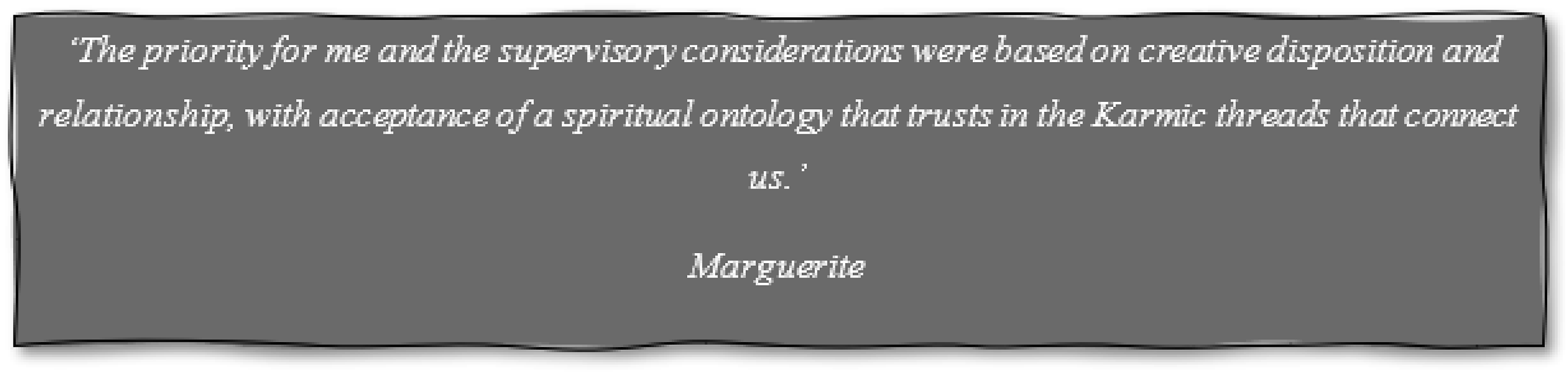
Supervisee Perspective (Marguerite)
The expectations of the supervisory relationship, according to university policy guidelines, are based on partnership, respect, professionalism, integrity, honesty, communication, within the boundaries of institutional policy and cognisant of health and well-being (University of the Sunshine Coast 2023). It is a reciprocal pedagogical relationship that, like all (deep) learning, is an intellectual, affective, transformative, and relational pilgrimage (Pinar 1975). Initiating the PhD process was a step into the unknown, a personal and professional threshold.
I entered the supervisory relationship with anticipatory assumptions based on the humanistic and strengths-based framework that I take to my own teaching (Rogers 1969; White and Waters 2015). The reciprocity of the teaching/learning relationship is a given to me, drawing from educational theorists and practitioners such as William Pinar, John Holt and Maxine Greene. Having a multidisciplinary background in visual arts, education, art therapy and emerging futurist; it was imperative that my supervisors’ collective experiences and interests could span these fields. Additionally, a non-traditional PhD, pushes the boundaries of creative thinking and diverse ways of knowing. (Brabazon, Lyndall-Knight, and Hills 2020). Of course, this is never done in a vacuum and so the supervisory relationship intrinsically includes the intersubjective space between the supervisor and supervisee (Figure 2). Duoethnographic dialogue.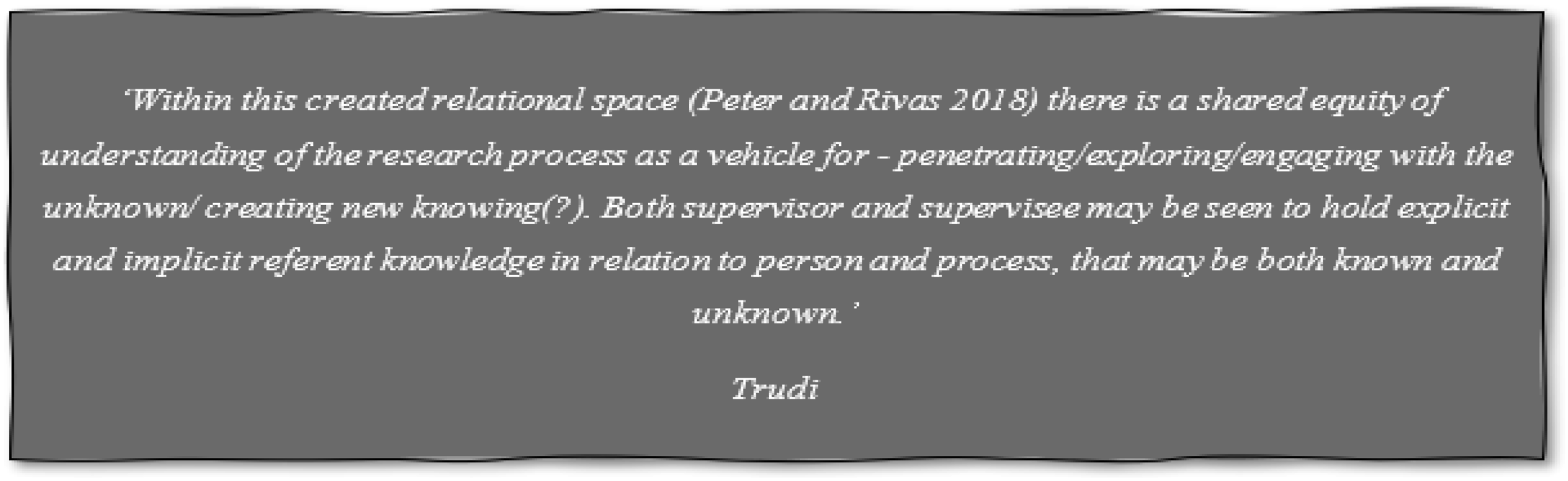
Having each witnessed through our practice, the ability of the expressive therapies to engage the intersubjective and elicit communication that is beyond the limitations of words, it piqued our interest to explore other ways of knowing and being within supervision, through sandtray.
Anticipatory: The Intersubjective in the Supervisory Relationship
In the intentional engagement with other, in inquiry, exploration and dialogue, an intersubjective space opens, unique in shape and content to the participant individuals. Stern (2004) describes this space as the ‘crucible in which interacting minds take on their current form’ (78). Self becomes decentered as the intrapsychic experiences and knowledges of each individual intermingle and interact within the intersubjective space, providing possibilities of genesis and synthesis of emergent new knowing (Wiederhorn 2015), that can be spontaneous, unexpected, and frequently profound (Lett 2011).
Intersubjective engagement has transformation potential, as co-created new knowledge may return to reshape the awareness of each constituent participant. Emergent futures may also be located within the intersubjective, which holds an anticipatory aesthetic that is brought independently and cooperatively and that evolves with dialogical interaction.
Within the supervisory context, the intersubjective describes an emphasis on relationality, dialogue and an orientation towards collaborative co-creation and revisioning of expanding realities. The relationship tends towards egalitarian, with the intersubjective focus offering a shared reciprocity of experiencing that makes growth available to both parties (Brown and Miller 2002; Herron and Stanley 2001; Yerushalmi 2012). This in turn feeds back into the intersubjective crucible, sourcing further evolution of the supervisory relationship itself (Yerushalmi 2012).
Introduction of participatory expressive arts and sandtray within the intersubjective space of inquiry, in therapy, supervision, or research, privileges the unconscious of each constituent participant, thereby creating an intersubjective space populated by the known (conscious), unknown but known (pre-conscious) unknown (unconscious/collective unconscious) understandings of each participant, actively engaged in the service of the inquiry (Rogers 1993; Turner 2005). The sandtray becomes a voice of the intersubjective experiencing. Input to, and output from, the intersubjective space can be verbal, non-verbal, kinaesthetic, sensory, somatic, affective, cognitive and/or symbolic. The three states present in the intentionality of giving voice to the intersubjective space are ‘joint attention, sharing of intentions and affective states’ which are ‘shared without translation into language’ (Trondalen 2016, 12).
Once commenced, the focused collaborative art making becomes a process and artefactual participant in the inquiry, providing both emergent content, and content in process, with the latter often accessed via reflexive iterative inquiry. Emergence, in this sense, reinforces an experienced understanding, that the co-creation of art in the context of inquiry, can give rise to meaningful discoveries and insights, that may not have been consciously anticipated or accessed. Within the sphere of arts-informed intermodal inquiry, this intersubjective journeying with other and collaborative multimodal forming is referred to as companioning (Lett 2011, 2018) (Figure 3). Duoethnographic dialogue.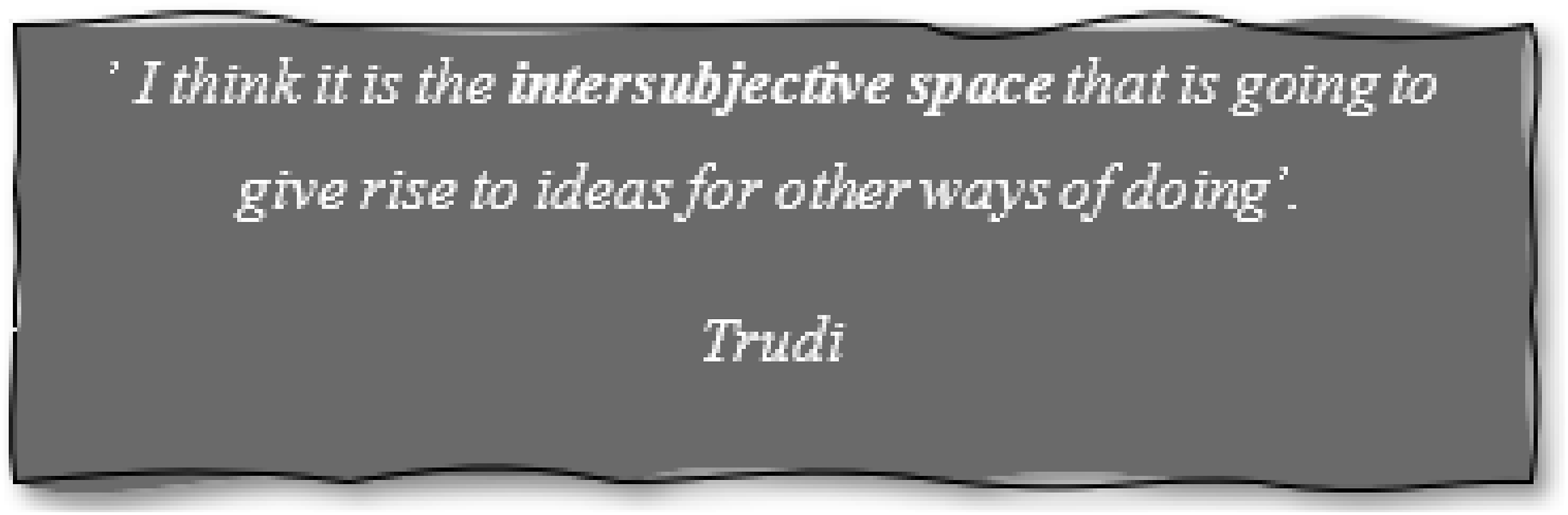
Anticipatory: Spontaneous Expressive Art
Following initial discussion in the opened shared space, we each worked with our own impetus to generate a spontaneous expressive artwork. What was initially considered as a vehicle for preparatory cleansing/releasing, was actually experienced as a deepening into the relationality that would sit at the core of the next stages of the work. Impetus driven art-making vehicles an expression of internal cognitive, affective, and somatic experiencing. Rumination, bidirectional intensity of affect and embodied tension each have the potential to impact capacity for Presence to the unfolding moment of the now, with associated impacts in terms of clarity and access to arising new knowing. As an initial process in reflection, spontaneous expressive art making can support a catharsis that will create space for subsequent insight-oriented arts-informed practice (Eberheart and Atkins 2014; Rappaport 2014).
In method, spontaneous expressive art making invites the artist to utilise available visual arts materials to express themselves in line, colour, shape and form (Pearson and Wilson 2009). Emphasis is placed on the process of making/movement, rather than product, wherein the inquirer/artist is invited to ‘follow their hand’ or ‘follow impetus’ rather than seeking to realise a desired creation or held visual image. Via this process, the spontaneous art creates a space for anticipation for emergence by clearing expectations, pre-conceived plans and engaging in artmaking in place. It fosters intentional seeing essential for attention to the phenomenological. The following describes both authors’ (Trudi and Marguerite) experience when moving through a spontaneous expressive arts process, prior to the commencement of the focal sandtray work.
Aesthetic and Emergent: Spontaneous Expressive Art Observations and Experience
Supervisor Artwork (Trudi)
I arrive into the space feeling agitated, and tired, and seek a release of this experiencing into the energising process of art-making. I choose a crayon like oil pastel in blue, with my right (non-dominant) hand. My hand begins to make circular shapes at a medium pace, tracing over and over gently thickening initial single lines. Holding loosely, I feel my body starting to relax as the circles swirl. I like, and feel pleasure in the making of the shapes, and in the feel of the crayon-pastel on the page (Figure 4). I stay with this movement for some time. There is a rising felt sense of a need for another colour, and I am drawn to add orange. I do so sparingly, and then begin to feel tight again. The blue swirls so calming and visually appealing. The orange taking me deeper. Exploration. As I notice the swirling shapes of blue, there is a deep and unexpected connection with femininity, a feeling of softness within. Amidst the layering of the darker shapes in the drawing, a face; a woman with a head wrapped in soft layers of blue scarf emerges. Spontaneous expressive art - Trudi Flynn.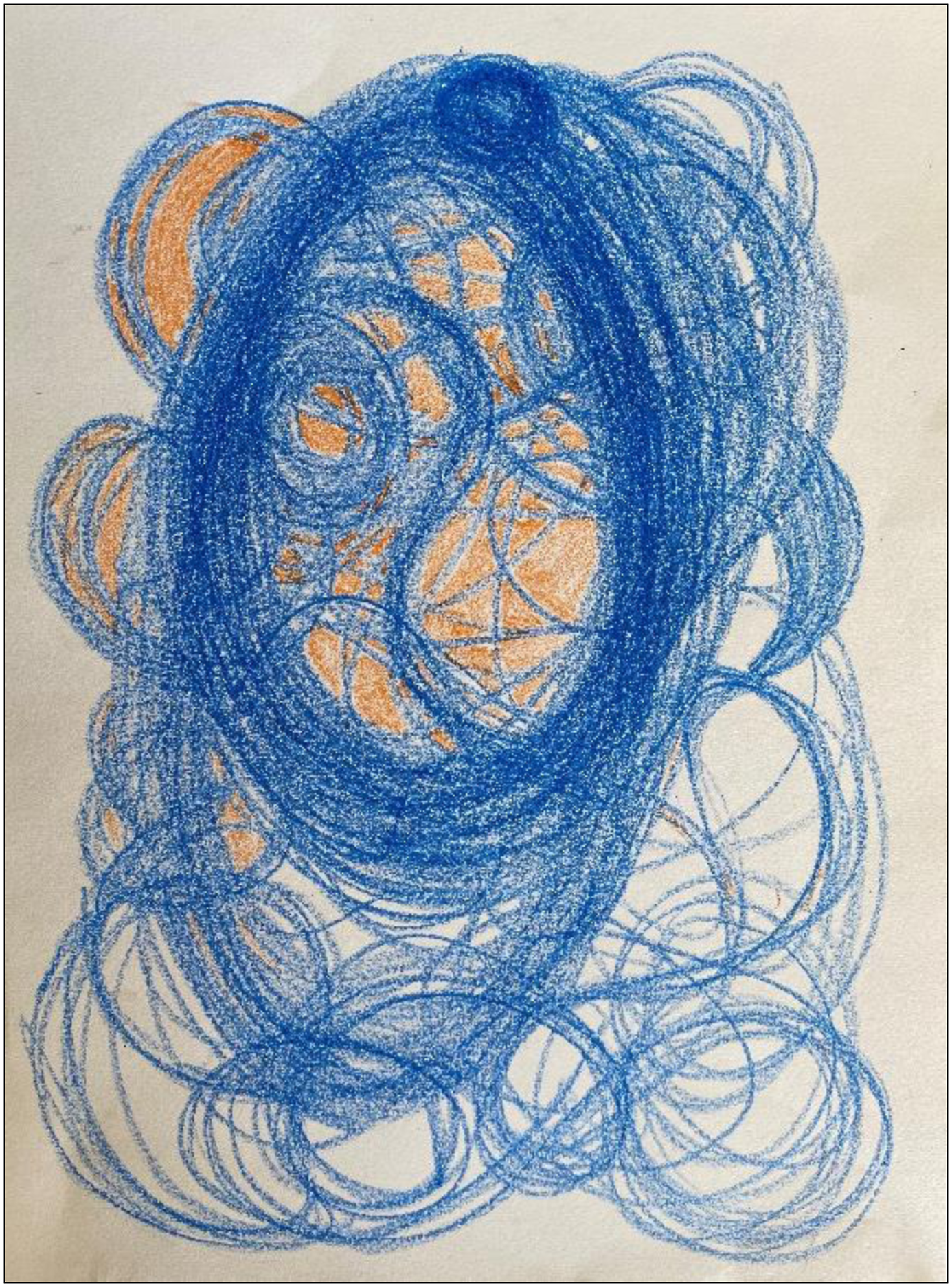
I rotate the art to the four 90-degree points, open to other emerging possibilities, though it is the woman who remains, As I focus on the orange, another layer of emergence occurs and the title/statement ‘Bedouin woman in the desert’ comes (Bedouin from Arabic badawi, means Desert Dweller). I rotate the art to the four 90-degree points, open to other emerging possibilities, though it is the woman who remains, As I focus on the orange, another layer of emergence occurs and the title/statement ‘Bedouin woman in the desert’ comes (Bedouin from Arabic badawi, means Desert Dweller). I feel myself hardening with necessary (?) capability at the recognition, and immediately grieve the soft spaces of moments before.
A week in the future and looking back to this time, I feel a connection in the blue swirls and soft gentleness of the feminine, with the embodied gentle femininity that seems to characterise Marguerite’s expression of self in our meetings together, and that has become a marking characteristic of the intersubjective of our supervisory relationship. I become aware of the juxtaposition that I often feel between this and my own more usual stance. There is a sense that the art has vehicled my opening into the intersubjective space between Marguerite and myself (Figure 5). Duoethnographic dialogue.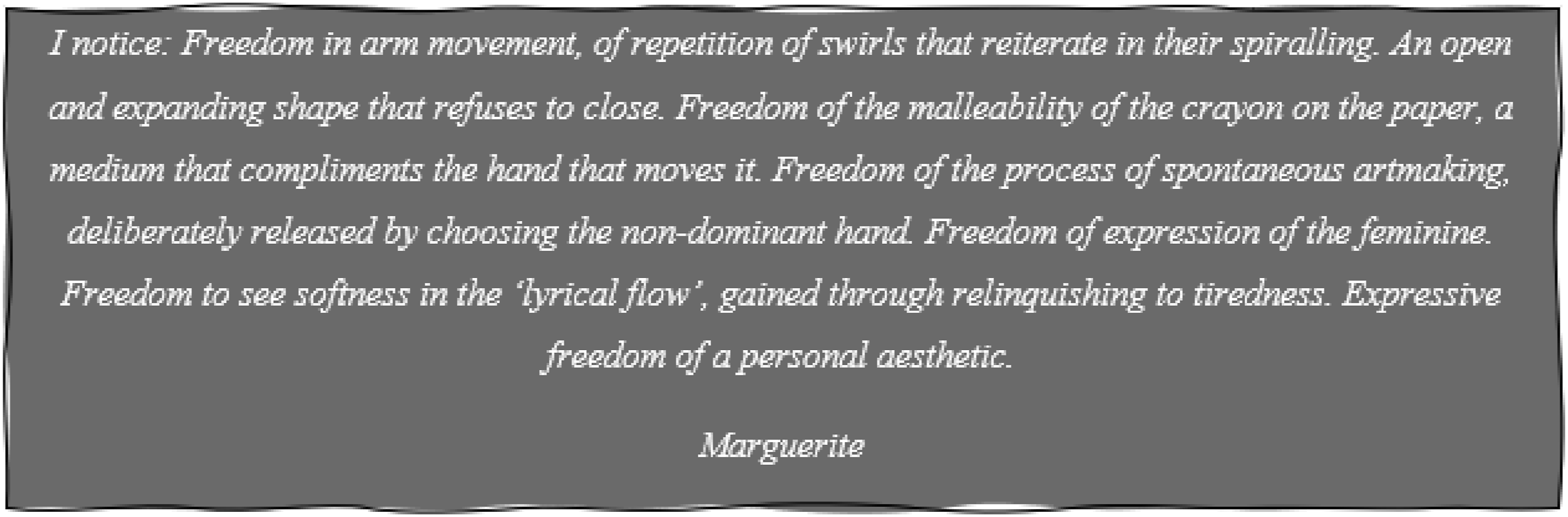
Supervisee Artwork (Marguerite)
I approached the artmaking with the notion of clearing conscious processing and rumination on my research from the night before. Contrasting elements and yet, complimentary colour and movement arise: a murmuration and a ground which meet and merge at a horizon line (Figure 6). The image spoke of murmuration’s, a favoured term I am presently using. It aptly describes the shapeshifting, busy contents of my consciousness. ‘Murmuration’ describes waves of movement and connection that overlap and intersect. It requires trusting what emerges from what could seem like chaos. ‘Chaos’ as defined by its etymological roots as a void with potential clarity. A grounding emerges – reflecting oscillating states, associated with the expectations of linear timeframes that belong to the institutions and systems the PhD is situated in. Which have a habit of stifling intentional listening to the emergent and creating obstacles to deep learning. A parameter that I am bound to (like it or not). There’s an airiness and a grounding, a precipice existing in the space between. A paradox of excitement and overwhelm. How much am I prepared to bend? In this space, what are the descriptors of the alternative role, what are the descriptors of what we don’t know. The supervisory relationship feels more spacious than the academy (Figure 7). Spontaneous expressive art - Marguerite Westacott. Duoethnographic dialogue.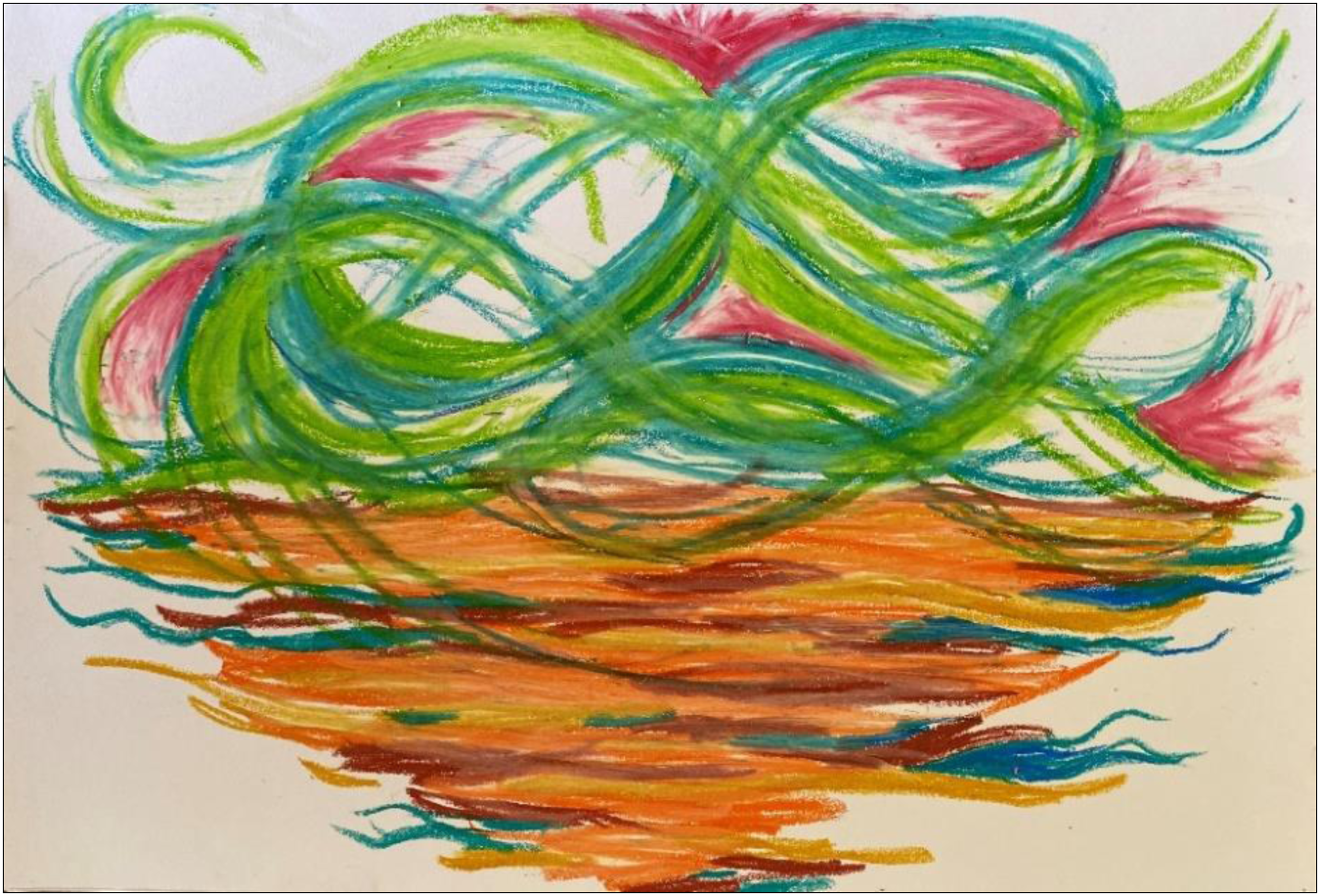
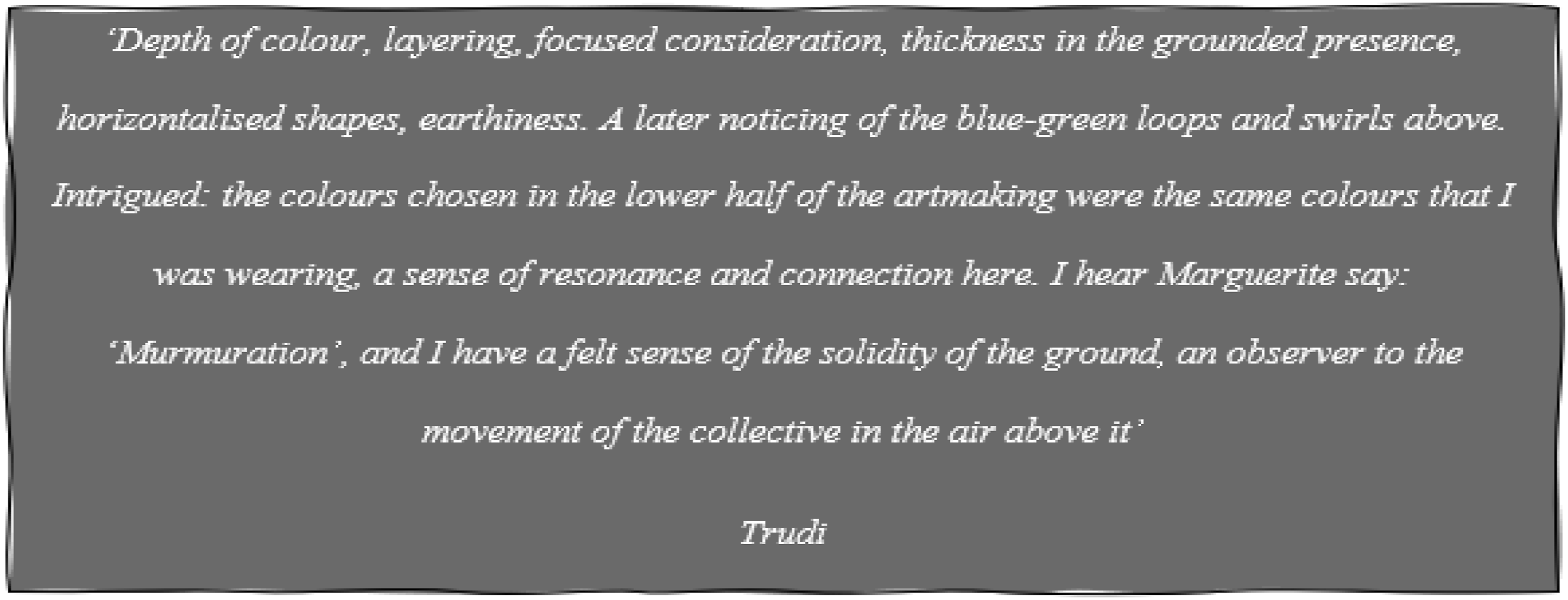
Emergent Duo Poiesis
Together in: the oscillating void. Trusting shape shifting chaos, Dwelling in: murmurations of embodied femininity. Soft grief, hardened pleasure. Unknown voices bend spaciously
Anticipatory: Introducing Sandtray
Sandtray is an expressive and projective therapeutic technique that supports wholistic externalisation and exploration of inner understanding via the selection and placement of symbols in a tray of sand (Homeyer 2016). Founded by Lowenfeld (1993; in 1993) in the 1920s, within a context of therapeutic engagement with children, the modality was further developed with Jungian context by Dora Kalff, who trained with Lowenfeld, in the 1940s. Sandtray is now commonly and broadly practiced with individuals of all ages, settings, informed by an array of psychotherapeutic frames (Homeyer 2016).
In application, the sandtray is typically rectangular, made of wood or plastic, with an interior bottom surface painted blue in colour. Included sand can be dry/damp/fine/coarse, with each providing a different frame of experiencing (Homeyer 2016). Individuals (inquirers) are invited to engage with the sand, and when ready, to select symbols from a provided array, and arrange them in the sand in a manner that feels congruent There is an invitation to follow any sense of feeling drawn to a particular symbol or placement, and an attending to somatic experiencing of both the inquirer and the facilitator throughout the sandtray process (Pangari 2023; Pearson and Wilson 2000).
Characteristics of sandtray, including the use of symbols, the invitation to metaphor, and the attending to the somatic and intuitive senses, privilege the unconscious, so that the field of a tray can hold expressions of information that is both known (conscious), known but not known (pre-conscious) and not known (unconscious) to the inquirer (Armstrong et al. 2015; Pearson and Wilson 2000; Turner 2005). Through sandtray, this material becomes available to the individual in an externalised, projective 3-D format that permits novel engagement. Once complete, exploration of the sandtray is led by the inquirer, and supported by the facilitator. There may be consideration of the visual array, meaning of specific symbols, spatial relationships between symbols, and emergent storying. This exploration is dynamic, and movement of symbols can occur during this phase (Homeyer 2016). Sandtrays can be completed as individual trays in a 1:1 exploratory setting, individual trays in a group setting, or collaborative trays where two or more individuals complete a tray together (for example in couples or family therapy) (Homeyer 2016). They may be initiated in response to a specific inquiry/held sense, or engaged with emergently, with no pre-identified inquiry. Sandtray work is multisensory, intermodal, heuristic and hermeneutic. It has potential to provide access to new ways of seeing and, by association, new knowing. The intermodal engagement afforded by sandtray can in turn inform preferred ways of being (Lett 2011; Pearson and Wilson 2000). The most common application of sandtray is within the therapeutic context.
An existing literature has explored the potential benefits of sandtray as a pedagogic instrument for clinical supervision with therapeutic professionals (e.g. Amas 2023; Anekstein et al., 2014; Garrett 2017; Perryman et al. 2016) and counsellors in training (e.g. Delgado et al. 2023; Perryman et al. 2020). Here the modality is variously utilised to support supervisee exploration of the Self, exploration of a presenting case, development of case formulation, and exploration of Self in relation to practice/case. Sandtray can also be used to explore arising challenges in the supervisor-supervisee relationship. Outcomes associated with inclusion of sandtray in clinical supervision include enhanced therapeutic self-awareness, increased reflection skills/capacity, improved understanding of client processes, strengthened supervisee skills, and encouraged expressiveness and rapport building within the supervisory relationship. The integration of sandtray within research supervision appears unique to this study. Our focus is the exploration of the potential contribution of sandtray to understanding and guiding of future developments in the HDR supervision relationship.
Aesthetic: Sandtray Observations and Experience
Supervisor Sandtray Observations (Trudi)
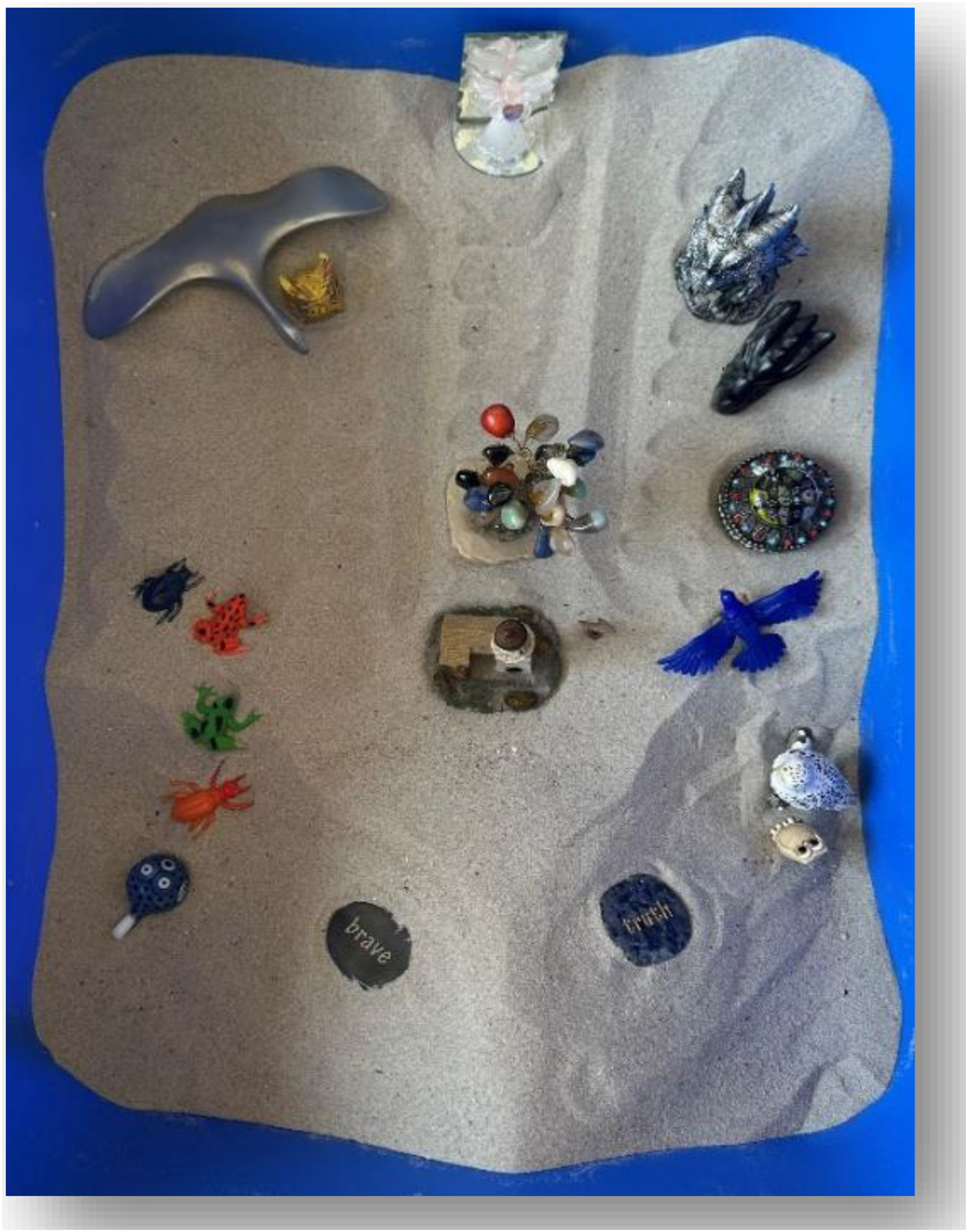
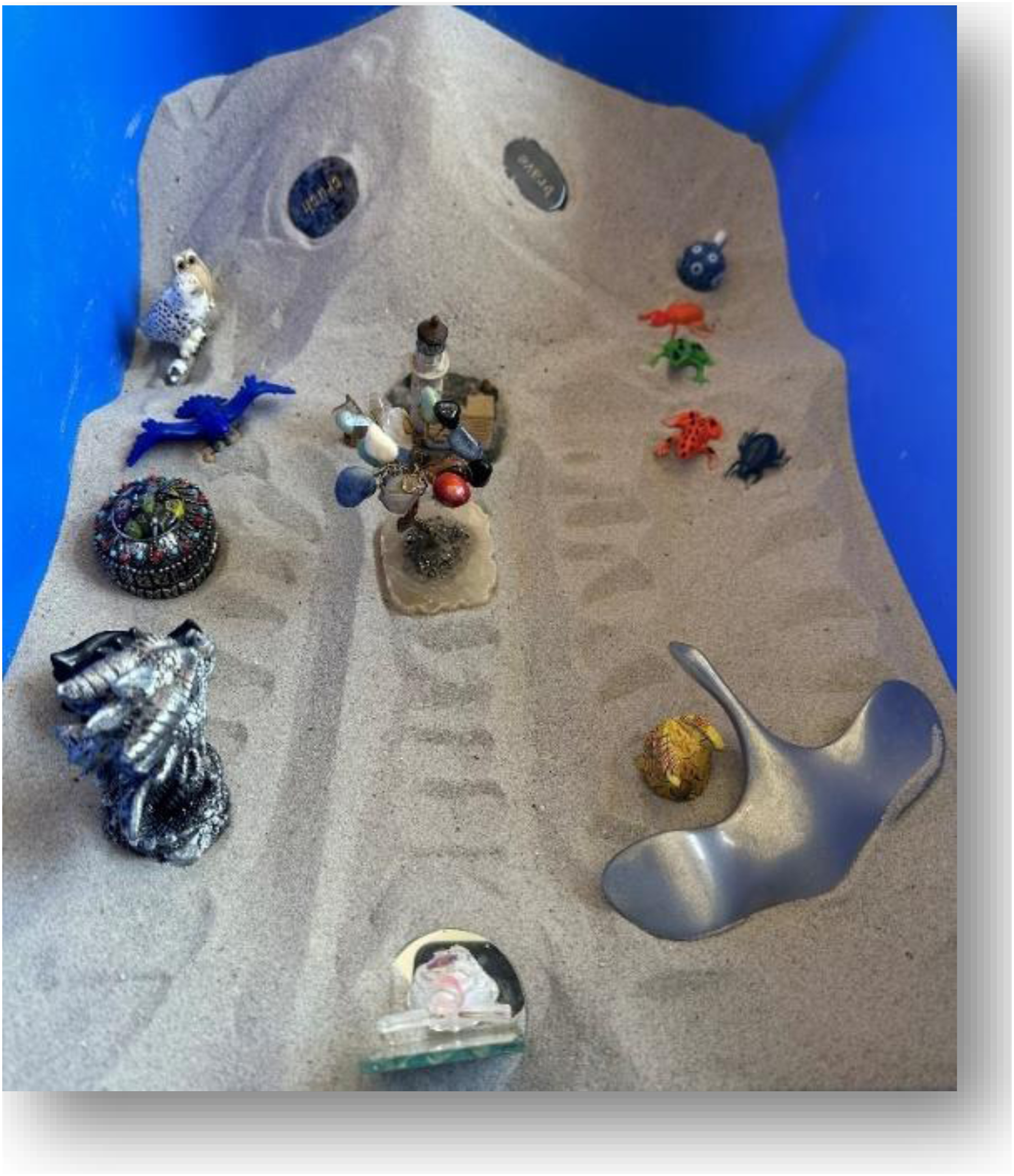
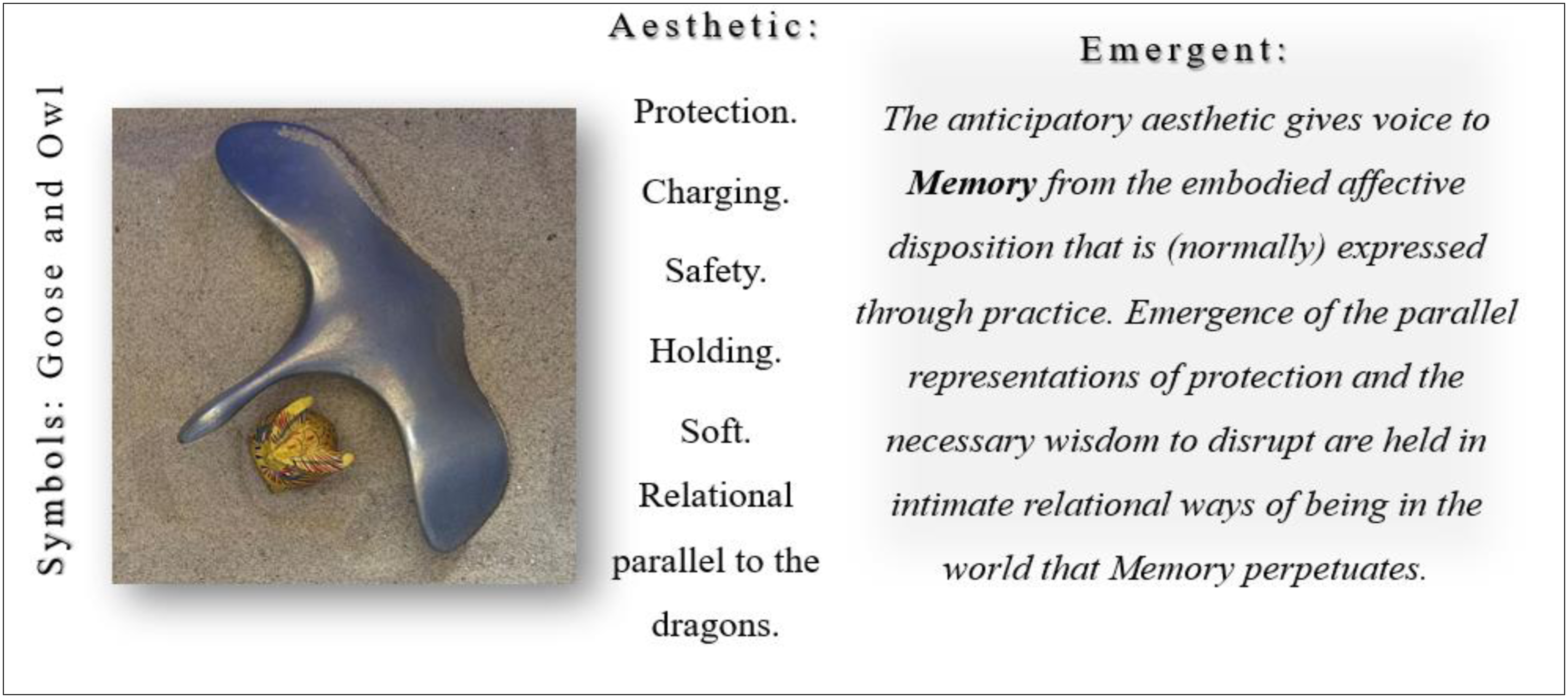
We break briefly following the exploration of the drawings, before returning the room in which the sandtray and miniatures are located. We each move to sit at each end of a large blue rectangular container, half filled with fine, dry, white sand. The container is on the floor. We have decided to bring an attitude of inquiry to the sandtray work, rather than a specific articulation. I move my hands through the sand, and soft patterns form in the wake of my fingers. I look up and observe Marguerite’s hands moving through the sand, I notice that we each keep to our own nearest ‘half’ of the tray in our movements. I observe Marguerite forming what I perceive to be a pyramid at her end of the tray I feel impetus to begin to shape the sand in my half of the tray as a response to the formed ‘pyramid’ and create a patterned forecourt. A clear, loud thought arises: “What is holding this PhD up?” The thought is so loud that I stop to write it down. When I move towards the shelves of symbols, I feel a rising tension, and a second loud thought arises, this time as an instruction - ‘Disrupt. You have to disrupt.’ I move across the front of the shelves. ‘Disrupt, Disrupt, Disrupt!.’ I find myself drawn to strong symbols with a sense of discomfort: two dragons; a charging metal goose. I feel resistance to what is emerging. Relief as a small, painted, wooden owl, presents for collection. I return to the tray and begin to place the symbols attending to impetus and resonance, also considering the location of symbols that Marguerite has already placed in the tray. There is no spatial overlap in our placement of our symbols - we each continue to stay (mannerly) in ‘our half’ of the tray. There is a space evident in the sand immediately in front of me. I seek out another symbol, and am drawn to the figure of an angel, with a crystalline heart, standing in front of an attached eternity mirror, I place the symbol into the space in the sand in front of me, and this feels aligned. I view the completed sandtray as a whole and look forward to the coming exploration and dialogue (Figures 8–10). Aerial view of whole Sandtray. Sandtray view from Marguerite’s position. Sandtray view from Trudi's position.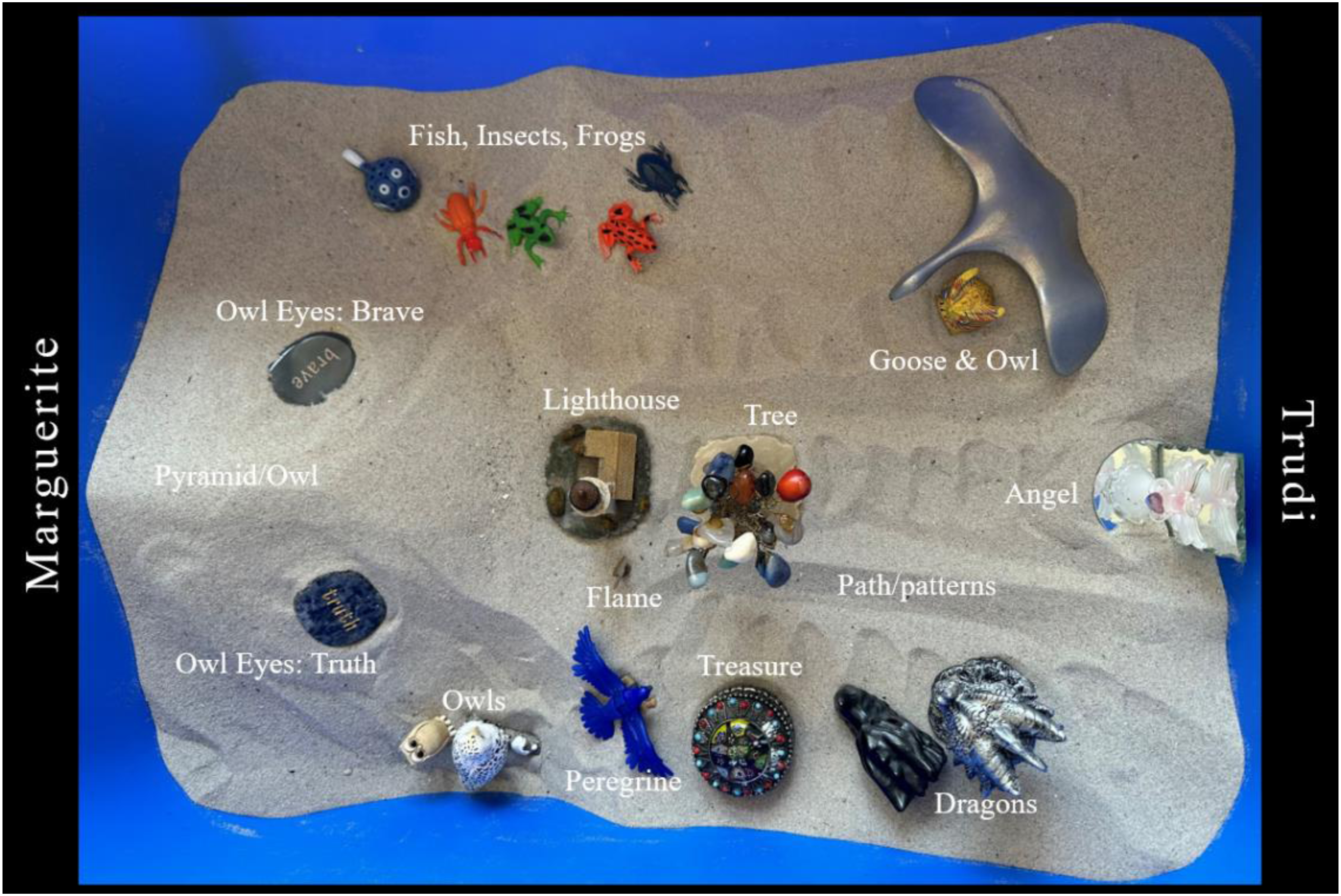
Supervisee Sandtray Observations (Marguerite)
Tactile connection with the sand is my first action. A haptic introduction of embodied knowing to the external locutor of the sandtray. There is an initial self-consciousness in sharing the sandtray space, perhaps a reaction to the perceived hierarchies in the academy, or a vulnerability of what the sandtray may offer. Exposure is not optional, so a safe relational space is essential. It is equally comfortable to be mutually experimenting, we are on the threshold of common and unknown ground. I allow an innate aesthetic to phenomenologically draw me to the objects offered in the sandtray resources. Their symbolism comes to me in an internal dialogue as I locate them in the tray: Object (aesthetic) - placement (anticipation) - meaning (emergent) – (rinse) repeat.
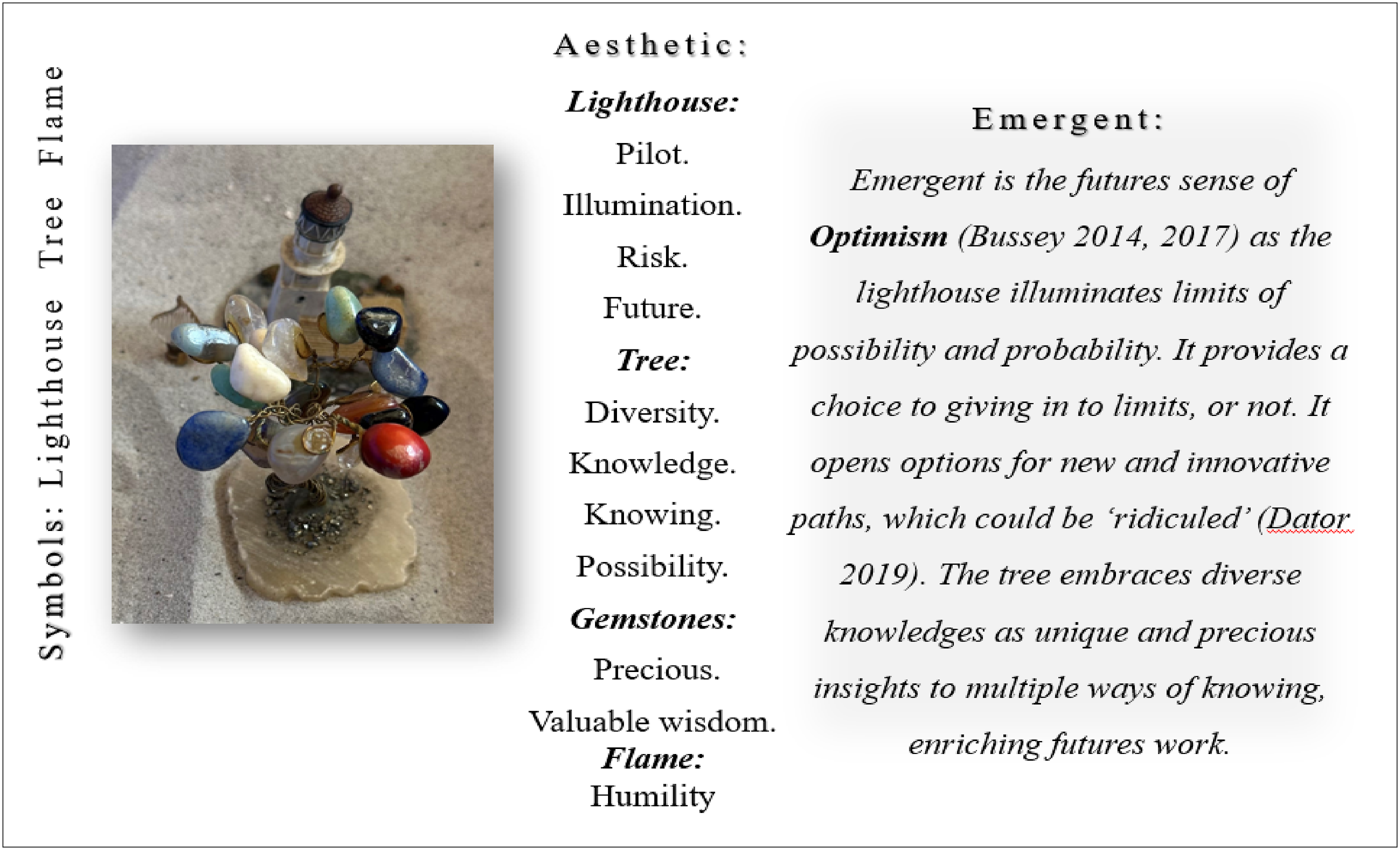
Some symbolism in the objects are familiar friends (frogs, insects, fish, peregrine). Others are new: lighthouse, tree, treasure, flame, owls and owl eyes. For further detail of the objects and emergent finding, see ‘Exploring the Symbols’ section of the paper.
When I look up I capture a glimpse of Trudi’s end of the tray, I was lost in my own until that point; just as she places the Angel. I am eager to hear her noticings, and my own, as I have no preconceived dialogue awaiting (Figures 8–10).
Emergent: Sandtray in Dialogue (Trudi and Marguerite)
Exploring the Symbols
The concept of the futures senses (Bussey 2014, 2016, 2017), progresses the anticipatory as an innate aesthetic that is underpinned by what Bussey has collectively identified as the futures senses: Yearning, Optimism, Voice, Memory and Foresight. Bussey observes that we are in relationship with the world via the Futures senses’’ (Bussey 2016, 41), that ‘orient individuals and cultures towards the future’ (50). Bussey (2014; 2016; 2017) identifies this as a relational and embodied engagement with futures that is culturally bound. Thus, human beings are in relationship with the future in complex and intimate, psycho-social-cultural and sensorial ways; that release us from dominant anticipation-for-the-future to anticipation-for-emergence (Miller 2018). In creating the sandtrays, we find that the anticipatory aesthetic is made visible.
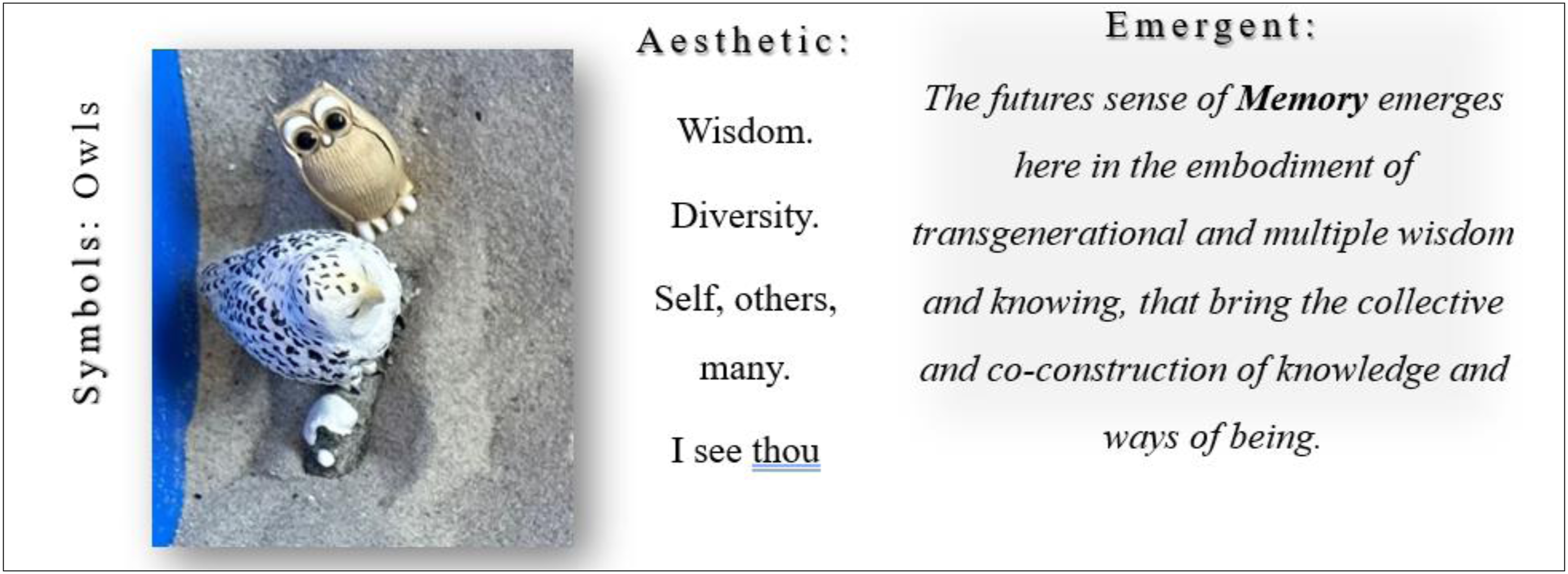
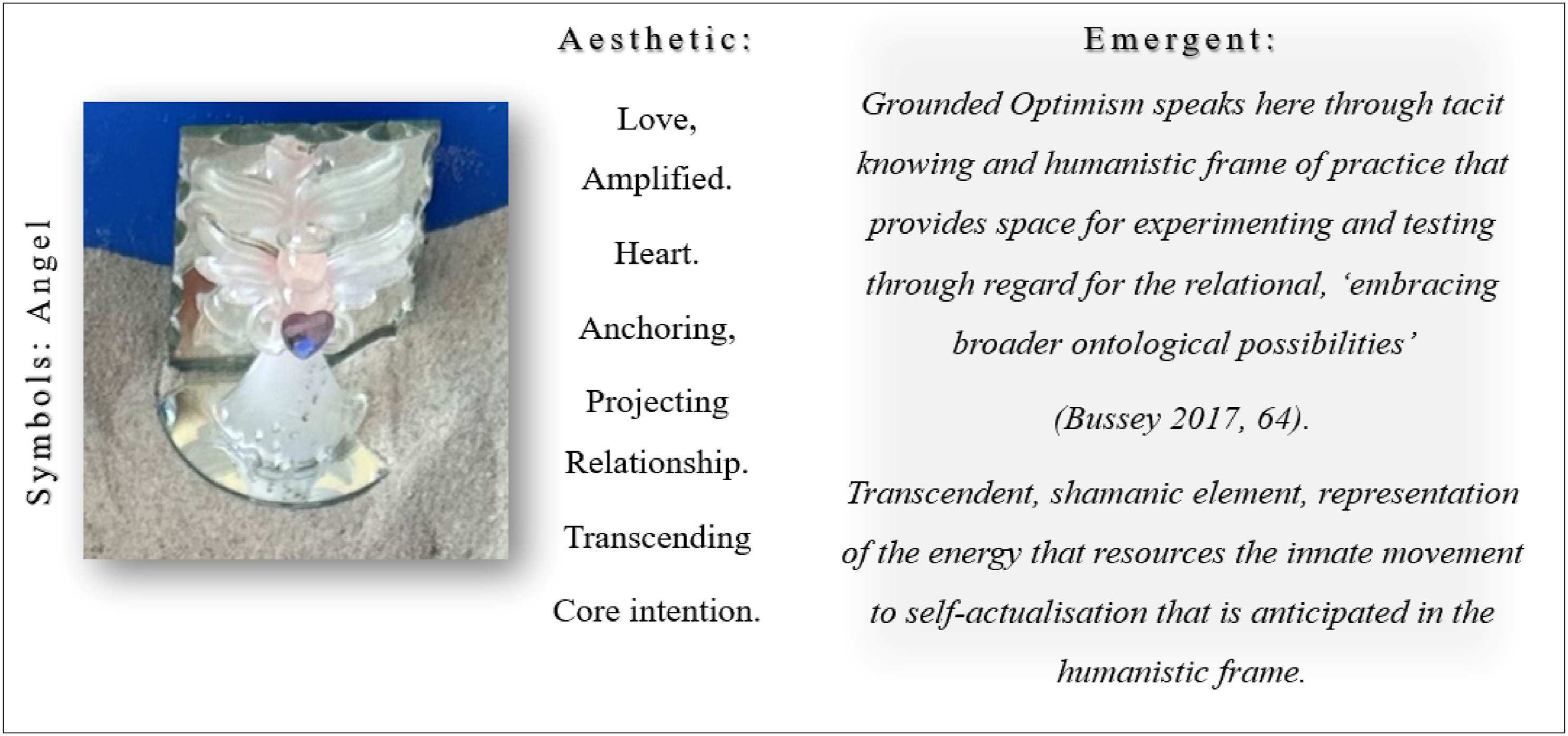
Presenting at the sandtray is an anticipatory action. In this case the anticipation was exploratory and experimental in a context uncommon to sandtray work. The images that follow, Figures 11–19, offer guidance for insight to our personal semiotic of our selected objects (see ‘Aesthetic’), and emergent futures literacy via the lens of the Futures Senses: Voice, Yearning, Optimism, Foresight and Memory (see ‘Emergent’). The intimate and emergent nature of our sandtray work is identified and made explicit, through descriptive words and explanation of the futures senses that underpin an anticipatory aesthetic responsible for guiding the hand. Symbol Exploration: Frogs, Beetles, Fish. Symbol Exploration: Ligthhouse, Tree, Flame. Symbol Exploration: Dragons. Symbol Exploration: Treasure. Symbol Exploration: Peregrine. Symbol Exploration: Owls/Eyes/Pyramid. Symbol Exploration:.Owls. Symbol Exploration: Goose and Owl. Symbol Exploration: Angel.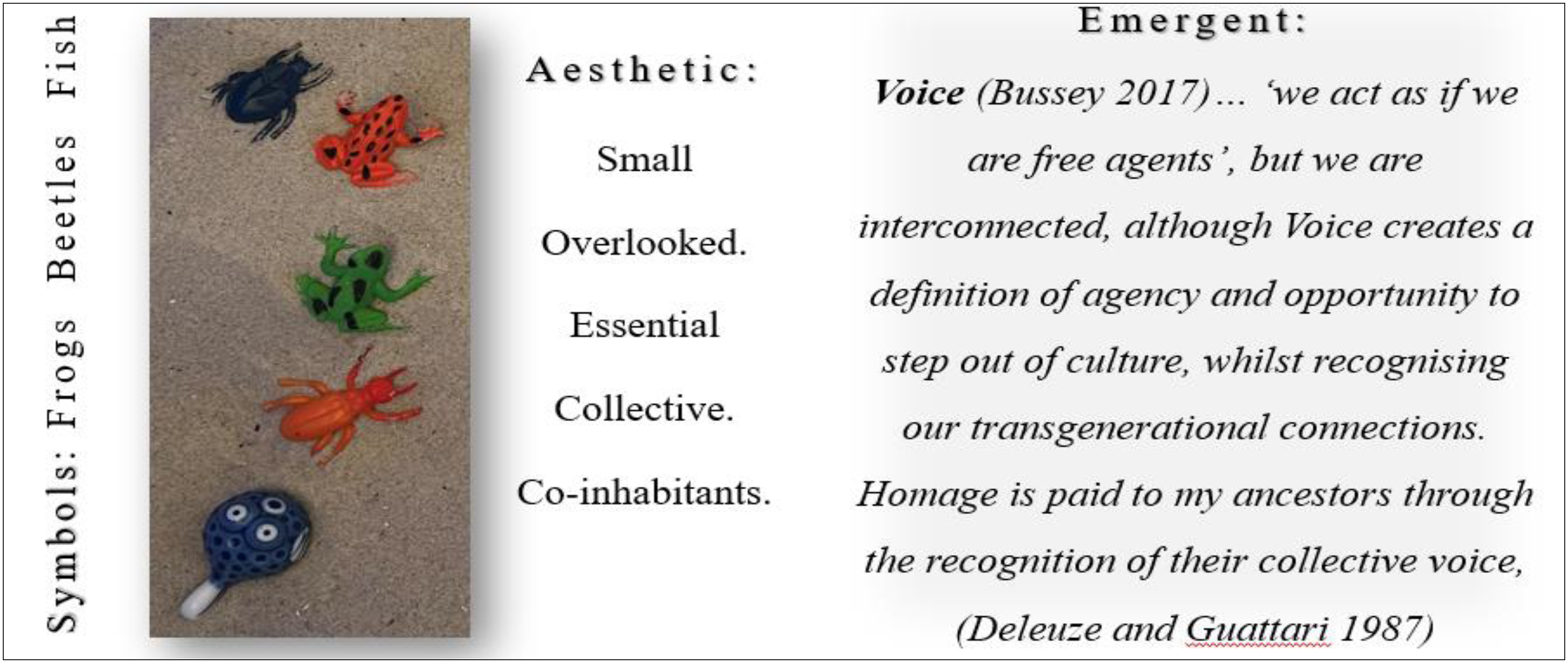
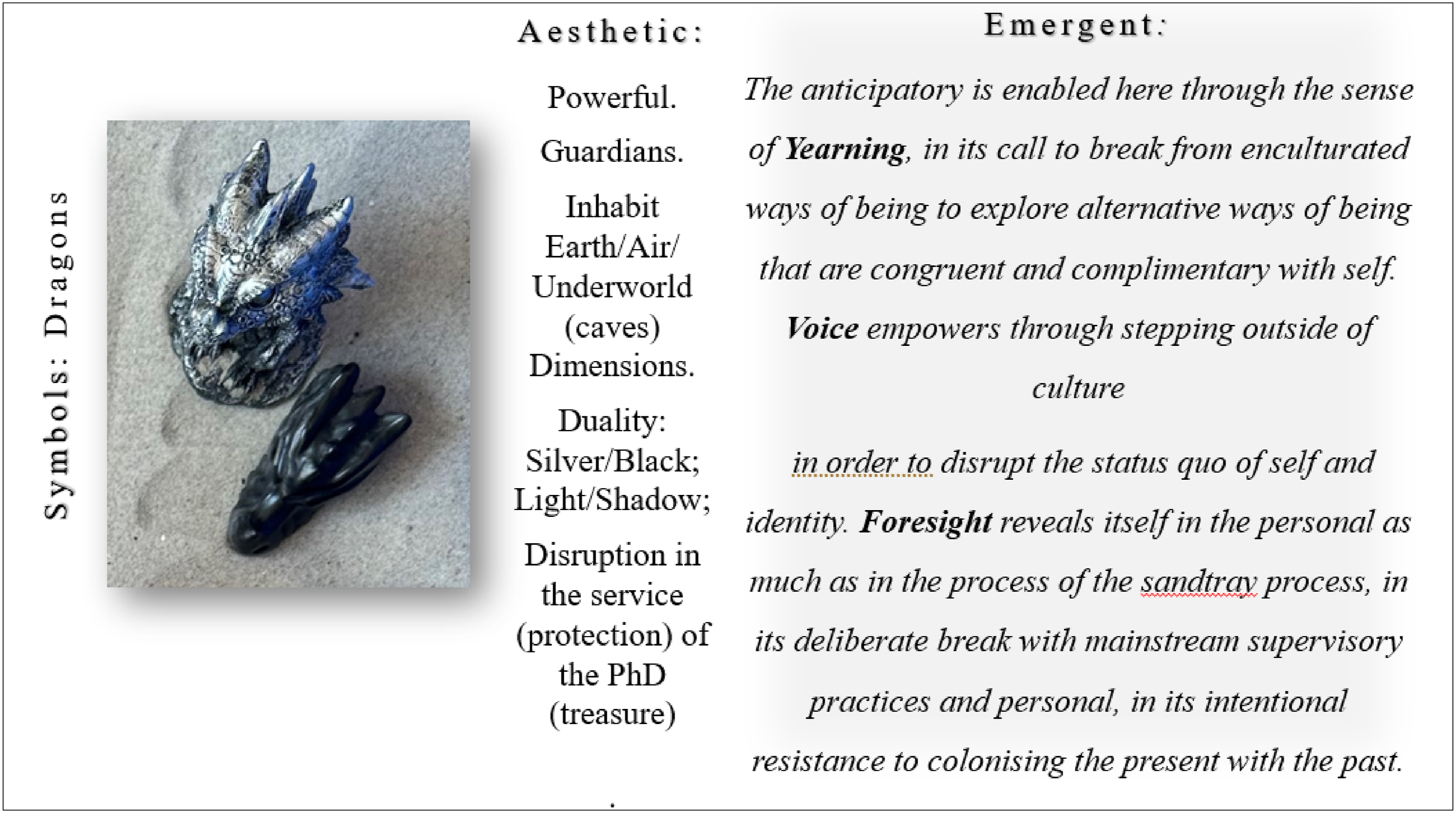
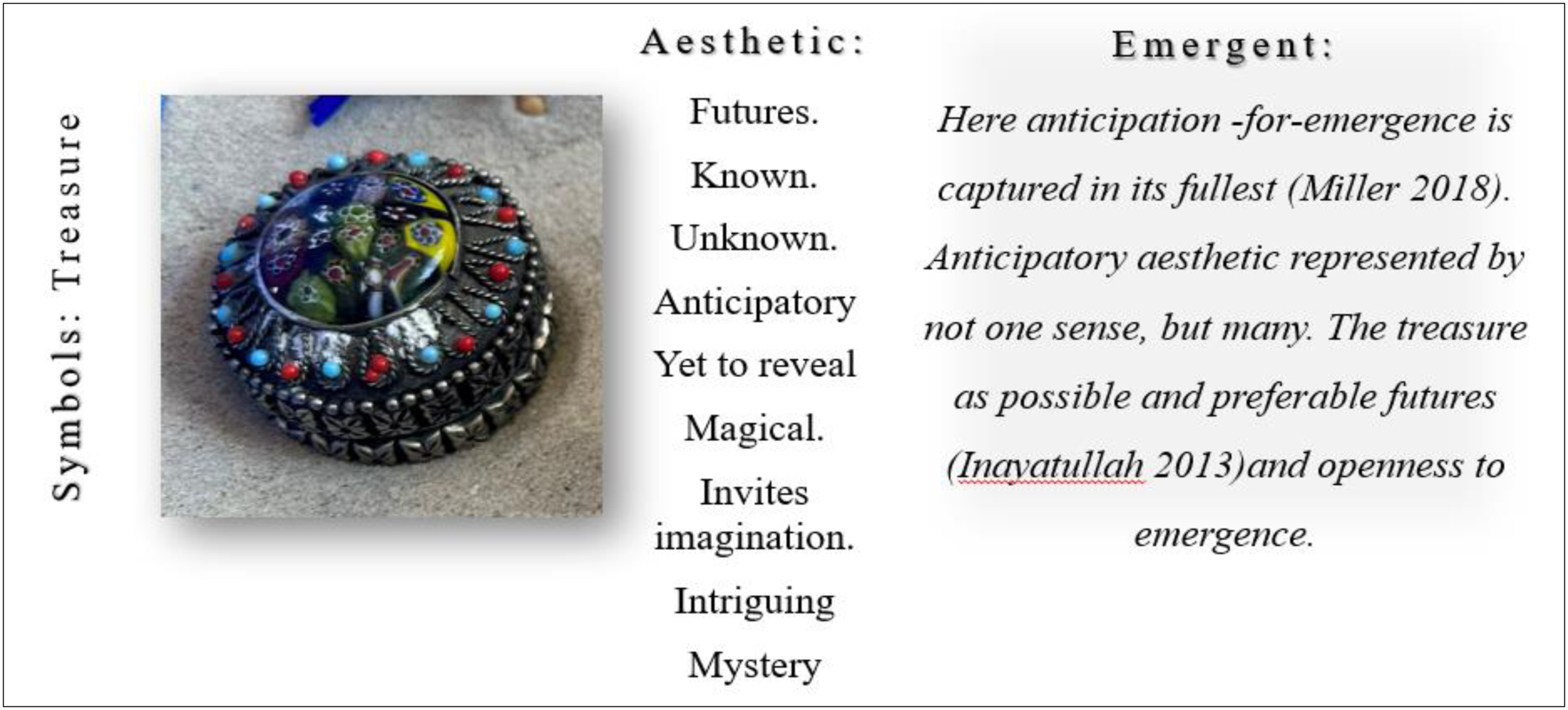
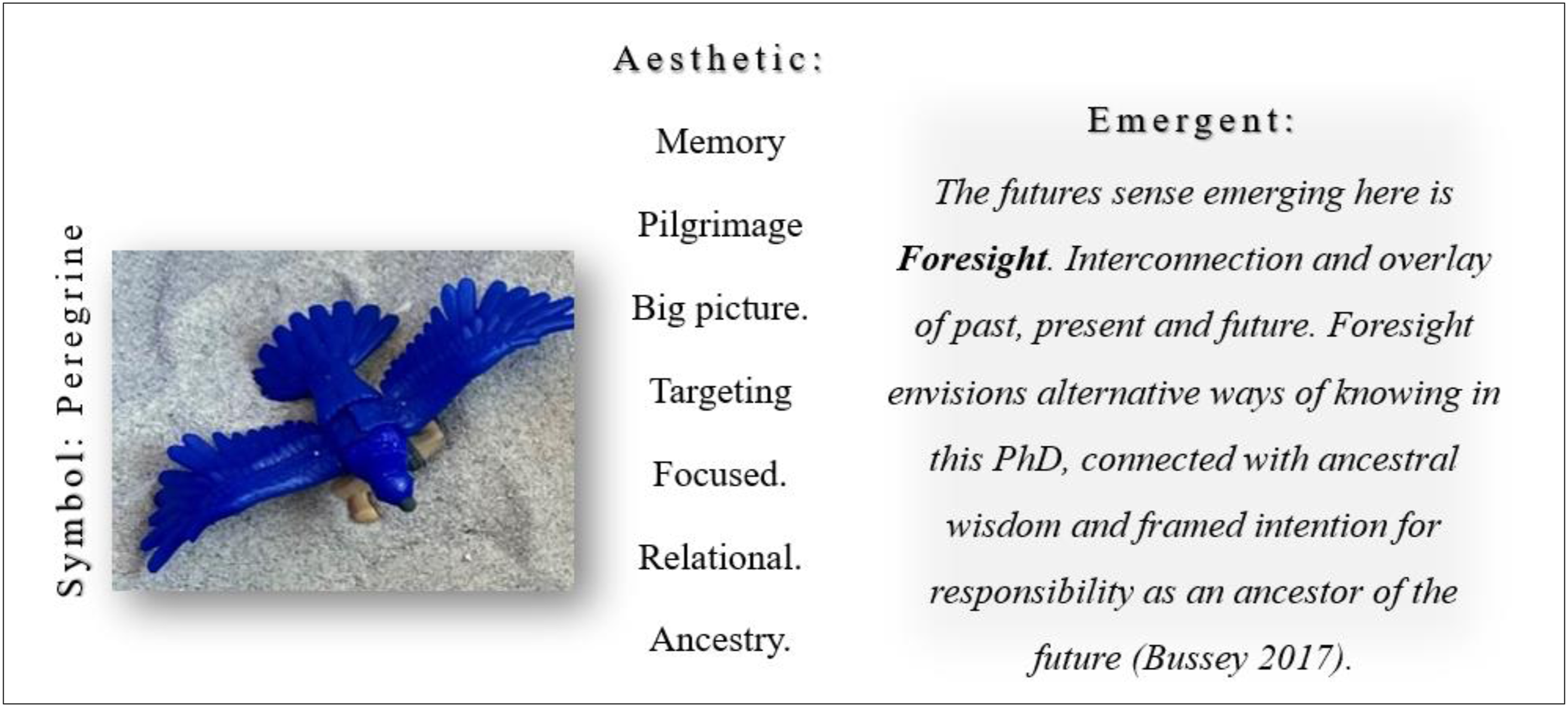
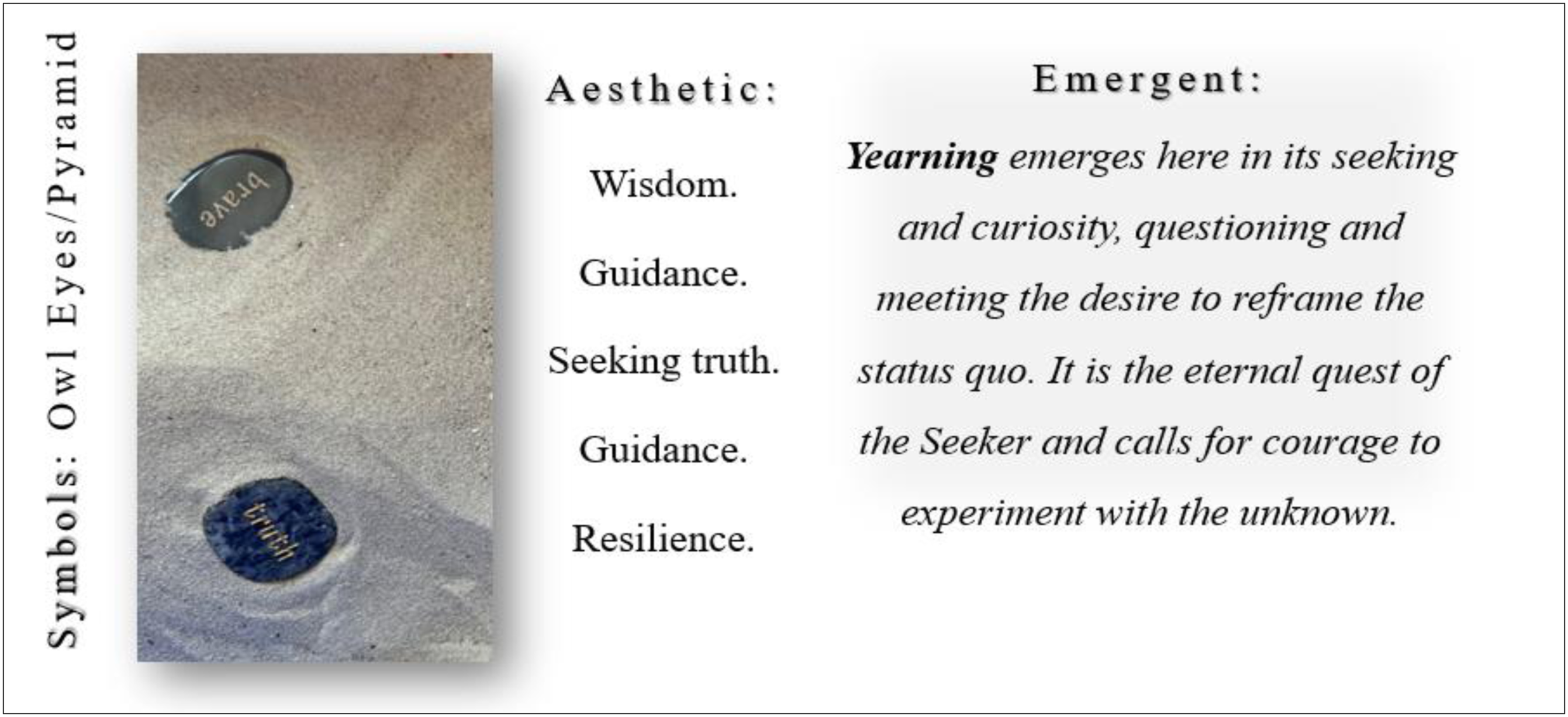
What is Holding This Phd up?
A clearly emergent statement arising within the frame of the sandtray activity came to prominence in our joint dialogue about the activity and unfolding process. What is holding this PhD up? In exploring, we discovered the dualistic possibility of the arising statement. What is obstacle? What is resource? We deepened into this line of inquiry, looking to standout patterns and groupings in the tray as potential access points for understanding.
Sandtray Patterns: Disruption Cluster
Dialogue
Trudi
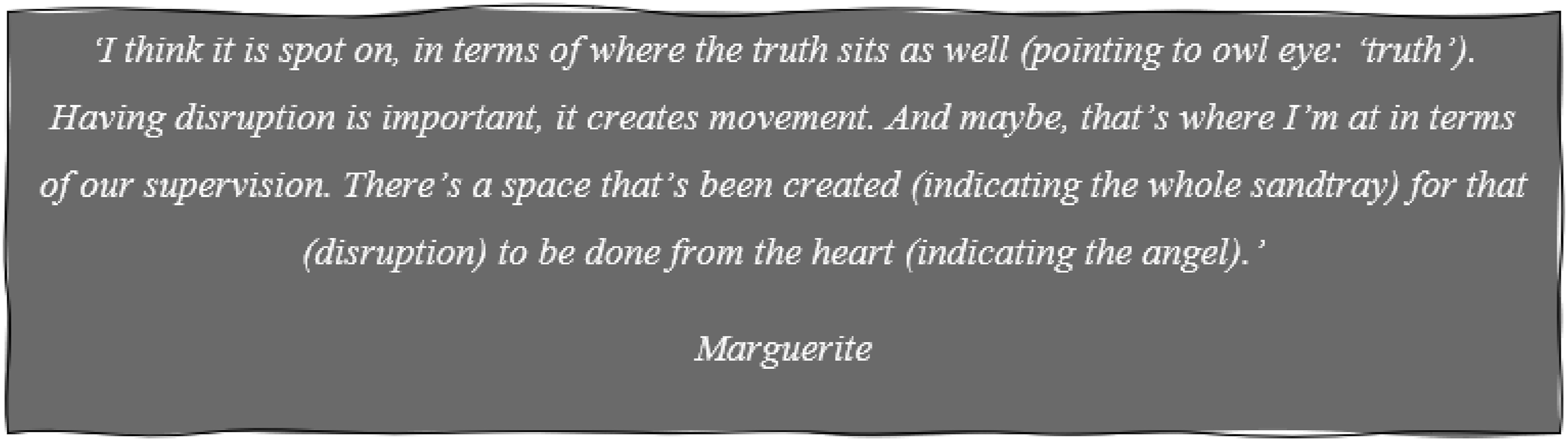
The necessity of disruption in service of the PhD. A message so important that it is repeated on both sides. Here though, the goose and owl offer a softer relational representation of the energy of the dragons. On this side, an informing of the how, an advice on the attitude of the disruption. I felt uncomfortable when initially drawn to these quite challenging symbols, and experienced a resistance that these truths were being offered through me. The notion of disruption as a characterising feature of the supervisor relationship, felt discordant with the humanistic alignment of my supervisory practice. Marguerite and I leaned into this resistance, discussing. For Marguerite, receptivity (Figure 20). For me, challenge (Figure 21). In the process of discussion, there was a sense of something shifting, and a feeling of opening to a more engaged and dynamic co-companioning as a development from a witnessing stance. A realisation of the significance of disruption as a potential vehicle for maximising opportunities for the arising unknown. Aerial photogrpah of sandtray outlining the disruption cluster of symbols. Duoethnographic dialogue.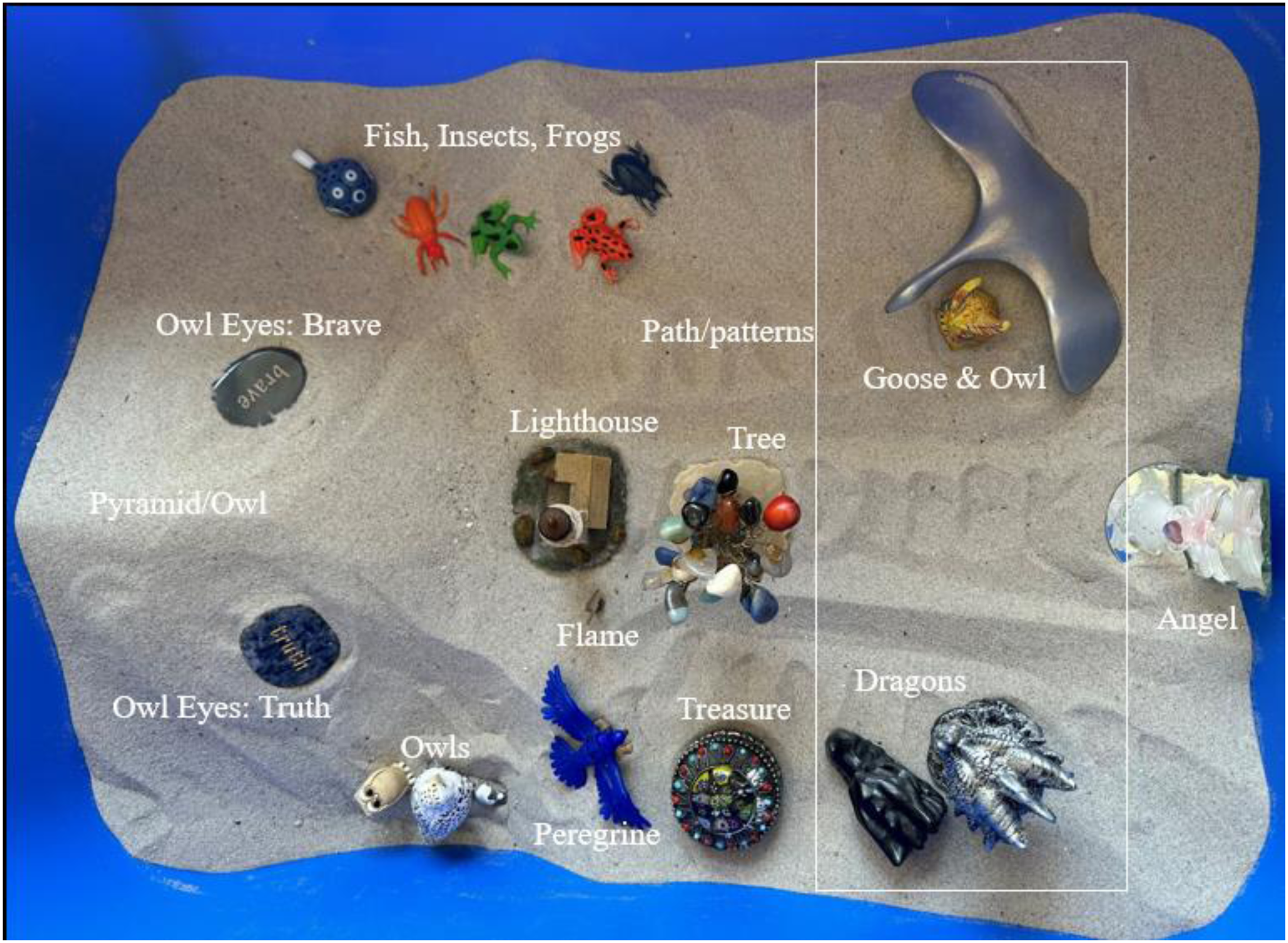
Marguerite
What is holding up this PhD? I welcomed the explicit expression of disruption (Figure 22). On reflection, anticipation-for-the-future was rising in me, on my journey to our meeting where I was innately anticipating the future in the presence of my commute. When the idea of disruption emerged out of the tray I met and welcomed it with a sense of familiarity. Symbols (predominantly the Owls) in the tray, spoke to me of my elders, those who see me. Elders who, with love, reign in the wayward (monkey) mind. I was curious of Trudi’s discomfort of the calling of disruption and so was keen to reiterate my genuine acceptance. It became a meeting of anticipation -for-futures and anticipation-for-emergent underpinned by a relationship that is more than the pragmatics of Academic HDR supervision (Westacott 2024 forthcoming). All elements in the sandtray either in their singular or dual purpose, pointed to the safe relational space that has laid the foundation for disruption to occur. Duoethnographic dialogue.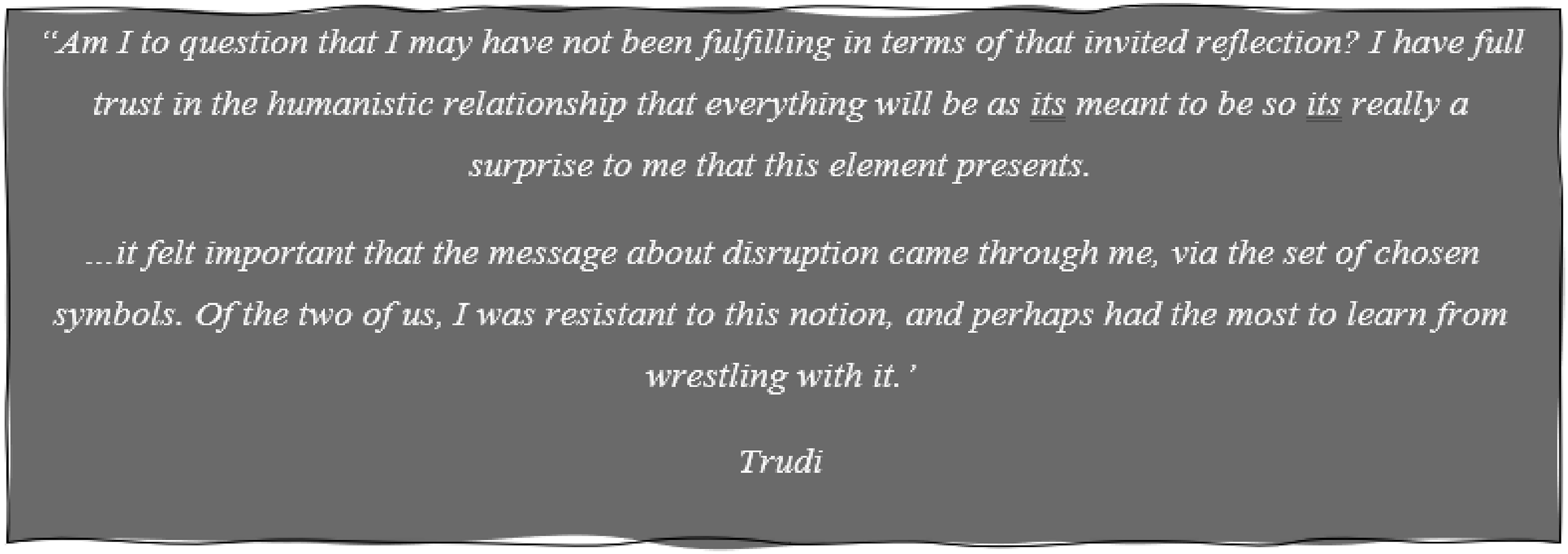
Sandtray Patterns: Central Triangle
Dialogue
Marguerite
In this triangle the elements are interconnected and represent multiple ways of knowing, being and becoming. Separating the objects undervalues the complexity of their inter-being (Hanh 2017) and the dynamic synergy between them. They are innovation, creativity, humility, diverse wisdoms, all interconnected with and in, the treasure of futures that experienced, though unknown. This is the spiritual apex of the tray for me. The treasure enlightenment, the lighthouse the path of the Seeker, the tree stating the wisdom of spirituality through diversity, the flame that provides a reliable reminder of walking lightly on this earth (Figure 23). Aerial photograph of sandtray outlining the central triangle of symbols.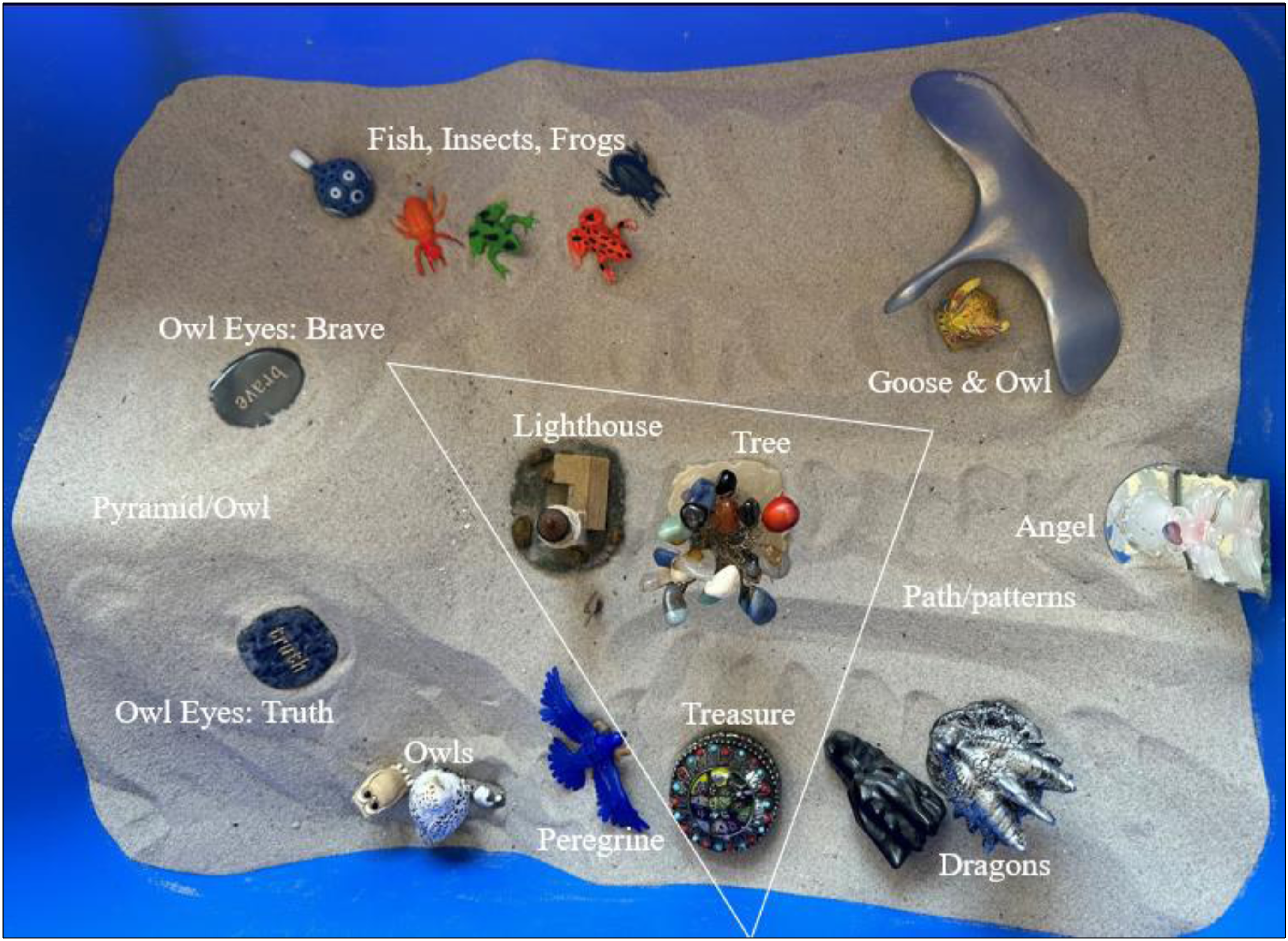
Trudi
This triangle feels solid, powerful, and significant in its location in the centre of the tray (Figure 23). The archetypal Tree of Life, holding an accumulated Wisdom. In relationship with the nearby, similarly coloured container of that which is not yet known. The Flame, and the Lighthouse, providing Illumination and protection against running aground. Gathered constructs, interrelated and co-informing. An engine. There is a feeling in this arrangement, of a capture of the core nature of the matter at hand (Turner 2005).
Sandtray Patterns: Central Line
The Great Owl and the Angel are situated at either end of the vertical axis of the tray, anchoring the work suggested in the centre of the tray (Figure 24). There is a sense here of the underlying and informing structures of the supervisory relationship. Heart informed, wisdom oriented, with transformative/transcendent possibility. Two powerful symbols anchoring process. Aerial photograph of sandtray outlining the central line of symbols.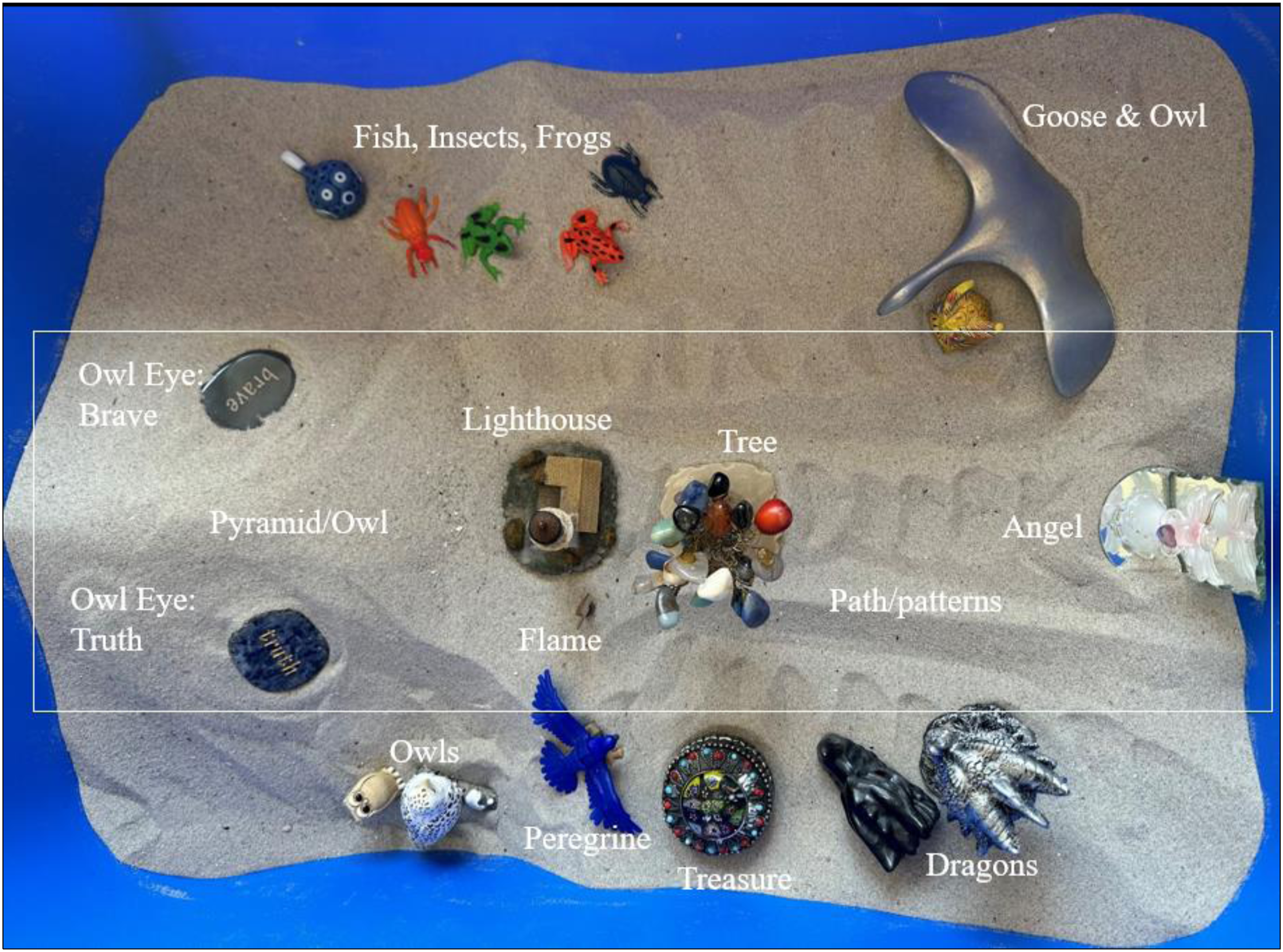
The Angel: Transcendent element, potentially representing the underlying or intrinsic energy that resources the innate movement towards self-actualisation that is anticipated in the humanistic frame (Rogers 1995) identifying its presence as an informing factor in the supervisory relationship. Here the mirrored background to the Angel suggests that this process/energy is amplified in this context, supporting the actualisation of the supervisory relationship itself (Figure 25). Duoethnographic dialogue..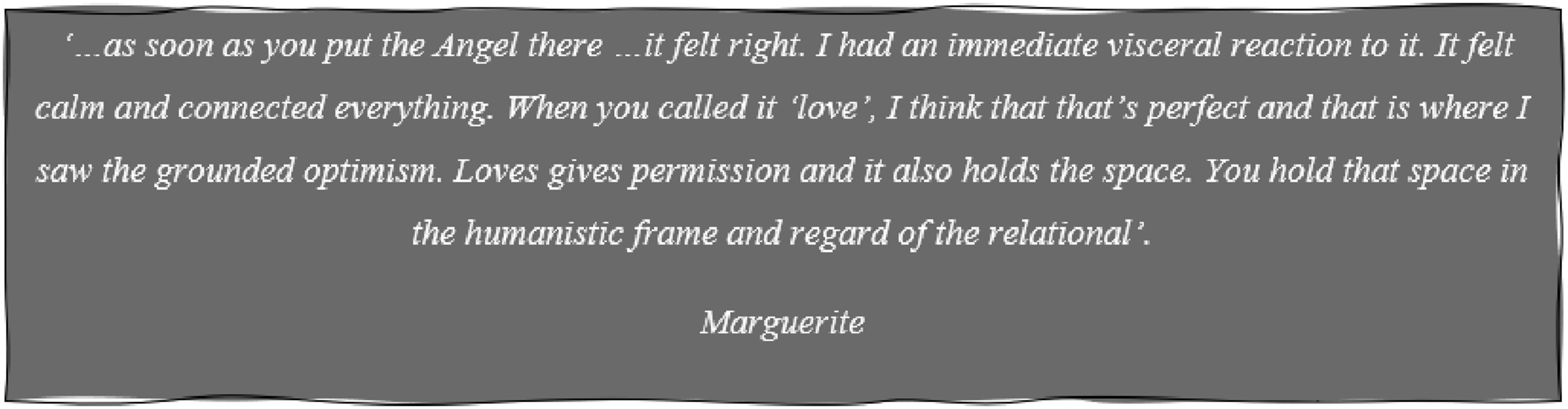
The Owl archetype of wisdom and guidance are amplified by their multiple representations (4) in the sandtray. As cultural symbols, owls represent (perceived) contrasting qualities of prosperity, insight, and good fortune, and death or evil (Fernandes 2022). The large ‘great owl holds ‘brave’ and ‘truth’ in its eyes - powerful qualities of the PhD pilgrimage and relationship. The owls represent the vast variety of wisdoms that are pervasive in this research project, which exist across realms of relationship, Spirituality, the intersubjective, physicality, embodiment, literature, transgenerational, cellular, implicit, known and unknown, conscious and unconscious. The Pyramid: Within the Owl, a seen pyramid, voicing a sense of ancient and powerful knowledge and process at work.
Emergent Duo Poiesis
A relationship anchored with amplified Love and Heart Wisdom and Guidance.
Disruption reigns in the wayward, shifting familiarity. Disruption, Resistance, Disruption; Dialogic companioning.
Illuminated synergy: Interconnected elements of dynamic knowing and becoming.
Conclusion
Preferred futures ‘should be envisioned, invented, implemented, continuously evaluated, revised and re-envisioned’ (Dator 2002). Expressive therapeutic arts and sandtray can contribute vitally within Futures inquiries related to research supervision, with potential to synthesise known (conscious), known but not known (pre-conscious), and unknown (unconscious), referent intrapsychic material to the intersubjective space of the exploration. Within the present study, dialogic reflexive engagement with emergent material has supported identification of both existing and preferred ways of being in the supervisory relationship and resourced constructive related action. Creative innovation has the potential to enliven and open supervisory pedagogy, moving it beyond the colonised academe, and thus, releasing it from ‘business as usual’. This enables exploration of possibilities, that can sit beyond cognitive reach, but are integral to studying futures, which complements the ethos of Futures Studies through being open, collaborative, experimental and rouse the imagination, creativity and the futures consciousness implicit in contemporary definitions of research (ARC 2023).
Footnotes
Declaration of conflicting interests
The author(s) declared no potential conflicts of interest with respect to the research, authorship, and/or publication of this article.
Funding
The author(s) received no financial support for the research, authorship, and/or publication of this article.
