




Abstract
Positive stories of change can play a powerful role in shaping systems. In systems-thinking, stories can take the form of systems archetypes which depict recurring themes and organizational dramas. Though these patterns are important for uncovering problems, they also have the potential to help us identify patterns of hope and aspirational futures. This paper will introduce Anti-Archetypes: systemic patterns of hope that allow us to move beyond what is to what is possible. The Anti-Archetypes are not radical redesigns of the existing Archetypes; instead, they reframe familiar stories to reflect more positive dynamics and outcomes.
Introduction
In the aftermath of the Rwandan Genocide, reconciliation between the Tutsi and Hutu seemed all but impossible. It is estimated that approximately 800,000 Tutsi and moderate Hutus were massacred (Bhalla, 2019). Peace-building initiatives were critical to moving beyond the crisis and healing the nation.
Amongst the most effective systemic change solutions was a radio soap opera called Musekeweya, which translates to “New Dawn”. Sometimes referred to as “Romeo and Juliet in Kigali,” the story depicted two star-crossed lovers—one Tutsi and one Hutu—from rival villages (Schwartz, Vedantam, Boyle, & Shaw, 2018). Rather than ending in tragedy like its Shakespearean archetype, the two protagonists overcome challenges to love, depicting storylines in which they not only navigate opposition but also present an aspirational, yet nuanced image for a post-genocide society (Schwartz, et al., 2018). Prevalent themes of reconciliation and healing trauma are embedded within storylines that demonstrate how to come together after being torn apart (Tanganika, 2015, p. 59).
Musekeweya aired on government radio, reaching almost 70% of Rwandans, and became a cultural staple for the nation (Schwartz, et al., 2018). Today, it is credited with helping to heal a deeply divided Rwanda. It is a testament to how positive stories that demonstrate desirable future states and behaviors have the power to change systems.
Narratives have played a significant role in the COVID-19 crisis and the systemic destabilization that has followed. From the politicization of masks to the downfall of hero entrepreneur myths to the ongoing battles against racism, the stories that emerged in 2020 and 2021 will shape our society for years to come. Stories like Musekeweya are powerful and can impact how a system evolves. By subverting the archetype of a tragedy, and reorienting it to positive outcome, Musekeweya was a fiction that created a new reality. Actively designing narratives—including positive, transformative stories—may help facilitate systemic change.
Systems-Thinking and Storytelling
A system is “an interconnected set of elements that is coherently organized in a way that achieves something” and “exhibits a pattern of behavior over time” (Meadows, 2008, p. 2–11). For instance, “a car is a system. It is both its parts (engine, transmission, brakes, etc.) and the product of how those parts interact to create locomotion,” (Damabi, 2016, p. 26). Organizations are systems and complex challenges also consist of systems. Most systems are defined by their boundaries, hierarchy, and interconnectivity (Damabi, 2016, p. 26).
Systems-thinking addresses the components, interconnections, and the goal or function of a given system (Meadows, 2008). It can apply to hard systems (in which problems are well-defined and an ideal solution exists) and soft systems (which have messy, undefined problems, no objective reality amongst stakeholders, and no clear solution) (Checkland, 1981, p. 139–146). While there is no singular definition of systems-thinking, it is, in essence, the examination and analysis of parts, and their linear and non-linear relationships, to better understand and/or influence the whole. When parts interact, complex behavior may emerge and evolve over time. Systems-thinking may seek to navigate and respond to wicked problems—deep-rooted, difficult to define problems that perpetuate, the interventions for which may result in unintended consequences (Rittel & Weber, 1973). More complex systems can also have enclosed systems nested within them just as grand mythologies can be made up of individual stories (Walloth, 2016, p. 13).
One of systems-thinking’s most explicit ties to storytelling is that of systems archetypes. In the literature and other forms of storytelling, archetypes are patterns, symbols, models, and characters that appear again and again. For example, the Hero’s Journey is an archetype in which a hero goes on an adventure, learns an important lesson, and returns home transformed and is the underlying pattern to many iconic stories including Star Wars, Lord of the Rings, and even Shrek (Winkler, 2012).
Systems archetypes are a common tool used to understand, analyze, diagnose, and design basic dynamics within systems. They are “analogous to basic sentences or simple stories that get retold again and again. Just as in literature there are common themes and recurring plot lines that get recast with different characters and settings, a relatively small number of these archetypes are common to a very large variety of management situations” (Senge, 1990, p. 18). They describe problems that exist within systems and present themselves again and again. Furthermore, “as we do with stories and fairy tales, we can use the archetypes to explore generic problems and hone our awareness of the organizational dramas unfolding around us” (Kim, 2002, p. 1). Each archetype is a visual representation of a particular dynamic; the parts of the system and the relationships between them.
In Systems Archetypes I: Diagnosing systemic issues and designing high-leverage interventions, Kim identifies the following archetypes: Drifting Goals, in which there is an increasing “gap between the goal and the current reality”; Escalation, in which one party perceives a threat from another; Fixes that Fail, in which solutions address symptoms and further exacerbate root problems; Growth and Underinvestment, in which “performance standards are lowered to justify underinvestment”; Limits to Success, in which limits slow down performance despite efforts; Shifting the Burden, in which attention is diverted from root problems by solving symptomatic ones; Success to the Successful, in which initial success perpetuates more success; and Tragedy of Commons, in which the pursuit of individual benefits erodes common benefits, (p. 6–7, 2002). These patterns emerge and persist over time, as individual parts interact with each other and the attempts made to resolve problems lapse (Braun, 2002, p. 2–3). Systems archetypes are used to address a variety of problems from organizational management issues to complex ones like climate change (Bahri, 2020, p. 12–21) (Kotir, 2020) (Gohari, et al., 2017, p. 1429–1430). They are not enough to resolve a wicked problem on their own but may help clarify an aspect of the problem or reveal potential points of intervention.
Though archetypes are critical for uncovering problems, they provide insights about the existing systemic paradigm and the behaviors that repeat over time, rather than its potential or desired state. They are focused on solving the problem at hand instead of reimagining the system altogether. For instance, an Escalation archetype may be used to describe competition in the marketplace or an arms race amongst countries. While identifying problematic patterns can help inform solutions, it may not necessarily uncover alternative possibilities or more positive patterns.
Consider the evolution of wicked problems and the deep-seated mythologies they are built upon. It has been 50 years since the Club of Rome’s co-founder, Hasan Ozbekhan, outlined the 49 Continuous Critical Problems: An Illustrative List in The Predicament of Mankind (1970). Each of the critical problems tells a dark story that has yet to be resolved. In the decades that have passed, we have done little to circumvent these problems; instead, we have exacerbated our problems to the brink of collapse. Nationalist movements are putting established democracies in peril, financial inequality runs rampant with an ever-increasing gap between rich and poor, and environmental collapse seems all but imminent. In 2019, “General Assembly President María Fernanda Espinosa Garcés (Ecuador) warned the gathering in her opening remarks, stressing that 11 years are all that remain to avert catastrophe”, stating: “We are the last generation that can prevent irreparable damage to our planet” (United Nations General Assembly, 2019). In 2020, COVID-19 laid bare just how inadequate and fragile our systems truly are. Yet, we have failed to take enough meaningful action that attacks these issues at their core, settling instead for shallow solutions and temporary fixes that will generate more unintended consequences in the long run.
In order to meet the emerging challenges of the 21st and 22nd century, we may need to reimagine our systems. If we only seek out and design for patterns within the existing paradigm, we will continue to create patchwork solutions and reinforce existing systemic states. By default, we will design extensions for what it is rather than what ought to be. Not all systems can or should be repaired, especially when a system is unsustainable or inflicts harm. Rather than identifying problematic patterns and seeking solutions, we may need to consider what the ideal system should be and seek to bridge the gap between current and future state.
It is also important to note that language is soft power and may be used to facilitate systemic change. In Notes on the Role of Leadership and Language in Regenerating Organizations, “language is the defining environment in which these systems live. It is how those in the system reach agreement. It is also a medium for organizational growth and change,” (Esmonde, 2002, p. 3). If language has the power to shape systems, then future-oriented language of hope may enable positive change. Consequently, the language surrounding our frameworks and models also need to reflect those future states—a language of flourishing—so that we may tell new stories.
Language also privileges some beliefs, consequences, and decisions over others. For instance, if we frame Limits to Growth as a problematic pattern that requires resolution, it suggests that either growth is inherently good or that limits and constraints are inherently bad. In reality, growth might not produce the most desirable outcome and limits might spur creativity and innovation. Similarly, Success to the Successful might afford conversations about “high potential” or exceptional individuals, making it easier to justify an uneven distribution of resources. Fixes that Fail suggests that all unintended consequences are negative, and that underlying patterns may not produce positive byproducts. As such, we remain within the current paradigm rather than considering what might lie outside of it.
Infusing aspirational language and frameworks into the broader field may enable new dialogue that seeks to transcend the current paradigm rather than work within it, and encourage us to rethink what we take as a given. Today’s words should not constrain tomorrow’s stories, and reframing systems archetypes to reflect aspirational stories is one approach that may encourage transformation. Like stories, the patterns we privilege lay out a journey toward a possible set of outcomes. Without positive language and models, we are hindered in our capacity to reimagine systems that embody an everyday utopia.
Borrowing From Futures
In order to reimagine systems for the better, systems-thinking may benefit by borrowing from an adjacent field that is abundant in hope: strategic foresight. Strategic foresight is the applied practice of futures studies which explores multiple, alternative future states (i.e., prototypes of the future) to design present-day strategies. Some methods include scenario archetypes: patterns of change that describe the future.
Amongst the futures considered in any given foresight exercise are bright and hopeful ones. Frameworks such as Bill Sharpe’s Three Horizons and Jim Dator's Generic Images both include transformational futures marked by high-spirited systems in which complex problems are addressed with aspirational outcomes, if not outright resolved. These futures are balanced by others that are less than ideal and even those that are undesirable. The implication is not that one type of future is more important than another, but that a spectrum of futures must be considered to create viable and/or sustainable solutions that continue to perform over time.
Additionally, systems archetypes are compatible with narrative foresight, in which “the skillful use of narratives” is critical to various forms of work such as scenarios (Milojevic & Inayatullah, 2015, p. 152). This includes the “framing of new narratives and reframing of old narratives” and the focus “on metaphors and myths within the interpretive” (Milojevic & Inayatullah, 2015, p. 152).
Understanding deep-seated stories and patterns gives new context to and insight on the challenges we attempt to address.
If we integrate this approach into systems-thinking, we can apply a futures-orientation to systems archetypes that speak to transformation. The goal is not to replace the existing systems archetypes; systems archetypes are an excellent tool that helps identify leverage points and solutions. However, similar to futures-thinking, it may benefit us to think about systems as spectrums rather than absolutes and givens; to use the constructs of hope in addition to the constructs of challenges. We might ask: are there hopeful alternatives to the existing systemic dynamics?
Anti-Archetypes
Archetypes lend themselves well to reinterpretation through a futures lens because they are stories, and stories are constructs that can be deconstructed and reconstructed. Like archetypal plots, we can substitute new ideas into an existing structure that follows a similar pattern but tells a different tale. By telling different stories and creating new patterns, we leverage requisite variety—ensuring that the internal diversity of a system matches the external complexity (Ashby, 1956, p.5–6). We can change the problem-oriented, negative frame of archetypes to a positive, more aspirational frame. In other words, we can subvert the existing patterns to create “Anti-Archetypes”.
The term “anti” means opposite, not negative. Anti-Archetypes are not a radical reimagining of the Archetypes that call for a fundamental change to their structures, and neither are they a prescribed replacement for the Archetypes. Instead, Anti-Archetypes introduce a new language that repositions our thinking around the patterns to reflect an alternative, futures-oriented, preferred state perspective. Anti-Archetypes borrow from futures-thinking and utopian fiction to imagine the system not as it is but as it could or should be. They are patterns of transformation; an alternative to the existing set.
They aim for long-term collective success rather than short-term individual or siloed gain, with an underlying value system that speaks to aspirational outcomes. They grant permission to tell stories of desired systemic states that perpetuate hope and strive for collective flourishing—the “all ships rise with the tide” scenarios. Anti-Archetypes will allow us to envision and design interventions and solutions to root problems, encouraging us to seek out positive unintended consequences. For instance, rather than identifying delays in the system, we look for catalysts (signified by the symbol delta) that facilitate change. Anti-Archetypes that reflect a desirable future state may be created once a traditional Archetype has been identified and explored, or when a future state that breaks from the existing paradigm is required. They are particularly good at articulating and uncovering compounding benefits.
In addition to traditional systemic design work, Anti-Archetypes may be used in futures work. Both systems-thinking and futures-thinking use the concept of archetypes in different ways, and anti-archetypes is one way of melding those distinct uses together. In futures, Anti-Archetypes may be used when drawing out the implications of hopeful signals, aiding in the design of transformation scenarios or as accompaniments to transformation scenarios, and extracting strategies and leverage points from scenarios (the existing archetypes may also be used as such). Anti-Archetypes may be used when designing preferred states. To further challenge ourselves, we might also consider using Anti-Archetypes with less desirable signals and scenarios to pull something positive out of something that might be negative. Similar to how we use scenario archetypes in an array of futures work—such as corporate foresight, public policy, and to address complex challenges, amongst others—systems archetypes and Anti-Archetypes may also be used for a variety of work.
The Anti-Archetypes provide a starting point for designing a positive story that may exist as part of a bigger narrative. Rather than telling a story in which we drift apart (Drifting Goals), we can tell a story about coming together (Cohesive Visions). In place of stories that perpetuate privilege (Success to the Successful), we can speak of empowering the marginalized (Success to the Marginalized). We can continue to push problems into the future (Shifting the Burden) or address them in the here and now (Taking Responsibility). By changing the story, we may inspire change.
Descriptions and Examples
The following Anti-Archetypes may help systemic designers and foresight practitioners design positive patterns of change. They may be used with or without the existing systems archetypes to address organizational and complex challenges. The legend for reading archetypes and Anti-Archetypes is presented in Figure 1 (Kim, 2002, p. 13). Additionally, the delta symbol (Δ) will represent a catalyst. Please refer to this legend for the Anti-Archetype illustrations. Legend for anti-archetype symbols (Kim, 2002, p. 3).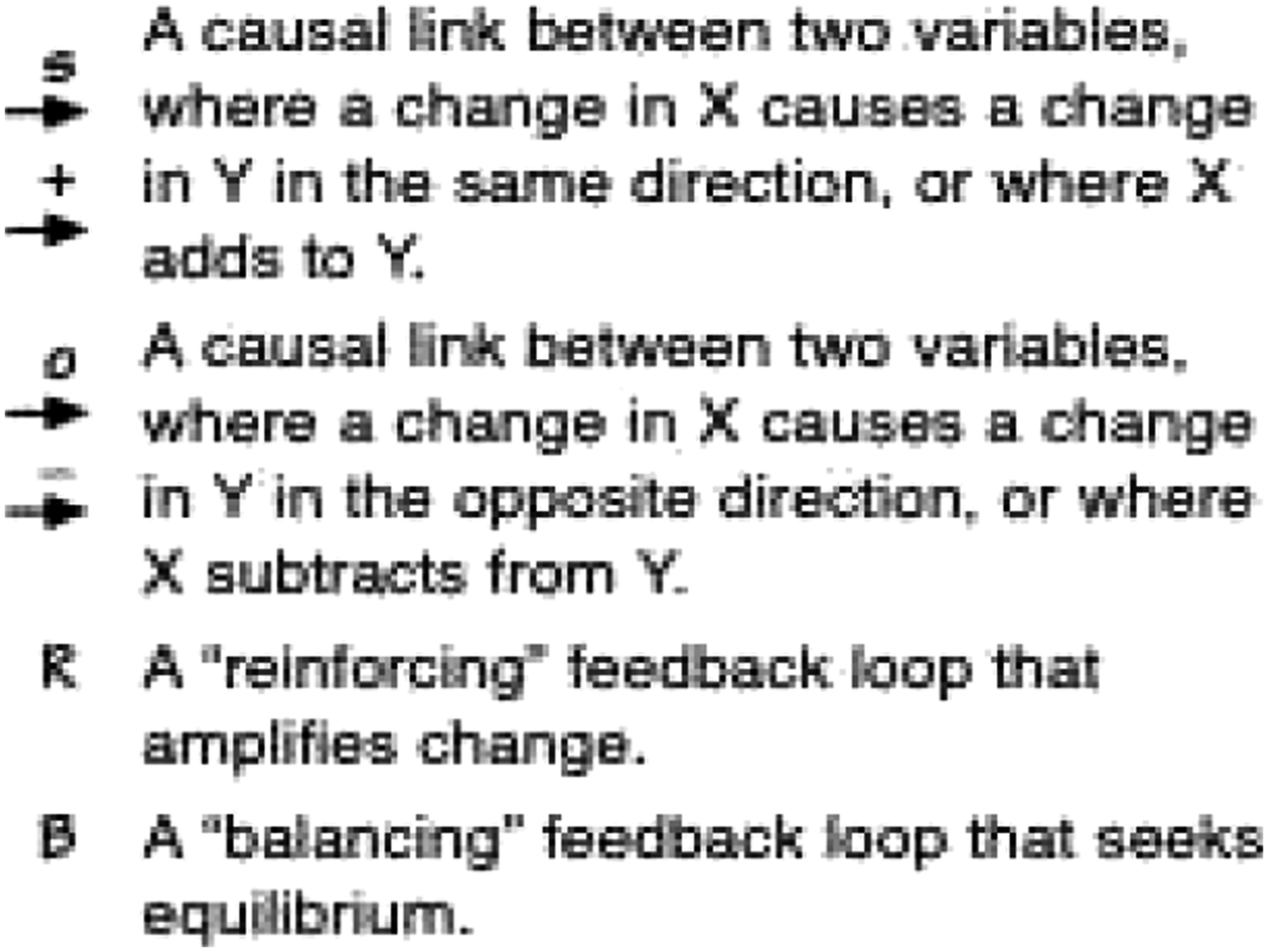
Cohesive Visions
Corresponding Archetype: Drifting Goals
In a Cohesive Visions Anti-Archetype (Figure 2), we pursue corrective action that achieves the desired goal but also incentivizes further action to raise the goal toward a greater vision. In contrast to Drifting Goals, which seeks to diminish the gap by lowering goals, here the gap is maintained because our goals escalate as we strive for more and better alignment toward a greater vision (Kim, 2002, p. 13). Cohesive Visions encourage individuals, teams, and organizations to come together to work on goals with a collective benefit. These are visions that put people and the planet first. The goal may reside outside the primary stakeholder as an ecosystem or societal goal that is adopted for a specific context. Articulating clear, actionable incentives that escalate as goals are achieved may help catalyze positive change. Cohesive visions anti-archetype.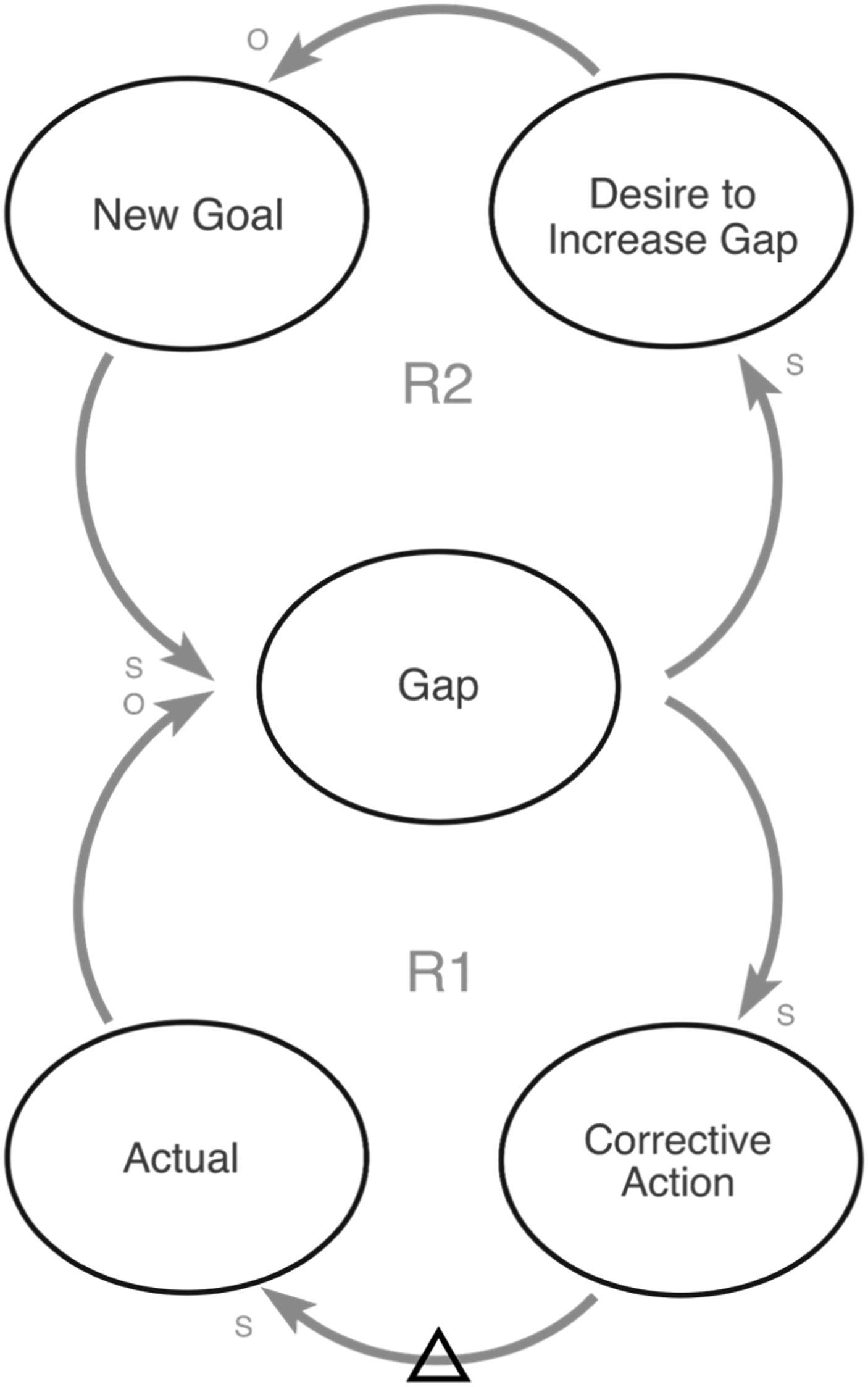
An example of a Cohesive Vision is reducing CO2 emissions (Figure 3). Rather than attempting to meet prescribed standards for C02 emissions, we can seek to escalate our efforts toward a new goal as the initial goal is achieved. A corrective action such as a carbon tax can accelerate the achievement of our initial goal, which then reduces the existing gap, while new goals are established to maintain the gap. Cohesive visions anti-archetype example.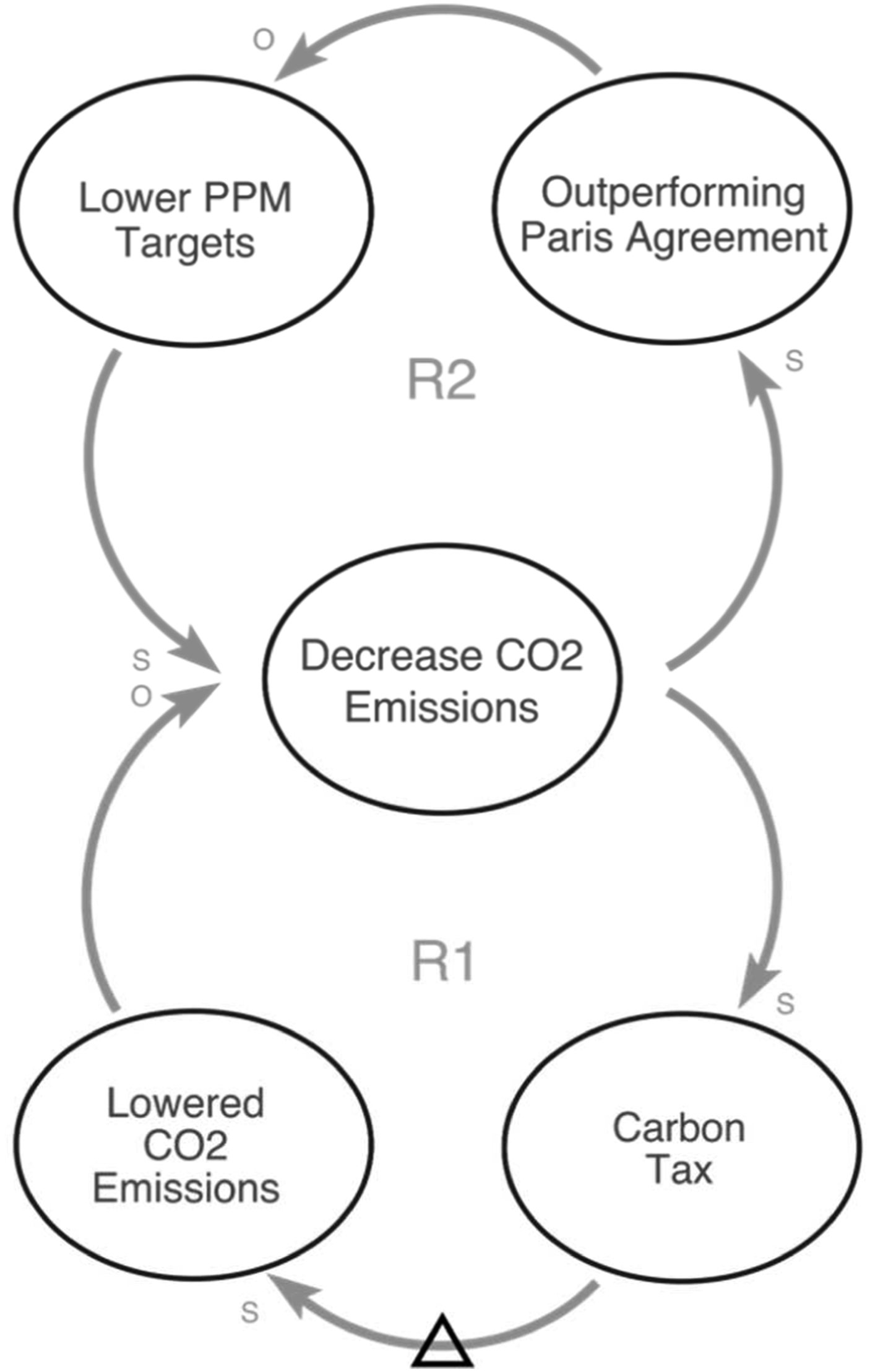
Organizational Applications Examples
Mergers and Acquisitions: combining or redesigning visions of two or more organizations into one coherent vision. Ecosystem Collaboration or Coopetition: competitors, partners, or adjacent organizations working together to achieve a common goal. Cross-Siloed Collaboration: different teams or groups working together, particularly when they rarely collaborate.
Systemic Applications Examples
Reducing CO2 Emissions: various stakeholders working together to create compounding benefits. Reconciliation: merging and closing gaps between two disparate visions. Peace Negotiations: creating a vision collective future after conflict.
De-Escalation
Corresponding Archetype: Escalation
When a De-Escalation occurs each stakeholder takes action or makes concessions to diminish threats, resulting in a diffusion of the problem (see Figure 4). The intention is to neutralize a high-intensity stand-off and seek out win–win scenarios in which the competing needs of each stakeholder are met. Some compromise may be necessary depending on the nature of the challenge; however, stakeholders act in good faith to ensure that both parties benefit from the outcome. A De-escalation Anti-Archetype may be used to negotiate and reduce conflict, particularly when an Escalation Archetype has already occurred. De-escalation anti-archetype.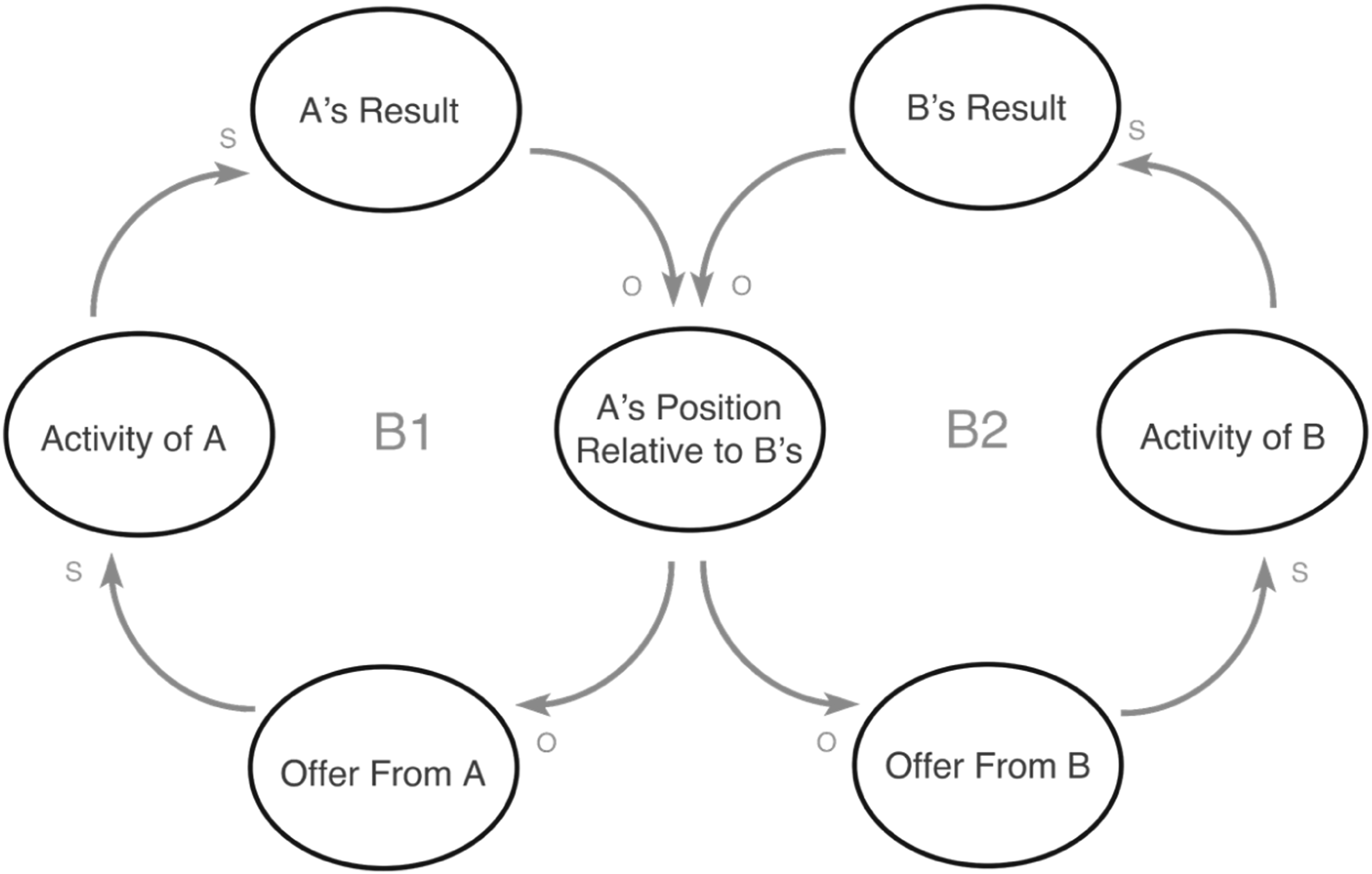
In Systems Archetypes I, Kim presents the concept of de-escalation and cites the Cuban Missile Crisis as an example, noting that “it takes two to have an arms race, but only one to stop it. Unilateral action can break the escalation dynamic by robbing it of its legitimacy,” (Kim. p. 15, 1992). A De-Escalation Anti-Archetype begins with one side extending an offer or an olive branch to the other, recognizing that a concession must be made to return to a state of peace.
An alternative example is presented here in which an escalating protest is diffused by friendly engagement and withdrawal of police (Figure 5). With reduced fears, crowds calm and are less likely to incite violence. Protestors, having communicated their concerns, eventually disperse. De-escalation anti-archetype example.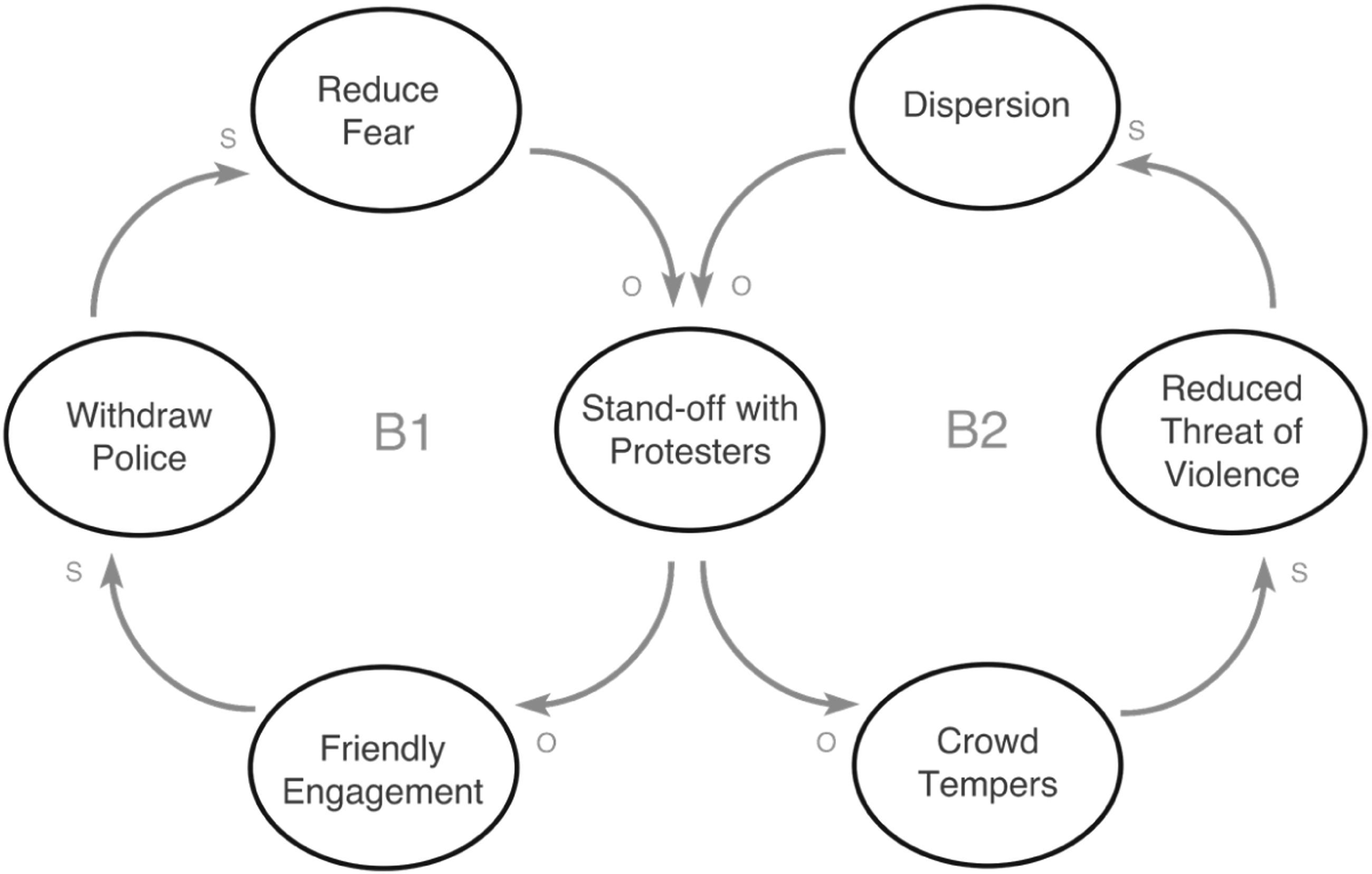
Organizational Applications Examples
Conflict Management: reducing tensions and stand-offs during heated exchanges. Contract Negotiations: extending offers in good faith to compromise. Leadership Stalemates: resolving disagreements between C-Suite and other leaders.
Systemic Applications Examples
Denuclearization: reducing or dismantling nuclear weapons. Racialized Conflict: reducing tensions in stand-offs, such as protestors and law enforcement. Peace-Building Efforts: reducing conflict to facilitate peace negotiations and efforts.
Fixes That Fuel
Corresponding Archetype: Fixes that Fail
This Anti-Archetype identifies fundamental solutions that alleviate symptomatic problems or symptomatic solutions that alleviate fundamental problems through positive unintended consequences. Fixes that Fuel may trigger a cascade of positive chain reactions that provide additional unexpected benefits or alleviate a problem not originally within scope (Figure 6). Fixes that fuel anti-archetype.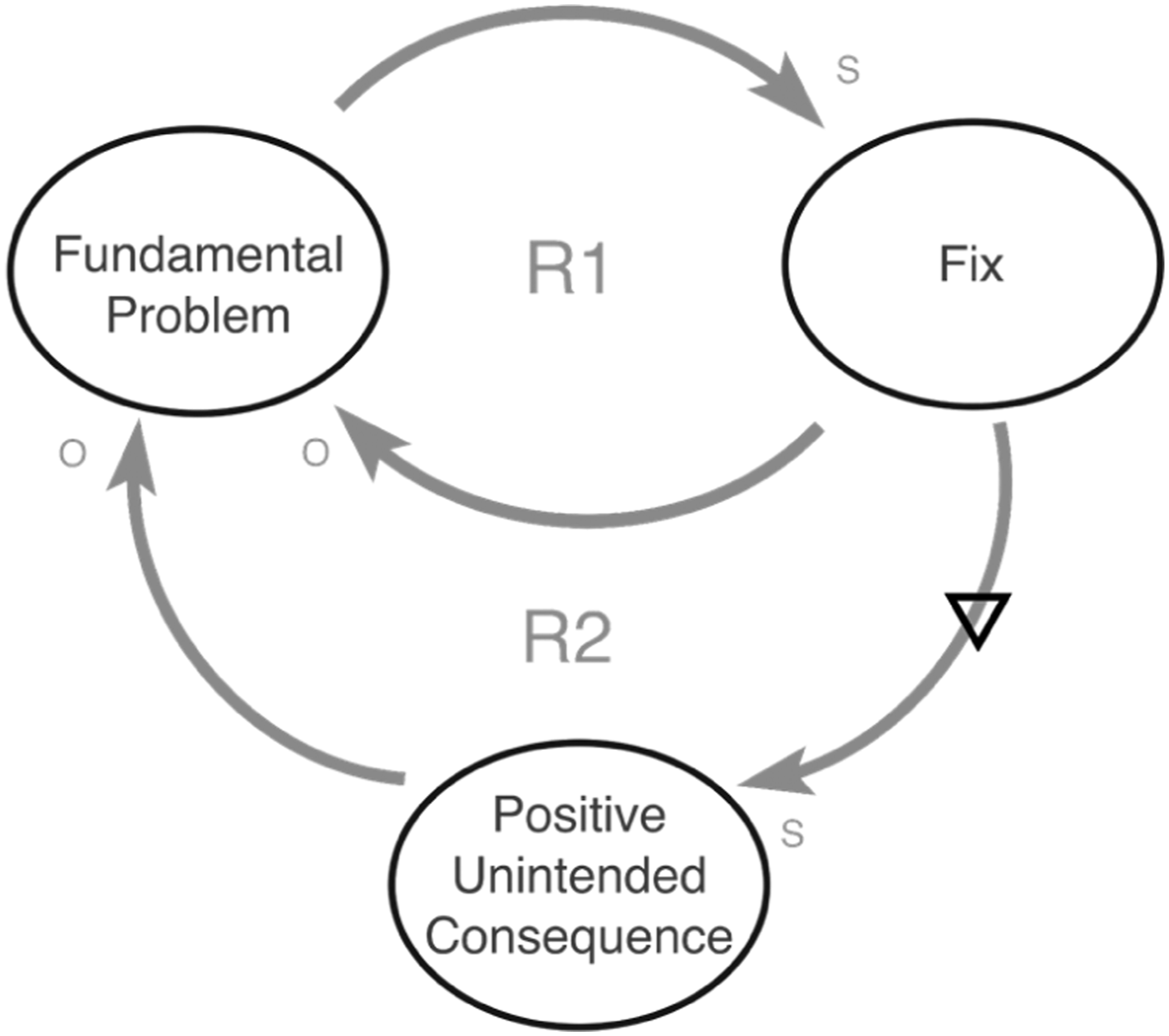
For instance, Universal Basic Income (UBI) may be intended as a solution for poverty but has several positive side-effects (Figure 7). Researchers evaluating the success of the UBI pilot project in Ontario, Canada noted that participants experienced a wide range of positive outcomes including less visits to the hospital and improved mental health (Taekema, 2020). Fixes that fuel anti-archetype example.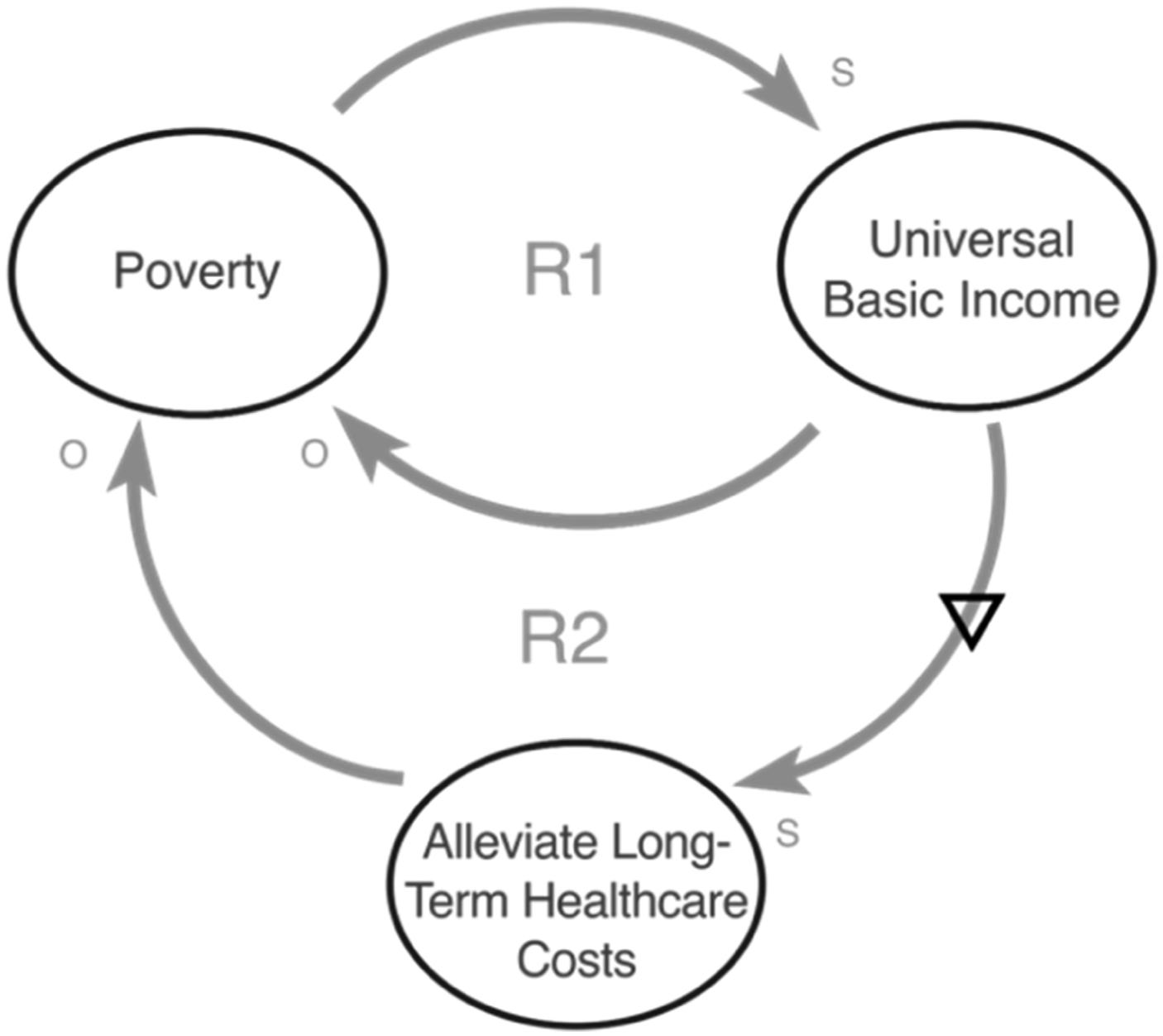
Organizational Applications Examples
Employee Well-being Initiatives: initiatives that improve mental health and produce additional benefits. Reduced Work Hours: reducing work to four days a week to improve overall productivity. Corporate Social Responsibility: genuine contributions to society and the environment that produce benefits for the organization.
Systemic Applications Examples
Affordable Housing: eliminating homelessness reduces pressure on other social systems. Eliminating Student Debt: alleviating pressure on younger generations and redirecting wealth into the economy. Urban Green Space: benefits to the environment and improved mental health for residents.
Success to the Marginalized Corresponding Archetype: Success to the Successful
The Success to the Marginalized Anti-Archetype should be used when a redistribution of power and/or resources is required due to systemic abuse, institutionalization, and oppression (Figure 8). It may also be referred to as Success to the Hindered when alluding to concepts and states, rather than stakeholders. Success to the Marginalized is intended to offset previous Success to the Successful dynamics or to anticipate where a potential redistribution may be required. Success to the marginalized anti-archetype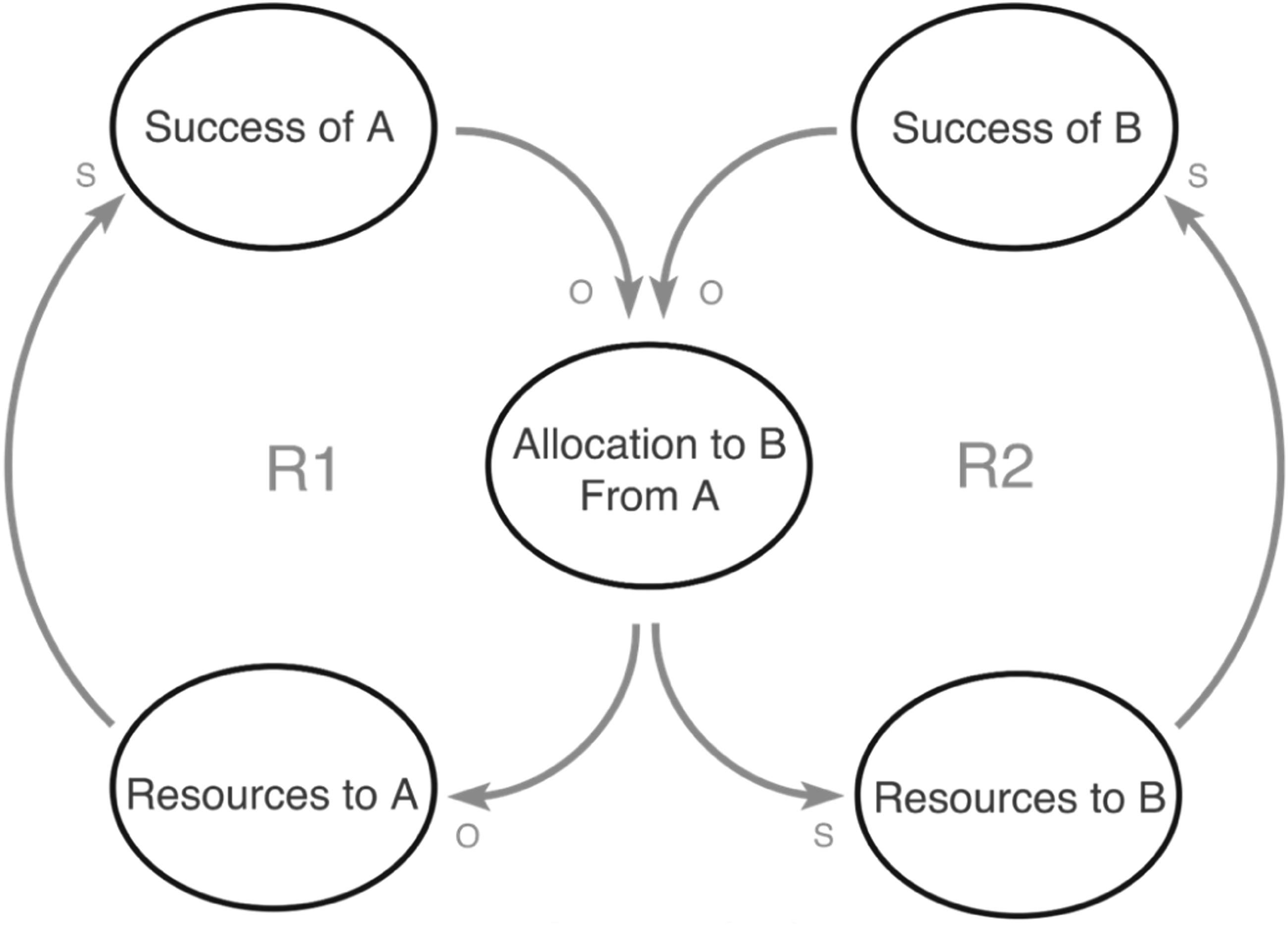
Wealth inequality is a good example of how and when Success to the Marginalized is required (Figure 9). When corporate power and wealth far exceed that of the communities that support them, policies such as seizures of tax haven accounts can be introduced to redistribute wealth to communities through augmented social services. When communities thrive, corporations may benefit from improved neighborhoods and consumer spending, which further incentivizes the need for redistribution. Success to the marginalized anti-archetype example.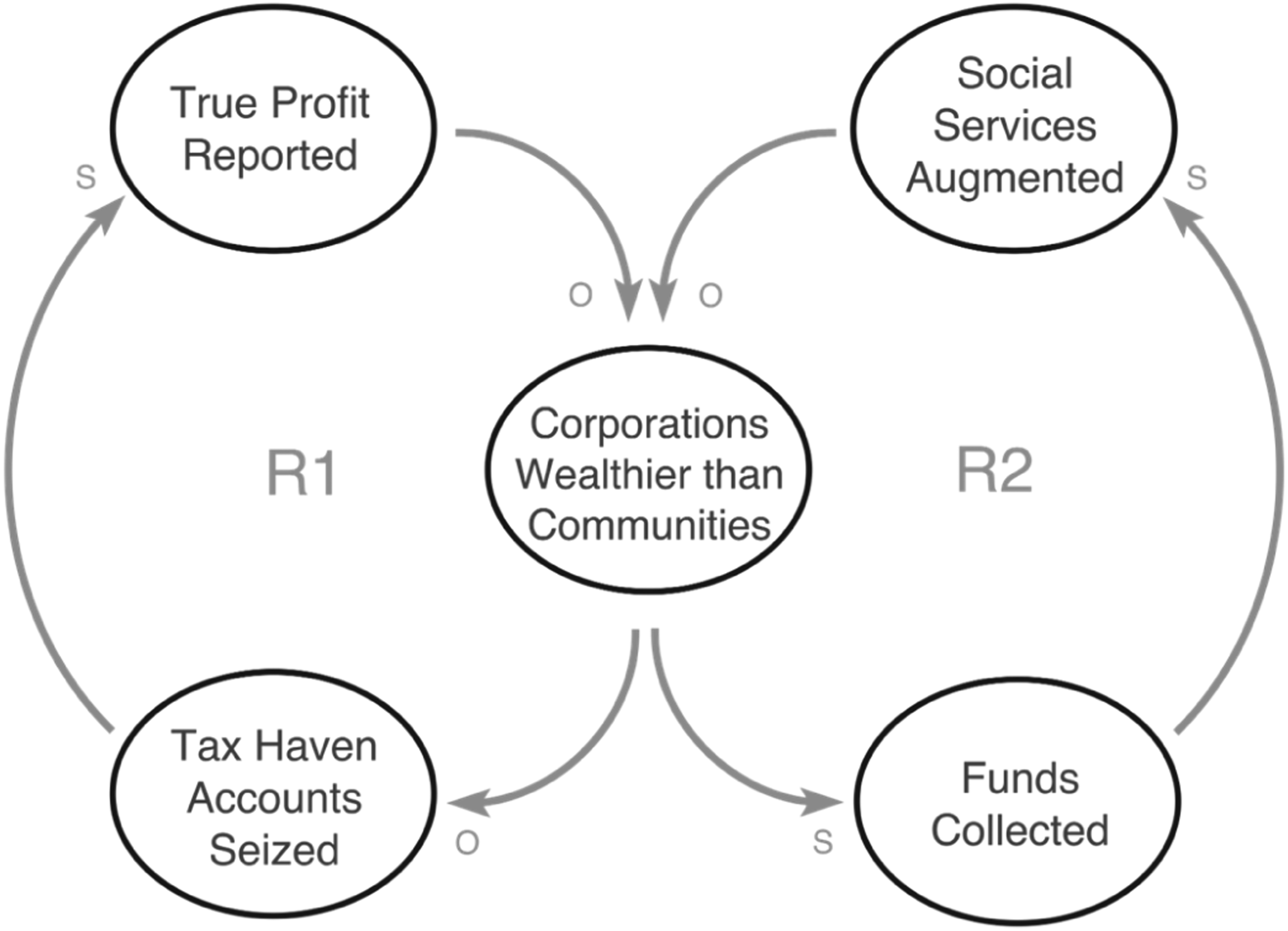
Organizational Applications Examples
Diversity and Inclusion Initiatives: redistributing organization resources to hire fx16 and support marginalized groups in meaningful ways. Unionization: redirecting power and resources to collective goods for workers. Resource Dispersion: reallocating resources from one part of the organization to another.
Systemic Applications Examples
Wealth Inequality: redistributing resources from elites to lower and middle classes through solutions like wealth taxes. •Reparations: amending for wrongs by redirecting wealth and resources to injured parties. Human Rights: identifying and redirecting resources toward what is fundamental to societal flourishing.
Sustainable Growth
Corresponding Archetype: Limits to Growth
This Anti-Archetype acknowledges and accepts the limits to growth, and strives for long-term sustainability over short-term performance (Figure 10). Environmental, social, and ethical performance indicators are strategically valued as much as (if not more than) economic ones because Sustainable Growth takes a systemic view that accounts for long-term needs of the many. Stakeholders design restraints and intentionally limiting actions that ensure long-term performance before externally imposed constraints can diminish outcomes. Sustainable growth anti-archetype.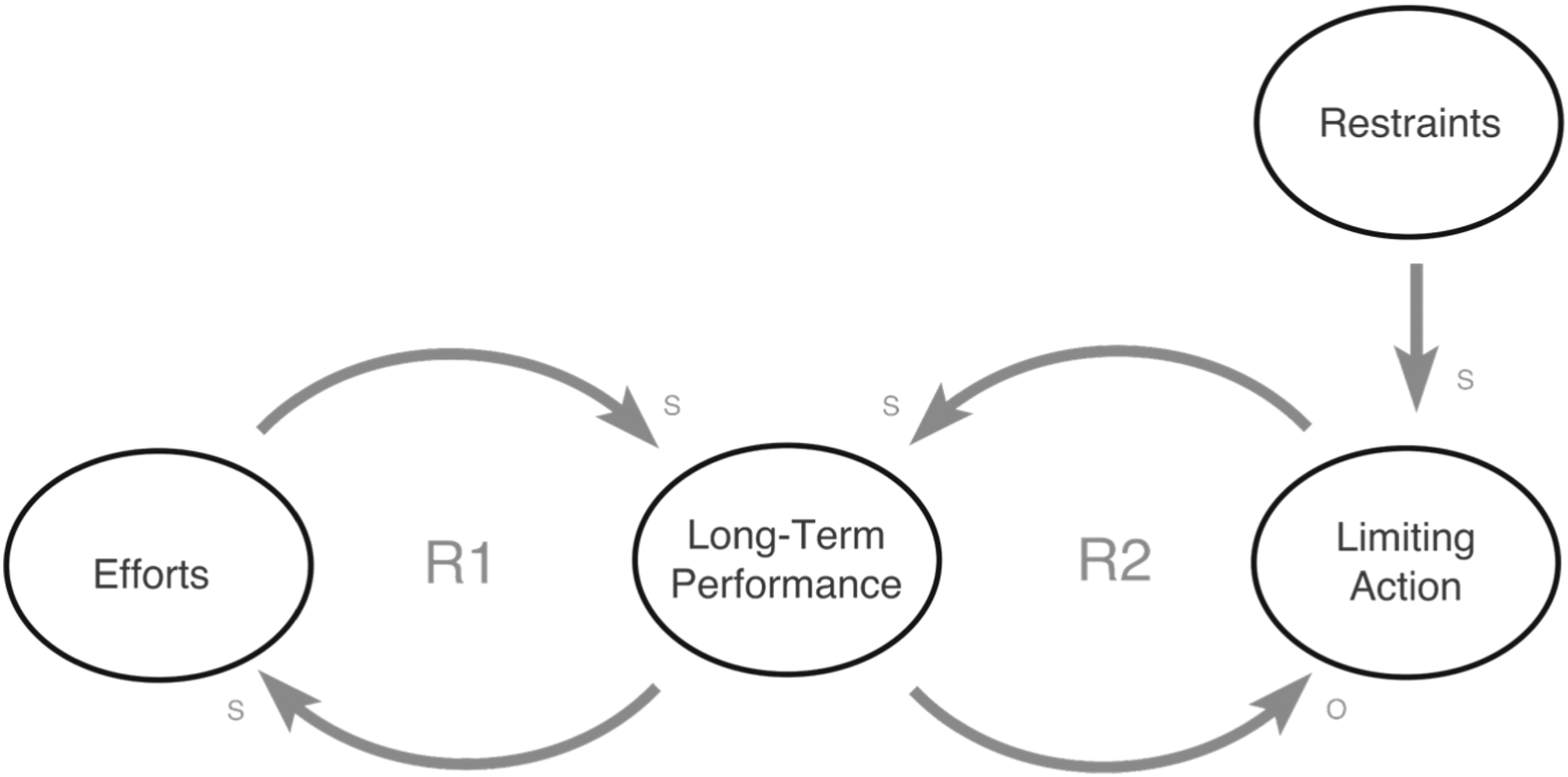
Sustainable food production is an example of this Anti-Archetype (Figure 11). Lab grown meats and overall reduction of meat in diets may help enable more sustainable food supply chains that are better for the environment. Both restraint and limiting action are designed solutions. Sustainable growth anti-archetype example.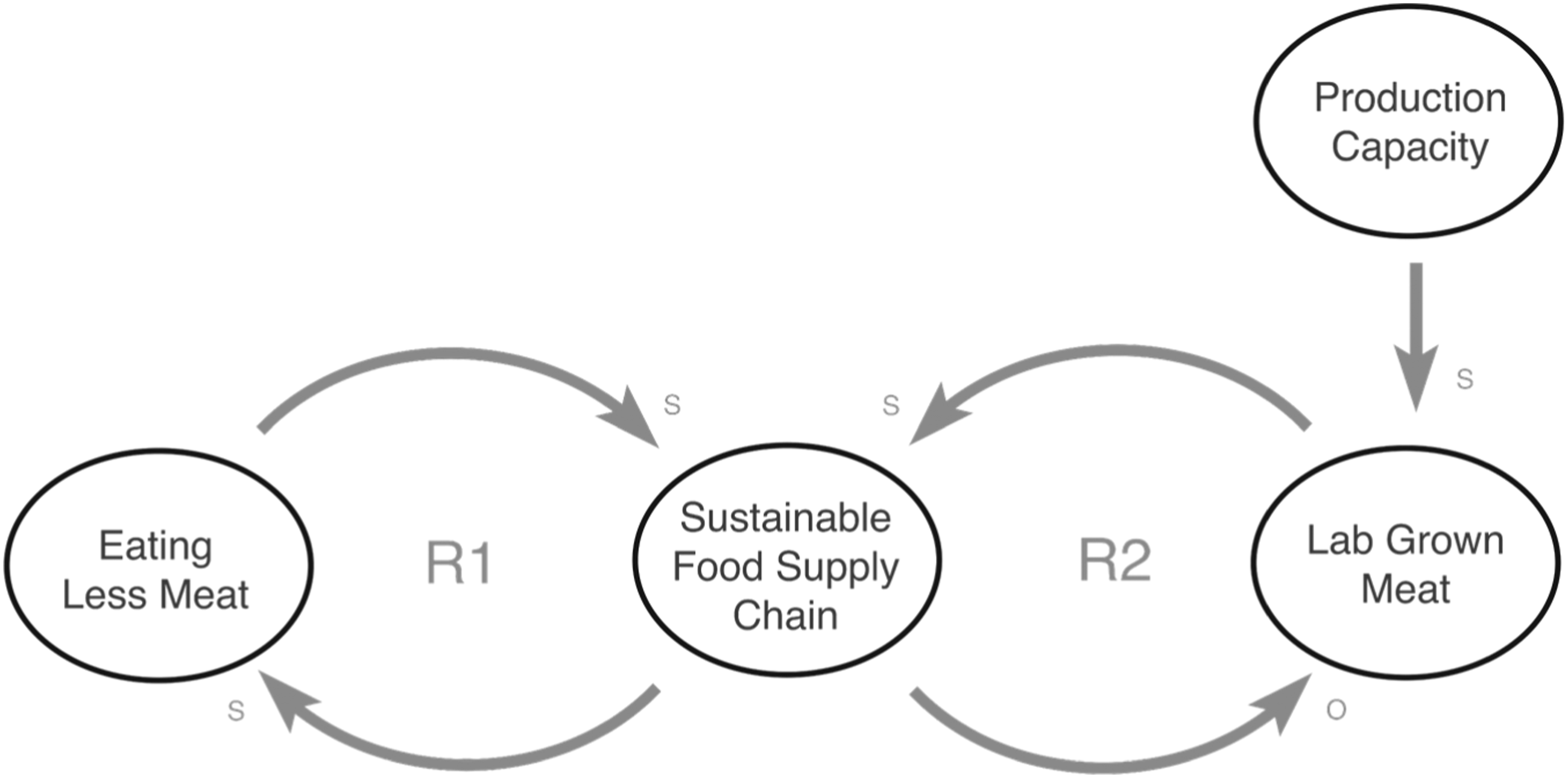
Organizational Application Examples
Achieving and Fulfilling B-Corp Status: improving access to future resources by limiting use of present-day environmental resources. Launching a Social Enterprise: limits to profitability to achieve alternative goals. Service Design: Systemic Applications Examples Low Growth Economics or Degrowth: restricting growth in favor of other long-term performance metrics. Environmentalism: restricting damage to and use of the environment for future viability. Infectious Disease Management: introducing limitations to manage and prevent spread of diseases (e.g., lockdowns).
Taking Responsibility
Corresponding Archetype: Shifting the Burden
Taking Responsibility places an emphasis on accepting accountability for fundamental problems and making a commitment to identify and implement fundamental solutions (Figure 12). Taking responsibility anti-archetype.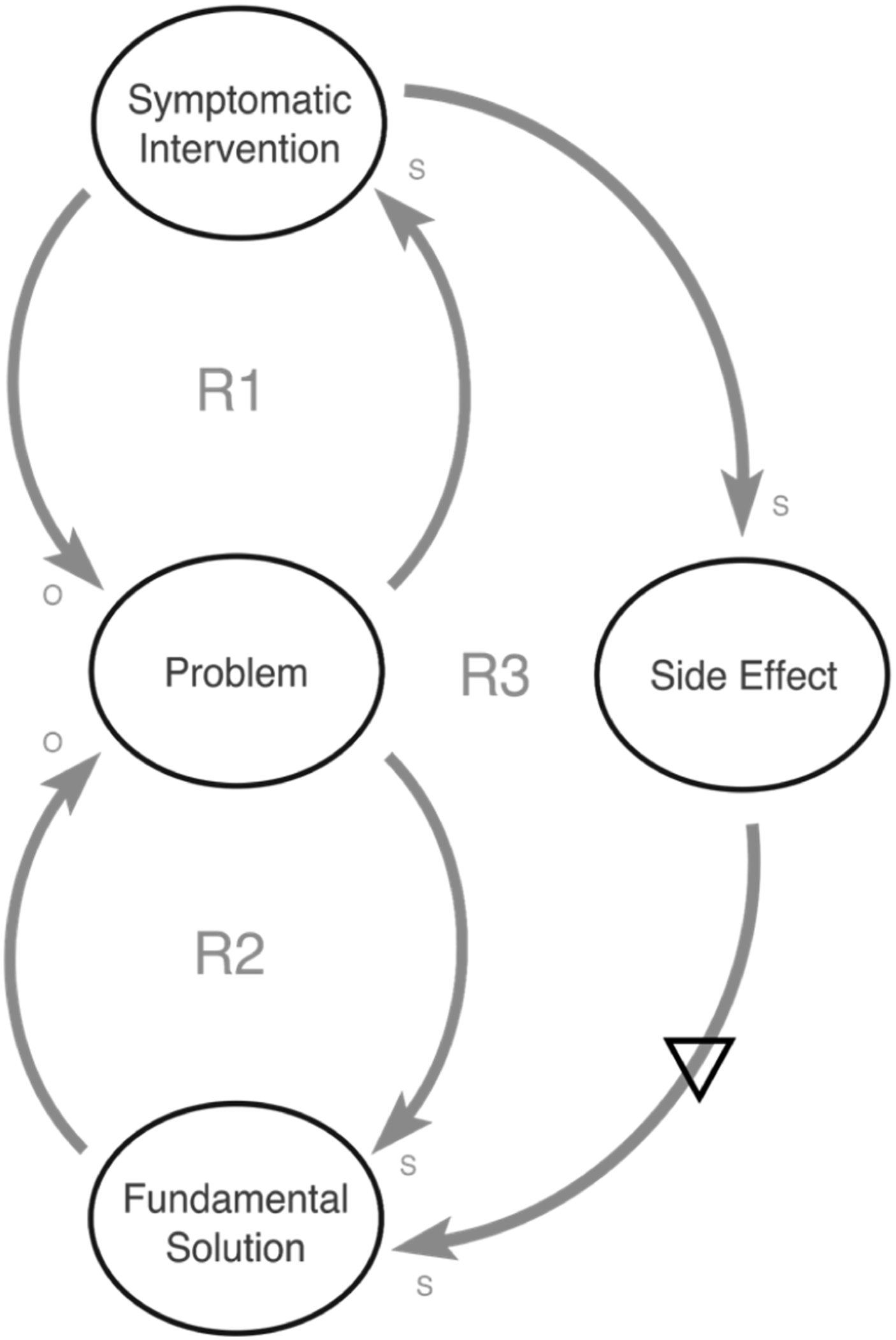
Furthermore, symptomatic solutions may have positive side-effects that catalyze fundamental solutions. Accountability and measured steps may be taken to counteract a previously established pattern of Shifting the Burden or when designing for emerging problems where a high degree of systemic responsibility is required.
The solutions implemented during the COVID-19 pandemic illustrate how symptomatic solutions can have positive side-effects that help augment fundamental ones. Though managing a pandemic requires strong healthcare systems and policy response, bottom-up discipline efforts such as physical distancing helped to reduce spread and, ultimately, prevent further strain on healthcare (Figure 13). Taking responsibility anti-archetype example.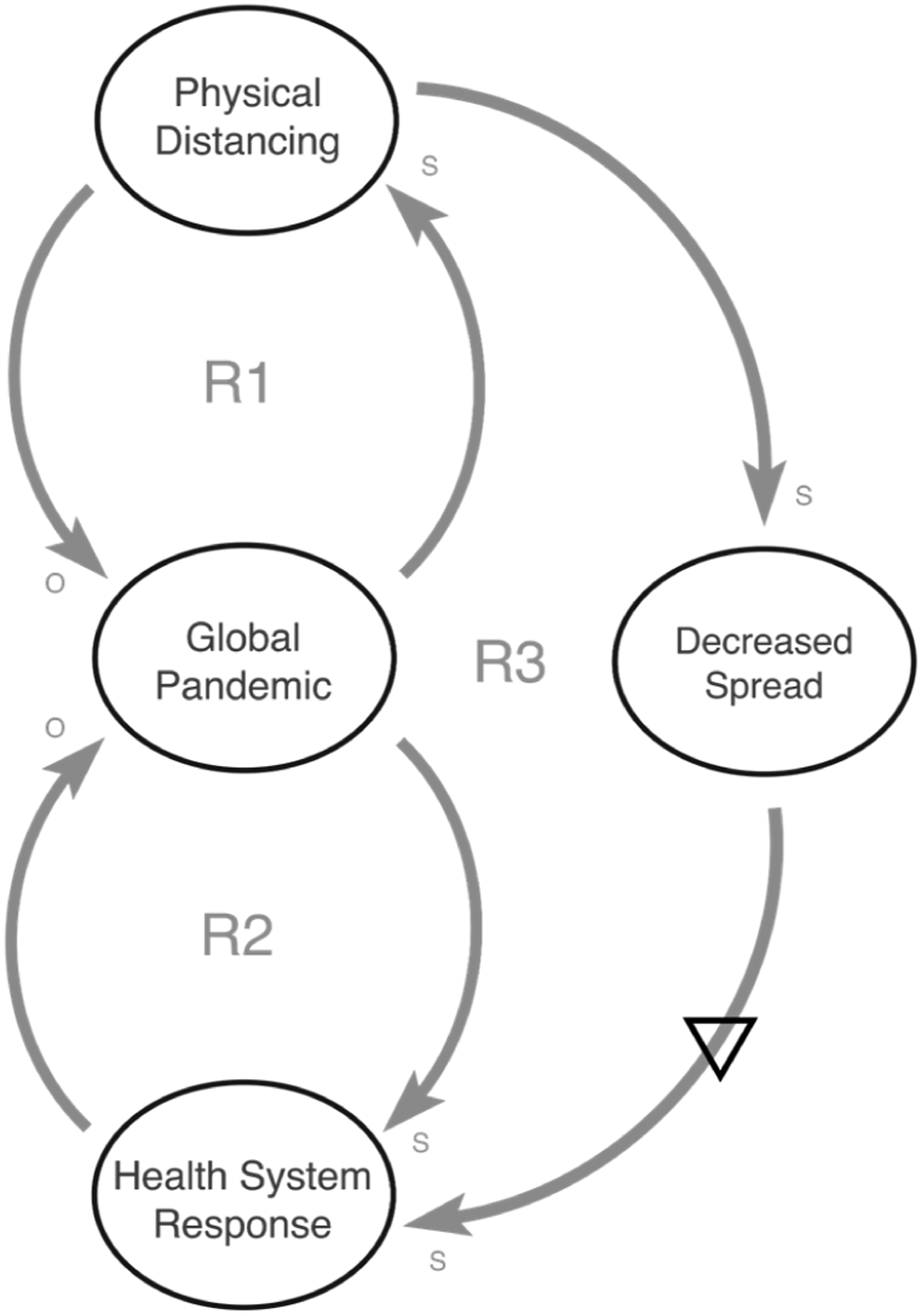
Organizational Applications Examples
Environmental Clean-Up: rectifying environmental damage caused by organizational actions or inactions (e.g., oil spill). Corporate Fraud: compensating injured parties with interest, such as losses from fraud or harm. Triggering a Crisis: an organization rectifying harmful intended and/or unintended consequences (e.g., opioid crisis).
Systemic Applications Examples
Decolonization: actively dismantling colonial structures and control such as museums repatriating art. Environmental Protection: reforestation efforts to offset carbon emissions improve mental health. Reparations: financial compensation for past wrongs, for example, for The Tulsa Race Massacres.
Wisdom of the Collective
Corresponding Archetype: Tragedy of the Commons
In contrast to Tragedy of the Commons, Wisdom of the Collective embraces a narrative in which each stakeholder pursues an aspect of a common vision, so that the whole is greater than the sum of its parts (Figure 14). The aim is to align individual activities for collective gain and the desired outcome is increased benefits for all. This archetype may be used to design collaboration opportunities that seek compounded benefits or a paradigm shift. Collective Wisdom anti-archetype.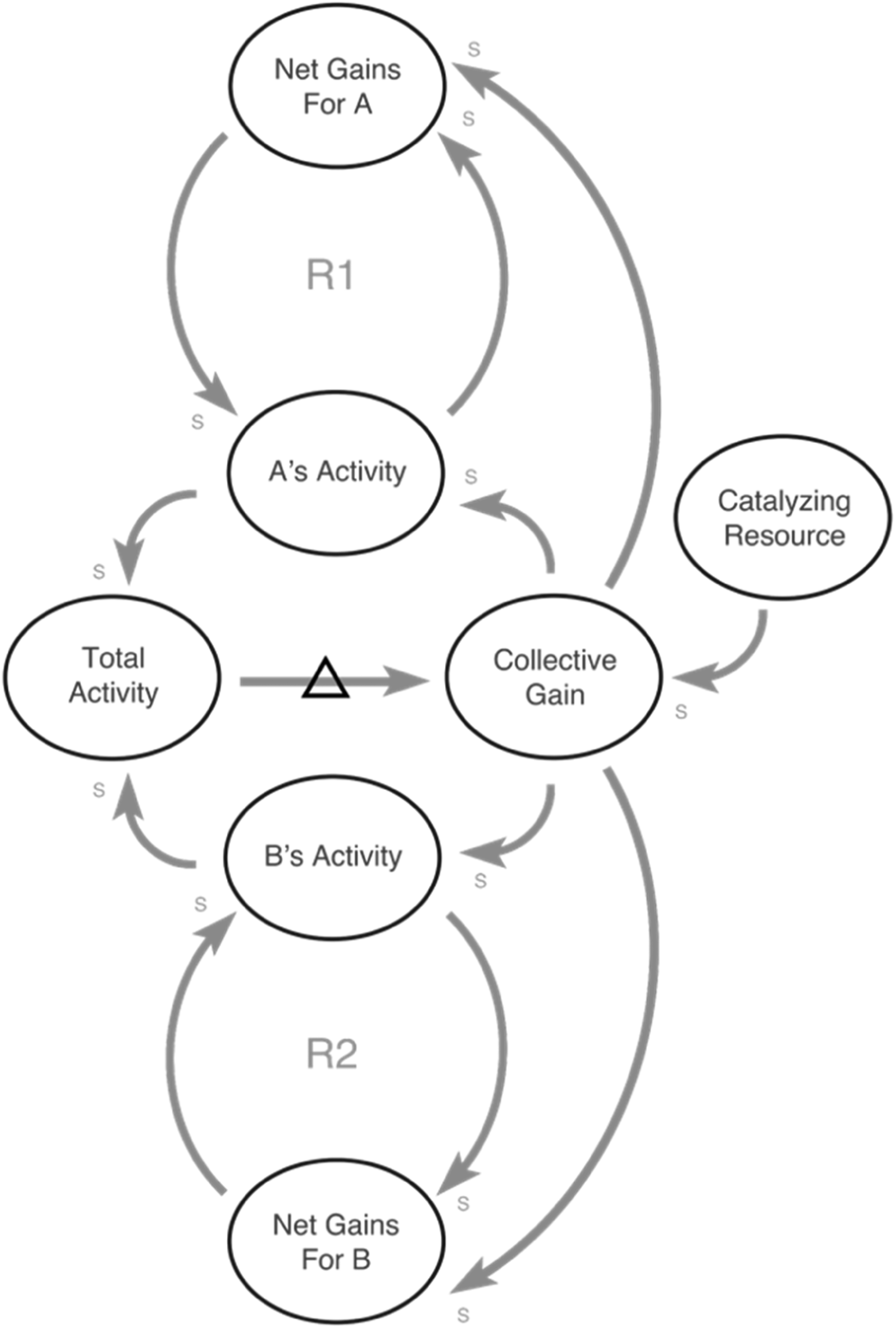
The example in Figure 15 illustrates how different organizations have assisted government response to the pandemic. With governments aiming to support and increase healthcare capacity, some private organizations shifted their production to include supplies such as ventilators, masks, and hand sanitizers (Oved, 2020). This combined effort increased overall output which increased the system’s ability to respond to the problem and support frontline medical staff. In turn, the organizations that offered to make medical supplies benefited from government funding at a time when their revenue declined, while building goodwill with the public. Collective Wisdom anti-archetype example.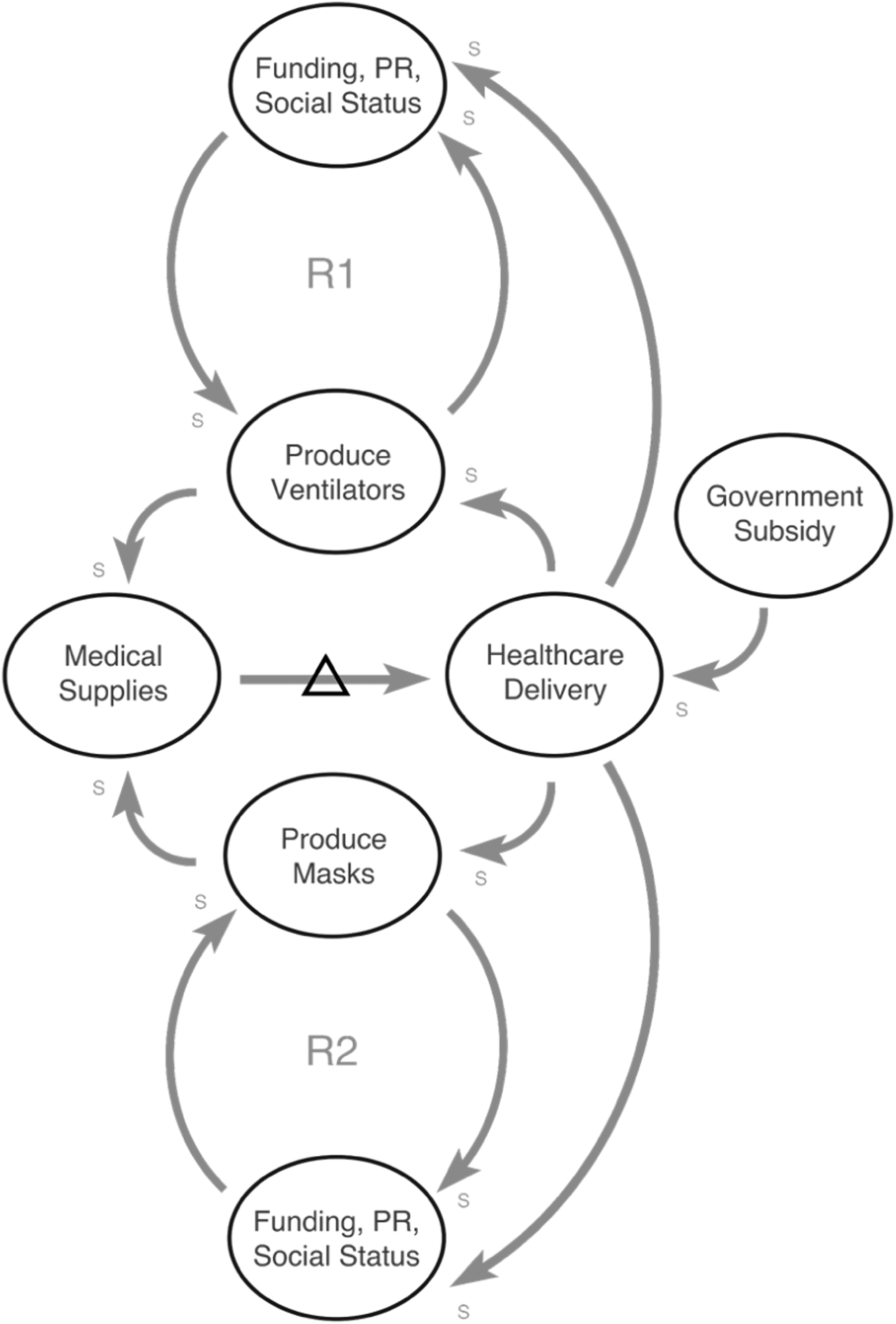
Organizational Application Examples
Coopetition: collaborating with competitors to innovate or improve ecosystem conditions. Public–Private Partnerships: working toward a common societal goal such as developing solutions for climate change. Community Outreach: actively working with the local community to improve living conditions which, in turn, improve the organization’s operating environment.
Systemic Application Examples
Public Service Reform: redesigning public services to look at social services holistically. Crisis Mitigation and Management: working together to mitigate or respond to a disaster. International Treaties and Agreements: collaborative efforts to tackle complex challenges such as SDGs.
Conclusion
As COVID-19 and its long-term implications persist, identifying and perpetuating positive, transformative narratives will become more important than ever. We now have an unprecedented opportunity to reimagine our systems and our way of life to not only improve our present circumstances but also to thwart future crises such as climate change which loom large on our horizon. The next one hundred years may require compounding solutions with positive side effects to offset an era of compounding crisis. This includes redesigning our systems to reflect our emerging reality.
To meet the needs of our current and emerging complex challenges, we need to think beyond our current paradigms to what is both possible and desirable. High-spirited, aspirational patterns and stories in the form of Anti-Archetypes will allow us to take a futures-thinking approach to systems-thinking. By designing patterns of hope, we create pathways to our collective preferred futures. As Harold Goddard once wrote “the destiny of the world is determined less by the battles that are lost and won than by the stories it loves and believes in” (p. 208, 1951).
Footnotes
Declaration of Conflicting Interests
The author(s) declared no potential conflicts of interest with respect to the research, authorship, and/or publication of this article.
Funding
The author(s) received no financial support for the research, authorship, and/or publication of this article.