




Abstract
Dung’s theory of abstract argumentation provides a unified foundation to knowledge representation and reasoning. It models the acceptability of arguments through their attack and defense relations, a perspective referred to as the attack—defense paradigm shift. While formal argumentation has been conceptualized in terms of argumentation as inference, argumentation as dialogue, and argumentation as balancing, most developments in abstract argumentation have focused on the inference perspective. By contrast, the dialogue perspective remains less explored. In this article, we contribute to bridging this gap by introducing new notions of agent defense, extending abstract argumentation with explicit representations of agents and their roles in defending arguments. These notions account for both individual and collective defense, enabling richer models of multi-agent reasoning. We position our proposal within the literature by comparing it with three existing approaches that extend abstract argumentation with agency: social semantics, agent-reduction semantics, and agent-filtering semantics. Using a principle-based analysis, we evaluate the formal properties of these approaches and the behavioral differences between them. This paper broadens the focus of abstract argumentation from inference-oriented models toward dialogue-oriented and agent-centered perspectives. This aligns with ongoing developments described in the Handbook of Formal Argumentation and the International Conference on Computational Models of Argument (COMMA) literature, and contributes to the shift toward modeling complex, interactive reasoning in multi-agent systems.
Keywords
Introduction
Dung’s theory of abstract argumentation 1 provides a unified foundation for different approaches to knowledge representation and reasoning in the field of artificial intelligence. The core concept of abstract argumentation is attack: the theory abstracts from the internal structure of arguments in order to focus on the attack relations between them. Defense is defined in terms of attack: an argument is defended by a set of arguments if every attacker of it is attacked by at least one argument in the set. The concept of defense further determines the acceptability or non-acceptability of arguments. In this regard, Dung’s abstract argumentation is seen as the attack–defense paradigm shift of formal argumentation. 2 From this perspective, the attack–defense paradigm shift can be understood as a methodological toolbox for reasoning alignment 3 : it provides systematic ways to represent and relate different reasoning—such as nonmonotonic logics, logic programming, and game concepts 1 or dialogue-theoretic concepts 4 —via argumentation frameworks, rather than prescribing a single semantics once and for all.
This toolbox perspective is reflected in the three volumes of the Handbook of Formal Argumentation. The first volume 5 explains the central role of Dung’s theory of abstract argumentation 1 and distinguishes three conceptualizations of argumentation: argumentation as balancing, 6 argumentation as dialogue, and argumentation as inference. 7 These conceptualizations are made explicit and related in the A-BDI metamodel, 8 which provides a higher-level abstraction of how the three models interrelate and can be integrated via extended Dung-style argumentation graphs, without reducing one model to another. Volume 2 9 surveys extensions of the attack—defense paradigm, including higher-order relations, 10 weights, 11 values, 12 and preferences, 13 which fall under the conceptualization of argumentation as balancing, alongside a chapter on dynamics and dialogues. 14 Volume 3 15 broadens the scope toward applications and cross-field connections and responds to the growing influence of subsymbolic AI and foundation models such as large language models (LLMs), with renewed emphasis on dialogue-oriented and agent-based perspectives, including chapters on applications of argumentation-based dialogues 16 and on argumentative agent-based models. 17
Our article adopts the conceptualization of argumentation as dialogue, grounded in agents, strategies, and games. Building on this view, we extend Dung’s abstract argumentation framework with an explicit set of agents. Agent-based extensions typically introduce various aspects such as knowledge, uncertainty, support, trust, and so on. We treat a minimal extension of Dung’s theory 1 as the common core of these approaches. That minimal extension is limited to an abstract set of agents, and all arguments are associated with agents. Although agent-based variants have been proposed in several studies,18–20 the question of how defense itself should be adapted and evaluated across these variants has not been studied in a unified way. Moreover, the semantics of agent argumentation concerns the merging of argumentation frameworks.21–23
This article is focused on adapting Dung’s notion of defense within agent-based argumentation frameworks. It introduces two new types of agent-specific defenses: individual defense and collective defense. These novel semantics modify the traditional attack–defense structure by taking into consideration the agents associated with each argument, which adds new dimensions to the concept of admissibility.
We address the following research questions:
How can the concept of defense be adapted in abstract agent argumentation frameworks? How do the new concepts of agent defense compare to those of other approaches to abstract argumentation semantics?
Below, we compare the defense-based semantics with other traditional approaches to abstract agent argumentation.
From a toolbox perspective, principle-based analysis provides a methodology for handling the diversity of argumentation models at a higher level of abstraction. 32 It offers a systematic way to design, select, and compare semantics across different computational contexts. In settings where no single semantics is canonical, principles function as requirements or neutral properties that guide semantic choice and make the consequences of modeling decisions explicit. Therefore, in formal argumentation, principles are often more technical. The principles most discussed for abstract argumentation semantics in the literature are admissibility, directionality, and strongly-connected-component (SCC) decomposability. 33 These principles play a central role in this article, enabling us to distinguish between different kinds of agent semantics.
The article is organized as follows. Section 2 introduces agent argumentation frameworks, and it extends Dung’s abstract argumentation framework by associating arguments with agents. Section 3 describes two new notions of agent defense—individual defense and collective defense—and analyzes their respective roles in admissibility and reinstatement. Section 4 compares these defense-based semantics with three existing approaches: social agent semantics, agent reduction semantics, and agent filtering semantics. Section 5 examines the role of principles in evaluating agent argumentation semantics, with particular emphasis on admissibility, directionality, SCC-recursiveness, and other key principles. Section 6 introduces additional agent-based argumentation principles to facilitate finer-grained comparison of different semantics. Section 7 discusses related work, situating our approach within the broader literature on argumentation frameworks and their agent-based extensions. Section 8 outlines future directions, which may include integrating agent argumentation with structured argumentation and dialogue models. Section 9 concludes the article with a summary of our main findings and their implications for agent-based reasoning.
Agent argumentation frameworks generalize the argumentation frameworks studied by Dung, 1 which are directed graphs in which nodes represent arguments and arrows represent the attack relation.
Argumentation framework 1
An argumentation framework (AF) is a pair
Dung’s admissibility-based semantics is based on the concept of defense.
Admissible 1
Let
For their principle-based analysis, Baroni and Giacomin 34 define semantics as a function that maps argumentation frameworks to a set of extensions (each extension being a subset of acceptable arguments).
Dung’s semantics 34
Dung’s semantics is a function
Dung introduced definitions for different types of extensions.
Extensions 1
Let
Each type of extension can be seen as an acceptability semantics that formally rules the argument evaluation process. In this article, we use
Two conflicts
Consider the argumentation framework visualized on the left in Figure 1, where An agent framework (AF) and an agent argument framework (AAF).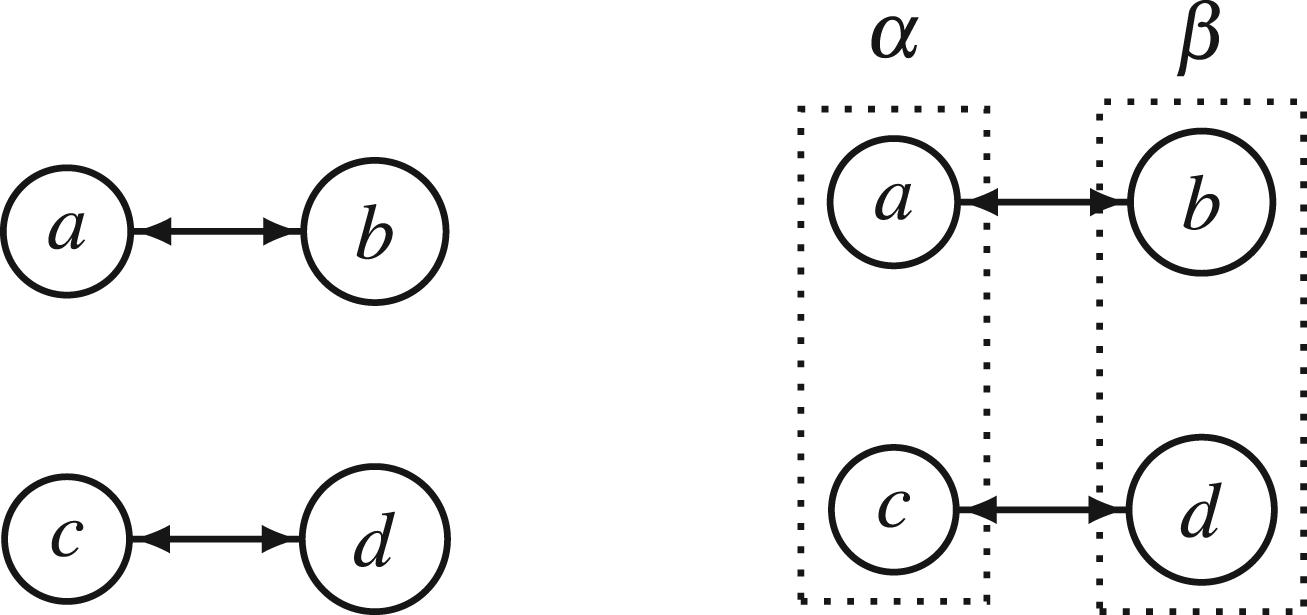
An agent argumentation framework extends an argumentation framework with a set of agents and a relation that associates arguments with agents. Note that an argument can belong to no agent, one agent, or multiple agents. This is the most general case. We briefly discuss restrictions in the further work section toward the end of this article.
We write
An agent argumentation framework (AAF) is a 4-tuple
Two conflicts, continued from Example 1
Consider the agent argumentation framework visualized on the right in Figure 1. The figure should be read as follows. Each dashed box contains all the arguments held by the agents in
Agent defense semantics
We now introduce a new kind of defense for agent argumentation frameworks called agent defense. Basically, if an agent puts forward an argument, it can only be defended by arguments held by that same agent. This reflects coalition-based reasoning as discussed by Qiao et al. 35
In individual agent defense, only one agent can defend each argument, whereas in collective agent defense, a set of agents can defend each argument.
Agent Admissible
Let
The following example illustrates individual agent defense and its role in the well-known property of reinstatement.
36
The ultimate status of an argument depends on the interaction between all available arguments. It may very well be that argument
Reinstatement
Consider the agent argumentation framework in Figure 2, where Agent reinstatement.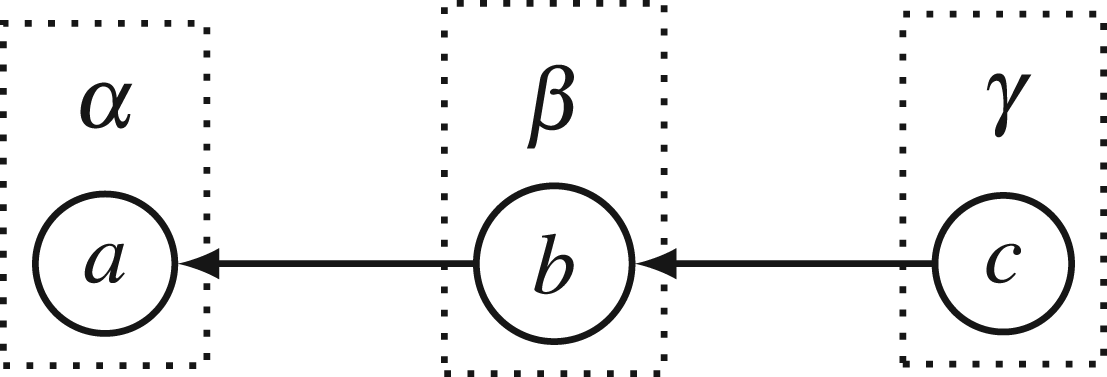
In the dinner scenario, Alice (
An agent semantics is a function
We use
Agent extensions
Let
The following two examples illustrate agent extensions.
Reinstatement, continued from Example 3
We revisit Figure 2. The individual- and collective-agent complete extension is
The following example shows the difference between individual and collective agent defense. In particular, it illustrates that if an argument is defended by a set of arguments all coming from the same agent (individually agent-defended), then the criteria for collective agent defense are automatically satisfied, though the reverse is not always true.
Collective defense
Consider the agent argumentation framework visualized in Figure 3, where 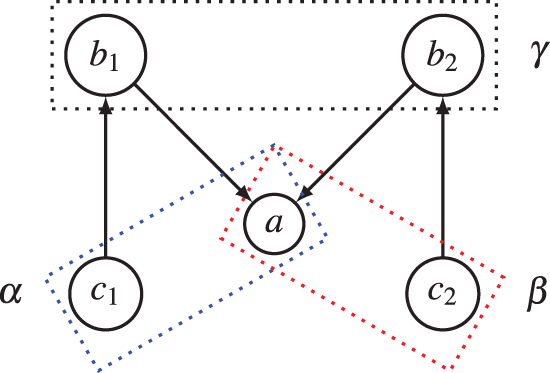
The pair
The following example illustrates another aspect of agent defense.
Consider Figure 4, where 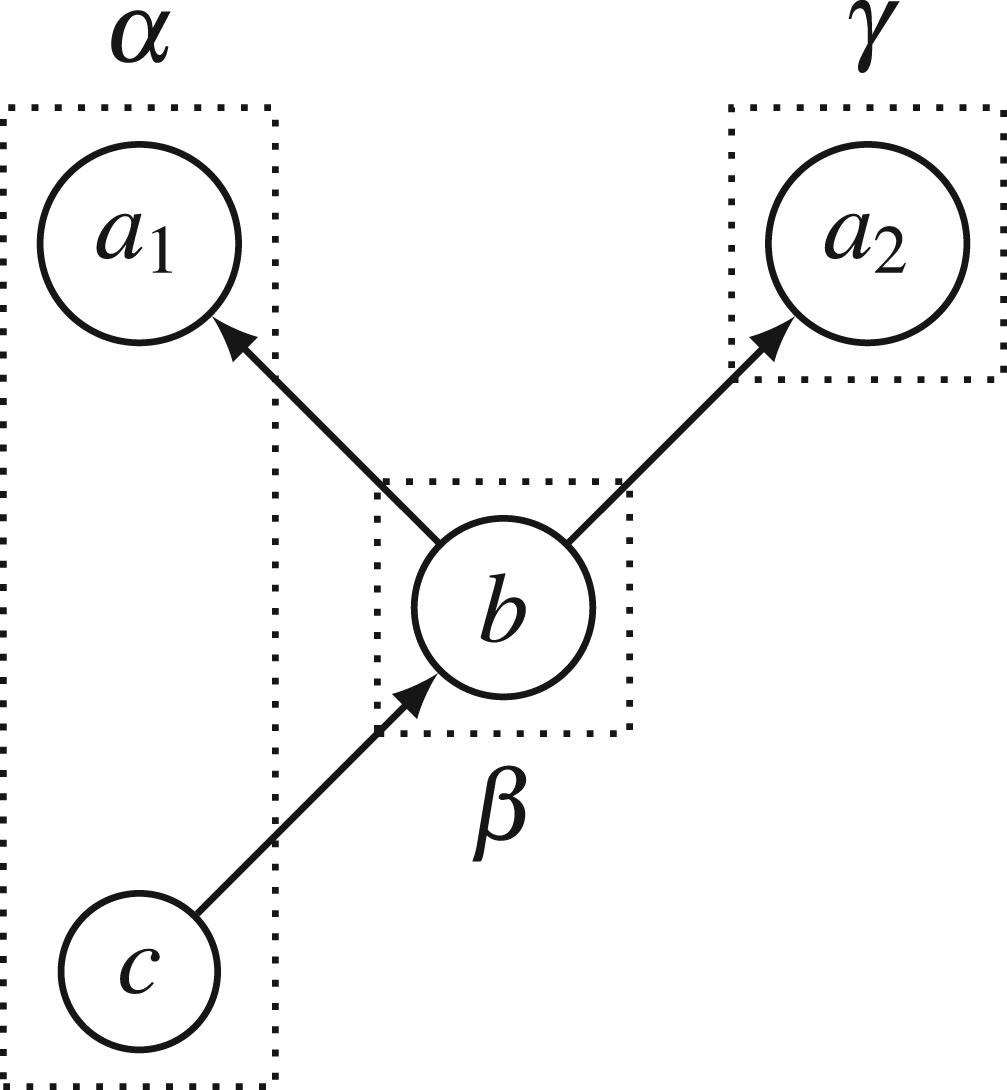
In this section, we introduce three existing semantics that extend abstract argumentation with agents. Each is defined via a reduction that transforms an agent argumentation framework into a standard Dung-style argumentation framework, using different ways of incorporating the concept of agent into the reduction process.
Social agent semantics
We begin with social agent semantics, which reduces an agent argumentation framework to a preference-based argumentation framework by counting the number of agents supporting each argument. This approach interprets agent argumentation as a form of voting, as studied in social choice theory and judgment aggregation. While other definitions of social agent semantics are available, the version adopted here is the simplest and the most natural choice for our formal setting. We first recall the definition of preference-based argumentation framework. It is not the only way to define social agent semantics, but given the formal setting we have adopted, it seems the simplest and the most natural possibility.
We first give the definition for a preference-based argumentation framework. 13
Preference-based argumentation framework
A preference-based argumentation framework (PAF) is a 3-tuple
Amgoud and Vesic 38 introduced two different reductions of preference, and Van der Torre and Vesic 32 introduced two more. We refer to these articles for explanation and motivation. We illustrate the difference between the reductions in Example 7 below.
Preference reductions (PR): Reductions of PAF to AF
Given a
In social agent semantics, an argument is preferred to another argument if it is held by more agents. The reduction from AAF to PAF is used as an intermediary step for social agent semantics.
SAP: Social Reductions of AAF to PAF
Given an
There are four definitions of social reduction, and
SR: Social Reductions of AAF to AF
Given an
Social reasoning
Consider the agent argumentation framework (AAF) on the left in Figure 5, where Social reduction. The semantics of the four argumentation frameworks (AFs) corresponding to We refer to Dung’s semantics as follows: complete (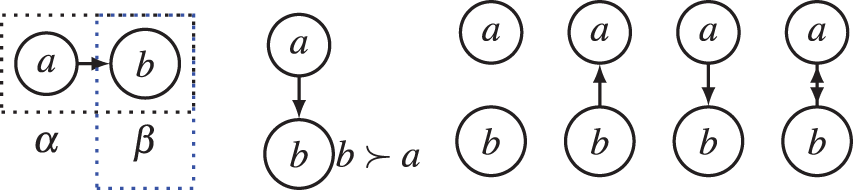

Agent-reduction approaches take the perspective of each agent individually, creating a standard argumentation framework for each agent view. Intuitively, each agent prefers their own arguments over those of other agents. Then we compute the collective acceptance of each argument. Like social agent semantics, this approach is based on reduction from an agent argumentation framework (AAF) to a standard Dung-style argumentation framework, but it works in a completely different way. In the second volume of the Handbook of Formal Argumentation, Baumeister et al.
39
discuss the approaches considered here within a broader context. Essentially, there are two distinct ways to combine the results of these per-agent reductions (cf. Figure 6). The argument-wise approach determines argument acceptability within individual views using standard methods, and then defines semantic aggregation methods. The framework-wise approach defines structural aggregation methods to aggregate individual views into a collective representation first, and then determines argument acceptability within the collective representation, using either standard methods or methods created specifically for that representation. A schematic overview of different approaches to collective acceptability in formal argumentation, where 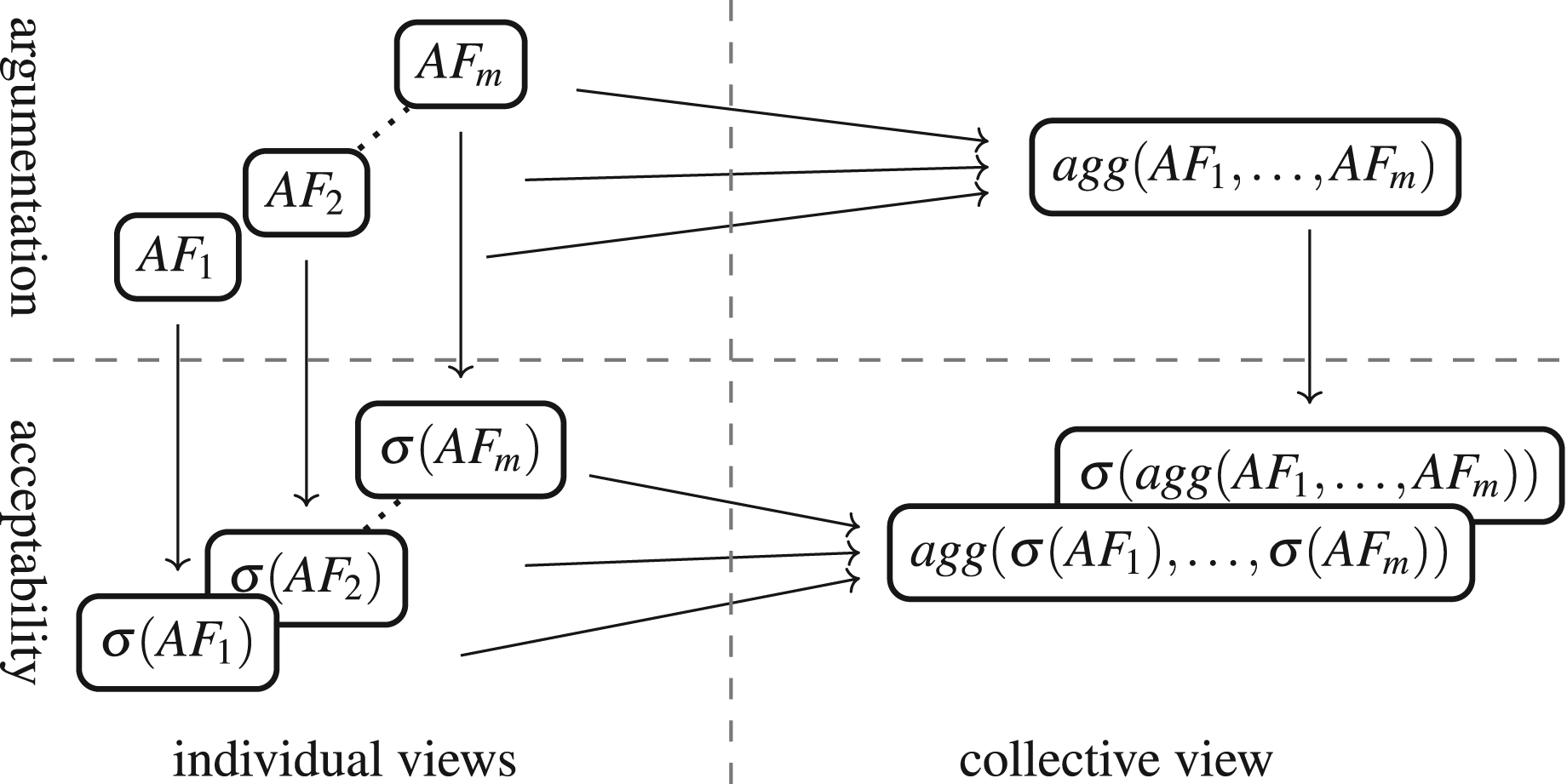
Each of the four kinds of reduction of preference-based argumentation frameworks leads to a corresponding kind of agent reduction.
Given an
As in social agent semantics, there are four definitions of agent reductions, and
: Framework-Wise Agent Reductions of AAF to AF
Given an
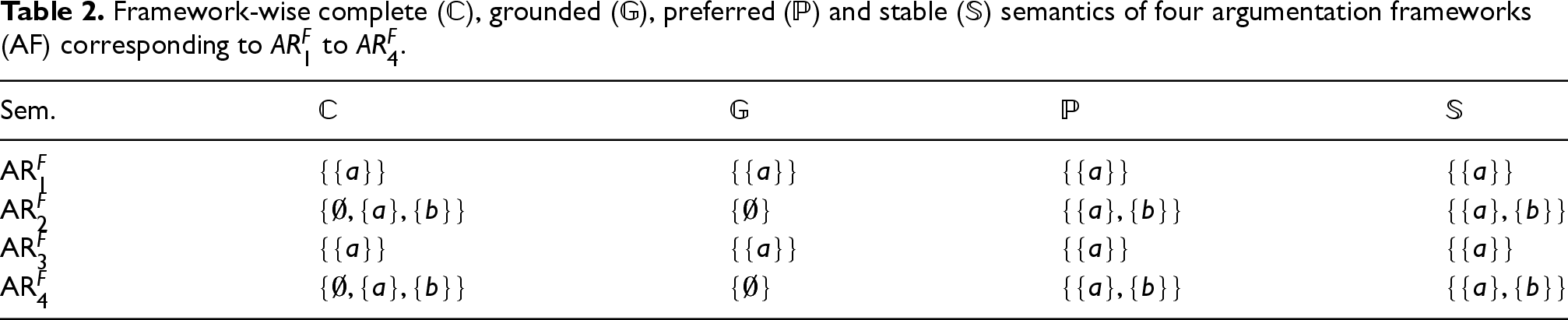
Framework-Wise Agent reduction
Framework-wise complete (
), grounded (
), preferred (
) and stable (
) semantics of four argumentation frameworks (AF) corresponding to
to
.
Framework-wise complete (
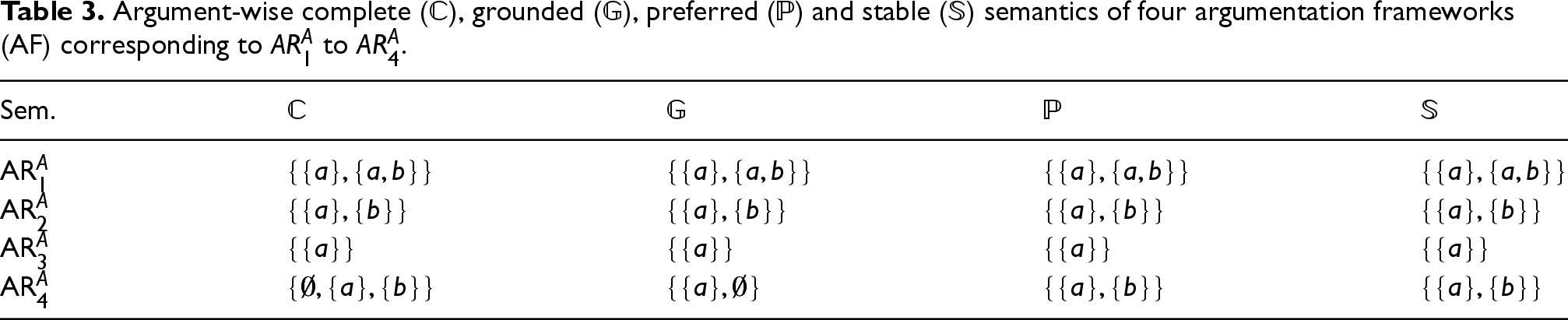
The argument-wise approach combines agent reductions in a new way. Instead of combining the frameworks, we can take the union of all the extensions to the individual frameworks:
Given an
In this section, we introduce the fourth kind of semantics for agent argumentation frameworks. Intuitively, agents may hold or express incomplete or even inconsistent information, especially in complex, uncertain and dynamic environments. After all, formal argumentation originates from conflict, and its primary aim is to represent and manage reasoning inconsistencies and disagreements regardless of whether they occur at the individual or collective level.
Agent filtering semantics addresses this by removing arguments or attacks that are not attributed to any agent, and are therefore considered either unknown or not trusted. This interpretation is particularly useful in design-time scenarios where the aim is to assess the internal coherence of individual agents’ arguments before considering their interactions with others. In such settings, cross-agent attacks may be irrelevant because they are never considered together by a single decision-maker.
The OrphanRemoval function removes arguments that are not held by any agent. The NotBothReduction function removes attacks that are not held by any agent. An attack is said to belong to an agent only if the target and attacker arguments are both held by the same agent. The reasoning behind this is that if two compatible arguments are held by different agents and these agents are not engaged in a dialogue and do not have knowledge of one other’s arguments, the existence of the attack is simply unknown from the perspective of any individual agent. In other words, attacks across agents require interaction or shared awareness, and in their absence, it is reasonable to omit such attacks from the epistemic standpoint of each agent.
Agent Reductions of AAF to AF
Given an
OrphanRemoval (OR): NotBothReduction (NBR):
Epistemic reasoning
Consider the two AAFs in Figure 7. For the figure on the left, we may say that argument Unknown argument and unknown attack.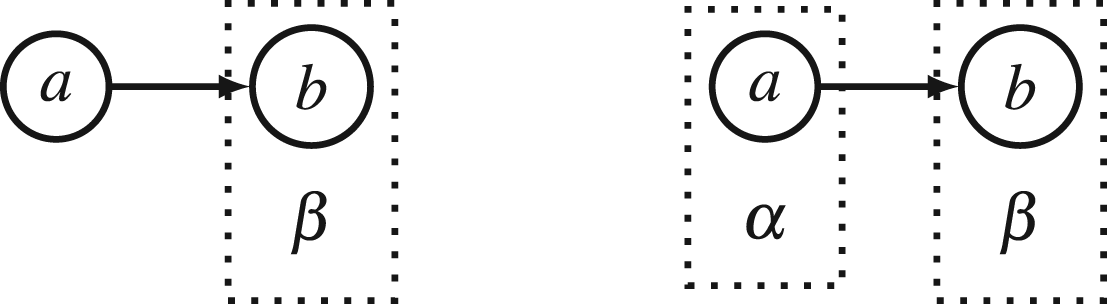
In this section, we repeat six important principles from the literature. As the baseline for the principles, we also include Dung’s semantics based on trivial reduction, i.e., we simply ignore the agents and the relation between agents and arguments.
TR: Trivial Reduction
Given an
Conflict-free 34
An agent semantics
The conflict-free principle reflects the intuitive idea that an extension contains the arguments that can be accepted together and that conflicting arguments cannot be included in the same extension. The admissibility principle reflects the idea that all arguments are defended.
None of the four kinds of Dung semantics for SR1 (
Consider the AAF in Figure 8. It is easy to see that A counterexample showing that 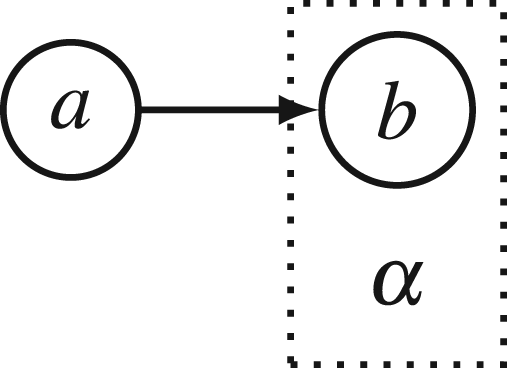
An agent semantics
It follows from Proposition 1 that none of the four kinds of Dung semantics for SR1 (
None of the four kinds of Dung semantics for SR2 (
We also consider the AAF in Figure 8. Here,
Besides, since
Directionality and SCC-recursiveness were introduced by Baroni, Giacomin, and Guida. 33 These principles reflect the idea that we can decompose an argumentation framework into sub-frameworks so that the semantics can be defined locally. For the directionality principle, they first introduced the definition of an unattacked set.
Given an
Restriction
Given an
Directionality 34
An agent semantics
Agent
We propose a counterexample. Assume an
The grounded, complete, preferred semantics for SR1 and SR3 satisfy Principle 3 but the stable semantics for SR1 and SR3 do not satisfy Principle 3.
A counterexample showing that agent stable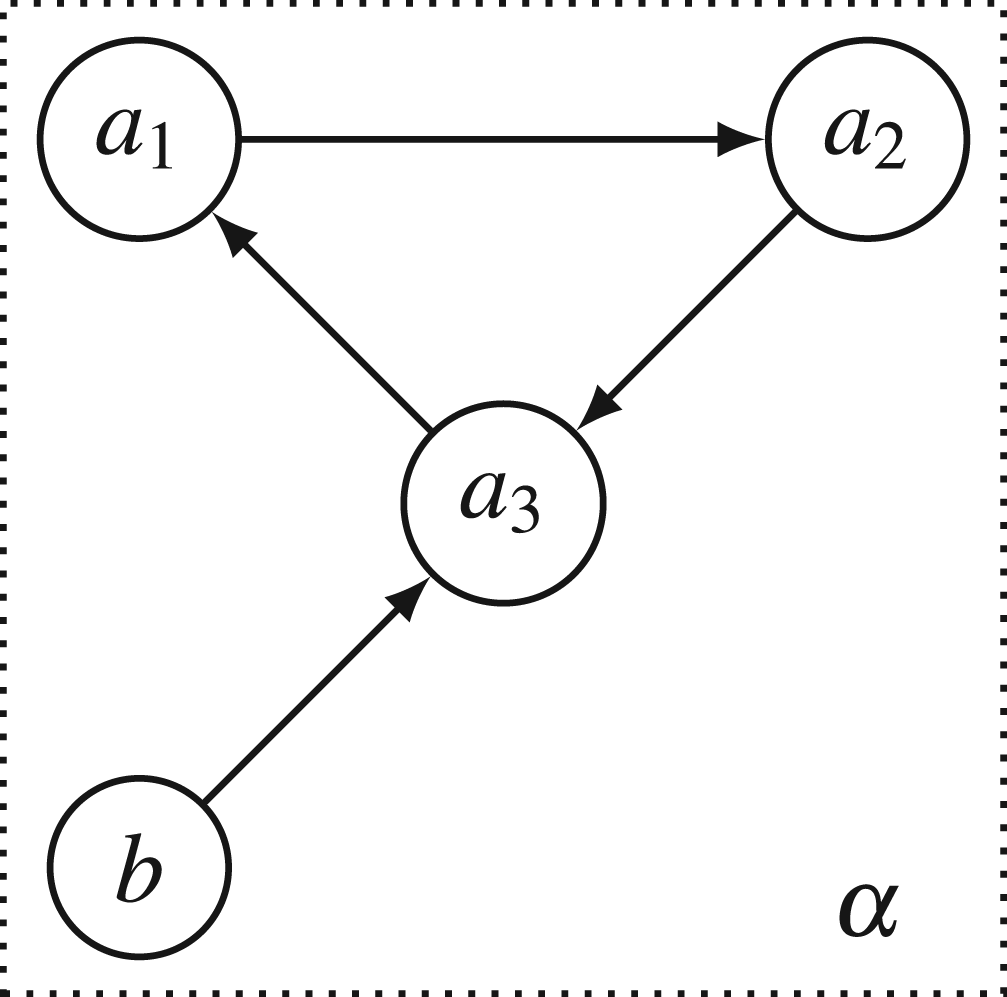
For any
For the second half of the lemma, consider
SCC-recursiveness is based on the concept of strongly connected components from graph theory.
A counterexample showing that stable semantics for SR1 and SR3 do not satisfy Principle 3.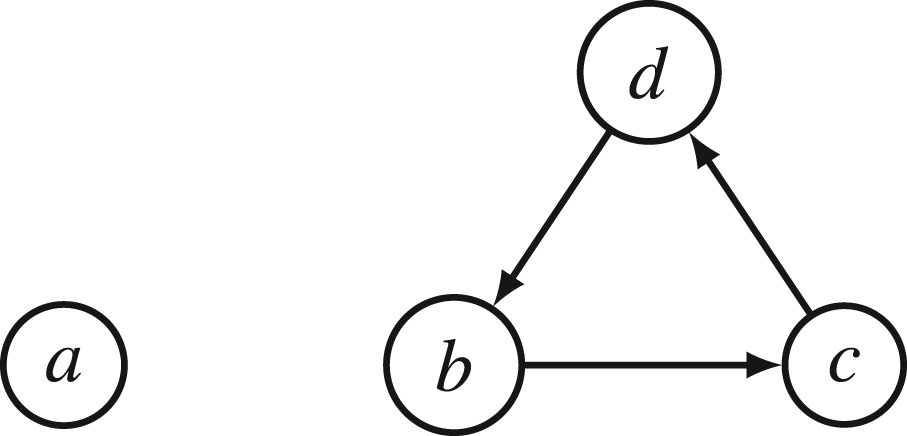
Let an for every given two distinct arguments
The strongly connected components of AAF are the equivalence classes of arguments under the relation of path-equivalence. The set of strongly connected components is denoted by
Given an argument
In other words, the set
D, P, U, UP
Given an
We now present the notion of SCC-recursiveness, which was introduced by Baroni, Giacomin, and Guida. 33
SCC-recursiveness 33
Agent semantics when otherwise,
where
Sem1, Sem2
P4
The grounded, complete and preferred semantics under admissibility1 and/or admissibility2 do not satisfy Principle 4, but the stable semantics does satisfy Principle 4.
Since the stable semantics is the same as in abstract argumentation frameworks, the second half follows from Baroni et al.
33
directly. Specifically, we can define the function A counterexample showing that grounded, complete, and preferred semantics under admissibility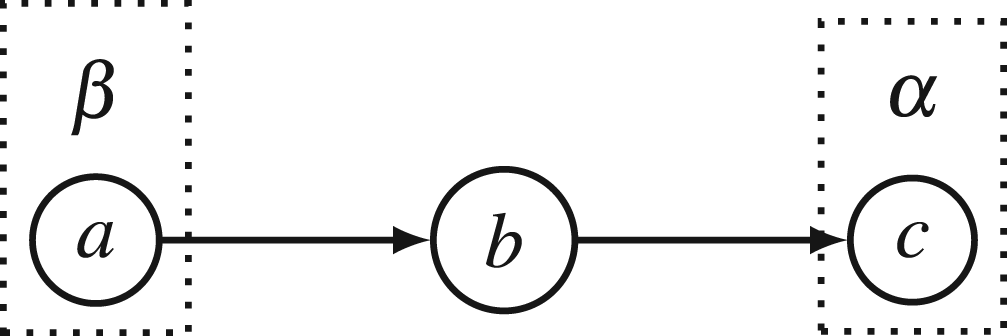
The cases for the complete and preferred semantics can be shown in a similar way.
None of the four kinds of Dung semantics for
We first consider the grounded semantics. Suppose, toward a contradiction, that the grounded semantics for A counterexample showing that A counterexample showing that SR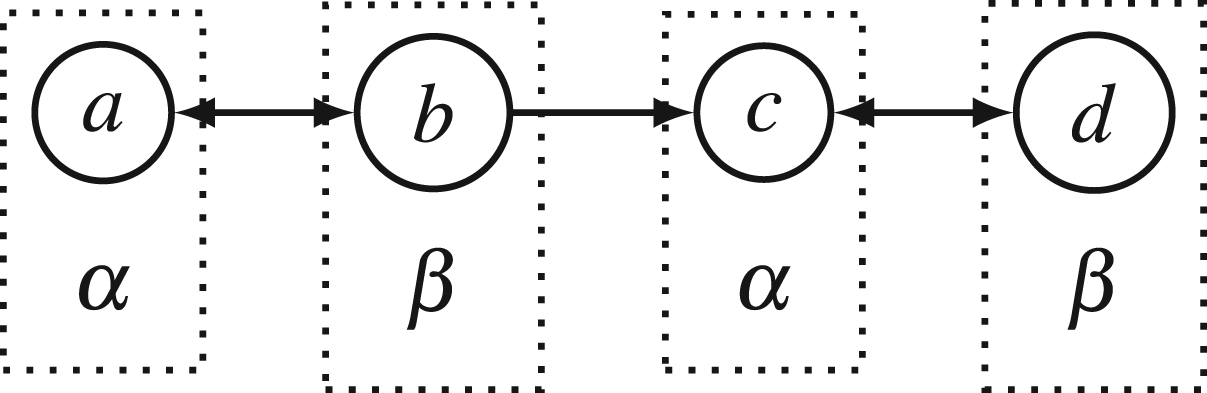
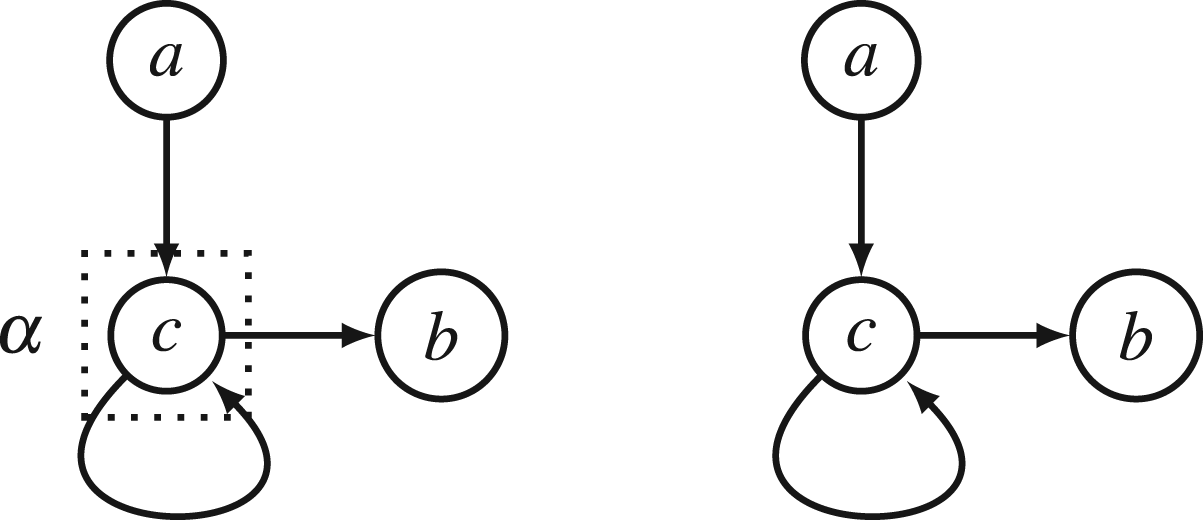
We have:
Now consider the set
The cases for complete, preferred, and stable semantics can be shown in a similar way.
Baumann, Brewka, and Ulbricht
40
introduce the modularization principle. By definition,
Given an
Modularity
An agent semantics
The modularity principle is related to the robustness principles of Rienstra et al., 41 which consider the addition and removal of arguments and attacks. We consider here only argument removal, which we call argument modularity.
SR1
P5
The grounded, complete, and preferred semantics for SR1 do not satisfy Principle 5, but the stable semantics for SR1 does satisfy Principle 5.
Consider the following
It is easy to see that
For the second half of the proposition, let
None of the four kinds of Dung semantics for
For the complete, preferred, and stable semantics, we use the same counterexample as in Proposition 41. For the grounded semantics, consider
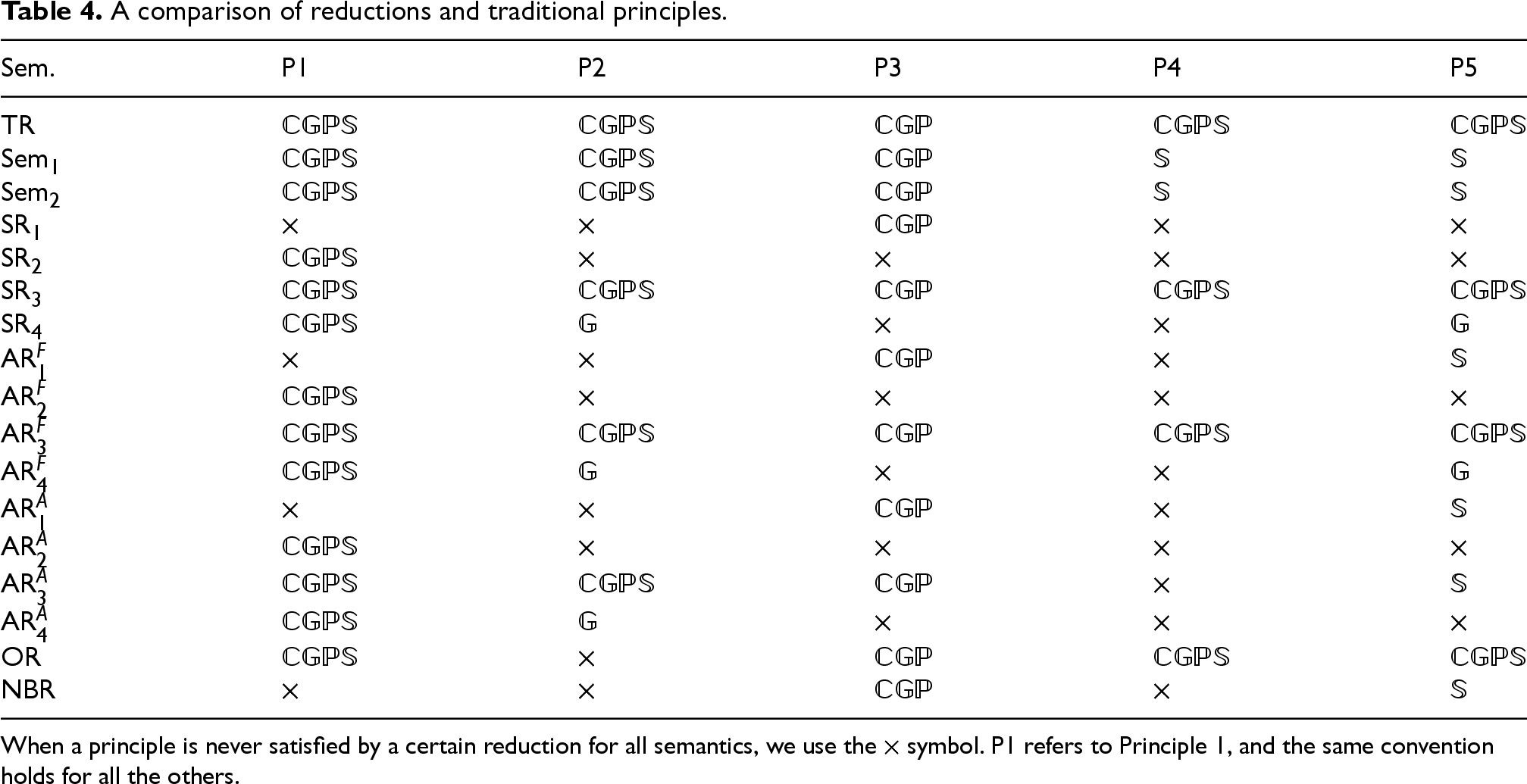
Table 4 provides a full analysis of the traditional five principles. The first line of the trivial reduction presents a well-known analysis of which of these principles hold for Dung’s semantics. Unsurprisingly, several easy examples we have already discussed in this article show that few of the traditional principles hold for agent semantics. This is a problem, particularly for SCC-recursiveness and modularity, because we cannot apply the corresponding recursive algorithm to compute the semantics. In the next section, we therefore introduce variants of admissibility, SCC-recursion, and modularity based on agent defense.
A counterexample showing that A comparison of reductions and traditional principles. When a principle is never satisfied by a certain reduction for all semantics, we use the 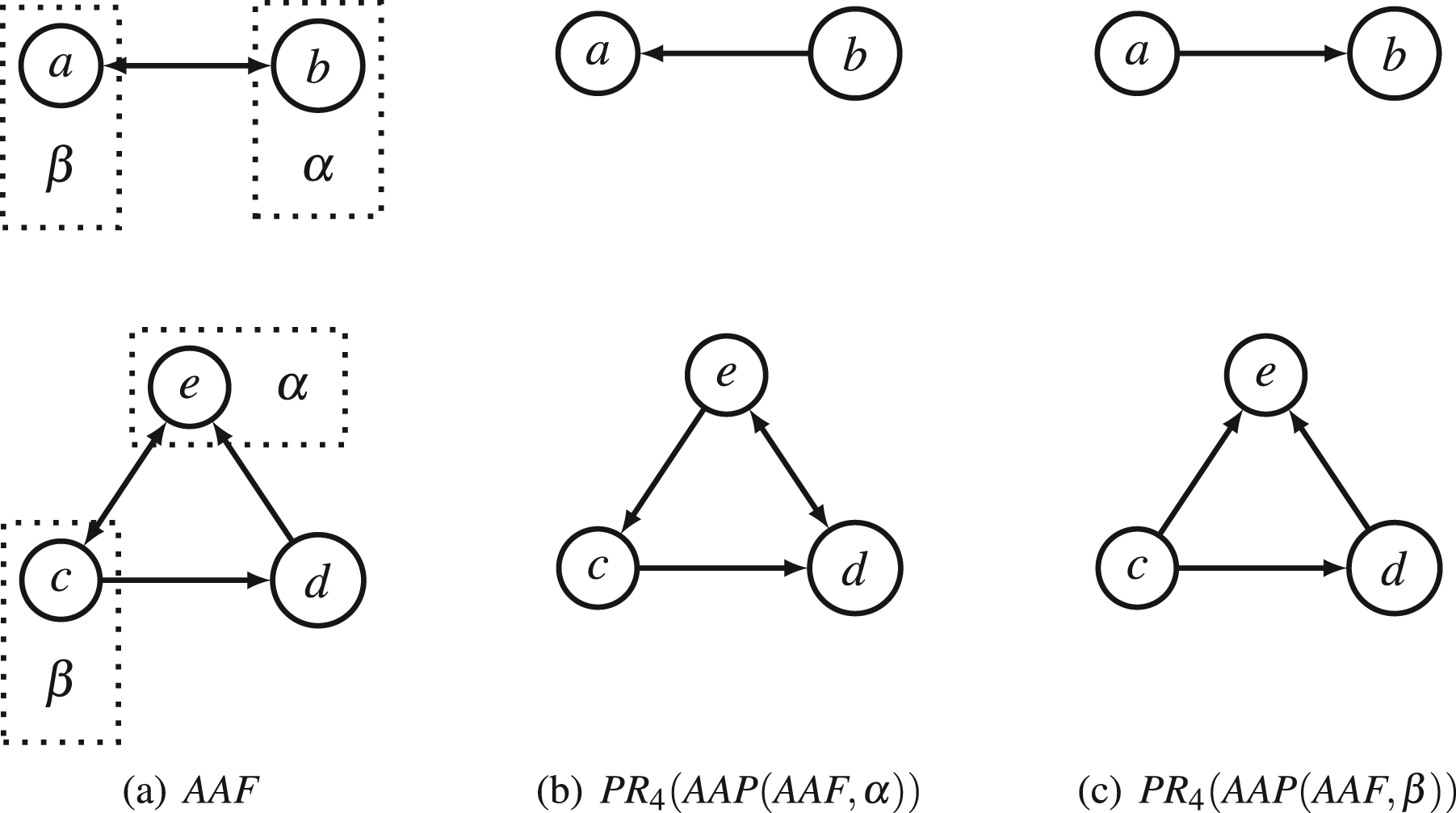
The agent admissibility principle is a straightforward adaptation of the traditional admissibility principle in which the traditional defense is replaced by agent defense. Since there are two kinds of admissibility, one for individual defense and one for collective defense, we end up with two agent admissibility principles.
Agent Admissibility
An agent semantics
Agent Admissibility
An agent semantics
We use the agent argumentation framework in Figure 2 as a counterexample.
The agent SCC-recursiveness principles are also adapted by replacing traditional defense with agent defense, and again we end up with two principles for individual and collective defense. What needs to be adapted is the definition of P, the provisionally defeated arguments. Roughly, P stands for cases where an argument is not defended against
To define agent SCC-recursiveness, we define AD
Given an
Agent SCC-recursiveness
An agent semantics when otherwise,
Sem1
P8
The grounded, complete and preferred semantics under admissibility1 do not satisfy Principle 8.
For the grounded semantics, consider
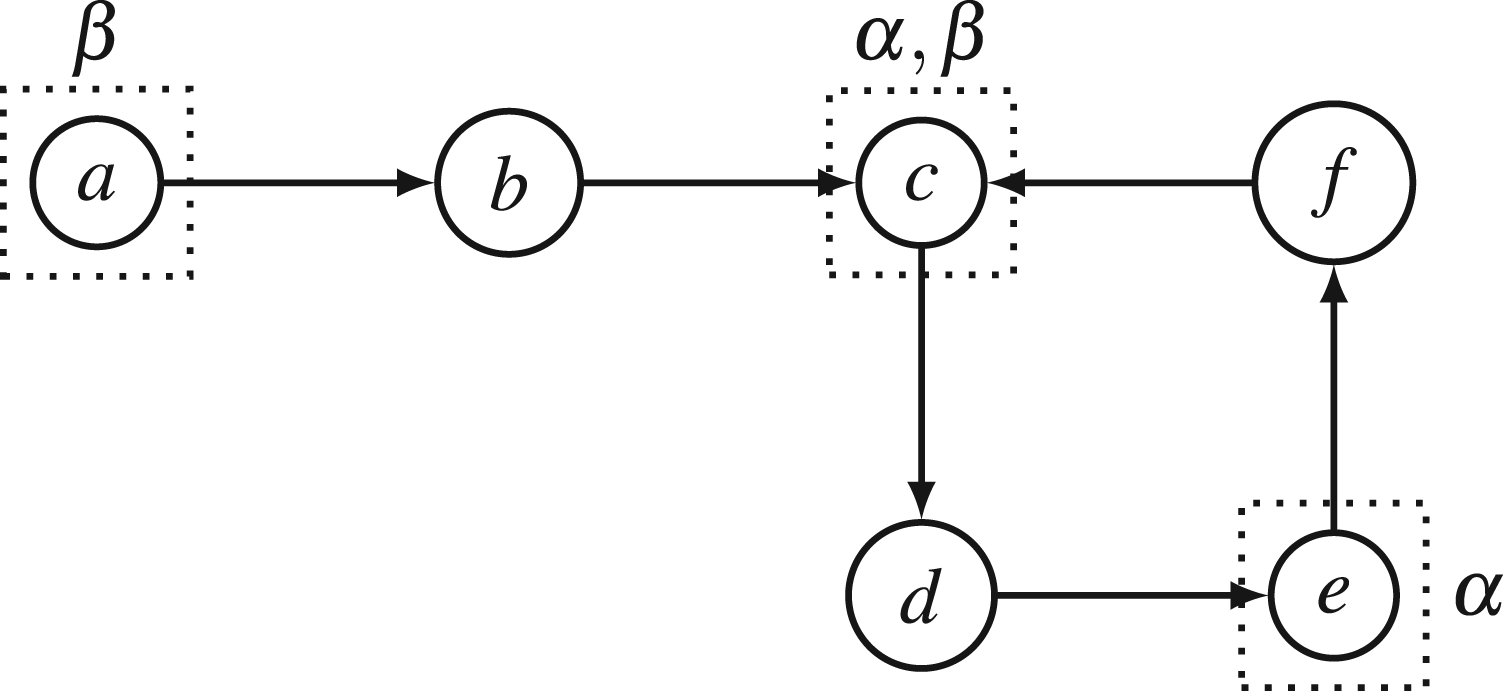
For the complete and preferred semantics, consider A counterexample showing that grounded semantics under admissibility A counterexample showing that complete semantics under admissibility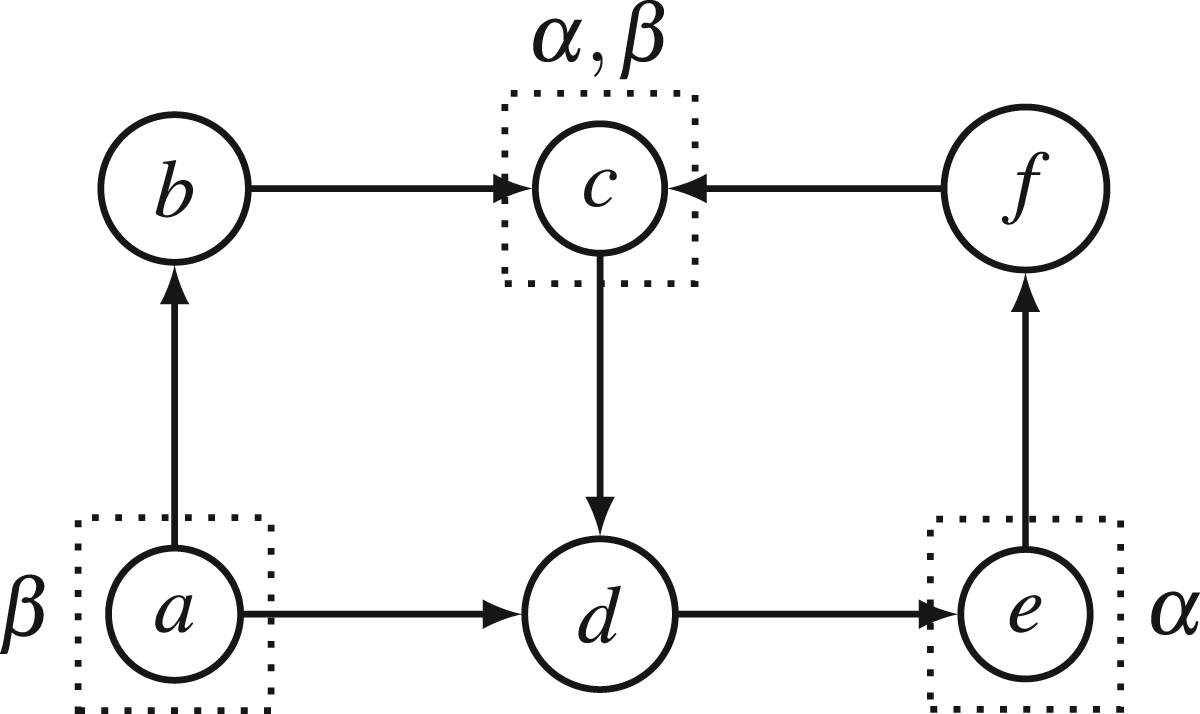
An agent semantics when otherwise,
Sem2
P9
The complete, grounded and preferred semantics for admissibility2 do not satisfy Principle 9.
For the grounded semantics, consider
Similar arguments hold for the complete and preferred semantics.
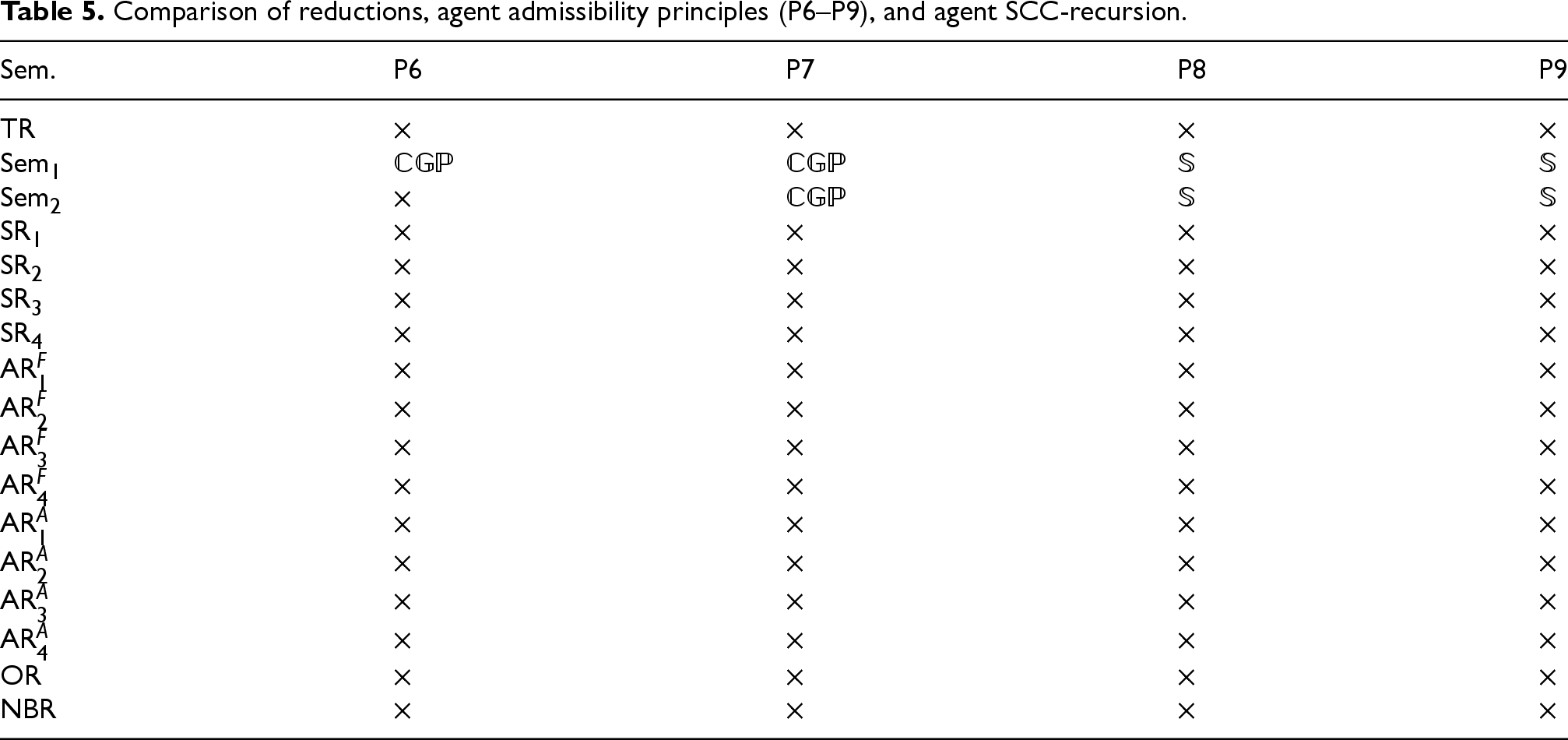
Comparison of reductions, agent admissibility principles (P6–P9), and agent SCC-recursion.
In this section, we introduce eight new principles to distinguish between agent semantics. Principle 10 says that if more agents adopt an argument that is accepted, this does not affect the extension.
AgentAdditionPersistence
An agent semantics
Principle 11 reflects the same idea as Principle 10, but is based on the assumption that
AgentAdditionUniversalPersistence
An agent semantics
OR satisfies Principles 10 and 11 for all the semantics.
Assume an
Principle 12 reflects a principle we expect to hold for all agent semantics. It expresses anonymity: permuting the agents does not affect the extensions. This is analogous to language independence for arguments as defined by Baroni and Giacomin. 34
An agent semantics
Principle 13 reflects that if the arguments of two agents do not attack one another, we can merge these agents into one single agent. This does not hold for agent defense semantics because new agent defenses may be created.
MergeAgent
An agent semantics
Principle 14 reflects that if two agents have the same arguments, we can remove one of these agents without changing the extensions. This represents the opposite of social semantics, where the number of agents makes a difference.
RemovalAgentPersistence
An agent semantics
Principle 15 is inspired by social agent semantics. It states that for two argumentation frameworks with the same arguments and attacks, if for every argument the number of agents holding that argument is the same, then the extensions are the same.
AgentNumberEquivalence
An agent semantics
Principle 16 is inspired by agent reduction semantics. It states that if the set of the arguments of an agent is conflict-free, then there is an extension containing those arguments.
ConflictFreeInvolvement
An agent semantics
Principle 17 is inspired by OrphanRemoval semantics. It states that if we have arguments that are not held by any agent, then they can be removed from the framework without affecting the extensions.
RemovalArgumentPersistence
An agent semantics
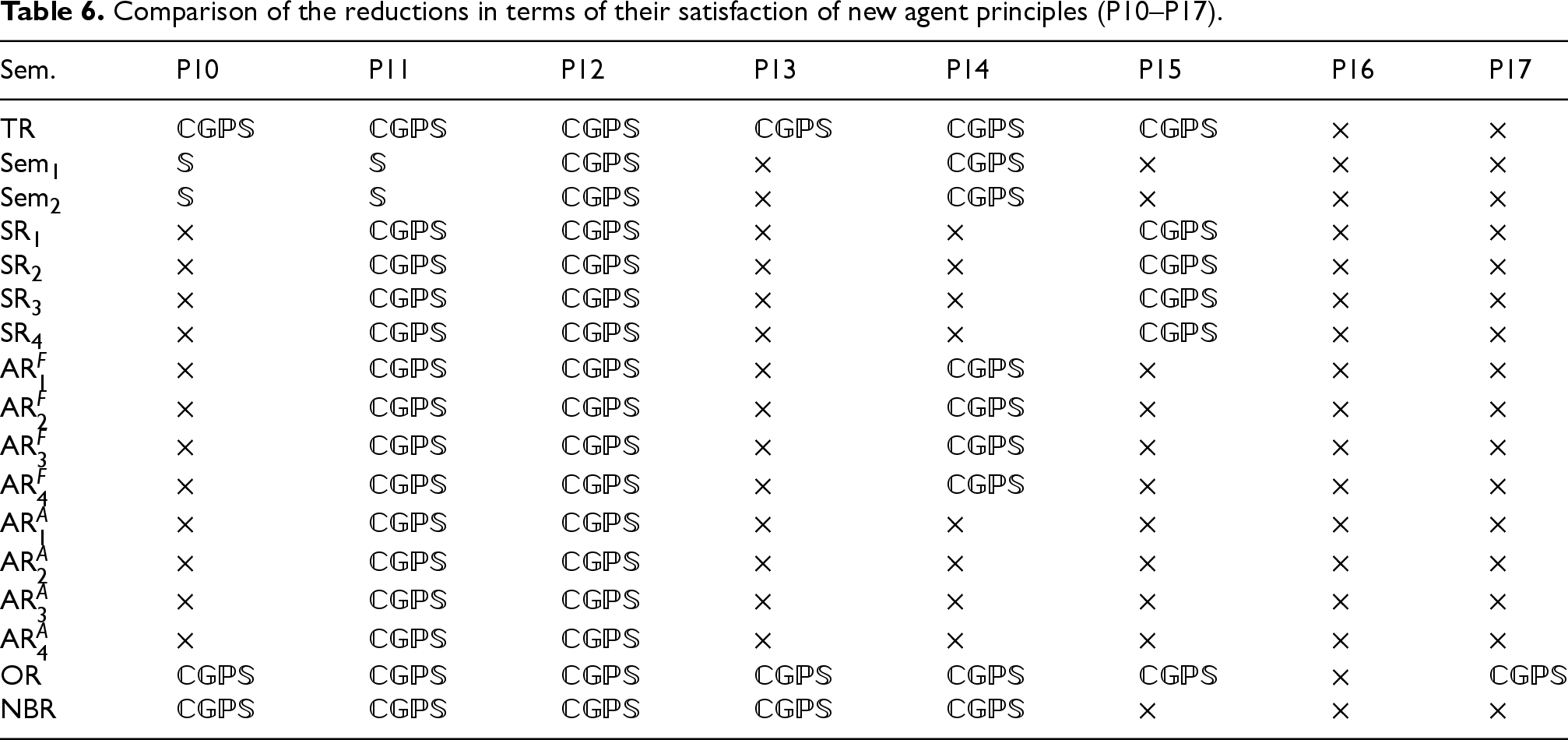
Most of the principles are independent—in particular, Principle 3 (P3 for short), P5, P12, P13, P14, P15, P16, and P17. However, some principles have inner relationships among themselves. For example, if a semantic satisfies P2, then it must satisfy P1; we denote this observation as P2
Comparison of the reductions in terms of their satisfaction of new agent principles (P10–P17).
Comparison of the reductions in terms of their satisfaction of new agent principles (P10–P17).
The third volume of the Handbook of Formal Argumentation 15 emphasizes argumentation as dialogue and agent-based perspectives, alongside application-driven work on argumentation-based dialogue systems 16 and argumentative agent-based models. 17 This article stays at the abstract level and focuses on the foundational notion of defense. We extend Dung’s abstract framework with an explicit set of agents by associating arguments with agents, and we study how defense and acceptability behave under this minimal form of agency. In the A-BDI 8 and reasoning alignment 3 perspective, argumentation as inference and argumentation as dialogue share a common abstract core but differ in what is taken as basic: inference is centered on argument construction and the assignment of attack from a knowledge base, whereas dialogue is centered on agents and interaction. This article connects these perspectives by revisiting the notion of defense under explicit agency and by evaluating the resulting semantics against principles.
There are other semantics variants that adapt the notion of defense for abstract argumentation frameworks. Blümel and Ulbricht introduce a unifying framework for abstract argumentation semantics by replacing Dung’s syntactic notion of defeat with a general refute operator, 42 from which generalized notions of defense, admissible, complete, grounded, preferred, and stable semantics are systematically derived, capturing both classical and many recent non-classical semantics. Baumann et al. introduced weak admissibility, 43 a recursive weakening of Dung’s admissibility that ignores attacks from arguments which cannot themselves be weakly admissible in the reduct, thereby neutralizing self-attacks and certain odd cycles. Based on this notion, it defines weak defense and corresponding weak complete, preferred, and grounded semantics, and shows that these semantics generalize classical ones while being insensitive to self-attacking arguments. Many extensions of abstract argumentation frameworks have been proposed, together with more general notions of acceptance. Some example additions to the basic argumentation frameworks are preferences, 13 support relations,44,45 abstract dialectical frameworks, 46 and higher-order relations. 10 Abstract dialectical frameworks are discussed in detail in the first volume of the Handbook of Formal Argumentation 5 while other extensions are discussed in the second volume of the Handbook. 9 Closer to our approach, Yu et al. 45 adapt the notion of defense in bipolar argumentation. Instead of using a reduction-based approach based on the interpretation of support, 44 which is used for introducing additional attacks and Dung semantics is applied afterwards, they define defense directly in terms of both support and attack.
There is a striking similarity at the abstract level between preference-based argumentation and support in bipolar argumentation—both can be seen as social reductions. One of the most closely related research comes from the field of social agent semantics. Leite and Martins
25
introduced an abstract model of argumentation in which agents can vote for or against an argument. They defined an abstract argumentation framework as a triple
From the agent perspective, there is a choice between 1) combining the individual agents’ frameworks into a common framework by voting on the existence of arguments and attacks, or 2) making it so that agents can agree on the framework and vote on the extensions. In this article, we have considered and compared both approaches. Additionally, Rienstra et al. 47 consider the case where the agents may have different semantics. For example, one agent uses grounded semantics while another uses preferred semantics. Furthermore, Kontarinis and Toni 48 analyze the identification of malicious behavior by agents using bipolar argumentation frameworks which, together with the paper of Panisson et al., 49 may inspire research on agent reduction semantics based on trustfulness.
When considering agents’ knowledge, epistemology, beliefs, and trust assessment, filtering semantics come into play. 50 Hunter et al. 51 take an epistemic approach to probabilistic argumentation, where arguments are believed or not believed to different degrees, thus providing an alternative to the subtle standard Dung framework. Fazzinga et al. 52 have proposed a trust-aware abstract argumentation framework (T-AAF) and an agent-aware abstract argumentation framework (Ag-AAF). They extend traditional frameworks by associating arguments with the agents who hold them and, in T-AAFs, assigning trust scores to these agents. This setup allows for trust-based filtering, enabling analysis of argument robustness by excluding arguments from less trusted agents. Ag-AAFs, in contrast, evaluate argument sets based solely on agent identity, thereby offering insights into argument robustness without relying on trust metrics. This approach could complement our study by providing a method for dynamically assessing argument acceptance based on agent reliability, which allows for flexible analysis in trust-sensitive environments. Yu et al. 53 have developed a context-based argumentation system (CAS) that supports consensus-building by enabling agents to prioritize norms and values in specific contexts, dynamically adapting to shifts in argument priorities. CAS’s flexibility in adjusting argument preferences based on evolving socio-cultural or legal contexts contrasts with static aggregation methods, making it suitable for multi-agent scenarios that require context-sensitive adaptations. Lastly, Sakama 54 introduces argumentation frameworks with beliefs (AFB), where agents can hold nested beliefs about arguments, thus allowing for complex belief states, such as inner conflict, within argumentation. This belief-driven approach adds a unique perspective on agent viewpoints, complementing formal acceptance-based frameworks by emphasizing the internal belief dynamics of agents.
In their exploration of multi-agent argumentation and dialogue, Arisaka et al. 55 have extended Dung’s abstract argumentation framework by assigning arguments to agents and by incorporating agent interaction and dialogue. Their approach centers on the concept of conditional acceptance, where an agent evaluates arguments not in isolation but relative to the trustworthiness of the sources (other agents) supporting these arguments. To formalize conditional and multi-agent argumentation, the authors employ the theory of input/output argumentation, 56 also referred to as multi-sorted argumentation. 47 They distinguish between individual and collective acceptance—individual acceptance is determined by each agent’s trust-based evaluation of arguments, while collective acceptance involves aggregating revealed arguments to determine global acceptability. Additionally, agents can strategically choose to hide certain arguments from others, revealing information selectively to shape dialogue outcomes. An external observer (e.g., a judge) may accept arguments that individual agents do not, applying an independent evaluation that incorporates or modifies agents’ disclosures. In this regard, Arisaka et al.’s 55 concept of collective acceptance parallels our agent reduction semantics, where individual agent perspectives are aggregated to define collective extensions at a global level.
Principle-based analyses are a standard tool for studying and comparing argumentation semantics,32,34 and have been extended to a variety of settings, including preference-based 13 and bipolar argumentation45,57,58 and multi-agent argumentation. 59 The present article follows this methodology but focuses on principles that are sensitive to agency and that distinguish between social, reduction-based, filtering-based, and defense-based agent semantics. In this way, the analysis clarifies trade-offs between approaches and makes explicit how classical notions such as defense and reinstatement behave once agency is part of the abstract framework.
Future work
A first direction concerns the alignment between argumentation as inference and argumentation as dialogue, as made explicit in the A-BDI metamodel 8 and in recent work on reasoning alignment. 3 One existing approach is via dialogue games. Caminada characterizes several abstract semantics by sound and complete discussion games, 4 showing that an argument is accepted under a semantics exactly when the proponent has a winning strategy. What is still missing is an integration of such characterizations with dynamic agent dialogues in which agents have their own perspectives and where the abstract framework may change over time. A dialogue-theoretic account of our individual- and collective-defense semantics would be a natural next step.
A second direction is to connect abstract agent semantics with structured argumentation and with the construction of frameworks from knowledge bases. Extended abstract frameworks increase expressive capacity, but it remains unclear how to construct them systematically from a knowledge base once agents, support relations, and quantitative elements such as numerical values or weights are part of the representation. Integrating agents more directly at the structured level seems particularly natural. For instance, systems like Jiminy 60 employ multiple stakeholders, each with distinct knowledge bases, to handle dilemmas and conflicts. Here, the argumentation engine can either combine individual arguments from each stakeholder to form a collective framework or merge the knowledge bases first before constructing an argumentation framework. Both approaches raise new questions about how to achieve coherent integration in structured argumentation settings.
A third direction concerns more general notions of defense. The attack–defense (AD) framework 61 replaces the binary attack relation by structured attack–defense triples and thereby captures context-sensitive interactions that cannot be represented in standard Dung frameworks. It is of interest to study whether agent defense can be represented within AD, and whether AD offers reductions for several patterns of defense redefinition, including weak admissibility, bipolar defense, and agent defense. Such reductions would make it possible to compare these approaches in a common setting without relying on separate ad hoc translations.
Finally, the principle-based analysis can be developed further. Principles do not only distinguish semantics; they also serve as requirements for semantics design. Beyond the present study, it is natural to seek characterization and impossibility results for agent semantics, and principles that govern combinations of semantic mechanisms (e.g., filtering followed by agent defense). It is also natural to connect this style of analysis with reasoning alignment diagrams (RADs), 3 which use commutative diagrams to relate different reasoning routes and to separate specification from explanation. In such a setting, agent-defense semantics can provide the acceptability component for dialogue routes, while principles can constrain input–output behavior when several reasoning modules are composed.
Summary
This article studies abstract agent argumentation, where arguments are associated with agents, and investigates how Dung’s notion of defense should be adapted once agency is made explicit. 1 We introduced two notions of agent defense—individual defense and collective defense—and used them to define agent variants of admissibility-based semantics. These defense-based semantics were compared with three established approaches to abstract agent argumentation: social agent semantics, agent reduction semantics, and agent filtering semantics.
The comparison is carried out by examining how these semantics behave with respect to well-known properties of abstract argumentation, including conflict-freeness, admissibility, directionality, and SCC-recursiveness,33,34 as well as properties that are specific to the presence of agents. This analysis makes explicit how classical notions such as defense and reinstatement change once arguments are associated with agents, and it shows precisely where agent-defense semantics differs from reduction-based and filtering-based approaches. In particular, several reduction-based semantics inherit SCC-recursiveness from the underlying Dung semantics via their reductions, whereas agent-defense semantics violates SCC-recursiveness for admissibility-based semantics and motivates corresponding agent-specific variants.
From a broader perspective, these results support a reading of Dung’s attack–defense paradigm as a modeling framework rather than as a commitment to a limited semantics.1,2 The same abstract core can be used to relate different kind of reasoning—such as nonmonotonic logic and game concepts, 1 dialogue games, 4 and belief change 3 —provided that the underlying modeling choices are made explicit. In this article, this choice concerns how defense is defined in the presence of agents. The analysis therefore fits the A-BDI perspective 8 and recent work on reasoning alignment. 3 Recent LLM-based chatbots make argumentation as dialogue practically relevant, 16 but they also call for symbolic constraints. 62 A symbolic layer can capture such constraints at the level of abstract semantics, independently of how arguments are generated. The abstract agent argumentation framework and agent-defense semantics developed in this article provide one step in this direction by making explicit how defense and reinstatement behave under individual and collective agency.
Footnotes
Acknowledgments
The authors thank the Luxembourg National Research Fund (FNR) for its support through the project Deontic Logic for Epistemic Rights (DELIGHT) (OPEN O20/14776480). Leendert van der Torre acknowledges the financial support of the FNR through the following projects: The Epistemology of AI Systems (EAI) (C22/SC/17111440), DJ4ME—A DJ for Machine Ethics: the Dialogue Jiminy (O24/18989918/DJ4ME), Logical Methods for Deontic Explanations (LoDEx) (INTER/DFG/23/17415164/LoDEx) and Symbolic and Explainable Regulatory AI for Finance Innovation (SERAFIN) (C24/19003061/SERAFIN). Liuwen Yu thanks the FNR for their support through the SERAFIN project (C24/19003061/SERAFIN) and the University of Luxembourg for the Marie Speyer Excellence Grant for the project Formal Analysis of Discretionary Reasoning (MSE-DISCREASON).

Declaration of conflicting interests
The authors declared no potential conflicts of interest with respect to the research, authorship, and/or publication of this article.