



Abstract
Background:
Respiratory therapy (RT) departments need to deliver care efficiently. There are limited data describing staffing models used by RT departments and how daily assignments are determined. We aimed to describe RT department staffing models.
Methods:
We targeted an electronic survey to directors, managers, and supervisors of RT departments via social media, professional networks, and a manager work group. We asked questions about hospital demographics, staffing models, daily assignments, full-time equivalent (FTE) calculations, and attitudes about staffing. Data analysis was descriptive and we compared those with high versus low vacancy rates.
Results:
We received 116 responses; 86% were managers or directors. The number of RT FTEs was reported as below what they need for 67% of respondents, 38% believed hospital leadership agreed the number of RT FTEs was below what they need, 63% reported the number of FTEs was determined above the RT director level, and 41% of RT departments owned the reports used to determine the number of FTEs. The AARC Safe and Effective Staffing Guide was used by 19% of respondents, 20% used only billable activities, and 24% used relative value units. For assignments and daily work load, 68% of respondents accounted for unplanned activities, 39% used a point system for daily assignments, 14% used an objective system to determine daily assignments, and 55% stated the charge or lead RT determined daily assignments. Forty percent of respondents reported no maximum for number of ventilators per RT and 81% reported RTs staffed in the ICU also have assignments outside the ICU.
Conclusions:
In a small sample of RT leaders, there was limited consensus on how daily assignments, FTE calculations, and target work load were determined among respondents. Most reported RTs having assignments outside the ICU and 40% did not have a maximum number of ventilated patients per RT.
This is a visual representation of the abstract.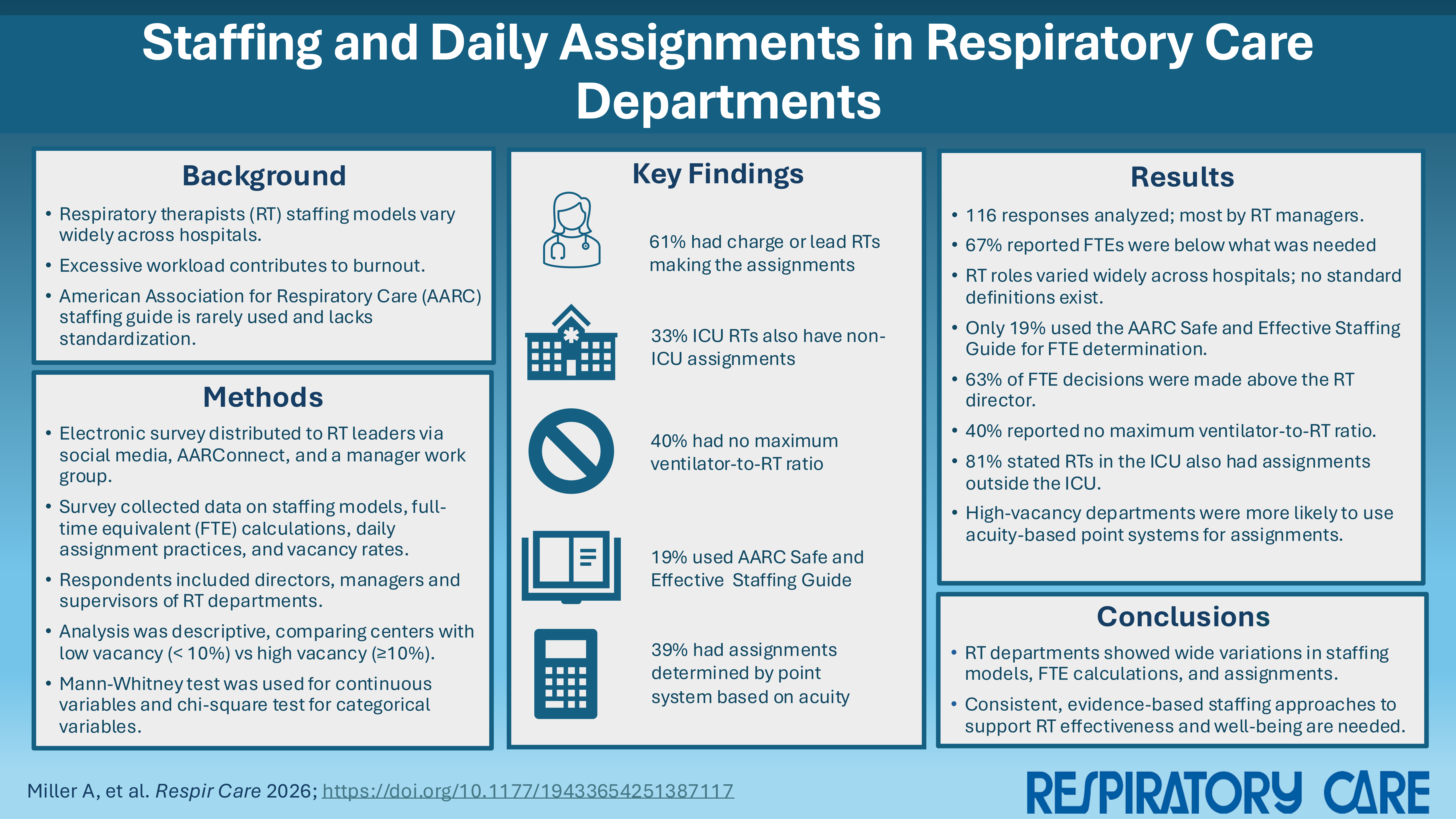
Get full access to this article
View all access options for this article.
References
Supplementary Material
Please find the following supplemental material available below.
For Open Access articles published under a Creative Commons License, all supplemental material carries the same license as the article it is associated with.
For non-Open Access articles published, all supplemental material carries a non-exclusive license, and permission requests for re-use of supplemental material or any part of supplemental material shall be sent directly to the copyright owner as specified in the copyright notice associated with the article.
