




Abstract
Globally, Indigenous communities are working to decolonise to contribute to marine management. Although there is an increasing recognition of their value, linguistic and bio-cultural importance, many Indigenous peoples, their marine environments and their cultures are going extinct. Relevant to the UN Ocean Decade Challenge 10 Restore society's relationship with the ocean, the article reviews 200 Indigenous communities facing environmental injustices from nine major economic development impacts, mining, port development, oil and gas, military impacts, nuclear, aquaculture, sewerage, and migratory fisheries. The evidence shows Indigenous communities defence of marine ecosystems makes for a more just and sustainable starting point for decision making. We acknowledge that while traditional tenure systems in some cases need to modernise for the Anthropocene, there are more benefits if resource management is Indigenous led. We conclude that while Indigenous nations and communities have considerably progressed with legal recognition to ownership over land rights, the benefits of management, use and right of their marine areas still needs greater decolonisation.
Introduction
Across the world, there is an increased recognition of Indigenous nations, peoples, and groups for their contribution to marine resource management building on customary systems, and through hybrid marine protected areas (MPAs) (Anbleyth-Evans, 2022; Luque and Doode, 2007; Rist et al., 2019; von der Porten et al., 2019). Despite this, many Indigenous groups still lack the management rights over marine resources, to plan and make decisions over marine spaces in an equitable manner. Historically, calm Indigenous harbour areas were always a favourite part of the coast to colonise first (Graeber and Wengrow, 2021). While many survive today globalisation brings multiple economic development projects, often initiated or supported by neo-colonial states. We consider these groups in the context of coloniality, the most general form of domination in the world today and their decolonisation (Quijano, 2007), as well as emancipation of their knowledge systems (Mignolo, 2021).
The developments considered here include: (1) submarine tailing dumping from mines (Coumans, 2018), (2) Seabed mining (Van Putten et al., 2023), (3) port construction, dumping and dredging and associated land reclamation (Anbleyth-Evans et al., 2020; Hattam et al., 2020), (4) Oil and energy development (Andrews et al., 2021; Hassler 2015; Wood and Rossiter, 2017), (5) nuclear power/weapons impacts and radioactive waste (Fan, 2009), (6) military/naval base development (Frain, 2020; Lutz, 2019), (7) sewerage (Araujo et al., 2013) (8) aquaculture (Buschmann et al., 2006), and (9) overfishing and impact on coastal ecosystems and Indigenous food security (Veitayaki et al., 2016). Added to this are top-down conservation initiatives such as in Comau Fjord Chile, where loss of space, power, and resource access rights occur in customary systems (Aburto et al., 2020), however these and windfarms are not discussed here. If Indigenous nations rights and wishes have been ignored, then permitting the projects mentioned can result in injustices (Lobo and Parsons, 2023). The extent these injustices are widespread were reviewed across 200 different marine Indigenous nations. Similarly, to understand this extent of these injustices, their different levels of rights across a spectrum were reviewed. For context, the article of Cisneros-Montemayor et al. (2016) suggests that there are approximately 2000 Indigenous coastal cultures. The extent they are unable to voice their concerns and interests effectively differs along a continuum of marine rights to management (Jentoft et al., 2019; Kymlicka, 2007; Stacey et al., 2017). To this end the article introduces a continuum scale of Indigenous nations rights. Those that have developed significant autonomy and are the primary influence on the marine environment, to those who are without any rights or influence at the other end of the scale.
How marine Indigenous nations can respond to the state- and corporate-led developments in marine areas, is not sufficiently understood in the context of blue justice (Parsons et al., 2021). With certain exceptions, governments around the world follow the idea that economic growth is universally beneficial, resulting in top-down marine planning for projects with loss of space and resource access rights for certain groups (Barbesgaard, 2018). This article shows the importance of decolonising Indigenous marine resource management over development projects. This is important in the context of developments whether from endogenous and exogenous economic organisations.
Here we ask to what extent Indigenous marine nations are afflicted by nine economic development impact types identified above. We ask; can increased Indigenous management over different economic developments slow down anthropogenic impacts in the marine environment, whilst increasing justice, decolonisation and bio-cultural conservation. It analyses the extent the 207 Indigenous marine territorial and management nations are respected or not by states. The article highlights the patterns and challenges Indigenous nations face to realise management over their marine environment and conserve their customary systems and cultures.
Supporting customary systems and Indigenous marine management
We considered nine types of economic developments that create pollution and disturbance of environments overseen by customary systems. These developments included ports, mining and industrial fishing can interrupt customary systems of subsistence fisheries, and Indigenous attempts to maintain traditional conservation strategies. Considerable attention has focused on the integration of customary management institutions, such as taboos, sacred areas, seasonal and spatial closures traditionally managed in the tenures of marine Indigenous nations (Ban and Frid, 2018; Johannes, 1978), and hybrid management strategies (e.g. Cinner and Aswani, 2007). Here we argue that responsibility over the development of these externally led developments is better situated in a hybrid system that builds on the customary management with these community stakeholders. While most modern marine management takes power away, a decentralised hybrid local authority gives space to reimagine and evolve the historic tenure system. While the original evolution of fisheries tenures may have been to realise community fisheries rights and gains versus other communities, today these tenures exist at a scale where community trust is continued. Where they have a long-term sense of place promoting local conservation, more sustainable developments can be realised (Hausmann et al., 2016). This can support cultural and linguistic rejuvination and ecological health, in contrast to the development priorities of the capital city and other ethnic groups that dominate through its institutions.
Bio-cultural conservation
Bio-cultural conservation is a term used to describe the preservation of the relationship between biological, linguistic, and cultural diversity and these customary systems, such as continued by Indigenous people (Aswani et al., 2020; Hong, 2013; Maffi, 2005; Rozzi et al., 2006). It can also include the recognition of cultural seascapes, such as the coral reefs of Hawaii (Shackeroff et al., 2009), or certain islands and their waters celebrated by Mapuche Williches, whose protection gives rise to wellbeing and continued rituals celebrating nature (Anbleyth-Evans et al., 2023). Another example is the Ijaw and Ogoni people's view of the waters as an integral life force, a spiritual inheritance, traditionally influencing their fisheries management such as periwinkle harvesting (Pegg and Zabbey, 2013). In this light, to realise bio-cultural conservation it is important to support Indigenous governance institutions. Further they were established contingent on the continuing ecological health for fisheries. This contrasts to the nine development types listed above, which are indifferent to whether corals or shellfish are alive or dead. Indigenous peoples empowered leadership through legally recognised territorial rights can potentially mean just regulation of development projects and resolve blue justice issues.
Legally binding and conditional instruments and Indigenous marine management
Understanding the legal rights and conditional instruments of Indigenous Marine Management is complex and diverse. Indigenous cases were included as having rights when specific information on legal status (Recognition rights, rights to autonomy/governance) social structure (continuing socio-cultural structure, or their disintegration), participation in marine management, and blue justice issues were available. Examples include those asserting rights of customary systems over externally led projects, such as through Pacific Local Marine Management Areas (LMMAs) (Govan et al., 2009); and those defined as Other Effective Area-based Conservation Measures, (coined by the Aichi targets of the Convention on Biodiversity and FAO guidance to Small-Scale Fisheries SDG 14 b). Our aim is to show the importance of empowering and establishing marine Indigenous led management, which can lead planning, supported by territorial rights. These can support justice for coastal communities confronted with increasing encroaching developments from outside (Artelle et al., 2019; Ferguson et al., 2022; Mulalap et al., 2020).
Legally binding and conditional instruments that are relevant include the ILO Convention 169 (1989) as well as the United Nations Declaration on the Rights of Indigenous Peoples (UNDRIP). This recognises the sovereign rights of Indigenous Peoples to land, self-government, and culture (UN, 2007). However, despite coastal environments being within historic and contemporary Indigenous territories, the right to lead management on the marine environment and assess development projects is not clearly identified, beyond the broad right to consultation and prior, free, and informed consent of UNDRIP, nor territorial, conservation or fishing rights. It is a declaration, which means it is not a kind of treaty subject to ratification (Moreira, 2020). Also relevant is the 1992 Convention on Biological Diversity, the first Treaty to recognise the rights to knowledge, innovations, and practices of Indigenous peoples and local communities concerning environmental protection.
In specific countries, legal instruments of note include the Indigenous Protected Areas of Australia (Including Sea Country and Traditional Use of Marine Resources Agreements) which while imparting recognition, do not legally grant formal legal territorial rights such as a treaty, do not allow for Indigenous final decisions on projects, but do recognise customary systems (Gould et al., 2021). They are defined as Indigenous led, or collaborative efforts to establish MPAs, which are of various managerial foci and effectiveness, and include spatial–temporal refugia, and/or strict no take zones (Rist et al., 2019). In Canada, while most treaties do not recognise marine territorial rights, various MPAs give co-management rights to Indigenous marine nations, such as the Songhees (Buscher et al., 2021) which are not necessarily the same as the recognition of customary systems. Also in Canada, the Kitasoo/Xai’xais people, declared their own ‘Gitdisdzu Lugyeks’ MPA in 2022 in their territorial waters of Kitasu Bay, without formally recognised government legal authority, as did the Mamalilikulla in 2021, which was later accepted (Von Herff, 2023). The Haida Gwaii agreements (Haida Gwaii, 2017) now explicitly recognise dual assertions of sovereignty and territory (Council of the Haida Nation, 2017), but while recognising customary systems, does not place them as the lead authority. While Indigenous Protected and Conserved Areas are discussed in Canada, there is yet to be any national legislation that calls for the protection of areas that are cultural, spirituality and ecologically important to Indigenous Peoples. The Oceanic Security state is used to justify the lack of Indigenous marine territorial rights in the United States (Na’puti and Frain, 2023). Contrastingly in Chile, the Lafkenche law allows for Indigenous coastal communities to apply for marine territorial rights (Anbleyth-Evans et al., 2020).
Worth noting in this light is the Voluntary Guidelines for Securing Sustainable Small-Scale Fisheries (SSF Guidelines) (FAO, 2015), which are concerned with the governance of Indigenous peoples’ customary tenure systems, including the rights to aquatic resources (Gonzalez, 2017; Jentoft et al., 2019). Also widely recognised are the Indigenous Community and Conserved Areas (ICCAs) (ICCA Consortium, 2024). Furthermore, while institutions such as the IUCN are promoting the importance of ‘Other Effective Area-based Conservation Measures’ (Jonas and MacKinnon, 2016), their focus still lacks a deeper consideration of the entangled importance of bio-cultural conservation and Indigenous property rights.
In the context of bio-cultural conservation and legal instruments, the introduction of cultural landscapes in 1993 as a type of cultural nomination for World Heritage Sites at the 1990 Rio Earth Summit, led to increased discussions about the link between biological diversity and cultural diversity (Rössler, 2006). Examples of successful efforts include: the legal recognition of the Whanganui River as Te Awa Tupua as an entity with agency (Charpleix, 2018), cultural seascapes of coral reefs in Hawaii (Shackeroff et al., 2009), continued protection of sacred fishing grounds in Fiji (known as Qoliqoli rights), combined with modern measures to control overfishing in the surrounding areas (Veitayaki et al., 2016). These cultural contexts were supported by the Indigenous international Aashukan Declaration (2017) which outlined key principles of Indigenous Impact Assessments, beyond generic EIAs and SIAs (Jolly and Thompson-Fawcett, 2021).
Methods
In a similar form to the Preferred Reporting Items for Systematic Reviews and Meta-Analyses method (Page et al., 2021: 1), literature was screened in and out depending on the relevance to themes of the (1) extent of their rights, (2) bio-cultural dimensions, (3) management or conservation mechanisms, or (4) blue justice issues, and (5) spatial area proposed or recognised. The first step was a qualitative desk top study to identify the marine Indigenous nations, projects, and associated impact issues, through a review of different literatures and sources, collected in an excel spreadsheet. Various databases and white papers from ICCA to UNDRIP and United Nations Development Programme, to the UN special committee on decolonisation (which supports nations on the path to independence), were searched. This grey literature also featured NGOs, campaign groups for Indigenous rights and other online resources found through google, Wikipedia and social media, searching the majority in English, with some in Spanish and French. The online search was further extended by other scientific literature (books and peer-reviewed publications) derived from an extensive Web of Knowledge and Scopus search for the respective nation.
One to two references were recorded in the excel spread sheet to evidence the themes. For this literature search, the search terms ‘marine Indigenous’, ‘marine conservation’, management, Indigenous monitoring, justice, stateless nations, fishing, bio-cultural, territorial and customary rights among others were used. These were sorted according to different Indigenous groups and nations, covering over 300 to 400 documents approximately. Primacy was given to academic publications; secondary references were used if none were available. The different texts were not scored, but they were crossed to checked across multiple sources to ensure they were showing the themes were appearing across the sources.
These Indigenous groups were then coded according to whether evidence of blue injustice was present or not, with a Yes or No. Originally their management rights were scored from 1 to 4 with 1 with the strongest rights, but co-authors felt with the great diversity, the description of a continuum as developed in the next section below alone would be better. Information was collected on 207 marine Indigenous nations, put into an excel spreadsheet, then distilled into table heuristic categories (Supplemental Table S1). This led to the generation of the different categorisations of Indigenous marine areas with different territorial rights recognitions, and management capacity across a continuum. Analysis of the rights, management capacity and extent of the blue justice issues led to the distillation of the results, Figure 1 and Supplemental Tables S2 and S3.
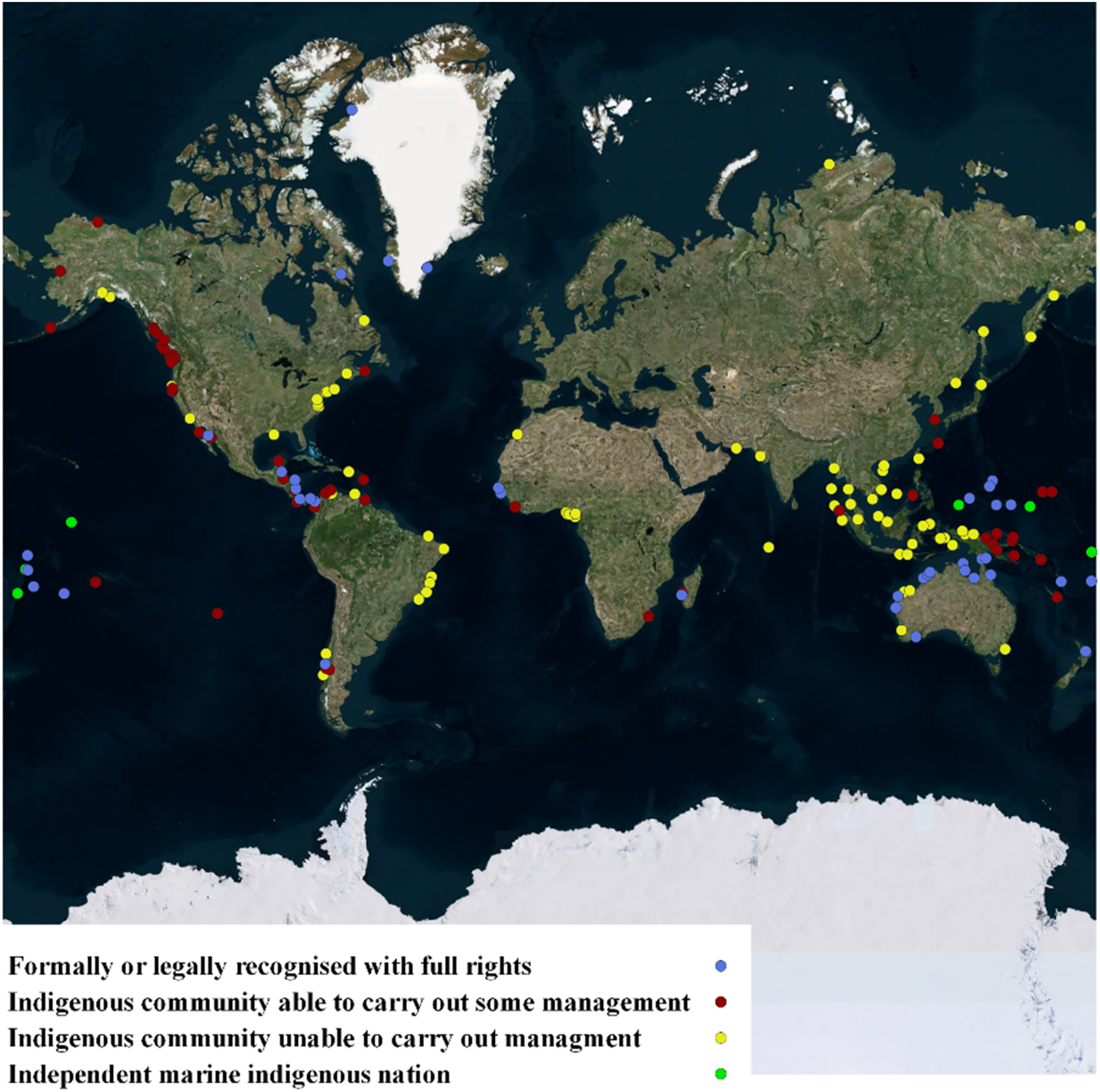
Showing the locations of the 207 marine Indigenous nations reviewed and the four categories of autonomy (generated by the first author).
Results
Indigenous marine legal rights categories on a continuum
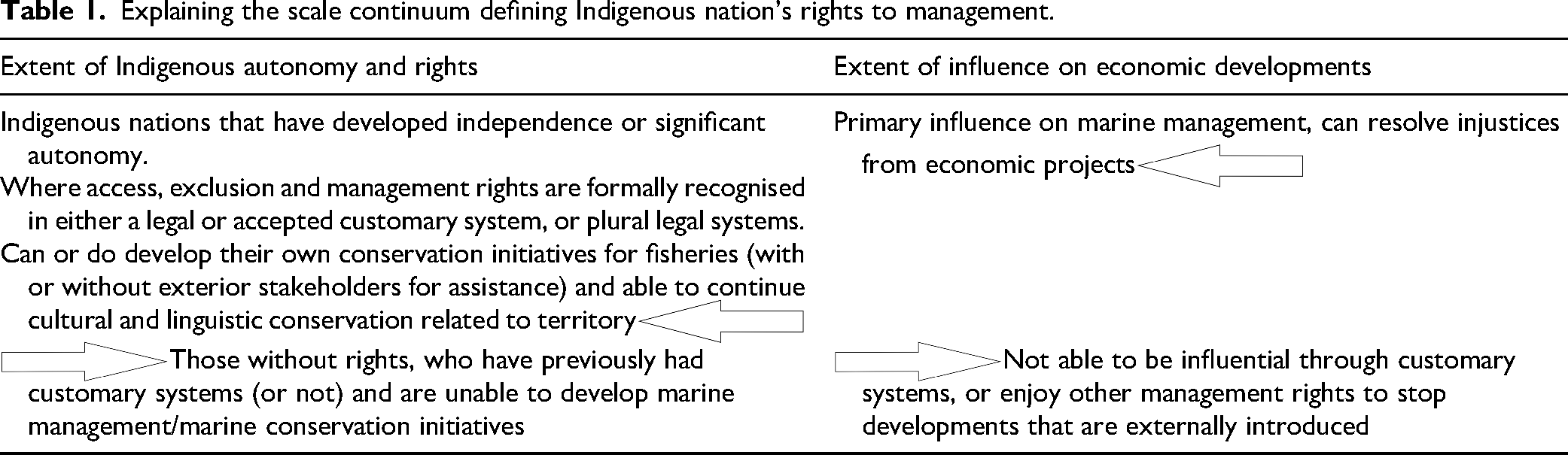
Indigenous marine rights are widely heterogenous, and the original four categories were not enough, so we placed them along a continuum scale. To enhance definition, we introduce the Indigenous marine categories in Table 1 and the paragraphs below, grouped according to different levels of empowerment.
Explaining the scale continuum defining Indigenous nation's rights to management.
Indigenous nations who are the primary influence on marine management
At one end of the scale are indigenous nations that have realised full independence or significant autonomy. Where access, exclusion and management rights are formally recognised in either a legal or accepted customary system, or plural legal systems. They can or do develop their own conservation initiatives (with or without exterior stakeholders for assistance) and are the primary influence on marine management of developments. It is worth emphasising that just because a country becomes decolonised, doesn’t mean the Indigenous nations within becomes decolonised simultaneously. Historically, huge territories were carved out to become unitary settler colonial states such as South Africa, Brazil, or United States, or Nigeria, Cameroon or the Solomons with multiple groups colonised put together, or historic empires such as China, Indonesia or Russia. Thus, independence didn’t mean that the Indigenous groups within were empowered over their marine territories. Decentralised decolonisation can enable all groups to influence development projects. Papua New Guinea is a good example of this, with 800 language groups or the 700–800 of Indonesia, itself based on the former Majapahit empire and its tributaries . Those with primary influence on marine management, often continue a flavour of Indigenous marine territories and associated fisheries customary or governance systems. While MPAs are known to be set up with the objective of preserving biodiversity and endangered habitats and species (Jones, 2014), customary management systems can have these objectives, whilst preserving the rights of Indigenous people, as introduced in Table 1 in the left-hand column. Whilst multi-dimensional, this is a scale that describes the Indigenous autonomy and rights, versus capacity to influence marine management on economic developments, (which originally was scored 1–4), which can be seen in Supplemental Table S2. These were thought by the co-authors to be too contentious to use when scoring the different groups, due to their subjective nature, so we summarised the differences in the review of literature below Table 1.
While they are not universally celebrated and are critiqued as conservation mechanisms by authors such as Polunin (1984: 268), others say Indigenous tenures represent some of the oldest forms of marine management and conservation in the world (Johannes, 1978). These customary systems or traditional tenures characteristics include managing their own resources, carrying out traditional customs, religious rituals, and food security through subsistence and small-scale commercial artisanal fishing (Ban and Frid, 2018). They are described as LMMAs where modern conservation ideas have co-produced hybrid systems, with some having characteristics similar to MPAs (Govan, 2015). Twelve examples from the Pacific where LMMAs are abundant include Fiji, Palau, Nauru, Kiribati, Tuvalu, Tonga, Samoa, Kiribati, and the Marshall Islands (amongst others in Oceania). Also including legally autonomous nations such as the Cook Islands, Bougainville, and Niue. In Niue, a self-governing island territory under the authority of New Zealand, the entire marine domain has been declared a whale sanctuary of 127,000 sq. km, based on customary systems (SPREP, 2017). Others around Oceania include New Zealand´s Māori, with the Maketu Taiāpure system, (Davies et al., 2018; Stephenson et al., 2014). Micronesia has autonomous customary systems in the nations of Pohnpei (Foster and Poggie, 1993), Chuuk, Yap and Kosrae, islands which all have distinct cultures and languages (Houk et al., 2015). The Oceanic identity, as emphasised by Hau’ofa in Our Sea of Islands has been crucial in highlighting the importance of a decentralised marine approach (Hau’ofa, [1994] 2023).
The emergence of LMMAs around Oceania, as well as to a lesser extent in the Indian Ocean, Southeast Asia, Latin America, Western Indian Ocean, and East Africa (Rocliffe et al., 2014), offer a form of conservation led by traditional customary marine tenure. Or, as acknowledged Indigenous management rights, over local coastal areas such as the Fijian traditional fishing grounds, Qoliqoli (Johannes, 2002). The proliferation of LMMAs is particularly found around Oceania, where community-based protected areas make up 51% of protected areas (Van Nimwegen et al., 2022). While many fail, they show the potential of area-based management approaches, in some of the most biodiverse marine areas on the planet, including coral reef ecosystems (Newell et al., 2019; Rocliffe et al., 2014; Samoilys et al., 2017). Despite low government support, LMMAs are the most successful example of Indigenous area-based management. The latest survey has counted 662 examples covering 1028 communities (Govan and Lalavanua, 2022). Typically, these are acknowledged in the national constitutions, including in Vanuatu, but even where there is legal ambiguity over traditional governance, plural legal systems continue (Rohe et al., 2019). The variety of tenure rights and systems lead sustainable use through locally imposed management rules including traditional closed areas (e.g. tabu, ra’ui, rahui, bul, kapu) around Polynesia, or tara bandu in Timor Leste, and other restrictions on fishing gears or access. For example, Brewer et al. (2021) found nearly three times more villages practising marine conservation measures than a contemporary inventory of LMMAs.
Indigenous Nations that have recognised marine territorial rights but are not independent include the Guna Yala people in Panama, who maintain traditional small-scale fisheries rights over their seas. They protect Gallu areas of high biodiversity, including turtle habitats (based on field notes). The Mapuche-Wichille in Chile control marine areas legally but not the coast and land itself and face challenges with aquaculture expansion (Anbleyth-Evans et al., 2020). Others in the Americas include the Seri or Comcaac in Mexico (Luque and Doode 2007), the Miskito in Nicaragua (Nietschmann, 1995), and various groups in Washington State, United States including the Quileute Nation, 2019).
Customary systems have been recognised as Indigenous Protected Areas (IPAs) in Australia. They are defined as Indigenous led, or collaborative efforts to establish MPAs, which are of various managerial foci and effectiveness, and include spatial–temporal refugia (Aswani et al., 2015), and/or strict no take zones (Rist et al., 2019). In Australia, various aboriginal nations have marine territorial rights including the Yolngu, Tiwi, Anindilyakwa, and those of the Torre Strait Islands (Nursery-Bray, 2011; Rist et al., 2019). Contrastingly, while recognised on the map, those in PNG are more disenfranchised by the capital (Cinner et al., 2009).
Outside the Pacific, Arctic Indigenous nations, include Greenland (Sejersen, 2004), and Nunavut (Reed et al., 2020), in Canada are the primary influence on marine management. In Nunavut, the Pikialasorsuaq Commission oversees an MPA of 123,325 sq. mi with traditional harvest rights preserved, through the Tuvaijuittuq co-management system (Bankes, 2020). The Heiltsuk and Haida Gwaii in Canada are increasingly guiding their own development thanks to improved recognition and territorial rights (von der Porten et al., 2019). Around Asia, including in the Philippines the Tagbanwa lead through well-defined customary and marine territorial rights (Capistrano, 2010). These Indigenous nations can or do develop their own conservation initiatives for fisheries, with or without exterior stakeholders for assistance, and are the primary influence on marine management decisions.
How territorial rights and independence interact with marine management
Results from the grey and academic literature review show that those Indigenous nations that have realised independence/autonomy or had recognised territorial rights, were most successful in organising themselves against projects that threaten the possibility of enacting bio-cultural conservation. Except for possible historic mining impacts on Nauru's coral reefs, all 12 independent Pacific nations had some form of conservation built on and expanding traditional customary use. Although in countries such as PNG and the Solomons the empirical evidence is mixed, and many including Fiji and Micronesia have nations still within them that are not independent. Those formally or legally recognised by states as having marine territorial rights, such as the Guna Yala, and those IPAs in Australia and LMMAs around the Pacific, had the next most success in realising marine management. Those which lack formal marine territorial recognition but can carry out management/conservation based on customary systems were the next most successful, as seen in Figure 1 showing the geographical distribution of the categories of autonomy.
We examined how the marine Indigenous nations on the continuum interacted with different development issues, shown in Figures 1 and 2. The most significant cases of ongoing ecological impacts on Indigenous seascapes were added into Supplemental Table S2.
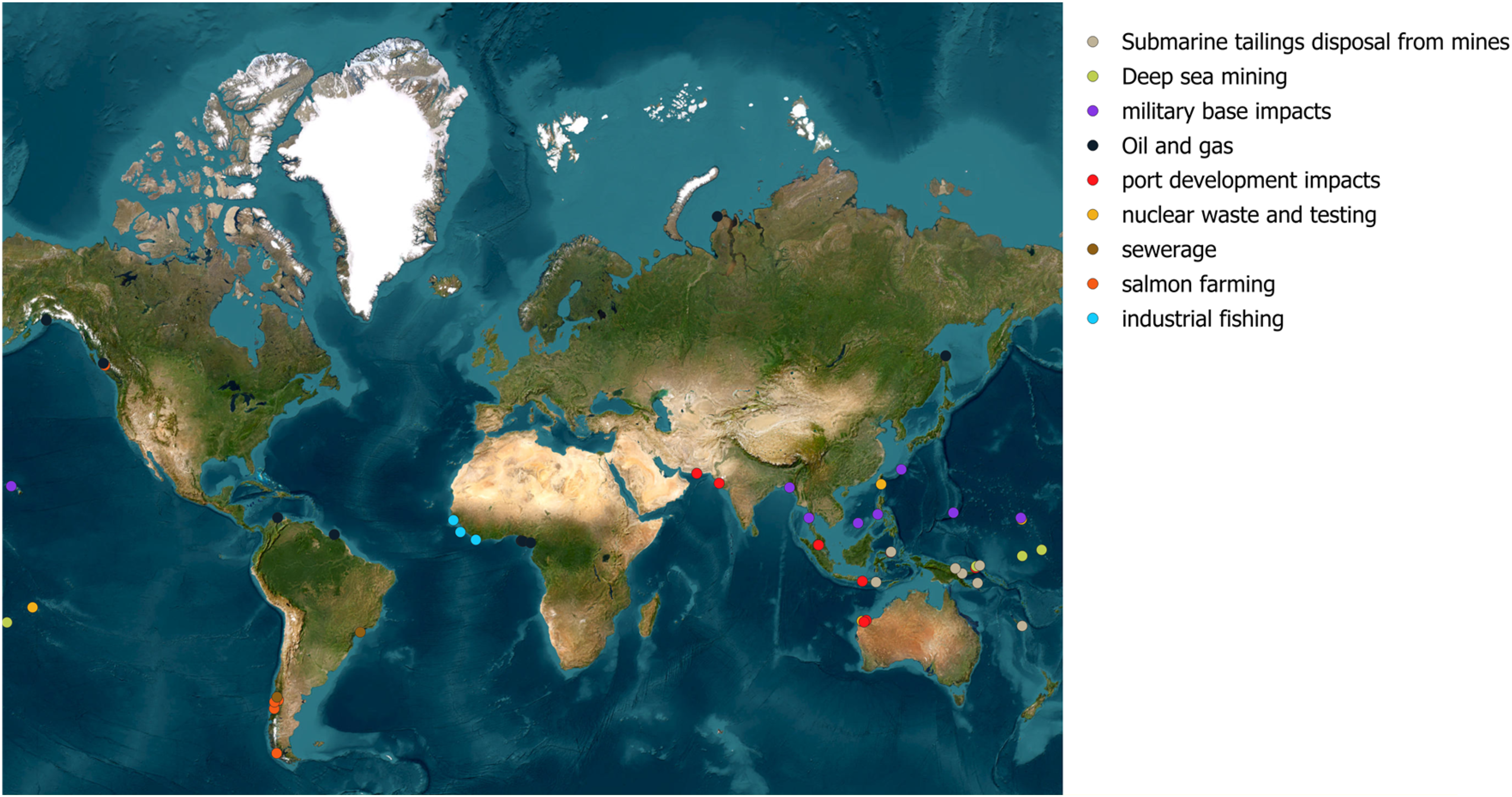
Showing where and what types of development projects issues are occurring, including submarine tailing disposal, deep sea mining projects, new and bigger ports, oil and gas, military, nuclear, sewerage and aquaculture.
Review of blue justice issues and different rights
A review of blue injustice issues follows, and discussion of who and how many they impacted is shown in Figure 2. The blue justice review shows that those communities without rights are less likely to realise their own management decisions when facing a range of impacting projects supported by nation states and corporations (and sometimes with support from Indigenous leaders themselves when they think they will benefit) (Aswani et al., 2020).
These blue justice issues are counted in Figure 3.
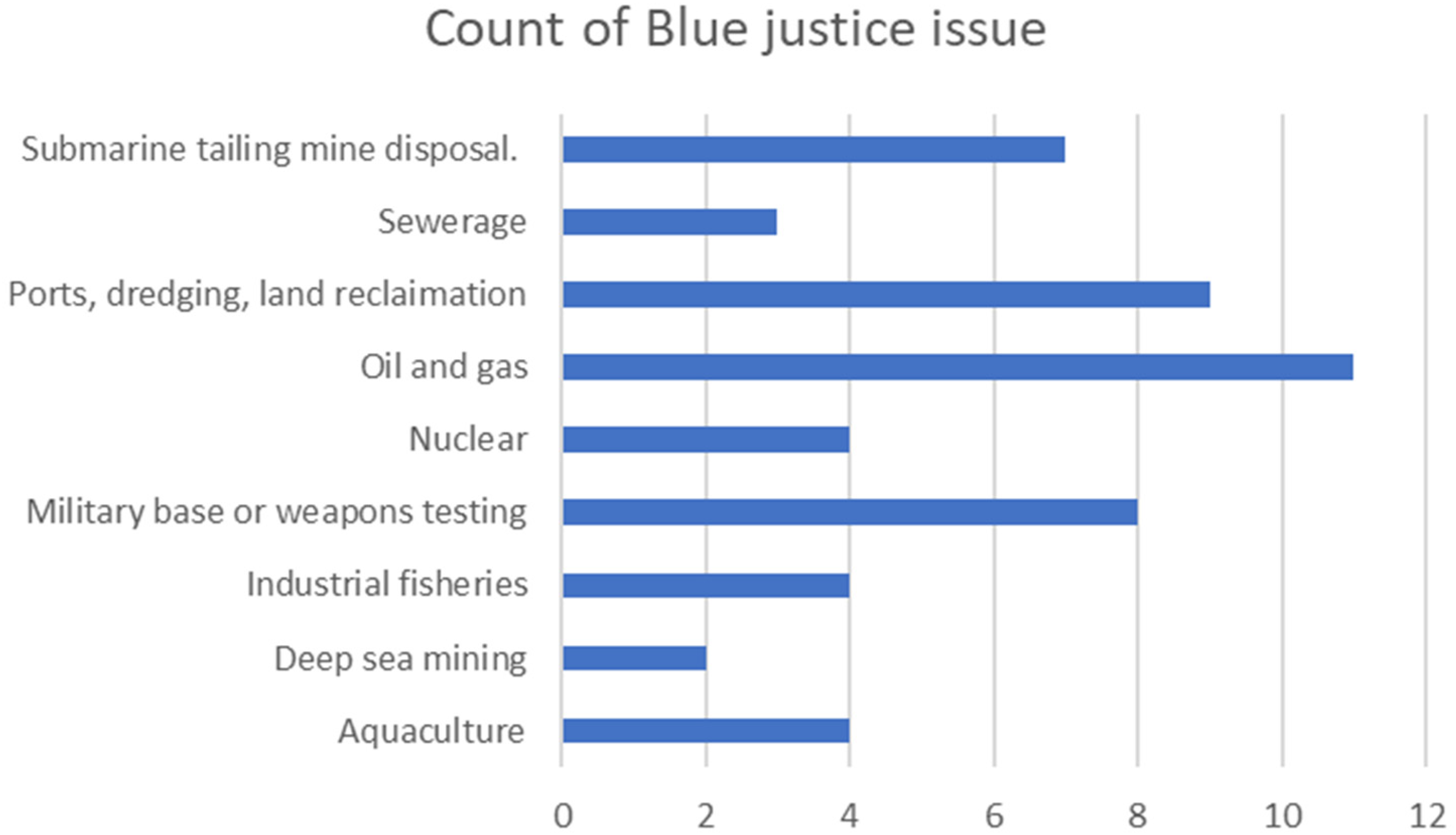
Showing the 53 distilled cases, identified as being experienced in Indigenous marine nation contexts derived from Supplemental Table S2.
Submarine tailing mine disposal
Seven cases of Submarine mine tailing (STD) pollution are ongoing (Coumans, 2018). This typically sees a pipe emit a mixture of chemicals from mine waste or tailings into coastal waters, below the thermocline at depth. While arguments have been developed to show that STD is an environmentally responsible solution, by those in academia connected to industry (including Kwong et al., 2019; Morello et al., 2016), it is banned in the countries where those mining companies are headquartered, such as Canada, United States, and Australia (Coumans et al., 2018). The impacts on marine Indigenous nations have not been described, but this analysis shows there are four projects in PNG impacting the Kala people, in Morobe province, Muyua people in Woodlark Island, the Muyuw people on Lihir island and most controversially the Mindiri people, in Madang province where large impacts were reported last year (RNZ, 2025). There are two in Indonesia, Batu Hijau mine open pit copper–gold mine, where submarine tailing disposal impacts are against the Sumbawa people’s wishes. Similarly, the Minahasa people in Sulawesi (Indonesia) from the Newmont Minahasa mine. Also, in New Caledonia, the Kanak people have been impacted in the south of the island.
Deep seabed mining
Deep seabed mining poses unknown risks in at least six cases. In PNG, environmental concerns related to irreversible damage of the food sources have been raised by Indigenous communities regarding the mining lease granted by the Canadian-registered Nautilus Minerals Inc, Van Putten et al. (2023). Interestingly, the Indigenous peoples made a statement regarding the lack of Free Prior Informed Consent outlined in the UNDRIP (Moreira, 2020: 161). In PNG, the Tigak people, have successfully resisted the project Solwara 1, where preliminary mining and testing activity has occurred supported by other groups in New Ireland (Childs, 2022). The project has been since reignited by Deep Sea Mining Finance Ltd registered in the British Virgin Islands, known for their secrecy. Therefore, greater stakeholder education of the importance of these ecosystems are needed to support the common heritage of humankind (Jaeckel et al., 2017) while authors such as Van Putten et al. (2023) have explored social and stakeholder acceptance in Environment Impact Assessments, this leaves out the decolonial, epistemological and ontological impacts. There are three cases for potential exploitation in Tonga, Nauru, and Kiribati, without projects being clearly concrete. More recently, The Metals Company has successfully applied for two exploration permits for Nauru and Tonga's Clarion Clipperton Zone blocks through the U.S. pathway, which is being opened up by Trump. The existing exploration contracts for these areas under the International Seabed Authority already exist (RNZ, 2025). The Cook Islands seem to be the only marine Indigenous nation likely to see any developments, however there is civil society resistance, in the context of the MPA strategy. Deep seabed mining can potentially impact species in benthic ecosystems in hydrothermal rifts, as well as associated coastal species.
Port development, dredging disposal and land reclamation
In the context of port development, dredging disposal and land reclamation ecological impacts, there are at least eight Indigenous marine communities facing impacts here with insufficient rights. These include the Mah Meri community in Malaysia (Hattam et al., 2020) and Makassar small scale fishers in Sulawesi (Indonesia). The Yaburrara in Dampier, and Kariyarra in Port Hedland, Western Australia, have had their marine environments impacted by port developments supporting iron and other metal mining exportation. The Balinese people have had their conservation programme severely disrupted by overdevelopment of Benoa Bay, through land reclamation and port development against local wishes (Adharani et al., 2020). Similarly, the Kutch people in Gujarat India, and the Baluch's from Gwandar port in Pakistan, have had small scale fisheries and conservation challenges from port developments (Kohli and Menon, 2016).
Oil and gas development
There are at least ten marine Indigenous nations with problems with oil and gas development. The Heiltsuk historically successfully stopped the Enbridge gas pipe going to their coast into the sea, and today are challenging the trans mountain pipeline, in alliance with other coastal First Nations in British Colombia, against Petrochemical exportation. Successfully, the Great Bear Coastal Stewardship initiative has a tanker ban in their waters. However, other nations have been less supportive (Wood and Rossiter, 2017). In Russia, the Nivkh people of Sakhalin Island, have protested industrial fisheries, and other marine contamination impacts from offshore oil. Similarly, the Nenets have rallied against gas infrastructure, which has removed coastal access for reindeers herding, and fishing in the Yamal peninsula (Degteva and Nellemann, 2013). The Eyak conservation society continues to campaign against petrochemical development in their seas in Alaska. In the Niger delta region, the Biafra group including Ogoni, Ebono and Ijaw people among others continue a campaign against Shell's estuarine and marine impacts (Obi, 2010), the same infastructure has now been bought by Nigerian companies headquartered in Abuja. Similarly, the Bubi peoples’ small-scale fisheries continue to be polluted by oil in Equatorial Guinea. Additionally, the Wayuu in Colombia have stopped seismic testing for oil in their sacred marine area, but pressure remains to get leaders to take money for other developments around the coast (Hassler, 2015). Another area of future potential injustice and contestation is the Brazilian government's plan for oil and gas extraction both in the Amazon Rainforest and offshore – including at the mouth of the Amazon River, with block 59 just off the historic territory of the Karipuna, now contained with Parque Nacional de Cabo Orange (Mongabay, 2025).
Military/naval base development impacts
There are at least eight cases, including upon the Chamorro people of Guam, who have experienced who have experienced historic agent purple (a forerunner of the agent orange pesticide) poisoning, which is thought still to have a lingering impact. They claim that a new military base extension from the U.S. Marine Corps, impacts on a sacred marine/land site, at Ritidian point (Frain, 2020), similarly in the Marshall islands. Local fishers and others are to be barred from accessing the area. Similarly, the Indigenous Hawaiian community, continue to raise concerns on marine life impacts on the Johnston Atoll – still poisoned with agent orange, and impacts from weapons testing on marine coastal sites in the Big Island, Pohakuloa Training Area (Lutz, 2019). Additionally, in Okiniwa, Ruyuku people have a similar issue from an American base, and the Spratly islands have recently been colonised by China with unknown effects on reefs from land reclamation (Moreira, 2020).
Nuclear impacts and power stations
There are at least three nuclear impact cases, including the nuclear dump site organised by the Taiwanese government on Pongso No Tao (Orchid) Island. This continues to energise protests, including artisanal fishers from the Tao community. The interruption of traditional ecological wisdom, and the customary fisheries management system is reported (Fan, 2009). The Marshallese people have their fisheries and conservation potential limited, by the ‘Dome’ on Runit Island, where entombed nuclear waste, is leaking radiation into the sea. Alongside this are the historic impacts of nuclear testing on the Bikini atoll and on the Enewetak lagoon also in the Marshall islands (Pevec, 2006). In French Polynesia, historic nuclear testing, and contamination lingers in Fangataufa and Moruroa lagoons, which are part of the Tuamotu Archipelago. They remain inaccessible as a military zone (Keown, 2018). Aboriginal Australians are also thought to have been affected historically by the nuclear testing at the Montebello islands from 1952 to 1956 (Cross, 2004).
Sewerage
At least three cases of this underreported issue are recorded here, but there are likely many more. In the Sao Paulo to Rio De Janeiro area, significant sewerage and urban contamination problems continue to impact Guarani Indigenous nations among other coastal peoples (Cirino et al., 2022; Raupp et al., 2017). Field research indicates that this is also impacting Mapuche-Wichille in Chile, and Mah Meri close to Kula Lumpar Malaysia (Hattam et al., 2020). There is likely to be much more elsewhere, particularly in urbanising areas.
Aquaculture
Four cases including the Mapuche-Wichille people of the Los Lagos region and Kawésqar people of southern Chile, have been particularly impacted by massive salmon farming expansion impacts around the coasts and islands (Anbleyth-Evans et al., 2020). Contamination of the seabed has occurred including by phosphates and nitrates, antibiotics, pesticides, antifoulants and invasive species. Similar challenges have been faced by Pacific coastal first nations due to Atlantic salmon farms in their areas (Heaslip, 2008).
Industrial migratory fishing
In West Africa, there are four cases industrial fishing caused injustices, listed in Supplemental Table S2, although this impacts coastal communities globally. Industrial fishing removes all parts of the food chain, particularly pelagic species, but bottom trawling impacts the benthos (Pauly et al., 2005; Pitcher et al., 2022). The Kru people in Liberia, have developed coastal MPAs, but like the Jola people of Senegal, foreign industrial migratory fishers are overharvesting pelagic fish (Belhabib et al., 2015). This is likely to be also affecting the Bijagos customary systems in the wider area (Madeira, 2016).
High-level pattern identification of Indigenous marine management and rights synthesis
In terms of high-level pattern identification, the results shown in Figure 1 and the annexe Supplemental Table S2 that the 12 independent marine nations could be called type one (as plotted in Figure 4 in green) which sit on one side of the continuum of both achieving marine autonomy and rights, and secondly marine Indigenous management capacity. We argue that the more rights Indigenous nations have the better chance they have at realising marine resource conservation and management. These independent marine nations, where systems of Indigenous management, building on customary systems had been given full international recognition and decolonisation. Indigenous nations that have realised independence were most successful in organising themselves against projects that threaten ecological and cultural conservation. All of these had developed large scale MPAs, being able to deal with issues such as migratory industrial fishing in the Exclusive Economic Zone, however in multi-ethnic decolonised nations where spatial justice is not distributed, local people of different ethnic groups are just as likely to be ignored. For example in Micronesia, the island of Chuuk is voting on independence for this very reason (Baldacchino, 2020). Also, places such as the Solomons see different island ethnicities outside of the capital island, such as Malaita, are marginalised in their attempts to realise economic equality and local governance (Uzonyi, 2023). In some cases, they create new core periphery relations, affording more power to foreign interests in development. For example, PNG, Indonesia, and the Philippines have granted many large mining corporations rights, despite the wishes of local Indigenous groups impacting customary systems, for example in Bougainville island (Coumans, 2018; Van Putten et al., 2023).
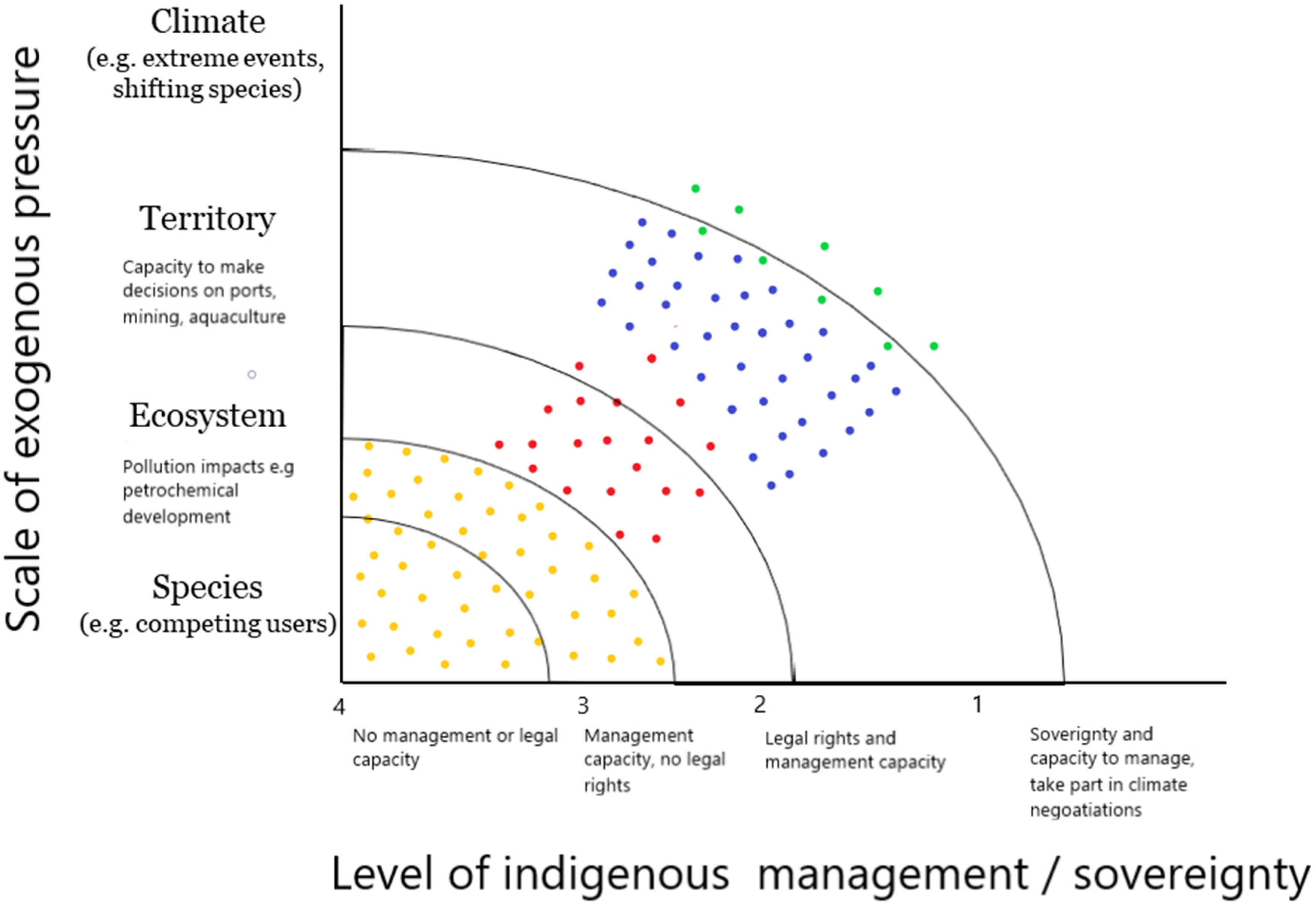
Graph showing the distilled blue justice case studies scatter plotted with scale of ecological exogenous pressure on the X-axis and level of Indigenous sovereignty or capacity for management (1–4) on the Y.
As seen in Figure 4 in blue the second most common were 66 Indigenous nations who have marine territorial rights, where customary systems can be carried out. These can or do develop their own conservation initiatives, for fisheries and other management (with or without exterior stakeholders for assistance) and are leading or involved in some form of participatory MPAs. These are sometimes called LMMAs and IPAs and often build on existing Indigenous customary systems. New ideas to enhance conservation and management, are particularly apparent around the Pacific and Indian Oceans (Govan et al., 2009; Rocliffe et al., 2014). Of those varieties of recognised rights, such as IPAs and LMMAs, 75.3% did not have blue justice issues.
Thirdly, type three emerged in red (plotted in Figure 4) to have at least 32 Indigenous nations, which can or do develop marine management, including conservation interventions for fisheries, such as based on customary systems, but territorial rights for management are not yet fully recognised. These include those that are involved in MPAs in some form in the planning, thus supporting future rights, such as new treaties in Canada, or the MPA in Chile which includes the traditional authorities in Rapa Nui.
Fourthly, plotted in yellow in Figure 4, we identified 92 cases, which previously had customary systems but are unable to develop marine management initiatives. As can be seen in Figure 4, this is compared to the scale of ecological, exogenous pressure, from species level through to the ecosystem, territorial, and global climate level scales, which were chosen as being from the local to global. Where given full recognition and rights, marine Indigenous groups can be better represented at international levels, such as with climate change discussions, such as Tuvalu recently coming to global fame in terms of their challenges with rising sea levels.
The countries with the most injustices were (1) Indonesia, (2) Russia, (3) Brazil, (4) PNG, (5) Nigeria, (6) United States, (7) Colombia, (8) Canada, (9) China, and (10) Australia. Some of these countries are under dictatorship, and the evidence is less clear being in non-Latin languages. The countries with the most amount of marine Indigenous nations were (1) Australia, (2) PNG, (3) Indonesia, (4) Canada, and (5) Brazil.
Discussion and recommendations
Given the diversity of the impacts discussed, achieving decentralised management rights is needed as the first step towards decolonisation. This can allow communities decision making power in management decisions where they are currently marginalised. Where different government advisors traditionally give water quality, migratory species, habitats and sessile species, navigation, historic and cultural heritage advice to central government for an EIA/SIA to make decisions, instead they can send this information to the new Indigenous marine management organisation. Where there are no territorial or decision-making rights over projects, whether an industrial scale aquaculture development or a port, there is little the Indigenous group can do about it. For example, where there are no legal rights in Australiás sea country IPAs, a project can still be imposed (Gould et al., 2021). While there is openness to change to allow for more Indigenous controlled marine management in many places, authors note that the impact assessment context ‘cannot be dissected into environmental, social or cultural’ (Jolly and Thompson-Fawcett, 2021: 106). Many Indigenous worldviews continue seamless interconnections of a multitude of domains. So, carving out an Indigenous space in impact assessment rather than being ‘eternally grafted to generic EIA or SIA menus as just another (albeit worthy) agenda item’ is critical (Matunga, 2018: 22). Formalised Indigenous marine management can build on local customary and/or legal regimes, based on historic culture, worldviews, and language (Temper, 2019). In contrast to central or federal government led marine governance, Indigenous marine management organisations can support their own biocultural conservation (Maffi, 2005; Warren, 1996). Nevertheless, we acknowledge that this marine management empowerment does not automatically mean the Indigenous communities will not try to enrich themselves and their communities with new projects as they become independent and integrated into the capitalist system. Thus, we recommend that beginning with cultural seascapes (Shackaroff et al., 2009) we recommend mechanisms that support the reproduction of constructed and natural heritage, ocean artistic inspiration, coastal animist religion, festivals, traditions, sport, can build upon traditional tenures or reimagined cultural sea plan areas. For example, supporting rituals that support ecological conservation, and including the wider community in cultural veneration of places, for example sacred islands and reefs (Anbleyth-Evans et al., 2023).
In terms of use of language in management, ecology, fisheries, and conservation, can feed back into education systems, if conservation laws are written in Indigenous languages, vocabularies can be refreshed and updated to safeguard ecosystem health and targeted restoration, thus bio-cultural conservation. There is a positive feedback loop between restoring cultural elements, nature worshipping rituals, language, and motivation to restore ecosystems. At the same time, supporting training of local fishers, coastal champions and scientists in their own language can reinvigorate both culture and stewardship. To boot, defined blue health areas signed in Indigenous languages can ensure safe spaces for aquatic recreation and improved physical and mental wellbeing.
Empowered coastal communities need multiple frameworks of evidence, such as combining traditional ecological knowledge and scientific research, where equal power relations are present to further their agenda of marine sustainability (Tengo et al., 2017). Supporting bi-directional feedback, such as the sharing knowledge of biodiversity and culture, between Indigenous fishers and conservation scientists, NGOs, Indigenous nations, and states, can ensure progressive institutional evolution (Anbleyth-Evans and Lacy, 2019).
Marine economic planning includes objectives for healthy social-ecological systems so all plans and projects can be evaluated according to ecological health targets, culture, and community need, preserving traditional livelihoods. This can ensure that planning and decisions for the large projects not rammed through. Marine democracy means decision sovereignty flowing from the local scale, responsive to community voices rather than a remote capital. If decision sovereignty is situated in the community, this limits economic clusters such as ports, aquaculture or mining having an outsized influence. This would be true even as the Indigenous nation is decolonised, and a new centre of administration is created, potentially outside of the community vicinity.
These marine management tenets cannot neglect the landward side, as all Indigenous nations view the sea and land as connected, and the ecological continuum at the coastal nexus. Thus, land territorial rights connected to marine rights can make realising the bio-cultural conservation more realistic. As their institutions develop, they can invite other stakeholders, such as the colonial government to participate at their own marine planning round tables ensuring a peaceful and deliberative transition.
Conclusion
This article showed that the majority of marine Indigenous nations without marine management rights experience injustices, including from port developments, petrochemical projects, submarine tailing disposal impacts from mining, deep sea mining, military, nuclear, industrial migratory overfishing, aquaculture contamination and sewerage disturbance. On the other end of the continuum, those where territorial, access, exclusion, and management rights are formally recognised in either a legal, plural, or accepted customary system, experienced the least issues. Nevertheless, without an explicit bio-cultural conservation strategy, they can easily reproduce the same issues. Marine Indigenous customary systems need support politically, legally, and conceptually, to conserve the marine environment. Without marine territorial rights being recognised, states and corporations will continue to delegitimise these customary systems under the narrative of economic growth and colonial national development. To move forward with this theme, declarations such as UNDRIP can be updated to include marine territorial rights and marine management. While Indigenous conservation and management is not always successful, and often Indigenous conservation projects are driven by territorial claims rather than for preserving biodiversity, marine Indigenous decolonisation, given adequate support may offer the best response to democratising the challenges of the marine Anthropocene.
Supplemental Material
sj-ods-1-hug-10.1177_19427786251409773 - Supplemental material for Indigenous marine resource management, decolonisation and development
Supplemental material, sj-ods-1-hug-10.1177_19427786251409773 for Indigenous marine resource management, decolonisation and development by Jeremy Anbleyth-Evans, Shankar Aswani and Felipe Kern Moreira in Human Geography
Footnotes

Ethical consideration
The author(s) declared that ethical approval was not necessary for this study.
Funding
The authors received no financial support for the research, authorship, and/or publication of this article.
Declaration of conflicting interests
The authors declared no potential conflicts of interest with respect to the research, authorship, and/or publication of this article.
Supplemental material
Supplemental material for this article is available online.