



Abstract
This paper examines the silence of critical and radical geographers during the Trump administration's 2025 federal occupations of Los Angeles and Washington, D.C., Despite decades of theoretical development around urban sovereignty and spatial resistance, scholars remained largely absent from public discourse during unprecedented military interventions. Analysis of academic responses reveals California universities dominated engagement while Northeastern institutions stayed silent, and legal scholars far outnumbered geographers in commentary. Google search data demonstrates immigration enforcement commanded minimal public attention despite record operations, averaging just 2.6% of national searches while competing issues maintained sharp advantages. This reflects broader academic marginalization of immigrant movements, where immigration activism ranks seventh in citations despite sustained effectiveness. We argue structural path dependencies, rather than moral failings, explain this disciplinary withdrawal. The paper calls for immediate deployment of critical geographic tools including counter-mapping federal occupation patterns and spatial analysis for community defense networks.
For critical and radical intellectuals in spatial fields like geography, the Trump administration's military assault on U.S. cities should be a Rubicon moment. Instead, silence has replaced radical voices in public discourse. This silence, in contrast to active engagement that elevates voice, stands in opposition to traditional commitments to utilizing theory as a practical and transformative tool to advance social justice, political recognition, and human emancipation.
In June 2025, the federal government launched an offensive against Los Angeles's working-class immigrant communities, followed two months later by an assault on Washington, D.C. Based on the administration's statements, more federal incursions were expected to target major hubs of urban resistance governed by progressive municipal governments, starting with Chicago. Trump announced, “If we need to, we're going to do the same thing in Chicago, which is a disaster. We have a man there who's totally incompetent. He's an incompetent man … And we have an incompetent governor there. Pritzker is an incompetent” (Trump, in Baichwal et al., 2025).
The governor of Illinois correctly noted that this effort to neutralize institutional spaces within the state where rivals could mount resistance to central state authorities was a strategy drawn directly from the Nazi playbook in its power consolidation efforts of 1933. “I talked about the fact that the Nazis in Germany in the ‘30s tore down a constitutional republic in just 53 days. It does not take much, frankly, and we have a president who seems hell-bent on doing just that” (Pritzker, in Kapos, 2025).
Since January 2025, the Trump administration has suppressed potential resistance hubs within the “integral state” (Gramsci, 1971): federal agencies, Congress, the judiciary, higher education, media, and civil society. With these counterpower hubs mostly neutralized through purges, legal manipulation, and institutional capture, left-leaning cities governed by coalitions with democratic socialists remain the last barrier to complete state domination. The sequence is deliberate: neutralize subnational institutions first, then turn the full weight of centralized power against the remaining sites of resistance.
Large cities present a potent threat. Urban voters reward resistance to the Trump administration and punish collaboration. City governments possess large revenue bases, vast institutional capabilities, and concentrated political power extending over state governments and congressional delegations. Most of these cities house majority-minority populations with electorates positioned from center-left to the democratic socialist left. Most critically, cities retain legal authority over the local “monopoly of the legitimate use of physical force,” and have built autonomous, militarized policing apparatuses over three decades. By neutralizing sub-national policing, the federal administration eliminates local capacity to resist the elimination of the liberal state.
This sustained assault on urban governance represents the most serious threat to progressive urbanism in modern American history. Dismantling local sovereignty through federalized policing and terrorization of working-class communities is designed to transform municipal resistance into submission through spectacular displays of federal force.
Despite the threat, critical and radical intellectuals based out of North American universities have offered minimal public criticism. Critical urban geographers spent decades developing the concepts that this moment demands: “right to the city” and “state spaces” for analyzing urban sovereignty, “accumulation by dispossession” for explaining state-enabled extraction, “revanchist urbanism” for contextualizing authoritarian spatial restoration. Beyond theory, we possess powerful methodological tools: counter-mapping to expose occupation patterns, community-engaged research to document resistance, participatory data collection to track raids and disappearances, and GIS analysis to visualize geographies of repression.
But these frameworks remain trapped in theoretical texts and academic conferences, far from the streets where they're needed. We understand how territory shapes power, how communities transform space into resistance, how cities become vessels for emancipatory politics, but too many of us remain silent, retreating into theoretical abstraction while the crisis unfolds. This is not a moment for retreat into speculative insularity. The moment demands deploying whatever intellectual weapons we possess in service of those defending the right to have rights to the city.
This paper makes two basic claims. First, scholarly silence is real and pervasive: systematic searches of media outlets, institutional statements, and social media show only a handful of academics spoke publicly about the raids, with radical and critical geographers in North America virtually absent from public discourse. The few who spoke were concentrated in California institutions, with Northeastern elite universities maintaining near-complete silence. Second, we explain this silence through “attentional economies” that devalue immigration topics, rendering undocumented immigrants (the most violently dispossessed population in the United States) invisible to both the public and critical intellectuals. We focus not on individual moral failings but on academic attention economies that structurally produce silence by devaluing immigrant struggles within competitive markets for scholarly recognition, creating path dependencies that preclude rapid response.
The assault on cities and the war on immigrants are two faces of one authoritarian project. To ignore one is to misunderstand both. As radical geographers, we cannot oppose fascism while remaining silent as its primary targets (immigrant communities and the cities defending them) face military dispossession. Silence represents a disruption of historical commitments to justice, socialism, and radical democratic practice, surrendering the urban terrain to advancing forces of MAGA fascism.
Our analysis of voice and silence unfolds in four parts. First, we document the federal invasion of Los Angeles and Washington, D.C., illustrating the scale and significance of the attack during the summer of 2025. Second, we assess general scholarly interventions in the public sphere during summer of 2025. Presenting findings from media, social media, and website searches, we capture sharp disciplinary and regional variations in the expression of academic voice. We find the near complete silence of scholars from the spatial sciences, let alone critical and radical geographers. Third, we zoom out from the summer of 2025 and Los Angeles to evaluate public attention of immigration. The section shows how immigration commands minimal sustained public focus despite swings in political urgency. We suggest the silence of critical and radical geographers during the summer of 2025 is symptomatic of a general “attention economy” that attributes low value to the broad subject of immigration.
Finally, we examine the attention attributed to immigration in a prominent academic subfield (social movement studies) and the disciplinary field of human geography. Attention allocated to the subject is low, suggesting that the “attention economy” of both fields allocates insufficient value to justify comparatively high, sustained focus on issues associated with immigration. Academic fields like human geography function as structured symbolic markets that valorize a vast range of topics differentially (Bourdieu, 1988). It follows: positioning in the academic field, not moral gumption and courage, largely determines academics’ calculations over voice and silence. Stated formally, the structural logic of the academic field determines motive (affective obligations to immigrant research subjects, peer expectations for action to be taken), means (expert knowledge facilitates production of critical speech, scholarly prestige enhances demand for and consumption of speech), and opportunities (networks to media and elected officials improves access to public sphere, rank and notoriety provides greater protections and offset risks of retribution) for articulating a public voice.
Academics who expressed a critical voice during the summer of 2025 were far more likely to be positioned in scholarly fields that properly valorized the study of immigrants. Fields like sociology and law have long valorized immigration research subjects and, consequently, produced large numbers of intellectuals with motive, means, and opportunity to speak. In contrast, critical and radical geographers are positioned within a disciplinary field that devalorizes immigration as a research topic. In stark contrast to sociology and law, such a field produces fewer critical and radical geographers with strong motive, means, and opportunities to speak.
Invading cities: The enemy is upon us
Los Angeles experienced a severe assault of federal violence directed at immigrant communities that constitute a near majority of the population. In June 2025, federal authorities launched an unprecedented military occupation. In addition to directing large numbers of immigration enforcement agents to the city, the government deployed 4700 military troops to crush the city and its working-class immigrant communities. This repression was not a simple law enforcement exercise, but a spectacle of state violence intended to dispossess marginalized communities and stifle all resistance. The occupation targeted the neighborhoods where immigrant life concentrates most densely, transforming everyday urban space into militarized territory under federal control.
However, instead of demobilizing the population as the administration predicted, this severe repression produced the opposite effect: sustained resistance that evolved from reactive defense to proactive territorial control and repossession. The resistance grew exponentially, from an initial 200 protesters in the first several days to a peak of thousands by the end of the week. Dense, interconnected Latino neighborhoods served as defensive clusters, with activists leveraging social networks and geographic concentration to their advantage, transforming spaces of vulnerability into sites of organized resistance. Community members established communication networks, coordinated rapid response forces, and created infrastructure for mutual aid. The Trump administration's military geography precipitated a geography of collective defense.
The federal response was brutal: over 851 protesters were arrested while many others were beaten and temporarily detained by occupying forces. Marines accompanied ICE agents on deportation raids while National Guard troops occupied beloved landmarks like MacArthur Park, transforming public gathering spaces into zones of federal domination. What began as a local battle over immigration enforcement escalated into a broader conflict over territorial sovereignty, democratic governance, and the right to have rights to one's own city. In the face of unprecedented repression, impoverished communities remained stubbornly committed to resisting, building robust fortifications to defend their right to the city. The resistance revealed not only courage, but sophisticated spatial strategies forged through decades of organizing against dispossession.
Los Angeles serves as a case of stupefying defiance against state-led, ethnonational dispossession. But it also reveals that the federal government can and will use whatever force necessary to suppress urban dissent. There is no need to manufacture consent among Californians since they play no part in the MAGA electoral coalition. Consent is not a check on the use of coercive force; rather, the opposite logic holds: deploying coercive tools against Los Angeles magnifies the administration's legitimacy and consent among its demographic base, enabling the fascist coalition to squeak by with electoral victories. Brutalizing California cities is not a contingency of MAGA rule but a core feature of its governing strategy. Red state voters reward the spectacle of blue state subjugation, transforming state violence against urban populations into electoral capital that fuels ever more tyrannical authoritarian rule. The violence is simultaneously performative and instrumental, terrorizing targeted populations while energizing the electoral base that demands such spectacles.
This Los Angeles campaign serves as a grim template for the federal takeover of Washington, D.C. in August 2025 and Chicago in September 2025. After declaring “Liberation Day in D.C.,” the Trump administration announced a federal takeover of the Washington D.C. police force, deploying 800 National Guard troops and 500 federal law enforcement agents to the streets. The pretext was an alleged carjacking and a misleading characterization of the city as a “crime-infested wasteland,” a description that ignored data showing significant declines in violent crime. The rollout of this crackdown served as a media spectacle heavily promoted by right-wing media figures who amplified narratives of urban chaos to justify federal violence. At the same time, Trump and his allies vowed to crack down on “young punks,” with the Secretary of Defense directing troops to quash the resistance.
The D.C. crackdown was part of a calculated strategy that began with Los Angeles to test the legal limits of presidential authority and normalize the deployment of federal military power against American cities. Each occupation builds precedent for the next, establishing new thresholds of acceptable federal violence against municipal sovereignty. Los Angeles established the template, Washington D.C. confirmed federal supremacy over the capital, Chicago extended the pattern to the Midwest, and the remaining cities governed by Left coalitions now await their turn, knowing that legal challenges have proven futile and public attention fleeting. The administration has learned that spectacular violence against cities produces no sustained political costs, emboldening further escalation.
Data searches
A note on positionality and the object of analysis
We write from within the disciplinary traditions we critique. Both authors maintain strong commitments to critical and radical geography and urban studies. These fields have shaped our intellectual formation and have contributed to our theories, methods, and normative priorities throughout our careers. As scholars committed to the idea that strong criticism is a precondition for radical egalitarian change, change requires that all relations of power be critically scrutinized, especially those relations of power that structure and regulate our own academic fields.
Our object of critical analysis is therefore not the moral character of individual scholars. Finger wagging—moralizing directed at individuals is not critical theory. Our colleagues are not reprobates or saints. They, like us, are regular human beings whose subjectivities are shaped by the structural forces underpinning their primary academic fields. In this way, our critical theoretical tools are directed at the academic fields that either elevate or silence attention to the repression of undocumented immigrants.
Academic fields have different normative, disciplinary, and procedural mechanisms that valorize scholarly attention unevenly. These can include citation metrics, journal hierarchies, funding priorities, and professional incentives that attribute higher value to certain topics while withdrawing value from others. Just as state and capital work to deny undocumented immigrants their rightful place in the republic, our disciplinary field participates in determining whose dispossession merits analysis and whose can be overlooked.
A note on data
Our analysis employs a three-pronged methodological approach. First, we identify which scholars and institutions engaged in public discourse about the immigration raids, mapping the geographic and disciplinary distribution of academic voice through searches of media outlets, institutional statements, and social media. Second, we measure public attention patterns through Google Trends analysis, revealing how immigration enforcement competes for scarce public focus against other political issues. Third, we assess the historical marginalization of immigration within academic scholarship through citation analysis across social movement studies and critical geography, demonstrating structural patterns of disciplinary devaluation that explain contemporary silence. This methodology moves beyond anecdotal observations to reveal the incentive structures shaping how critical and radical intellectuals allocate political voice.
We use “radical geography” and “critical geography” to refer to overlapping but distinct intellectual traditions. Radical geography, rooted in Marxist and anarchist thought, explicitly challenges capitalist social relations and seeks revolutionary transformation (Harvey, 2003; Lefebvre, 1968; Smith, 1996). Critical geography encompasses broader progressive scholarship interrogating power, inequality, and justice without necessarily advocating revolutionary change. We address both because they share theoretical tools (right to the city, accumulation by dispossession, revanchist urbanism, and state spaces) most needed now and common commitments to using theory as a weapon in racial-class struggle.
Identifying academic voice: Who spoke and who remained silent
To identify academic scholars who made public statements about ICE raids and immigration enforcement between 1 May and 13 August 2025, we employed a comprehensive search strategy across multiple platforms. Our primary approach involved searching news outlet archives (New York Times, Washington Post, LA Times, and Education Week) using keyword combinations of “ICE,” “immigration raids,” “deportation,” and “Los Angeles” paired with academic titles and institutional affiliations. We supplemented these searches by examining university websites and faculty pages, particularly law schools, sociology departments, and education policy programs where immigration expertise concentrates. Professional association websites and press releases were reviewed for institutional statements, and all potential statements were cross-referenced across sources to verify authenticity and publication date. Only verified public statements published in media outlets, official institutional websites, or formal testimony were included.
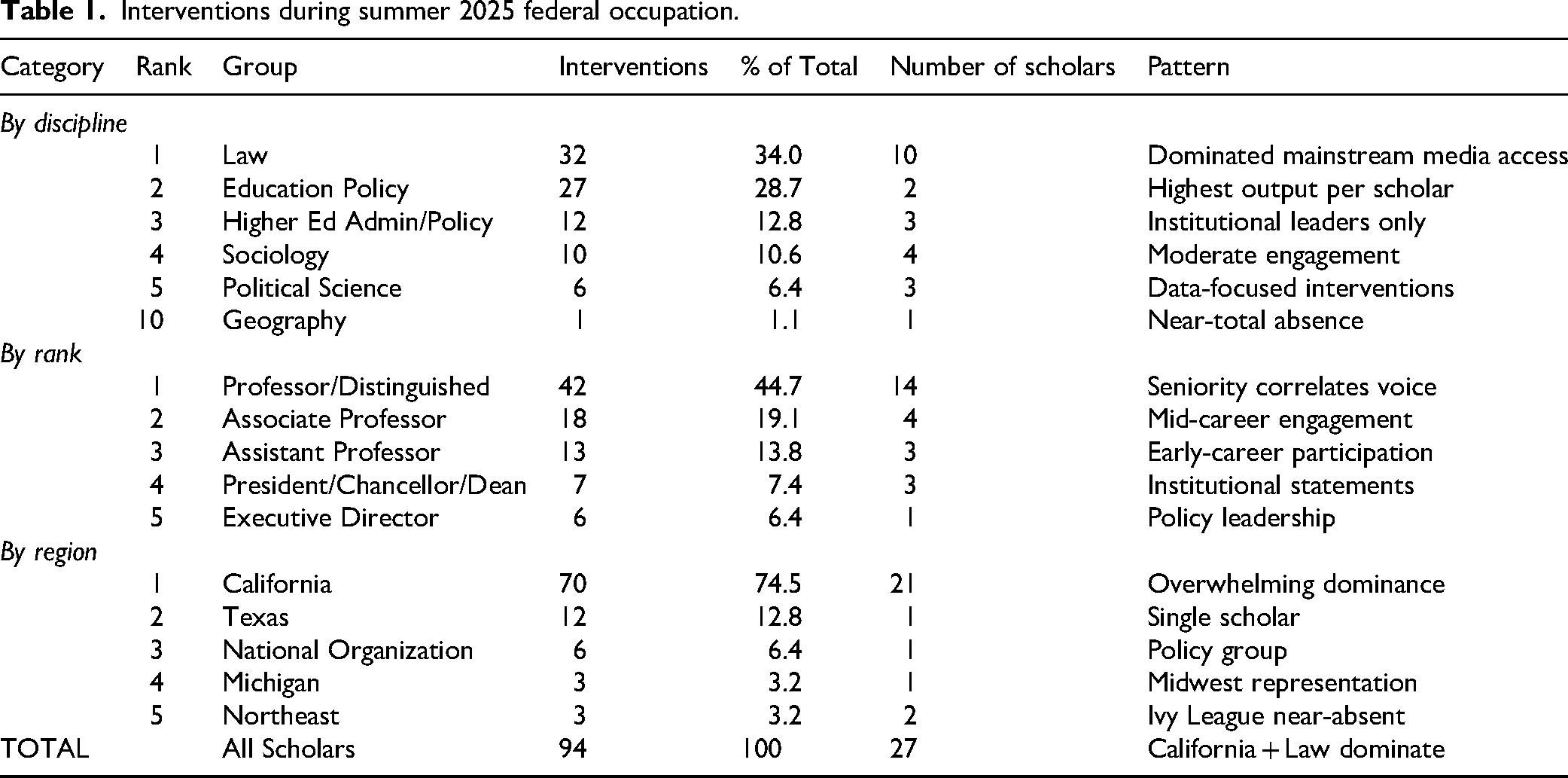
The resulting data was categorized across multiple dimensions: institutional affiliation and geographic region; disciplinary classification based on departmental affiliation and training; volume of statements per scholar; academic rank; and outlet types to understand differential platform access. Stark patterns emerged: 81% of responses originated from California institutions, 44% came from legal scholars, and notably absent were voices from Ivy League institutions and the discipline of geography, with only one geographer appearing in our comprehensive search.
To assess engagement of critical and radical geographers in alternative media and social media, we identified 50 prominent scholars based on citation counts from 2000 to 2025, ranging from David Harvey's 390,000 citations to approximately 5000 for those at the lower end. These scholars were classified into thematic subfields: Marxist/critical urban theory (n = 9), political ecology (n = 12), feminist geography (n = 8), Black geographies/abolition geography (n = 5), critical GIS/digital geographies (n = 5), labor/economic geography (n = 4), migration/borders (n = 3), and environmental justice (n = 4). We searched for their public engagement across mainstream media, left-leaning publications (Jacobin, CounterPunch, The Nation, Dissent Magazine, The American Prospect, and Verso Blog), and social media platforms that enable circumvention of traditional gatekeeping.
Our Instagram analysis manually collected 1630 posts from 566 accounts using hashtags #ICEraids, #LosAngeles, #NoRaids, #AbolishICE, and #SanctuaryCity during June-September 2025, identifying academic accounts through systematic review of descriptions, usernames, and profile information. Due to restrictions on X platform (formerly Twitter) data, we lacked resources to overcome these barriers during our research.
Fickle and fleeting public attention
The final measures assess our core explanation for the paucity of discursive interventions. We argue that both public and academic spheres function as attention economies assigning differential value to topics and modes of discourse. These overlapping markets create powerful incentive structures: when public salience aligns with academic valorization, scholars invest intellectual labor where returns are the highest (citations, prestige, and career advancement within brutally competitive disciplinary hierarchies). Conversely, topics lacking currency in either sphere, like immigration enforcement, become structurally invisible despite political urgency. Academic intellectuals, even those committed to radical praxis, adopt these market signals and allocate finite scholarly attention accordingly, producing silence not through moral failure but through disciplinary logic of academic markets.
To assess public attention toward immigration enforcement and understand the attention economy within which academics operate, we analyzed Google Trends API data from 13 May to 13 August 2025. The primary dataset consisted of daily search volume indices (scaled 0–100) for five core immigration-related terms: “ICE,” “Immigration,” “Los Angeles,” “Deportation,” and “cities,” with additional tracking of compound terms like “ice raids.”
Our analysis calculated peak values and period averages for each term, revealing ephemeral public engagement. Geographic stratification analysis across metropolitan areas and seven regional clusters revealed profound spatial disparities. Comparative issue analysis measured immigration enforcement against competing political topics across the same period, finding immigration-related searches far outmatched by other issues. Immigration enforcement generates enormous attention for those on the political right who use the topic as a constitutive feature of political identity and ideological “litmus test.” Outside hardcore anti-immigrant constituents, the general public attributes the topic little value. The asymmetric value in the attention economy therefore assigns the topic enormous worth for the political right and minimal worth for most others.
De-valuing immigration in social movement studies and human geography
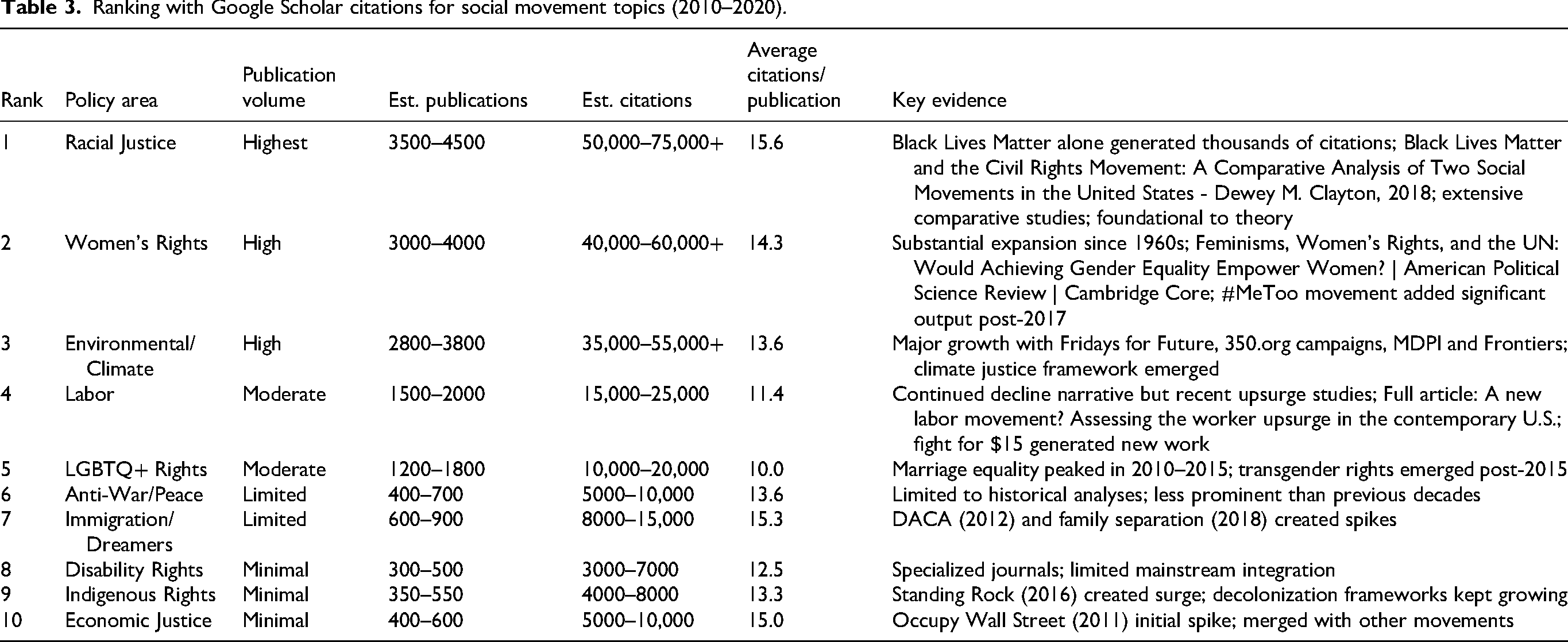
To understand whether contemporary silence reflects deeper structural patterns within academic fields, we conducted comprehensive citation analyses examining how immigration politics has been historically valued within social movement studies and critical geography. Using Google Scholar data from 2010–2020, we ranked social movements by publication volume and citation counts, revealing that despite the immigrant rights movement's sustained durability, multi-jurisdictional coordination, and concrete policy victories (from DACA to sanctuary policies), it ranked seventh among movements studied, dramatically overshadowed by racial justice movements (50,000–75,000 citations) and women's rights (40,000–60,000 citations). Immigration activism functions as a scholarly ghetto: intensely studied by specialists but systematically ignored by broader social movement theorists, creating parallel literatures that rarely intersect despite examining identical phenomena of collective action and rights claims.
Within geography specifically, we analyzed the 40 most cited articles from Progress in Human Geography (2020–2023), categorizing them by thematic area and calculating aggregate citations. Migration/mobility comprised less than 5% of highly cited work, while social theory, political ecology, and urban studies dominated the discipline's attention economy. We supplemented this by examining citation patterns across critical geography's subfields, aggregating total citations for six major thematic areas and identifying top contributing universities, then estimating the proportion of immigration-related content through keyword analysis. The results consistently demonstrated that immigration remains marginalized within the very disciplines theoretically equipped to analyze federal urban occupation, revealing how structural devaluation in academic attention economies shapes contemporary scholarly silence.
Our methodology cannot capture all forms of academic engagement, inevitably missing classroom activism, behind-the-scenes community organizing, or statements in venues our searches did not cover. Nevertheless, it provides evidence of broad patterns in public academic discourse during a critical moment of federal urban occupation. While measuring only public statements and mainstream/left media appearances may understate total academic engagement, the patterns revealed are sufficiently pronounced to support the core argument about structural forces producing scholarly silence when immigrant communities face unprecedented state violence.
Assessing the uneven voice of critical academics in the summer of 2025
This section examines the academic response to the federal occupation of Los Angeles through analysis of public statements made between May and August 2025. By mapping which scholars spoke out, from which institutions, and within which disciplines, we reveal patterns of geographic concentration and disciplinary narrowness, showing how academic engagement fragments along regional and professional boundaries, leaving the federal assault on cities largely unchallenged by those equipped to analyze its political geographic dimensions.
Our analysis of mainstream media outlets (New York Times, Washington Post, and Education Week) measures public intellectual reach and reveals structural inequalities: primarily law professors at elite institutions gained access while radical geographers remained excluded. When critical geographic analysis cannot penetrate mainstream discourse during urban occupation, this invisibility has political consequences. However, analyzing only mainstream venues would distort the picture, so we also searched left-leaning outlets (e.g., Jacobin, CounterPunch, and Spectre) and social media where critical discourse circulates more freely. The question is not whether every scholar should write for the Times, but whether the discipline collectively deployed its analytical capacity through any available platform to contest federal occupation.
Uneven voices of intellectuals: Who is speaking out
We searched for scholars who made public statements about the Summer 2025 federal occupations. This admittedly imperfect indicator reveals the limited level of academic engagement with state violence. Among the 27 academics and 95 interventions identified as contesting the Trump administration's immigration policies, the lack of unified response is as significant as the sporadic voices of protest.
Legal scholars dominated with 32 interventions across 10 scholars, representing 34% of total academic engagement. This concentration reflects both the disciplinary field's historical valorization of immigration as a research subject and the strong institutional positioning of law schools that provide superior access to media platforms. Law professors like Emily Ryo (8 statements), Kevin Johnson (4), David Hausman (4), and Ahilan Arulanantham (4) possessed not only expertise in immigration enforcement but also the professional networks and institutional prestige necessary to secure op-ed placements, expert testimony slots, and media interviews.
Three other disciplinary fields make up the lion's share of remaining contributions. First, education policy scholars produced 27 interventions, but these were concentrated in two individuals: Thomas S. Dee (15 statements) and Jacob J. Kirksey (12 statements). This lopsided concentration of interventions makes these cases somewhat anomalous. Second, sociology contributed 10 interventions across four scholars, reflecting the field's moderate yet consistent engagement with immigration politics. Distinguished scholars like Cecilia Menjívar (five statements) and Manuel Pastor (two) leveraged decades of immigration research to produce critical analysis. However, the field's overall response remained muted relative to its capacity to analyze racialized state violence, territorial dispossession, and working-class resistance. Third, political science produced six interventions from three scholars, with Graeme Blair's quantitative analysis of deportation data securing mainstream media attention.
Academic rank impacted public interventions. Full and distinguished professors producing 42 interventions (44.7% of total) compared to only 13 from assistant professors. This concentration among senior faculty reflects structural advantages in terms of means and opportunities: tenure protections against retaliation, established research programs providing expertise while elevating obligation to speak, accumulated prestige enhancing media access, and decades of relationship-building with journalists. Interventions from some assistant professor scholars, Emily Ryo for instance (assistant professor, eight interventions), reflects that disciplinary commitment to immigration research can generate sufficient motive to overcome disadvantages of means and opportunities for faculty at this rank. Positioning in a disciplinary field's institutional hierarchy impacts risk/reward calculations made by university intellectuals.
Geographically, California institutions produced 70+ interventions (74.5% of total), with UCLA alone generating 28+ statements from 9 scholars, while the Northeast contributed only 3+ interventions (3.2%) from 2 scholars at non-Ivy institutions. Not a single scholar from Harvard, Yale, Princeton, Columbia, or Penn appeared in our searches despite these universities housing prominent programs in immigration law, urban studies, and sociology. This regional concentration cannot be explained by proximity to events, as New York, Boston, and Philadelphia experienced their own ICE enforcement actions throughout summer 2025. Rather, California's dominance reflects institutional cultures that valorize public engagement, strong relationships between universities and immigrant advocacy organizations, and political environments where faculty face fewer donor pressures for silence on immigration. The Ivy League's absence suggests institutional risk aversion, disconnection from working-class immigrant communities, or calculation that the symbolic capital associated with elite university affiliation is too valuable to risk through controversial political speech.
Scholarly affiliation with prestigious Ivy League universities bestows enormous “symbolic capital” on their bearers (Bourdieu, 1988). This robust reservoir of symbolic capital significantly enhances legitimacy attributed to those voices, providing greater access to strategic media platforms, national breadth in message diffusion, and far more persuasive resonance among the general public, elites across business, civil, and political society, and middle-tier thought leaders. Rather than deploy these crucial symbolic resources, most opted to withhold their discursive power despite expressing moral outrage at the Trump administration's policies.
Loud silence of radical and critical geography
Based on data from general media search (Table 1), geographers, whether radical/critical or not, largely opted for silence during the fascism of 2025. Among 27 scholars making public statements, Austin Kocher from Syracuse University was the only geographer.
Interventions during summer 2025 federal occupation.
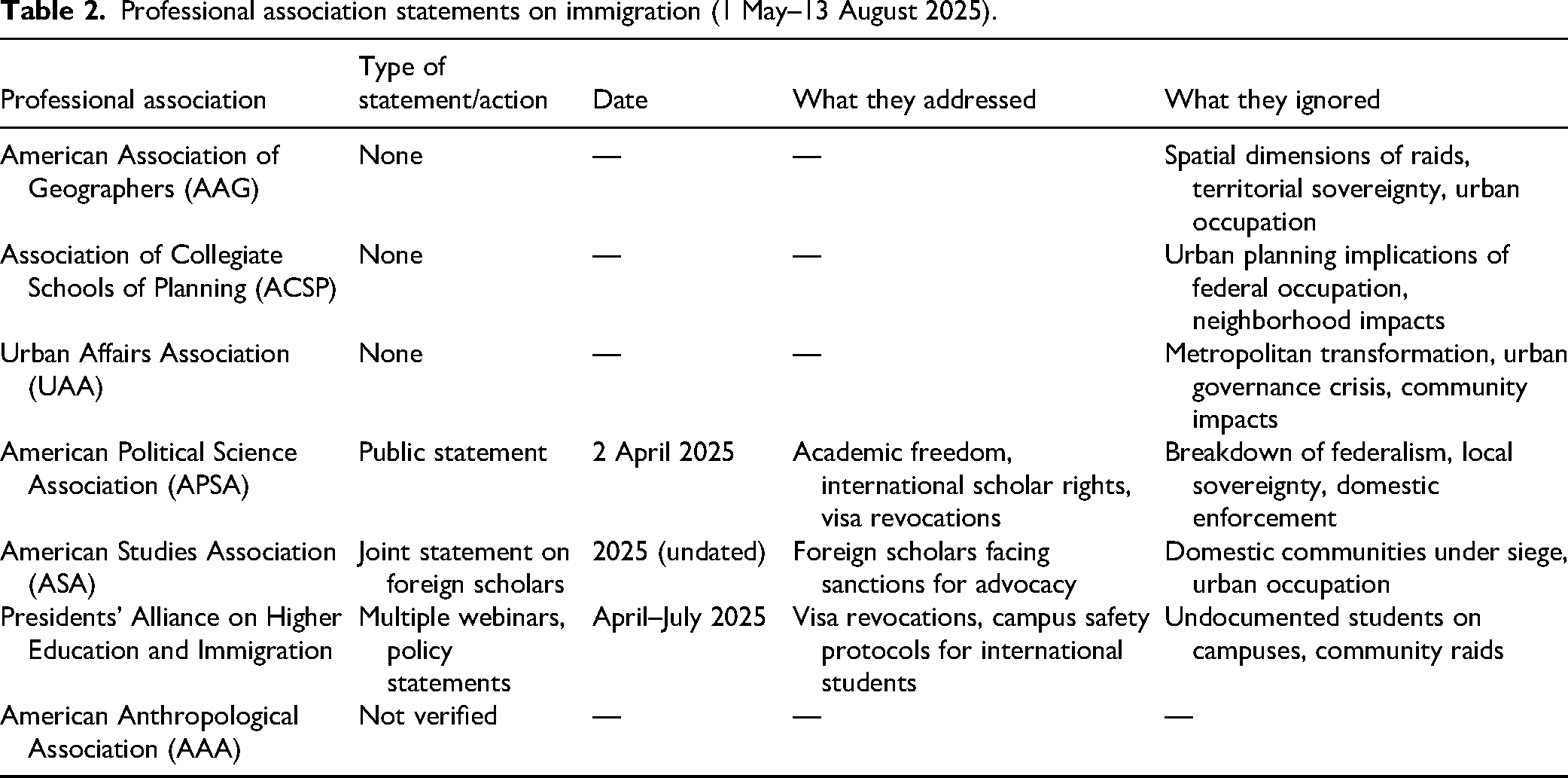
Professional association statements on immigration (1 May–13 August 2025).
Additionally, we identified 50 prominent critical and radical geographers based on citation counts ranging from David Harvey's 390,000 to 5000 at the lower end. Scholars represented eight thematic subfields: Marxist/critical urban theory, political ecology, feminist geography, Black geographies/abolition geography, critical GIS/digital geographies, labor/economic geography, migration/borders, and environmental justice. Of these 50, none appeared in mainstream media outlets or issued a statement during the summer of 2025. From our personal knowledge, we can confirm that one from our list of 50 worked in full partnership with a pro-immigrant advocacy organization in Los Angeles (Nik Theodore).
Our searches of Jacobin, CounterPunch, The Nation, and Instagram hashtags (#ICEraids, #LosAngeles, and #AbolishICE) revealed robust public discourse about the occupation but virtually none from the 50 most-cited radical and critical geographers. This was not a failure of limited access. The threshold for acceptance in CounterPunch or Jacobin is much lower than the New York Times or Washington Post. And Instagram requires no editorial approval. Silence did not result from exclusion or personal indifference. Rather, as we will argue later, it was more likely a function of positioning within their disciplinary field.
Our analysis of 566 Instagram accounts engaged with the Los Angeles occupation reveals the marginality of academic voices in grassroots digital discourse about state violence. Only eight accounts (1.41%) had academic affiliations, contrasting sharply with community organizations (127, 22.4%) and activist collectives (89, 15.7%) that dominated conversations about federal raids and resistance. The few academics who spoke occupied marginal positions within their fields: contingent faculty organizing through unions, ethnic studies scholars, and community organizers rather than traditional researchers.
Academic accounts included three California State University faculty union chapters, UCLA's Center for Immigration Law and Policy, the Association of Raza Educators, one Chicano Studies PhD (Sean Arce), one artist-researcher (Nina Sarnelle), and a single geography professor (Héctor Rivera, assistant professor at Pasadena City College). Rivera serves as an example of scholar-activists who are not represented within our top-50 sample, distinguishing himself by prioritizing his role as an organizer with the Tempest Collective over a publication-driven academic career.
The top-50 most-cited radical geographers remained silent on Instagram just as they remained absent from the New York Times, Jacobin, and CounterPunch. The data reveals a striking inversion: radical and critical geographers most engaged during the summer of 2025 (Kocher, Rivera) occupy positions outside citation networks conferring disciplinary prestige, while scholars who developed frameworks for analyzing urban occupation remained absent across all platforms. This pattern suggests that citation-based measures of scholarly impact, which we used to identify leading radical geographers, may capture a form of influence fundamentally disconnected from public intellectual work or political praxis.
The scholars who “win” within academic attention economies (accumulating citations, securing positions at elite institutions, shaping theoretical debates) appear least likely to deploy that expertise publicly when working-class immigrant communities face state terror. Conversely, those engaged in public scholarship and direct organizing (Kocher through TRAC's data analysis and media engagement, Rivera through the Tempest Collective's organizing work) remain marginal to disciplinary hierarchies defined by citation metrics. The attention economy that structures radical geography appears to reward theoretical production divorced from political practice, creating incentive structures that actively discourage praxis in favor of theoretical speculation. Those who give voice are those on the margins, while those with high reservoirs of symbolic capital opt not to deploy it in the battle to fight off federal forces occupying American cities.
The subfield of radical and critical geography spent decades developing frameworks like “right to the city” (analyzing urban sovereignty), “accumulation by dispossession” (explaining state-enabled extraction), “revanchist urbanism” (contextualizing authoritarian spatial restoration), and “state spaces” (theorizing scalar politics of federal-municipal conflict). Yet when federal forces militarized Los Angeles streets, occupied MacArthur Park, and deployed Marines for immigration raids, the scholars who developed these frameworks remained silent across mainstream media, left-leaning publications, and social media platforms. The silence cut across theoretical traditions and specialty areas. Leading theorists of neoliberal urbanism (David Harvey, Neil Brenner, and Jamie Peck) offered no analysis of federal urban occupation. Ruth Wilson Gilmore, whose abolition geography theorizes state violence, remained silent despite California connections. Established scholar activists like Cindi Katz and Katherine McKittrick similarly opted for silence.
At UC Los Angeles and UC Berkeley, no critical or radical geographers spoke publicly, even as colleagues in law, sociology, political science, and education engaged through robust university media platforms.
Institutionalizing silence over voice
Professional academic associations revealed selective engagement patterns. Organizations that issued statements (the Presidents’ Alliance on Higher Education and Immigration, the American Political Science Association, and the American Studies Association) focused exclusively on defending international scholars and students with legal status. They addressed visa revocations and academic freedom but ignored the federal occupation of cities, racial profiling, family separations, and constitutional questions raised by urban military deployment.
Spatial disciplines remained institutionally silent (Table 2). The American Association of Geographers, the Association of Collegiate Schools of Planning, and the Urban Affairs Association issued no public statements during this period of urban transformation and federal intervention. This silence from organizations representing scholars with expertise in spatial dynamics, urban governance, and metropolitan transformation represents a critical gap in professional response. The associations that did engage advocated for F1 visa holders and international scholars but not for DACA recipients and undocumented students facing deportation.
This pattern reveals hierarchies of deservingness: international scholars bring university prestige and research grants while undocumented students bring perceived political risk. Professional organizations function as sorting mechanisms, with the most privileged presenting highest rewards and lowest risks. Market logic colonizes solidarity ethics, transforming moral imperatives into cost-benefit analyses where the undocumented fail to meet thresholds for institutional attention. Institutional priorities focus on maintaining prestige rather than addressing needs of those facing greatest injustice.
The public attention economy: Fluctuating value of anti-immigrant state violence
The silence of radical and critical geography may be explained through the concept of the “attention economy.” The public sphere or an academic field can be conceived as a “market” where social, cultural, and political forces generate an array of issues that compete for the finite attention of the public (Citton, 2017; Davenport and Beck, 2001). Attention is a scarce resource that is allocated differentially based on how the “market” attributes value to the issues supplied. The attribution of value through the attention economy shapes what the public sees and partially what academics study, affecting which issues receive investments of time and resources and which remain unobserved (Bourdieu, 1988; Merton, 1968).
Radical and critical geographers are ensconced in a public sphere that attributes wavering value to issues associated with undocumented immigrant working-class communities.
Figure 1 displays Google search trends for four terms (ICE, Immigration, Deportation, and Los Angeles) from 13 May to 13 August 2025. Search interests are indexed 0–100 where 100 represents peak public demand. ICE searches explode on 10–11 June 2025, when federal forces arrested 851 protesters in Los Angeles. It took only several days after these mass arrests for the public to lose interest in federal siege of the city.
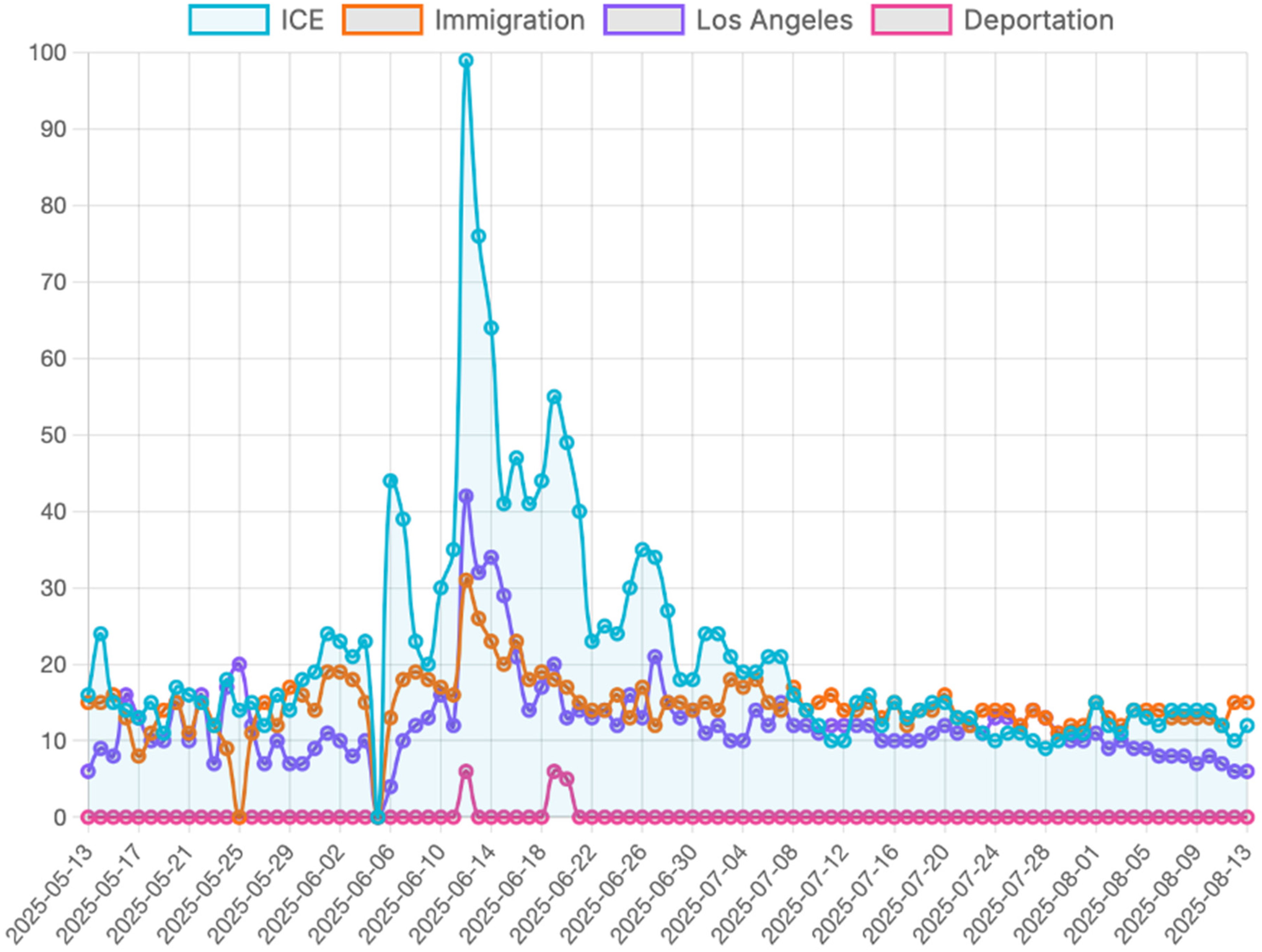
Google search trends for ICE, immigration, deportation, and Los Angeles.
Despite the federal government's unceasing use of unconstitutional violence on the city, public attention pivoted between brief spikes of public attentiveness followed by immediate obliviousness (Figure 1). Political violence persisted, but public sentiment did not assign enough value to the matter to warrant sustained and concentrated attention, especially when competing with other issues competing in the crowded attention market (Figure 2). Thus, the value attributed to the issue was comparatively low and fleeting, resulting in the transient allocation of public attention and the abilities of any other issue to outcompete it in this market.
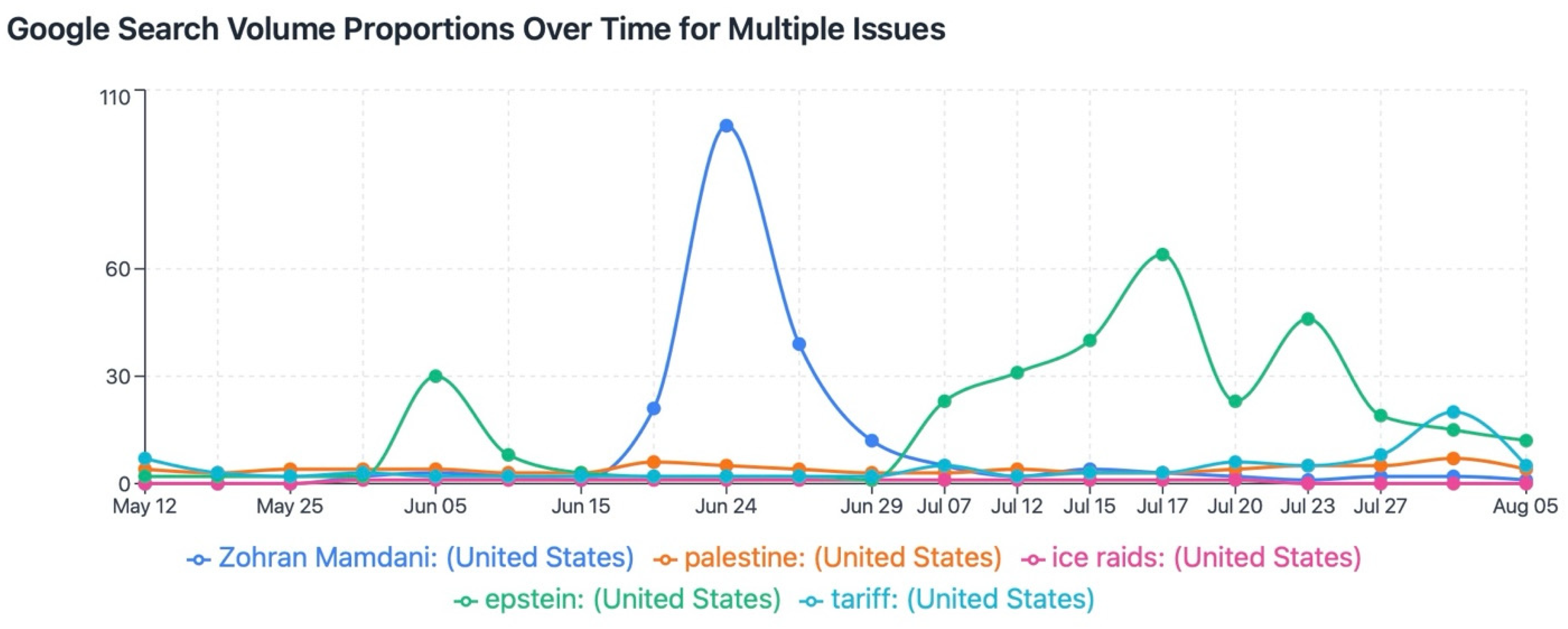
Google search for these issues: Zohran Mamdani, Epstein, ICE, Palestine, and Tariff.
Thus, the attention economy values immigration raids through ephemeral “spike-and-crash” cycles. Public attention dissipates before the issue could generate lasting resonance and escalate into “moral outrage.” Attention may turn to it but the meaning attributed to the issue remains uncertain. This provides the federal regime with great opportunities to advance and occupy American cities, with each unprecedented violation of liberal norms and laws getting further buried beneath mounting spectacles of violent despotism.
Fleeting attention and limited issue salience partially explains radical geography's silence. Although the academic field is relatively autonomous from the public sphere and has its own pricing rules, broader attention market dynamics can impact academic fields by shaping the priorities of private and public funders, public pressure on universities, and social osmosis. Scholars remain sensitive to broader attention market signals and allocate intellectual labor toward topics with greater and more sustained visibility. This creates a self-reinforcing cycle where lack of public focus produces scholarly silence, which in turn ensures public obliviousness of the issue.
Academic attention markets: Devaluing immigration in two academic fields
We now examine how the academic fields of social movement studies and human geography valorize immigration research. Both fields allocate minimal attention to immigration topics. Despite the substantive significance of the issue in shaping contentious politics and the political geography of the country, both fields devalue immigration-related topics. Radical and critical geographers are particularly sensitive to the disciplinary field of human geography, as the field's journals, conferences, and university departments serve as strategic sites that distribute the symbolic, administrative, and financial rewards to the field's players.
It follows that scholars positioned in fields valorizing immigration research possess infrastructure and incentives that make their intellectuals ready and able to intervene in public debates when they arise. Those in fields devaluing immigration lack professional incentives, established research programs, and protective networks necessary for immediate public interventions. Individuals may certainly recognize an issue as a “wrong” and moral outrage, but lack the motive, means, and opportunities to make their individual opposition into the source of a public assertion.
The value of immigration-related topics in the field of social movement studies
Radical and critical geographers are not alone in their inattention toward immigration politics. Since 2000, immigrant social movement organizations have played an influential role in shaping and contesting the U.S. nation state. The immigrant rights movement achieved what contemporaneous movements could not: sustained durability across administrations, effective multi-jurisdictional coordination, and concrete policy victories from DACA to sanctuary city and state policies. The immigrant rights movement built enduring infrastructure and delivered measurable wins (Nicholls, 2019).
However, the substantive importance of immigrant rights advocacy in local and national politics has not translated into a comparable value in the field of social movement studies. Among social movements during the decade of the 2010s, immigrant rights advocacy is ranked seventh according to the volume of publications and citations (Table 3), dwarfed by racial justice and women's rights movements. However, when assessing the issue by citations per number of publications, immigration activism averaged 15.3 citations per publication compared to 15.6 for racial justice and 14.3 for women's rights. This suggests that the attention allocated to the immigrant advocacy literature is drawn from the broader field of immigration studies rather than social movements.
Ranking with Google Scholar citations for social movement topics (2010–2020).
For scholars seeking upward mobility within the field of social movement studies (not adjacent fields like immigration studies), the devaluation of immigrant-related activism disincentivizes investments of attention and research resources into the issue. The negative incentive structure locks in immigration's marginalization in the field and in its future development on this field-specific path. Disincentives to allocate scholarly attention to the issue restricts the formation of robust groups of scholars with similar interests, depriving scholars of networks, funding opportunities, publication openings, and readers for sustained citations. The paucity of institutional support within these fields reinforces the devaluation of immigration-related issues, leading most new entrants into the field to allocate their scholarly attention toward issues that yield higher returns on attentional investments.
Consequently, the field has a paucity of intellectuals with strong motive, means, and opportunities to respond to immigration-related crises with concerted engagement in the public sphere. Field-specific attention markets can therefore help to explain public silence when clear political crises emerge at any given time. The attribution of value within academic fields matters far more than moral failings of individuals to explain such outcomes. Thus, the academic attention economy mirrors the attention economy of the public sphere. It attributes minimal value to immigrant politics even as immigrant communities assert themselves against enormous state repression and challenge the boundaries of citizenship and national sovereignty.
The value of immigration-related topics in the field of human geography
For radical and critical human geographers, the field of human geography is arguably the most impactful on calculations to allocate scholarly attention. The broader field distributes the rewards on investments through its journals, funders, ranked departments, networks, and citation-generated consumers of academic products. The subfield of radical and critical geography is important but nevertheless too small to fuel the rewards that incentivize the decisions of these geographers.
Table 4 ranks issue areas within the field of human geography by citations. Publications addressing “migration and borders” garnered 12,365 total citations, placing it last among the issue areas constituting the broader field of human geography. This citation count pales in comparison to the 618,620 citations amassed by publications in the issue area of “urban political economy.”
Critical geographic citations by thematic areas (2010–2025).
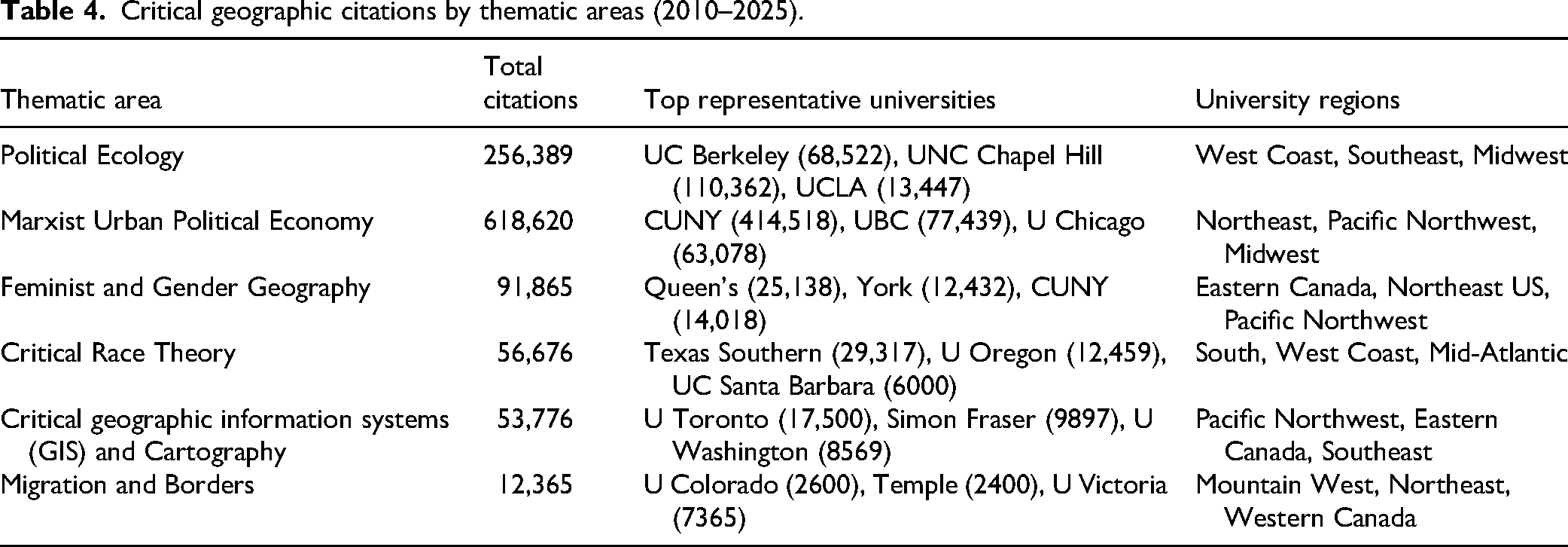
Moreover, in terms of the number of prominent radical and critical geographers, “migration and border” scholars trail the other issue areas. Migration-focused scholars (3 of 50 most prominent scholars) constitute the smallest cohort of prominent critical geographers. Nine of the 50 most prominent radical and critical geographers were associated with “urban political economy,” while 12 out of 50 with political ecology, making these other issue areas into far more potent centers of intellectual influence within the field. The geographic concentration of migration scholarship in smaller programs at institutions like Temple, University of Colorado, and University of Victoria reinforces an academic reward structure that marginalizes immigration research.
Another way to evaluate the value attributed to immigration-related topics in the broader field of human geography is analysis of prominent articles in the field's most highly cited and top-ranked journal: Progress in Human Geography. The prominence of the journal, its influence in shaping broader debates in the field, and the prestige attributed to those publishing in its volumes make it an important part of the field's incentive structure, shaping the allocation of value across the field, including critical and radical geographers. Among the 40 most cited articles from Progress in Human Geography (2020–2023), only one article directly addressed human migration. With 143 citations, this accounts for 1.9% of total citations (7535). Economic Geography/Finance (20.4%), Political Ecology (19.6%), and Social Theory (19.9%) dominated the citation landscape, collectively accounting for nearly 60% of all citations.
Radical geography's silence during the summer of 2025 cannot be explained by the absence of interest or moral courage. The question is not whether individual scholars spoke (nearly all did not) but whether the disciplinary field created a durable incentive structure for its intellectuals to possess sufficient motive, means, and opportunities to convert their individual moral outrage into a public intervention denouncing state violence as a threat to the general interest of the country.
Discussion: Stifling spaces of radical criticism
The academic attention economy shapes calculations over the allocation of scarce scholarly focus into an array of important issues. These markets introduce self-reinforcing mechanisms that lock topics into virtuous pathways of augmenting value versus vicious paths of diminishing returns: citations generate reputational capital, growing reputations enhance publishing opportunities in elite journals, and growing scholarly prestige opens access to prestigious academic positions and competitive grants (Bourdieu, 1988; Merton, 1968). And prestige is converted into institutional and financial power; dominant scholars reinforce pricing mechanisms that reinforce values attributed to their areas of research within the broader field.
Despite constituting one of the most potent and durable political forces of the 21st century, undocumented immigrant activism delivers minimal value for sustained research attention in social movement studies and geography. This results in fields with intellectuals with diminished motive (affective obligations to immigrant research subjects, peer expectations for action to be taken), means (expert knowledge facilitates production of critical speech, scholarly prestige enhances demand for and consumption of speech), and opportunities (networks to media and elected officials improves access to public sphere, rank and notoriety provides greater protections and offset risks of retribution) for articulating a public voice on the issue of state repression of working-class immigrant communities. State violence against immigrant working-class communities becomes invisible even to radical scholars operating in good faith. Institutionalized intellectual fields channel scholarly recognition toward “visible” wrongs while obscuring others, leading most radical and critical scholars to undervalue a population living in permanent states of exception within our urban worlds.
In addition to field-specific causes shaping the calculations of intellectuals, there is also the threat posed by state repression. The parallels to Nazi consolidation of power are striking, but we must also recognize a more proximate historical analogue: McCarthyism. Between 1947 and 1957, thousands of academics faced dismissal, blacklisting, and persecution for suspected “un-American” activities. The machinery of state repression targeted intellectuals because their capacity for critical analysis threatened authoritarian consolidation. University administrators collaborated with federal authorities to purge faculty, while colleagues remained silent to protect their positions. The academy largely complied rather than resisted, trading institutional autonomy for survival.
However, understanding the rationality of fear cannot justify its paralyzing effects. Niemöller's “First They Came” reminds us that when the logic of self-preservation is generalized across a population, we enable genocide and our own self-destruction. The costs of silence compound: each scholar who remains quiet makes the next scholar's speech more dangerous, while each aggression on our immigrant communities that proceeds without intellectual opposition normalizes the next. If radical and critical; geography means anything, it must mean refusal to let professional survival calculus override moral and political imperatives when working-class immigrant communities face state terror.
The federal assault on cities is an existential threat to urban democracy and the radical left political projects that have long found a home there. As every other institutional constraint on the Trump administration crumbles into complicity, the city is the last trench of hope for democratic socialist power. It is where undocumented workers organize strikes, where tenant unions fight off evictions, where working class youth transform fear into political mobilizations that threaten the fascist powers eating into the mind, body, and soul of this country.
The working-class immigrant communities defending Los Angeles have revealed what solidarity looks like: activists are arrested, beaten, and detained daily, but they are still fighting. They’ve built defensive networks from MacArthur Park to the southeastern cities of Bell and South Gate yet our academic associations remain silent on the most pressing matters. These communities have transformed vulnerability into organized resistance for bodily and community integrity while we remain stuck chasing symbolic values ascribed to topical trends. The pursuit of increasingly higher H-indexes has become a central focus within our field, while efforts to resist fascism are primarily being led by the urban working class with minimal external support.
If we lose the city, we lose everything: the spaces where undocumented workers build power, where abolition takes root, where alternatives to racial capitalism emerge. There is no neutral ground between federal troops and working-class immigrant communities, between deportation squads and sanctuary cities, between authoritarian consolidation and urban social democracy. As our citations vanish into the ephemera of history, those fighting on the frontlines will shape the material futures of all subject to U.S. imperial power. The federal government grasps the stakes better than we do. Cities must be subdued precisely because they harbor radical possibility. The choice is stark: deploy critical geography as praxis or surrender the urban to fascism.
We write this intervention recognizing the structural constraints that produce scholarly silence: academic precarity, professional risk, attention economies that devalue immigration politics, editorial gatekeeping, and disciplinary path dependencies. These are not individual moral failures but systemic features of contemporary academic labor and knowledge production. Yet understanding these structures cannot absolve us of responsibility. If we lose the city, we lose everything: the spaces where undocumented workers build power, where abolition takes root, where alternatives to racial capitalism emerge.
There is no neutral ground between federal troops and working-class immigrant communities. The federal government grasps the stakes better than we do; cities must be subdued precisely because they harbor radical possibility. The choice before critical geography is stark: accept the structural constraints that ensure our silence and thereby surrender the urban to fascism, or build new capacities for collective public engagement that can operate at the speed and scale this crisis demands. We choose the latter, knowing the risks and accepting them as necessary costs of meaningful intellectual work in the never-ending summer of fascism.
Footnotes

Funding
The author received no financial support for the research, authorship, and/or publication of this article.
Declaration of conflicting interests
The author declared no potential conflicts of interest with respect to the research, authorship, and/or publication of this article.
Ethical approval
Ethical approval was not required for this study as it did not involve human participants, personal data, or animals.