



Abstract
Concerns about the climate crisis have become widespread globally, raising the need to transition away from fossil fuels to other forms of energy production. In pursuing this path, energy transitions are often framed as practical solutions designed to modernize and maximize energy production and promote development and progress. Such framings justify top-down technological projects that frequently reinforce energy colonialism, perpetuating dynamics of dependency and slow violence. Thinking from one of the most climate-vulnerable regions in the world, the Caribbean, this piece reflects on the “Cucubanos,” a solar energy model from the community autogestión organization Casa Pueblo in Adjuntas, Puerto Rico. It argues that even while using similar technologies (e.g. solar panels), bottom-up initiatives differ fundamentally from top-down projects by prioritizing communal efforts rooted in a decolonial form of energy justice. These initiatives not only contribute to the decarbonization and decentralization of the energy system, they also play a pivotal role in democratizing and decolonizing Puerto Rico's future. Drawing on one year of participant observation, ethnographic field notes and semi-structured interviews, this article showcases the practical dimension of autogestión-driven transformations, illustrating how it serves both as an immediate option for frontline communities trapped in colonial dynamics and as a proof of concept for an alternative future. This reflection contributes to the understanding of the pluriverse of transitions by offering insights into a bottom-up practice that exists in the Caribbean amidst the climate crisis.
Introduction
When I returned to Puerto Rico 1 to listen, work, and learn with community autogestión 2 efforts, it was clear that transitioning to renewable energy sources is critical for sustaining life in the archipelago. The challenge, however, lies in determining how to achieve this change. The devastating impact of Hurricane Maria (2017), which left the entire archipelago with the longest blackout in United States history and the second longest recorded globally, left no doubt regarding the urgency of this issue (Santiago et al., 2020). Given the outdated and centralized energy system of the archipelago, combined with its dependence on imported fossil fuels, the likelihood of repeating such experiences is high. The lives of people in Puerto Rico are thus constantly vulnerable to the threat of losing access to an essential service (Moscoso-Cabrera et al., 2023). Consequently, initiatives focused on enhancing energy security have become vital to ensuring quality of life and sustaining productive activities. Through conversations with community leaders, activists, and academics, I had the opportunity to learn from various bottom-up efforts disrupting and proposing alternatives to top-down energy proposals that have failed to adequately serve Puerto Rico. Among these initiatives are the “Cucubanos,” promoted by the community-based organization Casa Pueblo in the town of Adjuntas.
The “Cucubanos” initiative is a decentralized energy system comprised of small-scale solar installations on roofs with battery storage that aim to provide energy security to low-income families (Glattard, 2022; Massol-Deyá, 2022). The name of the initiative draws inspiration from Caribbean imaginaries and a bioluminescent endemic species (Ignelater luminosus, a beetle) that emits light from its own body, thereby disrupting the darkness of the night. (Figure 1). These creatures are well-known by local people and serve as inspiration in the town of Adjuntas, guiding them in naming this bottom-up initiative that similarly produces light through their own efforts. “Cucubanos” emerged as a solar energy model after Hurricane Maria (2017), when the entire archipelago was plunged into darkness. Today, from “Cucubano” to “Cucubano,” there are over 200 solar-powered houses throughout the town, glowing in the dark every time there is a power outage (Massol-Deyá, 2022). Even though they may be mistaken for private energy installations, their commitment extends beyond individual households to the collective of the community, strengthening energy security and sparking an energy insurrection. 3

Artwork by the Puerto Rican artist Verónica Aponte, inspired by the Cucubanos. (Photo: Author).
Drawing on one year of participant observation, ethnographic field notes from three separate community gatherings, and semi-structured interviews, this piece reflects on how energy transitions should unfold. It explores the practical dimensions of autogestión-driven transformations 4 affirming that even while using similar technologies (e.g. solar panels), bottom-up initiatives differ fundamentally from top-down projects by prioritizing communal efforts rooted in a decolonial form of energy justice. These initiatives not only contribute to the decarbonization and decentralization of the energy system but also play a pivotal role in democratizing and decolonizing Puerto Rico's future 5 . Therefore, bottom-up approaches serve both as an immediate option for frontline communities trapped in colonial dynamics and as a proof of concept for an alternative future.
Facilitating a decolonial form of energy justice
The current climate crisis underscores the urgent need for climate mitigation measures and transitions to alternative forms of energy production (Dunlap, 2023; Soler-Villamizar & Rankin, 2022). These efforts aim to reduce greenhouse gas emissions, promote “sustainable development,” and “meet energy demands.” In pursuing this path, most top-down energy production initiatives focus on reinforcing existing systems through “green” initiatives, while maintaining current modes of production and consumption (Dunlap, 2023; York & Bell, 2019). Unfortunately, these initiatives often create a false sense of change, where plans and discourses serve primarily global conversations rather than addressing place-based needs, conditions of unsustainability, and injustices already embedded in the system (Sovacool et al., 2023; Tornel, 2023). Therefore, they offer an apolitical understanding of energy transitions that result in merely “adding” technologies while reinforcing energy colonialism (Dunlap, 2023; Lohmann, 2024).
Energy colonialism shapes energy production and intervenes in individual lives, transforming livelihoods and human–environment relationships, often justified under the ideals of universal “progress” and “development” (Lohmann, 2024; Müller, 2024). It is deeply embedded in the practices, discourses, and interactions that (re)produce colonial experiences, rendering certain places and populations as disposable. In Puerto Rico, energy production has historically been shaped by the colonial experience, alongside the priorities of modernization and industrial development. These dynamics have resulted in an energy system predominantly reliant on petroleum, coal and natural gas (De Onís, 2018; Lloréns et al., 2023; Massol-Deyá, 2022; García-López, 2018). As noted by Roque Antonnetty (2023), this model prioritizes capital over addressing social harms and environmental pollution. As a result, it relies on imports and is designed to depend on external resources while being controlled by foreign interests.
Currently, Puerto Rico's energy system is characterized by unreliability, high costs, and unsustainability. This situation has emerged from a combination of internal factors, such as corruption and operational failures; external challenges, including outdated infrastructure and inadequate planning; and natural hazards, such as hurricanes and earthquakes (De Onís, 2018; Roque Antonetty, 2023). In response, top-down calls for transitions in Puerto Rico's energy system have facilitated a “colonial-style” privatization, perpetuating cycles of extraction and slow violence (De Onís & Lloréns, 2021). This is evident in everyday life on the archipelago through higher utility bills, constant power outages, the appropriation of agricultural land for private industrial projects, and increased risks for individuals who lack power generators or solar energy systems and depend on electricity for medical devices or the storage of food and insulin (CPI, 2024; ENDI, 2024; Primera Hora, 2024; Vocero, 2024). Consequently, it reinforces a “system of death” that perpetuates vulnerability (Avilés-Vázquez et al., 2023).
Given the challenges of top-down energy transitions that perpetuate vulnerability, there is a need for decolonial forms of energy justice. Such approaches extend beyond ensuring access to the benefits of renewable energy—a dominant perspective in energy justice—and instead strive to be transformative (Sovacool et al., 2017, 2023; Tornel, 2023). Bottom-up efforts facilitate decolonial forms of energy justice by providing energy security while challenging dominant power structures and capitalist systems. They take historical contexts into account and empower citizens with greater knowledge and control over energy production and consumption (Blanco-Wells, 2019; Dunlap & Tornel, 2023; Temper 2019). Through this approach, they work to address conditions of unsustainability in ways that transcend mere technical implementation. As a community leader expressed: It is not addressing the energy issue in itself; it is addressing it within the context of the climate crisis, the issue of impoverishment, economic stagnation, and subordination.
6
Therefore, bottom-up emancipatory efforts address a diverse range of needs, aiming to challenge and transform colonial dynamics while simultaneously addressing energy production. They are rooted in social values (e.g. solidarity) and collective ideas (e.g. mutual aid), aimed at promoting the participation and empowerment of victims of energy injustices (Blanco-Wells, 2019; Stock, 2023). They also seek to move beyond modern, universal, and Western top-down notions of energy transitions through community-led initiatives. As a community leader stated at a gathering: We need to transition to renewable energy. That is going to happen with or without you. It will happen no matter what. The question is: how do we want to transition? Do we want to transition because someone from outside comes, as always happens, to tell us how things are done? Or do we want to transition with a local model, created by us, on our own terms and with the resources we have?
7
A praxis of
autogestión
Autogestión is commonly translated as “self-management.” The term, derived from the Greek autós (self) and gestio (managing), originates in classical European social anarchist thought, where it functions as both a countermeasure to neoliberal capitalist modes of production and a form of resistance (Hudson, 2010; Tamayo, 2019; Vieta, 2014). In Puerto Rico, community leaders and activists have embraced and redefined the concept, emphasizing the creation of autonomous spaces supported by diverse governance models, foundational shared values, strategies, and initiatives (Garriga-López 2019; Soto-Vega, 2019; Torres-Abreu et al., 2023). As currently practiced, these efforts go beyond resistance and survival; they proactively construct alternatives, turning the seemingly utopian into tangible realities (Massol-González, 2019). As such, autogestión today represents more than an ideological stance on class struggles—it is a complex, dynamic, and evolving praxis shaped by colonial contexts of need, constant hazards, and aspirations. In the words of a community leader: The colonial political model helped give birth to an option for survival and moving forward, which is autogestión.
8
There is a fermentation that has been occurring in the country to address the fundamental agendas of our people and in those fundamental agendas, the energy issue is one of them. And while from the top-down you do not see changes, you do not see satisfactory answers, you see agendas that are corrupt, that have prior interests, the communities have been organizing and offering alternatives.
9
From Cucubano to Cucubano
An illustrative example of autogestión-driven transformations comes from Casa Pueblo. 10 For 44 years, this community-based organization has defended Puerto Rico's natural resources from colonial and capitalist development and the threats of open-pit mining and Gas Pipeline projects. Instead, Casa Pueblo has promoted a variety of initiatives to break dependencies and facilitate alternative local development and social and environmental justice. Recognizing the need to seek alternative forms of energy production and resist the top-down imposition of dependence on coal, oil, and natural gas to generate electricity, Casa Pueblo has been promoting technical shifts to solar energy since 1999. After Hurricane Maria (2017), Casa Pueblo's efforts became particularly relevant as the organization turned into an energy oasis (their solar-powered facilities were open to the community), distributed 14,000 solar lamps, developed an emergency solar model for those most vulnerable, and strategically located solar systems in convenience stores to activate the economy and ensure community members could access necessary supplies (Massol-Deyá, 2022; Massol-González, 2019) .
Considering the situation of Puerto Rico's energy system and evolving from an emergency response towards a long-term energy project, the “Cucubanos” emerged as the first point of intervention of a practical autogestión-driven transformation of the energy landscape of Adjuntas
11
(Figure 2). The construction of what is call Adjuntas Pueblo Solar
12
is driven by the organization's efforts, with support from various non-governmental and non-profit initiatives, and is designed to address the community's critical needs (e.g. medical equipment; food and medicine refrigeration). It is also guided by the belief that reliable home energy systems can break the cycle of dependency and vulnerability, combat poverty, and transform community members into energy producers (Massol-Deyá 2022). In doing so, “Cucubanos” promote a decolonial form of energy justice by facilitating access to energy systems, lowering utility costs, and offering a reliable alternative amid unsustainable conditions. As a “Cucubano” homeowner expressed: The solar system provides incredible security because you know that, in times of difficulty, it will continue to function. If you have a health condition, you can trust that you will not be left behind and that it will respond to your needs.
13
Visit of a Casa Pueblo volunteer to a “Cucubano” following Hurricane Fiona. (Photo: Author). Community members in a “Cucubano” after Hurricane Fiona. (Photo: Author). You have to lose your fear and understand that it can happen that the [energy] system governs you or that you govern the system. I prefer to govern it myself. So, I learned. I turn it off and on and I tell it I need you now, I want you to connect to [the public] authority or I want you to depend only on the panels. Not everyone knows at the level that I know, but we help and support each other.
14
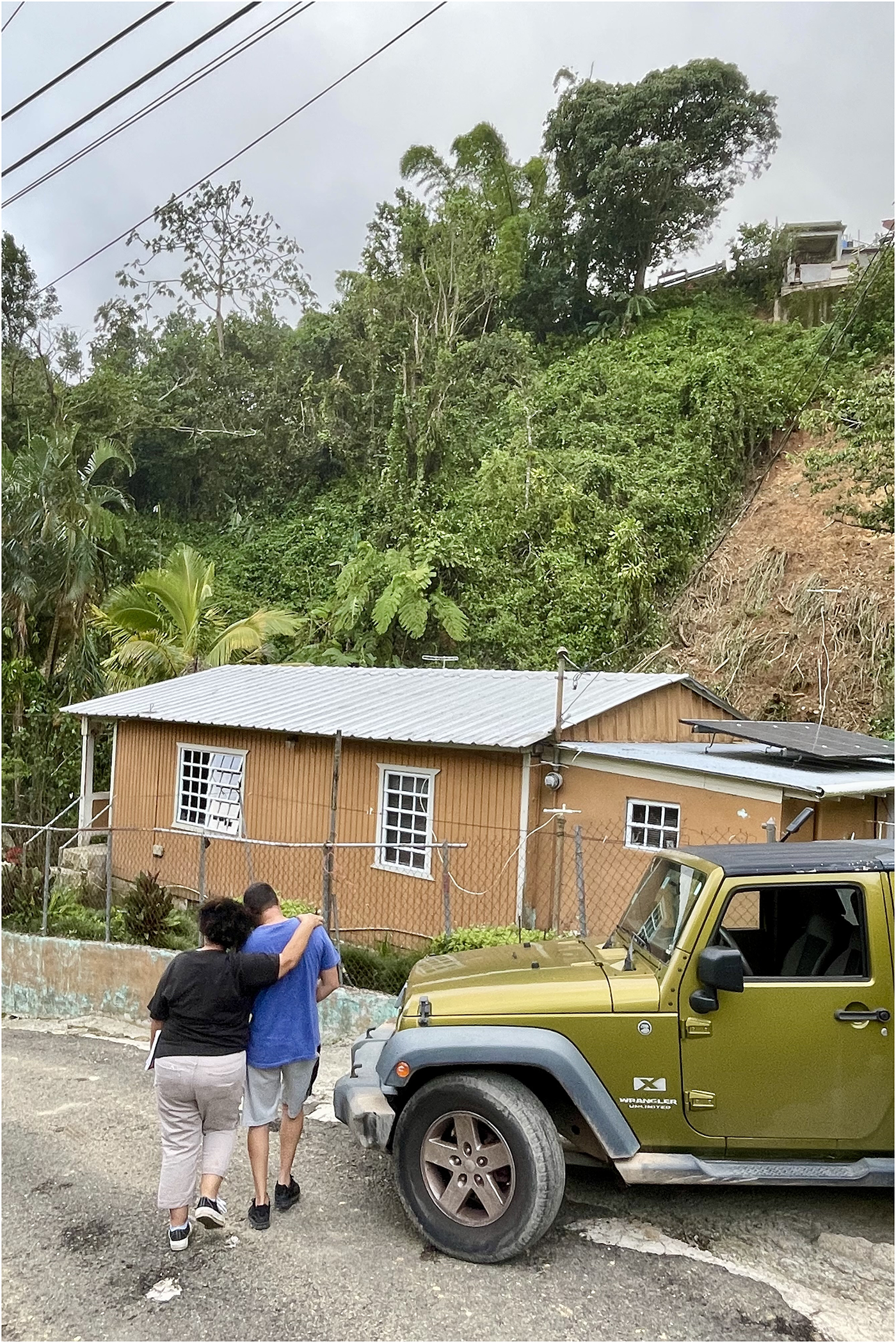
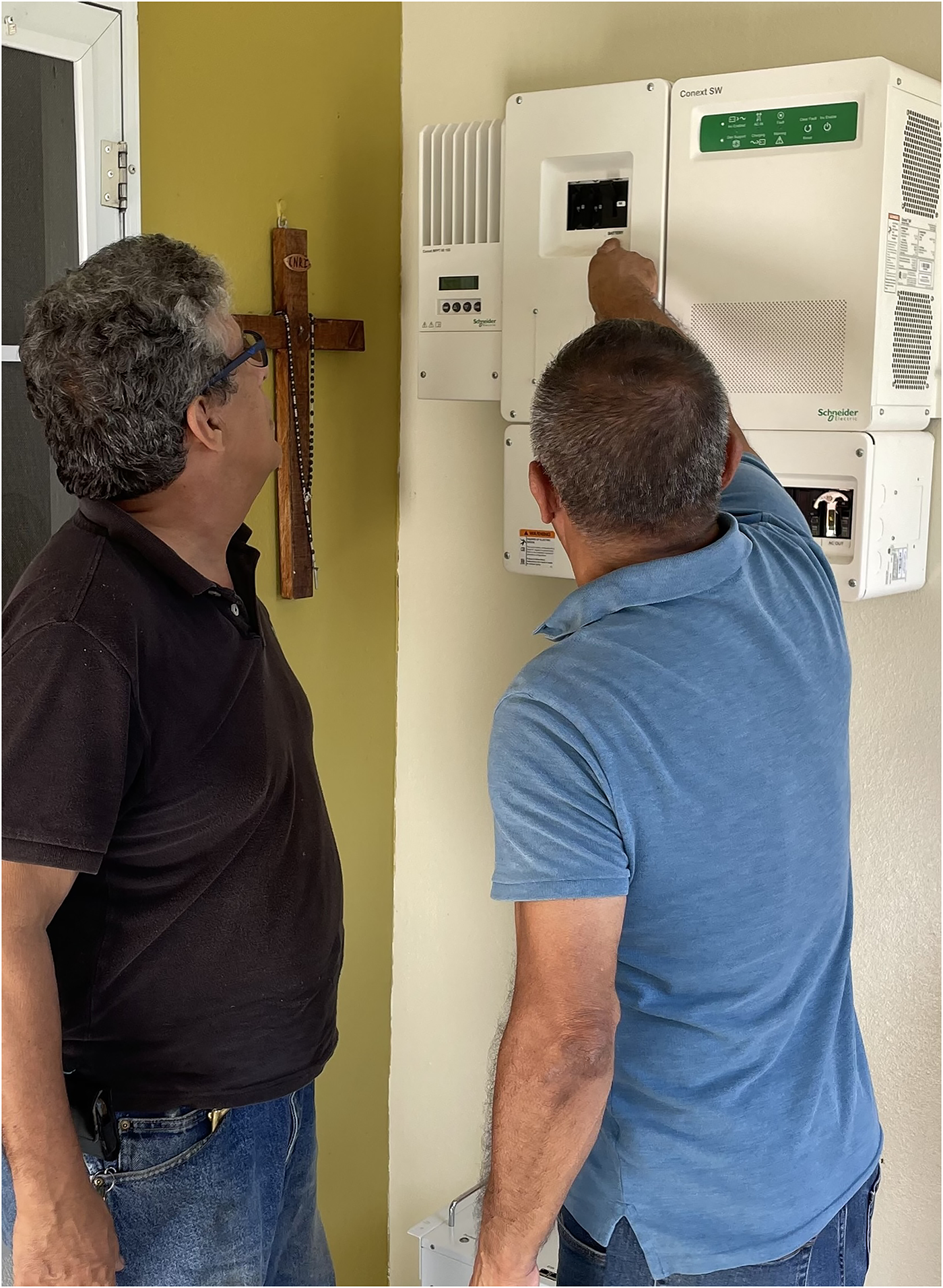
Seven years after Hurricane Maria (2017), with Hurricane Fiona (2022) testing their efforts, “Cucubanos” emerged as a community-led response to the slowness and inefficiency of top-down approaches. This bottom-up initiative, centered on communal approaches and the democratization and decolonization of Puerto Rico's energy future, does not solve all the challenges of the energy system but puts community members in a better position to deal with the challenges they face. Individually, they function as energy oases, contributing to the decentralization and decarbonization of the energy system by distributing energy production and educating and inspiring others to follow suit. Collectively, they provide an immediate option for frontline communities caught in the colonial dynamics of dependency and everyday vulnerability. This serves as proof of concept for an alternative future—one where energy production is guided by critical needs, fueled by endogenous sources, and can be reliable and accessible to all.
Conclusion
Recent global narratives prioritize top-down approaches, emphasizing the need for “advancement” and “speeding-up” energy transitions. For example, the US Department of Energy talks about “advancing” and “modernizing” Puerto Rico's power grid and “speeding up” the deployment of critical infrastructure to support energy resilience (DOE, 2024). Yet, these approaches prompt critical questions: advancement for whom? Speeding up to what end? Historically, Puerto Rico has been a ground for concepts of “development” and “progress,” often serving external and private interests rather than the archipelago itself. Today, Puerto Rico faces social, economic, and natural hazards continually produced by a “system of death,” wherein bodies and territories remain constantly vulnerable. Consequently, there is a pressing need for alternatives, aiming for more than technology implementation.
During my time in Puerto Rico, I listened to and observed public discussions and government visits that emphasized the urgency of the energy crisis and the need for transitions. However, this heightened awareness has not translated into actions that adequately account for historical realities or address the urgent needs and critical demands of communities. In this context, “Cucubanos” serve as a meaningful metaphor for bottom-up energy projects and autogestión more generally, offering a real place-based alternative within the pluriverse of bottom-up initiatives. Developed through community efforts, it seeks to offer light in the darkness by creating opportunities for everyone to educate, act, and support one another, embracing community resilience. While “Cucubanos” may not represent a universal solution, they are a model that addresses critical community needs and provides opportunities for the democratization and decolonization of Puerto Rico's future. These aspects are essential for confronting energy colonialism and offering alternatives for the inhabitants of the archipelago. They exemplify how practical autogestión-driven transformations facilitate a decolonial form of justice and can contribute to discussions about the pluriverse of transitions in the face of the climate crisis.
Footnotes
Acknowledgments
The author sincerely thanks Casa Pueblo, along with the volunteers, community members, and artists who generously shared their stories, insights, and work. Special appreciation also goes to Noella Gray, Sasha Davis, Alexander Dunlap, and Carlos Tornel for their time, support, and constructive feedback. The author is likewise grateful to the anonymous reviewers for their suggestions.
Declaration of conflicting interests
The author declared no potential conflicts of interest with respect to the research, authorship, and/or publication of this article.
Funding
University of Guelph, Social Sciences and Humanities Research Council of Canada (Grant Number 430736).
