




Abstract
This essay introduces a speculative “picnic methodology” emerging from site-specific performance art practice with a herd of reindeer. The practice expands from the justice-oriented picnic tradition and stages picnic as a space to envision nonhierarchical multispecies relationships. The picnic blanket is offered as a meeting place to appreciate more-than-human ways of being, thinking, and knowing, starting with our relative, the reindeer. The essay draws from the short film City Reindeer (2022), documenting the durational picnics in the wintery Arctic. The performance art practice forms here a contemplative and playful intervention to decenter the human and give the reindeer a voice, with an underlying commitment to promoting veganism.
Culturally assigned meanings to picnics are manifold and diverse, ranging from social bonding to romantic behavior to being a community-stabilizing force (Boskin, 1965; Mandell, 2010). Its ethos is equally elastic and can vary from peaceful resistance to oppressive regimes (Shihade, 2014: 460), consciousness-raising LBTGQ + “pinknics” to metaphorical science picnics. The history of picnics is infused with settler colonialism and landgrab (Symons, 1982: 307), in which the picnic blanket is seen as a central marker. White (2003: 102) speaks of the blanket as the fundamental logic of the picnic, establishing a controlled space to observe the landscape from the safety of the blanket's domestic space. As an aesthetic form and a method, however, the picnic has long been re-invented to become a framework for voicing and giving voice to and for the underrepresented and oppressed and a space and vehicle for the disruption of hierarchies. To connect to the justice-oriented picnic tradition and to address our damaged relationships with the more-than-human, I have set up durational picnics to rethink multispecies relationships in the Arctic, starting with our relative, the reindeer. The picnic blanket is offered as a meeting place for more-than-human and human ways of being, thinking, and knowing.
This essay formulates a speculative “picnic methodology” emerging from my site-specific performative picnics with a herd of reindeer. I am asking what the embodied practice of “alfresco” meals can do ecologically, artistically, and in restoring human–animal relationships. I am purposefully adopting the pseudo-Italian word alfresco, in the open air, (Furiassi, 2012: 772) and staging it as one of the critical terms for the methodology. The heart of the word “fresco,” or fresh, refers to a wall painting technique on moist plaster known since Antiquity. In both meanings, the open-air and a wet-on-wet paint application, there is an association with freshness, a fleeting stage in a process embodying the inevitable move toward dry, muggy, rotten, or frozen, for instance. Next to these material-sensory appearances, in the picnic methodology, alfresco refers to the curious and dynamic mental-biological state welcoming the more-than-human agency to change human thinking and behavior.
Grounded in my practice of performance art, this essay explores how the picnic with the reindeer and the narrative about it can become fruitful occasions for disrupting the (human-)established hierarchies between species. The suggested disruptions take place through two main avenues: first, I warp the conventional picnic apparatus by the chosen remote site, polar season, and my solitary presence and second, I purposefully set up the blanket as a domestic-wild boundary to be confused by the more-than-human. (As it appears later, they will initially refuse such mechanistic role-division.) The rationale behind such disruptions is to make the vulnerability and fluidity within the assumed boundaries and hierarchies experiential. In addition, these alfresco meals are not motivated by creating a leisurely ambiance associated with conventional picnics. For good reasons, picnicking is not customary in the wintery Arctic. Due to the low temperature and the materiality of snow, it is uncomfortable. As for picnic methodology, this is fuel. My picnics emerge from a tradition in which the artists purposefully expose themselves to mental-physical discomfort (Sandford, 2005) and the pioneering performance artists’ work with animals, such as Rachel Rosenthal and Joseph Beuys. The anticipated benefits of the (relative) sensory-emotional tension caused by frigid weather and proximity to large antlered herbivores include lived experiences of one's own animality and a sense of commitment to a deeper understanding of the reindeer nation's ways of being and knowing.
The “picnic methodology” should be understood as part of the performance (as research). While it is an initial articulation of ways to create nonhierarchical multispecies relationships through site-specific performance art and a form of asking “how to do things with performance?” (Arlander et al., 2021), it is also playfully performing an academic research apparatus. The practice is, however, serious in that the urgency and objectives of the picnic methodology originate from its global context of the climate crisis. The Arctic is impacted by global warming four times as fast as the rest of the world (Rantanen et al., 2022), heavily impacting the reindeer and herders. My work aligns with views in which climate breakdown is seen as a human behavioral crisis (Merz et al., 2023) and a relationship problem (Mind & Life Institute, 2021) instead of a solely carbon emission problem. As a result, the multispecies picnics envision wholesome alternatives for our problematic ways of being human and the existing human–animal hierarchies.
For a few years now, I have integrated picnicking into my practice-based research, manifesting in forms of sensory food gatherings (Harris, 2020: 106) and performance art with and for animals. I consider food one of the most intimate connections to the land, and sharing a meal as a connective tissue between beings. Without human language, my picnics are also a form of contemplative research, facilitating gestures of connection, being with, and becoming with. To further elaborate on how the picnic methodology comes to life, I will draw the making process of the short film City Reindeer (Koski, 2022), created during a month-long art&science residency at the Kilpisjärvi Biological Station, as it utilizes picnic methodology in practicing and reflecting on multispecies relationships in the Arctic. As alternative approaches to picnic menu and protocol, this case study includes weather-frozen meals, a durational picnic that disappears under a snow blanket, food that must stay in the bag to avoid herd havoc, and the experience of being stood up at the picnic. This site-specific practice is attentive to where the new multispecies relationships are being created and, therefore, is occupied with a fundamentally geographical question (Gillespie, 2019). In the process, the site is inherently woven into the artwork and the artist to the site, as the work is emerging from a durational lived experience of the weather, land, and real or imaginary dialogue with the beings within.
Figuratively speaking, a picnic refers to something easy and breezy. Experientially, however, even without the artist-initiated disruptions, picnicking is a fragile enterprise for comfort: the blanket is easily invaded by soggy grounds, wind, insects, or dogs, for instance. Interruption is, in fact, an inherent quality of picnicking, though typically not appreciated. Namely, instead of problematizing how “nature” is interrupting human comfort, picnicking has the potential to create a necessary interruption for us to snap out of hypnotized consumerism. Picnicking can thus function as a deep praxis of interruption to see the interrupting, messy, and needy other as entitled to our full attention (Zoloth, 2016: 3). Amongst companion species, this becomes a rich practice of “minding animals” both by imagining the more-than-human point of view and respecting their thoughtful minds (Bekoff, 2014: 6).
It is −30°C, −22 F, and early January in sub-arctic Finland. The sun is not rising yet above the horizon. The landscape resembles a pastel-colored hyper-reality or a film studio, lacking shadows and echo. I will set up my picnic outside, arriving in snowshoes with a blue tartan blanket, seat warmers, cutlery, and two plates of food stacked in a shopping bag. My menu consists of the bountiful spread of the vegan option from the station cafeteria, frozen upon arrival at the picnic site. For the reindeer, after some uninformed trials with lettuce and bread, I serve their two favorites: mushrooms and lichen. Due to frigidity, the meals have stayed neatly in their place during the shaky transport, precisely how they were plated (see Figure 1). An Arctic still life results.
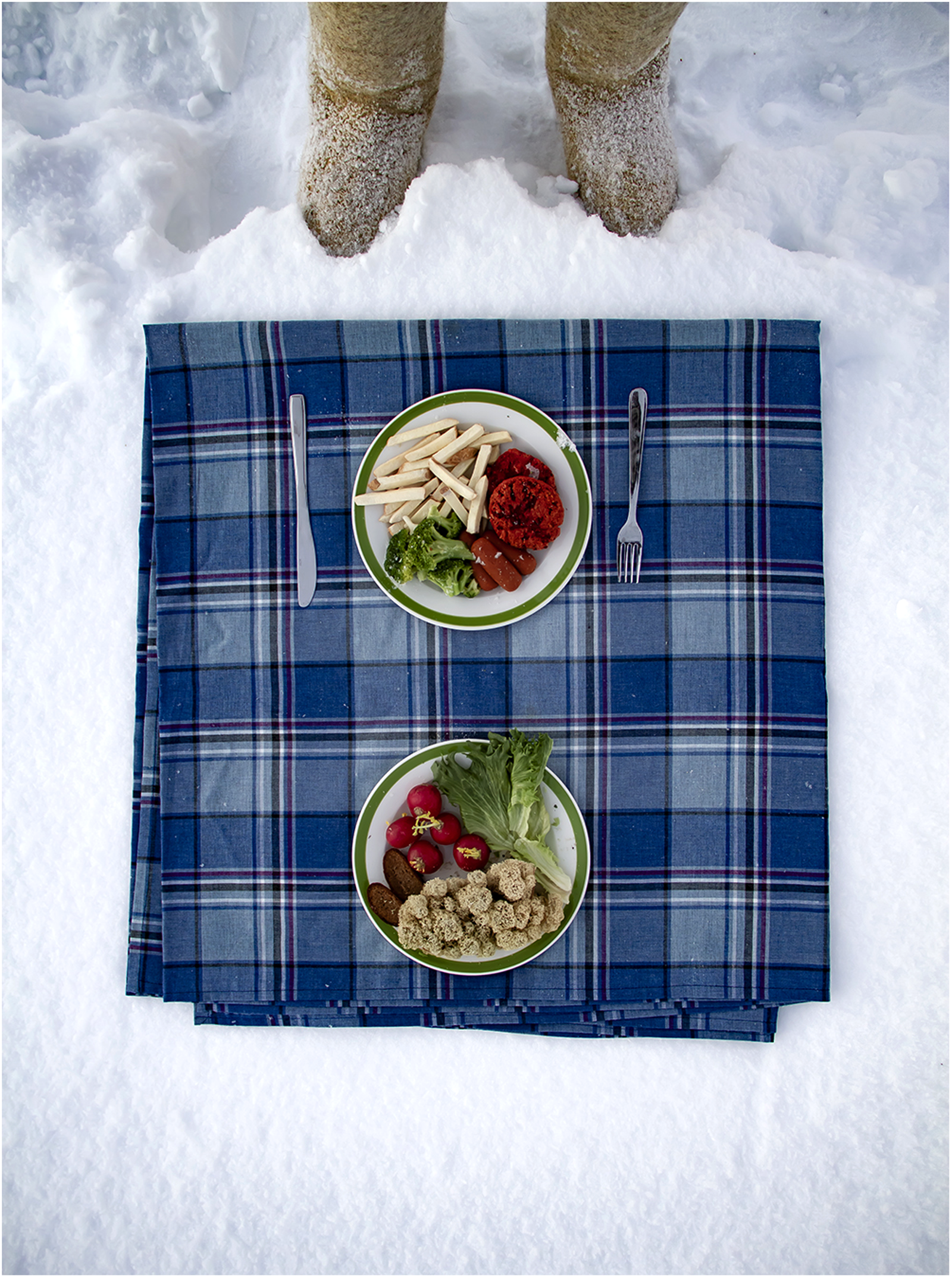
City reindeer (Koski, 2022). Frozen multispecies picnic.
I am waiting for the reindeer and eating my meals outdoors daily, leaving the blanket with their plate outside overnight. A week passes, and nobody shows up (see Figure 2). Meanwhile, the picnic blanket disappears under a thick snow blanket. This solo picnic appears to be an anthropomorphized multispecies fantasy, emerging from my lack of site-specific knowledge of snow depth and the seasonal reindeer behavior as a herd. However, thinking the multispecies picnic did not happen because the reindeer was absent would be arrogant. Like the sound of a falling tree in the forest, there is always someone (listening), irrespective of human awareness of it (Pratchett, 1992: 6). Based on the tracks, an Arctic hare has been nearby, as have several birds. Still, I can sense my human fragility in the slight feeling of rejection. Either the place, time, or language of my gesture needs reconsideration.
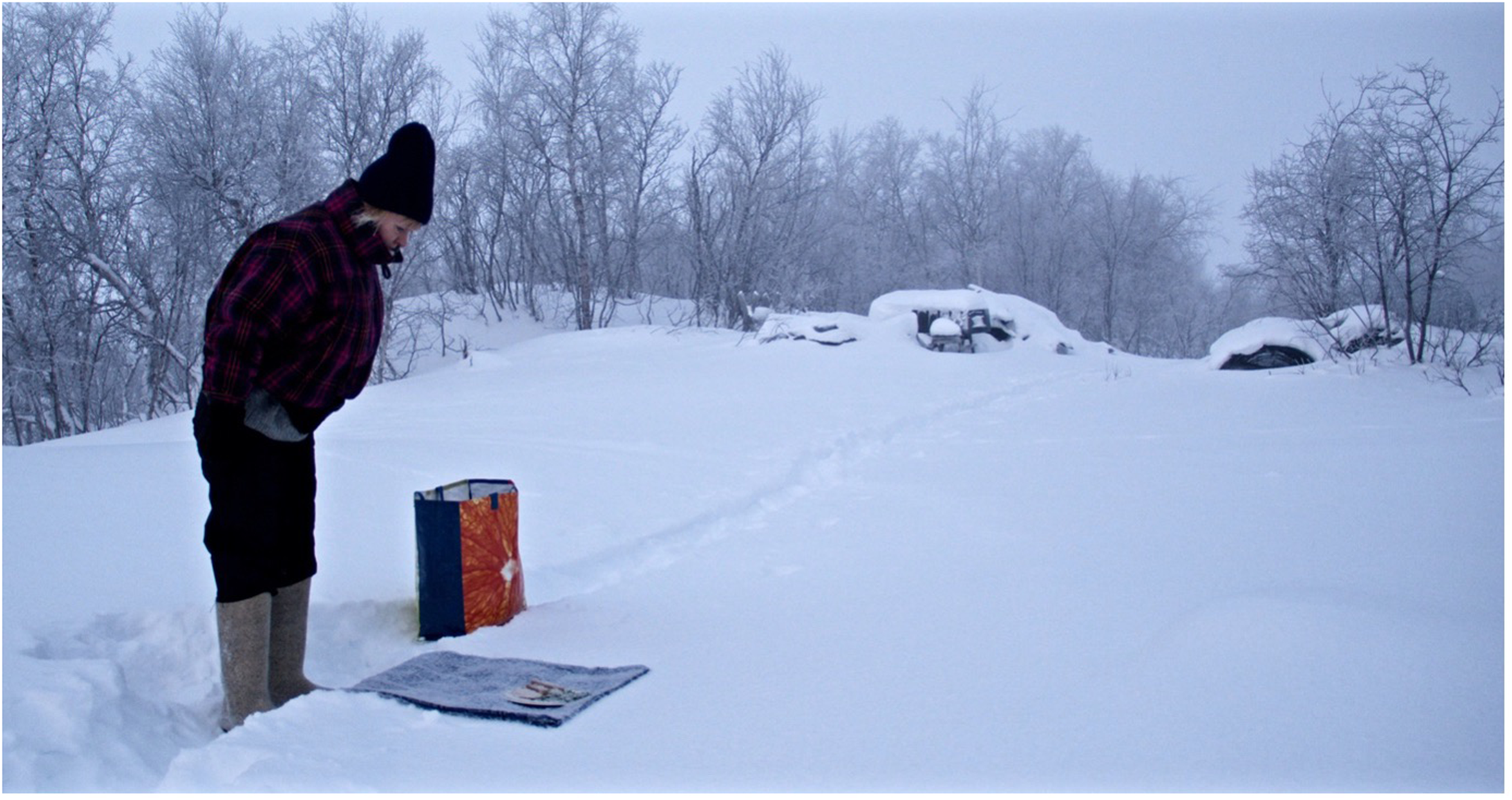
City reindeer (Koski, 2022). Feeling rejected by the more-than-human: no nightly visitors at the picnic site.
The relationship problem, which many indigenous scholars, activists, and researchers of contemplative traditions consider to be the background of the anthropogenic climate crisis (Mind & Life Institute, 2021; Twine, 2024), is sedimented in various forms of othering, speciesism, human exceptionalism and a disregard for species interconnectedness. Even though we often forget that humans are members of the animal kingdom, too, we have a fundamental need to be in communion with other animals (Andersson, 2023). In response, my multispecies picnics set out to subvert the perceived distance between the human and more-than-human by inquiring into my animal senses to explore, in David Abram's (2010) words, “the elemental kinship between the body and the breathing Earth.” The paradigm of performance art is considered particularly appropriate here in that it provides a tradition of and means to “appear together” in the same image space or stage with the more-than-human (Arlander, 2022: 153). Scholarly research often takes a critical stance, creating a sense of outsideness and limitations in developing a lived experience of interdependency, agency, and compassion. Drawing from Derrida (2008), my serial picnics with animals inquire into what happens when first absence and then the silence of the non-human is “imposed” on humans.
After a week of my assumed solitude, I relocate the picnic to a reindeer pasture. The reindeer herder has generously granted me access to visit his semi-domesticated reindeer independently. I am a visitor-interrupter of two nested territories: the traditional land of the Sápmi and the inner circle of a reindeer herd. The local people call me a city reindeer. The term is commonly used in Finland to refer to urban people being visibly out of context and helpless in the North. Hörö is the most exuberant of the herd of eleven. His reddish fur is patchy and shaggy, and the velvet skin of his antlers is ripped off to dangle loosely, giving him an unruly demeanor. Hörö disrupts the picnic apparatus by hoisting my blanket with his teeth and tossing it around. The same goes for the seat warmers (see Figure 3). Others join. There is something bewildering about being outnumbered and surrounded by the herd. Hörö also nudges me around with his body and antlers. And then he pauses, and we breathe next to each other long enough for my toes to freeze.
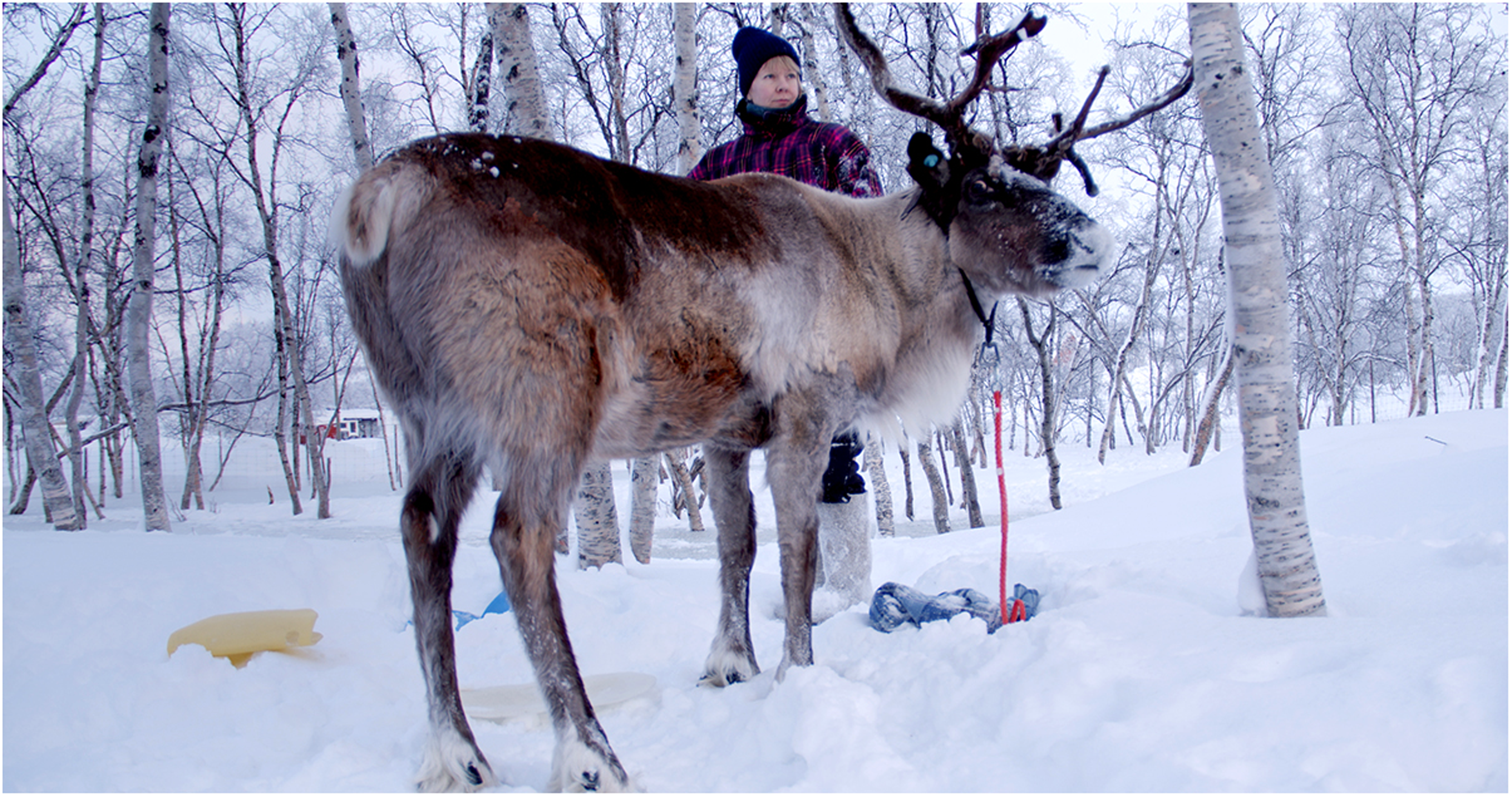
City reindeer(Koski, 2022). Picnic with a reindeer.
We are both interrupting and disrupting each other and ourselves. My being-with is a “foolish disruption” (Gray and Kontos, 2017: 5) and a nonsensical gesture: the concept of a picnic is meaningless to the reindeer. Overall, the picnic embraces the paradox of senselessness; it would not stop the injustice behind the climate crisis, and yet I will do it anyway. To wake up from a consumerist trance. To imagine a space where we co-exist (Ozeki and Okri, 2022). Despite my frozen toes, and partly because of them, the co-existence is a dynamic circular dance with only momentary pauses. The reindeer begins to surround me. When it appears I am not a food source, I am a mere entertainer to them: a primate clown to which the reindeer creep close to listen, see, smell, and feel whether I am in a good mood (Snyder, 1990: 190). I am excited, in fact, to be with them and see what happens. I also feel like a (city rein)deer in the headlights, receiving too much attention from the herd. This might be amusing to the reindeer, but for me, it is an avenue to feel my inner wildness. My animality. However, my novelty wears off quite quickly, as they either fall asleep on the snow-covered ground next to me or move on further to continue their daily activities. Only when I pick up the blanket does the movement turn centripetal again. Their consent to be filmed is based on curiosity about my moves, yet my relative hibernation instead of following them.
Next to circling one another, the picnic consists of nested frames, the pasture as a domesticated frame, within which the picnic blanket, and the camera frame that captures the frame within a frame. Zooming further in, I wear frames of yet another cultural fantasy, the tartan. Given that tartan is a fabrication of Romantic imagination instead of originating from clan heritage (Trevor-Roper, 2012: 23), it seems fitting for the city reindeer to wear an imaginary signifier of belonging and stage themselves as a three-dimensional picnic. As such, the social and personal value of “picnic methodology” emerges from the mutual exposure to disruption and interruption and increased tolerance of these by reconsidering the boundary-setting space and patterns of tartan (blanket), for one, and the diverse bodily postures and proximities as the primary (semi-wild) language, for another. These spaces and bodies are woven together by reciprocal experiences of playfulness and vulnerability, seeing them as potent equalizers of the hierarchies between the species.
When I leave the picnic site, my body mass has left a print on the snow. The surface pressure is calculated by dividing my weight by my derriere surface. This spot will thaw the last in the spring. The metaphorical and actual picnic prints are part of the humans’ geological force, causing changes in vegetation. And thus, we speak of “ecological carrying capacities” (Leney, 1974: 93). We are carried by the Earth but chronically over-weight.
My picnic began as still life, a table(cloth) set on a windless winter landscape. At different paces, however, several transformative processes occur. The picnic changes my food: the lettuce gets brittle as it freezes, rice grains will ice up into a clump, and eventually, the whole meal gets snow-covered. The picnic also changes my sensory experience; numbness quickly creeps into my extremities, sitting cross-legged causes cramps, the frozen food is tasteless, and the metal fork gets stuck to my lips. Perhaps most potentially, however, the picnic has the capacity to change my perspective and provoke me to “look through the eyes of all species” instead of humans of the global North only (Halifax and Figueres, 2022). Lowering my body and eyesight to the ground brings me closer to the vantage point of many four-legged mammals, allowing the reindeer to tower over my sense of edibility. By changing my physical posture, I change my attentional posture. Spending time “inside each other's attention” (Demuth, 2020), in all its awkwardness, invites the reindeer to create an “unsettlement” in my internal landscape. Thus, the picnic methodology begins by “painting” on the snow-saturated earth with food and our bodies but also allows our thinking and behavior to be impacted by the experiential dynamism between species. As an embodied fresco, I have invited the reindeer and its land to paint something unexpectedly fresh on the moist plasticity of my mammalian brain and nervous system.
Footnotes
Acknowledgments
The research has been conducted at the Ars BioArctica Residency at the Kilpisjärvi Biological Station, on the traditional land of the Sápmi. Warm thanks for their generous support goes to the following: laboratory technician Oula Kalttopää and the staff at the Biological Station, BioArt Society and the residency mentor Leena Valkeapää, Per-Henrik Tornensis and his Reindeer, Reindeer fieldwork assistant Tea Ahjosaari. I thank Dr Mari Mäkiranta for her valuable feedback on the previous version of this essay and the anonymous reviewers for their encouragement in explicating the picnic methodology.
Declaration of conflicting interests
The author declared no potential conflicts of interest with respect to the research, authorship, and/or publication of this article.
Ethical consideration
The author(s) declared that ethical approval was not necessary for this study.
Funding
The author disclosed receipt of the following financial support for the research, authorship, and/or publication of this article: This work was supported by the Research England (grant number E3).
